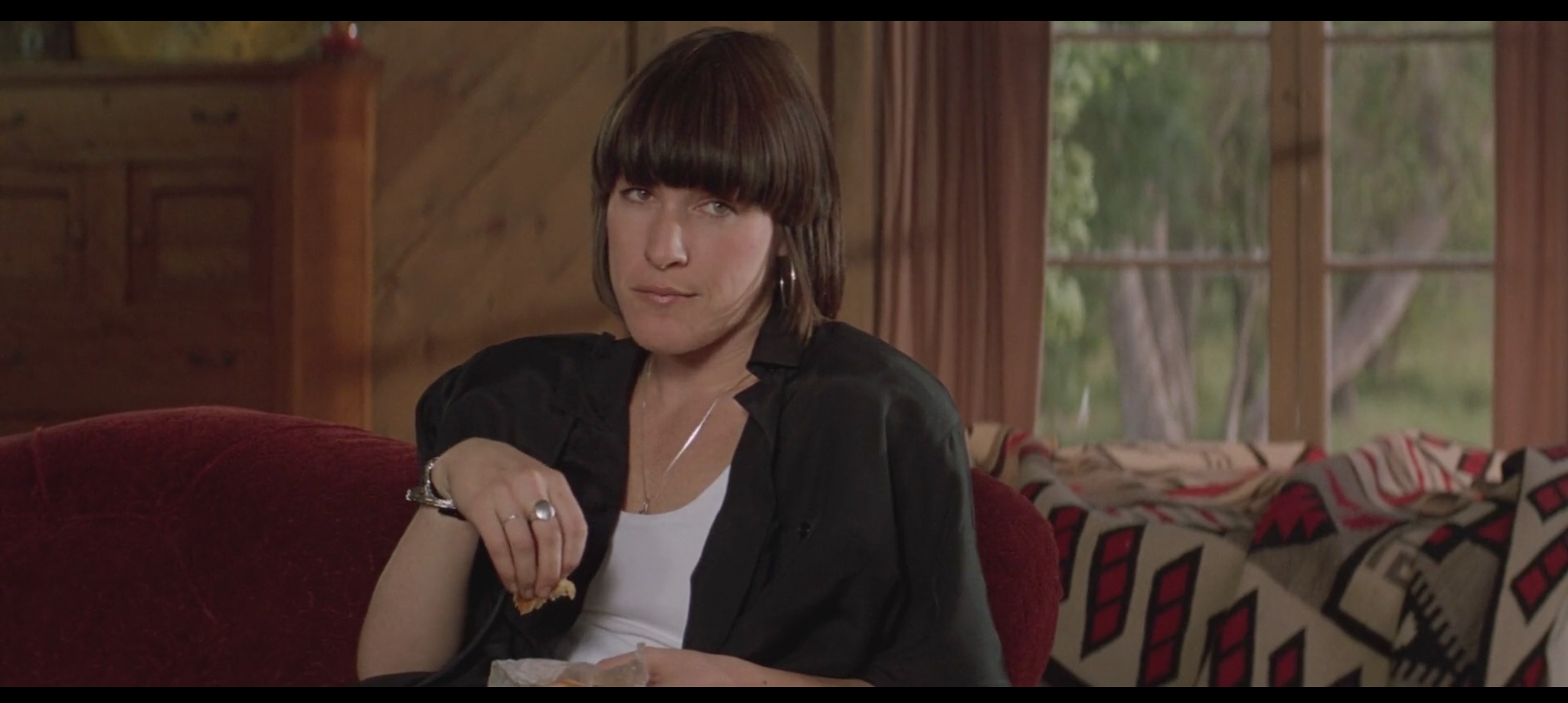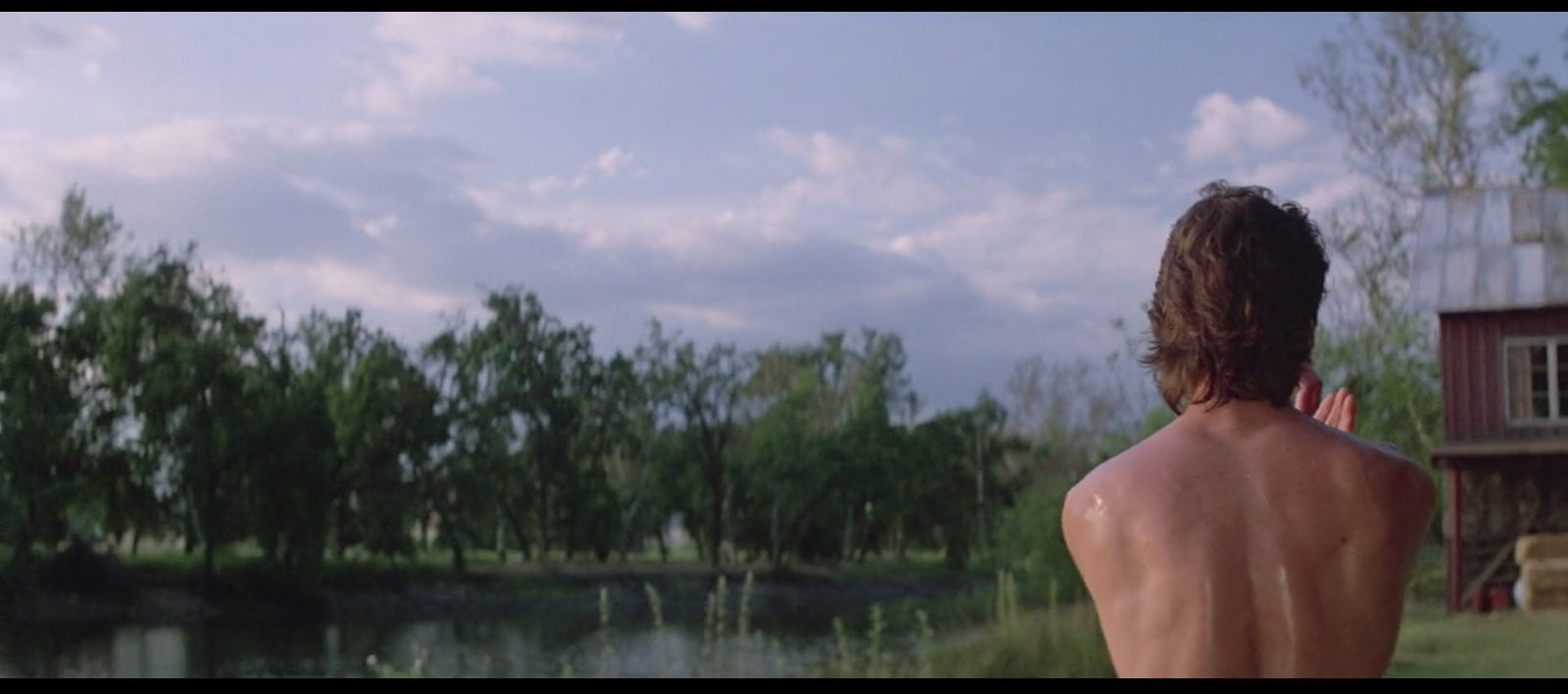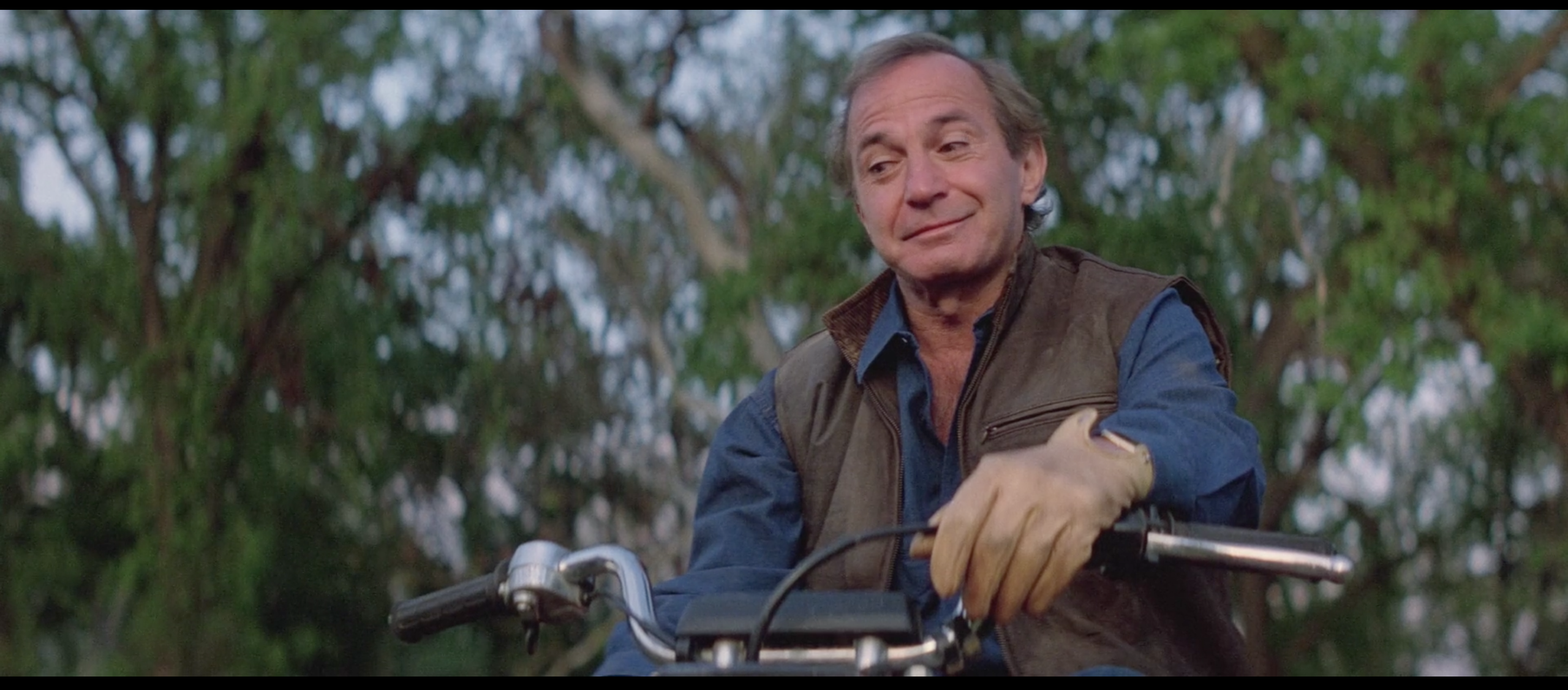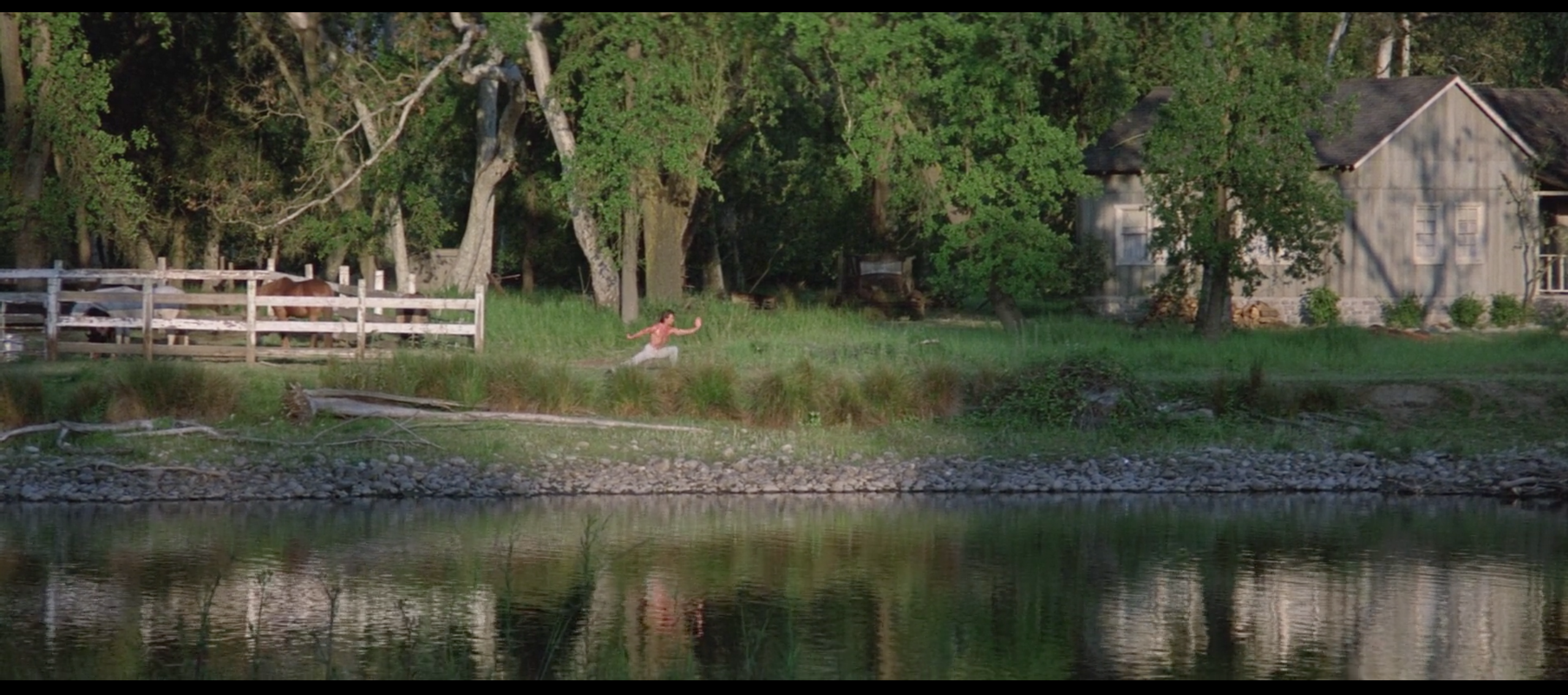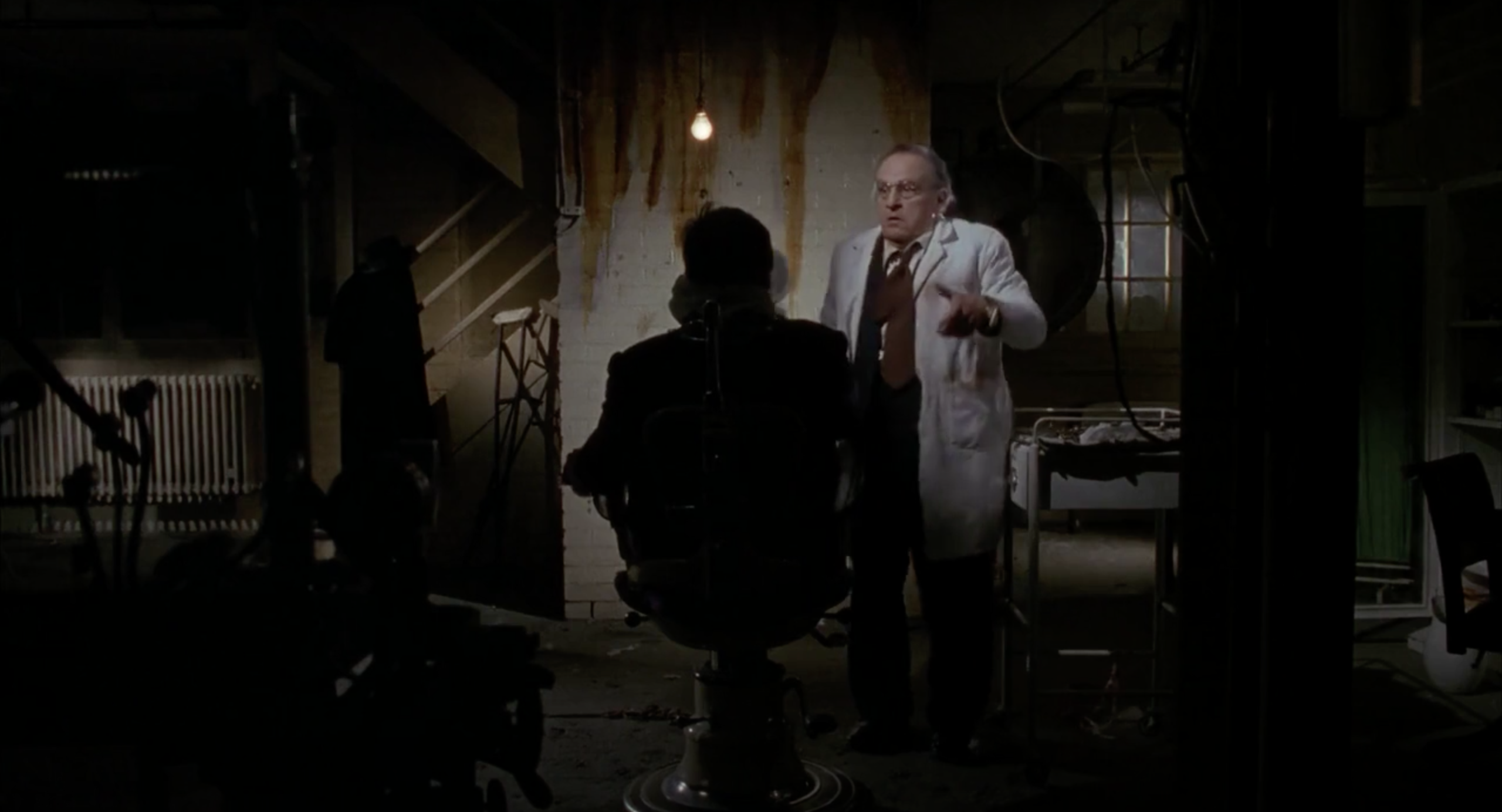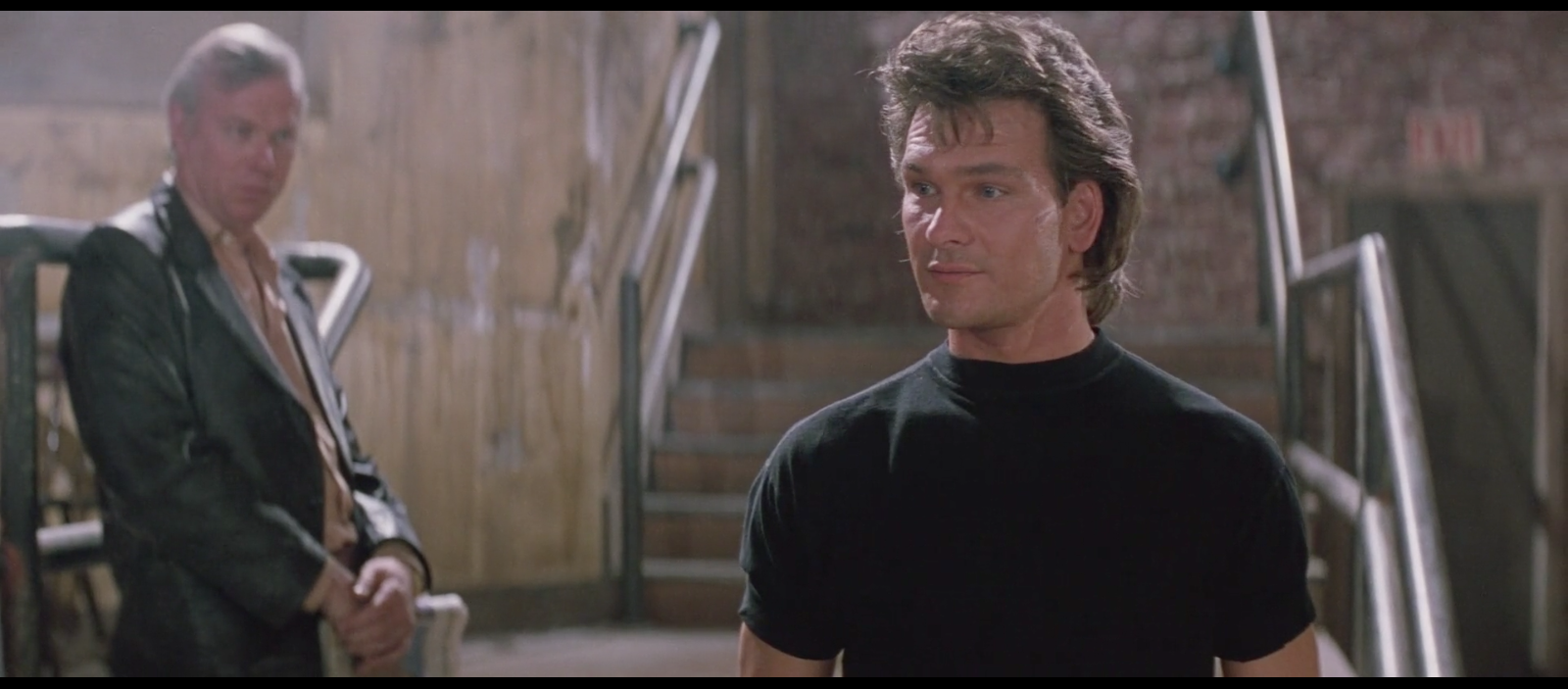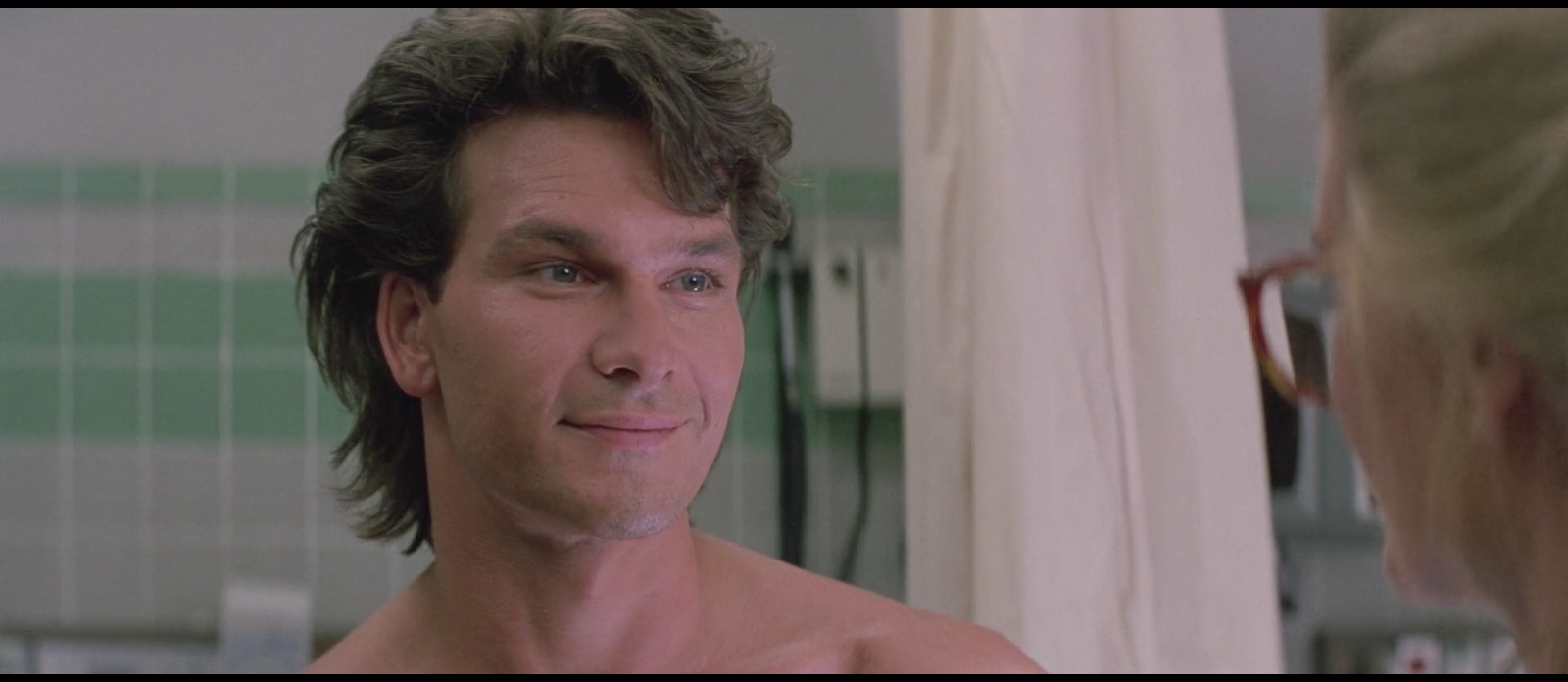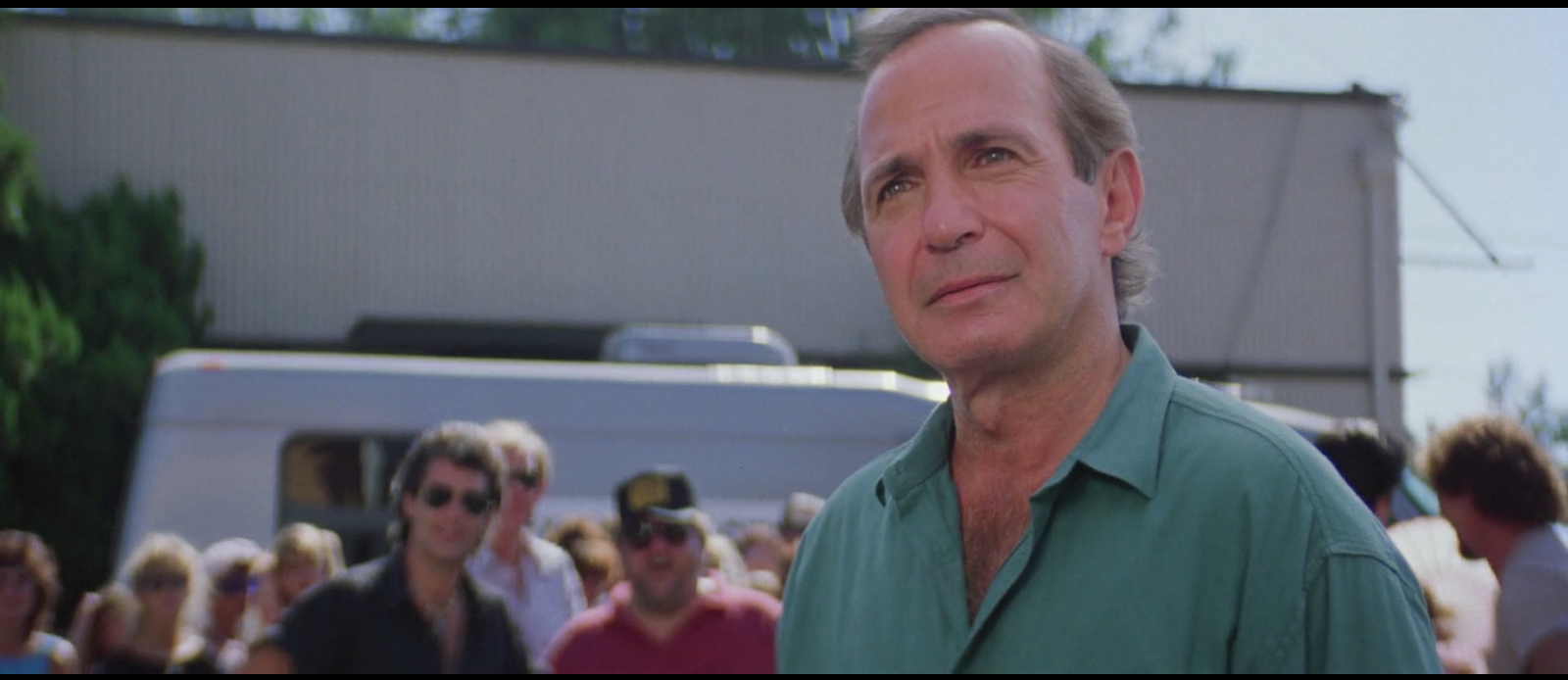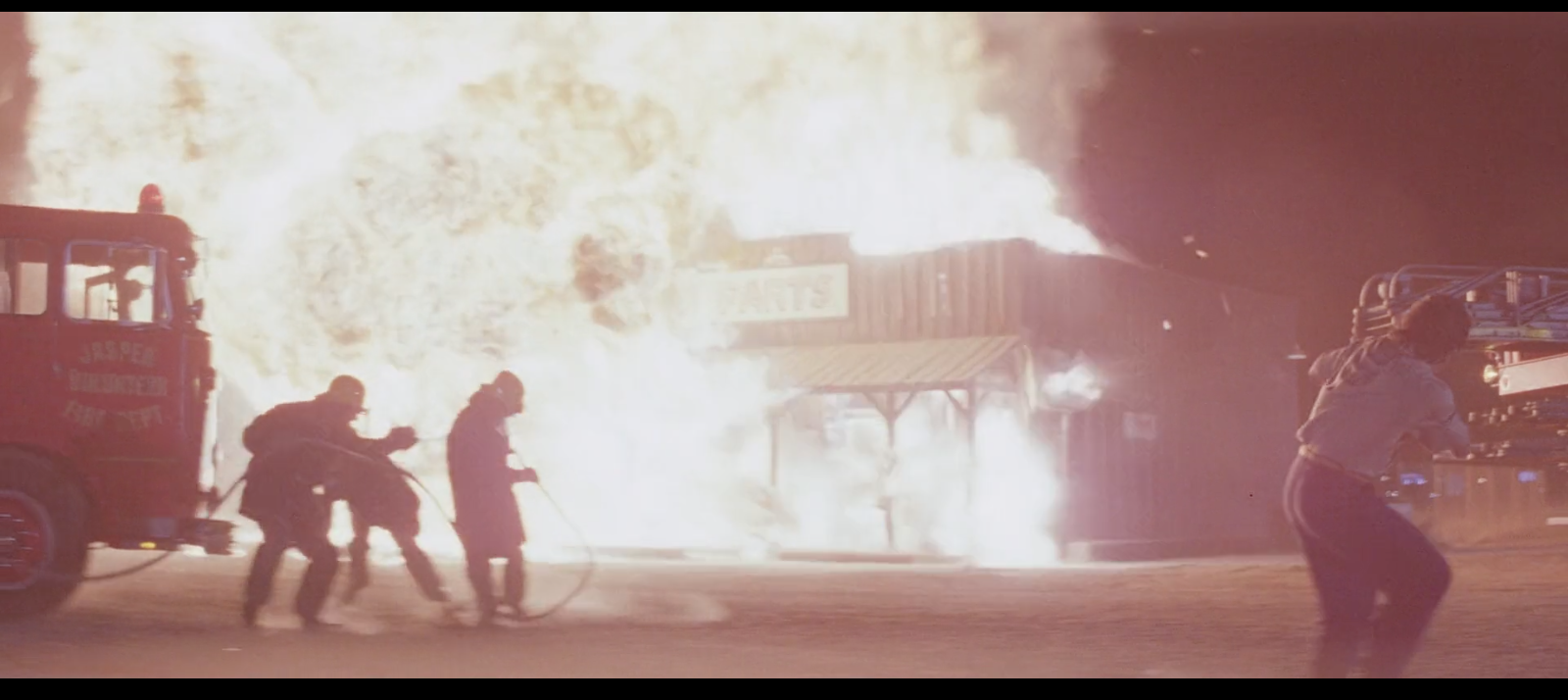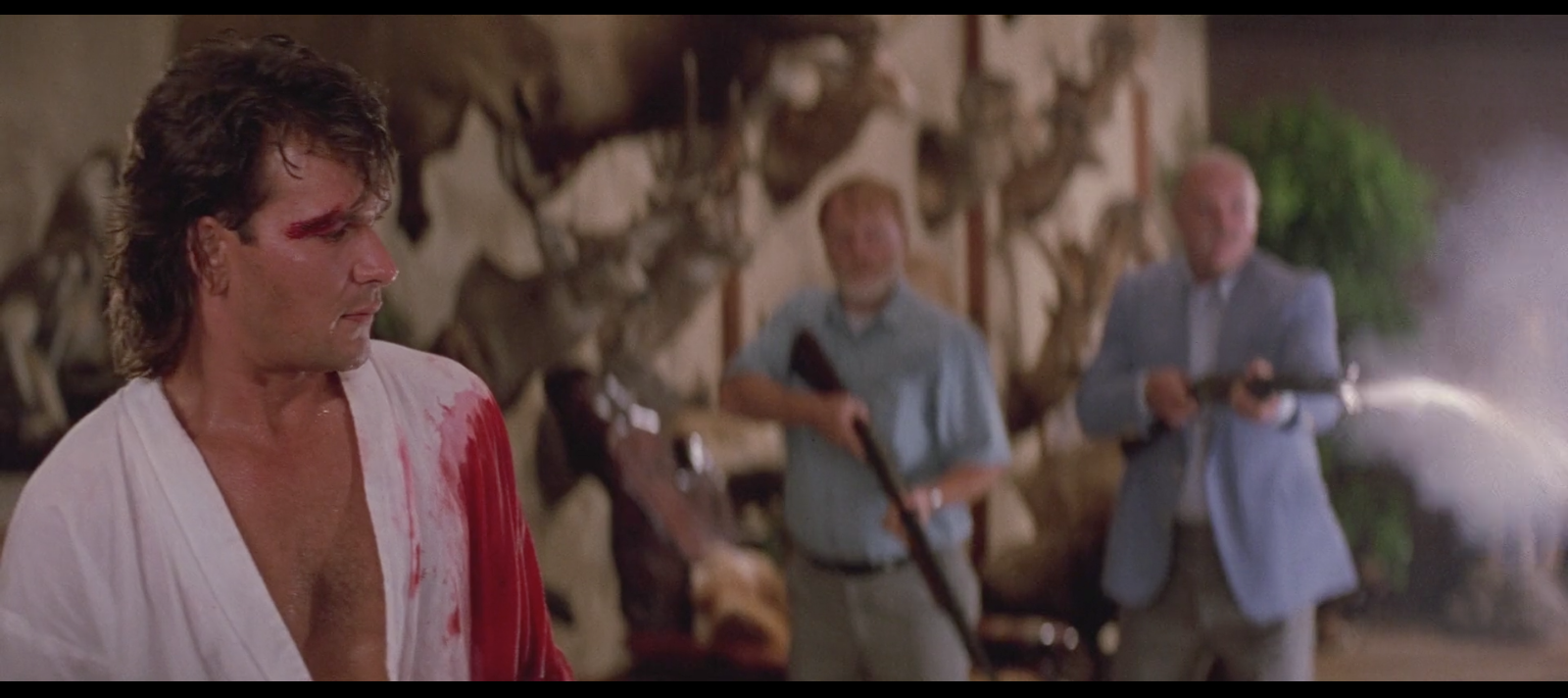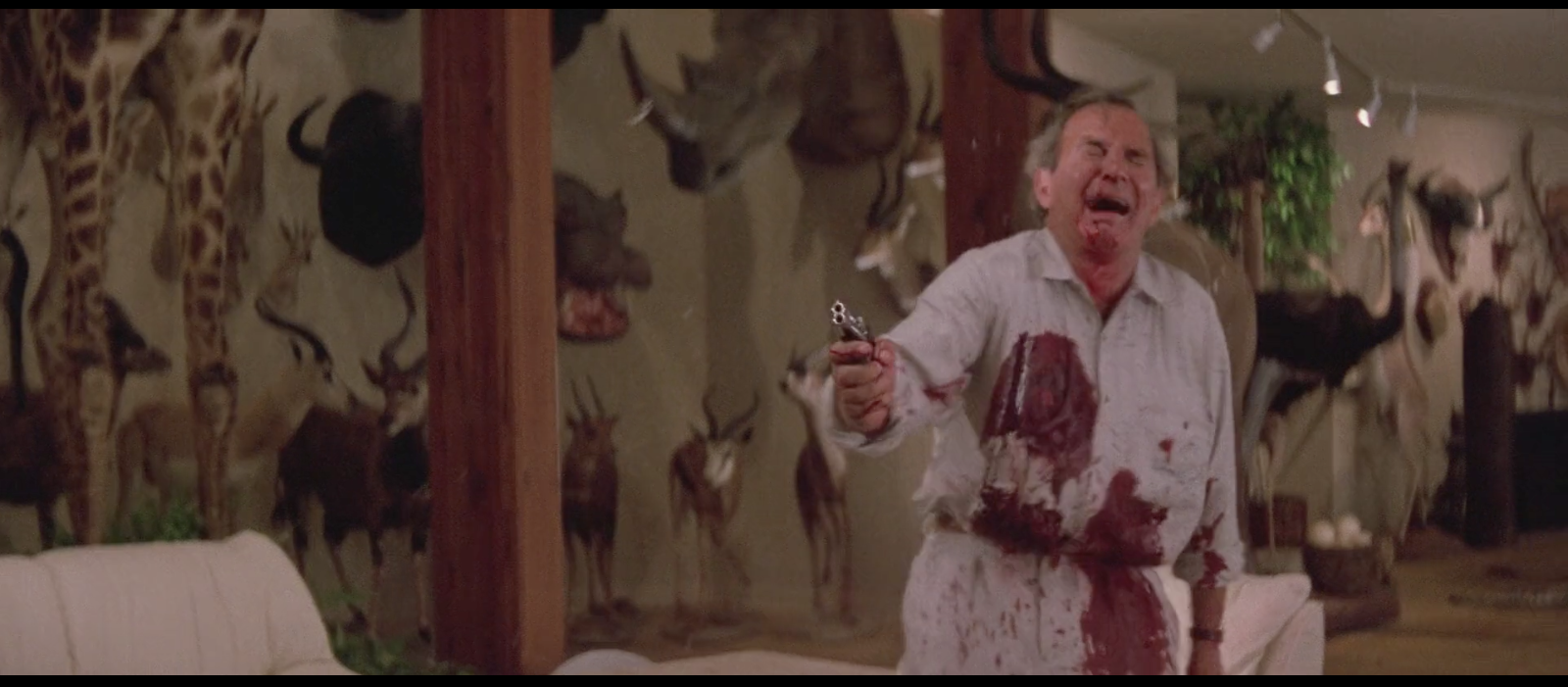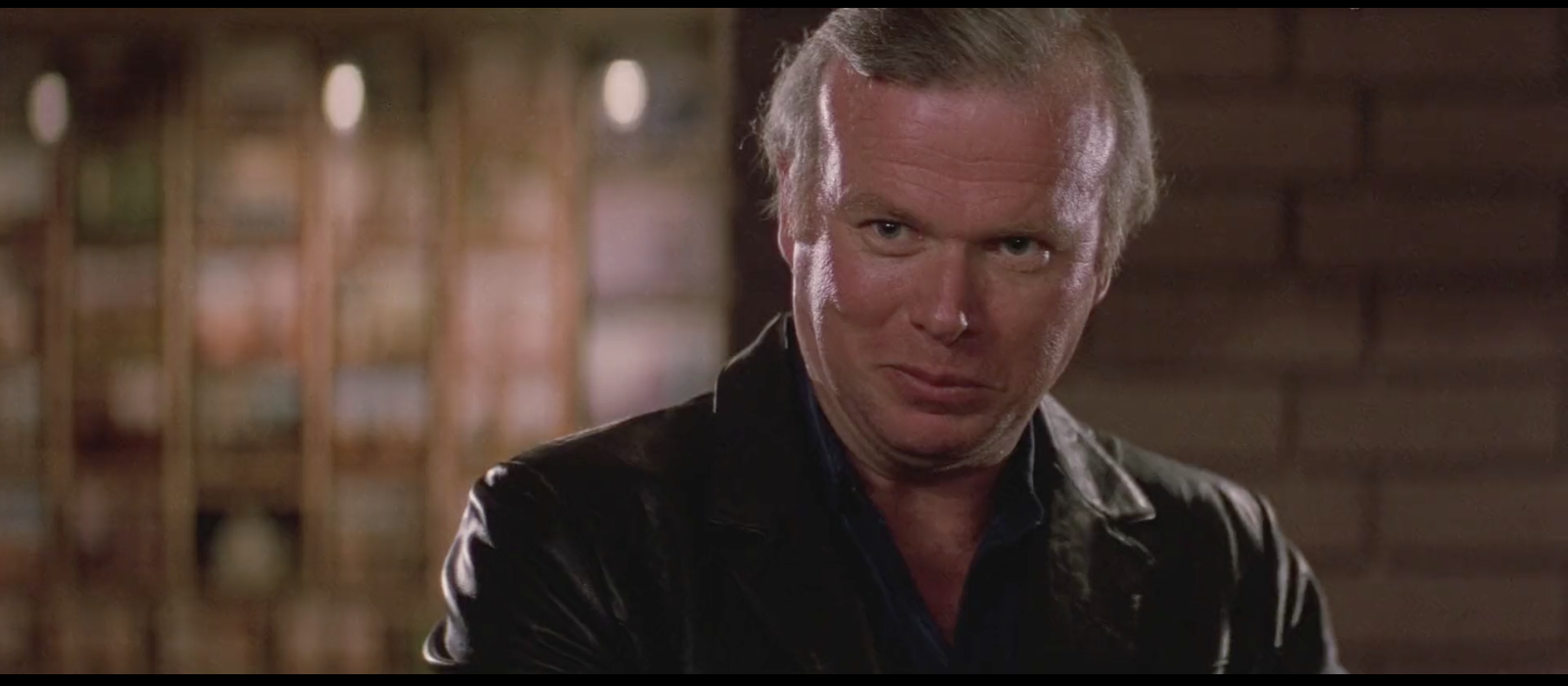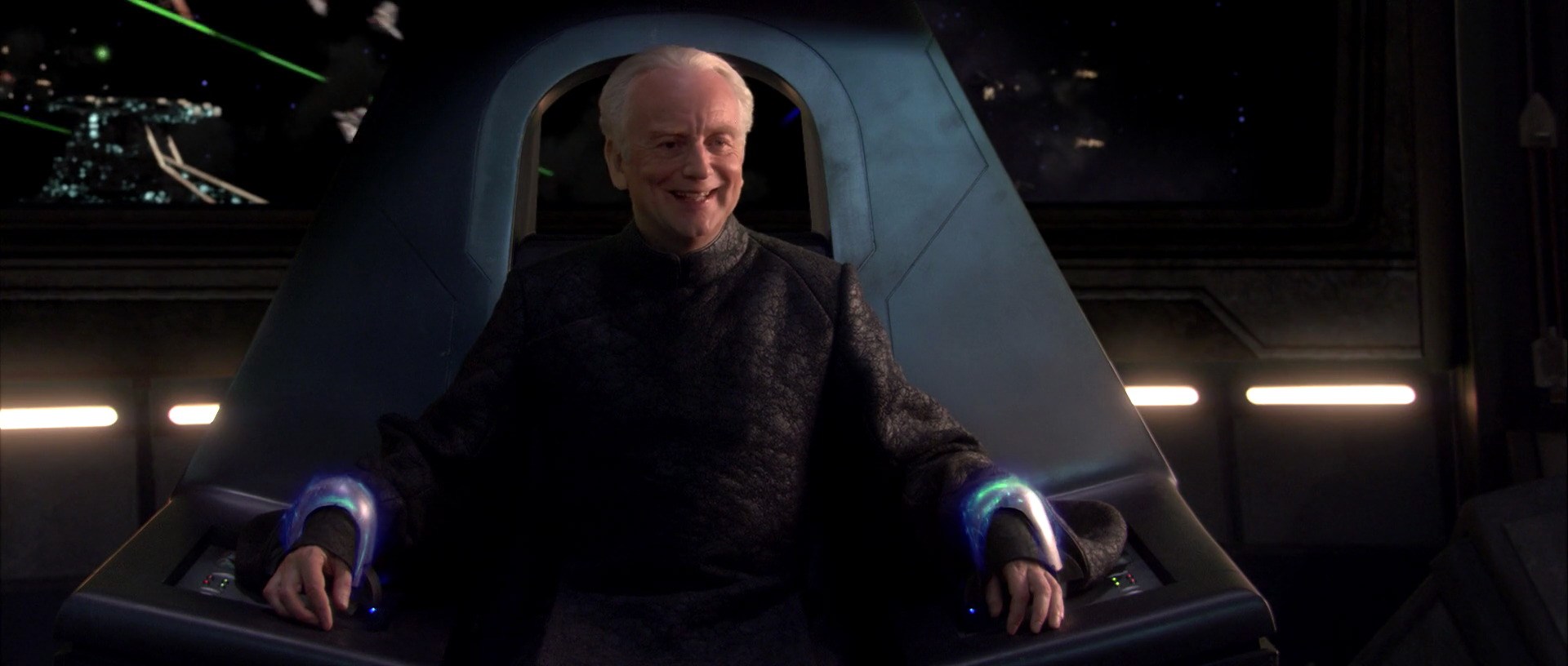
I wrote about 28 Weeks Later… in the context of Bird Box and A Quiet Place and survival-horror films with children at the center for the New York Times’ free Watching newsletter, which you can subscribe to here!
008. “$5,000 up front. $500 a night. Cash. You pay all medical expenses.”
According to 2017 research by the Bureau of Labor Statistics, the median pay for a security guard or gaming surveillance officer, the closest career to bouncer or cooler that the BLS tracks, was $26,900 a year. Assuming Sundays off and not counting the stipulated coverage of all medical expenses, a conservative estimate of the yearly salary paid to Dalton by Frank Tilghman for his services as a cooler at the Double Deuce comes to $328,259.17 in 2019 dollars.
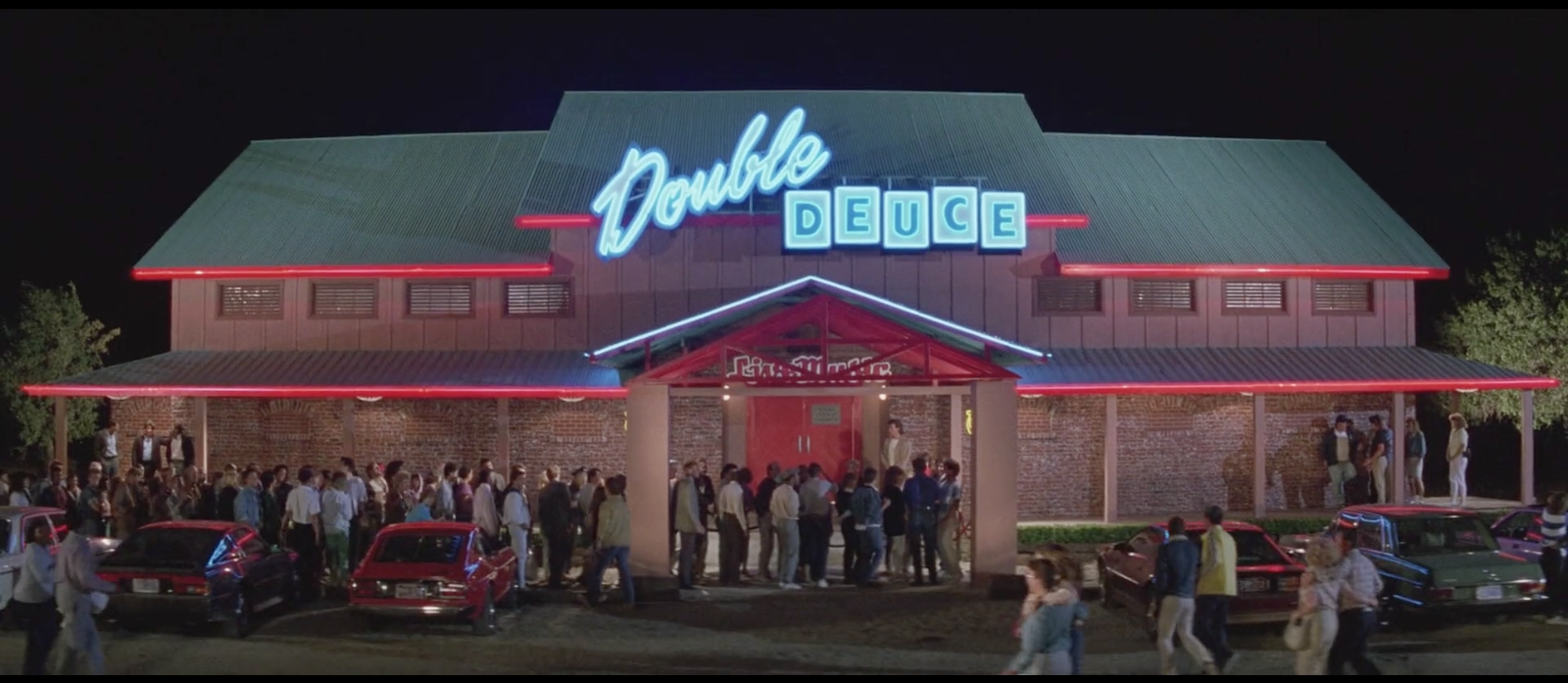
Tilghman prefaces his offer of employment to Dalton by saying “I’ve come into a little bit of money [and] I’d like to make a better life for myself.” Based on the elaborate redesign for the Double Deuce unveiled later in the film, he’s not kidding about the money. But the redesign, which we see him penciling on drafting paper the night Dalton shows up in Jasper, is meaningless if the volume of patrons required to make a bar that large and expensive a worthwhile investment doesn’t materialize. As Dalton himself puts it, “People who really wanna have a good time won’t come to a slaughterhouse.”
Dalton is the man who puts a stop to the slaughter. Though neither man knows it will happen when they make their deal, Dalton also breaks the back of the local organized-crime outfit, which according to Red Webster takes a minimum of “ten percent—to start” of gross income from every business in town. In fact, by personally murdering five of the town’s most violent criminals, beating a dozen or so others badly enough that they will never return, and driving one more to a Damascene conversion by dropping a stuffed polar bear onto him in a rich lunatic’s basement, Dalton eliminates the town’s bad element altogether.
Three-twenty-eight large is a bargain.
007. Goons
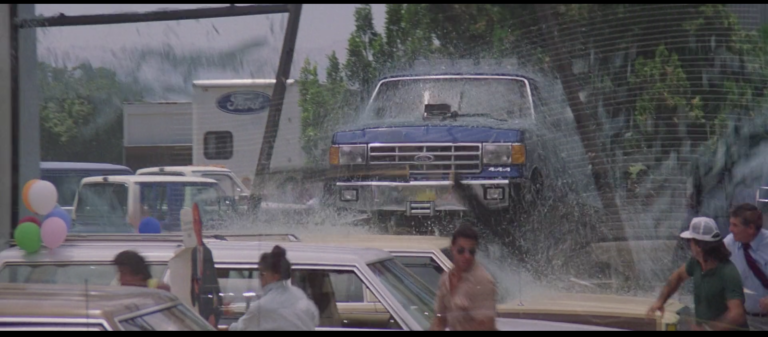
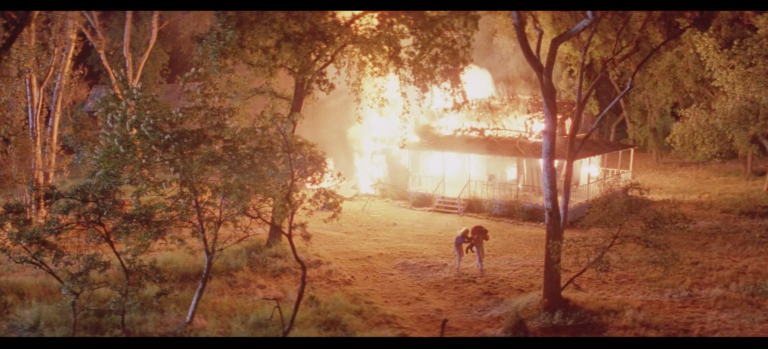
You can’t make a JC Penney without breaking some eggs. That’s where these fellows come in. Organized crime boss, mall developer, and job creator Brad Wesley employs a small army of goons, thugs, henchmen, minions, and muscle to do his dirty work around the town of Jasper, Missouri. Blowing up an auto parts store, blowing up an old man’s shack, and running over a car dealership with a monster truck are just the most glamorous aspects of the gig: These guys’ main function is to punch people in the face, and get punched in the face in turn. The following is a brief survey of the Wesleyans with speaking parts. You’ll be seeing more of these gentlemen for sure, but this should bring you up to speed.
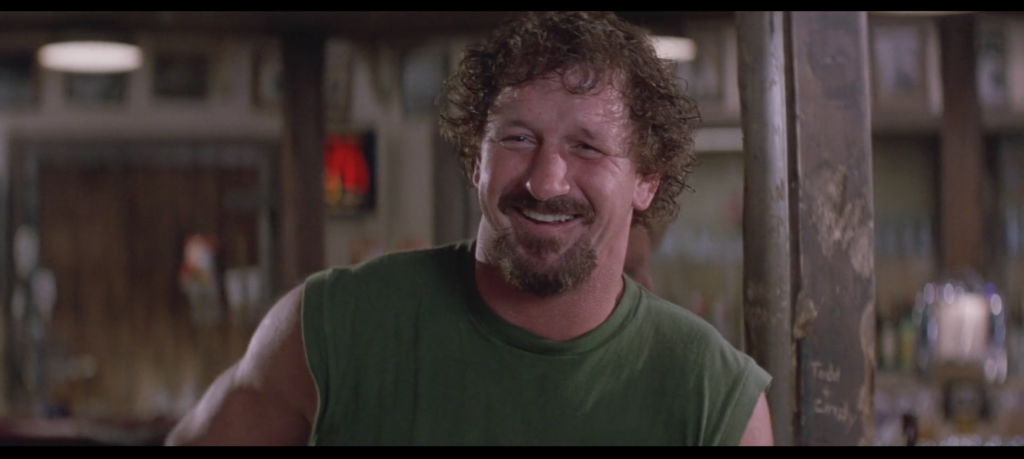
Morgan
Ornery brute. Originally a bouncer at the Double Deuce. Fired by Dalton because he doesn’t have “the right temperament for the trade.” Doesn’t take it well. Played by pro wrestling legend Terry Funk. Strengths: Looks and acts like a guy who could kick someone’s ass. (Not for nothing did he prompt the “It’s still real to me, dammit!” incident.) Weaknesses: Syllable emphasis.
Pat McGurn
Vicious weasel. Nephew of Brad Wesley. Originally a bartender at the Double Deuce. Fired by Dalton for skimming from the till, sparking the Wesley/Dalton feud. Played by punk legend John Doe. Strengths: Convincingly sleazy mustache. Weaknesses: Uncle’s Boy.
Jimmy
The main man. Wesley’s favorite. Rarely far from his boss’s side. Martial-arts master who fights both Dalton and Wade Garrett to near-standstills. Gets the film’s most famous non-Swayze line: “I used to fuck guys like you in prison!” Played by Marshall Teague. Strengths: Smoldering eyes, witty banter, maniacal laugh, actual fighting skill. Weaknesses: Sore throat.
O’Connor
Middle management. Basso profundo beanpole who leads the expedition to restore Pat to full employment at the Double Deuce, among other crucial tasks requiring minimal competence. Played by Juilliard graduate Michael Rider. Strengths: Business casual wardrobe. Weaknesses: He’s a bleeder.
Tinker
Lummox. Portly core component of the Wesley team. Frequent partner of O’Connor. Partial to trucker hats and suspenders. Played by John Young. Strengths: Comes closer to actually killing Dalton than almost anyone else, inflicting the knife wound that leads to Dalton meeting Dr. Elizabeth Clay; perhaps for this reason he is the only member of the Wesley Organization to find forgiveness and redemption. Weaknesses: Polar bears.
Mountain
The tallest. Towering doofus who serves primarily to dance amusingly during Wesley’s pool party and engage in brief but memorable dick-based repartee with Sam Elliott. Played by Check It Out! with Dr. Steve Brule fry cook Tiny Ron. Strengths: Hell of a dancer, very tall. Weaknesses: “Give me the biggest guy in the world: You smash his knee, he’ll drop like a stone.”
Ketchum
Serious business. Wesley’s most all-American thug. Trusted with the most hardcore tasks. Almost entirely forgettable despite performing several of the film’s greatest acts of villainy unless you’ve seen the movie enough to write about it every day for a year. Played by stuntman Anthony De Longis. Strengths: boot-mounted knife, regular knife, monster truck. Weaknesses: …wait, who are we talking about again?
Karpis
Man of mystery. Piercingly handsome guy in a smart-looking suit worn with rakish dishevelment. Present in background when Wesley’s chopper lands during the character’s introudction. Present in background when Wesley throws a pool party. Wordlessly witnesses Wesley’s punishment of O’Connor for failing to secure Pat’s job. Tosses Red Webster’s store to keep him in line and says “Life is good” as his one line. Vanishes completely from the film after these four scenes. Lives forever in my heart. Played by Joe Unger, aka Sgt. Garcia from A Nightmare on Elm Street. Strengths: Looks like he plays rhythm guitar for Dr. Feelgood or the Strokes circa the $2 Bill show, dangerously sexy. Weaknesses: Barely in the movie, named “Karpis.”
006. Church
Emmet: It ain’t the money, you understand, but if I don’t charge you somethin’ the Presbyterians around here are likely to pray for my ruination. How does $100 a month strike you?
Dalton: Fine.
Emmet: You can afford that much?
Dalton: If it keeps you in the good graces of the Church.
Emmet: Ain’t it peculiar how money seems to do that very thing.
—Road House
David Brent: [singing] “Who is wrong and who is right? Yellow, brown, black or white?” The spaceman, he answered, “You no longer mind. I’ve opened your eyes—you’re now colorblind.” Racial. So,
—The Office
Aside from having His Name taken in vain, God doesn’t figure much into Road House. That’s worth paying attention to. In the roughly contemporaneous Rocky franchise Rocky wears a crucifix and often prays prior to a big fight, which particularly during his showdown with Soviet behemoth Ivan Drago takes on added political weight. Rambo is crucified in First Blood Part II. Yet despite a down-home setting conducive to that old time religion, the closest Dalton gets to spirituality by contrast is doing tai chi outside with his shirt off and referring to his study of philosophy at NYU as “man’s search for faith.” Though he and Dr. Elizabeth Clay do indeed meet when he goes to the hospital with one of the wounds of Christ—a stab in his side—it’s on the left side rather than the right, and rather than probe it, like Thomas, she seals it, like a doctor. No one’s making room for the Holy Spirit here, so to speak.
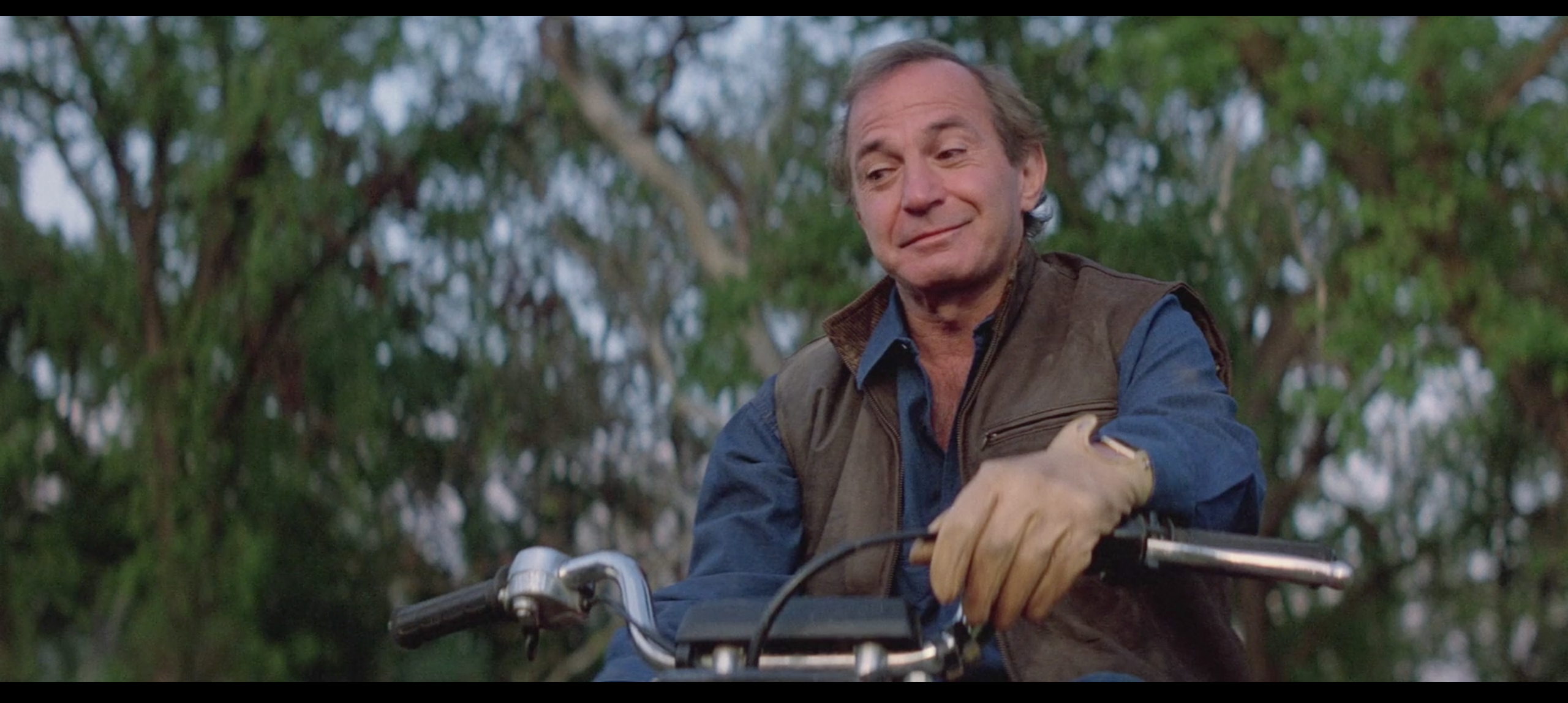
Played by “Sunshine” Parker, who was just 61 at the time of filming but looks like something hobbits might meet in an ancient forest, Emmet rents Dalton an outrageously huge and beautiful loft apartment open to nature with a view of the nearby water for one-fifth of what Dalton earns as a cooler every single night. He likes his horses and he likes company, and there you have it. Those are his wants and needs, and a few extra hundred dollars a month are superfluous. Why charge rent when it’s no skin off your ass not to? Why participate in a system that offers you nothing but things you don’t really need?
That this appears to be his attitude toward organized religion—and the film’s, since Emmet and Dalton are consistently portrayed as operating with unerring moral compasses, at least until Dalton commits the sin of despair at film’s end and pays for it dearly—is delightful to me. Sure, it seems thrown in there like it’s a David Brent–style attempt to open people’s eyes, as if anyone’s counting on Road House for enlightenment. But it works. There’s no Jesus, no Bible, not even any talk of praying to the Good Lord in his own way. There’s just a funny old codger summing up Christianity as a chauvinist capitalist scam. Brad Wesley with hymns, pretty much. When you’ve got the man himself to make your life miserable while singing “Sh-Boom,” who needs the hassle of godbotherers?
005. “You’re gonna be my regular Saturday night thing, baby!”
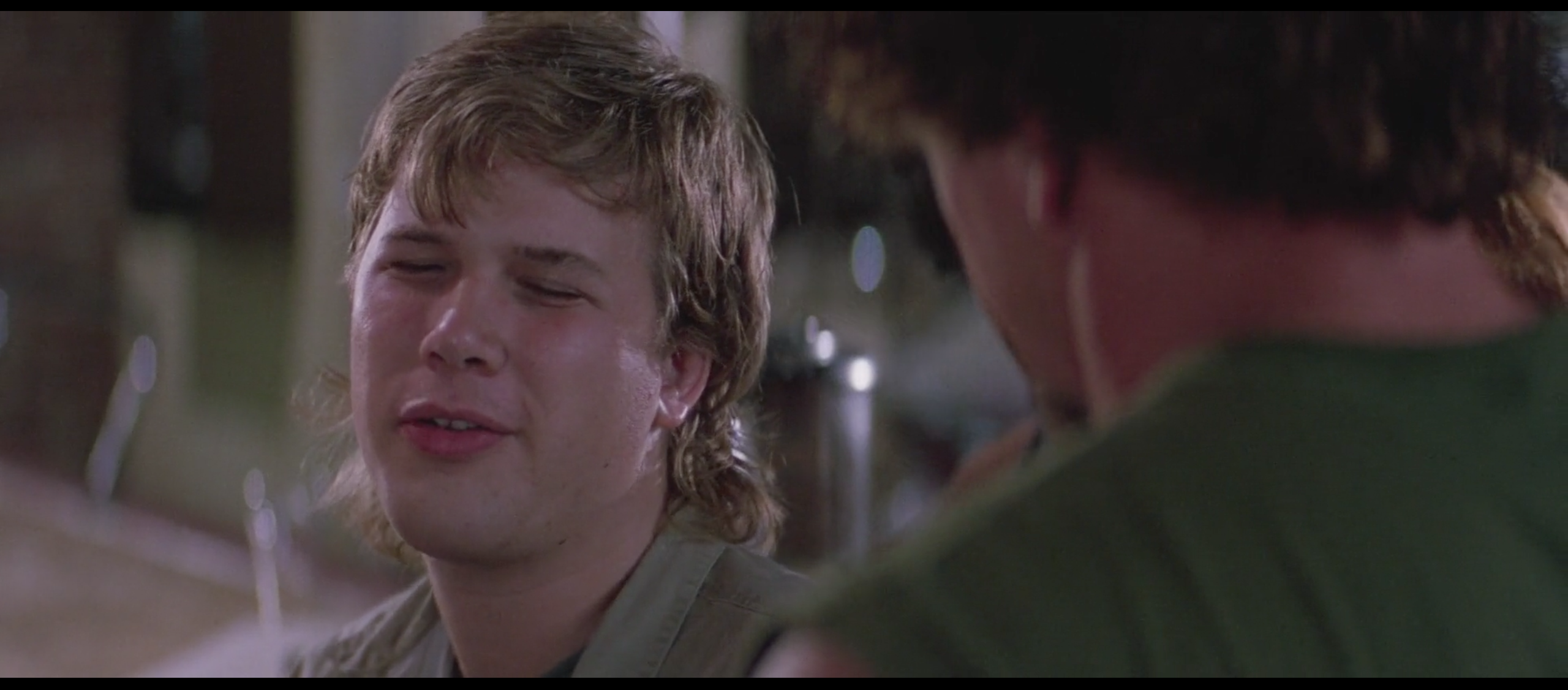
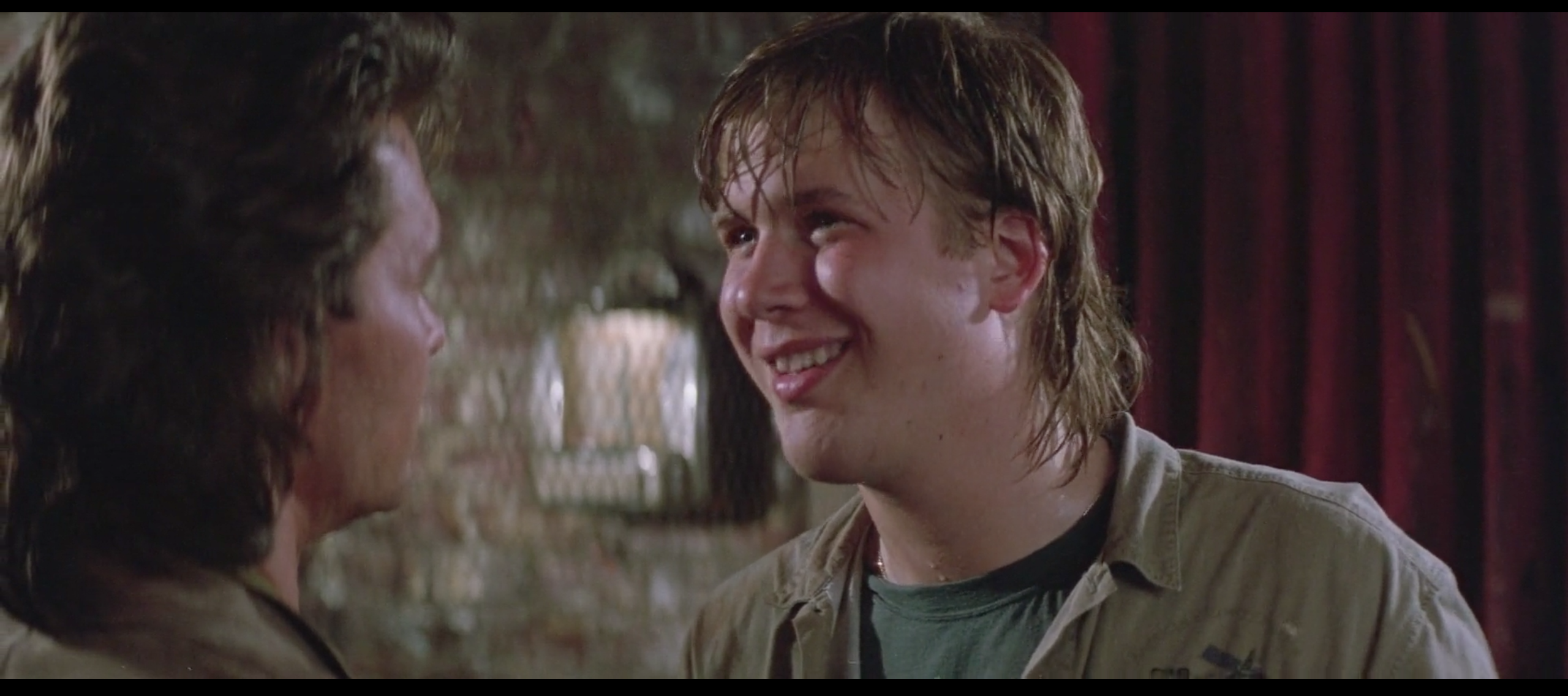
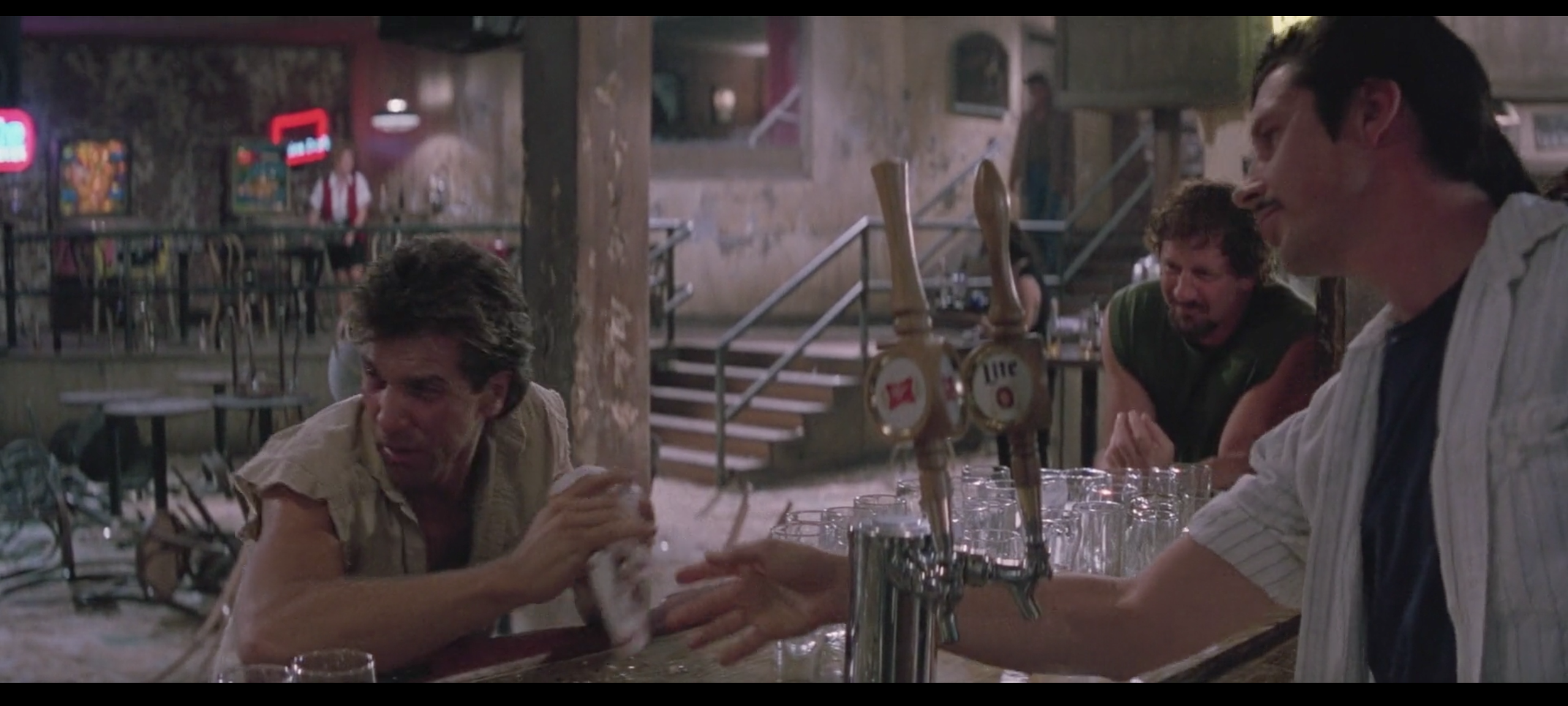
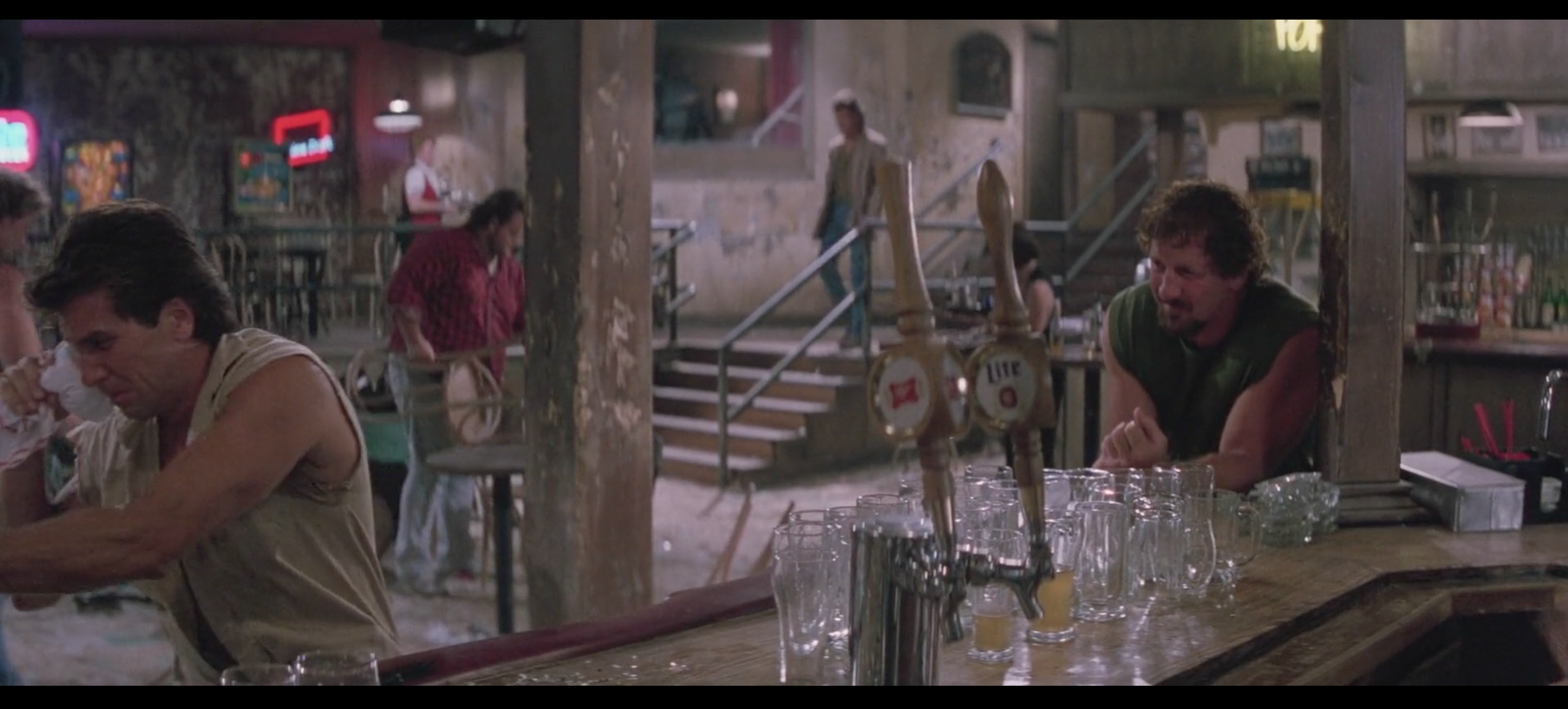
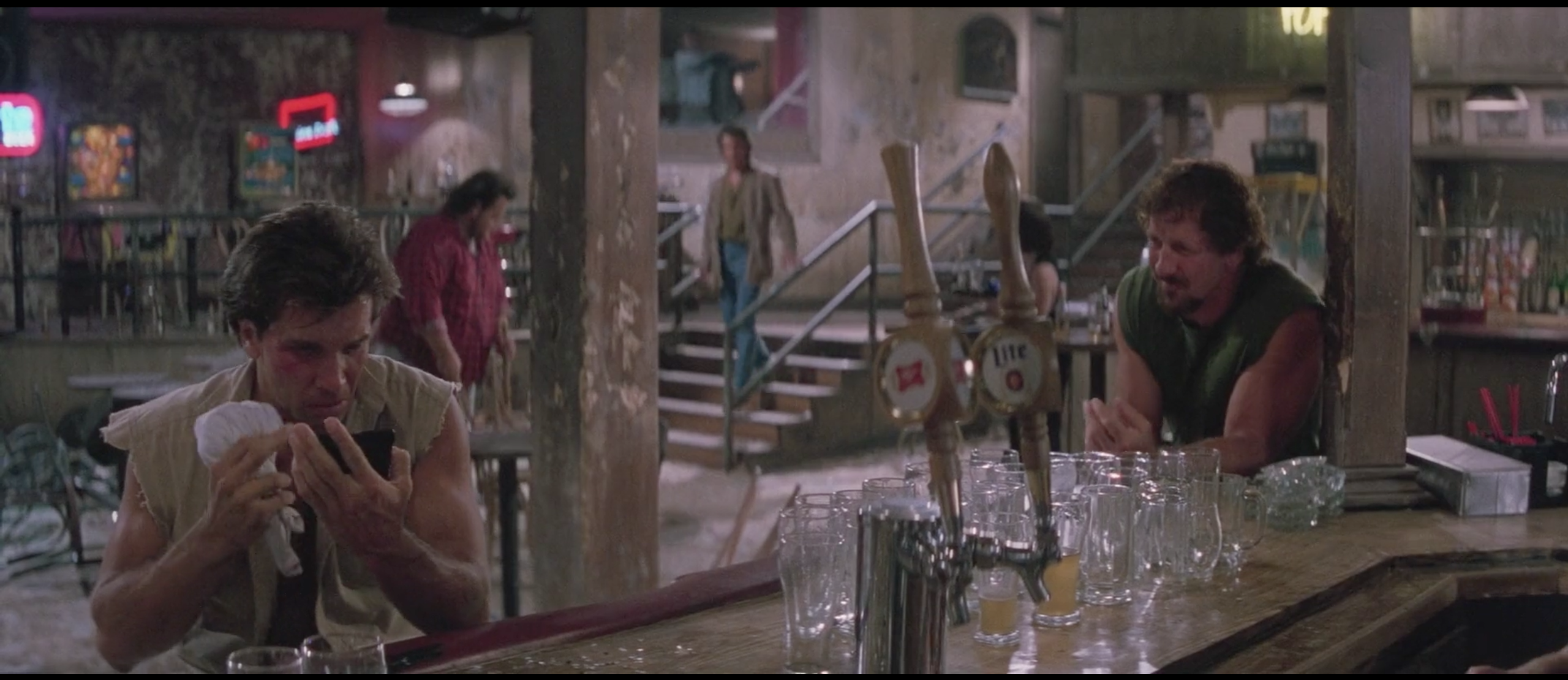
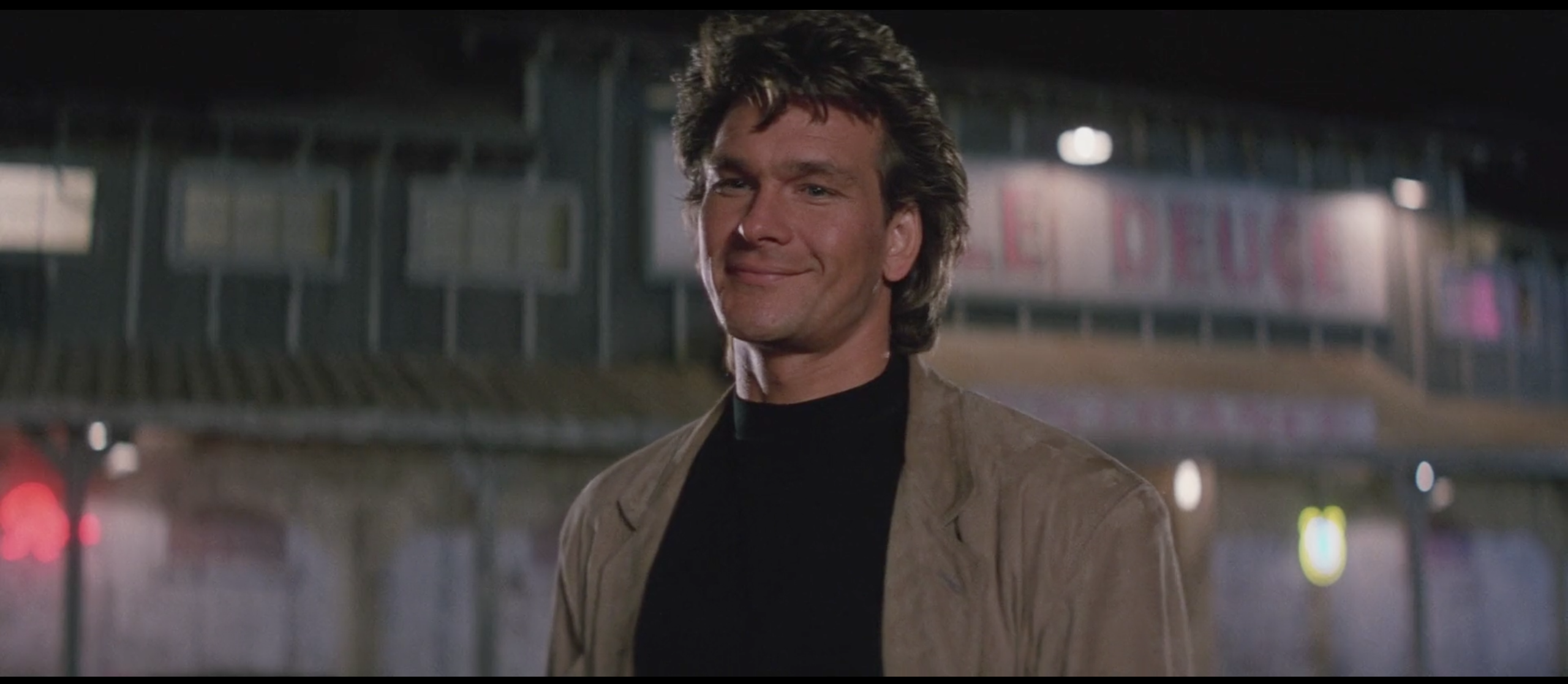
This is Steve. (The one on the left.) Steve is a bit of an anomaly in the world of Road House, a bit of an enigma. He’s one of four people abruptly fired from the Double Deuce by Dalton when he assumes control of “all bar business” (per Tilghman) as the joint’s cooler. Morgan, a cantankerous thug played by hardcore wrestling legend Terry Funk, is fired for not having “the right temperament for the trade,” the wisdom of which he demonstrates by later attempting to murder Dalton on behalf of Brad Wesley. Pat, the weaselly bartender played by L.A. punk legend John Doe, is fired for skimming from the till. He too attempts to murder Dalton on behalf of Brad Wesley (his uncle), multiple times, indicating that Dalton has made another correct judgment call. Judy, a wiry waitress played by Sheila Caan (ex-wife of James Caan and ex-girlfriend of Elvis Presley), is fired for dealing drugs in the bathroom. She does not attempt to murder Dalton on behalf of Brad Wesley or anybody else for the rest of the film, indeed she doesn’t appear in the rest of the film at all, indicating that perhaps a reformist approach may have borne more fruit in her case.
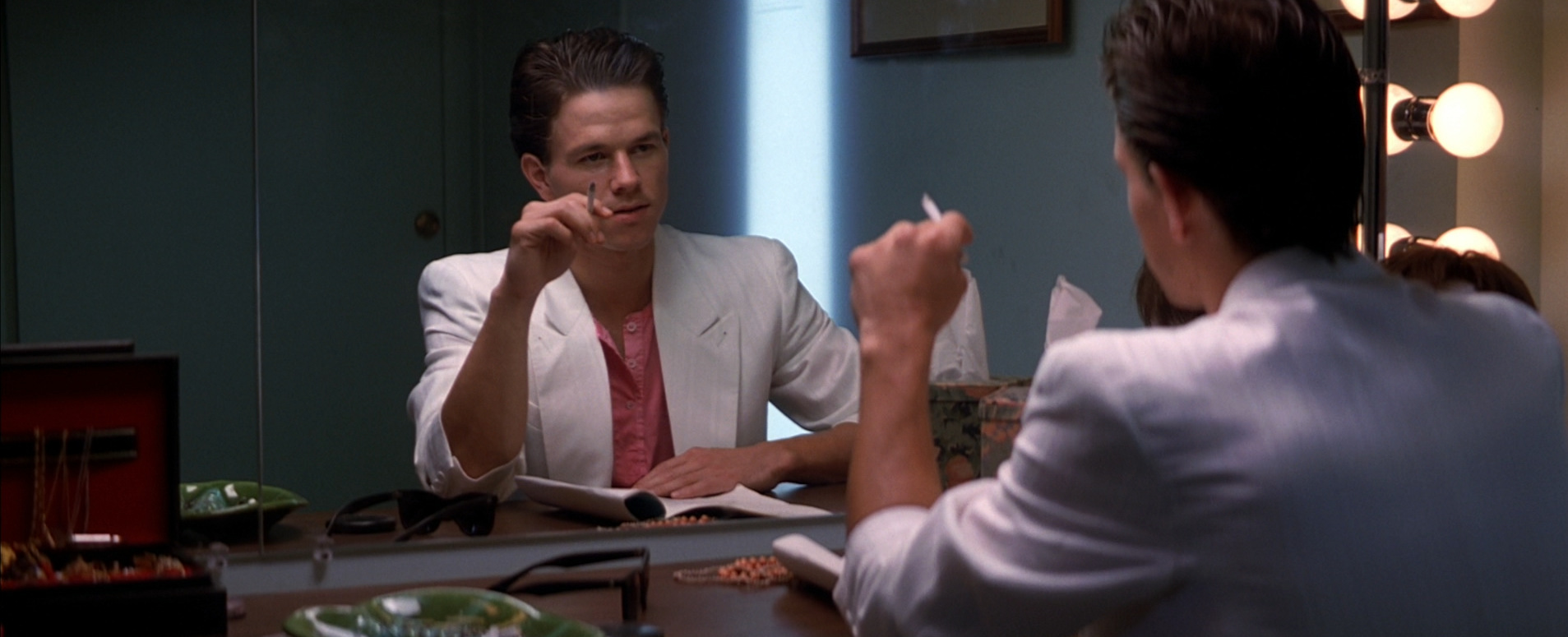
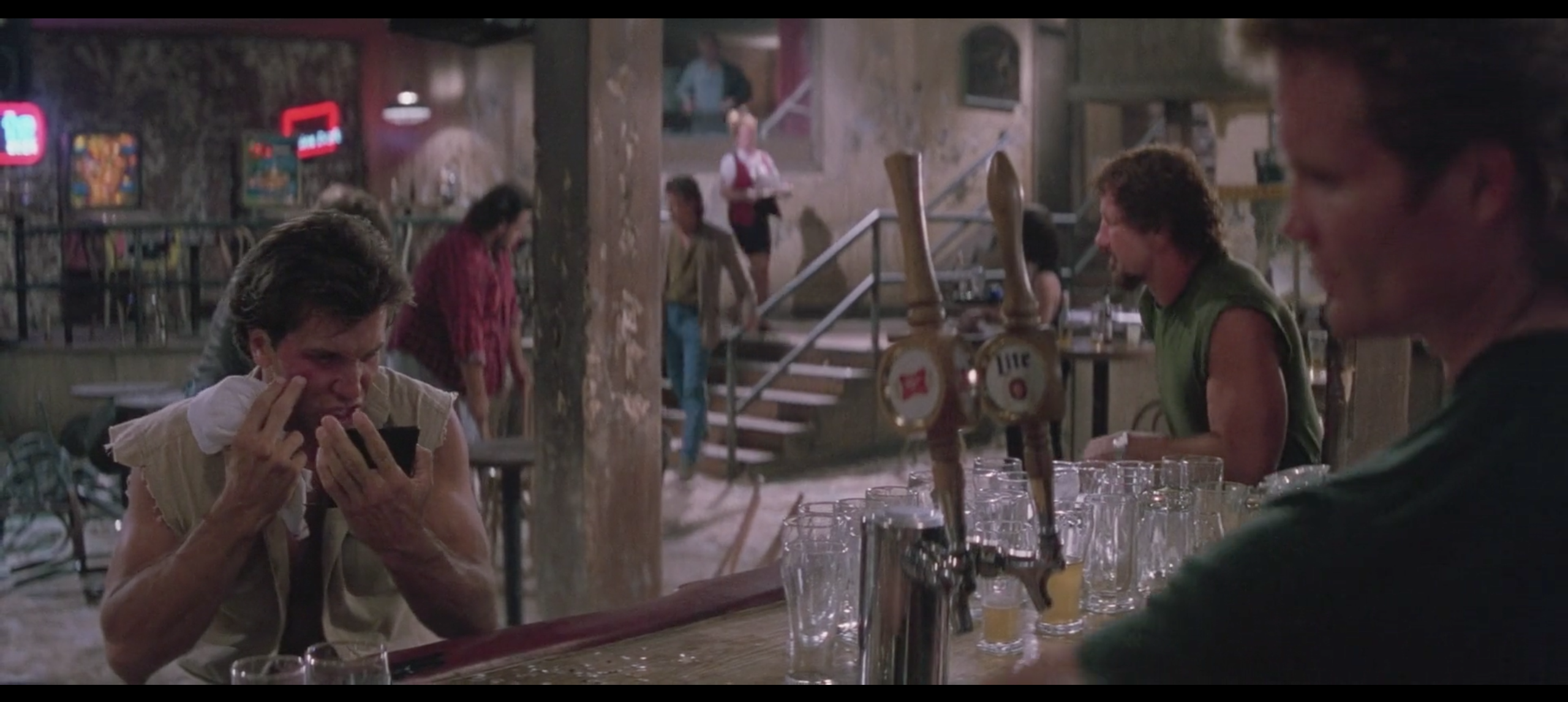
Despite being a heck of a physical specimen, Steve is not a pro or even semi-pro ass-kicker like his coworkers Morgan and Pat; the one fistfight in which he participates ends with him groaning into a mirror about the shiner temporarily disfiguring his beautiful face. He’s not a drug dealer or a legbreaker or involved in any organized-crime capacity at all. Steve’s not a fighter, he’s a lover. The problem is he that loves young women who are visibly below drinking age, which may in fact be putting it generously.
We first meet Steve (Gary Hudson, a hunk) when he blows off the idea that he should break up a rolling-on-the-floor fight between two aggrieved pool players (“fuck ’em, they’re brothers”) in favor of telling a bosomy patron, whose fake ID is probably Mclovin-level, that he gets off at 2am, and (should she play her cards right) she could get off shortly thereafter. Later that night he incurs the shiner, presumably ruining his plans. In our next encounter he’s antagonistic toward Dalton during the meeting in which he fires Morgan and Judy and lays out the rules everyone will be expected to follow going forward.
Then comes Saturday night. When Beverly and Agnes, two women in, let’s say, his target demographic, get stopped at the door for presenting a Sears credit card as ID, Steve swoops in to wave them through. Why? Because he’s been thinking about Agnes, and tonight is a very special night: the night he’ll roger her in the supply room beneath a St. Patrick’s Day banner during his break. (Steve invented the “I was on a break” excuse, which he uses to no avail as he slides his high-cut blindingly white briefs back up and protests his firing. Eat shit, Ross Geller.) Stripped naked as a jaybird and rhythmically fucking her from behind standing up (everyone does their best work on two feet in this film), he pays her the ultimate compliment: “You’re gonna be my regular Saturday night thing, baby!” Then Dalton walks in, looks on in bemusement for longer than is perhaps necessary, then breaks up the party and sends Steve packing. (Dawn Ciccone, the actor who plays Agnes, has a “whoopsie daisy!” look on her face afterwards that’s one of the most endearing things in the whole movie.)
Road House is like Shakespeare in many respects, but foremost among them is its propensity to coin phrases. Most of these—getting “nipple to nipple” as a euphemism for sex, “balls big enough to come in a dumptruck” as an elaboration of “balls of steel,” replacing “does a bear shit in the woods?” with “does a hobbyhorse have a wooden dick?”—are wonderful, vulgar, stupid, and all but impossible to imagine anyone saying in the real world.
But “my regular Saturday night thing” is different. It’s an effective encapsulation of an entire type of relationship: people who like having sex with each other enough to do so regularly, but who are otherwise indifferent enough to each other to keep it on a relatively light schedule, with no real desire to treat it as much more than a thing they do on Saturday nights. Other people might have stayed home to watch the NBC comedy lineup (227, Amen, Golden Girls, Empty Nest, good stuff, I was a religious viewer). Still others might well have come to the Double Deuce, but to dance on tables, or to stab the people who try to get those people to stop dancing on tables, which is the other thing that happens on this fateful night.
But Steve’s desire to be a part of Agnes’s life that begins when they enter the stockroom and ends, I’m guessing, about three minutes later is heartfelt and modest and mercenarily horny enough to resonate beyond the walls of the Double Deuce. It’s the reason Loverboy was working for the weekend. It’s why the Bay City Rollers chanted “ESS AY TEE-YOU-ARE DEE-AY-WHY…NIGHT,” even if their teenybopper audience didn’t realize it. Readers of this series almost certainly have never thought of their sexual partners in terms of getting “nipple to nipple,” but I’d wager more than a few of you have had, or have been, a regular Saturday night thing. If so, I hope your cooler called out sick.
004. Doc
Fantastic fiction often asserts that forces awesome, alien, or profound enough to overwhelm our senses will be processed by our puny brains in ways we’re capable of processing instead. The erratic movements and sudden disappearances of UFOs are how we see extradimensional travel. Vast unspeakable intelligences present themselves to us as dragon-winged squid-gods. Fire and life incarnate themselves in a flaming bird shape and a costume color-scheme change.
But can it work in the other direction? When faced with the inexplicable, can our minds process it into something more human, not less?
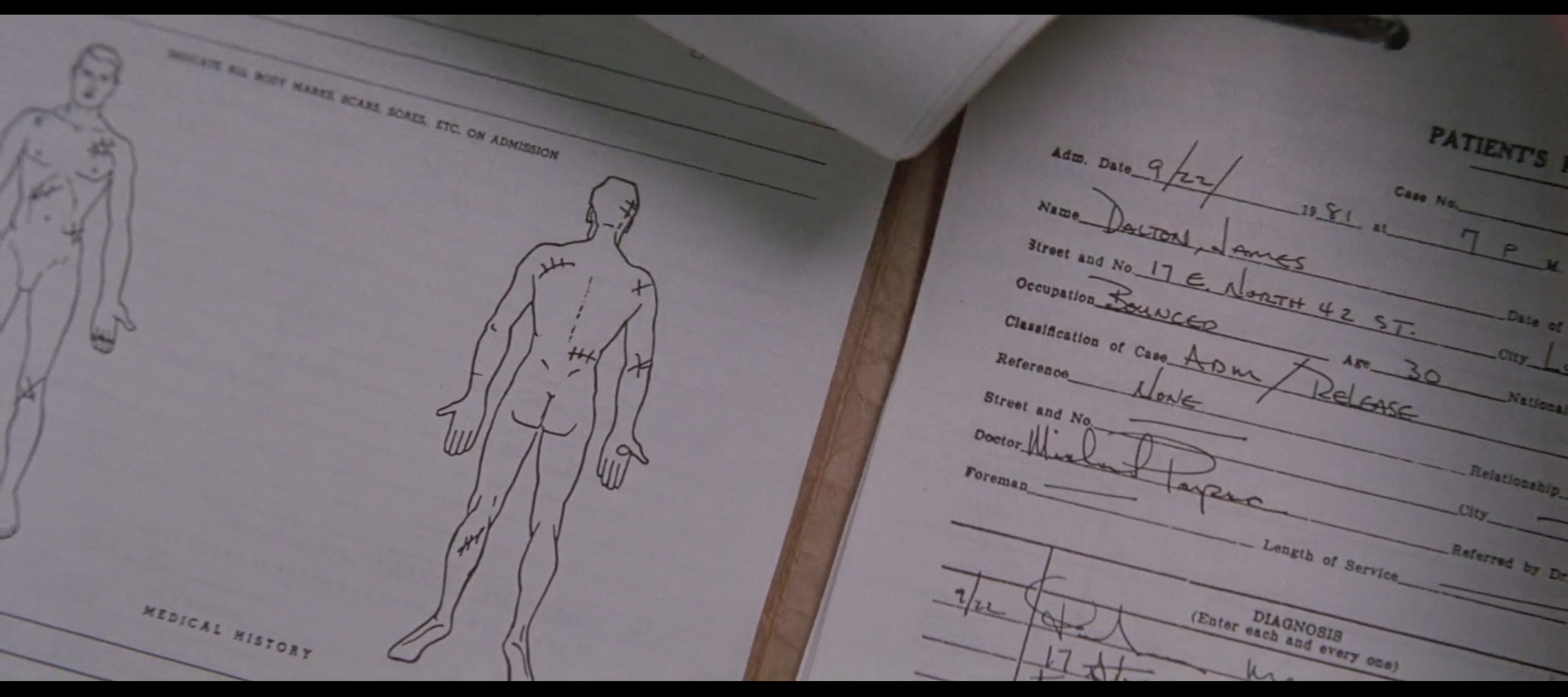
The life of Dr. Elizabeth Clay in Road House can be divided into five phases. She meets our hero, Dalton, when he’s admitted to the hospital where she works for the treatment of a knife wound he incurs on early in his tenure at the Double Deuce. After telling him the cut will require nine staples, she rattles off a list of previous injuries from his medical files, which he carries around with him. (“Saves time.”) She offers him a local anesthetic, which he refuses. (“Pain don’t hurt.”) She notes that his medical files say he graduated from NYU, where, he tells her, he studied philosophy. (“Man’s search for faith, that sort of shit.”) Given the damage that’s been done to his body, she facetiously asks him if he’s ever won a fight. (“Nobody ever wins a fight.”) Furthering one of the film’s recurring jokes, she says that she figured someone in his line of work would be bigger. (“Gee, I’ve never heard that before.”) Perhaps because nearly everything he says would look good as a back tattoo, she accepts his offer to take her out for coffee in the middle of all this.
Next time we see the good doctor, she shows up at the Double Deuce for their date, in a dress that looks like something Billy Joel and his first love ordered a bottle of white, a bottle of red over. She arrives in time to watch him finish beating the tar out of several of Brad Wesley’s goons alongside his fellow bouncers. During their date she brutally negs him for getting paid to hurt people, and for acting like a Nice Guy when he clearly isn’t. Perhaps impressed by how he tosses money on the counter of the diner where they’re eating so that the grumpy manager will allow a falling-down-drunk old man to sit there a while longer, or the good-natured way in which he reacts to discovering his enemies have rammed an entire stop sign through the windshield of his car, she gives him a chaste but heartfelt kiss goodnight before leaving. (He gives her the same little salute he gave the Second Car Salesman of Jasper, Missouri as she drives off.)
She meets up with him at the Double Deuce again a few scenes later, by which point Dalton has pretty much single-handedly reversed the place’s fortunes, which you can tell because the bartenders are wearing uniforms and there’s no longer any chicken wire around the bandstand to protect the performers from the audience. They go back to his place. He turns on the radio and, after they both reject Bullet’s “I Sold My Soul to Rock n’ Roll,” settles on “These Arms of Mine” by Otis Redding. They exchange five or six sentences about her Uncle Red, who raised her after the death of her parents, and her failed marriage. Then they have sex; he’s inside her, standing up, before they so much as kiss. She laughs while they fuck, like she’s in on the joke. Later that night they fuck again, on the roof, in full view of Brad Wesley, who lives across the water, and whose house she looked at ruefully shortly after arriving at Dalton’s apartment because he was the person she had the failed marriage to. (Though their relationship is confirmed, the actual fact that they were married is never stated outright, but the vacuum-sealed logic of the film allows no other possibility; there’s not enough room in anyone’s life for two major former disastrous love interests.)
When Dalton’s mentor Wade Garrett comes into town to help him in his battle against Wesley—Elizabeth has become a focal point in that grudge, and in Dalton’s desire to stay in town and take Wesley down rather than simply picking up stakes and moving on when things get ugly, as Wade advises—the two men and Elizabeth spend the night on the town, drinking beers and swapping stories about their old antics and injuries (the two are inseparable), which at one point involves Wade unbuttoning his jeans and revealing the dark thatch of his pubic hair to show her a scar on his hip that a woman gave him. They pull an all-nighter, during which Wade and Elizabeth dance in a diner (not the previous diner, nor the place they spent the night talking and drinking in, nor the Double Deuce, but a fourth dive altogether) and he comes on to her pretty heavily, with just enough plausible deniability that everyone can play it off with a smile. The sexual tension between all three is just insane, though it’s cut short by the start of the work day. (“Don’t mean to bust up the party, but my shift starts in a couple of hours—thought I’d go home, get some sleep,” says the trauma surgeon after spending the past five or six hours drinking.)
Elizabeth’s final emotional beat in the film is as the unhappy go-between in the Dalton/Wesley feud. She chastises Brad (she’s the only person who calls him that) for destroying Strodenmire Ford with a monster truck, and warns Dalton that if he’s trying to save the townsfolk from Wesley, “Who’s gonna save them from you?” Actor Kelly Lynch’s commitment to this line, which she shrieks at the top of her lungs, is so total that when Wesley’s lead goon Jimmy blows up the shack where Dalton’s landlord Emmet lives the next moment, at first it seems like she Carrie‘d the place. When Dalton kills Jimmy by ripping his throat out with his bare hands, she checks to make sure the man is dead, then leaves, horrified, and refuses to leave town with Dalton when he tries to convince her to do so at the hospital the next day. For some reason she goes to Brad Wesley’s house during the middle of Dalton’s killcrazy rampage through his army of goons; her arrival prompts Dalton to not tear Wesley’s throat out, which gives Wesley a chance to go for a gun to finish Dalton off, but fortunately four old men show up with shotguns and Sonny Corleone the shit out of the guy.
After she watches her ex-husband die during an attempt to kill her current boyfriend-ish guy, the doctor and Dalton are reunited and skinny-dip in front of his landlord Emmet happily ever after.
Every time I watch Road House I grow more and more fond of the Doc. And why wouldn’t you? She’s the smartest and most together person we meet, having one of the few jobs anyone holds outside of the automotive, alcohol, or beating-people-up industries. She has a good head on her shoulders regarding the lunacy of Dalton and Wesley’s blood feud, which has involved the total destruction of at least three buildings in town and the severe injury of dozens of human beings even before people start dropping like flies. Removed from the French braid she wears it in for work, her hair does this cool thing where it sticks out on the sides like an old Barbie doll. She’s one of the few human beings who could get bare-ass naked next to in-his-prime Patrick Swayze and hold their own.
However, she also accepts a date from a masochist who’s constantly getting his ass kicked, which she knows because she meets him while stapling his latest knife wound. She holds his job in open contempt and mocks the idea that he’s a force for good in town even when they’re getting along and used to be married to his arch-enemy, whose murder during the process of his attempted murder of Dalton she witnesses before settling down with Dalton for good. She goes into work at a hospital on two hours of sleep after spending the small hours pounding Miller High Lifes. Even by the standards of Road House, a film about famous bouncers, her behavior is hard to recognize as that of a normal human person.
Yet when I think about her, it’s always in terms of “Wow, way to put him in his place,” or “power move,” or “wearing that dress takes guts,” or “fucking before kissing, right on, this is a person who knows what she wants,” or “she must really love her uncle to hitch her star to Jasper, Missouri’s wagon on his account, I bet he was a great dad to her” or “she patches up Dalton’s knife wound but the next time we see her at work she’s looking at x-rays of someone’s colon, what’s her medical specialty,” or “she could absolutely talk Dalton into making out with Wade in front of her and she knows it, and just sits with it because knowing it is all the satisfaction she needs,” or “I wonder what she saw in Brad Wesley,” or “I bet she went to an Ivy League medical school because she’s just a little condescending when she talks about Dalton going to NYU.” In other words, things you might think about a normal human person, and a very interesting one at that. Confronted with Road House, the mind transmutes chaos into character.
‘I literally have nightmares and put them on screen’: Channel Zero creator Nick Antosca on 2018’s scariest show
Polygon: The first scene of the first episode of the first season of your show scared me more than other horror shows have during their entire runs.
Nick Antosca: You mean the interview at the beginning of Candle Cove? Sooo frequently, we were told to cut that scene. I’m not going to disparage, at all, the people who’d give us notes; we have a really supportive network and studio. But every round of notes on that, we were told “Cut that scene, cut that scene, it’s bad!” I knew that we were going to be asked to do that when I wrote it, so I put all of the exposition that would be necessary to understand the show in that scene so you couldn’t cut it.
The scene is like the opening of David Cronenberg’s The Brood, when Oliver Reed is having that weird therapy session onstage. Everything is dark and you have no idea what’s going on.
Antosca: You know, our show references The Brood in multiple seasons in other places, but that was not a deliberate reference to it. In the script, that was written as being interviewed by Dr. Phil at one point, then it was written as being interviewed by Charlie Rose and then Matt Lauer. We asked them both to do it and they wouldn’t do it. Thank God.
As frightening as that first scene was, the series basically never lets up.
Antosca: The idea of the show was always to capture a sense of dread, and we felt it was very important to establish that in the first scene, in a way that was different from other horror shows that I’m familiar with.
I interviewed Nick Antosca about his phenomenal horror anthology series Channel Zero for Polygon.
003. The Four Car Salesmen of Jasper, Missouri
If you think this sentence is confusing, then change one pig. —Uilliam M. Bricken, Jr.
An English professor of mine used that self-reflexive riddle to illustrate the way Christ’s parables are both medium and message: The second the concept behind the parable clicks, so does the larger point about ethical behavior or spiritual enlightenment.
In his book The Three Christs of Ypsilatnti, psychologist Mark Rokeach recounts an experiment, which he would later apologize for and reject as unethical, in which he placed three men who believed themselves to be Jesus Christ in regular group therapy sessions in hopes that encountering each other would shatter their delusions, to which end he occasionally manipulated them directly by concocting imaginary elements of their collective story himself. The experiment was unsuccessful.
This man is Big “T” of Big “T” Auto Sales, or so it seems safe to assume. We meet him around 17 minutes into the film, as he watches The Patty Duke Show on his office television while preparing to eat his lunch. He then notices our hero, Dalton, checking under the hood of a beat-up old car in the lot. “She’s a runner!” shouts this walrus-looking sonofagun as he strides out to meet Dalton face to face, treating the singular requirement of any used car sale—that the car being sold is capable of movement—like a selling point. Dalton drives a Mercedes when he’s not on the job, but since angry patrons of the bars at which he serves as cooler tend to take their frustrations out on his car after they’re ejected, he replaces it with a cheaply bought beater when he’s got a gig. He takes the car. We never see Big “T” again.
This man does not have a name, not that we’re given to know anyway. We meet him about one minute after we meet Big “T.” This fellow presides over some kind of automobile junkyard Dalton goes to not to purchase a used car, which he could have done here since used cars are visibly on sale in the background, but to stock up on spare tires, since people who are pissed off that he smashed their face through a table because their girlfriend was dancing on another table often slash his tires in revenge. Dalton loads the trunk of his new old car with tires and gives the proprietor a little salute, which the old man returns. We never see this man again.
This man is Red Webster, proprietor of Red’s Auto Parts. We meet him around 33 minutes into the film, after which he becomes a major character. His store is the closest business to the Double Deuce, with which it shares some kind of vast dirt parking lot or road or whatever it is despite being about a football field away. His niece is Dr. Elizabeth Clay, former love interest of Brad Wesley and, soon, current love interest of Dalton. He is Dalton’s primary source of information on the protection racket run by Brad Wesley under the guise of civic improvement. Dalton goes to Red’s store to order a new windshield and buy a new antenna for his car after both were destroyed by angry ex-patrons of the Double Deuce the night before. This is the third scene in which Dalton makes an automobile-related purchase, and the third business establishment at which he does so. The movie is not quite 35 minutes old.
This man is Pete Strodenmire, proprietor of Strodenmire Ford. We meet him around one hour and 24 minutes into the film, at a hastily convened meeting of Jasper business owners, plus Dalton and Elizabeth, to discuss the prior night’s destruction of Red’s Auto Parts in an arson ordered by Brad Wesley. There are seven people at this meeting. Four are Dalton, Elizabeth, Dalton’s nominal boss Tilghman (seen above in the background), and Elizabeth’s uncle Red. The other three, including Strodenmire, are people we’ve never seen before; the two who aren’t Strodenmire have no lines, and we never see them again. The next time we see Strodenmire, Brad Wesley has ordered one of his goons to run over the man’s entire glass-enclosed showroom of new cars with a monster truck, which he does with glee. Strodenmire winds up being one of four men—along with Red, Tilghman, and Dalton’s nominal landlord Emmet—who murder Brad Wesley, the film’s antagonist, with shotguns during the climax. Again, we meet him an hour and a half into a two-hour film that has already included three other car or car-parts salesmen.
This man is Emmet. We meet him about half a minute after we meet the man from whom Dalton purchases tires, when he rents Dalton a barn-loft apartment that must have cost $50,000 dollars to build for $100 a month. He doesn’t sell cars or car parts, but you can see how he and the Four Car Salesmen of Jasper, Missouri share a similar aesthetic.
Road House is a movie about a road house, that much is true. It’s not a movie about roads, however, nor about what you drive on them. (Much more time is spent showing Dalton buying cars, parking cars, and buying car parts to fix what happens to the cars after they’re parked, than is spent showing anyone actually driving cars.) Thus, the film’s maximalist approach to automotive retailers is striking, and bears contemplation.
Could Dalton’s trips to fully four different stores for his vehicular needs have been consolidated to, say, two, perhaps the ones owned by the two men who wind up saving his life from the character played by Ben Gazzara (John Cassavetes’s Husbands)? Yes.
Would this have been an easy way to establish Strodenmire, who I stress fires a shotgun into the body of the movie’s antagonist and inflicts a mortal wound, before the movie was three quarters of the way finished? Yes.
Would this have made things less confusing to people for whom men whose vibe is best described as “Old Fart” sort of blend together in an indistinguishable blur of ill-fitting work shirts and bold facial-hair decisions? Yes.
Is understanding that Road House has its protagonist make car-related purchases from three different men (two of whom are never seen again), includes a fourth as a main character when he emerges from a nameless scrum of unknowns when the movie is almost over (and who has never been seen before), and casts weird old coots in all four roles (with weird old coots to spare playing other parts)—that is to say, understanding things that makes no sense—key to understanding Road House‘s unique rhythm in all its concussive dreaminess?
If this sentence is confusing, then change one pig.
002. Brad
Here’s what we know about Brad Wesley.
He grew up on the streets of Chicago, where he “came up the hard way.”
He came to Jasper, Missouri after serving in the Korean War.
His grandfather was an asshole.
He has one sister, whom we don’t meet.
He has a nephew, Double Deuce bartender Pat McGurn, whom we do.
He has a cousin in Memphis. (This unseen—or is he?—cousin tells him Dalton killed a man down there. Said it was self defense, which Brad doubts.)
He owns a helicopter, an ATV, a red convertible, and a monster truck, all of which he enjoys driving, or paying someone else to drive, erratically.
He loves the song “Sh-Boom.” (The Crew Cuts version, not the Chords version, which if you know Brad is unsurprising.) He can’t stand today’s music, which has “got no heart.” He prefers when bands “play something with balls.”
He employs a squad of goons for whom he enjoys throwing topless poolside bacchanals, and whom he also enjoys beating up arbitrarily when they displease him for reasons such as bleeding too much.
His favorite goon is Jimmy, a martial artist who I believe to be his bastard son. Strictly speaking this is not supported by the text—Wesley refers to all of his goons as “my boys”—but it’s in the eyes.
He’s “dating” a woman named Denise, whom he beats up for coming on to our hero Dalton. Later he has her do an erotic striptease at the Double Deuce to teach Dalton a lesson (?).
He used to be married to Dr. Elizabeth Clay, a surgeon or gastroenterologist with whom Dalton becomes involved after she treats him for several wounds incurred in his first barfight at the Double Deuce.
He lives in a waterfront mansion across a lake or river or something from the farm or ranch or whatever where Dalton rents an extravagantly appointed open-air apartment from a bearded old codger named Emmet who sleeps in a union suit. This provides him with a convenient vantage point from which to buzz the old man’s horses with his chopper or sit in a rocking chair and watch Dalton and Elizabeth have sex on the roof of a barn.
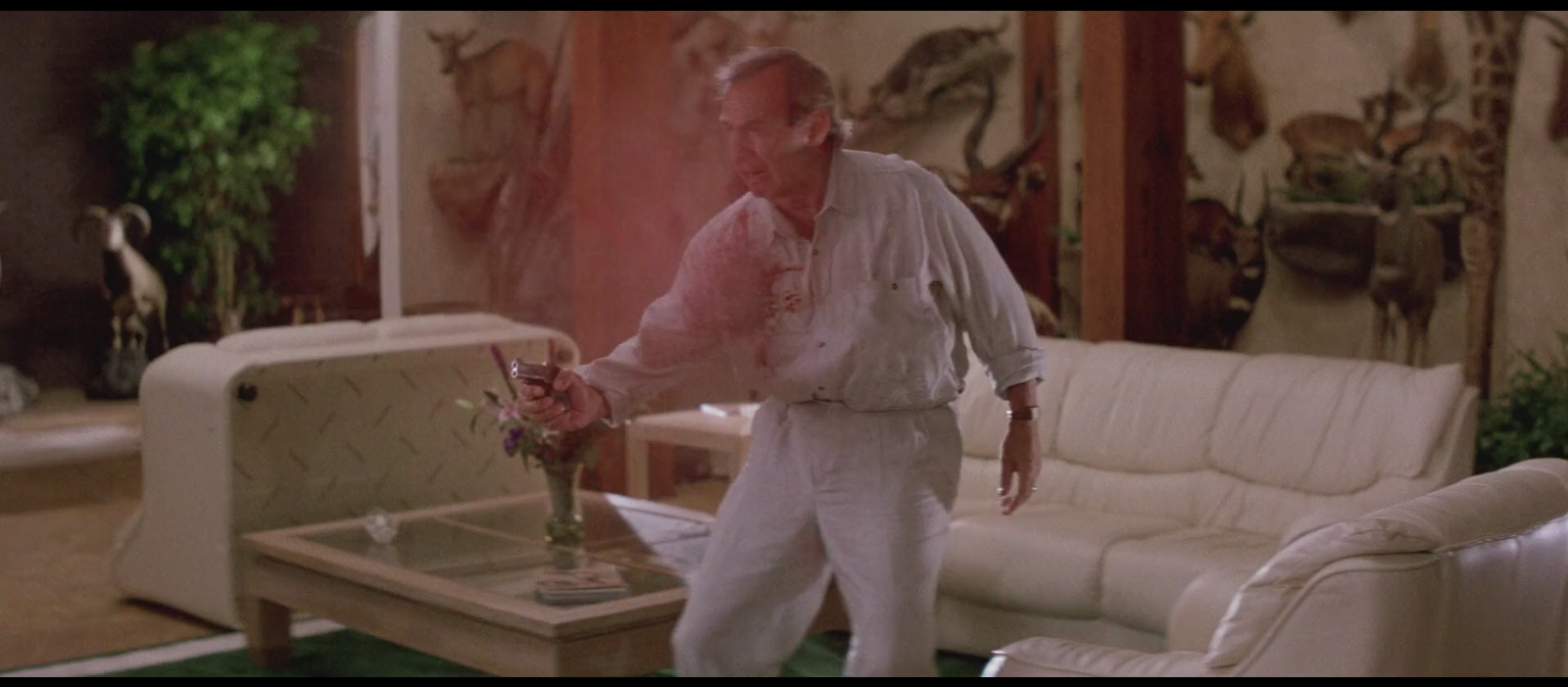
Now’s a good time to mention he’s played by Ben Gazzara, a frequent collaborator of John Cassavetes who created the role of Brick in the original Broadway production of Tennessee Williams’s Cat on a Hot Tin Roof.
He alternates between light-colored suits of the Boss Hogg variety and the fussily sporty apparel of a weekend warrior. As they do in the wardrobes of many characters in this film, boots play a disproportionately large role in his ensembles.
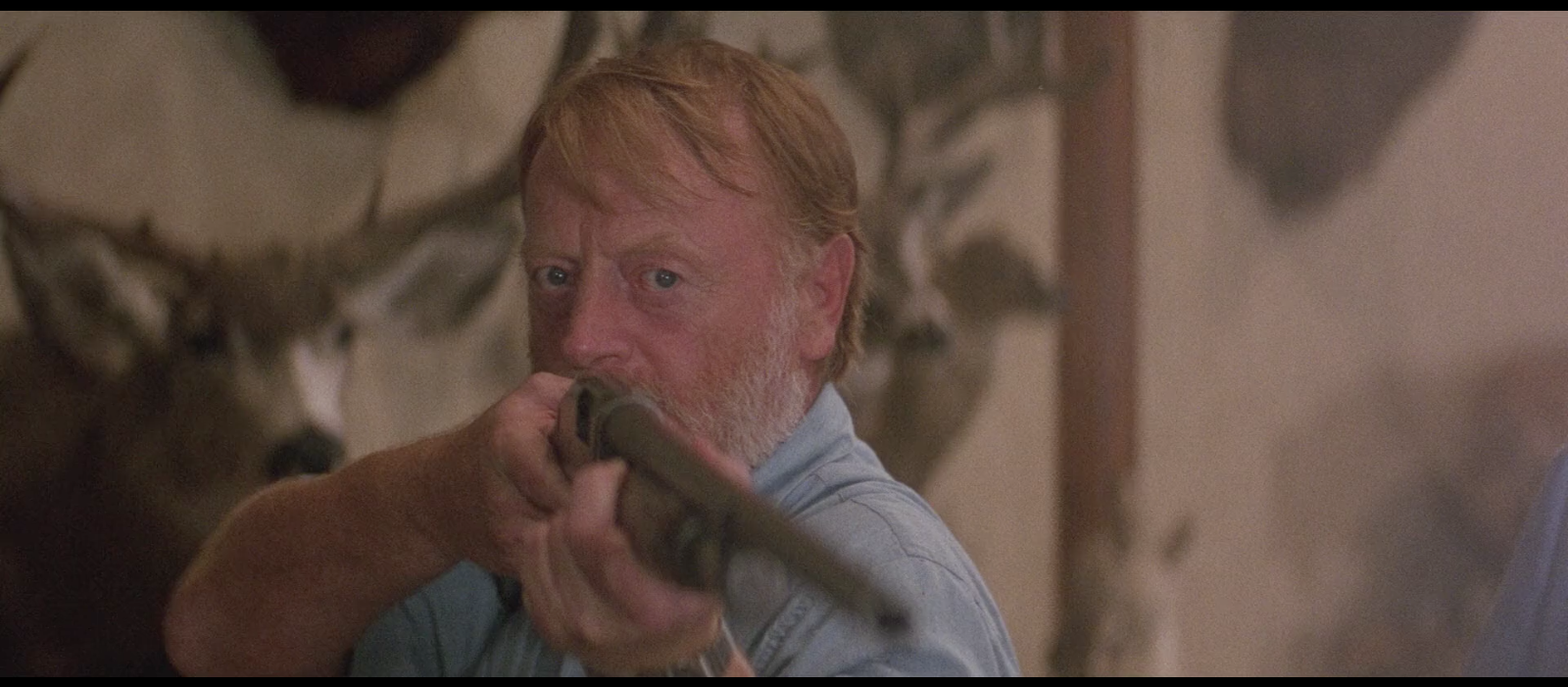
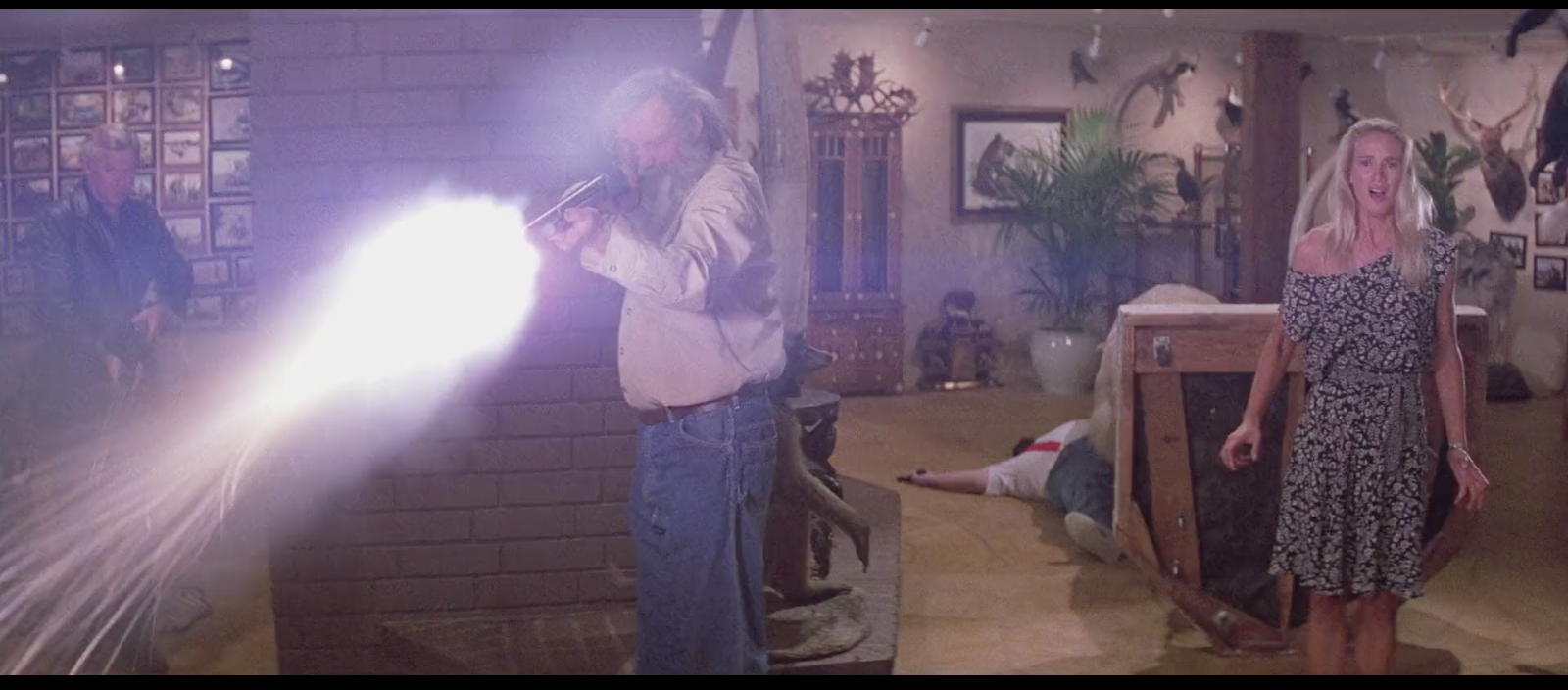
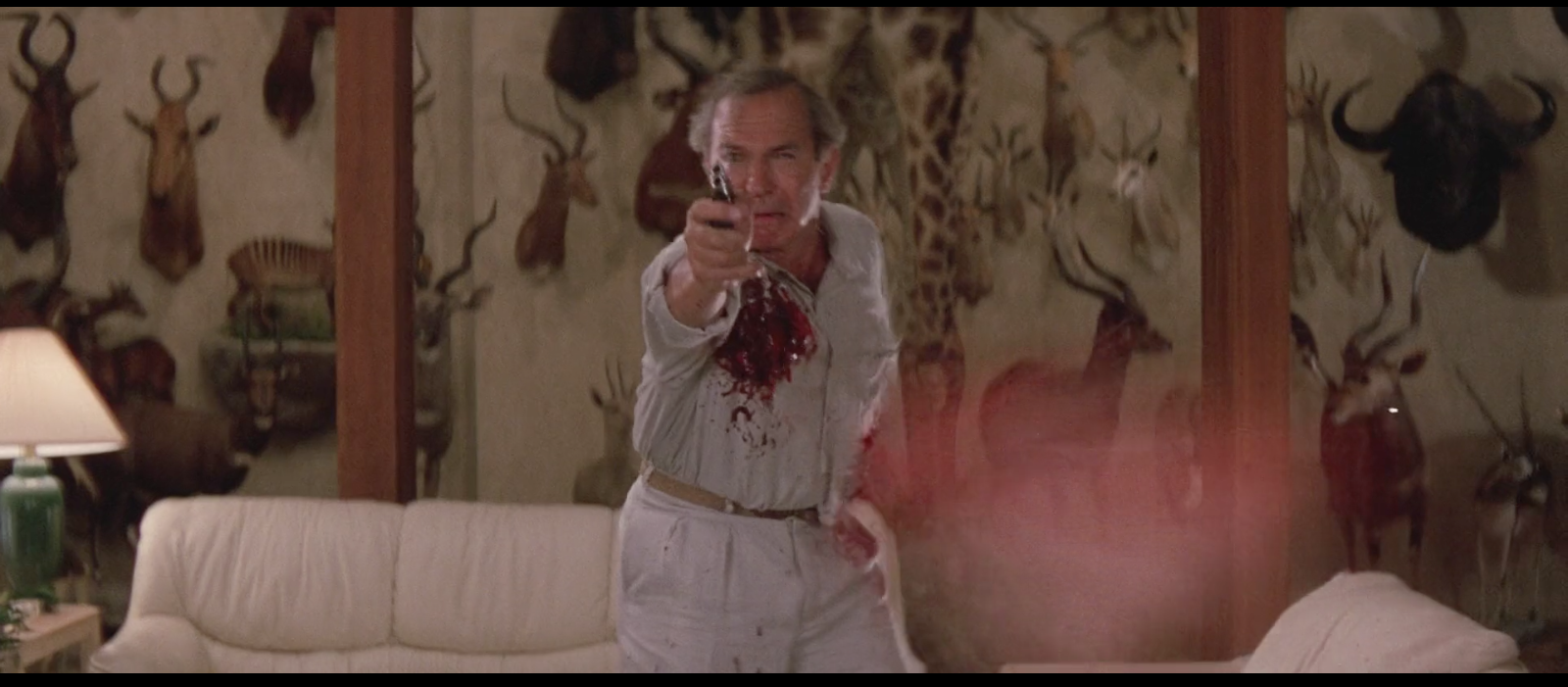
He has a trophy room full of the stuffed carcasses and mounted heads of both exotic and domestic animals that would shame a Trump son.
He runs a glorified protection racket called the Jasper Improvement Society that keeps all the local businesses under his thumb, including the auto parts store run by Elizabeth’s uncle Red Webster.
He controls alcohol distribution in the region, which provides him with a line of attack on the Double Deuce after his nephew Jimmy is fired for skimming the till.
He feels that his many achievements in building the town of Jasper up from “nothing” have entitled him to get rich off its inhabitants.
Here are those achievements, quoted verbatim.
I brought the mall here. I got the 7-Eleven. I got the Fotomat here. Christ, JC Penney is coming here because of me! You ask anybody, they’ll tell you!
Road House is the story of one bouncer’s quest to free a small town from the iron fist of the guy who is on the verge of opening the area’s first JC Penney. Over half a dozen men will die for this.
001. Fame
Road House is a film about a very famous bouncer. Not the most famous bouncer; that man is a supporting character. And not technically a “bouncer” either; our hero, played by Patrick Swayze, beautiful and terrible as the dawn, is a cooler, which is to say the Head Bouncer In Charge. But his job is basically bouncing, and he’s so good at it that he’s become famous for it.
So that tells you something about the kind of film Road House is: It respects the people who beat up people who beat up other people in bars so much that it affords them significant renown. Other men will fly across the country and offer these men hundreds of thousands of dollars a year for their services. Barfolk, for want of a better term, whisper their names in reverent awe. In the land of the blockheaded, the two-fisted man is king.
Because their reputations precede them, or because to invoke them inaugurates the ritually contracted cycle of redemptive violence for which they’ve been hired, the bouncers of Road House are reluctant to share their names.
“You got a name?” asks Carrie Ann, waitress at the Double Deuce, the ultraviolent Missouri honky-tonk at the heart of the story. “Yeah,” answers our hero.
“What’s your name, buddy?” asks Pat, the Double Deuce’s thieving failnephew bartender, who is played by John Doe of Los Angles punk institution X. “Coffee, black,” responds our hero.
When he conducts his first official bouncing during his tenure at the Double Deuce by smashing the face of a man with a switchblade and a Hawaiian shirt through a table adjacent to the one on which this man’s girlfriend has been dancing and thus lowering the overall atmosphere of class in the establishment, it falls to our hero’s blind white blues-playing guitarist friend Jeff Healey (appearing as himself) to reveal his identity to the amazed, and in several cases visibly aroused, patrons.
“The name,” he says, “is Dalton.”
Dalton is by this point in the film known to the Double Deuce’s staff, over whom he’s been given absolute authority by the bar’s bizarre owner Frank Tilghman. “What he says? Goes,” Tilghman tells his employees.
“It’s my way or the highway,” Dalton concurs.
The first person to learn his identity other than Tilghman himself is Carrie Ann, who powers through our hero’s extremely badass rebuff as described above and gets him to name himself, the way Superman tricks his gnomish extradimensional enemy Mr. Mxyzptlk into saying his own name backwards to eliminate him. (Carrie Ann has no such goal, of course; it is perhaps for this reason that she is rewarded later in the film with a glimpse of our hero in the nude. to which she reacts with slackjawed lust so powerful, courtesy of actor Kathleen Wilhoite, that it all but glows with its own internal erotic energy.)
“Shit,” Carrie Ann says when Dalton reveals himself. “I heard a’ you!”
The news spreads like wildfire through the waitstaff, bartenders, and bouncers already in the Double Deuce’s employ, none of whom need its import explained to them. Like I said, a famous bouncer’s reputation precedes him. One man has heard he ripped a guy’s throat out with his bare hands. Another has heard he has balls big enough to come in a dump truck. “Sometimes you wanna go where everybody knows your name,” runs the song from another artifact of Eighties bar culture. Dalton can go anywhere.
Which gives us some indication of his exact level of fame. No one at the Double Deuce recognizes him on sight, which means he’s not so famous that his face alone writes his ticket for him. However, the moment he says “Dalton” in response to Carrie Ann’s query, she immediately assumes he is the Dalton famous for being a bouncer, and not any of the other myriad possible Daltons in the world—B. the bookseller, for example. It’s as if she asked a woman who was new to the Double Deuce for her name, and that woman replied “Gaga.” Only one person leaps to mind.
This separates our hero from his hero. “Wade Garrett’s the best,” Dalton tells Tilghman when the Missouri restaurateur says he’s heard he, Dalton, is the best. “Wade Garrett’s getting old,” Tilghman replies. But age has not dimmed his starpower. Arguably, age is responsible for it. The longer he’s been out there, bouncing and cooling, the more time the dive-bar demimonde has had to put a face to the name.
The face belongs to Sam Elliott, who in this film has long greasy hair, tight black jeans, five o’clock shadow that creeps up his face nearly to his eyes, and a grizzled sexuality that wafts from the screen like a musk. When he arrives at the Double Deuce to help his one-time protégé Dalton defend the establishment against the depredations of Brad Wesley, a local business tycoon and J.C. Penney franchisee played by Ben Gazzara (The Killing of a Chinese Bookie), no one asks his name, because no one needs to. Practically the entire staff stares at him with the wide eyes of children in a film directed by Chris Columbus when he limps bowleggedly into the place looking for his mijo.
Grinning slyly, his eyes twinkling with a sinister delight that seems to be actor Kevin Tighe’s natural mien and has no basis within the character itself, Tilghman looks at this man and says, “I know you.”
Wade Garrett, it can be concluded, has achieved a level of fame so total that even people steeped enough in bouncer culture to know Dalton by name know him by sight. Michael Jordan fame. Michael Jackson fame. Santa Claus fame. Wade Garrett is the best, Dalton tells us. And when Dalton speaks, we would do well listen. It’s his way or the highway. What he says? Goes.
Directed by Rowdy Herrington, written by David Lee Henry and Hilary Henkin (Academy Award winner, Wag the Dog), released in 1989, directed by Rowdy Herrington (the name bears repeating), and starring Patrick Swayze, Kelly Lynch, Sam Elliott, Ben Gazzara, and an assortment of people with anywhere between one to six lines of dialogue all of whom I adore completely, Road House is one of my favorite movies ever made. I like to talk about it. I hope you’ll like to listen.
Sean T. Collins’s Eight Best TV Shows of 2018
Weird ‘Flix, but okay: 2018 saw a certain streaming behemoth finally achieve the approximate cultural reach and clout the Big Four broadcast networks still enjoyed as recently as a decade ago. Unfortunately, the level of artistic quality and risk-taking roughly followed suit.
But even the algorithm-assisted return of TV monoculture—you can have any flavor you like, as long as it’s a flavor our data indicates you’ve enjoyed before—couldn’t stamp out the hard-earned gains television has made as an art form since Tony Soprano woke up that morning 20 years ago. Shows predicated on the idea that challenging your audience is a vital part of entertaining that audience, even if it’s an audience you have to will into existence in the process, are still out there.
Television can still make even a jaded viewer sob with sorrow and joy, recoil in suspense and terror, stare in silent (or shouting!) awe at the sheer emotional and aesthetic audacity of it all. Between them, the eight shows below did all that for me and more.
8. On Cinema at the Cinema (Adult Swim)
Now, nobody likes a good laugh more than I do. But comedy is about making people laugh, which turns characters in comedies into joke-delivery mechanisms rather than characters in the fully developed sense from which we derive value in drama. So it takes a lot for a comedy to make my list of the best the medium has to offer.
In the case of On Cinema, Tim Heidecker and Gregg Turkington’s byzantine saga of atrocious human behavior in the guise of a thumbs-up/thumbs-down movie-review show starring two idiots, here is what it took: Tim, the right-wing hedonist host whose endless series of jilted wives, abandoned children, unwatchable action-movie side projects, unlistenable alt-rock and dance-music spinoffs, disastrous alternative-medicine experiments, near-death experiences (including toxic shock from unsterilized acupuncture needles, malnourishment from an all-drug diet, and incineration after falling asleep with a lit cigarette in the storage locker cum VHS-tape library he’d been reduced to living in) culminated in a mistrial for murder after 20 kids died from smoking his tainted vape juice at an EDM festival. The subsequent tenth season of his movie-review show (“On Cinema X”) saw him caught between the diktats of the show’s snake-oil sponsor and the civil judgment won by the family of one of his victims.
Somewhere in there, he and Gregg may or may not have awarded Solo: A Star Wars Story their coveted Five Bags of Popcorn seal of approval; between Tim screaming obscenely about the district attorney (against whom he mounts a quixotic electoral campaign) and Gregg prattling on about how Tim Burton won’t answer his letters, it’s a bit hard to tell. Heidecker and Turkington have played out this shaggy-dog joke for years, anticipating (not kidding at all here) both the rise of Donald Trump and the role that aggrieved nerds would play as his cultural vanguard. The result is maybe the best thing the extended Tim & Eric universe has ever produced. Long may they rant.
I named the eight best television series of the year for Decider. I believe in all eight of these shows very deeply, which is why it’s just a top eight and not a larger, rounder number. I hope you enjoy them too.
The Boiled Leather Audio Hour Episode 81! PLUS! The Boiled Leather Audio Moment #24 & #25!
BLAH 81: Sean & Stefan on Fire & Blood
George R.R. Martin is back with a new book. Sean T. Collins is back as an illustrious cohost. Sean & Stefan talk Fire & Blood for a full 90 minutes. ’Nuff said!
PLUS!
BLAM 24: Life-Changing ASoIaF Writing
Our subscriber-exclusive series of minipodcasts is back, BAY-BAY! This time around, Sean & Stefan answer our patreon subscriber The Orange Man’s inquiry about the essays, articles, and posts we’ve read that have had the greatest impact on how we thought about A Song of Ice and Fire from then on. Click here and subscribe for just $2 a month for the answers!
AND!
BLAM 25: The Top 5 Characters to Have Sex With
Only Sean’s friend and $5-a-month patron Gretchen Felker-Martin is a big enough horndog to be responsible for this installment in our subscriber-only series of mini-podcasts: Who are the top five lays in all of Westeros and Essos? Obviously, this was fun to answer, and we answered it irrespective of orientation so there’s something for everyone. Subscribe for the low low price of $2 a month and enjoy!
Additional links:
Our Patreon page at patreon.com/boiledleatheraudiohour.
Our PayPal donation page (also accessible via boiledleather.com).
“‘Best’ Is a Bullshit Word”: Phoebe Gloeckner on Editing “The Best American Comics 2018″
To get deep in the weeds a bit, when you’re selecting the best comics—
Okay, get rid of that word. Get rid of that word, because it’s not possible. OK, yeah, you’re choosing the “supposed best” or “so-called best comics,” right, yeah?
Mmhmm.
What is your responsibility to your readership? What do you think when you’re possessing them? Well, I don’t fucking know. [Collins laughs.] No, honestly! I’m not thinking I’m choosing the best because I know I am the filter. What matters to me is, Do I like it? Did I like it more than a number of other comics? If the answer is yes, maybe I’ll include it, because what else do I have?
It’s like grading student work, in that you’re looking for so many things. You’re looking for: Can they draw, can they write, is it working together? Then you think, Well, I’ve known this student for two years. Look at them two years ago and look at them now. God, they are so good, and they are so much better than they were. They’re really trying hard and they’re really actually finding out what they can do. They might not be your best student to someone looking in from the outside. But sometimes you get these students who are great coming in, but because they can draw so well they have no real way to push themselves. You can see that they’re stuck. Their stories are a little weaker. Any criticism you give them, they halfway don’t believe it, or get pissed because they know they’re good. And they are, but they get this attitude and they don’t really get better.
So on the outside you can say “That person deserves an A”—the person with all the talent—and the one who tries so hard and gets so much better and will continue to do so, from the outside you might think “That’s C work.” In reality, you’re looking at so many things that other people who might not be inside this classroom wouldn’t take into consideration.
It’s the same when you’re looking at all this work. Because we’re individuals, we tend to like certain things or be interested in certain things, not in others. You try hard to put that aside, but you can’t. You can’t get out of your own skin. In the end, you’re going to choose things you like for reasons you don’t even understand.
Are you asking me, Do I feel any responsibility towards the reader? Or if my role is, in a very dry and responsible sense, to present only the finest? I mean, what are you trying to ask?
Well, for example, a couple of years I was hired to write a piece on “The 33 Greatest Graphic Novels of All Time.” Immediately, I said to myself “This is going to be my list of the 33 greatest graphic novels of all time, not a survey of the major landmarks from each genre and tradition and geographical region. You can get that anywhere, but you can only get this from me.” How do you draw the distinction between the quote-unquote “best” and stuff that you, based on your own interests as a reader, as an artist, as a person, as a teacher, whatever, like the best?
This is different in that I wasn’t asked to choose my all-time best stories or favorite stories. It was just my favorites among those that were sent, submitted, or solicited at this particular period of time. In that sense, it is harder to impose your own tastes and preferences on the group. You didn’t direct yourself towards a certain group of comics, they’re just placed in front of you.
I went into it thinking—and Bill Kartalopoulos said—“It’s your favorite from this period.” He kept emphasizing, “You’re the one who’s choosing which ones will go in the book.” If we had been asked to honor the accepted greatest cartoonist or the best-selling up-and-comers, I mean, that would’ve been really different. Publicly that may have been more recognized as, this is good, this is bad, but it wasn’t like that at all. They always have a different guest editor because it’s understood that different tastes will be reflected depending on who’s judging the work.
Bill, in his foreword, says his task is different than the guest editors in that he’s seeing all the submissions and whittling them down to a broad range of suggestions, but one that’s still smaller than the overall submission group. As much as he stands by his personal taste and feels it’s informed and defensible, he puts it aside as he’s looking at work in genres or tones that he’s usually not interested in. He thinks to himself, Okay, well, this may not be my thing, but it’s a thing. Is it a really good example of that thing? Is it an ideal version of that thing? Is it doing something new with that thing?
Right, but he also admitted that he constantly chose things he thought I might like. I always thought, What exactly does that mean? I actually do like lots of things, so I wasn’t sure what he meant by that.
But with all those questions—is it doing something groundbreaking, is it really the best example of this type of thing in any particular year—even the most prolific artists aren’t vomiting up stuff at a fast clip relative to other forms of communication. What are the chances you’re actually going to get work that fulfills all those criteria? Sometimes, you’ll get really brilliant shining examples you can hold up and say No doubt, this is best, everyone will agree. Sometimes you’re getting a book that is better than others, but nevertheless this particular artist did a book that you liked far better two years ago. Yet you’re going to include this because it’s actually something you can say you admire more than you appreciated fifty other books that were also submitted. You’re not always going to get that many outstanding pieces of work, even from the best artist. If you look at a body of work you’re always going to have a preference for this period or this story or this book over another, even in one artist’s work. “Best” is a bullshit word. Nobody’s ever going to agree on it.
“Channel Zero” Is the Scariest Horror Show You’re Not Watching
Everything I’ve ever heard about Channel Zero, I’ve heard from other people on the internet. Perhaps that’s the way it should be. This rich, gorgeous, and astonishingly frightening horror anthology series takes the story lines for each of its four seasons so far from creepypasta — scary short stories in the form of faked message-board posts and comment threads. They’re the online era’s equivalent of urban legends, passed around from one terrified reader to the next. That’s how Channel Zero reached me, pretty much: from other impassioned viewers, desperate to persuade me to watch it too. The show infected them like a virus, until they passed that virus to me. And now … well, if you’re reading this, it’s too late.
But there’s so much more to the series than that slightly cutesy high concept, which I suspect turns as many people off as it turns on. Created by Hannibal veteran Nick Antosca, Channel Zero is full-service Good Television. It’s engrossingly beautiful and austere filmmaking, as shot by a different promising director every season. It’s a showcase for intriguing and surprising performances by a wide variety of talented actors, particularly women, who’ve led three of its four seasons. It’s a merciless autopsy of suburban disconnection, and how the few intimate bonds that are formed in that environment — with friends, with family, with lovers — can harm as well as help.
And above all, it’s scary. Just incredibly scary. I say this as a horror person, who crammed all four seasons down my gullet as fast as I could, alongside my partner, another horror person, and was flabbergasted by its singular, consistent, and prolonged ability to frighten, disturb, disgust. Take it from someone who endured several prestige-y limited-series adapted from famous horror novels/novelists this year: I was scared more, and more often, by the first scene in the first episode of the first season of Channel Zero alone than I was by quite a few other horror shows combined.
I came late to Channel Zero, but Julia and I burned through all four seasons in October and November and I’ve taken to it with the zeal of the converted. I tried to explain why in spoiler-free fashion (except for mentioning some characters and monsters) for Vulture. You’ve got to watch this thing.
How the Act of Dying Made “The Terror” One of the Year’s Best Shows
The men of The Terror did not, as they say, die as they lived. They lived as interchangeable cogs in the machine of empire—sailors in the Royal Navy of Great Britain, the largest imperial project ever undertaken by humanity between the ride of the Khans and the Pax Americana currently dying all around us. So the show based on their final misadventure dresses them in their blue uniforms, swaddles them in shapeless and face-covering winter gear, allows the cold to redden their faces and lengthen their beards, until distinguishing between them requires an expert’s eye and ear. (Or at least a thoroughgoing knowledge of English and Irish character actors.)
They lived their final years trapped in the frozen waters and barren lands of the Arctic, searching for an open lane of water that would bridge the Atlantic to the Pacific without the need for Her Majesty’s Ships to sail around the tip of South America to get there—the fabled Northwest Passage. (Only one of them would actually live, and not for long, to see the Passage, and only by accident.) So the show shoots them against endless uniform vistas of white and gray, with snowblinding daylight or soulcrushing darkness alternating for periods that lasted months at a stretch.
And in the end, they lived their final weeks, days, hours, minutes, moments dying from the same things: malnutrition, food poisoning, disease, starvation, exposure to the cold, murder at one another’s hands…and, in some cases, mutilation and consumption by ferocious hulking thing on the ice, out for their English blood. (Fee-fi-fo-fum.)
But when they died? When they died, it was different. They were different. Replacing the uniforms and the uniformity were visions as unique and beautiful and terrible and individual as people are themselves, deep down inside.
I wrote an essay on the many deaths of The Terror for Decider. As you’d expect for a piece on character deaths, there are many spoilers. I tried to do this magnificent show justice and I hope you enjoy the result.
The 10 Best Musical TV Moments of 2018
10. Westworld: “Do the Strand” by Roxy Music
Few shows have been as guilty of music-cue abuse as Westworld. Jonathan Nolan and Lisa Joy’s leaden and labyrinthine sci-fi parable has folded an entire Spotify playlist of classic alt-ish rock songs into its narrative via instrumental arrangements by composer Ramin Djawadi. Give a listen to his best-in-field work on Game of Thrones and it’s painfully clear he can do much better than player-piano Radiohead or Japanophile remixes of Wu-Tang Clan’s “C.R.E.A.M.” or whatever.
This is what makes Westworld’s in-world cranking of Roxy Music’s boisterous 1973 hit “Do the Strand” so remarkable. Blasted at full volume by James Delos (Peter Mullan), the Scottish founder of the Westworld theme park (and, unbeknownst to him, one of its core artificial-intelligence experiments), glam rock’s answer to Led Zeppelin’s “Immigrant Song” sounds as unexpected in the dour songscape of this series as Delos’s “dance like no one is watching” behavior looks. Yet Bryan Ferry’s hedonistic lyrical promise of the next big thing — “There’s a new sensation, a fabulous creation” — and Brian Eno’s retro-futuristic flourishes as the band’s in-house effects guy fit Westworld’s themes like they were engineered in a lab to do exactly that.
This is always one of my favorite pieces to do: I wrote about the 10 best music cues of 2018 for Vulture. Definitely stick around for Number One.
Music Time: David Bowie – “Glastonbury 2000”
According to many British music publications, David Bowie’s headlining set at the Glastonbury Festival in 2000 is the greatest performance in the history of the legendary event. (NME, ever effusive, called it “the best headline slot at any festival ever.”) But it’s greatest that’s doing the work here, not performance. It’s not individual highlights that make the set so fondly remembered, but the overall gestalt. Like the old saw about climbing Everest, Bowie’s Glasto set mattered because it was there.
By the time he took to the Pyramid Stage, Bowie had spent 15-odd years in the mainstream-music wilderness—first, post-Let’s Dance, making milquetoast megapop no one particularly liked, then rebuilding his reputation with experiments in everything from Pixies-inspired garage rock (Tin Machine) to concept-album Eno-industrial (Outside) to a Nine Inch Nails/Goldie hybrid version of drum ’n’ bass (Earthling). Different people liked these experiments at different times and in different amounts, though never at the level of his 1970s and early-1980s output. (Earthling rules, for what it’s worth.) During much of that period, his greatest hits were largely retired from service in his live sets.
But now, with a generosity of spirit as lush and flowing as his hair—which hadn’t been that long since Hunky Dory—Bowie was back! Resplendently coiffed and backed by a familiar band of musicians (including pianist Mike Garson, bassist Gail Ann Dorsey, and guitarists Mark Plati and Earl Slick, all of whom worked with the star for years), the once and future king of art pop was welcomed by the sprawling home-country crowd like Arthur Pendragon returning from Avalon.
I reviewed David Bowie’s Glastonbury 2000 live album for Pitchfork. Giving a mixed review to David Bowie. Hell of a thing.
“Narcos: Mexico” thoughts, Season One, Episode Ten: “Leyenda”
“It was that moment when it all fell apart.” The most compelling point made by the season finale of Narcos: Mexico (“Leyenda”) is that just when it looks like the United States is finally getting serious about heeding the warnings, cutting through the corruption, and taking the fight directly to the bad guys…well, they become the bad guys, or just as bad as them, if they weren’t already. The narration that closes this languorous, occasionally horrifying episode doesn’t appear anywhere else in the episode, and its voice finally represented on-screen in the person of a burned-out, gun-smuggling American agent played by Scoot McNairy. Both maneuvers lend extra weight to the narrator’s words, which are accompanied by real-life news footage of heavily armed soldiers and dead bodies. Those words essentially take the emotional logic of how the story of Narcos: Mexico has developed — indeed, the entire moral logic of the War on Drugs itself — and drag it out back to be bashed in the head and dumped in a field.
The Boiled Leather Audio Hour Episode 80.5!
A Lot of Stones and No Bread
What’s this? Is it a bird? A plane? No, it’s a bonus episode of the Boiled Leather Audio Hour! Back when I did the episode with guest host Jim McGeehin on military matters, we reaffirmed our shared love of games – video games, roleplaying games and board games, but decided to keep it out of the podcast (and failing to do so).
We couldn’t let go of the topic, however, and so we decided to come back round to it and dedicate an entire episode to it. Since our gaming interests are somewhat niche even in nerd terms, I thought it would be a bit much to sell this as a regular BLAH episode to our listeners who might not really be interested in this. Therefore, this is episode 80.5, a purely bonus episode. If you’re interested in this stuff, give it a shot, if not, well…don’t. The regular December episode will still come, and it will be a special treat.
A quick comment on the audio: I give the seperation of audio tracks yet another go, so hopefully this finally works with headphones. Please give me feedback on this. And second, after finally being almost finished cutting and editing the episode, the file crashed and I had to start over. I currently don’t have the time to do this again, so this is largely a rough cut. I’m really sorry about this, and the audio will be better again next time.
Additional Links:
—
Jim’s recommendations:
Gloomhaven – Scion – Steam sale
Stefan’s recommendations: