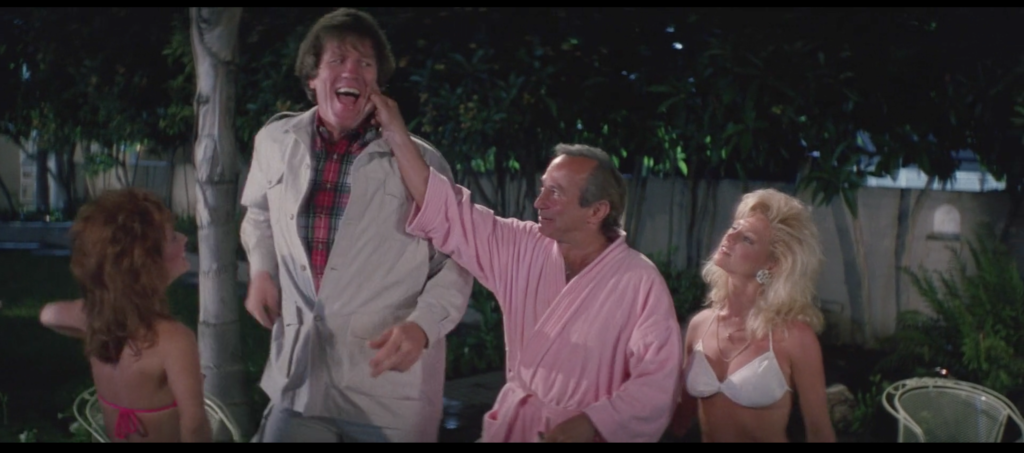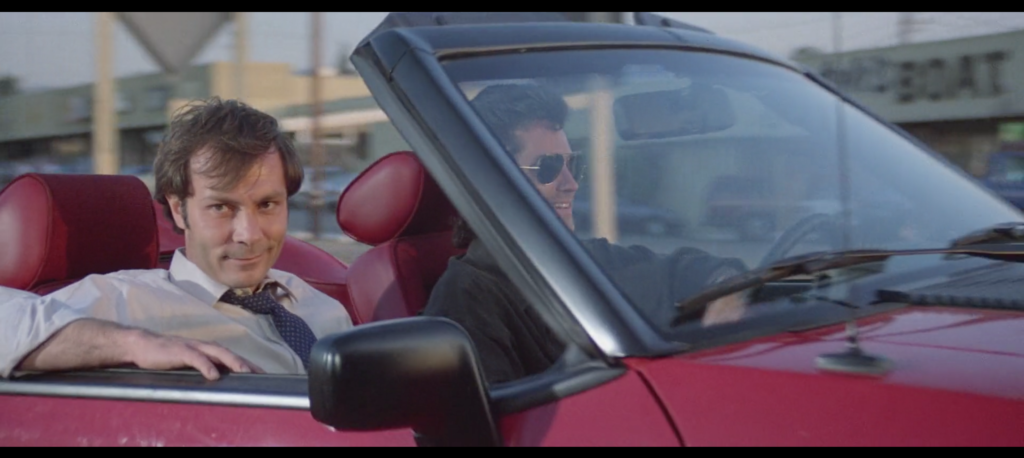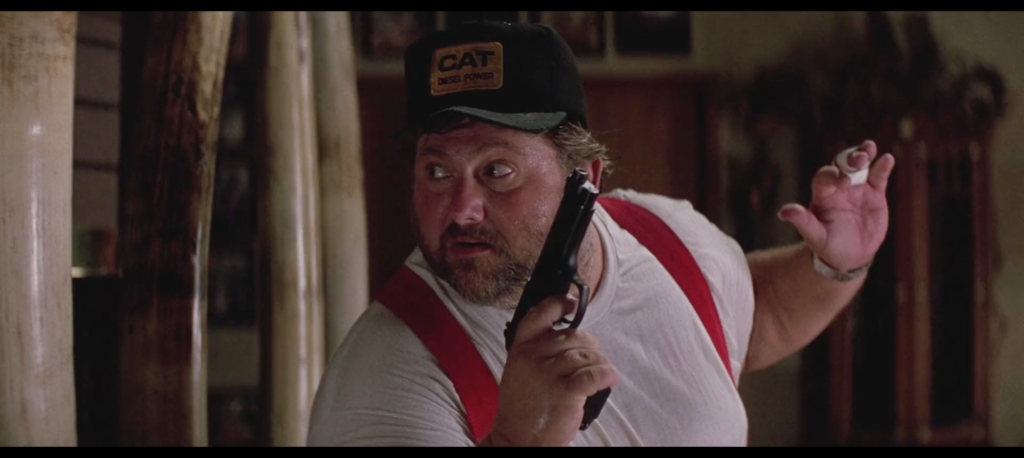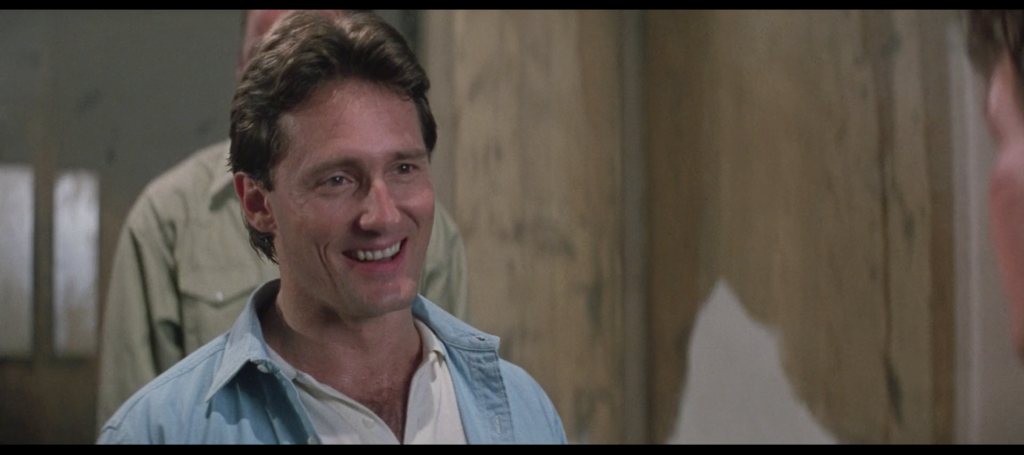
021. Welcome to Jasper


It would be incorrect to say that the “Welcome to Jasper” sign situated atop a clock in the town’s main thoroughfare is the sight that greets Dalton when he first drives into town, because he’s driving into view from the opposite direction. This leaves us with two possible interpretations. Either he’s driven clear across town from one end to the next just to take the place in and we’re catching up with him as he hits the opposite border from where he started, or this sign is an ad hoc affair in a shot the logic of which was not exactly thought through by the film’s director. Considering the strange effect cars seem to have on the amount of sense the movie makes at any given time I lean towards the latter interpretation.

Be that as it may, I hope Dalton caught it in his rearview mirror as he passed by, because it tells him a lot about the town, and the main body of the movie, he’s about to enter. The bright green neon signage is an unusual choice, either for a border marker or for a greeting from the town’s main shopping district. It evokes the neon of the Bandstand sign more than the wooden billboard paid for by the local Rotarians. That, at least, I believe was intentional on the part of the filmmakers. You are entering a Road House town.

The neon itself rests atop a tony-looking Seth Thomas clock. The same manufacturer created the clocks that greet travelers in Grand Central Station. It’s emblematic of both a bygone time and the promise the future held during that time, a past-future when it was possible to go anywhere and be anyone. The neon, too, has its own retro connotations, more sock-hop than Beaux-Arts. They don’t match up.

The combination makes sense only in the context of the film-Jasper’s crazy-quilt approach to authenticity. This is a town of bearded old codgers who raise horses, and also have expensive faux-rustic loft apartments in their barns, located directly across the water from mansions with property big enough for helicopters to land on. It’s the home of countrified fellas named Red who run small auto-parts stores and huge Ford card dealerships, both of which are held up to be models of small-business entrepreneurship against Brad Wesley’s chain-store depredations. It’s a place where one dive bar out of several that we visit can be the stomping ground of a clientele straight out of The Road Warrior one month and a mecca for nightclubbers who pay top dollar to see a blind white boy play the blues the next, predicated on the garish design sensibilities of the bar’s rich owner and the ability of the bar’s cooler to settle all problems in the town with violent force.

And you know that “main thoroughfare” bit? Who knows! I basically made that up, since we never see this place nor anywhere remotely like it ever again. This crowded stretch of commercial development with decent walkability and the network of dirt roads, junkyards, and greasy-spoon diners the rest of the movie traverses have about as much in common as, well, the clock and the neon sign. But each stretch of road broadcasts realness.

Dalton intuits this, which you can see in the way he self-effaces regarding his fancy degree from New York University, but takes the ancient practice of tai chi directly to the shores of Jasper’s lake-river. By turning the sign away from Dalton’s point of view at this early moment, Dalton’s status in the town is left an open question—one quickly answered, true, but that answer is earned. Dalton is welcome in Jasper.

Brad Wesley talks a good game about small-town values and that old time rock and roll, but everything else about him—riding in a chopper, erecting malls, interacting with nature primarily by killing, stuffing, and mounting wild animals from around the world rather than the good ol’ USA—does not. This makes him an interloper, an occupier, a colonizer, someone as out of place in Jasper as a Calvin Klein’s Obsession ad would be below that neon sign and Seth Thomas clockface. Brad Wesley is not welcome in Jasper.

But you are welcome in Jasper, dear viewer. You are welcome here from the start, trusted by the town to take it into your heart in all its complementary contradictions. You must be, because it’s the only way to move forward and drive on to what awaits.

“The Punisher” thoughts, Season Two, Episode Three: “Trouble the Water”

The Punisher is a murder machine. He’s not a gunslinger or a samurai, there to dazzle the audience with brio or technique. To the extent that his lethal maneuvers are impressive at all it’s down to how casual and calculated they are, especially when contrasted with the expression actor Jon Bernthal wears on his face for such scenes. Close-quarters hand-to-hand shit is one thing—that’s where he goes beastmode, growling and bellowing. But when it’s a firefight and his job is to advance on and kill his enemies until none are left, he has the attitude of a person tasked with a difficult but eminently doable task, like mowing the lawn. He puts people down like he’s using a hedge trimmer. Got it, next.

PUNISHER PUTTING THE GUY DOWN WITH A HEADSHOT

The most interesting thing about “Trouble the Water” (The Punisher Season 2 Episode 3) is how it shows the cost this ruthless efficiency extracts in human suffering.

I reviewed the third episode of The Punisher Season 2 for Decider.

“The Punisher” thoughts, Season Two, Episode Two: “Fight or Flight”

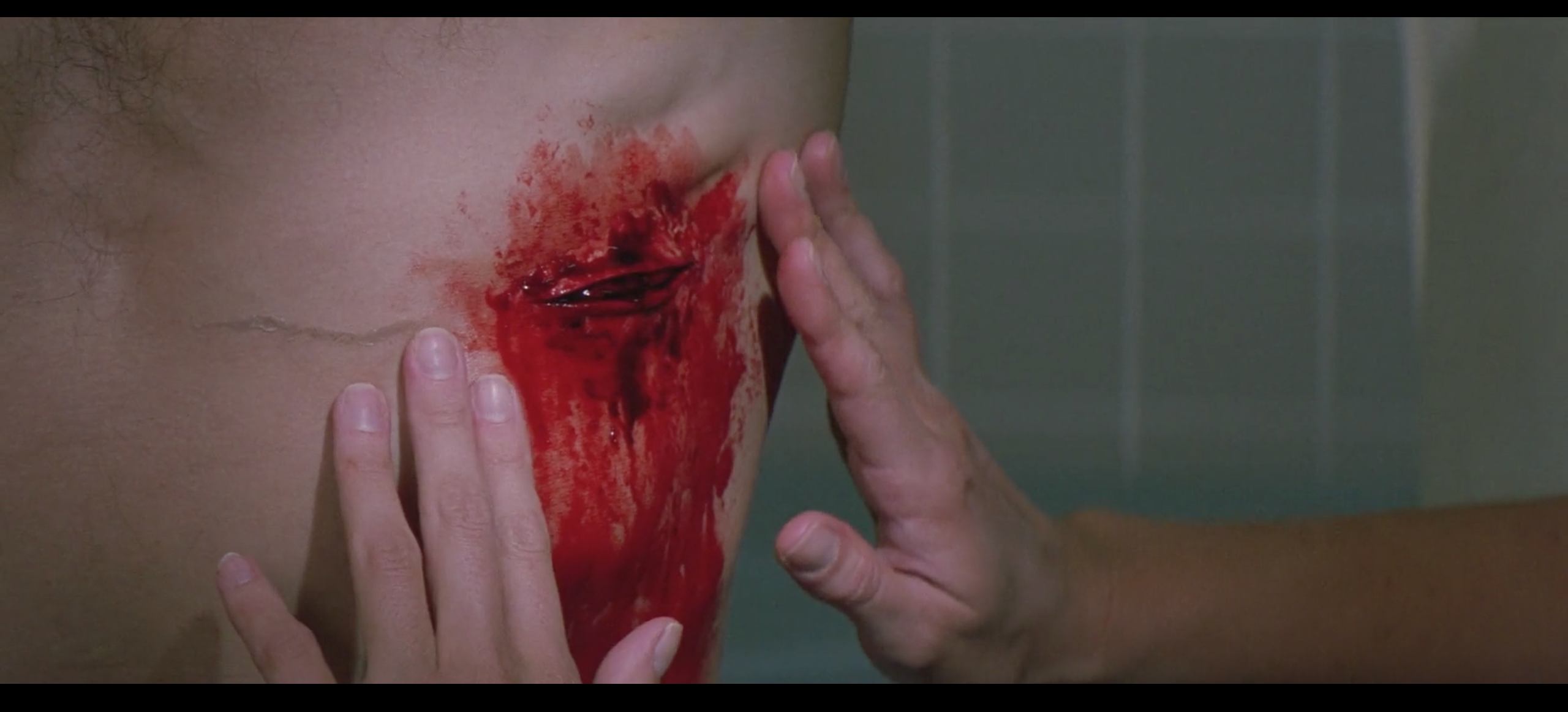
In this episode of The Punisher, a lady uses tweezers to take a bullet out of Jon Bernthal’s bare ass.

punisher 202 BULLET IN THE BUTT

There. Never let it be said that I’m one to bury the lede.

But if there’s one thing the Marvel/Netflix shows, even the ones I’m not crazy about, have been good at, it’s tying their superhero/vigilante violence to moments of physical intimacy. Sometimes this involves the main characters having sex, and from Jessica Jones and Luke Cage to Luke Cage and Misty Knight to Matt Murdock and Elektra Natchios, those scenes have been hot across the board. That’s certainly true on this show as well, from Agent Madani and Billy Russo to David “Micro” Lieberman and his wife Sarah to “Pete Castiglione” and Beth the bartender just last episode.

At other times the violence itself is intimate. This naturally tends to be the case more for the characters who lack super-strength than for those who do, but it’s true. Watching mortal men like Matt Murdock and Frank Castle be made vulnerable by the infliction of violence on their bodies is a display of intimacy. To quote myself quoting Barbara Kruger regarding another show, “You construct intricate rituals which allow you to touch the skin of other men.” Hallway fights are an intricate ritual indeed.

I reviewed the second episode of The Punisher Season 2 for Decider.

020. Nothing personal

“I want you to remember that it’s a job. It’s nothing personal.” We’ll be exploring of Dalton’s three simple rules for bouncing my Jasper road house in depth as the year progresses, but this elaboration of Rule Three, “Be nice,” bears scrutiny here in this early stage of the game. If you want to know what Dalton’s about, you need to see how seriously he takes not taking things personally. For now.

On Dalton’s first night on the job—the night of the Giving of the Rules—he makes a lot of enemies. He fires Morgan the bouncer for being a rat-bastard sadist and Pat McGurn the bartender for stealing from the register; both these men are members of the Wesley outfit and will repeatedly attempt to murder Dalton for costing them their jobs at what is, let’s face it, a complete shithole. He fires Steve the bouncer for having sex with teenagers on the job and he fires Judy the waitress (not that anyone ever says her name in the movie, of course) for dealing drugs on the job; neither shows up again but it’s hard to imagine losing their sexually and/or financially lucrative side hustles along with their day jobs sits particularly well with them. He also encounters a man who reacts to being asked to escort his girlfriend off the table she’s dancing on by whipping out a switchblade and threatening to stab a bouncer to death, and uses this man’s face to break a separate table in half before throwing him out; provided he hasn’t suffered a brain injury, my guess is he’s pissed off about it.

So there’s no surprise, and no shortage of suspects either, when Dalton walks outside and sees that his new car has had its windshield shattered, its antenna broken, and all four of its tires slashed.

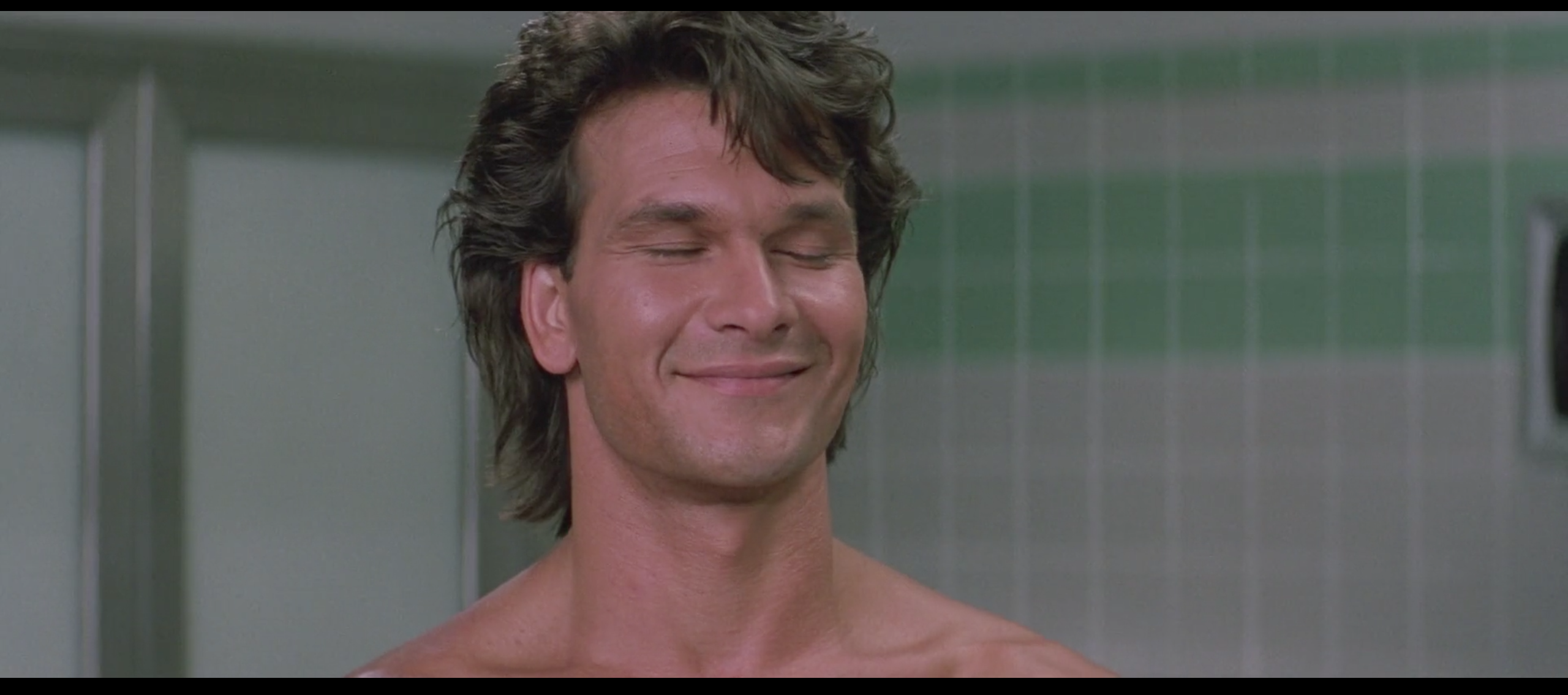
Dalton saw this coming, of course. As previously mentioned, he makes it a habit to buy a beat-up used car while he’s working, knowing how the people he alienates tend to react. But this isn’t grudging acceptance of a bad situation, the way you might grumble standing on line at the grocery store the night before a big snowstorm. When Dalton sees what’s been done to his car, which will require him to jack and replace all four tires at a minimum before he can even think of addressing the other problems, he simply smiles and shakes his head. He’d shoot the same you-gotta-laugh look if he had a toddler who just covered her hair with peanut butter.

This is the face of a man who has a job, who does the job, and who does not take the job personally. His background in philosophy might help. Same with his study of tai chi. And in general he reverts to “laid back” as a default setting when external stressors are absent. And I mean that literally: When Wesley sends his goons Tinker and O’Connor, who recently tried to murder him and got their clocks cleaned for their troubles, to fetch him for a sit-down, he’s lying on the car that their fellow goons most likely vandalized the way a normal person might relax on a hammock.

But the “it’s a job, it’s nothing personal” thing is crucial to understanding the transformation Jasper, Missouri forces him to undergo. With each scene, you can watch his progress from one end of that spectrum to the other. Just know that this is where he starts.


019. Staff

Brad Wesley isn’t the only man in Jasper, Missouri with a goontourage. The employees of the Double Deuce whom Dalton does not fire when he assumes the role of cooler can generally be counted upon to have his back. I don’t think this is just the dubious whipped-dog loyalty of working stiffs to the middle manager who spares their jobs while shitcanning other people instead, either, though god knows we’ve all been there. Dalton brings out the best in good people and the worst in bad people. He’s a moral refinery. Here are the people who emerge purified from the kiln of his character. Most go unnamed, but let us not allow them to go unsung.

Jack

Bouncer. Expressive eyes. Quick on his feet, literally and figuratively. Played by Travis McKenna, whose body type sets him up as the opposite number to Brad Wesley goon standout Tinker, but never used as comic relief (except maybe once, when Brad Wesley goon standout Jimmy uses his prone body as a fulcrum to pole-vault onto the stage at the Double Deuce with a pool cue) and shows much higher levels of emotional intelligence. Fastest-moving character in the film save for Dalton himself. Visibly receptive to Dalton’s advice and instructions. Demonstratively appreciative of his fellow employees’ talents (he’s positively delighted to discover Carrie Ann’s singing voice). Frequently is the first to warn Dalton of Brad Wesley’s bad acts. Most likely to become the Dalton to Dalton’s Wade Garrett sometime down the line. Steve the Horny Bouncer whom Dalton fires due to his regular Saturday night thing calls him “Bear.” No one ever says this character’s name in the movie.

Younger

Bouncer. Just a big ol’ mumble-mouthed meathead, played by Roger Hewlett. Politely raises hand to ask a question during Dalton’s orientation session. Has the least screentime of the three bouncers, leaving the nature of his skill set largely to the imagination. The guy I would least like to tangle with personally, as he seems like he might not notice he’d beaten you to death until long after it was too late. No one ever says this character’s name in the movie.

Hank

Bouncer. The most visually dashing of Dalton’s crew, and the most openly fanboyish about his renowned exploits. Reenacts Dalton’s infamous throat-ripping maneuver, alerting us to this chapter in his checkered past. Frequently takes point in breaking up hostilities prior to Dalton stepping in. Smokes a lot. Played by future real-life murder-suicide perpetrator Kurt James Stefka, because every Lost Highway needs a fucking Robert Blake. No one ever says this character’s name in the movie.

Carrie Ann

Waitress. Singer. Breakfast delivery person. Engine of pure erotic power. Pal and confidante. Just a kickass character in every way. It helps that people do say her name in the movie, that’s for sure. Played by Kathleen Wilhoite and god bless her for it.

Stella

Waitress. Has that weird “German schoolgirl” vibe (description courtesy of MST3K/RiffTrax genius Mike Nelson) common to waitress types circa the filming of the original run of Twin Peaks, which you could probably convince anyone she was a character in as well. Tosses a bottle and hits a nitwit at one point. Played by Lauri Crossman. No one ever says this character’s name in the movie.

Ernie Bass

Bartender. Keith David. Unrealized potential. For some reason people say his name in the movie, though considering how badly he’s wasted who knows why.

The Nameless Bartender

Bartender. Prominent throughout the film. An original employee of the Double Deuce, unlike Ernie, who is brought in when things are flush. Multiple lines of dialogue. No one ever says this character’s name in the movie. No one ever bothered to name this character for the movie. Played by James McIntire, uncredited. There’s gotta be a story here, man.

Cody

Lead singer and guitarist of the Jeff Healey Band. Played by Jeff Healey. Not named Jeff Healey in the movie, though. Plays pretty good for a blind white boy, according to Dalton, with whom he has a long-standing working relationship. Possibly the person who recommended Dalton to Frank Tilghman, though this is never established and neither man seemed to realize the other would be working at the Double Deuce at the time of Dalton’s arrival. Adds much-needed verisimilitude and is a lot of fun to watch and listen to, even if acting is not Jeff Healey’s first calling. Recently I discovered that it’s Cody, not Dalton’s landlord Emmet, who sits on the shore as Dalton and the Doc skinny dip in that water at the end of the movie. They did seem pretty close, certainly.

Cody’s Drummer and Cody’s Bass Player

Drummer and bass player of the Jeff Healey Band. Played by Tom Stephen and Joe Rockman, who are amazingly not related despite both looking like they rolled off the dollar-store Eric Bogosian assembly line in the same batch. Silent observers of the events of the film, a mute Greek chorus. Great hair. No one ever says these characters’ names in the movie, not even “hey, Cody’s Drummer” or “Congrats on the chickenwire coming down, Cody’s Bass Player.”

???

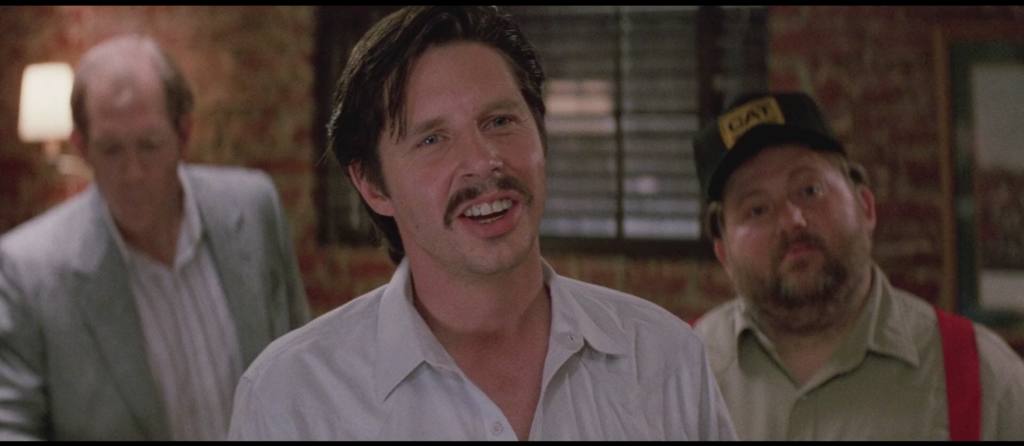
??? That’s him on the left. I don’t know who this man is. This man is in a grand total of one scene, Dalton’s orientation session. This implies he’s an employee of the Double Deuce, but he is never seen before or since. No one ever says this character’s name in the movie. No one ever says his name outside of the movie. No record exists of the actor who played him. No evidence of his existence can be found anywhere beyond these few minutes of footage. Where he’s from the birds sing a pretty song, and there’s always music in the air. LET’S ROCK

“The Punisher” thoughts, Season Two, Episode One: “Roadhouse Blues”

Have we—as a nation, a society, a people—done enough for Jon Bernthal? No, that’s not even the right thing to ask. What viewers of The Punisher, and all other media, must do is take a fearless personal inventory on the Jon Bernthal Question: What have I, personally, done to show respect and gratitude to this great man? If nothing else, The Punisher Season 2 will give all of us the opportunity to look inward and see if we’ve done right by the Last Action Hunk. You hear that, America? Fix your hearts or die.

I reviewed the season premiere of The Punisher for Decider. Jon Bernthal is perfect in this role.

(Note: These episode review summaries will be short while I play link catch-up. You’ll just have to read the reviews!)

018. Keith David

This is Keith David. In 1982, he played Childs in John Carpenter’s The Thing. Childs is the primary antagonist for the main character, R.J. MacReady, played by Kurt Russell. I mean, everyone is everyone’s antagonist, but Childs is the person who’s the most openly suspicious of MacReady and hostile to the way he sort of naturally slides into a command position. It’s too much to say the two men must learn to work together to have any hope of defeating the shape-shifting alien that has infiltrated their remote Antarctic outpost, since there’s no learning involved, but they must work together, that’s for sure. The extent to which they do or don’t is, in the end, the final question asked by the film. David plays the character like a pot of water set to boil at any moment; his chemistry with the less demonstrative but no less gruff and argumentative MacReady is considerable, and essential to the success of the movie, which is one of the greatest horror and science-fiction films ever made.

In 1988, David reunited with carpenter for They Live, in which he played Frank. Frank is the primary antagonist for the main character, Nada, played by “Rowdy” Roddy Piper. Again, everyone is everyone’s antagonist in this film, another stone sci-fi/horror classic about distrust and paranoia in a world where alien invaders can look just like you and me. Beneath the anti-consumerist, anti-capitalist, anti-cop, anti-corporate-media agitprop for which it has become justly famous, They Live takes The Thing‘s survival-horror cabin-fever claustrophobia and simply expands it outward, until the entire planet is the remote outpost on which the last sane men and women are trapped. Having slipped on a specially treated pair of sunglasses that enable him to see the true faces of the alien overlords and the mind-numbing subliminal messages they’ve implanted in every TV screen, billboard, and printed page, Nada is one such sane man, but he can’t fight back alone. He needs Frank, a guy even bigger and tougher than himself whom he met while they made just-above-starvation wages at a construction site, to put on the sunglasses and see for himself, so they can join forces and fight the real enemy. Frank, understandably, thinks Nada is out of his mind. The only way he’ll wear the damn glasses is if he is beaten up badly enough to literally be unable to stop Nada from putting them on his head. This is what happens, during an ugly, sloppy, seemingly endless one-on-one brawl in an alleyway that lasts for six full minutes. It’s just Roddy Piper and Keith David whaling on each other, over and over, for roughly the length of “Hey Jude.” In the end, Frank is made to see the truth, and the two combatants become allies. It’s one of the greatest fight scenes ever filmed.

In 1989, David joined director Rowdy Herrington and star Patrick Swayze for Road House, a film that is to men punching other men in the face and torso what the children’s book series Clifford the Big Red Dog is to big red dogs named Clifford, in which he plays Ernie Bass. Ernie is not a bouncer. Ernie is a bartender. He says “Whiskey’s running low.” I think maybe he says hello to Dalton at some point but I’m not sure. He does not fight anyone, at all, ever. Not one punch. Not even a raised voice. Who knows, though. Maybe he helps guard Jasper, Missouri from the forces of evil by Dalton’s side after the end credits roll. It’s possible, anyway. Why don’t we just wait here for a little while. See what happens.

017. The Double Douche

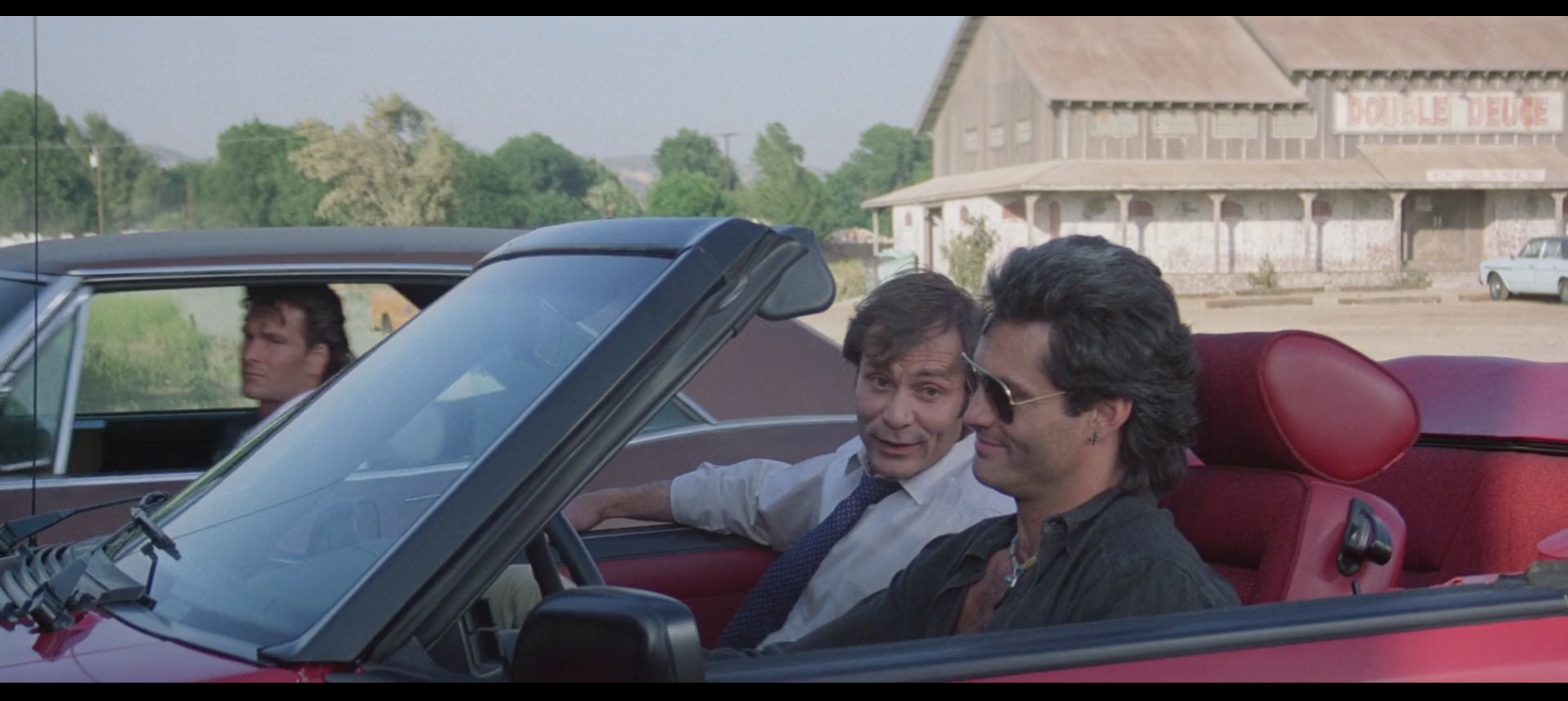
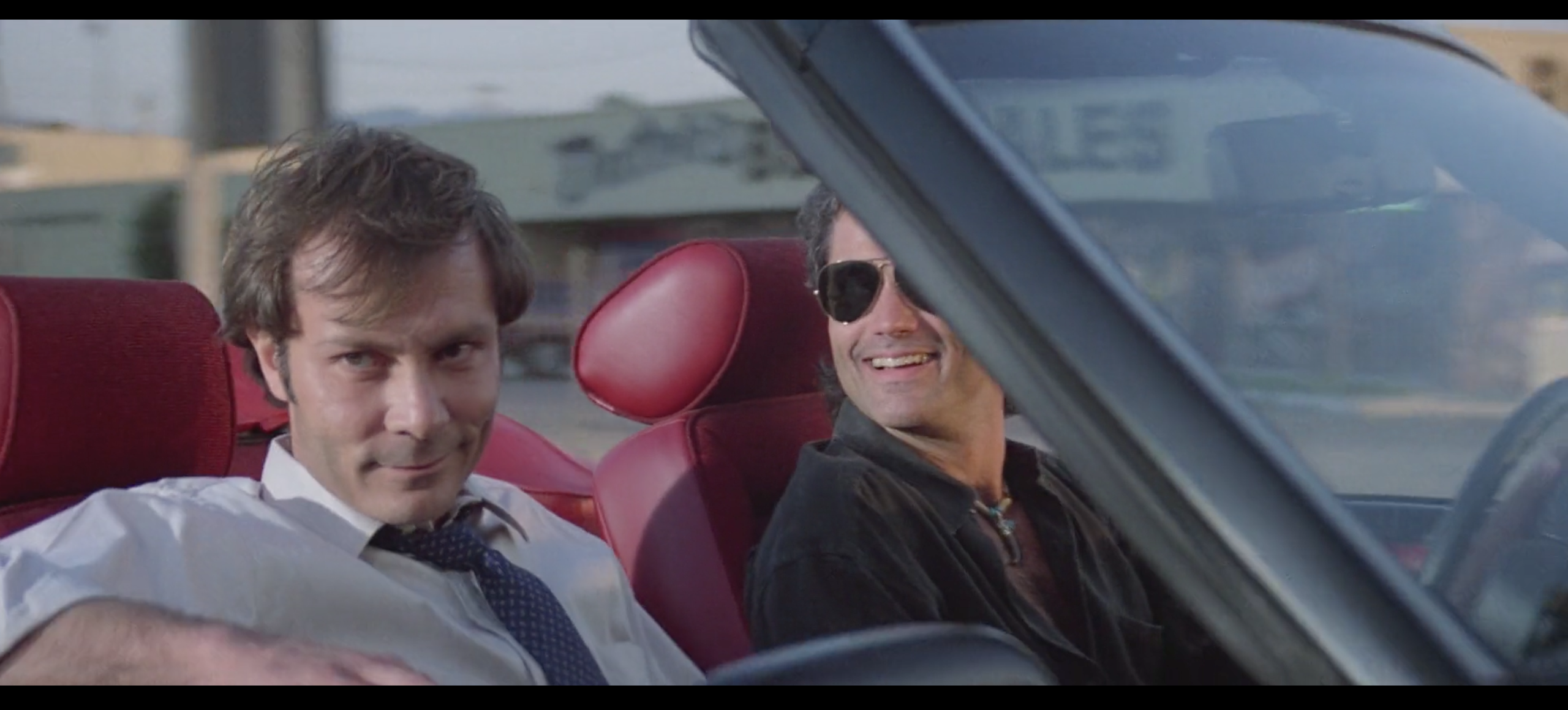
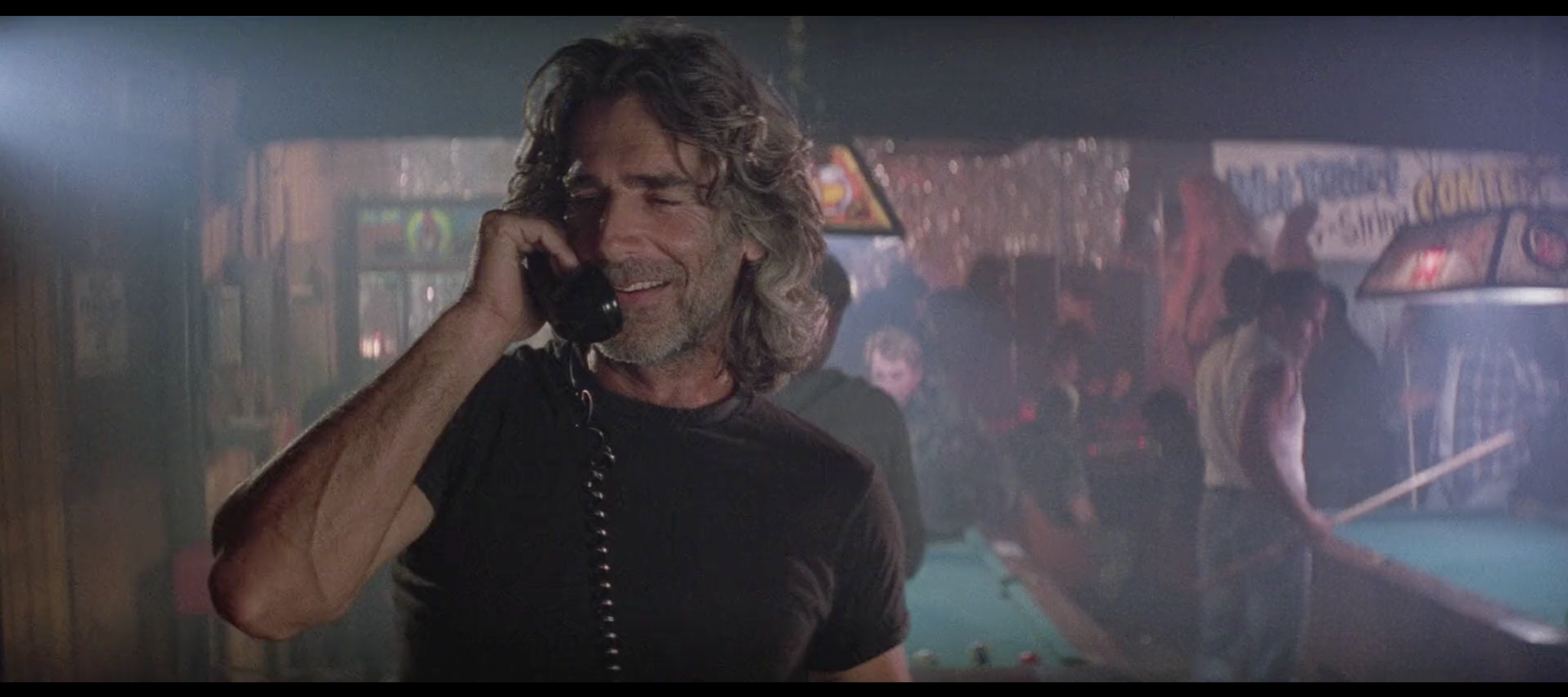
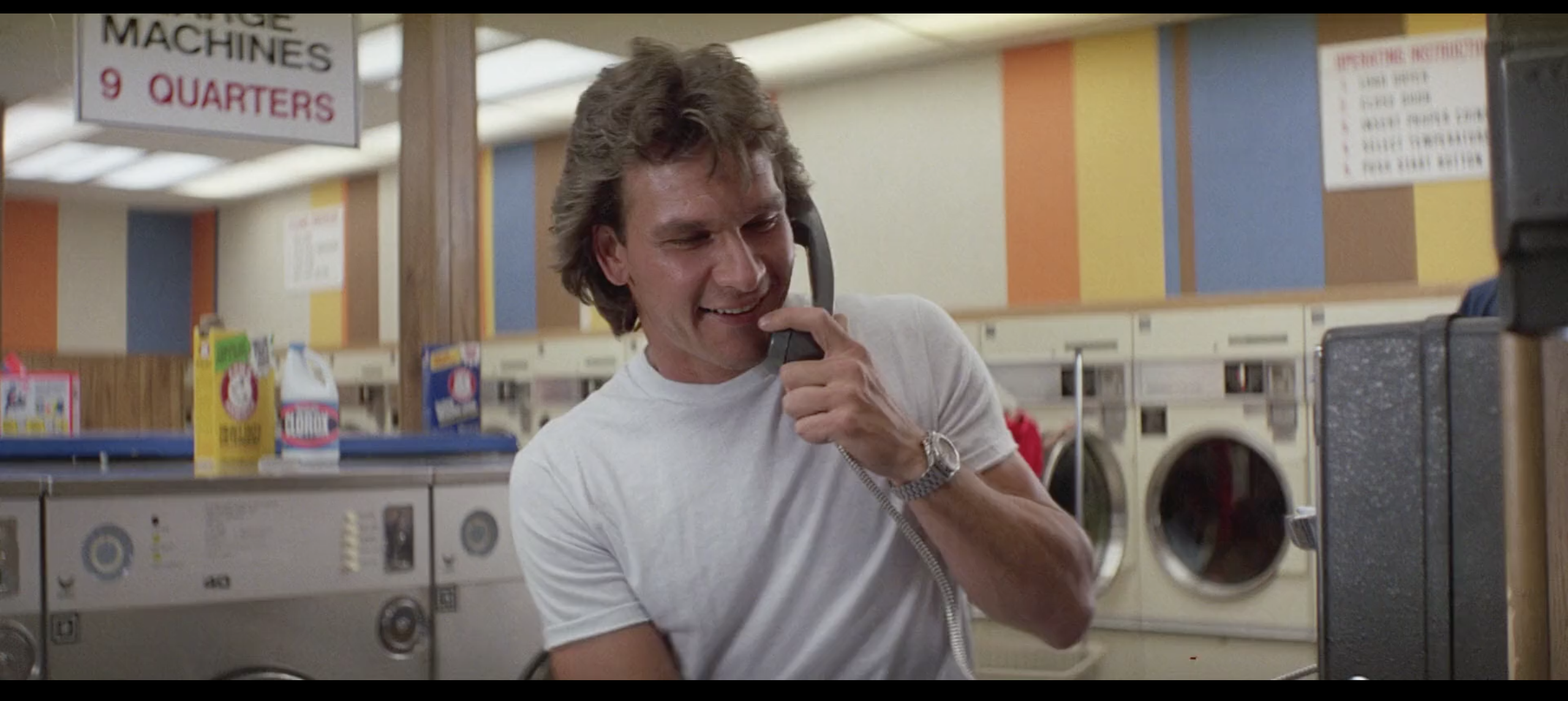
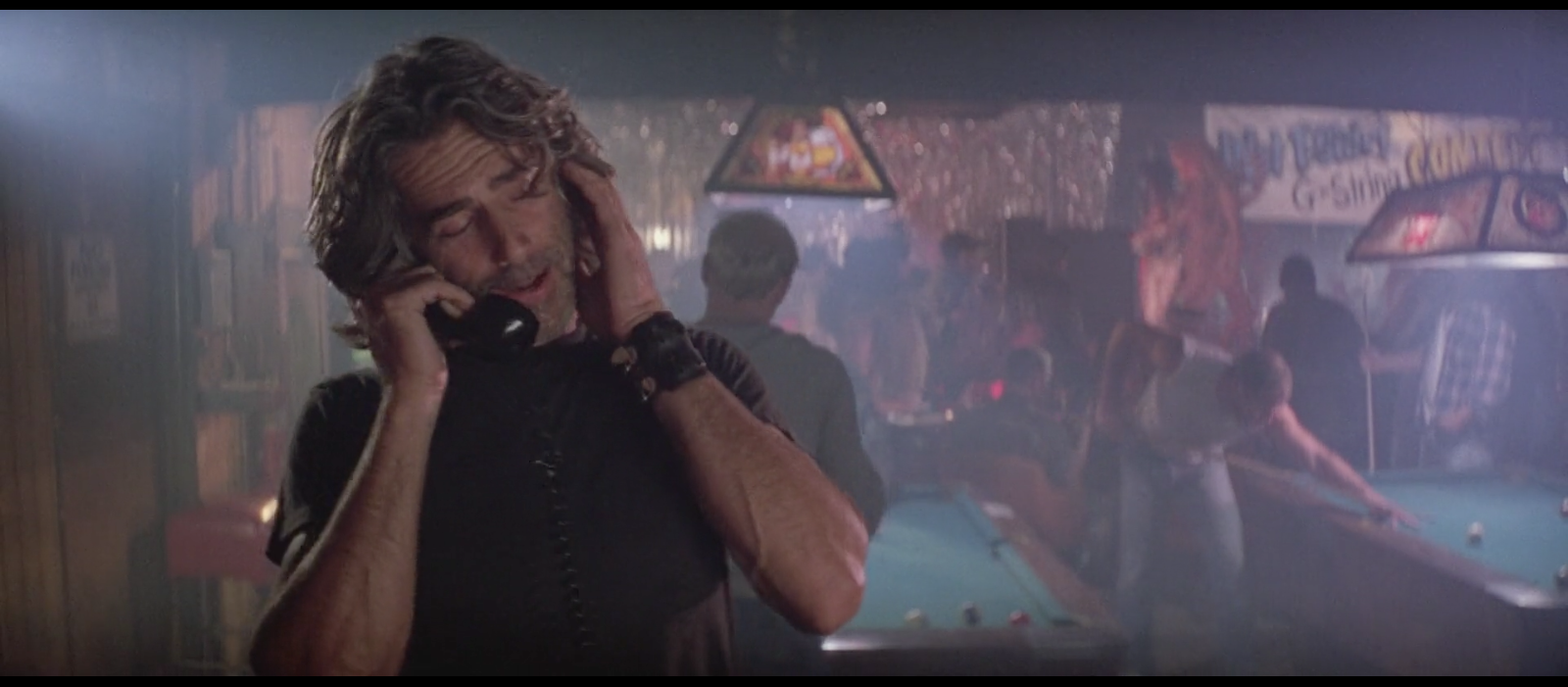
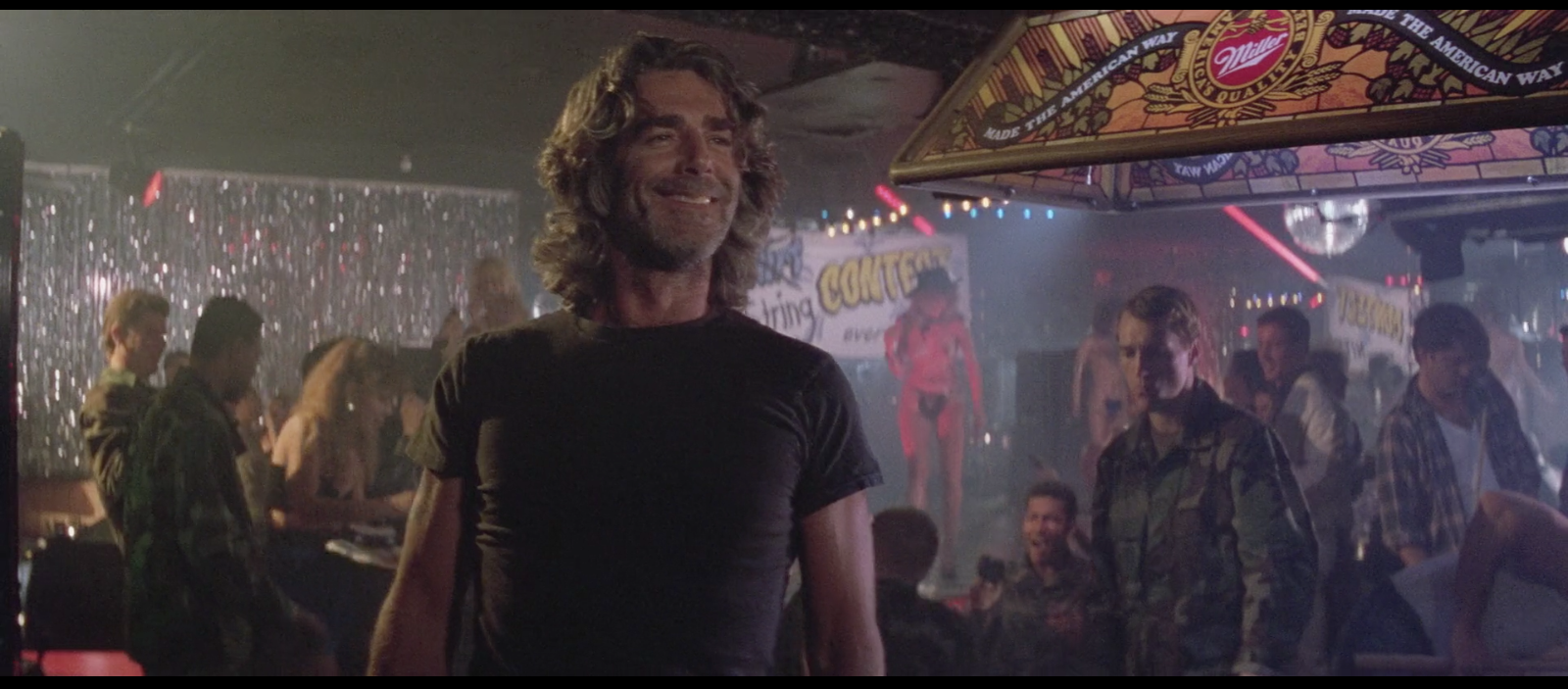
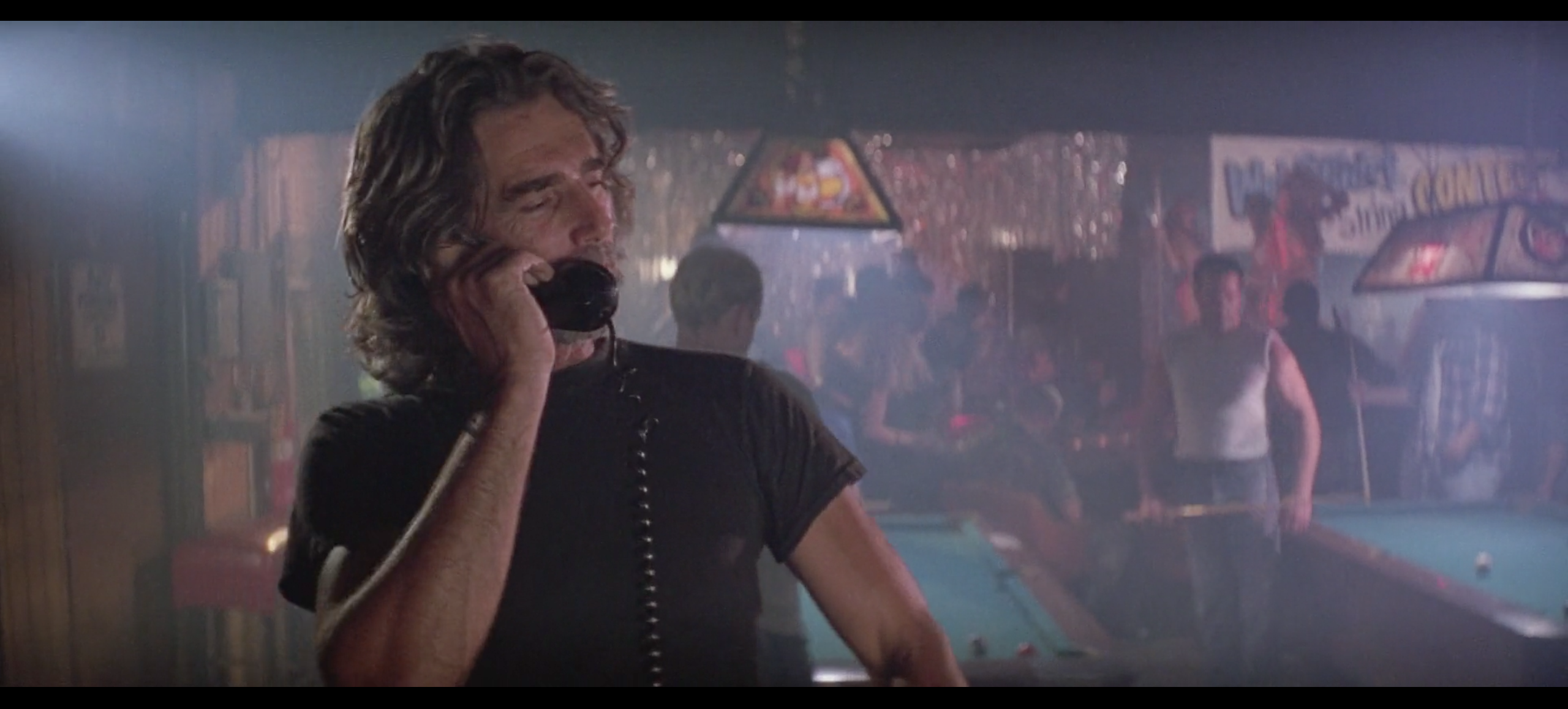
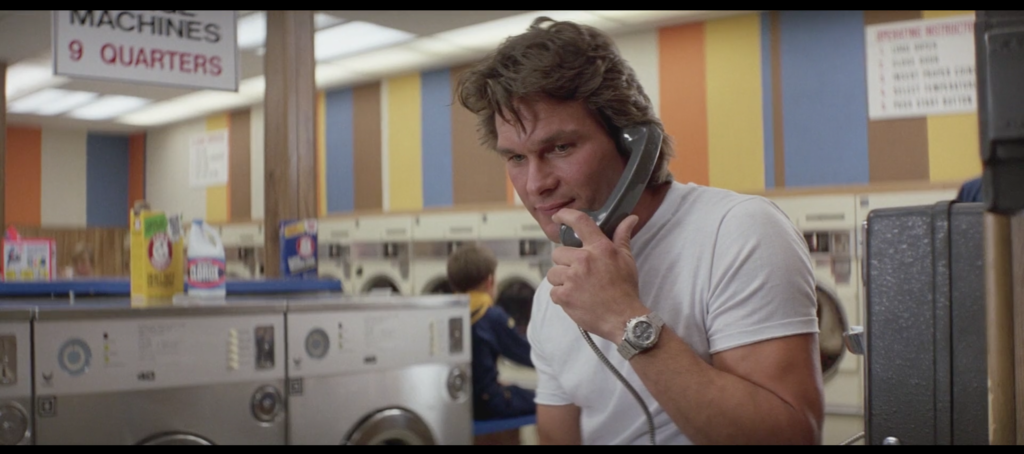
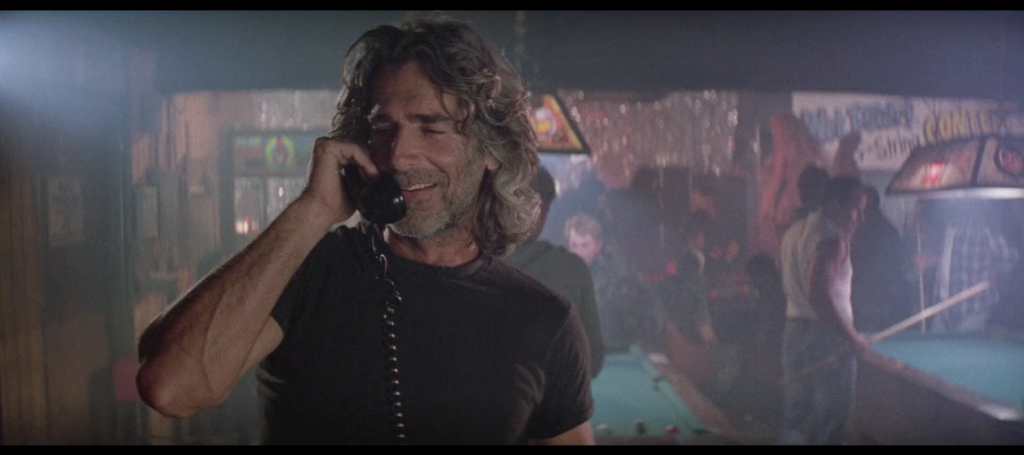
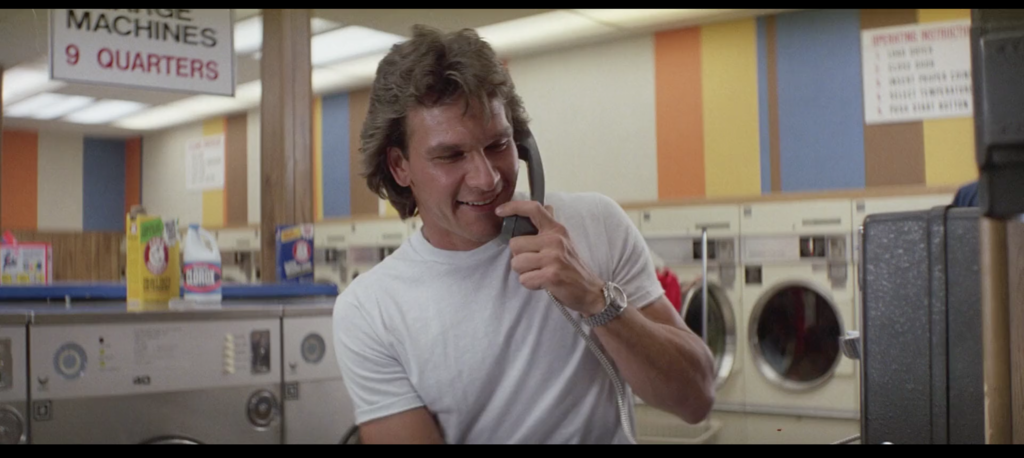
Dalton has worked at the Double Deuce for a while now, and business is booming. The place is packed every night. The bartenders and bouncers wear jaunty red shirts as uniforms. The band is out from behind the chickenwire. The facade has been remodeled to look like a place the gang from Saved by the Bell might visit. There’s just one problem: Brad Wesley has cut off the liquor supply. Dalton, an excellent cooler but not the most excellent cooler, knows this is no job for one man. He makes a call. (He has sex with the Doc.) Then, as Dalton requested, Wade Garrett arrives. Senpai has noticed him.

Wade Garrett is played by Sam Elliott, and what you’re picturing is almost what you get. The voice is there. The sense that you’re looking at a person who’s more beef jerky than man is there. But this isn’t the fine upstanding cowboy who wishes the Dude wouldn’t use so many cusswords. (Nor even the actual pitchman for beef.) Wade Garrett is a bit dangerous, a bit sleazy, a lot sexy. “Louche” might cover it.

So when Wade Garrett pulls up on his motorcycle, he doesn’t so much dismount the bike as ooze off of it. You can all but hear his bowlegs creak and stretch, smell his two-day post-shower aroma spiked with cigarette smoke and exhaust fumes and hot asphalt, feel him adjust his hips to ensure he’s doglegging in the proper direction within those skinny black jeans.

Wade Garrett looks up at the Giuliani Times Square marquee Frank Tilghman has erected over the former dive bar where young Dalton works, runs his hand over his greasy gray hair, and reads the name aloud: “The Double Douche.” [Sic.]

Why does he pronounce it this way? On one level I assume it’s a tip of the hat to the all-time god-emperor of pronouncing “deuce” as “douche,” Manfred Mann’s Earth Band’s version of the early Bruce Springsteen composition “Blinded by the Light.” Wade does have his shades on, and it is very bright out.

But it’s more than that. It’s a demonstration of Wade’s contempt for anything but the work of cooling itself. You can wrap it up like a Deuce, or a Douche if you will, but beating up the people who beat other people is what he’s here for. No delusions, no pretensions. He came to fight. To quote the man himself when he’s asked “Are you gonna fight, dickless?” a couple minutes later, “I sure ain’t gonna show you my dick.”

And it’s a signal that whatever his affection for his protégé Dalton, he shares little of the younger man’s philosophical outlook. It’s hard to imagine Wade Garrett telling anyone that being called a cocksucker is just “two nouns combined to elicit a prescribed response.” Wade is too much of the wild man, too much the heir to Mifune in Seven Samurai. Wade’s world is one of George Carlin’s seven words, several of which he lets fly before his untimely demise. It’s a world of sweat and blood and sexual fluids. Those are things he understands. Those are things he treasures.

This is not to say that Dalton is a slacker in any of those departments—far from it. It’s just that he maintains a certain detachment from it all. Not so Wade. He’ll pull his sidekick’s ass out of the fire one minute and compliment his sidekick’s girlfriend’s ass the next. He’ll show a woman he just met his pubic hair in order to reveal a wound incurred from a previous woman who was presumably well acquainted with his pubic hair before things went south, so to speak.

Speaking of bad breakups, the horrible crime of passion that haunts Dalton? Wade blames the woman whose husband Dalton murdered with his bare hands more than Dalton himself on account of her never revealing her marital status, and sees it as a simple matter of kill or be killed. Yet he’ll expose intense feelings like that only when pushed by the man closest to him, Dalton himself. Otherwise Wade Garrett is, as Billy Joel would put it, quick with a joke or to light up your smoke. He’s still cracking wise the last time we see him alive, after he’s been beaten half to death.

Put succinctly, Wade Garrett the type of guy to ride hundreds of miles to the rescue of his best friend, then make a sophomoric douche joke when he arrives. There are many ways to be an itinerant bouncer-sage in this world. The path of Wade Garrett is but one, as valid as any other.

016. A Great Buick

Where to begin with Frank Tilghman. As played by Kevin Tighe, silver-haired proprietor of the Double Deuce is a singularly unpleasant person to observe. He walks like a man who’s sneaking up on you even when he’s coming at you straight on. His smile is stuck in the “leer” setting. His eyes gleam with the dubious good cheer of a man who knows a secret enjoyable only to himself, like the retiree who leaves out bowls of antifreeze for the neighborhood cats, or the assistant manager at the Stop & Shop who occasionally rubs his genitals on the produce. He is the first main character we meet, when he shows up at the Bandstand to hire Dalton; anyone who doesn’t assume he’s the villain from his look and behavior during that sequence should be a prime target of the social-engineering hackers your office information-security training module warned you about. Yet he isn’t the villain, because somehow there’s an even weirder and more inappropriately chipper old man out there waiting for us.

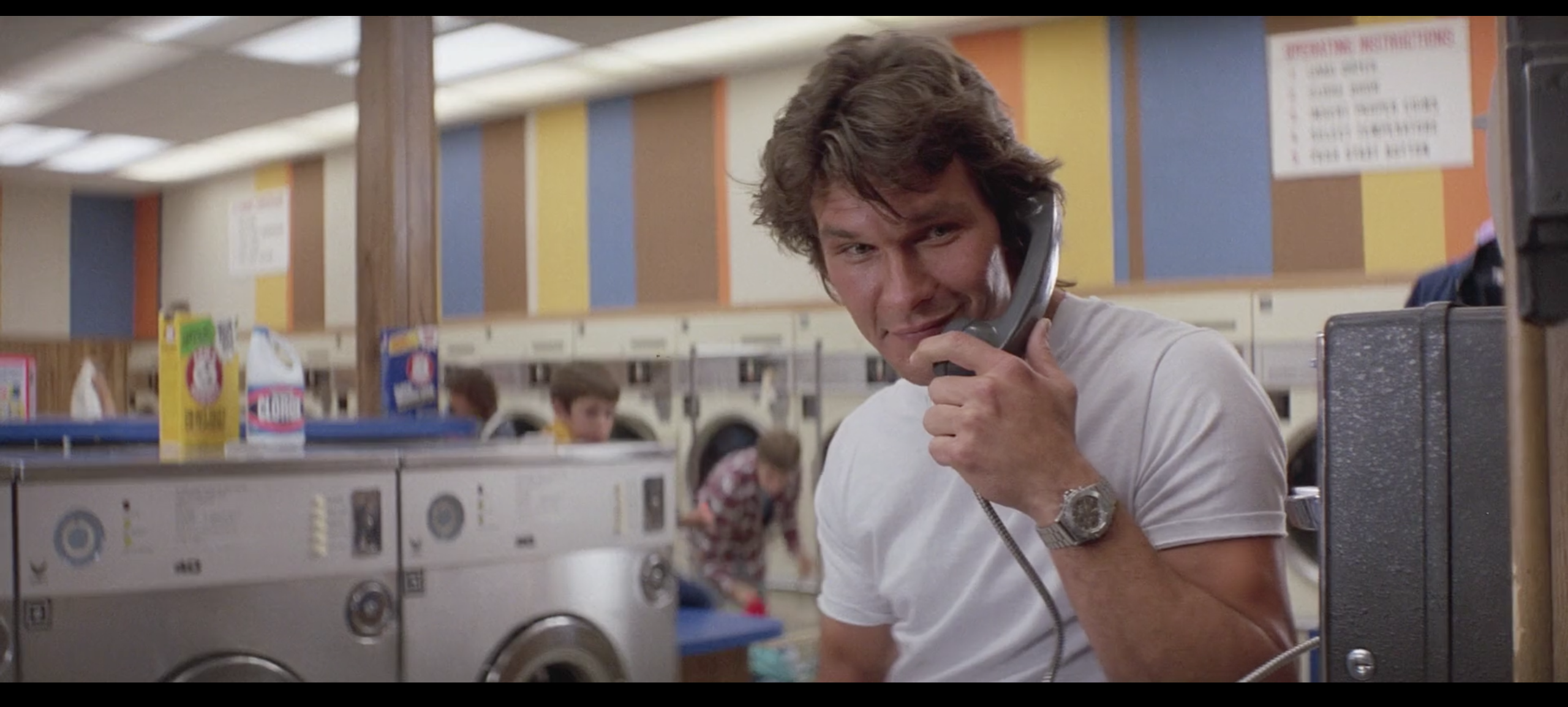
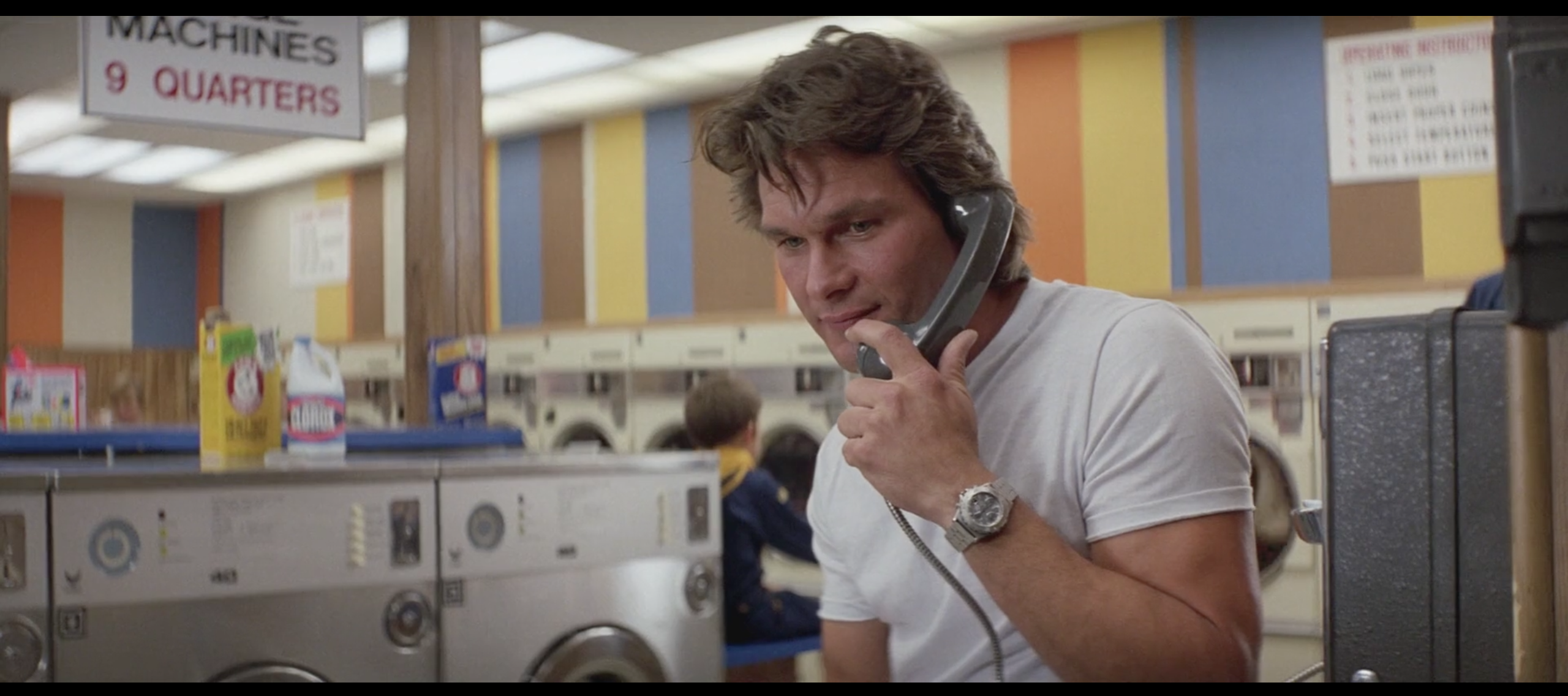
But until we meet Brad Wesley, the only proof of Tilghman’s good intent we have—virtually our only glimpse of his interior self at all—is when he changes the word “FUCK” to “BUICK” in the graffiti next to the Double Deuce’s payphone.

I won’t say I know what you’re thinking, because when Tilghman’s the topic of discussion all thoughts are permitted. But you might be thinking “Changing an obscene lavatory-wall come-on into a classified ad for a used car isn’t necessarily Good Guy behavior. The whole thing smacks of Capital.” That much is true. It’s the way Tilghman goes about this completely ridiculous act of appropriation that indicates his true character.

After hanging up the dangling handset back in the cradle, he notices the vulgar legend “FOR A GREAT FUCK CALL 555-7617,” which stands out amid all the other crude scribbles (“KATHRN THE GREAT & MR. ED” is written in white nearby, for instance) due to its size and bright red color. Looking over his shoulder, as if he’s the dirty-minded solicitor who might get caught by the owner of the bar, he produces a black Sharpie, unconvincingly converts the “F” to “B,” and slips an “I” between the “U” and the “C.” Voila: FUCK is now BUICK. Somewhere out there, the Four Car Salesmen of Jasper, Missouri rest a bit easier. (They’re most likely in Jasper, Missouri, admittedly.)

Then, before smiling in self-satisfied fashion and walking away, comes the coup de grace: He adds a little dot over the “I.” Yes, everything is in all caps, and no, he doesn’t care. He’s going to dot his I’s and cross his T’s, goddammit, even if it costs him in terms of verisimilitude. A man with pretensions to class that unwavering is absolutely a man who’d hire a wandering philosopher-bouncer to clean the joint up for a mid-six-figure yearly salary with no ulterior motives whatsoever. I respect this strange man. Not enough to risk death every night so that his house band doesn’t have to play behind chicken wire for safety’s sake anymore, perhaps, but I respect him.

Music Time: Trent Reznor/Atticus Ross – Bird Box (Abridged) Original Score

Starting with 2008’s sprawling collection of instrumental work Ghosts I-IV (released under the Nine Inch Nails aegis) and accelerating with 2010’s Oscar-winning score for David Fincher’s The Social Network, the instrumental side of Trent Reznor has effectively shared equal billing with the more traditional industrial rock that made him a superstar. Never one for half measures, Reznor clearly sees the film-soundtrack work done alongside his longtime composing partner Atticus Ross as a chance to flex. “We aim for these to play like albums that take you on a journey and can exist as companion pieces to the films and as their own separate works,” Reznor wrote recently. He’s not kidding: The duo’s score for Fincher’s 2011 film The Girl with the Dragon Tattoo, for instance, is 15 minutes longer than the movie itself.

In announcing the release of Bird Box, the score for Netflix’s treacly Sandra Bullock survival-horror film of the same name, Reznor described it as a way of presenting the audience with “a significant amount of music and conceptual sound” that didn’t make the film’s final cut. Even then, that “Abridged” parenthetical in the title points toward “a more expansive” version of the album due later this year. It’s just as well since what Reznor and Ross have created is better than the movie they created it for. It does exactly what good soundtracks are capable of doing, and what they expressly intend for it to do: Emerge as a rewarding experience in its own right.

I reviewed Trent Reznor & Atticus Ross’s Bird Box score for Pitchfork.

015. The Shirtless Man

A key piece of the ambience during our introduction to the Double Deuce, the Shirtless Man is an unsung hero of Road House. He’s on screen in the shot that immediately follows the “DIRECTED BY ROWDY HERRINGTON” chyron, shown over the exterior of the Double Deuce as Dalton enters for the first time. This means he’s a tone-setter both in-story and on a meta level. In the Road House world, he is implicitly Dalton’s introduction to the place he’ll be working in, and an indication of the kind of place this is. In the audience, he is implicitly crucial to director Rowdy Herrington’s vision, and an indication of the kind of movie this is.

This pans out in both respects. It’s true that the Shirtless Man does not participate directly in any violence; in the massive, bar-destroying brawl that begins a few minutes after we first see him he’s a non-factor. He’s just a huge blond musclebound cornfed doofus, dancing his ass off to the musical stylings of the Jeff Healey Band. Picture the way Rocky rocks out to Meat Loaf singing “Hot Patootie – Bless My Soul” in The Rocky Horror Picture Show and you’ve got a good handle on his overall affect (and talent as a dancer).

But I think of the Shirtless Man often later in the film, when Dalton institutes his clean-up regime to turn the Double Deuce into a place decent people will want to visit. We’ve discussed some of the personnel changes he makes already. The other problem, as he sees it? The thing that’s keeping “people who really wanna have a good time” away? “Too many 40-year-old adolescents, felons, power drinkers, and trustees of modern chemistry.” It’s unclear into which category the Shirtless Man falls, but it’s almost certainly at least one, if not more.

Sadly, the new and improved Double Deuce has no room for men this brazenly bare-chested. There’s a time and a place for shirtlessness, and it’s on the shore of the lake, doing tai chi. The next time we see the Shirtless Man is on Dalton’s first real night of work there; what he’s wearing wouldn’t pass a high school dress code, but it certainly qualifies as a shirt. After that things really turn around and we never see him again.

Yet his ebullient presence at this stage in the film points out a rare flaw in Dalton’s reasoning. Later in the movie, when Brad Wesley’s knife specialist Ketchum (please note that he is never named in the film, unlike all the other prominent goons who make it to the end, which is a part of why he’s impossible to remember) arrives to rough the place up, Dalton says the place is closed, despite all the people “drinking and having a good time.” Ketchum says that’s why he and his henchmen are there too, and promptly tries to kick-stab Dalton’s head with a high kick from his boot-mounted knife. Dalton doges the kick, catches his leg in mid-air, and bellows “You’re too stupid to have a good time!”

The emotional logic of the fight that follows puts Dalton in the right; he and the bouncers defeat Ketchum and his fellow goons, with a late-arriving Doc looking on. But he didn’t factor the Shirtless Man into his calculations, did he? That big towheaded slide of beef is most likely stupid, and is very clearly having a good time when we see him. You can push him and his kind out to make room for people who don’t violate the basic tenets of entrance into a 7-Eleven, yes, but you can’t erase his existence. Dalton may deny it, but if Road House teaches us anything, it’s that stupidity and good times often go hand in hand, and the Shirtless Man is living proof. There are more things in heaven and earth, Horatio, than are dreamt of in your philosophy degree from NYU.

“True Detective” thoughts, Season Three, Episodes One and Two: “The Great War and Modern Memory” and “Kiss Tomorrow Goodbye”

Already you can see that this isn’t just Season One Redux. Like McConaughey’s tortured cop, Wayne is lonely. But he’s just a bachelor, not a guy who sleeps in a bare room with a crucifix above his mattress. He’s a drinker, but just ties one on a few times a month rather than pounding a six pack during a deposition. He suffers from mental illness as an older man, but it’s not, uh, whatever makes you see spirals in the sky and say stuff like “time is a flat circle” to homicide detectives.

Wayne’s partner Roland is a less well-defined figure at this stage in the season than Woody Harrelson’s Marty Hart was during his. But so far, despite playing the straight man/good ol’ boy role in the partnership, he isn’t half the sexist shitkicker his predecessor proved to be. What’s more, Roland trusts his mercurial counterpart implicitly, defending the unorthodox tracking technique he picked up in ‘Nam when the local fuzz takes issue with it. That whole “one guy says something insanely profound (or profoundly insane) and the other guy tells him to shut the fuck up” dynamic is nowhere to be found.

Nor are the one-dimensional, do-nothing female characters from Season One. Ejogo’s Amelia is a full-fledged person, a welcome development that follows McAdams’ talking point last season. The show still isn’t perfect on this score — the documentarian character is an oblivious do-gooder whose talk of intersectionality and oppression we’re clearly supposed to find baffling and laughable — but we’ll take it.

I’m back on the True Detective beat for Rolling Stone, starting with my review of last night’s two-episode season premiere.

014. Carrie Ann looks at Dalton

I’ve been saying this for years, but it’s risky to write about what turns you on. When I first started reading the work of the woman who’d eventually become my partner it was hot in such a raw, unvarnished way—to me anyway, which explains a lot about what happened afterwards—that I wondered if she felt particularly bold or scared or vulnerable just putting it out there. Sex scenes are one thing, pretty much everyone who has sex enjoys it and even people who don’t usually enjoy watching it. But sex scenes, or scenes of sexuality, that tease out or revolve around a specific fetishized behavior aside from the basic forms of erogenous-zone contact or what have you…writing that stuff, or writing about that stuff, is in its own way as revealing as taking off your clothes.

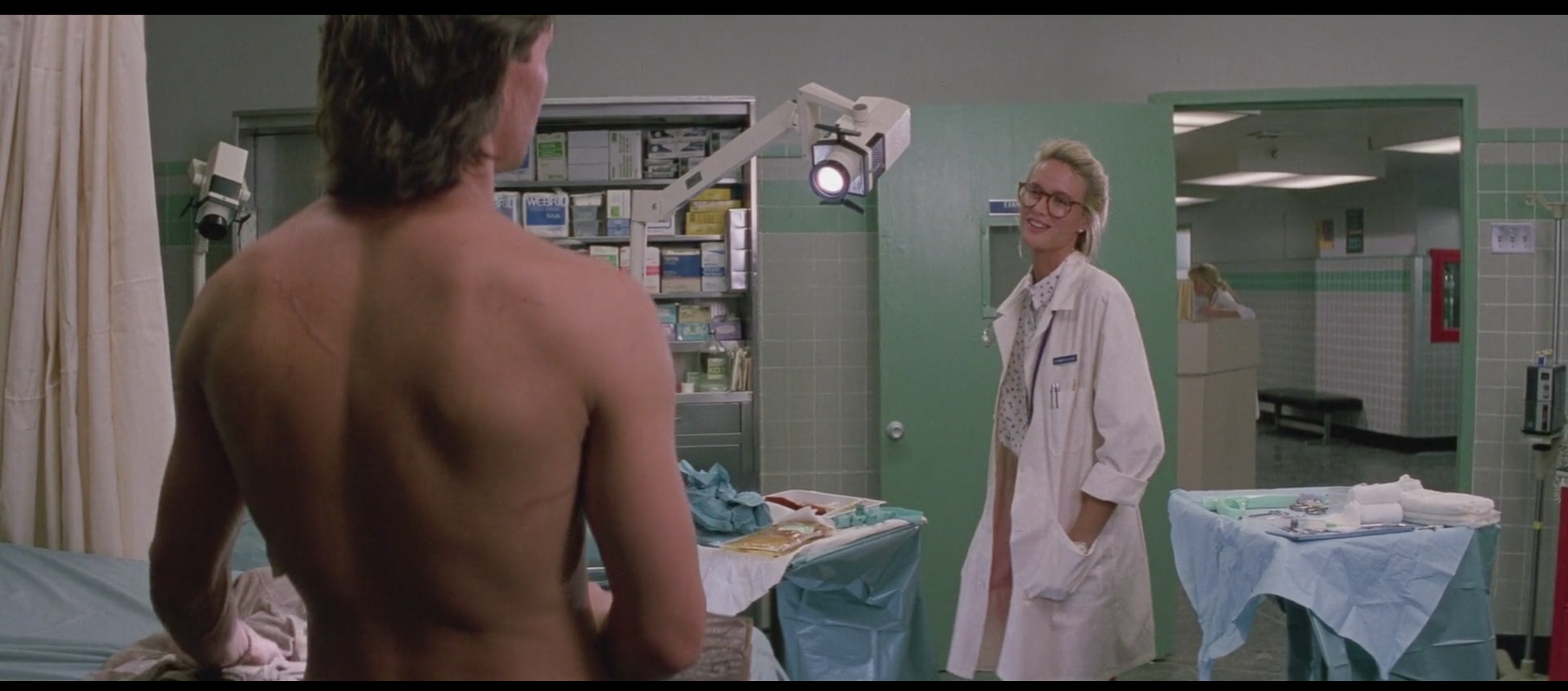
Anyway, the scene in which Double Deuce waitress Carrie Ann sees Dalton nude is the single most erotic thing I’ve ever seen in a movie.

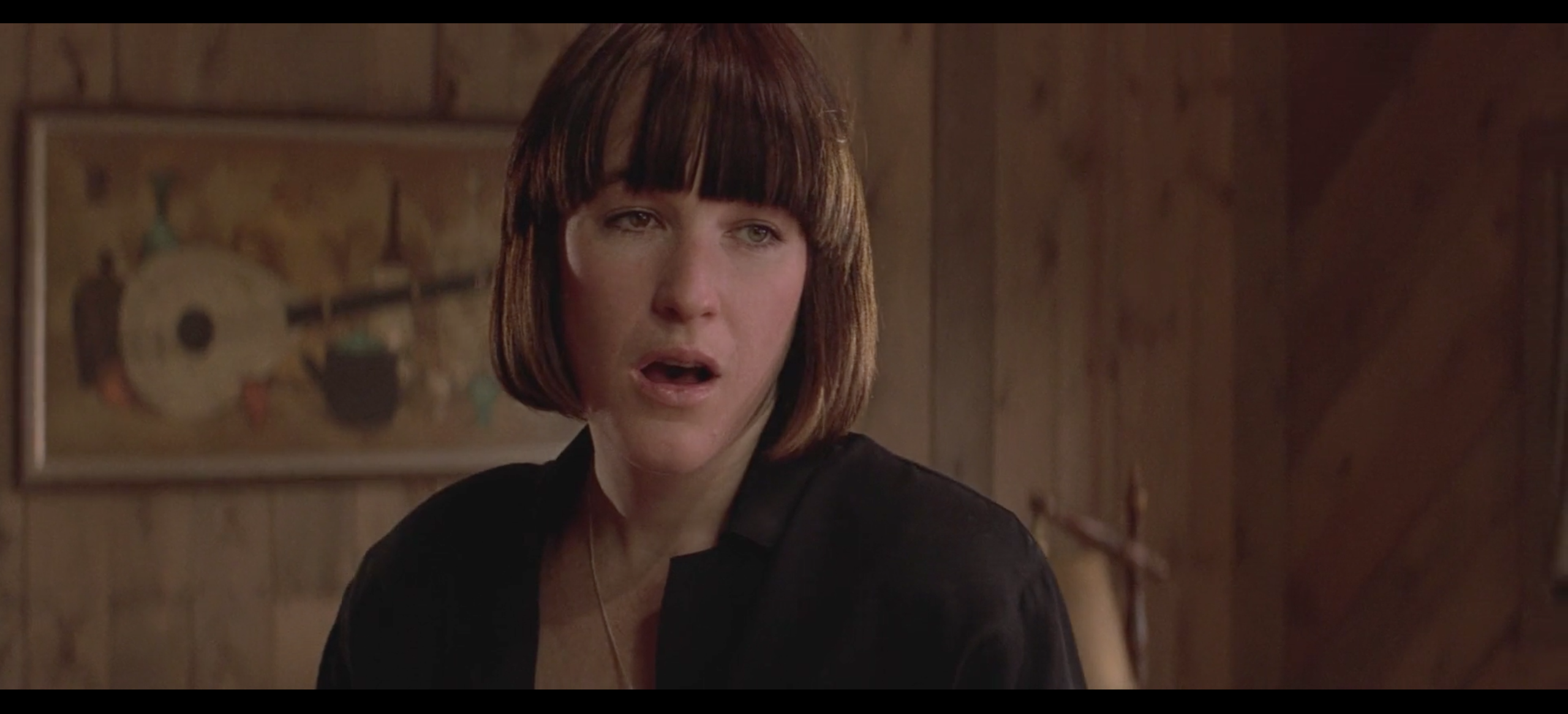
Played by Kathleen Wilhoite in one of the film’s least bizarre, most straightforwardly fun performances, Carrie Ann is what might have been called in earlier times a broad. She’s got a great brassy voice that she uses to dress down the Double Deuce’s belligerent bad element when Dalton first arrives and needs to get the lay of the land, eg. “Don’t let him bahhhther yew—Morgan was born an asshole and just grew bigger.” She’s the only female member of the core cast we ever see throw hands, when she smashes a bottle over a dude’s head during the movie’s first big brawl. Later in the film she’s revealed to have a terrific blue-eyed-soul voice, which she demonstrates by taking lead vocals for the Jeff Healey Band’s cover of “Knock on Wood.” (“I didn’t know she could sing!” announces the most adorable member of Dalton’s bouncing crew as the two men look on, grinning from ear to ear.) During the early-morning breakfast-delivery run she makes to Dalton during this scene, she’s mostly there to dispense greasy food and hard truths about the trouble he’s getting himself into at the bar, with a fuck-em-if-they-can’t-take-a-joke smile on her face the whole time.

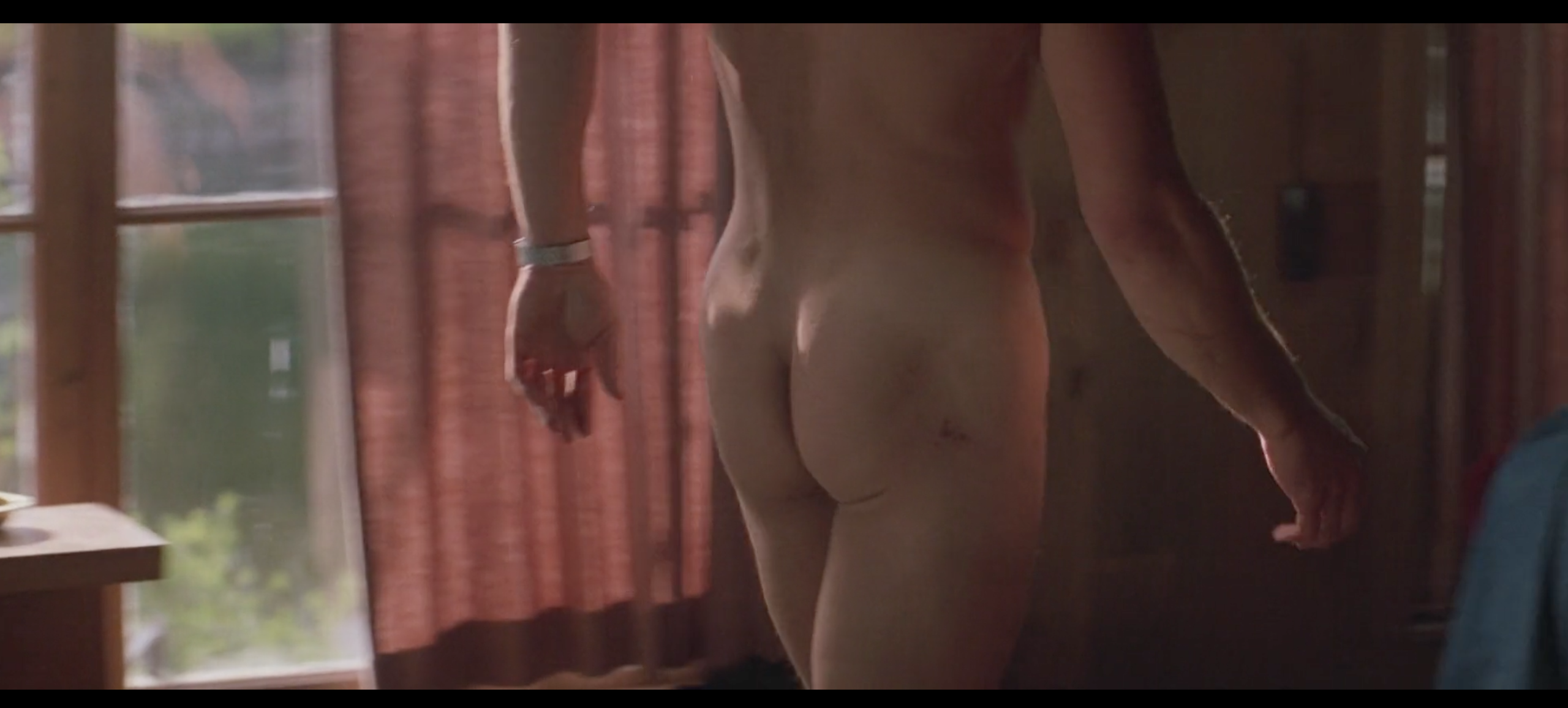
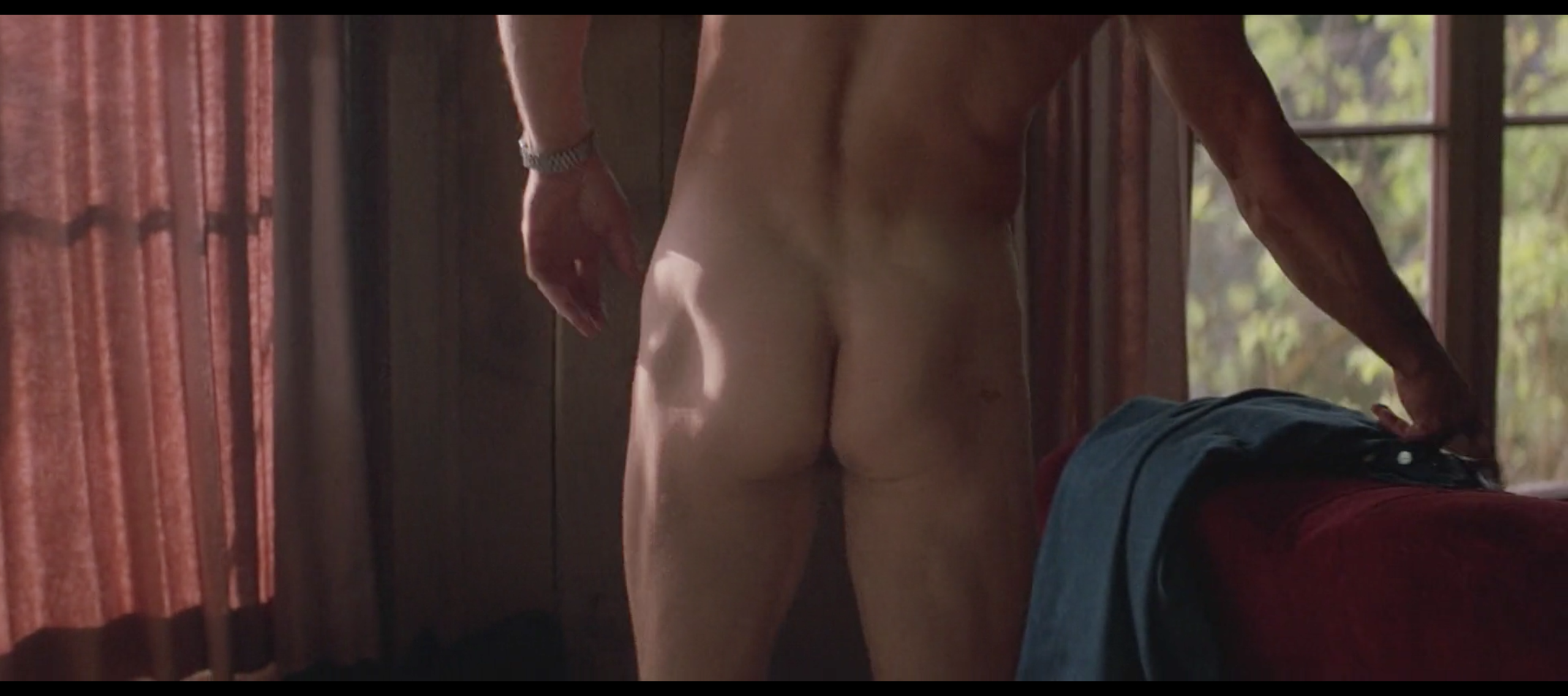
That’s what makes her reaction to Dalton’s bare ass, and implicitly other parts, so powerful. This beautiful man’s naked body strikes this seen-it-all chatterbox dumb.

And like, on one level, yeah, of course it does. I mean, look at him.

Carrie Ann isn’t the only woman bowled over by Dalton’s attractiveness—you’ll recall, perhaps, Denise sizing him up—and she’s certainly not the only person to look at him in this way either. Indeed, the way women look at Dalton is largely indistinguishable from how men look at him, which is part of why the “male swayz” is such a standout phenomenon. The gaze of Carrie Ann, Denise et al conditions us for the gaze of Emmet, Wesley, Jimmy, Karpis, Tilghman and so on.

But no one looks at Dalton the way Carrie Ann does, because she’s the only person we ever see looking at him naked. (Dalton and Elizabeth are fully clothed when they start having sex; when they go for round two in the nude, it’s shown from a distance. We never see what Doc looks like when she looks at her man’s bare body.)

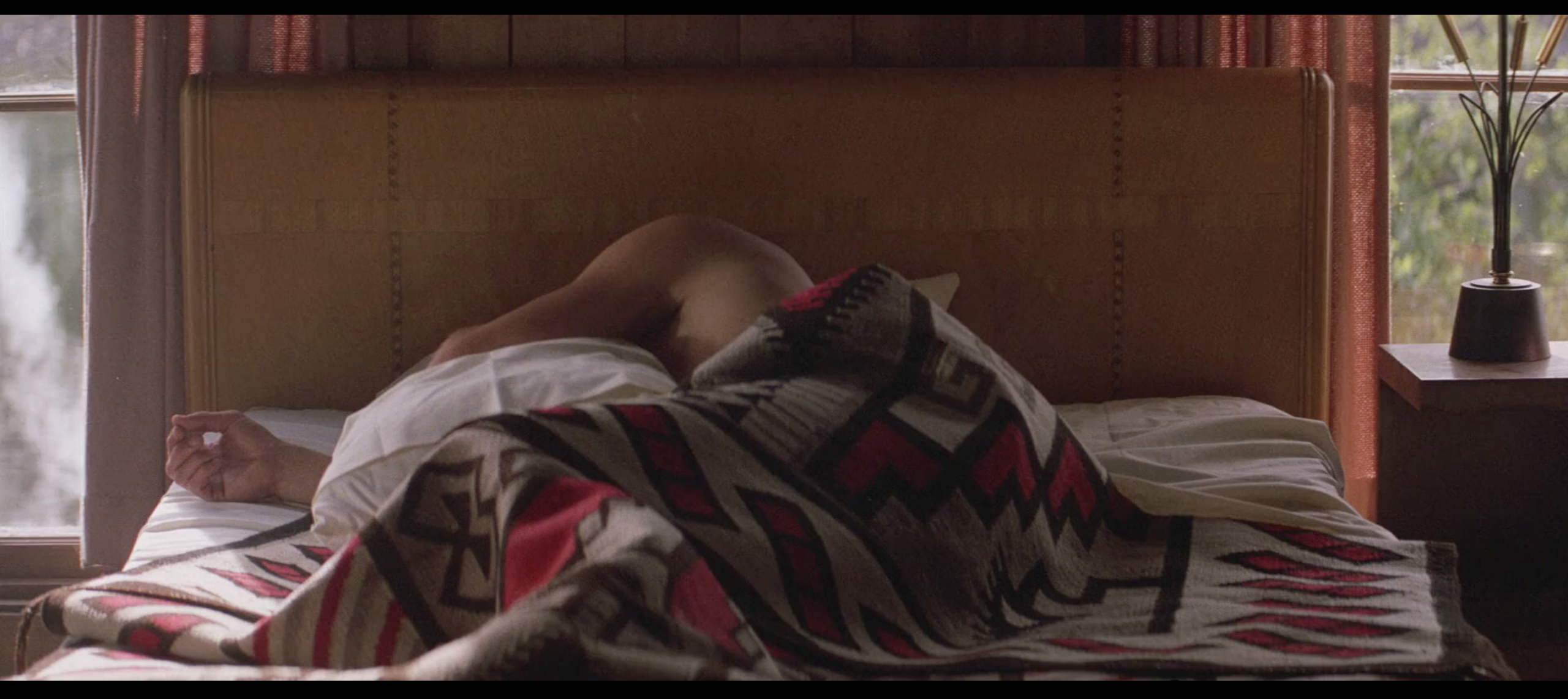
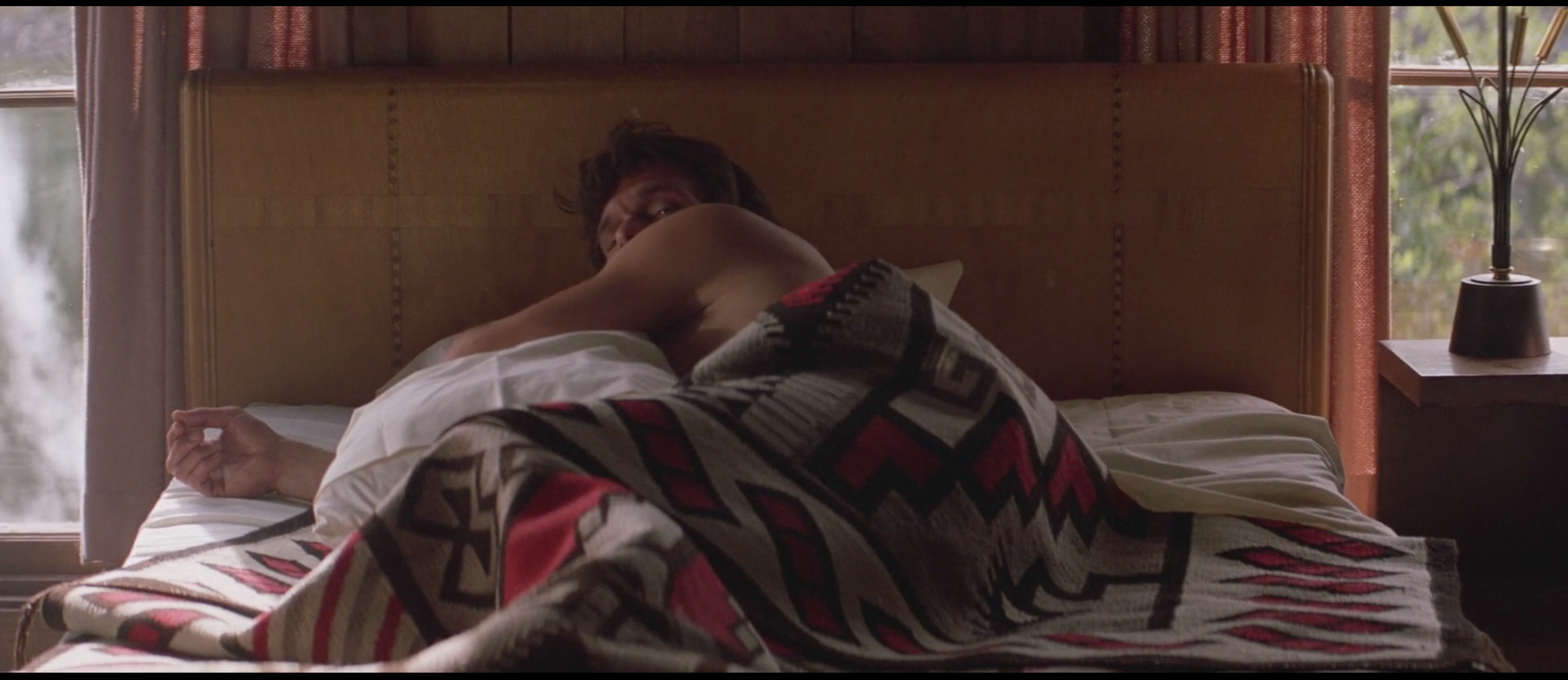
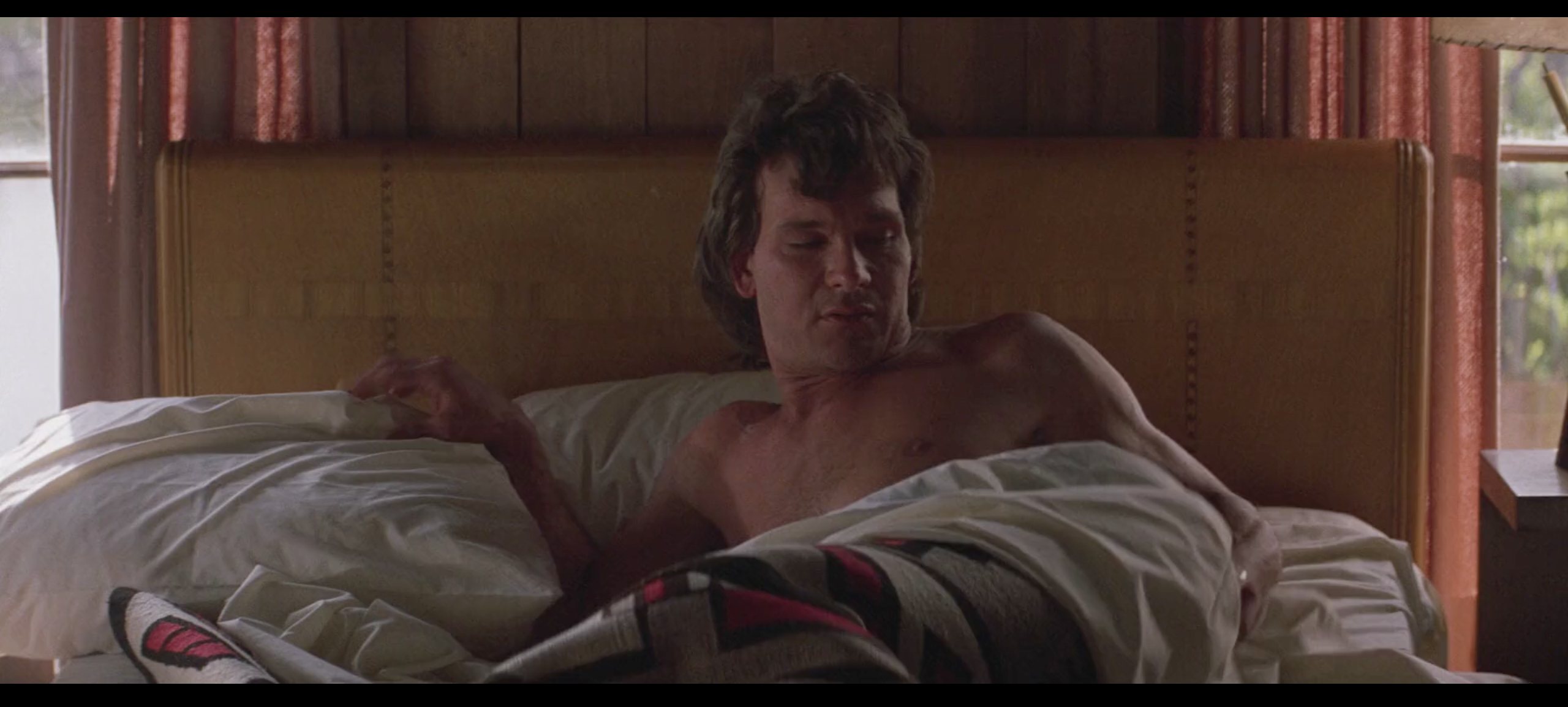
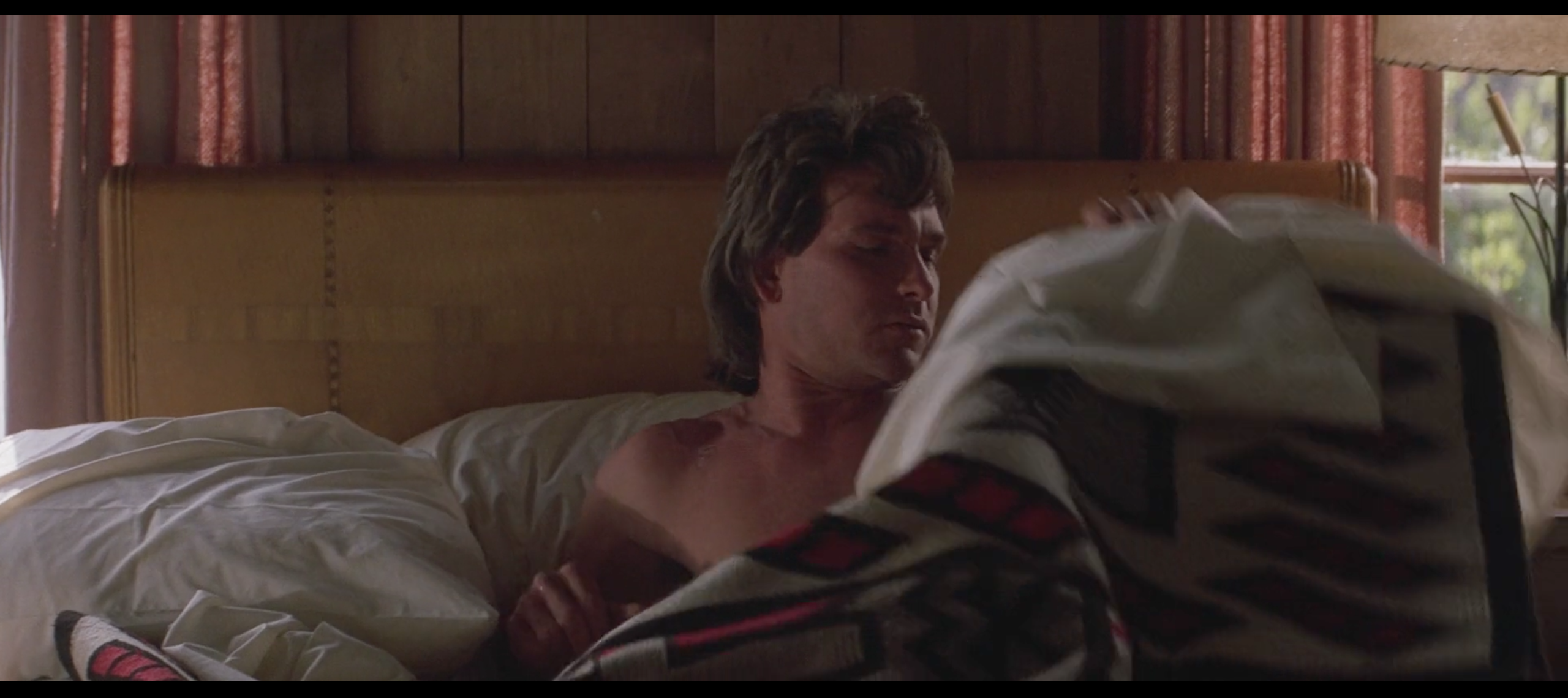
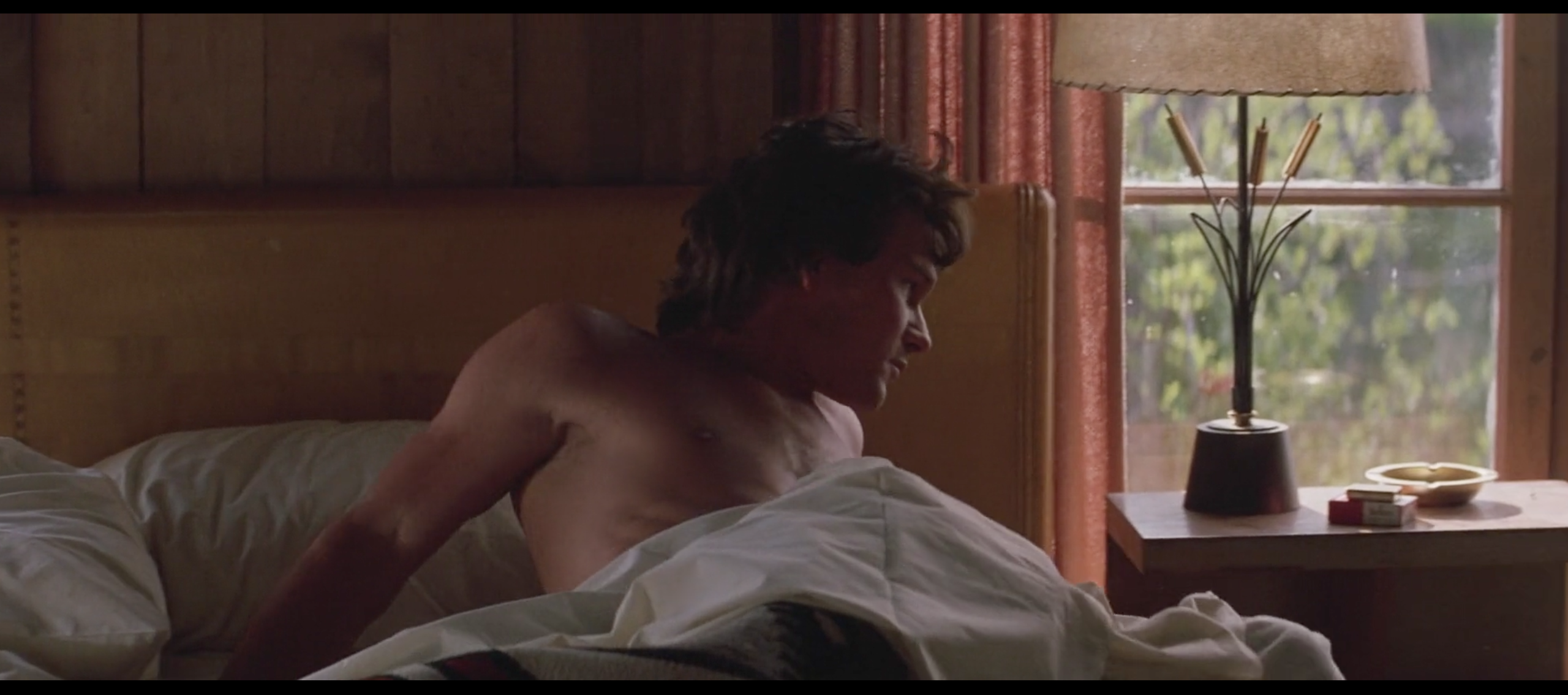
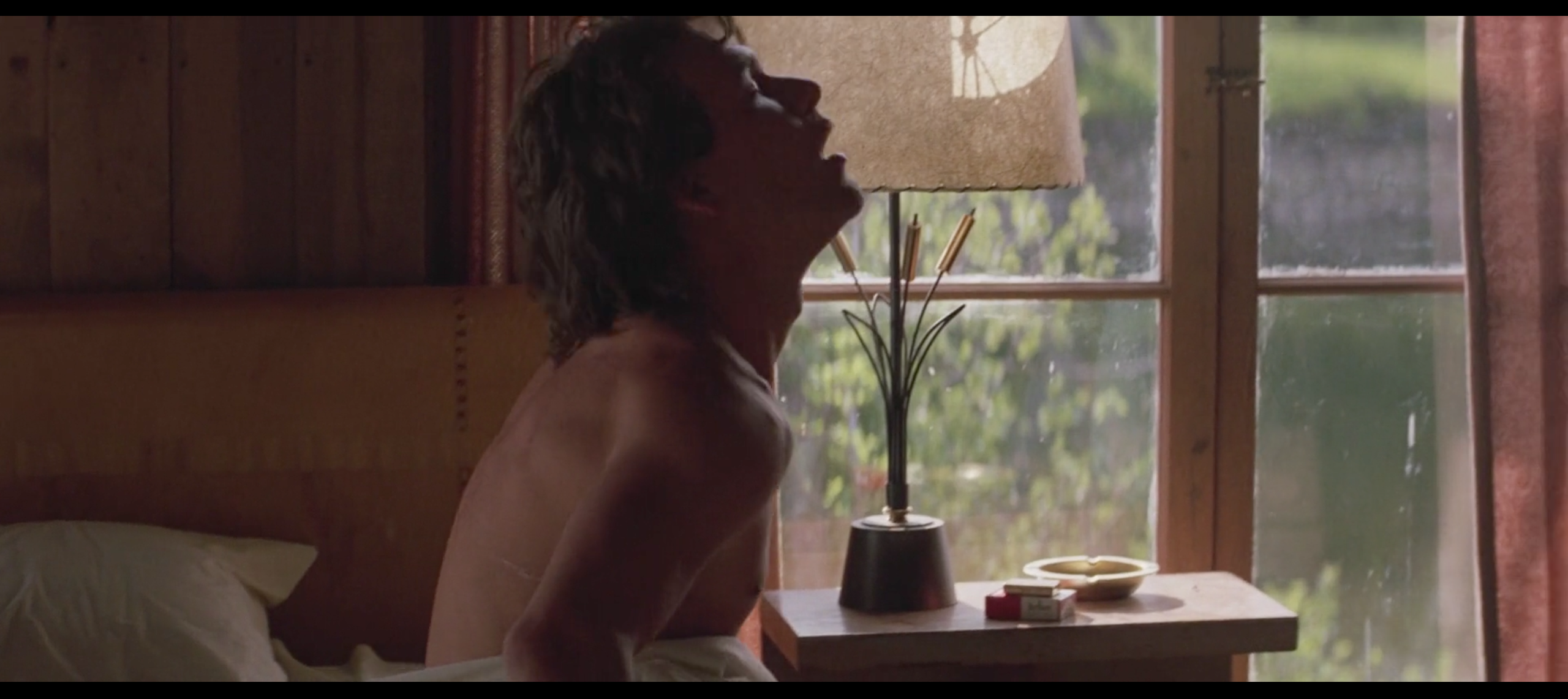
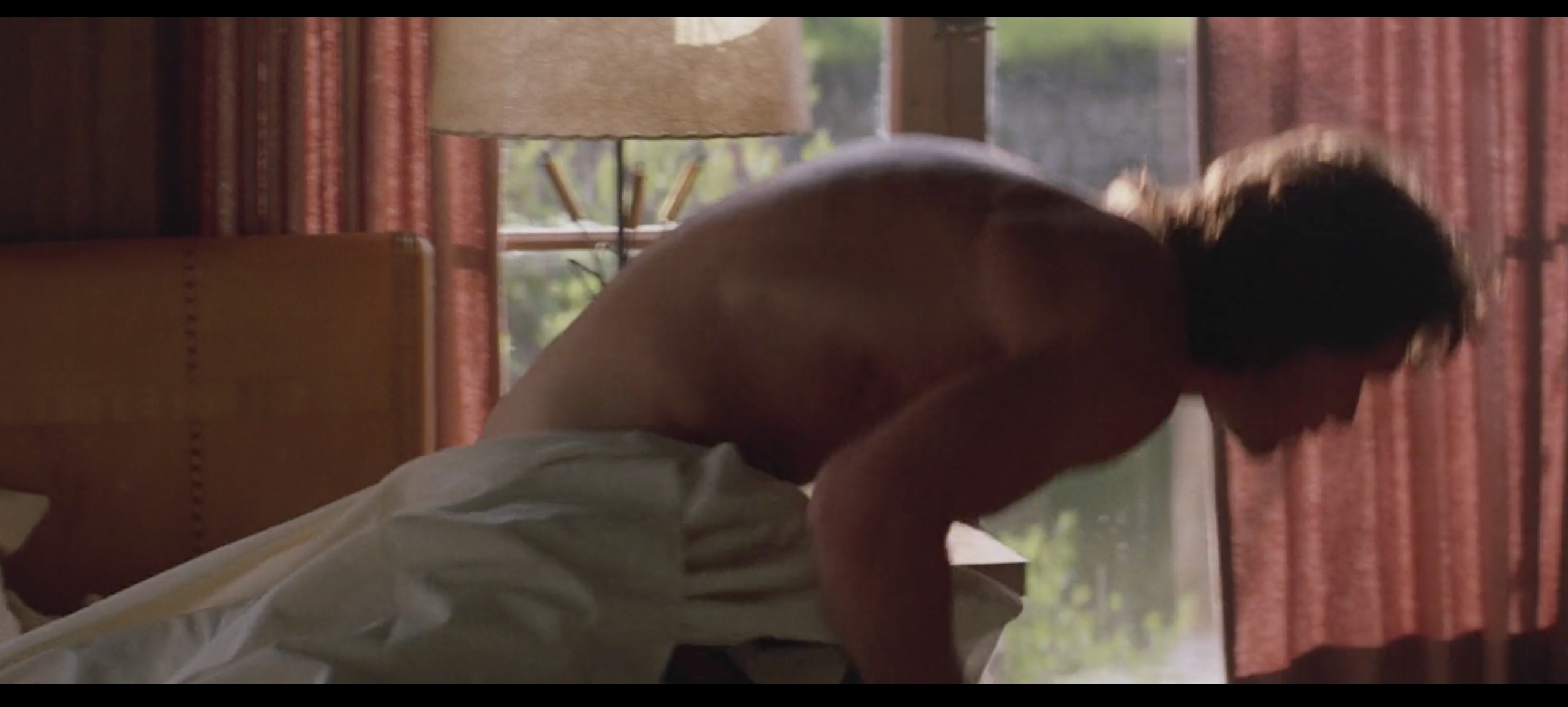
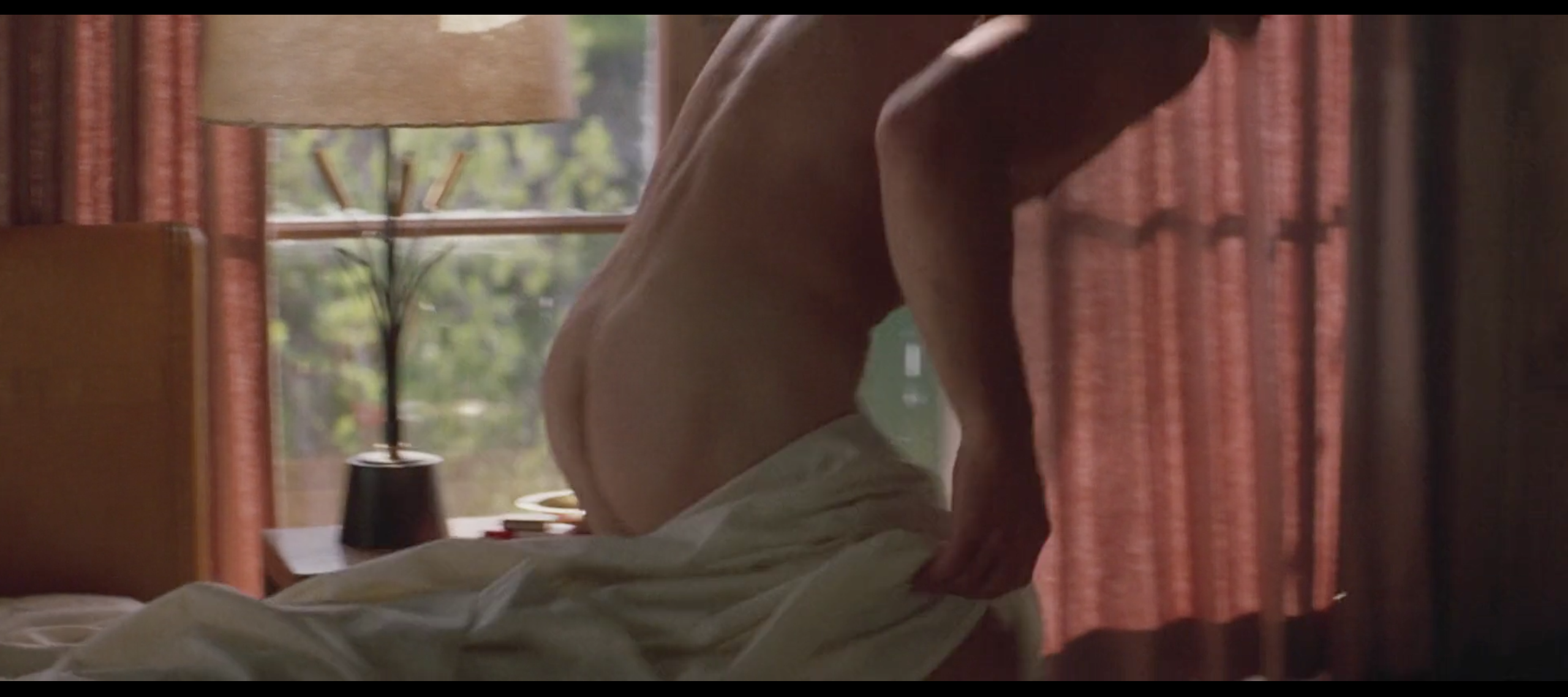
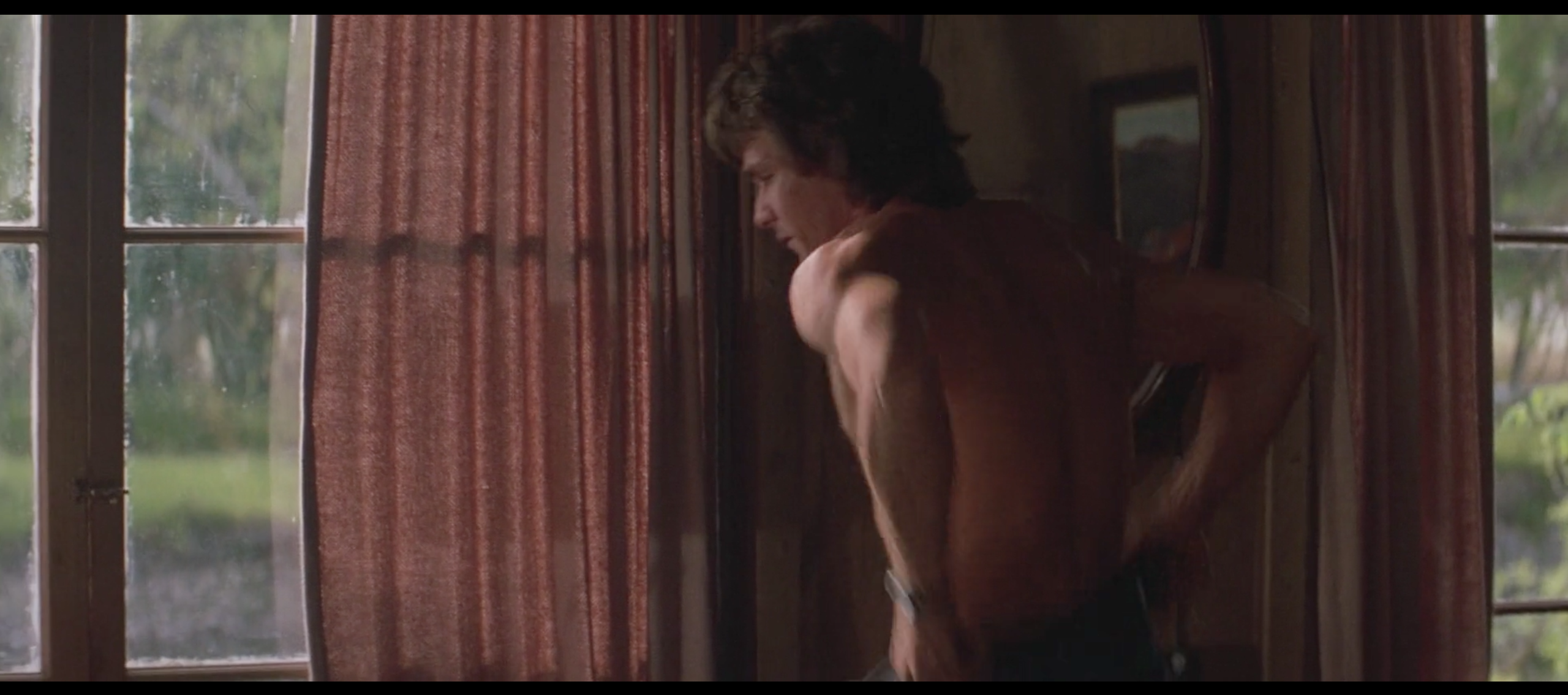
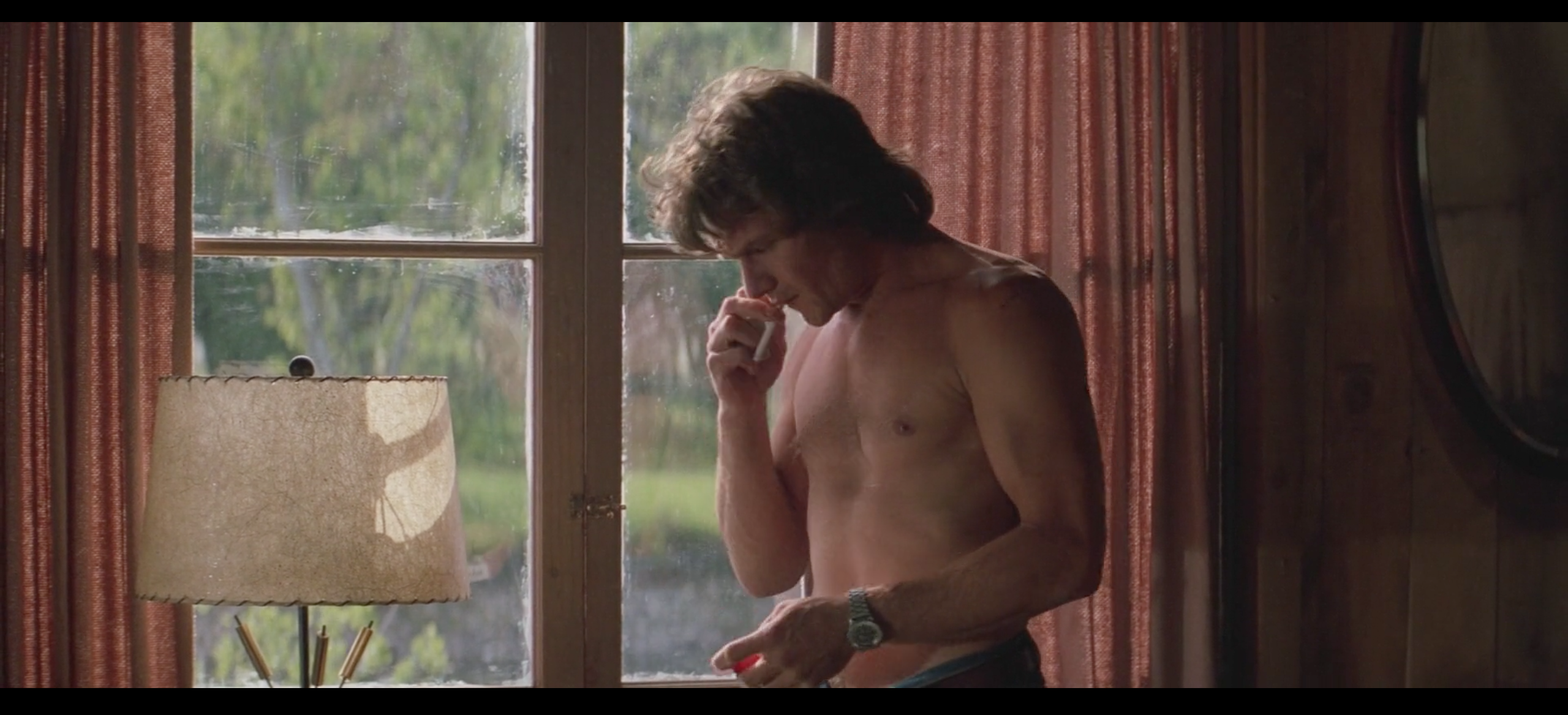
Carrie Ann shows up with breakfast the night after Dalton cleaned house at the Double Deuce, waking him up. He moans and groans and staggers out of bed like he’s hung over, which is funny since after he got home from work all he did was look across the way at Brad Wesley’s pool party in between chapters of the Jim Harrison novel he stayed up late reading. (For real.) But he sleeps in the buff, so when he slips out of bed, there he is.

Carrie Ann stops seemingly in mid-thought, like a rabbit in the headlights. Her eyes glaze. Her mouth opens. She gasps audibly. Her eyes heat up and a smile of pure horned-up delight briefly crosses her lips. Finally, she controls herself and looks away, abashed. There’s one final double entendre when he asks her how she tracked him down—”So how’d you find me?” “Oh! I, uh, it wasn’t too hard. I mean…you know what I mean.”—and by then he’s put on his jeans and begun his morning stretching-and-smoking routine. The scene moves on.

But I sure haven’t. Carrie Ann experiences something very rare for women in film: a moment of unguarded lust and guileless sexual objectification of the male body. She’s not doing this for Dalton, or even with Dalton’s observation and reaction in mind, since he’s not looking at her and has no idea what she’s doing. She stares and gasps and grins at him for no one’s entertainment or arousal but her own. Indeed, she’s sure to cut things off before he has a chance to notice and react. Perhaps this is done for his benefit, so as not to embarrass him, or for her own, so as not to embarrass herself. But the effect is that of a woman experiencing sexual desire in a totally personal, private, inviolate way.

What does this mean for us? We become voyeurs of another person’s voyeurism. And because her voyeurism is so accidental and unexpected, there’s a purity to it that avoids the fetish’s usual connotation of sleaze or outright violation, which lets us off that particular hook in turn. Without anyone trying, she gets to see something that turns her on, and we get to see her get turned on, and then it’s over. The eroticism of the moment is brief and blameless and beautiful. The fact that Carrie Ann is herself lovely helps, but it’s almost incidental. Arousal is lovely. Desire is lovely. And here they are, embodied in a moment and preserved, as in amber.

013. Men look at Dalton

When men look at women in Road House it means trouble. Steve the bouncer ogles his teenage would-be conquests. A husband with a cuckold fetish and a goofball barfly fetishize and fondle his wife’s breasts. A belligerent drunk starts a knife fight when people try to prevent him from watching his girlfriend dance on a table. Brad Wesley throws an absurd string-bikini pool party for his army of goons. A horned-up soldier rushes the stage in the topless bar where Wade Garrett works. Denise strips in front of the Double Deuce’s wolf-whistling bad seeds under Wesley’s approving eye in a strange act of macho-sexual judo. With two exceptions—the superimposition of the film’s title over an anonymous woman’s rear end, echoed by Wade hating to see Doc leave but loving to watch her walk away—the traditional male gaze is an indication that something is wrong.

When men look at Dalton, it’s different. And men look at Dalton alright. All kinds of men, for all kinds of reasons.

When they first meet, goons like Karpis and Jimmy lock eyes with Dalton in staredowns that sizzle with psychosexual challenge. (In Jimmy’s case the sexual element is made abundantly, infamously clear later on in the film.)

Frank Tilghman stares at Dalton and smiles over and over again, like a man seeing his favorite meal on the way over to his table. “I want you,” he says during one such glance, followed in that same conversation with a knowing “I thought you’d be bigger.” “He’s good. He’s real good,” he says to another man during another. Honestly Tilghman is such a strange character that he probably deserves an essay series of his own, but his open near-worship of Dalton is a start.

Both Dalton’s friendly landlord Emmet and his evil neighbor Wesley watch Dalton perform tai chi, shirtless and slick with sweat. Wesley has the look you often see on the faces of men in movies who’ve caught a glimpse of a topless woman through a window. Emmet looks like he’s questioning a whole lot about the world and his place in it.

Wesley even watches Dalton and Elizabeth have sex. You might think that Elizabeth is the object of the gaze here, but at no other point in the film does Wesley bring her up as a point of contention between himself and Dalton, even though their relationship does seem to catalyze a new level of hostility between the two men. There’s no “she’s mine, if I can’t have her no one will,” and when he talks to her about Dalton it’s to express regret that she’s wound up with a lowlife drifter, not to threaten her to come back to him. He only has eyes for Dalton.

And honestly, who wouldn’t? Look at him.

By constantly showing us men who visually appreciate Dalton, Road House models behavior for its primarily male audience. Which is not to say women were not a target as well. Surely a decision was made to capitalize on the sex symbol status of the man who plays Dalton, Patrick Swayze, for the women in the audience—by then he’d starred in the smash hit Dirty Dancing, and another romantic blockbuster, Ghost, was on the horizon; his sex scene with Kelly Lynch set to Otis Redding beat the pottery scene with Demi Moore set to “Unchained Melody” to the punch.

But Road House‘s life since its theatrical release has been one of basic-cable afternoon screenings for dudes. I myself never caught it that way, but I first saw it during a Road House/The Warriors/The Road Warrior triple feature with a bunch of drunk and high friends, which is more or less the same idiom. I came away from my first viewing feeling just an unbelievable amount of affection and admiration for Patrick Swayze, an actor I’d never really thought about at all before. When he was diagnosed with pancreatic cancer, I held a Road House/Steel Dawn/Point Break triple feature at my place and charged everyone a twenty-dollar donation to pancreatic cancer research for admission. I love Patrick Swayze just as I love Dalton. I believe these shots of men looking at Dalton, capturing the blend of admiration, envy, desire, and awe they feel when they look at him—call it the male swayz—are, at least in part, the reason why.


012. Bandstand

You’re sitting down to watch Road House is the first time. The action opens on a big glowing keyboard running down the side of the screen. The camera pans down and you hit a big neon red letter “R.” Awesome, Road House is about to begi—

Huh! “B.” Okay, not what I expected.

“BA.” BAR, it must be BAR.

“BAN.” Okay I give up.

The word is BANDSTAND, which is the name of the bar at which Dalton works at the beginning of the movie. Perhaps Road House will be the name of the bar where he works later on and oh no nevermind it’s the Double Deuce.

The first time I read A Game of Thrones I got confused by the very first proper name I saw: Ser Waymar Royce. This was before the show, and before I really knew anything about the books at all beyond “Tolkien but more hardcore,” so I had no way of knowing “Ser” was just a fantasy-universe way to spell “Sir.” I thought the guy’s name was Ser Waymar Royce, like Jan Michael Vincent or whatever. I can’t tell you how flummoxed I was by this. For some reason “Ser Waymar Royce” feels much more alien and strange than “Waymar Royce,” more alien and strange than I’d anticipated a series described as “The Sopranos with swords” was gonna get, and I had to shift my expectations pretty dramatically—only to shift them right back when I realized it was just a funny way to spell a familiar honorific.

The first time I saw Road House, this sign had a similar effect on me. In its first five seconds the movie went from comprehensible to incomprehensible, on a very small scale of course, but enough to have a disorienting effect that lingered long past the point at which the camera finished revealing the word “BANDSTAND” in radiant crimson. I can’t imagine this was the intent, but the opening shot prepared me for a movie in which anything could happen. In that respect, what followed did not disappoint.

011. First glimpse

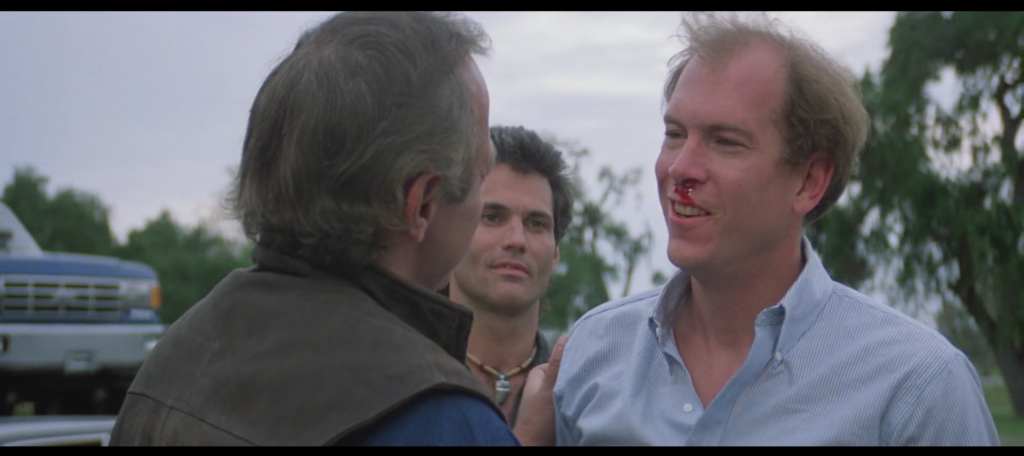
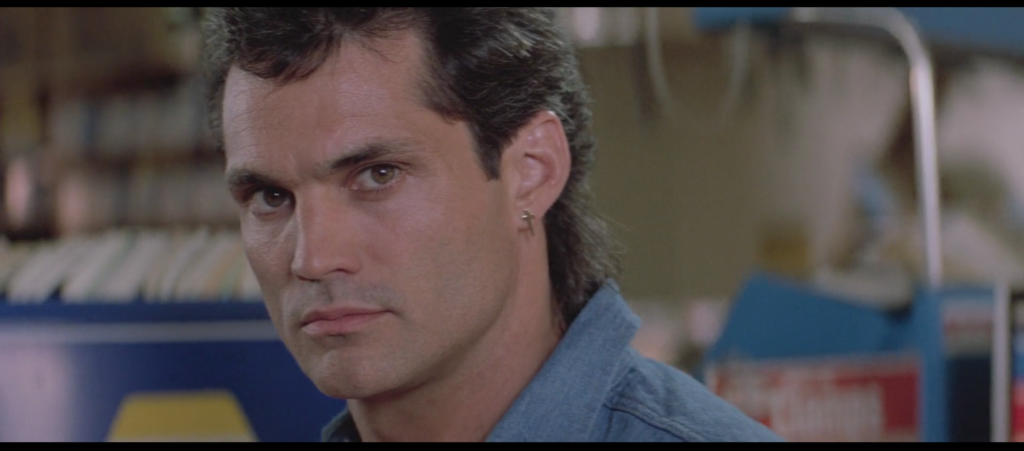
In the beginning was the Mullet, and the Mullet was with Dalton, and the Mullet was Dalton.

Mullet-based humor is now so old that I remember having to make sure the audience knew what mullets were when I wrote a sketch about them for my comedy group in college—in 1998. That isn’t what this about. The very first shot of Dalton in Road House shows the back of his head for a reason.

Please note that the director of photography on this film is Dean Cundey. His credits as a cinematographer include Jurassic Park, Who Framed Roger Rabbit?, Back to the Future, The Thing, Big Trouble in Little China, The Fog, Escape from New York—a murderer’s row of SFF classics from directors who convey story primarily through image and character through portraiture. The shot of Dalton’s mullet establishes him as recognizable first from behind, and then in silhouette. No one else in the movie has a head of hair anywhere near this magnificent and distinctive.

As the camera tracks in on Dalton, we watch him survey the crowd at the filled-to-capacity hotspot at which he currently works. He nods along absently to the beat of the music played by the band on stage, so absently in fact that his head tilts upward with the beat rather than downward. It reads more like a gesture of regal approval and command than a guy mildly rocking out, because that’s what it is. (He’ll make similar gestures a minute or two later, when he wordlessly instructs the bouncers in his charge in how to handle some ruffians.) At that moment, all is right with his world. The cooler has cooled.

Then things heat up. Dalton turns his face toward the camera and his eyes focus. A cut along his eyeline reveals what he’s looking at: a man soliciting a woman as if she’s a sex worker, putting a hundred-dollar bill down on the table for her services. Insulted, she takes out a knife and slams it downward, pinning the money to the table. Insulted in turn, the man kicks her chair right between her legs, tipping it over and knocking her on her ass. Bouncing and cooling ensue.

Pay close attention to the editing here, by Frank J. Urioste and John F. Link. Between them, and sometimes in tandem, these men cut Die Hard, RoboCop, Predator, Commando, Total Recall, Basic Instinct, Tombstone. They’re as responsible for establishing the rhythm and language of contemporary action-thriller cinema as any two people in the business. Do they cut from Dalton to the troublemakers once the trouble has started? No. They cut slightly before, after the sound of a single broken glass and a raised voice, in a jam-packed nightclub with a rock band playing.

Urioste and Link are not likely to have done this by accident. They’re establishing Dalton’s near-superhuman ability to detect, defuse, and defeat any bar’s bad element. They’re demonstrating what happens when his cooler-sense starts to tingle.

Thanks to these three top-tier filmmakers, Dalton’s mullet is as meaningful and memorable as Batman’s cowl or Darth Vader’s helmet.

010. Denise

Who is Denise? Denise is Brad Wesley’s girlfriend, and the most stylistically sophisticated and culturally aware human being in the entire film. You can tell this at first glance, and glances are really all you get. Her lines are minimal: She rebuffs a vulgar proposition, makes one of her own, and…that’s it, I realize now. That’s all Denise gets to say.

But she makes an impression, I can tell you that much, and she does so long before she enthusiastically strips on stage at the Double Deuce with Wesley looking on approvingly, some time after he beats her off-camera for coming on to Dalton. Even when the bar looks like it might collapse around her ears at any moment, even when its atmosphere resembles a Tables Ladders and Chairs match more than a nightclub, she’s there with her girlfriends, leader of the pack, out on the town and dressed to kill.

Sure, she attends Wesley’s ludicrous backyard pool party/dance party/orgy/whatever it is. But when he’s not around and she gets her first good look at Dalton, the camera whip-zooms in on her dilated-pupil look of desire like Cupid’s arrow. It’s such a jarring moment in this straightforwardly shot film—easily the most cinematographically adventurous thing that happens—that in any other movie it would indicate the start of a major plotline.

But it goes nowhere beyond her asking Dalton to go to her place and fuck, an offer she cleverly cushions with a rhetorical flourish: “Would you be shocked if I said ‘Let’s go to my place and fuck?'” Yeah, it sounds like the writers don’t understand that “If I said you have a beautiful body, would you hold it against me” is a play on words. But her forthrightness is admirable, as is the fact that she still has her own place and isn’t relying on Wesley’s largesse. Like O’Connor, whom he beats for the crime of bleeding, she knows you can’t count on staying on Brad Wesley’s good side.

By the end of the movie that’s not an issue anymore. Freed from Wesley’s influence and the watchful eyes of his goons, she’d theoretically be able to enjoy more nights out with the girls, in a renewed and revamped Double Deuce that better suits them. But we don’t know. Denise’s final moment in the film is being ridiculed by an uncharacteristically ugly Dalton as a pet that Wesley should keep on a tighter leash. She’s afforded no payback for that slight, or for Wesley’s abuse. Imagine if she’d wielded one of those shotguns instead of, say, Pete Strodenmire, the guy we see in a grand total of one scene before his car dealership gets run over by a monster truck. That would be something, right?

But there’s nothing instead. Awkwardly covering her bare breasts, she gets dragged off stage, off camera, and out of the movie. Freaking Tinker gets a better redemption arc. Still, during that one shot, there’s the promise of a whole world in her eyes—her apartment’s decor, her girls’ nights out, her love for buoyant late-’80s dance pop, her desire for a relationship with Dalton worth risking Wesley’s wrath for, even if it’s only for a night. She is Road House‘s great mystery, its Mona Lisa Lisa & Cult Jam. Who is Denise? We’ll never know. But she’s in there somewhere.

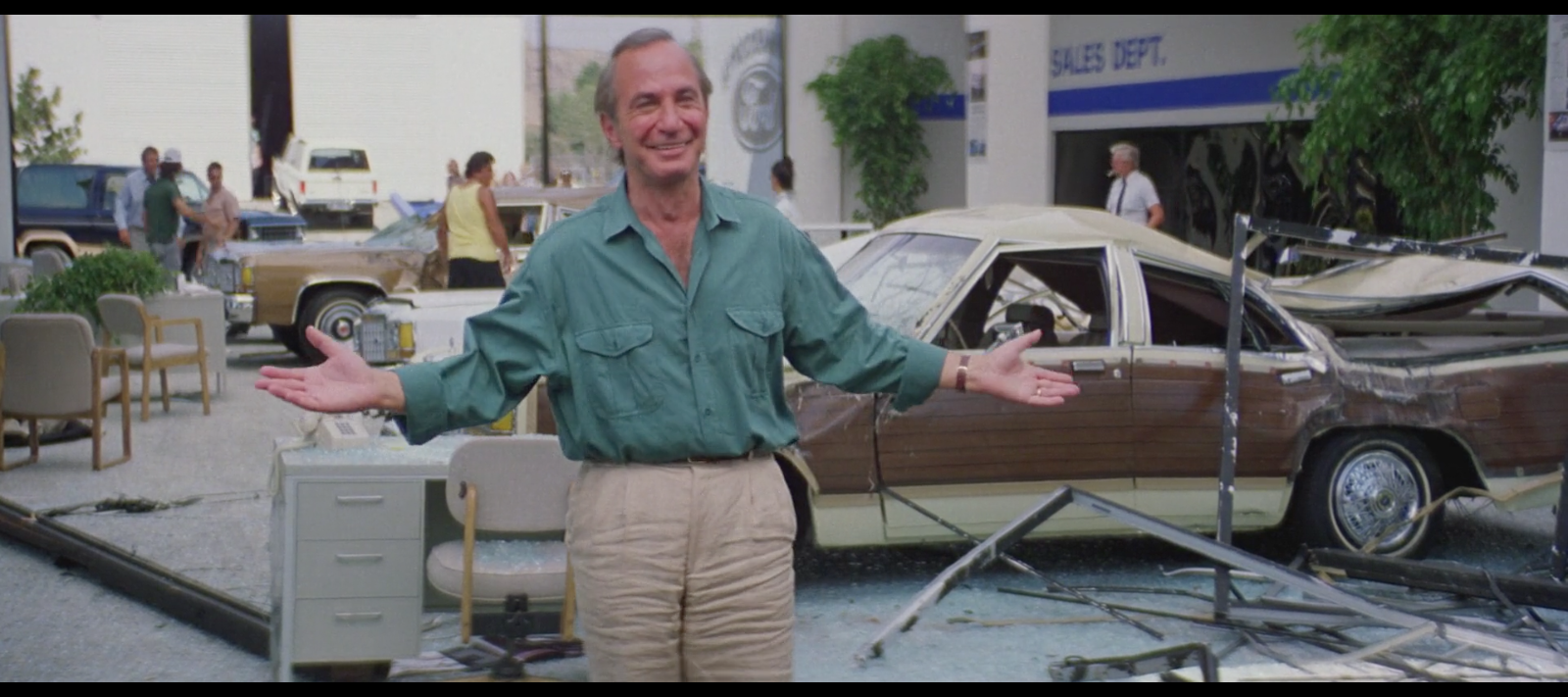
009. Running over a car dealership with a monster truck

Road House is a film in which a man runs over a car dealership with a monster truck.

Not a car. A car dealership.

He runs it over.

With a monster truck.

They mount a camera between the tires and everything. To capture every nuance. Of running over a car dealership. With a monster truck.

During Wagon Days, no less.

Obviously I’ve known that this happened ever since I first saw the film. I appreciated how over the top it is, even for Brad Wesley and his goons, and even for Road House. The presence of the monster truck at all is…well, it leaps right out at you the first time you see Ketchum drive up to Wesley’s mansion in it, like his brother had borrowed his Mercury Cougar for a trip to St. Louis so he drove his other car to his boss’s house, and his other car just so happened to be a monster truck. But it wasn’t until the other day, when I wrote the phrase “running over a car dealership with a monster truck,” that…no, actually, it was some hours later, when I reiterated the point on twitter. That’s what brought it all home for me. Road House is a film in which a man runs over a car dealership with a monster truck.

It sounds like any other wanton act of vehicular destruction, at first. “Oh yeah, he ran over a c—wait, what?” It takes a second to sink in. The closest point of comparison I can come up with is in the post-show interviews at the end of Waiting for Guffman, when Parker Posey’s character talks about her dad getting out of jail because he didn’t do anything that bad, “he just ruined some property.” Stole, destroyed, sure, whatever, but then you register the word choice. Ruined? Now I’m intrigued. Now I want to know, but also I don’t want to know. You know? Ruining property, like running over a car dealership, is understating an overstatement.

The other film I think of when I think of this moment is Citizen Toxie: The Toxic Avenger IV, because that’s the movie that was in pre-production when I interned at Troma Studios in the summer of 1999. I had very little to do with the finished product; my main contributions were scouting for a production office (unsuccessfully) and taking an uncredited rewrite pass at the screenplay (also unsuccessfully, though interns rewriting screenplays says a lot about Troma).

What I did do was read All I Need to Know About Filmmaking I Learned from The Toxic Avenger, the memoir cum how-to manual by Troma co-founder and creative force Lloyd Kaufman and a then-unknown James Gunn. The idea that’s stuck with me the longest since I read the book, aside from Karo Syrup making the best fake blood, is that if you have any means at your disposal by which to raise the apparent production value of your film, you avail yourself of those means. An eccentric uncle with a crazy-looking house? A rich friend with an insanely nice car? A major urban metropolis with a tourist mecca where there are simply too many people for the cops to catch you should you choose to film someone running naked through Times Square without a permit? (The filming, not the nakedness.) It doesn’t matter whether or not these things are germane to your movie. They look awesome and/or expensive. Make them germane.

I think about this every time I see a movie about barfights at one in the morning set a scene in a Ford dealership in broad daylight where a deranged businessman orders his minion to drive a monster truck through a glass enclosed showroom and over every single new car inside of it. I think about it every time I see the monster truck in this movie at all. Road House had access to a car dealership and Road House had access to a monster truck, ergo Road House has a scene in which a man runs over a car dealership with a monster truck. Those who can, do.

‘I literally have nightmares and put them on screen’: Channel Zero creator Nick Antosca on 2018’s scariest show

We had a small, very passionate writer’s room, and everybody in it brought their own fears to each story. And we just we had certain guidelines: Keep it personal. Draw from character. If something feels right then explore it, even if you don’t know what it means right away. That, to me, is what great horror does. It makes you dig deeper, makes you explore the parts of yourself that you’re afraid of, that you’re traumatized by.

I was thrilled to conduct a deep-dive interview on all four seasons of Channel Zero, one of the most frightening TV shows I’ve ever seen and as good as anything in the recent horror renaissance, with creator Nick Antosca for Polygon.