
Posts Tagged ‘reviews’
Two brief Mad Men thoughts
October 11, 2011IT OCCURS TO ME I SHOULD BE SPOILER TAGGING THESE
* I just finished the Matthew Weiner-scripted episode toward the back end of Season Two in which Don Draper has his Los Angeles idyl with the idle rich Eurotrash and their aptly/portentously/heavyhandedly-named scion Joy. While Don’s out there fiddling and relearning not to say no to things he wants (Joy, you are setting a bad example), Rome’s burning in the form of Duck Phillips’s attempt to cement his position, and take over Creative, by having his old British company buy out Sterling Cooper. What I love about this development is probably just long-form fiction writing 101, but here it is:
At the end of Season One, Don was faced with a choice. He could hire an outside applicant to take over his old position as he moved up to partner, with Duck the leading candidate, or he could promote Pete Campbell. Neither Don nor we in the audience wanted him to do the latter, for a number of reasons: 1) Pete was too big for his britches and didn’t seem to deserve the promotion on a professional level; 2) Pete was generally an obnoxious creep even by Sterling Coo standards and rewarding that behavior would have been unpleasant to watch; 3) Most directly, Pete attempted to secure the position through blackmail, and both on a “Crime Does Not Pay” level and in the sense that Don is a more likeable character than Pete, we wanted to see that fail. So Don hires Duck, then ends Pete’s game of chicken by deliberately crashing into him, and finally emerges victorious and more secure than ever. Hooray! In the moment, it looked like he made the right move.
And in the moment, he probably did make the right move! Promoting Pete under those circumstances would have been disastrous for Don, and probably not so hot for the company either. (Or for Pete, I suspect.) But this outcome — which Don selected and fought for, taking a risk and reaping the reward — had the unintended consequence of completely undermining his own happiness and power at the job. (At least I think it will — I haven’t seen how the deal with the Brits turns out yet, as I’m no further than the episode where it was first brought up.) What a great technique for the writers to use: They gave their character what he wanted, but instead of either a happy ending or a pat “be careful what you wish for” as a result, they use it as the seed from which something he absolutely doesn’t want will eventually grow. The Don vs. Duck line emerges not as a direct continuation of the Don vs. Pete line, but off on a tangent we couldn’t have predicted, and one we couldn’t have followed if Don and Pete hadn’t been made to collide in the first place. It’s Curt Purcell’s idea of narrative shrapnel (warning: A Song of Ice and Fire spoilers at the link) writ large. And it’s a great way for writers of serialized fiction to keep their stories going when seeming endpoints are reached.
* As if a film studies major couldn’t have enough fun making hay out of the name “Don Draper,” they went and made his real name “Dick Whitman.” Drop a “D” from the former and add an “e” to the latter and you’ve got an A in the class.
Drive second thoughts
October 11, 2011Maybe it’s just the YouTube of “A Real Hero” talking, but I find myself more warmly disposed toward Drive today than I was when I wrote this. I still feel that when a film of this film’s obvious intelligence dances this close to the whole “down these mean streets a man must go” necessary-violence thing, it’s a lot tougher to get past than when a film of obvious stupidity does so. (I watch Road House a lot.) And I still maintain that the film didn’t push the Driver far enough in one direction or another emotionally for us to have a working context for his violent outbursts. But in retrospect I can see little pointillist moments almost coalescing into something emotionally coherent. His completely unknown past prior to six years ago; the way he draws the line at violence but nevertheless still possesses a familiarity with and talent for the criminal world; the totally convincing viciousness of his threat against the guy he once drove when they bump into each other at that diner; the effortless rapidity with which he adjusts to kill-or-be-killed violence; his obvious guilt over his involvement with Standard’s final criminal act and subsequent death; the slow-mo shot of him looking horrified after he kills the man in the elevator; wearing a mask the one time he intentionally sets out to kill someone; leaving the cash behind; leaving Irene and Benicio behind even though no one’s out to get him or them anymore; even Standard’s lingered-on homecoming speech about how what he did in the past was shameful, but now he’s got a second chance…If I were the theorizing type, my theory would be that once upon a time the Driver was a real rough customer, but he changed, and the events of the film brought out a side in him he’d long suppressed, and so he abandons the woman and child he’s come to care about rather than subject them to it again.
The reason I’d love for this to be a little more than theorizing is not because I need things spoonfed to me — what I’m calling for is more emotional information, not more plot-fact information — but because it would be interesting for the film to have developed the Driver more in this regard. I don’t know if Matt Seneca was kidding when he suggested the film should have shown the Driver crying after he killed the two guys who attacked him and Blanche in the hotel, but amen to that. That’s a scene I’d have liked to see.
But I saw plenty of lovely things. The film was impeccably cast and delightfully acted, from Gosling’s quiet kindness to Ron Perlman grinning Noo Yawk gangsterisms. The ’80s look and sound was luscious and unpretentious. The violence was refreshingly hideous, mitigating against the redemptive role it plays in the narrative. And even if it didn’t quite get there emotionally, I do feel like it tried, and it had enough other things going for it that, to a degree at least, it can be forgiven for stopping short of where it needed to go. In many ways my entire life up until this point has put me on a quest for sad trash, and Drive comes pretty close.
Drive thoughts
October 7, 2011SPOILERS AHOY
You’re right, I am quite imaginative with my post titles. Thank you!
As the credits rolled and I contemplated the final decision made by the Driver as depicted in the final two shots, I thought to myself, “At this late stage, with all the other players eliminated, why wouldn’t he choose to go back to Irene and Benicio, if they’d have him?” I think I might have an answer, about which more later, but my main internal response to that question was just to shrug and wonder how you could really know anything about this guy as written.
“By their works ye shall know them” is a decent standard to apply to fictional depictions of bastardry and brutality, I think, but there was simply no way to apply it to the Driver in any way that made sense. Though he exuded a crinkly-eyed, quiet kindness throughout the film, especially in his tender interactions with Irene and Benicio but more revealingly with Shannon and especially Standard, and though he repeatedly insisted upon remaining an unarmed and inactive participant in the crimes he facilitated as the driver, he’s suddenly Jason Bourne at the drop of a hat when threatened. Not only is he a ruthlessly efficient killing machine, he’s cruel on more than one occasion: threatening to torture Blanche, actually torturing Cooke.
The problem on a structural level is that his actions, in and of themselves, are virtually indistinguishable from those of Bernie Rose, an equally proficient and brutal murderer who, like the Driver, does not seem thrilled about having been placed in this predicament. But Bernie’s clearly a bad guy by the standard of the film — as Benicio might say, just look at him, does he look like a good guy to you? But that distinction, between the good savagery of the Driver and the bad savagery of Bernie, is unearned. I know what Bernie is because of what I see him do. I see the Driver do similar things but I’m supposed to “know” that he’s something else. Is he?
I suppose you could say that that slow-motion shot of the Driver as he stares in apparently guilt-stricken horror at Irene after he crushes the guy’s skull in the elevator, coupled with the rivers of flop sweat pouring down his face as he confronts Nino over the phone while holding a hammer to Cooke’s head, is an indication that the Driver is deeply uncomfortable with the violence he’s forced to perpetrate. If that’s the case, then it follows that he leaves Irene and Benicio behind out of concern that he’s no good for them, even though they’re unlikely to be menaced by gangsters anymore. But his unthinking skill in this department, and those flashes of cruelty, are really hard to square not just with his niceness to his friends, but with all our other knowledge of his character — the hardworking kid who showed up at Shannon’s shop and worked for a song, the talented driver who doubles for the star of the movie and persuades gangsters to invest hundreds of thousand of dollars in a potential racing career, the getaway driver who limits his involvement with heists to five minutes of nonviolent chauffeuring.
The answer to the riddle is likely that the Driver’s just a type. He’s the reluctant hero, the good man forced to be a hard man. But while I can accept all of Drive‘s other thoughtful, beautifully executed homages to the Hollywood tradition — the Risky Business/Body Double score, the Taxi Driver lights in the windshield, the Lost Highway/Mulholland Dr. Weird Los Angeles vibe, the Man With No Name near-mute nameless protagonist, whatever — I have a hard time accepting a movie-person in place of an actual person. I didn’t used to, but I think I do now. I feel like the movie knew it needed to make the violence really horrifying to deflate the surrounding Coolness, and I’m glad it did, but I don’t think the emotional violence was commensurate. And to the extent that our satisfaction with the movie hinges so much on an emotional connection with those final shots of Irene knocking on the Driver’s door to no avail and the Driver driving away, a lack of emotional veracity elsewhere blows a hole in the whole thing.
Mad Men thoughts: Special “sex and violence” edition
October 6, 2011* I’m currently seven episodes into Season Two, I believe.
* Sex: Has there ever been a show this effectively and uniformly sexy in its sex scenes? I am no more the kind of person who says “The sexiest thing is what you don’t see” than I am the kind of person who says “The scariest thing is what you don’t see” when discussing horror movies. I mean, grow up. But nearly every sex scene on this show compares so favorably to the pneumatic breast-bearing cheek-clenching sweat-drenched thrustfests on comparable pay-cable programs that I’m starting to wonder if I should reconsider that position. Look, I like seeing attractive naked people, especially attractive naked women, I’m certainly not going to lie about that. And if we lived in an alternate universe where HBO had picked the show up after all, I’d reblog an animated gif of a nude scene involving virtually any of Mad Men‘s female cast members and cameo players so fast your head would spin, I don’t care how confused the readers of Superheroes Lose would get. But it seems as though the show’s necessitated focus on buildup and afterglow, anticipation and satisfaction, forced them to become peerless portrayers of desire and arousal. These, of course, are the hottest things about sex. You can see naked people in all sorts of contexts, but you can really only see truly turned-on people tear into one another in just the one. It’s in that glimpse of the performance of desire, and the subsequent glimpse of its fulfillment, that the erotic really lives. Bobbi Barrett isn’t even my type, but the scene in which she’s lying in bed face-down with Don face-down in turn on top of her, both of them panting and sweating after a job well done, as she talks about the air-conditioned sensation of being both hot and cold and then asks Don, basically, not to take his dick out of her yet…shit, man, that’s one of the sexiest things I’ve ever seen on TV.
* Violence: Would you believe that for the longest time, as I promised myself I’d watch this show but never got around to it, I worried that I’d somehow find it less compelling because the main characters are advertising executives rather than mafiosi, medieval knights, cops and drug dealers, cowboys, outer-space soldiers and killer robots, gun-toting crazy people stranded on an island someplace, and thus the chances that someone might get killed during any given episode were much, much slimmer? To be clear here, what worried me was what that would say about me, not about the show. I am so used to drama in which the ability of characters to kill other characters provides an instant high-stakes atmosphere, an array of dramatic story possibilities and emotional consequences, that I wasn’t sure how I was going to handle one in which the worst that could happen was, I dunno, someone gets fired or his wife leaves him or whatever. Now, if you look at my comics-reading habits, I have no preference for violent fiction; if anything it’s the contrary, as the sort of reading habits that privilege action-based genre work of whatever sort to the sneering exclusion of so-called New Yorker navel-gazers are perhaps my biggest pundit pet peeve. My prose reading list works in much the same way, though I do less prose reading and thus it can get a bit more lopsided toward violent genre work depending on what I made a point of plowing through recently. But for some reason, I’d be hard pressed to tell you the last movie I saw in a theater or on DVD in which someone wasn’t violently assaulted or killed. With TV it’s an even stronger bias, because one of my favorite aspects of all my favorite millennial shows is my uncertainty that any given character will live to see the end of any given episode. With Mad Men, by contrast, I’m reasonably sure no one will shoot Joan Holloway in the head at any point. Of course, it turns out that that certainty doesn’t hurt my enjoyment of the show in the slightest, and I’m just as capable of loving the narrative and execution here as I am in a Chris Ware comic. And the absence of violence as an ingredient in the everyday lives of these characters as opposed to the characters on Lost, Battlestar Galactica, The Sopranos, The Wire, Deadwood, or even Twin Peaks means that when the threat of physical harm does arise, be it intentional (the possibility that Don might kill his half-brother to shut him up, Don’s brief shoving match with Betty during their disagreement over corporal punishment, Don’s really unpleasant quasi-sexual-assault on Bobbi when he threatens to ruin Jimmy if he doesn’t apologize to the Utz owners for insulting them) or accidental (Don and Bobbi’s car crash, Bobby Draper burning his face on the stove), the bottom of my stomach really drops out.
* Just noticed this as I wrote that last sentence: Bobbi and Bobby.
* Speaking of Bobby: God, the Draper kids are just crushingly cute, somehow without being cutesy. Another absurd casting coup. When Bobby said to Don “We’ve got to get you a new Daddy”? Oh man, I’m getting choked up just writing it out.
* And speaking of that line: It’s possible I just wasn’t paying the proper amount of attention, but it seems to me like Season Two emphasizes the killer quotables more than Season One. I’m thinking of “We’ve got to get you a new Daddy”; “You’re garbage. And you know it” ; Don encouraging Peggy to power through her psych hospitalization by saying “It didn’t happen. It will shock you how much it didn’t happen”; Trudy asking Pete that if they don’t have a baby, “What’s all this for?”, and Pete replying “I don’t know.” I certainly don’t mind.
* And speaking of Trudy: I hate to say it, but Alison Brie is maybe…miscast? I love her on Community, and obviously she’s one of the prettiest people on television, but her broad brittleness works for comedy — particularly for a caricature like Adderall Annie — in a way it just doesn’t for drama. Certainly not for maybe the broadest and brittlest role on the show to begin with. There might be a way to bring some extra shading to that status- and baby-obsessed nag (not that the two obsessions are at all separate, mind you!), but Brie has yet to find it at this stage.
* Close your eyes and Vincent Kartheiser sounds almost exactly like Steve Buscemi.
* Every once in a while — and I mean every once in a while, not all the time — I’m able to see past the suits and dresses and smart hairstyles like they’re some kind of Magic Eye poster and see the twentysomething kids underneath the Sterling-Coo staff and their significant others. I spent my twenties feeling like I was playacting being an adult, and I damn sure didn’t wear a suit unless someone was dead or getting married, so that’s the experience I’m bringing to the table when evaluating Pete’s ambition or Ken’s good-time sexism or even Betty’s Donna Reed routine. The contrast may not be quite as striking as it is with the medieval-realistic ages of the characters in A Game of Thrones (the book, not the show) but it’s still pretty damn striking. I’m glad I’ve never been didn’t forced to perform adulthood the way they needed to/wanted to.
* Like Ray Wise, Grace Zabriskie, and (er) Robert Blake before him, Patrick Fischler, aka the Winkie’s dream guy from Mulholland Drive, will forever emit a dark luminosity that is the price of proximity to something terrifying that David Lynch directed. Every time I see his crass and unfunny dinner-jacket insult comic character Jimmy Barrett, I half expect some horrible person from another place to emerge and drive everyone insane. The funny thing, though, is that I first started thinking of him in these terms before his sudden snap into the rawest fury we’ve ever seen from anyone on the show, when he confronts Don about having an affair with his wife. With the flip of a switch he goes from jocular overbearing ballbuster to a curdle-faced desire to utterly annihilate another human being with words: “You’re garbage. And you know it.” The furrow-browed incomprehension on Don’s face was astounding. This is a man far more accustomed to the fawning treatment he received earlier in the episode from the unctuous English Cadillac salesman than he is to somebody telling him “You know what? Your constant terrible behavior does in fact make you a terrible person!” That the messenger was as big a creep as Jimmy Barrett — that Don’s conduct is so loathsome that it has the power to genuinely hurt and disgust even a guy like that — only made it worse. It was a knockout moment.
* The big question for me right now is a related one: What turned Don into Don? I get why he ran away from his past, why he adopted his new identity, but why play it this way, with the heaping helping of amorality? Especially because he doesn’t seem like a bad guy inside? I mean, it’s not just that he obviously cares about his wife and kids — so did Tony Soprano — it’s that the knowledge that what he’s doing would hurt them if they knew about it seems to genuinely be weighing on him. He’s not just thinking of their feelings as pesky inconveniences. Even when he offers to run away with Rachel after Pete finds him out, it’s clear he’s motivated by terror so profound it’s overwhelming his feelings about his family, not that those feelings are ephemeral. (I think that in many ways he hates the life he’s formed with and around his family, but he doesn’t hate Betty, Sally, or Bobby.) So what gives? Is it really as simple as Bobbi’s claim that you find a job and then become the person that does the job, and the person who does Don’s job must needs be a dick?
Comics Time: Love from the Shadows
October 5, 2011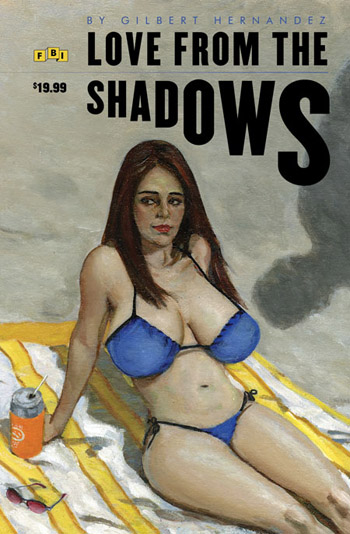
Love from the Shadows
Gilbert Hernandez, writer/artist
Fantagraphics, 2011
120 pages, hardcover
$19.99
Buy it from Fantagraphics
Buy it from Amazon.com

For reasons unknown to me, I did not create a Comics Time entry for this review, which was posted on April 20 at The Comics Journal. I’m just rectifying the situation now. Please visit TCJ.com for the review.
More Mad Men thoughts
September 30, 2011* Last night, during my stint enjoying the hospitality of the Long Island Rail Road, I finished the first disc of Mad Men Season Two. With a little more than a full season under my belt, I find that I still don’t really relate to it on a competence-fantasy level — but what I do relate to is what Don Draper is so competent at. He’s a writer! A copywriter at that! I’ve now read and watched so many stories about people who murder other people for a living that watching people spend time trying to figure out the right turn of phrase for a headline feels bizarre. Bizarre, but good.
* The best part is that Mad Men nails the main pleasure of copywriting: Using creativity to solve a puzzle. Case in point: Don, Sal, and Peggy try to figure out the right tagline for their Mohawk Airlines ad. Don rejects the initial sexual-adventure angle he’d helped develop in their previous meeting, instead focusing on Sal’s background illustration of the traveler’s little daughter. On the spot, Peggy suggests a series of taglines reflecting this new direction, and she and Don tweak and reject them until she arrives at the magical “What did you bring me, Daddy?” She knows it’s right, Don knows it’s right, Sal knows it’s right. I know that sensation! I’ve gotten it myself during my dayjob writing copy for a bookseller, and during freelance gigs writing jacket copy for graphic novels, and in meetings at my old magazine jobs, coming up with coverlines. The thrill of recognition was palpable.
* Which leads to a surprising insight: Don’s work life is actually pretty good! I expected him to be embroiled in cutthroat office politics the entire time, but at least up until this point, his work-related problems are actually personal problems in work drag: his problematic relationship with his client Rachel Mencken; an unexpected intel coup by his envious underling Pete Campbell; a quickly avenged and forgotten pass at his wife by Roger Sterling. Those events aside, Don has a creatively and financially fulfilling job. He has the full support of his superiors; even the one time that Cooper gainsays him by insisting they keep Campbell, Sterling immediately steps into the breach to safeguard Don’s authority in Campbell’s eyes. He has the nearly worshipful admiration of everyone at the office, from his bosses (who are also his friends) to his employees (including Pete, his own protestations to the contrary). He’s good enough at his job to actually deserve that admiration, moreover. He wants a raise, he gets it. He wants to make partner, he gets it. In fact, hiring Duck Phillips and discovering that he disagrees with the decisions Duck’s making in his old job is the first time Don goes up against anything resembling a structural problem with his job. No wonder he’s sacrificed or marginalized so much outside of the office.
* Peggy’s arc is a lot more disheartening than Don’s, because it entails her becoming a worse person as a function of getting better at her job. I’d be lying if I told you that my own recent experiences with miscarriage, premature birth, and fatherhood didn’t color my perception of her decision to reject her baby. Simply put, that scene made me cry at my desk. (It’s been tempered somewhat by the revelation that she handled her I Didn’t Know I Was Pregnant moment badly enough to be classified as mentally ill and/or maternally unfit by the state.) But it’s not just what she’s done about her baby. I watched in something approaching horror as she dismantled the pretty young voice actress she cast in the commercial for the weight-loss vibrator thingamajig, thinking that she was harping on a perceived lack of confidence to compensate for her own — but this blossomed into full-blown horror when I realized she did this on purpose so that she could ingratiate herself with the unctuously macho Kenneth Cosgrove by providing him with easy pickings, breaking the actress apart so he could sweep in and reassemble her around his dick. Peggy appears to have learned what it seems a lot of viewers don’t learn from Don and company’s behavior, which is that you can’t separate the competence fantasy from the competence nightmare.
* Don’s most profound violation of Betty’s trust was neither his many affairs, nor his lies about his name and background. It was his collusion with her psychotherapist. I’m not really sure if what I’m about to say truly squares with the reality of these situations, but I can’t help but feel that both his adultery and his identity are matters of withholding himself from Betty. These are areas of his life he has chosen not to share with her. But by violating her privacy in therapy, he’s actively invading those areas she chooses to keep from him in turn — socially sanctioned areas at that, unlike his own. It’s vile. And when I realized that his purloined phone bill would reveal not phone calls to mistresses (he was always pretty careful about that) but phone calls to the doctor, I gasped.
* Betty handled it differently than I thought she might, by the way. I think I expected a “press a button and she falls apart” physical collapse akin to — well, I won’t say, but another prominent drama involving a husband who cheated on his wife, when the wife was finally confronted with this in a way she couldn’t avoid. Instead, in true Draper fashion, she shrewdly uses her knowledge to voice her concerns and suspicions about Don’s infidelity, knowing that either a) the doctor wouldn’t dare tell Don about this, thus preserving her privacy, or b) the doctor would tell Don about this, thus starting a conversation she couldn’t bring herself to start on her own.
* But first she breaks down and cries and confides to a nine-year-old boy. I found her two interactions with her divorced neighbor’s sad little kid enormously affecting. The first, in which the kid busts in on her while she’s peeing and she subsequently gives him a lock of her hair, was like the fulfillment of every young boy’s first pre-sexual kindling of the erotic impulse. That’s a topic I don’t think I’ve ever seen addressed, except in cheesy Franco-Italian sexual-awakening movies about sultry brunettes who turn their little villages upside-down. But it was also enormously revealing of how desperate Betty was for sexual and romantic validation, and how little emotional sustenance her friends, husband, and work as a homemaker and mother were providing her. That second parking-lot interaction was all of that writ large, with the bonus violation of the era’s rigid insistence on the sacredness of childhood. She forced the kid to be an adult — in a tender and sad and empathetic way, so much so that even the kid realized this person needed taking care of, but yeah, that’s what she did. It was brilliantly written, and frankly January Jones, whatever her faults elsewhere, couldn’t be more ideal as this porcelain-doll wifebot who occasionally cracks in profound and dangerous ways.
* Back to Don for a moment: My favorite part of the slow-burning Dick Whitman reveal came before you even knew it was a reveal. It was the first time we ever heard the name “Dick Whitman,” when a fellow commuter bumped into Don on the train and used this unfamiliar name. For the entire conversation, I thought that this guy simply had it wrong, that it was a case of mistaken identity, that Don was rolling with it because doing so was easier than correcting him, that a point was being made about Don as an unperson, a meticulously constructed generic man-shaped void. And I think those last couple of points still stand, regardless. What an eerie, haunting little scene.
* Another detail I enjoyed: Don and Pete’s on-again, off-again, bonafide camaraderie — the camaraderie of enemies. In the course of my life, from grade school till now, I’ve had, I dunno, half a dozen dudes (always dudes) who’ve actively sought to hurt me and/or were out to get me in some way. In all cases this weird affinity develops with them in a way that doesn’t exist with more run-of-the-mill critics or unpleasant acquaintances. You get to know someone you hate, and when you get to know them, a closeness develops whether you want it to or not. In one case in my own life, a guy I almost came to blows with once in high school (unbeknownst to me — our mutual friends kept him away from me) literally did the look-back-on-it-and-laugh thing a year later, when we became friends in college. We wouldn’t have gotten there if we hadn’t started someplace else. So I totally buy the seemingly genuine concern, respect, and pleasantness that breaks out between Don and Pete every now and then. As Bert Cooper told Don, one never knows how loyalty is born.
* A couple of quick notes on two key supporting players. You’ll note that when I did a quick list of actors on this show who are easy on the eyes, I didn’t mention John Slattery as Roger Sterling. I dunno, there was something slightly avian and predatory in his sharp gray features. But Jesus can that guy talk. Hand me a mic and a phonebook, for real. What great casting, to make him the guy for whom bon mots are a way of life. He’s a juggernaut of verbal charm. The most troubling thing about his move on Betty Draper or his attempted twincest threeway on the night of his heart attack wasn’t the morality of the deeds, but how clumsy he was in suggesting them. That’s how you knew something was wrong. That’s sharp writing.
* Watching these DVDs was my first-ever glimpse of Christina Hendricks in a noncleavagecentric capacity. If you’ve only ever known of her in the context of your suspicion that Tumblr was developed as a slightly inefficient Christina Hendricks photo delivery mechanism, watching her act — specifically, watching her play Joan Holloway, who is herself a ruthlessly efficient Joan Holloway delivery mechanism — is a revelation. That’s a part that could be very one-note and very dull in someone else’s hands, but Hendricks brings the character to her own tenaciously curated form of life. Always you see the effort behind the effortlessness, but just a little of it, just enough to prevent her from lapsing into caricature on either side of the line. Hendricks makes “making ‘making it look easy’ look hard” look easy.
Comics Time: Prison Pit: Book Three
September 28, 2011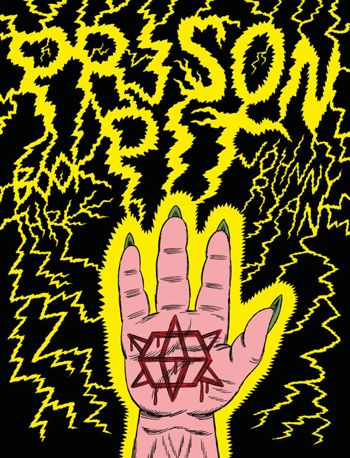
Prison Pit: Book Three
Johnny Ryan, writer/artist
Fantagraphics, September 2011
120 pages
$12.99
Buy it from Fantagraphics
Buy it from Amazon.com

For today’s Comics Time review, please visit The Comics Journal.
Comics Time: “Touch Sensitive”
September 23, 2011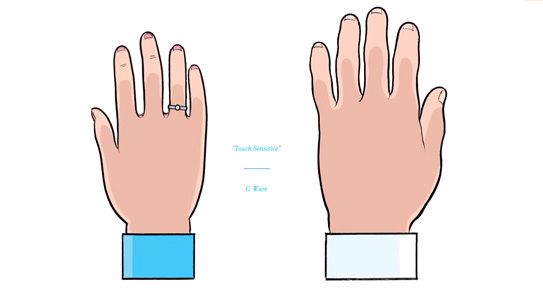
“Touch Sensitive”
Chris Ware, writer/artist
McSweeney’s, September 2011
14 pages
99¢ (in-app only)
Download the free McSweeney’s iPad app, then purchase it in the app’s store
For today’s Comics Time review, please visit The Comics Journal.
Mad Men thoughts
September 21, 2011In a cosmic coincidence, just days before Netflix announced that it was doubling its rates and renaming itself “Poops Deluxe,” I finally started watching the Mad Men discs I’d had out probably for the duration of wife’s pregnancy and our child’s first six months of life. Guess what? It’s a good show! I have the following spoiler-free thoughts about it in particular after watching the first four episodes:
1. Whoever cast this thing deserves a Congressional Medal of Honor. Jon Hamm is an enormously pleasant man to look at for an hour at a time. He’s like the human equivalent of Craig Thompson’s drawing: No matter how daunting the size of the undertaking, on a visual level it’s just like, “Hey, this’ll be nice.” And supporting players from Christina Hendricks to Bryan Batt are similarly enjoyable to look at for various reasons.
2. There was a twist in one episode involving a firm decision Don made, the kind you really can’t back down from, being undone by forces beyond his control, and I sat there watching it unfold thinking “How is he going to recover from this mess?” Then another character swooped in and fixed it for him by doing something I never in a million years would have thought to do, either as the character or as the writer. That impressed the hell out of me. Writing that’s smarter than you are is a rare gift, frankly.
3. Tom Spurgeon has this thing about contemporary superhero comics being, basically, competence fantasies. The reason all the characters have gradually been powered up into unstoppable badasses is because that’s what the audience is identifying with. They don’t want to see challenges dealt with, they want to see challenges overcome. Nerd culture has a problem with this generally — I see it a lot in A Song of Ice and Fire fandom, where readers “stop liking” Character X when Character X fucks up or does something stupid or reckless or naive, as if doing so makes them less interesting or worth reading about. I watch a show like Mad Men — or The Sopranos, or Deadwood, or The Wire, or Battlestar Galactica, or even Lost, which as the nerd-culture-est of all those shows had to deal with this problem over and over again as they made Jack and Locke progressively less heroic/antiheroic and more unpleasant — and wonder how the fuck those kinds of people process someone like Don Draper. Do they just not watch? Or are these the sociopaths who watch this show and feel like it’s brought back early ’60s smart-haircuts-and-suits-and-cigarettes-and-scotch coolness again, ignoring that all those things are basically just the pointy tails and pitchforks adorning this particular hell on earth?
Comics Time: Habibi
September 20, 2011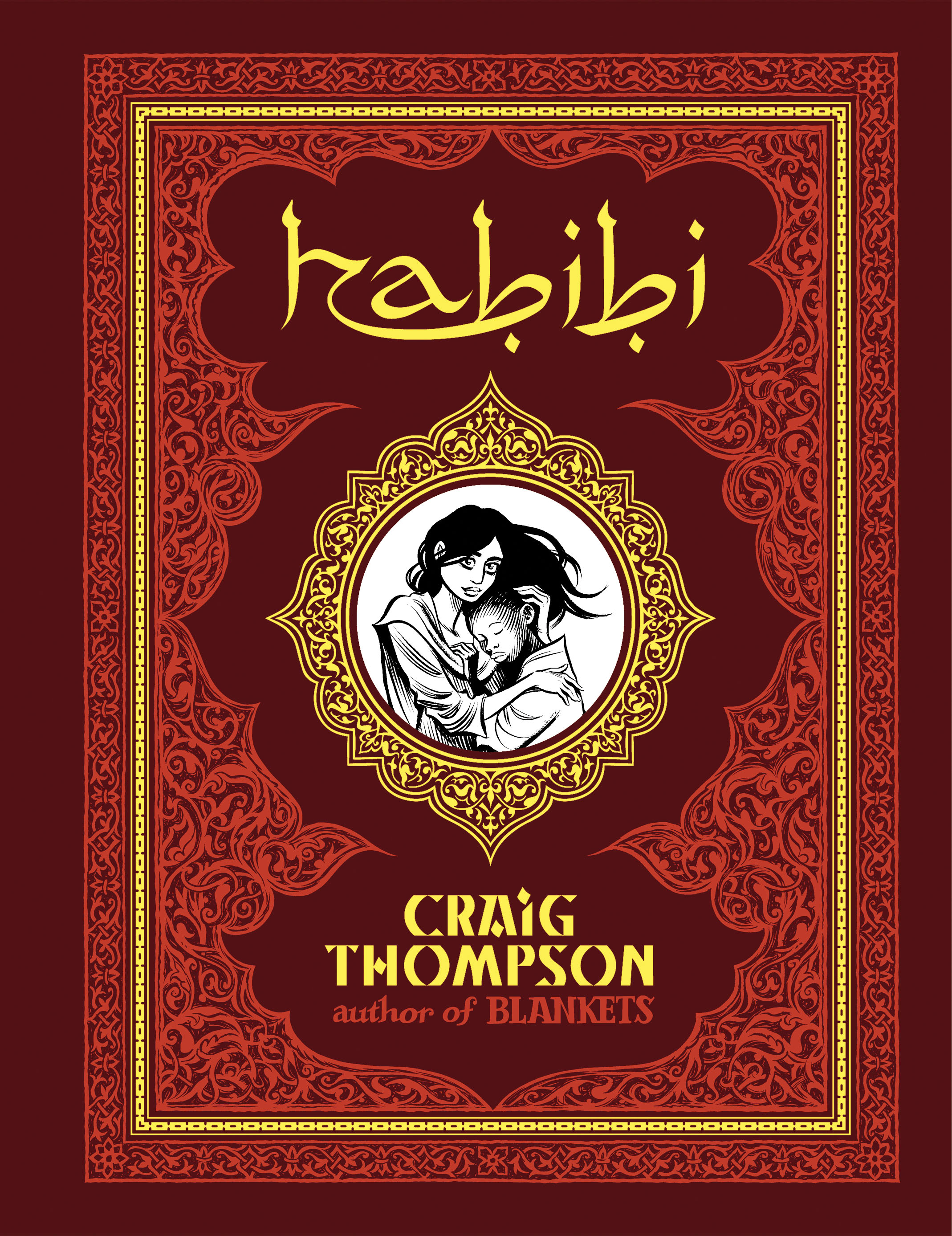
Habibi
Craig Thompson, writer/artist
Pantheon, September 2011
672 pages, hardcover
$35
Buy it from Amazon.com

Fifteen observations about Craig Thompson’s Habibi:
1. This is not a book about Islam. It’s not about any varieties of Islam — contemporary, ancient, fundamentalist, militant, or otherwise. It’s a book infused with Islamic art, culture, thought, and religious beliefs, certainly, but it’s not about Islam. This is another way of saying it’s not about 9/11, al Qaeda, Iraq, Afghanistan, Palestine, Iran, any specific Muslim countries, Muslims in America, uniquely Muslim varieties of misogyny, the Arab Spring, or any other contemporary news-story topic. I first talked to Thompson about his plans for Habibi in the summer of 2003, and in that context and over the course of many of the years to follow it was tough to think about the book without thinking of it one or more of these ways, but no, that’s not what it’s about.
2. This is a book that uses Islam to do other things. On a visual level, it gives Thompson a set of design elements, from calligraphy to ornamentation to architecture to dress to geometrical art, from which he can build a coherent visual world for his vaguely fantastical/post-apocalyptic/dystopian story. Not coincidentally these elements dovetail with his preexisting preoccupations as an artist, from swooping fabrics to obsessive-compulsive design filigrees to religious iconography.
3. It follows that the book is consciously, knowingly Orientalist, as you’d expect and hope of a book that’s using actual Islamic art as bricks in a fantasy world-building project. It’s got an Arabian Nights vibe. Thompson’s invoked Edward Said on this score and everything. To the extent that potentially problematic caricatures of Arab and African race are involved, and they are, they are at least consciously evoked.
4. Islam also provides Thompson with a back door into talking about religion and God — even recognizably Christian elements thereof, thanks to the presence in Islam of Jesus, Solomon, Abraham et al — without needing to rely on the brand of American evangelical Christianity in which he was immersed growing up and which he’s already explored in Blankets. At times the commonality between the issues he discusses in the two books is quite striking. For example, there’s a plotline here about how the bifurcation of Islam and Judaism/Christianity can be traced back to which son you believe Abraham was supposed to sacrifice, Isaac or Ishmael, that’s basically just Blankets‘ bit on scriptural malleability (“The Kingdom of God is within or around you”) blown up to world-historical scale. The impact of religious belief on the development of adolescent sexuality is a centerpiece of both books as well.
5. This is a book about sex. Even if there’s nothing in it that would earn the book anything more than an ‘R’ rating, it works through some violently ambiguous and conflicted feelings about sex in relatively explicit fashion. It took my wife reminding me that Craig first described the book as starring “a eunuch and a prostitute” to help me crystallize that, but there it is. And it makes sense, given the play-it-to-the-balcony tone of Thompson’s previous book, Blankets, and its autobiographical protagonist’s all-or-nothing approach to falling in love and making art, that this book would coalesce around those two poles as well. It is very frankly about the liberating and destructive power of both desire and the denial of desire. (To hearken back to the Arabian Nights element, here’s a tell: Instead of delighting the king with her stories for night after night under penalty of death, the central female character must delight him with sex.)
6. This is a book about many other issues that overlap with or orbit around sex in the popular imagination. They’re not sex, but they’re talked about in the same breath more often than not. They include rape, molestation, prostitution, pregnancy and childbirth, gender, misogyny, a panoply of queer identities, self-injury, puberty, motherhood, male-female friendships, sex and race, sex and organized religion, sex and spirituality, sacrifying sex/orientation/gender, masculinity and femininity…
7. The emotional and physical stakes for the characters are much higher than they are in any of Thompson’s previous works. This is established within the first few pages, in which a child is raped. A bloody sheet is held up to the child and the audience, the blood of her vagina on the blank white fabric equated with the letter-writing in Chunky Rice; the footprints on snow and drawings on paper of Blankets; the act of Creation itself — “From the Divine Pen fell the first drop of ink.” Violence and abuse are the lifeblood of the story.
8. Thompson’s art is much, much denser here than I’ve ever seen it before. It’s still lush and lovely on a surface level, his line still swoops and curves in a fashion he’s explicitly compared to handwriting, but there are more panels on the page, more black in the panels, few of the vast fields of white Blankets was known for, and few of its splash pages too. Decorative patterns of intricate detail are copied from Islamic texts by hand, and drawn repeatedly until they cover almost all the available space on a given page, also by hand. It’s a much tougher book for your eyes to breeze through.
9. Maybe the best way to symbolize that is in the new panorama Thompson has added to his repertoire. He’s said, and promotional art for the book has made use of the fact, that Good-Bye, Chunky Rice had the ocean, Blankets had the snow, and Habibi has the desert. That’s true, but Habibi heavily features vistas of another sprawling, enveloping sea: a man-made sea of garbage. It’s as dense and detailed and chaotic as the water, snow, and sand are unified and simplified.
10. The book is designed. Designed in the Watchmen symmetrical-issue sense. Each of its nine chapters corresponds to a box in the Islamic religious/mathematical talisman known as a magic square — a sort of spiritual sudoku — and its corresponding letter of the alphabet. Each corresponds to a specific topic, and a specific prophet of Islam used to illuminate that topic. But unlike Alan Moore, Thompson doesn’t foreground his machinations. This stuff is present, but in its way it’s beside the point. I didn’t even notice.
11. In much the same way that light, electricity, and information functioned as the stuff of life in Grant Morrison’s Final Crisis, fluid is the stuff of life here. Water is crucial to the various societal strata’s survival within the drought-stricken world of the story. Blood is crucial to nearly all of the book’s depictions of both sex and violence, the fuel of human physicality. Ink is crucial to the characters’ understanding of the nature of God and the world via holy texts and art, and to the author’s understanding of what the hell he’s been doing for the past eight years. There’s less semen or vaginal secretion than you’d think, but otherwise it’s a book about fluids, and fluidity. The greatest sin is staunching the flow, which is done in various ways — a metaphor that extends from environmentalism to art to, of course, spirituality and sexuality.
12. The relative lack of emphasis on sexual fluids is a leading indicator of where the book ultimately pulls an important punch. There’s a revelation, an exposure, toward the end of the book that we readers do not get to see. Since the book confronted virtually everything else it tackled so head-on, since it was so in-your-face about violence and sexuality, you really feel this revelation’s visual absence. Which is maybe appropriate, given what’s being revealed, I dunno. But it left me wondering “Why didn’t he show that?”, in a way that suggests it’s a misstep.
13. The book contains two of the toughest depictions of mental illness I’ve come across in comics. One in particular involved postpartum depression and was deeply sad to me. The other comes hot on the heels of the book’s single most unpleasant depiction of the cruel fate of children in this world. Actually, nearly everything involving children is rough stuff here. There’s not a lot of time for innocence.
14. The book contains two pretty rollicking action sequences. If you’ve read as many lousy action comics as I have, it ought to be a pretty great pleasure for you to watch an artist with Thompson’s attention to environment, layout, movement, and pacing choreograph chase scenes and fight scenes. It definitely was for me. And these sequences had the secondary function of release valve for the dense and emotionally oppressive material they helped break up.
15. Actually, the more I think about it, the more I think Habibi is a book of sequences. Maybe this is reinforced by Thompson’s non-linear storytelling, with his male and female leads’ stories shifting backward and forward in time independent of one another, a technique that emphasizes discreet sequences over the overall flow of the larger narrative. But the bathtub sequence (very successful), the dam sequence (this is perhaps the book’s climax, and I’m not sure it’s successful), the garbage man sequence, the childbirth sequence, the eunuchs sequence, the conflicting stories of Abraham’s aborted sacrifice — these are what stick out to me, embedded in the bigger picture. They’re what will draw me back into the book, moving backward and forward through the work of a cartoonist working out his personal obsessions on the grandest canvas imaginable.
Comics Time: The League of Extraordinary Gentlemen: Century: 1969
September 14, 2011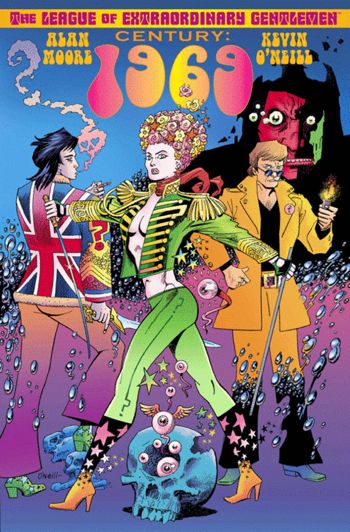
The League of Extraordinary Gentlemen Vol. 3: Century #2: 1969
Alan Moore, writer
Kevin O’Neill, artist
Top Shelf, August 2011
80 pages
$9.95
Buy it from Top Shelf
Buy it from Amazon.com

For today’s Comics Time review, please visit The Comics Journal.
Comics Time: Fantastic Life
August 26, 2011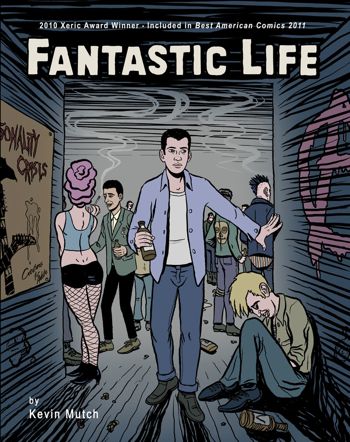
Fantastic Life
Kevin Mutch, writer/artist
Self-published, August 2011
128 pages
No price listed
Read the first chapter at Kevin Mutch’s website
For today’s Comics Time review, please visit The Comics Journal.
Have a Comics Time all the time
August 16, 2011I’m pleased to announce that the Comics Reviews section of the sidebar is now fully up to date. All of my recent Comics Time reviews have been added, and all the links lead to the relevant review here at seantcollins.com rather than at my old site. That’s in the neighborhood of 500 reviews. Please browse and enjoy.
Comics Time: Tales Designed to Thrizzle #5
August 16, 2011 Tales Designed to Thrizzle #5
Michael Kupperman, writer/artist
Fantagraphics, 2009
32 pages
$4.50
Buy it from Fantagraphics
(Originally posted at this blog’s previous location on May 26, 2009; I am reposting it because it does not seem to have made the move to the current site.)
By now I’ve written about how Kupperman’s humor works at some length, so you’d think it would have occurred to me by now that his humor is an entirely different animal from the vast majority of humor comics. Which it is, insofar as it’s funny and most humor comics aren’t. But it wasn’t until this (ironically) prose-heavy issue that I realized he’s not doing gag comics at all. The only four-panel punchline-driven strip in this entire book, “Ever-Approaching Grandpa,” basically exists to give lie to the notion of the four-panel punchline-driven strip (and is own title). He’s not content with using just the words and the visuals. I think what Kupperman’s doing–with his long, digressive “stories,” with his riffs on old-fashioned comic-book covers, and so on–is using the stuff of comics itself as a locus of the comedy. A grid of panels implies continuity of action, so he uses that to present an increasingly bizarre and disjointed Twain & Einstein adventure with barely any internal cohesion whatsoever. We assume that captions or word balloons will comment on the visuals against which they are juxtaposed, so he creates a how-to arts-and-crafts strip that for no apparent reason is also a brutal noir (“How to Pattern Print with a Potato, Johnny”). We’ve come to accept certain visual cues as meaning a certain thing, so he literalizes them so that they mean something entirely different–a phone in the extreme foreground actually turns out to be a just-plain gigantic phone; a mother’s wagging finger radiates motion lines that turn out to be “super-vibrations.” In his way, Kupperman’s just as concerned with making comics’ formal aspects work for him as Chris Ware. In his way he’s every bit as effective. Goddammit this book is funny.
Music Time: Jay-Z and Kanye West – Watch the Throne
August 12, 2011Crossposted from All Leather Must Be Boiled.
On Watch the Throne, the new collaborative album by Jay-Z and Kanye West, the title phrase or a variation on it is uttered nine times over the course of sixteen songs. Meanwhile, a recurring orchestral sample — its nervous energy evoking the spooky bits of Magical Mystery Tour, sinister ’60s children’s movies, and the shifty-eyed rhythm of Radiohead’s “Paranoid Android” — shows up in looped form as an unofficial theme at the end or beginning of four separate tracks, including the opener “No Church in the Wild” above.
Did this remind anyone else of George R.R. Martin’s character mantras/catchphrases from A Song of Ice and Fire/Game of Thrones? “If I look back I am lost.” “Where whores go.” “It rhymes with…” “She’s been fucking [names redacted] for all I know…” “Kill the boy.” “You know nothing, Jon Snow.” “Valar Morghulis.” “Weese, Dunsen, Polliver, Raff the Sweetling…” In each of these cases, these are phrases that wounded, worried minds keep circling back and back and back to, obsessively. They’re phrases they cling to and phrases that haunt them.
Can you think of a better way to describe what the the repetition of the words “watch the throne” might mean to two men whose unquestioned position at the top of their field means, as Jay-Z puts it, that the only place they can find an opponent is in the mirror?
I’ve been writing a post comparing Watch the Throne to ASoIaF/GoT since my first listen, but when you play the game of Game of Thrones comparisons, you publish or you perish. Oh well! I actually don’t mind that other people have gotten there first, because it means that the initial, incorrect critical narrative about the album — two rich people rapping about how rich they are, which is bad because of the debt deal and the London riots or something — is falling by the wayside. It’s as if the pressure to turn reviews of an important album around in 24 hours (due to the record’s unexpected, exclusive, leak-thwarting midnight release on iTunes) led critics to forget that anything ever happened at any other time. If it’s not okay to rap about fame and wealth to a struggling audience, then flush the last two decades of hip-hop, including multiple chart-topping critically acclaimed albums by Jay-Z and Kanye West, down the toilet.
But not only is the thesis ridiculous, it’s not even accurate. Obviously Kanye and Jay rap a lot about their money and the stuff they’ve bought with it on this album, and obviously the names they’re dropping are high-end and/or highfalutin’ enough to stand out to critics under deadline pressure. (I bet the Museum of Modern Art didn’t expect to have almost as much of a role on this record as Frank Ocean does.) But you’d almost have to purposefully ignore the rest of the lyrics, and most importantly the sound of the thing, to think that’s all there is to it, to characterize this album as a less forceful-sounding Rick Ross record. For all the talk about life at the top, they seem about as comfortable there as Robert Baratheon, Eddard Stark, and the stained knight Jaime Lannister. The music is foreboding and paranoid, minor-key prog samples, witch house synths, and soul legends chopped and pitch-shifted into demon shouts and banshee wails. The lyrics describe difficulties — from Jay-Z copping to depression, to Kanye’s R. Crumb-like dissections of his sexuality and misogyny, to overcoming the obstacles of a racist society to “make it in America” only to discover that the higher they go, the fewer people like them they find — that go a lot deeper than the usual litany of complaints about haters and biters. Both aspects of the record are embodied by those repetitions — that cycling, recurring, uncomfortable theme music; “watch the throne, watch the throne, watch the throne,” over and over again. If they were comfortable on the damn thing, they wouldn’t constantly be telling themselves and everyone else not to take their eyes off it for a second.
Comics Time: The Heavy Hand
August 10, 2011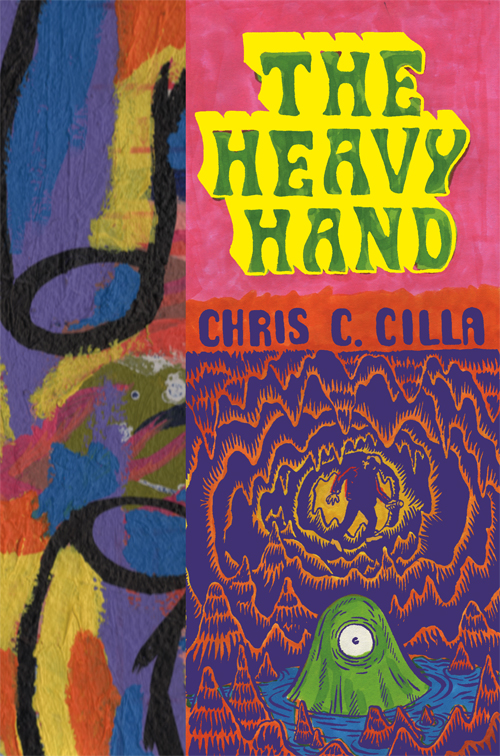
The Heavy Hand
Chris C. Cilla, writer/artist
Sparkplug, 2010
108 pages
$14.99
Buy it from Sparkplug
Buy it from Amazon.com

Fascinating book, this. It combines the textural, noise-based visual aesthetic of caves and monsters and melty stuff that you may have seen from many of Chris Cilla’s fellow contributors to the Paper Rodeo and Kramers Ergot anthologies with the down’n’out beer-swillin’ shit-talkin’ big-schnozzed characters of ’90s altcomix (big noses are to alternative what big feet were to the underground), so right off the top it’s doing something unexpected. And in the same way that the art is both densely intense and breezily funny, the story somehow coheres from jokey banter, grand-guignol monster attacks, and surreal non sequitur splash pages into an utterly convincing world. The Heavy Hand is basically the tale of Alvin Crabshack, somewhat feckless young guy who picks up stakes and moves from the city to a remote research site in hopes of bluffing his way into the employ of a scientist he admires, at which point he is drawn into a crescendoing series of bizarre science-fictional events — and it works great on both sides of that descriptive sentence’s comma.
Regarding the first half, Cilla’s command of the details of a young life not particularly well lived is substantial. Just for example, look at the way he differentiates between the two women Alvin is (duplicituously) dating by how he dresses both their rooms and themselves — the first has a neat haircut and sits in bed reading one book among many well-ordered shelves, candles and wine glasses strewn here and there; the second we meet as she cracks open a beer and picks a cassette tape off a table sporting a used ashtray and half-eaten dishes, all while bare-ass naked — while giving both sequences a sordid, stiff-nippled sexiness, a squalid heat that comes from lying to someone you know intimately and resent at least as much as you enjoy.
Of course, the second woman has a duck’s beak instead of a nose, which leads us to the strangeness. Obviously this wouldn’t be the first time an alternative comic featured unexplained anthropomorphism in an otherwise realistic setting, so I didn’t pay it much attention — nor the weird, wordless opening sequence in which some kind of ghostly scientist fixes both a machine and a cup of coffee by pissing all over them. But as Alvin’s journey progresses, we come to learn that not only is he basically lying his way into working with his academic idol, but the work he’ll be doing is considerably more odd and dangerous than the book’s opening makes it sound. Rival grant-sponsored teams plumb a system of caverns and underground rivers for giant eggs that contain dead reptiles, while huge and deadly one-eyed protoplasmic creatures devour their pack donkeys…which in turn hearkens back to tall tale about a curse on a nearby town that led to its affliction with these strange animals…which we suddenly realize relates to the odd interstitial splashes and spreads depicting a mustachioed man and giant spiders and so on…which we eventually learn aren’t the non-narrative interruptions they appear to be but an integral part of the story at hand…which culminates in a tour-de-force party sequence where the romantic entanglements and awkward interpersonal interactions of the beginning of the book come back into play. These competing, seemingly clashing narrative and visual threads slowly enmesh and intertwine so organically that you hardly notice, until suddenly you realize they’ve sewn up a structure so sturdy you could spend hours climbing around inside it.
My only complaint is that you don’t get that kind of time. As fun as that party scene is — I really love the way all of the dialogue is disconnected, with never more than two word balloons actually commenting on one another; it’s a great way to convey feeling out of place in an inebriated crowd — it eats up a huge amount of space relative to the densely plotted rest of the book, and rockets everything to its explosive conclusion way too fast. The Lynchian epilogue is as engrossing as anything else in the book, but it made me pine for a nonexistent much longer version, one that didn’t cut itself off right when it became apparent how rich and compelling it was. But since so much of the plot is driven by an anecdote about an inventor whose life basically had to blow up before he could do what would make him rich for the rest of his life, it’s hard for me to get too upset that the book itself follows suit. Wanting more is surely a sign that this smart, biting work of literary science-fiction comics did something right.
Comics Time: Love and Rockets: New Stories #4
August 1, 2011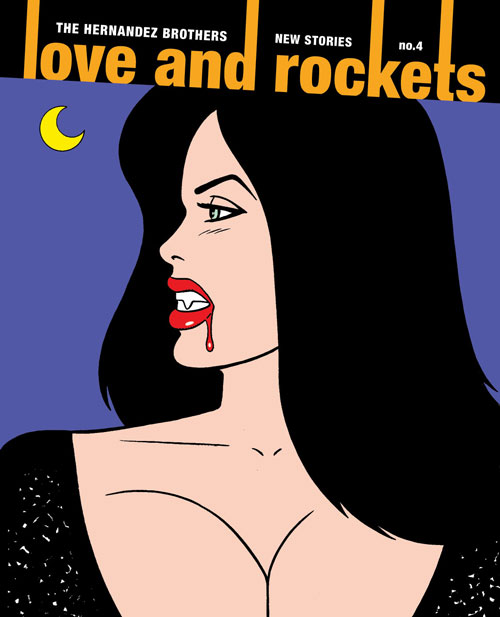
Love and Rockets: New Stories #4
Gilbert Hernandez, Jaime Hernandez, writers/artists
Fantagraphics, August 2011
104 pages
$14.99
Buy it from Fantagraphics
Buy it from Amazon.com

Love and Rockets: New Stories #4 will turn any fan of Los Bros Hernandez into the host of The Chris Farley Show. “Remember? That time? When you drew Calvin’s plaid shirt? So that the plaid was always facing in the same direction? No matter how much Calvin moved?…That was awesome.” I am seriously finding it difficult, if not impossible, to review this comic without simply hitting the bullets-and-numbering button and whipping up a list of everything in it that amazed me. It would be a long list, too. But I’m abstaining as much as I can — to challenge myself for starters, and to avoid spoiling the comic for those of you who haven’t yet read it (which is probably most of you since it’s not out yet) for the most part. But I’m also holding off on that listicle because I think it’s a cheat. The fact of the matter is that while reading this book I discovered that I’m at least as attached to Ray Dominguez and Fritz Martinez, the protagonists of Jaime and Gilbert’s contributions respectively, as I am to a decent number of real people in my life. So sure, I could rattle off the ways in which Xaime and Beto continually prove themselves to be among the most graphically inventive and entertaining cartoonists alive some three decades into their careers — the crosshatching on Ray’s shirt and Maggie’s sofa; Gilbert’s use of wavy, puddle-shaped, impenetrable fields of black in his vampire story; the impact of the just-this-side-of-parallel lines of Angel’s body as she bends her leg to put on a high heel; the upside-down lava-lamp shape of Fritz’s legs in a skirt, used as an anchor for panel after panel of her simply walking around town with her agent ex; dredging up a long-ago, possibly long-forgotten character, drawing him as a late-middle-aged man in a way that makes him unrecognizable until you realize just how recognizable he is; the smashed-skull-as-cubist-masterpiece in Gilbert’s customary burst of horrifying ultraviolence; the holy shit moment when you realize the visual structure to that montage spread from Jaime’s story; Gilbert storming the ramparts of the vampire story and launching sex and violence back into it like payloads from a trebuchet; Jaime serving up a story whose snapshot style echoes comparable material from “Wigwam Bam” in significant and story-relevant ways; tracing the similarities and differences between Killer and Fritz via the characters they play, the use of their amazing bodies fraught with story information. And hey, look at that, I did rattle them off! But in the end, how it looks pales in insignificance next to what happens, because making it look that good is a means to the end of imparting just how much what happens matters. Ray’s shirt and Fritz’s legs, the shadow of the vampire and the structure of the montage — they’re just landmarks to remind you where you were when you found out if Ray and Fritz and Maggie were going to get happy endings, or not. It’s the easiest thing in the world to understand, and it’s the hardest thing in the world to do, and it’s magic, pure magic, to do it this well.
Comics Time: Congress of the Animals
July 27, 2011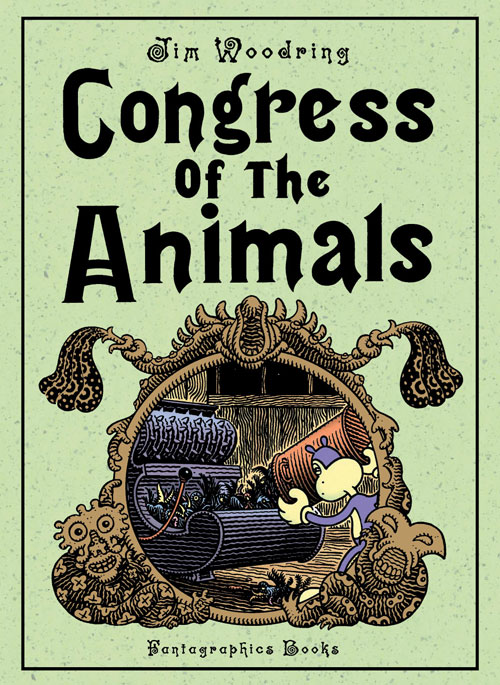
Congress of the Animals
Jim Woodring, writer/artist
Fantagraphics, June 2011
104 pages, hardcover
$19.99
Buy it and read a preview at Fantagraphics.com
Perhaps I should have seen it coming after the palpable (if fleeting) triumph of good over evil that comprised the climax of Weathercraft, Jim Woodring’s previous standalone graphic novel set in the world of his funny-animal avatar Frank. Regardless, I’ll admit it: I did not expect to read a Frank book whose final panel made me go “Awwww!”
It’s true that in Weathercraft, Frank’s hapless antagonist Manhog achieves enlightenment that for a short while allows him to become an elemental force of kindness, justice, and the security of a fundamentally benevolent order to the universe. But it’s only for a short while — the equilibrium restores itself, and he, the insouciant Frank, and the jauntily predatory Whim go back to their old ways. According to Woodring’s typically dense and hilarious jacket copy, we have the Unifactor, the familiar world of bulbous buildings and shoggoth-like plant deities in which Frank and his cohorts dwell, to thank for this state of affairs. Woodring calls the Unifactor “the closed system of moral algebra into which Frank was born, where “in the end, nothing really changes,” and where “Frank is kept in a state of total ineducability by the unseen forces which control that haunted realm.”
The difference here — and I’m not 100% convinced this would have been clear if Woodring hadn’t said so straight out on the jacket, but be that as it may — is that this time around, Frank leaves the Unifactor. Woodring’s customary Rube Goldbergian plot contrivances force Frank into a state of indentured servitude that ends with him on the lam. The journey positions Frank in the midst of various grown-up concerns, such as home ownership, property loss, commerce, employment, amusement, leisure, sex (in the form of what appears to be an angelic anthropomorphic vagina guarded by the giant disembodied head of a Dr. Seuss character), and religion (in the form of nude, beefy men with gaping chasms where their faces are supposed to be, whose ability to expose their guts at will and induce others to do so literally knocks poor Frank out with its disgustingness and is perhaps Woodring’s most troubling sequence since Manhog flayed his own leg); in other words, it’s a bit like Pippin. Normally we’d expect nothing to come of all this, save for an opportunity to marvel at Woodring’s buzzy, vibrating line, proficiency with creature design, and ability to distill unpleasant shit into slightly sinister slapstick adventures for his dog-cat-bear-mouse-thing hero. But the journey takes Frank so far afield that at some point (probably when he gets lost at sea and washes up on some distant shore) he ends up outside the Unifactor’s confines. New information can now enter his world, in the form of a female Frank-like character who lives in a house shaped like Frank. And at that point all hell breaks loose…which in a Frank comic is to say it doesn’t break loose at all.
Somehow, Frank has gained the ability to interact with another being without immediately sizing up the best way to have fun with, or at the expense of, that being, consequences be damned. They chat. They laugh at the bullying creatures who attacked him earlier, and blush at both having got such a kick out of it. (See, he hasn’t been brushed totally clean of his sins — as we see here and elsewhere, both he and his new pal still have a bit of an empathy deficit.) She protects him from the siren song of that angelic vagina-thing. She helps him return home, to the delight of his pets Pupshaw and Pushpaw, who seem overjoyed to find that their master has found his other half. But what really moved me is their simple physical interaction: They hug. I’m “awwww!”ing just thinking about it. That physical act is an act of grace on Woodring’s part, an escape from the mere hedonism or fight-or-flight responses that have been the sole custom of Frank’s world before now. It’s a new, rewarding emotion, embodied. And despite the break it marks from the world of Frank as we knew it, it fits, since isn’t embodying emotion what Frank stories have always been all about?
Comics Time: Citizen Rex
July 26, 2011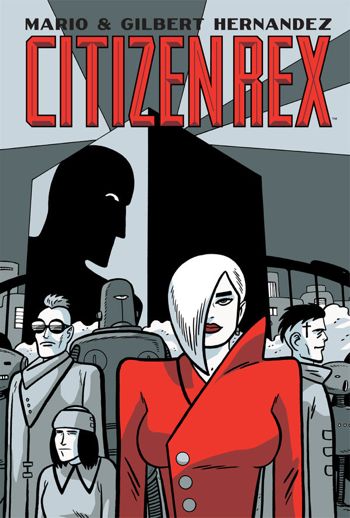
Citizen Rex
Mario Hernandez, writer
Gilbert Hernandez, artist
Dark Horse, June 2011
144 pages, hardcover
$19.99
Buy it from Amazon.com

For today’s Comics Time review, please visit The Comics Journal.
Music Time: James Brown – “Cold Sweat” (Live in Dallas, 8/26/68)
July 21, 2011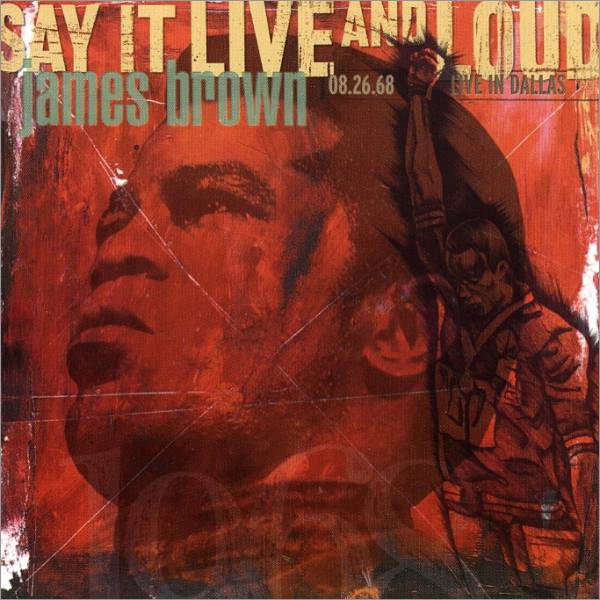
When my baby daughter gets fussy, which usually happens every night around 7:30, the one thing guaranteed to calm her down and cheer her up is for me to pick her up and dance around with her. So every night for about forty minutes or so we have a Daddy Dance Party, also known as Family Funky Time when my wife joins in. An undisputed highlight of the DDP playlist is this live version of “Cold Sweat” by James Brown from 1968, which over the course of its twelve minutes has exposed my daughter to more funk before age 2 months than I heard before age 20.
Virtually everything great about James Brown is on ample display in this recording. For starters, the man’s skills as a bandleader, even outside the studio and in a less controllable live setting, are quite simply astonishing. Listen as he and official bandleader Pee-Wee Ellis lead the group through an airtight version of the song, through minute after minute of vamping and solos, and back into the song again: Every note, every beat is hit hard enough to draw blood. As I listen to the thing, I marvel at his rapport with the band as they turn on a collective dime time after time — they seem linked almost at a telepathic level, where no cue comes as a surprise to anyone except everyone in the audience. Meanwhile, Brown’s charisma as a frontman is equally astonishing here. Those shrieks and yelps are really quite something, if you can try to forget you’ve heard them a million times and appreciate their ecstatic insanity afresh. But beyond that, his banter with both the band and the audience is funny and effortless, making cool-dude nonsense like “Excuse me while I do the boogaloo” or “If you ain’t got enough soul, let me know and I’ll loan you some — I got soul to burn” or introducing the latest dance move by challenging the band to guess its name (spoiler alert: it’s “the Detroit Pimp”) sound inspired, like a template young fans can apply when they want to be awesome.
But best of all, especially for those of us who’ve heard rock bands of Brown’s funk era stretch songs out into double-digit running times to enervating effect when performing live, there’s never a dull moment. The solos — fiery saxophone by Maceo Parker, follow-the-bouncing-ball bass from Alfonso Kellum, and most impressively, a double drum solo from Clyde Stubblefield and Nate Jones that ends with literally the funkiest break I’ve ever heard, driving the audience totally batshit — feel vital and exciting, an integral part of the performance, rather than a self-indulgent opportunity for the given player to show off while the rest of the band sneaks off for a cigarette break. And you never know when a lengthy vamp will be punctuated by Brown saying something funny or badass, or leading the band through snippets of Allen Toussaint and Lee Dorsey’s “Ride Your Pony” or Sam and Dave’s “Soul Man,” or quoting “my friend Sammy Davis,” or eliciting wild cheers from the audience with some unseen but undoubtedly crazy dance move, or god knows what else. The song is simply packed with pleasures I’m still discovering and delighting in after innumerable listens.
