Posts Tagged ‘reviews’
Comics Time: Celluloid
July 20, 2011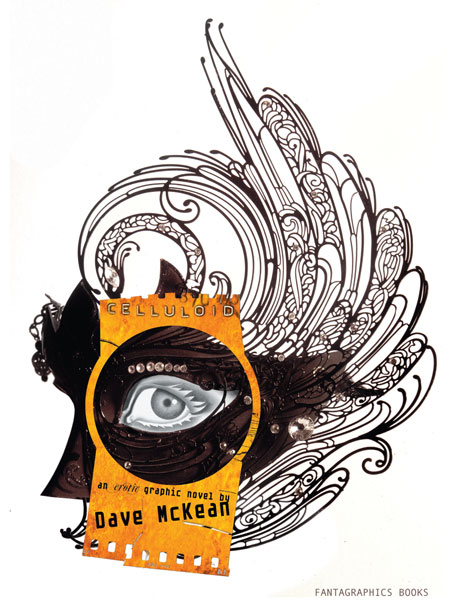
Celluloid
Dave McKean, writer/artist
Fantagraphics, June 2011
282 pages, hardcover
$35
Buy it from Fantagraphics
Buy it from Amazon.com

From a reviewer’s perspective, the nice thing about erotica is that, as with humor, there’s a clear threshold of physical response a work must cross to be judged successful. With humor comics, the key question (there are others, but this is the sina qua non) is “Did it make me laugh?” With erotic comics, it’s…well, let’s just say it ain’t laughter we’re after. And on that basic measurable (ahem) level, Celluloid comes up short (ahem ahem). McKean’s art is as otherworldly as ever, bathed in luminous gold, and until the final section it manages to avoid the “Hey, wanna watch some Sandman covers fuck?” photo gimmickry I was afraid of. But isn’t it kind of odd that of all the palettes McKean could choose to convey the film-projection-as-mystical-sexual-gateway metaphor that is at the heart of our nameless, speechless female protagonist’s “strange erotic journey” (to coin a phrase), he chose gold? Is that what you think of when you think of the shaft of light beaming from the projection booth to the screen, or the light the screen bathes you in in turn? Maybe if you’re Gordon Willis, but not if you’re me. The book is filled with weird little just-off details like that, from our young-ish heroine’s weirdly craggy body and her nose that seems to grow to Cyrano proportions at random depending on the angle McKean’s drawing her at, to the deeply unsexy choice to make our heroine’s foil in a lesbian sequence wear a garland of grapes that’s echoed by her (count ’em) fourteen breasts, leaving me to wonder if one of them was gonna get plucked off and eaten throughout their tryst. Working mostly with full splash pages and spreads, McKean is able to pull off striking isolated images here and there — off the top of my head I remember our heroine’s shocked face as she discovers a plaza full of copulating couples, a dramatic first kiss between our heroine and the grape goddess staged at a scale that makes it look like the sky is tenderly kissing the earth, and (one of the few actually hot moments in the book) her (non-sexual) removal of her top to take a bath right near the beginning of the book. But with the exception of the stunning black, white, and red sequence in which the protagonist sucks a demon’s totemic red dick until it ejaculates milky semen through the void like a spaceship floating by in 2001, isolated images are all they are. They get lost in a melange of homages to Picasso, Ernst, and “Soft Construction with Boiled Beans”-era Dalí, combined with McKean’s usual soft-focus multimedia wizardry and angular cartooning. What’s more, the whole affair has a didactic feel to it, as “let’s prove a point about the artistic legitimacy of erotica”-type comics often do. We’re clearly supposed to be proud of the protagonist’s journey of self-discovery, but all we have to go on to know such a journey is even required is a quick phone call at the beginning with her boyfriend — it’s an unhappy-seeming call, sure, but the impression it gives is that they’ve simply had a rough day at work, not that there’s some sexual void in their shared life that she’s filling in on her own, and certainly not to the point where the events of her magical journey into the sexy celluloid world make sense as a gauntlet to be thrown before the dude, as they are at the book’s end. That final sequence begins when the boyfriend returns home and turns on the mysterious projector that kicked off the woman’s journey. But by the time I closed the book, unfortunately, that projector was the only thing turned on. And that’s the heart, and other organs, of the matter, isn’t it?
Music Time: Washed Out – “Before”
July 19, 2011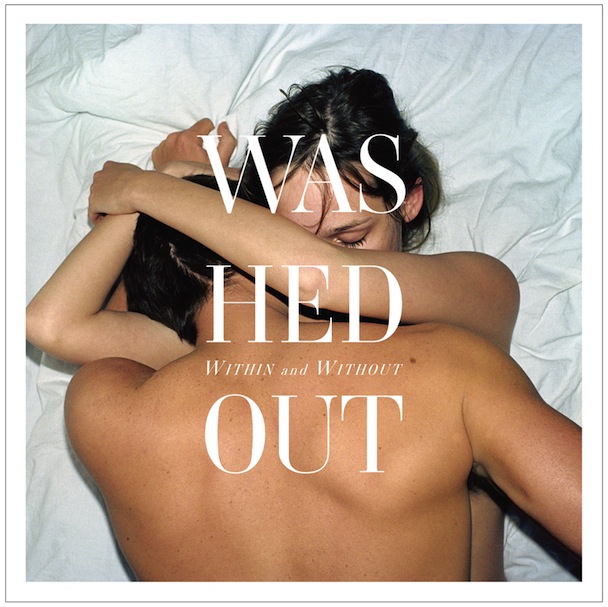
My friend Matthew Perpetua is fond of pointing out that beneath the gauzy haze of shoegaze is sex, at least when it’s done right. The formlessness and distortion isn’t just an anti-mainstream distancing aesthetic, it’s an evocation of sex’s obliteration of the self, the way the boundaries between you and your lover, your conscious and unconscious, your conception of the present as a step toward the future and a present that envelops all of existence, all blur. There’s more to it than Kevin Shields blowing Alan McGee’s money on the perfect guitar tone, and a bunch of lesser lights ripping it off.
If the maligned alt-pop subgenre commonly called chillwave can accurately be described as bouncy beats and bubbly synths subjected to a shoegazey sheen, then it seems to me that Washed Out has always been the act that acknowledges that heat beneath the Hipstamatic filter. I think people looked at the cover of his debut EP, Life of Leisure, and came away thinking it was the usual amorphous hat tip to summer and beaches and nostalgia, but I always thought something crucial was being conveyed by the fact that it’s not just any beach scene, it’s photo of his wife swimming in the ocean during their honeymoon. There’s an erotic component to it that goes beyond making the music sound like your synthesizer was left out in the sun to melt a bit before you started playing it. That’s what I get from “Before,” the standout track from Within and Without. (And hey, you wanna talk about a cover that tips the album’s hand?) I say this even though I can’t understand a word Ernest Greene is singing, even though I can’t even make out the two-syllable sample that recurs every fourth measure. That last bit is sort of the barb on the end of the beat, the part that hooks you, makes the beat exciting to listen to as it cycles through the song (itself the most beat-driven on the album, in a sort of trip-hop sense). It’s what keeps you moving through showers of sound that ebb and flow in intensity: high-pitched cascades, low pulses of synthesized strings, tinkling melancholy melodic lines where the chorus might go, texture provided by live percussion. In other words, for all its shimmering softness, it’s actually quite a pressure cooker of aural information, designed to create an intensely sensual listening experience — not background music, not hey-remember-when nostalgia. It is a super sexy song. Listen to it with someone you fucked on your honeymoon.

Comics Time: The Wolf
July 19, 2011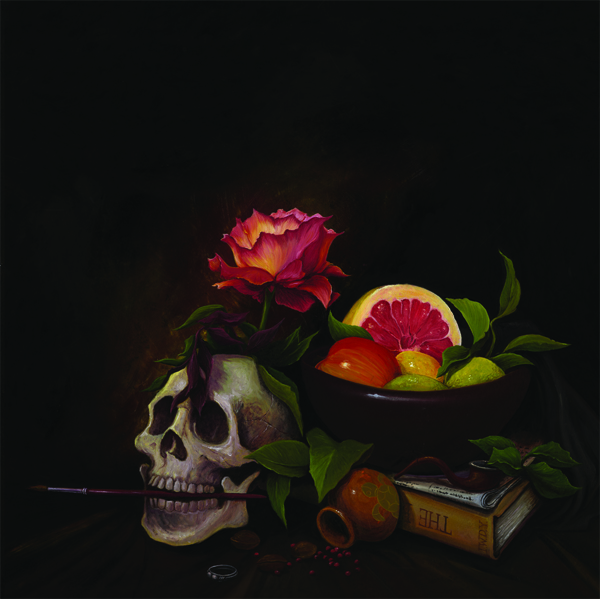
The Wolf
Tom Neely, writer/artist
I Will Destroy You, July 2011
228 pages
$25
Buy it from Tom Neely
See some preview pages and read my interview with Neely at Robot 6
One thing you’ll never get from online previews and PDFs of The Wolf, which were the only ways I’d experienced the book when I first read it and liked it enough to give it an effusive PR blurb, is its impact as a physical object. I’ve actually put off writing this review because I felt inadequate to the task of conveying what a smack in the face the thing feels like. It’s big and thick and square, with a wordless and cryptic cover that evokes albums of huge mystical mystery like In the Court of the Crimson King or Led Zeppelin IV. Inside, the one-per-page or per-spread images frequently go full-bleed, which isn’t the most uncommon thing in the comics world to be sure — but the square pages make it feel like you’re seeing a single panel blown up to brobdgnagian size. It’s a strange-making effect, taking the familiar “bigness” of a splash page or double-page spread, filtering it through a frame you’re not accustomed to, and making you feel the impact of size and scale like a new, fresh thing.
The images themselves are torn from an obviously deeply personal vocabulary of monsters, injecting the sexualized surrealism back into werewolves and zombies that have been stripped of their primal power by the conventions of genre. Spectacle, meanwhile, is here derived not just from violence or vistas but from sex: The battle between the title character and a multi-limbed red skeleton, a full moon that appears like a cigarette burn in a grey-blue night sky, and a series of abstract washes of hair-like blacks and fleshy pink-reds and seminal yellow-whites that appears in the middle of graphically depicted intercourse between the wolf and his pale, raven-haired bride all have equal knockout force behind them. You can tease an emotional narrative out of the proceedings easily enough — past callousness, cruelty, and self-destruction in the context of a relationship are overcome, atoned for, and healed through sexual connection, and a transcendent future is discovered, a natural world untouched by the taint of the bitter past. But it’s the way each individual stage of that journey is depicted with symbols, colors, and creatures that capture and embody it perfectly, their lush brushtrokes fraying and spattering and bleeding emotional intensity on every page, that gives the book its power. Every turn of the page is an encounter with raw feeling, made physical by cartooning. That’s great comics.
Comics Time: Black Eye
July 13, 2011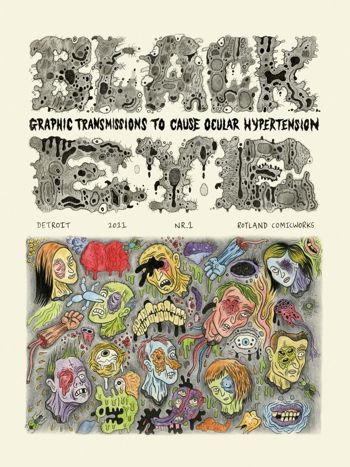
Black Eye #1
Wouter Vanhalemeesch, Al Columbia, Ian Huebert, Mark Newgarden, Onsmith, David Paleo, Roland Topor, Olivier Deprez, Olivier Schrauwen, Brecht Evens, Ivan Brunetti, Andy Gabrysiak, Michael Kupperman, Gnot Guedin, Tom Neely, Dav Guedin, Danny Hellman, Bob Levin, Brecht Vandenbroucke, Stephen Schudlich, Martin Rowson, Kaz, Max Clotfelter, Robert Goodin, Ryan Standfest, Jon Vermilyea, Mats!?, Nikki DeSautelle, Stéphane Blanquet, R. Sikoryak, Ludovic Debeurme, Emelie Östergren, Fanny Michaëlis, Lilli Carré, James Moore, Jeet Heer, Paul Nudd, Glenn Head, Paul Hornschemeier, Ken Parille, Paul Paetzel, writers/artists
Ryan Standfest, editor
Rotland Press + Comic Works, May 2011
112 pages
$14.95
Buy it from Ryan Standfest
For today’s Comics Time review, please visit The Comics Journal.
Comics Time: Our Love Is Real
July 8, 2011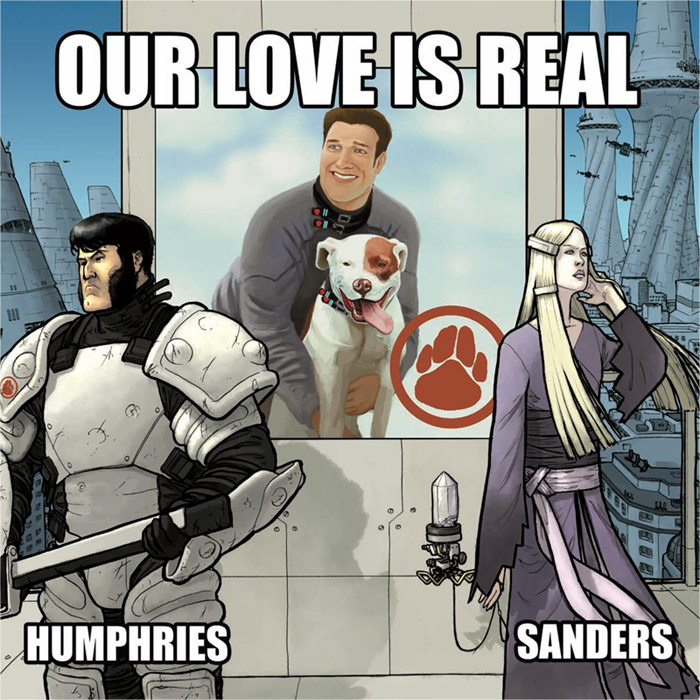
Our Love Is Real
Sam Humphries, writer
Steven Sanders, art
self-published, June 2011
24 pages
$3.99
Buy it at OurLoveIsRealComic.com
In the war to discomfit the reader, science fiction has an extra weapon in its arsenal: It can be set in a society whose underlying assumptions are disturbingly alien from our own. Depending on whether the differences happen to hit your buttons, this can be real put-the-book-down-and-squint-your-eyes-shut stuff in the right hands. The last thing I read to have that effect on me was “The People of Sand and Slag” by Paolo Baciagalupi in Wastelands, an anthology of post-apocalyptic short fiction. Baciagalupi created a world where genetically and biomechanically modified human beings presided over an empire of debris, feeling no pain, virtually indestructible, able to consume junk and rocks…and eminently unqualified to care the few vulnerable living creatures unfortunate enough to cross paths with them. It wasn’t a particularly gory or “disturbing” story, yet something about its protagonists, the fact that they were recognizably human yet utterly devoid of the qualities and vulnerabilities that we think of as characteristic of humanity, literally made me feel sick to my stomach. I still haven’t finished reading the anthology.
Our Love Is Real, it seems to me, is aiming to have the same effect. It’s set “five years after the AIDS vaccine,” in a world policed by hulking brutes in Iron Man/mecha exo-suits and characterized by sexual divisions not between genders or orientations, but between vegisexuals, mineralsexuals, and zoosexuals — people who have sex with custom-grown plants, the auras of crystals, and dogs respectively. But I think that previous sentence contains the problem with the project. The sex stuff that’s the story’s bread and butter is indeed rewardingly bizarre and blackly funny — I mean, look at that propaganda poster on the cover, it’s hilarious. But the world surrounding the sex is standard Dark Horse Legends sf-action material, instantly recognizable to anyone who’s read Hard Boiled or Martha Washington, or who’s seen the way Geof Darrow or Chris Burnham draw faces being smashed to flying splattering pieces. The character designs in particular are deeply indebted to Tony Moore, squarejawed men and snotnosed women who behave basically the way characters rooted in such designs can be expected to behave. When the genre visuals and action are that familiar, it’s tough to see how we get there from here with regards to the stuff that’s much further out. I mean, I get that the zoosexual cops hounding (no pun intended) the vegisexuals and mineralsexuals are analagous to heteronormativity and fag-bashing, but there’s not really an allowance made for the idea that people who have sex with dogs might build a sci-fi society that looks different from all the ones we’ve seen that were built in-story by plain-vanilla straight dudes. Starting with that lacuna, the book’s ideas never really congeal. It winds up feeling more like several neat ideas than one great one. I want it to go further.
But ultimately, the best compliment I could pay Our Love Is Real is that while its weakest points belong to other comics, its strongest points are all its own. The world depicted by Sanders and the characters that inhabit it may be overly familiar, but the climactic fight scene has real oomph and, weirdly, real grace. And while the characters’ behavior is traditional in a way that doesn’t mesh with the book’s bizarre animating ideas, those ideas are quite something, and are presented by Humphries in a way that’s straightforward but not smug self-congratulatory, the way knowingly out-there indie science-fiction comics by smart-and-they-know-it writers can be. Humphries’ is a new voice in a crowded field, saying truly strange and challenging things while speaking the language of mainstream action comics. With any luck that accent will thin, and future stories will have the fluency to forge a new dialect as singular as the ideas they’re designed to express.
Music Time: Interpol – “Pace Is the Trick”
July 8, 2011Pat as-above-so-below-isms like “the title says it all” normally drive me up the wall, but whaddayagonnado: “Pace Is the Trick” is the best Interpol song because of the rigorous and relentless pace of the guitar. The song itself is a midtempo number and not one of the band’s uptempo post-punk jams, but that distinctively brassy guitar never, ever ceases to be twanged with every eighth note. Like a traditional lead guitar line, each note is distinct, and the purpose is to deliver a melody; at the same time, like rhythm guitar, it’s a rhythmic element that gives the entire song a spine, even as its melody shifts and morphs from section to section. This pulls all the parts together and makes each new section and mood — determined by the varying timbre and intensity of Paul Banks’s vocals, the disappearances and reappearances of Sam Fogarino’s drums and the different beats he plays, and the degree to which the full band is engaged or holding back — feel like an inevitable outgrowth of the previous one. It’s one of those songs that makes me reflexively air-drum along when the loud parts kick in, and it’s that guitar, that literally non-stop “dundundundundundundundundundundundundundundundun,” that pulls me along for the ride. Meanwhile, Banks’s lyrics, delivered in perhaps his most finely struck balance between his laconic-croon and urgent-shout modes, use a variety of metaphors and outright declarations to cast love, or at least lust, as a matter of possession, predation, and destruction. As embodied in the song’s final lines — after ending the final iteration of the chorus (“and now I select you” etc.) by shouting about “the star-swept night,” Banks contributes to the lengthy outro by repeating “You don’t hold a candle” — it’s an enticingly toxic blend of seduction and contempt, tied together by a guitar that never allows any daylight between the two extremes.
Comics Time: SF Supplementary File #1
July 7, 2011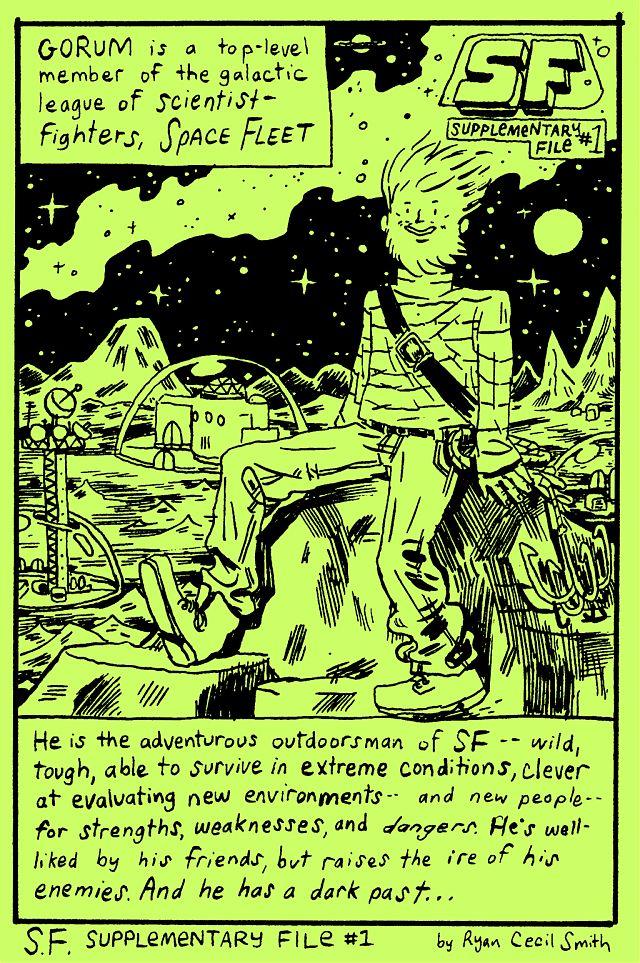
SF Supplementary File #1
Ryan Cecil Smith, writer/artist
Closed Caption Comics, June 2011
12 pages
Read it for free at RyanCecilSmith.com
Buy it for $2 from Ryan Cecil Smith
What if ’80s SFF action-figure franchises really took on the central role in our collective mythmaking and storytelling that their hardcore devotees (myself included, let’s be honest) seem to think they deserve? The children’s books, fairy tales, and fables such a would would create for itself might look a lot like SF Supplementary File #1, a spinoff from Ryan Cecil Smith’s fine alt-genre actioner SF that provides the origin story for one of the Space Fleet Scientific Foundation Special Forces’ memorable members, Gorum. In his “once upon a time”-style story of hidden paradises and pillaged resources, mad royalty and noble scientists, slain parents and vowed vengeance, I hear echoes of everything from Superman and Batman to Eternia and Shangri-La to freaking Spaceballs, shot through with a childlike funneling of nuclear anxiety directly into terror over the potential loss of Mommy and Daddy. Smith’s art here is winningly crude, as befits drawings that can be captioned with sentences like “Gorum attacked every ship going IN or OUT of the Planet of Dunes with VOLCANO CANNONS” — yet it’s flexible, equally able to pull off sophisticated visual tricks like juxtaposing the explosions that destroy a world, the ship that escapes that destruction, and multiple representations of the teary eyes of that ship’s pilot as he views the horror like some kind of Futurist Axe Cop. It’s fun to see something so lightweight be so solid.
Music Time: Drake – “Marvin’s Room”
July 5, 2011When last I checked in with Drake he was sounding like Everything But the Girl. In “Marvin’s Room” he’s sounding even more like Everything But the Girl — specifically “Single,” in which Tracey Thorn engages her ex in a bit of extraordinarily bitter concern-trolling over a hotel phone, accompanied a shuffling beat and ghostly synths. Voila, I’ve just described “Marvin’s Room” as well. But what Drake lacks in Thorn’s luscious vocal instrument he more than makes up for in a level of lyrical candor that is either really exquisite artistry or the complete lack thereof. This is a guy who’ll lilt “Fuck that nigga that you love so bad” like it’s the most romantic thing in the world, who’ll say “After a while, girl, they all seem the same / I’ve had sex four times this week — I’ll explain” in a song whose sketch of a chorus revolves around chiding his ex “I’m just sayin’ you could do better.” I have no idea if he knows what a leap it is to expose his assholishness to the world like this and is consciously making that leap, or if he’s simply so fascinated by himself that he’s sharing this information because he’s his own muse. In the end I’m not sure it matters if it makes for sad, lovely, disturbing music like this. Bonus points for repeating the ex’s incredulous “Are you drunk right now?” like it’s one of those Houston-to-Apollo transmissions from The Orb’s Adventures Beyond the Ultraworld.
Music Time: Beyoncé – “I Care”
June 30, 2011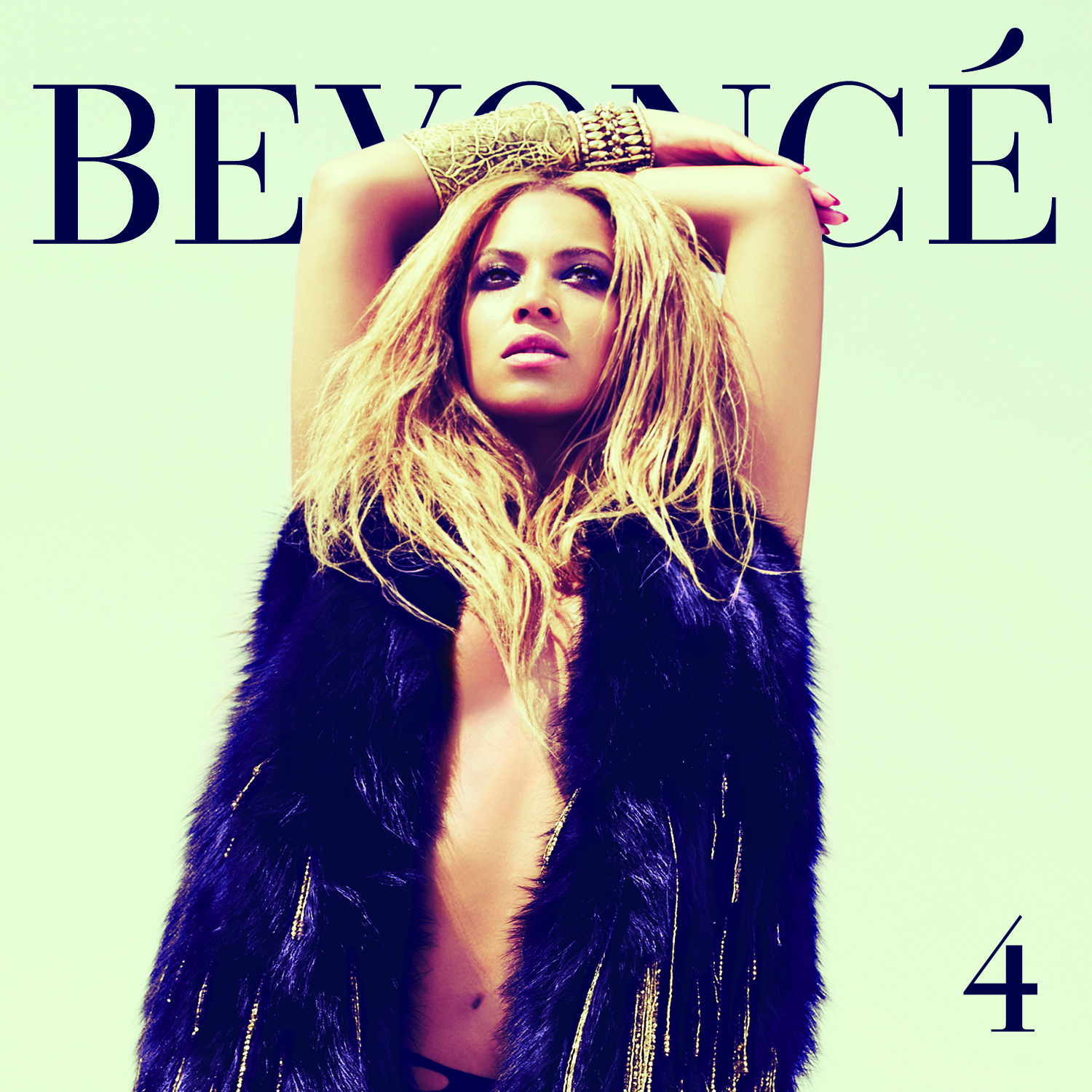
4 is the first Beyoncé album whose slow, serious songs I don’t automatically skip. Good thing, too, because it’s mostly slow-ish, serious-ish songs, as opposed to Dangerously in Love, which dumped them at the back end of album; I Am…Sasha Fierce, which gave them their own disc; and her best record, B’Day, which nearly excised them altogether. The up-tempo “Countdown” is getting a lot of attention right now, with its Franken-pop construction and inspired gibberish like “ME and my BOOF and my BOOF BOOF ridin'” (thus joining “Ra-ra ah-ah-ah, roma ro-ma-ma, gaga ooh-la-la” and “Mama say, mama sa, mama ma coo sa” in the annals of great pop nonsense), but the album’s undisputed highlights for me are the aforeblogged lovesexy scorcher of a ballad “1+1” and this song, in which Beyoncé addresses a lover’s indifference by attacking it with the nearest weapon to hand, her voice. Listen to the way she shouts “IIIII CARE!” in the chorus, or just plain screams at the end of it — it’s like Chris Cornell wailing into the abyss of Andrew Wood’s heroin overdose in “Times of Trouble” by Temple of the Dog. Sonically the two songs aren’t even all that dissimilar: state-of-the-art production that creates a nice melancholy purple cushion of air around the instrumentation, in “I Care”‘s case the tumbling drums in particular. Hell, in a world where Bey’s mashing up Prince and Kings of Leon and having freaking Tricky do the Sean Paul part in “Baby Boy” at Glastonbury, I wouldn’t be surprised if I woke up tomorrow to find out she’d covered it. It’d be a fine outlet for the sort of skill and conviction she displays here (like the way her voice warbles when she says she’s been “deserted” or the way she sings along to the guitar solo like she can’t bear to stop pouring out the emotion she’s feeling), and for her ever-sharpening taste for interesting arrangements (“I Care” and “I Miss You” are mostly synth tones and spare percussion; the latter just sort of disappears rather than ends the way proper commercial pop songs do; even the Diane Warren-penned “I Was Here” has some weird spectral Interpol guitar stretching out from the end of the chorus). She’s taking the sort of stuff that usually made for turgid one-listen mom-radio bait and making it lively and engrossing. Frankly there’s not much she can’t do at this point.
Comics Time: L.A. Diary
June 29, 2011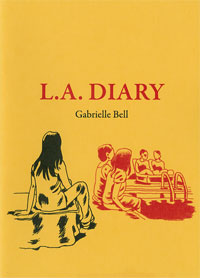 L.A. Diary
Gabrielle Bell, writer/artist
Uncivilized Books, October 2009
20 pages
$4
Buy it from Uncivilized Books
He doesn’t go quite this far himself, but it’s easy to interpret cartoonist and Uncivilized Books publisher Tom Kaczynski’s introduction to this minicomic collection of diary strips and sketchbook pages from Gabrielle Bell as a claim that her lack of transgression is itself transgressive. “Bell is not possessed by demons,” he writes by way of comparing Bell’s work to the autobiographical comics tradition established by Justin Green and Robert Crumb, going on to compare her work to the very root of the diaristic impulse in Western culture: maintaining a daily account of the world to better understand one’s place in it. And indeed, Bell’s understanding of her place in the world, as expressed through these comics, leaves little room for iconoclasm and taboo violation: The climactic strip in the collection focuses on her inability to hug people without dissociating. But Bell never translates her discomforts into reverse-exhibitionistic cris de coeur of loneliness, either — from the cover of the comic on down, she may be quietly separating herself from the friends with which she is constantly surrounded, but, well, she’s constantly surrounded by friends. Like the yoga poses she holds in a class designed to cultivate inner peace but which in Bell’s case simply give her one more opportunity for her mind to recursively burrow inside itself, her self-presentation in these comics is a painstakingly struck balance, neither woe-is-me nor look-at-me.
So no, we will never see a “Minnie’s 3rd Love” or “My Sex History” from Gabrielle Bell. But in this light, the smudgy swatches of black that dot her square panels seemingly at random and had me baffled for years could perhaps be seen as a deliberate act of obscurantism, breaking the plane of the art as if to interrupt our ability to take it in vérité-style, a way to say “No, this isn’t real, this is just a drawing.” Kaczynski suggests that that act of drawing is a “declaration of fidelity to the Great Work”; the diary form it takes, then, is simply a way for Bell to lash herself to the yoke of making art on a consistent basis. If he’s right, then Bell’s program has served her well, enabling her to produce a substantial body of work with nary a demon to drive her. Thus if there is a shocking revelation to be found in L.A. Diary, it’s the book’s final third, which reproduces the pages in her spiral-bound notebook where the preceding strips first took shape. Replete with spelling errors, cruder and at times almost childlike linework, broader and blunter story beats, and more direct navel-gazing (an abandoned storyline about starting a blog, a self-portrait in the locker-room shower that gets a bit toned-down and covered-up in the final version), it feels almost breathlessly unrefined compared to the finished product. It’s not Binky Brown Meets the Holy Virgin Mary, but in context, the exhibitionism is just as raw.
Music Time: WU LYF – “Heavy Pop”
June 28, 2011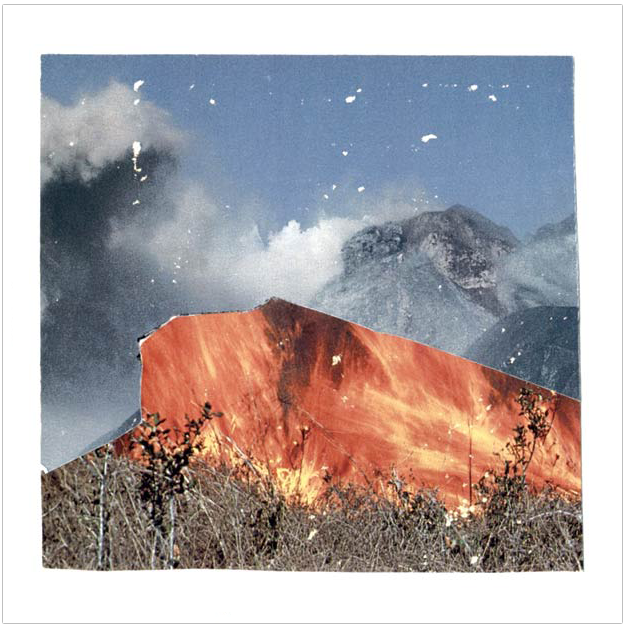
Played from start to finish, WU LYF’s debut album Go Tell Fire to the Mountain comes across like a music-nerd Mark Millar Idea: “What if there was the most uplifting anthemic indie rock album ever…but the lyrics were GIBBERISH?” And like most Mark Millar Ideas, real and imagined, the joke gets old quickly. The formula is simple and adhered to with minimal variation: Cavernous production (the album was apparently recorded in a church; the ever-present pipe organ’s a tipoff too) plus chiming guitar plus glossolalia screamed at the top of lead singer Ellery Roberts’s lungs. Slow songs, fast songs, quiet songs, loud songs, every song on the album gets the same treatment. By the time you reach track nine or so, the initially bracing effect of the approach, this sense that you’re witnessing something that’s half-hymn, half-howl at the moon, is diluted through repetition and general lack of imagination. No amount of Captain Caveman hollering is going to distinguish the umpteenth life-is-beautiful, we’re-all-in-this-together Joshua Tree legacy-character record.
But everything that makes WU LYF a lousy place to live makes it a terrific place to visit for the five minute, thirty-five second duration of the album’s concluding track, “Heavy Pop.” An admirably lengthy, virtually ambient organ introduction sounds like the world is slowly waking up, and when those first guitar notes hit, it’s like rays of morning sun, and Roberts is like a man screaming right back into the sky, greeting the dawn with defiance. It’s another answer to a goofy unasked question, in this case “What if the problem with Bruce’s vocals at the end of ‘Jungleland’ was that they sounded insufficiently committed?” At album length this doesn’t work at all, but for a single song it’s epic, genuinely so — it’s huge, it sprawls, it conjures images of great vistas and lone heroes and everything. There’s no need to press your luck with the other nine tracks. Unless you’re an Arcade Fire fan, I suppose, in which case go with God.

Comics Time: WunderKammer No. 1
June 27, 2011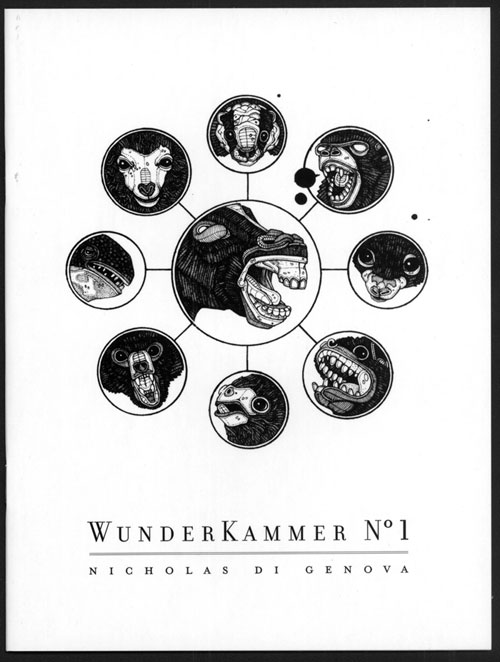
WunderKammer No. 1
Nicholas Di Genova, writer/artist
Koyama Press, 2009
24 pages
$8
Read about it at Koyama
Theoretically you can buy it at Nicholas Di Genova’s website but I can’t get it to load
Buy it from Atomic Books
Visit Nicholas Di Genova’s blog
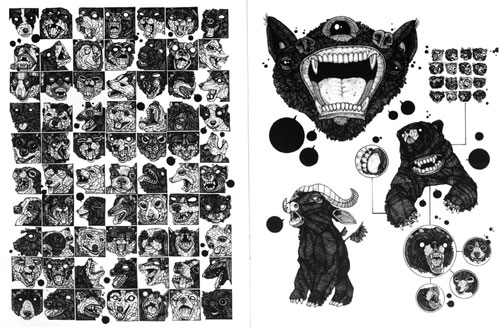
In googling for images and purchase links for this compendium of animal drawings by Nicholas Di Genova (of whom I was previously aware as a fellow resident of Partyka‘s periphery), I came across a post on a New York City art blog that took a faint-praise approach to Di Genova’s art but was really impressed by this so-crazy-it-just-might-work innovation he’d had of printing his pieces in a cheap, floppy book. Imagine that! So god knows what the fine art world (I feel like that should be in scare caps — The Fine Art World) makes of this stuff, and this way of presenting it. To me it’s a comic book, and a stunner. Di Genova specializes in drawing braying, barking, growling, blank-pupiled animals of all shapes and sizes and species, including many that don’t actually exist, in a riot of accrued maximalist detail. Each of his dogs, bears, rams, wolves with ram horns, bears with bird heads, two-headed turtles, tyrannosaurus rexes with zebra coloration and manes, three-eyed gorilla/bat hybrids and so on appear to have been constructed by carefully gluing little rectangles and circles and lines together, the way chainmail is constructed one link at a time. Only here the construction doesn’t necessarily seem chained together, so you’re left half tempted to shake the book like a snowglobe to see if the constituent parts resettle in new shapes to create a new bestiary. Di Genova repeats this dizzying effect in macro via pages that consist of massive grids of animal heads, one breed/species after another, one head per borderless panel — dogs, birds, and frogs each get their own page here, but there are plenty of smaller grids featuring turtles, bears, bats, rodents, and god knows what else. I found my eye zipping back and forth from line to line in an S-shape a la Brian Chippendale, the better to take each incredibly detailed head in without missing a beat. The pages featuring the smaller grids often come across like some sort of alternate-universe Chris Ware suffering from Audubon-inspired monomania: A large portrait of an animal will be connected to a grid of tiny ones with a diagrammatic line, or encircled and radiating off smaller drawings like the spokes of a wheel. A relationship, even a narrative, is implied through these devices; the fun is figuring out what the hell they could be. And while we’re on the subject of the visual language of comics, Di Genova comes up with the best technique for depicting the non-verbal vocalizations of animals I’ve seen maybe ever: tiny word balloons completely colored black. Whether it’s a bark, a tweet, a ribbit, or…whatever sound turtles make, it works.
The book’s centerpiece, literally and metaphorically, is the spread where Di Genova’s project is at its most basic and blunt: 702 butterflies, each as unique as a snowflake, in a 27 x 26 butterfly grid bleeding right off the top and bottom of the centerfold spread. The effect is at once overwhelming and inviting: I was dazzled by the variety present in nature and intimidated, almost horrified, by the artificial reproduction of that natural variety. At the same time, I simultaneously resigned myself to never really being able to take in the whole of the image and diving right into the spread to soak up as much as I could…and I distrust pat “as above, so below” interpretations, but what the hey: There you have it.
Comics Time: Night Animals
June 24, 2011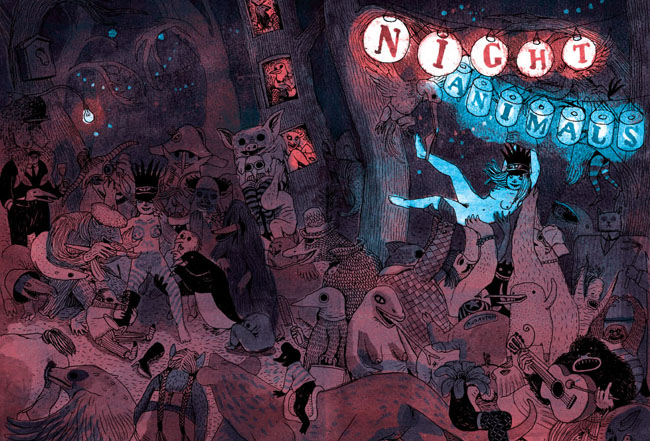
Night Animals
Brecht Evens, writer/artist
Top Shelf, January 2011
48 pages
$7.95
Read a preview and buy it from Top Shelf
Dare I say that this is even better than The Wrong Place? I think I dare! Created before that book but published in English after it, Night Animals is a more traditionally drawn affair from author Brecht Evens in that it is, in fact, drawn. The Wrong Place‘s paint-only art was its distinctive selling point and, via clever coloring, its primary storytelling mechanism, but as it turns out this innovation meant Evens abandoned a really lovely line — thick, ropy, tactile, full of motion, fun. It gives the art more immediate pop, and gives Evens’s really vibrant colors (look at that cover; now imagine a whole book like that) the day off, as it were, freeing them from the burden of telling the story themselves and allowing them to comment on and enhance the action, and of course simply delight the eye.
Said action consists of two separate stories in which the protagonists’ sexuality is passed through a gauntlet of children’s-story-style creatures of the wild. The first, in which a balding businessman and apparent tyro furry goes down a literal rabbit hole and braves an increasingly terrifying series of beasts on his way to the “Blind Date” that gives the story its title, has a happy ending: A grinning, recumbent woman in rabbit ears, probably a little plain under normal circumstances with her hornrimmed glasses and mole and pointy schnoz but bomb-ass hot as she’s presented at the end of this journey, with a promising white arrow directing her bunny-suited suitor straight to her crotch. After the painstakingly delineated labyrinth we’ve followed to get here, including a pair of stunning spreads filled with seemingly every sea monster and forest creature Evens could think of, this punchline image elicited a good-natured “haw!” from me; if I’d been there, I’d have high-fived both the guy and the girl before leaving them to get it on. Indeed, the very last image, a Wrong Place-style painted silhouette of the two characters in floppy-eared flagrante delicto, gives the impression of the artist quietly backing away and closing the door behind himself, letting our hero and heroine do their stuff in peace. Evens really nails the simple satisfaction sex sometimes provides — life can be filled with storm and stress, but every now and then it’s nothing that a special someone’s smile and genitals can’t fix.
The scarred side of the Night Animals coin is the second and concluding story, “Bad Friends.” (“So it’s not just a clever name.”—Wayne’s World) It starts, and indeed continues, innocuously enough, as a sort of distaff Where the Wild Things Are/Aesopian cover version of Stephen King’s Carrie, in which puberty rather than petulance is what enables our young protagonist to heed the call of the wild, and in which the rapid locker-room onset of menstruation leads not to a telekinetic killing spree but a visit from the Great God Pan, a trip on the back of a giant bird, and a rockin’ party with various critters in the woods. Our heroine whoops it up, enjoying the nakedness her newfound friends have reduced her to — complete with body-paint heart drawn around her pudenda — so much so that she doesn’t notice the darkness in their eyes as they close in to devour her. This story ends not with a clinch, but an empty bloodstained bed, worried parents, an ineffectual search of the now-empty forest, a single flower wilting on the ground. Evens’s trademark red goes from a spot-color stain on the girl’s underwear, to the alluring light of an illicit night out, to a symbol of sexual abandon, to the color of violence and death. It’s quite a performance, sexy and creepy at precisely the moments Evens wishes it to be one or the other, and a direct contrast with the earthy lightheartedness of the opening story. It’s awfully easy for sex comics to get didactic in their rah-rah positivity; Evens gives us the flipside, counting on us to be grown up enough to weigh the pros and cons ourselves. Good for him and good for this comic. It’s a blast.
Comics Time: Blammo #7
June 22, 2011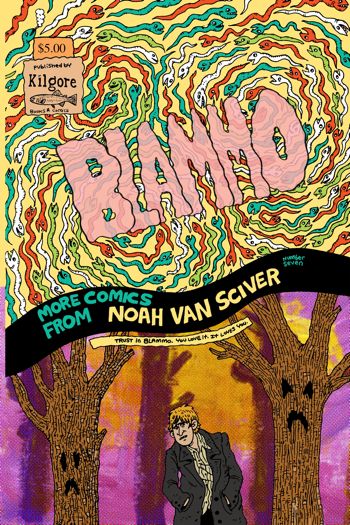
Blammo #7
Noah Van Sciver, writer/artist
Kilgore Books & Comics, February 2011
40 pages
$5
Buy it from Kilgore
The multiple times Noah Van Sciver uses fake ads and author’s notes to remind us of this notwithstanding, Blammo‘s throwback status as a ’90s-style solo-anthology floppy-format black-and-white “alternative comic book that is introspective and drawn by a hopelessly poor twentysomething with seasonal affective disorder” is one of the least interesting things about Blammo #7. It doesn’t hold a candle to the way he draws the darkness of a Halloween night spent trick-or-treating with a sky full of simple horizontal lines in “Because I Have To,” or to his po-faced, actually rather creepy retellings of a couple of Scary Stories to Tell in the Dark-style serial-killer urban legends in “Don’t Turn On the Light” and “This Is the Last One I’m Sending You Today.” It’s not as noteworthy as the way he tends to cheat his characters toward the viewer, the better to emphasize the big ears and big noses and worried brows and frowning mouths of his characters’ faces, or the way the whole of those faces is constructed so solidly that they remind me of a handwritten cursive letter more than a face. It doesn’t account for his slice-of-life fiction’s endearingly loose and rambling narratives — the way “Who Are You, Jesus?” piles up ironies in such a way as to emphasize its main character’s simultaneous shittiness and sympathetic nature with each turn, or the way the “Foreword/Because I Have To/Afterword” suite tells the story of a guy’s emotionally fraught Halloween evening in three sections wherein each thing that happens to him is weirdly disconnected from the others in precisely the way life tends to work. It doesn’t cover the way his broad funny-animal Chick tract parody complements his totally straightforward account of Joseph Smith and the origin of the Mormon faith, the way a biting fuck-you and a lingering respect tend to mingle in the lapsed. No, the mere fact that this is a defiantly anachronistic and un-hip alternative comic book doesn’t speak to the most important thing about it: It’s a very good one.
Music Time: Beyoncé – “1+1”
June 21, 2011I admire how few concessions this song makes. I figured that after a few introductory measures they’d clean up and smooth out that guitar triplet, but nope, it stays fragile-sounding and rough around the edges the whole time. The expected “TICK two three TOCK two three” 6/8 slow-jam drum never really materializes, requiring you to lean into those rich-sounding chords, which are themselves constructed largely from a subtle interplay between piano and bass. Synth strings and a watery organ sound and a snippet of piano played backwards are sketched in here and there, but you really have to wait for them. Beyoncé’s vocals, to paraphrase her lyrics, pull you in close and won’t let you go — there’s simply no ignoring those big whooping “OO!” sounds at the end of each line, nor a chorus structured around the simple phrase “make love to me,” nor a final verse that sets this lovemaking up as an alternative to a world at war. And when the climax finally comes, all that pent-up energy isn’t diffused into a dully loud full-band finale with a full-fledged beat or whatever, but poured into a reach-for-the-sky guitar solo. Everything surrounding it stays relatively restrained; the guitar does the shouting. Then it all just kinda disappears. “1+1” is, fittingly, more than the sum of its parts, all of which are astutely selected and intelligently, unapologetically deployed to transport you to a more beautiful place for four minutes and thirty-five seconds at a time.
Comics Time: I Will Bite You! and Other Stories
June 20, 2011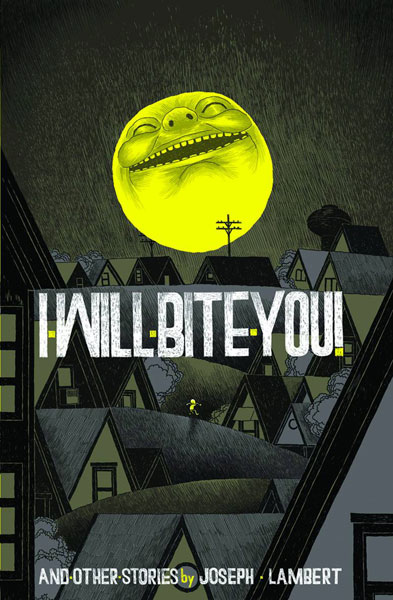
I Will Bite You! and Other Stories
Joseph Lambert, writer/artist
Secret Acres, April 2011
128 pages
$14
Buy it from Secret Acres
Buy it from Amazon.com

You want to see artists riding their personal visual vocabulary past the realm of utility and into Idiosyncracy Land. From Kirby crackle and Ditko hands to Jim Woodring’s fungoids and Al Columbia’s erasures, signature tropes are frequently a sign that something not so much practical as alchemical is going on in that artist’s brain when he puts lines on paper. Judging from this splash-making debut book from Joseph Lambert, a collection of work previously published in various anthologies and minicomics, Lambert has several such obsessions: Big grinning suns with devious intentions, fumingly angry and violent little children, and using the perspectivally flattening effect of two-dimensional line art to make people and things interact in unexpected ways — characters grabbing their word balloons to use as weapons, people in the foreground jumping onto objects that in “reality” are miles away or literally in outer space. The problem is that none of these visual tricks say much of anything to me. Watching an angry little kid leap into the air and assault the onlooking sun makes for a clever visual, but not a particularly communicative one. Children’s stories have used this kind of device to convey the naivete of their protagonists, and the matter-of-fact wonders of the world when seen through a child’s eyes; mythology uses it to bring a huge and frightening world down to our level, to grant us a degree of control. For Lambert, I think there’s an exploration of rage and frustration under here someplace, but it’s diluted from overuse. If that many characters are angry enough to threaten the sun, then how angry are any of them, really? It’s as though Lambert held his thumb out and blotted out the sun and thought “Wouldn’t it be neat to draw something that did that literally?” And yes, it’s neat, but after a while it’s not much more than that. Too many of the visuals presented here — word-balloon weapons, dancin’ on the ceiling perspective shifts, characters swallowing other characters whole and unharmed — have that feeling. “Why not?” is a terrific question for an artist to ask himself; “why?” is sometimes a better one.
Game of Thrones thoughts index
June 20, 2011Here are links to all of my Game of Thrones reviews. I’ve added the special features I’ve written for Rolling Stone to the list chronologically, so that once you’ve read the preceding review post, it’s safe to read that feature as well. I hope you enjoy them!
SEASON ONE
Episode 01: Winter Is Coming
Episode 02: The Kingsroad
Episode 03: Lord Snow
Episode 04: Cripples, Bastards, and Broken Things
Episode 05: The Wolf and the Lion
Episode 06: A Golden Crown
Episode 07: You Win or You Die
Episode 08: The Pointy End
Episode 09: Baelor
Episode 10: Fire and Blood
List: The Seven Most Awful Things People Did on Game of Thrones Season One
SEASON TWO
Episode 11: The North Remembers
Episode 12: The Night Lands
Episode 13: What Is Dead May Never Die
Episode 14: Garden of Bones
Episode 15: The Ghost of Harrenhal
Episode 16: The Old Gods and the New
Episode 17: A Man Without Honor
List: The 10 Biggest Differences Between Game of Thrones and the Books
Episode 18: The Prince of Winterfell
Episode 19: Blackwater
Episode 20: Valar Morghulis
* Follow-up 01
* Follow-up 02
List: The Best and Worst New Characters in Game of Thrones Season Two
List: Final Standings in the Game of Thrones After Season Two
SEASON THREE
Q&A: Bryan Cogman (Executive Story Editor)
Season Three Cheat Sheet
Season Three New Character Guide
Episode 21: “Valar Dohaeris”
Q&A: Natalie Dormer (Margaery Tyrell)
Episode 22: “Dark Wings, Dark Words”
Q&A: Sophie Turner (Sansa Stark)
Episode 23: “Walk of Punishment”
Q&A: Nikolaj Coster-Waldau (Jaime Lannister)
Episode 24: “And Now His Watch Is Ended”
Q&A: Alfie Allen (Theon Greyjoy)
Episode 25: “Kissed by Fire”
Q&A: Maisie Williams (Arya Stark)
Episode 26: “The Climb”
Q&A: Aiden Gillen (Petyr “Littlefinger” Baelish)
Episode 27: “The Bear and the Maiden Fair”
Episode 28: “Second Sons”
Q&A: Gwendoline Christie (Brienne of Tarth)
Episode 29: “The Rains of Castamere”
Q&A: Richard Madden (Robb Stark)
Taking stock of Season Three: Bloggingheads.tv discussion with Alyssa Rosenberg
Episode 30: “Mhysa”
SEASON FOUR
The Top 40 Game of Thrones Characters, Ranked
Season Four Cheat Sheet
Q&A: Pedro Pascal (Prince Oberyn Martell)
Episode 31: “Two Swords”
Q&A: Rory McCann (Sandor Clegane/The Hound)
Episode 32: “The Lion and the Rose”
Episode 33: “Breaker of Chains”
Episode 33 extra: on “that scene”
Q&A: Aiden Gillen (Petyr Baelish/Littlefinger)
Episode 34: “Oathkeeper”
Episode 34 extra: more on “that scene” and its aftermath
Episode 35: “The First of His Name”
Episode 36: “The Laws of Gods and Men”
Episode 37: “Mockingbird”
Episode 38: “The Mountain and the Viper”
Episode 39: “The Watchers on the Wall”
Q&A: Neil Marshall (director, “The Watchers on the Wall,” “Blackwater”)
Episode 40: “The Children”
The Top 10 Greatest Moments from Game of Thrones Season Four
Comics Time: ALT COMICS
June 17, 2011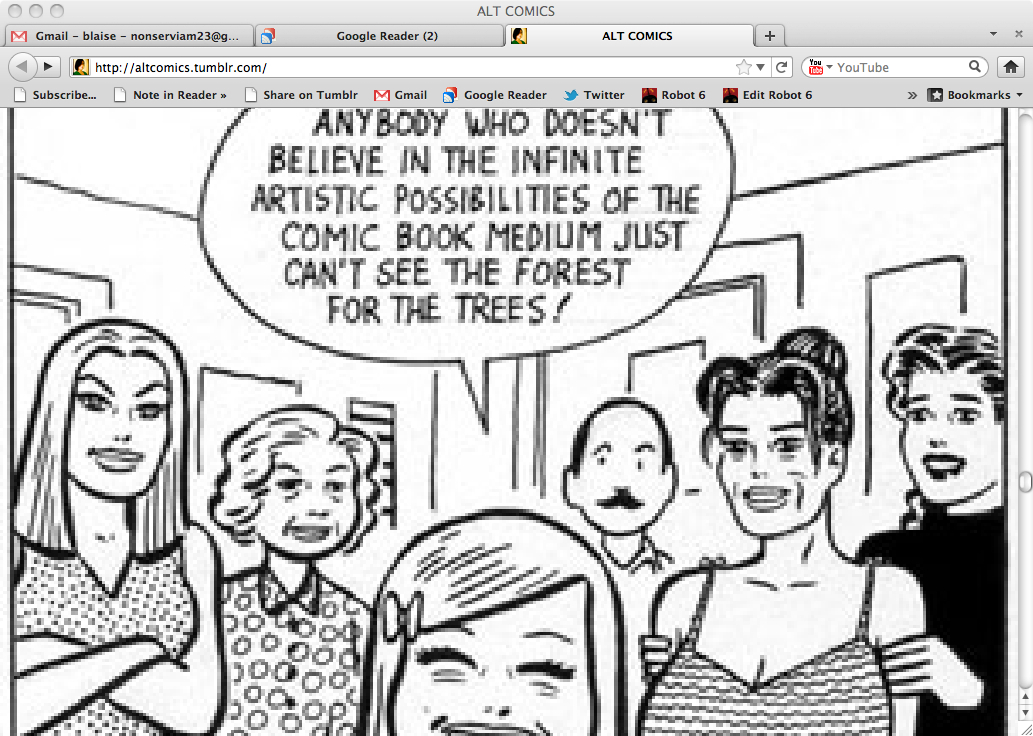
ALT COMICS
Editor unknown, to me at least, but it sure seems like a Comets Comets production
May 2010-present
Read it at altcomics.tumblr.com
“Comics is any art you can read.”—Sean T. Collins
Seen through an RSS reader, the Tumblr dashboard, or the crisply laid out collection of thumbnails that is its Tumblr archive, ALT COMICS is like any other image-based tumblelog. Viewed at its own address? It’s a black hole. Hold down the spacebar and you’ll rapidly scroll through literally thousands of images, frequently but by no means entirely of the “alt comics” persuasion, with the many many images that aren’t sort of averaging out in that direction. But they’re not meant to be sampled as eye candy, or as proof of the blogger’s excellent taste. Each one is blown up to the same massive screen-spanning size regardless of its original size, scale, or resolution. The result digitally distorts many of the images, makes most of them far too big to take in all at once, and erases any of the tumblr artifacts — permalinks, note counts, tags, sources — that tell you where one post ends and the other begins. The result? Pure images, pure juxtaposition, stripped of almost any context other than what’s immediately visible on the screen at the moment, and the cumulative effect of the accumulation of those moments. Taking that endless scroll to the blog’s all but unreachable bottom is a journey into the sheer pleasure of seeing lines on paper (or “paper”), seeing words mixed up with art, seeing styles collide and fracture and explode and detourne and corrode. It also invites you to deduce a method to the madness. Are the giant photos of James Kochalka, Jeffrey Brown, Matt Madden & Jessica Abel, and the Harkham/Crane/Ryan/Hernandez/Regé/Santoro L.A. comics crew intended as the equivalent of Johnny Rotten’s “I HATE PINK FLOYD” shirt? Which does the author of the blog like more: Jonny Negron or Goodnight Moon, Chris Ware or some poorly photoshopped internet-age visual noise, Scott Pilgrim or Harold Gray, a Devo album cover or the cast of Daria, Scott McCloud or Dr. Manhattan or Olivier Schrauwen or page after page of Blaise Larmee or or or or or…? Pure images isn’t even the right term for it — presented without comment or context, one size fits all, a digital haze rendering craft more or less moot as a reference point, you’re looking at the idea of images more than images themselves. That’s telling. It’s also telling that this project of re-presenting other people’s image-ideas is perhaps the strongest work I’ve seen from the Co-Mix crew so far.
Music Time: King Missile – “Happy Hour”
June 17, 2011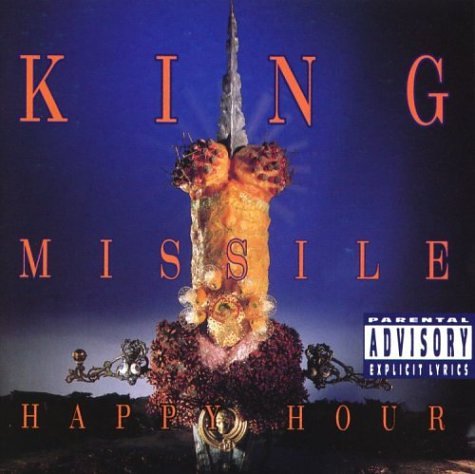
The other day my wife told me how glad she was to have come of age, culturally speaking, in the early to mid ’90s. We’ve had this discussion several times, because every time it becomes apparent how easy it was to have really terrific music placed right in front of you by the paltry-by-today’s-standards number of outlets geared toward putting music in front of teenagers, by god, it’s worth talking about. A case in point for me is this, the concluding and title track to the album that “Detachable Penis” came from. I still think “Detachable Penis” is very funny (“He wanted twenty bucks, but I talked him down to seventeen”). But what I couldn’t have known when I brought home the CD in its giant cardboard longbox from Tower Records was that the album that surrounded that novelty classic was stuffed with really first-rate alternative-rock musicianship. Some of it was pastiche of genres I really didn’t have any experience with yet (“VulvaVoid” is shoegaze! “Trapped” is mid-period time-to-rock-happily R.E.M.!), some of it was spoken-word weirdness and wordplay draped atop roiling hard rock I had no problem appreciating (“Sink,” “Ed”), and a lot of it is just crushingly morose songs about complete failure. “I’m Sorry” and “Heaven,” the third-to-last and penultimate tracks, contain lots of imagery of crushed birds and breaking things that can’t be repaired, all delivered with John S. Hall’s twerpy speak-singing to undercut the heaviness. No such undercutting takes place in “Happy Hour,” a dirge I put on to this day when I want to feel unremittingly awful. Funereal organ, some kind of electronic reverse-tape effect that sounds like something shuffling into a grave, lyrics that conclude with the lines “While the flesh fell off our bodies and we lost our limbs,” so fuzzy and distorted you can’t make it out without the lyric sheet, and on top of it all a melancholy, briefly beautiful piano chords and, finally, a guitar that sounds like it’s bleeding to death. Back then you could stumble bass-ackwards into shit like this all day long. You had it so easy you weren’t prepared for a time when you’d need a song like this.
Comics Time: Jessica Farm (January 2008-April 2011)
June 15, 2011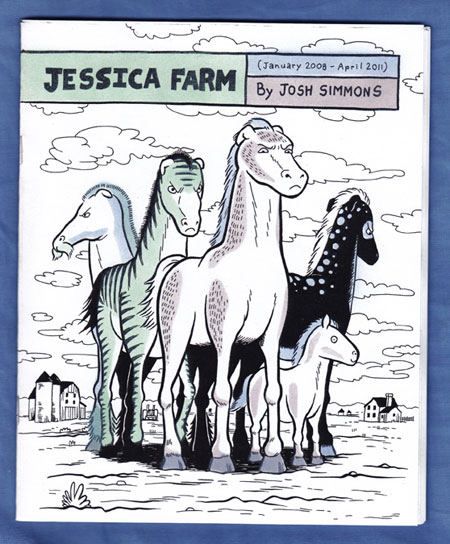
Jessica Farm (January 2008-April 2011)
Josh Simmons, writer/artist
self-published, June 2011
40 pages
$8 (including shipping)
Buy it from Josh Simmons
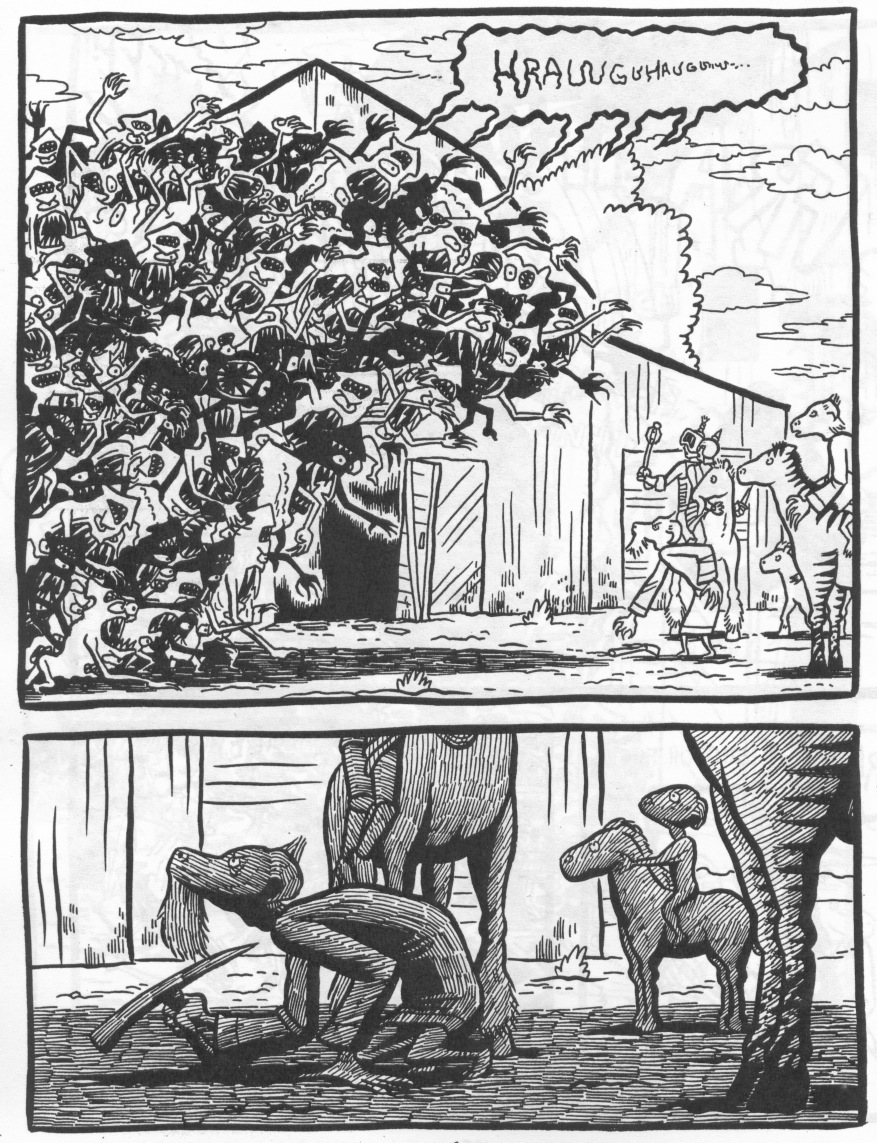
If there’s a cartoonist working today who more reliably, ruthlessly, and relentlessly exploits his own strengths with each new release than Josh Simmons, I’ve yet to encounter him. Witness this self-published slice of Jessica Farm, a 600-page graphic novel Simmons is drawing one page a month for a projected fifty years. Volume One was published by Fantagraphics in April 2008, (the back cover of this minicomic installment reads “Volume 2 coming 2016”), and already the contrast with the involving but formless original is striking. Instead of taking us on sort of “It’s a Small World” ride through various disconnected images of dreamlike horror and weirdness, Simmons here uses his rubric of a teenage girl meeting strange invaders and residents on the sprawling family estate to keep us rooted to the same two places: a bare room where a trio of goat-people called the Smiths are brutalizing a boogeyman akin to the one that Jessica encountered in Vol. 1, and the field outside where they eventually do battle with an army of the creatures. The book feels much more focused for the lack of literal wandering. Moreover, within these established confines, Simmons can get much more mileage out of his astutely choreographed action sequences. In the first half of the book, two dramatic attacks are dependent on our feel for how large the room is and how long it takes characters to get from one side to the other, and Simmons crafts that space so well that you can practically hear the scrambling footfalls. A later sequence involves charging horses and bounding beasts, depicted in a succession of widescreen panels that keep the action dead center in each one, a restrained presentation of very visceral material.
And I don’t know how it’s possible, but the pacing is remarkable for a book drawn with thirty days between each page. It’s reversal after reversal: These Smiths are scary, no wait, they’re friendly; they’ve got the upper hand on their captive, no wait, it’s got the upper hand on them, no wait, I was right the first time; they’re attacking a couple of monsters, no wait, they’re outnumbered a hundred to one, so what, they’re still going to win. It has a propulsive feel to it that Vol. 1 lacked.
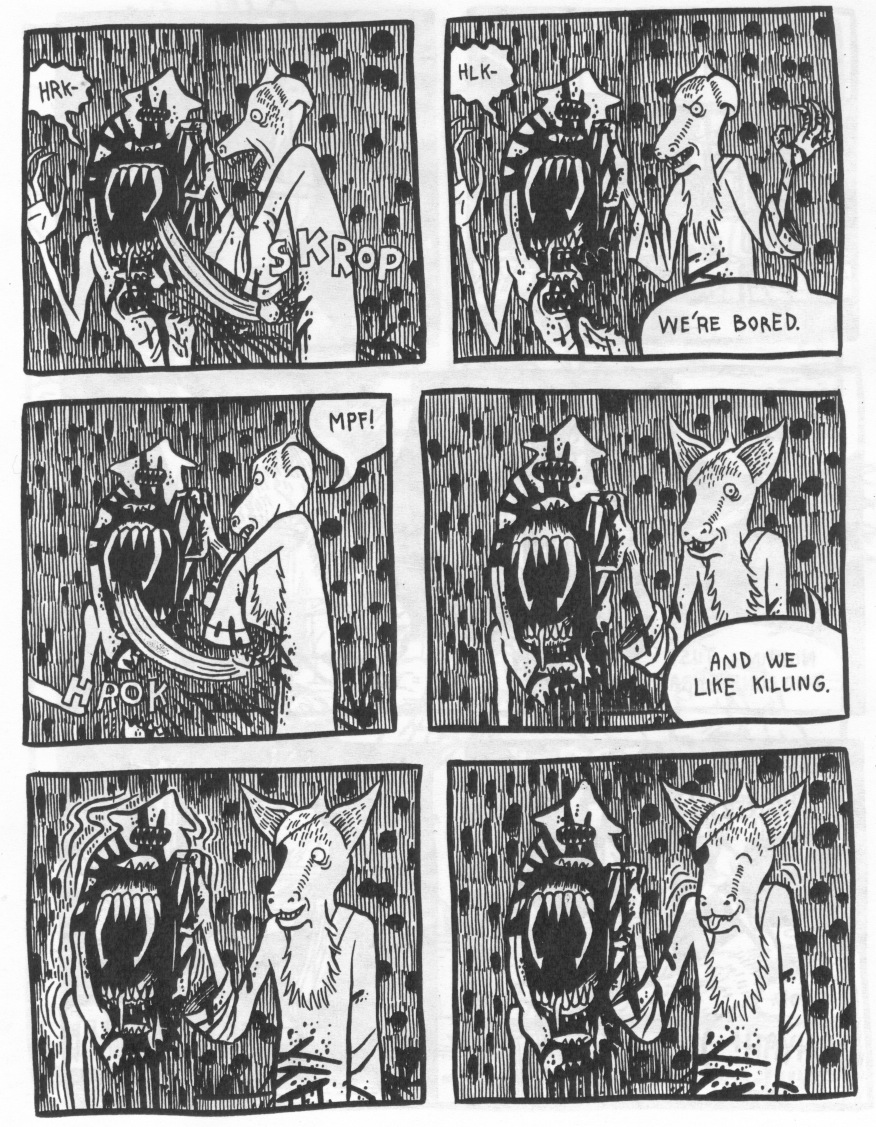
Simmons’s usual talents are in evidence here as well. From the title creatures in “Night of the Jibblers” and “Jesus Christ” to the witches and ogres of “Cockbone” to the Godzilla-sized pink slug in The White Rhinoceros, he’s developing one of the best bestiaries in comics, and the “skrats” at the center of this story fit right into that menagerie. They come in black and white varieties here, and in great numbers by book’s end, allowing Simmons’s ever smoother inks (reproduced beautifully here, by the way) to evoke everything from Spy vs. Spy to David B. to that Escher drawing with the fish and the birds. And like most of Simmons’s monsters, they’re a discomfiting combination of flesh and fangs that makes you feel that being attacked by one of them would be not just deadly but grotesquely intimate, like being mauled by a giant scrotum studded with razor blades. The characters we meet are similarly creepy, using Simmons’s standard and still unnerving combination of over-the-top aw-shucks friendliness and violent, obscene threats and exclamations, like a beloved uncle you suddenly realize you don’t want to be alone with anymore. Lovely cartooning, icky horror, and a battle scene that’ll likely top anything else you see this year, for eight dollars total? No way you should wait till 2016.