
Posts Tagged ‘reviews’
Comics Time: Danger Country #1
December 8, 2011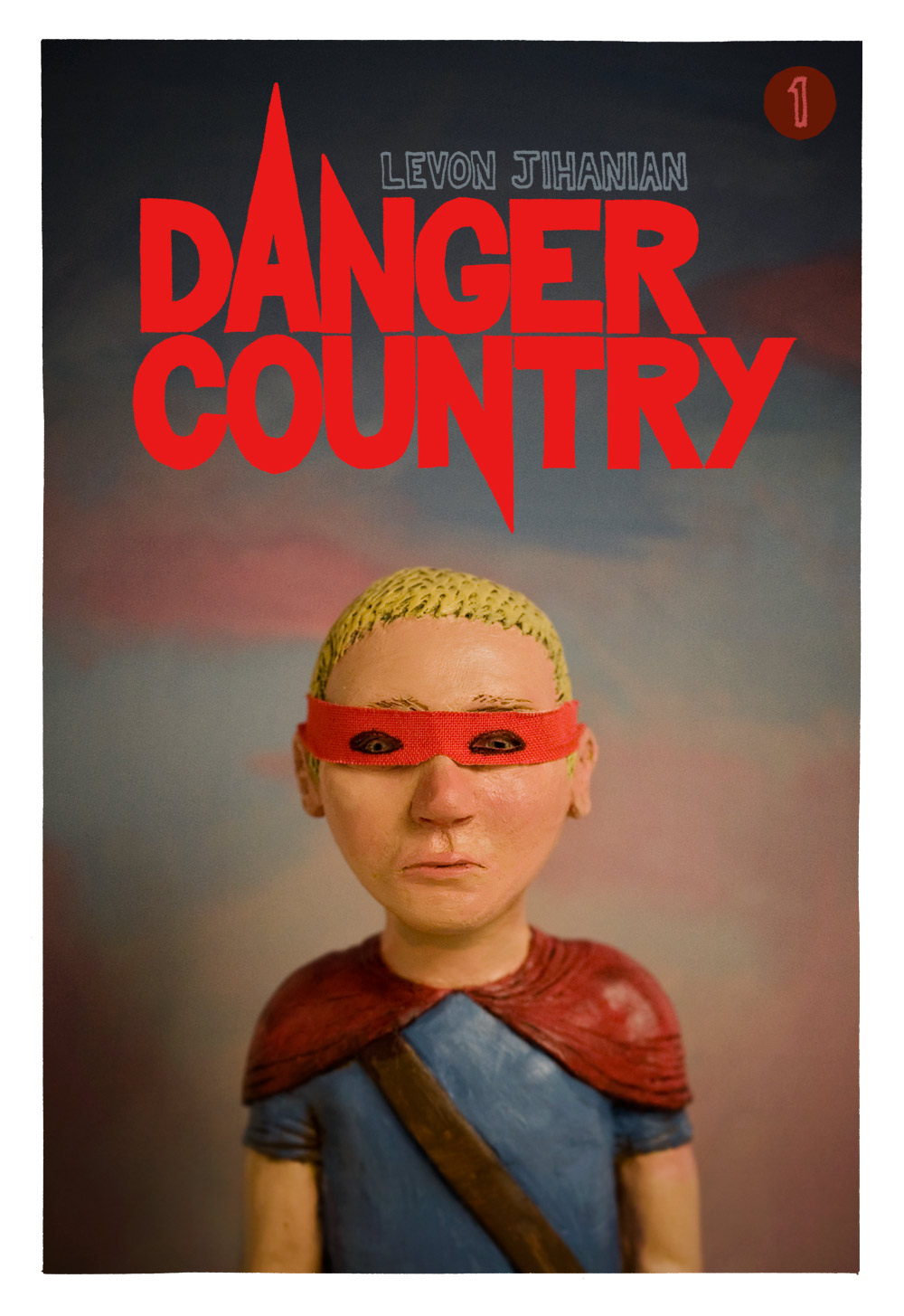
Danger Country #1
Levon Jihanian, writer/artist
Teenage Dinosaur, 2011
40 pages
$5
Buy it from Levon Jihanian
For today’s Comics Time review, please visit The Comics Journal.
Boardwalk Empire thoughts
December 7, 2011SPOILER WARNING, SPOILER WARNING
* Though I’ve been watching Boardwalk Empire faithfully since the series premiere, I’ve only written about it a handful of times. I think that’s because my enjoyment of it is a pretty simple thing. It’s a sumptuously shot, dressed, and acted gangster period piece, featuring increasingly savage and memorable outbursts of violence, and starring real-world organized-crime pioneers like Lucky Luciano, Meyer Lansky, and Al Capone as “playable characters.” In that light my fondness for the show doesn’t require a great deal of explanation. Moreover, the growing pains of a young show striving for greatness, an occasional shaky hand with character development, and (particularly this season) some visible discomfort with its women characters (usually where the rubber meets the road for the really great TV dramas) would seem to defy attempts to delve any deeper.
* Until now. My my my, but that was a magnificent episode the other night. I was actually a bit scared to search for reviews afterwards, since I knew without looking that any episode that took things as far as this one did would be a make or break one for many viewers and reviewers. Put me in the “make” column for sure.
* It was the dreamlike power of the episode that did it for me. By “dreamlike” I don’t mean amorphous, illogical, or surreal, at least not in this case. I mean the heightened reality of dreams, in which words and objects are freighted with meaning through their proximity to the strangeness or momentousness of the events of the dream. It’s gonna take me a bit to explain this, so please bear with me.
* It reminds me of the tail end of Grant Morrison’s big Batman R.I.P./Batman and Robin/The Return of Bruce Wayne storyline, in which the presence of certain artifacts in Bruce’s life — his mother’s pearls, her murderer’s gun, the bell he used to summon Alfred to save his life on the night he decided to become Batman — cast shadows through time, affecting him again and again.
* It also reminds me of an astonishing episode of Little House on the Prairie I happened to get stuck watching while feeding my baby with the remote control out of reach months ago. I found out later that it was the two-parter that served as the finale for Michael Landon’s final season with the ongoing series. Landon’s character’s adopted son gets caught in the crossfire of a bank robbery and is rendered catatonic. Desperate for help, Pa Ingalls rides off with the son to seek a doctor, and the show becomes this series of sweeping vistas as he goes deeper and deeper into the wilderness, until finally the horse dies (I think) and they’re trapped where they’ve stopped, and so thinking they’ll die he builds an altar of stones to pray for divine intervention, and in the middle of a thunderstorm an old man appears to them to help them…It was all image, all emotion. It led with raw power and let the plot draft on its slipstream.
* In this episode’s case, that meant a few things. First there was the repetition of lines, fraught with meaning: “Jimmy, I have to go.” “I’ll remember! I’ll remember!” “There’s nothing wrong, baby. There’s nothing wrong with any of it!” “Then finish it, goddamn you. Finish it!” (Eyes Wide Shut used this same technique.) Other lines were repeated as actions: the bayonet Jimmy told the army recruiter he wanted to shove into the Kaiser’s guts became the knife he used to stab the Commodore in the stomach. Actions were repeated and inverted as well: Jimmy beats his professor for assaulting his mother, then attacks his mother years later. Music cues stretched across scenes, plotlines, and timeframes. Fades to black brought us in and out of flashbacks and simply from moment to moment. Textbook Freudian uncanny doubling. It’s as if all these things operated on a slightly higher level of existence than everyday reality, less fixed in time, playing themselves out on a different scale.
* People seemed more…vivid as well. I don’t want to say mythic, because these days that’s a loaded term indicative of self-conscious Joseph Campbellization. (I know, I know, the show went full-on Oedipus here, so they brought it on themselves, but this felt more raw and real than “modern myths” nonsense. The Commodore didn’t just attack Jimmy with anything, he stabbed him in the back with some kind of spear. And he emerged from nowhere, a towering furious mute Bad Father. Jimmy’s guardian Richard Harrow had similar trouble speaking in this episode — he was a dark angel quietly disposing of the slain father and drawing the curtains on Jimmy’s consciousness with a nod. Van Alden tells us of his life as a living indictment of his parents’ most deeply held beliefs, and ends the episode by fleeing like, I don’t know, Frankenstein’s monster, rejected by his creator. The vulpine priest continued to hover over Margaret, benevolently preying on her guilt in his collar and cassock. Even Jimmy’s increasingly pronounced limp (to my eyes at least), and the way he cloaked the wounded half of his body from his sleepy son with his black jacket like a human yin-yang or the Phantom of the Opera, lent him a monstrous quality as he went about his monstrous work in this episode.
* Objects took on a numinous quality too. Agent Sebso’s gun and shoes are presented as an indictment of Agent Van Alden in and of themselves, dredged up from the river and the past. Margaret’s daughter’s leg braces embody her painful future, and provide the support needed for Margaret and Owen to have the conversation that they’ll both instantly regret. Margaret views the subpoena she receives as literally a divine calling to account. Angela’s white dress and Gillian’s torn dress are loaded with messages for Jimmy. The nearby railroad track, the clanging of its gate bells, gave the passing of time itself new urgency — each moment received its own soundtrack.
* So yeah, just a ton of powerful images and sounds, all of which feel like half-understood things to me, their impact primarily emotional. If you can construct a story out of that stuff, you’ve achieved something pretty special.
* And the episode pretty much could have coasted on the Jimmy/Angela/Gillian material, but in addition, it was Nucky Comes Alive. I’ve read writers I respect (Matt Zoller Seitz, I believe) argue that in retrospect, Steve Buscemi, as enjoyable as he is in the role, was ultimately miscast. But if I had to pinpoint one reason why I disagree, it would have to be scenes like the one in which he more or less threatens to have Margaret, the woman he loves (and I don’t doubt that he loves her!), murdered if she decides to testify about his role in the death of her abusive late husband. It reminded me of an earlier Nucky highlight from this season: His slowly revealed rage at Eli as he pulls the rug out from his own “apology accepted” and browbeats his penitent brother out of any hope of rapprochement with his “get on your knees” speech. The fury in Nucky’s eyes in both these moments! Buscemi spends most of his time as Nucky in more or less harmless emotional modes: gladhanding politician, avuncular friend/father figure/husband figure, “heavy hangs the head that wears the crown” man at the top. But when you really press him, when you do something that strikes at his core — and I don’t even mean run-of-the-mill confrontations with adversaries; this is basically limited to betrayals by family — suddenly the teeth get bared in such convincing fashion that it looks like he could tear someone’s fucking face off. And I have to imagine that this is what the other characters pick up on in a world with Buscemi/Nucky calling the shots. It took a lot to stand out in an episode this epic if you weren’t part of the Oedipal drama at its center; Buscemi and Nucky had what it took.
* The episode also tied in with any number of plot threads I’d enjoyed, and even more interestingly that I hadn’t enjoyed, from the season so far. Take the status of the black workers, for example. During Nucky’s conversation with his sharp new lawyer Fallon, I marveled at how candid they felt comfortable being despite the presence of a third person in the room, Nucky’s butler Harlan. The black servant class is invisible to these guys until they’re needed for something, I thought. But then Harland pipes up at Fallon’s request…and suddenly he’s made himself an indispensable man in two of the longest-running plotlines on the show, Nucky’s corruption charges and Van Alden’s incipient psychosis. It’s like finding out that the last piece of the puzzle was in your hand all along.
* It was nice for Angela to get a last turn in the sun. Her murder by Manny Horvitz last week was appropriately awful — I was hit pretty hard when she begged for mercy on the grounds that she has a little boy — but at the same time she’d been so underutilized all season long that it felt less like the end of her story and more like a page from Jimmy’s. “Women in refrigerators,” in other words. I couldn’t help but feel that in eliminating a character that the show appeared to have little use for anymore, Horvitz was serving as a proxy for the writers. But Jimmy’s flashback also served as an origin story for a character who really needed one. How did a relatively free-thinking lesbian end up with a dude like Jimmy, even given societal pressures of the day? Well, she was a college-age kid discovering her sexuality as she went along, and anyone who’s been that age can tell you how many roads that can take you down before you find the right one, including roads that cut you off from where you really ought to go. In her case she was trapped like a fly in amber by her pregnancy, knocked up and affianced to a guy she likes a lot but probably didn’t and could never really love, pressured against ending either the relationship or the pregnancy by societal stricture, probably guilt about betraying a man at war, possibly fear of what he’d do when he got home given what she witnessed the night before he enlisted. It’s weirdly gutsy of the show to give us its best Angela episode of the season after the one in which it killed her.
* I’m also glad to see Van Alden reemerge. I have nothing against having a baby as a plotline for a fully grown-up character in a drama — it’s not like when you’re a few seasons into a comedy or soap about young people, the writers run out of ideas, and suddenly a character or two gets saddled with a bun in the oven that necessarily closes them off from all sorts of romantic and comedic possibilities. (Cf. this season of Gossip Girl, if you dare.) But the execution of Van Alden’s baby storyline has been every bit as limiting and stultifying as the worst such sitcom. He’s just been completely closed off from the action, existing almost on a show within a show. Gone was the Wrath of God figure from Season One, the guy who made me more nervous every time he was on screen than anyone else. Even to the extent that he threatened Nucky, it was at a remove, as a potential witness Nucky heard about third- or fourth-hand. (Of course, it could be worse — he could be Lucy Danziger, whom the baby storyline granted several mightily creepy-sexy nude scenes and then chased off the show entirely.) But now…but now! What the hell is he gonna do now? He’s a freaking fugitive murder suspect! He foreswore his oath, to be all Game of Thrones about it. A suicide run against Nucky as the architect of his downfall, a Travis Bickle attempt to “rescue” Margaret from inequity — who knows what comes next? That’s some delicious uncertainty is what that is.
* Circling back to the doubling I discussed earlier, although this time in far less uncanny fashion: Two of my favorite developments this season provide a direct compare-and-contrast in terms of styles of criminal leadership — and no, it doesn’t involve Nucky and Jimmy, but Chalky and Eli. I’m gonna spell his name wrong I just know it, but Dunn Purnsley, the charismatic chatterbox (played with silver-tongued malevolence by Erik LaRay Harvey) who threatened Chalky in jail without realizing who he was and then paid the price for it with a beatdown from Chalky’s grateful subjects, is subsequently recruited by Chalky as a valued henchman and the pointman for the strike. Which is great in and of itself because Purnsley’s a wonderfully entertaining character I’m happy to see stick around, like Richard Harrow last year, but also because of the way it demonstrates Chalky’s thoughtful and magnanimous approach to power. By contrast, poor Deputy Halloran is repaid by years of loyal, silent service to Eli with a beatdown of his own, followed by a genuinely menacing but ultimately idiotically transparent attempt at intimidation by Eli himself — all over a treason Halloran was undoubtedly far too stupid to even contemplate, much less commit. And all Eli’s thuggery earned him was precisely the betrayal it was designed to prevent. If you want an illustration of why Chalky’s at the top of his world while Eli’s a perpetual also-ran, look no further.
* I’d also like to sing the praises of Mickey Doyle, believe it or not. One of the weirdest performances on a show full of weird performances, Paul Sparks’s unctuous, nasal, giggling bootlegger has become a favorite occupier of screen time for me, for no more complicated a reason than that he’s funny and strange, moving and sounding like no other person on television. Take it where you can get it!
* Women-wise? This was a step in the right direction. Angela we’ve already talked about, but however predatory and loathsome she may be, it’s abundantly clear that Gillian was broken by the Commodore all those years ago. Her seduction of Jimmy was train-wreck awful but also pitiful — the way she had to repeat to herself that there was nothing wrong with “any of it” could only be referring to the whole freakshow of her life, whether or not she’d ever admit it. Ironically given the circumstnaces, it took some of the archetypal Jocasta out of her and made her into a human being we could understand.
* And while there’s virtually nothing I find more boring in a drama than Catholicism, I can almost appreciate its use in Margaret’s storyline. I think we’ve learned enough about her to understand that this isn’t a real religious awakening in her — it’s a lighthouse as she drifts in the fog of her own guilt over everything else in her life. As she convinces herself that this is the only outlet for her emotions and the only way to right the wrongs she’s committed, she could become as problematic as any legit fanatic.
* So there you have it: An episode that might could represent the moment Boardwalk Empire became Boardwalk Empire — an a-ha episode akin to “College” for The Sopranos, according to conventional wisdom, or “University” for The Sopranos, according to me. And it sets up quite a finale: As best I can tell, Chalky is still gunning for the KKK, Manny Horvitz is after Jimmy, Jimmy has got to be after Manny, Richard seems even more likely after Manny, Mickey Doyle could be up to no good, Van Alden could be up to god knows what, Nucky and Owen might come to blows…
Breaking Bad thoughts
December 5, 2011I watched all of Season One. SPOILER WARNING
* Breaking Bad started off a lot broader than I expected. And I’ll be honest, it was hard not to hold that against the show, no matter how many times I reminded myself that The Sopranos spent two seasons as a black comedy about men trying to kill each other over cunnilingus and things like that.
* Mind you, the core family was fine the whole time. Bryan Cranston exudes the air of an actor who knows he has the role of a lifetime every moment he’s on screen. R.J. Mitte portrays Walt Jr.’s disability exactly the way he should, like an otherwise normal teenage kid dealing with one extra layer of crappiness. And though Anna Gunn’s Skyler is written a wee bit too pointedly oblivious to what’s really going on with Walter now and then, she’s certainly believable as a basically happy person suddenly being made to struggle with issues that threaten that happiness, financial and physical alike.
* But everyone else? The bulldog back-slapping brother-in-law, with his off-color remarks and gung-ho DEA attitude? The unbearable sister, meddling and judgmental and prone to referring to people as being “on marijuana”? Jesse Pinkman, a Slim Shady caricature who says “what up, biatch?” on his outgoing answering machine message? Various ésé-spouting Mexican-American gangsters blaring generic hip hop out of their cars and stereo systems? Nuance is hard to come by here.
* Then I started struggling with Walter’s actions, too. There was something too pat about the way he approached, say, disposing of a body like grading a quiz at work. I know that that’s what movies tell us that mild-mannered people suddenly drawn into life-or-death criminal enterprises would do, but a nervous breakdown seems like a far more likely result. The fact that that storyline devolved into splatstick with the bathtub full of dissolved body parts crashing through the floor didn’t help matters.
* I did buy the way he went about figuring out to do with the imprisoned Crazy Eight — basically coming right out and saying that he was bonding with him in an attempt to prevent himself from being able to kill the guy. And I bought the little touches in that storyline, too, from giving him hand sanitizer to use after he relieves himself in the bucket, to the way he wished aloud that Crazy Eight hadn’t hidden a shard of the broken plate to use as a weapon when he first discovered that it was missing. But after the deed was done, it seemed to weigh no more heavily on his mind than the secret of his cancer diagnosis, or whether or not to go back into cooking meth, or whether to accept money from his old lab partner, or whether or not to forgive Skyler for tipping the guy off about the situation in the first place, or whether or not to get treatment…I just had a really hard time swallowing that killing two people, including one time by hand, wouldn’t totally eat him alive.
* But a couple of moments toward the end of this short first season sold me on it enough to keep going. Well, that’s not quite fair — I’d probably have kept going regardless, it’s a perfectly entertaining show. But these moments made me think that maybe it could go from perfectly entertaining to hanging with the big boys.
* The first was the intervention scene, when Walter’s family tries to convince him to get treatment for his cancer. In particular, you could feel the actors playing the in-laws reacting to this material, much better than what they’d been given so far, like drowning animals getting their first big gasp of saving air. The sister was suddenly allowed to show both genuine compassion and express a viewpoint that didn’t conform precisely to our received wisdom about What Assholes Think and Do. Skyler’s benevolence, her facade of creating this safe space where everyone could speak their minds freely, was complicated refreshingly by her simple desperation to keep her husband alive. (Understandable! But not saintly, and that’s the point.) Walter was finally given the chance to truly hash out and articulate how crushingly unfair he felt the cancer to be in a life already proscribed and fenced in by things he never quite felt within his control. Even the buffoonish cop brother had a chance to visibly struggle with his own inability to express complicated, serious ideas in a fashion commensurate with their complexity and seriousness; by the end of the scene, he was quietly crying, though neither the filmmakers nor the actor made a big deal out of it, to their great credit. It was a beautifully done scene, one that convinced me that these were people who contained more than was visible on their surfaces, and/or that the filmmakers were up to the task of showing that to be the case. (There was a parallel track in that episode that, while not quite up to the intervention’s standards, helped flesh Jesse out in a similar fashion: His ability to convincingly clean up for a job interview, his crushed hopes when he realized what he’d be relegated to doing if he were to get the job, his lack of comfort with falling right back into his old ways given what he’d been through, his disappointment in himself for not being able to live up to the standard he and Mister White had set.)
* The second came a couple of episodes later, after Tuco beat Jesse up and stole his meth and money, when Walter goes to Tuco’s place to steal it back. When he gets back to his car after blowing up the room and working out the deal with the stunned but impressed Tuco, he lets out a primal growl of exhilaration, pumping his fists and pounding on the steering wheel. And suddenly I could understand why the murders didn’t destroy him like I thought they would — like I thought they ought to, frankly; suddenly his fun but kind of cheap outbursts of vigilante justice — roughing up the bullies in the clothing store when they made fun of Walt Junior, blowing up the loudmouth Bluetooth guy’s sportscar at the gas station — seemed less like “hey, wouldn’t it be funny if we ended the episode like this?” and more like signposts on a road to a destination. The destination being “Walter White is actually dangerous inside.” For whatever reason, some innate tendency toward risk-taking, thrillseeking, intimidation, and violence that had never had a chance to express itself until now was out, and the mild-mannered science teacher was now a bald-headed suicide bomber growling out his triumph with a lap full of hundred dollar bills. When they called the show Breaking Bad, they didn’t just mean going bad in terms of breaking the law — they meant that some rough beast was slouching toward Albuquerque to be born.
* And that’s the fundamental difference between Breaking Bad and all of the other shows I’ve watched that I’d consider to be the Great TV Dramas. The Sopranos, Deadwood, The Wire, Mad Men, Battlestar Galactica, Twin Peaks, even the less self-consciously Great Lost or the flawed Boardwalk Empire or the very young Game of Thrones were basically stories about men and women dealing with the consequences of moral codes they’d formed long ago and adhered to for years. Even in cases where circumstances recently changed for them in such a way as to force them to confront those consequences much more urgently or directly — a new sheriff in town, a new Hand of the King, a plane crash on a mysterious island, interplanetary robot genocide — the value systems we saw them working with were already in place before the cameras started rolling. On Breaking Bad, however, Walter White is becoming a changed man before our eyes. At times it’s just as baffling to us as it is to poor Jesse. In the end, I suppose it’s no surprise that I finally cottoned to the show when I felt like I’d gotten the lay of the land for what he’d changed into, and how he’d behave from now on. Suddenly the show had become the kind of show I’m familiar with as being prone to greatness.
* The show really lucked out in this respect: What a fucking transformation from Bryan Cranston simply by shaving his head! From “Dad who enjoys his daughter’s soccer games” to “police still have yet to identify several of the bodies found in the crawlspace” with the glide of a hair clipper. Years of closely reading comic books and learning to take every aesthetic quality as an intentional vector of story or tonal information has left me really fascinated by the impact a character’s mere physical appearance can have on the story he’s in, and this is as good an example of that as Jon Hamm’s prodigious handsomeness making Don Draper bearable.
* It also paid more attention to the aural dimension of filmmaking than probably any of the shows I listed above save, I dunno, Twin Peaks? The drones and buzzes in Walter’s head when things are going really badly for him are a totally effective tool in their arsenal. I don’t know why more shows wouldn’t go for that kind of thing.
* And let’s be honest, I’m predisposed to appreciate any show that uses its lead character’s relative willingness and ability to slip it to Anna Gunn as a barometer for his state of mind. (Although is it really a barometer of anything but whether or not he is a living heterosexual male with a functioning penis?)
* Anyway, I thought the very last episode was a bit anticlimactic. I like that Walt’s thinking big with the meth operation, and again, I’m deeply okay with rogering Anna Gunn. But the main takeaways from this episode — that Walt can go toe to toe with a druglord and that said druglord is an enormously unpredictable and violent meth-addled lunatic — were already established with much higher stakes in the previous episode — instead of hosting tense junkyard meetings, Walt blew up Tuco’s office; instead of proving Tuco’s propensity for violence by beating up some unnamed underling, the show proved it by beating up Jesse. But even still, I’m excited to see if my armchair psychoanalysis of Walter holds water in the following seasons. What up, biatch.
Comics Time: 1-800-MICE
December 2, 2011
1-800-MICE
Matthew Thurber, writer/artist
PictureBox, 2011
176 pages, hardcover
$22.95
Buy it from PictureBox
Buy it from Amazon.com

For today’s Comics Time review, please visit The Comics Journal.
Comics Time: Tales Designed to Thrizzle #7
November 23, 2011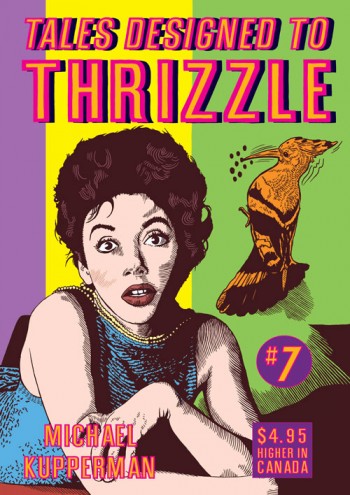
Tales Designed to Thrizzle
Michael Kupperman, writer/artist
Fantagraphics, November 2011
32 pages
$4.95
Buy it from Fantagraphics
For today’s Comics Time review, please visit The Comics Journal.
Comics Time: Flesh and Bone
November 17, 2011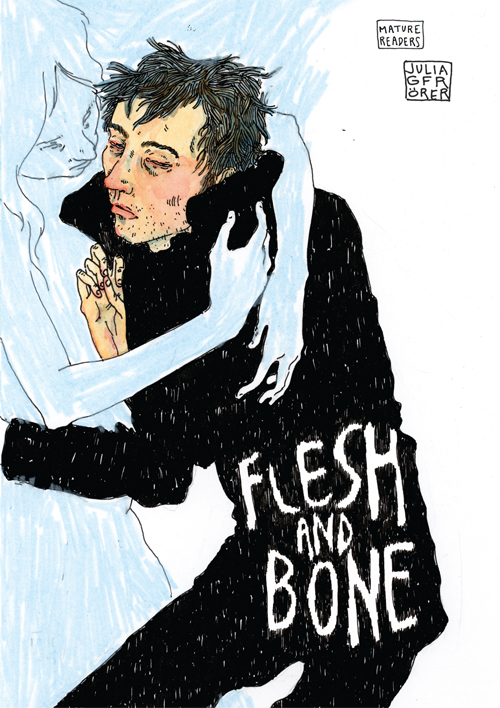
Flesh and Bone
Julia Gfrörer, writer/artist
Sparkplug, 2010
40 pages
$6
Buy it from Sparkplug
Death as an irreparable rupture. Explicit, raw, wounded-animal sexuality. The calculating and casual torture and murder of children. Occult evil that actively belittles the human capacity for love and kindness. It’s tough to think of a darker brew than the one Julia Gfrörer serves in Flesh and Bone, the all too aptly titled tale of a man who’ll do anything to be reunited with his dead beloved and the witch who’s all too happy to accommodate him. But it’s a heady brew, too. Gfrörer’s intelligence shines through in virtually every particular, from pacing (the excruciatingly interminable sequence in which the bereaved man writhes first in agony then in resigned masturbatory ecstasy on his beloved’s grave) to dialogue (a devastating exchange between witch and demon in which love is dismissed as “mutual masturbation,” a form of slavery that prevents humankind from pulling itself out of the muck) to strategic absences of dialogue (a harrowing silent sequence in which an owl is sent to blind a young witness to a horrible crime) to character design (the man’s Byronic good looks, the demon’s disembodied lion head) to facial expression and body language (the witch’s arched back and closed lids as she copulates with a screeching mandrake creature) to a cover that nails the appeal of her wiry, frail characters and line. I can think of few efforts in this vein that impress me, or resonate with me, more deeply than Gfrörer’s. Highly recommended.
Comics Time: Queen of the Black Black
November 14, 2011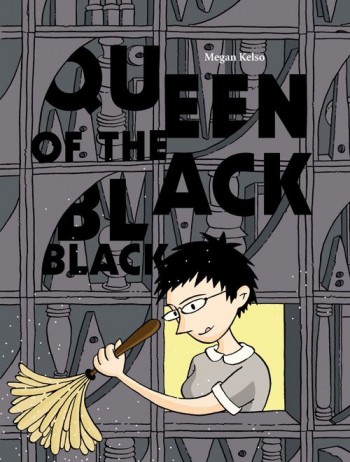
Queen of the Black Black
Megan Kelso, writer/artist
Fantagraphics, 2011
168 pages
$19.99
Buy it from Fantagraphics
Buy it from Amazon.com

For today’s Comics Time review, please visit The Comics Journal.
Mad Men thoughts index
November 9, 2011Here are links to all my Mad Men posts. I hope you enjoyed them!
* Season One, episodes 1-4
* Season One, episode 5 through Season Two, episode 3
* Season Two, episodes 4-7
* Season Two, episodes 8-11
* Season Two, episode 12 through Season Three, episode 2
* Season Three, episodes 3-6
* Season Three, episodes 7-13
* Season Four, episode 1
* Season Four, episodes 2-6
* Season Four, episodes 7-13
* Season Five, episode 1-2: “A Little Kiss”
* Season Five, episode 3: “Tea Leaves”
* Season Five, episode 4: “Mystery Date”
* Season Five, episode 5: “Signal 30”
* Season Five, episode 6: “Far Away Places”
* Season Five, episode 7: “At the Codfish Ball”
* Season Five, episode 8: “Lady Lazarus”
* Season Five, episode 9: “Dark Shadows”
* Season Five, episode 10: “Christmas Waltz”
* Season Five, episode 11: “The Other Woman”
* Season Five, episode 12: “Commissions and Fees”
* Season Five, episode 13: “The Phantom”
* Bonus: Season Five, episode 13: “The Phantom” with The Mindless Ones
* Season Six, episode 1-2: “The Doorway”
* Season Six, episode 1-2: “Seeing Mad Men Through Its Ads” column for Wired
* Season Six, episode 3: “Collaborators”
* Season Six, episode 3 column for Wired
* Season Six, episode 4: “To Have and to Hold”
* Season Six, episode 4 column for Wired
* Season Six, episode 5: “The Flood”
* Season Six, episode 5 column for Wired
* Season Six, episode 6: “For Immediate Release”
* Season Six, episode 6 column for Wired
* Season Six, episode 7: “Man with a Plan”
* Season Six, episode 7 column for Wired
* Season Six, episode 8: “The Crash”
* Season Six, episode 8 column for Wired
* Season Six, episode 9: “The Better Half”
* Season Six, episode 9 column for Wired
* Season Six, episode 10: “A Tale of Two Cities”
* Season Six, episode 10 column for Wired
* Taking stock of Season Six: Bloggingheads.tv chat with Alyssa Rosenberg
* Season Six, episode 11: “Favors”
* Season Six, episode 11 column for Wired
* Season Six, episode 12: “The Quality of Mercy”
* Season Six, episode 12 column for Wired
* Season Six, episode 13: “In Care Of”
* Season Six, episode 13 column for Wired
* The Self-Destruction of Mad Men (an essay on style for Esquire)
* The Great Don Debate (debating the role of Don Draper with Hazel Cills for Netflix)
* Season Seven, Episode One: “In Care Of” (for Wired)
* Season Seven, Episode Two: “A Day’s Work”
* Season Seven, Episode Three: “Field Trip”
* Season Seven, Episode Four: “The Monolith”
* Season Seven, Episode Five: “The Runaways”
* Season Seven, Episode Six: “The Strategy”
* Season Seven, Episode Seven: “Waterloo”
Mad Men thoughts: The Final Chapter
November 9, 2011I’ve now finished all four seasons! SPOILERS AHOY
* The back half of Season Four began with two of the series’ very best episodes. First there was the surprisingly innovative decision just to take the series’ two lead characters and have them talk to each other for an episode. Duck’s arrival added some emotional and physical pyrotechnics to the proceedings, but for the most part it was simply a pleasure to watch Don and Peggy hash out the depth of their relationship to one another, first angrily, then drunkenly, then with the genuine hand-holding tenderness that reduces me to a misty-eyed marshmallow anytime the show goes there. This episode was, in its way, the payoff for Peggy’s newfound openness with Don at the beginning of the season. And as much as a part of her resents it — not because she wants it any different, but because, well, would the possibility really have been that difficult to entertain — it’s also nice for Peggy to offer proof that Don can have a platonic, loving friendship with a woman other than the one whose husband’s life he stole. Seeing that glimmer of a good man when Peggy’s around is sort of like the audience reaping a reward Peggy earned through years of hard emotional, creative, and intellectual work. It connects us to her.
* Next up was an episode with the evocative title of “The Summer Man,” which wasn’t just one of the series’ best episodes but also one of its most…experimental? Tactile? Sensuous? I’m not sure I could sit here and tell you what really happened in it, necessarily; the more important thing was the parade of sensations it presented us with. Don’s new hobby of swimming, the sound and vision of his body swimming through the cool and pristine water of the pool, was contrasted with the slow-motion muted-sound shots of booze being poured into an endless succession of glasses as Don realizes he needs to dry out, at least in part. Don began keeping a journal, so you had his mellifluous baritone actually narrating the episode — a first — providing not just a rich and pleasant sound, but a series of ruthless insights into his life and the lives of those around him. “I bet she was thinking of that line all night,” he writes of his date’s farewell after she blows him in the back of a taxicab. Brutal. But hey, let’s talk about that blowjob, too, another example of the show understanding how crucial and sexy the initial stages of a hook-up are: Bethany smiling at Don as she unzips him, him smiling back as he realizes what’s up. Let’s talk about the summeriness of it all, too, particularly the shot of Don exiting the athletic club and watching young women and couples (to coin a phrase) go by dressed in their summer clothes. And let’s talk about the show soundtracking Don in all his glory with the Rolling Stones’ “Satisfaction,” which made me think of nothing so much as the writers having a eureka moment: “Holy shit—we can show Don walking around to ‘Satisfaction’!!!” Indeed they can! What an episode. I’m almost afraid to google for reviews.
* Just before we got to that episode and discovered what I like to call Conscious Don, I got to thinking about the challenge it must have presented to Jon Hamm and John Slattery in particular to play characters who are in a state of perpetual inebriation. After a while you no longer notice it, but when they go into someone’s office, and I mean pretty much every time they go into someone’s office, they drink. When they get home they drink. When a meeting ends they drink. Certainly when they go out to dinner they drink. Might the actors forget about this too, or do Hamm and Slattery always remember to play Don and Roger as self-possessed guys covering up a slight buzz?
* If I recall correctly there was another strong pair of episodes in there, basically a girl episode and a guy episode back to back. In the first, Peggy’s would-be boyfriend gives her guff about her gig, Joan has sex with Roger after they get mugged, Sally runs away from home and Betty comes to claim her, Faye whiffs on trying to soothe Sally, and Miss Blankenship dies. In the second, Don is nearly found out by the Defense Department, Pete has to take the bullet for Don by canceling the agency’s aviation gig, Lane confronts his father, and Roger learns both that Joan is pregnant and that Lucky Strike is leaving. I’m not sure that either of them stands out as cohesive units, but as a demonstration of how many balls the show can keep in the air within a short stretch of time, they’re tough to top.
* While the sequence with Lane’s stiff-upper-lip father and his Playboy Bunny girlfriend rang as false — okay, not false, but at the very least broad — as anything on the show since Peggy and Rizzo’s nude brainstorming session, the portrait it painted of Lane as an overgrown boy was one I really appreciated. I had already found myself returning repeatedly to the way he chose to explain to his wife what he liked about living in New York: “I’ve been here eight months and no one has asked me what school I went to.” That line’s obviously loaded with centuries of English class bias, but it also speaks to how fundamental his time as a schoolboy is to Lane’s conception of himself. And from the dutiful employee of PPO who resigned himself to transferring to Bombay in under 90 seconds, to the rebellious son who couldn’t wait for his father to disapprove of his new relationship, you see it repeatedly.
* “It’s like drinking a hundred bottles of whiskey while someone licks your tits.” Man, Midge sure makes heroin sound more appealing than Lou Reed did, and I don’t even have tits! Ah well. It was nice to see the first of Don Draper’s Great Brunettes of the 1960s reappear, if only for a sordid attempt to extract cash that was skeevy enough to make my arms itch. As I write this paragraph I realize that it was actually a rather well-played scene given how shopworn the fallen-idealist junkie thing could be. The contrast between her and her husband’s jocularity and their obvious desperation was an engaging detail from writers and actors alike.
* Speaking of pale brunettes, big Megan fan here, obviously. But that aside, I appreciate how the show slowly seeded her in, first with a standout role in Faye’s focus group about Pond’s cold cream, then by making her a tourist attraction for Peggy’s bohemian friends at the front desk, they by having her step in for the late Miss Blankenship, then by making her the control group for Faye’s failure to connect with Sally, then with a seemingly random shot of Don staring at her at the end of the day as she touches up her makeup to go out. You can certainly detect Matthew Weiner’s background with The Sopranos there — the best show ever at organically building up bit parts into major players. (Cf. Jaime Hernandez in Love and Rockets too.) And yeah, my initial reaction to their initial hookup was “Oh no!!!!”, a reaction that received some confirmation when Faye shows up at Don’s apartment later that night revealing that no, she had not in fact dumped him after all. But that wasn’t on Megan, who really legitimately seemed to be okay with things never going any further than that, even if it would be nice if they did. And I really really loved that they had her directly address her big teeth. She’s endearing and attractive and intriguing, with enough of a hint of potential “sees an opportunity and takes it” no-bullshit-ness that if she sticks around at the agency next season, she could make for a multidimensional foil for both Don and Peggy. And Joan! And Jane! So yes, thumbs up for Megan.
* I’ve said it before and I’ll say it again: Nothing warms the cockles of my heart like grown men cooperating and treating each other with kindness, especially when they have all sorts of incentives not to but do it anyway. So when Pete went out of his way to take the blame for North American Aviation dropping out, and when Don secretly paid for Pete’s share of the agency’s collateral with the bank, I all but audibly said “Awww.” When Don told Pete he could run the agency if Don had to skip out? My heart’s swelling even now. I think it’s not just that I value cooperation and kindness so much — it’s that the two of them started on such bad terms. They hated each other! So to see Don trust Pete like that, and Pete sacrifice for Don like that…I don’t know, it’s almost like it gives me hope for the world. People can change. And that’s a place where Mad Men differs from The Sopranos in a big way.
* The season’s final arc took the Season Three finale’s pulse-pounding heist storyline and stretched it out into a slow-motion trainwreck. Instead of a race against time, it was an attempt to arrest the agency’s downward momentum before they crashed into the bottom. It was a series of “oh-no”s. Oh no, the Defense Department! Oh no, Don’s sleeping with another co-worker! Oh no, Faye didn’t dump him after all! Oh no, the Lucky Strike asshole is about to tell Roger they’re leaving! Oh no, they’re going to lose two huge accounts at once! Oh no, Glo-coat’s dumping them too! Oh no, Betty’s gonna catch Sally with Glenn! Oh no, Betty’s gonna catch Sally with Glenn again! How many times can the bottom drop out of your stomach, you start to wonder. This has the effect of creating a genuine sense of dread where perhaps none need exist, too. I spent several episodes convinced that at any moment, Betty would truly beat Sally, or that one of the kids was gonna drown in that pool out in California, or that Faye was going to out Don in retaliation, or that Lee Garner Jr. was going to coerce sexual favors out of Roger, or or or or…It was grueling. Fitting, then, that rather than the spectacular saves that capped off the first three seasons, this ordeal was ended with Peggy and Ken securing a small account — a relatively minor turnaround for a comparatively spectacular downward spiral.
* If you take the two previous items and combine them, you have some sense of why I’m also so happy that Don and Betty’s final scene of the season worked out the way it did. I wasn’t sure what I was more afraid of, that Betty would snap in some profound and even dangerous way, or that Don would try to sleep with her again. Instead they shared a drink after Don procured both a bottle and a genuine laugh from Betty, and Betty reacted to the news of Don’s engagement with a congratulations that, while not happy, at least didn’t sound like she was lying through her teeth. This season Betty emerged as one of the show’s most fascinating characters, taking her shady Season One shrink’s diagnosis that she has the emotional life of a child and running as hard and as fast with it as she could. Consumed with the same kind of rage that troubles her daughter, insisting on seeing a child psychiatrist, driven into paroxysms of life-altering jealousy when Sally befriends the kid she herself once inappropriately confided in, and overall refusing to take yes for an answer from anyone. Not to repeat myself again, but January Jones is absolutely perfect in this role, a Hitchcock blonde playing Jimmy Stewart’s Vertigo role. My hope for Betty is that now that Don’s moved on, she can find a way to do so too.
* So there you have it: Mad Men! I’ll take your recommendations for things to read/watch/listen to about it in the comments, if you’d be so kind…
Mad Men thoughts again
November 1, 2011Today I finished Season Four, Disc Two. SPOILERS AHEAD.
* Heh, every time I start one of these posts there’s a moment of trepidation. There’s always so much to talk about!
* So, the supporting-cast bloodbath I worried about last time around wasn’t quite as bad as I feared. Ken Cosgrove appears to be returning, which actually solves a bit of a mystery for me — though I don’t know who played who, I did figure out that three of the names in the opening credits track to Ken, Paul, and Harry, and for those first few episodes I couldn’t figure out why two of those three actors were still listed even though Harry was the only character at the agency. I must say that he appears to have weathered his abandonment by Roger, Bert, Lane, Don, Peggy, Joan, and Pete a lot better than I would have. This goes double since he had recently been promoted over Pete when the exodus went down, so he had to have taken his exclusion as a commentary on his character or loyalty rather than a matter of dollars and cents. I’ll be interested to see if his ability to take a bite out of the shit sandwich Pete made a point of serving him upon his return to the fold means he can actually swallow the whole thing.
* Also returning, if only for a while: Allison the secretary. Her ill-fated dalliance with Don was an instructive storyline for two reasons. First, holy moses was it sexy. Their breathy, clothes-on quickie was all about desire and arousal in the moment, the simple physical acts necessary for the act of fucking, and the smiling newfound intimacy of two acquaintances after the fact, that sense of a shared knowledge, of pleasure experienced together. I’m really having a hard time thinking of a show that’s been this thoughtful and thorough in exploring what makes sex sexy.
* Second, it was our clearest demonstration to date of the negative potential of Draper Unbound. It’s not that Don’s cruel, per se. I mean, he can be — the way he mocked poor alcoholic Duck Phillips and that simultaneously hapless and overbearing cousin who interviewed for the copywriting gig in the award-show episode is proof enough of that. But he’s not a sociopath. When his bad behavior is brought to his attention, his remorse is real. The point is that it has to be brought to his attention. He’s clueless on his own! So in a moment of drunken lust he has sex with his secretary. Then, because he is aware on a conceptual level that that is a thing that can cause problems and is probably a Bad Idea, he cuts off any kind of collegial relationship with her whatsoever. But he never makes an effort to think ahead of the problem, to try to ease her out of the idea of a potential ongoing relationship with him, to make her feel comfortable working for him again (let alone to not have sex with her in the first place). Even when her misery becomes too obvious to ignore, he still whiffs on obvious partial solutions like personally writing her a very nice letter of recommendation. Problems pretty much literally need to be thrown in his face for him to really understand that they’re problems at all, and that he’s responsible for them.
* So he’s stumbling from one crisis to the next now: He makes dates for when it’s his turn to have the kids, and thus Sally is left alone by the babysitter for enough time to chop off her own hair. He gets drunk off booze and his own reputation, and thus unwittingly plagiarizes some doofus’s crap copy while showing off for a client. He gets deep enough into his own drinking habit to have a full-fledged lost weekend, miss out on a scheduled visit with the kids, infuriate his increasingly unhinged ex, presumably embarrass himself in front of the award-winning advertising person he slept with earlier in the weekend, and unwittingly reveal his real name to some random waitress he took home. Draper Unbound is more like Draper Unmoored.
* Related: It takes a village to raise Don Draper. In the season premiere, I was struck by the directness with which Peggy Olson told Don that everyone at the agency just wants to please him. Besides being the outright articulation of three seasons’ worth of subtext, it also served a plot purpose in that it spoke to the more intimate, casual, and free-wheeling nature of the new agency, an agency where Don’s improvisatory genius is built right into the DNA, both in its name and partnership structure and in the fact that it was his fast thinking that made its creation possible in the first place.
But this admirable openness about the staff’s desire to live up to Don’s reputation and expectations cuts both ways. Peggy, Pete, Allison, and Joan especially are willing to work extra hard to protect Don from himself, but this can have the effect of enabling him. With their safety net in place, he has yet to learn how badly a hard fall can hurt. I’ve got a feeling we’re headed in that direction, though. Allison’s defenestration was the first taste of that, and the Clio Award weekend the second. The last thing I saw at the end of Disc Two was Roger staring resentfully at Don as he traipsed down the hall, award in hand, then flashing back to the day Don first showed up for work after Roger (maaayyyybeeee) hired him during a liquid breakfast paid for by Don himself. If that’s any indication of what’s to come, those two brushes with disaster won’t be the last. Compare and contrast with Season One, where as I’ve noted before, Don’s work life was pretty much peachy. You’ve come a long way, baby.
* The show is going about the business of showing us Don’s vulnerable underbelly in some fairly non-obvious ways. Frankly I don’t even know if this is intentional, but I never find Don more pathetic than when he flashes that heavy-lidded half-smile at some woman when he’s on the make. In those moments, where he really opens up the charm firehose and drunkenly leans in to try and plant one on the girl Roger and Jane set him up with, or Anna’s collegiate niece, or Allison, or whoever he’s targeting, he’s revealed to be not some godlike avatar of success and confidence, but just some horny dude trying to seal the deal. It’s like seeing his hair messed up, only far more intimate.
* The show also makes its point about Don’s tumultuous life by juxtaposing his competence and incompetence in its most direct fashion yet. The buildup to the Clio Award doesn’t just feature all of the major characters explicitly expressing their anxiety and excitement, it includes the series’ single most endearing and adorable image yet: Don, Joan, and Roger sitting at the show, secretly holding hands under the table. You love these characters in that moment, because they love each other — they worked really hard on something, they want other people to like it, and they’re afraid that people won’t, and they’re clinging to each other in the face of all this. And then they win! Woo! Don is now the acknowledged master of his domain! …and then he breezes into this meeting with the Life cereal people, looking disheveled and stifling belches, comes within inches of destroying the whole relationship, embarrasses his coworkers, and only pulls the rabbit out of the hat with the help of unconscious plagiarism. From elation to “eeeeesh” in the space of two scenes. Brilliantly done.
* While we’re on the subject of excruciatingly awkward meetings, how ’bout a hand for Roger Sterling and his anticipatory reenactment of the “Germans” episode of Fawlty Towers with the Honda reps? When he walked into that conference room and said he hadn’t been told about the meeting, “but then again I know how some people like surprises,” I nearly lost my shit. But beneath the black comedy, may I suggest that the show is suggesting that war can deeply screw up even a happy wanderer like Bonnie Prince Sterling?
* Let us return for a moment to the Mad Men Sexiness Highlight Reel: If it’s possible to have a full-on Tex Avery bugout over a line of dialogue, then that’s what happened to me in the flashback where Roger gives Joan a mink stole at the beginning of their hotel-room date, and she responds by telling him that every time she wears it, “I’ll think of everything that happened the night I got it.” AROOOOGAH! AROOOOGAH! There’s more delight packed into that one-line promise than in a lifetime of Christmas mornings.
* Also super-duper sexy, but problematic for that very reason? Peggy Olson’s nude-off with the obnoxious new art director. Now, I’ll admit that that kind of casual yet still very highly charged nudity is where my bread is buttered. (Boola, boola!) So it’s entirely possible that there exist dudes who would be more discomfited than aroused by that kind of situation — or if Rizzo’s eventual surrender and retreat behind the closed door of the hotel bathroom with the shower running is any indication, both discomfited and aroused, at any rate. But something about the scene didn’t ring true to me even when correcting for my own fetishes, because…well, let me put it this way. When a woman resolves to triumph in a particular battle of the sexes by taking her clothes off, that’s what we in the penis-having industry call a win-win situation. I get that Peggy’s spontaneous, confrontational nudism was a way to shut this asshole up, to make him realize that he’s not the free-thinker he imagines himself to be, and thus to gain the upper hand in their work relationship. And perhaps back then a woman taking charge of her sexuality outside the framework established by men — a woman who can “stare back,” to use Peggy’s phrase about the Playboy models Rizzo spent the evening ogling — really was the shock to the system Rizzo took it as. Certainly that’s implicit from the contrast with Hef’s fantasy factory. But for the modern viewer, and presumably for the modern writers and filmmakers too, it’s Peggy Olson-slash-Elisabeth Moss taking her clothes off on camera, and having a jolly good time doing it, too (which is admittedly very important). And as a guy, the last thing that made me was uncomfortable.
* That said, it’s been fun watching the writers and directors make the most of Peggy’s ever-growing comfort in being demonstratively herself, even if it happens where no one else can see. Between her headdesk moment when she finds out that Trudy Campbell is pregnant, and her Glenn Quagmire creeper routine when she peers over the divider to spy on Don after Allison’s blow-up, she’s an animated-gif machine. Switch on the subtitles and you can add her bit about how her boyfriend may not own her vagina, but he is renting it. And of course there’s her ability to speak truth to Draper, both positive (everyone’s there to please him) and negative (he’s got to fix his own mistake with the Life cereal situation). She’s a hoot.
* But perhaps the most revelatory character work so far this season — ironically, given her relative lack of screentime — is with Betty Draper. The big discovery here is that her problems don’t all stem from a combination of her victimization by Don and the limits placed on women by her time and place, or by her time and place as personified by her parents, i.e. a general culture-created patheticness. No, many of Betty’s problems stem from Betty herself. This person has an entitlement streak as wide as it is mean. What’s happening now is that she’s gotten everything she wanted. Now that she’s divorced, she can no longer fall back on blaming society for not allowing her to pursue what she wants in defiance of tradition. Now that she’s free from Don, she can no longer pin her problems on his philandering, secret-keeping, and emotional unavailability. Now she has the house, the money, and a doting husband — who genuinely seems like a decent dude, even! Henry repeatedly makes statements against his own interest, telling Betty that as much as she and he might hate him, Don is often right about things like the house and the kids. He talks her down off various ledges rather than reacting with Don-style rage that she’s unhappy to begin with. He seems to keep a protective eye out for the kids, especially Sally, recognizing the danger the mother-daughter relationship is in. And he seems crazy about Betty, both emotionally and physically. And guess what? The tiniest crack in the surface of this world still sends Betty into paroxysms of rage. That’s not on Don, or her dad, or her mom, or her brother, or Sally, or Henry, or society — it’s on her. And hey, good for the show for handling it this way. Making all of Betty’s problems the fault of men, or of Men, would infantilize her just as surely as those men/Men have done. (And they have, to be sure. But yeah, there’s more to it than that.)
* Finally, I just have one thing to say about Sally’s storyline: WHOA. Uh, I did not expect to see a ten-year-old girl masturbating as a major plot point on an American TV drama! Of course it was handled with the show’s charateristic intelligence, the balance between restraint and directness, the multifaceted commentary on individual characters and the characters who shaped them and the society that shaped all of them. But probably more importantly, and maybe more impressively, was that it was handled at all.
Mad Men thoughts: Season Three extra/Season Four premiere
October 26, 2011I wanted to bring up a few things I forgot to mention in my Season Three wrap-up, and to talk about the first episode of Season Four. SPOILER WARNING
* Lane: When I first started writing about Season Three, I quickly noticed how many people seemed so excited by my mentions of Lane Pryce that it was like he was an old friend who came back to town. Though he seemed like a nice guy as a character, a decent man forced into a semi-indecent job and punished with abuse for his reliability, I wasn’t quite sure what the fuss was about. Until the Season Three finale. A “Well, gentlemen, I suppose you’re fired” here, a “Very good, Happy Christmas!” there, and suddenly his decency was complemented by that most delicious of traits: vengeance! The good guy won that one, and I’d imagine won many viewers hearts as well.
* I also suspect that the show modeled that behavior by welcoming Lane into the Bert/Roger/Don fold in that episode. If they can put his name on the wall, so can we, right?
* Sal: Well, I guess we’ve learned the limits of Don’s tolerance. With a simple “you people” directed at poor blameless Sal, he revealed that while he would in no way ruin a guy for behavior that didn’t impact on him, he’d cut the guy loose in a heartbeat the moment he did. Outing or ostracizing Sal would be an unforgivable breach of decorum for Don, but in his view, so too is Sal allowing (“allowing”) what he is to affect Don in any way. Don’s tolerant of anyone, to a point. After that, he’s pitiless.
* Sal’s departure from the show was one of the very few spoilers I’d stumbled across going into the series, couched in glimpsed headlines about Bryan Batt’s unhappiness with this, I believe. Seeing him in a cruising spot payphone telling his wife he loves her as our last glimpse of him was an appropriately heartbreaking goodbye for a character who was just a blast every time he was on screen. (Please don’t tell me if he comes back or not.)
* Speaking of departures, uhhhh, is Season Four the wholesale cast-change bloodbath it seems to be? Ken, Paul, Mr. Hooker, Kurt, Smitty, Allison, Lois the Lawnmower Woman, and all the other bit players at Sterling Cooper have been wished into the cornfield now? That’s harsh, man, and knowing what I know about AMC I have to wonder (and I mean have to wonder — I ain’t googling shit until the credits role on the Season Four finale) if costcutting was involved.
* My squeamishness about that aside, this was a fine start to things. The hilariously over-the-top swingin’ music cue when we first entered the new Sterling Cooper Draper Pryce office was just the first sign that this is a faster, looser, more informal operation; see also the fishbowl conference rooms and offices, the lack of a table, Peggy and the new artist’s non-stop in-joking, the presence of guys like Pete and Harry among the bigwigs, and on and on.
* Another break from the past: The show’s most explicit sex scene yet, with a dollop of sadomasochism on top. Based on everything we know about powerful men’s predilections, this fetish makes a lot of sense for Don, but it’s still a place I didn’t think the show would ever go.
* In this episode we had yet another case of the show teaching both us and the characters what’s wrong and how to fix it all at the same time. After a taciturn Don gives an interview to the Ad Age guy that’s quickly used against him, it’s easy to interpret his blow-up at the bathing-suit company reps who don’t want a sexy ad as typical Don Draper petulance. That’s clearly how Pete and Roger see it, it’s how Peggy would see it based on her earlier confrontations with Don over the ham-fight PR stunt, it’s how we’ve been primed to see it, and it may even be how Don sees it…at first. But when he turns around, goes back into the conference room he just stormed out of, and orders them to leave, there’s suddenly a method to the madness. If business is hurting because Don is too aloof, because the gap between his outsized success and his cipher of a personality is too huge, then by god he’s going to narrow it by becoming the swaggering champion everyone already expects him to be. And click! Like that, a series of character and narrative developments stretching back to his early, tense relationships with Pete and Peggy, his unease around Roger, his failure with Conrad Hilton, the formation of the new agency, and the Ad Age debacle all snap into place, leading to this moment: Draper Unbound.
* Now, I can’t imagine this ending well for anyone, of course…or at least I couldn’t if Don’s work situation ever ended badly for him. But so far it hasn’t. At the end of Season One, he unexpectedly triumphed over Pete by calling his bluff. At the end of Season Two, he unexpectedly triumphed over Duck by calling his bluff. At the end of Season Three, he unexpectedly triumphed over PPL by calling their bluff. Maybe Superdon will crash and burn, but if the show really gets serious about it, if it has him truly damage or ruin his career, I’d actually be quite surprised. That’s just not a place they’ve been interested in going so far. (Again, please, no hints, no “keep watching”s!)
* One last carryover from Season Three: Pete and Peggy are getting along great, apparently, answering my question about how the revelation of their child together would affect things. Seems like they’re both perfectly happy to act like it never happened. Which, you know, is really fine. I’m sure the kid is much better off with Peggy’s sister than he’d be in a shotgun-wedding family consisting of Mr. and Mrs. Pete and Peggy Campbell, or with a resentful Peggy on her own. They managed to be civilized about it.
Comics Time: Gangsta Rap Posse #2
October 26, 2011
Gangsta Rap Posse #2
Benjamin Marra, writer/artist
Traditional Comics, October 2011
24 pages
$3
Buy it from Traditional Comics
For today’s Comics Time review, please visit The Comics Journal.
Mad Men thoughts, post-Season Three edition
October 25, 2011Just finished Season Three. SPOILERS, SPOILERS, SPOILERS
* The Season Three finale was Mad Men‘s ultimate competence-fantasy moment, and kudos to T.J. Dietsch to tipping me off as to how and why: It’s a heist movie. Heist movies are always a competence fantasy, a narrative centered on pulling off a difficult job with efficiency and style, against authority, with a huge payoff. But in this episode, Mad Men goes even further. The usual beats are there: the “one last heist” set-up for guys like Bert and Roger; assembling the right team based on their specialties; watching the plan click into place as obstacles are overcome by equal parts hard work, moments inspiration (“Fire us”), and physical force; the efforts to conceal the planning, juxtaposed with the flamboyance of the successful execution’s aftermath. But the stuff that gets stolen by the men and women of Sterling Cooper Draper Pryce is incidental, of course. This heist’s target is talent. The best creative director, the best account men, the best copy writer, the best administrator, the best office manager. They use all their skills in order to be able to use all their skills. It’s a competence fantasy in which the item being stolen through their competence is their competence. It’s brilliant.
* But there’s another reason why it successfully hits my buttons. I’ve said before that my favorite thing to see depicted in fiction is competence, cooperation, and decency — in tandem. And that’s what this is. In order to pull this off, Don and Roger had to forgive one another and recognize one another’s indispensable talents. Don and Betty had to cease their incipient warfare. Don had to apologize to Peggy for mistreating her. Peggy had to come to terms with her gratitude to Don. Roger had to give Joan the respect she always wanted. Don and Roger had to assure Pete that he was valued as a worker and a person. Pete and Trudy had to come together on behalf of their shared future. (And based on the return of the Clearasil account, it sounds like they had to make amends with Trudy’s dad, too.) Bert had to acknowledge Harry’s vision and encourage him not to let it go to waste. Harry had to act like a man of vision in turn. Lane had to free himself from the abusive culture of PPL that had hamstrung him and his family for years. Don, Roger, and Bert had to acknowledge Lane’s talent, and his basic decency despite having been hired to be an overseer and hatchet man. Lane had to admit how much he admired the partners and enjoyed working with them despite their conflicts. In short, everyone had to be genuinely kind to and appreciative of everyone else. If you can think of a better feel-good moment in recent television memory than Don coming out of the bedroom in the new agency’s makeshift “office” to discover Bert, Roger, Lane, Peggy, Pete, Trudy, Joan, and Harry happily working, eating, and talking, I want you to program my DVR.
* But every rose has its thorn, and you don’t get much more direct than having Don dissolve his family in one room, then walk through the door to join his new work family in another room.
* If the first half of Season Three was Mad Men at its most Sopranos, the back half was Mad Men at its most Sirk. From Betty and Henry Francis’s fraught, unconsummated affair, to the newly suburban setting and “back to nature” purity (dancing around the maypole as Don’s fingers brush the grass; gathering outside to look at the eclipse) of Don and Suzanne Farrell’s affair, to lighting so lush and dramatic as to rise to the level of expressionism, Douglas Sirk’s melodramatic fingerprints were all over this. It gave these last half-dozen episodes a strong visual identity and cohesion.
* Indeed, this stretch contained a few episodes that are among the show’s tightest and most striking on an individual basis. Even in the moment — during the opening flashforward sequence in fact — I was floored by the structure and triple focus of the episode that starts with Don wounded, Peggy in bed with an unidentified man, and Betty glamorous and languid, then slowly reveals how they all got there.
** In Don’s case, I’m always a sucker for dramatically portentous strangers (cf. this past week’s episode of Boardwalk Empire), and thus loved the draft-dodging pot-smoking pill-popping couple he unwisely hooks up with.
** In Betty’s, I’m endlessly moved and fascinated by how her tightly wound way of life forces her to act out only in childlike, petulant ways, like buying a couch her decorator can’t stand.
** In Peggy’s, I’m still scratching my head over the erotic appeal of Duck Phillips, and wondering if he wasn’t simply a way to work out her issues with Don just as Pete warned her he was. Surely it was no coincidence that Don was forced by Bert to sign a contract in the same episode that featured the return of the guy over whom Don triumphed precisely because he didn’t have a contract.
*** Alas for Duck, Peggy’s sojourn as a Duckfucker appears to be coming to an end as she joins Sterling Cooper Draper Prce — you can sort of see it in her teary eyes when Don makes his last-ditch attempt to woo her in her apartment. I doubt Duck will take kindly to being duckolded like that.
** Plus, Bert showed the sharp teeth lurking beneath the Cheshire Cat grin by blackmailing Don with the unspoken specter of “Dick Whitman.” Surely this was the Emmy submission for something or other.
* Re: Suzanne—On a personal level, I must say that after the dyed distraction of Bobbi Barrett in Season Two, it’s nice to see Don picking up where he left off with Midge and Rachel in Season One and resuming his tour of the Great Brunettes of the Early ’60s. I got it bad, got it bad, got it bad, I’m hot for teacher.
* George Hearst in Deadwood, the Commodore in Boardwalk Empire, Conrad Hilton in Mad Men…Should I ever become a man of godlike wealth, influence, and power, please remind me that I need to go gray, lose my hair, and grow a mustache. Gotta watch out for those menacing mustache men! (Note to Weird Al: Please make “Pictures of Mustache Men” happen.)
* Actually it’s a bit tough to know what to think of Connie from where I’m sitting. Perhaps the best way to think of him is as a Grant Morrison-style doppelganger/double/reflection of the hero. As his presumption to father-son dynamics would indicate, Connie is Don writ large. From similar diminished circumstances, he rose even higher than Don. From similar personal alienation, he has developed an even more impressive bulldozing business style, coupled with an even more charming personal style. And in a similar guise of being a straight shooter, he’s able to be even more capricious, self-indulgent, and cruel than Don at his moodiest and most mercurial. When Hilton calls Don on the carpet for not putting together an add campaign for the Hilton chain’s entirely imaginary hotel on the moon, that’s the moment when the by-golly gives way to something approaching terror that this madman has the kind of power he has. There but for the grace of God.
* However, we did learn in the finale that Hilton served one other purpose: teaching Don that he needs Roger. Gladhandler and heel though he might be, sometimes gladhandlers and heels are required! But more than that, presumably Roger would have seen Hilton’s capriciousness coming and put the brakes on. That’s required too.
* What I like best about that particular revelation, though, was that it was revealed to us at the same time Don articulated it to both himself and to Roger. The wheels click into place, and suddenly, “A-ha! So that’s what the writers were up to!” exists in a spot where there used to be only uncertainty.
* The show did it again several minutes later, when Don makes his pitch to Pete: He needs Pete not for his portfolio or his skills as an account man, but because he is, of all things, a forward thinker. Teenagers, aeronautics, “the Negro market” — beneath his bluster and petulance, Pete has basically seen the entire ’60s coming. But I never saw that he saw it, and I don’t think most of the people at Sterling Cooper saw it, and I’m not sure Pete himself saw it either, not until Don articulates it this way at this moment. It was another “A-ha!” Really, really smart writing.
* So how did we feel about Betty’s discovery of Don’s secret past and their marriage’s subsequent dissolution? I wonder if I’m focusing so much on the work stuff because, as was the case with the earlier episodes in the season, Don’s romantic and family life felt less essential to the story this season. Ironically, perhaps, given that he and Betty had a baby and then broke up, but there you have it. It also proceeded in pretty much the way I expected, lacking only a really thoroughgoing breakdown on Betty’s part upon the initial discovery: finding a key, finding the box, debating whether or not to tell, confronting Don, Don’s emotional collapse, an attempt to be honest and bridge the gap, a subsequent rejection, angry words leading to the unspoken threat of violence, the split, a slight rapprochement. Other than the gasp exhaled at the moment Betty opens the drawer, none of this came as a surprise.
* But it was impeccably executed, mind you. Jon Hamm’s an extraordinary physical actor, and made it so that watching him fumble and drop his cigarettes was somehow as bad as him pissing his pants. Later, his drunken, rageful confrontation with Betty over Henry Francis was a concise blast of all his money, class, sex, mother, and father issues right in her face. When he tells her she’s a whore, it’s an indictment of anyone and everyone he thinks just laid around collecting other people’s money rather than going out and making it themselves — Betty, Roger, Henry Francis, his dead mother.
* January Jones…you know, okay, I see what people’s problem with her is. She’s stiff. But whether or not that’s by choice, isn’t it perfect for Betty Draper? Even a Betty Draper in extremis? Whether we can thank the casting director or Jones herself, playing that role that way makes Betty a character unto herself rather than a type.
* I worry about Sally Draper. The loss of her grandfather, the assassination of JFK and his alleged killer, and her parents’ divorce, all at once. Authority’s crumbling all around her, and the instruction she does receive from it — Gene slagging her mom, her mom’s pretty messed up ideas about romance — aren’t going to help. Again, Kiernan Shipka’s a fine young actress, so I hope they go somewhere with all this.
* JFK. That was handled about as well as I can imagine anything handling it. The initial broadcasts, the cacophony of ringing telephones suddenly silenced, the huddled groups of whispering and crying people, the days spent staring in disbelief at the television, the narcissistic but totally understandable resentment of how one’s own plans have suddenly been upended…it was horrifying, heartbreaking, scary, and all too familiar.
* Two lines from that episode stand out: Don’s genuinely stunned and baffled “What?” when Betty tells him that Oswald has been shot, and a confused Bobby naively asking Don whether they’d be going to the President’s funeral. I teared up at that last one, because I know the truth about Don’s reassurance that everything’s going to be okay. It never was. It never is.
Brief Boardwalk Empire thoughts
October 23, 2011SPOILERS AHEAD
I’m really admiring Boardwalk Empire‘s narrative audacity this season, from a structural perspective. Last season’s cliffhanger was that Jimmy, Eli, and the Commodore were conspiring to take Nucky down. My assumption, and everyone else’s I assume, was that we’d spend much of Season Two watching this happen. It’d be a slow race toward the final coup attempt: the conspirators working to keep their plans secret before the trap is sprung, Nucky working to stay on top and get to the bottom of the setbacks that would surely start to befall him.
Instead, the coup happened in the season premiere. It turns out Nucky’s too big to take down in one fell swoop, but that aside, he learned that his brother, mentor, and protege had all betrayed him; that the city bigwigs were backing his enemies; that he was all alone, with his money and clout in serious danger. Instead of whether the coup would take place, the season is about what happens afterward. Smart stuff.
So too is the arrangement of the warring parties. In a battle between Nucky and Jimmy, there’s no default for the audience’s sympathies. Nucky’s the guy in the credit sequence, but the story we were really sold from the beginning is the story we’ve seen many times before — the hungry young man on the make. In other words, there are two protagonists, and after watching them work together for a full season (albeit with some hiccups), we’re now watching them become one another’s antagonist. Who do you root for? What’s more, their primary allies on the criminal end of things are the show’s two most compelling such characters, Chalky and Richard. We’re obviously to root against the conniving, child-raping Commodore, and the politicians on both sides aren’t worth spit, but there really is no easy way to take sides between the primary players. Obviously there are plenty of big prestige cable dramas who at least attempted to split audience sympathy between rival factions, but for the most part there were still clear good guy/bad guy lines established initially, regardless of where things went from there — sheriff versus crime boss, cops versus druglords, stern but kind Northerners versus arrogant, hedonistic Southerners. Boardwalk Empire has really split things down the middle, and I’ve got no idea what side I’m gonna come down on. Mostly I hope for a rapprochement. Don’t you?
Comics Time: Ganges #4
October 21, 2011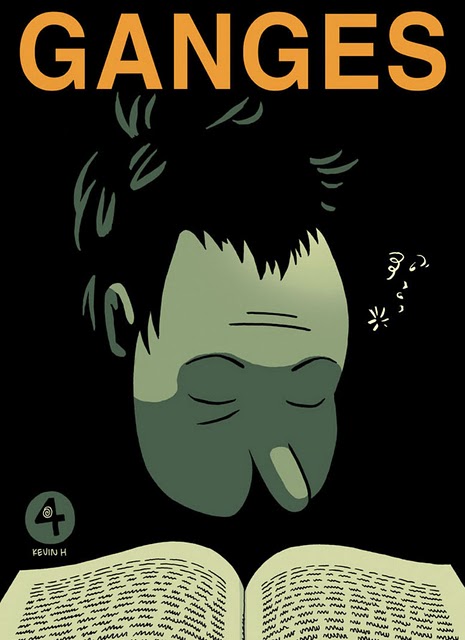
Ganges #4
Kevin Huizenga, writer/artist
Fantagraphics/Coconino Press, October 2011
32 pages
$7.95
Buy it from Fantagraphics
For today’s Comics Time review, please visit The Comics Journal.
Mad Men thoughts: Special “…and the John Deere you rode in on” edition
October 19, 2011* Just finished Season Three, Disc Two. SPOILERS AHEAD.
* I’ll admit it: I’m looking forward to being able to type “Mad Men” into Google and go berserk the moment I finish the series so far almost as much as I’m looking forward to the act of finishing the series itself. For years now I’ve been very studious in avoiding talk about the series (I lead a life lived in terror of spoilers, basically.) But even so, some things slip through the cracks — and sad to say, Roger Sterling in blackface was one of those things. Because I’m usually so careful I have no idea how I came across the image, but sure enough, a couple of weeks ago a Google image search revealed Roger doing his best Al Jolson. I winced for many reasons, but “Aw, shit — that would have come as a complete shock otherwise” was not least among them.
* Fortunately (if that’s the right word), enough time had passed that I sort of forgot the moment was coming, and when it did come it was more than shocking enough on its own terms. Literally jaw-droppingly shocking in fact. I sat there on the train staring at my laptop catching flies as dapper, jolly, funny, skeevy, charming Roger Sterling serenaded his bonnie bride with centuries of unthinking racial animus and privilege smeared all over his face. I think my main thought was “blarrrrrrgggghhh.”
* I think that was Don’s main thought, too. The big question, I suppose, was what made Don more uncomfortable: Roger’s heedless racism, or his heedless foolishness? It’s the foolishness that Don smacks Roger around for at the end of the episode, but his conversation with the incognito Conrad Hilton at the club’s abandoned bar indicates a lingering sense of solidarity with the help, no matter who they are. As was perhaps the case when he ignored Sal’s hotel-room indiscretion, I get the sense that the only thing that makes Don judge a person is incompetence. Insofar as bigotry blinds one to the feelings of a class of other people who could otherwise be engaged and thereby communicated to as an audience, bigotry is a form of incompetence, and that’s what matters.
* I did permit myself a bit of googling after the episode was over, and a quick search for “Roger Sterling blackface” revealed some pretty shallow and facile thinking about Mad Men‘s approach to race prior to the episode. I’m both amazed and not at all surprised that people who get paid to write about these things mistook the way the show reduced African Americans to speak-only-when-spoken-to servants, or to saintly nannies turned to in times of crisis, or to evidence of one’s beatnik bonafides, as evidence of the show’s racism rather than as an indictment of the characters’. Apparently episodes in which the characters gathered ’round the TV and talked about Birmingham would have been “better” than showing how they’d created a world for themselves where black people were permitted to exist at the margins but no further. I dunno, man. If that’s not an intentional absence, I don’t know what is. And watching it slowly leak into their lives as a presence — Betty’s drug-induced vision of the sad, slain Medgar Evars; Pete Campbell’s incredulity that anything as irrational as not wanting to be seen as the Negro TV company could ever trump the making of money; Paul’s failure to maintain a romantic relationship that needs must exist as more than symbolism and platitudes — has been bracing.
* Elisabeth Moss is a terrific actress because the role she’s playing is so challenging for a person of this day and age to play. She has to play Peggy as a strange and alien creature called a “woman,” learning and fighting to become a “human,” a transformation basically without social precedent.
I’ve been thinking a lot about sexism lately — I’m watching Mad Men, reading about superhero comics, and raising a baby daughter, so how could I not? And I’ve realized that I believe women are different from me as a man in three very specific ways and those three very specific ways only:
1) They have slightly different biology.
2) They identify as “women.”
3) I find some of them sexually attractive.
As best I can tell, that’s it. Aside from those three things I’ve never encountered a difference between myself and a woman that couldn’t be explained as a facet of that particular woman as an individual person rather than as a facet of her woman-ness. I remember discovering my senior year in college that one of my roommates had deliberately never taken a course taught by a woman professor unless required to, and this totally blew my mind — it quite literally never occurred to me that women as a class would be less good than men as a class at anything other than, like, bench pressing. I’m not saying this to pat myself on the back because I in now way feel like I deserve any “credit” for this viewpoint, any more than I deserve credit for having blue eyes. I did no work to get here. It’s just the way I see things, even if I’m only now articulating it in precisely this way, and mentally I never had the option of seeing it some other way, I don’t think.
The point is that problems arise when men think of women as a separate species. When Peggy looks at Don and sees who she wants to be, not who she wants to be with, for most men in the office that’s akin to a chimpanzee putting on pants.
* One variable I’d forgotten when trying to pinpoint the origin of Pete and Trudy Campbell’s newfound team spirit was Pete’s discovery that he’d fathered a child with Peggy. I’ve done a shit job of keeping track of Pete and Peggy’s relationship in light of this revelation this season — I barely recall if they’ve been palling around like the rest of the officemates or just cordial or barely speaking to one another — but all the evidence you need for the Campbells’ current relationship can be found in their hotstepping at Roger’s party. It made me happy for both of them to see them be stars together, however briefly.
* The bit at Roger’s party where that dude asks to put his hand on Betty’s stomach? Yeesh, this really is a sexy show. The performance of desire and arousal, and the invitation to intimacy. That’s where it’s at.
* I think my idiosyncratic Mad Men crush is on Sal’s poor wife Kitty. Meow!
* On a more serious note, what do you think she knows? Even though Sal would set off a five-alarm gaydar alert for most of us today, his coworkers seem completely oblivious, so it’s reasonable to assume Kitty is or was, too. I mean, she married the guy, and apparently after nurturing a boy-next-door crush on him for years beforehand. But she obviously senses that something is off. She feels left out when Ken comes for dinner, and she tells Sal he’s been distracted or distant for months. I really find myself puzzling out her teary eyes when Sal performs the Ann-Margaret routine he’s directing in the diet soda commercial for her. At first it seems she’s emotional because he’s letting her into his world. Then it seems like she’s upset because he seems so much more passionate about this Patio ad than he is about her. Then perhaps she’s jealous of the attention this presumably young and beautiful actress is receiving from him. But…is there also a sense that in this flirty, theatrical playacting, he’s somehow more himself than he’s ever been?
* I love moments when Matthew Weiner’s Sopranos starts showing. Previously the standout was the bit with the neighbor’s pigeons, the Drapers’ dog, and Betty’s gun — the lyrical way in which that stuff was shot, the use of animals, the weird outburst of violence. This season I think there’s been more than usual. We’ve had the episode that focused on a character who was about to die as he made some portentous final memories with another character (Gene and Sally). Betty had her dream sequence during childbirth. The agency preying on the dipshit jai-alai trust-fund kid was the Scautino bustout all over again.
* And, of course, the lawnmower. That was a majestic moment, man. Hilarious and awful and unforgettable, like any number of great Sopranos moments. I know without looking that there are a million animated gifs out there of that, aren’t there? Since violence on the show is so rare, a flash of grand guignol like that probably had a similar effect on large segments of the audience to the one it had on the people there in the office. (Wait, there was a Peggy/Pete moment I remember — he caught her when she fell. Dun dun dunnnnn!) It also gave rise to some of the show’s funniest and most mordant black humor: The “He might lose the foot.” “Just when he’d gotten it in the door!” exchange was topped only by St.-John-whatsisnames grave pronouncement that “The doctors say he’ll never golf again.”
* What’s more, it gave us sympathy for Lane, for perhaps the first time. He’s seemed like a decent guy rather than a tyrant throughout, but it wasn’t until he was rewarded for his achievements at Sterling Cooper by being packed off to Bombay effective immediately, a fate he resigned himself to in the space of about 90 awkward seconds, that we realized how much his stiff upper lip, company-man persona could cost him. The owners can rely on him and thus abuse him, and making himself amenable to the abuse is the only way he can make himself indispensable. When he tells Don that he feels like Tom Sawyer at his own funeral and didn’t like the eulogy, I really felt how awful that must be: to be great at your job and respected less because of it, not more. He’s the anti-Don.
* Writing that very last sentence made me realize that I’m barely talking about Don himself! He’s receded a bit this season — perhaps because he’s not sleeping around and thus there’s less relationship drama for him to star in, while at home he takes a back seat to Betty and the baby, plus after he threw his weight around in the final confrontation with Duck over the sale, we know he’s probably got more job security than anyone else at the company?
* Still, I think we got a “shape of things to come” moment when he talks to Sally’s hot, slightly drunk teacher over the phone as she divulges her personal history, then still thinks to tell Betty that it was “no one” even as they leave for the hospital for her to give birth to their baby. The ease with which he lies is alarming.
* But so too can be the ease with which he tells the truth. I have two married siblings, as does my wife, so I’ve seen just about every possible relationship between a person and their parents-in-law, from “great” to “my God make it stop.” Even so, I was still stunned when Don told Betty “He hated me and I hated him — that’s the memory.” To put it so bluntly, to remove any wiggle room for politeness and decorum…even after Gene’s death, that’s still a huge shock to the system. Good for Sally for coming in at just the right moment and defusing the situation by apologizing for bothering the baby.
* And man, Sally’s an MVP, isn’t she? That kid’s a terrific actor, and the show really uses her without overusing her. (Lately I’ve thought about the problems faced by Game of Thrones in having so much of the story driven by children acting basically on their own. The show had to age all of its characters up for a variety of both content-based and logistical reasons, but one of them was that if they’d kept (say) Arya and Bran at their ages in the book, you’d basically be relying on children the age of Sally and Bobby Draper circa Mad Men Season Two to anchor a quarter of the show.)
* Back to the lawnmower incident: Here we had another tour de force writing performance. An entire episode is spent setting up the possibility of a new status quo, ramming it into place, and forcing both us and the characters to contemplate it…then completely undoing it with one drunken mishap. I love not being able to expect where things are going even when the show comes out and says “This is where things are going.”
* Name nerdery: One of my favorite little comics factoids involves the naming conventions at the two big superhero publishers. DC characters tend to have a first name for their last name: Clark Kent, Bruce Wayne, Hal Jordan, Barry Allen, Guy Gardner, Tim Drake, Jason Todd, Ronnie Raymond, Barry Allen. Marvel characters have alliterative names: Peter Parker, Reed Richards, Sue Storm, Stephen Strange, Matt Murdock, Bruce Banner, Scott Summers, Warren Worthington, Victor Von Doom. (Also fun: finding the exceptions. Marvel’s got Donald Blake, Bobby Drake, and Clint Barton; DC has Wally West, Guy Gardner (again) and Superman’s entire supporting cast.) I’ve noticed something similar about Mad Men. The male characters’ names are nearly always a one-syllable first name and a two-syllable surname with the emphasis on the first syllable, i.e. “First LASTname” — Don Draper, Dick Whitman, Pete Campbell, Ken Cosgrove, Bert Cooper, Paul Kinsey, Duck Phillips, Gene Hofstadt, Bill Hofstadt, The female characters’ names are nearly always a two-syllable first name and a two-syllable surname, with secondary emphasis on the first syllable of the first name and primary emphasis on the first syllable of the surname, i.e. “Firstname LASTname” — Betty Draper, Peggy Olsen, Trudy Campbell, Rachel Mencken, Mona Sterling, Sally Draper, Bobbi Barrett, Judy Hofstadt. As the alpha male and female, Roger Sterling and Joan Holloway/Harris are the exceptions that prove the rule.
Comics Time: Sexbuzz
October 18, 2011
Sexbuzz
Andrew White, writer/artist
Self-published online, 2010-
Currently ongoing
Read it here
Holy shit. Who is this guy?
Though I first encountered Andrew White’s work through a collaboration with the writer Brian John Mitchell on one of Mitchell’s very tiny minicomics, I didn’t really become aware of White as a creator until a few weeks ago, when (I believe via twitter) I followed a link to his homepage and read this science-fiction sex/spy/slice-of-life webcomic. To say I was impressed would be an absurd understatement. Let me put it this way: I emailed my friends freaking out about him, but refused to tell him his name, because I didn’t want the word going out. A quick google search, in fact, had revealed essentially zero hits. The only person talking about Andrew White was Andrew White, and barely at that. That is nuts.
In Sexbuzz, you’ll see a lot of what you like in the comics of Dash Shaw in the way White fuses science-fictional ideas with formal play rather than with set dressing, which in turn gives him the freedom to pursue human-interest storylines without getting tripped up by excessive visual worldbuilding. You’ll see some Ryan Cecil Smith in how he uses loose, almost ramshackle character designs and a fine sense of movement and momentum in his action sequences to make his world feel loose, large, and full of possibility. You’ll see Paul Pope in his big thick ink squiggles, and a fixation on the role of physical objects as a loci of near-future science fiction rather than a more ethereal digital conception of the genre. You’ll even see some Gilbert Hernandez in the way he occasionally pulls back for isolated, abstracted images of the world around us that suffuses it with a weird melancholy magic.
But beyond all the trainspotting, White’s just very good at making the most of the tools at his disposal. The comic’s long vertical scroll gives you the sense of a long story, a story to get lost in, unfurling before your eyes. His graytones are beautifully applied for shading and contour, but also enhance the impression that this is a dingy, rain-soaked city of the night. He’ll slow time down to a crawl with spread-apart panels that evoke McCloud’s infinite canvas without using it outright, then leap forward in time at a chapter break. And he’s constructed the story itself — about underemployed twentysomethings who steal the works for their dangerous technological sex drug Sexbuzz from a sinister corporation — with ample room to play in any number of genres: sci-fi spy thriller, a satire of the corporate/security state, alt/lit young-person relationship drama, action, romance, even erotica. (The nakedly transactional exhibitionism of that opening chapter is hot stuff.) Like Jesse Moynihan’s Forming before it, it’s the kind of webcomic you dream of stumbling across. Long may it run.
(Here are a few pages.)
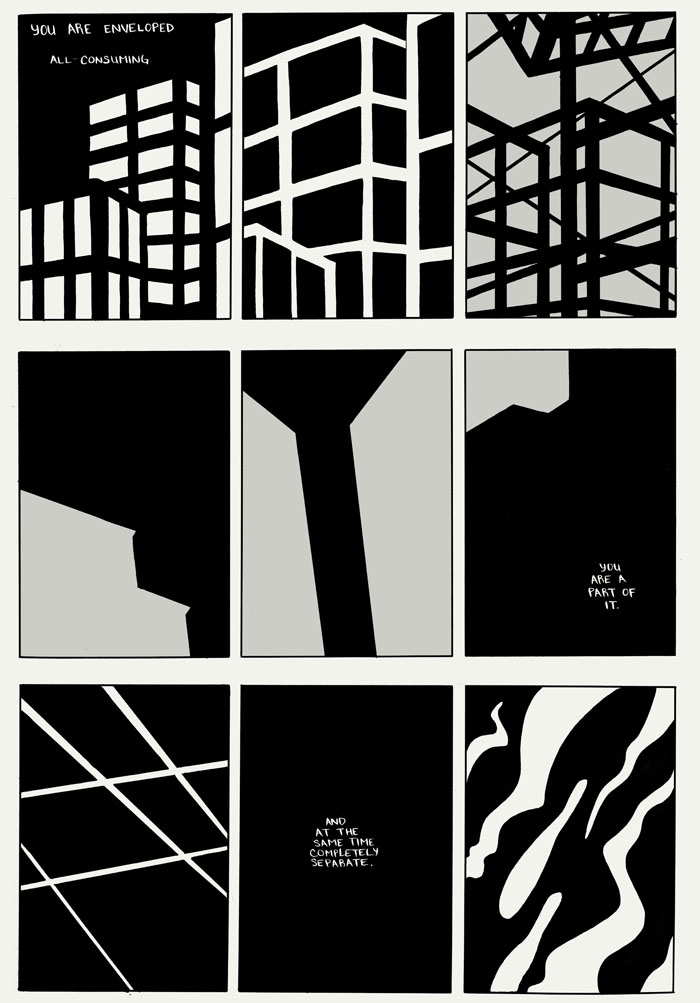
Comics Time: Thickness #2
October 17, 2011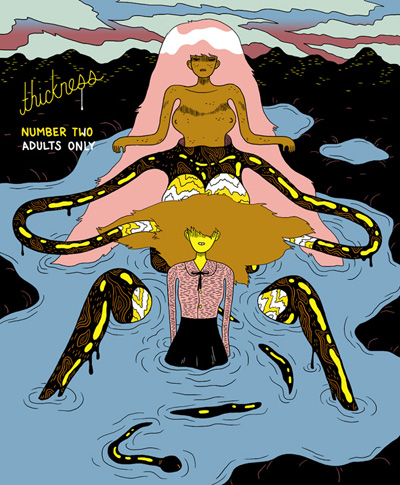
Thickness #2
Angie Wang, Lisa Hanawalt, Michael DeForge, Mickey Zacchilli, Brandon Graham, True Chubbo, Jillian Tamaki, writers/artists
Ryan Sands and Michael DeForge, editors
self-published, October 2011
60 pages
$12
Buy it from the Thickness website
Anthology of the year? I’d need to double-check some release dates, but it certainly seems that way to me. The second installment of Ryan Sands and Michael DeForge’s art-smut comics series is an intense, diverse collection of sex comics, beautifully printed and rich enough to revisit well after your first virgin read.
Michael DeForge, god help us all, continues his juggernaut run with what could well be his best comic yet. “College Girl by Night” stars a young man who’s transformed by the light of the full moon into a beautiful young woman, and uses the time to seduce and fuck college boys. His/her narrative captions don’t comment on the night-in-the-life activities depicted in the art, but rather explain the background of the transformations, her preferred conquests (tired of her “spoiled, drunken nineteen-year-olds,” she’s “made vague plans to set my sights on Edgeton professors, posing a student seeking advice after hours”), her almost idle questions about the science of it all (“Maybe if I got pregnant, it would only show when I transformed. If I even have a uterus, that is”), fictional precedents (“When Billy changed into Captain Marvel he wasn’t technically ‘transforming’…he was having his Billy Batson body physically replaced with an entirely different Captain Marvel one”), and daydreams about starting a relationship while in female form (“I once found a Missed Connection written about me on Craigslist”). It’s funny stuff, featuring DeForge’s trademark juxtaposition of the fantastic and the mundane. But it’s also really, really hot stuff. His character design for the main character’s female form is a note-perfect assemblage of alluring details: spagetti-like tendrils of hair, a dusting of freckles, a short and nearly translucent dress, long lashes that flutter when she throws her mouth open in ecstasy. But then DeForge takes the ruthlessly (if ironically) heterosexual nature of the situation (as she herself puts it, “Is it hugely unimaginative that during my time as a woman, the only activities I’ve done so far is fuck myself or get fucked?”) and crashes it right into its own subtext, reversing the transformation mid-coitus and presenting the two college guys now present on the scene with the opportunity to pick up where they left off, or not. Even if your door doesn’t swing in that direction, there’s a willingness to be led solely by pleasure and desire, a “Shhhh–no one can see, so why not?” quality, that’s hard to deny.
Brandon Graham’s “Dirty Deeds” is the most lighthearted of the contributions (well, aside from True Chubbo’s), and his sense of humor isn’t mine. It’s got this bigfooted vaudevillian underground schtickiness to it that’s just not my thing unless it’s Marc Bell. (Lots and lots of puns: “prostate of shock,” “cervix with a smile,” “I was young, I needed the monkey” — that last one’s a bit of a long story.) But that’s not to say that a breezy sex romp isn’t a welcome addition to this issue’s 31 flavors. Certainly Graham’s warm, curving line is shiny and happy enough to make up for a few jokes that leave me cold, and it’s fascinating watching him use it to achieve certain unique effects — the way he crams detail into limited segments of the page, piling line on line like a soft-serve ice cream cone, while letting the rest of the page breathe, say, which in turn lets him work wonders with images of massive science-fictional scale. And he really makes the most of Sands’s red-orange risograph’d coloring, particularly with his vivacious heroine’s hair and a sexy tan-line effect using what looks like the world’s tiniest zipatone dots. I’m kind of amazed that anything would give this Adrian Tomine print a run for its money in the “Sexiest Use of Tanlines 2011” sweepstakes, but there you have it.
Mickey Zacchilli’s contribution is the most off-model of the bunch, a melancholy affair in which a Brian Chippendalesque lost girl loses her wedding ring and therefore enters some weird subterranean sex chamber, in which a brawny beast and a “slime worm” have their way with her as she worries about other things. What keeps her going is the promise of ice cream on the other side of the chamber, but the showstopping reverie begins with the phrase “All I could think about at that moment were all the various objects that I had never stuck in my vagina.” Arrayed in the closest thing to a clinical grid as Zacchilli’s noisy, scratchy line can muster, this assortment goes from “Yeah, okay, feasible for a curious young woman” (“screwdriver,” “chisel tip Sharpie permanent marker”) to “uh-oh” (“rawhide dog bone,” “rotting arm,” “disembodied head”). When added to the brusque treatment she receives from the creature who lets her in — “Thru the door Alice, Jeanette, Angie, whatever” he says, her identity unimportant — and her tears when she discovers the ice cream shop is closed, it makes for a distressing portrait of disconnect between mind and body, thought and deed.
Dare I call Angie Wang’s contribution erotica rather than smut? Wang offers a four-page start-to-finish portrait of two women — one seemingly shy or hesitant, the other taking charge — having sex. Each panel depicts a discrete body part or moment of connection. It’s a familiar panoptic effect for this kind of thing, and I usually find it to be a bit false to the experience of sex, presenting it as a sort of greatest-hits grab bag rather than a journey from start to finish where the momentum, the upping of the ante from moment to moment, is key. But Wang cleverly jettisons the mishmash approach with an array of techniques: ratcheting the panel grid back from page to page, from 16 to 9 to 4 to a final, climactic (pun intended) splash page; using tangents to connect one panel to the next; paring away dialogue and sound as she goes; altering the focus of each page, from foreplay to initial genital contact to climax to afterglow. Whether despite or because of its delicate, painterly line, it’s got oomph.
Lisa Hanawalt’s contribution is profoundly Hanawaltian. Using the tried-and-true porn setup of the teacher with the hot student, she subverts (or heightens, depending on what you’re into) the fantasy by having the pair’s taboo rendez-vous take place in full view of the rest of the class; the teacher doesn’t even stop delivering his lesson on unreliable narrators (“the narrator makes mistakes” he says as he unzips his fly). Hanawalt apes the male focus on individual body parts with alarming accuracy: “Oh god, her tits! Tiiiiiits…And that ASS,” thinks the teacher over a series of panels focusing on the student’s curves with that familiar combination of thumbs-up celebration and lizard-brain leer. Oh, did I mention she short-circuits the whole thing by giving the girl the featureless conical head of a worm while stuffing her cleavage with fibrous miniature worms, and by giving the bird-headed teacher a penis that itself ends in a bird’s head, which literally vomits its semen all over her ass and vagina when he pulls out? When she slaps a David Lee Roth-referencing “CLASS DISMISSED!” on the final panel, I’m not sure whether to run for the door or stay for extra credit.
The final two contributions hearken back to Sands’s zine roots: Ray Sohn and his anonymous wife serve up one of the funniest, grossest True Chubbo strips to date (you’ll love the Lawrence of Arabia “NO PRISONERS!” quote, especially once you see the context in which it’s being quoted), while Jillian Tamaki’s centerfold pinup intrigues with its incongruous details — a monumental topless woman kneels amid lush flowers and a small army of Russian doll-like people-shaped dildos (I think?), her implacable gaze juxtaposed with her very human bikini-area stubble and a big goofy digital watch on her wrist. They give Thickness #2 a welcome diversity of form as well as content, a “hey, here’s everything that was fit to print” feel.
Thickness #2 is the real deal: talented, fearless cartoonists working in that viscous red zone of pleasure, terror, filth, and fun where the only thing that matters is what the body does and doesn’t want, and your brain is simply forced to go along for the ride. Bravo, thumbs up, panties down.
Long Mad Men thoughts
October 13, 2011I believe I am two episodes into Season Three. SPOILER WARNING.
* The key to Don Draper is war. I’ve thought this ever since the pilot episode, before I knew…anything about him, really. There’s a moment in that first hour where he takes a nap in his office, and slowly the sounds of explosions begin echoing in his head. I believe at some point before that we caught a glimpse of his Purple Heart, but that sound cue (effectively cribbed a few years later by Game of Thrones) was the moment when I realized that something happened to him out there, wherever there was. Everything we’ve seen since lends further credence to this notion. Dick Whitman became Don Draper in an explosion in Korea. The prospect of “total annihilation” sends him running from an aerospace conference directly into a lost fortnight of the soul. And I think it’s his candor about the Cuban Missile Crisis making him “sick” in his letter of apology to Betty that precipitates their subsequent reunion as much as anything else. I don’t think I’ve wrestled with this enough to boil down what Don’s experiences in Korea did to him and mean to him to a single sentence, but I promise you it’s not for lack of trying. But I do believe that the hole in Don, the part of Don that’s so hard to define — that hole was created by being blown open.
* My recent experiences with miscarriages, pregnancy complications, premature childbirth, and fatherhood have humbled me by showing me just how beholden to biography criticism really is. Man oh man, am I ever a mark for neglected-baby shit now. Every glass of booze or Lucky Strike that goes into the mouth of one of the pregnant characters is like nails on my mental chalkboard, and when Peggy rejected her baby that first night, or when Betty left the gynecologist’s office without a checkup and then proceeded to do various things he’d instructed her not to do anymore, I had a tough time getting around that with them. The funny thing is that, like my wife, I’m more pro-choice after our ordeal than I ever was before it. I think it’s the noncommittal quality of Peggy and Betty’s ways of dealing with their unwanted pregnancies that bothered me. If Betty had gone to that “doctor in Albany” that Francine told her about rather than simply going horseback riding again like it ain’t no thing, I’d have been much more okay with it and with her. Make a decision, is what I’m saying. I dunno, this shit’s complicated.
* Duck Phillips’s self-immolation was the show at its meanest. The guy’s only crime, it seems, was just not quite playing the game right. Everybody else gets to be a drunk — he has to be an alcoholic. Everyone else cheats — he gets a divorce, and doesn’t even have a 20-year-old secretary to show for it. Everyone else thinks big and takes risks — his big thoughts and risks never seem to pan out. When he finally shoots for the moon, he’s not Neil Armstrong, he’s Gordo the ill-fated space monkey. Sure, I was rooting for Don, and was invested enough in Duck’s defeat to literally shout “He doesn’t have a contract, you dope!” at my laptop screen out loud on the train, alarming the woman in the seat next to me. But even so, watching his seemingly successful office coup and business masterstroke end with his former boss dismissing him by saying “He could never hold his liquor” was a gutpunch. And like that, poof, he’s gone.
* That whole storyline was another terrific case of misdirection by the writers, of course. The entire time Don was wandering around California incommunicado, I anticipated a total meltdown or freakout when he returned to find Sterling Cooper sold out from under him and Duck Phillips calling the shots. Instead he collected his half million dollars, blithely offered to quit, and destroyed Duck’s career with seven syllables: “I don’t have a contract.” It was like one of his “magic pitches” (I wish I remember who introduced that phrase to me), where he has just the right idea at just the right time. He didn’t even break a sweat. He’s a miracle man.
* Betty’s post-adultery rapprochement with Don was one of the show’s few too-predictable moments. They’d been building up to it for so long that I had no doubt Betty would cheat one time only, “getting it out of her system,” in order to welcome Don back to the family. In general I find the supposed epiphanic value of sex to unhappy suburban women overvalued in fiction, as if there’s a whole nation of Joan Allen in Pleasantville out there just one bathtub frig away from Freedom. Still, it could be worse: They could have made like the odious American Beauty and made the housewife’s sexual satisfaction an object of ridicule and contempt. Personally, if you’re gonna go the whole When Hausfraus Fuck route, I prefer the Hellraiser option.
* Less predictable, and much more troubling for that, was the fallout for Joan’s rape by her fiancé. Specifically, there wasn’t any. I expected the Holloway facade to finally crack, but this was no life-altering trauma for her, because this is par for the course. If marital rape (I know they weren’t married yet, but I don’t know an adjectival form for fiancé) still occasionally has a hard time mustering outrage today, imagine what it would have been like then. Like smoking while pregnant or after a pair of heart attacks, perhaps for some people it’s something you don’t even know is bad. It was the show’s most depressing depiction of the era’s misogyny this side of all those avuncular or leering male doctors dispensing unsolicited life advice with each exam. Their lives are not their own.
* People told me Alison Brie’s Trudy Campbell would improve, and lo and behold. She and Pete are so different together, so much more understanding of and genuinely interested in one another’s feelings and opinions, in that first episode of Season Three that it almost feels like a continuity error. But I guess that if you peg it to Pete’s falling out with Trudy’s father and his own mother, you’ve got the precipitating incidents you need.
* Speaking of potentially jarring character transitions, I was a bit surprised to see Don back up to his old poon-hound tricks again with that stewardess in Baltimore before the Season Three premiere was even over. I figured we’d at least see him make an effort to stay faithful to Betty before failing. And yet this felt much less like plothammering to me than…well, I can’t say, but another acclaimed drama of recent years featured a womanizing, hard-drinking leading man who briefly reformed only to lapse back into bastardry when the demands of the writers required it. There — perhaps because the original development felt so well-earned — the reversal felt cheap and trollish. Here it’s another clue in the mystery of Don Draper.
* What makes it all the more puzzling is that both Don’s apology and his subsequent lapse were juxtaposed against two of the clearest indicators that he could well pass the Good Guy test. Don came home to Betty after we learn that he’s friends, close friends, platonic friends, with the woman whose dead husband’s identity he stole. For that kind of genuine, easy affection to develop under that kind of hideous circumstance, Dick Whitman must be some hell of a guy, right? And after he cheats, he discovers that Sal is gay, but subtly makes it clear to him that he has no intention of either outing nor ostracizing him for it. It’s not just that Don’s displaying admirable tolerance for a man of his era, although that’s awesome. It’s that he’s not a hypocrite. He knows how important keeping a secret and playing a part can be, so he doesn’t hold it against Sal. That’s admirable, in its way. (He’s been hard on Betty for being too sexy for others’ enjoyment from time to time — flirting with Roger at dinner, wearing a bikini to the pool — but while I can’t imagine him reacting well to her actual cheating, I feel like these bother him as breaches of decorum rather than as acts of mote/beam optometry.)
* Don to Peggy: “You’re not an artist, you solve problems.” Copywriters, this is our gift. This is our curse.
* Peggy Olson’s A Series of Unfortunate Hairstyles
* No, semi-seriously: Elisabeth Moss is an attractive lady, but in Peggy it’s tough to see. I had a real holy-shit moment recently when I realized that the girl in that uncomfortably intimate Excedrin Migraine commercial that had driven my wife and I crazy for years during Judge Judy was none other than Sterling Cooper’s newest copywriter because the voice and the eyes were virtually the only thing recognizable about her. That commercial is predicated, more or less, on the appeal of being close enough to this dewy-eyed, breathy-voiced young lady to make out with her, whereas Peggy, to me, has been defined by the awkward middle part of her bangs. Even her makeover at the hands of Bob Dylan enthusiast and noted pervert Curt Smith didn’t fix it. Only when she took a swing at reenacting Ann-Margaret’s Bye Bye Birdie performance in the mirror at home was I reminded that hey, my goodness.
* Sterling silver-tongued.
* Another gasp-out-loud-on-the-train moment: The save-the-date for Roger’s daughter’s wedding. The missile crisis material was so effective — it was the first time the show really affected my personality throughout the day, making me nervous and paranoid — that I was looking forward to seeing how they’d deal with Kennedy’s assassination despite its potentially hackneyed nature. Turns out they’re gonna run right into it full speed. This should be interesting.
* Don got to where he is — at the top of his profession, basically untouchable even by the new owners — because everyone respects his creative talent. Creative talent could make you in that world. I don’t give a fuck about fedoras and suits, but that’s something worth getting nostalgic over.
* Is it time to start shipping Don and Peggy? Deggy?
Comics Time: Daybreak
October 13, 2011
Daybreak
Brian Ralph, writer/artist
Drawn & Quarterly, 2011
160 pages, hardcover
$21.95
Buy it from Drawn & Quarterly
Buy it from Amazon.com

For today’s Comics Time review, please visit The Comics Journal.