
Author Archive
Comics Time: Footnotes in Gaza
February 19, 2010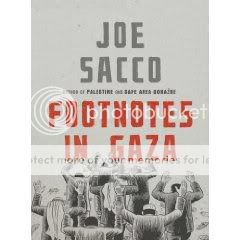
Footnotes in Gaza
Joe Sacco, writer/artist
Metropolitan, December 2009
416 pages
$29.95, hardcover

Journalist Joe Sacco’s latest book is about two massacres of Palestinian civilians by Israeli soldiers in two Gaza Strip camps/towns during the Suez Crisis in 1956. I think there are several things you can point to in it and say “Joe Sacco does that very well.”
The first is what you might refer to optimistically as scale or pessimistically as sprawl. There’s a memorable three-page sequence in the early going tht compares what the Palestinian refugee camps looked like in the mid-’50s, the time of the events the book spends most of its time chronicling, to what they looked like in the mid-’00s, which was when Sacco did the chronicling. On the first splash page, rows of little brick houses with sloping roofs and walled-in yard-like compounds trail off into the distance; a little street crosses the page in the foreground while the rows stop short of the horizon, which is buffered by a strip of wildnerness and then another, barely visible town just at the limit of sight. On the second page, giant apartment buildings jut upward against tiny shacks whose metal roofs are pinned down by bricks, tires, and debris; the roofs and clotheslines and water towers and telephone wires begin right at the bottom of the two-page spread and keep going until the taller buildings literally blot out the vast majority of the horizon, and even chunks of the sky. The message seems clear: Things may have been pretty bad for the impoverished, angry people of Gaza back then; everything is worse now. This is driven home later in the book by a second spread that mimics the set-up of the one that established the look of the camps today: This one show a barbed-wire fence and the ruins of bulldozed homes as far as the eye can see. Sacco is fond of that temporal-juxtaposition device, never more brutally used than when we see a contemporary row of cars parked against a wall on the right-hand side of a spread where dozens of dead bodies had been shown to us against that same wall some fifty years before on the left-hand side. Sometimes Sacco uses his skill with scale not for a landscape or panorama, but for single structures: The IDF towers that oversee the town of Rafah or a nearby checkpoint on the road to Gaza City rear up to the sky like menacing robots, while bulldozed multi-story building where many people once lived dwarfs us with the absence of it that we project against the sky. Other times it’s explosions and chaos that overwhelm us, swirls of stippled smoke and fire obliterating buildings and bodies alike.
The second thing Sacco does well is visual repetition. You see this in that initial page of the mid-century refugee camp and its little block houses, of course. But later, you see it with bodies. Men forced to run pell-mell through the streets of their camp by angry soldiers firing in the air, and sometimes not in the air at all. Often they are all made to strike the same pose, arms in the air to show they are unarmed; the unnatural positioning leads to a criss-cross effect as the men scramble around and past and behind and in front of one another. Sacco will shift to a bird’s eye view here, make skillful use of alternating gray and white clothing there, freeze the men with their backs to us like they’ve been paused in the middle of a Michael Jackson video dance routine here, throw them into a morass of beatings by the Israeli soldiers like a nightmare version of that third, battle-heavy Where’s Waldo? book there. Repetition leads to perhaps the book’s single most striking visual: The men of the town of Rafah, rounded up en masse in a schoolyard, forced to sit on the ground with their hands on their heads for hours at a time. Sacco shows this vista from slightly above and in front, from a three-quarter angle, from behind; the men become a featureless mass of little ovals of fear and discomfort, bleeding and pissing on one another, slightly cracked eggs in a massive carton.
The third thing Sacco does well is conveying a sense of action, or intense activity if you distrust that word’s genre connotations. Sacco’s careening caption boxes alone can get across the sweep of a magnificent view, the interruptions of constant cellphone calls, the chaos of constant violence, the chatter of a party, the march of history, the swell of a crowd, and the dance moves of beautiful women all by themselves–and in the book’s first seven pages, they do all that and more. Elsewhere he uses perspective tricks, like a swoop of flame that makes it look like a burning soldier has literally been propelled toward us. In the chaos of a sudden attack by an Israeli patrol he cross-cuts two different sentences like a giant X across an almost collage-effect collection of panels showing him and his companions as they flee in all directions; you have to read one of them backwards, manga-style. And it’s all but impossible to forget the montage based on the two stick-swinging soldiers seared into the memory of every man in the town as they tee off on hundreds of terrified captives being herded through a narrow gate, or the jump-cut chaos of a black-bordered POV sequence that makes as bold a use of the cut-to-black as anything since a certain HBO TV show.
The fourth thing Sacco does well is portraiture. This book is just as much a Beard Parade (and Mustache Parade, and Grumpy Little Kid Parade, and Wrinkled Old Lady Parade) as R. Crumb’s Book of Genesis Illustrated, and there’s just as much care and attention put into differentiating each from the other. (The exception are the Israeli soldiers in the flashback sequences; they have a uniform build, the shadow of their pith helmets rendering them eyeless and inscrutable. Only the notably monstrous or humane gain individualization.) But even still there are standouts. Take Sacco’s frequent interview subject and companion Khaled: A Palestinian guerrilla marked for death by the IDF and constantly moving from place to place, he nonetheless has a Cheshire Cat serenity in his heavy-lidded face. We frequently see him in repose, including one sequence where he lies immobile in bed, staring directly at the reader as he speaks of his utter exhaustion with his life on the run. The lines with which Sacco crafts his massive forehead, riven with wrinkles like the rungs of a ladder, and his jutting ears, and those preternaturally taciturn eyes, are all about the smoothest you’ll see in the entire book; they make him look like a Dick Tracy villain.
The regional leaders Sacco shows us also have a comic-book or James-Bond heavy vibe to them. Nasser is almost always shown pensively stroking his chin or smoking a cigarette, constantly scheming and planning for the greater glory of the Arab World, by which he means Egypt, by which he means Nasser. Ben-Gurion, with his wild ring of white hair, and Dayan, with his can’t-make-it-up Hollywood pirate eyepatch, point to maps and whisper in ears, goading like composite human versions of the angels and devils who appear on cartoon characters’ shoulders. At one point, the Egyptian and Israeli leaders are shown in the exact same poses as their forces clash; the implication of this mirroring for the Palestinians used as pawns in their schemes to provoke one another into a ruinous war is perfectly clear.
Individual militants can look like bad guys, too. An aged fedayeen telling of his career of raids on Israel-held lands at the behest of the Egyptian military looks for all the world like the standard stereotypical supervillain image of the Ayatollah, while his evident horror at having been made to fight side by side with out-and-out murderers whose “talents” the cynical Egyptians wanted to make use of but then hopefully have put out of commission by Israeli bullets is reflected in the mad eyes and bestial unibrow of one such killer who stares right at the reader with psychotic intensity.
I’m making Sacco’s portraiture seem un-subtle, I know. And in those cases, I suppose it is, to an extent anyway; his level of craft always elevates his Eisnerian-pantomime body language and facial expressions above caricature. But when he really sharpens the knife in this regard, when he puts together a sequence or assembles a moment that plays across a human face like a miniature film, that’s when he’s at his most dangerous and devastating. Right now I have the book open to a page where a three-panel tier at the top shows an old man, again staring straight at us, recalling how little time he had to bury his slain relatives in the first two panels, and then bam, in panel three, his eyes are closed and he’s silently weeping. Below that we see the first-grader self of a woman who’s old now, a look of utter confusion and dismay on her face as she watches the women of her neighborhood writhing on the ground and screaming in grief. Somehow even more frightening to me is a woman whose house is the last one standing on a block constantly being bulldozed by the Israelis as part of their policy of leveling any structure from which any kind of threat has emerged. (Sacco never says it outright, but it appears that saying that this justification is gilding the lily would be the understatement of the decade.) As the woman tells Sacco of her plight–how they’d leave their house since it’s clear the Israelis want no one in this area, but they have no money to move anyplace else; how her daughter has started pissing on herself and just crawling around in terror when the ‘dozers strike–she looks this way and that depending on where she’s standing, but the expression of wide-eyed, slackjawed horror on her face never changes at all.
But there are a pair of sequences even stronger, to me, than those moments. They’re stronger even than the rare times when Sacco makes his feelings on these subjects clear–his disgust at the grotesque, casually genocidal racism of an archival Israeli document about the displaced Palestinians; his disgust at the hypocrisy of Palestinian militants who decry the civilian casualties inflicted by Israeli soldiers even though their weapons allow for deadly precision, but disregard the fact that human explosives who enter a pizzeria or board a bus are the most precisely guided weapons of all; his digust at himself for forcing old, bereaved, desperately poor people to relive the worst day of their lives, then getting mad at them for digressing or getting their facts mixed up. These two strongest segments are sequences in which the immediately identifiable, loving connection of family to family and the unimaginable reality of violence are smashed together with astonishing power. The first is in a flashback from an old woman, picturing herself as the little girl she once was when soldiers entered her home and shot her father to death as she sat next to him. He slumps against the wall in a jacket and striped pajamas and traditional headgear, his head pointing sightlessly downward as if staring at the dark mass of blood staining his stomach; next to him the chubby, curly-haired, barefoot little girl, looking like one of those Campbell’s soup cherubs, looks up at her dead father, her tiny face seeming to crumple into a black hole of utter sadness. The second is another reminiscence by an old woman, recalling how she found her husband in the chaos after the book’s central round-up took place. Two panels show him fleeing for his very life, panicked and paranoid, mouth agape, eyes darting to and fro, a look of raw animal terror on his face–until in the third panel his wife literally catches him as he runs, looking up at him plaintively as he turns toward her mid-stride, the fact that he’s been grabbed by the woman he loves and not by…someone else clearly still not having registered. In that moment I tried to imagine what it would be like for my wife to see that look on my face, the look of all other thought and emotion and sentience out of my eyes, the look of a lifeform’s basic, primordial desire just to survive the next moment.
The fifth thing Sacco does well is convince you–or me at least–that there are no good guys in this world, only bad guys and victims, and that you’re lucky beyond imagining that you’ve never been forced you to find out which of the two you really are.
Carnival of souls
February 18, 2010* Dan DiDio and Jim Lee are the new Co-Publishers of DC Comics, and Geoff Johns is their new Chief Creative Officer. I wrote about this a bunch for Robot 6 today. Nose-tweaking over prognostications here. Highlights from the new management team’s various statements here. Pondering whether the company will head to Los Angeles here. Rick Marshall gets Diane Nelson to say no decision has been made on that score here. My colleague Kevin Melrose has a good round-up and analysis post here. Heidi MacDonald tries to pin down the status of other high-ranking DC figures like Karen Berger, Bob Wayne, Gregory Noveck, and Richard Bruning here. Tom Spurgeon casts a skeptical eye on the all-in-the-family promotion strategy here. My colleagues Kiel Phegley and Jonah Weiland interview the team here. Note the in-no-uncertain-terms statement that their goal is to make DC the number-one comics publisher.
* Most of us who talk about the vintage, Igor Kordey-illustrated Nu-Marvel makeover of the character Cable focus on the Darko Macan-scripted Soldier X, for good reason, but Marc-Oliver Frisch reminds us that the David Tischman issues were pretty good too.
* This collection of Kate Beaton comic strips based on old Edward Gorey book covers is as gorgeous and funny as you’d expect, but when I first looked at it my browser cut off the final panels of each strip, and you know what? I actually liked them better that way. The first strip in particular.
* Lots more juicy Lost comment action in the thread for my latest post.
Lost thoughts extra: Brother act
February 17, 2010SPOILER WARNING
Down in the bustling comment thread for this week’s episode, my brother Ryan carpet-bombed me with Lost knowledge bombs. Rather than respond to his lengthy comments downblog, I thought I’d pull them out and make a post of it. Ryan’s thoughts are in italics, mine are in roman.
This episode was amazing. Ben’s eulogy for Locke pretty much brought a tear to my eye. Also really enjoyed Sawyer calling out fake Locke even in a drunken stupor.
Two great, revealing character moments.
MIB’s tossing of the white rock into the ocean and describing it as an “inside joke,” was quite interesting as well. I guess you can draw a lot from that one action. The white rock could just symbolize Jacob in a literal sense. It could mean that with Jacob gone, the balance of power on the Island has swung back to fake Locke (and as we have been led to believe thus far, evil). Probably signifies both.
Right. The former idea is the “inside joke” aspect and the latter is the metaphorical aspect.
In reference to the creepy little boy, my best guess is that it is a young Jacob. I say this for a few reasons. First, I believe the first time MIB sees the little boy, the young boy has blood stained clothes. Jacob was stabbed to death brutally. The little kid had his hands out and, from my view, seemed to be bloodied. This is a lot like how Jacob looked when he was murdered.
Interesting. I need to check that out.
Secondly, in their next encounter, the little boy warns MIB (or fake Locke or Smokey or Esau) that he cannot kill Sawyer according to these darn “rules” that we always hear about. If this kid was Aaron or Claire (which I don’t think at all) , how do those two characters no the rules that only seem to be privy to MIB and Jacob??? Whidmore and Ben also speak of rules obviously but who knows if they are referring to the same things as Jacob and MIB.
I hadn’t thought of that line referring to Sawyer. Hmm! I thought of it as referring to Jacob, the implication of “you can’t kill him” being “he’s not really dead.” But it seems to work for Sawyer as well, if as you say the MIB is not able to kill candidates.
Also, Claire is currently on the Island in the same time frame. She just shot the Others that were going to kill Jin. Why would she then show up as a little child in clothing that we have never seen her in? In addition, the leader of the “temple” Others has mentioned to Jack that Claire has been claimed much like Sayid. If that is the case, it seems logical that MIB is the person or entity doing the claiming, no? If Claire has been claimed since the time she disappeared and left Aaron, don’t you feel that she is already under the influence of MIB? The real Locke was basically led to his ultimate demise while following the advice of Christian Sheppard. If dead people or dead bodies are claimed and used by MIB, I think it is reasonable to conclude that MIB somehow knew enough to orchestrate Locke’s leaving the Island only to ultimately be killed by Ben and brought back to the Island so that “a candidate” (Locke and his image) could infiltrate Jacob’s lair with Ben and persuade Ben to end Jacob’s reign on the Island.
1) I wonder if MIB has his own equivalent of recruiting “candidates” like Jacob does. Obviously Ilyana speaks of the MIB Locke “recruiting” Sawyer, but what about before that? Is Widmore working for MIB the way Ben is working for Jacob? Or are the dead entities the way that the MIB protects his legacy?
2) That theory about needing a candidate to ice Jacob is pretty tight.
If Claire was claimed, did she physically die somehow on the Island after leaving Aaron? Maybe she actually died when the house was blown up and somehow came back to life only to carry Aaron so far and leave him to the other Oceanic crew we know so well and then went off with Smokey and Christian Sheppard.
I remember people saying something along these lines at the time.
I think that Sawyer could see the young boy (maybe Jacob) because he is a candidate.
If that’s the case, then are we to infer that Jin couldn’t see the Ghost Jacob who visited Hurley because it’s Sun, not he, who is the “Kwon” candidate? Or is that a separate issue because that’s a straight-up ghost and we’ve established that the dead only talk to Hurley? (Or have their thoughts read by Miles.)
Also, it seems like we can believe MIB when he says that Jacob wrote those names on the cave ceiling because of the flashbacks linking Jacob to the names on the cave walls.
Right.
However, I only remember ever seeing Jacob on the beach or in the foot statue monument. Why would Jacob be living in a very shady cave on the side of a cliff that can only be reached by braving the rope ladders of death? Could it be possible that the names were not written by Jacob at all but by MIB?
I thought the same thing when we first entered the cave–that this is where the MIB lived, and that’s why, in the flashback where we first meet the real him and Jacob as they watch the Black Rock approach the Island, it’s said that it’s been a long time since they last saw each other. But I do feel like the show didn’t give us any cues that MIB Locke was lying about the basics of his story, even if I’m sure some of the details or spin are lies.
Perhaps through his activities as the Smoke monster, he knows about all the candidates and is systematically “claiming” or destroying them? Just a thought, it could easily be that he was telling the truth but you never know.
I would guess his unspoken goal is to kill the rest of the candidates to ensure that Jacob’s legacy would die with him. Why else recruit Sawyer? He needs someone to take down the other candidates since he himself is forbidden to or unable to.
Richard’s frantic behavior is pretty funny. He does have the guts to stand up to fake Locke and tell him that he will not go anywhere with him though.
Ah, good point. I think we can take that as another sign of how scared Richard is by MIB Locke, though–this guy is so terrifying that Richard won’t even pretend to play ball with him.
It’s ironic that Ben Linus, the calculating leader of the others, could not tell that fake Locke was MIB and didn’t even really believe Locke was dead until Richard shoved his face near Locke’s lifeless corpse but Sawyer sniffed out fake Locke in about 1 minute of conversation.
Ha! Very true. I’d been saying that you can’t con a con, but Ben’s as much of a con artist as Sawyer. I suppose Ben’s constant need to look out for Number One made him vulnerable to Fake Locke’s blandishments, whereas Sawyer just don’t give a fuck anymore and thus he sees through others’ ruses. Well, at least until he agrees to team up with Fake Locke.
The alternate reality is quite intriguing. I almost think that the writers want us to believe that certain things were destined to happen to the characters no matter what but other things can be changed. Rose and Locke (both healed by the powers of the Island) cross paths again in the alternate reality and again share the bond of their significant physical problems. In Claire’s alternate reality, she still seems destined to give birth and possibly raise Aaron as the adoption falls through the day she arrives in LA.
Helen mentioning that it could be destiny that Locke runs into Jack (a spinal surgeon) at the airport is eerily similar to Ben’s appeal to Jack on the Island when he is trying to have the tumor removed from his spine. It is also interesting that Locke is about to get married in the alternate reality. Jack originally performed surgery on his future wife under the promise that she might be able to dance at her wedding. If Jack eventually does perform surgery on John in the alternate reality, maybe Locke will get to dance at his own wedding.
I’d noticed a lot of those resonances, but missed a lot of the others–the dancing at your wedding thing, Locke and Rose bonding through their illnesses, Jack being Locke’s destiny the same way he was supposedly Ben’s destiny.
Did you guys ever discuss how Ben was able to summon the smoke monster to fight off Whidmore’s army of thugs? I still don’t get that.
No we didn’t, but I was thinking about that today too. If Ben and the Others are servants of Jacob (although they seem to have made a real hash out of his true wishes, if he is in fact the Good Guy many of us think he might be), how can they summon or command Jacob’s enemy? Unless the Monster was simply playing along.
Another thought:
Perhaps Christian Sheppard, as he appeared on the Island, was never really the spirit or ghost of Christian Sheppard. Perhaps it was MIB the whole time. I’m kind of figuring that MIB can use the form of dead bodies on the Island. The prime example is when Yemi appears to Eko. I don’t remember the tenor of the whole conversation but the main point of it was that Yemi (or MIB or Smokey perhaps) wanted Eko to atone for the live he had led up until that point. Eko wouldn’t and was consequently brutalized by the Smoke monster.
Right. There was also a deleted scene that they used as a webisode that was a flashback to the moments after the crash but before Jack wakes up and sees Vincent–in this scene, Christian approaches Vincent and tells him to wake up his son because “He has work to do.” Sounds like the Walt apparition that rallied Locke after Ben shot him and tossed him into the Dharma mass grave. And sounds like the MIB.
What makes it so hard to figure is that we’ve seen all different kinds of dead people. Ghosts appear to Hurley and talk to him conversationally. Entities like Christian, or Ben’s mom back in the day, or Yemi, or Alex, seem far more enigmatic and more likely to be the Monster in human form. On top of that, Christian and Yemi’s bodies both disappeared, suggesting the MIB needs the actual body to do his thing–but Ben’s mom died in America, not on the Island, while Fake Locke strolled right past real Locke’s corpse which was clearly not being puppeted around by him. And then you’ve got Walt appearing to Shannon and later to Locke. And then you’ve got this mystery boy this week. Tough to piece it all together!
At one point when fake Locke is talking to Richard and Richard refuses to go with fake Locke….MIB states, “Are you sure about that Richard because people seldom get a second chance?” That almost brings me back to Eko’s encounter with Smokey.
It sure does. I always thought that was a great bit, even though Eko was only being written out of the show because the actor didn’t like living in Hawaii. It takes guts for a show to take a beloved character and allow him to forgive himself for his sins, but then kill him for it.
Ilana later states in the Episode, I believe to Ben, that Smokey cannot change form anymore. My guess, is that now that Smokey has taken the image of a CANDIDATE, he can no longer change his image and use other bodies.
It’s gotta be either that, or that he’s stuck in whatever form he was in when Jacob was killed.
Smokey himself even says that he looks like John Locke so that he could gain access to Jacob. Hence, he had to take the form of a candidate.
Again, tight.
Still think the lair where the names were written doesn’t seem like a place that Jacob would inhabit or hang out.
I’m not so convinced, but it’s certainly possible.
Smokey says also that he was once a man and had become trapped. So I think Smokey and Jacob have a long history together going back to when they were possibly even children. Therefore, seeing a young, bloodied ghost or image of Jacob would draw the reaction that Smokey had during the episode.
Sounds about right to me. Do you wonder at all if there were people in the Jacob and Smokey roles before Jacob and Smokey? How far back does it all go?
Incidentally, Ryan, if you like the business with Jacob and Smokey, you ought to read The Stand by Stephen King. There’s stuff in there you’d get a kick out of.
Carnival of souls
February 17, 2010* I wrote a list of The Top 15 Greatest Science Fiction-Based Pop/Rock Songs for Topless Robot. (Hip-hop too.) I’m very happy with how it came out, and the mix of artists and songs that are in there, though of course after I handed it in I thought of at least two more I’d have elbowed some out of the way to include. Oh well, there’s always a second list. I have a blast doing this kind of writing for TR, I’ma tell you what. And as always, the comment thread is as much fun for me as the actual writing. You’d be surprised just how many variations on “Oh yeah? What about _____?!?!?” people can come up with. My favorite is the guy who called the list “EPIC FAIL” because of its lack of Uriah Heep.
* PS: Look at the tracklisting on the new Bowie live album! That’s quite a career retrospective, and it’s two discs for the price of one.
* Look, it’s Ben Jones’s Adult Swim show, and it’s called Neon Knome! Scroll down to the Mon Feb 22 line to view a snippet, but on your way there, be sure to vote for Michael Kupperman’s Snake ‘n’ Bacon in some sort of “winner gets on the air” contest Adult Swim’s having for a bunch of pilots right now.
* Todd VanDerWerff on last night’s Lost, a must-read as always. One thing he’s very right about is that the show’s best performers elevate their frequently generic–I mean that in the sense of genre, not in its usual pejorative way–characters. It’s similar to how a great artist can transform a pretty good superhero comic into a “holy shit read this” sensation.
* Speaking of Lost, be sure to pop into the (much to my delight!) ever more active comment threads for my two posts on last night’s episode.
* Tucker Stone interviews and waxes philosophical about Benjamin Marra of Night Business fan. God only knows what would constitute being successful as a self-publishing comics creator in 2010, but to the extent that success stories are possible, I sure like to hope that Ben is one. His books bring me great joy. (Via Ben’s blog.)
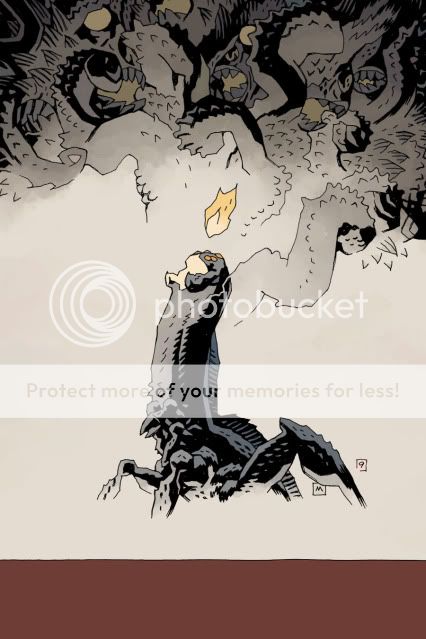
* Over at The Cool Kids Table, my pal Ben Morse does his monthly round-up of his favorite covers from the Previews solicits. Three things stand out: 1) There really are a lot of fine cover artists for the big companies these days; 2) Damn, who designed the Dazzler logo? That is killer; 3) Jeeeeesus–If you’ve followed Hellboy and B.P.R.D. at all, this cover for King of Fear #5 is absolutely terrifying.
* I supported these sick, sadistic monsters for years because I was too gullible, too proud, and too angry to see them for the sick, sadistic monsters they so obviously were. Shame, shame, shame.
* This video for Liars’ menacing new song “Scissor” from their upcoming album Sisterworld–which I’m told is an album-length experiment in dread along the lines of Portishead’s Third or the Knife’s Silent Shout–reminds me at varying times of Clive Barker’s “Scape Goats,” Stephen King’s “The Raft,” and the opening of Lucio Fulci’s Zombi 2. ‘Nuff said. (Via Pitchfork.)
Comics Time: Green Lantern #43-51
February 17, 2010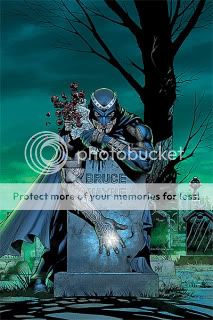
Green Lantern #43-51
Geoff Johns, writer
Doug Mahnke, artist
Ed Benes, artist on issue #47
DC, 2009-2010
22 story pages each except #50 which was longer
$2.99 each
Off the top of my head, here’s the stuff you’ll find in these Blackest Night tie-in issues of the ongoing Green Lantern series: Black Hand, Black Hand becomes the embodiment of the Black Lantern Corps, Martian Manhunter, Abin Sur, Abin Sur’s sister and Sinestro’s girlfriend Arin Sur, Barry Allen, John Stewart and that planet he blew up, John Stewart was part of Black Hawk Down, the Star Sapphires vs. the Sinestro Corps, Sinestro vs. Mongul for control of the Yellow Lanterns, the new Rainbow Lantern team featuring the Flash and Wonder Woman and Lex Luthor and so on, the Spectre, Parallax, Hal Jordan deliberately becoming Parallax again, Parallax getting kidnapped by some force only Hector Hammond is aware of, the Predator escapes from Zamaron, Blue Lanterns vs. Orange Lanterns, Red Lanterns vs. Green Lanterns, all the leaders of the different Corps teaming up, Orange Lantern Lex Luthor figures out that the Black Lantern Corps works the same way that the Orange Lantern “Corps” does, Ganthet becomes a Green Lantern, it looks like the Spectre might be to the Red Lanterns what Parallax is to Yellow and Ion is to Green and Predator is to Violet and Black Hand is to Black but he’s not but there’s a Red entity out there someplace…It’s crazy. The Yellow Lantern Scarecrow gets crucified at one point–in Siege, the weight of that one beat would anchor an entire issue, but in this storyline it’s like half a page.
What you have here, in other words, is supercompressed storytelling as filtered through the sensibilities of someone who really isn’t interested in formal play (unlike Grant Morrison and…uh, um, those other writers who do supercompressed superhero comics besides Grant Morrison, you know the ones) so much as just taking every aspect of the greater Green Lantern mythos and exploring every possible permutation of it in as rapid succession as possible. Having had no brief with Green Lantern before Geoff Johns started writing him, I’m surprised to find myself enjoying this stuff this much, and on this geeky a level. I mean, when I read today’s issue and realized that the Spectre might be the Red Entity, I actually gasped out loud. And I couldn’t care about the Spectre less! It’s just that kind of comic. If you enjoy the world Johns has built from the pieces of Green Lantern he found lying around and started connecting, watching the increasingly elaborate edifice he’s constructing here is a true treat.
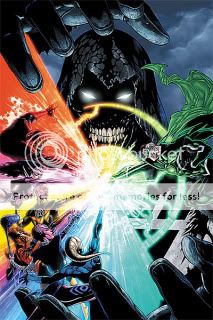 And when you sit and read it all at once, it’s not even incoherent–it’s just like a constant stream of rad shit hitting your eyeballs, and provided you have the kind of brain equipped to file away genre arcana and recall it as necessary, it flows from one thing into the next with the clarity and purpose of a freight train. Artist Doug Mahnke is an indispensable part of why this works. Mahnke rapidly ascended into my half-dozen or so favorite contemporary superhero artists over the course of his past three major projects; his segue from Final Crisis/Superman Beyond to these key Blackest Night tie-ins is arguably the first smooth transition from one project to another that any of DC’s event-comics artists have pulled off. (Seriously, Rags Morales, Phil Jimenez, J.G. Jones, and Carlos Pacheco all disappeared from DC after their star turns.) What makes him such a good fit here is both his proficiency with horror and monster-movie imagery (standout moments include Black Lantern Abin Sur using his ring to create a ravenous horde of giant floating disembodied black skulls, like he’s Stardust the Super-Wizard or something, and the way he paced Parallax’s fight with the Godzilla-sized Black Lantern Spectre to interrupt Orange Lantern Luthor’s tussle with Orange Lantern Larfleeze with the fall of one mighty foot) and the way his thick line, emboldened by inker Christian Alamy, holds the bright colors that the material demands. The funny thing is that the “dudes zapping dudes in all different directions” fight un-choreography I always complain about when I see it in ’90s X-Men books or contemporary Avengers titles is inherent to how these characters operate, but Mahnke’s visual imagination and ability to harness those effects and make them feel consequential rather than full of sound and fury but signifying nothing gets them over as involving battles anyway. This storyline–especially when read divorced from the larger plot points of Blackest Night with which it intertwines–is one of the great gonzo thrills provided by genre comics right now.
Quick additonal morning-after Lost thought
February 17, 2010SPOILERS AHEAD
Something I JUST thought of as I was fixing my generic cheerios that I thought deserved a post rather than a comment: Ethan and Ben were both already on the Island when Jack and company successfully blew it up in the alternate timeline–Ben was a kid and he’d been shot by Sayid and handed over to Richard and the Others, and Ethan was a little baby who’d just been born to Horace and Amy Goodspeed. So how are they walking around leading happy lives as productive members of society there on Earth X? Shouldn’t they be at the bottom of the ocean, or long dead from radiation poisoning? Do the ripples of “the incident” go both forwards AND backwards through the timestream, so that things somehow changed and now they were never on the Island at all? Or is there more to their current alternate-reality incarnations than meets the eye? Or is the “alternate reality” something else entirely?
Lost thoughts
February 16, 2010SPOILERS AHEAD
* “Hello, Lost viewers! It was great to have you swing by last week. This week, we’ll be shifting gears and focusing on characters you like doing awesome things like turning into smoke monsters, grabbing machetes, scaring the shit out of Immortal Guy in Eyeliner, climbing down Indiana Jones rope ladders, explaining the origin of the Numbers, and listening to Iggy and the Stooges. Meanwhile, in an alternate reality, we’ll show them being well-adjusted, becoming besties with their archnemeses, and marrying Katey Sagal.”
* In other words, ohhhhhhh maaaaaaannnnnnn that was outstanding.
* Because we’re so used to how Lost works structurally and in terms of the roles of the characters, shifting those things around really makes an impact. Normally this takes the form of flipping the “flashback/forward/sideways” switch. But they can do it with how the characters are behaving as opposed to how they used to behave, too. And in this episode they did that twice: First by taking Richard, whose primary superpower has been inflappability, and showing him absolutely frantic and terrified. Instead of striding up calmly to whoever we’re following, this time he sneaks up wild-eyed and panicked, and runs away mid-sentence like Tony Soprano seeing the Feds approaching across the snowy backyard. Second they do it by showing Ben actually admit that Locke shits bigger than him, going so far as to finally end his ruse about Locke’s death. Not about Jacob’s death, of course–let’s not get crazy here. But still. You do those two simple things and all of a sudden it’s like wow, new ballgame. The show even made reference to something similar diegetically, with Sawyer picking up on Fake Locke because Real Locke always had a tinge of false bravado to him. Say what you will about Real Locke, but that bravado ain’t false.
* Locke’s flashsideways was deeply, deeply satisfying, wasn’t it? The second I saw him in a big suburban house instead of a crappy apartment, I figured Katey Sagal would be returning, and that was wonderful to see, especially when it became apparent that they had a healthy relationship. But what really made it click for me was when he fell off the ramp and onto the front yard: Instead of throwing his usual rage-filled tantrum about his lot in life, he just grinned as the sprinkler kicked in, in a good-natured “man, ain’t that a kick in the head?” kinda way. Turns out he was still struggling with the same compulsion to prove himself capable of things he’s incapable of that we’ve always seen from him, but the struggle was less severe and damaging to him, and he was ultimately able to walk away and move on.
* The kicker to the sequence, of course, was when he meets Benjamin Linus, European History teacher, at which point I was literally holding my arms aloft in triumph and cheering. Terry O’Quinn’s magnificent smile at the very end–the look of a man who knows he’s just met someone who’ll be a great friend, which really does happen from time to time–is one of my all-time favorite Lost moments, full stop. This is what I’m talking about, man.
* The Island storyline was rad, too. I want to focus on the cave scene because I think it’s the first time we’ve ever seen little recap-style flashbacks presented to us while characters continue to speak in the flow of the narrative. Am I right? This technique is straight outta Murder She Wrote, or Wadsworth telling us how it was all done during the various endings of Clue. In other words? ANSWERS!
* I couldn’t help but think, even after they showed that the Numbers originated with Jacob’s list of people, of how Cuse and Lindelof have said that viewers will continue to demand that they drill down deeper into them, like a kid repeatedly asking “Why?” until you’re saying stuff like “Because God said ‘because'” or whatever.
* Why only one Kwon? Why no Austen? Were these just the 42 front-section passengers of Oceanic 815, or are they 42 people drawn from all sorts of groups–the Tailies, the Others, Not Penny’s Boat, Ajira, Widmore’s Army unit, Desmond, Dharma, etc.?
* Jumping back for a sec, if Locke’s on good terms with his dad, what happened to his spine?
* Fake Locke/Man in Black is obviously an unreliable narrator, but I didn’t get a whole lot of cues that he was not to be believed in this case. Maybe Jacob will turn out to be a straight-up White Hat, but the “rival puppetmasters with pawns in the middle” theory of Lost seems a lot more thematically resonant with what’s actually happened on the show.
* Sawyer joining forces with the MIB is like Wolverine going to work for Magneto.
* I’m totally buying it, by the way. Great new positioning for that character, and perfect for his inevitable heroic self-sacrifice.
* Who is the mysterious kid? I think everyone probably thought “Young Jacob” at first, especially when it seemed like Richard couldn’t see him and he just disappeared. But Richard wasn’t facing that direction, and he could have scooted away while Fake Locke was looking at Richard instead for that brief moment. Sawyer could see him, after all, though who knows what that means at this point. I started wondering if he’s some Walt-style superpowered real-live kid currently hanging out at the Temple or something. Was he that kid they kidnapped from the Tail Section, does anyone know?
* I’m also thinking that this is where Walt’s importance will lie. I’m more confident than ever that we’ll get a satisfying answer for both him and the importance of childbirth and the lack thereof on the Island.
* Lapidus is priceless. Special to Kiel: Screw Hurley, that’s your mom’s audience-identification character.
Carnival of souls
February 16, 2010* Chris Mautner takes a look at Al Columbia’s Pim & Francie, the best comic of 2009.
* Hey, the comics section of the McSweeney’s newspaper experiment The San Francisco Panorama is now sold separately. Sold! Smart move, Eggers.
* My friend and CBR overlord Kiel Phegley reviews James Robinson’s Starman Blackest Night special and Superman: Mon-El at length. This is the kind of close reading of how superhero comics work or don’t work that I usually save for chats with friends over lunch or email, and Kiel is one of those friends, so getting a rare chance to see him work his review chops in public is a pleasure. If you’re at all interested in this kind of comics, I think he’s worth reading here even where (I think) I disagree with him.
* Comics, you can keep bleeding sales off the top of the monthly charts as long as you also keep opening up whole new wings of yourself for us to discover, like this King Aroo thing for example.
* How John Porcellino learned to stop worrying and love the Smiths. For me it was a combination of discovering that Morrisey’s Your Arsenal was produced and sounded a lot like Mick Ronson and enjoying Morrisey’s modern-day transformation into a beefy British gangster, and simply tracing these things back to their point of origin. Still not sure I get the Johnny Marr hysteria, but whatevs, I guess there are Moz men and Marr men same as John and Paul or Stan and Jack or Mick and Keef or whoever else.
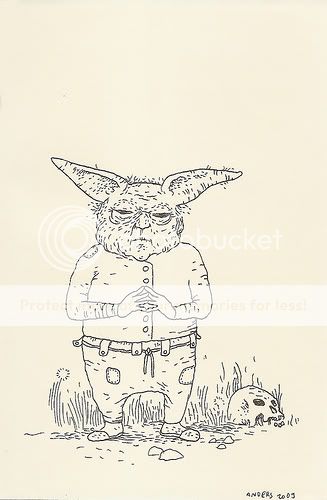
* Goddammit, Mike Baehr’s Yoda sketchbook is slaughtering my Bowie book. I know the guy works for a comic company and can threaten to shittalk artists to Gary if they fail to produce, but still. 170 entries! Goddammit! Here’s Anders Nilsen’s. Razzafrazza. (Via Flog.)
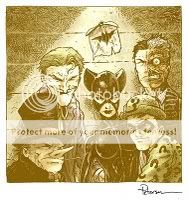
* Is there anything finer than a drawing of Batman’s awesome rogues gallery by a talented artist like David Petersen? That Muppet piece is pretty sweet too. Click the link to see them both at full size.
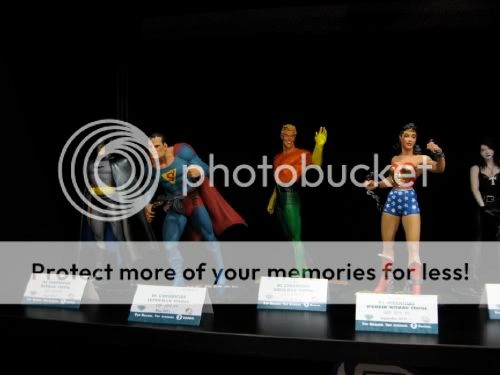
* DC Direct is releasing a cool line of 75th anniversary figures, featuring all their big characters as they looked in their debuts. I’d love to see that Shuster Superman slug a Doomsday action figure in the face.
* CRwM dissects the extremely unpleasant-sounding Korean torture-porn film The Butcher. I’ve been thinking of this subgenre, or at the very least what I used to call the “brutal-horror” ubersubgenre to which it belongs, on and off ever since I tried and failed to watch the French film Inside. If you recall, I gave up when it became apparent they were gonna break a cat’s neck, because that’s very very much not my thing, and I didn’t feel like the movie was going to be saying something in so doing that was particularly worth hearing. (No, “That bitch crazy!!!” doesn’t count.) But I don’t think I’ve seen a single horror film with a similar level of violence ever since, cat-killing or no. No Martyrs, no Frontier(s), no Asian or French extreme films, nothin’. And this is because I’m just not convinced I’d enjoy them, which is supposed to be the goal of going to the movies, right? I know that’s a weird thing to hear coming from someone who loves Hostel and The Texas Chain Saw Massacre as much as I do, but there you have it. Does this make me a wuss or a lousy horror fan? I really don’t know. I worry that it might, as I think I’ve said before. I wish I could articulate why the really awful movies that work with me work and the really awful movies that don’t work with me don’t, but to do that I’d have to see the latter ones, and, well, there you go.
Comics Time: GoGo Monster
February 15, 2010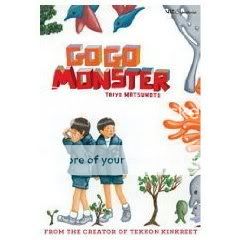
GoGo Monster
Taiyo Matsumoto, writer/artist
Viz, December 2009
464 pages, hardcover/slipcase
$27.99

It may only be the fact that Brian Chippendale just wrote about Taiyo Matsumoto yesterday, but I’d say GoGo Monster is every bit the exercise in creating a believable, cohesive, living environment that is Ninja or Multiforce or The Squirrel Machine. In fact I’d say that despite appearances to the contrary, this is truer of GoGo Monster than of Matsumoto’s Tekkon Kinkreet. TK‘s Treasure Town gives Matsumoto a far more obvious world-building workout, but ultimately its semi-dystopian near-future science-fiction metropolis can coast on our foreknowledge of such fictional environments and the narrative function they fulfill. GoGo Monster‘s run-of-the-mill elementary school can tap into our actual real-world memories of such places, certainly, but its place in a fictional narrative is comparatively undefined. Nor can it rely on the riot-of-detail school of art to accrue physical presence through a prolificacy of constituent visual parts as can those books–it’s not some fantastical land, it’s a grade school, and moreover that’s not the style Matsumoto is employing here. So to convey the kind of place Asahi Elementary School is–or at least the kind of place it is for our main characters–Matsumoto works overtime.
And he starts right away: Before we even get past the endpapers, deep-focus drawings reveal cavernous institutional hallways and vertiginous stairways, while POV close-ups of other characters reveal preoccupied teachers (that recurring pull-back-the-hair gesture!) and hostile, slightly distorted children, their speech not tied to them in the traditional word-balloon fashion, so as to suggest their fundamental disconnect from our hero. They’re not actors so much as elements, and their primary influence throughout the rest of the book is as a generator of sound effects just like wind or rain, as their near-constant disembodied chatter unfeelingly surrounds and buffets the protagonists.
Our real introduction to the school setting comes in the form of a hand-drawn map created by our main character, Yuki. It’s diagrammed out like a superhero’s headquarters, with all the funneling of wild imagination into cold orderly lines that that suggests. At the edges, menace creeps in, in the form of monstrous doodles that blackly snap at the border and proliferate in the school’s abandoned fourth floor. That level of the building takes on a central metaphorical role, demonstrating that this school exists independent from and indifferent to the hopes and fears of the child now inhabiting it.
Similar signifiers abound. Planes fly low overhead, their departure and destination unknown. A rabbit run is the only world its furry inhabitants ever know, and one of them disappears without any of its fellows or minders able to say how or to where. I have no idea if “perspective” has the dual meaning in Japanese that it does in English, but Matsumoto frequently skews and warps it so that the school leans in on its inhabitants. One pivotal character literally sees the world from inside a cardboard box. Most importantly, except for one key sequence I won’t spoil here, our heroes never leave the school grounds, and on the one occasion that parents visit, they are viewed only from a distance.
In short (haha, yeah), Asahi Elementary is the world for Yuki, who is either psychically sensitive or psychologically impaired, and Makoto, the new kid at school who befriends Yuki out of what seems more like a fascinated respect for his indifference to his peers than any kind of Heavenly Creatures-style shared psychosis, and for IQ, the eccentric-genius older kid who says he’s no more capable of taking a test without wearing his customary cardboard box than a normal person would be if forced to wear one. Their problems are solely their own and completely inescapable. If they don’t solve them, they won’t be solved.
Which makes GoGo Monster a harrowing read, in spite of the great beauty of the art. Indeed, the beauty makes the book feel like a tragedy in the making at every step. Whether they’re the product of a genuine gift or profound mental illness, Yuki’s increasingly troubling visions of a world beyond this one and the sinister Others who inhabit it can only bode poorly for him; either way, they will consume him, because in this insular world, there is no authority to which he has recourse to protect him. Yet at the same time he clings to these visions precisely because of the insularity of this world, and what it has shown him about the gray soullessness of grown-ups and their inability to connect with kids like him in any meaningful way. Only Ganz the groundskeeper and gardener understand Yuki’s plight from the adult world, but that understanding comes hand in hand with the conviction that it is in fact Yuki’s plight; Ganz tends him like a flower, but (hey, the metaphor is Matsumoto’s not mine) Yuki must blossom or wilt on his own.
In turn, Makoto and IQ are stand-ins for our own reaction to Yuki. Makoto is agnostic as to the veracity of Yuki’s visions; all he knows is that he’d prefer Yuki not have them, or at least not talk about them, because they’re frightening and they obscure the confident, funny, fascinating Yuki he otherwise knows. IQ is an atheist about them–he knows they’re all in Yuki’s head, the manifestation of various psychological complexes. But he offers this diagnosis while wearing a cardboard box on his head with an eyehole cut out, and eventually we learn this is the least of his own problems. Knowing what’s real is no help when what’s real appears to come crashing down.
In the book’s climax, that’s precisely what happens. We’re really no closer to understanding what’s really happening, though the nods in the direction of magic realism are as pronounced as, say, the end of Being There or Barton Fink. And we can only partially puzzle out the fate of a third of our trio, though sitting here after the fact I have my strong suspicion. No, Matsumoto is content to plunge characters and reader alike into a prolonged sequence of abstracted imagery, page after page that eventually becomes almost entirely obscured by darkness (which is itself depicted in just about the most fascinating way I’ve ever seen a comic do). What, if anything, emerges from the other side? Again, I’m not spoiling it here. But the journey through is a fine, emotionally accurate, uncompromising vision of the terrors of childhood. See, whether we are experiencing mental illness or actual spiritual evil here is a matter of debate–it works either way–but it definitely works as the realization that whatever meaning, safety, sanity, and comfort you can carve out of the unfeeling world, you have to carve it out yourself.
Carnival of souls
February 15, 2010* Comics Comics gets a lovely makeover and Fantagraphics co-honcho Eric Reynolds writes an essay for The Comics Reporter on pretty much the same day that long-time Comics Journal writers Noah Berlatsky, Ng Suat Tong, and Robert Boyd beat TCJ.com to within an inch of its life? Ouch. I imagine the temptation when receiving criticism from Noah is to grab an issue of The ACME Novelty Library off the shelf and congratulate yourself on the good company you keep, but at this point I sure hope that the people in a position to listen and act are listening and preparing to act. Because here’s the thing: The Comics Journal introduced me to the very idea of comics criticism. I’ll be eternally grateful Dirk, Michael, Gary, and everyone involved for giving me the chance to write for the magazine, and Gary Groth is probably my all-time comics hero. But the relaunch has been so slapdash, and Gary’s attitude about it as evinced in that hideous self-congratulatory “welcome” letter so off-putting, that it’s become tough to root for them. I know the Journal is a smaller part of Fantagraphics than ever before, but its web presence really could be contributing something beyond various people proclaiming how much they don’t like New Yorker short stories and attempting to metaphorically reenact the video for “Beat It” with Comics Comics in the role of the sunglasses dude, and I’d love to see that happen.
* Yikes. It sure looks like something’s gone very wrong with the kinds of comics that drive the Direct Market. The great recession, event fatigue, what? Marc-Oliver Frisch has more. Personally, my guess is that had “Dark Reign” lasted until early autumn ’09 instead into late winter ’10, we’d be looking at a different chart.
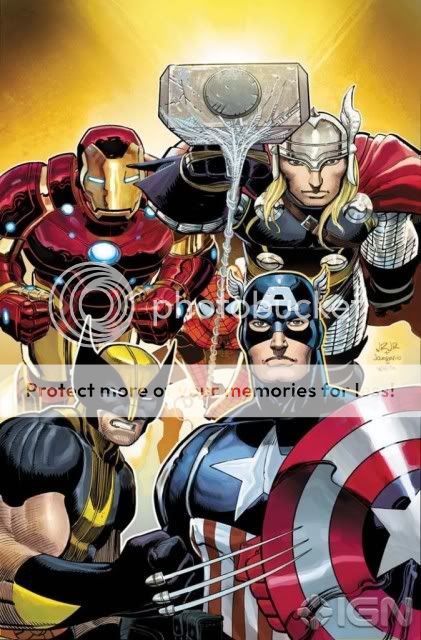
* Today on Robot 6: Mint JRJR cover for Avengers #1 and the Covered blog is doing an art show.
* Dan Nadel sure makes it sound like Ben Jones is doing an Adult Swim pilot…
* George A. Romero’s Survival of the Dead sounds pretty bad.
* How many of these killer little comics does Frank Santoro have socked away?
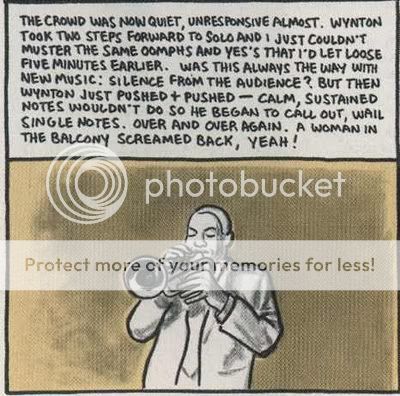
* Curt Purcell makes The Wolfman sound worth a matinee viewing.
* Jog takes a look at two recent Viz titles of note, Biomega and All My Darling Daughters.
* Dick Cheney loves torture so very much he just can’t shut up about what a war-crime perpetrator he is. I’m not even really exaggerating.
* Goldfrapp have the attitude every artist should have, both generally and about Van Halen specifically.
* Great job!
Comics Time: The Death of Superman
February 12, 2010
The Death of Superman
Dan Jurgens, Jerry Ordway, Louise Simonson, Roger Stern, writers
John Bogdanove, Tom Grummett, Jackson Guice, Dan Jurgens, Brett Breeding, Rick Burchett, Doug Hazlewood, Dennis Janke, Denis Rodier, artists
DC, 1993
168 pages
$9.99

Nostalgia is an occupational hazard for comics readers. Even as I write this, there’s a part of me that wonders how much of what I’m about to say is colored by the mere fact that I first read this material not as a 31-year-old, but as a 14-year-old, with a 14-year-old’s understanding of the industry and artform of comics. But honestly? I’m thinking “not much,” because the 31-year-old likes this comic a lot more than the 14-year-old did.
For example, back then I was deeply unimpressed by the motley crew of losers who made up the Justice League at the time, and who were really the stars of the show in the initial issues of this storyline. They’re a parade of weak designs and goofy powers, from Guy Gardner’s bowl haircut and leather jacket to Blue Beetle’s beetle-shaped spaceship Booster Gold’s superpowered spandex outfit to a character named Fire who is inexplicably green, not, you know, fire-colored. At least Ice looks icy. There’s some B-plot mystery involving a ’90s-tastic goofball named Bloodwynd (look at that ‘y’!) whose word balloons drip blood, there’s a woman warrior named Maxima who is to other, better superheroines like Wonder Woman and Phoenix what one of those cheapo greatest-hits collections you can get in a five-dollar bin at the grocery store is to the overall recording career of Johnny Cash…Man, do these guys suck.
Superman himself fared little better with me. I mean, he’s Superman, he has that going for him, which is nice. But what a square, boring world he inhabited at the time! The first issue collected here sees him face off against a bunch of underground monsters who talk like Cookie Monster and present just about as much of a convincing threat. There’s the usual horrible street-dialect comics writers of yore subjected any blue-collar character to–you know, “ta” instead of “to” and a lot of “in'”s instead of “ings.” Gross. Finally, Superman’s big character moment before the action starts is a TV interview in which they reveal a hidden power of his: The ability to avoid saying anything remotely interesting. He offers a politician’s focus-group-tested, studiously bland and inoffensive answers to questions about his role as the obviously most awesome guy in the Justice League, his recent fight with asshole Guy Gardner, the fact that Maxima looks and dresses like a swimsuit model, and so on. If the writers had set out to make him unappealing to teenagers, they couldn’t have done a better job.
And ultimately, 14-year-old me ended up sharing much of the conventional fan wisdom about Superman’s beating death at the hands of the monstrous new enemy Doomsday. Doomsday wasn’t a character, he was a plot device, created for the sole purpose of killing a character who basically couldn’t be killed. (DC would repeat this trick later with Bane and Batman, introducing a huge dude to beat the unbeatable hero.) Lex Luthor got gypped. It wasn’t a story, it was a mere slugfest, not the Shakesperean tragedy that would befit such a momentous occasion. Though I hadn’t read any of them other than The Dark Knight Returns, I was aware of the medium’s artistic masterpieces, such as Watchmen, Crisis on Infinite Earths, and Camelot 3000–did not Superman deserve a send-off of their caliber? Finally, by the time the hype died down, Superman came back to life with long hair (remember, no one used the m-word back then), and it became apparent that my multiple unopened polybagged copies of the actual death issue weren’t going to be putting me through college, I just plain felt ripped off. Instead of six copies of the Death of Superman comic, I wished I bought just one of that awesome Death of Superman t-shirt.
That last part I still agree with. The rest? Oh, to be that young and naive again! Because I’ll tell you what–I wish we could get an event comic as rollickingly entertaining as The Death of Superman today.
Viewed with some distance, read in the comfort of my marital bed rather than my parents’ basement, stacked up against the many many many many comics I’ve read since then, I find that most of my teenage complaints are flipped on their head. Okay, so the dialogue stinks, there’s really no bones to be made about that. (Seriously, people give Bendis a hard time over his tics, I know, but superhero comics have truly seen a quantum leap in the craft of creating believable, entertaining human speech.) But take that crappy Justice League (please!): It’s their very crappiness that makes the book so entertaining in its early going, when the action consists of nothing more or less than Doomsday pounding them into unconsciousness over and over again. If I recall correctly, Doomsday’s rampage effectively ended this era of the team, a consummation devoutly to be wished. It’s a perfect blending of an in-story plot with a meta need, i.e. to lose these losers. I could read page after page of Blue Beetle lying prone on a pile of rubble begging for help or Maxima getting tossed around like a sack of potatoes and never ever get tired of it.
And page after page of people getting the stuffing knocked out of them is exactly what you get, which leads to my next point: An action-comics event consisting almost entirely of action is a great idea, but as we’ve recently learned, it can be difficult to convincingly pull off if all you do is have big spreads with dudes shooting lasers in all directions in the middle of nowhere, punctuated by approximately one memorable action beat per issue. In The Death of Superman, laser blasts are kept to a minimum, and when they’re fired, they’re all pointed in one direction at one guy: Doomsday, who just stands there and takes it. Most of the rest of the action is fisticuffs, a pure slobberknocker. Doomsday has a simple goal: Keep moving and keep destroying. Superman and friends have a goal that’s just as simple: Stop him. In that basic set-up we have a sense of directionality, a readily understandable concept of what victory or defeat for either side looks like, and a simple way to root the combat in the immediate physical presence of the combatants.
I’m also now struck by how smartly staged the action can get. Doomsday’s less a villain than your basic rampaging monster, and thus the creative team sets him loose in time-tested rampaging-monster fashion, having him smash his way through everyday environments like a highway, a Wal-Mart, a suburban neighborhood. You picture something like this happening near where you live and quickly get a sense of how friggin’ cool it would look. In addition, Doomsday’s always moving, which gives the fight a propulsive momentum, but when he does get bogged down for a time by Superman or the Justice Losers, the creators make skillful use of that particular place–in the suburbs, a single mother bickers with her teenage son until Doomsday lobs a knocked-out superheroine through their kitchen window and eventually lights the whole house on fire; near the headquarters of the Jack Kirby-created Cadmus Labs, Superman and Doomsday fight in a giant technoorganic Ewok village whose treelike structures they bring clattering down like Lincoln logs; the final stage of the fight is just a bareknuckle brawl in the middle of the street outside the Daily Planet, which location they quickly reduce to a slag heap. In each case, you get a sense of where you are and what’s happening to it. Action has consequences.
Doomsday himself, moreover, is a great design. In the comic, he starts out in an all-over green jumpsuit and mask, festooned with looping binders, that obscures his bony spikes and monstrous face. He looks like a square-bodied Kirby creation run amok. But as the fight progresses, his outfit is torn away, revealing the very ’90s everything-more-awesome-than-everything-else spikes and claws and so on we’ve come to know. One of those allegorical Kurt Busiek/Alex Ross/Brent Anderson Astro City character designs couldn’t have done it better. Superman’s thoughts throughout the fight are a stand-in for our own: a dawning realization that yeah, this guy could succeed where everyone else failed.
In the end, that success (albeit pyrrhic–Doomsday “dies” too) comes suddenly. The final four issues of the story famously “counted down” from four panels per page to three to two, until in the climactic issue the story is told entirely through splash pages. What’s exciting about this to me now is that it’s hard to imagine a comic doing that today, simply because splash pages aren’t storytelling devices, they’re pin-ups and future original art sales revenue. But the Jurgens/Breeding team actually does things with those one-panel-per-page images other than “here, look at this awesome pose!” They awkwardly shift Superman’s body around: For every shot in which he’s flying menacingly at the viewer, there are several more where he’s being hurled into a helicopter, or where he slams into his opponent upside-down, or where he’s driven by his feet headfirst into the concrete. The angle shifts dramatically as well, and the bold transitions–from a worm’s-eye-view behind Doomsday’s legs to a medium shot of Doomsday from the front getting punched in the back to a ten-feet-overhead view looking straight down at Superman as he heat-visions Doomsday into the side of a building, for example–create an unpredictable, gripping flow. On the page in which the two fighters ready what will be their final blows, there are no grand gestures or profound interior monologues; the last thing Superman thinks before receiving a mortal injury is just “I’ve got to put this guy away while I still can!” (“This guy”!) Yeah, it’s a little awkward that the tableaux of grief with which we are presented are Ma and Pa Kent, Lois Lane and Jimmy Olsen, and…Bloodwynd and Ice, but the melodrama of that final image–Lois crying to the heavens with her hands twisted into tense claws, Superman lying stretched-out and slack-jawed in the rubble, his tattered cape fluttering off of some nearby rebar like a flag, Jimmy snapping one last photo (from the rear, but I assume he got the angle right eventually)–is a miniature model of body language, jagged edges, and superhero spectacle. And hey, lookit that–that’s not a bad way to describe the whole book.
Carnival of souls
February 12, 2010* Christopher Handley will do six months in prison for the crime of being mailed comics. He joins Mike Diana in America’s thoughtcrime hall of shame. More here.
* Today on Robot 6: King-Cat: The Motion Picture and Iron Man Was Right.
* Brian Chippendale on Taiyo Matsumoto.
* Let the games begin!
Carnival of souls
February 11, 2010* I interviewed Marvel’s Tom Brevoort at length for Robot 6 today. Tom’s a fascinating figure and I really enjoyed speaking with him.
* Also at Robot 6 today: Bill Ayers and Frank Miller are headlining MoCCA. Cue Odd Couple theme song!
* Incredible Hercules is being relaunched as Prince of Power in a way that would be spoilery were I to describe it to you, but I’m betting you can guess even without clicking. It’s funny–I interviewed Brevoort just a few days ago, but in the interim, two of the three series I cited as examples of critically acclaimed titles Marvel couldn’t get to stick have been relaunched. Again, I’m glad to see Marvel supporting books like Herc and Atlas…and I’m hoping Captain Britain & MI-13 gets revived for the hat trick.
* Very lively discussion in my latest Lost Thoughts comment thread. This was a controversial episode! Related: Todd VanDerWerff’s follow-up/round-up posts are starting to look like they’ll be as interesting as his actual reviews.
* Robert Kirkman talks about the upcoming, long-time-coming Invincible storyline The Viltrumite War. As this is basically the “Who Killed Laura Palmer?” for this series, it should be interesting to see how Kirkman navigates it and transitions the series out of it at the end.
* Aquaman’s back and Geoff Johns’s got him! That sounds good to me.
* Tom Spurgeon has the last word on conservative mau-mauing of Ed Brubaker’s Captain America.
Carnival of souls
February 10, 2010* Todd VanDerWerff was more patient with last night’s Lost episode than I was, and I think he’s largely convinced me, though I feel like we sort of need to see how things go in the next few episodes to see if this was laying the groundwork for something or just sort of anomalous. Ryland Walker Knight, by contrast, was even more dismissive of it than I was, though I think his characterization of it as feeling very Season Three was accurate. Again, though, we’ll see where things go.
* After its world tour of crossovers with the X-Men, the Avengers, Thunderbolts, and Incredible Hercules, Agents of Atlas is returning as just-plain Atlas. Hooray! I’m happy to see how hard Marvel worked on this book’s behalf, the apparently soon-to-be high profile of Gorilla Man being a good example.
* I really like the idea of War of the Supermen, the next big DC event, taking place over the course of 100 minutes. If the creators involved really work on packing those 100 minutes of battle in terms of memorable physical beats that are easy to follow from one to the next, it could really be something.
* Ta-Nehisi Coates on “the death of hip-hop”–this passage was a real eye-opener:
When I was a kid, I thought only better (lyrically) things would follow. I think that was a function of me not really understanding why most people were listening to hip-hop. Sure some of us obsessed over the words, but Dre basically had it right–“Ya’ll don’t wanna hear me, you just wannna dance.” That’s basically been the case from jump. Great lyrics were a beautiful and important side-effect, but a side-effect nonetheless.
Sad but true?
Comics Time: Monkey & Spoon
February 10, 2010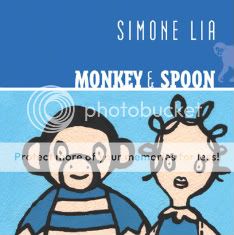
Monkey & Spoon
Simone Lia, writer/artist
AdHouse, 2004
pages
$9.95

What a pleasant book this is! I’ve loved it for a long time. It’s nothing more or less than a little scene about a husband-and-wife sock monkey and a doll made from a spoon who fight and then make up, but the specifics are just nailed. The book begins with a long wordless stretch as the couple fix a meal, with pointed silences and angry glances galore. When they finally start talking, each word is freighted with a day’s worth of frustrations and perceived slights, and every choice of phrase is belabored until it loses all meaning other than “WE’RE FIGHTING”: “This is pathetic ” “Pathetic? Is that what you think when I say something? It’s pathetic?” “I didn’t say that. You’re twisting my words.” Lia really gets the timing of how people talk when they’re arguing, too–I particularly loved how the monkey jumped on the spoon’s first soft-spoken statement with an all-caps “PARDON?” But soon enough a crisis intervenes, and the two instantly drop their hostile facades to attend to one another’s more pressing needs; once those have passed, they both remain in a safe enough emotional space to apologize for their bad acts and reach out to one another again. In my experience that’s how fights with the person you love work: Things can get as nasty as you’d expect when you’ve got a whole life together from which to draw your ammo, but it’s ultimately that life together that matters, and usually some part of you is just waiting an excuse to deactivate your offensive weapons and reconnect. Lia’s twee-crude line and character designs prove surprisingly resilient and effective in communicating such finely observed points, and providing big grin-provoking physical beats in the process. This book has a goal and meets it with precision and panache. Here’s your Valentine’s Day gift, Amazon Prime members.
Lost thoughts
February 9, 2010SPOILER ALERT
SPOILER ALERT
SPOILER ALERT
* How did Kate find Claire after ditching her? Why the hell would a woman 36 weeks pregnant decide to be besties with the woman who terrorized her with a gun to her head and stole all her shit? Why would two of Lost‘s most experienced writers throw a credibility-destroying development like that into one of the show’s final episodes?
* I’m pretty impressed that even after all these years, they’re still finding ways to have the Others do heinous shit but still leave open the possibility that it might almost kinda sorta be justified. I just wish people would remember that the fact that Destro fought Cobra Commander once doesn’t make him a good guy.
* So…the Others really are nominally servants of Jacob, but occasionally their Lazarus Pit turns people evil? Which most of them act like anyway? I guess we’ll get this ironed out eventually.
* Sawyer just saying “fuck it all” at this point makes a lot of sense. Josh Holloway’s handling it well. It’s funny, though: The Missus asked me toward the end of the episode “So why is Kate chasing after Sawyer now?” and I had no idea.
* Always fun to see Ethan. What great casting William Mapother was! The first of many, many compelling villains on this show. (Or the second, considering how Locke was initially handled.) It took me a minute to accept that hey, he’s not evil here, things worked out pretty good for ol’ Ethan Goodspeed in a world without the Island.
* And see, before anyone starts, I can accept synchronicity, as in Ethan being the doctor who delivers Claire’s baby. That’s how the world of the show works. I can accept smoke monsters and an immortal guy in eyeliner (I think that’s a Grant Morrison character, actually)–that’s how science fiction and fantasy work. If they’d worked a little harder to show that Kate finding Claire was a function of one of those things, fine. But they didn’t. Neither character seemed the least bit fazed by Kate pulling up to that bus stop, beyond a “Oh great, this lady again” look from Claire. It sure wasn’t a “What the fuck, how did this person find me again?” look. I’m pretty much stunned it got on the air. Oh well, maybe this means they got the rotten episode out of their system early on and it’s smooth sailing from here on out.
Lost clues!!!!
February 9, 2010“Ou sont les bagages? Ou est le voyageur?”
Monty Python was already asking the big questions!!!
Carnival of souls
February 9, 2010* I’d really like to see Ed Brubaker use Baron Zemo vis a vis Bucky Barnes the way he used the Red Skull vis a vis Steve Rogers over the past few years. I mean, it makes sense.
* I’ve been having fun watching Matthew Yglesias mercilessly beat down torture enthusiast Marc Thiessen and torture enthusiasts generally, because torture is wrong and those who support it are bad people. I’ve also been having fun watching Andrew Sullivan dance around the f-word when describing the political impulses embodied by Sarah Palin.
Carnival of souls
February 8, 2010* Today on Robot 6: Avengers-related news galore (let’s hope Secret Avengers is Brubaker espionage), possible glimpes of the Marvel Universe’s post-apocalyptic future, someone got Wizard wet, and Benjamin Marra’s awesome Traditional Comics commercial.
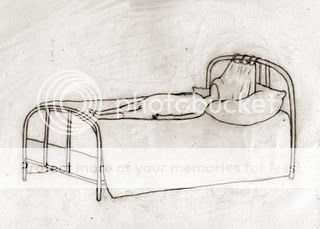
* Sometimes I feel like I discover stunning new comics art from somewhere on the medium’s spacetime continuum every single day. Today it’s the gorgeously static work of Pete Morisi, courtesy of Ken Parille.
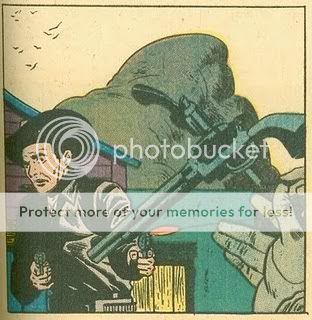
* The Cool Kids Table’s Comics Decade has come to an end with Scott Pilgrim, Black Hole, and cosmic comics.
* Charles Hatfield on Abstract Comics, at length, with a detour into Henrik Rehr’s excellent Reykjavik. The bit I found most interesting is Hatfield’s discussion of which shapes tended to make him tune out–I had a very similar experience, though with very different shapes.
Comics Time: The Book of Genesis Illustrated
February 8, 2010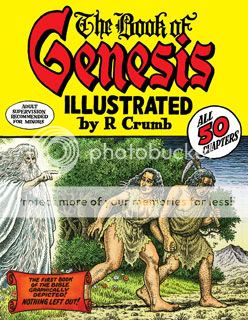
The Book of Genesis Illustrated
R. Crumb, writer-artist
Adapted from Genesis: Translation and Commentary and The Five Books of Moses by Robert Alter
W.W. Norton, 2009
224 pages, hardcover
$24.95

Captivating, illuminating, at times laugh-out-loud funny, and almost belief-beggaringly gorgeous, R. Crumb’s ambitious adaptation of the Bible’s first and foundational book hit pretty much every note I wanted to hear from such a project.
For starters, as a showcase of Crumb’s drawing chops–masterful even in his old(er) age–it’s tough to top. I’m aware of the criticism that it could have been subtitled Beards on Parade, and I reject that criticism, or rather I invert it: the beard parades were among the best parts! And they’re perhaps the most emblematic sections of the entire book, in that they boil Crumb’s project down to its essence. Genesis’ long multigenerational tale of the patriarchs of the Israelites and their large extended families necessarily includes a lot of hirsute dudes in Cecil B. DeMillian garb, and at times even substitutes litanies of their names for any actual story or plot. So what you get during the long lists of sons or what the back cover jocularly refers to as “The ‘Begots'” is a bit like folding one of Crumb’s sketchbooks into a comic. As the generations rattle by, Crumb draws scene after one-panel scene depicting some family activity at random: A mother nurses and laughs as her other son runs past playing; another mother breaks up a fight between two kids; people dance and drink at a party. At other times he’ll simply insert postage-stamp panel portraits of each person, inventing them out of whole cloth, and the act of reading becomes a master class in how many variations of the human face can be captured by one artist. In each case, through Crumb’s attention to detail, mastery of crosshatching and stippling, and rock-solid carved-from-clay character construction, an entire life, and the world that surronds it, is suggested in the space of a panel.
And that’s pretty much what made the whole book so very appealing to me–another litany, that of the keenly observed and impeccably depicted moments that take the musty, revised, translated, censored, edited, politically motivated, at times inspired, frequently batshit bizarre text of the world’s most important religious document and make it something fun to read. Gimli-like Abraham, never looking his (not-firstborn, not only!) son Isaac in the eye as he leads the lad to the slaughter. The denizens of Sodom, portrayed not as a bunch of mincing homos, but rather as a predatory pack of grinning good-time assholes. The destruction of Sodom and Gomorrah, portrayed in a stand-out layout of three widescreen panels that arrange contorted bodies and black and white spaces in a manner suggestive of an un-abstract David B. The close-up on Lot’s face as he begs God to let him hide out in a nearby town rather than force him to take a dangerous journey even further away from the soon-to-be-destroyed cities, his wild eyes matching the desperation in his repeated assertion that “it’s such a little place!” The moving, teary-eyed embraces during the rapprochements of sundered brothers Jacob & Esau (a development I’d entirely forgotten about) and, later, Joseph & his eleven brothers. Esau dancing up a storm. The random brutality with which Crumb depicts “the wickedness of the human creature” that inspired God to flood the Earth. Shem, Ham, and Japheth drawn as Shemp, Larry, and Moe. The hoary cliche of God as a white-robed, white-bearded, white-haired old man put to graphic use as his flowing locks and whiskers become an elemental thing, echoing the radiance of the sun or the force of the rain and wind. The easy physical intimacy of Adam & Eve and Isaac & Rebekah romping, or Isaac & Rebekah cuddling on their wedding night. The sexiness of Tamar dressing up as a temple harlot, or Rachel presenting her handmaid Bilhah to Jacob, or “that scene” with Onan and Tamar. Reinforcing Joseph’s ruse that he doesn’t recognize his brothers by presenting his speech to them in hieroglyphics and then using a translator to relate them. The “do what now?” looks in the eyes of everyone who must get circumsized. The shocked sideways glance Eve shoots Adam as he throws her under the bus. The serpent as an anthropomorphized He-Man villain, until God curses him to crawl on his belly.
I am not a believer, and thus I appreciated the rough edges of the original text that a project like this brings out–the repeated pimping out of people’s wives to save their own skin; the polygamy and incest (Where’s your traditional marriage now, Moses?); God’s nutso caprice throughout the entire enterprise; the frequent brutality and deception employed by God’s chosen ones; the complete absence of monotheism as a concept, complete with gods mating with human and producing superhero hybrids; and so on. So if you’re the kind of person who insists that a comic of this nature must reveal the pure-dee lunacy of using these stories as the basis for the self-developed narrative of mainstream Western religious tradition, let alone as a basis for a moral code, let alone as the literal history of the world that way way way too people mentally carry with them when they enter the voting booth, you’ll make out fine.
But at the same time, the material is treated dead-on and respectfully, like “a straight illustration job” as Crumb puts it in his introduction. No cheap shots, no ironic image/text juxtapositions, no playing up the ugliness or contradictions. Rather you have a sympathetic treatment of these characters as people. Reading it, I got a taste of the solace evangelicals draw from these stories, and the entire cottage industry of “see, the people of the Bible are just like you!” sermons and books and so on that draw on them, if only to fit everything into a “so just believe in the God of the Trinity Broadcasting Network and everything’s fine” mold after the fact. That part’s absent, and instead you have a lively, living look at ancient stories that still retain their power to surprise, delight, enrage, and entertain. It’s a hugely successful comic.