
Author Archive
Carnival of souls
February 5, 2010* Amazon’s having a huuuuuuge Lost sale.
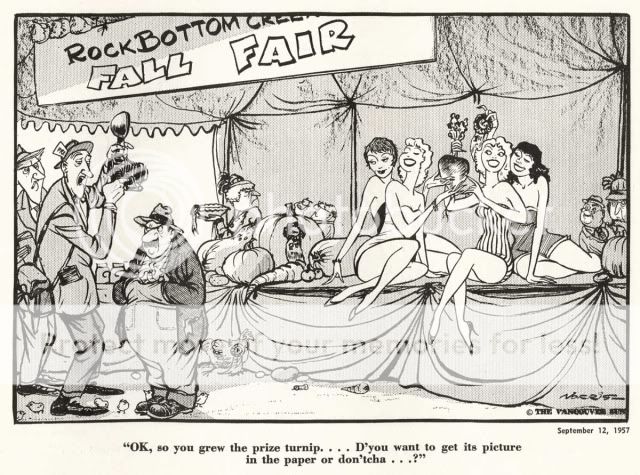
* Good gravy, this fellow Len Norris sure could draw. Just look at how the absence of gray magnetizes your eyes to those women. Yeah, the absence of gray is what does it, that’s the ticket. (Via Tom Spurgeon.)
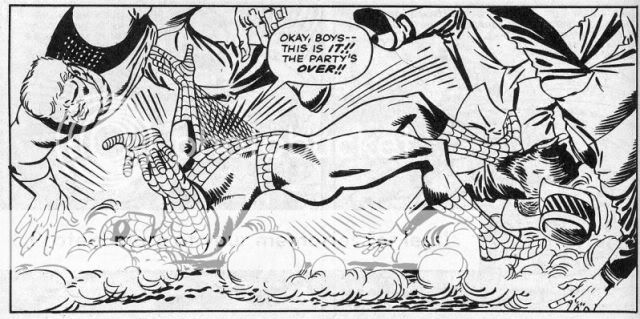
* Steve Ditko sure could (can?) draw too. Andrei Molotiu makes an STC-fave point about how you can use the motion of people and objects to physically describe, animate, and make real a space on the page. I sure do wish the artists of many of today’s big action comics were forced to read these panels prior to sitting down at the drawing table.
* A trio of impressive things by the Closed Caption Comics crew.
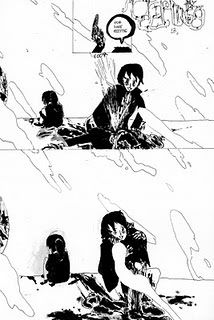
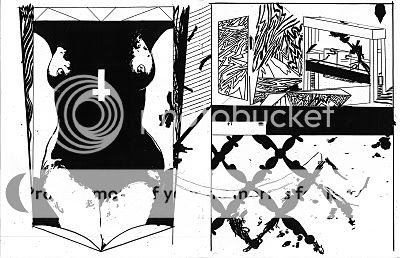
* “No, I’m Death, pure and simple.”
* Today on Robot 6: C2E2 & Anaheim’s guest lists and Rick Veitch’s soul.
Comics Time: Mercury
February 5, 2010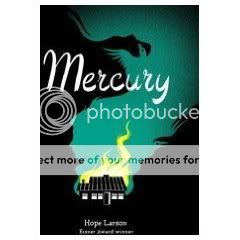
Mercury
Hope Larson, writer/artist
Atheneum, 2010
240 pages
$9.99

Hmm.
Okay, first of all, can we talk about what a lovely package you’re getting for $9.99? That cover is a killer, and Larson’s luminous line does nothing if not radiate “look at how beautiful this comic you’re reading is!” with every glance. Her blacks shimmer and shine, and her characters’ eyes glow like Influence in an old Chester Gould Dick Tracy. Seeing her art employed in a tale of familial and romantic teen angst up North gives the impression of a Craig Thompson with control instead of ecstasy as the key ingredient. For a measly $9.99, a price point even many tankubon volumes appear to have abandoned by now, the tween and teen girls who are Mercury‘s target will be getting a lot of art-object bang for the buck.
As for the story, I’ll be honest: Going into this thing, I was ready to be at a loss coming out of it. I have zero experience with YA fiction for girls, and very little with YA fiction for boys, even when I was a YA myself; there’s a degree of critic-proofing that that genre and that demographic lacquers on to any project. I was prepared to come away saying “Well, I see what’s going on here, and I’m guess it will/won’t work for its audience, but ultimately it’s not for me.” The critical white flag in other words.
And sure enough, there’s some YA stuff that fell a little flat for this less-than-YA. The period setting and attendant slightly stiffened dialogue, for example, are an obstacle that the earlier of the book’s two parallel plotlines have to work hard to overcome. I’m just not a bonnet-book guy, and unless you’re in a village that could potentially get raided by orcs, I don’t want to hear about how you have to finish your chores before Father returns from the market. To be less fatuous about it, I often find myself wishing that period fiction could just lose the dated dialect and have the characters speak like people today would, eschewing anachronisms but otherwise talking normally. I suppose you could always be a David Milch-level genius and devise, y’know, the best period speech ever, but barring that I feel like more is lost than gained with the distancing effect of the more formal speech–though to be fair, that’s often part and parcel of the stricter social codes that end up playing a huge part in the story, so perhaps that’s unfair. Meanwhile, the high-school setting of the contemporary half of the book is strangely sexless for a relationship-focused narrative; it’s funny to think of these characters as being in the same age group as the gang from Black Hole. A librarian who’d run screaming from The Diary of a Teenage Girl is going to have no trouble putting Mercury on the shelf, and that’s a sensible decision–and one for which Larson compensates with lots of finely observed detail regarding how teenage emotion can imbue everything from sleepover movie-watching to a pizza lunch with strange melancholy power. But it’s also not really the high school experience I remember. In books that deal in emotional truths, that’s a shortcoming, no matter how justified the sanitization might be.
But! No white flag here, no shrug of the shoulders and mumbling of “Eh, not my thing, but I bet your niece will like it, maybe.” Taken on the same terms as any other comic, Mercury is still an idiosyncratic, ultimately gutsy read. The kicker is the period story, about an itinerant prospector who finds gold on a farmer’s property and makes time with his teenaged daughter Josey while he helps the dad mine it. After a long rollout that has you suspecting the potential for heartbreak but not necessarily expecting it, takes a sudden and viciously sharp turn for the tragic, even the horrific. Thinking about its denouement now, I’m suddenly reminded of a sequence in, of all things, Louis Riel, that’s how severe Larson is willing to get here. But what ruins the lives of the characters in the past sets up a much better life for the characters in the present, specifically Josey’s teenaged descendent Tara, left with her aunt and uncle and trying to find her way among the public-school kids her single mother took her away from for homeschooling when a nasty divorce screwed her up. I won’t get into exactly how, but Tara’s happy ending, thoughtfully only teased rather than spelled out, is a direct result of the terrible misfortune that befalls Josey. I suppose you could read some sort of pat “circle of life, sunrise sunset, strikes and gutters, ups and downs” kind of message into that, but I saw it as a tougher, more bracing idea: that actions have consequences that reverberate down the line for decades, even centuries, enough to change entire lives. For an age group that tends to see everything, except perhaps the SATs, as somehow both all-encompassing and utterly in-the-moment, confronting the idea of legacies, unexpected ones at that, is stinging stuff.
But riding shotgun is the notion that in a world that works like that, you should take your happiness where you can get it. That’s what Tara does over and over: she forces herself to overcome her jitters and befriend the cute boy she meets, she hunts for the things that will improve her life, and–she has no way of knowing this, but of course Larson definitely does–she doesn’t allow the tragic legacy of her forebears to prevent her happy ending. None of this is handed to you with neat parallels or telegraphed transitions, by the way: I’m still teasing it out, and I’m glad that’s what I have to do.
Carnival of souls
February 4, 2010* Holy Moses, they’re screening a 145-minute uncut version of Clive Barker’s Nightbreed! The Holy Grail has been found! The quest has been fulfilled!
* Today at Robot 6: cool Paul Hornschemeier/Holy Consumption prints and debunking the Wizard/Watchmen 2 connection.
* NeilAlien provides a history lesson on the comics blogosphere.
* A fascinating Tom Spurgeon review of the fascinating ’80s-underground minicomix anthology Newave!
* Jesse Moynihan is putting his quite good webcomic Forming on hiatus while he takes a day job and plans for future installments.
* Jeet “The Real Deal” Heer (that’s what I like to call him) tracks parallels between the state of comics and the state of still photography. I wonder what the era of Terry Richardson and Last Night’s Party will produce?
* Did you know that comics publisher Sparkplug has a blog?
* FourFour’s Rich Juzwiak pounds the stuffing out of…Small Wonder?
* Further Lost thoughts from TV blogging’s indispensable man, Todd VanDerWerff. Check the comments for an interesting and to my ears accurate accent-related observation I noticed during my re-watch with the Missus last night, and for some details about a certain couple I missed entirely until I saw such comments online.
* Coming soon: What The–?! goes to the winter games.
One last SPOILERY Lost thing
February 3, 2010SPOILER ALERT
When Juliet first comes to at the bottom of the pit, she’s all upset, she tells Sawyer “it didn’t work,” that she hit the bomb but they’re all still stuck on the Island. Later, after Sawyer removes the big beam pinning her down and gives her a hug, she’s suddenly all smiles, she says “Let’s get coffee sometime–we’ll go Dutch,” she kisses him, says she’s got something important to tell him, and then dies, but Miles says she was gonna say “It worked.” Seems to me that the line about the coffee is something she will say to Sawyer in the alternate reality, and somehow she knows about its existence and that’s why she said it worked after all.
Carnival of souls
February 3, 2010* The best Lost reviews/recaps I’ve found are by Ryland Walker Knight at The House Next Door and House veteran Todd VanDerWerff at the LA Times’ Show Tracker.
* I’ve been looking forward to this ever since I helped set it up: Chris Mautner interviews Brendan McCarthy about Spider-Man: Fever and sundry other things.
* Wow, Tim Goldsworthy appears to have severed his working relationship with James Murphy and the DFA. Or vice versa. And this may have been going on for some time. They were the dance act of the decade for me.
Further Lost thoughts
February 3, 2010SPOILER ALERT. SPOILER ALERT. SPOILER ALERT.
* Initial, mostly silly thoughts here.
* I’m told that Maggie Grace initially had a film commitment, but that the show was ultimately able to work something out with all the actors they wanted to return for the final season. That’s really terrific news. Longtime readers know how much I hate the kind of situation where they have to create Frankie Pentangelli because Richard S. Castellano wanted too much money to return as Pete Clemenza.
* Thus it’s safer than ever to assume that Mr. Eko will be back. And I’m guessing my theory that he’ll link up with Jin and the Paik organization in some way will pan out too.
* Regarding Juliet’s double-dip death, I assume the thinking was that they couldn’t just bring her back as a dead body, that would be weird. They needed to give Elizabeth Mitchell something to do rather than just use a dummy or whatever.
* But mainly, this sets up Sawyer as the season’s most intriguing character. I’m hoping he becomes a really scary guy, that we get some full on Sawyer berserker attacks. They actually did one off-screen last night, after all.
* It’s never made sense to me that the time-travelers’ clothes transport with them. If it’s something about how anything in contact with you goes too, fine, but a) what about their shoes, those would only be touching their socks, most likely, and b) where do you draw the line? How much of the atmosphere comes with them, or the ground, or whatever? Oh well, I think we can give the show a pass for not being sticklers for pseudoscientific accuracy that would necessitate constant nudity. You can leave that to my fanfic, the title of which Nick Hornby stole for his latest book
* Just yesterday I was telling someone I was looking forward to the inevitable Biggest Smoke Monster Attack Ever this season. I didn’t expect it to come in the very first hour! Pleasantly surprised. Also, I guess Fake Locke = Monster = Man in Black is settled law now, though I imagine people will still be searching for zebras after seeing this particular set of hoofprints.
* It was entertaining to see Hurley given some agency, above and beyond “Hi, I’m the audience identification character that the creators identify as such at every opportunity.” It didn’t feel fanservicey, either–it wasn’t the creators saying “Hey fans, now YOU get to be the hero!” I also enjoyed the way he just rolled with Jacob telling him he’d died an hour ago. You gotta get up pretty early in the morning to find a way to weird Hurley out at this point.
* I was surprised how entertained I was by the alternate timeline material. Here’s a case where the only thing weird about these sequences is the fact of their existence–there really aren’t any other genre staples to speak of, at least not yet. In that sense it’s very much a return to the tone of the Season One flashbacks, back before the science fiction, fantasy, and series-mythology elements seeped into pretty much everything. The way they sustained interest, besides the basic “hey look, it’s that guy!” stuff, was through attention to detail: the marshal getting up to retrieve the briefcase that had knocked him out from the overhead bin; playing with whether or not Locke would be in a wheelchair; some nice Rose/Bernard business; Locke still being a weirdo; Locke and Boone connecting; and so on. Little nods in the direction of things that were important way back when, bringing things full circle.
* They threw in some head-scratchers, too, of course. With Desmond on the plane and Shannon and Jack’s dad’s body not on it, we’re left to wonder how divergent the timelines really are. We don’t know if there’s added significance to Jack’s recognizing Desmond beyond their earlier meeting in that stadium, or to Charlie’s statement that he was “supposed to die” beyond junkie melodrama. We don’t know if Desmond really disappeared, or just went back to his original seat. And in a show that pays this much attention to detail, I even wonder why Sawyer and Charlie’s haircuts were so different.
* When Sayid came to and started talking, I tried to determine whether or not he sounded different–mostly meaning if he started speaking in Michael Emerson’s cadence. After all, Richard had said way back when they used the Temple to save young Ben after he was shot by Sayid that if they did this, Ben would never be the same. Sayid’s got the same wound, was treated in the same way–what’s different about him now? Is he now a vessel for Locke or Jacob?
* I’m not 100% convinced we’ll never see Actual Locke or Actual Sayid again. It seems to me like the show would want to make it clear whether these characters died a “good death” or not. I don’t see it as the kind of show that lets a good guy die believing he’s going to Hell.
* I sure am hoping we’re moving toward a “save the world from the Smoke Monster Man in Black” plotline. I fully support the Man in Black getting off the Island having the narrative significance of Sauron getting the Ring back.
(Thanks to Matthew Perpetua, Ben Morse, Kiel Phegley, and TJ Dietsch for the conversation.)
Comics Time: Night Business #3
February 3, 2010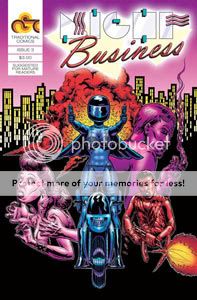
Night Business #3
Benjamin Marra, writer/artist
Traditional, January 2010
24 pages
$3
Buy it from Traditional Comics
About the Author:
Benjamin Marra is an artist who lives in the city. He is utterly and completely passionate about art. “Art … consumes me,” says Marra, “It is a part of my soul. When I look at a painting on the wall and I see a brush stroke, I can see the universe in it. I spend a lot of my time in galleries and museums looking around at the artworks. I like to see what’s going on in the art scene, you know, see what the new concepts are in art, see what my colleagues are up to.”
–from Night Business #3
The above text is pretty much what I love about Night Business in a nutshell. It’s simply a perfect encapsulation of a teenager and/or shut-in’s idea of what the City is. Artists who refer to themselves as such going to galleries and museums to stay on top of the activities of their cutting-edge colleagues. The glamorous, high-paying world of stripping and stripper management. Pimps who squirrel away a small army of thugs in warehouses filled with wooden crates and barrels of gasoline. Cops who thought they’d seen it all learning they haven’t, not by a long shot. One good man, pushed to the limit, taking a stand for what’s right and to hell with the consequences. Streetlight people, oh oh oh.
I don’t have the first two issues in front of me, but my impression is that this is the strongest yet on several levels. The insistent, grandiose stupidity of the writing reaches a delirious pitch here, my favorite example being the no-nonsense gun-toting would-be rapists who accost a pair of women on a thoroughfare broad and bright enough to be 14th Street: “Hey, ladies!! Are you looking for a party?!” “Hah, yeah! Are you looking for a party?! You’re invited to our party!” “We’ve got your official party invites right here! Don’t move.” “Scream and you die.” The pacing’s pretty sweet too, with the climactic fight between Johnny and the aforementioned warehouse full of thugs staged with one beat per panel, like the drum intro to “Big Bottom.” It ends with a glorious pin-up of Johnny flying through the air as he escapes an explosion, with knowingly wonky foreshortening, neatly symmetrical bursts of smoke and flame, and shiny inking showing off Marra’s studiously hidden chops despite himself. I’d kill to hang that page on my wall, let me just tell you. I’m all about seeking pleasure in comics these days, and this comic gets me off but good.
Lost thoughts
February 2, 2010SPOILER ALERT
SPOILER ALERT
SPOILER ALERT
SPOILER ALERT
SPOILER ALERT
* And the Deadwood Cast Relocation Program continues! Please welcome Sol Star, ladies and gentlemen. John Hawkes, please say hello to Kim Dickens, Paula Malcomson, William Sanderson, Robin Wiegert, and Titus Welliver when you get the chance. Meanwhile, break open the fuckin’ canned peaches, because I’m starting the Countdown To Ian McShane right here and right now.
* On a related note, I’m not all that worried about the hapless Oceanic employee who had to inform Jack that his father’s body was missing, because that guy’s accustomed to getting spooked:
* I’m pretty impressed by a television show that can maintain that “whaat..thee…hell?” feeling for a full two hours. So…divergent timelines, and the overlap is the whispering sound?
* Just very very nice to see Claire and Charlie and Boone and Rose and Bernard again. Even fanservicey old Frogurt and Arzt made me chuckle. I take it that negotiations with Maggie Grace broke down, however.
* Pulling for Mr. Eko’s L.A. drug connection to be the recipient of Mr. Paik’s watch.
* “I’m sorry you had to see me this way.” Smokey, takin’ us for a ride on the LOLicopter!
* Nice little shadow-and-light homage to Apocalypse Now and Col. Kurtz. I think I’ll enjoy crazy evil Locke-esque person.
* The second they slowed down to give us a glory shot of the Temple, I knew we’d get a “so, I guess this is the Temple” line from Hurley and would then cut to commercial. Sure enough!
* Rough of them to double-dip on the death of Juliet. I think we sort of have to wait and see where Sawyer goes from here to judge the effectiveness of that move. If he turns into a full-fledged monster, that’d be something.
* Cindy! Cindy! Cindy! Cindy! C-C-C-Cindy and the kids!
* I suppose the big question is whether Jack recognizes Desmond because their meeting at the stadium where they both were practicing running still happened, or because the Jack of this timeline is somehow able to remember what went on with the Jack of the other timeline.
* Haircuts are not consistent throughout the timestream, as it turns out.
Carnival of souls
February 2, 2010* On Sunday night I went to a very cool, very swanky, very funny fundraiser held by the stars and writers of Saturday Night Live to benefit the forthcoming stage/multimedia adaptation of Phoebe Gloeckner’s all-time-great graphic novel The Diary of a Teenage Girl. Here’s the report I did on the event for Comic Book Resources. Your takeaway should be that you should read The Diary of a Teenage Girl and go see Hannibal Burress and John Mulaney do stand-up if you get the chance.
* John Porcellino is blogging. Long Live the King. (Via Tom Spurgeon.)
* Hot damn, a new Jaime Hernandez Love & Rockets digest. Those books are the perfect blend of form and function. Scott Pilgrim fans, you have your instructions!
* My comics compadre Matt Wiegle did a 24-hour comic. Liz Bailie, MK Reed, Sally Bloodbath, and pie factor in.
* Gaze upon the face of your destroyer.
* Lost‘s final season begins tonight, and so…
* Lost Links #1: Noel Murray’s pondering of the show at the Onion A.V. Club contained a paragraph that spoke to some of my feelings about the show:
On the other hand, I’m not sure that the mythology is the heart of the show either–at least not for me. I dig the mythology more than the Sawyer/Kate/Jack/Juliet love quadrangle (and I do have questions I want answered), but I primarily love Lost for its thematic concerns and ambitious genre-play. I’ve already talked about how much I get out of the predetermination/freedom business, but I also like that Lost has always been a celebration of storytelling, from the arcane to the archetypal. It’s a genre-hopping story that pays direct homage to nearly every text that’s ever influenced its creators. It’s one long story, made up of a bunch of little stories. It’s a story about how backstories encroach and affect the main narrative, whether it be via time-travel or flashbacks (which are a kind of time travel). And, finally, it’s a story about the repetition of stories, and about which elements can be altered and which can’t.
In the past I’ve said something not identical, but similar: I watch the show not as an exercise in puzzle-solving, but as an exercise in genre that does everything genre can do, very very well: sex and violence, mystery and horror, awe and adventure, heroism and villainy, the literature of ideas, genre elements used as a sort of crucible for character development. Rather than the thematic or philosophical concerns that intrigue Murray, though, I prefer the individual character stories insofar as they deal with what people do when confronted with failure.
* Lost Links #2: In this colloquy between three TV critics–the Chicago Tribune’s Maureen Ryan, the Newark Star-Ledger’s Alan Sepinwall, and Time’s James Poniewozik–this passage stood out:
Poniewozik: Unfortunately, there’s this [problem] that’s inherent to sci-fi shows that “Battlestar Galactica” ran into.
In a regular, character-based drama, maybe people have high expectations for the finale, maybe they expect that closure from it, or [maybe they expect it to] wrap up in a certain way for the characters. Even when it’s a finale that people really don’t like — the “Seinfeld” finale, the “Sopranos” finale for a lot of people — I don’t know that many people who said, “I hate this ‘Seinfeld’ finale so much that it ruined the show for me.”
But there’s a thing about sci-fi that they expect the finale is not just supposed to be a narrative ending. It’s supposed to be an Answer, which to me is kind of ridiculous. The finale is supposed to say what it all meant, what everything was about. And you know, I’m not saying that it’s unimportant. I watch these shows for the same reason, but if the show is really good, that’s secondary.
Ryan: Well, I really felt like there was a left-brain, right-brain split in a way, when it came to the reaction to “Battlestar.” I’m obviously being overly reductive, but it seemed like there were two sort of realms of fan responses or reactions. There were the people that wanted the whole mythology to add up correctly and make sense, and there were the people who wanted the character stuff to kind of wrap up. I was mostly in the latter camp. And so for me, I felt like there were a couple of wobbly things in the finale, but I was willing to live with them because the “Battlestar” finale really delivered, for me, on a character level.
Whereas, in the post-finale comments I was seeing, people wanted the math to add up. You know, like, the show is a math equation and the show needed to get the right answer. And in my mind, it was never going to do that — I necessarily didn’t expect that or think it was going to be possible for it all to add up neatly. I felt like, this is a show that has taken many risks. A few of them have not paid off, but I’d rather watch a show that does something crazy that has an 89 percent chance of working out down the road, story-wise, than a show that plots things out in a way that is purely logical and kind of clinical.
I don’t have much to add to that. (Via LOSTblog.)
* Lost Links #3: Here’s a cute idea from Topless Robot’s Kevin Guhl: ranking the season premieres and season finales by their openings and cliffhangers respectively. I think the openings list is more or less right on, though I would have given top honors to the pilot episode, because that harrowing opening sequence is what sold the world on the following six seasons. The cliffhanger section is sort of weird, though–he doesn’t seem to actually like any of them.
Oscar
February 2, 2010Much to my surprise, I find myself very excited by this year’s Oscar nominees.
I was pretty skeptical of the decision to expand the Best Picture category from five films to a whopping ten, since it seemed such an naked studio cash grab rather than a legit reconsideration of how this process works. But I didn’t realize that it would open the category up to films and genres outside the beaten path of your usual Oscar fare. A hardcore science-fiction movie like District 9, for Best Picture? That’s very exciting to me. (Avatar doesn’t count, because it made so much money it was BOUND to get nominated. Nothing succeeds like success!) It doesn’t really matter, even, that District 9 is a flawed work–as time has gone by, that fun but not terribly interesting action climax has overshadowed all the meatier stuff earlier on for me–because, c’mon, look at what normally gets nominated. If you’re going to have a contest between great works, flawed works, and sometimes out-and-out bad works, you might as well expand the pool from which you’re drawing.
All in all three of my four favorite films of the year were nominated: A Serious Man, Inglourious Basterds, and The Hurt Locker. I also liked District 9 and Up in the Air. I’m pretty happy with the choices. (For the record, Best Films of 2009 as of this very moment: 1) A Serious Man 2) Inglourious Basterds 3) The Lovely Bones 4) The Hurt Locker 5) Crank 2: High Voltage–1 & 2 especially are subject to change)
I’m thrilled that Jeremy Renner got a Best Actor nod. Loved him since Dahmer, in which he was really something special. Shit, I’d have nominated him for 28 Weeks Later. (Man, that was a finely acted horror film.)
Also thrilled about Stanley Tucci and Christoph Waltz getting nominated for Best Supporting Actor for the villains they played. Tucci was maybe the best serial killer since Renner in Dahmer? And Waltz, I mean, duh.
I’m a bit perplexed that A Serious Man earned a Best Picture nomination AND a Best Original Screenplay nomination for the Coen Brothers, but they didn’t get nominated for Best Director. Was that due to rules against co-directors, or was it felt that they should have done a better job?
Also a bit perplexed that BOTH Vera Farmiga and Anna Kendrick were nominated for Best Supporting Actress for Up in the Air. They were good, and as far as I’m concerned Kendrick should be nominated for nearly singlehandedly making the Twilight movies entertaining (her and Michael Welch), but I thought Farmiga didn’t have much to do but be sexy. Nudity tends to be rewarded, so I’m wondering, was the Academy unaware she used a body double?
I tend to care about the Oscars only to the extent that I have a dog in the race. When The Return of the King swept I was over the moon; most years since then I haven’t even watched. That seems to me like a healthy level of engagement with this thing and with award programs generally. So it looks like I’ll be watching this year. I don’t do picks or predictions, but I will say that The Hurt Locker‘s chances seem very strong and I’m glad of that. There were a few films I preferred, but that’s a totally worthy movie, and obviously it would be a huge, long-overdue deal for a woman director and/or her film to win. It’s not a terrible idea to reward an entertaining, non-didactic, but still powerful Iraq War movie, either.
Let me ask you a question
February 1, 2010How the FUCK have I never heard THIS before?
Carnival of souls
February 1, 2010* Recently at Robot 6: Frank Miller drew new Sin City covers, Bendis and John Romita Jr. on Avengers, Picasso-style superheroes, and the Shamus/Wizard cons spread to Cincinnati.
* Child-porn conviction in Australia for dirty drawings of The Simpsons, The Powerpuff Girls, and The Incredibles. That’s a bad bad precedent. A real, serious crime involving imaginary depictions of imaginary people.
* Craig Thompson answers questions in a short interview someone’s doing for a school project. Aww!
* Kevin Melrose has a pretty fascinating interview up with Rafael Grampa of Mesmo Delivery. Check out the influences he rattles off–this guy’s the real deal. Interesting stuff in there about the move from AdHouse to Dark Horse, design as storytelling, and more.
* Red Lantern Gary Groth better thank his lucky stars there’s no Black Lantern Carol Kalish.
* TWIN PEAKS SPOILER ALERT IF YOU CLICK THIS LINK: Believe it or not it took me more than a day to mentally picture Star Sapphire Audrey Horne. I will take credit, however, for pointing out that Twin Peaks already had a power ring.
* Sam Gaskin sings the praises of Aapo Rapi, one of the highlights of Kramers Ergot 7.
* This is going on two years old now, but Phoebe Gloeckner took a photo of Ann Perry, the British mystery author whom fans of Peter Jackson’s Heavenly Creatures might better know for other reasons.
Disconnected
February 1, 2010I really really really liked The Lovely Bones, a movie about murder and grief funneled into a big huge emotional slow-motion close-up panoramic fantasia swirling-camera special-effects Brian Eno CGI tear-streaked period-piece whirligig. It made me cry. The serial killer material was unusually well-handled and realistic, in that greasy nauseating biting-on-tinfoil way that those men are. It used a bunch of actors I personally have an affinity for, like Mark Wahlberg and Michael Imperioli, as buttresses for a CGI-as-metaphor spectacle, something you’d seen hints of here and there in King Kong and The Lord of the Rings, but here Peter Jackson goes full-on Heavenly Creatures with it. It had a fine Brian Eno score, including a couple of cues from his weird-pop days (I heard “Baby’s On Fire” coming about three minutes before it really started). There were A-class suspense sequences and a musical montage set to the Hollies’ “Long Cool Woman in a Black Dress.” If you wanted to read it as a horror movie that just spends an unusual amount of time with people who aren’t threatened by the monster anymore, you could do that, and I actually suggest that you do. Right down to the tricky climax, it made meaning from the stuff of moviemaking. If it were nine years ago or so, I could see myself getting stuck in a k-hole with this movie, staying up past everyone else in my house and watching it and living with it night after night. I found it strange and very sad.
Comics Time: The Winter Men
February 1, 2010
The Winter Men
Brett Lewis, writer
John Paul Leon, artist
DC/WildStorm, 2009
176 pages
$19.99

Whoa ho ho, this is something special, huh?
I was only ever vaguely aware of The Winter Men during what struck me as a very long run for a six-issue miniseries, though I’m pretty sure I was confusing it with Peter Milligan and C.P. Smith’s The Programme for much of that time. I got the sense, just by seeing who was reviewing it, that it was a genuine critics’ darling, and I feel like I also heard that the production process was an unhappy one, with long delays or editorial troubles or something. I knew it was about Russian supersoldiers, drawn by JP Leon, so I mentally located it on a continuum with Sleeper and Gotham Central and Daredevil and other books that filtered superheroes through crime and espionage and drew them in a scratchy, black-heavy naturalist-noir style. That’s a subgenre people will associate with the ’00s like grunge and the ’90s, I think; I’ve still got a soft spot for its past examples even though I don’t know how much more of it I really need, so I figured hey, a limited series of it would be a pleasant way to spend a couple of train rides.
What I didn’t anticipate was Brett Lewis. Jiminy Christmas, this guy. I can’t remember the last time I read a genre comic this in love with language, this thorough and astute at developing and deploying its own. And here’s why it works: The Winter Men is about the bleed between the warriors and enforcers of the fallen Soviet Union and those of the New Russia’s criminal empires, a fluid and yet impenetrable world characterized by byzantine alliances, shades-of-gray legality, and the lack of any kind of centralized authority on either side of the law. The main spider we follow around this web is Kris Kalenov, an ex-spetznaz who was part of, essentially, the USSR’s Iron Man program, and who now works as a crooked cop for Moscow’s mayor, who runs the city like an independent state. He gets caught up in a kidnapping case with roots in an entire alphabet soup of international espionage agencies, military unites, and Russian mafiya outfits–the kidnapping’s the main throughline, finding out whodunit and all that, but it’s the journey, not the destination, that matters. Kalenov and his three comrades from the war–now a soldier, a gangster, and a bodyguard–get drawn through the web to and fro, and we follow him on such diverse enterprises as working undercover for the CIA infiltrating a Russian mob in Brooklyn, grabbing a criminal for a witness ID on behalf of some judge, conducting a hit, organizing a commando raid on a remote super-science outpost, drinking with his friends, fighting back against a new organized crime outfit as it muscles in on his gangster friend’s turf, taking down a couple of major crime kingpins, stealing a table from a McDonald’s, and on and on. In other words, The Winter Men is like The Wire: Moscow. Everything’s connected, but how is almost impossible to determine, and how to get it all to work for you instead of against you is even more remote. You work the angles you can and hope you did something right.
So, as a feat of storytelling, it’s impressive. But the language in which the story is told is directly analogous to the story itself–that’s the real knockout. Lewis develops a rhythm of speech that suggests a work of translation even when all the characters are talking to one another in fluent Russian. It’s not a pidgin English, it’s not a full-fledged Nadsat-style dialect. It’s just a question of where the narration and dialogue leans into you or away from you–unfamiliar slang or jargon whose meaning is nonetheless unmistakable, unexpected formality, disarming directness, repetition, a choice of which words to use, which to emphasize, which to elide. It’s a verbal map of the territory–shifting, shady, inscrutable, yet practical, impactful, something you can use to get what you want. A world with familiar elements, but arranged in a dizzyingly distant fashion, leaving you racing to keep up. In its way it’s as elegant as David Milch’s gutter Shakespeare or David Chase’s corner koans, and as inseparable from the world being depicted, the people populating it, and the message being delivered.
Weak spots? Sure. The super-stuff is superfluous–it brings nothing to the table you haven’t seen before, has no real narrative weight, and as best I can tell the only real purpose it served was “getting this book published through WildStorm.” I wished it wasn’t there, wished this was a straight-up crime book. The way it becomes so much more prominent in the final chapter after entire segments where it wasn’t a factor at all–including a pair of mini-masterpieces in which Kalenov and his gangster pal Nikki transport a suspect and fend off a challenge, the latter utilizing Dave Stewart’s where’s-waldo spot color for the book’s visual highlight–feels rushed and lopsided. I also wanted to see more out of Nina, the bodyguard, who never had much to do other than be beautiful and quietly pissed at Kalenov.
Mostly, though? I just wished it were longer. A nice long run of Winter Men trades could have been one of contemporary comics’ consummate pleasures. But this thing feels so meaty as is, so novelistic in its ins and outs and ups and downs, that I didn’t come away feeling robbed. Thrilled, more like.
Sidebar
January 30, 2010Yesterday I discovered that even one of this blog’s most frequent readers and commenters didn’t realize that I have links to pretty much every comic, book, and film review I’ve written in the sidebar to the left. But I do! In the absence of tags, that’s probably the best way for you to find an old review or just browse to see what I’ve said about this or that. There are also links to a handful of “best of ADDTF”-type posts, interviews I’ve done, interviews I’ve given, all the comics I’ve written that are currently online, and so forth.
I tend to update the non-blogroll portions of the sidebar around the end of each month, so right now it’s pretty current. Happy surfing!
Comics Time: Axe Cop
January 29, 2010
Axe Cop
Malachai Nicolle & Ethan Nicolle, writers
Ethan Nicolle, artist
Ongoing webcomic, December 2009-January 2010 and counting
This comic was inevitable. In retrospect, it’s where we were headed all along. The New Action. The Art of Enthusiasm. Attempts to recapture the childhood joy of drawing, the ability of action to form its own narrative logic through sheer visual cohesion, the incorporation of the almost surrealist conventions and tropes of video games and action-figure lines and kung fu films, all of that–Axe Cop does it by having a five-year-old kid come up with characters and storylines and dialogue for a 29-year-old Eisner nominee to lay out and draw. From Bryan Lee O’Malley’s Scott Pilgrim to Benjamin Marra’s Night Business to Geoff Johns’s Green Lantern to C.F.’s Powr Mastrs to Ed Brubaker & Matt Fraction’s Immortal Iron Fist to Brian Chippendale’s Ninja to Kazimir Strzepek’s The Mourning Star to Kevin Huizenga’s Ganges #2 to BJ and Frank Santoro’s Cold Heat to Malachai and Ethan Nicolle’s Axe Cop. There was no other way.
Now, let’s not get crazy here: the elder Nicolle is not inventing new ways of conveying action and physicality and space on a page, or constructing elaborate metaphors for the fate of the artist in a rapaciously capitalist society, or drawing on previously ignored methods of pop-culture storytelling. He’s “merely” an accomplished illustrator, drawing his kid brother’s delightfully crazy ideas for a super-cop with an axe and his partner, who wields a flute as a weapon, then transforms into a dinosaur, then transforms into an avocado. His swanky line is employed to milk humor out of mirrored sunglasses and mustaches, or superheroes made out of socks that fly around like boomerangs, or babies with unicorn horns who you can throw around like a grenade. Ethan uses his older fanboy’s experience to wring specificity and hilarity out of the super-action conventions with which young Malachai is already entertainingly familiar: opposite-number characters (Bad Santa and his newfound enemy Good Bad Santa), secret origins (Axe Cop and Avocado Soldier are secretly brothers whose parents were killed by their time-traveling nemesis, but they bumped heads while walking backwards and have had amnesia about their true relationship and origin ever since), enemy archetypes (rejected heroes, giant robots, elementals) and so on.
I’m not going to say the storytelling style is inimitable, because lots of people imitate it, but there’s no faking the “and then…and then…and then” rhythms of a really excited first grader. The comic’s web interface enhances the flow: Instead of clicking from page to static page, you drag your cursor to scroll around one gigantic mega-page per episode, catching the craziness as it comes. My guess is that this is as much of a reason that this comic went from total obscurity yesterday morning to Internet fame by yesterday afternoon as the don’t-that-beat-all backstory, impressive and accessible cartooning, and overall Looney Tunes “Duck Amok” zaniness level. On every level it’s a pleasure of a sort you haven’t experienced elsewhere. Hernandez, Buscema, Kubert, Nicolle–if you’re going to be online for the next few months, make room in your brother-act pantheon.
Carnival of souls
January 28, 2010* Maureen Ryan wraps up her long conversation with Lost‘s Damon Lindelof and Carlton Cuse in a two-part post: The first half’s the article she wrote up out of the interview, and the second half is part three of the interview itself. Lots of talk about the race of people on the Internet to be the first one to stop applauding, to see their skepticism validated, to go into things hoping not to be entertained, etc.
* As you can see below, I went Lantern Crazy today. There’s more at Robot 6. And if you read just one Internet thing today, make it Tom Spurgeon’s Muppet Lanterns.
* I haven’t seen Man Bites Dog in…13 years? I haven’t thought about it in about half that long, I’d imagine. But Scott Tobias has me wanting to revisit it in a post-torture-porn world.
* Vaya con Dios, Heidi Mac.
* Ta-Nehisi Coates is so good, I forgot he was a blogger today for an hour.
The Lost Lanterns
January 28, 2010Red = John Locke
Orange = Charles Widmore
Yellow = Benjamin Linus
Green = James “Sawyer” Ford
Blue = Jack Shepherd
Indigo = Kate Austen
Violet = Desmond Hume & Penelope Widmore
Black Lantern Avatar = Christian Shepherd
Black Lantern Guardian = The Man in Black
The Bureau of Paranormal Lanterns
January 28, 2010Red = Liz Sherman
Orange = Baba Yaga
Yellow = whoever the King of Fear turns out to be, obviously
Green = Hellboy
Blue = Lobster Johnson
Indigo = Abe Sapien
Violet = Johann Kraus
Black Lantern Avatar = The Black Flame
Black Lantern Guardian = The Ogdru Jahad
Carnival of souls
January 27, 2010* Today at Marvel.com I interviewed Chip Kidd about his cover design for the Strange Tales hardcover. Man, what a pleasure that guy is to talk to. He talks about his comic cover design philosophy, Marvel vs. DC, how he finds projects…enjoyable stuff.
* Diamond is changing its policy regarding minimum orders so that they’ll still fulfill orders for an item that falls short, only canceling related future issues. So you can still get your foot in the door. It’s still more of a hatchet than a scalpel, in the parlance of our times, but it’s a step in the right direction.
* Chris Ware is going to C2E2. ROAD TRIP
* Tom Spurgeon reviews Afrodisiac. He’s right–this book could have simply coasted, but Rugg and Maruca chose otherwise.
* My main takeaway from Marvel’s official Heroic Age/Avengers announcement is that it appears Gorilla Man from the Agents of Atlas is joining the Avengers. More, but alas not more about Gorilla Man, at USA Today and CBR.
* Bout of Geekery #1: The fact that neither CBR nor USAT actually listed the characters depicted in the promo art indicates to me that maybe this line-up isn’t really the line-up. Regardless, it’s Thor, Iron Man, Bucky Barnes as Captain America, Spider-Man, Hawkeye, the Thing, Beast, Black Widow, and Gorilla Man. It’s interesting to me that after all the to-do about getting the Big Three Avengers back together, this team gets Bucky Cap rather than Steve Rogers. Also interesting: a bit of a sausagefest, no? Also also interesting: It’d be cool if the Thing, Beast, and Gorilla Man were there as official representatives for their respective teams, the Fantastic Four, the X-Men, and the Agents of Atlas. That seems like a geekily logical way to build teams like the Avengers and the Justice League. Heck, by that light you could see Black Widow as an agent of SHIELD, and even Spidey as a liaison from the New York City street-level dudes. Also, I could be wrong, but I don’t see a lot of potential for intra-team conflict in that line-up. That’s a bunch of get-along guys, for the most part.
* Hahaha that Saw guy is really pissed They’re making him do another Saw movie instead of Paranormal Activity 2. Like, talking shit about the movie he’ll be directing for the next few months and everything. Awesome.
* This is indeed a fine piece on Lady Gaga by the great Rich Juzwiak. Locating her as the fulfilled prophecy of electroclash was a nice touch, as was examining the role of mystery and mythmaking among young listeners, something I wasn’t sure was even possible anymore in the Internet age. If anything I think Juzwiak’s a little hard on her regarding her philosophical pontifications–I mean, Bowie was all over the fucking place in his provocateur days any time he ventured much further than talking about rock music, and no one holds that against him, or no one should. (Via Pitchfork.)
* Bout of Geekery #2–Extreme Edition: Ben Morse selects his Marvel Lanterns. Here are mine:
Red = Wolverine
Orange = Doctor Doom
Yellow = Green Goblin
Green = Spider-Man
Blue = Captain America
Indigo = Professor X
Violet = Cyclops
Black Lantern Avatar = The Punisher
Black Lantern Guardian = Thanos
This wasn’t all that easy.
Ben picked the Hulk for Red, and obviously that’s a great choice, but a) I wanted Wolverine on here, and b) there’s already a Red Hulk so the visual impact wouldn’t be as strong. Berserker Wolverine’s just as logical a choice.
I thought about making Doctor Doom Yellow, since I think he needs to be the A-Number-1 supervillain for Marvel and should scare the shit out of the heroes any time he shows up, but his lust for power, knowledge, and the kudos Reed Richards got instead of him makes him a prime Orange candidate.
I picked the Green Goblin for Yellow to get him back to his scary crazy Halloween-costume roots (something I think that Brian Bendis/Michael Lark mask sequence in the Siege prologue issue did very well, by the way).
I imagine Spidey as the Green Lantern leaves some folks scratching their heads, but a) making the flagship Marvel character the flagship Lantern makes sense on a meta level; b) Spidey is all about overcoming great fear and adversity. The Corps could rest assured he’d use his power responsibly, duh. Plus I think you could get some neat power-ring-as-web-shooter visuals out of it.
Cap’s a no-brainer for Blue.
I wanna see Professor X get back to being the Martin Luther King of the Marvel Universe, instead of a slaveowner who covers up multiple murders routinely, so Indigo for him.
Cyclops seems like a character defined by his relationships, first with Phoenix and now with Emma Frost, so it’s Violet for him. If you insisted on having a woman in this role since we haven’t seen any male Star Sapphires yet, I think it’d be an interesting commentary on Emma to give it to her, implying that her feelings for Scott are really real and have really changed her. Plus, she’s pretty much already there, outfit-wise; you’d just have to change the color scheme.
It ain’t rocket science making the Punisher the Black Hand of the Marvel Universe–he’s cheated death twice, and the more-or-less in-continuity Garth Ennis origin story Born literally had him make a deal with Death for eternal life in exchange for being able to routinely murder people, so he’s already halfway there if not more. And Thanos as Nekron = obvs.
For reference, here are my ideal DC Lanterns–I’ve changed the line-up somewhat:
Red = Doomsday
Orange = Lex Luthor
Yellow = Batman
Green = Hal Jordan
Blue = Superman
Indigo = Steel
Violet = Wonder Woman
I’ve come around on making Wonder Woman Violet/Love, rather than my initial idea of Green/Will. Seems to me that part of what makes Wonder Woman dull these days is this a very joyless interpretation of what a tough superheroine warrior woman would be like. Tapping into her as some embodiment of love for humanity might lighten and liven her up a bit. If they lost the bare midriff from the costume, I wouldn’t mind it at all. Plus, this way the marquee power of the line-up is stronger than when I had Hal out altogether and Kyle Rayner in the Violet slot.