
Posts Tagged ‘reviews’
Your Love and Rockets 30th Anniversary thought of the day
July 9, 2012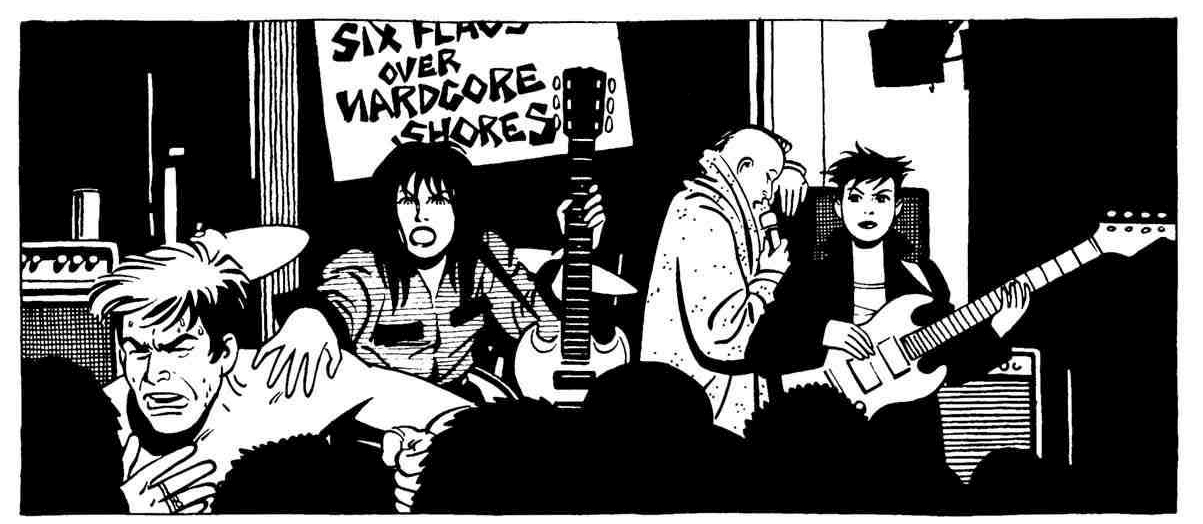
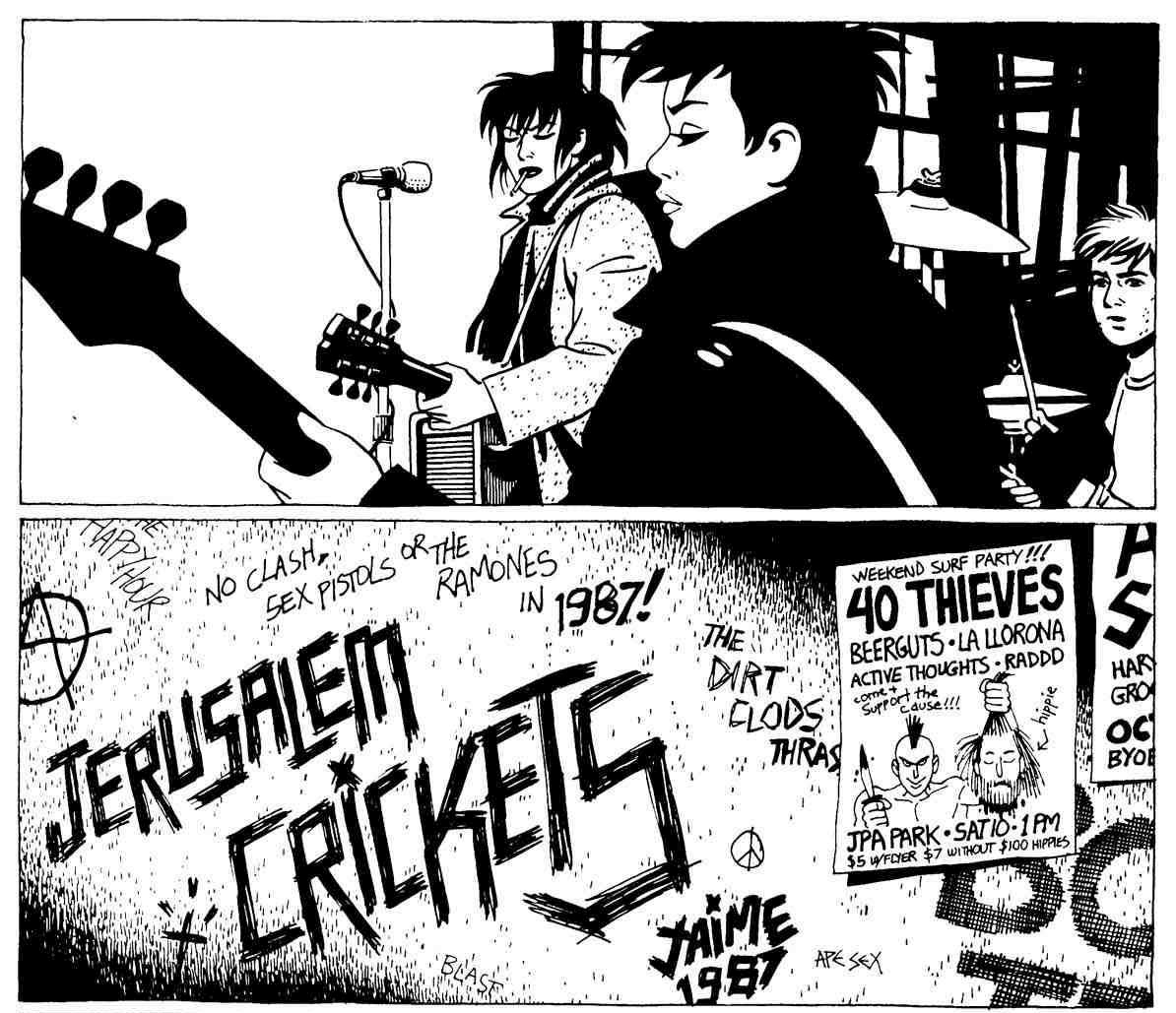
No cartoonist has ever captured the spirit of rock and roll — listening to it, watching it, performing it, defining your life with it — like Jaime Hernandez. Vanishingly few have even come close; most attempts are cringeworthy. Jaime not only nailed the style, and the intensity, and the specific idiom of his punk milieu (the graffito “NO CLASH, SEX PISTOLS OR THE RAMONES IN 1987!” in the panels below is worth more than entire critics’ bodies of work), and the nuts-and-bolts stuff like the body language of people playing music on stage, he also chronicled the lives of the characters involved long enough to be basically the only cartoonist ever to explicitly examine what it’s like when you grow up and grow older and discover that you no longer look and act and think like someone in the pit at your favorite band’s show.
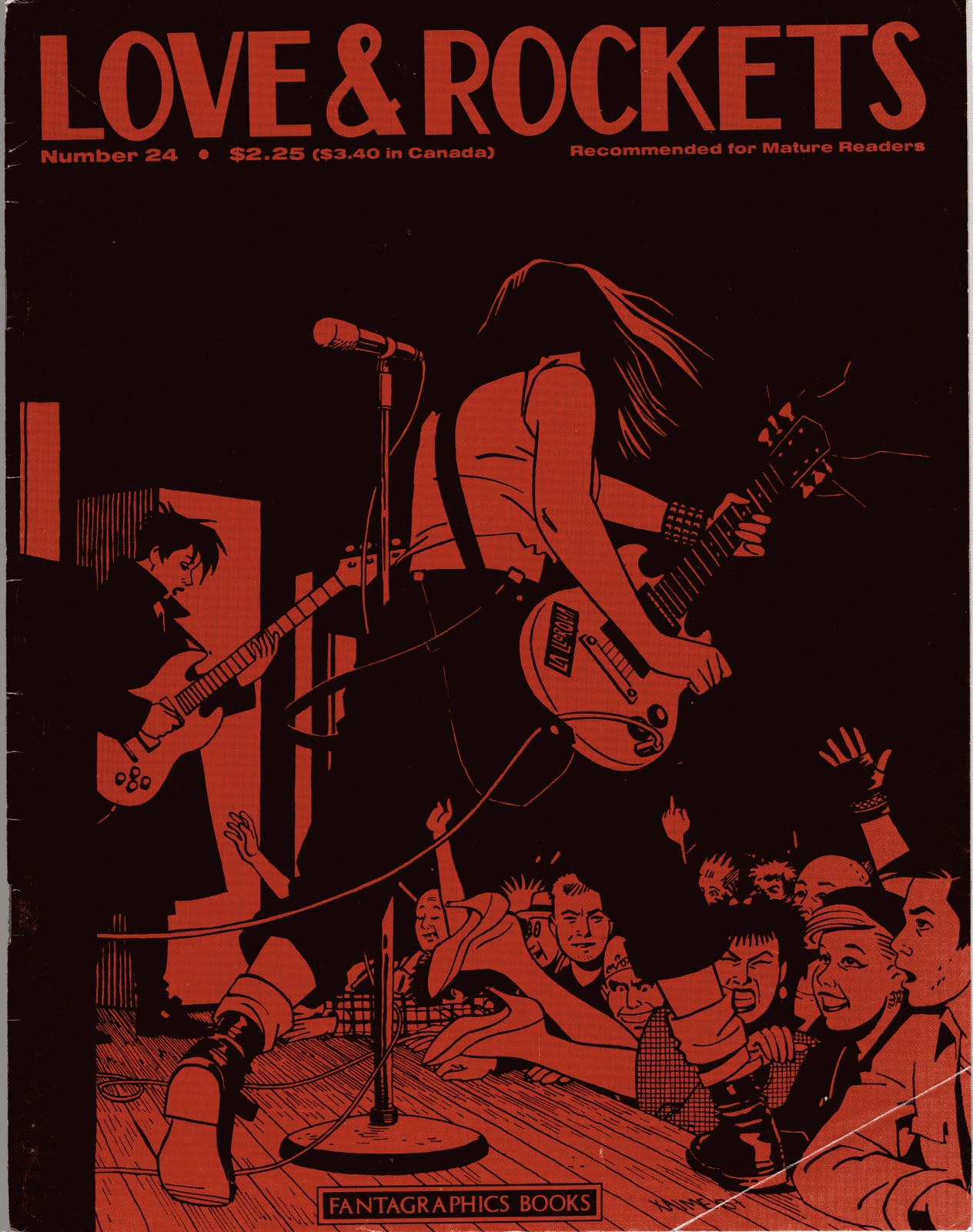
Love and Rockets, the great serial comic by Gilbert, Jaime, and sometimes Mario Hernandez, is celebrating its 30th anniversary at the San Diego Comic-Con International this week. Inspired by Tom Spurgeon, this week-long, daily series of posts will highlight some of my favorite things about Los Bros Hernandez and their comics. For more information, click here.
Comics Time: The League of Extraordinary Gentlemen Vol. III: Century #3: 2009
July 2, 2012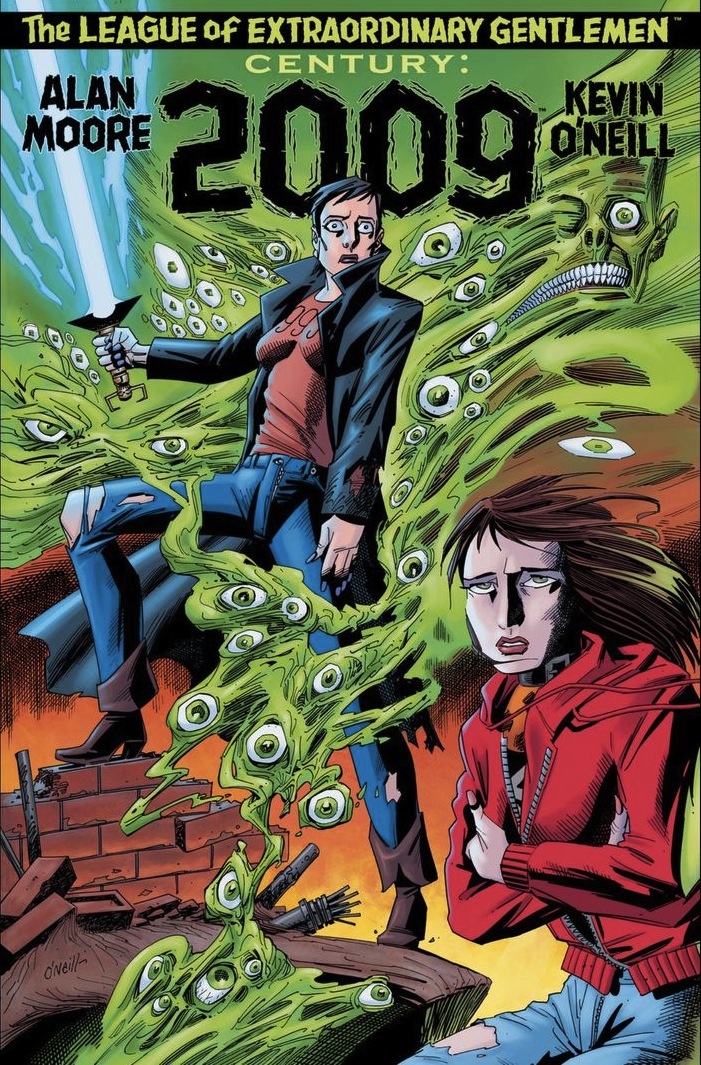
The League of Extraordinary Gentlemen Vol. III: Century #3: 2009
Alan Moore, writer
Kevin O’Neill, artist
Top Shelf/Knockabout, June 2012
80 pages
$9.95
Buy it from Top Shelf
Buy it from Amazon.com

For today’s Comics Time review, please visit The Comics Journal.
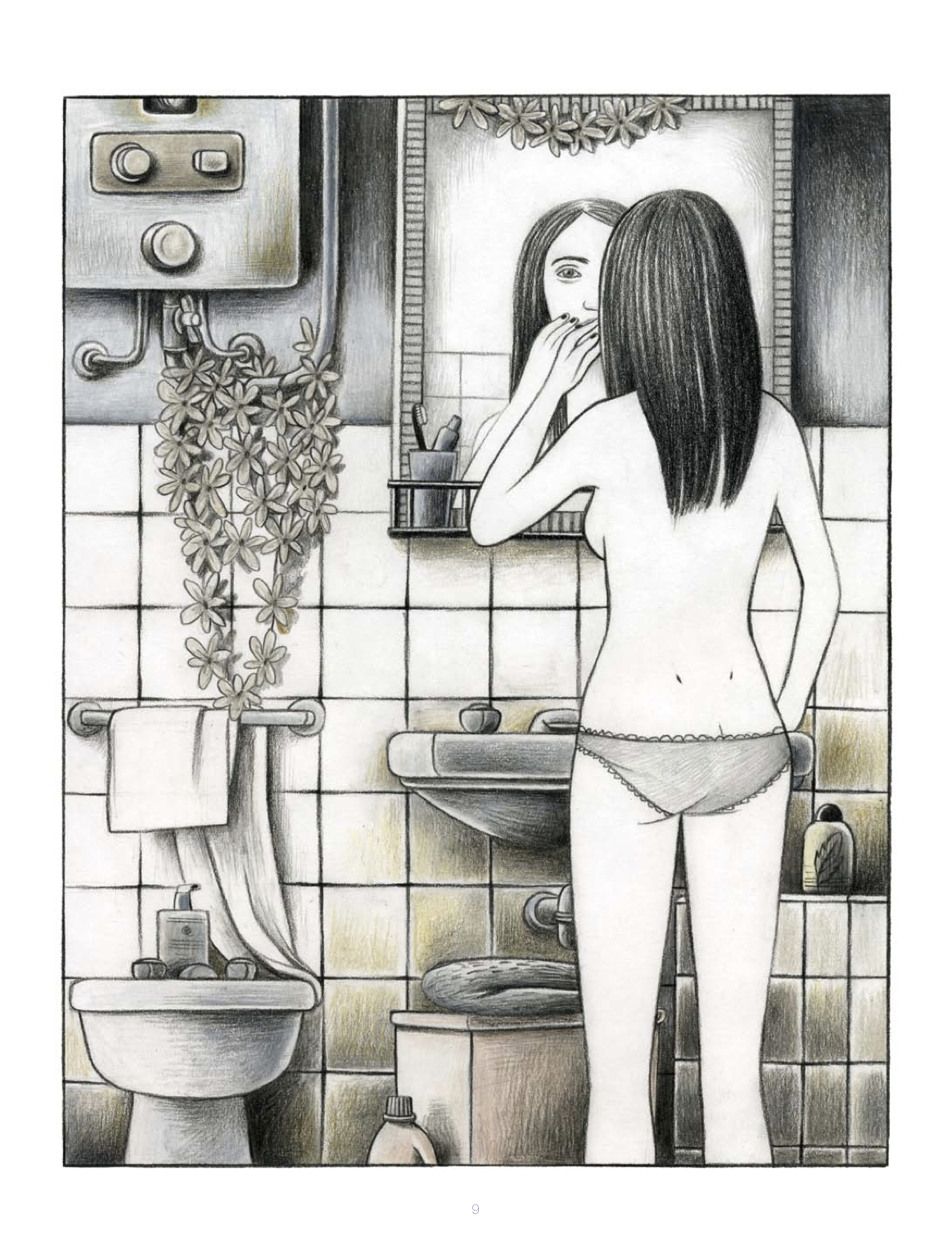
Comics Time: Interiorae
June 28, 2012
Interiorae
Gabriella Giandelli, writer/artist
Fantagraphics, 2012
144 pages
$19.99
Buy it from Fantagraphics
Buy it from Amazon.com

For today’s Comics Time review, please visit The Comics Journal.
Comics Time: Annie Sullivan and the Trials of Helen Keller
June 22, 2012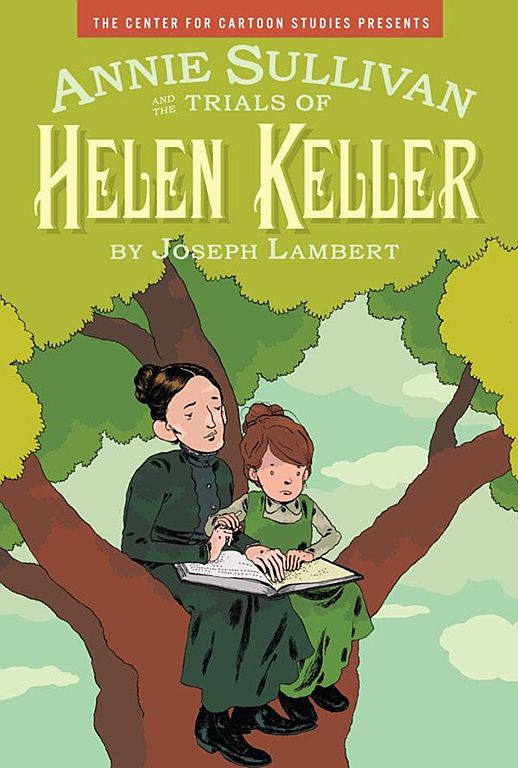
Annie Sullivan and the Trials of Helen Keller
Joseph Lambert, writer/artist
The Center for Cartoon Studies/Disney/Hyperion, March 2012
pages, hardcover
$17.99
Buy it from CCS neighbor the Norwich Bookstore
Buy it from Amazon.com

A dual biography of deaf-blind Helen Keller and her teacher, mentor, guardian, and lifelong companion Annie Sullivan — whose own coming-of-age tale of overcoming near-blindness, abject poverty, orphanhood, loss, lack of education, and a generally piss-poor attitude is depicted in parallel with Annie’s better-known story — Annie Sullivan and the Trials of Helen Keller is the best comics biography since Chester Brown’s Louis Riel. Like Riel, it succeeds, it innovates, as comics as much as it does as biography. It does so with none of the repetitive tics that marred cartoonist Joseph Lambert’s earlier work, here supplanted by the intensity of the story’s central challenge and Lambert’s own clarity of purpose in meeting it. And more than Riel, it’s a work of immense and intimate emotional power, deeply touching and profoundly moving without ever growing maudlin or manipulative.
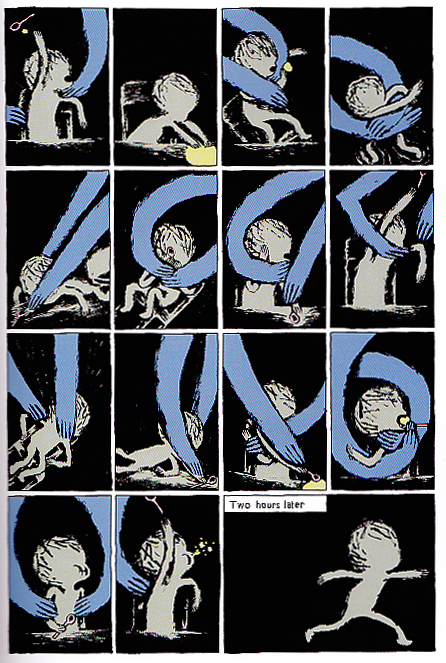
The key visual conceit is Annie’s world: black, comprising her sketchy self-image, objects she encounters rendered in a dull brown, things with which she has any kind of emotionally charged interaction (from her family to food) colored in sidewalk-chalk primaries. Spend more than two seconds thinking about experiencing life like this and it’s harrowing, even horrifying, but Lambert holds back on depicting it as some existential hell, since after all, this is the only life Helen really knows. (She went blind at 19 months of age, and neither she nor her caretakers are sure what, if anything, her brain remembers from its sighted experiences.) Annie’s quest is to get Helen to understand that the hand gestures she forces her to perform when touching new objects or requesting familiar ones aren’t just a game to play, but a way to label these objects, and thus to understand them and their relationships to one another.
Though Lambert’s access via cartooning to Helen’s inner world is unique among depictions of this well-worn story, it’s only through juxtaposition with the more traditionally told tale — the literal wrestling matches bas Annie tries to physically force Helen to learn — that the magnitude of Helen’s struggle becomes clear. Without seeing Helen in all her painfully adorable and vulnerable and angry tousle-haired glory, throwing plates and running into walls and knocking Annie’s teeth out and leaving both teacher and student in (magnificently well-drawn) prostrate exhaustion amid debris-strewn rooms, her famous eureka moment at the well, which we see alternating back and forth between Annie and Helen’s perspectives, would not have the power it does. When big block-lettered NAMES finally emerge into Helen’s mental void, it’s not just WATER or HANDLE or PITCHER or even TEACHER that get their names, it’s the inchoate fury that’s plagued her like an infection all her young life. In this case the diagnosis is the cure. Lambert’s depiction of her almost unbearable excitement at finally getting it, frantically touching and signing out the names of everything at the pump until she reaches “TEACHER” and collapses into an embrace of the woman who effectively gave her a voice and saved her from insanity, is easily the most emotionally moving sequence of comics I’ve read all year. I’m crying just writing about it.
The visual language Lambert develops for Helen’s own developing language isn’t the sum total of his artistic strengths here. Now, for the life of me I’ll never understand how dully acidic, Exorcist-vomit green became the default background color for comics imprints with mainstream aspirations, from Vertigo to First Second, and in this Disney-Hyperion release Lambert overuses that lamentable hue. But it’s more than offset by the stunning Mentos-variety-pack skyscapes and lush green fields and trees of the Keller homestead; the subtle and astute interplay of trademark colors for the two women in Helen’s life, blue Annie and pink Mother; the use of various muted grays, blues, pinks, and yellows to differentiate spacial and temporal settings within Lambert’s not-an-inch-wasted sixteen-panel grids; brief but memorable uses of bright red or high-contrast black and white; and of course the very direct but still very effective depiction of the pre-speech Helen’s world as a black and gray-brown void into which new sensations intrude in synesthetic terror and splendor.
The book culminates in scandal — a minor one in the context of the Sullivan/Keller legend lo these many decades later, but a catastrophic upheaval in the lives of Annie, Helen, and their benefactors at the Perkins Institution for the Blind at the time. The climactic interrogation sequence, in which the school’s instructors grill Helen for hours about a potentially dubious achievement she’s alleged to have made, stands firmly in the grand (inquisitor) tradition ranging from O’Brien and Smith in Ninteen Eighty-Four to the real-life questioning of the West Memphis Three in Paradise Lost. It’s a hugely upsetting and dispiriting scene, one which literally reduces Helen to the sketchy, spectral brown shape running around in the darkness that she was before Annie illuminated her world.
The real trap of it is that it’s precisely that act of illumination that damns Helen in her interrogator’s eyes, and partially in her own. When her life is one great string of discoveries, her joy is unstoppable; when she’s forced to confront how those discoveries were all filtered through one other person, she can no longer trust her own ability to determine where she ends and Teacher begins. Is she the water, or just the pitcher into which someone else’s water was poured? Moreover, the trap is twofold: . Lambert’s third-hand revelation of Annie’s potential deceit is deftly done, and breathtaking in the way it takes what we’d come to see as virtues in “Miss Spitfire” and unveils them as potential faults. Based on everything we’ve seen of her — her desire to get the full credit she deserves, no less but also no more — it’s highly unlikely that she consciously committed the crime of which she stands accused. But also based on everything we’ve seen of her — her defiance, her refusal to be cowed, her sneakiness, her confidence that she’s the smartest person in any given room — her role in the cover-up is all too believable. For Lambert to prove himself capable of character work this subtle and rigorous, character work that complicates and enriches the character rather than reducing them to mere angels or martyrs, in a book that moves from strength to strength visually as well, is almost unfair.
Every year there’s a comic that makes me end my review with the sigh of awestruck resignation: the exclamation “What a comic.” This is my “What a comic” comic of the year to date. It’s stunning. Don’t miss it.
Comics Time: Jerusalem
June 18, 2012
Jerusalem
Guy Delisle
Drawn and Quarterly, 2012
320 pages
$24.95
Buy it from D&Q
Buy it from Amazon.com

For today’s Comics Time review, please visit The Comics Journal.
You shouldn’t have worn that dress?
June 15, 2012I wrote about a memorable live performance of “Sex Type Thing” by Stone Temple Pilots for my music tumblr, Cool Practice.
Girls thoughts: the return
June 15, 2012Been thinking about this show some. Mostly because it’s very funny, and I like thinking back on it and going “Haha, that was funny!” But aside from that:
* The AV Club’s Todd Van Der Werff argues that Girls suffers for not falling into the currently acceptable molds for “great television,” i.e. the rapidfire single-camera sitcom mode established by Arrested Development or the alpha-male-dysfunction drama mode established by The Sopranos, with a particular emphasis on how the latter template has hampered the ability of prestige shows based on women to connect with critics or audiences. This seems more or less indisputably true to me.
* And it reminds me that one of the funniest and most subversive things about Girls is how it depicts boyfriends as lunatic aliens, the way most sitcoms depict girlfriends. Between Hannah’s (until recently) gruesomely insensitive Adam and Marnie’s (until slightly less recently) well-meaning but obliviously overattentive Charlie, it’s like a satire of how women in comedies are made the butts of jokes if they’re not goldilocks—not too needy, not too independent, just right.
* What’s more, it’s not done with the usual “am-I-right-ladies” tone of fake-empowered commiseration that you find in shows where the hot, smart woman is married to the fat, dumb man, or in commercials where the husband’s idiocy is remedied by the wife’s shrewd use of Product X. My own wife has always described this dynamic as a bone thrown to women in hopes they won’t notice what a condescending snowjob it is: “Sure, girls, we may only make eighty cents on the dollar, but even though it has no effect on our standing in society whatsoever, we’re secretly the smart ones!” Nope, as hapless as they are, the women of Girls are the alphas of the story in the sense that they’re unambiguously the protagonists, the drivers of the story, and the bad behavior of the guys is something they put up with out of choice, not because that’s the way the world must needs work. The narrative could, and did, find a way for Hannah and Marnie to no longer be long-suffering, something unimaginable in Home Improvement or that Excedrin commercial where the guy destroys his deck furniture with a power washer.
* Girls is also just a very funny, brutal, and gross sex comedy. From Hannah asking a one-night stand if she’s tight like a baby, to her leaving the bathroom to find Adam heedlessly jerking off, to (my favorite) the exquisitely explicit and mortifying scene in which Marnie re-breaks up with Charlie after cajoling him back into a relationship right in the middle of cowgirl, you’d have to turn to an alternative comic from the ’90s to find anything else as intent in delving into sex’s wettest, squishiest, most embarrassing places within a recognizable milieu of unhappy young people. The fact that it has no nasty misogynistic aftertaste just makes it all the better.
* None of this is to say that that material can’t be alarmingly, almost frighteningly powerful, too. Adam’s mortifying, self-lacerating monologue from that two-man show hit awfully close to home, for example — I mean, there is no doubt in my mind that I viewed my success with the opposite sex during my late teens as vindication that I wasn’t the ineffectual loser that bullies and popular kids had made me out to be. (Though in my case the “I’ll show YOU” element was never directed at girls, only the guys with whom I was locked in illusory competition for coolness via sexual proficiency.)
* One Girls criticism I never see anyone (except Douglas Sherwood) make but for which it’s wide open: Lena Dunham seems never to have struggled like Hannah. They’re the same age—Hannah’s unemploy[ed/able], Dunham’s on HBO. You could argue she and the rest of the show’s quite successful young writers and actors are condescending to their characters. I wouldn’t buy it, necessarily, but it’s better than “HBO hired her because her mom’s Laurie Simmons.”
* I’ve never had a problem with the way the show inserts genuine pathos into the cringe comedy and social satire. For one thing, that never seems to bother anyone when NBC’s Thursday night line-up does it, so why should it rankle here? As long as both aspects are finely observed and portrayed — as long as it’s not the sitcom equivalent of The Host — tonally shift all you want.
* That said, the big argument between Hannah and Marnie in the most recent episode was the first time I felt like however proficient they are with the comedic material, they might not quite be up to the big drama moments. Admittedly it suffered from apples-to-apples comparisons with some of the all-time greatest scenes in history, though: Don vs. Peggy, Tony vs. Carmela, Walt vs. Jesse. It’s almost unfair.
* My one quibble with Van Der Werff’s post is when, in a passage on how the show’s detractors come up with new reasons why it’s not any good every week depending on what’s the softest target, he says “One week, it’s the idea that the show’s ‘not funny enough,’ whatever that means.” I think it’s really easy to understand what that means: I laughed five times total during the first two episodes, and that’s not funny enough for a comedy. But it got much funnier, and now I laugh at it as hard and as often as I do anything else on televison.
STC & the Mindless Ones vs. Mad Men
June 15, 2012I’ve joined The Mindless Ones for their review of Mad Men‘s Season Five finale. I was super-flattered by the invitation — these guys have done some really remarkable writing about that show over the course of the season.
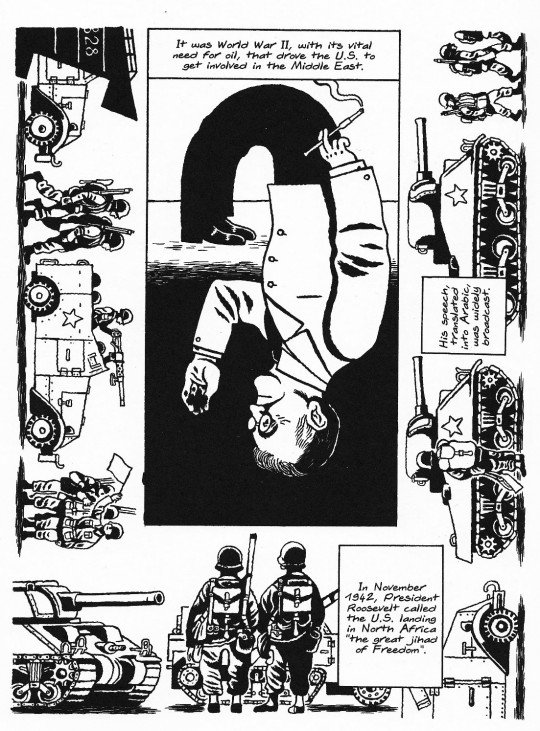
Comics Time: Best of Enemies: A History of US and Middle East Relations – Part One: 1783-1953
June 12, 2012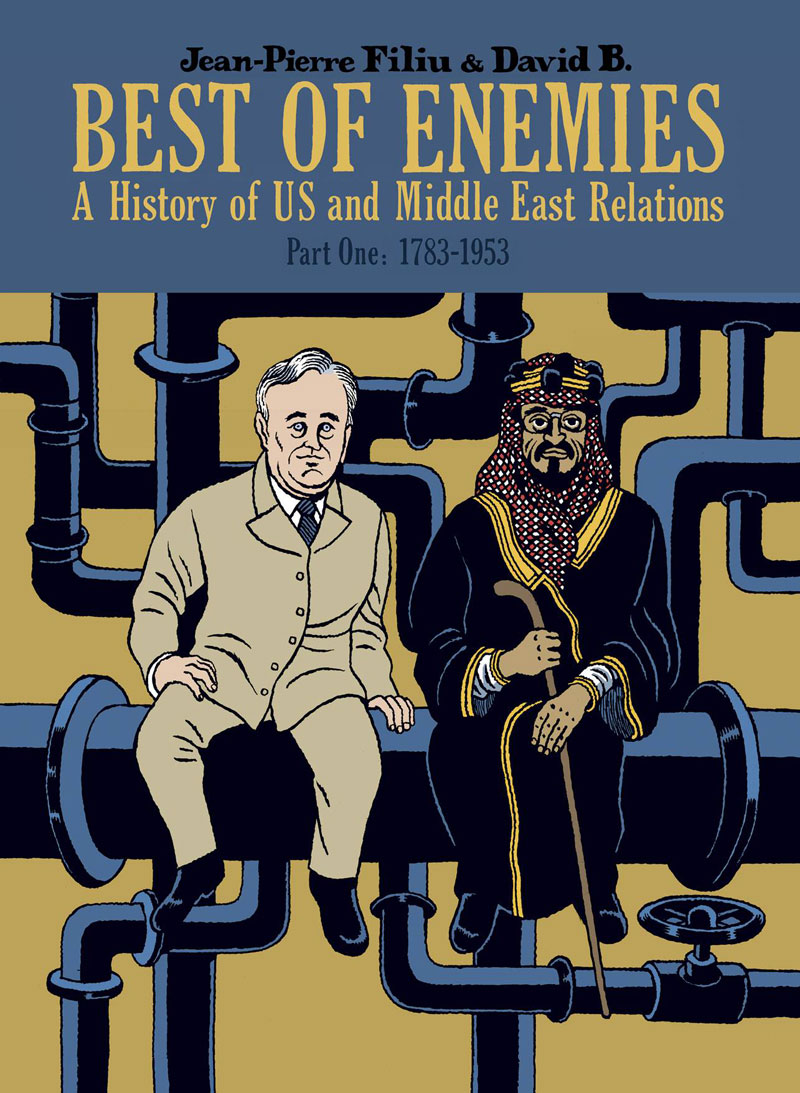
Best of Enemies: A History of US and Middle East Relations – Part One: 1783-1953
Jean-Pierre Filiu, writer
David B., artist
SelfMadeHero, 2012
120 pages
$24.95
Buy it from SelfMadeHero
Buy it from Amazon.com

For today’s Comics Time review, please visit The Comics Journal.
Mad Men thoughts, Season Five, Episode Thirteen: “The Phantom”
June 11, 2012* “This program contains brief nudity.” YES.
* Don has a toothache. Very “Test Dream.” Perhaps that’s the best way to understand “The Phantom,” from the seen-and-not-seen title on down: an experiment in investing a “real” episode of television with the nervous energy of a dream. Don’s repeated hallucination of Adam was the most obvious element, but there were also a series of gestures of finality that made it seem like various characters were waking up from the events of the season. Megan gets her “big break.” Pete gets the Manhattan apartment he wanted. Roger’s on top of the world again, smiling naked at the skyline, the trickster god triumphant. The agency is flush and ready to expand. Don has his rotten tooth removed, and in the end seems ready to get back up to his old tricks thanks to the most portentous cut to black since The Sopranos. Were Beth and her ECT-induced memory loss — her feelings and actions washed away, leaving her resplendent in recuperation and ready to face a new day — the key? Was it all a dream?
* Pete grabs Beth’s scarf as it trails behind her luggage on the train. Oh, Pete, you hopeless romantic, you. Everything that makes you happy slips through your fingers.
* Now that we know what Harry was asking Joan about in the elevator, I have to give the “Next week on Mad Men” from last week props for a terrific fakeout. Who can blame anyone for assuming Harry, that grinning dope, would be the one to ask Joan about how she got her partnership?
* Adam???
* “I’m so bored with this dynamic.” Right on, Sal. I wonder how much longer Don and Ginsberg will put up with each other.
* Pete’s absurd high-backed leather office chair.
* “Don, I give you my proxy—I’ve got things to do.” “We can do that?” Has there ever been a group of businessmen less interested in being businessmen?
* So Beth is a sick person. I get it now — the joyless simulacrum of pleasure in lieu of pleasure itself.
* I’m not the only one who thought Glen’s the heavy breather on Megan’s phone, right?
* Pete’s plan is to escape to L.A., like Don did. Something about tragedy and farce?
* A door in a dark place Beth wants to go through. Resonant image, man.
* Pete says suicide is “for weak people, people who can’t solve problems.” So that’s how he’s dealing with Lane’s death. I actually did more thinking about Pete’s reaction over the past week than I did about anyone else’s. Surely his feelings toward Lane were mixed, to say the least, after the humiliating beating the buttoned-down nebbish doled out to him a few months back, although it sure seemed that Pete’s horror and sadness over his death were real. How do you deal with the death of someone within your circle who you’ve come to dislike? It isn’t easy, though in my experience the dislike doesn’t change much, except as a marker of the waste inherent in death. That’s how I spent the little time I had dealing with this person? But if Pete feels that suicide is terminal weakness, and a terminally weak man beat him up, what does that say about Pete?
* “I thought you hated advertising.” If you were wondering how Don had really processed Megan’s departure from the agency for an acting career, look no further. “Well you certainly don’t think it’s art, and you’re an artist, aren’t you?” Nasty, man, and targeted not only at her insecurity about who she is and what he does, but implicitly at his own, too.
* Megan gets her own chance to broadcast her deepest problems with their relationship, after she gets hammered. “This is all I’m good for,” she tells Don as she tries to seduce him, and it’s not clear if she’s sarcastically referring to how she thinks he sees her, or how she sees herself. (Answer: C) Both A and B.) Then more shots at Don, alleging he wants her to fail so that she can be the proper homebody he supposedly wants her to be. I’d say that this isn’t true, that he always works to temper his initial unpleasant reactions to news of the demands of her career in a way he never did after fights with Betty, and that after he sees how fucked up she is over her failures he goes ahead and gets her the commercial gig after all. But is that because he truly values her happiness, or simply the peace and quiet that goes with it?
* At least now we can see why he has the problem he has with her acting career, particularly as it takes on a more commercial manifestation: He now cannot help but see her as a product to be sold. Watch his face curdle as he watches her test real, the smoke in the air solidifying the beam of light from the projector and literalizing the male gaze like it’s one of Cyclops’s force blasts. (The circle on the chest of Megan’s dress is the bullseye.) He goes from pride and enjoyment to…bleh, something’s wrong with this. Of course, what’s wrong is that he’s watching her in the conference room where he’s no doubt screened a million ads for a million products. “Megan Calvet” is just the latest thing he needs to figure out how to sell. This circles back to his reaction to her performance of “Zou Bisou” in front of their friends and coworkers — he didn’t want them to have access to her, and to his relationship with her, in that way. (Note how the sophisticated, sexy “European-ness” of “Zou Bisou” has now been transformed into a comical, over-the-top mirror image for the commercial.) It circles back to his reaction to her departure from advertising — he wants her to be in the elite, the people who are in on it, the salesmen, not for her to be the thing being sold. It circles back to his reaction to Joan’s indecent proposal, and to his worst-ever insult for Betty a season or two back, and to paying a prostitute to hit him in the face, and to Lane’s wife use of brothels as the coup de grace in her dressing down of Don when he visits her to drop off the check — because of his mother, he is horrified by the idea that a person can be bought and sold.
* About that check: I think Don really does think he’s done something kind for Lane’s family, and not in a self-congratulatory way, either, but because he wants to be kind to Lane’s family. He and Joan don’t even bring it up for a vote, not even after Joan says they ought to: He’s going to do what he can to make it up to Lane, and by proxy to his brother. (Ah, proxy: “We can do that?”) For her to throw it back in his face like that must have been genuinely upsetting to him.
* If Lane had been able to hang on for four months he’d have been fine.
* Jeez, Maman is a monster. It’d take an awful lot of work on being deliberately awful for me to get to a place where I’m comfortable dismissing my own daughter as having the artistic temperament without actually being an artist. What a devastating line. If this is secretly Maman’s self-assessment, as Megan alleges when she throws her “the world couldn’t support that many ballerinas” comment back in her face, that only makes it worse, the same way that Don’s self-doubt only fuels the worst elements of his reaction to Megan’s career.
* Just as devastating: Pete, telling Beth/himself that his life with his family is “just a temporary bandage on a permanent wound.” Pete is horrible in many ways, but at that moment could you feel anything less than total sorrow and sympathy for him? How do you get out from under an injury that deep? Say whatever else you want to say about Pete, but it takes strength and bravery to face yourself like that and declare that your whole life is a waste. It’s a courage you don’t really even want to have.
* At least there’s Roger around to brighten things up — the Loki of the Sterling Cooper Draper Pryce pantheon. Look how happy he is just to have successfully tricked Don and Megan with his Emile impersonation! Watch as he finds the single funniest, smuttiest thing to do or say in any given situation: “What is ‘Regina’?” Witness his triumphant gaze and mighty buttcheeks as acid sends him the message that he is indeed the master of all he surveys!
* Many lovely, haunting shots in this thing. Megan leaving the frame as she turns on the shower, her bright pink robe hanging on the wall like a gun waiting to go off, which it later does. Roger and Megan’s mom on that vast gold bedspread. Lane’s empty red chair looming in the background as Don passes his wife the check. The glory shot of the five partners silhouetted against the window of the new office space.
* “Give me an old fashioned.” Oh, Mad Men! Seriously though, that kind of directness is a lot of fun. If this were an action show they’d make points by shooting people, and if this were a straightforard comedy they’d make points with jokes, and here they make points with symbolism. Why not enjoy it?
* “Are you alone?” I guess it depends. Adam tells Don it’s not the tooth that’s rotten; at just around the same time, Don’s relationship with Megan appears poised to permanently sour. Was it the good part of Don that was removed? Did they take out his sweet tooth instead?
Music Time
June 8, 2012I felt like I should again note here that I’m writing about music for my new blog Cool Practice, about songs and videos that read as “cool” to me.
* Beastie Boys – “So What’cha Want”
* Public Enemy – “Fight the Power”
* Country Joe McDonald – “The ‘Fish’ Cheer/I-Feel-Like-I’m-Fixin’-to-Die Rag”
* Nine Inch Nails – “March of the Pigs”
I hope you like it.
Mad Men thoughts, Season Five, Episode Twelve: “Commissions and Fees”
June 4, 2012* We’ll get to it eventually, don’t worry.
* But first: A weirdly optimistic episode, in its “Other than that, Mrs. Lincoln, how was the play” way, no? As though the whole show had heard “You Really Got Me” as Peggy got on the elevator and reacted accordingly?
* For instance: Apparently SCDP has successfully completed its public-image turnaround. Both the rival ad exec, who has no reason to brownnose Don, and the 4A guy, who has no reason to hire Lane, say how impressed they are. Dunlop basically does the same thing by seeking the agency out rather than vice versa. The mood is reflected among every non-Lane partner.
* What’s more, Don’s got the fire in his belly again, to an alarming, almost monstrous degree. For the first time in ages he seems like the kind of man Connie Hilton would admire, a guy determined to shoot for the moon.
* And he didn’t need to sacrifice his skill with a pitch in this attempt to make big things happen again. Bulldozing Ed Baxter was brilliant lateral thinking, and moreover Don’s position of privilege allows him to pull that kind of thing off where Peggy failed in the Heinz baked beans meeting earlier in the season.
* Nor did he have to ditch his newfound kindness and empathy to make it happen. He may not have been able to pull Lane out of his nosedive, but he gave Lane nearly the exact same advice he gave Peggy in the hospital long long ago — proof he truly did care about the man and didn’t want to see him hurt any worse. He may have given Glen a lift back to school in order to have a nice long car ride to clear his head, but he saw that the kid was hurting and did his best to help. He may not have been able to bring himself to talk to Megan about Lane’s death just yet, but he was as warm and kind to her as he could be without getting into it.
* (And it’s worth noting he’s still legitimately pissed about what happened with Joan. No relief that he didn’t have to make decision himself — just anger at his partners for going against his wishes and putting his friend in such an awful position. And at her, too, it needs to be said.)
* I remain impressed and delighted with the Don/Megan relationship, by the way. He comes home and she blasts him for not calling, reading all sorts of disrespect into it — she drops it right away when he tells her what he’d been through, and from then on out it’s all sweet mutual gestures like holding hands and gently ribbing him for drinking his way through the problem. They’re the best, man!
* Like Don alleges Lane felt when the truth came out, Sally and Glen are relieved to mutually discover they don’t like each other in that way. How much better to admit it than to force yourselves to go through the motions in hopes of making it true. (I also got a nice LOL when Sally asked Glen what he wanted to do now that they had the apartment and the morning to themselves, and his was response was basically “duh–the Museum of Natural History!” I had some empty-house free-morning moments with lady friends myself when I was Glen’s age, and I had no interest going to no motherfucking museum, that’s for sure.)
* Even Betty got a nice warm moment of validation, when Sally ran home to her (despite spending an entire episode basically wishing she didn’t exist) for comfort after her Sansa Stark moment. Of course, being Betty, she converts this into an opportunity to gloat over Megan (something Megan either doesn’t notice or doesn’t give a shit about, to her credit either way), and it’s unclear from her face whether she’s capable of processing momentary closeness with her estranged daughter through any lens other than her own narcissism. But we can hope!
* On a slightly darker but no less delightful note: Ken Cosgrove, thou art avenged! Ken effortlessly kneecaps Pete Campbell after all this time, at last getting his revenge for the way Pete made him eat shit when he first (re)joined the new agency. When you think about it, it makes perfect sense that a guy who writes science fiction short stories under a series of pseudonyms has no problem waiting a long time for his moment in the sun — and when he saw it, he took it, with the same smiling self-confidence and security with which he does everything else. He’s actually succeeded in being what all the other people at SCDP torture themselves into trying to be.
* Great Sally moment #1: Oh, fun, fighting with Mom about food! Am I right, ladies??
* Great Sally moment #2: “I wanted to know if you would have any problem with me strangling Sally.” “Should we be having this conversation on the phone?” I laughed really hard at that one.
* Great Sally moment #3: filling that coffee cup with sugar. Sweets to the sweet.
* “Why do we do this? I don’t like what we’re doing. I’m tired of this piddly shit.” Ha, I thought Don was going existential on us — turns out he just wants bigger accounts. Well, that’s something. As Roger tells us (Great Roger moment #1), enlightenment wears off.
* Great Roger moment #2: “She’d never had room service before. It’s too easy.”
* Great Roger moment #3: Detonating Don’s months-long Ed Baxter-based impasse with a tossed-off insult: “You let that wax figurine discourage you?”
* Great Roger moment #4: “I don’t want it to sound rehearsed.” “No danger of that.”
* Great Roger moment #5: No one does “watching in slightly slackjawed, mildly dazed amazement as someone else walks away after doing something surprising” like John Slattery does.
* Nothing convinced me more of the finality and seriousness of Lane’s suicide attempt than when he broke his glasses in half. As a glasses-wearing person I can’t even think of doing that. That’s just destroying your ability to interface with the entire world.
* Don’s confrontation with Lane was excruciating on any number of levels. He’s firing a man for forging a signature he himself has been forging for decades. He’s firing a man for breach of trust in a company whose trust he breaches every day just by showing up. He’s offering to keep Lane’s secret but threatening to expose it should Lane force him despite having a huge secret of his own. And as we see a few minutes later, he’s reprimanding Lane for not coming forward with the problem despite having kept secret Ed Baxter’s revelation that the Lucky Strike letter sunk the agency with the big boys. The way Jon Hamm plays it, it’s clear Don’s acutely, painfully aware of all of this, but has to do it anyway. I kept waiting to see if this had weaponized Lane in some way, made him capable of destroying Don in return. I’m glad it didn’t. I wish it did.
* The car won’t start. Rimshot! In all seriousness the buildup and follow-through of Lane’s death by Jaguar was the show at its most Sopranos, which is to say the show at its best.
* I want to point out how exquisitely staged the discovery of Lane’s body was. Listen to the already mounting panic in Joan’s words as she goes next door to tell the guys, despite her best efforts to be calm: “I think something’s terribly wrong in Mr. Pryce’s office.” Watch as all the sight gags involving characters peering over glass to spy on other characters get transformed into a way to glimpse something horrible. Look at the empty office in broad daylight. Endure the intensely awful intimacy of Pete, Roger, and Don taking him down off the door. Watch Don’s face as he realizes a second man has now hanged himself because of something Don did, or failed to do — crushing childlike sadness.
* “I suppose you’d rather I imagine you bouncing on the sand in some obscene bikini.” Lane can’t help but befoul even the nicest thing in his worklife on his way out the door. Bon voyage indeed.
* A coldly beautiful snow falls, a figurine of the Statue of Liberty buried the frame. Sure, why not.
* Orange alert: The lining of Glen’s coat. Joan’s collar. The couch on which Pete, Harry, and Ken climb to see inside Lane’s office. Lane’s Mets pennant.
* So here are your Zoroastrian competing philosophies: “The next thing will be better, because it always is” versus “What is happiness? It’s a moment before you need more happiness!” Or to flip it, “Why does everything turn out crappy?” versus getting to drive a grown-up’s fancy car all the way home. Note which one the show ends with (eliciting crazy-person peals of laughter from me, by the way — laughter of relief). The nonsense Don’s been selling for years about a car or a Kodak being the key to a fulfilling life turns out to be true, in this very limited scenario at least. At last, something beautiful you can truly own.
Comics Time: Nurse Nurse
June 4, 2012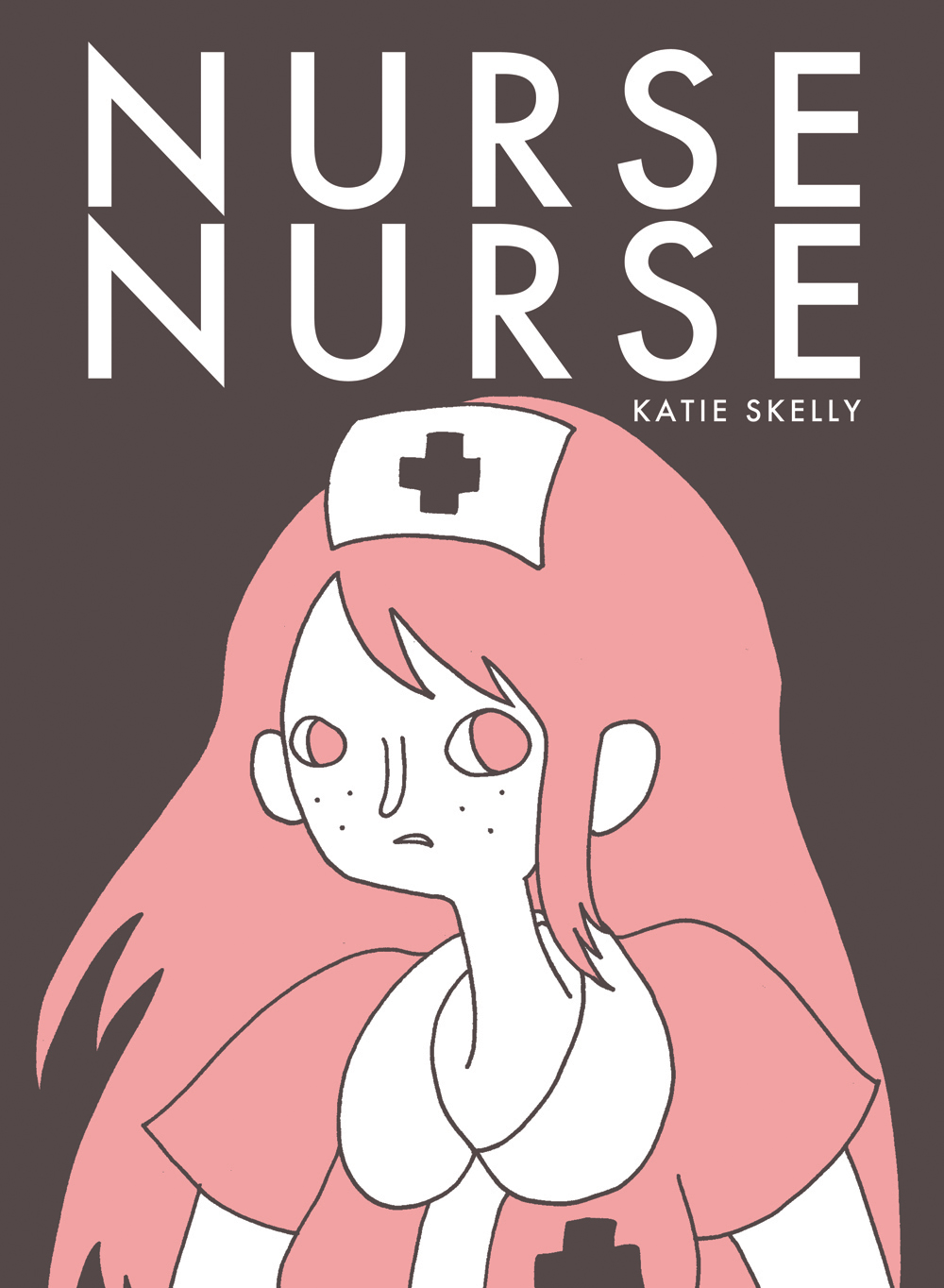
Nurse Nurse
Katie Skelly, writer/artist
Sparkplug, 2012
160 pages
$15
Buy it from Sparkplug
For today’s Comics Time review, please visit The Comics Journal.
The difference between Game of Thrones (TV) and A Song of Ice and Fire (books) in a nutshell
June 4, 2012Instead of cutting characters or storylines from the books to save room on the show, Game of Thrones cut a theme: that you are a single thread in a sprawling tapestry of history and prophecy sprawling backward and forward and sideways through time; that you have no control over the shape or design or pattern of this tapestry; that the occasional glimpses you get of the larger tapestry can be exhilarating and terrifying and awe-inspiring; that attempting to unravel the awesome mystery of what it all looks like and how it all connects is a driving force in people’s lives.
Most of the major storylines and characters remain intact; other themes, particularly the exploration of how violence destroys human dignity and connectedness, remain intact. So there’s still much of what you love from the books in the show. But the theme above is not what the creators are interested in exploring. You have to decide how to handle that on your own.
Game of Thrones thoughts, Season Two, Episode 10: “Valar Morghulis”
June 4, 2012For my recap/review of Episode 20, please visit Rolling Stone.
No, for serious: Please do click the link and read it, because that’s my real review. The stuff that follows is…I don’t know what it is. A review of my own viewing experience?
Alright. BOOK SPOILERS AHEAD. Do not read unless you’ve read at least the first three volumes.
All season long I’ve tried to chart a middle ground — not just in writing the reviews for RS, but also simply as an audience member — between considering the differences between the books and the show and not letting that be my be-all-end-all. There’s a good professional reason for that: Most of the audience hasn’t read the books, and I want something I write for a big mainstream publication like Rolling Stone to be useful to as many of those people as possible. And there’s a good critical reason for it, too, I daresay: It’s just not a productive use of one’s critical faculties to perpetually weigh an adaptation against the source, across the boundaries of different media/art forms and geared toward a different audience and with different creators behind the wheel.
Unless you’re someone for whom fealty to the book is quite openly the one metric that matters to you — and I can respect that — the fact that Littlefinger behaves differently on the show than he does in the book, say, is a value-neutral proposition. Is his new behavior well written, well acted, well shot? In the end that’s all that matters. Frankly, I don’t center my criticism on “but THIS changed, and THAT changed, and and and” as a writer, because I know how little use I’ve gotten out of that sort of criticism over the course of the season as a reader.
Now, once upon a time I tried to evaluate the series based on what non-readers would think, or even what they’d simply be able to understand and comprehend; I don’t think I lasted any longer than the series premiere before realizing what a mug’s game that was. I’m not a mind-reader and I can’t speak for those people, and it’s a waste of time to try. What I described in the paragraph above is different than that, mind you: I’m not trying to guess what non-readers think, I’m trying to base my opinions solely on the text at hand without constantly turning to an outside source for justification.
That being said, nothing can change the fact that, well, I have read the books, and I do notice the differences. And it’s clear at this point that some, but not all, of what I truly love about the books isn’t a priority for Benioff & Weiss. I don’t know why the truncation and bowdlerization of the House of the Undying came as such a shock to me given that the two most directly comparable scenes from the first book, Bran’s vision of the land of always winter and Ned’s dream of the Tower of Joy, were both dropped entirely, but it did. And that’s hard to deal with, man! If I were to make a list of the most important scenes in the series so far, in terms of communicating what the series is “about,” the original House of the Undying sequence would be in the top four, behind only Jaime throwing Bran out the window, Ned’s execution, and the Red Wedding. For all intents and purposes it’s not in the show at all, not in a form that counts — a form freighted with all that prophetic information and linking Dany to a grand tapestry of past, present, and future events. And that’s a loss to me. To a lesser extent, so is turning Brienne into a fury-fueled killing machine, or making it look like Jon killed Qhorin in a rage.
I don’t feel “betrayed” like Linda does, though, because I don’t understand how art can betray anyone. All of us have it within our power to make art completely harmless in terms of its direct impact on our lives, simply by not watching or reading or listening to the stuff we don’t like. Moreover there’s still plenty of stuff going on here that I DO like, centered mostly on marvelous, powerful performances, and a tendency to nail the big images, and the same healthy, bitter anti-violence message I respond to in the books.
Ultimately what I need to do, I suppose, is stop weighing the two against each other entirely — to look at the books as an outline, if at all, and take Game of Thrones as it comes, on its own terms. That’s a tall order, not because I’m married to the text, but simply because when you’ve read the source material you can’t help but remember it. Unlike The Sopranos, Twin Peaks, Deadwood, Lost, Battlestar Galactica, Breaking Bad, Mad Men, The Wire, and even Boardwalk Empire, the element of surprise that separates those shows from the pack — when I sat down to watch an episode of any of them, I literally had no idea what I might end up seeing, and that’s different from 95% of television — simply cannot exist for me with Game of Thrones. In the end, that’s the big obstacle for me, not for the show, not if I’m giving it a proper chance to be its own thing.
Mad Men thoughts, Season Five, Episode Eleven: “The Other Woman”
May 29, 2012* I’m kind of glad I had to spend Sunday night writing my Game of Thrones “Blackwater” review instead of watching this episode of Mad Men back-to-back with it. I think I would literally have died otherwise.
* At some point during the episode I simply wrote down the phrase “Christ, this is gross.” I can’t quite tell when in the episode this happened from where it falls in my notes. I think that’s telling.
* Before we get into everything we must get into, I’d like to point out that Mad Men continues to be one of the funniest shows on television, and this enormously upsetting and dispiriting episode was no exception. Highlights:
** Ginsberg’s mistress-inspired Jaguar tagline: “Jaguar: You’ll love it when you’re in it”
** Kenny standing and silently giving Peggy an ovation for her bacon-saving conference-call pitch brilliance
** Peggy staring at the catered lobster from outside the conference room
** Lane’s solution for everything: “I say we take our bonuses and move on!”
** Don literally throwing money in Peggy’s face
** Pete describing the commute: “It’s an epic poem for me to get home.”
** Ginsberg’s secret technique for coming up with good Jaguar copy: “I kept imagining the asshole who’s gonna want this car.”
** The “Ginsberg, you magnificent bastard” look of disbelieving awe and delight on Don’s face when Ginsberg gives him the great line he comes up with for the car (cf. Kenny’s reaction to Peggy)
** Even after she’s made the decision to leave, Peggy still drinks when she hears Joan’s been made partner
Whatever else they are, the really great shows tend to be darkly hilarious. That requires a mastery of tone that many other shows, even many good ones, don’t trust themselves to maintain — Battlestar Galactica, much as I love it, could never bring itself to have fun at the expense of any of its characters’ suffering (except Gaius Baltar’s, which is a big part of what made him the best character on that show). But you can count on Mad Men to go for a laugh even — especially — when plumbing the absolute depths of its characters’ emotions. Laughter is likely the only way any of us can feel in control when presented with life’s inevitable misery, I suppose. It’s a big joke, but we’re in on it, at least for a moment or two.
* “Do you really want help, or do you wanna yell at me?” “I don’t know yet.” I know I’m a broken record, but Don and Megan do not have a dysfunctional relationship. Look at the deft way in which Megan identifies, gently mocks, and thereby neutralizes one of Don’s most destructive relationship dynamics in that brief exchange. That is some high-functioning shit!
I’m not saying they don’t have problems, or even issues — they obviously do. I’m just saying everyone has problems and issues in their relationships; Don and Megan are better at addressing theirs than literally any other couple on the show, and even when they have ruptures and blow-ups, you can understand why. Megan’s intense discomfort with discussing the idea or appeal of mistresses with Don for any reason, even just as the underpinning for some ad copy, is palpable, but totally understandable given Don’s history.
Similarly, Don’s command that Megan not take her acting gig if it means moving to Boston for a preview run appears to her like he’s being both possessive of her and dismissive of her talents and career prospects, but the way he clearly has relented the next time the subject comes out indicates that this is just a very Don way of reacting to the understandably upsetting prospect of your wife moving away for three months. I wouldn’t be happy about that either! Note that when she first brings up getting a callback and an interview with the producer, Don, despite all his preoccupations, is genuinely interested. “That’s terrific,” he responds, and you think he’s just giving her a boilerplate atta-girl, but then he pauses, and says with real dawning enthusiasm, “That’s a big deal!” He didn’t have to continue the discussion at all, but instead he chooses to express to her that he understands how important this is and is as excited about it as she is. You have to view his later freak-out in that light — even though Megan is likely right and Don has never seriously considered what her success might mean for their relationship, I don’t think that means he doesn’t want her to be successful, just that he hadn’t thought it through. Don takes his time, but he’s capable of coming around to new things, we’ve learned time and time again.
Ultimately, the difference between Megan and Don and any other couple comes down to Megan’s line about how she’d handle being forced to choose between acting and Don, should he decide to make her make that decision: “I’ll choose you, but I’ll hate you for it.” Betty or Pete would grin and bear it and be miserable and make everyone else miserable in the process; a few years ago Don and Joan would have swallowed it too. But Megan realizes there’s no future in a future like that, acknowledges it, and tells Don. Now he, and they as a couple, can evaluate the truth of the matter, instead of performing emotional kabuki. TV and film have trained us to view relationships as either/or — either you’re perfectly happy all the time, or a single fight is indicative of impending doom. But this is what a healthy relationship between two adults who aren’t clones of one another looks like.
Man oh man do I want things to work out for these two crazy kids!
* After all that, it sure was awful to discover that the producers wanted to see what Megan’s ass looked like.
* One last point on Megan—It looks like my crackpot theory is at least half-right: Ginsberg has a major thing for Megan. Staring wet-eyed at her as she breezes in and out of the conference room for afternoon delight with Don. “She just comes and go as she pleases, huh?” It took me embarrassingly long to realize that he wrote his killer-app tagline for Jaguar, “At last, something beautiful you can truly own,” about Megan. When Don sells the ad to Jaguar, he’s unwittingly selling a much younger man’s love for his own wife.
* Alright, I put it off long enough: Joan. In a show that’s shown us more than its fair share of completely mortifying and hateful things, her storyline in this episode is King Shit of Turd Mountain. Part of this is obvious. Joan is an intelligent, complex, capable, caring human being with a full inner and outer life, integral to the lives of any number of other human beings with which she interacts — from everyone at the agency, her participation in which is vital, to her child — but because she is a woman, and an attractive one, the fullness of her personhood is denied. Society in general and the men with whom she interacts in particular commodify her into an object to be bought and sold, a pleasing set of curves, a Jaguar you can fuck. (“At last, something beautiful you can truly own.”)
* But worse — worse than that, if you can imagine it! — is how this commodification is presented as a grotesque parody of empowerment. By agreeing to allow a stranger to purchase access to her tits and ass and pussy for the night, Joan achieves financial and professional success that would be impossible for her to achieve any other way. It really is the smart business decision for her, guaranteeing a better future for her and her baby and her business, provided you’re willing to ignore the intangible cost to the human fucking dignity of everyone involved.
* Worse still? Despite their years together — 13 and counting, as Don helpfully/crushingly reminds us during his conversation with Peggy — all of the partners save Don are capable of viewing the leasing of Joan’s sex to some car salesman as a business expense. I’ve never wanted to punch Bert Cooper in his grinning face harder than I did when watching his nonchalance ooze all over the screen during those meetings. And Pete! Good Lord, whatever was good in him has been crushed to pieces. Actual note I wrote while Pete pitched her on prostituting herself: “What the FUCK, Pete, what the FUCK!” They’ve forced Joan into a position from which they can never respect her again, right? How can they respect her? That was my first thought. But then I thought, how can they respect themselves? Then: How can she respect them? Then: Given what she’s already seen of all of their behavior, how could she ever have respected them? Is this any worse than what all of them, to a man, have already done in her line of sight? Finally: How can she respect herself? Every time she sits in on a partners’ meeting, all of them knowing what she had to do to get there — isn’t her entire life and future now Jane Siegel-Sterling’s new apartment, forever tainted by sex she shouldn’t have been asked to have?
* But the absolute worst, from the narrow and narcissistic perspective of a heterosexual male Mad Men viewer? The loathsome car saleman Herb’s final line before getting down to business. “I don’t know how much longer I can restrain myself. Let me see ’em.” Emphasis mine. Actual, verbatim thought when looking at Christina Hendricks mine. Yours too, if you swing that way, I guaranfuckingtee it. The parallel storyline of Megan the actress being evaluated based on her hotness the same way we viewers evaluate the Mad Men actresses based on their hotness made it crystal clear: We’re all implicated in this transaction.
* OH JESUS PETE’S READING GOODNIGHT MOON TO HIS BABY DAUGHTER AFTER HELPING TO CREATE THIS UNBEARABLY SHITTY WORLD FOR WOMEN THAT HIS DAUGHTER WILL GROW UP TO INHERIT, OH JESUS. Yeah, that one hit home.
* Don’s involvement in and reaction to Joan’s transaction was the added degree of difficulty few if any other shows would even attempt. For starters, now we know why we spent so much time with the two of them last episode, and it wasn’t just because it’s deeply delightful to watch Don and Joan, and Jon Hamm and Christina Hendricks, interact. It was to establish the depth of their friendship and respect for one another, a respect neither has every sullied (my, it’s perverse putting it this way, but it’s the truth) by sleeping together. (See also Olsen, Peggy.) As my co-worker pointed out, the show very much teases the possibility that had Joan known her friend Don was not on board with the plan, she never would have gone through with it at all. One thing the really great ensemble dramas do is explore relationships in which one character’s external voice echoes the internal voice of another. Downton Abbey‘s Thomas/Mrs. O’Brien partnership is the toxic, negative example of this, a case in which each brings out the worst in the other, eggs the other on, provides the other with the support and cover to behave abominably. It’s easy to see how Don and Joan can provide the exact opposite for each other, and how his failure to get to her in time — a failure abetted by Pete and Lane, who repeatedly smooth over the objections of the objectors (Don, but to a lesser extent Roger, who loathsomely, gutlessly agrees to go along with the pitch to Joan but clearly hates it and assumes she’ll hate it too) when presenting the plan to Joan — could well have been the thing that enabled her to go through with what she did.
* My co-worker also cracked open something I’d never ever thought of before: Don hates the idea of Joan prostituting herself because his mother was a prostitute! Moreover, this is, in its way, the Rosetta Stone for his entire view of women — relentlessly sexualized and possessive, but disgusted with himself and them alike for that possessive element. He’s all too familiar with what it means to own something beautiful, or at least rent it.
* Welcome to THE WORLD’S MOST ORANGE APARTMENT, Don Draper. Hope you survive the experience!
* That time shift? Clever girl, Mad Men.
* “I was just about to get into the shower, but how can I help you?” Depressingly/hilariously, even Joan’s alibi is sexy.
* Don’s “one of those good ones” according to Joan, whose condescension in that line is almost tender. Don’s pitch to Jaguar was “one of those good ones” according to Roger, whose hope in that line is almost touching.
* Don thought he’d won the Jaguar account, but he was doubly wrong. First of all, he was unwittingly cuckolding himself by selling a line written by Ginsberg about his own wife. Second, he was bringing coals to Newcastle, telling a man who’d already found a way to own something beautiful that only this car could make that possible. But everyone heard what they needed to hear. It was only when Joan entered Roger’s office along with the other partners that Don’s own failure — to protect her, to succeed on his own — became known to him. I wouldn’t be in a celebrating mood either.
* “Every time someone’s asked me what I wanted, I’ve never told them the truth.” Lane provides an epitaph for the entire episode, which is all about the consequences of choosing to tell the truth about what you want, or not.
* I miss those giant headphones of Pete’s. My Dad had a pair.
* “I can never tell, ballerina, if you’re ambitious or just like to complain.” With that, Freddy Rumsen sums up my own dilemma with Peggy all season long, ever since a friend suggested that the source of Peggy’s troubles is that she might just be mediocre, what Bill Murray once devastatingly called a “medium talent.” The contrast with the “genius” of Michael Ginsberg, and her patterning of her life and career after an endangered species like Don, seemed to imply that her talent and ambition would only serve to lock her into a middling career as a middling person. Fitting that Freddy breaks her free of the impasse by telling her it’s what Don himself would tell her to do. She says as much to Don, in fact: “You know this is what you would do.” She’s trying to be like him even as she leaves him behind.
* My first thought when I saw she was interviewing with the odious, improbably spelled Ted Chaough? “Oh gross, Ted Chaough!” The kind of guy who knows his rival must be talking about him all the time, you know? Blehh. But when I saw his “negotiated” job offer — all the authority Peggy’d demanded as copy chief, but with more money than she was asking for — I sure did a 180. I shouted “Peggy! Fuckin’ take the job, Peggy!” at the screen! Who cares if Ted’s just the professional version of Duck Phillips, trying to steal the other guy’s girl?
* But I think there’s more to it than that, clearly. You don’t get to be a partner in an ad agency by throwing money and power at someone you actually think is so-so just to spite someone else. Peggy really is great at her job, and we’ve been so dazzled by Don for so long, and by Ginsberg for this brief honeymoon period, that we’ve forgotten it just like they did. (Hence the Hail Mary conference-call pitch — we needed that evidence.)
* Don is crushed by Peggy leaving. Crushed like we haven’t seen him be crushed since Anna Draper died and he sobbed in Peggy’s arms. He snorts with peevish, furious, smiling impotence when she tells him she’s going to his hated rival’s firm, like a child. Then he takes her hand and kisses it — the hand she used to come on to him during her first day only for him to brush it away, the hand she used to comfort him after the death of his only real friend (other than, perhaps, Peggy herself). He pours six years of affection, intimacy, and rivalry into a physical interaction. It’s the kiss they never shared, it’s a romantic gesture from a dead-and-gone era, it’s an indication of huge and melodramatic Respect funneled through the pressing of lips against skin. He holds it and holds it and holds it. They both hold back tears. I couldn’t.
* The kicker: Joan watches Peggy walk away from Sterling Cooper Draper Pryce. The symbolically resonant death-elevator opens not on an elevator shaft, but a kickass Kinks song about being totally at the mercy of a kickass woman. If Jaguar is proof that SDCP has a future, that exit, that song, is proof that so does Peggy.
* (Poor Kenny–Peggy broke the pact!)
* There are a couple of episodes to go, so this may change — the Lane shoe still needs to drop, obviously, and Jaguar could run back into the jungle. But now we at least can see how the show can square the circle of the agency’s story this season. The show has always ended each season with good news on the business end: Don defeats Pete, Don defeats Duck, the team defeats the Brits, Peggy and Kenny secure just enough of an account to show the world that SDCP isn’t dead after the departure of Lucky Strike. But this season was so devoted to showing everything that wasn’t working at SDCP that I wasn’t sure how, or if, they’d maintain the pattern. Could Mad Men even get away with showing the characters fail on a professional level? I don’t doubt that Matthew Weiner has the guts to do it, mind you, but would it injure a key element of the show’s appeal, even though we all oughta know better? Well, here’s your answer, perhaps: A victory that feels like a failure, like a loss, like the only way to truly be a winner is to get on the elevator and get the hell out of there.
* I’ll say it: Best show on television right now, best episode ever?
Game of Thrones thoughts, Season Two, Episode Nine: “Blackwater”
May 28, 2012For my recap/review of Episode 19, please visit Rolling Stone.
You have no idea how hard it was not to just title this one “Smoke on the Water” and call it a day.
Lost thoughts revisited: “The End” and other endings
May 23, 2012The series finale of Lost aired two years ago today. Many critics are celebrating by digging up their reviews at the time, and I figured I’d do the same.
I wrote four separate posts on the finale:
Part one
Part two
Part three
Bonus Finale Face-Off: Lost vs. Battlestar Galactica
The first was a brief, in-the-moment reaction to what I’d just seen. The second and third were long, detailed responses, posted as comments in the thread for the original post. (That thread is the single best, largest comment thread I’ve ever hosted, and is well worth reading in its entirety. It’s a real who’s-who of smart comics people, too.)
The fourth post was a comparison to the end of Battlestar Galactica that’s obviously quite spoilery for both shows, but which is where you’ll find the best explanation of my main problem with the Lost finale. For the benefit of those of you who haven’t watched BSG and don’t want it spoiled, here’s an edited version:
The first problem with the mysticism in Lost‘s finale, i.e. the purgatorial afterlife, is that it’s not tied to the show’s central driving conflict and overarching mythology. While it does seem like the Island is the world’s most direct manifestation of the force for good behind the flashsideways afterlife, that’s only a link in a very general sense. It seems like any group of people who were tied together by anything would have ended up in much the same place; moreover, the Island plot is resolved without requiring any knowledge of the show’s conception of the afterlife, if that makes sense. The afterlife ties things together emotionally, not narratively, and has no significant connection to the show’s big plot questions.
The second and more damning thing for Lost is that its conception of spirituality as articulated in that final sequence is awfully banal: The afterlife is a place generated by the force of goodness behind all major religions where you reunite with your loved ones, atone for your sins and shortcomings, and find true happiness before achieving literal enlightenment. Generic New-Age self-help stuff—whoopedy doo! The creators of Lost could have just mailed every viewer a copy of The Celestine Prophecy and been done with it. Nothing about this idea challenges me or haunts me, and thus I find myself mentally returning to the show very infrequently, if at all.
The best series finales I can think of are both sharp and sticky. They hurt you as well as wow you, and they keep you coming back, and you end up thinking better of the show because of them. Put The Sopranos and Battlestar Galactica (and even Twin Peaks, which was approaching it from an entirely different and more desperate direction) in this category. The worst devolve into sentimentality and didacticism — an unearned victory lap that alienates you from what’s gone before. The Wire‘s entire final season qualifies. Some are a sort of lateral move, in which you get a nice summation of the appeal of the series without any kind of real valedictory oomph. The final episodes of Deadwood and Dan Harmon’s last Community — neither of which were conceived of or billed as series finales, yet both of which were done by showrunners who’d seen the writing on the wall — fit this bill.
And then you have Lost, which is almost a category unto itself: nailing it in some ways (everything involving Jack), blowing it in others (the flashsideways — its unimaginative ecumenicism, its superfluousness to the rest of the final season, its negation of so much of the preceding season’s central narrative drive), and coming out as a wash in others (I love that so many factual questions were left unanswered, but like everyone I also hate that my pet factual questions were among them). As time passes it’s become undeniable that the finale hurt the show for me, but not so badly that I don’t still appreciate and enjoy everything I appreciated and enjoyed about the show before it aired. I don’t feel I wasted my time.
Comics Time: Difficult Loves
May 23, 2012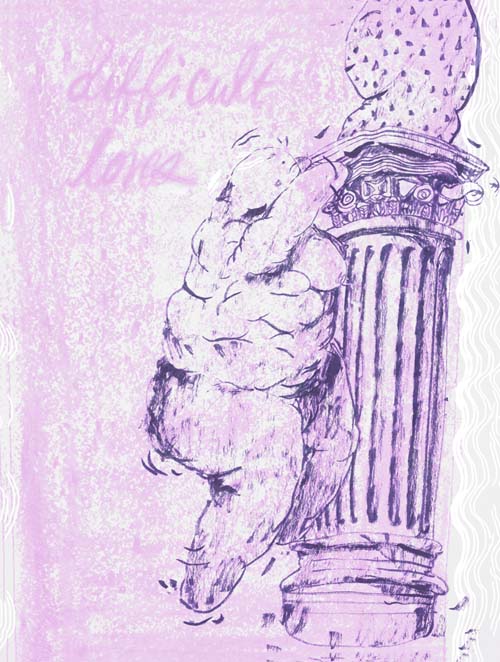
Difficult Loves
Molly Colleen O’Connell, writer/artist
Domino Books, May 2012
24 pages, 2 poster inserts
$6
Buy it from Domino
For today’s Comics Time review, please visit The Comics Journal.
Mad Men thoughts, Season Five, Episode Ten: “Christmas Waltz”
May 22, 2012* Said it once before but it bears repeating: This is the sexiest show on television. And I’m not even talking about “Mother Lakshmi” bending over Harry’s desk and looking back and saying “Take me like this,” despite that being hotter than all the rumpy-pumpy on Game of Thrones combined. (That’s not a dig at Game of Thrones, really — sex on that show is not about pleasure and desire, for a reason.) I’m talking about the ELECTRIC SHOCK that ran through my body the first time we saw Don touching Joan, grabbing her around the waist to pull her away. I mean, holy shit, I had an involuntary seizure, practically. Simply seeing these two alpha predators in close contact was viscerally thrilling, and their dynamic throughout the trip to the Jaguar showroom (“Oh honey, what’s that?” Joan drawls about the sports car, rippling through the timestream to put me through puberty) and their long drunken afternoon at the bar was dynamite. Two people who each know the other is the most attractive person they’ve ever known, luxuriating in that shared knowledge, choosing never to act on it anyway? Aw man, that is like the richest dessert the show could possibly serve us. Seconds, please.
* The return of Paul! Though it turns out his time with the Hare Krishnas hasn’t really made him much happier, was I the only one who was glad to see he’d really gone for it? From what I can gather about critical and audience response to his earlier nods in the direction of protest and counterculture — his trip with the freedom riders, his black trophy girlfriend, his beard and weed and overall hipster affectations — no one really thought he had it in him to go this far. But he left it all behind, he really did — the things that are keeping him from full Krishna consciousness are loving a woman, wanting to write good science fiction, and worrying if people like him. How the hell could you not sympathize with that?
* Glad to see Ken Cosgrove’s not the only Sterling Coo alum who’s a sci-fi nerd. But perhaps there you see the contrast between Ken and, well, pretty much everyone, from Paul to Don to Megan to Peggy: Ken feels no need to suffer for his art.
* Harry stands out on this show because he has no gravitas. His discomfort and unhappiness and awkwardness is always played for laughs rather than treated as symptoms of a font of internal turmoil. Don not caring for him is telling: Don values depth, though he despises the flaunting of it.
* Lane’s storyline was awfully dispiriting. When he finally gave in and outright forged a check to get out of his debt to the taxman, even the score got upset about it. There’s something to the idea that it’s not the mercurial genius or the rich playboy or the frustrated up-and-comer or the out-to-lunch founder who’ll bring down SCDP, but the stiff-upper-lip accountant.
* Lane forges Donald Draper’s signature, something Don himself has been doing for years.
* Roger line of the night: “Bazooka Joe?” This is a guy who can make a crack about Don Draper taking a dump and in the next line be the most charming insult comic ever. I like that he gets everyone to laugh with him — I think that’s vital. He can’t just be magnetic and entertaining to us, he has to be the same way even for guys like Pete and Don.
* When Bert rained on Pete’s Jaguar parade during the partners’ meeting, I realized I simply love watching these guys together. The whole cast generally, but the unit of Don, Roger, Bert, Pete, and Lane specifically. I could watch an entire episode that was just a long partners’ meeting in real time. They play off one another in ways that are familiar yet unpredictable, a real trick.
* Don’s face at the play.
* Megan ribbing him after the play. “‘Yep.’ ‘Nope.’ Shoulda been our wedding vows.” She’s good. She’s fearless with him, and he responds to it. Her departure from the agency is being viewed as a referendum on his worth as a person, as expected, but they have so much else going for them I hope they (he) can get past that.
* “He doesn’t know what he wants, but he’s wanting.” “He knows…It’s just the way he is. And maybe it’s the way she is.” Don and Joan debate whether adultery is better explained or excused. They take the fact of adultery for granted.
* “You used to love your work,” Megan tells Don. Earlier Don tells Joan “The office misses her.” Between those two lines we discover what happened to Don’s spark this season. He fell more in love with Megan than with his job. While she was there, he didn’t really need the work. After she left, he didn’t really want the work.
* The look of joy and admiration on Pete’s face when he realizes that Don’s back in the game! <3 <3 <3 * Placesetting episode, mostly, and that's fine. There's never not stuff to talk about. And there's nothing more bizarre to me than the fixation on plot movement and "things happening" among critics and viewers. If you like the show, why wouldn't you want to follow it into the occasional cul de sac?