
Posts Tagged ‘reviews’
Game of Thrones thoughts, Season Two, Episode Eight: “The Prince of Winterfell”
May 21, 2012For my recap/review of Episode 18, please visit Rolling Stone.
I’m especially pleased with the opening line for this one.
Made Mine Marvel
May 14, 2012Last week I saw The Avengers and its immediate Marvel-movie predecessors, Thor and Captain America: The First Avenger. (And just for reference: Iron Man, The Incredible Hulk, Iron Man 2.) Here’s the most important part of the following review of these three films: I gave three times as much to The Hero Initiative upon viewing them I did to Marvel and its business partners. Yes, this means that I gave Marvel and its business partners a non-zero amount of money to see these movies, more than they gave the family of Avengers/Iron Man/Hulk/Nick Fury/Captain America/Thor co-creator Jack Kirby (who despite what you may have heard did receive a brief on-screen credit, for what it’s worth) for making these movies possible. That’s deeply unfortunate and deplorable and wrong, and as both an occasional freelancer for the company and a fan of any number of its comics and creators, I encourage Marvel to change its tune on this matter, just as I encourage those of you who pay money to watch these movies to give an equal or greater amount to The Hero Initiative to help take care of creators who are in need because the companies they built never did so themselves. Indeed the bad taste in my mouth would have kept me from going to the movies to see Avengers at all but for the intervention of, literally, my three oldest friends, who were in town and wished to recreate our summer-blockbuster theater trips of old. When life gives you $4 concession-stand sodas, you make lemonade, I suppose.
First, I watched Thor. It was bad, pretty much. I mean, it had its moments, largely via the fantastic casting of its two leads, Chris Hemsworth and Tom Hiddleston as Thor and Loki. Think of what an unwatchable turd this would have been if those two had been less committed and gleeful about their ridiculous shouty roles! Space Éomer and Cosmic Wormtongue were a real coup, especially given how important Hiddleston’s Loki ended up being for The Avengers. A tip of the hat to Kat Dennings as well for her turn as the kind of sarcastic, kind of dopey friend/assistant. In a film as flatly functional as this one was, any part that that isn’t strictly required to advance the narrative should be celebrated, and Dennings made the most of it, especially when required to embody the female gaze while Thor walked around with his shirt off. For real, the presentation of male superheroes as eye candy for the female audience in both this and Captain America is a funny, smart, sexy, and welcome development — imagine if the comics had the stones to do something like that!
So yeah, that was good. So was the reasonable gravitas projected by Stellan Skarsgaard and Idris Elba in their supporting roles as a scientist and the most interesting Asgardian — y’know, they got the job done. And the big epic visuals were surprisingly effective as well. It wasn’t Kirby, of course, nothing but Kirby himself is, but I thought the golden architecture of Asgard was suitably grand and smartly designed; the Bifrost’s spherical teleportation mechanism was a memorable bit of business, for example. Meanwhile, the closest the film got to saying something really unexpected and smart was its frequent use of awe-inspiring rainbow-colored shots of the distant stars and galaxies, implying that the reality of our universe is at least as amazing and unknowable and impressive as anything a science-fantasy can conjure up.
The rest of it, of course, was the purest anonymous hackwork from Kenneth Branagh. I’m really hesitant to ever use the h-word simply because I’m not a mindreader and don’t presume to know whether an artist really was just banging something out for cash, but in Branagh’s case we have enough of a track record on other projects involving adaptation and interpretation to see how rote this Lord of the Rings knockoff really is. Dull would-be sweeping opening narration. Vast armies of undifferentiated CGI baddies. A band of warriors distinguished solely by their hair. Purple clichés like “You’ve come a long way to die, Asgardian” and “Allfather, we must speak with you urgently” dropping like bricks from the mouths of flimsy supporting actors, as if someone had taken the “give up the halfling, she-elf” line from the Jackson/Walsh/Boyens Fellowship of the Ring adaptation and made an entire screenplay out of it…gah, what a tedious and derivative mess.
Just as disappointingly, Branagh displays no proficiency whatsoever for directing action, and that really could not be more crucial to making a good superhero movie. The frost-giant fights were murky and lazy, just a bunch of people swinging things around and knocking things over. Worse still was Thor’s break-in to the SHIELD compound, in which what could have been a Bourne-style tour de force of ruthlessly efficient takedowns became a supporting-card match-up between pro-wrestling jobbers who don’t know how to sell. You got that one big wish-fulfillment moment when Thor got his powers back and took the fight to the Destroyer, where you’re like “Yesss, that’s what it’d be like to wield the hammer of the gods, Robert Plant was totally right,” but that was about it. No, wait, there was the scene where he beat up a hospital room full of doctors and nurses, but the success of that sequence had more to do with how odd it was to see something like that in a hero’s-journey-by-the-numbers flick like this than for particularly memorable ways in which to coldcock phlebotomists.
The key non-Hemsworth/Hiddleston performances were pretty brutal to watch, too. Anthony Hopkins eats so much scenery that I suspect the Odinsleep is actually a diabetic coma. Natalie Portman as the love interest is just horrible, like her insufferable Garden State character got an astrophysics doctorate. She’s one of the most beautiful human beings on God’s gray earth, yes, but has she ever been good in anything not Closer or the SNL thing where she cursed a lot?And that’s when you start paying attention to the plot and realizing how flimsy that is, too, even beneath the actual good performances. For example, both Portman’s Jane Foster and Hiddleston’s Loki undergo 180-degree reversals of their entire lives up inside, what, 48 hours? The brilliant astrophysicist takes the word of a person she has no reason to believe isn’t mentally ill, because he’s hot and SHIELD is mean? Everything here happens because it must, because that’s the kind of movie this is. Take away Hemsworth and Hiddleston’s joie de vivre and you’ve got Marvel’s 2nd-quarter financial report, not a movie.
(I will say this for it, though: Making Thor’s opposition to genocide the hinge on which the climax swings is a very interesting, and frankly wonderful, idea. Given that writer Geoff Johns just used the commission of genocide as a way to get his new, younger, tougher version of Aquaman over with the audience of his comic, apparently successfully, you can see that this could very easily have gone the other way. More easily than the way it went, in fact.)
Captain America: The First Avenger, though? This thing was pretty good. It had heart, and it had wit, and it had smarts. First, the heart: a warm, slightly sad performance from Chris Evans (!!!) as Steve Rogers, one that made him feel as much like a man out of time during World War II as he would later in the present day. I understand that the line in which Steve presents his zeal to enter the Army and fight the war not as a hankering to kill Nazis but as a deep-seated dislike bullies of all shapes and sizes, given that he’d been victimized by them his entire life, was a Joss Whedon contribution, so good on Whedon; that cracked open that character and showed me what’s inside in a way that no other interpretation of him, not even Ed Brubaker’s fine ongoing multi-series megastory of the past half-decade or so, has done. (As an aside: Jeez, does this version of Cap reveal Mark Millar’s line from Ultimates, “You think this A on my head stands for FRANCE???”, as the single worst comics line of the decade or what? Shame, shame, shame on me for not seeing it at the time. And for many other things besides, but mostly that, for our present purposes.)
Then the wit. Unlike Thor‘s random, listless swinging of arms and knocking-about of bodies (seriously those fight scenes played like my baby daughter tearing into block towers), Captain America‘s director Joe Johnston made his fight scenes memorable by dint of effort and attention to detail. He figured out like maybe no one ever has before how to make Cap’s nebulous “peak human ability” not-quite-a-power-set work in the context of action: Imagine the coolest, most amazing possible move a person could make, if they were both as skilled and as lucky as they could possibly be, then imagine a guy who can make move after move like that, without fail. If he leaps, he’s going to make it. If he dodges, they’re going to miss. If he shoots or throws or punches or kicks, he’s going to hit the target.
Johnston peppers the action sequences with little flourishes of visual imagination and humor, too: using multiiple countdown clocsk for the destruction of the Hydra lab instead of just one; the Red Skull firing off a dud round with his magic laser, then trying again, then nodding with self-approval when it works this time, like “Ah, there we go”; ending a “he’s got a gun on the kid!” hostage situation by having the bad guy toss the kid into the water, only to discover him treading happily, telling Cap, “Go get him! I can swim!” Even the gunfire, of which there was a surprising amount for a superhero movie, felt concrete and dangerous without being grotesque, in that bloody/not-bloody Indiana Jones way.
Indy, of course, is the film’s lodestone, from the Nazi-relic-hunter maguffin on down. The trick–and this is where the smarts come in–is in flipping the Indiana Jones conventions around in novel and entertaining ways. The film begins with the Nazis successfully acquiring and using the magical artifact rather than being a race to stop this from happening. The places-on-a-map travel montage doesn’t depict Cap’s quest across the globe, but his USO tour. Cap is the good-hearted mensch who recruits affable rogues to help him, not the other way around. And Cap actually gives himself over to the ameliorative, sacrificial oblivion that Indy always seemed required to surrender to, only to save his own bacon at the last moment.
Moreover, a few of Captain America‘s shrewdest moves have multiple purposes. Chris Evans joins Chris Hemsworth on the list of Marvel men whose bodies are presented unambiguously as sex objects, somehow threading the needle between appealing to women without turning off men — four-quadrant success, here we come — but also selling a historically undersold dimension of superhero physicality. (No sculpted-muscle rubber bodysuits required here!) Making Hydra a cult of personality in service of the Red Skull both obviates the need to keep the icky Nazis a key part of this international-audience family blockbuster, but it also provides an explanation as to how its marvelous, anachronistic weaponry never spread outside the narrow conflict between Hydra and Cap’s crew, altering both the war and the course of human history.
Cap also boasts the liveliest supporting cast of the bunch. Like Thor, it could probably have gotten away with its core protagonist-antagonist pairing, the strong performance from Evans and the delightfully cartoonish villainy of Hugo Weaving, who knows from cartoonish villainy. (And dig the voice: Hugo Weaving presents Werner Herzog as the Red Skull! He joins Daniel Day-Lewis as John Huston as Daniel Plainview and Heath Ledger as David Lynch as the Joker in the pantheon of Great Movie Villains Who Sound Like Great Movie Directors.) instead it gave us Tommy Lee Jones’s most effective turn as himself this side of The Fugitive and No Country for Old Men, Hayley Atwell as a believably steely and caring Allied intelligence operative, and lookalikes Sebastian Stan and Dominic Cooper as tough-guy Bucky and swaggering scientist Howard Stark, a pair of alpha males working different angles on that role and quietly setting an example for Steve as to how he does and doesn’t want to behave himself.
I don’t mean to oversell Captain America, mind you. It could just be my decade in the sausage factory souring me on its prospects for capturing the imagination of a generation the way Indiana Jones did for me, but I can’t help but feel it’s not going to be returned to in quite the same way. It almost certainly won’t by me. But it feels like a film, a work of art/entertainment with a unique personality and point of view which one could locate in its director’s overall oeuvre, in a way that Thor simply didn’t. It does more than what is strictly necessary and sufficient, and that can be a lot.
Which brings us to the crown jewel in the Marvel Studios “cinematic universe,” Joss Whedon’s Marvel’s The Avengers. Two of my favorite elements of this film never even appeared on screen. Rather, they were in my head, as I pictured rooms full of multi-millionaires putting their heads together about the Hulk and concluding “Nope, we can’t make this guy work for movie audiences, let’s kick it to Jeph Loeb for a TV show,” and another room full of multi-milloinaires putting their heads together about Joss Whedon and concluding “Nope, we can’t make this guy work for movie audiences, let’s scrap his Wonder Woman movie and concentrate on Green Lantern.” I’m a big believer in the Hulk and completely agnostic about Whedon (this screening popped my Joss Whedon live-action cherry, as a matter of fact), but I’m bullish to the fucking extreme on Big Two corporate execs eating crow, so way to go, Avengers!
Beyond that? Every lead actor not a SHIELD agent was just terrific, all the action and fight sequences were wonderful, and everything else was boring. Was it just me or was the film one-third uninteresting espionage, one-third flabbily written “we’re not so different, you and I” attempts at revealing character through various antagonistic dialogue pairings, and one-third wish-fulfillment/celebration of competence and cooperation/checking off items from the fanboy wishlist one by one? Could we not have expanded that last third to encompass the entire film?
To expand a bit, I realize Whedon deserves basically no credit for the cast—aside from the wonderful Mark Ruffalo, his primary contribution was Cobie Smulders; everyone else was imported from the other Marvel movies. And I realize that when they weren’t running around punching things, Whedon’s screenplay was an enervating, unfunny mess. I laughed a grand total of three times: “Legolas”; the thing where the Hulk just slams the shit out of Loki–that one brought down the house; and the shawarma stinger, which nevertheless made me feel like I did the first time I sat and watched all the way through the closing credits of Monty Python and the Holy Grail because my best friend, who accompanied me to Avengers by the way, told me something awesome happened at the end. The non-fight stuff was tepid enough to get me thinking about plot holes, even. Quick: What’s German for “Sorry, sir, but I don’t speak a word of English?” If the Hulk is always angry and thus always in control of his transformations, then shouldn’t he go to jail for hulking out and attempting to hunt down the Black Widow and beat her to death? Why are we and the characters supposed to care so passionately about Agent Coulson, a guy whose job is to lie about things and bigfoot everyone in the name of almighty Security? Why does the allusion to the Holocaust in the Germany sequence feel so much more tasteless than the use of actual Nazis as antagonists in Captain America?
And yet! Somehow Whedon and his spotty script never got in the way of what made each of the leads compelling and entertaining to watch. Even aside from obvious highlights like the Downey Jr./Ruffalo buddy comedy, or the relationship between Scarlett Johansson’s Black Widow and the always excellent Jeremy Renner’s Hawkeye (you see their scene together and picture an alternate universe in which they’d co-starred in an autumn indie drama of mild renown), or the Hemsworth/Hiddleston reunion, I was just happy to watch all the superheroes walking around and talking even when I was completely bored by what they were saying and doing. I’m not sure I can think of another film like that (not that I’d necessarily want to).
It’s really the fights that made it happen. Like Johnston and Jon Favreau before him, but now multiplied out to half a dozen characters, Whedon understood each character’s unique power or skill set, what makes them exciting, and how best to showcase them in a fight. Thor’s hammer-and-lightning was a pleasure every time, not just in one big moment of glory. The Hulk was alternately terrifying and utterly joyful, as the Hulk ought to be. Cap once again rolled a 20 with every saving throw, and added to that repertoire a ground-level mastery of tactics that served the dual purpose of explaining to the audience why he was in charge rather than Iron Man and giving each character’s personal action arc a sense of location and purpose. Black Widow and Hawkeye didn’t seem ludicrously out of their weight class when fighting alien robot monster things as they ought to have by rights — their “power” is just “being really good at killing things,” which is kind of a subversive thing to use as a way for people to earn their way into Captain America’s superhero team. And Whedon cracked open Iron Man’s modus operandi nearly as well as he did Cap’s in the previous film: Iron Man can almost always find a solution rather than a sacrifice, and that’s the defining characteristic of how he fights as well as how he lives.
Best of all, particularly in that magnificent CGI-aided long shot in the final battle, the fight is choreographed to depend on teamwork, with each character using the others’ unique abilities to enhance their own. Contrast it with the lame group battles involving Thor, Sif, Loki, and the Warriors Three in Thor — no comparison, is there? Visually as well as emotionally, you’ve been given a reason to value these characters as they fight the computer-generated hordes, and a reason to be impressed by their successes in doing so.
It’s also kind of a sexy movie, you know? Sexy in that stealthy, PG-13 family blockbuster kinda way, a way that reminded me of Laura Dern’s hinder in Jurassic Park kinda way. Gwyneth Paltrow’s jean shorts and bare feet, Jeremy Renner’s eminently fondleable biceps, Chris Evans’s clenching asscheeks and inverted-triangle torso as he pounds a punching bag into oblivion, Scarlett Johansson’s lovingly lingered-upon kiester, even the less physical sex appeal of RDJ and Ruffalo and Smulders…equal-opportunity hubba-hubba stuff that made the film feel alive and cut against the numbing effect of the violence. Was the fact that much of that violence, heroic and thrilling and inspiring though it may have been, was the result of an ethically dubious bureaucrat tricking its authors into perpetrating it a commentary of some sort? Sit in silence, chew on your shawarma, and decide for yourself.
Comics Time: Baby’s in Black
May 9, 2012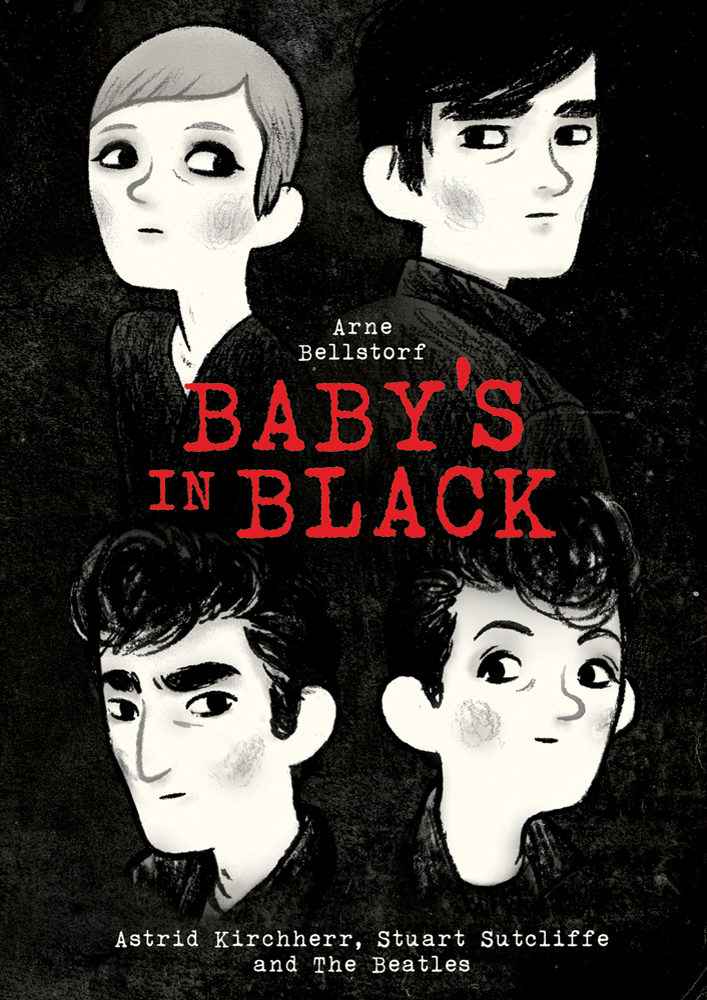
Baby’s in Black
Arne Bellstorf, writer/artist
First Second, May 2012
208 pages, hardcover
$24.99
Buy it from Macmillan
Buy it from Amazon.com

For today’s Comics Time review, please visit The Comics Journal.
Girls thoughts reconsidered
May 8, 2012Girls episode four was very funny and very mean, which is great. Lena Dunham really has figured out how to take everyone’s worst characteristics, exaggerate them, and use them to smack around the other characters Punch-and-Judy-style. No, I don’t know anyone who’d be as openly repulsive as the bongo playing guy or Hannah’s boyfriend, or who’d be as acquiescent to sexual harassment as Hannah and her coworkers, or who’d be as vapid and pretentious as the British girl, but a) as Daniel Clowes put it, “Likeable characters are for weak-minded narcissists,” and b) I also don’t know anyone even a little bit like Kramer or George Costanza, or Basil Fawlty, or Blanche Deveraux, or Doctor Steve Brule, and on and on and on. It’s a comedy, and at this point it’s firmly established itself as a comedy of exaggeration which (contra the slapdash, any-weapon-to-hand first couple of episodes) is at least exaggerating recognizable human foibles, so who cares?
But that pretty much eliminates my desire to write about the show anymore, even though I’m absolutely going to keep watching and, hopefully, enjoying it as much as I’ve enjoyed the past couple weeks. I don’t have a whole lot to say about sitcoms, as a critic. So much rides on just being funny, and being funny forces characters into situations and narratives that defy the kind of writing about character and theme that I do. In a comedy, even the details of performance and appearance I like to focus on boil down to whether or not they made a joke better. I look at people who write about Community (a show I enjoy) the way they write about Mad Men (a show I enjoy) and it seems so foreign to me, like hearing your favorite song sung in Esperanto. I’m sure Hannah and company will “grow,” but that’s the thing I’m least interested in discussing, unless the growth is set-up for a punchline.
But it’s a good show, you should watch it.
Mad Men thoughts, Season Six, Episode Eight: “Lady Lazarus”
May 7, 2012* Nothing worse than someone who interrupts you when you’re reading during your commute. Dude deserved to be cuckolded for that alone.
* I’m really glad this show is not above a bit of comic business involving some schmoe lugging skis and ski poles around. Or as Roger approvingly put it, “And I got to see that!”
* Actually, that echoes his line during Pete and Lane’s fight, doesn’t it? I like the image of Roger as a hedonist observer. All the world’s a stage and he’s got great seats.
* Pete’s skis: the telltale use of orange of the night.
* “No one can keep up. It’s always changing.” Megan gets the Matthew Weiner “this is what this season’s about” line of the evening.
* Guest starring Rory Gilmore as Gloria Trillo!
* At least that’s where I thought it was headed at first, though it turns out Beth was the one slamming the brakes on her dalliance with Pete, not Pete. In fact, I got it backwards: Pete gender-flips Gloria Trillo’s trademark move and initiates the inappropriate incognito meeting with the cuckolded spouse, rather than the other way around. I think what threw me was her wildly inconsistent and inappropriate affect during their initial encounter. She just seemed, you know, potentially mentally ill. But something Salon’s Willa Paskin tweeted made her click for me: She’s just the Betty Draper of a show we’re not watching.
* The Don and Megan Show is so fucking good. It’s only in this episode that I cottoned to why, though: Megan’s an actress! She can fake a rapport with a product and a client (by masking it as a rapport with her husband) naturally, in a way it took Don a long time to master by his own admission.
* Don suggesting Megan work at another advertising firm was the key to that late-night conversation. On the one hand, it’s really, really sweet. He might have changed his tune eventually, but Don’s first instinct when Megan tells him she doesn’t want to work at the agency anymore is not “Oh no, I’m losing her!”, it’s “Oh no, I’ve made things too unpleasant for her at work, but she’s really talented — she’s gotta find another place to do this.” Only upon further thought was I like “Hmmm, maybe he’s concerned that a rejection of his profession as the road to fulfillment is a rejection of him, too?”
* Don plays his true feelings about what he does for a living close to the chest, mostly by expressing very different things about it at different times. He’s been visibly and sincerely thrilled by finding the right line, or when a pitch goes well, or when he won his Clio, but at the same time he’s been dismissive of grand ambition and ars gratia artis. He tells Megan we don’t always get to choose where our talents lie, implying that part of him wishes his own talents lay somewhere else. So in the long run it’s tough to say how he’ll feel about Megan’s departure from SCDP as a reflection of his professional and creative life.
* But it’s perfectly clear how he feels about it short-term and in the gestalt of his marriage: miserable. The hilariously direct dissolve from his slowly deflating smile after dittoing her line about being everything she’d hoped for to his miserable punim during that excruciating Cool Whip test-kitchen pitch with Peggy says it all. Yes, she’s super-duper hot. Yes, she cooks barefoot and plants a steamy kiss on him while she’s at it, while playfully admonishing him not to expect this kind of thing all the time. Yes, she’s honest with him and brings out the honesty in him. Yes, she rolls with his dark side, from his secret identity to his sexual fetishes. But last episode Don told her, with something like awe in his voice, “You’re good at all of it.” Not anymore. No more walking into work together — that part of their life is over. Now she’s definitionally not good at “all of it,” and that disappointment’s going to weigh on Don the same weigh Megan’s realization that following Don’s career path (however legitimately great she might be at it) wasn’t going to fulfill her weighed on her.
* Christina Hendricks is really a master of Joan’s elaborate social kabuki. Listen to her delivery when she asks Don “I mean, she’s not disappearing is she?” A hyperbolic joke covering a straightforward question about whether Megan’s going to make herself a stranger to her former colleagues covering an implied question about Megan’s future with Don.
* Rizzo nails it. “For what? Heinz baked beans.” Peggy’s dilemma is that she can’t blow off the inconsequentiality of what she does for a living and still be (apparently) happy like Rizzo, nor can she cut bait and admit it doesn’t make her happy and go do something else like Megan. Personally I’m not sure whether she really is unhappy, mind you — I think she’s not quite sure. She just hasn’t faced up to the “I’m good at this, and now let me figure out if that means anything or not” internal discussion yet.
* Don’s tin ear for rock music is funny, but I seized on something different in that scene when the guys come in to play him the song the client picked for the commercial: He says “help yourself”, but no one else drinks.
* When did music become so important? Michael Ginsberg tells Don the song’s making him fucking nauseous and all Don can do is express bafflement at the harsh language, but that’s the kind of thing I’ve said probably hundreds of times. When did this change take place? When did music become the core cultural thing by which cultural-people define themselves? At least I do, and always have, more than film or books or comics or TV or anything else. I assume the first example of this is beat/jazz culture in the ’50s, but I don’t know.
* Joan assumes Megan will be the failed second wife. That’s one of the slots she has available, and she’s gonna make that square peg fit, by god. For my money, Peggy has the right of it: Megan’s gonna be good at what she does. We’ve already seen what an actress she can be.
* Pete tricking his way into his inamorata’s home reminded me of how he pressured the au pair into having sex with him a few seasons ago. When he wants something he has a hard time understanding he can’t always have it.
* The invisible woman at the test kitchen.
* MAD MEN CAN AFFORD THE FUCKING BEATLES MOTHERFUCKER
* In all seriousness, the use of “Tomorrow Never Knows” does more than put paid to all the knowing critic jokes about what songs Mad Men can and can’t afford to use this season, it serves as a declaration of ambition. Not that we didn’t know how ambitious Mad Men already was, mind you — don’t let’s forget it soundtracked a Don-looking-badass shot with “Satisfaction” last season, though obviously Mick & Keith are way more profligate than the Apple corps with the usage rights if the price is right. But to use an original Beatles song, any Beatles song much less a landmark like that one, is to take a run right at a cultural monolith/megamyth. Hell, I was thrilled enough when Don whistled “I Wanna Hold Your Hand” a couple episodes back. Watching him wrestle with “turn off your mind, relax, and float down stream” was a higher order of pop-culture pleasure.
* My favorite thing about it, though? The credits continued the song after Don shut it off, like Matthew Weiner was saying “Okay, Don may not care for it, but this song’s awesome, why don’t we keep listening?” Endearing.
* I can’t remember the last time I found something on a tv show more frightening than that open elevator shaft. That it didn’t pay off in any concrete way made it even scarier. It was a Hitchcocky image, for sure, in an episode that referenced Hitch explicitly (The Birds) and implicitly (Beth had a tortured Vertigo vibe to her), as well as the Hitchock-acolyte elements of David Lynch–there was something Blue Velvet/Laura Palmer about Beth’s tender feminine damage, and the shaft was a flash of the unexplained uncanny as darkly luminescent as the ear on the front lawn or, insofar as it’s a portentous absence, the disappearing angel in picture on Laura Palmer’s wall. The thread will be torn, Mr. Draper, the thread will be torn.
* Whoa: Did you know that if you take the first letter of the first sentence in each “next week on Mad Men” teaser clip this season, it spells out “P-E-T-E-C-A-M-P-B-E-L-L-I-S-G-O-I-N-G-T-C-O-M-M-I-T-S-U”???** I wonder what the next letters are!
** not true, at least as far as I know
Comics Time: Night Business #4
May 2, 2012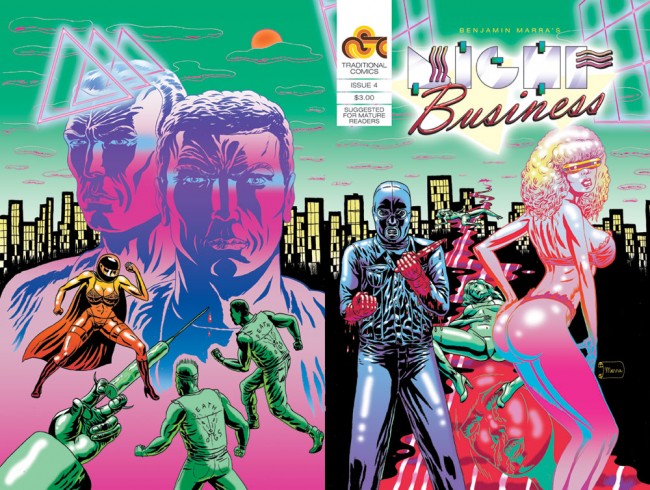
Night Business #4
Benjamin Marra, writer/artist
Traditional Comics, 2011
24 pages
$3
Buy it from Traditional Comics
For today’s Comics Time review, please visit The Comics Journal.
Girls thoughts revisited!
May 1, 2012I almost invariably hate it when TV critics say that Show X was bad until Episode Y, at which point it miraculously transformed into something truly worth watching. It’s a common phenomenon when you’ve read enough TV crit, and when you happen to disagree with the selected turning point and/or the supposed problems that preceded it, it highlights the subjective nature of criticism, and thereby the unreliable nature of critical interlocutors, like pretty much nothing else, because it’s such an all-or-nothing proposition. “The show was basically no good until this happened, and then it became good”: Disagree with any element of that and it all falls apart, and you’re left looking at the computer screen and hollering “What are you talking about? The wigs during Game of Thrones Season One simply were not that distracting!” or whatever. You end up embarrassed for the critic who asserts that something that either didn’t bother you or didn’t wow you is in fact a self-evidently dispositive element of the show.
So I’m going to be as circumspect as possible when I assert that the third episode of Girls is a whole new ballgame. I got to the closing credits and found myself surprised that Lena Dunham was once again the writer-director, so different did it feel to me. I got the hang of the show, is part of it — okay, it’s a parody of these kinds of people, it’s making fun of them from within, very well then, game on — but so did she. The characters are now more consistent in their ridiculousness, more coherent as caricatures, rather than collections of random tics and neuroses stuffed into human-shaped containers. It’s like Dunham figured out exactly what makes each of them awful and pathetic and just kept hitting that soft/sweet spot instead of merely flailing around, careening into the nonsensical in an attempt to make everyone look maximally obnoxious at any given moment. Marnie’s off-putting alpha-femaleness felt cohesive: She was turned on to the point of rubbing one out in the ladies’ room by a guy who ran roughshod over her sense of decorum in much the same way that she shits on her boyfriend’s gestures of goodheartedness. Hannah clicked too, as a sort of human magnet for terrible, arrogant guys who use her as a beta test for establishing their new identities. Whatsername the idiot Brit worked like a Seinfeldian send-up of freespiritedness, insisting on wearing a see-through outfit to a babysitting job like Sue Ellen Mischke walking around wearing a bra with no shirt. And Shoshanna is settling nicely into the nerdy-neighbor role, the Skippy/Urkel/Kimmy Gibler of Girls.
I’d be pleased if the show continued to use new guys as a Lost in Space-style “monster of the week” feature, too, revealing a freshly terrible dimension of maleness with each new episode. Nice to see Jorma Taccone used as a Will Ferrel/Tim & Eric-style avatar of leering sexual overconfidence, for example; that Marnie gets off on it is a joke on her and him both. Hannah’s insufferable ex Elijah works in much the same way, as a swipe at her and himself both: “Beau is my lover” is a ridiculous thing for anyone to say, while the guilty-pleasure insensitivity “That fruity little voice you’ve put on”/”Excuse me?” exchange is paid back by his awesome, successful attempt to get the last word: “It was great to see you, your dad is gay.” Even the tangents the conversation go on are very funny in their weird specificity: Hannah offering “I’m seeing this guy, and sometimes I let him hit me on the side of my body” as proof of her sexual-experimentation bonafides was probably my biggest laugh line from the show so far. I’m sitting here imagining the negotiation process as to the acceptable hitting zones and writing a flashback episode in my head as we speak.
It wasn’t until someone pointed it out to me on twitter that I realized this episode also happened to be the one with the most “heart and soul” — the “Dancing On My Own” sequence at the end is the best example of course, but there were other flashes of it, particularly the brief but surprising and genuinely touching moment in which Hannah’s horrible fuck buddy actually, sincerely consoled her about her HPV diagnosis. (She didn’t expect it any more than I did; I’m glad Dunham stayed away from the easy joke there.) Normally I’d think this sends a mixed message regarding what kind of show this is, because honestly I think my muddled expectations for what I was watching were a big obstacle for enjoying what I got in the first two episodes. So much of the writing about the show treated it like “Finally, this voice is being heard! This world is being represented!” that I couldn’t help but judge it based on those merits, and the judgment rendered was “A) the voice is garbled, and b) yes, but so what? This exists isn’t a TV show, it’s a thinkpiece in TV-show drag.” Toss in the inconsistent characterizations and doughy jokesmanship and the resulting impression was even muddier and less appealing. But in this episode the writing was so much sharper both in terms of character work and basic funniness that you could get away with giving these dopes the happy ending of having a great time dancing like nobody’s watching in their apartment at the end of a long night. The sharpness leavened the warmness and vice versa.
Anyway, that’s where I stand on Girls as of episode three, and as best I can tell I stand alone. The people who like the show seem to have liked it from the start, and that goes double for the people who love it. Meanwhile I don’t think it changed many, or any, detractors’ minds other than my own. So it’s entirely possible I’m seeing something only I can see and embarrassing myself by molding it in no uncertain terms into a verdict on the show as a whole. Best I can do is put it out there and ask: Are you with me on this, or am I just dancing on my own?
Mad Men thoughts, Season Five, Episode Seven: “At the Codfish Ball”
April 30, 2012* Poor Marten Weiner as Glen Bishop. The Sofia Coppola in Godfather Part III of Mad Men.
* Fun fun casting for Megan’s parents. Career European Ronald Guttman as her philandering Marxist intellectual father? Bien sur. and of course you knew something sexy was gonna happen the moment you recognized Julia Ormond as maman.
* Roger’s ex-wife looks GREAT. I guess he’s not the only Sterling getting a second wind.
* “No, pervert, this is about work,” Megan tells Don when she comes into his office to tell him her great idea for the Heinz baked beans campaign. “You’re good at all of it,” Don tells Megan as they leave the dinner meeting with the Heinz guy where they were supposed to get fired but ended up securing the account because of Megan’s quick thinking and her and Don’s intellectual and emotional rapport. And those two lines in a nutshell are why I insisted last week that Don and Megan are not dysfunctional, not the way Don and Betty were, not by a million miles. (That part of last week’s post got me more “just writing to say I agree” responses than anything I’ve ever written about a show, maybe because so few other people out there seemed to agree?) The sex stuff that seems so powerful and even dark in the moment is something they playfully joke about when the office door is closed, just something else they share along with great ad ideas and Don’s secret identity and Megan’s parents’ dysfunction. (Now that’s a place to use the d-word.) Megan’s good at all of it — working the room, coming up with ideas, delivering them in compelling pitches, adjusting to the facts on the ground, being pretty and supportive, being sexy, soothing Don’s melancholies, mothering the kids, having a mind and personality and drive of her own. They’re great together.
* Or they would be, if not for the soft underbelly Megan’s dad pierced at the banquet. The signs were there already, of course. There was her discomfort when her Hail Mary pitch is celebrated at the office the next day — seriously, I literally stood up, pumped my fists, and cheered when the Heinz guy okayed the idea, let alone the characters in a world where this actually happened, but Megan just seemed to struggle with the knowledge that she should be happier than she is about it. “This is as good as this job gets,” Peggy tells her, and means it as a compliment; Megan reacts like she’s smelled a fart, like being told you’re a young Peggy Olsen is like being informed you have a chronic medical condition.
* But it was daddy dearest who really shattered the dream of Don and Megan. I was hoping that his line of attack that Megan had given up on her dreams to follow Don’s career footsteps was just a bitter man lashing out because he can’t stand happiness in others when he has so little. But one look at Megan’s total deflation after he tells her she’s given up shows he absolutely nailed it. We’d never really seen this side of Megan before — last season she told Don she wants what he and Peggy have and it seemed sincere, and her mentions of her failed acting career seemed as good-natured as such things could get. Frankly I was surprised to see how effective her dad was in dismantling her this way. But now I’m just really alarmed for her future with Don and his family. I don’t know how you paper that big a problem over with Draper pitches and kinky sex. It never worked for Don himself, after all.
* Speaking of which, those ads for that show The Pitch are unintentional comedy gold in the context of the show during which they’re airing. Jesus, could AMC have missed the point of Mad Men any more spectacularly? (Granted, I say this despite having hollered at the screen like a baseball fan during the World Series when the Don-Megan tag-team pitch landed. Maybe AMC knows me better than I know myself.)
* Peggy getting man advice from Joan feels like she used a time machine to do it. And because it started in that way, that throwback to the mores of the ’50s way, you knew it’d end in tragicomedy. But the comedy was funny. I loved Peggy watching Peggy realize what she’d just said when Abe asked her if she wanted to order and she replied “I do” — the facial-expression equivalent of the sad trombone. And I loved Mrs. Olsen’s inflection as she greeted Peggy’s boyfriend. You don’t have to have grown up Catholic to find hilarious the way a disapproving middle-aged Catholic woman would pronounce the name of her daughter’s live-in boyfriend if that name happened to be something like Abraham…but it helps!
* An adult content warning 3/4 of the way through the episode? Now we’re talkin’!
* Who Killed Donald Draper?
* Seriously, the total devastation of the underpinning of Megan’s marriage to Don by her dad was actually surpassed in dreadful revelatory power by Ken’s father-in-law Ed Baxter, played by the eternally incandescent Ray Wise, telling Don that his career as adman for the powerful is basically over. Again, there’s no way past having made yourself publicly, spectacularly, even proudly untrustworthy in the eyes of the people whose trust you need to survive.
* Like Game of Thrones, which this week took 12-year-old Maisie Williams and put her one on one with Charles freaking Dance because that’s just how good the kid is, Mad Men knows what a resource it has in the form of gifted child actress Kiernan Shipka, and rewarded her and us this week by putting her up against John Slattery’s Roger Sterling. Roger was just what she needed — an adult treating her as one of them — and she was just what he needed — a zero-pressure opportunity to work all his charm muscles without his livelihood and self-worth rising and falling on it. They’re both obnoxious people in a lot of ways, but they’re also both magnetic and funny and interesting, and that’s the side that comes out when the two are juxtaposed. What a pity it ended the way it did. Sally’s a woman of the world to an extent — you have to assume her late-night phone calls with Glen have tackled some taboo topics, I know mine did at that age. But seeing Megan’s mom polishing the sterling did more than expose her to the act itself: It showed her the truth of what all the play-acting about being Roger’s date and implicit equal entails. You wanna be a part of a successful man’s life, being squired around to fancy-dress banquets and becoming his partner in securing new business and all of that? Here’s something else you’ll be doing. That’s a lot to swallow, and oh jesus I promise you I didn’t think of that pun before I wrote it.
* I loved how that scene ended: with a goddamn tableau. You want on-the-nose, critics who distrust art making its artifice apparent? You got it. Ditto the crash cut to black after Sally pronounces the city “dirty.” Pardon my French twice over, but FIN, MOTHERFUCKERS.
* Finally, I want to take a moment to salute the single funniest thing I’ve seen on TV all year, when Megan’s dad tells Don that one day, “your little girl will spread her legs and fly away.” It’s not even the dad’s comment that does it, despite its turducken structure — a bitter swipe at Don in the form of a dirty joke disguised as a possible trans-language malapropism. Nope, it’s Roger Sterling cracking up about it, laughing loud and hard despite how completely inappropriate and uncomfortable the comment was for everyone else in the room. I was dying, just dying. Roger Sterling’s the Fool, the Joker, the Comedian, and getting the joke is its own reward. Laugh and the world may not laugh with you, but hey, at least you’re having a good time!
Girls thoughts two
April 27, 2012* And likely final. When your zeal for making your characters contemptible extends to not bothering to make them interesting to watch, ya blew it.
I understand how exciting it is to see yourself and your peer group represented on a show run by your peer group, and I like to think I can at least see what that would mean in gender terms from where I’m standing as a dude as well, though obviously I’ll never fully feel the impact of the gender disparity in pop culture the way the people on the losing end do. And I’m legit excited about the abortion storyline making it on to TV the way it did. But that’s about all this has going for it, best I can tell.
Lena Dunham aims for warts-and-all and winds up with all-warts, to the point where the characters are incoherent, and not in a Whitmanesque containing-multitudes way. That poor square virgin character, for example, reacts to the news that Hannah’s getting an STD test by saying “Fun!” and meaning it, at least until her friends talk her down. This is something no actual human being would ever say or think, but she does because we’re meant to find her ridiculous, and for Dunham any weapon to hand will do. Ditto whatsername, the one who’s not Hannah and not the British person and not the square virgin — she’s upset that she hasn’t had an unplanned pregnancy? How does that square with wanting her boyfriend to be less of a milquetoast? Or with, you know, being a recognizable human person? Comedy is obviously about exaggeration and distortion — see also the opening sex scene with Hannah’s grotesque fuckbuddy, which stacked the deck horrendously and wasn’t funny but which at least stemmed from familiar human behavior. Hannah’s friends, on the other hand, are just a collection of tics and neuroses and random embarrassing things (moving to New York because of Rent). That in turn made me less forgiving even toward the understandable caricaturing of the bit players.
Most fundamentally, though, once again I found myself sitting through a half-hour comedy during which I could count the laugh-out-loud moments on one hand with fingers to spare (for the record again: “What if I want to feel like I have udders? This woman doesn’t speak for me.” and “When they pull out, it’s fucking mayhem.”) Whatever else they’ve got going for them, whatever else they bring to the pop-culture table, horror is supposed to be scary, smut is supposed to be sexy, and comedy’s supposed to be funny. So, pass.
Mad Men thoughts, Season Five, Episode Six: “Far Away Places”
April 23, 2012* It’s normal to just wave your arms around and cheer in delight several times during an hour-long television episode, right? Happens all the time?
* Big big cheer when I (finally? not sure how I stacked up vs. most viewers) realized what was happening with the narrative. I’d gotten pretty worried when we had that brief glimpse of an obviously distraught Don at a payphone in the middle of the night, asking Peggy if she’d gotten any calls in a cryptically unspecific fashion, hanging up in the middle of her mea culpa for the Heinz debacle. (I realize now that part of what worried me is that the last time I saw a quick cut to an alpha male at a pay phone we never saw him arrive at, telling a woman with whom he has a relationship rife with sublimated parental and romantic feelings about something bad that had happened off-screen, on a show Matthew Weiner worked on, I was watching a Sopranos episode called “Long Term Parking.”) But the next time we see Don he’s cheerfully rebuffing Roger’s attempt to turn a trip to an upstate Howard Johnson’s into an old-school Draper/Sterling debauch (Don: “I love Howard Johnson’s…” Roger: “We’ll try and stop by!”), inviting Megan along instead, so everyone I was worried about while watching that phone call — Don, Megan, Roger — seemed squared away. It wasn’t until the beginning of the third, Don-centric segment of the episode, when we saw conversations repeated from a different perspective, that I understood. And marveled!
* Peggy’s soundtrack was ambient. (Both ambient music and ambient noise — thank you, stereo surround system purchased for us by my college friends as a wedding present for the low bass thrum from the street below as Peggy had her first drink.) Roger’s was found music (including “I Just Wasn’t Made for These Times,” LOL MAD MEN MUSIC CUES). Don’s was traditional orchestral scoring.
* One of my little cheers was for me, I admit, for identifying the role of the color orange on this season early and often, just in time for a metric ton of payoff during the Howard Johnson’s sequence. “We’d have rolled out the orange carpet!” The battle of the orange sherbet! Those gorgeous, ridiculous HoJo-noir night shots against the glowing orange roof! Not since the Godfather movies has orange been such a portent of doom. It was easy for me to believe that something really had happened to Megan, that this was the last Don or we or anyone else would ever see of her, simply because she had a salmon dress on.
* Roger and Jane are advised to look at their acid trip as a boat ride. Don looks around the parking lot for Megan and finds a boat. (Pretty sure that was salmon-colored, too.)
* Roger’s trip (band name alert!) was maybe only the second-most Sopranos thing to happen in the episode, thanks to that Don phonecall, but god was it a great reminder of what made that show so great. Both shows give images the time to play themselves out and then leave you with them, little emotional depth-charges you might not even understand in the moment — lots and lots of shots of the women at the party lying down, crawling, faces obscured, just for example. Both don’t mind being frightening and silly within the same scene, or letting dream logic infect everyday reality. Neither is afraid of taking a message and punching you right in the face with it, because after all, sometimes you really do get punched in the face with a message about your life IRL. What, are they not gonna have Roger fixate on an old-young man in an ad, or reminisce-hallucinate about the Black Sox scandal in a way that makes him seem like a creature from a wholly different century than his young wife? If you were Roger, wouldn’t you?
* Speaking of silly-frightening drug stuff, I caught a heavy “Revolution 9” vibe from the sequence despite it predating that song by, what, two years? I mean, maybe it was just Don whistling “I Wanna Hold Your Hand” later in the episode — and jesus, how’s that for a pop-culture moment, Don Draper Meets the Beatles — that put me in mind of the comparison, but seriously: the full-blast snippets of grand orchestral music, the overlapping and disconnected conversations, the songs played one on top of the other, the occasional goofy sound effect — heck, eventually Roger and Jane became naked!
* Roger hears the words of his guide and sees Don. I think that’s a lot more complex a hallucination than the “haha he idolizes Don” sight gag suggests. He idolizes Don, he fears Don, he envies Don, he likes Don…but he also made Don. Don exists because Roger thought him up, essentially, saying okay, this guy has some talent, let’s see what he can do. The hallucination is, quite literally, a reflection of that reality. And since Roger’s the elder, he can never acknowledge any of these feelings, not to anyone else, not even to himself without the help of LSD, without violating a tremendous taboo against being less self-sufficient than the generation that follows you. That is some magnificent burrow-deep-down drug writing right there.
* I’d pretty much accepted the implication that Jane simply didn’t remember her decision to divorce Roger during the trip, but it occurs to me now — it’s just as possible Roger hallucinated her entire side of the conversation, isn’t it?
* The irony there, while we still have the dawn of Roger and Don’s relationship on our minds, is that it began under similar circumstances. The morning after their first liquid lunch, Don shows up to work, telling an amnesiac Roger that he hired him the day before.
* “I say we postpone this conversation until after we turn on.” I laughed hard at that.
* Shit, this is a sexy fucking show. Peggy’s movie-theater handjob may be top dawg. “Just watch the movie.” Yowza.
* Peggy awoken by the Dawn.
* Regarding the super-fake car rides: This is a show that could make car rides look convincing if it wanted to. This wasn’t them trying to shoot perfectly natural-looking car rides and failing.
* Ginsberg born in a concentration camp? This revelation dropped into the middle of a story about being a Martian from which he never breaks character, peppered with portentous quote-unquote jokes like not being able to find any others like him and receiving the instruction simply to stay where he is and wait? Peggy gets her Jewish reporter boyfriend to fact-check the story during a booty call — she’s nothing if not efficient — but it’s not Ginzo the person within this world I wonder after, it’s Ginzo the device within this show. Mad Men‘s just given him an origin story that echoes Don’s in nearly every particular — both orphans raised by a non-biological parent, both shaped by war in a formative way — but trumps it over and over. He’ll see your whore and raise you a Holocaust victim. He’ll beat your army-grunt identity switch by never having been known by his original identity. He’ll take your Korea and give you a World War Fucking II. Who is this guy?
* I’ve already talked a bit about how plausible Don’s morbid ideation about Megan’s post-fight fate were made to seem by the filmmaking in the episode, but of course the other half of that equation is that all of us have gone on similar flights of terrifying fantasy any time our significant other takes too long getting back from getting prescription filled or whatever. I’m pretty sure I don’t talk enough about Jon Hamm as an actor, but good lord did he nail the moment when he discovers their apartment’s been locked from the inside — that moment when some little thing, the tip of a vast iceberg of relief and gratitude, tips us off that our loved one is safe and sound after all. The shuddering release of breath, the momentary jellyfish-jiggle as your nervous system hits the “she’s okay” button as hard as it possibly can.
* This is why I think it’s a big mistake to view Don and Megan’s relationship as dysfunctional, at least as I understand it. Look at the way the fight ends, with Don clinging to her like a life raft — not to their life, not to the idea of her, not to what she represents as a signpost of the life he’s made for himself, but really to her, to this person named Megan. Look at the way her look and touch absolves him, accepts his apology, expresses regret as she comes to understand how upset he truly was. I don’t wish to deny how titanic and terrifying as the fight’s climax was, with Don chasing her around the apartment like a madman — that’s not romantic, that’s threatening, although I don’t get the sense that Megan felt truly in danger, just that she in that moment was horrified by the prospect of being close to Don at all. His actions “diminish” what they have, she says. They do not fight well, that’s clear; their fights are tied into the May-December sexual kink they share and thus can ricochet off in hugely inappropriate and hurtful directions (Don’s chase is just an ugly goes-to-eleven distortion of their earlier dom-sub shenanigans) unless the combination is calibrated exactly right. But the way even the nastiest, scariest, most rage-fueled fight dissipated into near-nothingness the moment they realized how hurt they both were rang very true. In that moment the immensity of their love dwarfed their anger at one another, so they just swatted it away. I don’t know if I’ve ever seen that depicted on film before.
Music Time: Lords of Acid – “The Crablouse (Ludo’s ‘Coming Even Harder’)”
April 20, 2012In its original version, which I think is the ’90s dance-industrial act Lords of Acid’s single best recording proper, “The Crablouse” was already one of the sleaziest songs I owned. What can you say about a paean to the erotic and orgasmic potential of pubic lice? The lyrics, barked by a female vocalist in a mic-distorted Euro-rap that gives way to a reach-for-the-heavens ululation in the chorus, don’t actually, you know, make any sense, but they didn’t need to. The point was simply “THIS IS A DIRTY SEXY SONG ABOUT DIRTY SEXY DIRTYSEX,” and the music flung a gigantic beat and huge guitars and synths and snarling raging panting jungle-beast vox at you to reinforce the point. (The immortal album cover by friend of the blog COOP didn’t hurt, either.)

Much as I like that original version, though, I think I like this remix by Carl. S. Johansen even better. I like it for its focus. Instead of the frantic, distortion-laden industrial instrumentation of the original, this is just big glittering washes and skittering snakes of synth, the kind of beat that always sounds like you’ve turned the bass up in your car too loud to be properly heard, and seven words’ worth of lyrics (not THOSE seven words, but you’re not on the wrong track) that boil the Lords’ entire dirty-dance project down to its barest and most goal-oriented essentials. (The EP it came on had a pretty great cover of its own.)

Maybe I’m overthinking it now, years later, but looking back this song must have hit me at just the right time. It’s loud, scary, heavy, danceable, utter anathema to square notions of taste, futuristic, weirdly lovely at times, and hyperbolically sexual in a relentlessly pleasure-seeking and bluntly honest way. A terrific fantasy version of adulthood for someone just becoming an adult! It didn’t all work out quite that way for me, I suppose, but you know, I did alright.
Comics Time: Cyclical, Stale N Mate, Let’s Fucking Party, and Cheek Up’s
April 19, 2012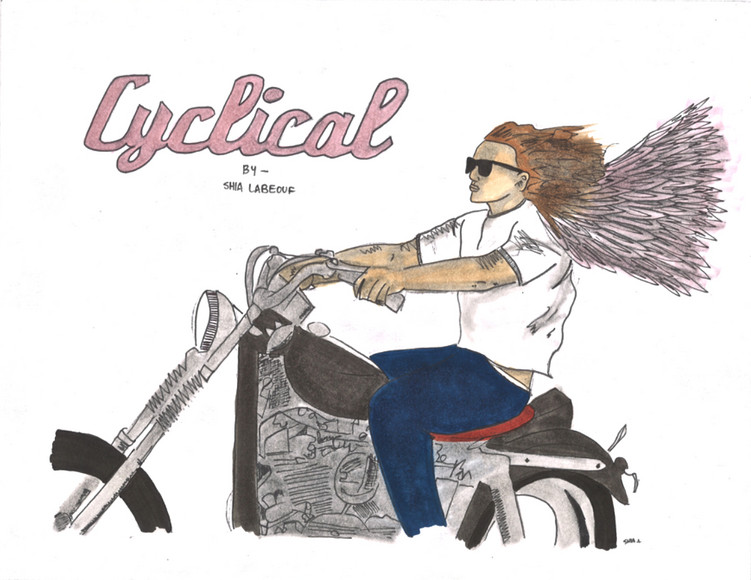
Cyclical, Stale N Mate, Let’s Fucking Party, and Cheek Up’s
Shia LaBeouf, writer/artist
The Campaign Book, 2012
various page counts
Cyclical, Stale N Mate, Let’s Fucking Party: $10 print/$5 ebook
Cheek Up’s: free ongoing webcomic series
Buy them and/or read them for free online at The Campaign Book
For today’s Comics Time review, please visit The Comics Journal.
Girls thoughts
April 16, 2012The amount of demimonde-establishment crammed into virtually every line of dialogue in the premiere episode of Girls makes Game of Thrones‘s worldbuilding look dashed off and noncommittal. Perhaps it’s the shock of recognition talking here, the fact that I instantly grokked nearly every deployment of descriptive specificity because these lives are, if not my own life per se, at the very least visible from the one I’m living. But holy jeez, from “He was in Prague that semester” to “Will you get me a Luna bar and a SmartWater and a Vitamin Water?” (did they steal my wife’s shopping list?), I suddenly understood everyone who complained about actors being made to cough up Baratheons and Winterfells and Khal Drogos every time they spoke to one another. Writer/director/producer/star Lena Dunham could literally have animated comic-book word balloons reading “NEW YORK CITY, PRESENT DAY” emerging everyone’s mouths and it wouldn’t have been more utilitarian than what we actually got.
But Girls‘s pilot is hardly the first to creak under the weight of its own need to serve the purpose of communicating What This Show Will Be About. Mad Men‘s period references were never clunkier than in its first ep — I remember the very smart writer Zak Smith/Sabbath wondering aloud on twitter if every episode was going to be characters shouting “IT’S THE SIXTIES!” — while both The Sopranos and Breaking Bad played as broad black comedy the blend of irony and violence they’d later refine into something far more vicious and terrifying and unpredictable. Girls‘s avalanche of detail may have been suffocating, but there were flashes of Interesting twinkling throughout that vast Brooklyn-twentysomething landslide.
The casting, for one thing, in which everyone felt…achievable, if that’s the right word for it. Jemima Kirke played the superhumanly worldly “British cousin” Jessa like a dressed-down version of Gossip Girl‘s Serena Van Der Woodsen, her bohemian-branded effortless perfection tempered/complicated/enriched/take-yer-pick by a less superhuman physique, and cast-off clothing the knowingly awkward fit of which was still, y’know, awkward. (Plus peeing, plus pregnancy, plus shitting her pants on coke.) Adam Driver, playing Hannah’s crush/fuckbuddy Adam (the inevitability of Adams being another pointedly true Brooklyn touch), combined what could be charitably termed as “unconventional” looks with a gym-honed physique, an obvious overcompensation that I wish the show had left uncommented-on rather than trotting out the high-school fat-kid origin story. Meanwhile, I live on Long Island and and married to someone who studied and teaches voice, so seeing Zosia Mamet (Peggy’s delightful lesbian friend on Mad Men) show up in a pink tracksuit and speak in the vocal fry register for sentence after sentence gave me the thrill of seeing two of my long-standing pet peeves embodied and ridiculed in a single scene.
These are the kinds of things I wish the show had taken more time with, rather than never letting 15 seconds pass without another LOL BROOKLYN. The nervous, cramped editing and framing didn’t help — I understand it was a deliberate choice, but that doesn’t make it a good one. And I could count on one hand the times I laughed out loud, (for reference: Peter Scolari’s earring; “Will you get a condom?” “I’lllll consider it!”; “Let’s play the quiet game”; Hannah spitting her opium tea back out a la Alvy Singer sneezing into the cocaine), so in the future it’d be nice if the ostensible purpose of a situation comedy weren’t crowded out of said situation comedy. But Girls is nothing if not self-aware — “All my friends get help from their parents,” Hannah says in the very first scene, telegraphing her own hugely sheltered and unrealistic experience of the world in terms so blunt I’m almost surprised that half the Internet missed it anyway — and my hope is that that self-awareness will extend, eventually, to making something less self-conscious.
Mad Men thoughts, Season Five, Episode Five: “Signal 30”
April 16, 2012* If last week was Mad Men at its most David Lynch, this week was Mad Men at its most David Chase. (Which makes me hope that over the course of the next two eps the show will homage David Simon and David Milch, thus running the table on Great TV Davids. Tell me you couldn’t get a great systemic-failure-of-politics episode out of Henry Francis, or that Duck Phillips couldn’t return to the office and tell Don “God is not mocked, you son of a bitch” before stabbing him in the gut.)
* From the opening sequence of scenes — a dialogue-free scene juxtaposing a character watching portentous film with a fixation on a figure of untouchable feminine beauty and youth, segueing into that character being bedeviled by a literal leak of unpleasantness into his life via the house that symbolizes and embodies his supposed success — forward, goddamn was this a Sopranos-y episode, and that’s always a good look for Mad Men. Specifically it reminded me of the Season Six Part II premiere, “Soprano Home Movies,” which like last night’s MM ep was co-written by Matthew Weiner — and it did so during that sweaty, awkward dinner party in a relatively rural setting, quite before we got around to the equally awkward fistfight between two people who had no business fistfighting. Other Sopranos ingredients: the group trip to a house of ill repute, the Tony-esque lament about an ineffable decline from an idealized past (“Things seem so random all of a sudden. Time feels like it’s speeding up,” says Pete’s driver’s-ed Lolita prior to reminsicing about those happy golden bygone days of, like, two years ago), the liminal presence of real-world atrocities from the news, car rides, a high-school setting that recalled “The Test Dream” (I actually thought the initial high-school scene was a dream until we returned to the setting later in the episode). Shit, man, if you worked on the greatest television show of all time, wouldn’t you tip your hat to yourself now and then?
* I suppose the big difference between Mad Men and Davids Lynch and Chase is that the threat of violence here remains an un-serious one, to be sublimated into dreams in the former case and slapstick in the second. (See also Betty shooting the neighbor’s birds, Duck and Don’s drunken swing-and-a-miss-fest, the lawnmower man.)
* Not to be outdone, Stanley Kubrick continues to exert an influence on this season on an atomic level: the black/white/orange color scheme just gets more and more prominent, and it’s joined this time around by lovely lovely Ludwig Van.
* My first thought upon the quick cut to Lane’s ridiculously British pub celebration: “I can’t wait to hear what the Mindless Ones think of this.”
* Kenny on the move? His previously unmentioned pact with Peggy to take her with him if and when he leaves is our most dramatic sign yet that things aren’t going well at SDCP — more even than the no-new-business meeting, I think.
* I am deeply, deeply delighted by the return to the fore of Ken Cosgrove’s writing career, and was so excited by the fact that he’s writing SFF I literally cheered. For one thing, in terms of doing thoughtful work in a frowned-upon field, he’s Game of Thrones. For another, I always find myself…moved, I guess is the best way to put it, by mid-century science fiction — men and women toiling in unappreciated obscurity (or anonymity!) but absolutely drunk on the potential of raw imagination and cutting metaphor.
* Don’s Don, Roger’s Roger, Pete’s Pete, but to Joan, Bert’s still “Mr. Cooper.”
* I’m a huge huge sucker for moments of genuine cooperation and compassion between adults in fiction, so the presentation of Pete and Trudy’s baby to the group had me near tears, for real. Look at Don’s beaming, beaming face when he sees li’l Campbell: He is genuinely delighted by the kid and thrilled for Pete (for Pete!) and Trudy. Then look at Pete’s face, his emasculation by the exploding faucet (“it just blew in my face!” LOL Trudy) and Don’s effortless handling thereof completely evaporated by the pride he takes in his family, the love he feels for them, the gratitude he feels for the obvious affection and admiration shown to him by his coworkers and friends. You put enough scenes like that into a show, you can get as nasty and cynical as you want, and we’ll never feel like you’re saying none of it matters, because you’ve shown us that it does.
* Of course this scene was also essential to setting up Don’s obvious disgust — disappointment, even — over Pete’s behavior at the brothel. There were elements of sanctimony and hypocrisy here, sure, and Pete’s quick to point that out, but ultimately that line of attack rings hollow. Whether or not Don should have appreciated Betty and what he had with her and the kids more back then is irrelevant to the question of whether Pete should appreciate what he has right now. Moreover, we viewers know as well as anyone — better than anyone, most likely — that Don really was unhappy by the time he reached the end of the road his infidelity set him on. Why wouldn’t he try to impart that hard-earned wisdom to this man with whom he’s developed such an unlikely affection?
* Finally — I mean, tangentially but also finally — Don’s apparent fondness for Trudy Campbell and his comparison of Trudy not to Betty but to Megan was a quietly funny reminder that Don Draper has fine taste in brunettes.
* Great episode for ugly jackets, no? This is sort of what I was getting at in my post on the season premiere: As the fashion gets uglier, it’ll be harder for people to cling to the fashion in lieu of confronting the ugliness.
* I’m not going to do a good job commenting on this without sitting the episode and simply transcribing every word out of Roger’s mouth, but that was wonderfully well-written material he was given. After several episodes watching him alternately coast and flail, we not only get a hefty dose of his wit and charm in his instructional interplay with Lane, we also see just how good he was at his job, how important that wit and charm were to what he did and how talented and invaluable he was at doing it. We also get one of our first-act-of-Casino-style glimpses into the process that makes the ad agency work, and the efficiency and flexibility with which Roger can size up a potential client, in effect getting them to tell him exactly what they want from him without ever tipping his hand, is glamorous and enticing just as all of the show’s displays of professional hypercompetence are. Then we get to see that he’s well aware he’s past his prime: “professor emeritus of accounts”; “When this job is good it satisfies every need — believe me, I remember.” Doctor Phil tells me that you can’t change what you don’t acknowledge; I’m not sure Roger will be able to change, but at least he acknowledges that he probably ought to.
* Not that that stops him from bon-motting it up during the Pete/Lane rumble. I wouldn’t have it any other way, of course!
* It feels a bit declasse to comment too much on a dude fingering a girl in a high-school driver’s-ed class, but I’m sorry, that was a magnificent little bit, and proof once again that Mad Men does sexy sex better than any show that could throw bare asses at you all the live-long day. He lowers his hand; she parts her legs and leans into him. It’s all about sending the signal that you want someone, and then that person giving themselves to you. No wonder Pete’s crushed by it: He can never have what he wants, since the only thing he ever wants is whatever he can’t have. “Nope. Nope. Okay.”
* What a great episode!