058. The Sentry

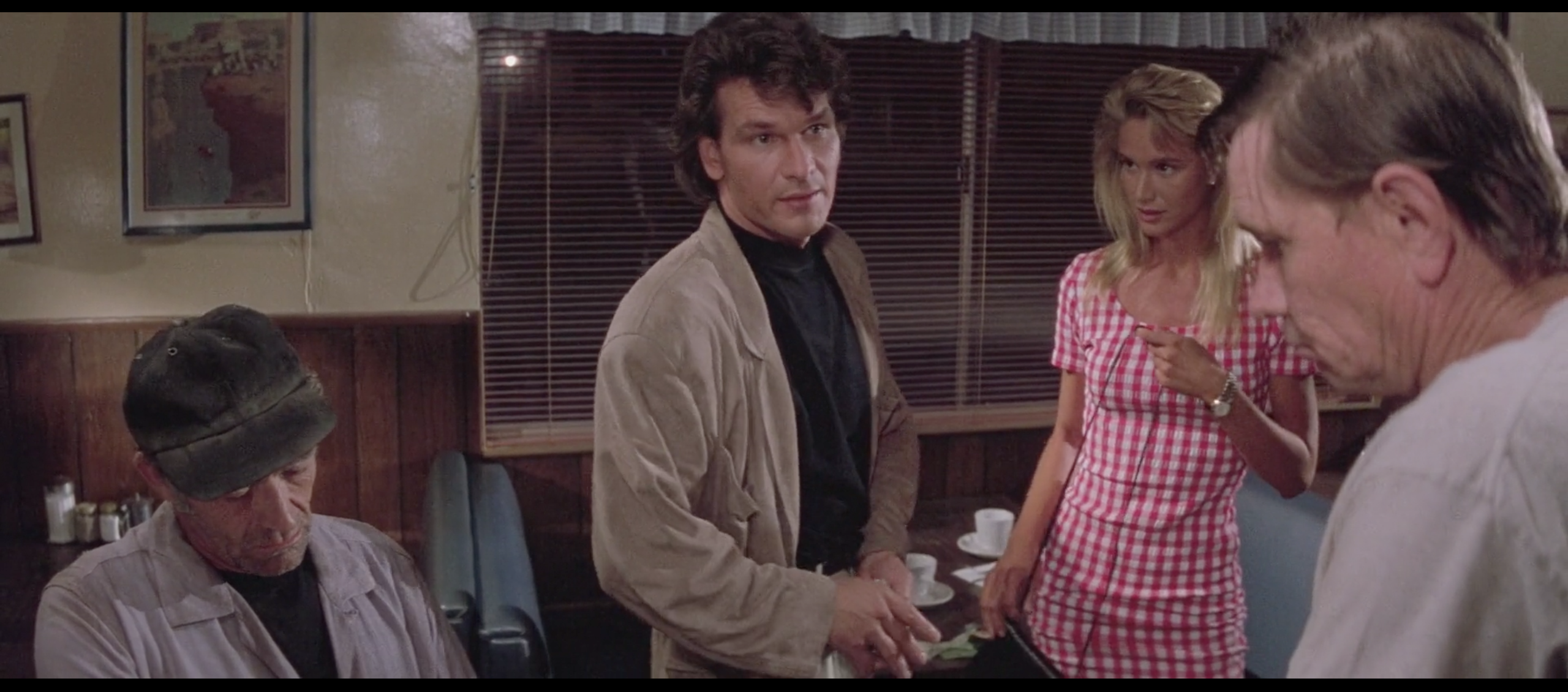
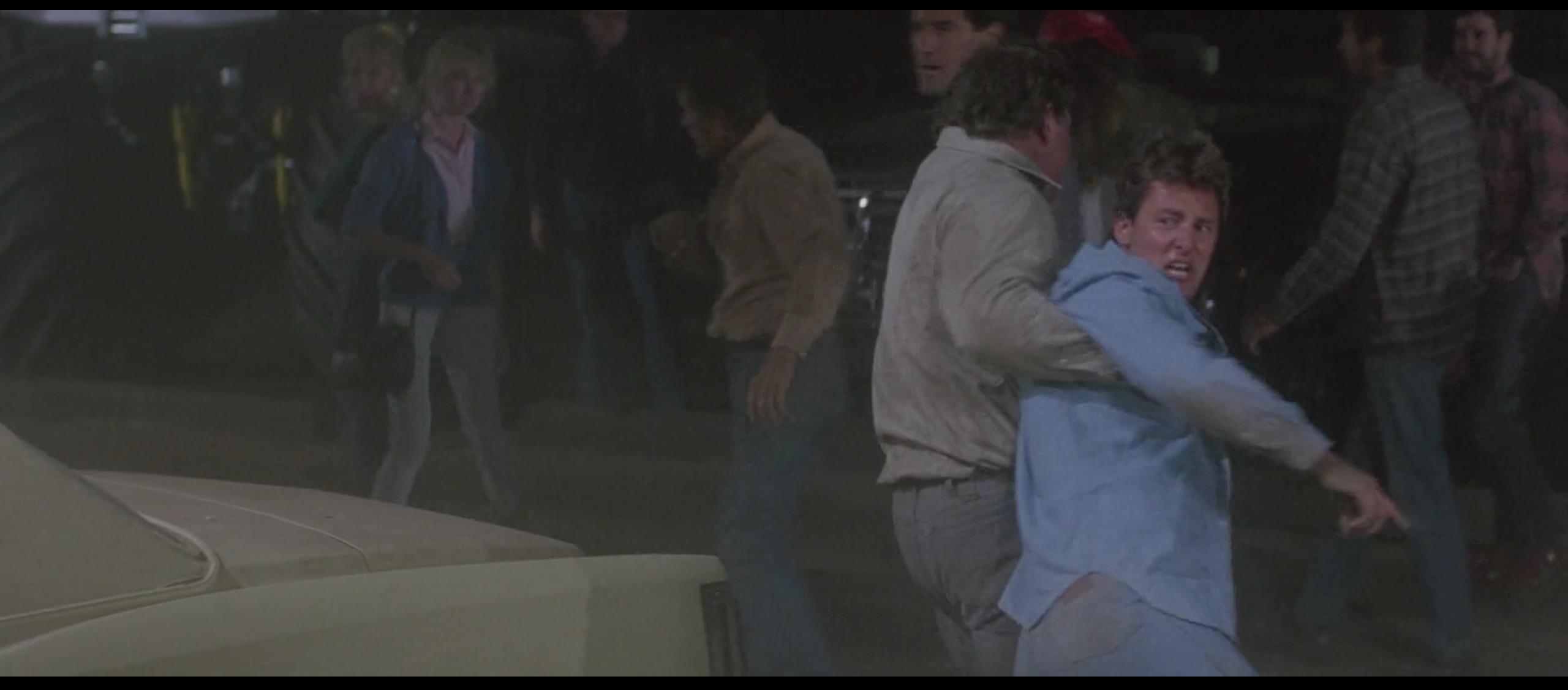
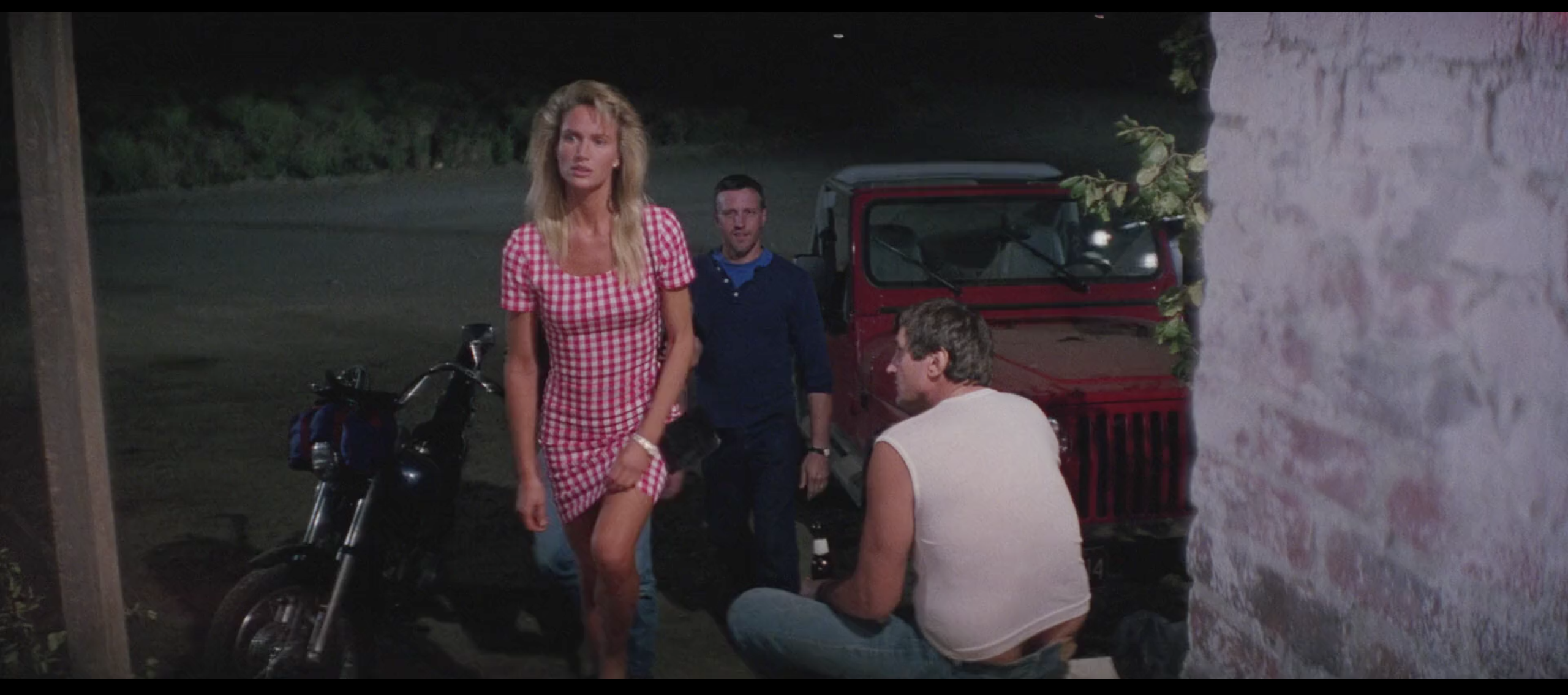
The shadow lies upon Wade Garrett when first we see him. He stands ramrod straight, stiff lipped, chin up, eyes alert. He rocks back and forth from the intensity of the vigilance thrumming in every sinew and synapse. To his right is a sign of prohibition. To his left, a box controlling the generative energy of the bar itself. Behind him, a doorway, barred by his very body. His hair is grey with the knowledge and peril of the long years, and his raiment is black. Wade Garrett knows the gate. Wade Garrett is the gate. Wade Garrett is the key and guardian of the gate.

At that very moment, here’s what he’s looking at.

Not without professional cause, mind you. Within seconds, a horned-up Marine yells “CHARGE!” and rushes the stage, and Wade must rush into action. He sits the jarhead’s ass back down and defuses the situation with a quip about Rambo and saving the world from the Commies that shows Dalton is not the only cooler for whom Be Nice is a cardinal rule. But his protégé, strong though his game may be, could never match the sly grin Wade flashes at the dancer he rescued, who smiles and winks appreciatively in return. Condoms have been lab-tested with less.

What can we learn of the Way of Wade Garrett from this sequence? Most obviously, the integrity of the Wet T-Shirt G-String CONTEST every NITE! would rightfully be called into question but for his presence. We see that humor, even irony, feature prominently in his bouncing arsenal. We see him through the eyes of a dozen drunk, erection-toting members of the United States Marine Corps, who view him as likeable enough, formidable enough, or most likely both to allow him to lay hands on one of their number and walk away unscathed (and bowlegged). He is himself horny, and hairy, but not handsy. He’s quick to action, but not eager for it; not for him is Dalton’s remonstrance to Morgan about not having “the right temperament for the trade.”

And from that first look at him, standing silent sentry in the half light, we see that he harbors within him a darkness—one that does not belie the revelry with which he surrounds himself and the merry manner in which he polices it, but which informs and complements it. He is only at ease because he knows all there is in the world to worry about. Those things have worried at him, and he has held them at bay. For now, anyway. For now.

“Suburra: Blood on Rome” thoughts, Season Two, Episode Two: “Consequences”

One of Suburra‘s many strengths, and the one most responsible for making it such a strangely endearing show regarding its dirtbag characters —other than the fact that they’re all played by incredibly beautiful actors I mean— is how emotional it is. I think I’ve used that word every time I’ve discussed the show at any length, but it’s the only one that fits. There are so many shots of so many people quietly crying about losing other people while that lush, mournful theme hits in the background that you can’t help but feel something like what they’re feeling, you know? It’s the contrast between everyone’s affected tough-guy personas and their tendency to melt into sobbing puddles when they’re rejected or bereaved that makes you care.

“Consequences” (Suburra: Blood on Rome Season 2, Episode 2) counts on this. It drills right down into one of the series’ closest and most volatile relationships, and then ends it.

I reviewed the second episode of Suburra: Blood on Rome Season 2 for Decider. 

“Suburra: Blood on Rome” thoughts, Season Two, Episode Two: “Consequences”

One of Suburra‘s many strengths, and the one most responsible for making it such a strangely endearing show regarding its dirtbag characters —other than the fact that they’re all played by incredibly beautiful actors I mean— is how emotional it is. I think I’ve used that word every time I’ve discussed the show at any length, but it’s the only one that fits. There are so many shots of so many people quietly crying about losing other people while that lush, mournful theme hits in the background that you can’t help but feel something like what they’re feeling, you know? It’s the contrast between everyone’s affected tough-guy personas and their tendency to melt into sobbing puddles when they’re rejected or bereaved that makes you care.

“Consequences” (Suburra: Blood on Rome Season 2, Episode 2) counts on this. It drills right down into one of the series’ closest and most volatile relationships, and then ends it.

I reviewed the second episode of Suburra: Blood on Rome‘s second season for Decider.

057. “It’s my way or the highway.”

Dalton, during the prologue of The Giving of the Rules: “It’s my way or the highway.”

The highway:

Show me the lie.

Whether by accident or design—who can say? alright I can say, it’s by accident—there is no aphorism, no catchphrase, no idiomatic expression, no imbecilic threat or come-on or dick joke in the entirety of this film that does not bear close, even literal, reading. This is what I want to impress upon you more than anything else. This is what inspired this project: the sense that in the 15 years I’ve been watching this movie I haven’t touched bottom any more than you might during a swim in the middle of the ocean. Road House is a journey of discovery, a highway if you will, and the higher you fly the deeper you go the deeper you go the higher you fly so come on come on come on it’s such a joy.

056. Gi

Several martial-arts disciplines utilize the gi, a simple uniform developed over time with the physical and strategic demands of each particular discipline (judo, karate, whatever) in mind. Dalton, who in another life would have made a hell of a mixed martial arts fighter, likes to wear his out on the town sometimes. It’s the only outfit we see him in not once but twice: first on the day he takes a trip to the auto parts store and discovers that Red Webster is getting shaken down by Brad Wesley and his goons, and second on the day of his final mad battle against the Wesleyans. Dalton is wearing a gi when Red springs the original colloquialism “Does a hobbyhorse have a wooden dick?” on him in lieu of the traditional “Is the Pope Catholic?”, and again when he approaches his niece Dr. Elizabeth Clay in the middle of examining the x-ray results for her latest trauma patient and/or colonoscopy recipient to beg her to skip town with him so they can avoid the wrath of her insane Fotomat-owning ex-husband. But I assure you that in neither case did he slip this clean white garment on in anticipation of seeing action. It’s simply the film’s way of communicating that the Dalton Path stretches from East to West. In many ways it’s an equivalent signifier to stretching with a lit cigarette in his mouth, or waking up hung over from a late-night binge-read, or receiving a philosophy degree from NYU for studying “man’s search for faith, that sorta shit” prior to becoming a professional ass-kicker, or asking for a king’s ransom as a salary but living in a place that costs $100 a month and driving a car chosen specifically because it’ll function basically the same if it gets half-destroyed by angry drunks whose noses he’s broken, or doing tai chi by the water in between tours of every greasy spoon and dive bar in town. He is a human mixed martial art. Might as well dress the part.

“Suburra: Blood on Rome” thoughts, Season Two, Episode One: “Find Her”

Judging from this fast-paced premiere—which despite a three-month gap since the Season One finale seems to pick up right where we left off—Suburra: Blood on Rome Season 2 will offer all the pleasures of its initial outing.

SUBURRA 201 -01

The moody and often beautiful score by Canadian electronic musician Loscil is there, lending grandeur and pathos to the high points of the squalid proceedings. Cinematographer Arnaldo Catinari and director Andrea Molaioli serve up one stunning bit of portraiture after another, and collaborate on a color scheme unlike anything else you’ll see in the genre, with bright blues and lurid greens you won’t see either in the ice-blue/sickly-green palette of the usual prestige-adjacent crime shows or the bisexual lighting that’s dominated tales of slick and attractive people who kill other people for living on the big screen for several years. The plot is a tangled web of hastily formed alliances that keeps you alert but remains easy to follow so long as you pay attention, despite the language barrier. There’s a theme of generational and familial conflict that rings true whether or not your family is involved in organized crime.

And at the heart of it all is a suite of performances from skilled and (this must be stressed) extremely attractive actors. Particularly the core trio of newly minted local Roman crime boss Aureliano Adami (Alessandro Borghi), his Sinti Roma opposite number Alberto “Spadino” Anacleti (Giacomo Ferrara), and drug dealer turned double agent turned cop Gabriele “Lele” Marchilli (Eduardo Valdarnini). Whether killing each other’s fathers to giving each other mudbaths, these three crazy kids are impossible to take your eyes off of. Why would you want to, anyway?

I reviewed the premiere of Suburra: Blood on Rome Season 2 for Decider. 

(NOTE: These review summaries will remain brief while I play catch-up with links. I guess you’ll just have to read the reviews!)

“Suburra: Blood on Rome” thoughts, Season Two, Episode One: “Find Her”

Judging from this fast-paced premiere—which despite a three-month gap since the Season One finale seems to pick up right where we left off—Suburra: Blood on Rome Season 2 will offer all the pleasures of its initial outing.

The moody and often beautiful score by Canadian electronic musician Loscil is there, lending grandeur and pathos to the high points of the squalid proceedings. Cinematographer Arnaldo Catinari and director Andrea Molaioli serve up one stunning bit of portraiture after another, and collaborate on a color scheme unlike anything else you’ll see in the genre, with bright blues and lurid greens you won’t see either in the ice-blue/sickly-green palette of the usual prestige-adjacent crime shows or the bisexual lighting that’s dominated tales of slick and attractive people who kill other people for living on the big screen for several years. The plot is a tangled web of hastily formed alliances that keeps you alert but remains easy to follow so long as you pay attention, despite the language barrier. There’s a theme of generational and familial conflict that rings true whether or not your family is involved in organized crime.

And at the heart of it all is a suite of performances from skilled and (this must be stressed) extremely attractive actors. Particularly the core trio of newly minted local Roman crime boss Aureliano Adami (Alessandro Borghi), his Sinti Roma opposite number Alberto “Spadino” Anacleti (Giacomo Ferrara), and drug dealer turned double agent turned cop Gabriele “Lele” Marchilli (Eduardo Valdarnini). Whether killing each other’s fathers to giving each other mudbaths, these three crazy kids are impossible to take your eyes off of. Why would you want to, anyway?

I’m covering Suburra: Blood on Rome for Decider again this season, starting with my review of the season premiere. I love this show.

(Note: I’m playing catch-up so these review descriptions will be brief. You’ll just have to read the reviews, I suppose!)

055. Rise and shine

After a long night of breaking tables with people’s faces, firing bouncers for fucking teenagers in the storeroom, making Frank Tilghman fire Brad Wesley’s nephew (and I think it’s safe to say his own lover) Pat McGurn, and reading Jim Harrison novels while Wesley and his goons have a topless pool party across the water, Dalton likes to get out of bed hungover without drinking a drop the night before and fully nude in front of his co-worker Carrie Ann, light a cigarette before he finishes buttoning the fly of his jeans, and do some light stretches without even taking the lit cig out of his mouth as she presents him with coffee and a jelly donut or a danish or something. That’s just who he is. That’s just how he (jelly)rolls. The whole little morning ritual we see when Carrie Ann pays him her erotically charged visit is a delight precisely because of the incoherent portrait it paints of this man. He’s constantly smoking even when he’s exercising but he turns up his nose at junk food. His entire method of bouncing depends upon everyone reading everyone else for the slightest cues and clues but he walks around bareassed in front of a woman over whom he has hiring and firing authority, who’s there delivering him food out of the goodness of her own heart. He’s a huge nerd who was up all night reading a book, to the point where he frowns upon some relatively wholesome sex-comedy shenanigans over at Wesley’s place, but when he wakes up it’s like he’s coming off a three-day bender. If you sat and tried to depict the contradictory demands of ideal masculinity—stoic yet vulnerable, wise yet monosyllabic, sexy yet oblivious to his own sexiness, abusing the body he treats as a temple—I don’t know if you could come up with a better illustration than a shirtless Dalton doing his morning stretches while smoking like Dan Aykroyd in Ghostbusters while wearing pants he hasn’t quite finished putting on.

054. The Ballad of Pat & Tilghman

Standing in the bar down in Jasper
Sweeping up the eyeballs for thrills
My bartender’s Pat
Hey, at least I have that
Until when Dalton said he’s skimming the till

Christ, you know it ain’t easy
You know how hard it can be
A man named Brad Wesley
He’s gonna crucify me

Finally found myself with some money
Thought I’d fix the place up just right
Dalton helped me to learn
That my man Pat McGurn
Costs me about a hundred-fifty a night

Christ, you know it ain’t easy
You know how hard it can be
A man named Brad Wesley
He’s gonna crucify me

Pat McGurn’s the son of Brad’s only sister
Canning him’ll take me some nerve
I may own the bar
That only takes me so far
Cuz Mr. Wesley owns the liquor I serve

Christ, you know it ain’t easy
You know how hard it can be
A man named Brad Wesley
He’s gonna crucify me

Wesley takes my money almost every day
“Jasper Improvement Society”
It’s his town he said
Oh boy when he’s dead
The killers will be four men who are old (Tink)

“Take the train, consider it severance”
Pat looks at me raising his brow
Incredulous Pat:
“I didn’t hear you say that”
I stammer “Well, I’m sayin’ it now”

Christ, you know it ain’t easy
You know how hard it can be
A man named Brad Wesley
He’s gonna crucify me

Pat McGurn’s my headcanon lover
Firing him makes me start to pout
His voice is a purr
When he asks “are you sure”
Takes all I have to whisper “get out”

Christ, you know it ain’t easy
You know how hard it can be
A man named Brad Wesley
He’s gonna crucify me
A man named Brad Wesley
He’s gonna crucify me

053. Why We Fight

“This has been, without question, one of the worst weeks of my life, but one man offers succor.” I tweeted this with the above picture a few minutes ago, as I sat down to write today’s Road House essay. I knew exactly what I was going to write about, too. I knew the scene, knew the moment, knew the angle, knew how to flesh it out. It’s one of the ideas that made me want to start this project in the first place. So I’ll get to it, probably soon, and I’ll enjoy it and hopefully you’ll enjoy it as well. But wasn’t until I opened up WordPress in a new tab that I realized the thing I posted on twitter before writing today’s Road House essay is today’s Road House essay.

I’m not going to talk about the week I’ve had, or why it’s been so bad, bad enough that as I type this I am home alone with my stepson instead of out with my partner and our friends because we were supposed to go to an all-sad-songs karaoke party together and I am too sad for Sad Song Karaoke. It’s not really my story to tell anyway. I’ll tell you what is, though: Road House. I don’t think I ever fully understood the concept of “comfort viewing” until Road House came into my life. I don’t think there’s any other film like Road House out there. Viewed communally, which is how I watched it the first time, it’s joy, an invitation to participate in the kind of drunken cinematic mental and verbal horseplay that always makes me think of Ozzy Osbourne saying “eat shit and bark at the moon.” It’s a bark at the moon movie. Viewed in a more intimate setting, with just one or two people who’ve never seen it before, it’s the closest thing to taking a child to an amusement park and seeing a world of delight open up before their eyes, seeing it through their eyes, that I’ve ever found this side taking my daughter to Coney Island for the first time. I have yet to screen this movie for any first-timer who didn’t fall in love with it immediately. Viewed with the person I love it feels like a comfortable couch, a long conversation punctuated by bursts of laughter, the easy romantic camaraderie of talking lightly while getting dressed after sex, a car ride soundtracked by songs we both adore, a hit of Gorilla Glue and a sip of Noah’s Mill, a shared secret, a private joke, a glance that means something to us and no one else. Everyone has these things, but no one has our things; that’s how Road House works. Returned to in isolation day after day, night after night, it has proven to be an inexhaustible source of pleasure and inspiration. This dumbass brilliant movie about a famous bouncer’s duel to the death with an unhinged 7-Eleven franchisee and his army of hapless meatheads for the soul of a town populated exclusively by beautiful blonde women, howling yahoos, and the living embodiments of old man smell is a case study in the rewards of close reading, the powers and boundaries of genre and style, the maxim held close to my heart that the energy of every character in any story can be kinetic rather than potential. At the heart of it all is Dalton, warrior, philosopher, guru, hero, lover, killer, smoker, fighter, fatherless son, living breathing erasure of class distinctions, poet of one-liners and vulgarities, preternaturally calm, childishly petulant, soul of a Blake and body of a Baryshnikov in a world that has made him a gladiator, a prophet and a pusher, partly truth partly fiction, a walking contradiction, played by a beautiful man who once said of the cancer that would go on to kill him “I’m in great condition. I’m a cowboy. I’m a dancer. I’ll beat this.” Every punch in the face, every grotesque insult, every dumb joke, every inexplicable line reading, every grin on Ben Gazzara’s face, every sauntering step Sam Elliott takes, every white-blues song on the soundtrack, every remarkable mutant in the cast, every glimpse of Dalton’s face and hair and chest and ass and credo feels to me to have sprung from the heart of the man that said those words—the cowboy and the dancer who raged against the dying of the light. This has been, without question, one of the worst weeks of my life, but one man offers succor.

052. Boot knife gleam


They added a gleam effect to the knife in the boot on the leg of the goon who tries to high-kick Dalton in the head with his knife-mounted boot. Just in case, you know. Even with the closeup—an eyeline match cut from Dalton and his Padawan learner Jack to the boot and then back again (Dalton: “Right boot.” [pause for boot] Jack: “Got it.”)—the audience could have missed it, primarily because even for the kinds of people who might want to watch Road House boot-mounted knives are not the kind of thing you’re trained to spot in the wild. Can’t be too careful, really.

No, really. Let’s review. Never underestimate your opponent. The opponent here is the audience’s inability to recognize a knife sticking out of a Knife Nerd’s shitkicker. Expect the unexpected. You wouldn’t expect someone to miss the knife when it’s one of three things on screen, the other two being the boot and the jeans covering the leg part of the boot, would you? Take it outside. Step beyond the boundaries of yourself and see things through the eyes of others. Never start anything inside the bar unless it’s absolutely necessary. The trouble here started when Brad Wesley, outside the bar, ordered this man to go inside for the express purpose of necessitating violence. Be nice. Dalton’s simply points out the location of the weapon to Jack rather than raising holy hell, a first move echoed when he amasses his bouncers, approaches the boot knife goon with a smile, and simply says the bar is closed. Until it’s time to not be nice. The arrival of the boot knife is the big hand reaching Not Nice O’Clock.

That gleam is not just the light reflected off some jackass’s dopey weapon. It’s Dalton’s bouncer-sense made visible.


The 50 Best Film Scores of All Time

27. John Williams – Star Wars Episode V: The Empire Strikes Back (1980)
George Lucas’ Star Wars was an absolute blast—and still is, anytime you’re flipping through channels and catch the Death Star attack run. For the sequel, Lucas and company went a bit deeper, got a bit darker, and added more mystical light and romantic heat. So did Lucas’ go-to composer.
Between JawsClose Encounters of the Third KindSuperman, and, of course, that first Star Wars, John Williams was already responsible for some of the most recognizable film music ever recorded, combining a pop musician’s ear for hooks with a sense of scale commensurate with galaxies far, far away. In Empire, he expanded the sonic template he established for the original film, creating his richest and most varied set of compositions yet. Foremost among these is “The Imperial March,” the brassily sinister martial theme associated with Darth Vader. “Yoda’s Theme” is its opposite—soft and sweet, its melody seems to slowly levitate. A swoon in musical form, “Han Solo and the Princess” is an intensely romantic theme for that literally tortured love affair. Empire is the definitive Star Warsscore, featuring songs so intrinsic to Lucas’ fictional universe, it’s hard to believe they weren’t there from the start.

051. Tableau III (Nipple to Nipple)

Here in the Double Deuce, after Dalton’s arrival, prior to The Agreement and the subsequent bar-destroying brawl, things are proceeding as one assumes they always proceed. Denise, Jasper’s sole indication that there is a non-Jasper culture out there to which one can aspire, glides up to the bar to ask Pat McGurn (John Doe, cofounder of X, lest we forget) for a “vodka rocks.” Enter the Barfly, and this is actually how he’s credited, “Barfly,” played by Frank Noon. In a film teeming with barflies he is selected as the representative specimen. This absolute slob, I mean maybe the most gormless motherfucker in the whole film, this asshole sidles up to her and says “Hey, Vodka Rocks, what do you say you and me get nipple to nipple.” I hesitate to call this pickup line a euphemism, because it’s actually much more vulgar than describing the sex act outright. Getting nipple to nipple is a phrase that can only make one feel bad about having sex, or wanting to have sex, or being capable of having sex, or being part of a species that propagates itself by having sex. It embarrasses me anew every time I hear it. Goof coming out of his well armed with his quip to slutshame mankind. Point is it’s not happening for this turkey. Denise looks down in contempt, unconsciously mirroring the way Dalton, whose hair is only slightly less magnificent than hers, looks down in disapproval. Then she looks up and, this being Road House, shoots the guy down in the strangest possible way. “I can do that without you,” she says, before turning away and giving Dalton an appreciative once-over (more like a thrice-over actually, she is hot to trot for our hero) in the process. The reasonable interpretation of this rejoinder is that Denise can somehow aim her breasts at one another so that her nipples can touch, a pincer movement if you will. I choose to believe she thought fast and decided to shoot this goofy down by saying something even weirder than he did. Either way, and I hope you’re sitting down for this, he does not take rejection well. See Morgan back there? He’d been leaning on the bar in the background unseen until the dirtball mooselipped chickendick made a pass at Denise. (Do people make passes at other people anymore? When I was a kid Three’s Company and The Golden Girls had me believing that’s all anyone did as an adult. “He made a pass at me” is something I’ve never heard a human being say outside of a multi-camera sitcom. Anyway) The moment after “nipple to nipple” dribbles out of his mouth, Morgan pops into the frame from behind, like a fucking jack-in-the-box. It’s one of my favorite little moments of abject stupidity in the movie. On his worst day in the ring, Terry Funk couldn’t oversell a bump half as hard as he oversells Morgan overhearing someone hit on his secret boss’s girlfriend and getting mad about it. Of course Morgan is always mad. He’s an orneriness elemental. And he puts it to good use when Mr. Nipple angrily grabs Denise by the shoulder. Morgan grabs him by the shoulder, punches him in the gut, and tosses him into a table full of patrons, spilling him and them and the table and the drinks on it and several bystanders to the ground in the process. Why this doesn’t lead to an apocalyptic bar-wide battle royale is beyond me given that The Agreement ends in a nearly identical fashion, but at the very least it gives Dalton, serene and detached, an eyefull of Morgan’s modus operandi. This is clearly a bouncer who will need to be bounced. So! Beautiful, slightly weird woman. Ugly, very weird man. Angry, very angry bouncer. Knocked-over tables. Knocked-over patrons. Pat McGurn. The malign influence of Brad Wesley behind it all. Dalton has just gotten nipple to nipple with the Double Deuce. It’s not pretty.

050. The Third Rule

“This is the new Double Deuce,” says Frank Tilghman. We are at the start of an all-hands staff meeting, and Tilghman is pointing to the concept art for the bar’s redesign. But standing nearby is his latest hire, Dalton. It is through Dalton, with Dalton, in Dalton that the new Double Deuce will be achieved. Dalton embodies the new Double Deuce. He is its future.

When Dalton takes over as cooler he becomes more than just the chief bouncer. His role is not to handle a series of discrete incidents, but to institute sweeping reforms that will eliminate such incidents forever. “It’s going to change,” he states—not a threat, not a promise, a fact. His bouncers, too, must change for this to take place. As below, so above.

Bouncing on the Dalton Path is a matter of following “three simple rules.”

This is the third.

3. Be nice.

The three simple rules for bouncing my Jasper road house all contain and account for their own direct contradiction. More than that, they depend on the aspirant’s ability to formulate that contradiction to be fully understood. Thus “Never underestimate your opponent; expect the unexpected” conveys both that chance will always break in the enemy’s favor and that a true brother bouncer—the unmentioned ally in a rule nominally covering the adversary—leaves nothing to chance at all. “Take it outside; never start anything inside the bar unless it’s absolutely necessary” is as much about one’s headspace as it is about one’s physical space, such that participation in a fight that takes place within the building is a requisite condition for obeying the rule in the first place. Even Dalton’s prefatory statement “All you have to do is follow three simple rules” is best thought of through the formulation of the philosopher Linda Richman: They are neither three nor simple nor rules nor followed.

So. The Third Rule. It is the shortest rule, and it requires the most explanation. It is the least practically minded rule, and it is illustrated with the most practical applications. It is a rule about being kind to others, on the surface at least, and it is the rule greeted—and at times delivered—with the most open incredulity, even hostility.

All this is necessary. One must see the complicated clockwork mechanism behind the simplest maxim. One must learn that on the Dalton Path, all philosophy is applied philosophy. One must be goaded into anger to understand the nature and value of its opposite. These things the Third Rule anticipates, mandates, births into being. This simplest of the three simple rules is alone in meriting a fuller and more complex reformulation from the Giver of the Rules, a new testament to unlock the old. It is the Great Commandment. It is not come to destroy, but to fulfil.

3. Be nice…until it’s time to not be nice.

to be continued


The 50 Best Film Soundtracks of All Time

46. Paul Giovanni – The Wicker Man (1973)

The Wicker Man is never what you expect it to be. Like its hero, a Scottish police sergeant trying to find a missing girl in a pagan community, the New York musician Paul Giovanni was a stranger to the old Celtic folkways he was hired to investigate for Robin Hardy’s haunting horror film. His outsider’s ear for both the then-booming British folk scene and its ancient antecedents made the music he composed the ideal mirror for such a twisted journey. The opening song is a tightly harmonized adaptation of Scottish poet Robert Burns’ “The Highland Widow’s Lament,” nearly abrasive in its mournful mountain-air beauty. Sex is a frequent topic for the film and music, rendered in forms both profane (the absolutely filthy drinking song “The Landlord’s Daughter”) and sacred (“Willow’s Song,” the set’s dirty-minded but gorgeous standout). Rousing community singalongs and sparse hymns of ritual sacrifice weave conflicting narratives of their own. It’s a soundtrack that casts strange shadows and remains ungraspable, like a tongue of flame.

I reviewed the soundtracks for The Wicker Man, GoodFellasand This Is Spinal Tap for Pitchfork’s list of the best soundtracks of all time.

049. Jimmy, or The Laugh

It’s not all fun and games. No, it’s not all fun and games. We joke here at Pain Don’t Hurt, we laugh here, because Road House is a fun and often (nearly always) funny movie. But the Dalton Path leads inexorably toward darker days and nights.

This is Jimmy, Brad Wesley’s right-hand man, chief enforcer, and bastard son. (Non-canonically.) We’ve met him before during the nearly fifty days I’ve been writing about Road House, but he has remained a liminal presence, his dark eyes and blue denim looming in the background like a pale man at a party in a David Lynch film. He accompanies Wesley to Red Webster’s store for their weekly payout but doesn’t say a word. He drives Karpis (unnamed handsome man, in the parlance of the film itself) to fuck the store up later on but never gets out of the car. He laughs as Wesley beats O’Connor for bleeding too much but never throws a punch. He scoffs at Dalton and the Doc as he and Ketchum (the other unnamed goon) spy on them but doesn’t make a move.

It’s at the precise moment when Jimmy is finally set loose, battling Wade Garrett and the entire Dalton-led bouncing staff of the Double Deuce after Dalton cruelly shuts down Denise’s Wesley-approved antagonistic striptease (?!), that things go bad.

Brad Wesley, who moves through life grinning wryly at virtually everyone and everything he sees, has taught his boys well. All of them, even Tinker, have learned to laugh at the misfortune of others, and at nothing else. But Jimmy is Brad’s best boy, and his is the deepest laugh, the fullest laugh, the loudest, the longest—and the last.

Jimmy emits this piercing and preposterous peal—the supervillain laugh to end them all—after blowing up the shack where Dalton’s landlord Emmett lives (and, judging from the size of the explosion, cooks meth) in the middle of the night. So delighted is he by the night’s mean work that he actually stops his getaway motorcycle to look back, take in the extent of what he has done, and enjoy the moment to its fullest. He laughs like a man not acquainted with the concept in any context where the smell of blood and cordite is not on the night wind.

In this moment, Jimmy exhausts the good humor of the Wesleyan Goons with one titanic cackle of pure, joyous malice. No longer are they the cocky cut-ups who run over car dealerships with monster trucks or get beat up in bars. From here on out they exist to kill. Jimmy inhales horseplay and exhales murder. And Dalton is the man who breathes that fire back in.

048. The punchline

For want of a nail the shoe was lost.
For want of a shoe the horse was lost.
For want of a horse the rider was lost.
For want of a rider the message was lost.
For want of a message the battle was lost.
For want of a battle the kingdom was lost.
And all for the want of a horseshoe nail.

traditional

“Hey buddy, what are you doin’? Are you gonna kiss ’em or not?”
“I can’t!”
“What do you mean, you can’t?”
“I ain’t got twenty bucks!”

Road House

This concludes “The Agreement,” a seven-part special Valentine’s Week series. Thank you for reading.

047. A Dream

Part Six of “The Agreement,” a special Valentine’s Week series

The Agreement is as follows: For the price of twenty bucks (specifically ten a kiss, though the phrasing of The Agreement implies that each breast is to be kissed once rather than one breast kissed twice), Gawker may kiss the breasts of Well-Endowed Wife, with both her and Sharing Husband’s enthusiastic consent. Gawker’s consent to The Agreement appears—appears—to be no less enthusiastic. On the contrary, it’s possible that at the moment he says “ARE YOU KIDDING?!?” no one has ever been more enthusiastic, about anything.

The Agreement brings forth a spirit of joie de vivre in all who participate in or observe it. Gawker, hands full of Well-Endowed Wife, is happy. Well-Endowed Wife, liberally coated with Gawker, is happy. Sharing Husband, by name and by nature, is happy. Heckler…well, Heckler looks like he’s watching The Agreement be fulfilled primarily to keep himself from sliding off the face of the Earth, but whatever part of his brain still functions certainly seems to be happy.

The Agreement is not only happy, however. The Agreement is sweaty. Get the most high-resolution copy of Road House you can find, get a good look at our cast of characters in this scene, and you can smell the salt of physical exertion, the alcoholic tang of beer-induced perspiration, the slightly acrid pit-stink from Gawker’s sleeveless underarms, the how-about-this-heat hail-fellow-well-met forehead dew of a jocular neighbor who seems to be more barbecue grill than man during the warmer months of the year on the noggin of the Sharing Husband, the chemical (or alchemical, if you happen to swing this way and be moved by this kind of thing) interaction between Well-Endowed Wife’s perfume and hair product and moisturizer and makeup her own body’s barely perceptible production of its natural coolant.

What I’m trying to say about The Agreement is that they’re not just having fun, they are into it, man. The absurdity of the whole situation masks this somewhat. My advice? Don’t let it.

Enter the Double Deuce on its own terms. Treat the concerns of its patrons and staff as valid and real. It’s what unlocks the whole film, turns it from “so bad it’s good” to, to, to this. It’s like knocking down some drywall and finding a whole other room, or like finishing The Hobbit and discovering the existence of The SilmarillionRoad House can be enjoyed in any number of ways but the rewards of this approach are—I was gonna say immeasurable, but all of us can count to 365. I know I can. And here, on day forty-seven, you can read the rewards of The Agreement all over its participants’ smiling faces.

Unfortunately, when it comes to the success of The Agreement, there’s only one measurement that counts: twenty American dollars.

Remember these moments, friends. Remember this sweathog happiness. Remember what we had, and could have had, before the bill comes due.

There was a time when men were kind
When their voices were soft
And their words inviting
There was a time when love was blind
And the world was a song
And the song was exciting
There was a time

True Detective Season 3 Is Twin Peaks’ True Heir

True Detective season three is about the fate of the Purcell children, yes. But it’s also about the prejudice and PTSD that drove Native American Vietnam vet Brett Woodard to spark a lethal firefight after his neighbors tried to lynch him for a crime he didn’t commit. It’s about the mysterious one-eyed man who gave the Purcell kids a doll he purchased from a racist parishioner at the local Catholic church, then resurfaced a decade later to harangue Amelia for profiting off other people’s suffering. It’s about the black neighborhood that understandably reacts to a visit from the police like an invasion by outside occupiers. It’s about the three random metalhead teenage assholes who nearly get jammed up for murder because they’re surly and wear Black Sabbath shirts in a God-fearing southern community. It’s about Tom Purcell, driven to alcoholism to dull the pain of life in the closet. It’s about his wife, Lucy, who employs drugs, drink, and promiscuity in much the same self-medicating way after a childhood of abuse and incest. It’s about the contemporary true-crime boom, and how well-meaning filmmakers and podcasters and writers can get us closer to the truth but do a lot of damage on their way there. It’s about the way wealthy men and their allies in government and law enforcement can collude to treat the communities they rule with the kind of impunity that would make a feudal lord envious. It’s about an old man with Alzheimer’s, whose own life is fast becoming as big a mystery to him as the case he could never quite solve, and whose loved ones are slowly slipping into anonymity the same way the real killers and kidnappers did.

In this respect, True Detective season threehas learned lessons not only from its own direct predecessors, but from the ne plus ultra of small-town murder mystery television: Twin Peaks. And it’s learned the right lessons, too.

I wrote about True Detective Season 3 in the context of Twin Peaks–style small-town sadness and horror for Vulture.

046. Tableau II

Part Five of “The Agreement,” a special Valentine’s Week series

I’m sitting in a bar writing this. The bar’s name is Duggan’s. Duggan’s is one of five Irish pubs within a one block radius of my apartment. (Jameson’s, McCarthy’s, Cork & Kerry, and Fallon’s are the others. Arps Tavern too, if you wanna get a little creative with your geography. This does not include the five non-Irish non-pub restaurants with a liquor license in the same area.) What you’re seeing above is not a scene that takes place at Duggan’s, young and dumb and full of cum as its clientele often is. On the kinds of nights when people who are young and dumb and full of cum go out and socialize, anyway. It’s otherwise the province of the shrieking Irish-American racists whose every breath is a betrayal of the Irish liberationary socialist tradition they all believe they support, sans the socialism. Anyway. Duggan’s boasts a relatively genteel crowd even at its most raucous compared to McCarthy’s, the bar whose parking lot abuts my apartment building. I’ve stepped inside there a grand total of once, to see if anyone belonged to the car in the lot with its headlights on. (They did not. At least not that they could remember.) McCarthy’s produces a nightly brawl like Kander & Ebb. I wish I were kidding. Every single night there’s some…what is the Long Island Irish equivalent of the word “guido”? because there really should be one, and “paddy” doesn’t quite cover it. Anyway—every single night there’s some moronic Hibernian, some bog person whose great-great-great-grandma snuck past Ellis Island despite Thomas Nast’s best efforts, screaming “HOLD ME BACK BRO, HOLD ME BACK BRO” or “MY FUCKING SISTER BRO, MY FUCKING SISTER” or “COME BACK COLLEEN, COME BACK COLLEEN” at the top of his lungs about fifteen away from MY HOME where my wife-to-be sleeps and my children play with their toys. McCarthy’s is the kinda place that they sweep up the eyeballs after closing. That’s not where I’m, currently, at. The distinction I’m attempting to draw is that what goes on at the Double Deuce during our first visit to the Double Deuce is intended to be unique to and representative of the Double Deuce. So let’s revisit the image above, and let’s do it from right to left, like we’re reading manga or the Torah. You have Well-Endowed Wife, eyes closed and smiling, thrilling to the sensation of a gormless stranger’s hands on her tits and her husband’s attention and affection resulting from same, I mean she’s transported by it. You have Sharing Husband, cackling with glee, simply could not be happier and more entertained by the spectacle of other men enjoying his wife’s body and his wife’s body enjoying other men. You have Gawker, now and forever Groper just like Donald Merwin Elbert became now and forever The Trashcan Man when he blew those oil tankers in Powtanville (Hey, Trash, what did old lady Semple say when you torched her pension check?), as riveted by this woman’s tits as the first men on the moon were by the earthrise. And—and this is key—you have Heckler, played by Charles Hawke, previously remarkable in this film for hollering “HEY YA PAID TA PLAY PLAY!” AND THROWING A excuse me and throwing a beer bottle at the Jeff Healey Band for the crime of announcing they’re going to take a brief break to urinate in the bathroom rather than piss themselves on stage, and throwing it with sufficient force to shatter it against chickenwire looser than Steve the bouncer’s ID requirements, and saying this with Noo Yawk accent that makes about as much sense in its Jasper, Missouri setting as the idea of famous bouncers, and I’m sure we’ll return to him eventually, but for now let’s look at this miserable bastard, transformed by the spectacle of the tripartite Agreement between Sharing Husband, Well-Endowed Wife, and Gawker/Groper from a belligerent cut-up to fucking Saul on the road to Damascus, transfixed by the sight, blinded by the light, revved up like a deuce another runner in the night, just completely fucking poleaxed by watching one idiot feel up another idiot’s wife. You don’t see that—you might still see it in the desert—but you don’t see it at Duggan’s, and you don’t see it where Dalton is at work. Beautiful in its idiocy as it is, the world Tilghman is building has no room for it. The Elves sail West and the Gawker and Heckler and Sharing Husband and Well-Endowed Wife disappear and so help me god the bar as I sit here writing this the bar is playing “I’m Shipping Up to Boston” by Dropkick Murphys and where is Dalton and Thomas Nast when you need them.