
Posts Tagged ‘reviews’
Comics Time: Gangsta Rap Posse #1
September 18, 2009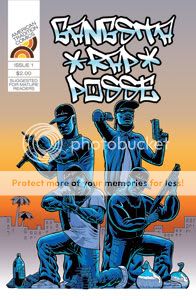
Gangsta Rap Posse #1
Benjamin Marra, writer/artist
American Tradition, 2009
14 pages
$2
Or: “What If N.W.A. Weren’t Making All That Shit Up?” The idea of a Bush I-era hardcore hip-hop outfit who actually are gun-toting, ho-pimping, mass-murdering drug kingpins as outlined in their platinum-selling rap career is so fucking brilliant a high concept I’m stunned I’ve never seen it in action before. It’s difficult to remember now, in an age when Jay-Z has more number-one album debuts than anyone but the Beatles and the President jokingly banters about Kanye West’s antics, but when my generation of white kids was growing up, “rapper” was a career that took on the same sort of quasi-mystical air as “cowboy” or “ninja.” Obviously there really were people who did those things for a living–okay, maybe not ninjas so much anymore–but the word, the concept, had a totemistic quality above and beyond “performer who composes and recites rhymes over beats.” Now, I was never a huge gangsta fan, but the less criminally minded but equally angry Public Enemy were one of my favorite groups of any kind during middle school, and from Flav’s accessories to Chuck D’s barn-burning baritone to the marching, uniformed S1Ws to that crosshairs logo, P.E. came across like a black G.I. Joe squad. The kinds of hip-hop that politicians and parents groups rent their garments over back then were tailor-made for action-hero status, and that’s what Marra delivers here. Watching his N.W.A. manques roll up on a rival MC’s compound and strafe his bodyguards with machine-gun fire fulfills a long deferred desire to see the larger-than-life lyrics of such groups made real, or at least as real as an action comic would make them.
It’s so effective in that regard that it’s tempting to overlook the obviously problematic racial territory we’re in. What we have here is a white guy taking Easy, Cube, Ren, and Dre’s lurid cop-killing, bitch-fucking, crack-pipe-illuminated fantasy world and drawing it, and that’s a bit of a sticky wicket, innit? It’s an ugly portrait, even if you’re just painting by the numbers left by the subjects. Fortunately, aside from the all-too-real hairstyles of that era, the visual stereotyping is kept to a minimum; Robert Crumb’s “When the Niggers Take Over America” this isn’t. But the irony is that while, to me, Crumb’s comic is an obvious parody of white racism, Gangsta Rap Posse‘s lack of Crumb’s corrosive irony and sarcasm might make it tougher for some to take despite its simultaneous lack of Crumb’s most outre visuals. Similarly, the dialogue’s ebonics are a far cry from Crumb’s pidgin dialect, but it’s also never half as clever, say, the lyrics from Straight Outta Compton, which were so wickedly funny that they came across like the group letting you in on the joke. Here, it’s a little tougher to tell if the joke’s on them.
But it seems to me that what Marra’s doing is simply taking vintage gangsta and treating it like any other kind of genre fiction. Perhaps the big clue is the sequence where the GRP’s manager complains that the record label’s been waiting for their new album for two years–how could they possibly have time to maintain their recording career when they’ve got an organized crime empire to run? The Gangsta Rap Posse doesn’t exist in continuity with Malcolm X or the Last Poets, they’re in the tradition of Robert E. Howard or the film library of Golan and Globus, and Marra’s using “Fuck tha Police” here the same way he used exploitation cinema in Night Business, or maybe even the same way Bryan Lee O’Malley uses Mega Man in Scott Pilgrim. He’s working much, much edgier territory here than either of those works–it has a lot more in common with Johnny Ryan than O’Malley–but you get that same thrill of cross-pollination and unexpected magpie influences. So I’m down. And I’m really hoping the GRP come up against a fictionalized black-nationalist paramilitary organization version of Public Enemy in the next issue.
Comics Time: Night Business #1-2
September 16, 2009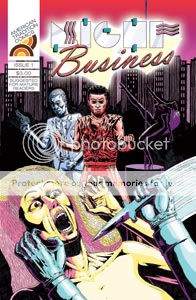
Night Business #1 & 2
Benjamin Marra, writer/artist
American Tradition, 2008-2009
24 pages each
$3 each
Buy them from BenjaminMarra.com
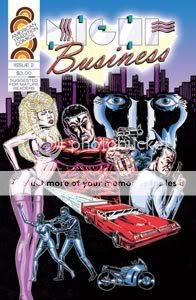
I had a whole long tedious review of these comics written out and five seconds ago I deleted it. Didn’t even copy it to the clipboard first! I think it’s stupid to write a boring review of an exciting comic. (Not that it’s stopped me in the past…) And Night Business is definitely an exciting comic, the kind of thing you want to sneak into the hands of all your teenaged cousins or spill beer and pizza grease on during the Crank 2: High Voltage/Road House/Predator movie marathon you’re having this Friday night.
The point I was trying to make in the scrapped review was that Night Business isn’t a pastiche of ’80s trash-culture thrillers as found in straight-to-video late-night-cable exploitation movies or “adult” independent comics from fly-by-night “publishers” so much as it’s a re-creation of them. Dolly Parton (whom, coincidentally, Marra has drawn) famously said “it costs a lot of money to look this cheap”; while I doubt that Night Business cost anyone a lot of money, its cheapness is clearly hard-earned. Benjamin Marra’s art is studiously amateurish and ugly in a totally consistent fashion–precisely the way that the art of someone whose natural talent is totally outgunned by his boundless enthusiasm and obsession bordering on dedication would be. These blocky, blockheaded, stiff figures–everyone, male and female, looks like their bodies are 85% gristle–seem like the thought-through product of a worldview, like they’re the output of someone who’s drawn page after page after meaty, pulpy page of these people without ever thinking twice about what anyone will think of it (beyond, perhaps, “they’ll fuckin’ love it!”). The layouts are simple, all business, as if to say “enough of all the frou-frou, let’s just see what happens next.” Every outfit is peeled from some hair-metal or porno fantasy world where men are either leather and denim street toughs or sharp-dressed sharks in suits, and where women routinely walk around in lingerie and heels. The City (capitalized like a motherfucker) consists almost solely of strip clubs, alleys, morgues, and the preposterous offices of an exotic-dancer management empire; everything is lit by streetlights or neon. In order to offset some of the icky taste that might be left in your mouth by doing a story about the serial murder of strippers while spending page after page depicting the naked bodies of those strippers (necessarily, I think; look how toothless Robert Rodriguez’s strangely prudish grindhouse homage Planet Terror ended up being without it), the series takes a page from every bard of the urban nightpeople since Steve Perry’s small-town girl took the midnight train going anywhere and builds up the hopes, desires, and dreams of each dancer as she takes it off to the leering crowds. Sure, they’re all pure-dee hokum, but in a world where the men’s emotions can all be expressed by grimacing and never rise above the complexity level of a Blackest Night tie-in issue’s Lantern Corps appearances, they’re the most psychologically fleshed-out characters in the book. The effect isn’t just reminiscent of some bargain-bin Scarface, it’s identical. If it weren’t for the ironic author photo and bio giving the game away at the back of each issue you’d never know that Marra is, on some level at least, kidding. And by that point, who cares? Smoke ’em if you got ’em and bring on issue #3.
Comics Time: The Squirrel Machine
September 14, 2009
The Squirrel Machine
Hans Rickheit, writer/artist
Fantagraphics, 2009
192 pages, hardcover
$18.99

Given what I’ve been reading lately I can’t help but compare Hans Rickheit to Fort Thunder. Like Brian Chippendale, Mat Brinkman, Brian Ralph et al, Rickheit spent the late ’90s and very early ’00s living and working in a combination art gallery/performance space/flophouse in a New England college town–theirs, Fort Thunder, in Providence; his, the Zeitgeist Gallery, in Cambridge. Like them, he saw his one-time shangri-la end before its time–theirs by municipal diktat, his by fire. Like them–and, like them, perhaps unsurprisingly given his years-long conflation of room and board with bristol board–he creates comics centered on the exploration of space, rooms, houses, environments. And like them, he fills that space with marks, so that reading one is almost a tactile, exploratory experience itself.
But the similarities are not complete. Unlike Ralph’s cavemen or Brinkman’s monsters or Chippendale’s warriors, Rickheit’s Edwardians are observers at least as much as explorers. Though they move about in his strange, gristly world, they are not of that world. More often than not they’re limned by a fine white void; it serves the purpose of making them pop against his often overwhelming backgrounds, yes, but it also reinforces their separateness, their otherness. They wander through strange environments constructed by unknown architects, gazing through lenses and orifices at any number of bizarre transmixtures of human, animal, and machine. They are constantly seeing things, to borrow the title of a book by Rickheit’s visual and thematic kindred spirit Jim Woodring. When we see what they see, the effect is reminiscent of catching a glimpse of an older family member as he or she masturbates, or strips to reveal what Rickehit’s friend E. Stephen Frederick refers to in his memorably Kenneth Smithian introduction to The Squirrel Machine as “secondary hair.”
In the comics of the Fort, exploration is, at worst, value-neutral. In Ralph’s comics they lead mostly to mischief and lessons learned (though that changed somewhat in the bleak zombie comic Daybreak), in Chippendale’s they usually lead to freedom or adventure, and in Brinkman’s, for every bleak wordless parable of creatures lost in an endless maze, there’s another LOL-inducing story of a beast barging into a castle to take a dump on the king’s throne. In Rickheit’s comics, though, the explorations and the visions waiting at their conclusions are unmistakably disturbing. They reveal creatures and creations of arcane origin and dubious value, frequently hidden inside a smoothly artificial or warmly organic surface like a grotesque parody of birth, or a Cracker Jack prize. When you end up at the end of one of Rickheit’s wonderings, there’s a sense that, to quote Trent Reznor, “Now I am somewhere I am not supposed to be, and I can see things I know I really shouldn’t see.” That’s no less true for our desire to see them. In this, he has more in common with Josh Simmons than with the Fort, though unlike the House author, up until this point the damage incurred in Rickheit’s characters’ travels is more psychological than physical.
This changes in The Squirrel Machine, Rickheit’s Fantagraphics debut and for all intents and purposes a simultaneous coming-out party and summation of all that has gone before. In the past–his Xeric-winning erotic coming-of-age nightmare Chloe, his dewily sexualized surrealist gag strip Cochlea & Eustacea–Rickheit imbued his character’s journeys into what he refers to as the Underbrain with a sliver of redemptive power. Chloe finds something that replaces what she lost; Cochlea and Eustacea’s antics are as funny and horny as they are freaky. But here, the downbeat direction hinted at by C&E’s fate in the last issue of Rickheit’s self-published anthology Chrome Fetus emerges in full flower, and the result is awesome to behold.
In Rickheit’s story of the brilliant brothers Torpor, William and Edmund, art does not provide the antidote to the encroaching cruelty of the civilized world, as it does in Chippendale’s Ninja. On the contrary, the art of William and Edmund is wholly dependent on the taking of life. Their childhood games aren’t free-spirited enactments of the struggle of good against evil, and they’re not really games, either. They’re attempts to follow their brains as far as they can take them. Other beings–the animals who are their chosen medium, their hapless mother, the angry townsfolk and mocking bullies–factor in only as means rather than ends. Even exploration itself is represented as a frightening loss of control by its most prominent exponent here, Edmund’s sleepwalking. There seems to be no escape from the power structure of oppressor and oppressed.
The one exception to that rule is for those with whom they can form a sexual connection–but even that will only be allowed to take them so far. Visually, Rickheit tips his hand after the book’s first big sex scene. It’s weird, hot stuff as always from Rickheit, rooted in memorable details that serve to knock you off balance and make you vulnerable like the characters themselves. But in the middle of the act we cut to a stunning two-page spread, silent, no people present–simply incredibly byzantine images of the Torpor family home, utterly cluttered with the detritus of their inventions. Pipes and chains and ropes and stairs and beams and wires crisscross the panels, creating along with the gutters a dense thicket of tangents and congruences. The eye is led everywhere and nowhere all at once. The message is clear: Sex offers no escape. And like art, it can, and likely will, destroy and degrade and subjugate. When life and love, of a sort, finally do reassert themselves at the book’s end, it’s horrifying and drawn in a fashion that makes it look less like a natural thing and more like a terrible apparition, or a special effect.
It’s strange, but of all the dizzying details Rickheit deploys in The Squirrel Machine, the one that stood out the most to me came early on in the book: A distant water tower topped not with the usual tank, but with what looks like a giant version of the old-fashioned, grated helmets divers once wore. It sits atop a tower and beside a train trestle that are both as realistic as you please, but there it is, a mute monument to illogic. In Grant Morrison and Dave McKean’s Arkham Asylum, Amadeus Arkham recalls his fateful initiation into his mad mother’s “other world”:
A world of fathomless signs and portents. Of magic and terror. And mysterious symbols.
This has long been the world Rickheit has chronicled. The allure in both cases is that these portents can be scryed, these symbols can be decoded, this world can be mapped. But it’s only in reading this book–a painstaking chronicle of the lack of solace provided by art to the powerless–and thinking back on the diver’s-helmet tower that I realized that in our darkest moments, it’s easy to see that world as our world too–only the symbols can’t be read. When exploration is punished, when everything we see feels like something we oughtn’t, when theoretically life-affirming forces are either nipped in the bud or exposed as brutal frauds, doesn’t it all seem as maddeningly inscrutable as a giant diver’s helmet on top of a water tower? That there’s some reason for it all, something lurking beneath the surface, something we will never, ever get to?
Comics Time: Ninja
September 11, 2009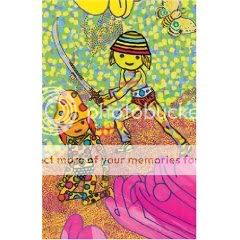
Ninja
Brian Chippendale, writer/artist
PictureBox, 2006
128 pages, hardcover
$34.95

Starting off a review of a Brian Chippendale comic by talking a plot seems like the laziest most wrongheaded way to start off a review of a Brian Chippendale comic, like an unwitting parody of all the lame comics criticism that other comics critics criticize for focusing on writing rather than art. Shouldn’t I be saying something about markmaking or snake-style layouts? Maybe, but much more so than with Chippendale’s Maggots, the creation of which predated and the publication of which followed this book, the plot of Ninja matters. Not just as a driver for the imagery, but to Chippendale, and to me.
The book starts with these silly little comics about a ninja–basically, fighting against Cobra from GI Joe–that Chippendale drew when he was 11. They look like a child artist’s representation of a sidescrolling Nintendo game, like Ninja Gaiden: After breaking into a bad-guy base, the ninja will move forward or up or down and discover a new opponent, and we watch as he figures out a way to defeat or avoid each enemy. Most of these strips end when the ninja, having stolen some valuables from the evildoers, successfully escapes from their lair and returns to his home (complete with its incongruously normal front door). What Chippendale does in this collection is every so often insert a brand-new, recently drawn strip between the stuff he drew as a kid, fleshing out the Ninja’s home life and world at large. Meanwhile, in the world of the kid strips, the bad guys become less involved with…whatever it was they were up to before the Ninja showed up, and more and more fixated on capturing and killing the Ninja in retribution for all the havoc he’s caused them.
The problem for Chippendale is that his younger self was apparently less dedicated to making art than his grown-up incarnation–like many kids who spent their youths creating their own, enthusiastically derivative fantasy worlds to play in, he eventually ran out of steam, and his final Ninja strip from that era is unfinished. The solution? A new penultimate strip, in which the bad guys build a doomsday device that gets out of control and begins absorbing reality as we know it. Now, when 11-year-old Chippendale’s last Ninja strip abruptly cuts off mid-page, leaving rows of blank panels unfilled beneath it, it’s not just a kid losing interest and putting his pencil down to go play Nintendo or skateboard–it’s the end of a world as we know it.
Cut to 18 years later, and to the bulk of the book. Now, in typical Fort Thunder fashion (prefigured to an astonishing degree by the space-based action of the kid stuff) we explore the city of Grain and its surroundings, where the Ninja and his enemies once lived. Only now, with the Ninja gone and his “killing villains for fun and profit” activities curtailed, the city’s gone to hell. Not the openly dictatorial hell that the old Bad Guys might have ushered in–they seem to have been consumed by their own device, unless I missed something–but a quotidian nightmare of corrupt public officials, rapacious corporate raiders, callous resource thieves, brutal cops, and relentless, even violent, gentrification and homogenization. Everyone may still look like refugees from Super Mario or the Masters of the Universe, and the level of violence and dimension-hopping and overall weirdness remains consistent with that, but in essence their concerns are the same as those of an artist who returns home from a tour with his noise-rock band to discover the place he’d lived and worked in for years had chains on the doors so the city could raze it and install a supermarket parking lot.
Of course none of this is super-apparent from the get-go. I spent a decent amount of time waiting for the Ninja to show up again after the 18-year jump, storming back into town to take it back. But as we watch Chippendale’s little groups of characters–good, bad, and ugly alike–go about their zany business, it becomes apparent that there’s a build to the eventual reveal of “What happened to the Ninja?” to rival any slow-burn mystery-villain storyline Marvel or DC have done this decade. And once you find out, the solution is elegantly simple, childlike, charming, and utterly inspiring. I’m not going to spoil it, but suffice it to say I closed this book feeling better about humanity than I’ve felt in quite some time. Maybe there is a solution after all.
Okay, so, the art. The collage material is an eye-candy orgy as you’d expect, one of the purest distillations of that aspect of Chippendale and the whole Providence scene’s output as I’ve seen so far, though for the life of me I couldn’t figure out what role it was playing in the narrative–it didn’t seem to pop up at logical reality-warping breaks, like when the Bad Guys’ machine ran amok and caused a House of M style fade to white–until I read in PictureBox’s synopsis of the book that they’re just chapter breaks. More immediately grokkable and impressive to me were the many, many bravura moments in the comics themselves–painstakingly delineated Dore-style deserts, a city covered completely in OCD stripes, characters becoming aware of a spy camera filming them in a scene simultaneously “shot” from their perspective and that of the camera, two scenes taking place at the same time but on different vibrational planes suddenly smooshed together in strips as though they were pieced together from two separate shredded documents, a brutal torture sequence and hot sex scene both showing up in the book’s final act. And Chippendales back-and-forth panel flow is so addictive (and much more consistent than in Maggots) that I found myself trying to read other comics that way after finishing Ninja. There’s a certain magic to these elements that feeds into and plays off of the narrative even when it doesn’t have any strict narrative cause, like any great spectacle.
But ultimately this is a book about an idea: the need to persevere in your pursuit of fun, which in most of the ways that matter is a synonym for Good with a capital g. Sometimes, compromise may be necessary–after all, the Ninja was slicing up bad guys not just because in the world of the comic it’s the right thing to do, but for their loot; and (still trying to avoid being spoilery, though this may skirt the edge) his ultimate fate does not necessarily provide a happy ending for everyone. But you can reclaim the comics you made when you were a kid and build them up into a statement on where you are as a grown-up without sacrificing the buoyant illogic and unfettered imagination that came through originally. You can hang on to the important things you found in your arts-commune idyll even when the outside world finally smashes down the walls around you. You can still think ninjas are cool.
Comics Time: Sweet Tooth #1
September 9, 2009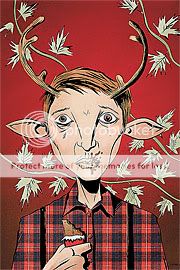
Sweet Tooth #1
Jeff Lemire, writer/artist
DC/Vertigo, September 2009
32 pages
$1.00!
Tim Heidecker and Eric Wareheim of Tim and Eric Awesome Show, Great Job! have a recurring…concept, I guess? called “Brown Town.” Sometimes it’s used as a euphemism for potty humor: “That ‘Poop Tube’ sketch was a little too Brown Town for our parents.” Sometimes it’s just a funny-sounding nonsense phrase, as in their unsolicited candy jingle-cum-Doobie Brothers pastiche “Rolo Tony.” But I like to think it’s meant to describe where we’re often taken by colorists for Vertigo comics.
Jose Villarrubia’s Lee Loughridge impersonation aside, this is a fascinating little comic just because of how different it is from pretty much everything else Vertigo has done this decade. There’s no fabulous and violent rock’n’rollin’, there’s no in-your-face ugliness (except for one shot–pun intended), there’s no modern-mythmaking, no real echoes of Gaiman or Ennis or Ellis or Azzarello or Willigham. And there’s no writer/artist team, either–it’s just Jeff Lemire, author of Top Shelf’s Essex County trilogy and creator of some of the best damn convention sketches you will ever see. It’s tough to imagine a better fit for this story of an isolated deer-boy hybrid left on his own in an unforgiving post-apocalyptic world after the death of his father than Lemire’s shaky, nervous line, which has always had a vulnerable deer-in-the-headlights quality and which isn’t toned down or slicked up a bit for this major-label effort. Even the bloodspatter remains an abstracted splash of red rather than an HBO Original gorefest. The art holds color well, moreover, though as I said, it might be nice if colors other than brown were deployed for that purpose. Instant-classic cover, too, perhaps the best the imprint has seen…I was gonna say since Dave Johnson on 100 Bullets or James Jean on Fables, but this strikes me as potentially iconic in and of itself in a way that those storied cover-art runs only were in toto.
In one of those self-promoting editorial columns Vertigo creators do during a series launch, Lemire suggests that what sets Sweet Tooth apart from your average monthly comic is the quietness of his approach, an approach he’s carrying over from his altcomix, the idea being that when something really fucked up happens, it’ll be that much more startling. I think he’s right, so far, one issue in. Now, there are things I’m not so sure about–the boy’s dialect scans a bit like Claremontian cliche at times, while his bumpkin naivete and the hunters’ gruff bad-guy-ness are a little too high-pitched to maintain that delicate quietness Lemire’s striving for. And this is a bit picayune, but I feel like a lot of shots crop off the characters’ feet for no reason? But regardless, this is a very likeable book, a comic you want to succeed really for all the right reasons: It’s clearly the product of a personal vision rather than an attempt to fill some kind of niche, it has lovely art, it attempts to win you over to its characters rather than bash you over the head with their badassness, and it honestly seems like it could go anyplace at all at this point. I’ll be following it.
Comics Time: Agents of Atlas #10
September 7, 2009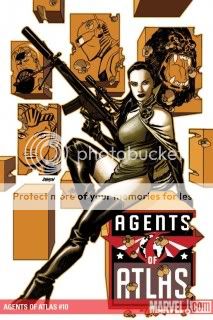
Agents of Atlas #10
Jeff Parker, writer
Gabriel Hardman, Paul Rivoche, artists
Marvel, September 2009
32 pages
$2.99
Credit for this excellent superhero comic must go first and foremost to colorist Elizabeth Dismang. Coloring this nuanced, engaging, and lovely in a superhero comic is a rare treat indeed, and from nighttime parking lots to forgotten mad-science labs to the red hair of the goddess Aphrodite to the sheen of a killer robot, Dismang imbues this issue of Jeff Parker’s strong off-model Marvel super-series with warm, sumptuous, tactile hues. Put it together with the just-so minimal-realism (is there such a thing) of Hardman and Rivoche and you have the best-looking variation on modern Marvel’s noir-naturalism house style since David Aja on The Immortal Iron Fist (or that Ann Nocenti Daredevil story everyone’s talking about). Right now I’m looking at a panel where Venus asks a wistful-looking Namora if she’s thinking about her old comrade and lover Hercules, and the team nails the emotion of it just as well as they handle the machine guns and robots of the action sequence that follows it. It’s really a joy to look at.
And that makes all the difference, doesn’t it? Books like Agents of Atlas, operating at the margins of the mainline superhero universe of which they are nominally a part, live and die on the strength and cleverness of their ideas, or specifically the variation they represent on the usual superhero ideas, if you follow me. But there are a lot of perfectly clever, perfectly nice minor superhero comics out there–you’ve probably read a lot of them–with art that never rises above the functional, and therefore who cares? But you care about the Agents of Atlas after reading a gorgeous-looking, well-constructed issue like this. Parker packs its pages with idea after idea–you get more exposition on this whole “warring Dragon Clans” idea that makes for a nice fit with the kinds of things Iron Fist fans would appreciate; you get a crazy Weapon Plus-style look at the decades-old killer-robot production program Atlas has instituted; you get a big giant battle with souped-up automatons. But more importantly, you also get that great calm-before-the-storm feeling you’ll remember from your favorite action movies, with the characters collecting their thoughts, bonding a bit, but also making damn sure they’re ready for whatever’s about to come through that door. I know that sounds like such a cliche, but here it feels fresh, rooted to this specific motley crew of characters drawn from the various corners of the Marvel Universe and thrown together by the accident of when they were first published. You’ll believe a top-notch, visually and emotionally engaging comic can be made out of an Atlantean queen, a siren, a talking gorilla, a mute robot, a Uranian-Earthling hybrid guy, a dragon, a bunch of knowing yellow-peril/dragon-lady pastiches, a thawed-out secret agent from the ’50s, an Art Bell knockoff, and some warp zones. Like Mike Mignola, John Arcudi, and Guy Davis’s B.P.R.D., it’s an ensemble action book with brains, looks, and heart. Well done all around.
Comics Time: Inkweed
September 4, 2009
Inkweed
Chris Wright, writer/artist
Sparkplug, 2008
152 pages
$16
I didn’t want to like this comic. I didn’t even want to read it. There’s something…off-putting about that cover, a weird combination of Klasky-Csupo/Gary Baseman character design I never found that appealing and just a lot of brown, empty space. The interiors similarly failed to pull me in–lots of crosshatched backgrounds and clothing placed behind and draped around a cast of sub-Muppets. In order to keep myself sane, my usual criteria for whether I’d even read a comic at all is that I at least have to enjoy flipping through it, so I was sorely tempted to leave this on the shelf and would have done so but for the good things I half-remember hearing about it. Plus, it seemed like it’d be a quick read.
What I didn’t count on is the writing. Good Lord. I’m still not 100% sold on his art, but the Chris Wright stories collected here are sharp as a knife, just as incisive, just as likely to leave a wound. Most concern older people coming to terms, or failing to, with their failures: a painter who seems to have traded acclaim for ability, an astronomer who falls in unrequited love with his assistant, a witch who cultivates fine blends of pipe tobacco for an unappreciative Satan, a famous author whose equally gifted but resentful son comes between him and his young wife, another painter whose drinking gives him an outlet for his extravagant self-loathing and a cover for his fear of failure. I suppose these are all fairly well-trodden paths–you don’t have to have read Asterios Polyp recently to feel like you’ve gotten your fair share of stealth-autobio art about the struggles of artists. But Wright is distinguished by the swift and brutal way he deals with the themes. The ends of his stories tend to leave the characters staring down the abyss in matter-of-fact fashion–literally, in the case of the astronomer, who can only gaze once again into his telescope, and in the case of the famous painter, who must trade his blank canvases for the blankest canvas of all. Other stories end with no-nonsense cris de coeur: “What’s wrong with me?” asks the alcoholic painter; “FUCK!” yells a man whose confrontation with God over the heartache he feels has been abruptly cut short mid-sentence when God vanishes with a Nightcrawler-style BAMF. The lead-ups to these grand finales are unsparing as well, particularly the story about the father and son authors and the father’s wife–that one takes a swing-for-the-fences turn for the disturbing that still manages to preserve the humanity and agency of all the characters involved rather than reducing any of them to something for someone else to react to. Wright accomplishes that in part by pushing the most extreme reactions off-panel, just one of any number of extremely shrewd storytelling choices he makes in here.
And you know, the art does have stuff to recommend it after all. Populating his stories with dollar-store Fraggles may be off-putting at first glance, but it can keep the stories from getting too maudlin or too on-the-nose. It also strangely enhances the period feel of the material–watching these creatures roam around in 19th-century garb reminds me of half-remembered cartoons in which anthropomorphized animals acted out human conflicts in old-timey settings. But his strongest visual flourish is the way he can slowly zoom in and out of abstraction in the middle of his stories, focusing only on the patterns created panel to panel by hands, eyes, stars, candles, enabling our minds to make sense of the images as the characters similarly grapple with their thoughts and emotions. Wright eventually lets this get away from him a bit toward the back of the book in a series of abstracted one-page strips and illustrations–the strongest of these, a short and bitter near-poem about alcoholism, is also the most straightforward. But the way he works such sequences into his traditional short stories bespeaks confidence and skill. This is already one of the best-written comics I’ve read in quite some time–goodness knows where a few more years at the drawing table will take him.
Comics Time: Soldier X #1-8
September 2, 2009
Soldier X #1-8
Darko Macan, writer
Igor Kordey, artist
Marvel, 2002-2003
32 pages each
$2.99 each
Comics Time: Flash: Rebirth #4
August 31, 2009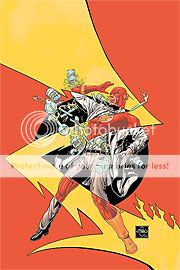
Flash: Rebirth #4
Geoff Johns, writer
Ethan Van Sciver, artist
DC Comics, August 2009
32 pages
$3.99
If you know Geoff Johns, and particularly if you know his work on this project’s thematic predecessor, Green Lantern: Rebirth, you knew this was coming. This is the issue where Johns redefines, organizes, and expands the Flash mythos, tying together various elements and explaining how revived hero Barry Allen is an indispensable part of them all. The following thoughts about this aren’t quite Flash Facts–maybe they’re Allen Opinions?
This was nowhere near as elegantly done as the reveal of the “emotional spectrum” concept in Green Lantern, or even the “Parallax was a separate entity” reveal from GL: Rebirth. I think that’s because the core concepts being utilized here aren’t as easy to instantly grasp. With Green Lantern, if you were gonna bring back mass murderer Hal Jordan you had to come up with a reason why it’s okay for us to like him again, and “he was possessed by a demonic yellow fear elemental at the time he killed all those people” is a pretty easy one to get behind. And once you’ve established that arch-enemy Sinestro’s power ring is fueled by fear in much the same way that GL’s ring is fueled by willpower, it’s a logical leap to other colored rings being fueled by other states of mind.
By contrast, the big revelations here…well, I’ve never quite understood what the heck the Speed Force is supposed to be anyway. For years I labored under the misapprehension that it was some pseudomystical thing, like what J. Michael Straczynski did with that horrible “Spider-Totem” idea in Amazing Spider-Man–so that instead of that accident with the lightning striking Barry Allen while he was holding some chemicals giving him his powers, that just opened up some portal to the Speed Force or something, just like how in JMS’s justly ignored origin revamp the spider was magical and the radioactivity was just a coinicence. I’ve since learned that I was wrong and the Speed Force was just something out there that people who got super-speed through whatever means became able to commune with or tap into or whatever the proper term might be. Either way, this is a much wonkier concept than “rainbow of space armies,” and so rejiggering things so that now Barry Allen’s accident created the Speed Force doesn’t have the same oomph as “the reason Green Lanterns were vulnerable to yellow is because of the giant yellow Fear Monster inside the Power Battery.”
Same with the revelation that there’s a Negative Speed Force embodied or utilized or whatever by Professor Zoom, the Reverse Flash. To convey this idea, Johns and Van Sciver tie it to the fact that the Flash’s speed lightning is yellow while Zoom’s is red. Frankly, I’d never noticed this before–it’s certainly not a famous concept like Green Lantern’s green ring vs. Sinestro’s yellow one, or even just “the Flash wears red while the Reverse Flash wears yellow.” Without that easy-to-envision visual hook, it’s a much tougher sell; all Van Sciver’s little design flourishes and neato ways of showing superspeed Van Sciver can’t quite make up for it.
However, there were quite a few things I liked in this issue. For starters, I appreciate the way Johns has shifted the generative spark for the Flash’s powers back to that lightning/chemicals accident instead of positing some preexisting speedster ether floating around out there. Now it’s all a result of Barry’s accident, ripples from which apparently spread throughout all of time and space–which moreover is as good an answer as any to the question “Why is this Flash different from all other Flashes?” Plus, I feel like we’re closer than ever to a speedster team book called Speed Force, which is far past due, and since I don’t have a dog in the Jay vs. Barry vs. Wally vs. Bart vs. Max Mercury vs. whoever the hell else race (no pun intended), it could star any of these guys and I’d be fine with it. The prospect of the Flash Family being its own little squad centered on one of DC’s coolest superhero concepts, like the Green Lantern Corps or Batman and his Robins or the Super-people, is pretty appealing.
But I suppose the main reason I’m not letting my problems with Johns’s solution to the Flash equation is that I’m not convinced we’ve seen the end of it. For example, I have to assume an explanation is in the offing that ties the new, time-jumping Zoom in with Professor Zoom’s negative Speed Force. Maybe Johns will explain (by which I mean invent, of course) why non-Speed-Force-using Superman is able to keep pace with the Flashes. Maybe that turtle villain who slows things down will be revealed as some sort of Slow Force avatar. Maybe there’s some sort of Superhero String Theory in the offing that connects the Speed Forces to the Emotional Spectrum to Anti-Life to the Purple Healing Ray to New Order’s “Blue Monday,” I dunno. I appreciate the effort of imagination needed to put it all together and await its continued rollout.
Comics Time: Big Questions #12: A Young Crow’s Guide to Hunting
August 28, 2009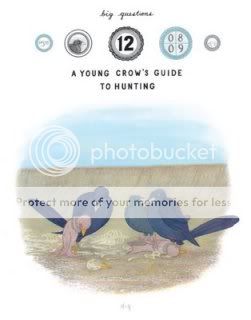
Big Questions #12: A Young Crow’s Guide to Hunting
Anders Nilsen, writer/artist
Drawn & Quarterly, 2009
24 pages
I don’t remember what I paid for it–$6.95, maybe?
I’m sure you’ll be able to buy it from Drawn & Quarterly eventually
Of the three action comics I reviewed this week, the most thrilling, best choreographed, most suspenseful, most pulse-pounding was not the Frank Miller/Jim Lee team-up or the Geoff Johns event comic but a little black and white story about birds. In this antepenultimate installment of Anders Nilsen’s long-running magnum opus, things come to a head between our “hero” birds and the big black crows who’ve been harassing them throughout this bleak story about how difficult it is to process tragedy. Because it has been so bleak, the tension here is almost unbearable. As the crows make a mockery of the birds’ noble but feeble attempts to defend themselves, just one big question filled my brain: Just how far will Nilsen take this?
As the action picks up the panel borders disappear, leaving Nilsen’s already feather-delicate images feeling more vulnerable and exposed than ever. Each image is a marvel of composition and clarity as the black and white birds clash, calling to mind everything from yin and yang to that incongruous cover image on the original hardcover versions of Stephen King’s The Stand. Each visual beat is so strong, and complemented so chillingly with the crows’ callous dialogue, that even as I raced to find out what happens, I couldn’t help but linger on every panel, trying to squeeze out every last bit of detail. I refuse to spoil the ending, whether devastating or joyous–frankly, everyone should experience it for themselves–but I will say that it made me more confident than ever that Big Questions is a masterpiece in the making.
Comics Time: All Star Batman & Robin, the Boy Wonder
August 26, 2009
All Star Batman & Robin, the Boy Wonder Vol. 1
Frank Miller, writer
Jim Lee, artist
DC, 2009
240 pages
$19.99

Now that this first volume of Frank Miller and Jim Lee’s, uh, controversial Bat-book is out in a nice fat trade paperback, I finally sat and read its nine issues’ worth of comics from start to finish for the first time. Then I sat around and tried to figure out what to say about it. One phrase kept leaping to mind no matter how much I tried to come up with an alternate approach, so fuck it: That phrase is “mentally ill.”
But I mean it in the best way!
I understand that Miller’s staccato and repetitive dialogue and narration is enough to give some people aneurysms. Ditto, and more so depending on whether you’re talking about some of my former coworkers at Wizard, his new take on Batman as a cackling, grinning, foul-mouthed, stubble-sporting, child-abusing psychopath. For pete’s sake, former editor Bob Schreck’s introduction to the volume is nothing more or less than an apologetic for what follows. But I know self-parody when I see it–and honestly, even if Miller really isn’t capable of writing in any other way anymore, that doesn’t make it any less of a self-parody–and I have no attachment to some platonic ideal of Batman. In point of fact I actually have long felt Batman would have more fun pounding the bloody bejesus out of criminals than we’ve been led to believe. In the immortal words of J.R. “Bob” Dobbs, fuck ’em if they can’t take a joke.
And you know, the thing really is (to quote Grant Morrison’s Mad Hatter) very much cleverer than its rep as a goddamn-Batman meme generator would indicate. Miller is constantly getting Lee to play around with panel layouts in memorable fashion, from the Bendis-like talking-head array during Batman and Dick Grayson’s conversation in the Batmobile to the gigantic splash-page extreme-closeups of the Robin and Superman logos (the impact of which is muted somewhat by similar treatment of other images to fill up space in the collection, but still) to the outrageously over-the-top barroom banter juxtaposed with an image of a burning fuse during the Black Canary’s introduction. There are even a couple moments that recalled the genuine madcap wit of mid-period Miller (roughly from The Dark Knight Returns through Hard Boiled)–a great jumpcut reveal of Dick’s kidnapping ruse during the Dynamic Duo’s confrontation with poor befuddled Green Lantern, and that massive multi-page fold-out of the Batcave that just keeps unfolding. By the time I got to the fourth fold, I was laughing out loud. Though Jim Lee has aged into his “nicest guy and biggest artist in comics” role very gracefully, he’ll never be the formal innovator (or popularizer of others’ innovations) that Miller has been, but even still, all these moments shine quite aside from his primary selling point of drawing DC’s characters as heroic and awesome and eye-poppingly big-big–BIG as possible. Put it all together and it’s a pleasure to flip through this book.
That’s not to say that the “this goes to 11” tone works all the time. There’s just no way to carry off any kind of emotional nuance if everyone sounds like a manic cross between Raymond Chandler and Matthew Perry’s Chandler. At one point, you’re supposed to infer from Vicki Vale’s speech pattern that she’s in shock, but she just sounds like everyone else (I imagine that was intentional, but it’s still a bit flummoxing). Meanwhile, the selling point of Miller’s Joker, back since DKR, is that he’s unsmiling and quiet, but his internal monologue is as chatty as all the other characters’. It doesn’t help that the Joker has always been one of Lee’s weakest interpretations of DC’s characters, the nose too pointy, the face too demonic. And honestly, Lee’s polished work is the reason that this book, at its best, will always just be really entertaining, whereas I truly think that the raw power Miller’s own The Dark Knight Strikes Again (or his crazy gorgeous alternate covers for ASB&R, reprinted here) is like a message from an alternate future for superhero comics.
But having the first nine issues of the book collected in one place does a lot to clarify what’s going on. For example, no longer does the Batmobile ride seem to go on for weeks (though Miller inserted a joke about that)–it just seems like one more feverish element in a story paced like a series of exclamation points. And tackling those initial, hostile conversations between Batman and Robin just a few minutes before you come to this arc’s comparatively quiet graveside denouement helps you realize that hey, this book just might be about Robin’s buoyant presence dragging Batman back from the brink of lunacy as we were promised after all! It certainly makes a convincing case that running around dressed as a bat and hospitalizing people all night for a year or so would drive you, well, batshit. Maybe that’s the quality, the tone, that Miller’s trying to capture more than anything else. I mean, there’s an issue where Batman and Robin lure Green Lantern into a room painted from floor to ceiling in bright yellow–so are they, though unfortunately we don’t see how that came to be–and Robin steals his power ring and crushes his windpipe so they have to perform an emergency tracheotomy on him. Mentally ill, meant as a compliment.
Comics Time: Blackest Night #0-2
August 24, 2009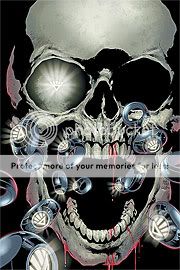
Blackest Night #0-2
Geoff Johns, writer
Ivan Reis, artist
32 pages each
#0: Free
#1-2: #3.99 each
Despite months of “Prelude” issues (whole story arcs, actually), a zero issue, and a “Prologue,” in Green Lantern #43, it’s the official first issue of Geoff Johns’s years-in-the-planning event comic Blackest Night that counts. And to be honest, my first read-through left me cold, largely by way of contrast.
That first Sinestro Corps Special a few years back was a first-round knockout–nutso heavy-metal character designs and all-out ring-on-ring action by Ethan Van Sciver, a Humpty Dumpty Green Lantern getting shot in the head, and a final “holy crap, this is going to blow you away if you’re a giant fucking nerd” secret bad-guy reveal splash page that, since I am a giant fucking nerd, blew me away. By comparison, BN #1 doesn’t have a whole lot going on. The “hey wouldn’t it be neat if…” idea of different-colored Lantern Corps isn’t new anymore. Both the comic’s general premise of dead heroes being brought back to life as killer zombies and the identities of many of the specific heroes to be revived were already common knowledge for most semi-savvy superhero fans. Van Sciver’s career-best art, and Doug Mahnke’s star turn on the tie-in issues of the main Green Lantern title–both of them weirder and harder-edged than mainstream comics need to be, with Mahnke in particular edging upward toward the top mainstream tier of Quitely, Romita Jr., Cassaday, and Frank–are replaced by the stalwart but pretty traditionally superheroey art of Ivan Reis, looking like Jim Lee scaled back toward Neal Adams a bit but somehow muddier and murkier than he’s been on GL in the past. There’s no last-page reveal at all. And the violence is extreme even by dismemberment enthusiast Johns’s standards.
But I think that this was ultimately a case of me expecting something different than what Johns was attempting to deliver. He doesn’t need to launch several years’ worth of future stories here–instead, he needs to tie several years’ worth of past stories by writers across the DC line together. He doesn’t need to kick off a thrilling saga of space-faring combat–he needs to start telling a horror story about dead superheroes coming back to life and murdering their friends. He doesn’t need to redefine and reinvigorate a character and his mythos–he needs to serve up a series of snapshots of multiple characters and the mythos of the entire DC Universe.
So rather than writing a review of BN #1 the second I bought it, I sat on it, keeping it in my backpack and pulling it out every now and then for another flip-through, another read. Now that I knew what to expect, I started to enjoy it, and the following issue, a lot more. I could admire how Reis made the Black Lantern versions of kindly old superheroes like Martian Manhunter and Aquaman into hulking, uruk-hai-style physical and existential menaces. I could get a kick out of his little flourishes, like the impressive Green Lantern hologram display of all the DCU’s dead heroes, or his riff on Rags Morales’s hyperthyroidal Hawkman (now the standard portrayal of the character, much to my amusement and delight). I could chuckle at the “jump scare” of turning a page on a quite rooftop conversation between Commissioner Gordon and his daughter Barbara to suddenly find Hal Jordan’s plummeting body smashing the Batsignal into pieces.
For as long as I’ve been reading it, Johns’s superhero writing has consisted almost solely of finding ways to express through action and dialogue exactly what each of DC’s superheroes means. As they fight, heroes will explain what it is that makes them tick and what iconic qualities they represent in DC’s pantheon, while villains will berate them for failing to live up to those demands. If this sounds boring or precious, most of the time it’s neither, because Johns just happens to be really good at identifying those core components of each character and basing fun action adventures around them. With the exception of the Justice Society of America–there’s just no way to remove the smell of mothballs and Ben-Gay from a team full of septuagenarians, guys in gimp masks, and (oddly) perky teens–his major recent works, lengthy runs on Action Comics and Green Lantern, have been like a carefully curated retrospective of Superman and Green Lantern’s careers, enemies, and milieux. At this point, if my comics-curious best friend from high school asked me to loan him comics that would inform him as to why Supes or GL are awesome, they’re what I’d hand him.
I guess that the idea behind Blackest Night is for Johns to take aim not so much at any particular character or even set of characters but at a basic fact of life for the DC Universe itself, the simultaneous omnipresence and impermanence of death. Everyone’s always getting killed (editorially speaking, Dan DiDio’s tenure at the top has been like a Robespierrian reign of terror for the men and women in tights) yet everyone’s always getting brought back to life (at the same time he’s been reviving more dead people that Jesus and George A. Romero combined). The power of the Black Lanterns reanimates dead heroes as extremely violent and extremely douchey killing machines, who taunt and mock the heroes they target for death, who are then brought back to life in the same fashion to continue the cycle. Depending on how much credit you’re willing to extend Johns, you could argue that this concept makes literal the way the constant death/rebirth cycle makes a metaphorical mockery of whatever import these characters’ adventures are supposed to have with us. If it’s all a wash eventually, what the heck difference does all the blood sweat and tears, all the rage and avarice and fear and will and hope and compassion and love that drive the multicolored Lanterns, even make?
Chances are a lot of you are simply saying “Jimmy crack corn and I don’t care.” Unless you have some basic investment in the idea that these characters can still be used to tell involving stories, this probably won’t mean much to you. Moreover, unlike Grant Morrison, Johns’s evangelical belief in the power of superheroes isn’t accompanied by the experimentalist brio that’ll hook the hipsters. He’s simply trying to make a really good superhero comic book. But here’s the thing: A little faith is all you need. As other people have gone into in great detail, Johns strove to make this thing as new-reader friendly as a comic that culminates in the Elongated Man and his rape-murdered wife rising from the dead and slaughtering the umpteenth incarnation of Hawkman and Hawkgirl can be. Obviously I like superhero comics and have read quite a few, but without having read them as a child, I lack the masters degree in minutiae that many fans, particularly self-identifying DC fans, seem to view as a necessity. Therefore, while I think I’d heard the names of, say, Aquaman’s little posse of Garth and Mera and Tula and Dolphin before, I had no idea who the hell they were when they all showed up to fight over Aquaman’s grave. But because Johns’s writing is always primarily concerned with explaining and exploring each character’s role in the pantheon, I didn’t need to know who they were–it was explained to me between, and during, punches. So then it becomes a scene not about trivia questions, but about characters’ past mistakes and biggest failures literally coming back to destroy them. It’s quite effectively done. It’s not knocking me on my ass the way Final Crisis did, but who says it needs to? It’s a fun, violent superhero comic that has a sense of weight, a sense that within its confines, what’s happening to the characters, despite all the dying and rebirthing, matters to them. Clearly it matters to Johns, and I think his ability to translate that into writing that’s creative and entertaining rather than insular and pathetic is his personal power ring.
Comics Time: West Coast Blues
August 21, 2009
West Coast Blues
Jacques Tardi, writer/artist
adapted from the novel by Jean-Patrick Manchette
Fantagraphics, 2009
pages, hardcover
$18.99

In a book like this, where a cartoonist is adapting a novel you haven’t read, it’s difficult to say who deserves credit for what. All I know is, someone deserves a lot of credit. As slim, smooth, and hard as its attractive, Adam Grano-designed album-style hardcover format, West Coast Blues is as strong a crime comic as you’re likely to see this year (or until whenever the next Gipi Wish You Were Here Ignatz book comes out). So maybe it’s weird for me to start by talking about the problems I had with it, but let’s get them out of the way: Certain basic character components are things you’ve seen many times before. There are hitmen who banter innocuously between dispassionate murder attempts, a torturer who loves his dog, and a protagonist who doesn’t seem attached to anyone but his own hide. Which is weird, since the protagonist, George, is just an average joe. Maybe there are people out there who, when suddenly targeted by murderers, would be able to ditch their families and entire lives without feeling much of anything about it, but I don’t think I know any, and I’m certainly not one of them. All I do is feel. Sometimes I think crime fiction would be a lot more effective if, as is often the case in real life, the crime really visibly fucked the victims up. (Though to be fair, there are other characters we come across for whom it’s done exactly that.)
What the book does right makes for a much longer list than what it does wrong. For starters, there’s Tardi’s art, a master class in spotted blacks and lines like garrote wire. Tardi juxtaposes cartoony figures against frequently photorealistic backgrounds and objects like a manga-ka, but his characters of a rubbery Rick Geary look that’s at once lighthearted and ugly. This makes them perfect vessels for the story’s sudden bursts of apocalyptic violence, which appear out of nowhere, rain mayhem all over a couple of pages, and then vanish like a summer storm, returning us to our taciturn hero and his quotidian environments. I think everyone will talk about the beach attack, for instance–how well Tardi conveys a Jaws-like seashore scene so sunny and crowded with swimmers that a man could be assaulted and drowned without even those closest to him realizing that anything was going on but horseplay. It was a stroke of genius for this to be the first big setpiece, sending the message that bad shit could go down anytime, anyplace. Just as impressive, and just as well-choreographed from an action perspective, is the book’s central one-two-three punch: a chaotic shootout, an assault by a ghoulish hobo, and the tumble from a train through a seemingly Mirkwood-like forest that’s seen on the book’s cover. After a prolonged period of Godot-like waiting for something to happen, it all seems to happen at once, leaving both George and the viewer dazed and confused amid Tardi’s riot of a woods. George emerges from the other side of this sequence as another person, in a literal sense, and it’s such bravura storytelling we can innately understand why.
The end of the book (and the beginning) seem to want to raise bigger questions than the basic plot–essentially, “no good deed goes unpunished”–would appear to offer. I suppose it’s to Tardi and Manchette’s credit that they try to address my complaint about George’s weird stoicism more or less head on, though I’m not sure I buy their explanation. But it left me thinking, I’ll give them that, and a book that can leave me thinking after keeping me turning the pages as fast as I can is a book that got it done if you ask me. I even liked how people’s howls of pain were simply portrayed as giant letter A’s. This sucker’s good.
Comics Time: Comics Are for Idiots!: Blecky Yuckerella Vol. 3 and Prison Pit Vol. 1
August 19, 2009

Comics Are for Idiots!: Blecky Yuckerella Vol. 3
Johnny Ryan, writer/artist
Fantagraphics, 2008
104 pages
$11.99

Prison Pit Vol. 1
Johnny Ryan, writer/artist
120 pages
$12.99

One of these comics features a giant monster made of semen, a guy who shoots acidic puss out of his body acne, and a slug who sucks cock. The other is a Johnny Ryan gag-strip collection.
Yes, both of these books are like kryptonite to good taste. But there are a couple of big differences between what Johnny Ryan is doing in Comics Are for Idiots!, his latest Blecky Yuckerella strip collection, and what he’s doing in Prison Pit, his ultraviolent action-comic debut. The most obvious is he switched from brush in the former to pen in the latter, stripping himself of his secret weapon: one of the lushest lines in comics. Turns out it was a smart move. With Blecky, the buoyancy of his slick black swooshes and swoops is reflected in his figurework: everyone’s googly-eyed, grinning and chortling like, well, idiots, and if they’re not doing that then they’re gasping or being knocked out of the panel, feet flying in the air, their shock or disgust just as joyous as their glee. That’s how gags about curing brain tumors by exposing them to dogshit or throwing babies in the trash (and to be fair, this is nowhere near as bad as things have been getting in Angry Youth Comix lately) still manage to get you to laugh along with them–they’re just so exuberant! Prison Pit, on the other hand, is all business. Yes, tongue’s in cheek to a certain extent–in addition to the gross-out bits I mentioned above, all the characters look like rejected He-Man concepts, there’s gratuitous swearing and swastikas, the portentous opening chapter heading reads “FUCKED” while the second chapter is called “MEGA-FUCKED,” and Ryan has said he’s swiping liberally from ridonkulous action manga like Berserk. And yet the tone feels as serious as a heart attack, thanks in no small part to a line that’s gone wiry and vicious, able to evoke the doom-laden skies of Gilbert Hernandez’s Chance in Hell, the nightmarish stone wastelands of Mat Brinkman’s Teratoid Heights, the seedy body-horror of Josh Simmons, the painstaking monumentalism of Tom Gauld. At times when the visuals are at their most abstract, you’d be hard pressed to recognize Ryan in them at all.
The second big difference is one of pacing. The four-panel Blecky strips often feel like a breakneck race to the punchline through some kind of bizarre obstacle course requiring the basic premise of the gag to get more ridiculous with each panel. It’s not enough for Blecky to get a pair of x-ray spex–she has to use them to spy on Wedgie’s kidney, and the kidney has to be anthropomorphized, and it has to be going through the personals column, and it has to be circling ads for both men and women, so that the ultimate joke is that Wedgie has a bicurious vital organ. Maybe the best distillation of this kind of set-up features Blecky’s Aunt Jiggles getting her ass caught in a jelly jar, her boobs caught in a coffin lid, and her head caught in a bird’s vagina one panel at a time, for a payoff panel of Blecky saying “You’re the coolest person I’ve ever met.” Rapid-fire ridiculousness is the height of virtue here. Compare that to Prison Pit, which opens with an abstracted, dialogue-free spaceship landing that lasts for four pages. Similar space is given to the protagonist getting wrapped up in someone’s prehensile intestines, or cutting someone’s head off, or falling through the sky, or tumbling down a mountain, or simply losing consciousness. This meticulous rolling-out of physical business is occasionally contrasted with dramatic splash pages–from an x-ray view of the hero’s circulatory system to a disembodied portrait of his penis–but for the most part, this giant fight scene feels disconcertingly quiet, lonely, and loveless, right down to its skin-crawling coda. Ryan’s rep as altcomix’s premier overgrown juvenile delinquent is well deserved–and don’t get me wrong, you can absolutely enjoy Prison Pit on that level–but the poetic savagery he depicts here is the work of a grown-ass man.
Comics Time: Red Riding Hood Redux
August 17, 2009
Red Riding Hood Redux (Red Riding Hood, The Wolf, The Grandmother, The Mother, and The Hunter)
Nora Krug, writer/artist
Bries, 2009
80 pages per volume
$5 individually, $20 for the set, if I recall correctly
I’m going to make Nora Krug’s multifaceted, wordless retelling of the Little Red Riding Hood story sound dreary and depressing if I say that it’s about the ugly business of adult life: Grief, greed, alcoholism, joyless sex, irrevocable mistakes, brutal dominion over animals. The thing is, it’s not not about those things–they’re present in the five interlocking little volumes, each presenting not just the point of view but the literal eye-view (and sometimes mind’s-eye-view) of a different character in the story, that are bundled together with a rubber band to form the overall package. But Red Riding Hood Redux is also about vivid and skillful use of color, clever formal play, astute visual shorthand, baroque and virtuoso storytelling, funny comic business, and the sheer pleasure of telling a shaggy dog tale. Krug deftly reintroduces us to the specifics of the Red Riding Hood story, from the stuff we all remember (“What big ears you have!”) to the stuff we thought we’d forgotten (Grandma and Red filling the sleeping wolf’s belly up with rocks in order to dupe him into still feeling full after the hunter frees them). Oftentimes she presents us with only the half of key sequences and conversations that our current POV character can see, leaving us to fill in the blanks first mentally and then, with great pleasure, through the other side of the story when we get to the other characters’ versions. But just as much fun, if not more, are the aspects of the tale Krug concocts on her own. Maybe there really was a love triangle between Red’s mom, the hunter, and Red’s dad, who by the way was imprisoned for the accidental killing of Grandpa, but I sure never heard it in the versions of the story I was told; Krug imbues this whole bedroom drama with heart, laughs, and real regret. At other times she gets fanciful, creating a bizarre Journey to the Center of the Earth-style world-within-world inside the Wolf’s belly, and continuing the Wolf’s story post-mortem in a fashion that delighted this animal lover to no end. Krug’s simple line and deft coloring are both perfect fits for the project, keeping things childlike while still able to convey all kinds of information and emotional content within the sparse one-frame-per-page set-up she’s using. Heck, just the way she drew Grandma and Red’s views when they get drunk was worth the price of admission. If you can snag this, by all means do so.
Comics Time: Stuffed!
August 14, 2009
Stuffed!
Glenn Eichler, writer
Nick Bertozzi, artist
First Second, 2009
128 pages
$17.99

While I can’t say I recommend this book without reservations, I also can’t say I’ve ready very many comics about the moral and ethical issues surrounding the depatriated, taxidermied body of an African. Along with Nick Bertozzi’s always elegant, full-of-life cartooning, it’s that subject matter that will get Stuffed! over with those for whom it’ll get over. In Colbert Report writer/Daria helmer Glenn Eichler’s story, two estranged brothers–happy, if harried, suburbanite Tim and acid casualty Free–come into the possession of the stuffed human remains of a man from Africa, who’d been displayed as a curio in their surly late father’s rinky-dink museum of weird stuff. Tim hooks up with Howard Bright, an African-American anthropologist at the Museum of Natural History, in hopes Bright and the other Museum staffers can help locate “The Savage”‘s country of origin and return him home. The quite contrary Free, who’s not all there, instead argues that the best way to honor the memory of both the African and their father is to keep the former on display. Various didactic contretemps ensue between Tim and Free, Howard and Free, Howard and his wife, Free and Howard’s wife, Howard and his son, Howard and other museum staffers, Tim and diplomats from a pair of African countries where the stuffed guy may have come from, and so on. Yeah, there are a lot of arguments in this book, the kind of arguments where conflicting worldviews are represented and, in the aftermath of one pivotal argument, catharsis is achieved. You may be tired of those kinds of arguments in dramas, and honestly I don’t blame you. But it’s tough to get tired of watching Bertozzi draw them. Despite occasionally acidic coloring by Bertozzi and Chris Sinderson, his figurework and body language looking more than ever like a down-and-dirty Will Eisner, rough-edged and inky where Eisner was smooth and cartoony. His characters seem to move around within their panels with real vitality, breathing breezy readability into what could have been tedious talking-head scenes in lesser hands. (It’s easy to spot the lingering influence of the Modernist painters he chronicled in The Salon, too.) And I have to say it’s rather refreshing to read a graphic novel in which every character is essentially working toward advancing basic human decency, even in misguided ways. And that’s the heart of Stuffed!–a legacy of tragedy and brutality has been reduced to kitsch, so how do we expand it back out of spearchucking stereotypes and past racism and oppression into the full-fledged humanity this person was entitled to? It’s a provocative and engrossing question, and your interest in the answer can get you past Stuffed!‘s shortcomings for the curios to be found inside.
Comics Time: Ultimate Comics Avengers #1 and Ultimate Comics Spider-Man #1
August 12, 2009
Ultimate Comics Avengers #1
Mark Millar, writer
Carlos Pacheco, artist
Marvel, August 2009
32 pages
$3.99
Ultimate Comics Spider-Man #1
Brian Michael Bendis, writer
David LaFuente, artist
Marvel, August 2009
32 pages
$3.99
I’m sorry, but there’s simply no way Mark Millar could open his return to the Ultimate Universe with Nick Fury saying “What the %@#&? I disappear for ten minutes and the whole place goes to hell” without intending it as autobiography. After essentially establishing the superheroes-as-paramilitary-unit tone that mainstream comics–certainly Marvel Comics–would have for the decade in The Ultimates, Millar left the franchise in the hands of Jeph Loeb for two arcs, the first of which sold pretty good but made Transformers: Revenge of the Fallen look like Chinatown and had little if anything in common with the vibe and characterizations established by Millar, and the second of which never even came out. Instead, Loeb destroyed Manhattan in the event miniseries Ultimatum, then decamped for more buoyantly awful comic-making in the main Marvel line, leaving Millar and his fellow Ultimate-line pioneer Brian Bendis to pick up the pieces.
Of course, since establishing the Ultimate Universe, Millar and Bendis (who never left, though his Ultimate Spider-Man series has had arguably the lowest profile of any of his books over the past couple years) have been given free rein over the Marvel Universe proper, which as I’ve said before is probably a big reason why the Ultimate books lost their unique luster. So I imagine it’s a matter of pride for the pair to return to their rebooted books guns blazing, proving that what they can do here, they can’t do anyplace else.
Mission accomplished to an almost alarming degree, if you ask me. Ultimate Comics Avengers #1–retitled to capitalize on the still-stunning-to-me popularity of the main-line Marvel team upon which the book is based, said popularity owing to Bendis’s revamp of it and soon to lead to movie megastardom–reads like Millar is intent on doing everything he does best. So you have some of his irksome tics, like unnecessary commas between adjectives and Tony Stark holding forth while drunk and surrounded by strippers, but you also have the kind of rock-solid widescreen action that you’d think a decade of aping Hollywood blockbusters would have made more superhero writers better at by now. Honestly, Millar is aided immeasurably by the real star of the issue, Carlos Pacheco. I’ve long thought Pacheco could be a truly ideal superhero-slugfest artist–his layouts are dynamic and when he keeps them on-model, his squarejawed superheroes look like they’re just dying to pound the shit out of someone. Here, that’s exactly what they do, as Captain America gets his ass handed to him in midair by the Red Skull in panels so full-bleed they look like the edges were deliberately cropped–like the pages can’t handle combat this two-fisted. Pacheco did yeoman’s work as a Final Crisis fill-in, and he’s looked beautiful colored by Dave Stewart in Kurt Busiek collaborations like Arrowsmith and Superman, but this is so much better than anything I’ve seen from him before. It’s like the detail of Bryan Hitch combined with the oomph of John Romita Jr. It was gonna take a lot to get me back aboard the Ultimates bandwagon after Loeb, not to mention Millar’s own lackluster “second season” of the series, but hey how about this, I’m in. Amid all the superhero comics I’m reading because of their imaginative concepts or clever execution, surely there’s room for the equivalent of Invasion U.S.A..
Bendis didn’t have as tough an act to follow–he’s been writing Ultimate Spider-Man non-stop for, what, nine years, and his recent work with Stuart Immonen has been quite strong. But there’s always a risk of diminishing returns, and those did set in for a while in the late-double-digit issues. Plus, there was all that uncertainty over whether or not Ultimate Spidey would actually live be the star of his own book post-Ultimatum, though in the end his survival ended up revealed in a weird pair of “Requiem” issues that read more like a framing sequence surrounding inventory stories they needed to burn off. And no, this reboot issue isn’t entirely free of residual Ultimatum ickiness–it’s nice that the line has the freedom to kill everyone in Manhattan, but this isn’t the kind of franchise where the characters can adequately process a trauma of that magnitude or where the societal and economic ramifications of destroying the most important city on the planet can even be touched on, not by a longshot.
But that aside, this is prime Ultimate Spidey. And again, it’s a new artistic collaborator who really makes it shine. David LaFuente feels like a bionic Stuart Immonen–the character models are similar, particularly Peter Parker’s increasingly preposterous hair, but everything’s slicker, younger, shinier, at times looking like anime (not manga, anime). I’m not sure who’s responsible for the overall look, LaFuente or colorist Justin Ponsor, but I could really get used to it. There’s a moonlit make-out scene with a lovely looking Gwen Stacy that’s absolutely sumptuous. There’s a great opening splash page that twists into some comic business at a fast-food joint, there’s a USM-trademark scene where Spidey shows up late to a fight, and after yet another ludicrous explanation for how well-known murderer the Kingpin can come back to New York and carry on business-as-usual, someone kills him. (I hope it sticks!) I was entertained throughout and surprised at the end. Keep it coming.

Comics Time: Squadron Supreme
August 10, 2009
Squadron Supreme
Mark Gruenwald, writer
Bob Hall, Paul Ryan, John Buscema, Paul Neary, artists
Marvel, 1985-1986 (my collected edition is dated 2003)
352 pages
$29.99

For today’s Comics Time review, please visit The Savage Critic(s).
Comics Time: Ho!
August 7, 2009
Ho!
Ivan Brunetti, writer/artist
Fantagraphics, 2009
112 pages, hardcover
$19.99

I didn’t laugh once while reading this book. Weird, right? The status of Brunetti’s previous gag-cartoon collections Haw! and Hee! (from which Ho! is largely compiled, though whether as a best-of or a complete collection is unclear to me) as trailblazers in the realm of going-way-too-far comic-book comedy is unquestioned; Brunetti made his bones while Johnny Ryan was picking up cheerleaders. And generally speaking, I’m down for the rough chuckles. In comics terms, I obviously really like Ryan and the astonishingly black comedy (or comic blackness) of Josh Simmons. Meanwhile, my favorite Monty Python movie is the nihilistic Meaning of Life, and among my favorite Tim & Eric sketches are the savagely misogynistic Carol & Mr. Henderson bits, Steve Mahanahan’s Child Clown Outlet, the Lynchian vignette where Casey Tatum gets kidnapped by Mahanahan and vomits in terror, and the “Business Hugs” video in which Leland Palmer instructs us on the best way to comfort a man after his wife suffers her third miscarriage. This shit should be right down my alley.
So what happened? It’s difficult to say why something you don’t find funny isn’t funny to you, particularly in a case like this, where Brunetti is intentionally working with material a lot of people would find anything but funny. But I’m not on their wavelength–it’s not the extreme nature of the gags (and they get fucking extreme) that’s turning me off. I suppose it’s the disconnect between the material and the execution? Brunetti’s impeccable line looks like it’d be more at home in the pages of The New Yorker than Sleazy Slice, which I imagine is the point, but for me at least, this just neuters all but the most vicious jokes–otherwise it’s just a litany of beautifully drawn dick/poop/pedo jokes. One that has likely been robbed of much of its power to shock and entertain by the similar work of Johnny Ryan, whose more buoyant, energetic line and use of the more expansive strip form rather than the one-panel cartoon gives his midnight-black gross-out stuff a brio Brunetti lacks.
To be sure, Brunetti occasionally serves up an amusing twist or wrinkle to the calvacade of horrors. I’m particularly smitten with the gag where a man’s wife walks in on him and the dog in flagrante delicto thanks to his strategic use of frosting; the guy’s sidelong glance and pause for thought before attempting to act shocked (“Um…Bad doggie! Bad doggie!”) is a hoot. The new comics Brunetti includes in the back of the book, drawn in his current, even more simplified style, are a fine show case of his geometric character designs, all round heads and curvilinear arms. For my money, the best jokes are barely jokes at all, but rather virtually unfiltered violence and rage: A man waving goodbye to his baby as he fills its bath with acid, another man shooting a woman in the head and barking “NOW you look sexy, whore,” a pair of men sitting in a bathtub filled with the blood of the dead woman hanging from a meathook above them and agreeing that this is better than sex. It’s enough to make you wonder if the gag cartoon’s potential for horror has ever been fully explored.
But in general? Eh!
Comics Time: Whiskey Jack & Kid Coyote Meet the King of Stink and Monsters & Condiments
August 5, 2009
Whiskey Jack & Kid Coyote Meet the King of Stink
Shawn Cheng, writer/artist
Partyka, June 2009
44 pages
$3
Monsters & Condiments
Matt Wiegle, writer/artist
Partyka, June 2009
16 pages
$1
I can’t pretend to be an unbiased observer of these comics. Matt and Shawn are friends of mine from my bright college years; I’ve collaborated/am planning to collaborate on comics with both of them; I’ve even worked the Partyka table at conventions (though I’ve far more often freeloaded off of them). But this pair of goofy minicomics is as good an excuse as any to explain what I like about their skills as cartoonists and as packagers of their cartoons.
Whiskey Jack is a prequel of sorts to Shawn’s The Would-Be Bridegrooms, which itself was kind of like Kevin Huizenga’s Fight or Run before Kevin Huizenga’s Fight or Run existed. Instead of fighting each other to win the hand of a fair maiden, this time around the titular pair of shapeshifting braggarts fight a giant skunk to save the fair maiden’s life. They make a hash of it and the fair maiden proves more capable than either of them, as you’d expect. Shawn’s a specialist in combat, as Bridegrooms and his collaborative fight comic On the Road of Knives would indicate, but that’s not really the point here–the goal of Whiskey Jack is pretty much to show a Godzilla-sized skunk running around making fart jokes. The pleasure of the thing stems from how well-drawn the fart jokes are–I could watch Shawn’s intricate use of zipatone and his fine geometric character designs play out all the live-long day. I suppose your mileage may vary with a hand-stitched minicomic that culminates in a gigantic shit explosion, but I got pretty far with it.
 Matt Wiegle puts out one or two quick gag minis a year, and Monsters & Condiments is his latest. It’s a series of seven monster portraits, presented as dishes from the menu of one Hercule Van Helsing: “Nosferatu with dried bonito flakes over mayonnaise,” “Redcap Dwarfs with trio of dipping sauces,” “Eldritch Horror from Beyond with fresh guacamole,” etc. It’s a treat for all you fans of the creepy-cute out there, that’s for sure, and if Matt did webcomics it’d be highly meme-able–but Matt makes exquisite little minicomics with silkscreened covers instead, so it’s presented with po-faced grandiosity that makes the conceit all the funnier. He’s got a real way with monsters, too (which I’ve taken advantage of in my collaborations with him), and in particular his use of black in each portrait creates pleasing and impressive transitions as you flip back and forth. Stop by the Partyka table at any given small-press show and there are any number of similar pleasures to discover.