
Posts Tagged ‘reviews’
“Downton Abbey” thoughts, Season Three, Episode Three
January 20, 2013“We all live in a harsh world.” I wrote about whores, Irish, and other undesirables in my review of tonight’s Downton Abbey episode for Rolling Stone.
Music Time: Depeche Mode – “Higher Love”
January 15, 2013I wrote about “Higher Love” by Depeche Mode for Cool Practice. A band playing to its strengths and obsessions, hard.
“Downton Abbey” thoughts, Season Three, Episode Two
January 13, 2013I freaking LOVED writing about this week’s Downton Abbey. It’s at Rolling Stone. #teamedith
Movie Time: Contagion
January 11, 2013On a whim I started watching Steven Soderbergh’s 2011 viral-epidemic disaster film Contagion at midnight last night. I can’t say that’s a great idea: It kept me up way past my bedtime, and when you’re a tired father pretty much the last thing you want to see when staying up past your bedtime is the grayfaced corpse of a little boy in his pajamas, which is something you see within this film’s first, I don’t know, ten minutes. Keep repeating, “It’s only a movie…it’s only a movie…”
It’s very much a movie, in fact, a nice little disaster picture of modest ambition and tight execution. The Soderberghian excesses that Traffic trained me to look for were there: fathers freaking out about their blonde daughters risking their health by having sex, technocrats discovering their souls when It Happens To Them, sentimentalized poors, overscoring. But Soderbergh’s primary ambition is twofold: to make a movie out of that amazing chapter in The Stand that follows the virus from hand to hand and object to object across the country, and then to pull the world back from the brink of apocalypse. I admire a movie that has such specific goals and trims away so much fat in their pursuit.
Soderbergh uses his repertory company of very famous actors to strong effect, killing some pretty blondes for that Psycho effect and thus training us to wait for the deaths of all the main characters, many of which then fail to come. He leaves a lot of loose ends like that: one character collates interviews for a report we never see, another exits safety for danger and we never see that what happens when they arrive, another takes a grave but secret personal risk and we never know if they pay for it. There’s a portentous off-screen character we never meet, there’s a sweet and sappy resolution for a young character the architect of which never gets to witness, there’s a Devlin MacGregor-style megacorporation dog that doesn’t really ever bite, and on and on. The handoffs between storylines happen so quickly and are edited with such aplomb that the loose ends feel like deliberate signal-sending: This isn’t where the story ends, it’s just where it stops. By looping back to the very very beginning in the film’s final scene, Contagion even not-so-subtly suggests that it could start again at any moment. Thus the grim watch-the-car-crash catharsis of a good apocalypse flick and the triumph-over-nature catharsis of a good disaster flick are welded together inseparably, leaving you turning the thing over and over in your mind, trying to find the right angle to determine what it is you just watched. It’s a neat little trick in a neat little movie.
“Downton Abbey” thoughts, Season Three, Episode One
January 6, 2013“Downton Abbey” Season Three Cheat Sheet
January 4, 2013I’m pleased to announce that I’m continuing my unbroken streak of getting paid to write about Best Drama Emmy nominees and covering the American airing of Downton Abbey for Rolling Stone this season. Here’s a cheat sheet I whipped up to bring folks up to speed, breaking the cast down couple by couple.
Let me also take this opportunity to howl into the void about the delay between the show’s debut in the UK and its rebroadcast here in the States. Thanks to this I’ve had preeeetty much the whole season blown for me, goddammit, just in the process of googling/wikiing around while factchecking this cheat sheet. Please don’t spoil me any further, but yes, I know that that happens, and no, I AM NOT EMOTIONALLY PREPARED FOR IT IN THE SLIGHTEST.
Comics Time: My Friend Dahmer
January 3, 2013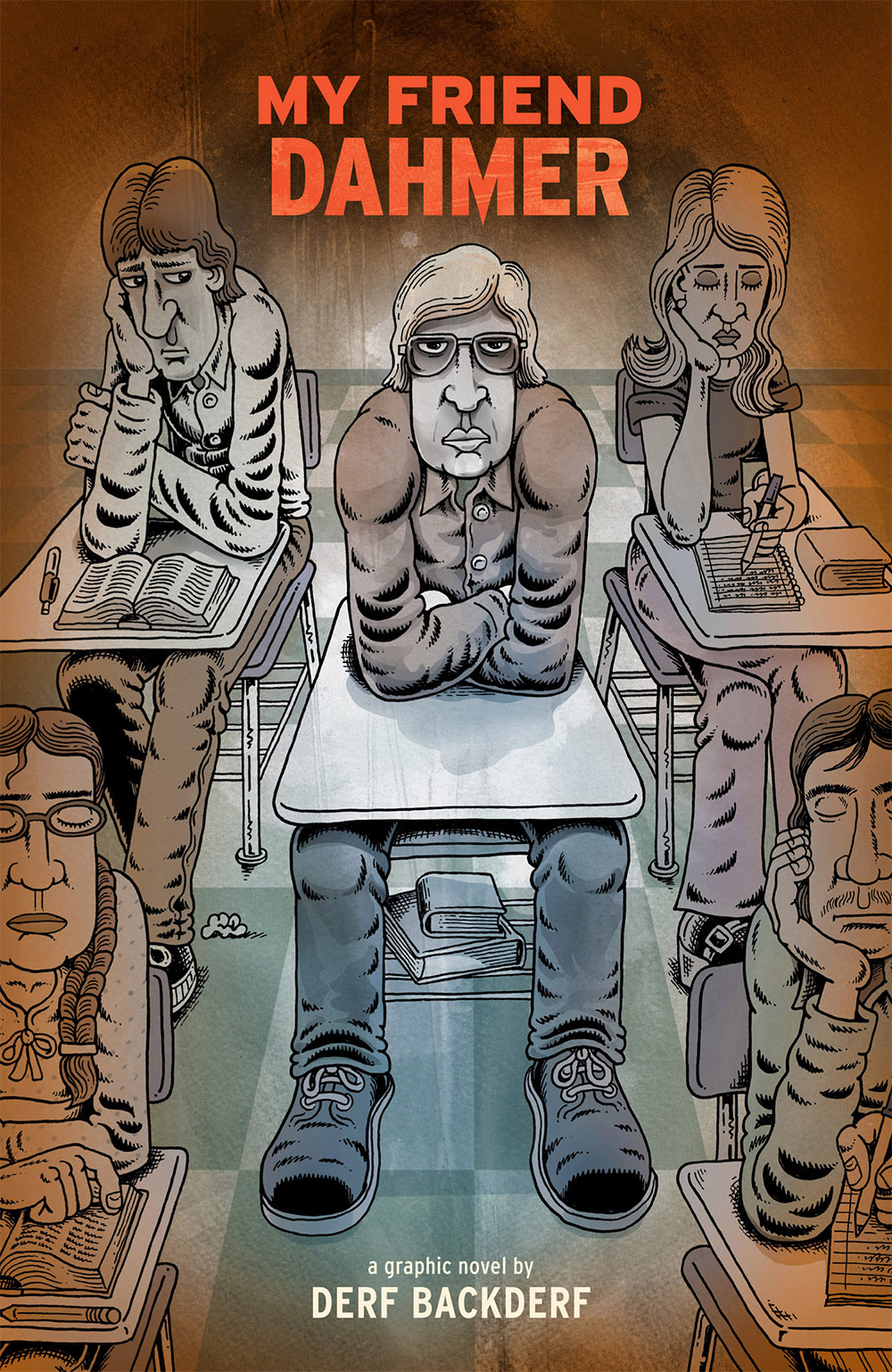
My Friend Dahmer
Derf Backderf, writer/artist
Abrams ComicArts, March 2012
224 pages
$17.95
Buy it from Amazon.com

In introductions, afterwords, and interviews alike, Derf Backderf makes it abundantly clear that his sympathy for Jeffrey Dahmer, his old high school acquaintance and serial killer of young men and boys, ends when Dahmer’s murders begin. By coincidence, so does the story he tells in this book, pretty much: Dahmer began killing upon graduation from high school, at which point he also dropped out of touch with Backderf and his circle, thus closing Derf’s window on his darkening world.
But while My Friend Dahmer abhors Dahmer’s crimes, it also does him, and his victims, the courtesy of never saying what they are. No body counts; no grim stories of the homophobic cops who returned a nude, wounded underage boy who’d escaped Dahmer’s clutches to his eventual killer before making jokes to their dispatcher about getting de-loused; no gruesome accounts of body-part altars and DIY trepanation attempts. The endnotes in the backmatter deliver the basic facts, but in the comic itself he consigns his old friend’s crimes to the void, perhaps the most empathetic thing he could possibly do with them.
The story Backderf chooses to tell is one of uncontrollable urges. At one point he describes them in the purple terms of mass-market true-crime paperback back-cover blurbs, as otherizingly and alienatingly as you please: “What spawned this perverse sexual hunger? What deep, fetid part of his psyche gurgled up this miscreant desire, so powerfully voracious it immediately devoured him whole?” But immediately before that he makes the direct connection between Dahmer’s necrophilia and his own irresistible adolescent lust for his female classmates, one of whom he draws walking alluringly down the hall in tight jeans, her spherical asscheeks drawing his attention as inexorably as a local jogger commands Dahmer’s far more lethal lust.
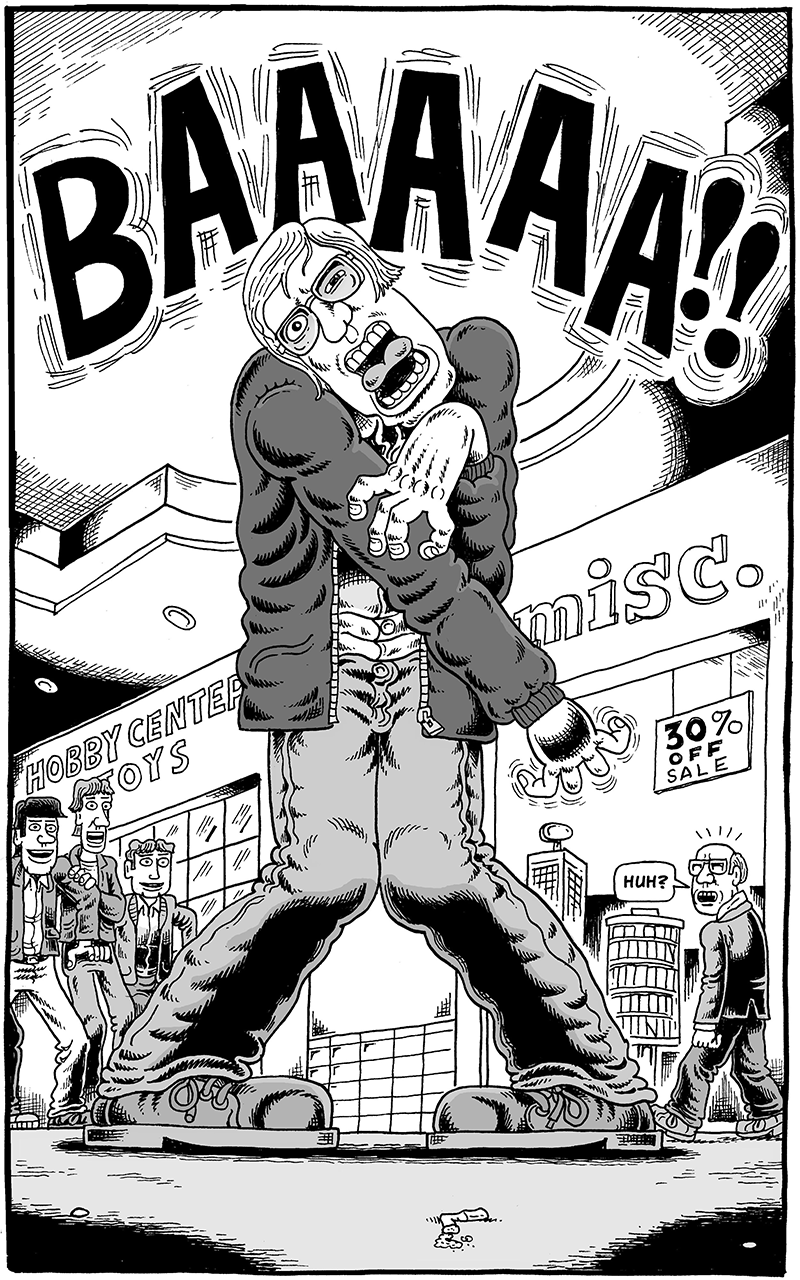
The girl’s body points to the great strength of Backderf’s resolutely unstylish art: Everyone’s a collection of lumps and bulges, molded into shape by his thick, blunt ink line. This isn’t the only prominent ass we see drawn this way, as it turns out: Another belongs to Dahmer’s mom, clenched in unflattering high-waisted mom pants as she seizes uncontrollably due to a morass of psychological, neurological, and pharmaceutical problems. Her trembling, sweat-soaked, jut-jawed body locks into bizarre, almost vogue-like positions, her neck craned upward at a 90 degree angle like a modernist portrait. She’s reduced to her body in these moments. “This,” Backderf writes, “is what Jeff came home to.” Dahmer’s mind rapidly reduces all life to mere bodies, bodies over which he can exert control. In fact, it’s his imitation (unbeknownst to his classmates, who think he’s making fun of someone else) of his mother’s symptoms that makes him a legendary character among his classmates.
The implicit connection Backderf draws between all these things is that Dahmer couldn’t help how he felt about dead men any more than Derf could help how he felt about pretty girls’ rear ends or than his mother could help having fits. What they all could control is how they responded to them, or to anything else. That’s where Backderf’s real anger is directed: at the choice of Dahmer’s parents to abandon their son — first emotionally and then quite literally, leaving him to live by himself in their house as they went their separate ways following an acrimonious divorce — and at the apparent choice of their high-school teachers and administrators to ignore the heroic quantities of alcohol Dahmer was consuming during the school day to self-medicate his urges away. The moment his parents left and school let out, even the minor impediment of negligent adults was removed entirely, so the alcohol was no longer enough, and the last few tethers holding Dahmer to sanity snapped. If some adult had cared enough to wrestle those urges to the ground, Backderf argues, Dahmer’s lonely life would still have been a sad one, but the lives of dozens and dozens of other people would have been far less so. The goal of this book is to lead you to the chasm between the potential and the actual and scream into it. Between the idea and the reality, between the motion and the act, falls the Shadow.
The Best of BuzzFeed Music
December 29, 2012My pieces on musical chills/ASMR and Godspeed You! Black Emperor are featured in this list of the editors’ picks for BuzzFeed’s best music writing of the year. But besides that there’s rock-solid writing on Passion Pit, Bruce Springsteen, Kendrick Lamar, Ke$ha, Frank Ocean, Bat for Lashes, Taylor Swift, the Replacements, PJ Harvey, Nicki Minaj, Ben Folds Five, Rihanna, EDM and more.
Shallow Rewards
December 21, 2012This is normally the sort of thing I’d reserve for a Carnival of Souls linkdump post, but by now I’ve put off putting one together for so long that I’m actually intimidated by the volume of stuff I’ve got bookmarked for it. Besides, I think this deserves its own showcase.
If you haven’t seen them already, I want to introduce you to Chris Ott and Shallow Rewards.
Shallow Rewards is a series of video essays, I guess you would call them, in which Ott blends music criticism, music-criticism criticism, industry talk, and pop-rock history lessons in the most seamless and engaging fashion I’ve ever seen.
Here’s the first one I really watched, independent of the he-said/he-said intercritic tussling that attracted me lookie-lou-style to the series in the first place. It’s about Bruno Mars’s surprisingly great Police pastiche “Locked Out of Heaven,” to which I was exposed in the very same way Ott was: Driving my family around in the car, listening to pop radio. This is him singlehandedly carving out the discourse the song deserves, looping in the Police, Sting, the Romantics, Gorillaz, superproducers, Mark Ronson, poptimism, nostalgia, and more, all amply illustrated with video and audio and textual support.
SHALLOW REWARDS // 15 BRUNO MARS CALLS THE POLICE from Shallow Rewards on Vimeo.
And this is the video that really floored me, somehow. It’s Ott in his rant mode rather than his music-history raconteur mode, explaining how the Internet’s ubiquitous access to a wide variety of music, coupled with music criticism websites’ need to drive hits by talking about the things people are talking about, has led to “peak distortion”: the canon is discussed to death while the median, with which listeners were once forced to come into contact via scarcity-bred chance, is invisible.
SHALLOW REWARDS // 04 CRAP GUITARS & THE MADNESS OF CROWDSOURCING from Shallow Rewards on Vimeo.
The first time I watched these videos — and let’s pause and reflect on the import of that statement: the first time, out of several, I’ve voluntarily watched the same recordings of a music critic talking into a camera — I watched them in mix-and-match fashion, gravitating toward the topics I was most interested in: the Ministry episode, the 4AD episode, the opening series of rants, the Duran Duran two-parter (!). That’s a great way to watch them.
But I think it actually does a tremendous disservice to how thoughtfully Ott arranged the arguments he made and the videos in which he made them. When you start at the beginning and work your way forward, the cumulative impact is just tremendous. There’s a cataloguing of symptoms, there’s a diagnosis, there’s a prognosis, there’s a prescription, and there’s a demonstration of what things would look like when cured.
Were I to boil it down it’d all sound like truisms: Don’t chase attention, don’t write about the same things everyone writes about, don’t willingly or unwittingly serve the interests of commerce or PR, reclaim your worth as a writer and/or musician and/or music fan by talking passionately but non-hyperbolically, originally but not obscurely, about good-to-great music wherever you find it. But laid out as Ott lays it out it’s like taking the red pill and seeing the Matrix for the first time.
Ott is a big, funny, combative personality. Boy, is he ever. His twitter feed is scabrous, and as I said, I first came across him when he did a whole video going after a review by Mark Richardson, one of my other favorite music critics in no small part because there’s not a ranty bone in his body. But this facet of Ott’s work doesn’t drive me crazy the way similar work done in comics criticism drives me crazy (literally, in some small way this year), for a few reasons. First, I’m far enough removed from the issues and industry and personalities involved that little to none of myself is invested in the outcome of the fight. I can watch it like I watch a football game my family puts on the TV during a holiday gathering.
Second, you may disagree with the contours or conclusions of Ott’s angriest arguments, I know I do from time to time (I don’t see the need to cede the discussion of Death Grips to the band’s grandiose pronouncements about themselves instead of talking about the way their music sounds, which I like a lot, for example). But they are always actual arguments, not a bunch of assumptions, ad hominems, and contrarian-conventional wisdom hastily jerryrigged into a platform upon which to perform standup insult comedy.
Last, and not necessarily not least since I believe in the inherent value of criticism independent of what else you do but not necessarily least either, he’s doing so much more than rant. He’s being the change he wants to see in the world. Moeover, he’s being the change he wanted to see in his own life and career, which is probably more important. He saw what was out there, he identified what didn’t work, and he’s fixing it, video to video. Video to well-made, thoughtful, funny, clever, sometimes charmingly self-important, always entertaining video, might I add.
(The “Crap Guitars and the Madness of Crowdsourcing” video above is the ne plus ultra of the form. Damascene-conversion insights, dishy insults, funny rock-nerdy insults (Lana Del Rey “is the reason the KLF lit a million pounds on fire”), thoughtful fuck-yeah music cues (ending a rant about the “industrial effort…like making a car” put into creating Lana Del Rey with a quick and unexplained cut to “God” by former one-time record-industry people-pleaser Y Kant Tori Read frontwoman Tori Amos), an “I know how this looks and I really don’t care” cut back to a silent shot of Ott drinking a beer and shaking his head in disgust while looking off-camera — it’s all there.)
A few weeks ago it looked like I was about to pull out of the depressive nosedive I’ve written about recently. I had a great, relaxing weekend with my wife and kid and cats. Boardwalk Empire was incredible and Homeland aired the best episode of the back half of Season Two. I was writing about all sorts of things all the time, and getting money and recognition in return. I finished a comics script I’m really excited about that said a lot of what I wanted to say at that moment. Then a few days later dozens of people I know and like got laid off and treated badly in the process and I was blown prostrate to the floor again. C’est la vie.
Anyway, the point is that perhaps more than any of the other things I just listed, discovering Shallow Rewards, watching and rewatching them, literally losing sleep staying up to watch just one more video before bed, helped me out of the tailspin. I’d become unmoored from comics criticism, the thing I’d spent a decade defining myself by doing — over unpleasant interactions, over feeling out of step with the prevailing tone, over a gradual inward transition from “writing about comics” to “writing comics,” over getting more intellectual and emotional and financial and interpersonal rewards from writing about television and music, over a lot of things. Seeing these videos made me feel like criticism can do anything it wants to do if you love the thing you’re talking about enough to want to live up to that love. If you’re angry, fine, you can do something with that. If you’re obsessed, great, you can do something with that. If you want to recreate the overall vibe of the most fascinating fact-filled chat you’ve ever had in a bar with some guy or girl who’s into something you’re interested in and just totally, totally knows their shit and communicates it to you with such effortlessly revelatory power it’s like you just learned about a 27th letter of the alphabet, awesome, you can do something with that. The point is that you can do something. If it’s possible to do with pop music, an industry that’s fallen off from its ’90s highs but still has cash and infrastructure enough to support the creation of a fleet of Star Destroyers, it’s possible to do with literally anything you’re interested in enough to talk about. Anything.
I can’t think of a work of criticism that hit me as hard as these videos did in a long, long time. I wrote a fawning fan letter because of them. To a critic. How about that?
Start your holiday break early and watch them. Maybe they’ll inspire you the way they’ve inspired me. Enjoy.
Comics Time: Flayed Corpse
December 21, 2012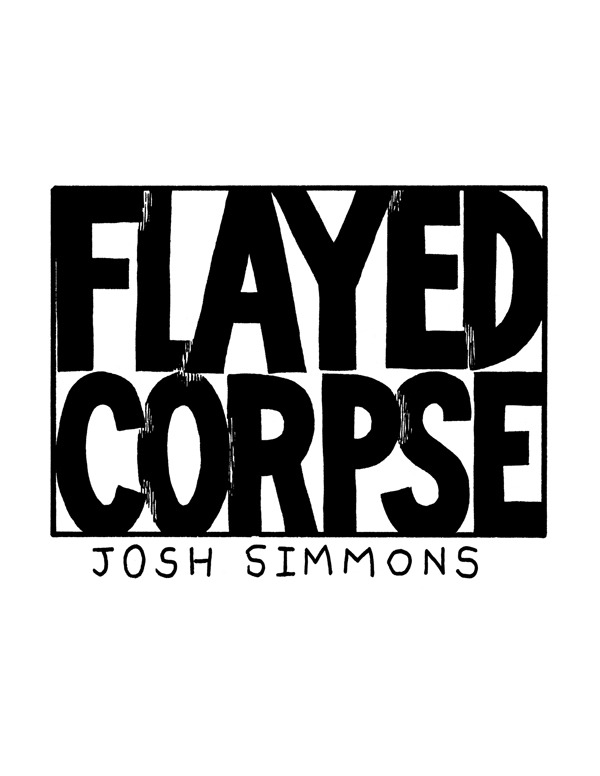
Flayed Corpse
Josh Simmons, writer/artist
Oily Comics, 2012
12 pages
$1
Buy it from Oily
I reviewed Flayed Corpse by Josh Simmons for The Comics Journal. Happy Holidays!
The Feel-Bad Album of the Year
December 19, 2012I’m depressed. I’ve also been obsessively listening to Godspeed You! Black Emperor’s album ‘Allelujah! Don’t Bend! Ascend! These two phenomena are not unrelated. I wrote a piece for BuzzFeed Music explaining why.
My friend and editor Matthew Perpetua put it this way in the hed/dek he crafted for it:
How 2012’s Most Miserable Album Helped Me Through Depression
Godspeed You! Black Emperor’s Allelujah! Don’t Bend! Ascend! was the only record that made sense to me when it felt like my world was falling apart.
It’s something I was building toward writing for months and I hope you like it.

2 more good moments from Homeland‘s bad Season 2
December 18, 2012I updated my Rolling Stone list of Homeland highlights to include a couple of strong scenes from the finale. There’s always good stuff in there!
I’d also like to promise everyone that no matter how vitriolic I sounded in my reviews, I ain’t even mad. The worst thing that happens when you watch a bad episode of TV is the feeling that “argh, I just watched a bad episode of TV.” Writing the review forces you to articulate the negativity, but that doesn’t mean I’m angry at the people who made it.
“Homeland” thoughts, Season Two, Episode Twelve: “The Choice”
December 17, 2012I reviewed the season finale of Homeland for Rolling Stone. I did not like it, I can tell you that much.
The 10 Best Moments from Homeland‘s Bad Season 2
December 15, 2012Despite my many many problems with Homeland this season there were still a lot of terrific scenes in there, and I wrote about them for Rolling Stone.
One thing I don’t think I mentioned specifically but which bears mention generally is that Carrie and Brody are both really singular characters amid the prestige-drama landscape, and the performances behind them (at least until very recently) have been dynamite. Between them they carve out a lot of new territory for the TV that big-time TV watchers watch, which is a big part of why the show clicked the way it did, and why folks have had so much patience with it.
13 Things You Need to Know About “The Hobbit”
December 13, 2012I wrote a quick-and-dirty guide to The Hobbit: An Unexpected Journey for Rolling Stone. Between the source material, the adaptation process, the original Lord of the Rings trilogy, the new 48fps 3D technology, the expansion into a new trilogy, and just generally trying to make a good movie, there’s a ton of stuff going on when you watch this thing, and this piece was my attempt to make sense of it all for everyone before they hit the theater—what to watch for and pay attention to and ignore.
The movie is awesome, by the way. Lord of the Rings Season Two. Anyone who tells you otherwise hates joy. Does anybody remember laughter?
“Homeland” thoughts, Season Two, Episode Eleven: “The Motherfucker in the Turban” / “In Memoriam”
December 10, 2012In the guise of a review of last night’s episode, which appears to have been retitled while it was airing, I present my grand unified theory of what’s wrong with Homeland over at Rolling Stone.
“Boardwalk Empire” thoughts, Season Three, Episode Twelve: “Margate Sands”
December 5, 2012* 1. Mad Men 2. Breaking Bad 3. Boardwalk Empire
* Boardwalk “Blackwater”
* I’m consistently entertained by this show, and amazed by that entertainment. I mean it. I haven’t re-read all my reviews so I’m not 100% sure, but I’m almost there: I don’t think I once reached the closing credits this season thinking “Meh,” let alone “Goddammit.” That puts Boardwalk in very rare company indeed. So I’ll go to war for this show, one of the great pleasures of my life over the past few months. I wish a fraction of the ink spilled over that shitty Homeland episode had been spent on this magnificent thing, this pretty hate machine.
* I’m not sure what new thing I can add to all the reasons I’ve cited before as to why I think this show really has become Great TV. Here’s what I said about it this time last year:
I think that when genre material gets sufficiently dark or weird, when its tropes become a form of sinister spectacle rather than just hitting the marks required by convention, that’s a depth all its own — a way to communicate the emotional and philosophical themes more commonly articulated by plot and dialogue, if at all. Boardwalk Empire the balls-to-the-wall engine of gorgeously shot death that perverts and slaughters its characters in periodic fits of nihilism is saying at least as much as some theoretical Boardwalk Empire the meticulously drawn character study, or Boardwalk Empire the rigorously developed allegory for contemporary political issues.
You can quibble over the quality of the execution, and that’s perfectly valid. But to dismiss Boardwalk Empire as phony baloney, as faux-Great TV, to say it’s empty-calorie gangsterism, is to make an argument that aesthetic sensation is inherently empty sensation. Personally, I think watching beautifully backlit bodies jerk from machine-gun fire for half a minute as men whoop and cheer says something without speaking. Same as a distorted guitar. Same as a visit from the Black Lodge. Its superrealism is real to me. There’s a line I wrote down from this episode and now I don’t know who said it, or when, or why, and google doesn’t help, but here: “Where’s the God in this?” As real as it gets.
* Part of the problem, perhaps, is that it’s obvious to everyone watching that this will never be a show that will make its audience complain “When is someone gonna get whacked?” This will never be a show that will frustrate audience expectations — delay their gratification in service of playing a season-long game instead of an episode-by-episode one, sure, but never frustrate them. For God’s sake, Terence Winter wrote “Pine Barrens” and spent the rest of his tenure on The Sopranos trying to convince David Chase to resolve the fate of the Russian. Is there a more perfectly illustrative anecdote than that in the history of television? The trick is to deliver what the audience expects in a way that feels like it fulfills those expectations rather than panders to them. Does Boardwalk pull it off? Watch the Richard sequence from this episode and then you tell me.
* It’s easy to overlook in light of everything else that happened — happened seconds later, even — but I think Gillian’s storyline in this episode was the first time I felt Boardwalk Empire really did right by one of its female characters, really treated her plight, her scheme, her damage with same sense of enormity with which it’s treated those of the men for so long. Her sexual brinksmanship with Gyp Rosetti amazed me.
Having driven away the men who could have protected her and Tommy from the depredations of Gyp and his goons, Gillian realizes, too late, that the Artemis Club truly is no place for a child, or even for her. So she attempts to free herself and her grand/son from captivity with the only weapon she has: her ability to figure out what men want, and deliver. This is likely the most high-stakes gamble she’s ever taken with her sexuality since the bad old days of her childhood relationship with the Commodore. Gyp is a 1) thin-skinned 2) sociopath who gets off on 3) sado-masochistic 4) humiliation and 5) asphyxiation: any one of those ingredients are potentially lethal to a prostitute forced to do business with them, let alone all of them in tandem with nothing less than the life of child in the balance. However monstrous and unsympathetic Gillian’s behavior has been throughout the last two seasons, I felt nothing but tremendous sadness for her as she put her body and dignity on the line, probing Gyp for his sexual secrets, delicately taking one step at a time until at last he put himself where she needed him to be. How devastating for her and us both that her best, the sum total of everything she’d been forced to learn by the men who preyed on her for years and years and made her into a predator in turn, wasn’t good enough. “Someone’s gotta lose.” Ugh, ugh, ugh.
* Her subsequent “conversation” with Nucky, after suddenly appearing, beatific and from out of nowhere, in a hallway full of dead people, was the episode’s most explicitly dreamlike moment, and as I’ve said over and over the show is rarely better than when it’s dragging the structure and imagery of nightmares into the real world. This was Nucky’s earlier hallucinations of a young Jimmy Darmody made real — a sudden and unavoidable encounter with the past in living form. What a nightmare for Gillian, and what a collision with the uncanny for the baffled, then horrified Nucky. Never forget, Enoch.
* Even Margaret’s material worked, at long last. Kelly MacDonald goes a long way toward overlooking how poorly the show has historically done by Margaret. Her rapidfire 180-degree morality turns throughout season one were a mess, and her fixation on religious guilt during season two was more consistent but also more dull, since nothing is death to drama like Roman Catholicism. For a long time it seemed like her newfound interest in women’s reproductive health and freedom was just a new way to atone after the failures of temperance and Jesus.
* But when she stepped out of the communal bathroom after her abortion and encountered the Luciferian presence of Nucky in the hallway, mirroring the miscarriage that brought him to her in the pilot episode, it all clicked for me: For the women of Boardwalk Empire biology is destiny and pregnancy is a life sentence. Margaret loses her baby at her abusive husband’s hands, driving her to Nucky (and driving Nucky to order a murder, for what I believe to be the first time). Years later, her pregnancy with Owen is the final straw for her decision to leave Nucky, and she abandons Nucky and (more importantly?) his money within minutes of reaching down between her legs and finding blood following her abortion. Pregnancy through rape irrevocably altered the lives of Gillian Darmody and her young son. Pregnancy by Jimmy wedded Angela Darmody to a man, a life, and a sexuality she had no business with. The first Mrs. Van Alden was kept in lonely thrall by her husband’s decision not to fund fertility treatments for her, and left him once she discovered he’d impregnated another woman. That woman, Lucy Danziger, viewed her pregnancy as parasitical, sucking away her life and looks and freedom, and ran from it as soon as she could. The inability of women of this time period to control their own lives without being able to control their own bodies is as much of a throughline through all three seasons as anything on the show. You wouldn’t know to look at it that Boardwalk Empire is one of the most feminist and pro-choice shows on television, but there you have it.
* That opening shot. Slo-mo balletic violence! Full Peckinpah! Slowly seguing into normal-speed villain walking up and firing into the camera! Full Scorsese! Margaret closes the door on Nucky at the end! Full Coppola! Nucky puts on a hat and disappears into the crowd! Full Silence of the Lambs! Not a show that’s afraid to wear its influences on its lapel.
* Also not a show that’s afraid to bob and weave a bit in terms of where you expect the weight of the narrative to fall. Who else thought we were headed for a big one-time-only winner-take-all assault? Instead we open with a gang-war montage (Godfather again, but violent like Casino) that takes place over the course of at least a couple weeks. It’s the inverse of how I expected all of season two to lead up to Jimmy, Eli, and the Commodore’s coup against Nucky, which instead happened in the first episode.
* You’d have to dig a couple seasons back into Breaking Bad to find a more delightful cast of heavies, by the way. A brief highlight reel:
** Mickey Doyle’s giddily obnoxious telephone exchange with Arnold Rothstein: “Am I disturbing you?” “Yes.” “Oh. Alright.”
** The sweat pouring down the face of the big undercover cop as he beats Luciano up.
** Meyer Lansky’s face as he contemplates Luciano’s screw-up on their way up to see Rothstein. Yikes. A glimpse of the coldness you expect from the guy who’ll dream up the Commission. (Which, you might have noticed, Nucky Thompson proposed a few episodes back.)
** Rothstein’s “heh, what a goon” smile as Masseria curses at Meyer and Charlie.
** Capone’s street-fighter stance vs. Chalky’s prizefighter stance.
** Michael Stuhlbarg’s inexpressive doll eyes and flat affect as he demands 99% of the distillery as payment for helping Nucky not die.
** Gaston Means leaning into the frame to deliver two whispered words in the ears of a great man and thus change the landscape of American criminality.
* Then there’s the late, lamented Gyp Rosetti. I loved his suddenly gentlemanly affectation as he instructs his goons to please show Miss Darmody in. I loved the obliviously rotten job he did of playing along with Gillian’s affection for children when asked how old his daughters are: “Sixteen and fourteen, I think.” I loved the veiled threat as he repeated Tommy’s age back to Gillian: “Six. Got his whole life ahead of him.” I loved how hungry he was to reveal his masochism, given the slightest prompt, but how he cagily first cloaked it in sadism. This was all in the space of a single conversation, by the way, during which he also split the double Ts in “settled” the way my Brooklynite grandfather used to do. Need I even mention his final scene, the unhinged way in which he launches into his Nucky impression, then launches his face at his goons as he completes it by bugging his eyes out? A magnificent character, a go-for-broke performance, funny on purpose in a way Homeland doesn’t have the brains or stones to be, pretty much ever. Bobby Cannavale, ladies and gentlemen. I mean, this? I’ve had entire mornings like this on a weekly basis for months now. I get it. I get it.
* Finally, Richard. Richard Harrow. This is tricky territory, because whatever else it was, however successful it was, Richard’s rampage was fanservice. I mean, let’s be honest about it. Winter’s described it as such in interviews, not using the term but echoing the intent. As such it could be one of those maybe-slightly-too-cornpone moments — the drunk embittered veteran dad letting Tommy sleep in his late son’s room; Nucky lighting a cigarette and throwing his carnation on the ground — writ show-ruiningly large. And talk about referencing the crime-movie pantheon: This is Taxi Driver given a Jason Bourne makeover. Also a potential disaster.
It worked as well as anything I’ve ever seen on television. The choreography, the staging and layout and pacing, Huston’s performance and how he used his character’s clipped way of moving and his incongruously tweedy get-up and his unseeing eye to turn himself into a totally unique and convincing action hero, all that was great, yes. But what made it was the ending, and the confrontation with that marvelously well-cast creep with the flaring nostrils and the schoolmarmish way of saying “Put it…down” and the totally believable nihilism of “You think I give a FUCK?” When Tommy ran to Richard and hugged him as we watched through the blood-spattered glass, I started to sob. Big tearless spasms wracking my entire body. I sobbed for a little boy’s chance to feel safe and loved again — I have a father’s weakness, now, for children made to suffer. And I sobbed for a man who’s spent years killing people, because he believes people have no connection to each other, finally connecting. Not because I look for the heart of gold inside every mass murderer, but because Richard’s nihilism is something that haunts me every fucking day I get up in the morning, and I want to believe that damaged people aren’t forever trapped in their damage. Hashing this out in the context of an unstoppable killing machine in a Phantom of the Opera mask orchestrating a gangland massacre to protect the child he loves isn’t bullshit, it’s a way to make the event as big as the emotion. That’s why I love Boardwalk Empire. It’s as big as you feel.
“Homeland” thoughts, Season Two, Episode Ten: “Broken Hearts”
December 3, 2012It’s usually a pretty bad sign when your Emmy Award-winning drama repeatedly makes me think of Mystery Science Theater 3000. The result is my review of last night’s Homeland for Rolling Stone.
The Superheroics of Muse
November 30, 2012I wrote a piece on Muse as legacy superheroes and Matt Bellamy’s voice as their superpower for BuzzFeed Music. The piece was pitched to me as “What is the essence of Muse? What is it people like about them beyond sounding like Queen and Radiohead?” This is what I came up with. Big thanks to my pal Matthew Perpetua for whipping it into shape.
“Boardwalk Empire” thoughts, Season Three, Episode Eleven: “Two Imposters”
November 28, 2012* “Everything connects, Charlie, whether you know it or not.”
* I’ll tell you all what: I could get used to this show totally leveling up every time it reaches a season’s penultimate episode, that’s for sure. Last year’s nightmarish, flashback-haunted “Under God’s Power, She Flourishes” displayed the show’s most confident and stylish filmmaking since Martin Scorsese’s pilot and, with its revelations about Jimmy, Gillian, and Angela’s past and its final Oedipal confrontation, essentially unveiled, for the first time, what the show was really about, how it saw itself, how it worked best. I don’t think anything quite so dramatic and revelatory went on here, but what we got was in its own way almost as impressive: thread after thread after thread being firmly pulled in the same direction from opposite corners of the room and woven together with furious determination. Just a relentlessly suspenseful and enjoyable episode. When it ended, I laughed and clapped with delight.
* What a great decision to make Nucky’s relationship with his afterthought of an assistant, Eddie, the center of the episode. For starters, well, who doesn’t like Eddie? He’s virtually never been used for anything but mild and effective comic relief, sort of like a Muppet, so no one in the audience is gonna go “Yeah, ice that guy.” Shrewd.
* On a deeper level, maybe we needed to see the only person left who genuinely loves and trusts Nucky come under threat, and see Nucky rise to the occasion and risk everything because it turns out he loves and trusts him back, to keep us invested in Nucky’s plight. If you were uncharitable you could see this as a cheat on the show’s part, a way to make sure we all see that Nucky’s not a villain but an antihero, that he still has a heart of gold deep down in there despite his monstrousness. But it felt truer than that in the moment. Or at least I was willing to cut it some slack.
* Finally, seeing and hearing Eddie, who normally operates at a consistent level of befuddlement, give way to absolute fight-or-flight panic sold the threat like few other things could have, particularly given the number of assassination attempts Nucky has already survived. There were a lot of standout details in that initial attack on Nucky’s suite at the Ritz, from the dead phone to the shootout staged almost entirely through a hole in the door, but Eddie’s desperate cry of “Noocky!” to warn his boss about the gunman behind him will stick with me most of all.
* And how’s this for an increase in scale: Gyp Rosetti conquered Atlantic City. That took my breath away, when I realized that’s what the show was doing. This wasn’t just a hit squad, it was the vanguard of an invading army. They stormed the palace, killed the royal guard, assumed control. When Gyp’s sidekick started talking about meeting with the ward bosses and letting them know it was business as usual it really brought it all home for me. This was one of the clearest demonstrations yet of the show’s belief that crime, like war, is politics by another name.
* Looks like we’re headed for Richard Harrow’s Taxi Driver moment. A few thoughts about that:
** It would seem like my theory about Richard being Nucky’s endgame against Gyp is both wrong and right. There likely won’t be any collusion between the two of them, but Richard will still fulfill that basic role by killing his way through Gyp’s headquarters.
** “Everything connects” indeed: That scene from early in the season when Nucky learns with awe just how deadly Richard is was done to establish this eventuality. And Richard’s relationships with Tommy and with his girlfriend and her father were done to give him motivation. And Gillian’s murder of a false Jimmy was done to sever whatever loyalty he may once have felt to her.
** Does Gillian not realize what kind of person Richard is? That’s not a rhetorical question, by the way: Does she not know what he did in the war, or what he did in Jimmy’s employ? Judging from her recent dialogue she appears to think of him in the same condescending terms you’d expect from her about someone who was “feeble-minded” — a gentle, damaged freak she takes pity on but no longer has any use for. Do you all think this is a viewpoint she could reasonably have come to?
** Jack Huston is very, very good in this role. The mask hides that, maybe, and the CGI makeup effects, and the monotone voice. But man, even though he only has one eye and half a mouth to work with, when that switch in Richard goes off, boy oh boy can you see it. It’s terrifying.
** And exciting, let’s be honest. As high-minded as I make myself be about art-violence, it’s thrilling and cathartic to see a practiced killing machine let loose. That overhead shot of Richard assembling his arsenal? I mean, come on, that’s the sort of thing you cheer about. At least I do. I don’t respect myself in the morning, if that helps.
* Lucky getting busted for heroin: another “everything connects” moment? This removes him from the playing field as a potential protector for Gillian, his partner in the brothel. It badly weakens Rothstein and Lansky. Given the expense of his and Lansky’s secret deal with Masseria it throws Masseria’s organization into disarray as well.
* Why not make the undercover cop a fake mute with a gnarly throat scar? Why not stage the buy on a rooftop flapping with laundry?
* Very, very happy to see Nucky interact with my beloved Dunn Purnsley, however briefly. I loved Purnsley’s grin after he and Chalky dispatched the Rosetti thugs who were about to search their truck for Nucky, like, “See? I told you we were loyal, asshole.”
* Laugh out loud line from Chalky: “All due respect, General Custer: This ain’t no spot for a last stand.” All the material involving Chalky hiding Nucky and Eddie was gold. Creatively staged in an interesting set, with easy-to-understand parameters for success and failure, and a crackerjack setpiece in the form of Rosetti’s Italians facing off against Chalky’s African-Americans, all of them bristling with firearms.
* Am I the only one with visions of posters for Boardwalk Empire Season Four featuring a picture of Nucky and Chalky standing back to back or face to face with a tagline like “TWO KINGS”? If things go well for them this Sunday, Chalky becomes the single most important person in Nucky’s organization (if he wasn’t already), and a fixture of the boardwalk, AC’s public face. He could easily be the new opposite pole around which the story revolves. That’d be great, wouldn’t it?
* The ending? Pure fanservice. Fuck it, I’m game. So game that I’m willing to forgive the martial drums and, you know, the very notion of Eli and Purnsley showing up with the calvary in the form of Al goddamn Capone, America’s kindliest young gangster. After all, the beauty of this set-up is that the show is harnessing historical inevitability as a tool in its storytelling arsenal as unequivocally as it ever has. A fight between Al Capone and “Gyp Rosetti” can only end one way. Hahaha!
* A fight between “Richard Harrow” and “Gyp Rosetti,” on the other hand… 🙁
* What’s Capone’s game here? We’ve established that Torrio’s in semi-retirement, content to leave the operation of the Chicago outfit in Capone’s hands, up to and including picking fights with rival gangs. We’ve established that Remus is down for the count and the Midwest needs a reliable supplier, and Nucky’s man Mickey Doyle is running Mellon’s operation. We know he milked Van Alden for information about Dean O’Banion’s operation. We know that Capone — showCapone, anyway — hates bullies.
* Bravo. Onward to victory.