
Posts Tagged ‘reviews’
Things you should know about “The Twilight Saga: Breaking Dawn – Part 2”
November 27, 2012* The Bunk is in this movie. Yes, from The Wire. He has a scene as a P.I. and fixer for the vampire who used to be a Confederate soldier.
* The guy who played the “bing bang bong” annoying catchphrase incompetent teenage forensic examiner who turned into a serial killer and ruined the show on SVU is in this movie. He plays Dracula, who is gay and an albino.
* Lee Pace from Tumblr and Mirkwood is in this movie. He plays a vampire who fought in the American Revolution (on the American side, this time). He is scruffy and edgy. Many of the vampires have special powers; when my wife asked me what his was supposed to be I said “Sexiness.”
* Kristen Stewart and Robert Pattinson are in this movie, as contractually required. They could not look or sound more miserable about it. Whatever the truth about their offscreen romantic relationship, they so clearly do not enjoy making these movies anymore, and it’s not like their joy radiated from the screen to begin with. The result is an almost magnetic anti-chemistry anytime they’re required to act sexy or romantic toward one another. Here are two very attractive people (well, I’ll take your word for it on RPatz, whose at this point I can’t see without seeing a million parodies of how he looks, but KStew is a Top 10 Pleasant to Look At Human Beings Worldwide entrant) who we know have fucked in real life, but you put them together and each of them looks like they’ve been forced into close proximity with a person whose 24-hour stomach virus they’re trying to avoid catching.
* That said, their sex scene was marvelously shot and surprisingly hot for a PG-13 flick geared toward tweens and their parents. Obviously they can’t show any nudity or have too much grunting and panting and moaning and gasping (that’s what On the Road is for), so what they did is stitch the scene together from all but abstracted close-ups of hands and mouths making contact with bare skin. It didn’t quite overcome the follow-up pillow-talk scene where they unconvincingly talk about how they plan to be so disgustingly sexual with one another at all times that the rest of their vampire family will have to stay away from them for a decade, but in the moment it worked.
* By contrast, the third wheel in the triangle, or whatever, Taylor Lautner, seemed happy to be there as always. I’m not sure I would, if my part required me to be a werewolf who falls in love with a baby, which is what happens. So yeah, if you’re going to hold abysmal stupidity against a film, then yes, Breaking Dawn – Part 2 is a bad movie in that there are almost no words to describe how idiotic and repulsive and braindead it is to have a werewolf fall in love with a baby. But blame the truly demented sexual politics of Stephenie Meyer, not Lautner, who sorta sells it as yet another weird thing about his biology he has to come to terms with and explain to others on top of the whole “turning into a giant wolf sometimes” bit. It doesn’t work, but he tries.
* He also makes the most out of his character’s admirably direct method of convincing Kristen Stewart’s character Bella’s dad that the supernatural exists: telling him he’s about to show him something weird, then stripping down to his underpants and transforming into a giant wolf in the guy’s backyard. The scene’s meant to read like an over-the-top spoof of coming out and propositioning a guy, doubly so because the guy has a Village People cop mustache and Lautner pings one’s gaydar like that one scene in Aliens where all of a sudden they’re in the crawlspace above the ceiling. I’ll be honest: If I were the dad and suddenly Lautner’s ridiculous physique were all up in my face, I’d consider it.
* Michael Sheen plays the main evil vampire. Michael Sheen is a hero, a legend. It’s as though all the fun the series’ leads should have been having got stored up, poured into a syringe, and injected into his aorta. He chews scenery until chunks of it spray from his mouth like the Cookie Monster. At one point he laughs like Truman Capote doing an impression of Woody Woodpecker. He kills a major character, holds up his severed head, and smiles in the most “U MAD?” gif-able way imaginable. He makes the movie, even the series. I want him to take tea with Tom Hardy’s Bane.
* I’m not going to spoil it, but the twist ending is so fucking shameless in how it forces the audience to discount pivotal and even devastating information it had recently received that it races right past “cheating” and “cop-out” and blasts off into “I’ve really gotta fucking hand it to you, Breaking Dawn – Part 2” territory. Audacious doesn’t even begin to describe it. I’d heard about it before hand, because with this series who cares about spoilers, and assumed I’d hate the whole film because of it, but it’s so crazy that I sat there like Bobby Baccala gazing at Junior Soprano: “I’m in awe of you.”
* Hearing an audience of low-level Twihards (we saw it the day after Thanksgiving) react with total shock and dismay to the run-up to the ending was wondrous and life-affirming, and I don’t mean that in terms of schadenfreude at all. This film moved and stunned and horrified them when they didn’t expect it. That’s a great thing to be able to do, and to see happen from the outside.
* The aftermath of the twist couldn’t be more open about its real goal if the studio head wandered out on camera holding up a sign reading “STEPHENIE, PLEASE WRITE SOME SEQUELS.”
* The opening credits, lovely lovely time-lapse macro photography of roses and blood and ice crystals and so on, were better than the comparable, much-lauded Skyfall opening credits. They segued nicely into a strong depiction of what vampires’ enhanced senses feel like, too — in other words they smartly saved the need to literally represent or tie into the story until after they were over.
* No Anna Kendrick.
* That Mike guy’s been funny too, but he’s not in it either.
* The closing credits show all the main characters from all five movies. They show the redheaded vampire that they recast with Bryce Dallas Howard twice, once for each actress.
* There’s a scene in which two of the other prominent werewolves are gathered at a little Christmas party at Bella’s dad’s house, and instead of re-hiring the actors who played them previously, the film just took extras and sat them with their backs to us and gave them no lines but had the other characters speak to them.
* In order to keep Bella and Edward’s rapidly aging vampire-human hybrid child consistent with the child actress who plays her at her oldest, the baby/toddler/young child versions have superimposed CGI faces. Again, if you’re going to hold abysmal stupidity against a film, I can hardly stop you here.
* There are multiple vampires from the Amazon basin who show up in the snowy Pacific northwest in their loincloths and stay that way for the duration. There’s a little trio of vampires from Ireland who look like they came from a Hallmark Channel movie about Ireland. The vampire ladies from Egypt are very pretty. Dakota Fanning is very pretty.
* The big battle happens because the good vampires know the bad vampires, who’ve mistaken their vampire-human hybrid daughter for a child they’ve illegally turned into a vampire, wouldn’t listen if they tried to explain the truth. Based on that assumption, the bulk of the movie happens: gathering allies, training to use their powers, the final confrontation itself. Guess what the bad vampires do the moment they show up and the good vampires try to explain the truth? Here’s a hint: They listen. Oh, shoot, that was the answer.
* There’s a genuinely horrifying flashback sequence in which a blood-covered vampire child is snatched from the body-strewn ruins of the medieval town he just destroyed, his sobbing vampire mother is killed in front of him, her body is lit on fire, and he’s unceremoniously tossed into the flames. He’s like five years old. It’s like Tyler Durden spliced in that one scene from Hostel Part 2 all of a sudden.
* Here’s what I thought of Twilight and New Moon and Eclipse; I didn’t write about Breaking Dawn – Part 1 because it was one of the worst movies I’ve ever seen, all but unwatchable even with help from RiffTrax. In that movie a superstrong vampire fetus pulverizes Bella’s spine and guttyworks from within, so Edward has to perform an emergency c-section by tearing through her superstrong placenta with his teeth. There’s also a getting-ready-for-sex montage that shows Bella brushing her teeth, and a “no sex please we’re cross-species lovers” montage in which they sit around wasting time and being bored in different ways. Abysmal stupidity opponents, you know the drill.
* This movie, though? The series’ one true camp classic, the one where you could watch it independent of a packed theater and actually have fun with the good-badness of it. We left the theater amazed to be glad to have seen it.
Let your body move to the music
November 26, 2012I wrote about “Vogue” by Madonna for my music tumblr, Cool Practice. The pre-sexual dreams of a starstruck sixth grader are invoked.
I encourage you to listen to the song and watch the video from beginning to end, especially if you haven’t done so in a long time. It’s remarkable how much anticipation and excitement she packs into that thing. It’s a curtain being drawn back on a new world.
“Homeland” thoughts, Season Two, Episode Nine: “Two Hats”
November 25, 2012“Boardwalk Empire” thoughts, Season Three, Episode Ten: “A Man, a Plan…”
November 20, 2012* A dream comes true. Echoing your opening credits in your opening scene is a surefire signal that something momentous is going to happen in the episode, that’s for sure. And while we’re on the subject of how this show brings the dream world into the real world, that shot of Neptune running into the sea was disproportionately unnerving to me. Typhoon! Typhoon!
* The smiling old woman with the rotten teeth was a big moment, too. I don’t know…I just feel like this show has gotten really, really confident in its ability to wordlessly, plotlessly communicate itself.
* Gaston Means is fucking phenomenal. That’s mostly Stephen Root at work, of course: the snake-oil accent, the purred one-liners (“I hope you don’t choose a surgeon on the same basis”), the way he smizes after advising Jess Smith to take his money and “consign it to the fires of hell,” the obviousness of how unused to being caught off guard he is with Smith surprises him in the middle of his home invasion, his IDGAF grin after Smith takes care of the job for him. But it’s also how Means is being presented as a character: Here’s a guy who in the case of Smith alone is playing trusted advisor to at least three people that we know of, all of whom are at literally mortal odds by the end of the gambit. Here’s a guy who’ll double-book a hired gun to people on opposite ends of a conflict, only to serve as his own triggerman. He couldn’t be further removed from the immigrant-gangster milieu of the New York/New Jersey/Chicago Jewish/Irish/Italian criminals, yet he demonstrates that a true genius for graft knows no ethnicity. I hope the show gives him room to breathe — its track record for this sort of character puts him at about 2:1 odds against.
* Speaking of: Please let a negro nightclub be Chalky’s ticket to increased screen time and plot prominence.
* Also speaking of: I liked Owen. Hailing as he did from the auld sod, how could I, Sean Thomas Patrick Collins, not like Owen? But…did he ever really get off the ground as a character? Better: Did he ever really reveal his character? It was never clear to me whether he was ever truly down for the Cause or simply a gangster who went where the market for his talents provided. It was never clear to me if he was the compunctionless killer who choked a man to death in a men’s room and remorseless liar who proposed to poor Katie knowing full well he’d be skipping out on her, or the romantic who apparently sincerely planned a life on the lam with Margaret and her two-point-five kids. This made it difficult to know how to feel about pretty much everything he said and did in this episode.
* Crystal clear how to feel about our final glimpse of him, though: jesus, that was grim, grim business — high-Godfather mafia-movie violence at its most dramatic and unpleasant. Margaret’s dragged-out screaming and sobbing and flailing in response was all but unbearable. Certainly that character’s finest moment in a long, long time.
* Regarding Means and Owen, and also Lansky & Luciano’s betrayal of Nucky & Owen to their former rival Masseria: Their respective storylines in this episode embody something Terence Winter said in interviews after the conclusion of season two: that among other things, the show turns out to be a show about the difference between people who are able to make a go of high-level high-stakes criminality versus those that aren’t. This, I suppose, is how he squared the circle of having people named Al Capone interact with people named “Jimmy Darmody” — since we know what the show can and can’t do with those two sets of people, they might as well make it a theme.
* Richard’s galpal looks a little bit like Gillian Darmody, doesn’t she?
* The shovel to the protruding head murder is one of the most appalling I can remember seeing on television. If Owen-in-a-box is The Godfather, Gyp’s execution of his underling’s hapless fisherman cousin is Casino. Makes me wonder if my “Richard is the endgame” theory is incorrect and Gyp’s heretofore acquiescent underling will be his boss’s undoing.
Skyfall thoughts
November 20, 2012Hey, I went to the movies! Second time this year! I miss it.
* Skyfall was good. I enjoyed it. I don’t understand the contention that it’s the best Bond movie ever. I’ve seen very few Bond movies but I can tell you that I enjoyed GoldenEye and Casino Royale and very probably Quantum of Solace more at the times I saw them in the theater than I enjoyed Skyfall yesterday.
* It reminded me an awful lot of the experience of watching The Avengers, which was the last time I actually went to a movie theater and bought a ticket and watched a movie, in that it was a good time overall with strong action sequences punctuating long boring stretches. Now, Skyfall‘s long boring stretches weren’t nearly as long or as boring as The Avengers. This movie’s non-battle character interactions were actually capable of making me laugh more than twice, and it was more accomplished as filmmaking on nearly every conceivable level, up to and including simply giving you lovely things to look at as often as it could, even when what was going on was otherwise a bit on the dull side, so in fact “boring” may be overstating the case. But yes, same overall pattern.
* The dullness was particularly dull in the long first third of the movie, following the opening sequence in which Bond appears to have fallen to his death. Since it’s unlikely that the rest of the film was going to play out in flashback, we knew he was still alive; since it’s a James Bond movie, we knew he’d be back on the job. Everything that led up to his resurrection and reinstatement, therefore, was just playing out the clock. You can get away with an awful lot when you have a set of strong, visually magnetic actors being all authoritative at one another, but that’s only papering over the lack of dramatic drive during this section.
* Kind of felt like a James Bond-fronted Christopher Nolan Batman movie cover band, didn’t? Numerous plot points and even specific mechanics and images were ported nearly wholesale from The Dark Knight and The Dark Knight Rises. I don’t know enough about the film’s production history to tell if this was deliberate or a coincidence, and frankly don’t care enough to go look it up, but man was it striking. Javier Bardem playing the Joker made it all the more so. So did the identical “he let himself be captured” scenes, the calm supervillain in the isolated jail cell, two students of the same master, etc etc etc.
* What was up with the Evil Homosexual vibes from Silva in that one scene, by the way? I almost couldn’t believe my ears and eyes, it was so flagrant and anachronistic. Sure, it gave the movie a chance to imply that Bond has had homosexual experiences too, but that’s not really enough, is it. Also hinky: We’re not to think any less of M for handing Silva over to be tortured to death. It’s on him for not understanding!
* I’ve spent a lot of time giving everything from the Nolan Batman movies to Homeland the business for their ludicrous plot holes, so I’d like to point out to everyone that I’m not going to say a word about any of that here. The reason why is because this is a James Bond movie, and even if it’s in the more serious Daniel Craig mode, and even if fancy-pants director Sam Mendes is in charge, no one here has any delusions about what that means. Contrast it with Homeland, allegedly conceived as a sort of penance for its creators’ stint writing terrorists as supervillains and torturers as hard-man heroes on 24 yet increasingly driven by supervillainy and soap-operatic sloppiness itself; or with Nolan’s Dark Knight trilogy, which despite the marvelous villain performances and skyline photography in its final two installments spent so much time cultivating itself as an “adult” take on the superhero genre that it did nothing to enrich its inch-deep dorm-room philosophizing and a titular protagonist who’s frequently incidental to the advancement and resolution of the action. Live by Serious Business, die by Serious Business. This movie never did, to its great credit, and so there’s no need to put the boot in for how all of Silva’s fake/rogue cops know exactly which subway station he’ll be fleeing into and out of at every moment.
* What a pretty, painterly film! Again, the fact that it’s a James Bond movie cuts against the pretension of, say, having not one but two explicit homages to Wanderer Above the Sea of Fog. I haven’t seen a Sam Mendes film in a long long time, deliberately, but I must say I’m impressed by his use of all those lovely lovely rectangles of imagery. Bond overlooking the London skyline, the Romantic/Byronic Wanderer in the urban wilderness. Bond bound, his back to us, framed by row upon row of jerry-rigged computer mainframes. Bond in the mouth of the dragon. The Bond Girl forced to live out the William Tell routine against a backdrop of crumbled totalitarian sculpture. Fighting in silhouette against a backdrop of LED signage. You never knew what the next juicy morsel of eye candy would be, and that helped propel you through the slow spots. The use of silhouettes in particular also helped compensate for what I assume was Mendes’s inexperience in shooting action, not that you’d necessarily know it from watching the shootout in the hearing room or the opening motorcycle chase or the showdown at Skyfall.
* Komodo dragons! I love love love that they didn’t limit Bond’s “you gotta be kidding me” look to a single shot — he kept looking at the thing incredulously for several seconds, even when busy getting flipped upside-down by his opponent.
* Ben Whishaw as Q: They’re casting roles in blockbuster franchises directly for Tumblr at this point, aren’t they?
* Extremely good-looking people are almost like aliens. Daniel Craig as Bond is one of the most iconic examples of ugly-pretty’s male division since Jagger; the man wears a suit impossibly well, and hell, the movie was basically built around how he looks much older than he is. Clever of them to leave that just-graying stubble intact for so much of the movie as well. And Berenice Marlohe as his ill-fated entry point into Silva’s world — when they’re having that conversation in the casino, her features were so perfectly, oddly symmetrical and striking she seemed like a special effect. Which of course is how Bond Girls are employed, historically, but seeing the two of them together like that really brought it home.
* Her beauty is less unusual or otherworldly, but I also thought this was the best I’ve ever seen Naomie Harris look. Making Moneypenny a genuine peer of Bond’s does a lot to right the ship.
* I didn’t feel at all cheated by the climactic battle sequence, which is almost unheard of in the major franchises these days. With the possible exception of the out-of-nowhere sudden paramount importance of Bond’s gamekeeper, which I didn’t mind because it was Albert Finney with a beard and a shotgun, everything was properly weighted from a dramatic perspective as well as cohesive and coherent and intelligible as action. Nice work, gang.
* Silva pretty much won, right? He killed M. He died not knowing it, though, and I suppose that’s what matters.
* How nice to watch a big action movie in which details of framing, editing, and sound design matter. Proper superspy storytelling requires its leads to be aware of the people on their periphery, the sounds beneath the sounds, the corner you’ll turn two corners from now; proper superspy filmmaking requires the same, and the deft touch necessary to nudge the audience in the direction its characters are headed, just a couple paces behind. Simple things like Bond asking Séverine about her “friends,” and then oh look, a couple of goons are standing out-of-focus over her shoulder in the distance — so deeply pleasurable to me. Bond is nothing if not a cinema of pleasure.
* PS: This is as good an excuse as any to direct you to my review of the three Matt Damon Bourne movies and the previous two Daniel Craig Bond movies, probably my single favorite piece of film writing I’ve done for this blog. Hope you dig it.
“Homeland” thoughts, Season Two, Episode Eight: “I’ll Fly Away”
November 19, 2012I reviewed last night’s pretty silly Homeland episode for Rolling Stone. “NEE-KO-LASS” lol
“Boardwalk Empire” thoughts, Season Three, Episode Nine: “The Milkmaid’s Lot”
November 18, 2012Last week’s thoughts today, again!
* “The man is on the phone. The gypsy.” Nightmare phrasing right there. This show is actually quite good at tipping reality juuust over into nightmare. In fact, now that I write that out, isn’t that what Nucky’s impairment following his concussion is all about? Giving his speech and thought process the non-sequitur, molasses-slow quality of the show’s dream sequences? I thought it was tremendously effective, placing him in a dimension just slightly alternate to reality like that.
* Actually, while we’re on the subject, isn’t that the point of Gyp Rosetti at this point as well? Gyp’s reality is obviously all too real to him — from what we’ve seen last week and this week he’s barely holding it together — but that surreal, unpredictable intensity makes him a nightmare figure to everyone else. The guy strode on to the beach to look on his works while wearing a tri-corner hat, for pete’s sake. If Nucky saw that he wouldn’t know if he was awake, asleep, or hallucinating.
* “I’ll wear that fucking dago’s guts like a necktie.” I wonder if it’s Margaret’s failure to get with the handsome liberal doctor that’s pushing her toward escaping her marriage to a murderous monster by running away with…the murderous monster’s chief enforcer. Maybe it’s just those smilin’ Irish eyes of his.
* Tommy’s an artist, just like his mother.
* Everyone at the Legion hall loves Richard. Whatever’s broken inside him, they don’t see it.
* I still think he’s Nucky’s endgame against Gyp, somehow.
* Enormously depressing, watching all the real-life gangsters wash their hands of Nucky. Depressing even though I know the basic contours of Joe Masseria’s career and thus could predict how this particular segment of it would shake out. Now, I suppose, we learn how well the show can manage building up real-world people into characters knowing full well they can only take them off the board at the appointed time.
“Homeland” thoughts, Season Two, Episode Seven: “The Clearing”
November 11, 2012I reviewed tonight’s episode of Homeland for Rolling Stone. I’m probably a pretty tough sell on this show at this point.
“Boardwalk Empire” thoughts, Season Three, Episode Eight: “The Pony”
November 11, 2012Last week’s Boardwalk Empire today! Sorry for the delay — I had a house full of hurricane refugees and time was short.
* Nice to know that you can have half a face and no ability to modulate the pitch of your voice and you can still say something like “Jimmy deserved better than this” and make it crystal clear what you really mean.
* Hey, Hymie Weiss is being played by Meadow Soprano’s fiancé Finn!
* Poor Van Alden, with that whiskey still pumping away amid his kids. That guy is like this weird swiffer cloth, attracting venality and corruption to him wherever he goes.
* Lotta laugh lines in this one:
Nucky’s man Friday: I am so sorry for your loss.
Nucky: Don’t be an idiot.
Nucky: That’s all you’re gonna give me?
Means: Rather more than you came in with.
And of course Esther’s line about running naked through the pages of the United States Criminal Code for fun.
* My notes for this ep, which all my notes for this show are starting to resemble, are basically a series of OMGs. “Jeeeeeesus that club Mellon’s in.” “Sheesh, that low-angle shot of Gillian pouring Nucky a drink.” “Gyp and Richard. Hoo boy.” “That fucking shot of Chicago.” A series of exciting things to see and think about.
* Margaret’s DTF.
* Capone puts on his hat realizing he’s the boss now, right? He is a weirdly lovable figure on this show.
* No question whatsoever that that asshole at the iron company was getting an iron in the face. You really have to admire how far the show went into the absurd with that whole sequence. They’re really making very little effort to either make Van Alden less of a mutant or to tie him into the prevailing tone of the rest of the show.
* The Billie situation was easy enough to see coming, particularly when we start getting her “just a small-town girl, livin’ in a lonely world” backstory. Ah well. Goodbye, Nadine Beckenbauer.
“Homeland” thoughts, Season Two, Episode Six: “A Gettysburg Address”
November 4, 2012I reviewed tonight’s episode of Homeland for Rolling Stone. No sir I didn’t like it.
“Boardwalk Empire” thoughts, Season Three, Episode Seven: “Sunday Best”
November 2, 2012* One thing Boardwalk Empire’s detractors miss is its sense of humor. To hear tell, you’d think it was a thing of leaden tough-guy self-seriousness. In reality it’s the kind of show that cold opens on a corrupt-cop ex-con skulking around his yard hiding what you think is evidence or weaponry, then reveals it to be Easter eggs.
* Another thing they miss — and somewhat more understandably, since the show’s undoubtedly too blustery in this regard from time to time — is how focused it is in delineating the violence its violent characters are capable of. This episode was a high water mark for two such portrayals, Richard and Gyp. We’ve learned over the course of the past couple seasons that Richard isn’t quite the dead-behind-the-eyes broken man who once proclaimed that people have no connection to each other. And in this season — this episode — in particular we’ve seen that there’s enough humanity left inside him for him to be genuinely sweet, protective, and even flirtatious, as opposed to a broken man attempting to recreate what that would be like, like Frankenstein’s monster tossing the little girl in the water. But man, when you trigger him, he is ready to go, the most compunctionlessly lethal man on the show. Listen to how he says “He hits you?” when he misinterprets his would-be girlfriend’s line about going at it with her father like prizefighters, or how he says with evident honesty that he’ll kill the guy if he doesn’t let go of Tommy. Richard’s capable of valuing certain individual lives, but that’s a choice he makes on an ad hoc basis. He does not feel that life has any inherent value. I wonder if his lady friend will realize that before it’s too late for her or someone she cares about — that his threat to kill her father wasn’t bluster at all.
* Meanwhile, I feel more and more confident about comparing Gyp to various Sopranos Bad Guys of the Season (I did that, right? I should have), because he’s becoming what dudes like Richie Aprile and Ralph Cifaretto and Phil Leotardo were — comically creepy funhouse-mirror versions of the protagonists’ more nuanced and tortured villainy. So now, on top of his erotic-asphyxiation fetish and wandering through a bloodbath with his dick out and a dog collar around his neck, we get that hilarious mama’s-boy staring match with his mom and the other ladies of the house, and mugging a priest for the poor-box money, and literally screaming at Jesus for not giving him any friends, and learning that his ill-fated attempt to spite Nucky for allegedly snubbing him cost him most of his territory at home, and just completely failing at convincing his boss he’s good for anything but maybe taking down a few of his enemies in a blaze of glory. So this is our answer to how Gyp could possibly have gotten as far as he did: dumb luck, which just ran out.
* Another point in the show’s favor? Its artiness, even when that artiness is self-conscious. Sure, that beautiful shot of the two Mrs. Thompsons as Margaret reveals Nucky’s infidelity, and Eli’s wife’s reaction to that revelation, were heavy-handed, but who cares? It was still a beautiful shot. Unnecessarily so, like the later shot of the flash going off when Richard gets his picture taken on the boardwalk.
* Pretty profoundly anti-war, this show: the patriotic music playing as Tommy discovers the dead son’s toy soldiers, the old man audibly weeping after he shuts himself in his son’s room. Oh jeez, that last bit.
* Remarkably uncomfortable filmmaking, all those lingering and sensual close-ups of Gillian’s hand washing her ersatz Jimmy’s body long after we’ve realized she intends him ill. Injecting him with an overdose of heroin came as a blessed relief compared to the trauma I figured she was about to inflict on that bare flesh.
* I’m glad, by the way, that there was a reason behind this murder, and that she wasn’t simply becoming some kind of Elizabeth Bathory/black widow psychopath.
* How do Richard, and Nucky, handle this obvious bullshit about Jimmy ODing? That’s my big question.
* Another question: In real life, we know that Gyp Rosetti doesn’t kill Arnold Rothstein, Lucky Luciano, Meyer Lansky, or Bugsy Siegel. How do they make his quest for vengeance on Masseria’s behalf suspenseful and able to hold its dramatic weight, then? I worry for Margaret’s kids, pretty much. I know I’m supposed to, that this threat has been hinted at for some time this season (giving the dead man’s dog to Margaret, the business with the gypsy man who burned the greenhouse, the son and his knife, the constant references to guards and Margaret asking Nucky whether they’d be in danger, etc.) and could therefore be a misdirect, but I do worry.
“Homeland” thoughts, Season Two, Episode Five: “Q&A”
October 28, 2012“Boardwalk Empire” thoughts, Season Three, Episode Six: “Ging Gang Goolie”
October 28, 2012Last week’s Boardwalk Empire thoughts today!
* That scene in the Legion Hall gave me that Barton Fink feeling. Not the movie Barton Fink, but a play written by the character Barton Fink — stagey, overearnest, and political, yeah, political! What a funny vibe to go for.
* Some marvelously weird framing in this one: Margaret dismissing her guard who can be seen only through a window on the opposite end of the frame; Billie entering her apartment as viewed from some weird angle on the staircase. Because why not?
* For some reason, the enormous height differences between the singing Boy Scouts made me laugh out loud. That whole scene had this off sense of humor — I love the idea of the thoroughly corrupt Harry Doherty protecting his less than useless old Boy Scout buddy at all costs.
* Amazing how gross and disturbing a mere spanking can be now, isn’t it?
* I was just wondering where the DA played by Julianne Nicholson went! Now we know. Glad to see her.
Comics Time: 67 monthly comics
October 23, 2012A couple weeks ago I realized I hadn’t read a single monthly comic book series since August 1. That’s the longest I’ve gone without reading a comic from the industry’s serialized backbone since I started reading comics in earnest again in the spring of 2001. Looking back, there were many reasons why I took this unplanned sabbatical, some of which it shares with my deliberate step back from writing about comics at the same time, but “I don’t enjoy these comics anymore” was not one of them. It’s an odd, transitional period for serialized action-adventure pamphlet comics, the kind people call “mainstream”: Marvel’s longest and in some cases best runs are all about to come to an end as they shuffle writers to new projects en masse, DC’s New 52 relaunch appears to have pushed my old favorite Grant Morrison into winding down his titles as well, and the Image-led renaissance in non-corporate non-shared-universe creator-owned comics may not be equal to its hype but certainly provides ample opportunity to read finely crafted action-adventure comics far removed from the line-wide editorial diktats of the Big Two. There’s an end of an era feeling in the air, and depending on how things shake out there may never again be a time when I’m reading and enjoying as many of these comics as I would have been reading and enjoying during those two and a half missing months.
So over the past two weeks or so, I crammed. Here are my impressions of the 67 comic books I read during that time, written in the order I read them. They’re all books I either have an established track record of liking or new titles I thought sounded interesting, so the result probably isn’t a useful portrait of What’s Not Working in Monthly Comics Today. The stuff I knew wasn’t working, I stayed away from. But I definitely didn’t end up liking everything I thought I’d like, and ended up liking some things more than I expected, so there are a few surprises in there.
Before I start, let me note for the record that this is absolutely the way to read these things, if you can help it: binge on them in big chunks. The serialized monthly comic is an almost uniquely inefficient and cost-ineffective art-delivery mechanism, so anything you can do to stack the deck in the favor of a satisfying single-sitting reading experience helps.
Avengers vs. X-Men #10-12, AvX VS #5-6: I liked this thing. It was certainly the best non-Final Crisis major line-wide event comic since Infinite Crisis kicked that era off. Wrapped up a lot of narrative and thematic threads from throughout the nu-Marvel era in fairly organic and enjoyable fashion. The action was engaging and intelligible, aside from a couple of weak spots (Bendis can’t write action and Coipel can’t draw it). The all-fight spinoff comic was a terrific idea–pure fluff, and a million times better than seeing the umpty-umpth splash-page melee with people shooting lasers in all direction that constitutes way too much superhero-comic action these days. I even liked the overall tonal progress of the series, how it went from being very much in line with Bendis’s usual seen-it-before military-superhero stuff to an X-Men mutant dystopia to a war of the gods, with the heroes flying and teleporting around from mystical cities to floating island prisons to Limbo to the moon, conducting their fights literally above the heads of the hoi polloi. Cyclops killing Professor X is a great story beat and I actually think this editorial/creative regime will make it stick for some time. And man, was it an orange book by the end. When I think of this series I’ll think of fire in the sky, which sounds really overdramatic and cheesy now that I’m typing it out, but it’s really not a bad look for an event comic to have a prevailing, lingering mental palette like that, one that overlaps with the overall tone and theme and story. If you’re predisposed to shit on this sort of thing nothing here will make you change your mind, but I’m almost always up for a good time at the movies and that’s what this provided me.
Action Comics #13 & #0: The bloom’s off the Morrison rose and he has no one but himself to blame, between a take on the Superman Year One concept and character that has never quite clicked, a relationship with the artists on this title that also hasn’t clicked, and a series of lame dodges and venal fuck-you-I-got-mine responses to creator’s rights issues either brought up by interviews or offered without prompting in his book Supergods. That said, these two issues contained my favorite aspects of Action Comics so far: the relatively convincing relationships between Clark Kent, Lois Lane, and Jimmy Olsen, here portrayed as young journalists getting a start in the big city by attempting to make uncompromising work, characters of a sort you basically never see; and done-in-one All Star Superman-style run-ins with Kryptonian villains, in this case the first criminal sentenced to the Phantom Zone. The art by Travel Foreman was memorably burned-looking, the take on the Phantom Zone creepy and unpleasant, and I’m a mark for Krypto stuff. It’s hard to take Morrison stories about the unbeatable power of good over evil when he abdicates any and all responsibility to behave ethically toward his peers and forebears IRL, but sometimes artists can lead you to the promised land but not enter themselves and that’s okay. Atheists write lovely hymns sometimes.
The Walking Dead #102, Michonne Special, and #103: One of the nice things about this series is that it can set up a new status quo, like Rick convincing his community of survivors to surrender to a more powerful and dangerous rival community, and you know Kirkman will have the follow-through to stick with this new status quo for, potentially, a year or more, and that when time’s up it won’t just get restored to the status quo ante. You can put up with a lot for that sense that “hey, this matters.” Over in the Michonne Special, which seamlessly edits an origin story written and drawn for Playboy (!) into a reprint of Michonne’s first appearance in the series, it’s striking how much Charlie Adlard’s art has changed from what looks now like an attempt to ape previous artist Tony Moore’s expressive, definitively delineated oblong faces into his own loose moody gray thing.
Uncanny Avengers #1: This is 99% set-up for future storylines, and said set-up is 99% angry superheroes telling each other how disappointed in each other they are, which I’d be happy never to read again. Rick Remender is an entertaining superhero team writer but much more so on certain titles than others, and this is an inauspicious start.
Powers #11: I was all set to say “so much time goes by between issues of Powers that you forget why you’re reading it anymore” but this issue was involving and lovely, with big breathless layouts in the big smackdown of Walker and Triphammer vs. some giant green god-thing and a moment that tied together years of storylines I’m surprised I remember. I see they’re going to relaunch the thing yet again as Powers Bureau, and we’ve seen this movie before: three or four on-time issues, then waiting five months each for the final two installments of the initial arc, then reading that Bendis and Oeming are back with a vengeance for the all-new story arc. I don’t look forward to the waiting or the fingers-crossed promises, but I do look forward to the reading. I wish Bendis would drop the assignments and the TV pilot that prevent him from putting out more of this, at a rate sufficient to help us forget we’ve seen a lot of these story beats before.
Invincible Iron Man #523-526: Not everything works in Matt Fraction and Salvador Larroca’s lengthy Iron Man run—the supporting cast at Tony Stark’s company resilient never distinguished themselves beyond “the people Tony and Pepper Potts banter with at meetings,” the stunt “casting” of, say, Nicole Kidman as Pepper lessened as time went on but was still distracting, and the less said about Tommy Lee Jones The Cussing Dwarf the better. But most of it worked very well indeed. Larroca’s art and Frank D’Armata’s colors look every bit as shiny and candy-coated and slick and future-ish as they ought to; nothing else in superhero comics looked like it in turn, that much I can say. Fraction gets Tony Stark as well as anyone this side of Robert Downey Jr., his intelligence and ego the only things that can get him into the scrapes he gets into AND get him out of them again — a great fit for Fraction as a personality based on what I can gather. Fraction’s Stark is just a pleasant character to spend time with. Plus there’s simply a lot to be said for guys in armor flying around punching each other. Even the Mandarin’s off-brand version of supervillain megalomania is compelling. This is one of the most consistently enjoyable superhero runs of the past decade, and I’ll be glad to see it end in a month or two only in the sense that then I can have a complete run of it.
Winter Soldier #9-11: Speaking of lengthy runs that are about to wrap up, Ed Brubaker’s tenure on Captain America and its assorted spinoffs is nearing the finish line, too. Just a wonderful match of writer to character, even if everything after Steve Rogers’s return from the dead has felt a bit like gilding the lily. The artists on the main title have strayed from the visual template established by Steve Epting and Mike Perkins back in the day, but here, Butch Guice is working right in that “naturalist depictions of superhero antics” sweet spot that made Bru-Cap the perfect blend of black ops, superspy, and Star-Spangled Avenger. Most of the time, at least — other times it looks like he’s just tracing photos to save time. It’s weird, how dramatically it shifts. Nice colors from Bettie Breitweiser, though, working in the teal-and-orange palette of Jimmy Corrigan’s cover and simultaneously muted and garish at the same time. Kind of glo-fi on occasion. Finally, Black Widow fights Bucky while wearing a ballerina costume.
Invincible #94-95: Here Kirkman gives us a sort of My First Sony version of the old sci-fi trope where centuries pass for characters stranded on an alien world while they and the Earth they come from barely age at all. The disconnect between the immensity of that experience and demeanor of the characters involved is so massive it’s all but played for laughs, but given the fact that these are two very much supporting players and yet the book is still spending issue after issue on this story, it’s still an entertaining example of Kirkman’s willingness to both go big and go offroad. Series co-creator Cory Walker draws the alien-world stuff; I think his design for the grown-up Amanda Monster Girl is hella cute. I’m always glad to have read Invincible when I put it down because I never know where it’s headed when I pick it up–I certainly didn’t see this storyline coming. Who could’ve?
B.P.R.D. Hell on Earth: Return of the Master #1-2: Tyler Crook had the thankless task of following the great Guy Davis on this title (literally thankless in the sense that Dark Horse barely said boo about Davis’s departure–I still scratch my head about that) and preceding the tour de force monster on monster combat story arc illustrated by James Harren. So you can hear the collective kvetching when he’s on duty. But his work is just fine — not as creepy as it should be, perhaps, but very expressive, which was always the other big tool in Davis’s arsenal. I’d rather have good acting from the characters than super-scary visuals, frankly — it’s made the relationship between the secretly evil Russian zombie guy and his imprisoned immortal-little-girl predecessor at the top of Russia’s BPRD equivalent a lot of fun to watch, for example. Anyway I feel like the best thing for the Hellboy/BPRD saga would be for it to end in the middle-term future — it’s been a marvelous, unpredictable, evocative ongoing series but it needs a true ragna rok to stick. Hopefully we’re headed there.
Lobster Johnson: The Prayer of Neferu: You could go either way with these Hellboyverse spinoffs and say that their tangential relationship to the main story helps them — they’re looser and freer and less burdened by a sense of building to a climax that never comes — or hurts them –it’s not the character-based Lovecraftian good stuff so who cares. I guess I’m in the former camp for this one. Wilfredo Torres’s faces are a bit too obviously photoreffed but ooftah, that line of his! Loose, thick, luminous, lively. Shades of Dave Stevens, maybe. Meanwhile, Lobster Johnson crashes a party full of gangsters and reincarnated Egyptian occultists and sticks around until he’s managed to kill all of them, then leaves. Ruthlessly efficient.
Uncanny X-Force #29-32: Four issues in two months. This doesn’t bother me like it’s bothered a lot of people, since I haven’t seen any dimunition in the quality of the stories Rick Remender’s telling, and the art, while inconsistent, is always competent and almost always colored by Dean White, one of the best in the biz and the book’s aesthetic lynchpin. Granted, though, he’s less in evidence by the end of this little run, and that’s a loss. Anyway, no, generally I’m fine with lots of Uncanny X-Force. This run made me realize how much Remender is willing to stack the deck against his own theme. The idea behind Uncanny X-Force is that violence poisons the souls of those who commit it, even for the right reasons — and not in the usual, hardass, “down these mean streets a man must go”/”you want me on that wall” way that books starring the Punisher and Wolverine usually approach this stuff. No, all the characters here, their lives are legitimately worse than they were before they signed up, and they know they have only themselves to blame. The interesting thing there, though, is that Remender pursues this theme in the face of antagonists who are just out-and-out monstrous psychopathic villains with “does what it says on the tin” names like Apocalypse, Dark Angel, and the Brotherhood of Evil Mutants. (He’s done the same thing in Secret Avengers, too, resurrecting the Masters of Evil.) X-Force’s opponents either have evil in their name or preside over alternate realities where the consequences of not stopping them are visible everywhere. Yet the message, that engaging these thoroughly awful murderers by murdering them in turn is wrong and destructive, remains. It’s exciting to see someone willing to make extra work for themselves to make their point stick.
Batman Incorporated #3 & #0: Morrison’s still got the fire here, I’ll say that much. Obviously having Chris Burnham and Frazer Irving in your corner goes a long way toward creating that impression — Burnham’s taken Frank Quitely’s pointillist approach to action and made it his own, and Irving can just do so much with so little, from boiling chase sequences down to figures made from little shapes of color to drawing gorgeous Jonny Negron-style hip ladies getting down. But the story itself remains engaging, giving the impression that you’re about five feet away from being able to see the whole picture, but it keeps advancing right along with you to keep the answer to the mystery tantalizingly out of reach. That’s how Morrison’s been handling his conspiracy-based Bat-run for years and years now, and it remains an electric read, even if his concept of a corporation dedicated solely to do-gooding now reads like pure projection. Or perhaps it’s not “even if” but “because,” I don’t know.
Happy #1: We all get it: Morrison’s doing a parody of Mark Millar and Garth Ennis, with Ennis collaborator Darick Robertson riding shotgun. That’s nice, I guess, but as far as this first issue is concerned, it’s all set-up and no subversion. It simply reads like a undistinguished example of what one assumes he’ll be sending up in a more ambitious fashion by series’ end. It’ll be a bit of a slog getting there with these undistinguishable foul-mouthed hardasses vomiting f-bombs at each other. Still, I like Robertson’s art well enough — maybe it’s just reading this and Batman Incorporated back-to-back that did it, but now I can see his influence on Burnham, and that influence is reflected back in a way that makes me appreciate him more.
Secret Avengers #30-32: Compared to writer Rick Remender’s similarly structured Uncanny X-Force, there’s just…not a lot going on here. The closest it gets to a theme is the use of Marvel’s various android characters for a look at what makes us human, an issue I’ve never felt compelled to grapple with, seeing as how the question is basically answered every second of every day you get up in the morning. Nominally this storyline is the payoff to a grand mystical conspiracy introduced by Ed Brubaker in the inaugural arcs of the series before he realized he doesn’t like writing team books and bailed, but the payoff is a dud — literally, pretty much, as nothing happens when the archvillain pulls the trigger on the superweapon he’s spent the entire series to date preparing. The figurework by Matteo Scalera is scratchy and elastic in a way that softens the impact of the black-ops and hand-to-hand combat that drives the story. It’s inoffensive, and occasionally fun, but extremely slight — exactly what I’d worried it would be after that initial preview issue back when, and impossible to overlook now that it’s not being papered over by the lovely cosmic artwork of Renato Guedes and Bettie Breitweiser from the Avengers vs. X-Men tie-in arc.
Lobster Johnson: Caput Mortuum: And this one is super-duper slight, yet its mere presence in the Mignolaverse, the implacability of its lead “character” (Lobster Johnson is something of a deliberate cipher), and some exciting action stagecraft played off of Tonci Zonjic and Dave Stewart’s solid and efficient artwork make it feel like a much more worthwhile affair. It’s weird to read a Hellboy/BPRD-related book without a single hint of the supernatural — this is just a vigilante against Nazis with an advanced chemical weapon — and that may speak to the overextension of the concept generally, but not enough to complain about the particulars.
Captain America #16-18: Well, this is a bummer. After a near-decade run that was arguably the best in the character’s history, Ed Brubaker hits the eject switch from Marvel in favor of TV projects and creator-owned stuff, and in the confusion a co-writer is roped in to handle his final full arc on the title, which seems to mean scripting off of Bru’s plot. So a long-running storyline about Cap’s primary antagonist for the past year or so is basically taken out of Brubaker’s hands, with even his trademark, claustrophobic narrative captions removed, and the result is just unspectacular superhero boilerplate. Doesn’t help that artist Scott Eaton isn’t elevating the material, although the menagerie of three inkers and two colorists he’s saddled with in issue #16 don’t exactly give the impression that this is the thought-through product of a singular vision either. I believe Brubaker’s getting his very own farewell issue, at least, but this is a pretty depressing example of Marvel’s need to move product trumping what had been one of its creative highlights for literally years. If you’re keeping track, it’s much worse a sin than the cast of thousands necessary to make Uncanny X-Force a biweekly title, but way better than Brian Bendis being forced to unceremoniously kill off Ultimate Spider-Man after well over a hundred issues and replace him with an interesting character hamstrung by a gross tribute to union-busting school-“reform” propaganda film Waiting for Superman because Mark Millar tossed out the phrase “Death of Spider-Man” on his way out the door of a creative summit.
Prophet #28-29: This series has been just fantastic, a most welcome addition to the few, the proud, the “who knows what the hell’s going to happen when you open any given issue of this book?” monthly series. Deadly serious yet never humorless — a trick known to its pulp antecedents (it’s very much Space Conan) but hard to pull off in the present day. The scale of this “literature of ideas” take on SF is just phenomenal — all the concepts are just so big! It’s the universe as a massive, rotting body, with each individual alien or warrior or creature or robot the tiniest of molecules in the tiniest of cells in some small organ or digit somewhere, locked into a life-and-death drama with no sense of its own inconsequentiality relative to the grand scheme of things. It’s actually rather breathtaking. The rhetoric surrounding the comics of Brandon Graham, who here is “just” the writer where elsewhere he does the lot, has been messianic enough to make the most ardent Grant Morrison fan blush (I know whereof I speak there), and I personally bristle at his boilerplate Chris Ware disses, but there’s no sign of any of that affecting his work for the worse here. Even his use of puns, perhaps his greatest vice elsewhere, is judicious and illuminating (“mind field” instead of “mine field” is the main one here, and it’s an evocative and informative turn of phrase). Graham has a stable of talented off-model sci-fi artists to work with, though the standout here is the stunning gray-white color work of Joseph Bergin III and Charo Solis in issue #29. Realizing the connecting thread to the series’ done-in-one format was one of my favorite eureka moments in the past couple years of comics, and it continues to be one of the book’s great delights. Simply a pleasure from start to finish.
Fantastic Four #609-611 and FF #21-22: Writer Jonathan Hickman wraps up his long-running, interlocking dual Fantastic Four series with a series of one-shots and two-parters dedicated to individual subplots and supporting characters. That’s a fine note for the series to end on, as I’ve always been much less impressed by its long-game clockwork narrative structure — for all the breathlessness of Hickman’s writing this has always felt like an academic exercise to me, tied neither to a Morrisonian sense of creepy mystery nor a Moore-style autopsy of humanity’s inevitably failed attempts to remake the world in its own image — than by the way it simply places likeable characters with fun powers in close proximity with big cosmic superhero sci-fi ideas. It’s tough to go wrong with that, or at least it should be. I like Hickman FF less than Fraction Iron Man or Brubaker Cap, but I still like it, and as with those other series I’ll be glad to have The Complete Jonathan Hickman Fantastic Four &c on my bookshelf.
Green Lantern #12, Annual #1, #0, and #13: I’ve always thought Geoff Johns’s Green Lantern run works because a) he cracked open the concept and found a whole new world of possibilities inside, and b) those possibilities stem from the childlike simplicity of “what if there were other colored power rings?” which is pure inner-eight-year-old gold. But this recent stretch of GL books (and good luck figuring out what to read in what order, all those new readers attracted to comics for the first time by the New 52, we know you’re out there) makes me realize something else that’s going on here: Green Lantern is a daytime soap opera, but instead of rival families, there are rival lantern corps. There’s that same neverending roundelay of emotionally pitched, for-all-the-marbles confrontations that, miraculously, just seem to break down and reconstitute themselves with a different alignment of the players a few months later down the line. Right now, Hal Jordan and Sinestro are allies against the Guardians, who are using Black Hand in a plot against all the lanterns. A few months ago Hal and Sinestro and the Guardians were united against Black Hand. Before that Hal and the Guardians were united against Sinestro. And so on and so on. I like these characters and concepts, and I like the artists who draw them (particularly Doug Mahnke, who gets a nice glory shot of the Justice League on the final page of #13), so I’m up for watching the kaleidoscope shuffle and realign. As a side note, the last couple issues see the introduction of a new Arab-American, Muslim Green Lantern, who is recruited by Hal and Sinestro’s shared power ring while he’s in the middle of being wrongfully accused of, and tortured for, terrorism by the American government. That’s a super-duper progressive superhero origin, and one that’s likely to be a lot more timeless than Greg Rucka’s Batwoman character becoming a vigilante after getting bounced out of the military under Don’t Ask Don’t Tell. Depending on whether you choose to emphasize the progress of gay rights or the rise of open Islamophobia, this is a real half-full/half-empty situation.
Marvel Now Point One: This is an anthology one-shot featuring various prologue short stories by various creative teams of various upcoming titles. I’ve read around 40, 50 monthly comics in under a week at this point in this little project, and I could make heads or tails out of a grand total of one of these stories. (The Fraction/Allred/Ant-Man one, a teaser for a future Fraction/Allred FF book I won’t be reading because Allred did a variant cover for Before Watchmen, which is the same reason I’ve dropped Mark Waid’s Daredevil now that Before Watchmen cover artist Chris Samnee is the regular artist. Both of these men can get out of Before Watchmen Scab Limbo by donating their proceeds to charity, Paul Pope style!)
B.P.R.D.: 1948 #1: This is the first BPRD comic to spook me in a while, mainly because I find the thunderbird legend deeply unnerving. The idea that even as well-trod a territory as America is big enough to house a relict population of birds the size of a city bus…I don’t know, it’s like staring into the ocean or the night sky in some way. The bird in this BPRD comic isn’t a bird at all, mind you, it’s a cthulhoid monstrosity of the Hellboy/BPRD kind, but it’s playing with thunderbird imagery and it’s creepy. I like it.
Godzilla #4-5 and Godzilla: The Half-Century War #1-3: If you’d told me this time last year that I’d soon be reading not one but two beautiful, rollicking comic book series starring Godzilla and drawn by artists on the alternative-leaning side of indie comics, I never would have believed you, but lo, it has come to pass. I never talk about this for some reason, not even relative to stuff like He-Man or G.I. Joe, but I was a huge, huge Godzilla fan as a little kid, with the stack of VHS tapes featuring three movies taped off Channel 11’s Saturday matinees per tape to prove it. These comics do what those movies did: Create reasonably engaging human characters to provide a worm’s eye view of these giant, magnificently designed and imagined forces of nature as they wreak havoc and attack each other. The main title, written by Duane Swierczynski, is sort of the action-comedy/tween-boy animated-series version of the concept, starring a not-at-all-veiled Jason Statham figure as he and his team fly from place to place, taking down giant monsters for large sums of cash. It features the art of Simon Gane, which looks like it was assembled by tracing the wrinkles on crumpled-up aluminum foil, and I mean that in the best way. The monsters look solid, and they pop off the rubble and explosions. Even more impressive is the James Stokoe written/illustrated Half-Century War, which reads like what it is: An already talented and established cartoonist given the reins of something he loved as a kid and given carte blanche to do his own thing with it. This one’s slightly more serious in tone, in the way that monthly action-adventure comics can be “serious,” but it’s primarily a fun-for-fans Ultimate Godzilla, or maybe Marvels Meets Godzilla, that plays with the timeline established by the Toho movies in a sort of real-time way. There are a couple of spreads — the debut of Godzilla’s trademark sound effect and a giant-monster battle royale — that made my jaw literally drop.
Batwoman #12, #0, #13: An unnecessarily beautiful series, co-written and illustrated by J.H. Williams III with color by the amazing Dave Stewart. I mean, this thing…Batwoman has an enormously overcomplicated history in her few short years thanks to co-creator and original writer Greg Rucka’s fondness for some truly dopey ideas, some of which (the half-animal guys that are the rare thing Williams is bad at drawing) linger to this day, but holy god is it a thing of goth glamour and splendor. The reds in the zero issue are worth buying the damn book for. Twelve and 13 are done almost exclusively in two-page spreads, because why not? There’s a spread where Batwoman and Wonder Woman burst out of the goddess of night’s lair by lighting a match that made me say “Jesus!” out loud, it was so stunning. I’m basically sticking with this book on the off chance my daughter turns out to be a Hot Topic shopper in her teens, because this is really remarkable for that demographic, and purely in visual terms for me as well. They really ought to do whatever it takes to prevent anyone but Williams from drawing it, though. (PS: Regarding something I mentioned earlier, I notice they’ve now begun glossing over the fact that she was drummed out of the military by Don’t Ask Don’t Tell, instead simply saying she was kicked out of West Point.)
Glory #29: Joe Keatinge and Ross Campbell’s contribution to the same Rob Liefeld reboot line that spawned Prophet is goofily beautiful — there’s a panel of the main human character Riley smiling as her hair’s black tendrils blow in the chilly wind that I sat and looked at for a solid minute — and the character designs reveal Campbell to be just as proficient with genre body types as he is with the skinny/chubby/everything-in-between goths in his moody slice-of-lifer Wet Moon. This one actually has a couple of post-coital scenes, which means you get to see his hulkingly muscular version of the title character, who used to be just kind of a Wonder Woman knockoff from what I understand, in all her glory, and it’s a hilariously transgressive image. It’s tough to say where this series is headed because there’s always this disconnect between the calm demeanor of the characters and the inevitable slaughter they’re constantly talking about being headed toward, but it’s a really attractive book in the meantime.
Fatale #7-8: This is the first disappointing Brubaker/Phillips collaboration I’ve read. The combination of supernatural horror and noir just doesn’t work: the past-tense neurotic noir narration smothers any potential to present a super-rational shock in the moment, Phillips isn’t really a natural when it comes to framing horrific imagery, and Brubaker’s giving him basically nothing to work with beyond “spooky guys who sometimes have Cthulhu heads.”
Mars Attacks #3-4: Good clean fun. John Layman and John McCrea take the BEMs from the gruesome old Topps trading card series and let them run amok among various action-movie and alien-invasion cliches. This feels like someone’s action-pastiche comic you picked up at BCGF, only it looks like a book that runs in the front of Previews. That’s a fun feeling! These issues featured giant praying mantises eviscerating a college class, and that made me laugh. Very much in the vein of the Godzilla series also published by IDW. I could stand more books like this, sure. Cheap pulp kicks.
Hawkeye #2-3: I hate to use the term Mary Sue, but suddenly Hawkeye’s a down dude who lives in Brooklyn where he attends rooftop parties with his neighbors, he loves 1970 Dodge Challengers, and he’s as irresistible to women as billionaire playboy Tony Stark and famous lawyer Matt Murdock, so what else do you call it. How any of this squares with the basics of the character — why he suddenly lives in Brooklyn instead of wherever it is that the Avengers live, why he’s a super-cool dude instead of the ex-circus ex-con archer guy…I dunno, it feels like Matt Fraction poured a bunch of unrelated ideas into a Hawkeye-shaped vessel because that’s what was available. I’m not saying there’s some One True Hawkeye out there, I’m saying I don’t think Hawkeye, One True or otherwise, is anything but an extraordinarily flimsy frame on which to hang surface-cool writing like this. At least we’re past the Russian guy who said “bro” all the time from the first issue, Fraction’s worst writing since the cussing dwarf from Iron Man, but these issues also set up the distasteful idea that Hawkeye and the girl who took over for him in the Young Avengers want to fuck but think it’s a bad idea, so it’s hardly a step in the right direction.
Fatima: The Blood Spinners #3-4: Gilbert Hernandez’s heretofore relatively lighthearted zombies-getting-shot-in-the-head epic takes a sharp left turn into Sexual Unpleasantnessville, with a pair of mutant-slug-rape-pregnancy scenes that even in this Prison Pit era have the power to shock and horrify. Yet the series maintains its just-another-day-at-the-office tone, from its flat-affect heroine Fatima on down. The matter-of-factness with which Beto presents violence and depravity in this and pretty much all of his postmillennial comics is as harrowing a vision of the world as any cartoonist has ever had, though I can certainly see why lodging such nihilism in an action-adventure romp starring a beautiful lady in super-cute short shorts sits ill with some readers. Gilbert doesn’t make it easy on anyone.
“Homeland” thoughts, Season Two, Episode Four: “New Car Smell”
October 21, 2012I reviewed tonight’s episode of Homeland for Rolling Stone. Short version: Carrie Mathison is the one who knocks.
“Boardwalk Empire” thoughts, Season Three, Episode Five: “You’d Be Surprised”
October 17, 2012* Gyp Rosetti, erotic asphyxiator? Sure, why the fuck not. The best thing about this development is how hugely unoriginal it is. The Sopranos went to the “annoying antagonist gangster is a prevert in the sack” well not once but twice! But this being Boardwalk Empire, it took the thing other shows and films have done a million times and just Boardwalk Empired the hell out of it — in-your-face sweaty hairy bare-assed goggle-eyed vein-popping grunting Gyp jerking off and passing out, and later wandering around the climactic overhead shot from Taxi Driver completely naked, his dick covered in blood, the broken belt wrapped around his neck like a mad dog who pulled its leash free of its master’s hand. Let’s throw in the murder of a teenage boy and a waitress’s rather marvelous bare ass in there too, while we’re at it. It’s all about excess, and Gyp Rosetti is the most excessive of all. Let him stagger through a bloodbath in the nude, by all means. Ecce homo.
* Andrew Mellon! Eddie Cantor! Gaston Means! Bugsy Siegel! Boardwalk Empire‘s ambition is starting to outstrip Game of Thrones‘. Hell, they even stuntcast Mellon, paying James Cromwell for two minutes of work — but this is a show that stuntcast a fucking photograph, with Deadwood‘s Molly Parker showing up as a picture of Nucky’s late (and currently completely forgotten) wife in the pilot, and never ever in the flesh. It’s sort of like watching an anthology series, from week to week.
* Which I like, but the sprawl does keep it from focusing on individual characters or relationships the way it ought to. Richard Harrow has appeared in like ten minutes total so far. Chalky White and Dunn Purnsley spent this episode as glorified muscle. How much would you rather follow Richard around, or spend some time with the White family, than watch Nucky make time with Billie Kent or Margaret take up her latest transparent attempt to placate her own conscience with do-gooding? (I know some of you would toss out the Lansky/Luciano stuff too but I’m sorry, you’re just never going to get me to complain about Meyer Lansky and Lucky Luciano.)
* Top TV director Tim Van Patten comes through with those jarring shots of Gillian and Levander staring right into the camera. And those truly wonderful off-center shots of Luciano and Owen waiting for their bosses to finish arguing — their entire lives defined by the small amount of space they’re permitted to occupy relative to the men who call the shots.
* Bugsy’s mostly an easter egg so far, but in showing how unreliable he is for anything other than unfocused mayhem and rampant sociopathy, the show’s setting up a contrast with Gyp — equally wild, but not exactly destined to create Las Vegas the way Siegel would go on to do. Maybe it comes down to the company you keep.
Great band name or greatest band name?
October 17, 2012I wrote about Ned’s Atomic Dustbin and the coolest kid in high school for my music tumblr, Cool Practice. I still love everything about this band — totally inerrant melodic instincts, and that lead bass sound is singular, and the lyrics could not be more practical for the unlucky in love.
(The answer to the above question is Carter the Unstoppable Sex Machine, but Ned’s is a close second.)
“Homeland” thoughts, Season Two, Episode Three: “State of Independence”
October 14, 2012For my review of tonight’s episode of Homeland, please visit Rolling Stone. I liked this one quite a bit.
Comics Time: RL Book 1 by Tom Hart
October 11, 2012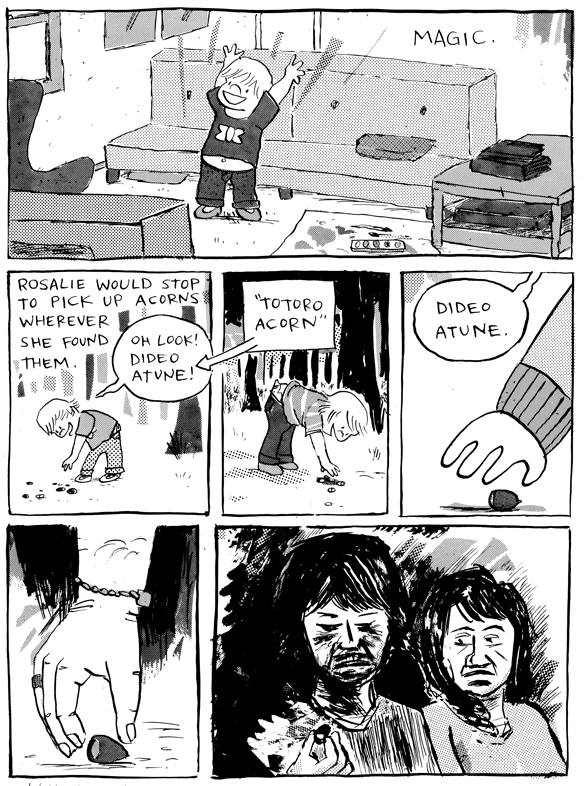
“[C]omics as a medium could ideally be the most visually honest and consciousness-plumbing medium out there, even more than film.”—Chris Ware
“Boardwalk Empire” thoughts, Season Three, Episode Four: “Blue Bell Boy”
October 9, 2012* Hey, it’s Al Capone! Glad to see him again. I’m a mob nerd, yes, but beyond that I find myself enjoying the show’s presentation of him as…well, you know in the commercials for Honey, I Blew Up the Baby where they have shots of the giant toddler wandering around the city like Godzilla? That’s kind of Capone on this show: an overgrown third-grader, sweet in many ways and funny in many other ways but also not at all someone you’d want to entrust with power over life and death.
* Eli’s great…? Am I really saying that? I never thought much of that character before, to be honest, but quiet, humbled, older-and-wiser is a much better look for him than resentful kid brother. Literally a better look for him, in fact: Shea Whigham’s severity is engrossing to behold. So I’m glad to see him as well.
* And I’m glad to see Owen’s girlfriend again too KNOWHATIMSAYIN
* And at least this time they gave us some attractive male nudity too! Alright, it was from a distance and out of focus, but still, beggars can’t be choosers.
* Fuck nuns, fuck Catholicism — not just annoying, but boring from a dramaturgical standpoint. That scene with Margaret and the smarmy doctor trying to get the nun to agree to use the word “vagina” was precisely the sort of self-congratulatory empty-calorie “LOL the past, aren’t you and I glad we’re so far beyond that now” progressivism porn that Mad Men is often accused of but rarely actually indulges in.
* Man, look at the chipped paint and wood rot on the doors and shutters at the thief’s place. Gorgeous. This show’s attention to detail is seamless.
* Wonderful camerawork in that house, too, from the initial scene of Nucky and Owen winding their way through the labyrinth of liquor through all the cat-and-mouse business with the prohies.
* Nucky resents Owen for not being Jimmy. Not being Jimmy didn’t do young Roland Smith any favors, either. Nuck’s not in the protégé market, not anymore.
* I’m not one for plotting the future course of the shows I watch, but I do wonder if the solution to the Gyp Rosetti situation is for Nuck to loose Richard Harrow on him, and if perhaps setting that up was the purpose of their run-in last week.
* How about the way the massacre was treated, huh? Heard from a distance as Eli sits powerless to stop it, then a god’s eye view of the aftermath? And how about those closing shots of the boardwalk, luminously artificial? I maintain my belief that the show is more than just eyecandy, because there’s nothing just about it.
* That said, Chris Allen responded to my recent enthusiasm for the show by writing one of the better rebuttals to such things I’ve come across in a long time, so, equal time. His comment made me think of three things:
* This is Margaret’s least interesting storyline yet, and that’s saying something.
* I think the simplicity of Gyp’s threat is what makes it threatening, or at least that’s how the show is presenting it. There’s nothing to be outfoxed here — just a supremely well-armed lunatic who picked the right location to make trouble.
* I’m curious if the seemingly tangential Capone and Luciano/Lansky/Siegel storylines are going to remain separate now. Game of Thrones opened that door and I wonder if more shows will step through.