
Here’s a working link to my most recent Game of Thrones review.
Comics Time: Baby’s in Black
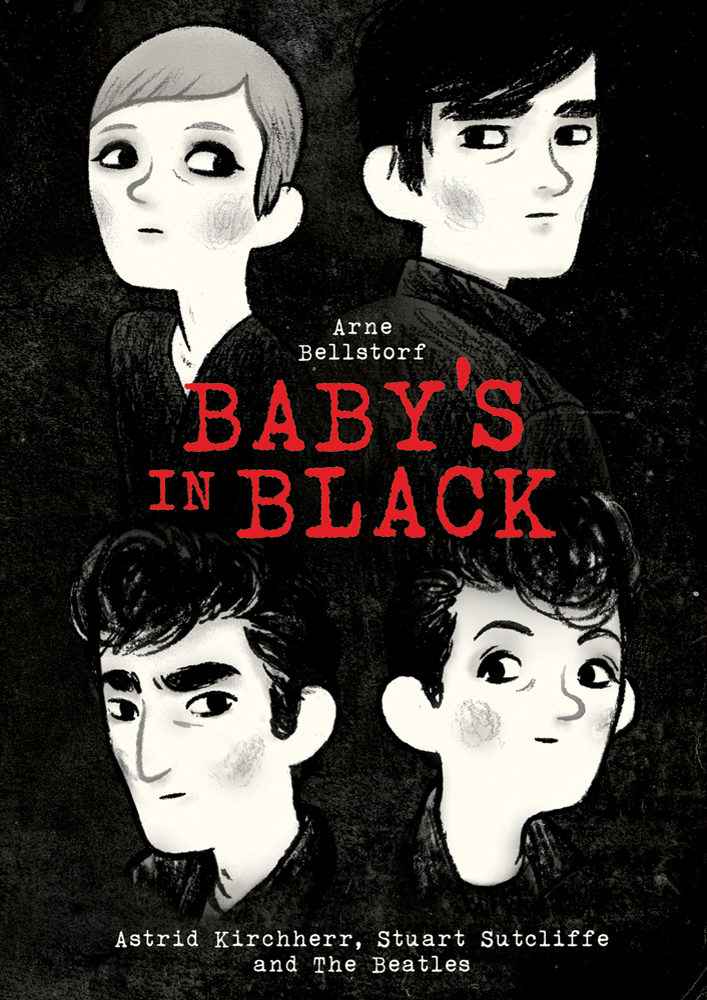
Baby’s in Black
Arne Bellstorf, writer/artist
First Second, May 2012
208 pages, hardcover
$24.99
Buy it from Macmillan
Buy it from Amazon.com

For today’s Comics Time review, please visit The Comics Journal.
The Boiled Leather Audio Hour Rises Again, Harder and Stronger
My A Song of Ice and Fire/Game of Thrones podcast is back! This time my co-host Stefan Sasse and I are joined by Race for the Iron Throne’s Steven Atewell for a brief discussion of the A Game of Thrones graphic novel and a lengthy discussion of the nature of prophecy in the series that manages to be both nerdy and heady. Enjoy!
Carnival of souls: Jack Kirby, Andrew White, Mad Men, more
* Here’s part three of the Comics Journal’s sumptuous Jack Kirby roundtable. Long live the King.
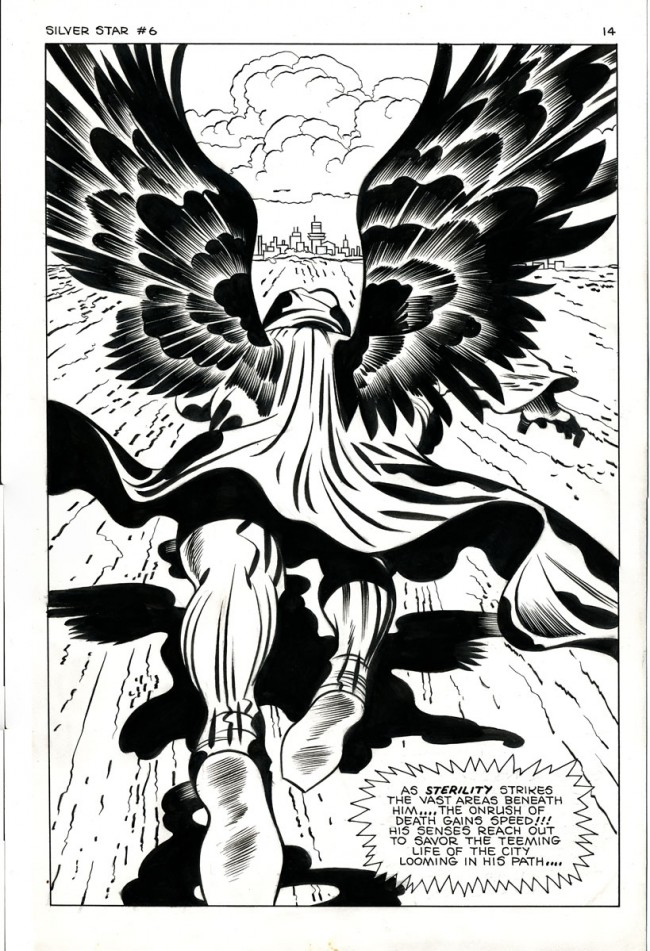
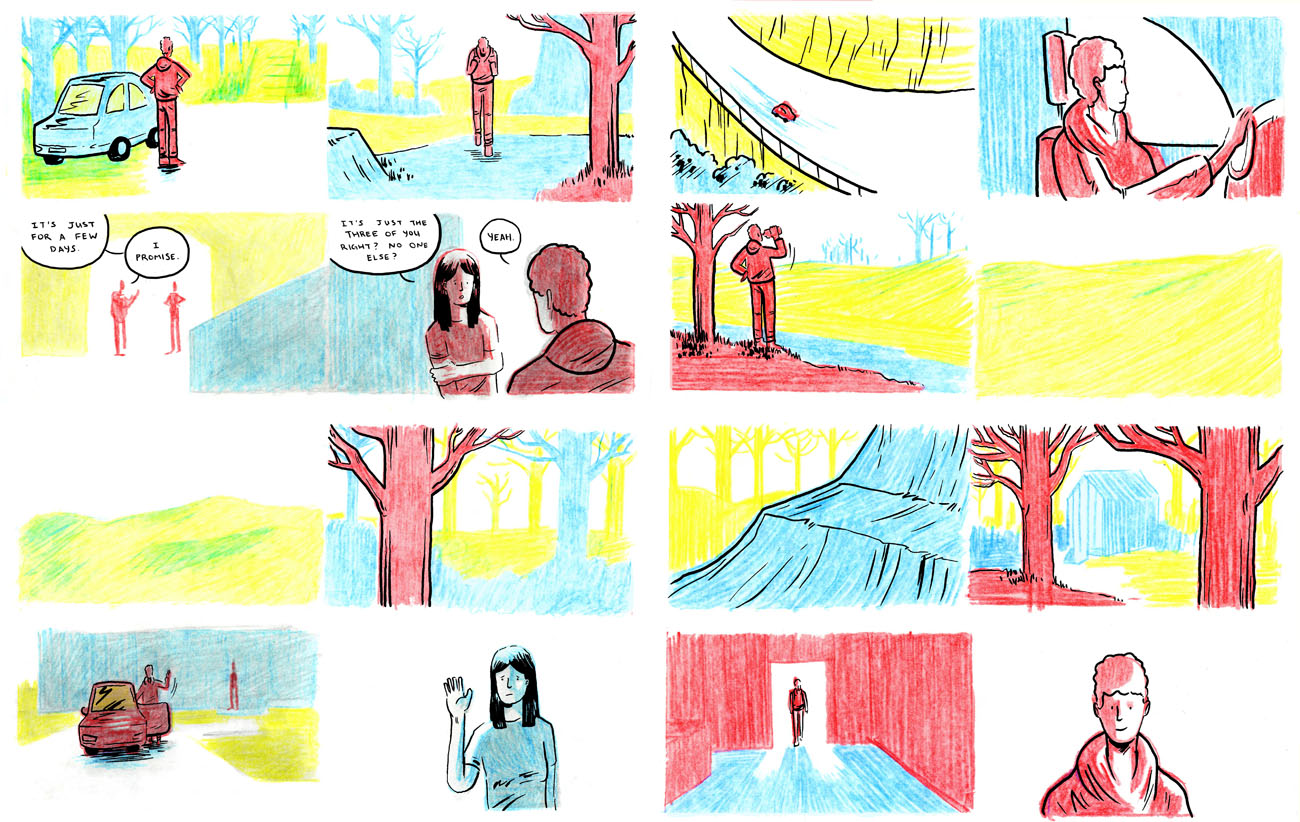
* Territory, the comic Andrew White made for Frank Santoro’s correspondence course, is very pretty and, like all of the products of that course I’ve seen so far, very Frank!
* Good Mad Men writing: I liked Maureen Ryan’s take on how far above Don Draper’s head the Beatles are, and Deborah Lipp’s forthright reaction to the show’s death imagery, and the Mindless Ones’ comprehensive look at last week’s episode. Jeez, this is a rich text.
* Glenn Greenwald predicts the future:
…six more months of ritualistic, chest-beating dances over the body of Osama bin Laden and the constant hailing by Democrats of the stalwart, pulsating courage of our Commander-in-Chief for having safely sat in the White House, surrounded by layers of security greater than that enjoyed by any of history’s emperors, and ordering that bullets be pummeled into the skull of an unarmed man and his corpse thereafter dumped into the ocean.
Girls thoughts reconsidered
Girls episode four was very funny and very mean, which is great. Lena Dunham really has figured out how to take everyone’s worst characteristics, exaggerate them, and use them to smack around the other characters Punch-and-Judy-style. No, I don’t know anyone who’d be as openly repulsive as the bongo playing guy or Hannah’s boyfriend, or who’d be as acquiescent to sexual harassment as Hannah and her coworkers, or who’d be as vapid and pretentious as the British girl, but a) as Daniel Clowes put it, “Likeable characters are for weak-minded narcissists,” and b) I also don’t know anyone even a little bit like Kramer or George Costanza, or Basil Fawlty, or Blanche Deveraux, or Doctor Steve Brule, and on and on and on. It’s a comedy, and at this point it’s firmly established itself as a comedy of exaggeration which (contra the slapdash, any-weapon-to-hand first couple of episodes) is at least exaggerating recognizable human foibles, so who cares?
But that pretty much eliminates my desire to write about the show anymore, even though I’m absolutely going to keep watching and, hopefully, enjoying it as much as I’ve enjoyed the past couple weeks. I don’t have a whole lot to say about sitcoms, as a critic. So much rides on just being funny, and being funny forces characters into situations and narratives that defy the kind of writing about character and theme that I do. In a comedy, even the details of performance and appearance I like to focus on boil down to whether or not they made a joke better. I look at people who write about Community (a show I enjoy) the way they write about Mad Men (a show I enjoy) and it seems so foreign to me, like hearing your favorite song sung in Esperanto. I’m sure Hannah and company will “grow,” but that’s the thing I’m least interested in discussing, unless the growth is set-up for a punchline.
But it’s a good show, you should watch it.
Watching the ‘Thrones’: Panic! at the Red Keep
What Are They Doing With Dany On ‘Thrones’? | Video | MTV
The latest MTV News Game of Thrones video roundtable once again covers my two favorite moments from the episode. Also, I’m wearing a FREE GAIUS Battlestar Galactica t-shirt handcrafted by 24/7 Magnum, and that’s pretty exciting to me.
MCA
Twenty years later and this is still what cool looks like to me. I love you Adam Yauch.
Mad Men thoughts, Season Six, Episode Eight: “Lady Lazarus”
* Nothing worse than someone who interrupts you when you’re reading during your commute. Dude deserved to be cuckolded for that alone.
* I’m really glad this show is not above a bit of comic business involving some schmoe lugging skis and ski poles around. Or as Roger approvingly put it, “And I got to see that!”
* Actually, that echoes his line during Pete and Lane’s fight, doesn’t it? I like the image of Roger as a hedonist observer. All the world’s a stage and he’s got great seats.
* Pete’s skis: the telltale use of orange of the night.
* “No one can keep up. It’s always changing.” Megan gets the Matthew Weiner “this is what this season’s about” line of the evening.
* Guest starring Rory Gilmore as Gloria Trillo!
* At least that’s where I thought it was headed at first, though it turns out Beth was the one slamming the brakes on her dalliance with Pete, not Pete. In fact, I got it backwards: Pete gender-flips Gloria Trillo’s trademark move and initiates the inappropriate incognito meeting with the cuckolded spouse, rather than the other way around. I think what threw me was her wildly inconsistent and inappropriate affect during their initial encounter. She just seemed, you know, potentially mentally ill. But something Salon’s Willa Paskin tweeted made her click for me: She’s just the Betty Draper of a show we’re not watching.
* The Don and Megan Show is so fucking good. It’s only in this episode that I cottoned to why, though: Megan’s an actress! She can fake a rapport with a product and a client (by masking it as a rapport with her husband) naturally, in a way it took Don a long time to master by his own admission.
* Don suggesting Megan work at another advertising firm was the key to that late-night conversation. On the one hand, it’s really, really sweet. He might have changed his tune eventually, but Don’s first instinct when Megan tells him she doesn’t want to work at the agency anymore is not “Oh no, I’m losing her!”, it’s “Oh no, I’ve made things too unpleasant for her at work, but she’s really talented — she’s gotta find another place to do this.” Only upon further thought was I like “Hmmm, maybe he’s concerned that a rejection of his profession as the road to fulfillment is a rejection of him, too?”
* Don plays his true feelings about what he does for a living close to the chest, mostly by expressing very different things about it at different times. He’s been visibly and sincerely thrilled by finding the right line, or when a pitch goes well, or when he won his Clio, but at the same time he’s been dismissive of grand ambition and ars gratia artis. He tells Megan we don’t always get to choose where our talents lie, implying that part of him wishes his own talents lay somewhere else. So in the long run it’s tough to say how he’ll feel about Megan’s departure from SCDP as a reflection of his professional and creative life.
* But it’s perfectly clear how he feels about it short-term and in the gestalt of his marriage: miserable. The hilariously direct dissolve from his slowly deflating smile after dittoing her line about being everything she’d hoped for to his miserable punim during that excruciating Cool Whip test-kitchen pitch with Peggy says it all. Yes, she’s super-duper hot. Yes, she cooks barefoot and plants a steamy kiss on him while she’s at it, while playfully admonishing him not to expect this kind of thing all the time. Yes, she’s honest with him and brings out the honesty in him. Yes, she rolls with his dark side, from his secret identity to his sexual fetishes. But last episode Don told her, with something like awe in his voice, “You’re good at all of it.” Not anymore. No more walking into work together — that part of their life is over. Now she’s definitionally not good at “all of it,” and that disappointment’s going to weigh on Don the same weigh Megan’s realization that following Don’s career path (however legitimately great she might be at it) wasn’t going to fulfill her weighed on her.
* Christina Hendricks is really a master of Joan’s elaborate social kabuki. Listen to her delivery when she asks Don “I mean, she’s not disappearing is she?” A hyperbolic joke covering a straightforward question about whether Megan’s going to make herself a stranger to her former colleagues covering an implied question about Megan’s future with Don.
* Rizzo nails it. “For what? Heinz baked beans.” Peggy’s dilemma is that she can’t blow off the inconsequentiality of what she does for a living and still be (apparently) happy like Rizzo, nor can she cut bait and admit it doesn’t make her happy and go do something else like Megan. Personally I’m not sure whether she really is unhappy, mind you — I think she’s not quite sure. She just hasn’t faced up to the “I’m good at this, and now let me figure out if that means anything or not” internal discussion yet.
* Don’s tin ear for rock music is funny, but I seized on something different in that scene when the guys come in to play him the song the client picked for the commercial: He says “help yourself”, but no one else drinks.
* When did music become so important? Michael Ginsberg tells Don the song’s making him fucking nauseous and all Don can do is express bafflement at the harsh language, but that’s the kind of thing I’ve said probably hundreds of times. When did this change take place? When did music become the core cultural thing by which cultural-people define themselves? At least I do, and always have, more than film or books or comics or TV or anything else. I assume the first example of this is beat/jazz culture in the ’50s, but I don’t know.
* Joan assumes Megan will be the failed second wife. That’s one of the slots she has available, and she’s gonna make that square peg fit, by god. For my money, Peggy has the right of it: Megan’s gonna be good at what she does. We’ve already seen what an actress she can be.
* Pete tricking his way into his inamorata’s home reminded me of how he pressured the au pair into having sex with him a few seasons ago. When he wants something he has a hard time understanding he can’t always have it.
* The invisible woman at the test kitchen.
* MAD MEN CAN AFFORD THE FUCKING BEATLES MOTHERFUCKER
* In all seriousness, the use of “Tomorrow Never Knows” does more than put paid to all the knowing critic jokes about what songs Mad Men can and can’t afford to use this season, it serves as a declaration of ambition. Not that we didn’t know how ambitious Mad Men already was, mind you — don’t let’s forget it soundtracked a Don-looking-badass shot with “Satisfaction” last season, though obviously Mick & Keith are way more profligate than the Apple corps with the usage rights if the price is right. But to use an original Beatles song, any Beatles song much less a landmark like that one, is to take a run right at a cultural monolith/megamyth. Hell, I was thrilled enough when Don whistled “I Wanna Hold Your Hand” a couple episodes back. Watching him wrestle with “turn off your mind, relax, and float down stream” was a higher order of pop-culture pleasure.
* My favorite thing about it, though? The credits continued the song after Don shut it off, like Matthew Weiner was saying “Okay, Don may not care for it, but this song’s awesome, why don’t we keep listening?” Endearing.
* I can’t remember the last time I found something on a tv show more frightening than that open elevator shaft. That it didn’t pay off in any concrete way made it even scarier. It was a Hitchcocky image, for sure, in an episode that referenced Hitch explicitly (The Birds) and implicitly (Beth had a tortured Vertigo vibe to her), as well as the Hitchock-acolyte elements of David Lynch–there was something Blue Velvet/Laura Palmer about Beth’s tender feminine damage, and the shaft was a flash of the unexplained uncanny as darkly luminescent as the ear on the front lawn or, insofar as it’s a portentous absence, the disappearing angel in picture on Laura Palmer’s wall. The thread will be torn, Mr. Draper, the thread will be torn.
* Whoa: Did you know that if you take the first letter of the first sentence in each “next week on Mad Men” teaser clip this season, it spells out “P-E-T-E-C-A-M-P-B-E-L-L-I-S-G-O-I-N-G-T-C-O-M-M-I-T-S-U”???** I wonder what the next letters are!
** not true, at least as far as I know

Comics Time: Night Business #4
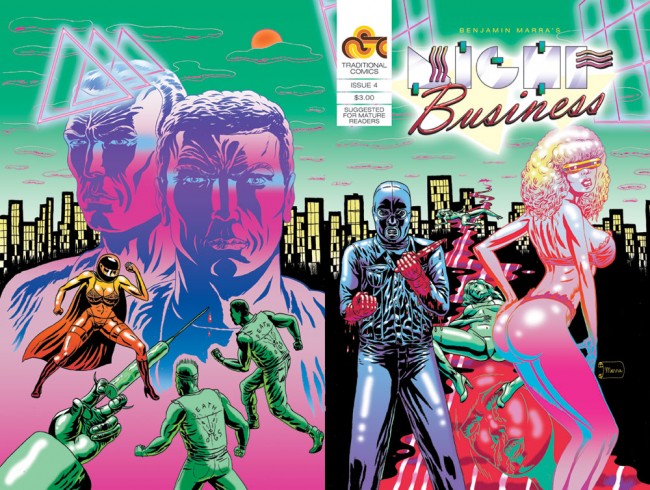
Night Business #4
Benjamin Marra, writer/artist
Traditional Comics, 2011
24 pages
$3
Buy it from Traditional Comics
For today’s Comics Time review, please visit The Comics Journal.
Girls thoughts revisited!
I almost invariably hate it when TV critics say that Show X was bad until Episode Y, at which point it miraculously transformed into something truly worth watching. It’s a common phenomenon when you’ve read enough TV crit, and when you happen to disagree with the selected turning point and/or the supposed problems that preceded it, it highlights the subjective nature of criticism, and thereby the unreliable nature of critical interlocutors, like pretty much nothing else, because it’s such an all-or-nothing proposition. “The show was basically no good until this happened, and then it became good”: Disagree with any element of that and it all falls apart, and you’re left looking at the computer screen and hollering “What are you talking about? The wigs during Game of Thrones Season One simply were not that distracting!” or whatever. You end up embarrassed for the critic who asserts that something that either didn’t bother you or didn’t wow you is in fact a self-evidently dispositive element of the show.
So I’m going to be as circumspect as possible when I assert that the third episode of Girls is a whole new ballgame. I got to the closing credits and found myself surprised that Lena Dunham was once again the writer-director, so different did it feel to me. I got the hang of the show, is part of it — okay, it’s a parody of these kinds of people, it’s making fun of them from within, very well then, game on — but so did she. The characters are now more consistent in their ridiculousness, more coherent as caricatures, rather than collections of random tics and neuroses stuffed into human-shaped containers. It’s like Dunham figured out exactly what makes each of them awful and pathetic and just kept hitting that soft/sweet spot instead of merely flailing around, careening into the nonsensical in an attempt to make everyone look maximally obnoxious at any given moment. Marnie’s off-putting alpha-femaleness felt cohesive: She was turned on to the point of rubbing one out in the ladies’ room by a guy who ran roughshod over her sense of decorum in much the same way that she shits on her boyfriend’s gestures of goodheartedness. Hannah clicked too, as a sort of human magnet for terrible, arrogant guys who use her as a beta test for establishing their new identities. Whatsername the idiot Brit worked like a Seinfeldian send-up of freespiritedness, insisting on wearing a see-through outfit to a babysitting job like Sue Ellen Mischke walking around wearing a bra with no shirt. And Shoshanna is settling nicely into the nerdy-neighbor role, the Skippy/Urkel/Kimmy Gibler of Girls.
I’d be pleased if the show continued to use new guys as a Lost in Space-style “monster of the week” feature, too, revealing a freshly terrible dimension of maleness with each new episode. Nice to see Jorma Taccone used as a Will Ferrel/Tim & Eric-style avatar of leering sexual overconfidence, for example; that Marnie gets off on it is a joke on her and him both. Hannah’s insufferable ex Elijah works in much the same way, as a swipe at her and himself both: “Beau is my lover” is a ridiculous thing for anyone to say, while the guilty-pleasure insensitivity “That fruity little voice you’ve put on”/”Excuse me?” exchange is paid back by his awesome, successful attempt to get the last word: “It was great to see you, your dad is gay.” Even the tangents the conversation go on are very funny in their weird specificity: Hannah offering “I’m seeing this guy, and sometimes I let him hit me on the side of my body” as proof of her sexual-experimentation bonafides was probably my biggest laugh line from the show so far. I’m sitting here imagining the negotiation process as to the acceptable hitting zones and writing a flashback episode in my head as we speak.
It wasn’t until someone pointed it out to me on twitter that I realized this episode also happened to be the one with the most “heart and soul” — the “Dancing On My Own” sequence at the end is the best example of course, but there were other flashes of it, particularly the brief but surprising and genuinely touching moment in which Hannah’s horrible fuck buddy actually, sincerely consoled her about her HPV diagnosis. (She didn’t expect it any more than I did; I’m glad Dunham stayed away from the easy joke there.) Normally I’d think this sends a mixed message regarding what kind of show this is, because honestly I think my muddled expectations for what I was watching were a big obstacle for enjoying what I got in the first two episodes. So much of the writing about the show treated it like “Finally, this voice is being heard! This world is being represented!” that I couldn’t help but judge it based on those merits, and the judgment rendered was “A) the voice is garbled, and b) yes, but so what? This exists isn’t a TV show, it’s a thinkpiece in TV-show drag.” Toss in the inconsistent characterizations and doughy jokesmanship and the resulting impression was even muddier and less appealing. But in this episode the writing was so much sharper both in terms of character work and basic funniness that you could get away with giving these dopes the happy ending of having a great time dancing like nobody’s watching in their apartment at the end of a long night. The sharpness leavened the warmness and vice versa.
Anyway, that’s where I stand on Girls as of episode three, and as best I can tell I stand alone. The people who like the show seem to have liked it from the start, and that goes double for the people who love it. Meanwhile I don’t think it changed many, or any, detractors’ minds other than my own. So it’s entirely possible I’m seeing something only I can see and embarrassing myself by molding it in no uncertain terms into a verdict on the show as a whole. Best I can do is put it out there and ask: Are you with me on this, or am I just dancing on my own?
Carnival of souls: Fluxblog 2005, BCGF 2012, Slechtemeisjes, Thickness, The Hobbit, Jack Kirby, more
* Matthew Perpetua’s Fluxblog returns with its latest eight-disc (eight disc!) survey of music from the ’00s; this time it’s 2005 in the spotlight.
* I think I may have missed an earlier announcement, but my RSS reader insists this is breaking news: The Brooklyn Comics and Graphics Festival, historically the best comics convention, has announced its date for this year: Saturday, November 10, 2012. That’s about a month earlier than usual, and while I’ll miss the gray wintry Brooklyn weather and holiday-season vibe a bit, I don’t see any reason the new time frame won’t work.
* Ooh boy, Secret Acres is publishing a print edition of the profoundly strange and uncomfortably sexy webcomic Slechtemeisjes called Wayward Girls, now revealed to be by Netherlands art-school graduate Michiel Budel! That’s a good get.

* Thickness #3 may be the final issue of the series, but co-editor Ryan Sands reveals a collected edition with added material is in the works.
* This Comics Journal roundtable on the comics of Jack Kirby and critic Charles Hatfield’s book about Kirby The Hand of Fire, is an absolute feast, and as of this writing there’s no end in sight. Featuring Jeet Heer, Dan Nadel, Jonathan Lethem, Sarah Boxer, Glen David Gold, R. Fiore, and Doug Harvey.
* Speaking of the Journal, here’s a great review of Benjamin Marra’s Lincoln Washington: Free Man by Matt Seneca. And Brandon Soderberg’s review of Derf Backderf’s memoir My Friend Dahmer, about the author’s adolescent friendship(ish) with Jeffrey Dahmer, makes me want to read the book even more than I already did.
* Salon’s Willa Paskin is a fabulous TV critic, and her piece on the exquisite awfulness of Joffrey from Game of Thrones offers ample evidence as to why. I’m going to print out that first paragraph and keep it under my pillow at night.
* Speaking of fabulous TV critics, don’t miss the Mindless Ones on last week’s Mad Men.
* So I guess the picture quality of The Hobbit‘s revolutionary 48 frames-per-second filming technique is so good that it actually goes back around to ugly-looking. Peter Jackson defends the move, while TheOneRing.net’s Quickbeam (whoa, flashbacks to 12 years ago!) says it’s a matter of taste that takes getting used to.
* Sam Costello talks to Robot 6’s Brigid Alverson about his decision to end his very, very ambitious webcomic/print-comic horror anthology series Split Lip. Sad to see it go.
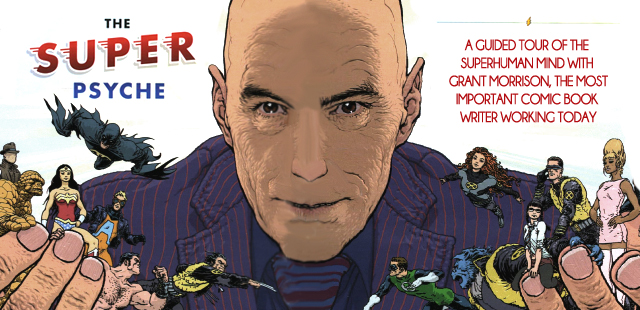
* How bright will seem, through mem’ry’s haze, those happy, golden, bygone days: Grant Morrison waxes thoughtful on the big superhero characters for Playboy. Also Frank Quitely is now drawing him to look like a nightmare cross between Crowley and Burroughs.
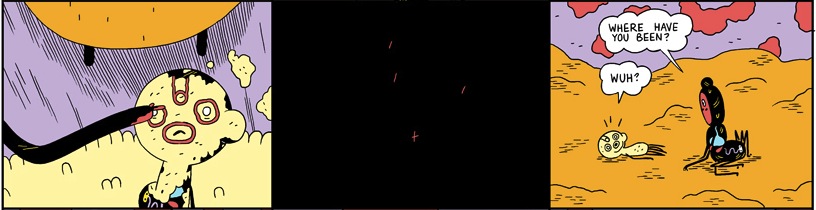
* I don’t know how Michael DeForge’s Ant Comic is able to keep making me feel worse and worse, but I’m…glad it does…?
* Keep going, Jonny Negron. Just keep going.
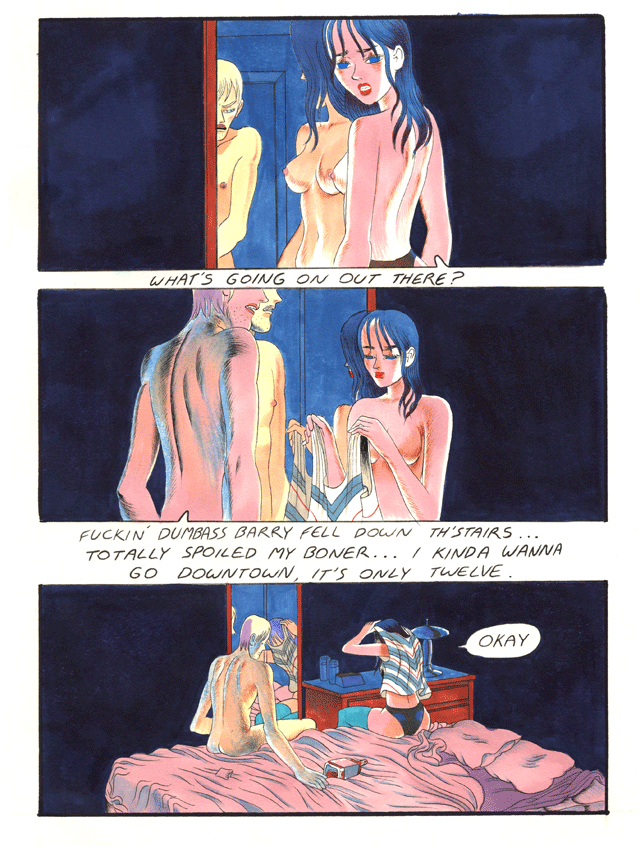

* Let’s ask people about Alan Moore Before Watchmen. Let’s ask people about Jack Kirby and The Avengers. Let’s note for the record what they say.
* Julia Gfrörer on Dylan Williams. What a moving video.
Watching the ‘Thrones’: Shadowboxing
In the latest MTV News Game of Thrones video roundtable, I talk a bit about a certain shadowy aspect of last night’s episode that I wasn’t crazy about but didn’t really get to talk about in my Rolling Stone review. Plus I wear a bitchin’ Monster Squad t-shirt from Found Item Clothing. Check it out!
Mad Men thoughts, Season Five, Episode Seven: “At the Codfish Ball”
* Poor Marten Weiner as Glen Bishop. The Sofia Coppola in Godfather Part III of Mad Men.
* Fun fun casting for Megan’s parents. Career European Ronald Guttman as her philandering Marxist intellectual father? Bien sur. and of course you knew something sexy was gonna happen the moment you recognized Julia Ormond as maman.
* Roger’s ex-wife looks GREAT. I guess he’s not the only Sterling getting a second wind.
* “No, pervert, this is about work,” Megan tells Don when she comes into his office to tell him her great idea for the Heinz baked beans campaign. “You’re good at all of it,” Don tells Megan as they leave the dinner meeting with the Heinz guy where they were supposed to get fired but ended up securing the account because of Megan’s quick thinking and her and Don’s intellectual and emotional rapport. And those two lines in a nutshell are why I insisted last week that Don and Megan are not dysfunctional, not the way Don and Betty were, not by a million miles. (That part of last week’s post got me more “just writing to say I agree” responses than anything I’ve ever written about a show, maybe because so few other people out there seemed to agree?) The sex stuff that seems so powerful and even dark in the moment is something they playfully joke about when the office door is closed, just something else they share along with great ad ideas and Don’s secret identity and Megan’s parents’ dysfunction. (Now that’s a place to use the d-word.) Megan’s good at all of it — working the room, coming up with ideas, delivering them in compelling pitches, adjusting to the facts on the ground, being pretty and supportive, being sexy, soothing Don’s melancholies, mothering the kids, having a mind and personality and drive of her own. They’re great together.
* Or they would be, if not for the soft underbelly Megan’s dad pierced at the banquet. The signs were there already, of course. There was her discomfort when her Hail Mary pitch is celebrated at the office the next day — seriously, I literally stood up, pumped my fists, and cheered when the Heinz guy okayed the idea, let alone the characters in a world where this actually happened, but Megan just seemed to struggle with the knowledge that she should be happier than she is about it. “This is as good as this job gets,” Peggy tells her, and means it as a compliment; Megan reacts like she’s smelled a fart, like being told you’re a young Peggy Olsen is like being informed you have a chronic medical condition.
* But it was daddy dearest who really shattered the dream of Don and Megan. I was hoping that his line of attack that Megan had given up on her dreams to follow Don’s career footsteps was just a bitter man lashing out because he can’t stand happiness in others when he has so little. But one look at Megan’s total deflation after he tells her she’s given up shows he absolutely nailed it. We’d never really seen this side of Megan before — last season she told Don she wants what he and Peggy have and it seemed sincere, and her mentions of her failed acting career seemed as good-natured as such things could get. Frankly I was surprised to see how effective her dad was in dismantling her this way. But now I’m just really alarmed for her future with Don and his family. I don’t know how you paper that big a problem over with Draper pitches and kinky sex. It never worked for Don himself, after all.
* Speaking of which, those ads for that show The Pitch are unintentional comedy gold in the context of the show during which they’re airing. Jesus, could AMC have missed the point of Mad Men any more spectacularly? (Granted, I say this despite having hollered at the screen like a baseball fan during the World Series when the Don-Megan tag-team pitch landed. Maybe AMC knows me better than I know myself.)
* Peggy getting man advice from Joan feels like she used a time machine to do it. And because it started in that way, that throwback to the mores of the ’50s way, you knew it’d end in tragicomedy. But the comedy was funny. I loved Peggy watching Peggy realize what she’d just said when Abe asked her if she wanted to order and she replied “I do” — the facial-expression equivalent of the sad trombone. And I loved Mrs. Olsen’s inflection as she greeted Peggy’s boyfriend. You don’t have to have grown up Catholic to find hilarious the way a disapproving middle-aged Catholic woman would pronounce the name of her daughter’s live-in boyfriend if that name happened to be something like Abraham…but it helps!
* An adult content warning 3/4 of the way through the episode? Now we’re talkin’!
* Who Killed Donald Draper?
* Seriously, the total devastation of the underpinning of Megan’s marriage to Don by her dad was actually surpassed in dreadful revelatory power by Ken’s father-in-law Ed Baxter, played by the eternally incandescent Ray Wise, telling Don that his career as adman for the powerful is basically over. Again, there’s no way past having made yourself publicly, spectacularly, even proudly untrustworthy in the eyes of the people whose trust you need to survive.
* Like Game of Thrones, which this week took 12-year-old Maisie Williams and put her one on one with Charles freaking Dance because that’s just how good the kid is, Mad Men knows what a resource it has in the form of gifted child actress Kiernan Shipka, and rewarded her and us this week by putting her up against John Slattery’s Roger Sterling. Roger was just what she needed — an adult treating her as one of them — and she was just what he needed — a zero-pressure opportunity to work all his charm muscles without his livelihood and self-worth rising and falling on it. They’re both obnoxious people in a lot of ways, but they’re also both magnetic and funny and interesting, and that’s the side that comes out when the two are juxtaposed. What a pity it ended the way it did. Sally’s a woman of the world to an extent — you have to assume her late-night phone calls with Glen have tackled some taboo topics, I know mine did at that age. But seeing Megan’s mom polishing the sterling did more than expose her to the act itself: It showed her the truth of what all the play-acting about being Roger’s date and implicit equal entails. You wanna be a part of a successful man’s life, being squired around to fancy-dress banquets and becoming his partner in securing new business and all of that? Here’s something else you’ll be doing. That’s a lot to swallow, and oh jesus I promise you I didn’t think of that pun before I wrote it.
* I loved how that scene ended: with a goddamn tableau. You want on-the-nose, critics who distrust art making its artifice apparent? You got it. Ditto the crash cut to black after Sally pronounces the city “dirty.” Pardon my French twice over, but FIN, MOTHERFUCKERS.
* Finally, I want to take a moment to salute the single funniest thing I’ve seen on TV all year, when Megan’s dad tells Don that one day, “your little girl will spread her legs and fly away.” It’s not even the dad’s comment that does it, despite its turducken structure — a bitter swipe at Don in the form of a dirty joke disguised as a possible trans-language malapropism. Nope, it’s Roger Sterling cracking up about it, laughing loud and hard despite how completely inappropriate and uncomfortable the comment was for everyone else in the room. I was dying, just dying. Roger Sterling’s the Fool, the Joker, the Comedian, and getting the joke is its own reward. Laugh and the world may not laugh with you, but hey, at least you’re having a good time!
The full Thickness

THICKNESS #3
edited by Michael DeForge & Ryan Sands, debuting on June 16 at Chicago Alternative Comics Expo, including sexy stories by:
- Edie Fake
- Lamar Abrams
- Julia Gfrörer
- Jimmy Beaulieu
- Sean T. Collins / William Cardini
- Gengoroh Tagame
- A pinup by HamletMachine
- A new TRUE CHUBBO strip
- An Andy Burkholder mini supplemental
Turn me on, dead man!