
Author Archive
Comics Time: The Perry Bible Fellowship Almanack
January 27, 2010
The Perry Bible Fellowship Almanack
Nicholas Gurewitch, writer/artist
Dark Horse, 2009
272 pages, hardcover
$24.95

Read these comics for free at PBFComics.com
Every single Perry Bible Fellowship comic strip ever, plus a bunch of extras that didn’t make the website cut, in a sizable yet reasonably sized hardcover with one of those built-in ribbon bookmark things, for $25 SRP? Pretty glorious. Nick Gurewitch’s webcomics sensation–and that’s exactly what it is/was, a strip that batters past the most well-secured don’t-care-about-webcomics defenses–was already the kind of work you’d stumble across thanks to a friend’s recommendation and almost instantly attempt to consume in its entirety in one sitting. Which isn’t even all that hard, given the one brief shining moment Fawlty Towers/British Office brevity of its run. Moreso than with many other webcomics, a fat book collection serves the material well.
Placing every strip between two covers allows you to easily follow along on several parallel tracks. You can watch the maturation of Gurewitch’s art, for one. His line smooths and strengthens. His designs round out and combine with his increasingly sophisticated and subtle color palette to produce that sickly sweet Stay Puft feel. He becomes increasingly comfortable showing off illustrative chops not usually seen in a campus weekly–his dinosaurs, monsters, and animals would all be at home in Golden Age pulp or an immaculate children’s storybook, while his impersonations of Edward Gorey and Shel Silverstein or his pastiches of Asian and commercial illustration styles are impeccable. His stable of recurring visual tropes–people with inanimate objects for heads, meticulously drawn fantasy- and animal-kingdom characters, those cookie-cutter people–have more of an impact each time.
You can also trace the evolution–maturation’s definitely not the word here–of his sense of humor. The strip starts out as the kind of bawdy, horny humor lots of collegiate wits unleash upon their newly parentless world. A recognition that sex is fun and attractive people are awesome joins hands with the realization that one’s pursuit of the aforementioned is often really stupid and the failure to make it happen is often miserably painful, and off they go, skipping and tra-la-la-ing across your funnybone.The strip also mines a lot of humor out of senseless violence from the get-go. But right around page 82-83, “Mrs. Hammer” and “Gotcha the Clown,” its riffs on that theme, and the whole gestalt of the strip, make a quantum leap. Suddenly the capriciousness of physical violence in the PBF world is joined with a gleefully anarchic sense of comic timing–that much-ballyhooed gap before the final panel, much wider than any other gag strip, leaving much more to the imagination, and making the payoff that much more unexpected and hilarious. Something awful will most likely happen by the end of any given strip; the trick and the genius of it is that you don’t have any more idea of what it’ll be than the poor saps to which it’ll happen.
It’s worth noting that it’s not just that leap of faith Gurewitch forces you to take between the penultimate and final panels that makes his strip such solid gold by the second half of its run. (To be fair, there are three or four head-scratching clunkers in the early going; it took him a while to make that punchline panel work.) It’s the way he sticks that landing, the moment-in-time specificity of the body language he so frequently depicts–freezing battling characters in mid-beatdown, capturing just the right looks of amazement on the faces of cheering crowds, doing the same with characters weeping in devastation or fleeing in terror. There’s also often a perfectly calibrated comedown from the pomposity and grandiosity of the beginning of the strip to the deflated rimshot or sad trombone of the final panel, and Gurewitch uses an array of tools to nail it: ornate, expressive lettering; shifts in illustration style; jumps in time or spatial perspective.
And then like that–poof–he was gone, off to do animation or funny award-acceptance speeches or whatever it is he’s up to. He left behind one of the most visually accomplished and mercilessly funny comics this side of Tales Designed to Thrizzle. If you like to laugh at comic books, this belongs on your bookshelf.
Caprica thoughts
January 27, 2010How’s this for a secret origin: The Cylons were an unsuccessful attempt to develop the Cinco Boy.
[hey RSS users–you gotta click the actual post to see a couple videos here]
People thought Battlestar Galactica was dark because its pilot episodes centered on genocide, with a dollop of 9/11 on top. That’s true. But they were still a swashbuckling space adventure with dogfights and killer robots and sexy robots and so on. The pilot for Caprica, on the other hand, is pretty much just a suicide bomber blowing up a subway and killing some teenage girls, and chain-smoking fathers in dark suits dealing with their grief. There’s some science-fictiony stuff in there too, to be sure–and in the DVD version that I watched, that stuff includes virtual-reality titties–but for the most part it’s about as thrilling as importing your old files to your new MacBook. Nope, you come for the parents burying their children or you don’t come at all.
That’s a lot to ask of your audience, and a very big risk for a pilot episode on the network that brought us Ice Spiders to take. For all the talk of BSG as SciFi/Syfy’s flagship show, it never did flagship ratings, Peabody Award or no. I can’t imagine that in a culture as angry and ground down as we are right now, an actionless morality play about the lengths to which people are driven by grief is going to put up gangbusters numbers. Frankly I’d be surprised if it got renewed.
That would be a pity, because I really enjoyed this episode. For one thing, it just looks so classy. “Classy” usually means “blue-tinted” these days, but not here. I mean, sometimes I guess, but when I realized there was going to be a major plotline about the mob connections of our lawyer lead character Joseph Adams (nee Adama) and it was going to be shot in the rich golds and blacks of Gordon Willis and The Godfather, the blues and grays struck me more as Godfather Part II than perfunctory prestige picture. Throughout, the stately, ruminative pace of late Battlestar was maintained–an editing rhythm that puts you in the company of big, unpleasant moments and questions and lets you sit with them. I know to some that’s a minus–cf. Jim Henley and his “Caprica: Planet of the Assholes” lament–but if I want happytimes I can watch The Golden Girls. (Except any episode with a touching Blanche moment. God, those are a punch to the gut. Or the one where Sofia’s son Phil dies and she has to deal with her grief, to bring it all back home.) I don’t mind assholes. I am an asshole myself.
Fine cast of assholes, too. I was particularly taken with Esai Morales as Joseph Adama. He came across like a classy, hardworking guy with some part of himself burnt out by a life of tragedy and unfortunate choices, and I bought his climactic conversion as an effort to try to relight that spark because living as he had brought no hope to him. Eric Stoltz had a tougher row to hoe as technological and corporate wizard Daniel Graystone–he had to deliver some mad-scientist speeches to Joseph when both were at a particularly low emotional ebb, which would be a challenge for anyone to pull off. The way he sold it was by hinting that his drive to technologically reproduce his slain daughter was a manifestation of grief-driven mania, but then utilizing all the tools of salesmanship and argument to expertise that made him Caprica’s Bill Gates in the first place. When he guilts Adama into helping him steal the technology he needs, his “leave now and you’ll always wonder what could have been” speech didn’t feel like a cliche, it felt like something a results-oriented businessman would say to seal a deal.
Then there’s Allesandra Torresani, as both teenage-radical trustafarian jerk/budding computer genius Zoe Graystone and the virtual-reality duplicate of herself she develops. It’s funny reading everyone automatically lash out at teenage actors, like no one ever enjoyed The Goonies or Rebel Without a Cause; me, I liked her raspy sullenness and regional-production-of-Zooey-Deschanel looks. She seemed like the kind of smart-and-knows-it teen dickhead I was at my worst, and I thought she handled the heavy lifting of the show’s wooliest “what is it to be human?” sci-fi ponderings with aplomb. Keep in mind that when Battlestar started, Grace Park, Tricia Helfer, and James Callis were all somewhat difficult to stomach. Things worked out pretty well with them.
On a purely nerd level, I got a kick out of the glimpses of Colonial society we got here. Strife between the Colonies, racism, cultural and religious differentiation, and the roots of the rancid brand of monotheism that infected the Cylons in BSG. Also, “Cybernetic Life-form Node.” Not bad! Plus, the great Bear McCreary is back for the music. That guy’s an MVP, and a huge part of what made both shows feel classy in the first place.
There’s reason to be worried, of course. Wikipedia tells me that there are a lot of cooks in Caprica‘s kitchen. The concept was developed as a separate movie pitch by Remi Aubuchon, who was then thrown together with BSG‘s Ronald D. Moore and David Eick by Universal. Moore and Aubuchon, who’s since departed the show, co-wrote the pilot for Friday Night Lights‘ Jeffrey Reiner to direct. There have already been three showrunners: Moore, BSG/Buffy‘s Jane Espenson (who has an aggressively mixed track record in this world), and Desperate Housewives‘ Kevin Murphy. BSG‘s worst fault was schizophrenia, even with a pretty consistent hand at the helm; who knows what result all this will have. Meanwhile the show could get bogged down by its fairly cheesy depiction of what a VR counterculture would look like (has science fiction ever done that convincingly? It’s all Rent extras and underground Matrix rave orgies), or by making Polly Walker’s secret, scheming terrorist cell leader a supervillainess, or by a whole plethora of potential pitfalls. But I have faith in Moore and Eick, faith they earned and rewarded in BSG. By gods, I’m on board.
Carnival of souls
January 26, 2010* Frank Miller, my all-time favorite cartoonist, is on Twitter!
* Very long, very thorough, very interesting, minimally controversial interview with Grant Morrison over at IGN on Batman & Robin and Batman: The Return of Bruce Wayne. Dan Philips always does a fine job with these.
* The Iron Man 2 soundtrack is all AC/DC. I support any maneuver that results in “Shoot to Thrill” being released as a single.
* LOL, They’re making the Saw VI guy who another group of Them hired to do Paranormal Activity 2 do Saw VII 3D instead!
What did John Bonham do during the first half of “Stairway to Heaven” when Led Zeppelin played it live?
January 26, 2010* Psych himself up
* Consume the biosphere of a small planet to recharge his cosmic energy
* Prank call Keith Moon
* Play the drums in his head
* Play the drums in a soundproof room elsewhere in the arena
* Play the drums for another band at a nearby venue after knocking their drummer out
* Drink
* Mate
* Grow and shave off one cycle of his mighty beard
* Gather a party of stout Bossonian bowmen and raid the Pictish wilderness ruled by Zogar Sag beyond the Black River
* Play pinochle
* Concoct and spread the “mudshark incident” rumor as an experiment in memetic engineering
* Listen intently and imagine where the drum parts WOULD go
* Translate the lyrics into Quenya
* Use his four sticks to sit in for Clyde Stubblefield AND Jabo Starks over the phone during a JBs recording session
* Sit quietly and wait his turn
* Bed down the significant others of each and every member of Vanilla Fudge
* Pray
* Chip in a few chanted verses from Aleister Crowley’s Liber AL vel Legis to keep Jimmy Page’s black magick curse against David Bowie going
* Do a quick set of squat thrusts
* Entertain the roadies with a few Monty Python bits
* Continue his years-long investigation into the “Paul Is Dead” rumor–the very thing would end up getting him killed when he got too close to the truth
* Shift his molecular vibration over to an alternate universe where the band was already up to the drum part of “Stairway,” perform it there, and then come back just in time
Carnival of souls
January 25, 2010* Your must-read of the young year: Tom Spurgeon on the embarrassment of riches that is comics today. It’s a Golden Age.
* Here’s a terrific anecdote you may have heard before, but this one comes in straight-from-the-horse’s-mouth, setting-the-record-straight form: Star Trek’s Nichelle Nichols talks to Savas Abadsidis about her fateful meeting with Martin Luther King Jr.
* More meaty, and yet spoiler-free, Lost wonkery with Damon Lindelof and Carlton Cuse at Maureen Ryan’s blog. Interesting to hear their take on whether re-watching the whole show is a good idea, for instance.
* Jeebus, go read–or more likely gawk at–this gloriously image-heavy Andrei Molotiu post on abstraction in Frank Miller’s Spider-Man–plenty of Batman, Spidey, and Daredevil art from all eras.
* Today at Robot 6: Gareb Shamus launches Wizard World New Jersey, Kevin Huizenga posts some Yotsuba&! fan art and Tom Brevoort posts some pictures of Blackest Night comics people sent to Marvel for a Deadpool Siege variant. You really want to read the comments for that last one. Study them, remember how they make you feel, and call that to mind every single time you read comment-thread people talking about any of the issues of the day.
* Elsewhere on R6: Jack Kirby Draws, Is God
* Brian Heater interviews the great, gregarious Frank Santoro at length. Never not worth reading. (Via Dan Nadel.)
* Speaking of Frank, here’s a killer little comic by him called “MTA.”
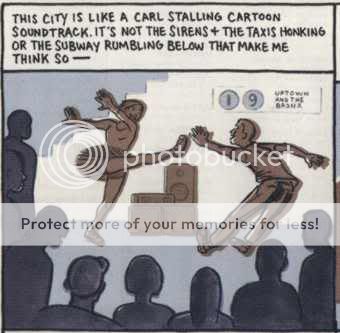
* I enjoyed the latest installment of the Cool Kids Table’s Our Comics Decade series, 2008. Planetes, Casper, Secret Invasion, more.
* Jeet Heer makes the case for the greatness of Gahan Wilson. That seems worth doing to me. I can’t be the only person who sees that huge two-book set sitting on the shelf and thinks “Hey, Wilson’s cool and everything, but is this something I need?”
* What do scientists think aliens will look like when we meet them? (Via Thoreau.)
Comics Time: One Model Nation
January 25, 2010
One Model Nation
C. Albritton Taylor, Donovan Leitch, writers
Jim Rugg, Cary Porter, artists
Image, December 2009
144 pages
$17.99

Well, here’s a strange little number. Let’s take it step by step. C. Albritton Taylor is Courtney Taylor-Taylor, lead singer/songwriter for the Dandy Warhols, but the only reason I know that is because artist Jim Rugg said so on his blog months and months ago. Donovan Leitch, scion of “Atlantis” troubadour Donovan and a musician himself, is credited as the book’s “historian” and shares with Taylor the credit for “original concept,” which I assume means he helped concoct the Venn diagram of its plot, in which late-’70s radical West German politics and terrorists overlap with a breed of Cold War art rock, highlighting a very, very specific niche. Rugg’s work here looks nothing like Rugg’s work anywhere else I’ve seen; it’s like he purposefully threw his usual slick and kinetic art out the window, employing a rough, thin, uncertain pen style instead. Riding shotgun for a few-page framing device is artist Cary Porter, working in a mushy all-pencils style that reminds me of Nikolai Maslov’s Siberia. Taylor is billed as “producer” along with Image’s Joe Keatinge and cartoonist Mike Allred; if the incongruously colorful David Bowie who shows up in the middle of the story to chat with the titular band isn’t drawn by Allred himself, then Rugg is doing the world’s best Red Rocket 7 impersonation.
The story: In 1977 or thereabouts, a four-man band called One Model Nation–from what we can gather, a stylistic, sonic, and sartorial melange of Kraftwerk, Einsturzende Neubaten, Joy Division, Gang of Four, and Berlin-era Bowie–appear poised to become West Germany’s, and perhaps the world’s, next big thing. But the peril of being the voice of one’s generation is that sometimes one’s generation is filled with terrorists, as was the case in the Germany of the day, plagued as it was by the nihilistic/Communistic violence of the Red Army Faction, aka the Baader-Meinhof Gang. When people peripheral to OMN’s world–friends, fans, exes, roadies–turn out to be involved in the killings, the intense public, political, and police scrutiny forces the bandmates, particularly sensitive Sebastian, to come to terms with the at-times dueling imperatives of fame and creativity.
It’s tough not to read the book as thinly veiled autobio at times, or at least as a soapbox upon which Taylor can talk about issues he clearly cares about a great deal. It’s easy to imagine the framing conversation between a fellow-traveler of OMN’s and a documentarian investigating their disappearance as a variant of ones that took place between Taylor and Ondi Timonder, director of the excellent Dandy Warhols/Brian Jonestown Massacre doc DiG! Ditto the band’s chat with Bowie–a friend of Taylor’s–and his droll observations about taste, art, and politics. Ditto, almost didactically so, a comparatively long discussion of critics, pundits, the press, and their deficiencies. The very idea of the book, a fictionalized account of a particular era of rock and roll that its makers find fascinating, reminds me of a discussion I had with Taylor when I interviewed him long ago about the film Velvet Goldmine, which, despite his admiration for director Todd Haynes, he dismissed as “jocks dressing up like rockers.” This is sort of like Velvet Goldmine “done right.”
And it is done right, I’d say. I mean, it’s a weird weird beast. I think Rugg’s style here is going to throw a lot of people–it’s so understated, so scratchy, with muted colors, and a really rigid panel grid with wide gutters. The rectangular word balloons and computerized lettering meshes with those big white lines to create a feeling of artificiality and distance. The character designs are at times difficult to distinguish from one another, and they frequently sit on the page as if they’re uncomfortable being there, all awkward elbowy arms and long faces with dull hair hanging limply. The plot kind of weaves in and out and back and forth: Sebastian leaves the band, fed up with the attendant nonsense, comes back, high-tails it after a raid, comes back again… Cameos by the Red Army Faction and the actual, Russian Red Army are given equal weight as cameos by, say, Klaus Nomi. The whole thing ends with a whimper, too. There really aren’t any epiphanies or climaxes. I imagine that if you don’t share my fondness for the creative team or the subject matter, you’ll walk away shrugging.
But I think that’s the idea. Making art, the book seems to argue, is an ongoing process of decision-making rather than a vocation handed down by the gods. Obviously innate gifts and talent are a part of it, but hitting upon the sound and style that rockets you to the top is the product of countless factors beyond your control. A lot goes into being a hero, and if you make it, terrific, but some people are heroes just for one day, for one reason or another. Nomi died of AIDS; One Model Nation peters out in the face of the revelation that the terroristic public image thrust upon them was just that–an image. They make a decision to stop making the decisions necessary to be rock stars. Some of it’s in our control; a lot of it isn’t. What you do may be dramatic, it may be influenced by dramatic events, but whether you do it or not is not a drama. It’s kind of a gray message. It’s kind of a gray book. I’m still mulling it over.
Carnival of souls
January 22, 2010* B.P.R.D. was the best ongoing superhero comic of the 2000s, and hey, the teens are young yet but the bar’s pretty high. With that in mind here are two terrific B.P.R.D.-related links: a great Tucker Stone review that makes the case that the book is the best there is at what serialized super-person storytelling is supposed to do, and an interview with artist Guy Davis focusing on his stunning, troubling monster designs. The art selected for both is out of control, too. (Via Dirk Deppey and Aeron Alfrey.)

* Recently on Robot 6: Conan O’Brien does Chris Ware, a billion artists submit cool pieces for charity, and Brendan McCarthy shows his stuff.
* The House Next Door has a new address! It’s now attached to Slant Magazine.
* Skimming Tom Spurgeon’s review of James Sturm’s Market Day makes it seem mightily depressing, which means I’ll have to read it.
* Wow, I guess I need to go see Hausu.

* Jonah Weiland, you wily man–what a great idea to interview the guy who drew that “I’M WITH COCO” image.
* Yep, that’s pretty much how I figured Theo Ellsworth spent his spare time.
* Chris Sims inflicts Jeph Loeb’s Ultimatum upon himself.
* 26 G.I. Joe Codenames That Are Almost Certainly Sexual Euphemisms. I laughed harder than I probably ought’ve. Tunnel Rat, man. Backblast!
* That of course reminded me of the greatest David Letterman Top 10 List of all time, Top 10 Body Parts and/or Van Pattens. Oh man, get ready to waste some time and laugh your ass off at that link. Top 10 Words That Almost Rhyme with ‘Peas,’ man.
* I’d like to leave you for the weekend with this video of Leighton Meester lounging around in her underwear. The reason I like it–well, the other reason–is that the video uses the song “Clean Coloured Wire” by Engineers, which you might have spotted in my Best of 2009 mixes below. The song is based on a sample of a song called “Watussi” by the Krautrock-ambient supergroup Harmonia, the vocal melody is a snatch of “Come In Alone” by shoegaze titans My Bloody Valentine, and the vocals are delivered with the prime blissed-out head-music style of the really good early Dandy Warhols albums or something like that. It’s music of epic, sexy mystery. So using it as a soundtrack to watching Leighton Meester strut around in lingerie makes seeing Leighton Meester strut around in lingerie seem like the most awesome thing ever, akin to, I don’t know, entering the Stargate or discovering a hidden city of extradimensional gods on the Moon. If this is the song that comes to mind when people picture you in your underwear, you’re in pretty good shape.
Comics Time: Crossing the Empty Quarter and Other Stories
January 22, 2010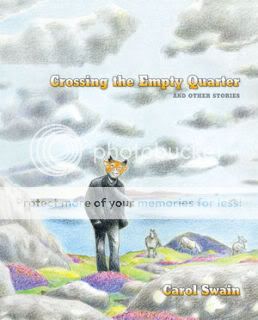
Crossing the Empty Quarter and Other Stories
Carol Swain, writer/artist
Dark Horse, December 2009
200 pages, hardcover
$24.95

Carol Swain’s panels are like prisons. They feel too narrow, too cramped for her dramatic angles, her furiously filled-in blacks and grays, her askew, sometimes even fish-eyed perspective, and her disorienting character close-ups. Thus they root you in this moment, then this one, then this one, force you to confront it head-on–often literally, bringing you right up against the face of the protagonist in each of this anthology’s thirty-plus short stories. Which is fitting, since they too are often rooted or even trapped themselves. Some are hemmed in by the metaphysical constructs of Swain’s daydreams or gentle magic-realist conceits–immovably knee-deep in the mud of the Atlantic, chained in the bedroom by overprotective parents who alternately rattle off the dangers of the outside world and the many knitting projects she could do inside, sealed in the black glass of fused sand created by a bomb blast in the desert, trapped in the middle of nowhere by faulty compasses and starless skies. Others are stuck in more quotidian predicaments–an immigrant’s plight, soft vote suppression, lots and lots of dead-end towns, lots and lots of dull grinding urban grayness, lots and lots of glimpses of a larger world that seem only to reinforce the futility of reaching further and higher. And yet, there’s always that lovely, lush shading and linework, a hint of softness, and with it a suggestion that maybe there’s reason to hope. I think that makes the book harder on you, ultimately. In hopelessness there’s release.
Seanmix | Best of 2009
January 21, 2010It’s been a while since I’ve posted a mix, and today I finally got off the pot and put together this little three-volume collection of my favorite songs of the year that was. No trail-blazing, no ground-breaking, just a bunch of songs I really enjoyed from 2009. I hope you like them too! If you do, buy the relevant artist’s record, please. Not a clunker in the bunch.
Music Again – Adam Lambert || Cannibal Resource – Dirty Projectors || Dominos – The Big Pink || Bricks and Mortar – Editors || Hold Out – Washed Out || My Wife, Lost in the Wild – Beirut || Another World – Antony & the Johnsons || What Would I Want? Sky – Animal Collective || Marrow – St. Vincent || Two Weeks – Grizzly Bear || All the King’s Men – Wild Beasts || Yesterday & Today – The Field || Take Me Baby (feat. Jimi Tenor) – GusGus || Ashes Grammar/Ashes Maths – A Sunny Day in Glasgow || Remorse Code – Richard Hawley || Travelling Woman – Bat for Lashes
Bay of Pigs – Destroyer || My Girls – Animal Collective || When I Grow Up – Fever Ray || Feather – Little Dragon || Siren Song – Bat for Lashes || Bad Romance – Lady GaGa || Talk to Me – Peaches || Happy House – The Juan MacLean || The More That I Do – The Field || Lion in a Coma – Animal Collective || While You Wait for the Others (feat. Michael McDonald) – Grizzly Bear || Coconut – Fever Ray
Glass – Bat for Lashes || A/B Machines – Sleigh Bells || Mommy Complex – Peaches || Summertime Clothes – Animal Collective || This Must Be the Place – Miles Fisher || Feel It All Around – Washed Out || Kingdom of Rust – Doves || For Your Lover Give Some Time – Richard Hawley || Stay – Ghostface Killah || Ring Ring – Sleigh Bells || Clean Coloured Wire – Engineers || Useful Chamber – Dirty Projectors || Blinking Pigs – Little Dragon || Fine for Now – Grizzly Bear || Miss My Friends/Starting at a Disadvantage – A Sunny Day in Glasgow || Aeon – Antony & the Johnsons || Chase the Tear – Portishead
Carnival of souls
January 20, 2010* Benjamin Marra’s Night Business #3: On Sale Now!
* Jesus, Jordan Crane, Sammy Harkham, and Ted May’s site has added Steven Weissman and will soon add John Porcellino, Gabrielle Bell, John Pham, and Ben Jones? Holla holla, it’s murdaaaa.
* CRwM on Paranormal Activity. Sit back, relax, enjoy.
* AMC has green lit the pilot episode of The Walking Dead. High hopes for this one.
* Zack Soto has a blog and he’s naming his favorite comics of 2009 on it.
* Lost time is almost upon us, and with that in mind I got a lot out of this interview with Damon Lindelof and Carlton Cuse and this interview with Michael Emerson. The former is sort of a collation of everything they’ve said about the general theory of ending a show–discussion of the Battlestar Galactica and Sopranos conclusions abounds, as does what constitutes a mystery and what constitutes an answer. This bit was particularly welcome as it echoes what I’ve been saying for a long time now regarding developing theories about what’s going on:
But I think the sci-fi distinction you make is an interesting one because, when you talk about the “Sopranos” ending or the last episode of “Seinfeld” or “Friends,” there’s only so many iterations of what can happen. The “Sopranos,” the only thing that people were talking about is, “Is Tony going to live, or is somebody going to kill him?”
With “Lost,” nobody can even guess what the ending is going to be. If you were to have a contest right now saying, “In one paragraph, summarize what you think the last episode of ‘Lost’ might be” — if you say it to 100 people, you will get 100 paragraphs that have nothing to do with each other.
The Emerson interview breaks a whole bunch of news, or at least to me it does. SPOILER ALERT OF THE ‘WHO’S COMING BACK AND WHO’S NOT’ VARIETY: Michael and Libby will be back, Annie won’t (at least as far into the season as Emerson has gotten). END SPOILERS And this struck me as mighty promising:
I feel great curiosity, because from what I’ve shot up to this point, I don’t see any end in sight. The storyline is continuing to expand instead of contract. It’s grown more fragmented, rather than becoming more unified. The threads aren’t joining up, they’re flying away. It will be dazzling to see. Certain big mysteries on this show are being answered. Every episode, something huge is falling into place, but it’s still a mystery.
Goodness gracious! (Links via Whitney Matheson.)
A man, a Plan, a canal, Adama
January 20, 2010So the Battlestar Galactica prequel series Caprica debuts this Friday night. Sort of: They did that weird SciFi/Syfy double-dip where they released the “uncut” pilot on DVD first and show it on TV months later. That’s what they did for the stand-alone BSG movie Razor (I think; it’s possible they premiered around the same time), and that’s what they did for the show’s movie-length epilogue, The Plan. But I guess my TiVo didn’t recognize it as part of my Battlestar season pass, because I have no idea when it actually aired. It was only hearing that Caprica was finally ready to blow that made me watch my DVD copy in the first place.
Given my level of Battlestar Galactica fandom generally and my enthusiasm for its extremely divisive ending particularly, that’s kind of weird, right? But maybe it’s not. I was deeply satisfied by the BSG finale–like, almost spiritually satisfied by it. It was a take on apocalypse and cultural extinction I’d never seen before–a people sacrificing their nominal legacy in hopes that a true legacy of peace, free from the sins of the past, might someday be inherited by their unknowable descendants. Also, Starbuck was an angel. You can check io9 or Tor.com for the vitriolic C.W. on these developments; I loved them, was powerfully moved and shaken by them. The idea of watching a new episode of Battlestar after that, no matter how many “answers” it promised to provide, was just…anticlimactic.
To their credit, writer Jane Espenson and director (and supporting player) Edward James Olmos seem to realize that. The Plan isn’t the fill-in-the-blanks everything-you-know-is-wrong blockbuster I had vaguely in mind. You might even see it as a bill of goods. Turns out the only “plan” the whole “and they have a plan” bit was referring to was just “they would like to kill all the humans.” Um, surprise?
What you do find out that you didn’t know before is that the Brother Cavil who lived in the fleet, the one to whom the Chief came when he thought he might be a Cylon way back when, was orchestrating the fleet-based Cylons’ various attempts at murder and mayhem. So you see how Boomer got her instructions when she was a sleeper agent–it wasn’t internal programming, it was orders she received from Cavil, who then put her back under to fulfill her missions. You find out how Leoben became obsessed with Starbuck. You find out where that phony Defense Department Six came from when she tried to frame Baltar for the crime he actually committed, and where she went afterwards. (I think she was airlocked.) You find out why the Five who suicide-bombed himself did it. You get some back-up for the way multiple copies of the same Cylon roamed around the fleet without getting caught, and why. You find out who Caprica Six was meeting on Caprica before the attack, and you find out that yes, it was Baltar who passed Adama the note about the 12 Cylon models.
In addition, there are some comic-book-tie-in-style new storylines introduced. There’s a Four in the fleet, and he has a human family he doesn’t want to destroy; there’s a Four in Anders’s little group of survivors back on Caprica, too, and by contrast he wants that group’s Cavil to pull his thumb out and get to murdering. And the two Cavils come to very different conclusions about the Cylons’ attempted extermination of man, which is sort of the philosophical crux of the episode. (It’s hard not to call it that.) These are welcome developments in that Dean Stockwell becomes the star of the show, while Rick Worthy, always the most underused of the Cylon actors, finally gets a chance to do something with his sinister warmth. But again, none of it gives you the “a-HA, so THAT’S what was going on!” feeling you might have expected.
And so. We can question the wisdom of prefacing every episode of your show by referring to a Plan but never, in fact, having one, and then not even bothering to make it up in time for the finale, so that you have to create an almost anthology-style appendix to the show and air it months after the fact. Moreover, you can question the weirdness of the execution of that enterprise. In the opening credits there’s a line about how the film is “based on the series Battlestar Galactica created by Ronald D. Moore” or something like that, as if it’s not even technically a piece of the series. Moore isn’t the only MIA figure, either–try half the cast. Apollo, Starbuck, and Baltar appear only in repackaged footage from the original episodes. Despite the movie being about the Cylons, Lucy Lawless’s D’Anna has approximately three seconds of flashback screentime. Most bizarrely, Mary McDonnell’s President Roslin doesn’t appear on-screen at all; in an unintentionally hilarious bit at the very end, you see the legs, and only the legs, of a character I assume is supposed to be Roslin descending a ladder. Roslin’s absence also makes it next to impossible for there to be much Tory material in the movie–her involvement amounts to crashing her car when the bombs hit, getting rescued, and then walking down that ladder. Finally, because this was a straight-to-DVD release, there’s a bunch of entirely gratuitous nudity. (And no, not from anyone you’d already decided you wanted to see naked.) It’s a weird project, in other words, and the seams of its production show.
But here as always, for me, Battlestar Galactica is all about the delivery. Not the mythology or the mysteries, which were all kind of a convoluted, contradictory mess when all was said and done (this ain’t an Alan Moore comic, it’s not even Lost), but exploration and observation, through writing and acting, of how individuals and societies deal with catastrophe. And on that score, The Plan came through. It’s essentially a big ol’ tone poem about murder and suicide. Character after character comes to the point where they must kill, and then they do or they don’t, and we see what that does to them. That’s pretty much it in a nutshell, and to say it’s down my alley is to understate the case considerably. I mean, find me a Blue Velvet fan who doesn’t want to watch a movie in which Dean Stockwell orchestrates a series of cold-blooded murders, culminating in a particularly ugly and taboo one he commits himself.
Aside from some clunky theological dialogues between Anders and Cavil, Espenson mostly stays out of the way of these parameters. Given that her last episode was nearly series–ruining in its awfulness, her redemption arc is perhaps The Plan‘s standout. Meanwhile, Olmos, who established himself as one of the series’ finest directors with the episode in which Baltar was tortured, acquits himself equally admirably here. He lets silence and image do the talking a lot of the time–following nuclear payloads to their destination, following mushroom clouds into the sky, following battlestars as they drift and burn, following airlocked bodies as they freeze and float, following bodies as they fall.
It’s in this way that The Plan dodges the knockout punch thrown by the series finale proper. (Actually, I think you could comfortably stick it within the finale–pop the DVD out after the climactic shootout and the final jump; watch The Plan; put the finale back in and finish it up.) If “Daybreak” was about human and Cylon abandoning their horrific legacy, The Plan IS that horrific legacy. A gutsy choice, leaving that as the final taste in our mouth…and yet it tastes delicious.
Comics Time: Detective Comics #854-860
January 20, 2010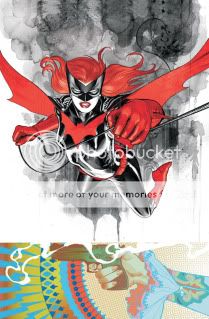
Detective Comics #854-860
Greg Rucka, writer
J.H. Williams III, artist
DC, 2009-2010
24 story pages each
$3.99 each
I’ll admit it, I was too hard on Detective Comics. I always understood, and agreed with, every word of praise offered for J.H. Williams III’s almost comically proficient art, mind you. You don’t need me to go over that, Jog handled it nicely. It’s just that beyond the art…well, I didn’t think there was anything beyond the art.
Maybe it’s that Question back-up that threw me, with the erstwhile Renee Montoya adopting the exact same crimefighting set-up as the lead feature’s star, i.e. beautiful lesbian with military and/or law-enforcement training adopts the mantle of a male superhero while her old-man sidekick sits at a computer back at HQ. And it’s not exactly as if either of them are the only strong-women-also-cry tough gals Rucka’s ever written. Meanwhile, some past Rucka plot points I never really got into come along for the ride, most prominently the convoluted Religion of Crime and its Batwoman-obsessed prophecies. I liked that idea when it was tied directly into Darkseid–the more other stuff that it hooked up with, from Vandal Savage to some old Rucka characters to the actual Bible, the less compelling I found it.
On a more fundamental level I think I’m just a lot less interested in superhero comics as fed through the filter of writers who’ve read, watched, and written a lot of spy and crime fiction over the past decade. What was once a thrilling deviation–seriously, The Ultimates, Sleeper, Gotham Central and the Daredevil/Alias/Powers trifecta blew my mind once upon a time–is now the default. Over at Marvel you’re seeing, or you will be seeing, I think, that noir/black-ops framework give way to a bold new era defined by loosey-goosier writers like Matt Fraction and Jonathan Hickman; Ed Brubaker’s given a pass because that really is the perfect place for a postmillennial Captain America to be. At DC, that kind of stuff doesn’t interest the main moneymakers and ship-steerers, Geoff Johns and Grant Morrison, in the slightest. And though I’m far less militant (heh) about this point than other readers I know, there’s always the suspicion that shoehorning superheroes and their fantastical fiction into exciting but reality-based counterpart activities like law enforcement and espionage and organized crime is a way to strip them of the weirdness and wonder even the worst of them usually contain–to polish them up even while darkening them up, to smooth out the angles and make them action-franchise-friendly. So for all those reasons there’s a degree to which I’ve had my fill of books in which characters nonchalantly drop military argot in conversation and suchlike, and thus I’m a tough nut for Rucka’s writing in ‘Tec to crack.
But after taking the opportunity to read all seven issues of the “Batwoman in Detective Comics” run, I’ve realized just how far short I was selling it. Is the story a game-changer, a brain-melter? No. But it’s a good deal wilder and weirder and, yes, more wondrous than your average spandex-turned-kevlar effort. And shame on me for not seeing how Williams’s art, far from an Avatar-style silk hat on a pig, draws on and enhances Rucka’s strongest stuff while muting the weaker elements. Simply put, how did I miss how very Hot Topic the whole “pale redheaded lesbian dresses up like an S&M vampire and does battle with her pale loligoth Satan-worshipping evil twin sister who dresses like Alice in Wonderland” thing is? It’s a very glam, very goth, very fetishy, very fun set-up, hammered home with Williams’s dark psychedelia, polymorphous mimickry (that extended Mazzucchelli impersonation is really breathtaking) and (you don’t hear much about this, but for real) dazzling good-girl art.
What’s more, this is actually some of my favorite Rucka writing I’ve come across. You know how most superheroes have a two-stage origin? Batman’s parents are killed, and the bat flies through his window; Spider-Man gets bitten by the spider, and his Uncle gets killed; Superman’s home planet blows up, and he’s raised in all-American fashion by his kindly adoptive parents? Batwoman’s mother and sister are killed, and then she gets Don’t Ask Don’t Tell’d out of the military. She’s not just gay–homophobia is a foundational trauma for her. I love it. I also really like the air of doomed glamour, to use a favorite phrase of mine of late, with which Rucka imbues the whole affair. Batwoman’s bright-red trimmings seem like war paint she puts on to power past the sense that this was all a terrible, terrible idea. Rucka knows the power of pointed silences and fade-outs, all of which are painstakingly choreographed by Williams, using disembodied panel boxes to pinpoint moments in the comics equivalent of slow motion. When we suddenly see Alice’s tear-streaked mascara emphasized during her fight with Batwoman’s father, when Alice falls across the top and down the right hand side of a climactic spread with a great gulf of ocean mutely occupying the rest of the pages–it means something. I can already hear the Moore-derived derision that none of this has any echo in any one’s real life, but even if that’s true, who cares? It’s violent, it’s sexy, it’s spectacular–just what I want from my superhero comics.
Carnival of souls
January 19, 2010* It’s been brought to my attention that some people may doubt my sincerity when I sing the praises of Tom Brevoort’s blog and/or Twitter feed–from which I mined the content in this Robot 6 piece on the Marvel/DC rivalry. Let me assure you that I’m serious as a heart attack. It’s not that I agree with everything he says, or that I don’t realize that it’s at least in part showmanship–it’s that I wish every other bigwig in the biz came out and said what they were thinking. We’d be healthier.
* Speaking of said rivalry, here’s Kiel Phegley on Marvel’s provocative Siege/Blackest Night comic-swap offer.
* Here’s Jog on last week’s comics. It starts with the sentence “This is a VERY GOOD Image comic about orcs and stealing and penises and conquest” and gets better from there.
* Here’s David Welsh on Natsume Ono, author of the very promising-looking not simple.
* Here’s Jim Henley on how Gary Gygax and Dave Arneson are, and aren’t, like Stan Lee and Jack Kirby or Paul McCartney and John Lennon. Actually, it’s also about how Lee/Kirby and McCartney/Lennon themselves aren’t like Lee/Kirby and McCartney/Lennon.
* Here’s Jeet Heer on the paradox of James Cameron’s Avatar. Speaking of, I know it was very nice-looking, but I’m trying to figure out why the hell it won the Golden Globe for Best Picture, and in fact why it was even nominated versus, say, District 9 or Paranormal Activity, and the only answer I can come up with is that Hollywood wants to canonize absurdly expensive filmmaking that makes an even more absurd shitload of money in turn. If this thing had flopped as hard as people thought it would–as hard as I thought it would–heads would have rolled in the dozens. (Well, in theory; accountability is so not hot right now.) It was structurally important to the American film industry for this movie to be hugely popular with audiences and critics.
* They hired a guy who makes Saw movies to do the Paranormal Activity sequel. You can’t make that up.
* Jeepers, that’s a gawjuss Dough Mahnke cover for Green Lantern #53. Click the link for the full-sized image.
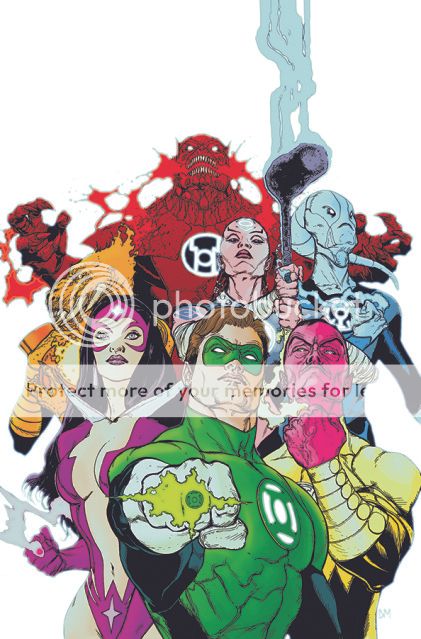
* I can’t even imagine spiking a finished comic. I’m too precious about my own work and too un-prolific to spare one.
* I thought this Onion News Network piece on Lost fandom could have gotten a lot more vicious than it did, but it’s the appearance of Damon Lindelof and Carlton Cuse toward the end that tipped the scales in its favor. They kid because they love!
Carnival of souls
January 18, 2010* In this interview at Robot 6, Sean Murphy, artist of the upcoming Grant Morrison series Joe the Barbarian, has just inducted himself into the Tom Brevoort Candor Hall of Fame.
* Chris Butcher rains on Orson Scott Card and Alan Moore, albeit to different degrees and for very different reasons.
* Real Life Horror: We straight-up murdered three guys in Guantanamo Bay.

* Today on Robot 6: Tons and tons and tons of cool comics by Winsor McKay (via), Johnny Ryan, Conor Stechschulte, and Benjamin Marra.

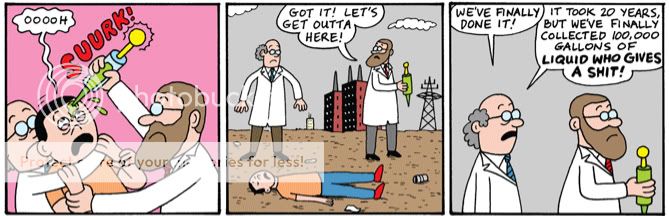

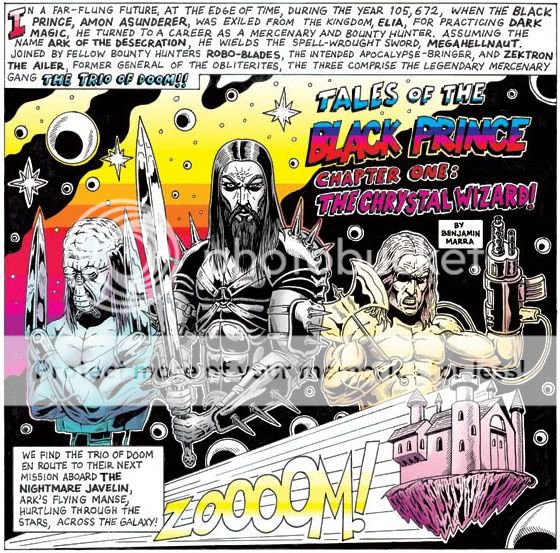
Cage Variations
January 18, 2010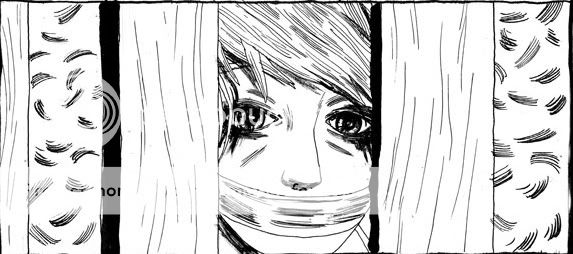
Over at Matt Rota’s site you can read “We Had No Idea,” our latest comic together. I hope you enjoy it!
Comics Time: Forming
January 18, 2010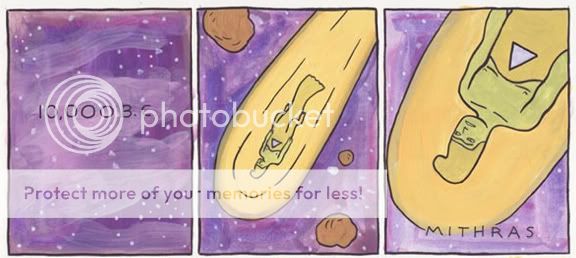
Forming
Jesse Moynihan, writer/artist
ongoing webcomic, January 2009-January 2010 (and counting)
I was pretty happy with the high concept I came up with for Afrodisiac, so let’s try it again: What if the stars of Anders Nilsen’s Big Questions were the Big Answers? Like Nilsen’s funny-animal epic, Forming tells the tale of characters struggling with the stuff of existence–life, death, fate, their place in a universe that appears fundamentally capricious. Unlike Nilsen’s birds, though, Moynihan’s characters are archangels, cosmically powered alien beings, demigods and titans of legend, founding members of humanity who commune (and copulate) with higher beings on a daily basis. The metaphor scales our human plight up, not down, in other words. The art follows suit. Moynihan’s line is soft, its weight gently fluctuating, shored up by quietly irregular coloring, suggesting the same vulnerabilities as Nilsen’s stippling and figurework. But the design is maximalist: Crazy Kirbyesque costumes, Fletcher Hanks psychedelic action, long sequences of physical combat, extradimensional travel, mental fantasias. The stakes are similarly higher–the central action includes Lucifer’s battle with Michael and the birth of human civilization as conferred upon us by ancient astronauts. The gag, of course, is that these highfalutin’ types are just as messed up as we are, complaining about their jobs and their family and their sex lives and so on.
So yeah, you’ve seen it before. But what makes its use in Forming so appealing is the strip’s rolling, loping, laconic pace. New subplots–a literal clash of the titans, Lucifer & Michael, Adam & Eve, corporate intrigue on the alien homeworld–are slowly folded into the strip, and our lens on the action swings back and forth between them like a pendulum. Moreover, most of the strip’s two-page installments are stacked on top of each other, our eyes slowly cascading downward as the action unfolds over a long vertical plane. The cumulative effect does even more than the specifics of the dialogue in terms of humanizing the cosmic characters and wringing bleak gallows humor from their dilemmas. If this thing ever gets collected in print, I’d love to see it in a super-tall, super-narrow format just for that reason. It’s a very pleasurable reading experience, and it’s easy to see how rewarding a weekly visit could be.
Carnival of souls
January 15, 2010* Today at Robot 6: Tom Brevoort, the Lord Emperor of Twitter, talks about the Siege/Blackest Night trade-in offer and Neil Gaiman’s Marvelman plans.
* Brendan McCarthy’s Spider-Man: Fever arrives this April. GLO-FI AS FUCK
* I only skimmed it since I haven’t seen the movie yet, but CRwM’s piece on Park Chan-wook’s vampire film Thirst takes some provocative shots at the horror blogosphere. Sample quote:
This is why the general mediocrity of the Great Zombie Revival is actually the key to its success: A subgenre that reinvents itself in mind-blowing ways every two or three films is going to exhaust the mental bandwidth of its audience as well as sow some discord among people who latch on some particular configuration of the genre elements and decide to become purists. But a certain pandering familiarity, spiced with only slight hints of novelty, neither taxes your audience nor risks alienating them.
I skipped Thirst because I thought it was directed by the guy who did The Host, which was a piece of shit, so that’s my bad.
* Matthias Wivel, Tucker Stone, and Noah Berlatsky explain their choices for the Best Online Comics Criticism of 2009. I recommend Matthias’s and Tucker’s posts, but not Noah’s, since he thinks Ganges is boring.
Comics Time: What Had Happened Was…
January 15, 2010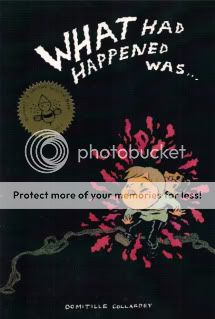
What Had Happened Was…
Domitille Collardey, writer/artist
Weeping Willow, 2009
20 pages
$6
Buy it from Domatille Collardey
You could rough this one up pretty bad if you wanted–like Jog says, it’s an alternative comic of the “here’s some stuff that happened” school that people who dislike alternative comics think all alternative comics attend. Collardey’s stories–actually, that’s too strong a word–reminiscences about her move to Brooklyn, her visit to San Francisco, her interview with Francoise Mouly, her conversation with her Holocaust-survivor grandfather, even her very life story aren’t revelatory, or (with one obvious aforementioned exception) even memorable on their own terms. What they are is a showcase for her art, and she’s got some serious chops. I’m really drawn to her wavy line, the way a series of gentle S-curves both cohere into little people and convey the timidity and uncertainty with which Collardey apparently approaches the world. Against that backdrop her depiction of Mouly really pops: Bigger eyes rimmed with make-up, darker hair, taller body, confidence and competence standing out amid Collardey’s gee-shucks artistic personality. Equally impressive are color sequences that employ brown and gray watercolors to convey warmth rather than desolation or “realism,” most notably in a self-portait that strikes me as both clear-eyed and flattering–which is then surrounded by a colorful panoply of cartoon heads. The paper stock really holds Collardey’s brushwork and colors well, by the way. As a sampler of an artist with a lot of potential, it’s worth a glimpse. Let’s see where she goes from here.
Carnival of souls
January 14, 2010* Dannie Flesher, cofounder of Wax Trax! Records, has died at age 58. I really would not be the same without him. When I was a teenager, the industrial aesthetic pioneered by Flesher, his partner Jim Nash, and Wax Trax! acts like Ministry, KMFDM, and their myriad side projects defined “cool” for me in a way that still holds true for me today. Trent Reznor and Al Jourgensen joining forces to cover Black Sabbath with 1000 Homo DJs’ “Supernaut” is pretty much the most amazing thing a 16-year-old Sean could imagine. Any day I’m dressed all in black, which is usually three or four days a week, you pretty much have them to thank. Today I’m still impressed by just how committed Wax Trax! bands were to their sound and style. There’s a totality to their encapsulation of deviance and decay that’s still chilling, and extremely edgy and ballsy even now. Plus, a vintage Ministry side project is a joy forever–I listened to the Revolting Cocks Beers Steers & Queers just this morning, not knowing what had happened, and it’s still a death-disco hoot. Thank you, Dannie. I hope wherever you are now, Jim’s there with you.
* Today on Robot 6: Buy Prison Pit pages and check out the Best of 2009 comics meta-list, plus a quick thought from me on same.
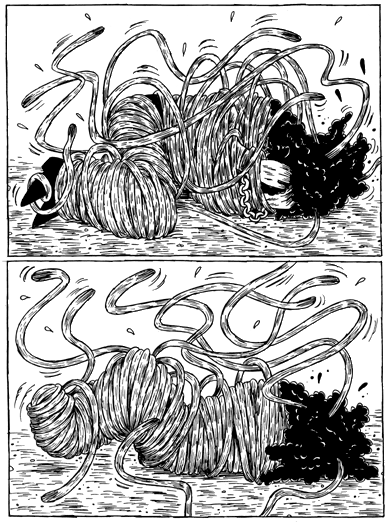
* Hey, new Paul Hornschemeier Forlorn Funnies? How about that!
* Jesse Reese of Are You a Serious Comic Book Reader? tackles Mike Mignola and Richard Corben’s Hellboy: Bride of Hell. The Hellboy books proper spent some time in the wilderness, but I think with The Wild Hunt and Bride of Hell, they’ve been duly and deftly brought in line with what makes B.P.R.D. so compelling: Their heroism ultimately futile, our heroes fail.
* Viz has some cool-looking comics coming out soon.
* Here’s a list of the bestselling graphic novels at my LCS, the great Jim Hanley’s Universe, in 2009. Superhero-heavy, but which superhero titles we’re talking about is kind of surprising.
* Benjamin A. Shobert of Asia Times waxes philosophical about the Red Dawn remake, in which Red China is apparently the heavy. (Via CRwM.)

* Clive Barker is making some fucked-up Halloween costumes.

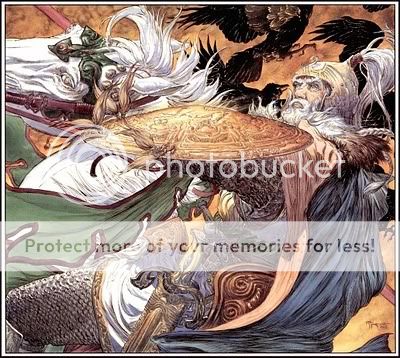
* Thanks to Tom Spurgeon for directing me to Michael Wm. Kaluta’s J.R.R. Tolkien calendar and a terrifically choreographed Buz Sawyer chase sequence. Next time you just wanna take your superheroes and have ’em fly around shooting shit at each other, please take a look at this and think again!


Carnival of souls
January 13, 2010* Hey, it’s a new comic I wrote! Well, it’s actually not new, but it may be new to you and it’s certainly new to the Top Shelf 2.0 site. It’s “Pornography,” a non-pornographic comic written by me and drawn by the great Matt Wiegle. I hope you enjoy it.
* The League of Tana Tea Drinkers horror-blog collective is tackling horror comics. Click the link for further linkage.
* Poe-etic creepiness from Mr. Noel Freibert.
* Solid observation by Tom Spurgeon regarding the December 2009 Direct Market sales charts:
I personally think it worrisome that there’s a drift downwards in books that sell over 50,000 copies, which would seem to support a theory — or late-night, drunken blurting-out, as you will — that a lot of effort is necessary to push certain comics into respectable sales territory and that maybe nothing is being done or can be done for the bulk of them. The comic book middle class is rotting away, in other words. One might suggest that the more poignant outcome of “event fatigue” isn’t that people are going to get tired of events eventually (even though they likely will), but that people are only excited by events now and fatigued by everything else as a result.
* Curt Purcell kicks off a series on Final Crisis by labeling its use of Modernist techniques self-defeating–an anti-story movement welded to a celebration of stories and storytelling. There’s a lot to disagree with here, from the characterization of Morrison to the characterization of Modernism, but I wanna see where we’re headed first.
* The latest What The–?! video is a parody of Dark Reign. The stuff I didn’t write made me laugh.