
Author Archive
Comics Time: S.H.I.E.L.D. #1
April 7, 2010
S.H.I.E.L.D. #1
Jonathan Hickman, writer/artist
Dustin Weaver, artist
Marvel, April 2010
36 story pages
$3.99
Supremely confident superhero comics-making from Jonathan Hickman here. In fact I’d say there hasn’t been a debut issue this sure of itself, this willing simply to throw its audience headlong into what the writer has cooked up, since the Nu-Marvel golden age of Morrison & Quitely’s New X-Men, Bendis & Maleev’s Daredevil, and Milligan & Allred’s X-Force. Who knows where it’ll all end up, who knows if it’ll hold up or make sense or not be really stupid or something. But within the context of these 34 pages of comics and two pages of Hickman designiness, I found it extraordinarily invigorating.
S.H.I.E.L.D. purports to tell the secret history of a Marvel Universe (I’m not comfortable using the definite article for reasons that will become apparent), in which a blend of fantistorical figures like the Pharaoh Imhotep and actual real-world Great Men like da Vinci and Galileo have banded together over the centuries in an ancient secret society called the Shield (I’m not comfortable using the acronym for reasons that are a little nebulous at this point). The Shield has quietly protect the world from assorted apocalyptic threats familiar to us from Marvel’s outer-space material, including Galactus, a Celestial, the Brood, and (I think) the Phoenix. You are perhaps at this point tuning out: Secret histories and secret societies and super-awesome science heroes who protect us both from threats and knowledge of those threats are obviously a pretty shopworn concept at this point, and the influence of Hickman’s mad-idea-mongering predecessors Grant Morrison and Warren Ellis is unmistakable.
But it’s not the size of the boat, it’s the motion of the ocean, and Hickman and artist Dustin Weaver keep things moving at breakneck speed. You get a grand total of one page to ease into the action, with main character Leonid slowly and silently walking toward the viewer, and then BOOM, he’s whisked off by a pair of suited agents in a sweet ’50s car, he’s revealing that his body is made of stars or something, he’s flown to Rome and shown a gigantic underground city–by page four. Most comics today might get that far by issue four. I’m not one to complain about decompression, or at least I didn’t used to be, but obviously the technique has gotten so common as to become predictable; most anyone who’s read enough superhero comics could write a new series’ first story arc in their sleep, knowing exactly where each beat would fall. With Kirkman and S.H.I.E.L.D., I’m kept dancing to a different beat, one where world-ending threats are introduced and thwarted in the space of two to three pages, only for a jump of centuries to bring us to the next one; where a character learns his great destiny and then a three year lacuna reveals him stuck in place, bored and staring at the ceiling; where villains are introduced for the very first time anywhere as if we have the same lengthy history with them that the characters do; where names of great import to Marvel fans are dropped in, precisely calibrated to do that whole “everything you thought you knew was wrong” thing; where Leonardo da Vinci flies into the sun, All-Star Superman-style. In my favorite panel, a council of elders just starts rattling off omgcrazy terminology like they’re reading the specials at the Cheesecake Factory: “The Greater Science.” “The Quiet Math.” “The Silent Truth.” “The Hidden Arts.” “The Secret Alchemy.” Rat-a-tat-tat!
I know he’s being singled out for a lot of praise, but I think Weaver’s the weak link here, to an extent. He’s doing great things with the designs of the Shield’s unique armor and architecture, in a fashion that reminds me of similarly impressive filigrees by the likes of Steve McNiven and Mike Choi. But his characters sit awkwardly among the splendor: Their scale is off at times, and but for a blink-and-you’ll-miss it caption and school bus it’s impossible to tell that this is a period piece and that Leonid’s in high school at the oldest. I’d love to see as much attention paid to the mundane aspects of establishing the story’s world as the mind-blowing ones. But this is sort of small beer. Call it supercompression, call it simply a return to the no-nonsense pacing of the Golden and Silver Age superhero origin stories, but S.H.I.E.L.D. comes across as a book that knows what it wants to do and can’t wait to show you. It’s a delightful feeling.
Lost thoughts
April 6, 2010SPOILERS AHEAD
Well, that was about what I expected.
Carnival of souls
April 6, 2010* Please send Robot 6 your MoCCA plans!
* Speaking of MoCCA and Robot 6, Alex Dueben’s got a pretty crackerjack list of comics-related activities attendees can partake in around the city, including a surprising number of plays and museum exhibits.
*Also on Robot 6: The Avengers/X-Men comics/movie conspiracy theory.
* Some dude named Andrew Lincoln will star as Rick Grimes in Frank Darabont’s adaptation of Robert Kirkman, Tony Moore, and Charlie Adlard’s The Walking Dead for AMC. That’s good to know, but it also gives me occasion to point out the relentlessly nudity-focused coverage of male casting announcements by my compadre Jason Adams.
* Well, how about that: On the list of cartoonists I expected to participate in Robert Goodin’s Covered blog, John Byrne was nowhere to be found. My mistake!
* I guess watching this video for Kelis’s shamelessly button-pushing dance song “Acapella” is what watching a Fischerspooner video would be like if I were extremely attracted to Casey Spooner. (Via Tom Ewing.)
* Why I put off listening to this for this long I have no idea, but I am pretty much floored by the excellence of Brad Smith’s MOON8, a cover album of Pink Floyd’s The Dark Side of the Moon done in the style of an 8-bit video game soundtrack. Think of how good you think this will be–it’s that good. Since I’ve pretty much been mainlining this album and Super Mario games for the past year or so, this is some serious two-great-tastes shit for me. To be semi-serious for a sec, it’s also a fascinating combination of the nostalgic flavors: The video games of your childhood combined with the music of your adolescence (or whenever) which itself was likely the music of your parents’ adolescence (or whenever)…but screw being serious, it’s 8-bit “Us and Them”! (Via Topless Robot.)
* While you listen, be sure to pop in for one last look at last week’s Lost thoughts thread–and I’ll see you tonight for this week’s!
Super Black Market Clash
April 5, 2010I can’t remember the last movie I went to see in the theater with expectations as low as those I had for Louis Leterrier’s Clash of the Titans. It’s not even that I had fond memories of the apparently cheesy-but-fun-if-you-were-a-kid-at-the-time original and its Ray Harryhausen special effects (so if you were dreading my impersonation of Harry Knowles explaining how this raped the unforgettable afternoon he spent in the theater with Father Geek, don’t sweat it). When all I had to go by were the trailers and commercials, I was actually pretty excited. Lord of the Rings meets 300? Sure, I’ll eat it.
Then I got wind of the hideous 3D transfer, and the supposedly turgid and stupid movie underneath, and nearly got spooked off. But I’ve got a buddy I wanted to see who likes seeing big dumb shit on the big screen even more than I do, so off I went. By this point, my theory, and my solace, was that having eschewed the bogus 3D version and with expectations resting somewhere in the underworld, I might actually enjoy the thing. Relatively speaking.
And I suppose…I did? I mean, I didn’t wanna walk out or anything. I don’t even think I got bored. But I want to assure you that if you’ve ever seen a fantastical genre action movie, and I mean ever, there is no need for you to see Clash of the Titans. You’ve seen it allllllllll before, over and over.
Indeed, Clash is counting on you having done so. It relies on a kind of popcorn-movie shorthand to convey key plot elements, attach you to its characters, intimidate you at its low points and rally you at its high points. It’s so ersatz it’s almost mind bloggling. Aside from the fond memories you have of the Fellowship of the Ring or the Colonial Marines or whoever the hell else, there is no reason for you to care about any of the film’s anonymous, uninteresting…I wanna say “characters” here but I have to put it in sneer quotes. Nothing that the green young rookie warriors or the grizzled old veterans or the crazy ethnic tagalongs do or say rises above stock poses and cliches you’ve seen and heard a million times before. The casting department scored a bit with some guy named Draco or Drago or something to that effect simply because he’s played by an older, whiter, more unintelligble doppelganger of Dwayne “The Rock” Johnson, but beyond that? Ciphers to a man. And I’m including Sam Worthington, who in the course of his three SFF tentpole films has established himself as the most bizarrely uncharismatic action superstar since–hey, I’m drawing a blank, so maybe he takes the taco! Gemma Arterton distinguishes herself as Io by being extraordinarily attractive, something that (say) Old Veteran Who Makes Quips In The Face Of Danger doesn’t have going for him, but that’s some faint praise right there.
Now, I’ll say this for Clash: Almost anything creature-related is surprisingly well done. Given how overly fluid, artificial, and biologically unconvincing CGI creatures can look–cf. Avatar–it takes some real doing to, say, light giant marauding scorpions so that the desert haze is properly reflected off their carapaces, or convincingly depict the way the heft of a giant snake-woman’s tail drags her dying body off a ledge. I was impressed that Clash pulled it off and found myself looking forward to each, well, clash. True, Medusa herself was kind of unimaginative and the Hades bat-demon things were never on screen long enough to get a good look at, but the witches and Djinns or whatever they were were delightfully creepy and gross, grand nightmare fodder for little kids. I even preferred the eye-in-hand witch things to the Pan’s Labyrinth critter they ripped the look off from.
But it was pretty much all one step forward, two steps back. For each rock-solid monster there was an embarrassingly obvious greenscreen shot–is it really that hard to make people standing around on a moving ship or animal blend in with the background? The battle sequences were generally well put together, a series of intelligible beats that made use of the space in which they took place and had physical consequences that could be readily understood–again, contrast with Avatar. But within those sequences, individual one-on-one fights were a hastily crosscut blur a la Batman Begins. As my friend put it, it was like they didn’t bother to choreograph, they just shot a bunch of people swinging swords in different directions and put it together in post. This works fine when you’re Peter Jackson and Weta and you’ve run out of time to do the warg sequence in The Two Towers, so you wing it, and even though it’s the least meticulously constructed fight in the whole trilogy, it thereby stands out as a quick, nasty, down-and-dirty tussle. This doesn’t work at all if it’s your whole movie, and you’ve really only got a total of three battles to work with. And seriously–three monsters, one of which was basically just the Cave Troll grown to Godzilla size and slapped with some Watcher-in-the-Water tentacles and Cloverfield appendages? I’m glad they kept the movie short by the increasingly overblown standards of today’s self-important popcorn flicks, but with so little actually happening, it didn’t feel like much of an adventure.
If you’ve read my blog for a long time, you know I always say that plot holes can be forgiven if the stuff that surrounds those plot holes is compelling enough. But a few impressively done scorpions does not a movie make, and thus I just sat there shaking my head at the whoppers in this thing. How did the people of Argos find out Perseus was a demigod? Why does Zeus agree to punish humanity for its hubris (a word never used!) but then constantly attempt to help Perseus stop the plot he himself set in motion? Isn’t the hilarious religious zealot figure, who looks like he came straight from an Oberline hackey-sack circle, completely reasonable in his desire to sacrifice one person in lieu of the tens of thousands who would die if the gods carry out their threat to wipe out Argos–to say nothing of the dozen who actually do die on Perseus’s absurd quest, or the hundreds who actually do die when the Kraken attacks, or even the dozens who die after Perseus defeats the Kraken by turning it to a stone statue so fragile that it collapses, raining concrete death upon the citizens he supposedly just saved? Why should we care about Perseus rescuing a character we’ve barely met and have no reason to care about any more than all the cannon fodder who’ve been sacrificed while the important people work out their daddy issues? Are we supposed to cheer for the return of those two ethnic hunter guys whose names we don’t even know and who participated in a grand total of one battle? Why didn’t the Argossians just, you know, leave Argos before the clearly articulated deadline for destruction arrived? Why cast a real actor as Poseidon only to give him one line and–this part I stress–not even make him the person who releases the Kraken? Was I the only person who got the giggles when watching Liam Neeson as Zeus argue with Ralph Fiennes as Hades because they were both in Schindler’s List?
Look, I care about action and violence and monsters onscreen as much as pretty much anyone I know. I’m always happy to see cool stuff like the scorpions or the Kraken or whatever, they go into the old fantasy memory bank to be drawn from at a later date. I got my money’s worth in that regard. But I could have walked over to the office copy machine and photocopied the cover of The Return of the King, put the page back in the paper tray, then photocopied the cover of 300 on top of that and called it a day.
Carnival of souls
April 5, 2010* WonderCon announcement #1: More All Star Batman and Robin, the Boy Wonder! Only now it will shrewdly be called Dark Knight: Boy Wonder. I hope it still sells great and baffles and enrages even more people.
* WonderCon announcement #2: Greg Rucka flounces from DC and Batwoman. Did he jump or was he pushed, or as he is insisting, did he simply choose to go where his muse was taking him? I’ve seen a lot of people saying “he just wanted to tell creator-owned stories again because that’s what was getting him fired up,” and that’s largely true, I assume. But at the same time, he’s saying he had a planned wrap-up to his Batwoman material that now he’s not sure when if ever it’ll get done. If it’s all about telling the stories he wants to tell, well, that’s a story he wants to tell, right? You’d think he could wait another six months. Anyway, I hope he does get to do that Batwoman story eventually, and I’ll check out whatever he does with J.H. Williams III on his own as well.
* WonderCon announcement #3: Tom Spurgeon’s epic con report does more con reporting by breakfast than most people’s con reports do all week.
* Big ups to Tom Spurgeon’s thoughtful Best Comics of 2009 list. He’s worth reading on The Photographer and Cockbone alone.
* Speaking of worth reading: David Bordwell on the recently unearthed cut of Fritz Lang’s Metropolis.
* Marc-Oliver Frisch interviews Robert Kirkman on The Walking Dead. That book’s trend-bucking sales success is one of the past decade’s great comics success stories; it warms my heart a bit every time I think of it, for real. Equally impressive to me (and Frisch brings this up) is the way Kirkman paid off that years-long prison interlude. He really went all out.
* I’m always glad to see new Dave Kiersh.

* Recently on Robot 6: Jim Lee fingerpaints on his iPad.

* I laughed pretty hard at this, but I was also a bit scared.
Alone on a Saturday night?
April 3, 2010Here’s a fun way to spend the next little while: Watch the story of Marble Hornets.
The rest of the videos are here. Enjoy your evening!
Wow
April 3, 2010I don’t think I’ve ever in my life been as shocked by a book as I was by what I read in book three of George R.R. Martin’s A Song of Ice and Fire series, A Storm of Swords, last night. Maybe by the end of part two of Nineteen Eighty-Four, possibly by “I did it thirty-five minutes ago” in Watchmen, but I’m not sure. Seriously, I was so stunned that even though it was way past my bed time, I decided I had to keep plowing through the book to get to the next section that dealt with that segment of the storyline–but then stopped when I realized I wasn’t even actually reading the chapters, just letting the words pass through my eyes until I got where I wanted to get to. I had to put the book down. Then I had a hard time sleeping, I was so flabbergasted. I mean, for pete’s sake, I’m up at 7:16am on a Saturday blogging about it. Wow. Folks, you need to read this series. How I’m going to be able to wait until 2025 or whenever Martin will finish the final book is completely beyond me.
(Just a request for commenters who’ve read books three and four in their entirety: Please don’t hint at any coming developments for me! I want to go in as blithely unsuspecting as I was here. “You ain’t seen nothin’ yet” is acceptable.)
Carnival of souls: Special “no love for legacies” edition
April 2, 2010* Douglas Wolk was not nuts about Blackest Night #8. He argues that by reviving various old dead superheroes and supervillains, the series undermines both the DC Universe’s unique “legacy” aspect, by which the mantle of different superbeings is worn by different characters over time, and the dramatic impact of their original deaths. I disagree with all this for a few reasons. (Spoilers ahoy…)
For one thing, very very very few of these characters’ deaths were all that dramatic to begin with. I’ll grant you Martian Manhunter and Osiris, even Maxwell Lord and the Hawks (even though their deaths were pretty icky). But the rest? Aquaman had been turned into Squidbeard the Grey or something when he bought it, Firestorm and Jade and Captain Boomerang were run-of-the-mill sacrificial lambs to juice up an event comic (which frankly was the case with MM and the Hawks too), and the Reverse Flash and Hawk died so long ago I forget how it happened. Gwen Stacy they ain’t. Plus, nearly all the characters who’ve been revived during the last year or so, including everyone in Blackest Night except the Reverse Flash and Hawk, were killed by the same editorial regime that ended up bringing them back. It’s not like some storied classic run was undone by any of this.
Meanwhile, legacies are hardly relevant with many of these characters: There are no younger versions of Martian Manhunter, Aquaman, Hawkman, Hawkgirl, Deadman, Maxwell Lord, Osiris, or Jade for the old versions to replace, while it appears the new and old Firestorms will be combined, and Professor Zoom had already been resurrected to interact with his successor Zoom several months ago. And frankly, God help you care passionately enough about the new Captain Boomerang or the new Hawk to complain that they’ll no longer have the spotlight to themselves.
Which leads me to my core contention, which is that the legacy aspect of the DCU is perhaps the single most overrated concept in superhero comics, not least by the company itself. It reminds me of Jerry Seinfeld’s routine about how sports fans are really just rooting for laundry: Is it really all that exciting to anyone that this or that outfit has been given to some new clown? With the possible exceptions of the various Robin characters and the new Blue Beetle–who can’t maintain a title in today’s market, for whatever that’s worth–has there even been a legacy character worth his or her salt since the Silver Age reinventions of the Flash and Green Lantern anyway? Douglas says this keeps things feeling fresh, like the world moves on, but if you’ve ever read any DC comic dealing with the legacy concept–Justice Society of America is about legacies almost exclusively–you’ll know they’re about anything but keeping things fresh and forward-looking. They’re the most nostalgia-obsessed, most past-fixated comics in their entire stable. As Douglas himself says, in reality “legacies” are about copyright service as much as anything else. So why not bring back the classic dudes and dudettes if you’ve got the chance?
* If you followed all the stuff I wrote about Siege‘s sales levels on Robot 6, you might wanna check out Joe Quesada’s take on the topic in this Robot 6 interview with Kiel Phegley. One angle he introduces that I find interesting is that the company has a variety of smaller but still high-profile series and mini-events going on that perhaps diverted some sales away from the main event. I’m not sure how convinced I am, but it is true that over at DC you’re really only talking about Blackest Night and Batman and Robin.
* Chris Evans is Captain America. Sure, why not.
* Here are Whitney Matheson’s weekly Lost comment-thread catches. There’s a tidbit from a recent producers podcast that struck me.
* Here’s what’s in that extended Nightbreed workprint. Qualified enthusiasm seems to be the order of the day.
* Recently on Robot 6: Rich Koslowski does the Three Little Pigs.
* We Are the LAW is really cookin’ lately. I drew Orko Revealed, Batman of Gondor, and Shaving Captain Caveman, while I really dig my pal Zach Oat’s Boy’s Club/Teen Wolf tribute. Click the links for the big versions!


Tee-tiny carnival of souls
April 1, 2010* Recently on Robot 6:
* Blackest Night gets lots of love from DC, Final Crisis not so much;
* and Tom Brevoort has hisself a Formspring account.
* How did I forget to smack the stupid V countdown clock around?
Carnival of souls
March 31, 2010* A gigantic Jack Kirby art exhibition curated by Dan Nadel and Paul Gravett? Sure, I’ll eat it! Or I would if it weren’t in Italy. Love the dig at that MoCCA Archie show, too.
* New trailer for The Expendables! Good gravy. I’m actually a little upset that my brother is getting married the weekend this and Scott Pilgrim come out.
* I’m not sure if anything fills me with the joy of my film-student days like a good Gregg Toland/Orson Welles deep-focus shot from Citizen Kane. David Bordwell traces the technique’s antecedents and parallels.

* Zak Smith is trash-talkin’ Tolkien a bit too much for my taste in his post on the H section of the D&D Monster Manual, but the Hell Hound entry makes up for it.
* I like the way Todd VanDerWerff has become my “food taster” for the opinions (usually negative) of Lost fandom at large–he bravely samples them and makes me aware of their overall flavor, and I am free to push away from the table.
Lost thoughts
March 30, 2010SPOILER ALERT, SPOILER ALERT
* Historically, I’d come to dread Jin/Sun episodes of Lost. They were to me what Kate episodes or “FlashJacks” were to a lot of other people. Yes yes, they’ve had a troubled relationship marred by deceit, we get it. Things necessarily livened up once the flashbacks gave way to flashforwards, the Islanders/Oceanic Six split, and time jumps. But since I knew that this season’s Jin/Sun episode would be showing us what the couple was up to in 2004, flashback style, I really wasn’t looking forward to it at all. Not even knowing that Jin would end up bound and gagged in a gangster’s kitchen someplace did much to sweeten the pot.
* But whaddyaknow, it was a good episode!
* For one thing, it turns out that Jin ending up bound and gagged in a gangster’s kitchen someplace sweetens the pot quite a bit. The flashsideways couldn’t end with some little epiphany about their relationship, it had to end with how Jin escaped from his plight. The relationship stuff was sort of seeded throughout, and came off the better for it. And hey, it’s still all based on lies, but this time it’s a mutual lie rather than one lying to the other. It’s not quite the breakthrough achieved by Jack, Ben, Locke, or Sawyer, but it beats poor Sayid.
* Also, it wasn’t the worst idea in the world to kick off the Jin/Sun stuff by having Sun take her top off. I’m just sayin’.
* But beyond that, it gave Sun something to do! I wasn’t super-into her heel turn during the flashforwards when she was plotting to kill Ben, but as the Missus always puts it, she’s not a person you wanna fuck with. I like that she’s normally sweet but very dangerous when cornered or pressured. She’s her father’s daughter.
* Another thing the episode had going for it was that it appears we’ll be advancing the main Island mythology ball at a pretty rapid clip at this point, or at the very least eliminating some possibilities as to what the heck’s going on. For example, between Fake Locke’s bug-eyed distress upon finding his camp raided in his absence–and surely all of us thought he’d left on purpose!–and the dick-measuring contest he had with Widmore on the shore of Hydra Island, we can now rest assured that they really aren’t on the same side.
* This raises the question: If Widmore and his people want to stop the Monster, and Ben and his Others worked (after a fashion) for Jacob who also wanted to stop the Monster, then we really were looking at a blue-on-blue conflict, if you will: Two rival teams of “good guys” who were doing horrible stuff all the time to one another and to anyone else who got in the way. “Good guys” really deserves its sneer quotes on this show.
* Also, our Cavalcade of Unreliable Narrators with regards to explaining the Monster/MIB/Fake Locke saw the addition of Charles Widmore. Welcome aboard, Chuck! Now in addition to Richard’s warning that he’d kill everyone on the Island and everyone everyone on the Island cares about, and in addition to Jacob’s characterization of the MIB as a darkness that can’t be allowed to spread past the Island, and in addition to the late Isabella’s warning (via Hurley) that if the MIB escapes “we all go to Hell,” Widmore says that should the MIB get off the Island, Sun and Ji-Yeon and Penny and presumably many more people besides will “cease to exist.” !!! What is this guy, Azathoth?
* And then there’s Fake Locke himself, explaining that he needs all the remaining Candidates to get off the Island. Apparently they have to come willingly, since otherwise he could have just Smoke Monstered Sun’s ass to wherever he needed her to be. Jack and Hurley too, for that matter.
* Kate’s not listed on the wall of the cave “anymore.” She used to be–what changed?
* Great bit with Sayid not feeling anything. I was curious as to how Fake Locke would react to that–was this a surprise to him, or something he’s seen before, or at least expected? Seems like he was unfazed, for whatever that’s worth.
* I’m quite glad Kevin Durand was back again as Martin Keamy. How creepy! I do wish Andrew Divoff had been given more to do as this new, two-eyed, more mild-mannered, easier to kill Mikhail Bakunin, however. And it was also a bit weird to see an Other mixed up with Keamy’s crew–almost a stretch, I’d say.
* Speaking of which, I’m waxing enthusiastic for this episode despite my hunch that Internet naysayers will have a field day with this one. Sun’s loss of English (followed by the now de rigeur fanservice acknowledgement by Frank–could have been Hurley or Miles or even Sawyer too–that this is kind of ridiculous), Jack’s line about the tomato that didn’t know it was supposed to die, Mikhail getting shot in the eye OMG!!!, Jack once again earning someone’s trust for a big plan despite the fact that all his previous plans ended in bloody disaster, a SWAT team led by a geophysicist and that dimpy guy from various commercials taking out a few dozen hardened Others and Castaways with poison darts…a lot of the stuff in this episode could read as clunky or cheesy or forced. I just read it as fun.
* One thing about that Jack/Sun conversation: I think it’s worth pointing out that you can trust people for different reasons. Trusting Jack doesn’t necessarily mean that you have confidence in his ability to successfully execute a plan, it just means that you trust he’s a good person with your best interests at heart. Frankly, I too would take that over a smoke monster wearing the skin of my crazy dead friend.
* Was I disappointed that it was Desmond in the locked room, not Walt? You betcha. I mean, I guess I ought to have known that the guy in the opening credits in every episode would show up by now. Oh well. Still holding out hope that Walt is 108.
* Oh yeah: What the heck can Desmond do to stop the MIB? We’ve seen that he has some rare abilities in terms of weathering time travel of various kinds, and he managed to blow the Hatch without imploding…
Carnival of souls
March 30, 2010* Last night I saw the stage adaptation of The Diary of a Teenage Girl by Phoebe Gloeckner. It was great. Here’s my review. But I really want to stress that the show is accompanied by an exhibition of original Gloeckner art and comics pages, which right then and there transforms it into a can’t-miss situation for fans of Gloeckner’s work. I mean, these things are astonishing. The show runs through MoCCA weekend, so get your tickets, and even if you hate the play or think it’s just alright, you’ll have seen Gloeckner originals up close and personal. The blowjob cross-section, for God’s sake. The beach scene!
* Elsewhere on Robot 6: Bill Sienkiewicz draws friendly dictators.

* The Bram Stoker Awards will recognize graphic novels. That’s cool, but only if they look farther afield than the schlocky, not scary horror-comics mainstream. I mean, I’m totally fine with two nominations being eaten up by The Walking Dead and Mike Mignola every year, but I’d rather see The Squirrel Machine instead of Simon Dark or whatever.
* I enjoyed this essay by Oscar Moralde on the challenge of ending a TV series for The House Next Door. I think he’s right that Lost‘s finale, by virtue of the whole construction of the series, will bear more weight than even the finales of The Sopranos and Battlestar Galactica, for good or ill.
* They’re remaking Godzilla–yes, again. I’m mildly optimistic. It’s a little-known fact that I freaking LOVED Godzilla as a kid, and I would assume that the hideous Devlin-Emmerich remake provides a pretty convenient “what NOT to do” guide for whoever makes the new one. Cloverfield proved how scary scale can be; I imagine a Hollywood Godzilla is going to be an all-ages summer-tentpole affair rather than a serious horror movie, but summer-tentpole needn’t equal braindead.
* I think I love you, Zak Smith.
* I think I hate you, Ken Bromberg.

* Lost thoughts tonight, of course, but for now why not take one last gander at last week’s?
Comics Time: The Diary of a Teenage Girl
March 30, 2010 The Diary of a Teenage Girl
Phoebe Gloeckner, writer/artist
Frog, Ltd., 2002
312 pages
$22.95
Buy it from Random House
Buy it from Amazon.com

Originally posted at The Savage Critics on April 27, 2009.
Heartbreak and rage: that’s what I feel when I read this book. It’s the story of one Minnie Goetze, a 15-year-old girl growing up in ’70s San Francisco, doing so in large part by having sex with her alcoholic mother’s adult boyfriend and, as time goes by, through various other increasingly drug-fueled sexual encounters. There are a couple of tricks to the book.
The first is that “Minnie Goetze” is Phoebe Gloeckner. Gloeckner doesn’t so much deny that the book is autobiographical as question the validity of the very notion of autobiography, but I mean, that’s a photo of teenage Phoebe Gloeckner on the cover, what can I say. Does it matter, more than in just a lurid/tabloid way? I think it does a bit, in that you can then see the book not just as a novelistic chronicle of a precocious teenager’s troubled adolescence but as a product of that adolescence, and of the subsequent lived experience of its author. It also goes a long way toward explaining how perfectly Gloeckner is so able to capture teenagedom’s unique combination of acute self-awareness and total cluelessness, its passion for physical pleasure and mental/emotional inability to process that pleasure’s ramifications: Presumably, a lot of this is lifted from an actual diary of an actual teenage girl.
The second trick is that the book is a hybrid, “An Account in Words and Pictures” as the subtitle puts it. The bulk of the book is prose, a series of entries from the titular diary. That material is the voice of 15-year-old Minnie, pure and simple. Though she frequently addresses an imaginary audience in those entries, they really have an audience of one, Minnie herself, and they’re where you get her unfiltered in-the-moment understanding of what is going on in her life. Then there are doodles and full-fledged, underground-style comics created by 15-year-old Minnie (actually 15-year-old Phoebe) interspersed throughout, revealing how Minnie is processing her experiences into art, just like any artist would. (At 15 she could already draw the pants off a lot of underground cartoonists, by the way).
Next there are illustrations by the grown-up Gloeckner (we never have a sense of the presence of a grown-up “Minnie”), sometimes presented as spot illos, other times receiving a full Victorian-style page with a caption beneath it. Here is where the current, adult author inserts herself, crafting psychologically subjective images of whatever is going in the narrative. Sometimes they’re just impeccably drawn portraits of the characters (“Ricky Ricky Ricky Wasserman, that exquisitely handsome boy”) or doodles of the minutiae and marginalia of Minnie’s life and mental environment (“the image of the dinosaur that is travelling through space right now”). Other times they’re stylized for effect, highlighting the venality and ridiculousness of Minnie’s situation with satirical savagery. A favorite weapon in Gloeckner’s artistic arsenal is to exaggerate the size of Minnie and her teenage friends’ heads in proportion to their body, or exaggerating the size and fleshiness of Monroe, Minnie’s adult lover, in proportion to Minnie–emphasizing the fact that for all her intelligence and sexual experience, Minnie is a child, often with a child’s way of relating to the world. (It’s easy to understand the implication of her near-constant crying before and after liaisons with Monroe, or while there’s just as much of a thematic connection between her sexual and pharmacological voraciousness with her sweet-tooth as there is with the alcoholism and drug use of her mother and Monroe himself.)
Finally there are the comics, which is why I’m talking about this book on this site to begin with. This, again, is adult Gloeckner expressing herself, but this time with the dispassionate yet brutally condemnatory eye of reportage–a Joe Sacco of Polk Street, right down to the formidable chops. (Gloeckner worked as a medical illustrator, which helps explain images like these–“exceptionally unsafe for work,” as the site warns.) Using a couple of simple grid templates and relying on few illustrative tricks except exceptional craft, the comic sequences generally focus not on the truly disturbing moments in her life, the statutory rape and the heroin–for that, see Gloeckner’s first book, the collection A Child’s Life–nor on the girly teenage fun stuff that pops up in the illustrations and prose with just as much frequency as the sordid material. Rather they depict the run-of-the-mill not-right-ness of her everyday life. A mother who parties with a lawyer they’ve nicknamed “Michael Cocaine” in front of Minnie and her sister, though he’d never do so in front of his own kids. A married man Minnie’s friend Kimmie babysits for, getting them high and driving to a hotel to have sex with them. Various men, from family friends to upperclassmen, making comments about Minnie that are just this side of uncomfortable and inappropriate. Minnie’s mischievous antics around Monroe, Monroe’s dismissiveness and emotional unavailability and predation toward Minnie. There’s a bravura, wordless sequence where Monroe takes Minnie and Kimmie to the beach, and as we and Minnie watch, Monroe seduces her friend. Another knockout where Minnie and the girl she falls in love with, Tabatha, smoke a joint that Tabatha then tells Minnie was laced with angel dust, the neat grid of the comic giving way with a page-turn to a midnight-black splash page peppered with psychedelic non sequitur images (the dinosaur travelling through space makes a return appearance), evoking the mystery and terror of chemically blowing a mind that isn’t nearly finished growing on its own.
It’s not easy material, that’s for sure. But it’s warm and detail-driven and just so, so smart, even at its most potentially sensationalistic. And it’s rich, extraordinarily so. The main storyline is devastating, no doubt–this time around reading the book, I found myself getting physically nauseated when Minnie’s diary falls into the wrong hands, the same way I felt when I had a similar experience as a teenager; meanwhile my anger and disgust for Monroe and Minnie’s neglectful (or outwardly abusive, depending on how charitable you feel like being) mother were almost physical as well, as was my delight in reaching the book’s final illustration/caption combo (you’ll enjoy it when you get there, too). But you can just as easily spend a read-through focusing on, say, the contrasting qualities of the illustrated material like I did above. Or the development of Chuck and Pascal, the two characters who genuinely appear to have Minnie’s best interests at heart, and their fates as we learn whether or not that is in fact the case. Or the ’70s countercultural touchstones: David Bowie, Donna Summer, Pink Floyd, EST, Rocky Horror, R. Crumb and His Cheap Suit Serenaders. Or how fearlessly Gloeckner addresses teenage sexuality and sex in general. The raw pleasure, the hunger for it…
Oh God, you know, you can really feel it when they come inside of you.
I know Monroe would miss me if I wasn’t around. I know he’d think about me then because he doens’t know anyone else like me. I think of him all the time.
And that hot breath…dreamy.
And when they’re just as hard as rocks and they’re stabbing you and you could just scream you can hardly breathe it is so 78vghjftgj46z35uzsfyubyuib78cx5742q24xr68v680b790[79[v689pc568ozx3463455yw46uc46759v689pvyuiuilv679
…and the barely suppressed disgust at the physicality of it…
The sexual nature of Kimmie Minter is a viscous cervical mucus that always welcomes mating. She was slimy and wet even though she always says she doesn’t like Monroe and she says Marcus’ dick is much bigger and it’s too bad I didn’t see it.
…and the emotional trauma it can cause when people who should know better have made it so that’s all you see yourself as good for…
I hate men. I hate their sexuality unless they are gay or asexual or somehow different from the men I’ve known. I hate men but I fuck them hard hard hard and thoughtlessly because I hate them so much. At least when they’re fucking me, they’re not looking at me. At least I can close my eyes and just hate them. It’s so difficult to explain.The Diary of a Teenage Girl is, in that sense, the diary of a lot more than one teenage girl. It’s the intimate mind-life of a segment of society populated by men, so very very very many men throughout the book, who sense pain and hunger like that radiating off a 15-year-old and swoop in like moths around a flame, like vultures around a carcass. And for every extraordinarily strong and brilliant and talented Minnie who manages to emerge from the swarm intact enough to recount her experiences decades later, how many don’t? It’s a comic from the edge of the abyss, and I love it.
PS: In case you missed the link, here’s a lengthy interview I conducted with Gloeckner back in 2003. It’s one of my favorite interviews I’ve ever done.
Carnival of souls
March 29, 2010* Recently on Robot 6:
* …and Barack Obama looks at awesome things.

* AMC has picked up six episodes of The Walking Dead, to air around Halloween. I wonder if this covers the first story arc?
* Lost links: Here’s Todd VanDerWerff’s weekend odds’n’sods post and Whitney Matheson’s weekly best-of comment roundup. For my part, I watched the last two episodes back to back with The Missus this weekend and enjoyed both more than I had initially.
* I liked this bit from a Daily Kos post by Devilstower on MMORPGs:
As I was passing through a town, a figure came running up to me. It was another player, a low level player dressed only in rags.
“Can you help me?” he asked. “I’ve just started playing this game, and this player — one not as far along as you — killed me and took all my stuff. He ambushed me right outside of town.”
Being exceeding noble, I followed this poor man back to the scene of the crime. Want to guess what happened next? If you think I managed to kill off the criminal and return the victim’s gear, please come back when Barney is over. If you think that I fought the good fight and the victim and I became online pals, that’s endearing, but no. If you think that as soon as I took ten steps out of town, the “victim’s” half-dozen bruiser pals jumped out of hiding, beat me senseless, and took every scrap of my gear and money now you’re talking. They killed me, jumped up and down on my corpse, and laughed at me.
And the first thing I did was get angry, and the second thing I did was think “wow, this is going to be huge.”
* Chloe Sevigny shit-talks the most recent season of Big Love on the record, claims to have been taken out of context, gets called on it. As a writer, this sort of thing makes me happy, because it’s so easy to blame journalists and reporters and critics and so on for problems of your own making. On the other hand, Sevigny seems not to stand foursquare behind “out of context”–her ultimate explanation is basically “I wish I hadn’t said that.” I can sympathize with that.
* Matthew Perpetua is a one-man army of Goldfrapp. I myself disagree strongly with the lukewarm reviews her last two records have garnered. It’s weird how everyone lined up behind “folk” and dismissed it as such when Seventh Tree was hardly folk, and how Head First is getting dismissed as unmemorable when it’s such a perfect package of a microgenre with an emotional project. (’80s, ’80s, yes, I know, but I don’t recall a lot of people doing stuff with things like the Pointer Sisters and Jefferson Starship and Olivia Newton-John and ELO.) Also, what a live show!
* Finally, I’ve been reciting this sketch for years with no hope of ever actually seeing it again, so imagine my surprise and delight when David Paggi directed my attention to it today. It’s from the Jon Stewart-hosted, The State-starring MTV show You Wrote It, You Watch It, and I love it so. It’s a PAR-ty line, and the party’s goin’ FINE!
Carnival of souls
March 25, 2010* Allow me to be the 3,892nd person to direct you to the trailer for Scott Pilgrim vs. the World. It looks good! I like how the trailer is cut as if to communicate “This ain’t your very slightly older sibling’s Michael Cera movie.”
* Speaking of young people who punch each other while learning about life, check out a giant 50-page preview of my pal Justin Aclin’s new superhero graphic novel Hero House!
* Hey look, that cartoon Grant Morrison was gonna do for Virgin is kind of, sort of, almost coming out! Artist Mukesh Singh did nice work on that Gamekeeper book.
* Recently on Robot 6:
* and Matt Furie Boy’s Club luv.
* Real-Life Horror: The Pope belongs in prison because he supports and enables the molestation of little children, as does the Roman Catholic Church as an institution. (Yes, I went to Catholic high school, why do you ask?)
Carnival of souls
March 24, 2010* Jason Leivian of Floating World Comics interviews Benjamin Marra of Night Business and Gangsta Rap Posse infamy for The Comics Journal. Why is it that Ben’s broad-strokes dismissal of literary comics comes across as charming and sincere while every other “blah blah boring autobio artcomics blah blah blah” person comes across like a giant tool? (Via Traditional Comics.)
* I wish there were a way to subscribe to all of Vice‘s comics-related content in a separate RSS feed, rather than wade through god knows how many pictures of beheaded goats, blood- and feces-stained restrooms, and slatternly drunk people to get to it. As it stands I’ll just click over once and a while and power through to get to the comicsy stuff. For example:
* Here’s one of Nick Gazin’s review rampages, this one featuring photos of topless women for some reason. Featured books include Hot Potatoe, Night Business, City-Hunter, The High Soft Lisp, Almost Silent, The Unwritten, Young Liars and more. As usual it’s written in the voice of your friend’s older brother who wore a lot of denim and listened to Motorhead.
* Here are some jam comics by Gazin and Johnny Ryan. Sample quote: “Ha ha, your shit died of AIDS!”
* Best for last: A new Boy’s Club comic by Matt Furie! Nobody does it better.

* Still at Vice but not comics-related, Chris O’Neill talks to Internet/virtual reality pioneer Jaron Lanier about his Web 2.0 skepticism, as expressed in his book You Are Not a Gadget, which I keep going on about but still haven’t read. Here are a couple of passages that struck me:
As an example, right now there are a lot of software designs that have a tendency to put people in a situation where they happen to get mean. Because people act in an anonymous way, they are without consequences and so aggregate into mob-like tendencies very easily. One example of poor design which brings out the worst in people is the anonymous postings beneath YouTube videos. We’re seeing these specific designs — not the web as a whole — tending to create a profound split where people only talk to their kind, becoming ever more confrontational and ever more dysfunctional. I don’t think such designs are good, they promote meanness and they cause damage on a very significant scale.
I don’t know why I never thought of the Internet’s anonymity-based structure as a conscious choice with the negative repercussions I see every day in Robot 6 comment threads, but there you have it. Lanier also talks about how David Bowie would be impossible today, which is worth noting.
* Jeeeeeesus, has everyone been reading the serialization of What Am I Doing Here? by Abner Dean at What Things Do? Look at this! Please, someone put this back in print.

* Zak Smith’s journey through the Monster Manual has taken him up to G. Sample quote:
Frost giants are extraordinarily metal, and being metal is always good.Interestingly, slaying frost giants is also metal–even more metal than being a frost giant. And therein lies a great insight into the nature of metal.
* I’ll be discussing Todd VanDerWerff’s Lost review/recap at greater length in my own Lost thoughts comment thread, I think, but here it is for now.
Comics Time: The Last Lonely Saturday
March 24, 2010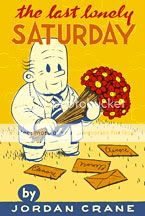
The Last Lonely Saturday
Jordan Crane, writer/artist
Red Ink, 2000
80 pages, hardcover
$8
Buy it from Fantagraphics

Originally published at The Savage Critics on March 16, 2009.
I find it both impossible and undesirable to separate The Last Lonely Saturday from the pivotal role it played in my life as a comics reader, and thus in my life in general. During the year 2001 I took a job as an editor at the A&F Quarterly, Abercrombie & Fitch’s big giant magazine/catalog/softcore porn hybrid publication. My boss there, Savas Abadsidis, was and is a big fanboy, and a chance encounter with a Wizard magazine on his desk, which contained an article teasing an upcoming revamp of the X-Men by Grant Morrison (whom I remembered favorably from my days as a comics reader in high school for Arkham Asylum) and Frank Quitely, led me into Jim Hanley’s Universe on 33rd Street to track down the series. This was the first time I’d entered a comic shop to purchase anything that wasn’t either an isolated Acme Novelty Library, Savage Dragon, or Frank Miller comic in years–the birth of my modern comics readership.
Intrigued by the offerings on hand, and empowered by a complete lack of editorial oversight that enabled us to write about anything we wanted in the Quarterly–not to mention Abercrombie’s expense account–I made a solemn vow to buy something completely unfamiliar to me every week. Jordan Crane’s The Last Lonely Saturday was one of my first such purchases. From there it was a short journey to Crane’s anthology NON, his distributor Highwater Books, the Fort Thunder aesthetic in general, and thence all of alternative comics.
None of that was likely to happen if I didn’t just love The Last Lonely Saturday to pieces. And that itself might seem unlikely. It’s a slight book–many of its 80 pages are endpapers, and the rest contain all of two panels apiece. Dialogue is minimal; the majority of it of it comes from a little boy’s triplet proclamations: “It’s a man,” “Look man run,” “Ha ha! Windy!” It has a simple red, white, and orange color scheme. Although a ghost is involved and a character dies, we’re pretty far from the violent morality plays that make up much of Crane’s recent work.
What The Last Lonely Saturday is is a love story, a romantic fable. To some eyes, it might be a creepy one at that. In the tradition of the Police’s “Every Breath You Take,” albeit in something of a gender reversal from that song, Saturday could be looked at as a depiction of the role fixation and selfishness, even emotional violence, frequently play in love. But just as the sweeping, insistent, intimate, evocative sound of “Every Breath You Take” make it one of the great love songs regardless of the obsessive lyrics, so too the particulars of The Last Lonely Saturday make it pretty much the best love story in comics form I’ve ever come across. Crane’s character designs are at their most adorable here. His jolly little potato-shaped protagonist, with his rumpled suit and charmingly crinkled brow, looks like the grandpa of our collective unconscious made real. His beloved Elenore’s jaunty hairdo, long eyelashes, and high-wattage smile evoke beauty and charm that transcends her cartoony form, while her two lines of flashback dialogue upon receiving flowers from her beau (“Oh sweet heart! They’re just lovely!”) nail me to the floor with sweetness every time. Everything seems airy–leaves and papers float and twirl in the breeze, the little old man’s car jauntily jumps along the road, puffy white clouds are a constant presence in the background–until, at the story’s moment of truth, Crane weighs down his line and crumples his art toward the center of the panel. I’m a huge, huge sucker for emotionally devastated old men, so imagine my utter joy when our hero is granted a reunion with his dear Elenore! (Think the video for Blur’s “Coffee & TV” and you’ve pretty much got it.) At that point, it doesn’t matter to me how it happened–that it did happen is what’s important, and that Elenore understands this is what makes The Last Lonely Saturday a great love story, in that it appreciates that what can seem unpleasant to outsiders is, within that world of two, an act of grace. It’s an intelligent, moving, beautiful, terrific little comic.
Lost thoughts
March 23, 2010¡SPOILERS!
* Alright, I may be done speculating about what the real deal is with Jacob and the Man in Black, what they really want, whether they’re good or evil, whatever. We just have no clue! I mean, I’ve gone on at length about what an enjoyment-sucking waste of time Doc Jensen-style theorizing is, but obviously I’ve still had fun trying to guess what was up with the core mystery. But after tonight’s episode, I’m about ready to hang up my spurs. From tweaking our understanding of how the Monster operates (apparently he can take the form of a dead person and make Smokey noises off) to showing omniscient Jacob as slightly less than omniscient (he seemed surprised enough by Richard to beat him up before asking questions) to showing benevolent Jacob as slightly less than benevolent (lording it over the MIB, being kind of a dick to Richard, his whole sadistic lab-rats experiment of dragging people to this Island to kill each other on the off chance that they might not and thus help him win a dorm-room philosophy argument with the MIB), the episode may as well have begun with “You think you know, but you have no idea.”
* I do feel comfortable calling them both mass murderers, for whatever that’s worth!
* Haha, after seasons of speculation, Captain Magnus Hanso doesn’t even appear!
* Man, they’re not even trying to pretend they’re not straight-up ripping off The Stand anymore, are they? Digging the bolt out, the business with the keys…all the MIB had to do was quote “Sympathy for the Devil” and I think Lost would be in King-verse continuity. But hey, why not? Steve won’t mind, and it’s great source material.
* For all the revelations and all the long-awaited pay-offs, I still think my favorite part of the episode was the very beginning, with the rapid cross-cutting between Ilana’s flashback, the gang on the beach, and Richard’s increasingly desperate and freaked-out flight from his old life as Jacob’s liaison. The show has only done that sort of thing a handful of times before, and never for such a sustained period of time–it felt breakneck and thrilling. I hope we see more of this style as the series hits the homestretch. It’s certainly a great way of connecting dots in a way that communicates “this is us connecting dots” while still being entertaining.
* Great little showcase for Nestor Carbonell. Again, after years of him being cool as a cucumber, it’s effective writing to flip that all on his head and show him hysterical and devastated.
* And you know, fun to watch an oldtimey Spaniard ride a horse around and sail on a big ship and such. Mmm, pulp.
* Was it just me, or was Titus Welliver shaping his line readings to mimic Terry O’Quinn now and then? Fine, fine casting.
* Oddly, I don’t have much more to say about this episode. Which is sort of the point, I would say. I’m just buckling up and going for the ride.
Carnival of souls
March 23, 2010* Vaya con Dios to Graeme McMillan, the trailblazing comicsblogger who’s saying goodbye to his gig at io9. Good writer, good people.
* Recently on Robot 6:

* and tons and tons of Lost art and comics.
* Now that I’ve finally gotten around to watching it, I agree with everyone who told me how fascinating this BBC roundtable on Joe Sacco’s Footnotes in Gaza is. First of all, I didn’t know Sacco had that accent. Secondly, it’s good to see someone object to Sacco’s standard, subjective, “here’s the side of the story with which I sympathize” take on things without obviously sharing the agenda of the other side. Finally, apparently in the U.K. you can be an elected official and not feel obligated to act stupid and talk at a third-grade level to the people who voted for you. I await a world where American congresspeople use phrases like “filmic immediacy” in a televised discussion of a comic book with the same fervor of Teabaggers anticipating the Rapture. (Via Boots.)
* Chris Evans is Captain America. Okay, sure.
* Nothing really leapt out at me from Whitney Matheson’s weekly plumbing of the Lost commentariat hivemind, but maybe you’ll feel differently. I also recommend taking one last plunge into last week’s Lost thoughts comment thread here at ADDTF before tonight’s goes up.
* For her birthday, I got the Missus tickets to see her favorite choral composer (and mine), Eric Whitacre, conduct a program of his work–e.e. cummings adpatations specifically–at Carnegie Hall in April. So I’m pretty thrilled to see this video of his song “Lux Aurumque,” performed by a “virtual choir” of 185 singers who filmed their separate contributions with their own webcams, go viral. Damn it all, listen to how beautiful this is:
* Beautiful woman on magic horse: Olivia Munn or Alison Goldfrapp–who wore it best?

(Munn on Mike Choi’s unicorn via Heidi MacDonald. Goldfrapp via her own bad self.)
“And as things fell apart, nobody paid much attention”
March 22, 2010Over the past week and a half or so I’ve been reading George R.R. Martin’s A Song of Ice and Fire series, prompted equally by HBO’s greenlighting of a series based on the books and by all the enthusiastic comments about them here on the blog. I’m done with A Game of Thrones (the first volume, which lends its name to the HBO series) and about a third of the way into book two, A Clash of Kings. There’s a little scene in the latter I just loved, and it gives me a chance to talk about a bunch of things I’m really enjoying about the series. SPOILER WARNING duly issued, though I don’t give away a whole lot of potentially enjoyment-lessening stuff, I don’t think.
Anyway, way down South in the capital city of King’s Landing, the book’s anti-hero, an aristocratic little person named Tyrion Lannister who is currently helping to run the kingdom, has his hands full. In addition to helping gird his war-torn kingdom against several major pretenders to the throne and their armies, he’s also navigating the treacherous, occasionally murderous politics of the high-ranking officials within the city itself. He’s got a secret girlfriend, he’s trying to solve a murder mystery for which he himself was once framed, his love-hate relationship with his sister the Queen could go permanently sour at any point, the peasants are revolting (rimshot!), and so on and so forth. For these reasons, and because the messenger in question is a right dickhead, he blows off an emissary from the Wall that guards the farthest border of the kingdom hundreds of miles to the North, and decides to see the severed hand the man has brought along with him (for reasons Tyrion doesn’t even bother to learn) another day. Maybe.
What we know and Tyrion doesn’t is that the last time we saw the severed hand, it was still moving of its own accord. And shortly before that, it was attached to a dead man, who’d risen in the middle of the night to slaughter those he once called his brothers in the Night’s Watch along the Wall.
What makes this such an evocative, powerful little moment? Quite a few things. For starters, the fantasy element in these nominally fantasy books has been minimal. In A Game of Thrones, it’s present in the prologue, then doesn’t reappear until the final few chapters. But that prologue is our first glimpse of the Others (!), a supernatural menace lurking in the wilderness beyond the Wall that turn their victims into undead soldiers for their cause, and so on and so forth. Kind of a Tombs of the Blind Dead deal, if you will. Since this is the very first chapter in a proposed seven-book series, we can assume (and indeed, only 1 1/3 books into the series, that’s all I myself can do) that this will be the crux of the whole affair. But when tipped off to this potentially apocalyptic development, Tyrion Lannister shrugs it off without even realizing the import of what he’s heard. I love the idea of the world’s most important piece of information being lost in the shuffle. It’s like the end of Raiders of the Lost Ark, only if the Ark was secretly multiplying and readying the destruction of civilization there in that warehouse.
So that’s the main thing I dig about it so much. But it also speaks to some of the books’ unique strengths. For example, so much of what happens in them hinges on the personal relationships between the characters, and the way old grudges or old friendships cloud judgement and lead to poor decisions. In this case, the Night’s Watch sent as messenger Ser Alliser Thorne, a man Tyrion had come to dislike during his own visit to the Wall months ago. Tyrion has no problem letting the asshole cool his jets for a few days — the more insulted he gets by the delay, the better, in fact. This despite the fact that Tyrion has been shown to be not just one of the shrewdest characters in the book, but also, despite the crimes of his loathsome family, one of the fairest and most interested in administering justice and preserving the kingdom and its people. What’s more, during his visit to the Wall he took a genuine interest in the fate of the Night’s Watch and promised he’d do what he could to persuade his family to support their mission. But even so, he still can’t help but give the brush-off to a dude who picked on him — and who could blame him?
Another strength: Martin doesn’t hesitate to show that even when a decision is made wisely and justly, with good intentions, and even with good results, that doesn’t mean it can’t still be a disaster in some unforeseen fashion. In this case, it really was a good thing for the head of the Night’s Watch, the Old Bear, to send Ser Alliser away. The guy was a sadistic tool, and in his position as a sort of drill sergeant for new recruits he was much better at bullying his chargers and setting up potentially fatal conflicts between them than he was at actually training them to fight. By sending Thorne on his way, the Old Bear instantly improved the quality of the training the Watch’s desperately needed recruits would receive and punished a creep for his abusive ways. It just happened to backfire in that he didn’t realize Tyrion would be the man to receive the message.
On a structural level, it’s also just a hoot to see one of the book’s many separate storylines poke its head into another. The goings-on at the Wall tied tightly to the main storyline early in book one, with Jon Snow, a member of main character Eddard Stark’s extended family, going to the Wall to join the Watch and Tyrion coming along to pay it a visit. But since then it’s been off on its own almost entirely, with the intrigue and infighting over the kingship and its attendant positions taking precedence. Heck, elsewhere there’s a storyline taking place far outside the kingdom that has yet to tie directly into the main storyline at all, unless you count the decision to dispatch an assassin in the latter bearing fruit in the former, which I don’t since there’s no character overlap. In fact, I read that that storyline won awards on its own as a separate novella — and you really could excise those chapters and have a standalone book if you wanted to. I admire the patience involved, and Martin’s ability to invest his many separate strands with more or less equal pull.
Finally, how creepy is the image of a severed, rotting hand flexing and clutching all on its own as a desperate messenger travels hundreds of miles to a besieged city in a vain attempt to warn its inhabitants that soon such hands could be around their collective throat?
In short, these books are engrossing as all get-out. I’m glad I’m reading them and would recommend you do the same.