
Author Archive
Carnival of souls: Special “Not really special, I just like this one” edition
March 22, 2010* Kiel Phegley interviews Mike Mignola at length about Hellboy, B.P.R.D, and the whole Mignola-verse of titles. Best of all, it’s just part one of an ongoing series! I was pleased to see Kiel ask a question of mine, and equally pleased to see a sneak preview of the next issue of B.P.R.D.: King of Fear, aka “the book where all the chickens come home to roost.”
* Recently on Robot 6:
* The promising-looking but unfortunately-on-newsprint anthology pood is set to debut at MoCCA;
* Salon drops Tom the Dancing Bug;
* Is Mark Millar racist and sexist?;
* and Kurt Busiek is on Twitter.
* At this point I could read nothing but Zak Smith’s alphabetical rundown of D&D monsters and still come away from the Internet a happy man. Here’s E (as in Eye, Floating) and here’s F (as in Flail Snail).
* My favorite part of Frank Santoro’s lengthy review of Gipi’s excellent Garage Band is right at the beginning, where he notes that the book’s casual, anecdotal (lack of) narrative is a feature, not a bug. (Personal to Matthew P.: Garage Band is another good “You liked Scott Pilgrim–now what?” book.)
* Art galore–I know you wanna click the links for the full-sized versions, don’t you?:
* Closed Caption Comics has posted a trio of previews of its eponymous anthology’s ninth volume. Mr. Freibert’s back cover Pete Frazon’s front cover is really blowing my mind.

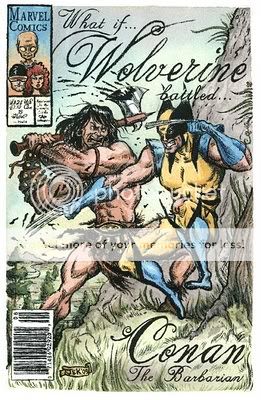
* Joe Kolitsky draws the Wolverine/Conan throw-down of your memories!
* Tom Neely draws the Glenn Danzig/Henry Rollins romance comic of your dreams!

* Rob Bricken draws the Captain Caveman portrait of your nightmares!

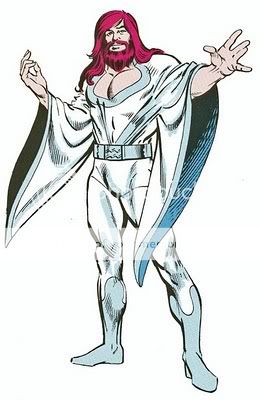
* Calling all bears: Ben Morse salutes Comics’ Finest Beards!
* I stayed away from this for a while because it’s so meme-y, but I finally relented, and it’s every bit as delightful as everyone’s saying: It’s a video of a bunch of Lost cast members saying “Mmmm…cake.” Is there a way to loop the Elizabeth Mitchell/Yunjin Kim portion? (Explanation via Todd VanDerWerff.)
Comics Time: Black Hole
March 22, 2010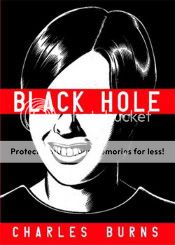
Black Hole
Charles Burns, writer/artist
Pantheon, 2005
368 pages
$18.95, softcover

Originally published at The Savage Critics on February 23, 2009.
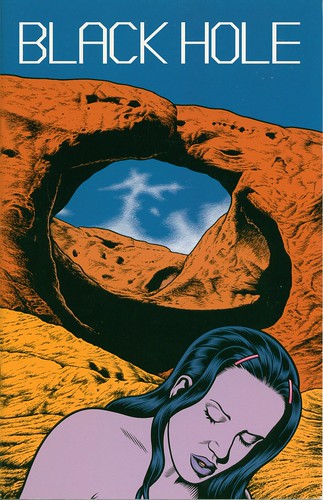
You lose a lot of extremely impressive supplemental material if you purchase or read only the collected edition of Black Hole rather than the individual issues from Fantagraphics (and, earlier, Kitchen Sink). The full-color front and back covers for each issue are probably what stand out in most people’s minds, followed perhaps by the almost masochistically detailed endpage spreads, and last but not least those terrific ripped-from-the-hotbox dialogue snippets that accompany Burns’s yearbook-portrait openers. I think everyone is probably partial to the one where a guy asks to be cremated if he dies so that his friends can smoke his ashes, but the one from the first issue isn’t some nugget of stoner wisdom, it’s the premise of the entire book:
It was like a horrible game of tag…It took a while, but they finally figured out it was some kind of new disease that only affected teenagers. They called it the “teen plague” or “the bug” and there were all kinds of unpredictable symptoms…For some it wasn’t too bad – a few bumps, maybe an ugly rash…Others turned into monsters or grew new body parts…But the symptoms didn’t matter…Once you were tagged, you were “it” forever.
That quote made it into the collected edition as the back-cover blurb. This one, from the twelfth and final issue, didn’t:
It’s like tryin’ to explain sex to a nun – there’s no way you’d ever understand it unless you lived it. I was there, okay? Half my fuckin’ friends died out there, man. I never dreamed I’d get out of that shit-hole…but one day I notice the stuff on my face is starting to heal and a couple of months later, I’m totally fuckin’ clean…out walking around with all the normal assholes.
This directly contradicts the quote from the first issue and upends the premise it establishes. Turns out the horror of the teen plague is finite. Turns out everything that happened in the book didn’t need to happen, not the way it did, not based on the assumption that nothing was going to change and they’d never get better. Turns out, in other words, that the teen plague was ultimately like being a teenager itself: It sucks, but you grow out of it.
Rereading Black Hole for the fourth time or so, it’s easy to see the set-up for this punchline. Keith in the woods during the kegger where he finds out Chris has the bug, peeing on a tree and grumbling to himself, “This is it…this is all it’s ever gonna be. It’ll never get better…I’ll always be like this…” Chris’s similarly themed rebuke of her parents: “You don’t understand! You’ll never understand! Never!” The constant hyperbole the kids use to describe virtually everything even potentially enjoyable: “It was going to be the best day of my life”; “Rob had brought along all kinds of incredible things to eat…black olives, an avocado, french bred, salami, cheese…”; “All right! That’s gonna blow your fuckin’ mind!“; “It’s called Monument Valley–you won’t believe how amazing it is!”; and my favorite, “I want to show you how to make the best sandwich in the world.” Chris telling Rob “I’ll love you forever, no matter what,” and Keith and Eliza telling each other the same thing. Chris’s repeated refrain “I’d stay here forever if I could”–in Rob’s arms, in the icy water looking up at the night sky. Everything is either the best it can possibly be or the worst it can possibly be, and it will never change.
Needless to say that’s just about the most accurate depiction of the emotional life of teenagers I’ve ever seen. It’s how I remember high school. It’s not terribly far removed from how I remember college. (And to be perfectly honest, when I think of how I look at the world even now, it’s within spitting distance of how I live today, which is probably a big part of why this is one of my favorite comics.) But of course, things do change. Bad things usually get better, which is why it’s such a goddamn tragedy any time a teenager commits suicide because of a bad grade or a breakup–or when a group of sick kids feels it necessary to drop out of school, run away from home, and in the case of some characters literally throw their lives away. And unfortunately, good things often get worse; parents do understand, at least some of the time, and it’s damn hard to tell someone “I’ll love you forever, no matter what” and mean it, and two stoners driving across country probably won’t be able to find a cozy apartment where he can make an honest living and she can work on her art and they both live happily ever after. That’s a tragedy too.
So why remove the quote that points this out, the quote that completes the metaphor? Maybe–and I’m just guessing here; I’ve interviewed Charles Burns about this book a couple of times but I don’t recall asking him about this–he didn’t want to give us that escape valve. Maybe he doesn’t want us to read this and think, “Silly kids, if only they knew.” Maybe he wants to eliminate anything that lessens the number-one effect of the story and the art here: claustrophobia.
Honestly, the claustrophobia of Black Hole is what struck me the most in this reread. Take the panel gutters, for example. Burns employs a traditional method of delineating between real-time action and dreams or flashbacks–straight gutters for the real stuff, wavy gutters for the reveries. But those wavy gutters still create as uniform a grid as ones drawn with a ruler would. Instead of dreaminess, they evoke haziness, like heat waves radiating up from a road or the room spinning when you’re cataclysmically wasted. Indeed, the few times the grids do deviate from the norm is when the characters are completely blotto, or completely panicked–even there, panels remain locked in tiers, and the effect is like careening from one side to another when you’re too drunk to stand up straight and really, really wish you were suddenly sober again but you’re stuck drunk. There’s no way out.
Then there’s the look of the art itself. Elsewhere I’ve described it as like immersing yourself in a blacklight poster, which is apt not just because of the subject matter (look and you’ll see a few such posters on a few walls, in fact) but because looking at this book can practically give you a contact high. While I read the book this time around, I thought it might be neat to listen to a couple of playlists I recently made of the kind of electronic music I listened to in college, a time when presence of the kind of emotions you find in Black Hole still feels fresh to me, a time when I got stoned pretty frequently listening to that very music. Even though I did this on the commuter train out of New York, I’ll be damned if I didn’t feel the pressure on my eyeballs, the weight in my limbs, a slight throbbing of the vision when staring at Burns’s flawless blacks and the trademark shine effect of his characters’ hair. For the first time in his career, I think, style and substance lined up perfectly. It’s not for nothing, though, that the use of drugs and alcohol in the book almost always reduces the options available to the characters–most of the time they prevent people from doing what needs to be done or saying what needs to be said, and even during the story’s few positive depictions of inebriation, intoxicants are used to push things toward a preordained conclusion rather than open up other possibilities. No minds are expanded.
Maybe the most powerful aspect of the book’s claustrophobic effect is its eroticism. True to adolescent love and lust, the desire these characters have to fuck one another is irresistible and all-consuming–it has to be, or else the story couldn’t have happened, and virtually every major plot development wouldn’t have taken place either. Frequently the very environments where the sex takes place contribute to this feeling. Rob and Chris’s fateful liaison takes place in a graveyard. Keith first sees Eliza, nude from the waist down, under the harsh and unforgiving glare of florescent kitchen lights
. He first becomes aroused by her when her tail struggles against the restraint of her towel. Their romance is kindled in her bedroom, surrounded by hundreds of her bizarre (and very blacklight) drawings. They first have sex while stoned as fuck, a red scarf draped over the lamp and bathing everything in crimson. The atmosphere is oppressive, but so can be the feeling of being very, very turned on. “That’s all it took to get me totally sexed up and crazy,” says Keith of his first kiss with Eliza. “I could hardly catch my breath.” (Is it worth noting I knew a girl who looked a bit like Eliza back in college? Probably.)
One final motif comes to mind when I think of how Black Hole works to confine and oppress: repetition. I’ve already mentioned some of the repeated dialogue, and there are any number of repeated visual cues–shattered glass, snakes, holes–and even repeated scenes–Chris floating in the water, those dream sequences. But there are two instances of repetition that stand out to me the most. The first is when Keith angrily leaves his parents’ house to avoid watching some lame TV movie with them, only to end up tripping on acid and watching the very same movie at his friend’s girlfriend’s place. The second, and the most chilling, is Eliza’s sexual assault, which is an implied echo of never-directly-described abuse she suffered at the hands of her stepfather–and, as her nightmare at the end of the book indicates, will likely continue to haunt her dreaming and waking life. Even her and Keith’s blissful roadtrip escape is just a tour of places she’s already been, trying to recapture the happiness she knew long ago. And maybe this more than anything else is why cutting that final reveal that the bug was temporary was the right move: Bad things usually get better, but that doesn’t mean they never come back–different, perhaps, but the same in all the ways that count. Sometimes you can break free of something only to spin right back around to it, spiraling inward into that gravitational maw until that bad thing might as well be constant, for all you can truly escape from it.
I mean, the book is called Black Hole.
For further discussion of Black Hole by myself and Dick Hyacinth, visit The Savage Critics.
Carnival of souls
March 19, 2010* They–and by “They” I mean some of the worst of Them, Michael Bay and Rob Cohen–are going to remake The Monster Squad. Look, I’m not some “raping my childhood” mouthbreather, but the original was good for a variety of reasons specific to itself, from Stan Winston’s creature effects to a script from Shane Black edgy enough to never get off the ground as a children’s movie today, that simply aren’t going to be in play here, so why fucking bother.
* Jeez, I could lose hours reading Zak Smith’s posts about D&D monsters. Twenty-two tagged posts in the series! And he’s now going through them all alphabetically! I want to leisurely drink a beer while I read this. I mean, shit, read this essay on dragons. Got dang.
* Even without ever having read so much as a panel by John Stanley, I can appreciate the geekiness of this “stream of Stanley” from Jeet Heer.
* This post on the overuse of teal-and-orange color grading by Hollywood has been making the rounds so much over the past few days I don’t even remember where I first saw it. I do remember that I first clicked on it because I remembered a weird comment one of the judges made a couple weeks ago on Project Runway, to the effect that the teal-and-orange color scheme of one contestant’s dress was weird and bad. I can see the spine of Jimmy Corrigan: The Smartest Kid on Earth from where I sit when I watch TV, so obviously I disagreed that this was some bizarre violation of the norm. Apparently Hollywood does too. Anyway, like anyone who goes to the movies or watches TV I’ve noticed how nuts everyone’s gotten with the icy blues, but I don’t think I’d noticed the teal component. Eye-opening!
* Finally:
Carnival of souls
March 18, 2010* Is August 2010 shaping up to be the best month for action movies ever? Neil Marshall’s Centurion on August 6th, Edgar Wright’s Scott Pilgrim vs. the World and Sylvester Stallone’s The Expendables on the 13th. Triple feature!
* Frazer Irving leads a Seven Soldiers class reunion on Batman and Robin and The Return of Bruce Wayne. Thus the artist hot streak of Frank Quitely, Cameron Stewart, and Andy Clarke remains unbroken. Wait, what?
* Recently at Robot 6: Wizard relaunches its website and spoils Battlestar Galactica in the process and Kate Beaton does a comic about Lost and does not spoil it in the process.
* An anthology featuring new Ron Rege Jr. and John Hankiewicz? Why did no one tell me of this? Publisher of Shitbeams on the Loose #2, my email’s in the left-hand sidebar.
* Wow, Dave Johnson’s really breaking the Mignolaverse mold for his upcoming Abe Sapien cover run. Also, upcoming Abe Sapien!
* I hope Hercules bedded dudes down all across the Marvel Universe.
* Uncle Steve got a bum steer.
* Real-Life Horror: The Roman Catholic Church is an international child-rape racket whose leaders from the Pope on down all belong on trial at The Hague, parts one and two. Just so you know!
* All mash-ups are equal, but some are more equal than others. This little Matthew Yglesias piece on Michiko Kakutani being hoist by her own anti-quotation-culture petard made me laugh, even though I am broadly sympathetic to some of what I’ve seen from Jaron Lanier (about whom she was talking) when flipping through You Are Not a Gadget, particularly a bit about how the Internet’s built-in anonymity gave rise to a happiness-depleting culture of bullies. I need to get that book.
* Honestly? Even as a kid, I wished the Teenage Mutant Ninja Turtles would do exactly this. Li’l Sean was like “They have bladed weapons!” (Via Topless Robot–where else?)
Happy St. Patrick’s Day!
March 17, 2010Carnival of souls
March 17, 2010* Boardwalk Empire, a new HBO series about Prohibition-era gangsters created by The Sopranos‘ Terence Winter, directed by Martin Scorsese, and starring Steve Buscemi, Leonardo DiCaprio doppelganger Michael Pitt, Omar from The Wire, and whatsername from Trainspotting and No Country for Old Men? I’ll eat it and ask for seconds! (Via Keith Uhlich.)
* Zak Sabbath’s I Hit It with My Axe, the video companion series to his brilliant blog Playing D&D with Porn Stars, has begun!The funny thing about it is that Sasha Grey is my audience-identification character! She’s an RPG newbie being introduced into an ongoing campaign involving more experienced players, which was my exact position during the one D&D campaign I ever played. This should be fun to watch. And as Rob Bricken says, you really need to be reading Playing D&D with Porn Stars. It’s pure gold.
* Typically astute stuff from Todd VanDerWerff in his Lost review/recap for the week. I liked hearing him echo a comment made by our very own Tom Spurgeon in the comments for my Lost thoughts on yesterday’s episode. Go chime in!
* I share Jason Adams’s intense ambivalence about Human Centipede. My situation is that not wanting to watch more than five seconds of something as much as I don’t want to watch more than five seconds of Human Centipede makes me wonder if maybe I need to watch more than five seconds of it.
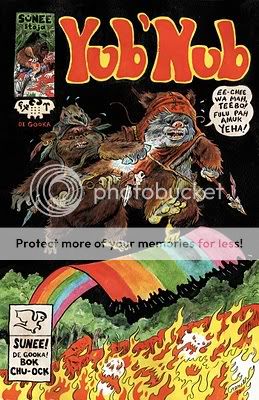
* This Aaron Renier contribution to Covered is most delightful to this Ewok-lover. As always, click the link and celebrate the full-sized love.
* David Bordwell gently annihilates the notion that film criticism is a dying art. I’m sure you can think of a few comics people who’d be well served to read this essay, right? And music, too, if that’s your thing. Anyway, every boldfaced section header in the piece is a gem, eg. “Writing style is overrated.” I feel like I’m being extra-effusive in this Carnival, but if you care about criticism at all, you need to read this one.
Comics Time: Weird Schmeird #2
March 17, 2010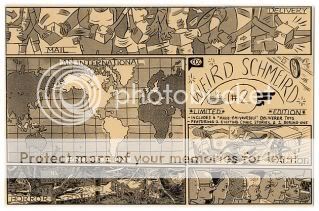
Weird Schmeird #2
Ryan Cecil Smith, writer/artist
self-published, 2010
32 pages plus six lasercut cardboard toys, plastic sleeve
$8
Ambitiously constructed and beautifully packaged, this is another workout in varying styles by CCC member Ryan Cecil Smith. The cover, and the opening vista of suburbia for the minicomic’s first story “Koshien: Impossible,” scan like Kevin Huizenga. The rest of that first story is all dense, explosive, propulsive ninjas-on-bicycles action, with massive rivers of speedlines that cohere like a Brian Ralph environment. There’s a sketchbook section in the grand “cartoonist’s travelogue” tradition. There’s a story set in the world of Two Eyes of the Beautiful, using that same Umezu-derived style to tell a “they had no idea how close they came to death”-type story about two oblivious, bicurious teenage girls who nearly fall into the clutches of the increasingly demented disfigured woman, who’s already transplanted the brain of one girl’s boyfriend into a dog. There’s a one-page cameo from Noel Friebert, with his trademark graphic treatment of text and almost textual treatment of graphics. There’s a little one-page Anders Nilsen monlogue-type thing. There’s a couple more sketchbook pages, making strong use of tones (as does the whole book). And there’s a third story that starts out with a Dan Zettwoch-style diagrammatic depiction of the university mailroom Smith worked in one summer, before telling the very very average tale of his life at that job in the Porcellino/Huizenga tradition. Finally, there are little die-cut cardboard mock-ups of DHL, UPS, FedEx, and Postal Service vehicles, and even a little mailman. Story #1’s the real highlight here–that thing’s a visual knockout, and I for one am dying to see Smith give that style a longer workout on something other than Xerox paper–but frankly it seems he could have stuck with any one part of this hodgepodge and made a strong minicomic out of it. As it stands, he went with all of them and made a strong minicomic out of that, and he could go down a number of rewarding roads from here.
Lost thoughts
March 16, 2010SPOILERZAPOPPIN
* Explain to me how “We’re takin’ the sub” constitutes a) a cliffhanger; b) an adequate response to their lack of a pilot to fly the plain, unless Sawyer became a sub captain during his Dharma days and I missed it.
* So that part was pretty irritating, and since it’s the end of the episode, it left something of a sour taste in my mouth.
* I suppose I’m also frustrated that my “Widmore’s coming to pick up the MIB” theory didn’t pan out. Well, as far as we know. Everyone is just lying to everyone else all the time now, then admitting it and moving on, so I figure both Fake Locke and Widmore are entitled to be bullshitting about this too.
* Actually, maybe I’m just frustrated by everyone lying all the time. What is this, Gossip Girl?
* Anyway, now that we’ve (in theory) learned that Widmore isn’t on MIB’s side after all, how many factions are really in play over the course of the show? You’ve got Widmore’s people. Ben’s Others. Jacob still seems separate from the Others to me. Then there’s the MIB. The Dharma Initiative. The castaways. Rousseau. The French team?
* In the “pro” column on this week’s installment: Sawyer’s a character who can really hold an episode, and while I’m sure the cop stuff in the flashsideways is as egregious inaccurate as was the teacher stuff in the Ben flashsideways last week, I’m not married to a cop and wasn’t raised by a cop so it didn’t bother me, and instead made a lot of sense as a road Sawyer–or more accurately, in this case, Jim Ford–could have gone down. It makes at least as much sense to become a cop and track down the con man who destroyed your family as it does to become a con man yourself to do it.
* And again we see a character confronting and surmounting the emotional issues that bedeviled them in the original timeline. Jack puts his daddy issues to rest and mends fences with his own son; Locke lets go of his rage and compulsion to prove everyone wrong and allows himself a happy life with his wife-to-be; Sawyer opens up, trusts someone, and knowingly puts a huge if not insurmountable roadblock in the way of pursuing his grudge to its murderous end. In all three cases these aren’t storybook happy endings, but in the immortal words of Bruce Wayne, “This would be a good life…good enough.”
* On the other hand, we’d previously put Kate in this category–instead of running, she came back to care for Claire–but of course here she’s still running. And ending up in the hands of Sawyer/Ford in a fashion reminiscent of Sayid finding Jin.
* Which raises the question: Why the hell did Sawyer, a cop, let a woman in handcuffs go at the airport in the first place? Was it because he didn’t want to reveal to anyone that he was there? Wouldn’t there be ways to tip someone off without saying “I’m a cop”–like not helping her sneak past security, for example? Well, maybe this’ll come out during her interrogation, I don’t know.
* Lots of cameos in this episode. Good to see Charlie’s brother.
* Good to see Charlotte, too! She was never my favorite, but I liked her here, and not just because she looked better than she’d ever looked before. Well, okay, maybe because she looked better than she’d ever looked before. But kudos to Rebecca Mader for that anyway. She was convincingly sexy, and she handled the infuriating humiliation of being angrily booted from a bedroom just minutes after having sex convincingly too.
* (Speaking of which, this is only relevant to Tri-State Area viewers, but one of the things I’ll miss about Lost are those little five second glimpses of Liz Cho during the teaser commercial for Eyewitness News.)
* I don’t know if this says more about Lost or what watching Lost does to people, but Fake Locke tells Sawyer he’s the smoke monster, Sawyer asks about why he killed all those people but not a peep about “what the fuck are you, smoke monster???”, and I barely even blinked.
* Haha, the “I’m just a scared and lonely survivor please don’t hurt me” routine’s been done before, Zoe, and by a better actor than you. Won’t get fooled again!
* Even though it was (too) quickly defused, the creepiness of Claire being all friendsy with Kate and then trying to cut her throat while Sayid looked on all sedated-like, then Fake Locke coldcocking Claire to talk her down, was really somethin’. I wasn’t sure what kind of mileage they’d get out of these sorts of scenes, but it worked, not least because crying is something Evangeline Lilly does well.
Carnival of souls
March 16, 2010* “Why won’t you play the game?” Your very-much-lead item today is Scott Woods’s “In Search of Digital Love,” an hour-long audio documentary/review/essay/mixtape/mash-up/sound collage/whatever exploring Daft Punk’s flawless song “Digital Love.” Aided and abetted by critics Brian MacDonald, Michaelangelo Matos, and Nate Patrin, Woods makes some really astonishing sonic connections here, sometimes by simplly riffing off a single word uttered by his interview subjects–a suite of samples from ’70s/’80s songs with the word “Magic” in the title, for example. (This makes me want to make a playlist of such songs, but adding in my twin faves from this ’80s-radio-staple subgenre, the Alan Parsons Project’s “Magic” and Steve Miller’s “Abracadabra.”) Meanwhile, I never would have thought of “Layla,” but dang if that isn’t dead on. And there’s science-fiction content galore in there, as you also might expect. (I’m proud I recognized Lenny Van Dohlen’s voice in the commercial for Electric Dreams simply from remembering him as Harold in Twin Peaks–which is also sampled!) I’m so impressed by this thing it’s not even funny. Take the time and listen to it. (Via Tom Ewing.)
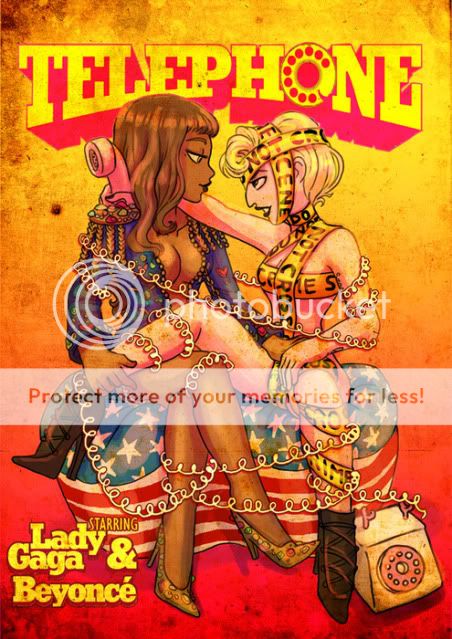
* Recently at Robot 6: How to write comics and Lady Gaga/Beyonce/”Telephone” tribute art.
* In a very fine postcript to Not Coming to a Theater Near You’s Kubrick retrospective, Aaron Cutler talks about Steven Spielberg’s A.I., lingering on the heartbreak of it. I need to revisit this film.
* Tom Spurgeon reviews the John Porcellino King-Cat collection Map of My Heart. I like when Tom discusses what new things he gets out of experiencing a familiar, even beloved work in a new format, and this review is of a piece with his earlier commentary on Fantagraphics’ excellent Love & Rockets digests.
* Always love a Jeffrey Brown superhero piece.
* Eve Tushnet liked Deadgirl, the hot-zombie-woman-as-sex-slave movie. I’m glad to hear it’s about misogyny rather than a function of misogyny. On the other hand, my wife’s admonishment that we’ve had quite enough art told from the perspective of misogynists, thank you very much, continues to haunt me.
* Apparently They’re very happy with the performance of Caprica and want to make more Battlestar Galactica spin-offs.
* Speaking of: I am very late to this game, but I know you gonna dig Katamaran’s mash-up of Battlestar Galactica with the feel of Spike Jonze’s video for the Beastie Boys’ “Sabotage.” This thing had me laughing out loud, hard, on the train.
I suppose it’s worth pointing out that you could never do this with Caprica. (Via Topless Robot.)
* Twilight Saga: New Moon RiffTrax available simultaneously with the DVD release! BALLS OUT. (Also via Topless Robot, bless his heart.)
* Finally, I took one last dip into last week’s Lost thoughts comment thread. Take a look, then I’ll see you back here tonight!
Carnival of souls
March 15, 2010* Due to a scheduling mishap I’m not sure if this showed up in everyone’s RSS readers today, so please note this morning’s Comics Time reviews of several noteworthy monthly comics that came out last week.
* Recently on Robot 6: How Siege and Blackest Night are really doing, Savage Dragon does the Strange Tales/Bizarro Comics thing, and Sara Ryan and friends have advice for comics writers.
* Phoebe Gloeckner says The Twilight Saga: New Moon was the Best Film of 2009. Somehow this does not surprise me at all. In other news, The Diary of a Teenage Girl debuts tonight off-off-Broadway.
* The Doug Wright Awards strike me as a serious consideration of comics whereas most of the other major North American awards programs really aren’t.
* I found Frank Miller’s tribute to Brittany Murphy (no permalink but it’s the only thing there at the moment) surprisingly moving. (Via Heidi MacDonald.)
* I skipped a few of these (plain old missed the 2001, skipped A Clockwork Orange when I saw it was a pan (!), and I still haven’t seen Barry Lyndon despite Kubrick being my all-time favorite director and owning the movie since the Kubrick box set came out a decade ago), but Not Coming to a Theater Near You has rounded out its series on Stanley Kubrick with fine pieces on his three final (and my three favorite of his) films: The Shining, Full Metal Jacket, and the best of the bunch, Eyes Wide Shut. Provided you put any effort into it at all, it’s difficult to write badly about EWS.
* On the Lost front, Todd VanDerWerff’s weekly round-up post has a couple of nice catches, while I’m way behind on the comment thread on my own Lost post for last week.
* Kate Winslet and Sam Mendes have split up. Perhaps she realized that she is Kate Winslet and he is Sam Mendes.
Comics Time: Various (mostly) superhero comics worth your time
March 15, 2010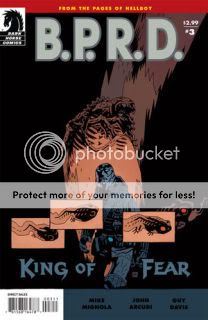
Last week was a strong week for monthly comics from the front-of-Previews publishers. Here are the ones I read and enjoyed.
Action Comics #887 (Greg Rucka, Eric Trautmann, writers; Pere Perez, Cafu, artists; DC): Not only do I like the idea and image of a giant, mad Kryptonian god-clone slowly walking from Iraq to Pakistan and fucking up everything in his path, I also like the “story” filed by Lois Lane about the rampage that serves as the issue’s narration. A lot of times these things sound so phony, but Lois’s piece on this crazy thing, and how Kryptonian heroes Nightwing and Flamebird have been framed by her dear old Dad, has the the breathless feel of a celebrity Huffington Post column, which is probably the sort of thing Lois would be doing in the real world. Solid stuff. Also, Cafu (cover artist and artist on the Captain Atom back-up) is a phenomenon in the making.
Batman & Robin #10 (Grant Morrison, writer; Andy Clarke, artist; DC): I thought Andy Clarke had a couple of storytelling hiccups here, nothing major, but upon a re-read paying closer attention, they mostly evaporated. In this issue he and Morrison turn Wayne Manor into, as Dick Grayson himself puts it, a sort of game of Clue–a three-dimensional puzzle with secret passages, hidden messages, and portraits of long-dead ancestors that contain clues to a centuries-old secret. It’s like that part in Indiana Jones and the Last Crusade where Indy and Elsa roam around that library looking for the entrance to the catacombs–only this has Batman & Robin! Brainwashed, programmed-to-kill Robin at that! Morrison seems to be leaning too hard on the “Oberon Sexton is Bruce Wayne” thing for it to ultimately pan out, but who knows. This thing is inner-eight-year-old gold.
B.P.R.D.: King of Fear #3 (Mike Mignola, John Arcudi, writers; Guy Davis, artist; Dark Horse): My God, this book just keeps getting better and better. I don’t want to spoil what happens in this issue even obliquely, except to say that I’m very very happy that what happened happened, that there’s a character design in this that is among my very favorite character designs of all time (particularly for how it utilizes Guy Davis and Dave Stewart’s blacks), that every page pays off some years-old strand of story, and that the slow downfall of the Bureau–unfurled with laconic dialogue punctuated by bouts of intense violence–is my favorite ongoing storyline of the last decade.
Criminal: The Sinners #5 (Ed Brubaker, writer; Sean Phillips, artist; Marvel/Icon): Sweet revenge! And wow, Val Staples does yeoman’s work on this book, huh? Again, I don’t wanna be a heel and give away the ending, but it ends on a high note for the arc, and I admire the grin-provoking way in which the final pieces click into place.
Powers #3 (Brian Michael Bendis, writer; Michael Avon Oeming, artist; Marvel/Icon): The obnoxious teenage girl Walker and Sunrise are chaperoning in this issue spouts Brian Bendis’s funniest dialogue in recent memory, while it’s fascinating to watch Michael Oeming’s once-slick Timm-isms give way to this rough-hewn, almost abstracted tumult of shouting faces, blasting energy, spurting blood, and flying, tumbling bodies. This whole issue is visceral in a way that only those grand-guignol killings used to be. Very interesting.
Superman: Last Stand of New Krypton #1 (James Robinson, Sterling Gates, writers; Pete Woods, artist; DC): I sort of wish this issue’s “This is a job for Superman!” moment had been the climax of the final issue of World of New Krypton–I think it would have punched up an ending that sort of felt anticlimactic, what with its murder mystery involving characters we barely know and a series of confrontations with rather marginal space-faring DCU denizens. But that aside, I think this is a rollicking payoff to one of the more underrated superhero runs in recent memory. Brainiac and Lex Luthor vs. Superman vs. Zod is a terrific roundelay, Zod’s behavior here re-villains him after he got a little too cuddly during WoNK, it’s fun seeing the rest of the Superman Family (Superboy, Supergirl, Mon-El, the Legion) show up and slug it out with Brainiac bots for the life of New Krypton, Pete Woods draws some good flying and punching…In a weird way I’m almost glad that J. Michael Straczynski will likely make a clean break from this material, because that means at some point in the relatively near future I’ll be able to own a complete set of trade paperbacks of this whole era of interconnected Superman titles, and on some rainy afternoon I can watch the whole conspiracy and war unfold. Should be a pip.
Ultimate Comics Spider-Man #8 (Brian Michael Bendis, writer; Takeshi Miyazawa, artist; Marvel): It’s a shame the Ultimate line seems to be in the same boat as the Superman line, because Ultimate Spidey has rarely been better. In all fairness, it’s almost always been very good, of course. But the whole “Aunt May’s Crazy House of Teenage Superheroes” idea is a deeply satisfying status quo for the book. For starters, it’s a cool way to keep the universe feeling broad without needing to read too many of its other titles (thank goodness–they’re murdering babies out there!). For another, I’ve always thought Bendis writes these teen characters really well, the dramatic ups and downs of their friendships, and David Lafuente’s drawings of them are simply gorgeous. (His Gwen Stacy is out-and-out crushworthy.) Takeshi Miyazawa fills in here, and pretty strongly if not spectacularly, although the way he does Iceman’s head-icicles grosses me out. (I have a personal phobia about that sort of thing.) I got some laughs out of the names suggested for superpowered teen Ultimate Rick Jones, and I got a reminder that I’ve been enjoying this series for, what, 130 issues now, or something? I suppose I’m mostly curious seeing who becomes the real archvillains in a post-Kingpin, post-Green Goblin Ultimate Spidey world, but I don’t mind taking our time getting there.
Comics Time: Two Eyes of the Beautiful
March 12, 2010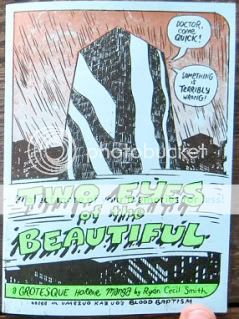
Two Eyes of the Beautiful
Ryan Cecil Smith
self-published, 2010
26 story pages
$5
Based on Kazuo Umezu’s Blood Baptism, this minicomic from Closed Caption Comics stalwart Ryan Cecil Smith–labeled “a grotesque horror manga” on its cover–is funny and queasily suspenseful in equal measure. One one level it’s an experiment in wedding Smith’s thin-lined, loose altcomix style to the doe-eyed, slackjawed strangeness of Umezu’s character designs, and to the spectacle of his horrific “punchline” panels and pages. The wedding’s a happy one, milked mainly for the blackly comedic effect of the contrast. This ironic tinge helps to capture the over-the-top emotional absurdity of this kind of material–in this story, a famous actress literally walks away from her own life and goes into hiding with her daughter on the promise of some sketchy doctor to heal her facial disfigurement if and only if she were to completely disappear from society. (Jeez, I consult the Internet for a second opinion over cough medicine.) Once we learn that the actress has been instructed by the doctor to procure one pure, beautiful young girl for his presumably nefarious purposes, Smith has a lot of fun ratcheting up the tension in horror-comedy style, first via a long, overly specific interrogation of the little girl by the actress, trying to make sure she hadn’t told anyone she was coming over as she slowly locks all the windows and doors to prevent her escape; and second via a pictureless depiction of the actress’s struggle to tie up the little girl, a series of blacked-out panels where the action is conveyed solely through sound effects (“MMMMMPHHHH, KICK, EEE, MMMPHH, PANT, TIE, STRUGGLE, PANT”).
Yet at the same time, given the kinds of cruelty to children we know these comics are capable of, the material is actually quite dreadful amid its goofiness. You hate to think what this vein, horrible woman will do to this poor innocent orphan (you BET she’s an orphan), and then you hate how easy it is for the woman to shift the blame to the little girl when she escapes and seeks aid. I was quite prepared to be sickened by whatever would happen to this poor kid; I dodged a bullet, but I know it was only through the restraint of the cartoonist that this occurred. For a formal exercise, it’s striking stuff.
Comics Time: All-Star Superman
March 11, 2010
All-Star Superman Vols. 1 & 2
Grant Morrison, writer
Frank Quitely, artist
DC, 2008-2010, believe it or not
160 pages each
$12.99 each


For today’s Comics Time review, please visit The Savage Critics.
Carnival of souls
March 10, 2010* Remember when TV on the Radio’s Tunde Adebimpe drew a picture of David Bowie for my David Bowie sketchbook? The Yellow Bird Project is now using it as a t-shirt design to raise money for Haiti relief. I’m very excited about this and am grateful and glad to have been a part of it. Buy one!

* I was sad to hear about the death of Corey Haim. Prior to the release of Crank: High Voltage, the only film of his I’d seen all the way through was The Lost Boys. (Blown Away I tended to fastforward to the good parts back in middle school.) But The Lost Boys is obviously a marvelous movie, and watching it recently, one of my favorite parts was Haim’s one-of-a-kind performance as some kind of junior-high dandy.
* Todd VanDerWerff liked last night’s Lost more than I did. He makes a decent case.
* As a big fan of both Ta-Nehisi Coates and Ghostface Killah, I’m please to be able to say this: Ta-Nehisi Coates on Ghostface Killah.
Comics Time: Savage Difficulties
March 10, 2010Today’s Comics Time review, which was to be hosted at the all-new all-different Savage Critics, has been gobbled up by a host switchover. I will be able to reconstruct it and post it tomorrow.
In the meantime, may I suggest you add the new Savage Critics RSS feed to your RSS readers. The switchover isn’t automatic, so if you previously subscribed, you’ll want to update it.
Thank you for your interest.
Lost thoughts
March 9, 2010SPOILERS SPOILERS SPOILERS HO
* “May I please see the storage facility, Mr. Venkman?”
* Here’s a phrase I never expected to hear in conjunction with Lost: “Directed by Mario Van Peebles.”
* Tania Raymonde = Great Googly Moogly
* It would be odd of Ben’s dad (legitimately great make-up job on Uncle Rico/the werewolf, by the way) to suggest that their life would have improved if they’d stayed on the Island had a nuclear bomb gone off and sunk it to the bottom of the sea, right?
* But who knows what kind of strange rules apply in a world where high school principals exercise dictatorial control over the budget and teachers jockey for power to replace them in the middle of a school year.
* Arzt is getting annoying. (Getting?–Ed.) I sort of wish Locke had been the guy riding shotgun with Dr. Linus’s scheme to take down Principal Walter Peck, but I suppose that sets up all kinds of parallels they weren’t prepared to do.
* I also sort of wish Illana weren’t such a pivotal character right now, because we have so little to go on with her. We’re less attached to her than to any other surviving character on the entire show. She is to the cast what the Temple set is to Lost sets.
* One way I could tell in this episode that things are moving to a head is that they had two climactic confrontations: Jack and Richard, and Ben and Ilana. Either could easily have been the focal point of an entire episode, and would have been, in an earlier season–or hell, earlier in this one.
* As it stood, I think I preferred the Jack and Richard scene. I loved seeing both men pushed past their limits: Richard in panicked despair, divided between shadow and light as he frantically explains why he’s now so desperate to die; Jack in crazy-eyed, careless confidence, bound and determined to find out the reason he’s now so sure he has to be there, a Man of Faith to rival Locke from earlier in the show. Good stuff.
* Ben’s scene was as well-acted as you’d expect from Michael Emerson, and I bought it, but again, using Ilana as his foil made it feel like a dress rehearsal rather than closing night. Imagine if his interlocutor had been Locke, Jack, Kate, Sawyer, or Richard. (Moreover, you’d think Miles, Lapidus, or Sun would have something to say about forcing a man, even Ben, to dig his own grave.)
* So maybe the episode was a bit…off-balance? Given the subject of the flash-sideways, Ben’s story should have been the main one. But you had a big moment with Jack, Richard, and Hurley, while Fake Locke showed up as well. It dulled the impact.
* I always enjoy a good slow-motion smiley reunion scene on this show. With all the team-ups and split-ups and bumping into each other in the jungle and storming off in a huff that goes down, it’s occasionally nice to get a reminder that a lot of these people really like each other, or did at one point, and care about one another. We care about them too!
* Miles psychically detecting Nikki & Paulo’s diamonds was a hoot. It was like the writers raced to pick up something even the most die-hard fans wouldn’t have put together. (That said, I’m sure someone said “hey, wouldn’t Miles notice Nikki & Paulo’s diamonds?” before, but I almost feel bad for that person.) Would have been nice if he noted they’d been buried alive, but still.
* So Fake Locke’s posse is on Hydra Island, huh? I wonder if Sawyer and Kate will have one last roll in the polar bear cage, for old times’ sake.
Exceedingly brief carnival of souls
March 9, 2010* Recently on Robot 6: The Best Show on WFMU and send Tom Brevoort a postcard.
* This dude made his D&D room into an actual dungeon. Living the dream. (Via Topless Robot.)
* See you tonight for Lost thoughts!
Comics Time: Naoki Urasawa’s Monster Vols. 6-18
March 8, 2010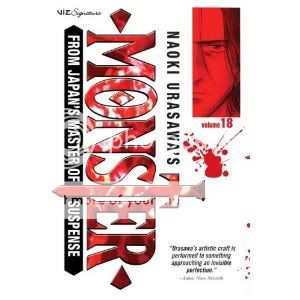
Naoki Urasawa’s Monster Vols. 6-18
Naoki Urasawa, writer-artist
Viz, 2006-2008
200+ pages each
$9.99 each

It’s not quite accurate to say that Monster got away from Naoki Urasawa in the end. Never–not as volume after volume of increasingly baroque hidden connections, repressed memories, and buried Communist conspiracies multiplied and refracted like a screensaver, not even as he added still more characters to a cast that already made The Lord of the Rings look like No Exit in Volume frickin’ 18–did Urasawa come across as anything but totally in control. Each time a new concept was introduced, I knew it would tie into someone or something we’d already met in a way that would nonetheless surprise and delight me. Each time a new character came along, I knew I’d be made to care about this new sad-sack with either a tormented past or an overdeveloped sense of right and wrong. Every twist made it clear I was in the hands of a master.
Yet for all that I knew Urasawa was making conscious decisions at every turn rather than running around frantically to keep all the plates spinning, I can’t help but feel that by the end, he’d made some bad decisions, spun some broken plates. First and foremost, remember when Dr. Tenma was the main character? Nominally I suppose that’s still true, as the final showdown with the titular character is with him. But by then you’re just as likely to be spending screentime with Grimmer, or Nina, or Eva, or Reichwein, or Lunge, or Gillen, or Verdeman, or even random characters who are in and out in the space of one volume like Martin or Milan or the people of Ruhenheim. (That I remember the vast majority of those names off the top of my head speaks well of the material, but still.) Without the singular, driving focus of the original concept– A doctor saves a little boy who grows up to be a serial killer and now must hunt him down–the story’s sprawl starts to pull it apart a bit, and the climactic confrontation is robbed of some of its weight.
Then there’s that confrontation itself. It’s distinguished by the strongest image in the series, a searing two-page spread that screams “instant classic.” And it undoubtedly brings to bear the full weight of the preceding 17 1/2 volumes of cat-and-mouse, before knowingly (if a wee bit over-familiarly) pulling the rug out from under the moment. The problem is that for, oh, four or five volumes leading up to that moment, it’s felt like one climax after another. I know this could be an artifact of the translation and adaptation process, but the dialogue really starts to feel artificially stretched out in the home stretch, with short sentences split between five panels across a full page in some cases just for dramatic impact. Of course, do that too often and the impact is dulled; do it for a quarter of your series and it starts to feel like a neurotic tic. Particularly given how many times this is done to depict a character reaching into the recesses of his or her memory and pulling out something dark and terrible but stopping just short of dragging it into the light for good, the repetition begins to grate, and to make it difficult to distinguish final revelations from teases.
That said, this stuff is as thick and engrossing as quicksand. The steady rhythm and rock-solid character designs are pretty much tailor-made for getting lodged in your head and replayed as you drift off to sleep at night–I for one had a pretty messed-up dream last night about my wife and I fleeing through a hospital from a monstrous child-thing. Several sequences are genuinely chilling: The standouts for me are the cruelty of a child who briefly fell under the tutelage of the title character, the dark storybooks of Klaus Poppe (beautifully drawn in a vastly different style; remember that storybook about the train in the Dark Tower series?), and the ending itself. I’m not sure how sold I am on the book’s constant waxing philosophical about good, evil, and the value of human life, particularly the hard line it makes Tenma take against killing even in immediate self-defense or the defense of others, given the track records of the characters he tends to be pointing his gun at in these situations. But at the same time, the material concerning the abuse of children, the mad ambitions of people with lots of power and little oversight, and the notion that secret, forgotten deeds committed in the name of defunct ideologies can reverberate indefinitely with disastrous consequences is all very effective. That last bit, it strikes me now, is symbolized by the sign of the long-gone Three Frogs pub that becomes so pivotal: An artifact that has outlived its artisans, a symbol that has outlived what it symbolized, yet which still has a potent ability to harm. From the high concept on down, Monster is a story of unforeseen consequences, which are often more awful than the awful things we meant to happen.
Carnival of souls
March 8, 2010* Here are the 2010 Oscar winners.
* Not Coming to a Theater Near You’s Stanley Kubrick retrospective is up to Lolita and Dr. Strangelove. Here’s a fine bit from the former by Katherine Follett:
In the novel, Humbert believed in his arrogance that lusting after a basically non-sexual girl was somehow the mark of a rare aesthete, as if he had an appreciation for inaccessible modern art, while adult women were the equivalent of banal, eye-pleasing landscapes. But now that Lolita has the body of an adult woman, and Humbert’s interior voice is nonexistent, we’re left with no special reason why Humbert is drawn to Lolita, other than ordinary–and totally understandable–lust.
Sue Lyon was a dime, obviously, but I still thought the film got “she’s too young” across effectively enough. Meanwhile, I enjoyed Timothy Sun’s take on Strangelove for how systematically it reminds us that American cinema’s greatest satire includes characters called Buck Turgidson, Jack T. Ripper, Merkin Muffley, and Major Kong.
* Dan Nadel on Jim Rugg & Brian Maruca’s Afrodisiac. Interesting point of comparison to Josh Cotter’s Driven by Lemons.
* Loving, loving, loving Zak Smith’s Playing D&D with Porn Stars. Here’s a killer pair of posts running down the pros and cons of the game’s Demons and Devils, and here’s a marvelous rumination on the way players flip back and forth between their in-game and real-world selves while playing. I mean, for real, I’m running out of superlatives.
* Recently on Robot 6: JMS as the third leg on the Grant Morrison/Geoff Johns footstool and Jared Stumpenhorst’s LOST 365.

* I’m starting to think it’s weird that trailers show you the entire plot of a movie. Like, this Iron Man 2 trailer leaves pretty much no surprises for the first three reels, right? But hey, War Machine.
Would you like to buy over 800 pages of Lee/Kirby Fantastic Four for eight bucks?
March 7, 2010The 848-page Fantastic Four Omnibus Vol. 1 hardcover, for $8.24. Act now, because I assume this price won’t last.
Tons more deals via Bully, but that one strikes me as particularly outrageous. (Via Ken Lowery.)