
Author Archive
‘True Detective’ Season 3 Is ‘Twin Peaks’’ True Heir
March 10, 2019When that one-eyed man popped up at Amelia’s book reading in “Hunters in the Dark,” disruptive and distraught, perhaps complicit in the central crime in some tangential way but seemingly remorseful and also very obviously disturbed by his own experiences, I didn’t think of the Black Lodge or the Red Room, Norma Jennings and Dougie Jones. I thought of Russ Tamblyn’s Dr. Jacoby, the eccentric psychiatrist who had an unethical relationship with his teenage patient, snapped when she was murdered, and wound up a conspiracy crank in the woods.
There are so many people like that in Twin Peaks, people driven to the margins of the idyllic small-town society by abuse, poverty, mental illness, drugs, or their own bad actions, never to return. Harry Dean Stanton’s Carl Rodd, wise and sad in his trailer park. Alicia Witt’s Gersten Hawyard, a onetime child prodigy clinging to her suicidal and abusive junkie lover. Lenny Von Dohlen’s Harold Smith, the shut-in with the lonely soul. Catherine E. Coulson’s Log Lady, whose prophetic gifts couldn’t save her from dying of cancer like anyone else. Addicts, adulterers, crooked cops, scheming hoteliers, lonely gas station operators.
Some are closely connected, in one way or another, to murdered high-school student Laura Palmer — herself pulled in a million different soul-damaging directions long before her murder and quite apart from the demonic forces feeding off her misery. Others have no connection at all except geography. All of them float around in the dark and icy waters of the American underclass. In Twin Peaks, Laura’s tragic murder is the crack in the ice that allows us to observe the sea of suffering underneath.
That’s what I think of when I think of True Detective season three, not Matthew McConaughey’s twitchy nihilism, nor Colin Farrell’s thousand-yard, eight-beer stare. Wayne Hays, Amelia Hays, and Roland West may well be the truest detectives we’ve met yet. But from Agent Dale Cooper on down, not even the best investigators have ever truly seen an open-and-shut case, one they could comfortably solve and file away forever. The forces that made life so hard for the Purcells and the people around them, that empowered their community’s worst elements and discarded otherwise decent people like corpses at a crime scene, will be there even if Will and Julie’s attackers are taken down once and for all. Who killed Laura Palmer?was the start of a discussion about what we do in the face of endemic pain and injustice, not the end of it. If True Detective season three wraps up with the same strengths it has displayed so far, it will ask a similar question, and offer just as challenging an answer.
“True Detective” thoughts, Season Three, Episode Eight: “Now Am Found”
March 10, 2019It wasn’t the flashiest season of True Detective, or the scariest, or the trippiest. It was the simply the best.
I reviewed the season finale of True Detective for Rolling Stone. This was a really good show.
“True Detective” thoughts, Season Three, Episode Seven: “The Final Country”
March 10, 2019But there’s one more revelation to discuss … and it’s a doozy. Elsa Montgomery, the documentarian interviewing Wayne in 2015, directly connects his case to the one pursued by — you guessed it — Rust Cohle and Marty Hart, who we even get to see in a newspaper clipping. Isn’t it possible, she wonders, that both crimes were part of a massive conspiracy between rich and powerful child molesters? One in which key witnesses were repeatedly killed or mysteriously disappeared to keep the cops from getting to the truth?
How much hay should we make of the now 100-percent confirmed links Seasons One and Three? Not much, most likely. Note that Elsa claims the “crooked spiral” iconography associated with the Rust and Marty case served as a calling card for the elite pedophile ring. But that particular symbol was spread by Errol Childress — an impoverished, illegitimate, extremely mentally ill offspring of the powerful Tuttle family that really ran the show. Presenting the fancy true-crime director as well-intentioned but incorrect gets right down to the notion of: Can even the most educated investigators, whether they’re detectives or writers or filmmakers, ever really know what happened?
I reviewed the penultimate episode of True Detective Season Three for Rolling Stone.
“True Detective” thoughts, Season Three, Episode Six: “Hunters in the Dark”
March 10, 2019But forget, for a second, the series’s first two divisive seasons and their maddening whodunits. True Detective Season Three has turned into a show about how a single, central crime spreads like a spiderweb into a whole host of small-town sins. Racism and sexism, poverty and class warfare, sexism and homophobia, addiction and religion: They all play a part here.
Even as old men, Wayne and Roland may eventually discover the truth beneath it all. But maybe the point is that some mysteries of the human heart are simply too big to solve.
“True Detective” thoughts, Season Three, Episode Five: “If You Have Ghosts”
March 10, 2019What makes this not just ironic but fascinating is that Hays and West are easily the least weird, least corrupt, least abusive protagonists that showrunner Nic Pizzolatto has created yet. They like each other. They’re capable of long-term romantic relationships with intelligent women who have lives of their own (even if those relationships eventually end). They’re dedicated to solving the case, even if it means defying the higher-ups. Sure, they’re gruff and have a tendency to play bad cop/bad cop when interrogating suspects, but it’s nothing you haven’t seen in like two dozen Law & Order characters. You could even say that they are [drumroll] … true detectives!
And yet the case is as much of a mess as the hunt for the Yellow King. Why?
The answer is rooted in the previous seasons, and not because of various subreddit-worthy clues indicating they occur in a shared universe. Whether Matthew McConaughey or Rachel McAdams were in the lead, those stories left the power players behind their central crimes untouched, even if individual mysteries got solved.
You don’t need to believe in Carcosa to understand that there are evil forces at work in the world that no murder investigation can eradicate. Poverty, race, class, alcoholism, political corruption, misogyny, people just plain being shitty — they all conspired to commit this crime. Catching the killer won’t stop any of those factors from destroying more lives. Not even a keen-eyed Vietnam War tracker and his trusty by-the-book companion can stop that destruction. The best they can hope for is to preserve the peace, along with some of the pieces.
I reviewed episode five of True D S3 for Rolling Stone. By now it’s become clear that Nic Pizzolatto has a very firm grasp on this material.
“True Detective” thoughts, Season Three, Episode Four: “The Hour and the Day”
March 10, 2019The thornier material here centers on Tom and Lucy Purcell, the estranged alcoholic parents of the murdered boy and missing girl. When Roland picks up the former from a bar where he picked a fight with a man that his wife slept with, he spits out the n-word to describe Hays; the black cop’s assignment to the case, he claims, proves that no one’s taking it seriously. But when West sticks up for his partner, saying he’s the best detective on the job, Tom apologizes, immediately and repeatedly — and digs deep into his own despair.
“I can’t be in that house, man,” he says, sounding like a broken man even before he adds, “I just wanna die all the time.” It’s an absolutely heartbreaking performance from Scoot McNairy — the fact that it begins with a racial slur and ends with him begging the cop not to reveal his shameful bigotry only makes it more so.
This is doubly true of Lucy, whom Amelia visits. The moment the teacher offers a shoulder to cry on, the grieving mom unleashes a torrent of self-loathing. “I’ve got the soul of a whore,” she says, lamenting her neglect of her kids. Her pain takes the form of rhetorical questions: “Children should laugh, right?” And: “What kind of woman hates the only things that ever showed her love?” Wishing she had the courage to use her gun on herself, she begins just straight-up bawling and howling “God forgive me.” Actor Mamie Gummer is so convincing here you want to cover your ears.
But when she takes poorly to her visitor’s suggestion that she reach out to Wayne with any information she might not have previously revealed, an entirely different sort of pain starts pouring forth. She immediately turns on the teacher, exploding in a sudden fireball of racist invective so intense that her visitor almost runs from the house. Anyone who says suffering is somehow ennobling is clearly fooling themselves.
“True Detective” thoughts, Season Three, Episode Three: “The Big Never”
March 10, 2019The real difference now is that the dialogue and performances line up with the relatively linear plot. Mahershala Ali, Carmen Ejogo and Stephen Dorff may play characters tied to a major crime investigation, but other than that they act like normal people. They drink a bit too much when they want to have a good time, or when they want to forget bad ones. They fall out of touch when they take different jobs (“Once we stopped working together, we just … stopped,” as Roland puts it) but are happy to reunite. They complain about the size of big-box stores, racial disparities in the state police, whether or not they spend enough time with their kids. West even holds Tom Purcell’s hand to pray as part of the recovering alcoholic’s surrender to his Higher Power. It’s hard to imagine Marty Hart or Ray Velcoro doing anything of the sort. Never mind the flat circles of time; what you’ve got now is a True Detective that’s shooting straight instead of weaving spirals.
I reviewed episode three of this straightforward season of True Detective for Rolling Stone.
069. The Third Rule, Verse 3
March 10, 2019“This is the new Double Deuce,” says Frank Tilghman. We are at the start of an all-hands staff meeting, and Tilghman is pointing to the concept art for the bar’s redesign. But standing nearby is his latest hire, Dalton. It is through Dalton, with Dalton, in Dalton that the new Double Deuce will be achieved. Dalton embodies the new Double Deuce. He is its future.
When Dalton takes over as cooler he becomes more than just the chief bouncer. His role is not to handle a series of discrete incidents, but to institute sweeping reforms that will eliminate such incidents forever. “It’s going to change,” he states—not a threat, not a promise, a fact. His bouncers, too, must change for this to take place. As below, so above.
Bouncing on the Dalton Path is a matter of following “three simple rules.”
This, once more, is the third.
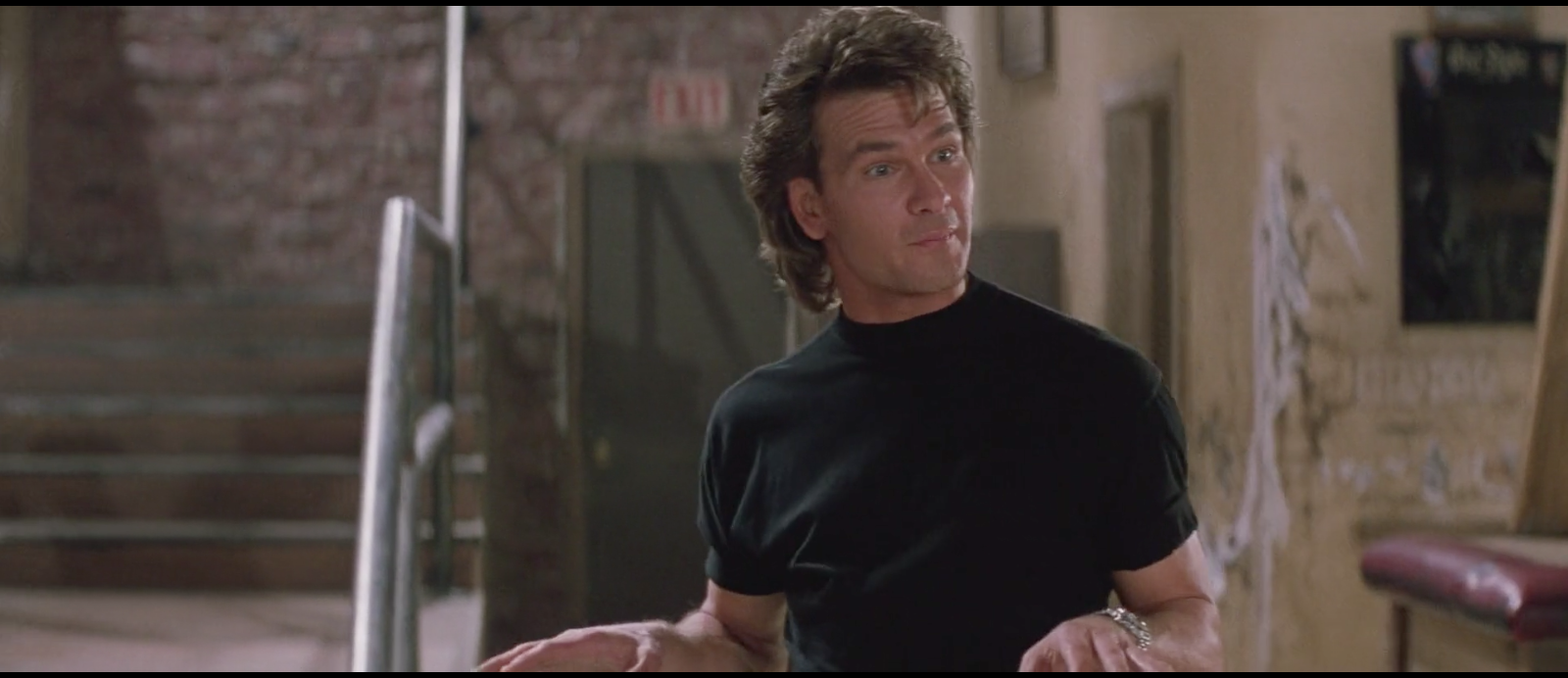
3. Be nice. (continued)
We’ve established the Third Rule’s Great Commandment, and we’ve examined its combination of theory and praxis. Today’s lesson follows closely in the latter’s footsteps. Almost literally, insofar as it’s about walking.
You’ll recall that the previous lesson introduced the parable of the man who gets in your face and calls you a cocksucker. In the lines that follow, Dalton continues the story. “Ask him to walk,” he advises his bouncers regarding such a person, “but be nice. If he won’t walk, walk him, but be nice. If you can’t walk him, one of the others will help you, and you’ll both be nice.”
By now his voice is pleasant, almost cheerful, the “it’s my way or the highway” edge to it long gone. It stands to reason, since the whole point of this passage is that neither he nor anyone else need walk his way alone. You can do so side by side, arm in arm, perhaps even hand in hand. Indeed his delicate double-handed gesture when he says “and you’ll both be nice” suggests nothing so much as a pair of children playing “Heart and Soul” together on the piano in the school music room.
This is the least difficult portion of the rules so far from which to glean the hidden moral instruction beneath the practical element. By way of comparison, eep in mind that “turn the other cheek” was as literal as it gets, at least within the context of the sentence in which Jesus introduced the concept: You get socked in the side of the face, you offer up the other side too. Yet hundreds of millions of people over thousands of years had no trouble figuring out what he was getting at.
I’d like to think that Jack, Hank, and Younger understand that Dalton is talking about more than just the problem introduced by Hank at the start of the Giving of the Rules: “A lot of the guys who come in here, we can’t handle one-on-one, even two-on-one.” Aiding a fellow bouncer in the ejection of a particularly recalcitrant or powerful patron is important. Even reiterating that the purpose of bouncing is to bounce the patron out of the bar, not bounce his head off of it, is important. But is “If he won’t walk, walk him,” so far removed from “it was then that I carried you”? Is “one of the others will help you” so different from “For where two or three are gathered together in my name, there am I in the midst of them”? Seeing yourself as part of a whole that includes the patrons, the bouncers, and the bar—that is the key that unlocks the new Double Deuce, the nice Double Deuce, a house with many mansions. When you walk through the storm, hold your head up high, and don’t be afraid of the dark.
068. “Opinions vary.”
March 9, 2019Morgan: “You know, I heard you had balls big enough to come in a dump truck, but uhh…you don’t look like much to me.”
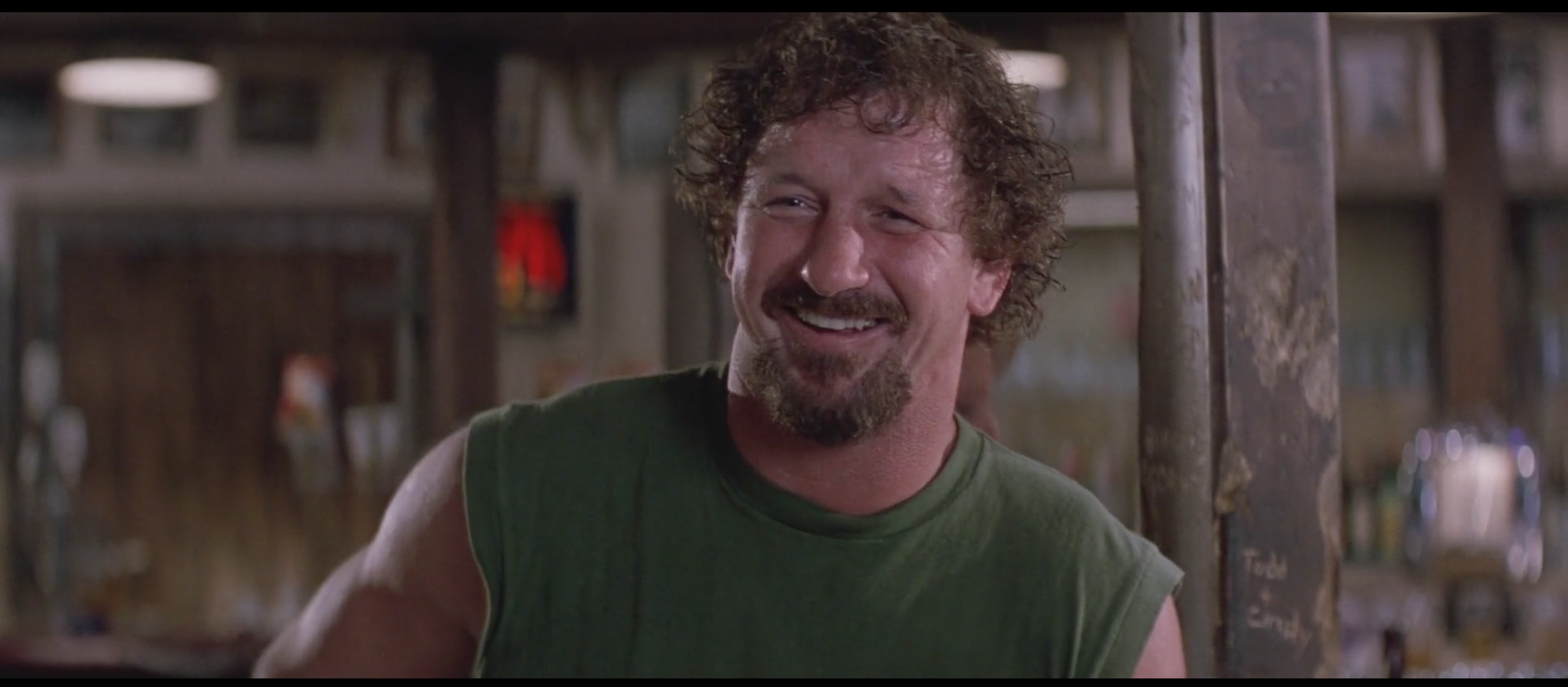
Dalton: “Opinions vary.”
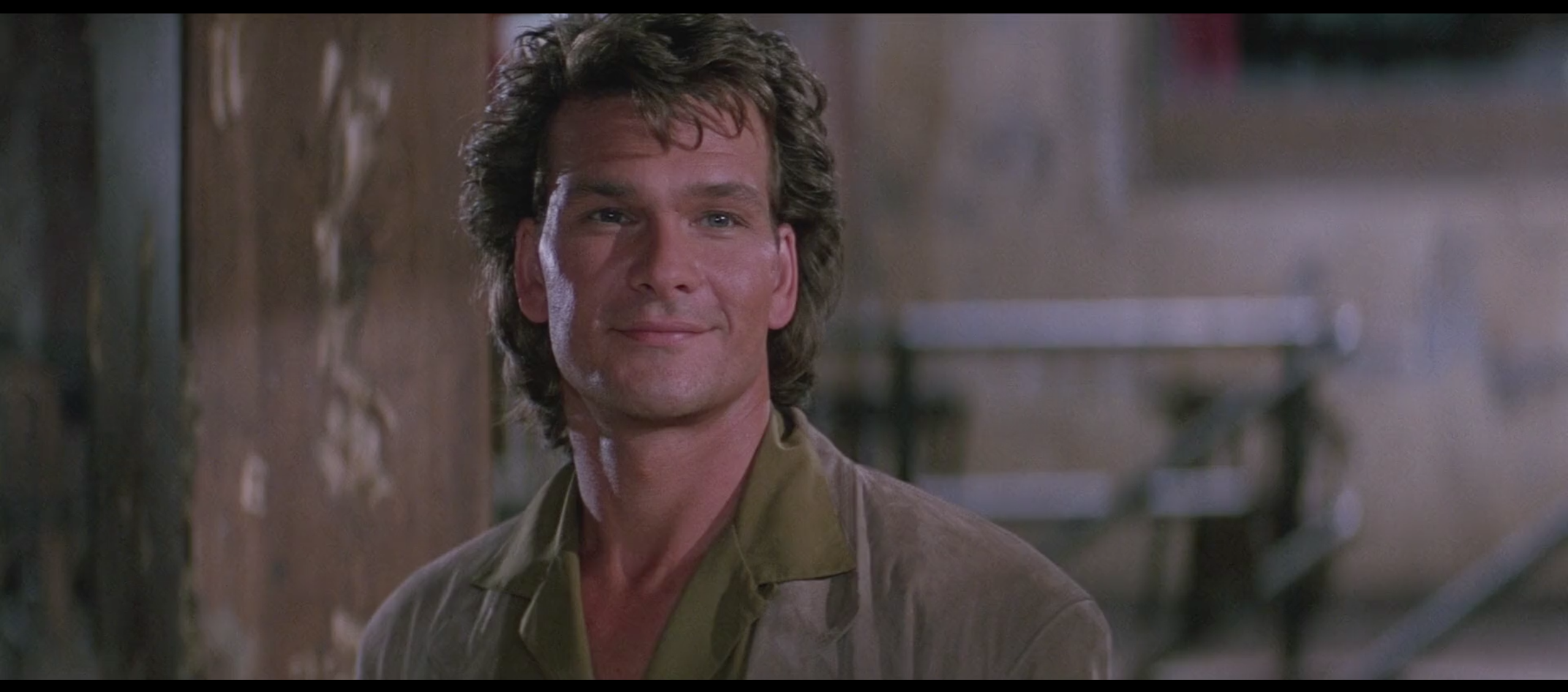
Morgan: […]
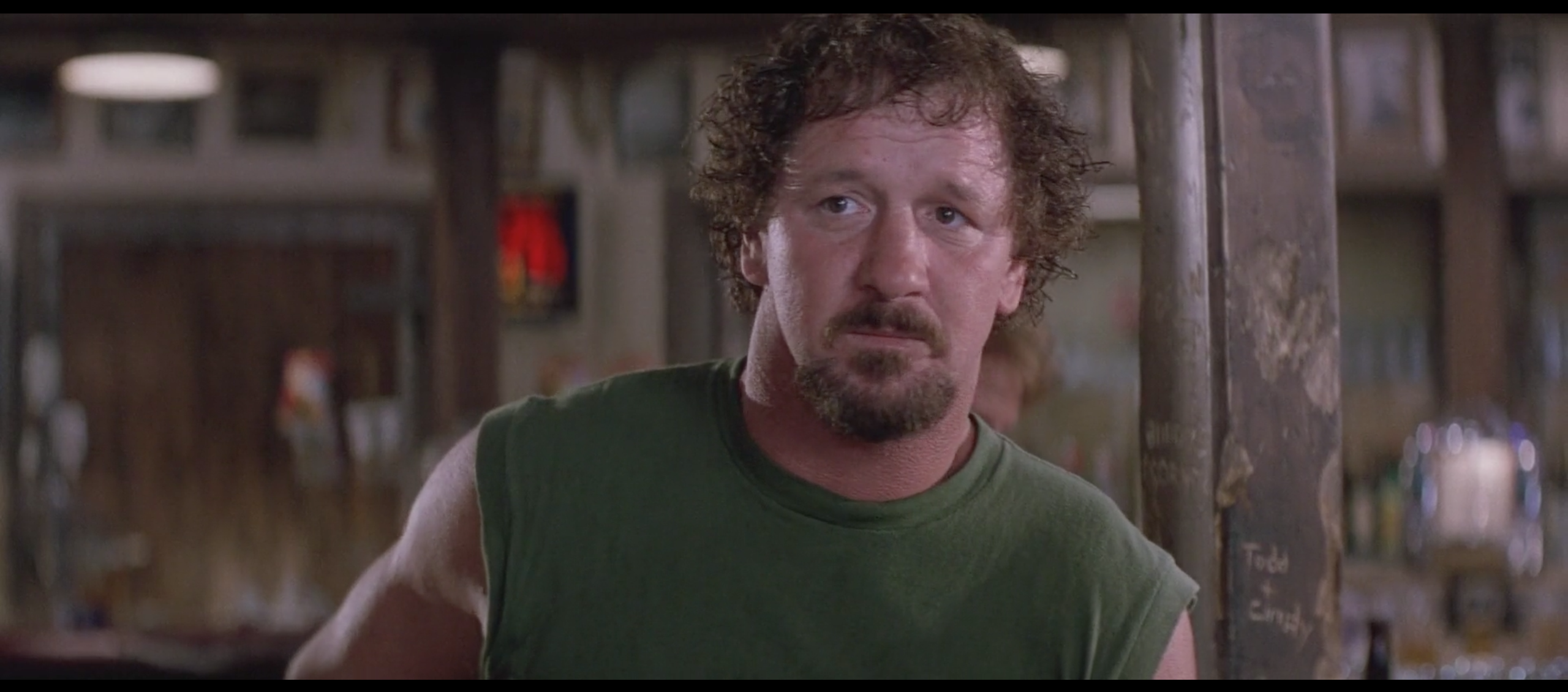
Morgan does not have the right temperament for the trade, but he does know a threat when he sees one. To a fault, perhaps. His biggest fault as a bouncer, aside from working for the local crimelord, is that he exists in a permanent state of bouncing. To Morgan, every customer is a peckerhead who’s been slugged in the gut and physically thrown through the front doors into the parking lot—they just don’t know it yet. Morgan’s great task in life is to be the one to inform them, with his fists. Witness the first thing he says to Dalton: “And if you’re not drinkin’, you’re outta here.” This is just after he ejected Mister Nipple to Nipple, and in the process upended a table and sent several perfectly pliant patrons of the establishment ass over elbows to the ground. You’d think he’d have bigger fish to fry, but no: The silent stranger with the magnificent head of hair is another threat waiting to be neutralized. Morgan is a preemptive strike in a sleeveless green t-shirt. Existing in this state of constant certitude—that everyone’s an asshole but you, and that it’s your job to pound that knowledge into them—makes Morgan ill-prepared to brook even the slightest dissent.
Witness the above exchange after Dalton’s first night visiting the Double Deuce. Morgan has just participated in a bar-wide fight that leveled nearly everyone and everything in its path; Dalton sat the whole thing out, observing from a distance and then meeting in Tilghman’s office for an off-screen tête-à-tête. So perhaps Morgan’s skepticism about Dalton’s martial prowess is warranted, though expressed it a needlessly condescending way.
To his credit, Dalton doesn’t even disagree with him, not explicitly. He neither confirms nor denies whether his balls are big enough to come in a dump truck, or whether he looks like much, or whether he is much. All he says is “Opinions vary,” and that’s enough to transform Morgan’s whole affect to a comical degree. (Terry Funk is a perform accustomed to playing to the cheap seats, after all.) He goes from a smirking prick to a puppy who just heard “Bad dog!” within about one second, all because Dalton suggested that points of view exist besides Morgan’s own. That’s it, that’s all it takes. If Dalton had walked right up and cold-cocked him it would have had less of an impact.
Aside from Dalton and Wade Garrett themselves, Morgan is by all appearances the most experienced bouncer in the film. Not for him, the Dalton Path. Not for Morgan, the Way of Wade Garrett. The Morgan Idea holds that Morgan is the master of everything and decides everything. Dalton’s simple statement that this is not so strikes at the man’s very soul; by resisting he has signed his own death warrant. That dump truck is barreling down the road toward him at 100 miles an hour, loaded for bear with Dalton’s balls, and he is constitutionally incapable of getting out of the way until he kisses the grill.
Netflix’s Bright Future Looks A Lot Like Television’s Dim Past
March 9, 2019In 1995, the Emmy nominees for Best Drama were Chicago Hope, ER, Law & Order, NYPD Blue, and The X-Files. In 1996, the Emmy nominees for Best Drama were Chicago Hope, ER, Law & Order, NYPD Blue, and The X-Files. In 1997, the Emmy nominees for Best Drama were Chicago Hope, ER, Law & Order, NYPD Blue, and The X-Files. That is: two cop shows set in New York, two medical shows set in Chicago, and some aliens, spread across four networks, represented the height and breadth of the art form for three years running.
In 1995, the Emmy nominees for Best Comedy were Frasier, Friends, The Larry Sanders Show, Mad About You, and Seinfeld. In 1996, the Emmy nominees for Best Comedy were Frasier, Friends, The Larry Sanders Show, Mad About You, and Seinfeld. In 1997, the Emmy nominees for Best Comedy were Frasier, 3rd Rock from the Sun(surprise!), The Larry Sanders Show, Mad About You, and Seinfeld. Three shows about neurotic well-off New Yorkers, one show about neurotic well-off Seattleites, Garry Shandling, and some (other) aliens, concentrated almost solely on NBC with one lone outlier represented the height and breadth of the art form for three years running.
By 1999 that lone outlier was airing The Sopranos and Sex and the City, and the story from there is familiar to pretty much everyone. The Wire and Deadwood, Mad Men and Breaking Bad, HBO, AMC, FX, DVDs, DVRs, the New Golden Age, new voices, shorter seasons, higher standards, bigger stars, superstar showrunners, more choices, the widely pronounced death of monoculture and the waning of the Big Four broadcast networks—an embarrassment of riches, an art form in its ascendancy at last.
In this quest-narrative of progress through increased options, streaming services were supposed to toss the One Ring of monoculture into Mount Doom for good. They’d offer virtually limitless viewing options. They’d enable viewers to cut the cord that bound them to cable and broadcast networks, allowing those viewers to watch those endless options whenever and wherever they wanted. When the biggest of those services, Netflix, entered the original-programming fray in earnest, it kicked off the arms race of production known as Peak TV. In this content-rich environment, creating a culture-unifying hit is a war for the throne that only one or two shows could win, but finding the right show for your personal subculture of one was easier than ever. No more TGIFs, no more Must See TVs: Television was the art form of the future, and Netflix was the future of television, and the future was here at last.
And now we know what it looks like. In 2018, 14 of Neflix’s top 20 shows, and all 10 of its top 10 shows, were broadcast-network reruns. Friends, which received its first Emmy nomination while Bill Clinton was president, is number one.
067. Table dancer
March 8, 2019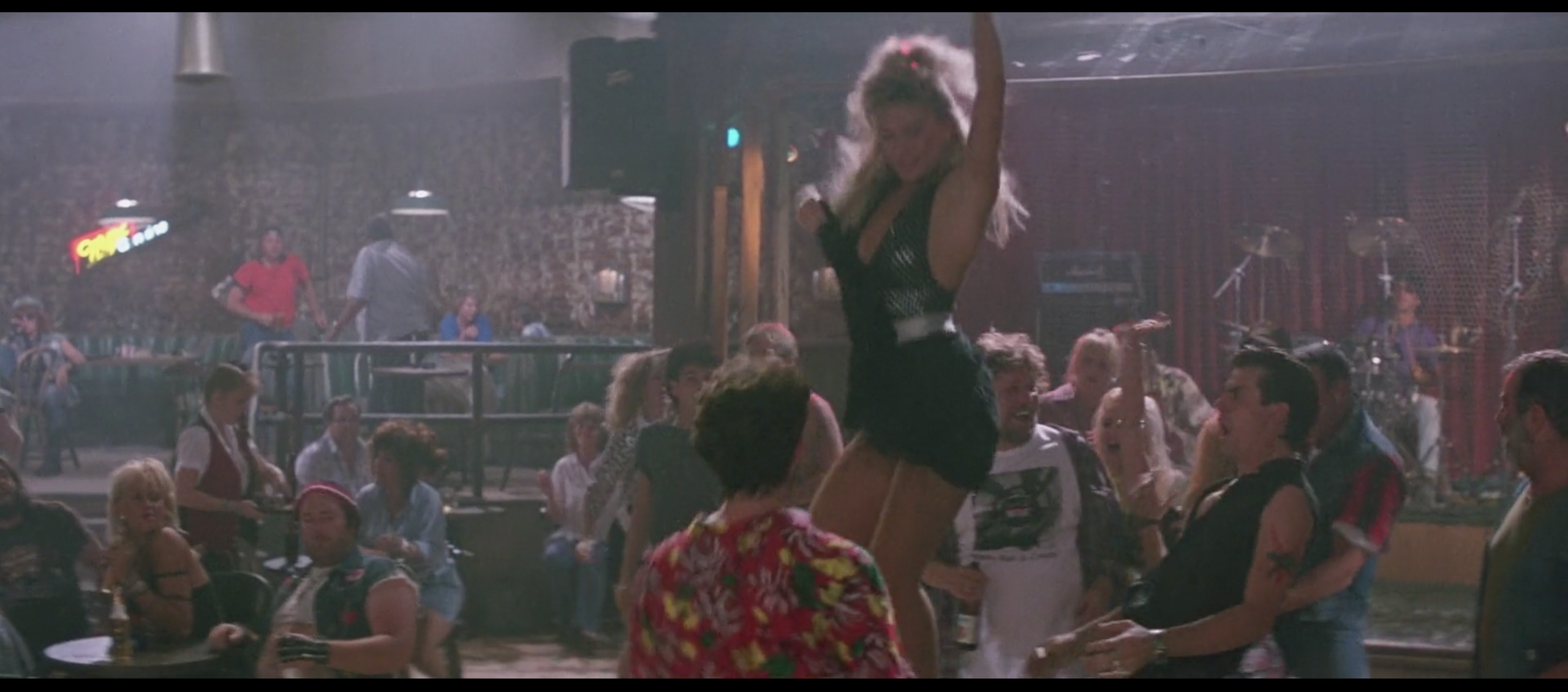
“We don’t cause trouble, we don’t bother nobody.” Few of the barflies whose acquaintance either we or the staff of the Double Deuce have the good and/or mis fortune of meeting adhere to Rick the Ruler’s public proclamation of good behavior as closely as Table Dancer. Played by Sylvia Baker, she’s the character who dances on a table. Here are things that, based on the conduct of other barflies in the film, she could reasonably be expected to do instead:
- Pull a knife and threaten to stab someone at a moment’s notice
- Pull a knife and attempt to stab someone at a moment’s notice
- Pull a knife and actually stab someone at a moment’s notice
- Agree to grope a woman’s breasts for money without actually having the money
- Wallop the shit out of someone who groped a woman’s breasts for money without actually having the money
- Offer her breasts to be groped for money without first doing due diligence
- Have a fistfight on the floor with a sibling
- Propose getting nipple to nipple
- Lob a beer bottle at a blind man’s head because he says he has to urinate
- Laugh like an imbecile
- Drink until incapacitated
- Have sex with an employee in the storeroom
- Be part of a team sent by a local businessman to assassinate a bouncer
- Not wear a shirt
- Purchase and snort cocaine, though somehow not in that order
- Deface the walls with vulgar graffiti
- Locate the vehicle of a bouncer, slash all its tires, break its radio antenna, smash its windshield, and shove an entire stop sign through the window
- Say “dirtball” or “moose-lips”
- Wear a very loud shirt
All Table Dancer wants to do is gyrate spasmodically on a table to the Jeff Healey Band, occasionally lifting her skirt to show that her silver-black bodysuit goes all the way down. It’s her rat-faced boyfriend who decides this is worth committing murder in a room full of witnesses for, not her. She doesn’t even get upset when Dalton rams her boyfriend’s skull through furniture solid and steady enough for her to dance on. She’s just like “Oh! Party’s over I guess” and takes Dalton’s extended hand to climb down off the table, then looks him over like the snack he is as she leaves.
Table Dancer represents the joie de vivre to which the rest of the film’s barflies should aspire. Would Dalton have been so quick to send Hank in to break up the party if this were the worst of the behavior one could expect of the Double Deuce’s clientele? I think not. She falls victim to broken-windows policing more than anything else, like how Giuliani used to shut down all the clubs where black people went to listen to hip-hop to make the city safe for oligarchs, somehow. Am I saying Dalton gentrified and Disneyfied the Double Deuce?
Am I?
066. Frank Tilghman’s fist
March 7, 2019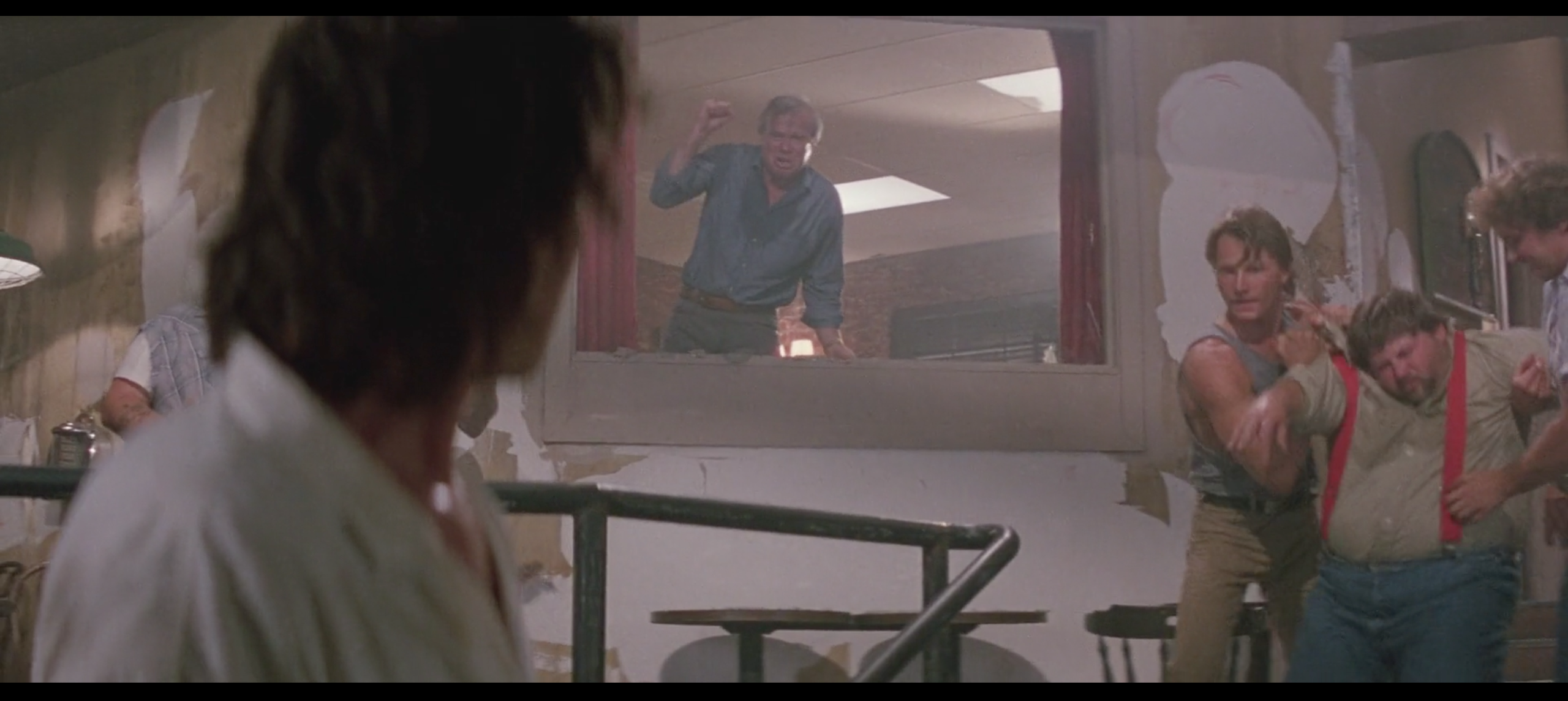
One thing I never noticed before starting this project, one thing I never noticed before tonight in fact, one thing I never noticed despite watching Road House dozens of times over the course of nearly fifteen years, is that when Brad Wesley’s goofiest goons, Tinker and O’Connor, come to the Double Deuce with Wesley’s nephew Pat McGurn to force Frank Tilghman to overrule Dalton’s decision to fire Pat under threat of physical harm and the cessation of liquor shipments to the bar due to Wesley’s control over distribution in the Jasper, Missouri metropolitan area, and Dalton expresses skepticism about the idea, and Pat almost instantly loses his fucking mind and attempts to slice Dalton open with a knife the size of a Little League baseball bat, and Dalton breaks his nose and tosses him through a plate glass window, and O’Connor assaults him and they both go tumbling through the place where the window used to be, and they fall first to a raised dais and then make their way to the main floor below after O’Connor bumrushes him over the railing, and Dalton pounds the crap out of him and eventually beats him unconscious, and doesn’t even bother to deliver a coup de grace, just kind of holds O’Connor up by his jacket for a moment and then drops him to the ground in disgust, and meanwhile Tinker, who during Dalton and O’Connor’s initial fight in Tilghman’s office punched Tilghman in the gut and then sliced Dalton open with his own knife and then punched Dalton in the face before Dalton kicked him in the chest for leverage to thrust himself and O’Connor through the window, meanwhile Tinker he suckerpunches Younger when he rushes through the door to see what’s going on, but then Hank comes in to help and he and Younger incapacitate Tinker and punch him in the gut while holding him still which is the kind of thing villains do but all’s fair in bouncing, and as Jack and Hank and Younger drag the punchdrunk bodies of their enemies through the bar and presumably to the exit, and Dalton is all covered in sweat and blood and getting ready to head out the back door and go seek medical attention, Tilghman, you remember him, Tilghman staggers over to the broken window and makes eye contact with Dalton and raises his right fist in a gesture of triumph and solidarity that’s one of the most ridiculously obsequious things Tilghman does in the whole movie, which in the parlance of our times puts it in the running for most ridiculously obsequious thing worldwide, I mean Tilghman contributed nothing to the fight, he just got winded by Tinker until he was rescued by the other bouncers, but there he is, small business owner, vicariously victorious in his non-worker role, and Dalton gazes into the fist of Frank Tilghman, as he raises that five-sided fistagon, as the bodies get dragged away.
065. “He killed a guy once. Ripped his throat right out.”
March 6, 2019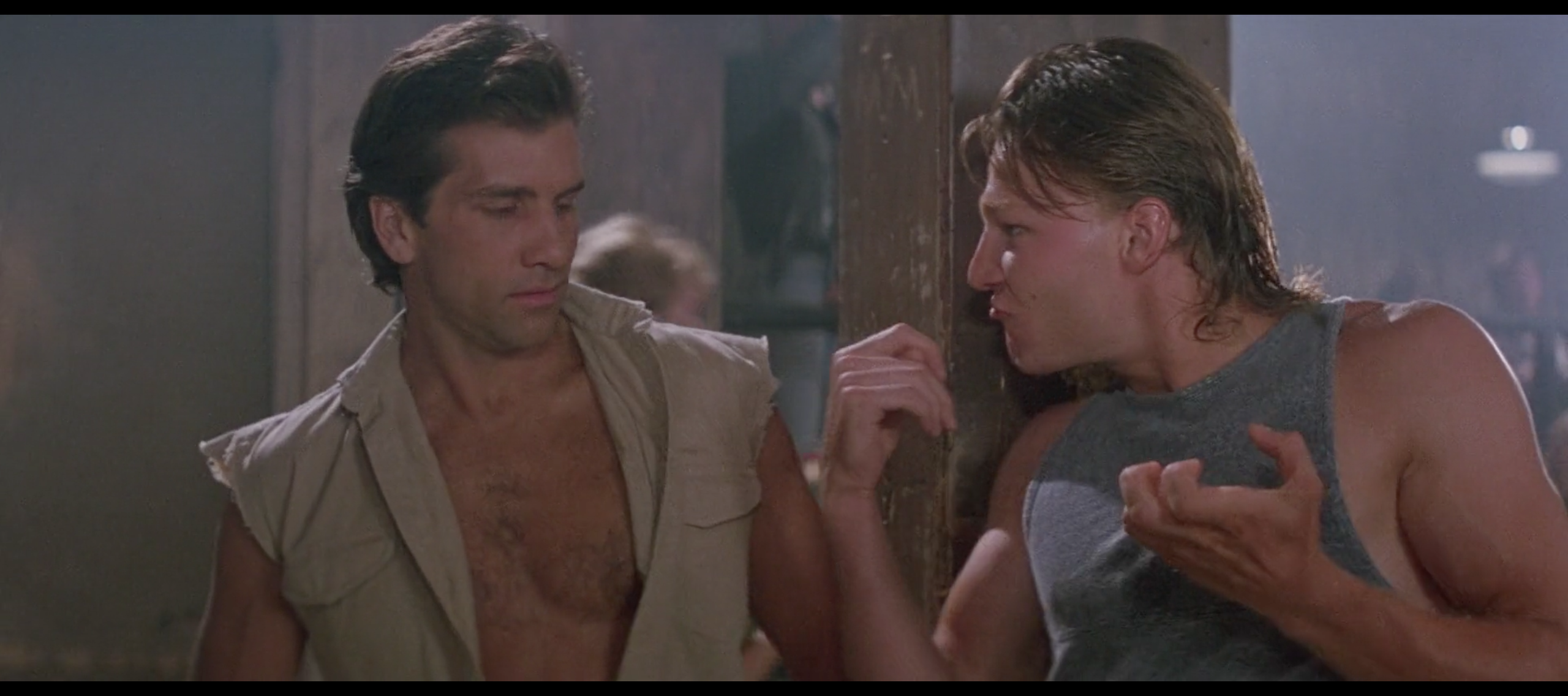
When Frank Tilghman traveled to New York (City?) to hire the (second) best damn cooler in the business and also cast humorous aspersions on the size of his penis, we in the audience pretty much had to take his word for it. Dalton has great hair, a great body, a cool as ice demeanor, the ability to dupe Knife Nerds into leaving a bar of their own volition, and the stomach to stitch up his own knife wounds, yes. But actual bouncing? No evidence of that just yet, much less enough to decide that this lion-maned man is a one-man army in a throwdown.
Conveying just what Dalton is capable of in the clutch (literally) falls to Hank, the Double Deuce’s resident Dalton fanboy. When Dalton first arrives and word of his identity gets around—he tells Carrie Ann and Pat McGurn overhears and thus the legend is spread—the bar’s staff are all aflutter, some with excitement, some with skepticism, some with…whatever emotion covers “shit, I’m not going to be able to steal from the cash register/beat up patrons at random so easily anymore.” Hank is on the excitement end of the spectrum.
“He killed a guy once,” Hank tells his fellow bouncer Horny Steve as they lounge against a wooden post while wearing what would, if combined, amount to nearly one whole shirt. Hank shoots his left arm forward across their bodies, then pulls it back hard, raking his clawed fingers against the air just in front of Steve’s neck. “Ripped his throat right out,” he explains. He sounds like he’s talking about Regina George.
Our man Steven is unconvinced. “Bullshit,” he replies, only he pronounces it in that great movie-hardass way: “Bull shit,” two words, like the t-shirt the kid wears in The Jerk. And for all we know, Steve has the right of it. The way people have carried on about Dalton in this movie so far, there’s no telling what he’s actually capable of on the one hand, and how much his reputation has been exaggerated by the awestruck barfolk of the world. After all, Carrie Ann the extremely cool waitress recognizes his name instantly and reacts like she’s just realized she’s been making small talk with INXS’s Michael Hutchence. People are bowled over by this dude.
Also, and I think this is crucial to understanding a lot of what goes down in the first act of the film, nearly everyone we meet is very stupid. Dalton’s not and Tilghman’s not, that much is clear. But by the time the film hits the 15-minute mark, a grand total of nine words longer than two syllalbes, and zero words longer than three, have been uttered; of those nine, one is “peckerhead” and another is “attitudes.” It’s not difficult to imagine convincing Hank here that Dalton is bulletproof.
But even an extremely dumb clock tells the right time twice a day.
“Suburra: Blood on Rome” thoughts, Season Two, Episode Eight: “Tell Me the Truth”
March 6, 2019The dumb handsome dirtbags. The heart-on-sleeve performances by the actors (Alessandro Borghi, Giacomo Ferrara, and Eduardo Valdarnini) who play them. The action, romance, tragedy, and extravagant cynicism. The lush lighting, lavish scenery, aching score, and sharp cinematography. The use of betrayal, backstabbing, and devastating shocks—crime-fiction staples all, for obvious reasons—as ways to explore their polar opposites: love, loyalty, and the natural human desire to be able to depend on others, and to be depended on in turn. Everything good about Suburra: Blood on Rome in general is good about its second season finale in particular.
Indeed, the rapid clip at which gobsmacking, heartwarming, and heartbreaking developments take place in “Tell Me the Truth” make this that rarest of beasts: a Netflix season that should have been longer.


I reviewed the season finale of Suburra: Blood on Rome Season Two for Decider.
“Suburra: Blood on Rome” thoughts, Season Two, Episode Eight: “Tell Me the Truth”
March 6, 2019The dumb handsome dirtbags. The heart-on-sleeve performances by the actors (Alessandro Borghi, Giacomo Ferrara, and Eduardo Valdarnini) who play them. The action, romance, tragedy, and extravagant cynicism. The lush lighting, lavish scenery, aching score, and sharp cinematography. The use of betrayal, backstabbing, and devastating shocks—crime-fiction staples all, for obvious reasons—as ways to explore their polar opposites: love, loyalty, and the natural human desire to be able to depend on others, and to be depended on in turn. Everything good about Suburra: Blood on Rome in general is good about its second season finale in particular.
I reviewed the season finale of Suburra: Blood on Rome Season 2 for Decider.
064. I Thought You’d Be Bigger Vol. 1: Tilghman
March 5, 2019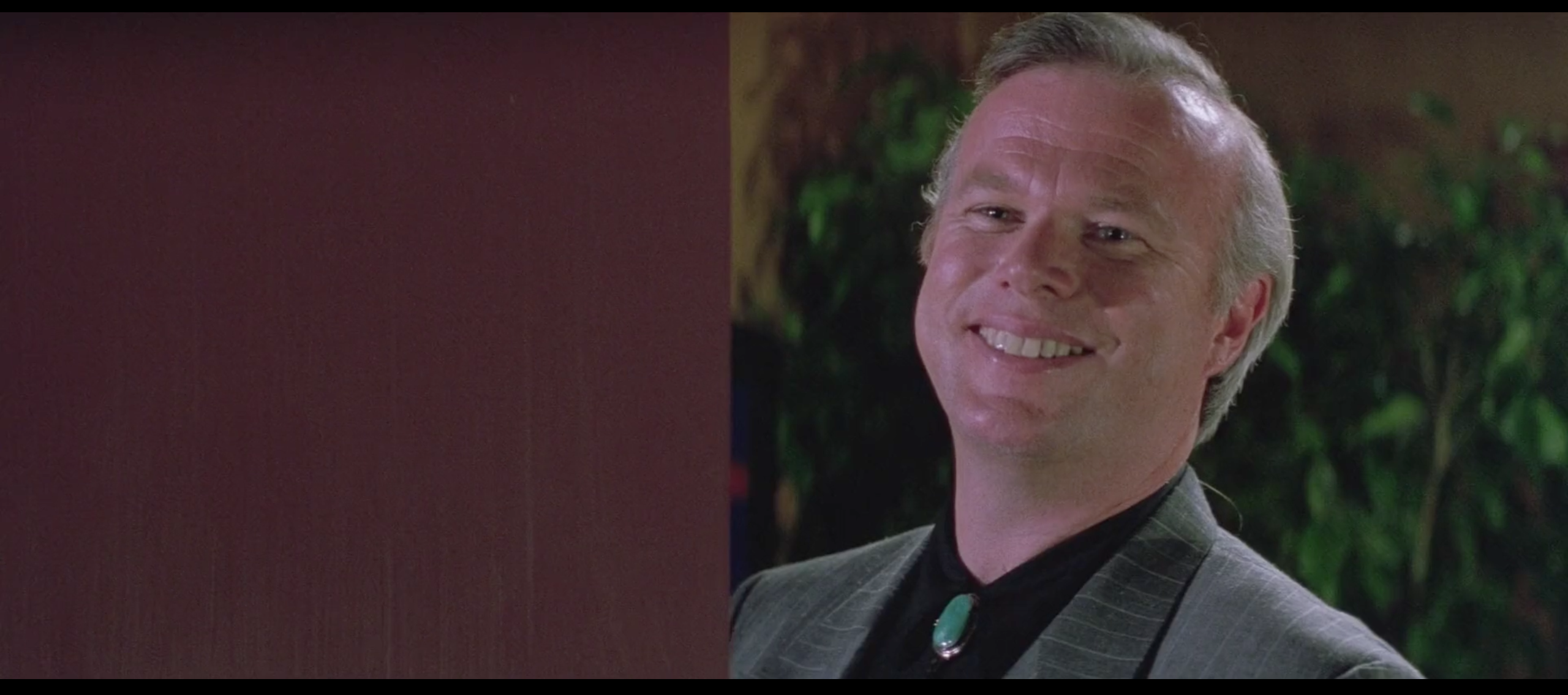
At the end of their first encounter Frank Tilghman tells Dalton “I thought you’d be bigger.” This is Road House‘s primary recurring joke; you’ll hear it two more times from two other people. It’s probably swiped from everyone telling Snake Plissken “I thought you were dead” in Escape from New York, for what it’s worth. It’s a groaner, and it’s endearing in its groanerness over time.
It is also a weird thing to say to someone you just met. It’s a weird thing to say even if they’re a person whose job is usually associated with being of a certain size. Imagine meeting a professional wrestler or basketball player and saying that: You can picture the mechanical smile and hear the canned response already, right? Because chances are it’s not the first time the person in the job usually performed by a bigger person has been made aware that they are, comparatively speaking, smaller. It’s more likely that they’ve thought about this for literally decades, like since they were in first grade, than that this charming bit of banter will catch them delightfully unawares.
Frank Tilghman is a weird guy, though, whether by design or by Kevin Tighe’s inability to play him any other way. (A reader I’ve since argued with because I think it’s more likely Steven Spielberg has cinema’s best interests at heart than Netflix does suggested he auditioned for the Brad Wesley part, got Tilghman instead, and simply decided to play the role as Brad Wesley anyway, and it’s a damn good theory.) If you could dress a leer up in a bolo tie, that’s Frank Tilghman. He looks like a police sketch based solely on an eyewitness saying “He was some kind of pervert.” If you can watch him during the opening of this movie and not assume he’s the villain of the piece, I think that constitutes a Turing test failure.
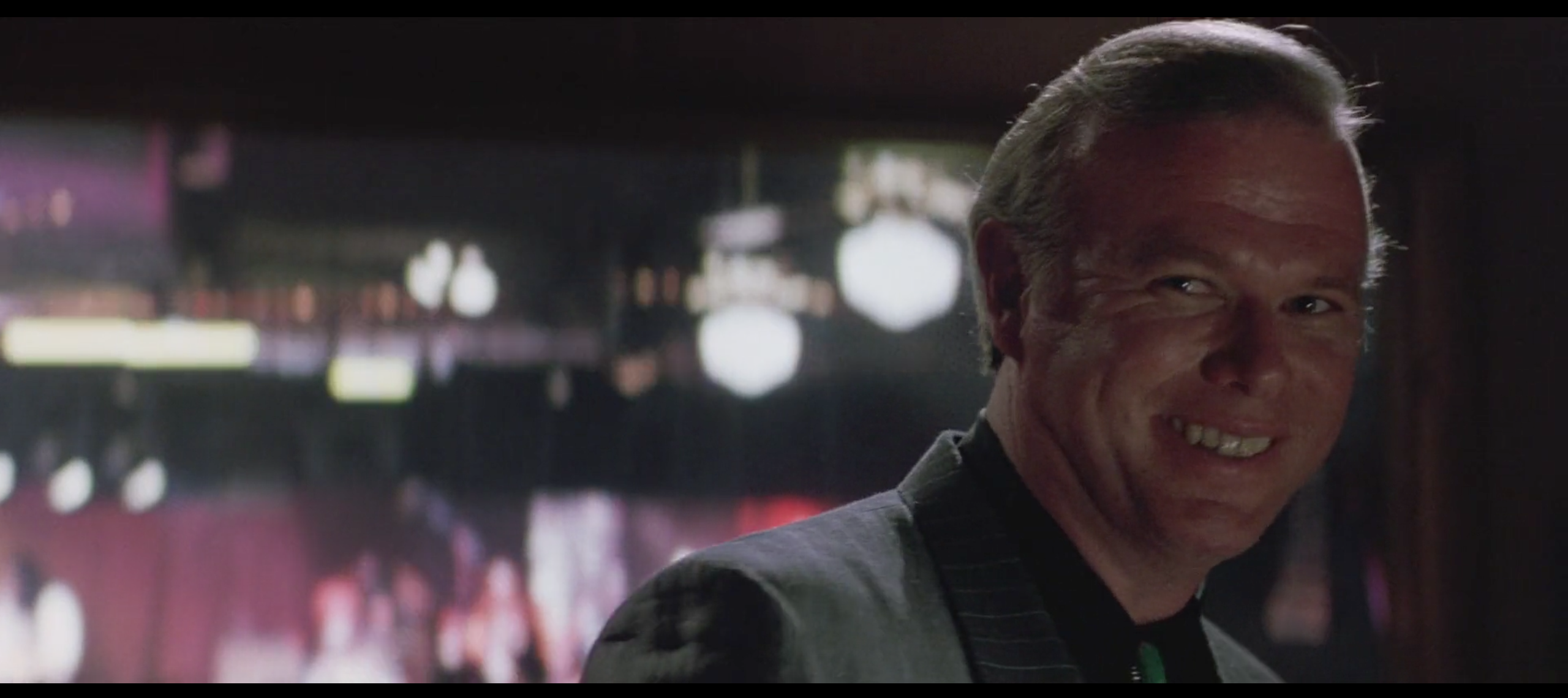
Nevertheless he is one of the good guys, he has no ill intent toward Dalton, at no point does he do anything to antagonize or undermine or bamboozle or even overtax Dalton during his employment at the Double Deuce. This only makes “I thought you’d be bigger” even weirder.
Yet the way he says it is the weirdest thing of all, way more than the mere fact of saying it. He’s closes a deal bringing the best young cooler in the nation into the fold for a cool mid-six-figure salary, with no set start date. He does this while watching Dalton a) stitch himself up from a knife wound Tilghman also watched him incur minutes earlier, and b) summarily quit his current job while treating the owner of the bar he’d worked in like dogshit. And what does he do on his way out the door but pause, flash that unmarked-van grin, and say “You know, I thought you’d be…bigger.” The ellipsis represents a pause so pregnant with implication and innuendo its water is breaking, and the emphasis on bigger is definitely in the original, and did I mention he literally looks Dalton’s shirtless body up and down as he says this?
Now then. Do we have reason to believe Tilghman lusts after Dalton? Yes: Dalton is reason enough for anyone to lust after Dalton. Do we have reason beyond that? Yes: My theory that he and Pat McGurn were at one time involved romantically for one thing, or my other theory that the mysterious fortune he’s suddenly come into that allows him to renovate the Double Deuce and hire Dalton to keep the place secure came from an old rich widow he seduced as a closeted gigolo, persuaded to change her will to make him her sole beneficiary, and then tossed over the railing of a cruise ship, like the “Not great, Bob!” storyline from Mad Men, would (if true) indicate he is attracted to men and also makes destructive decisions in that regard. Are we intended to read his “I thought you’d be…bigger” as both a come-on and a sexualized dick joke? Yes: Our eyes and ears are not lying to us.
Do we need to respond with the kind of gross shitty gay-panic laffs we might have expected from movies and audiences alike for decades prior to this film’s release and at least a couple decades after it? No! The proper way to respond is this. First, to paraphrase RiffTrax’s Mike Nelson, the question of whether Kevin Tighe is trying to bed down Patrick Swayze, or the character equivalents of same, is a fascinating one on its face. It’s like when you learn Kate Beckinsale has a kid with Michael Sheen, which many people just learned when they also learned Kate Beckinsale is fucking Pete Davidson, the Saturday Night Live lotto winner who was previously fucking Ariana Grade. “A lot going on here,” I believe is your American expression, yes?
Second, and more importantly, this is a workplace safety issue, because Frank Tilghman absolutely is sexually harassing his new employee here before his first day on the job! Frank Tilghman may be on the side of the angels where the larger war for the soul of Jasper, Missouri is concerned, but he is without question an awful boss. Remember that before Dalton, Tilghman’s hires (that we know of) include two Brad Wesley goons and an extremely surly and obvious coke dealer and a guy who allows teenagers into the bar so he can have sex with them. The fish rots from the head.
Seen in this light, “I thought you’d be…bigger” becomes more than a come-on or a dick joke. It’s a cry for help. Frank Tilghman knows the magnitude of the task ahead of him—not cleaning up the Double Deuce, that’s just a metaphor, but cleaning up Augean stables of his very soul. To Tilghman, that is Dalton’s true task. Beneath the clumsy curiosity about his new hire’s penis lies the real question: Is he man enough to make me whole?
“Suburra: Blood on Rome” thoughts, Season Two, Episode Seven: “Saints Peter and Paul”
March 5, 2019In one of the most momentous episodes of Suburra Season 2 to date—an episode in which one member of our core trio is crowned king and another is tortured till he’s a broken man—a little detail in the first minute or two after the opening title sticks with me. It’s morning, and Aureliano and Nadia have slept off their narrow escape of the previous night. She wakes up first, and pads over to the couch where he’s sleeping, seemingly just to get a look at him. She turns and walks toward the window, not realizing that for a brief moment he’s opened his eyes, just to get a look at her too. Storied television romances have been built on much less subtle and solid a foundation.
I reviewed the penultimate episode of Suburra: Blood on Rome Season Two for Decider.
“Suburra: Blood on Rome” thoughts, Season Two, Episode Seven: “Saints Peter and Paul”
March 5, 2019In one of the most momentous episodes of Suburra Season 2 to date—an episode in which one member of our core trio is crowned king and another is tortured till he’s a broken man—a little detail in the first minute or two after the opening title sticks with me. It’s morning, and Aureliano and Nadia have slept off their narrow escape of the previous night. She wakes up first, and pads over to the couch where he’s sleeping, seemingly just to get a look at him. She turns and walks toward the window, not realizing that for a brief moment he’s opened his eyes, just to get a look at her too. Storied television romances have been built on much less subtle and solid a foundation.
I reviewed the penultimate episode of Suburra: Blood on Rome Season 2 for Decider.
063. Patrick Swayze Beating the Shit out of John Doe from X
March 4, 2019Road House is a film in which Patrick Swayze beats the shit out of John Doe from X.
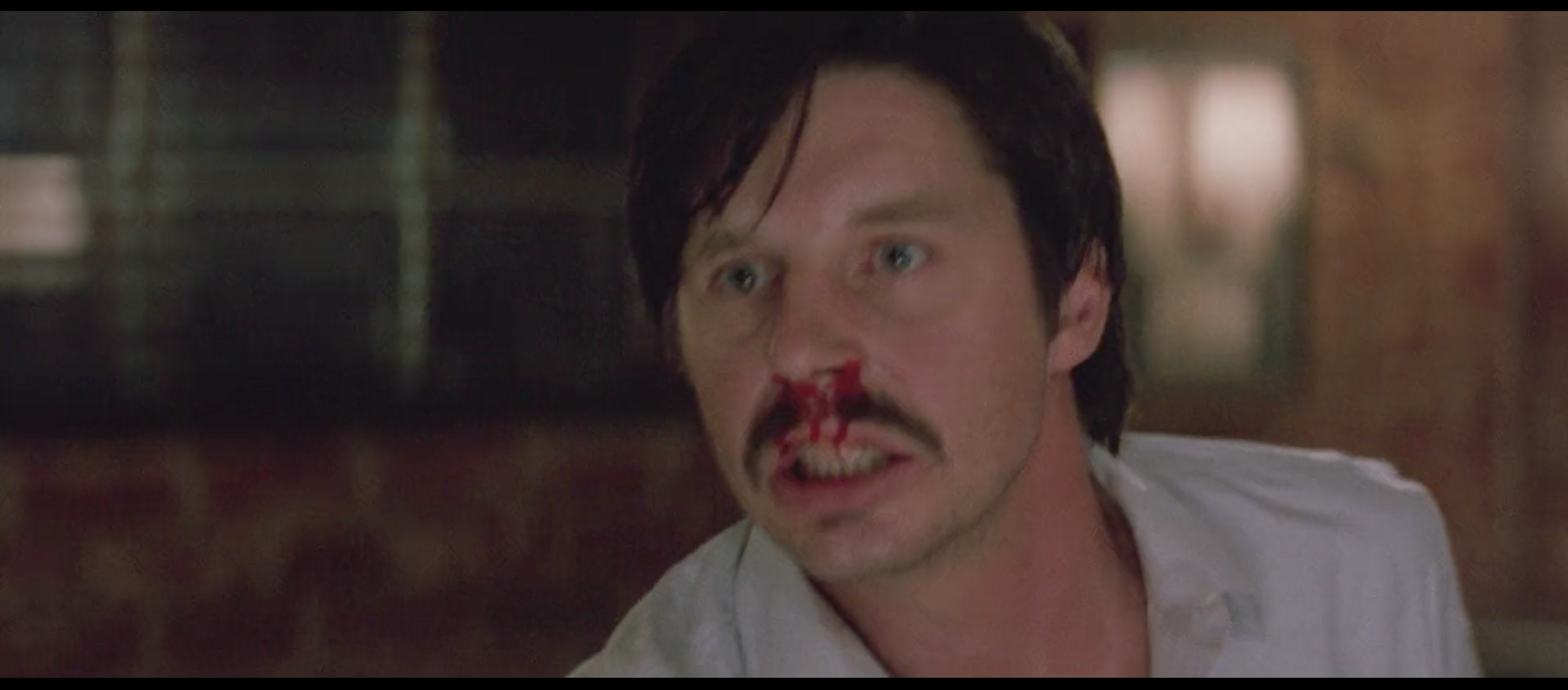
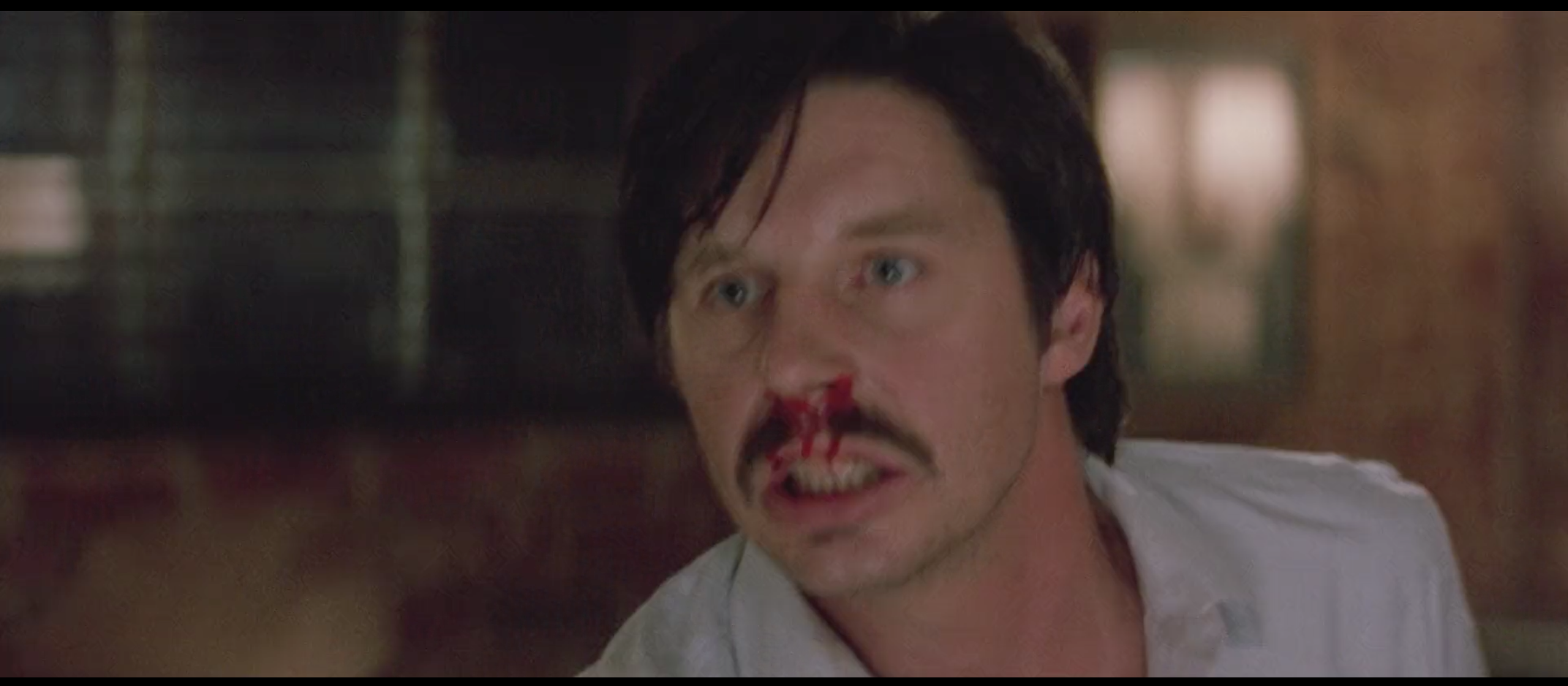
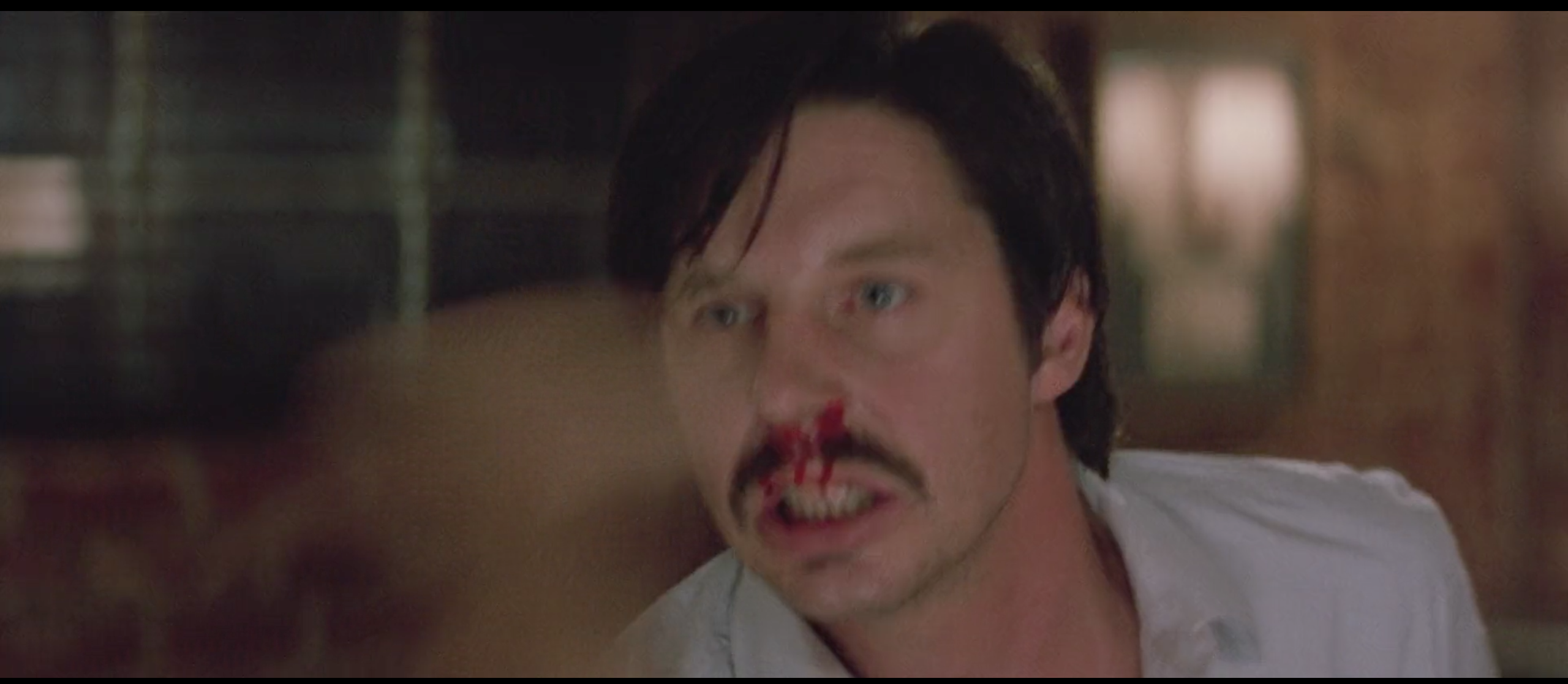
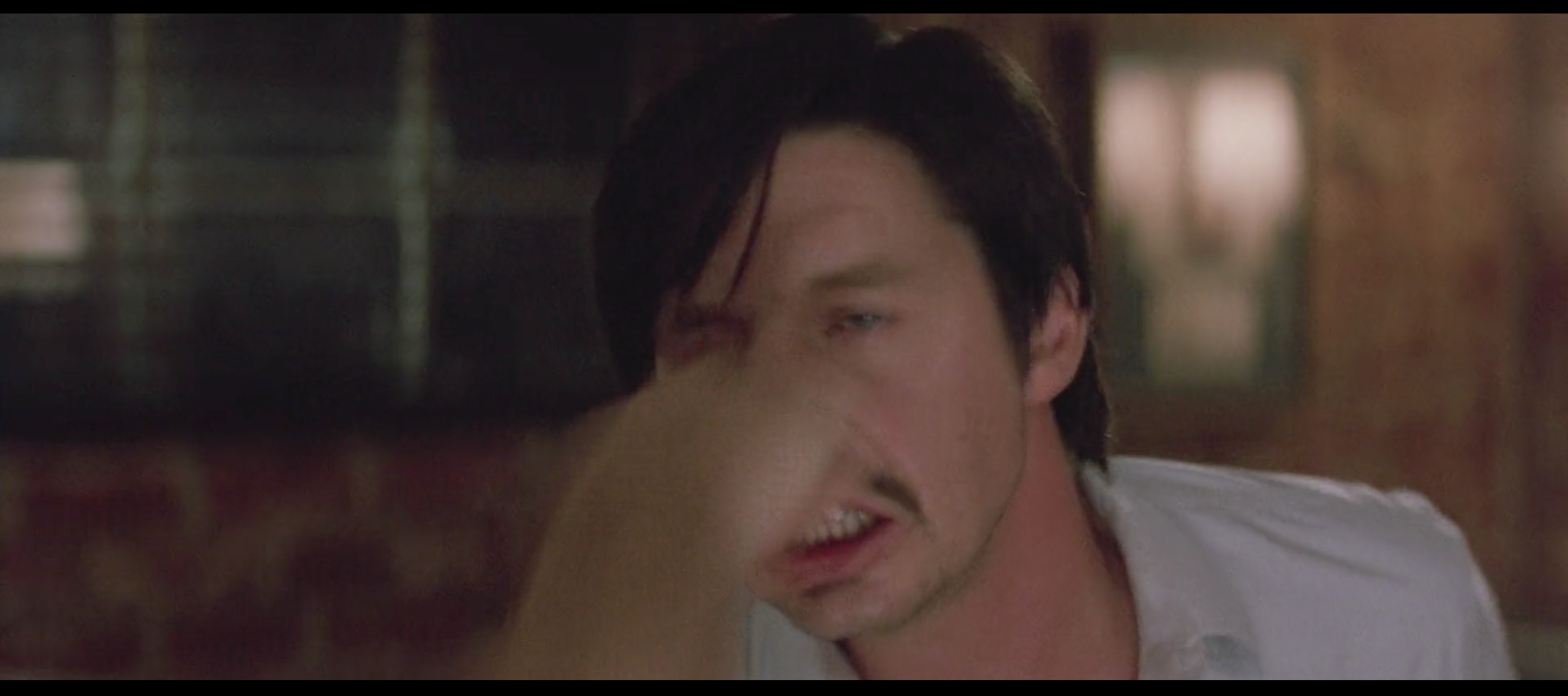
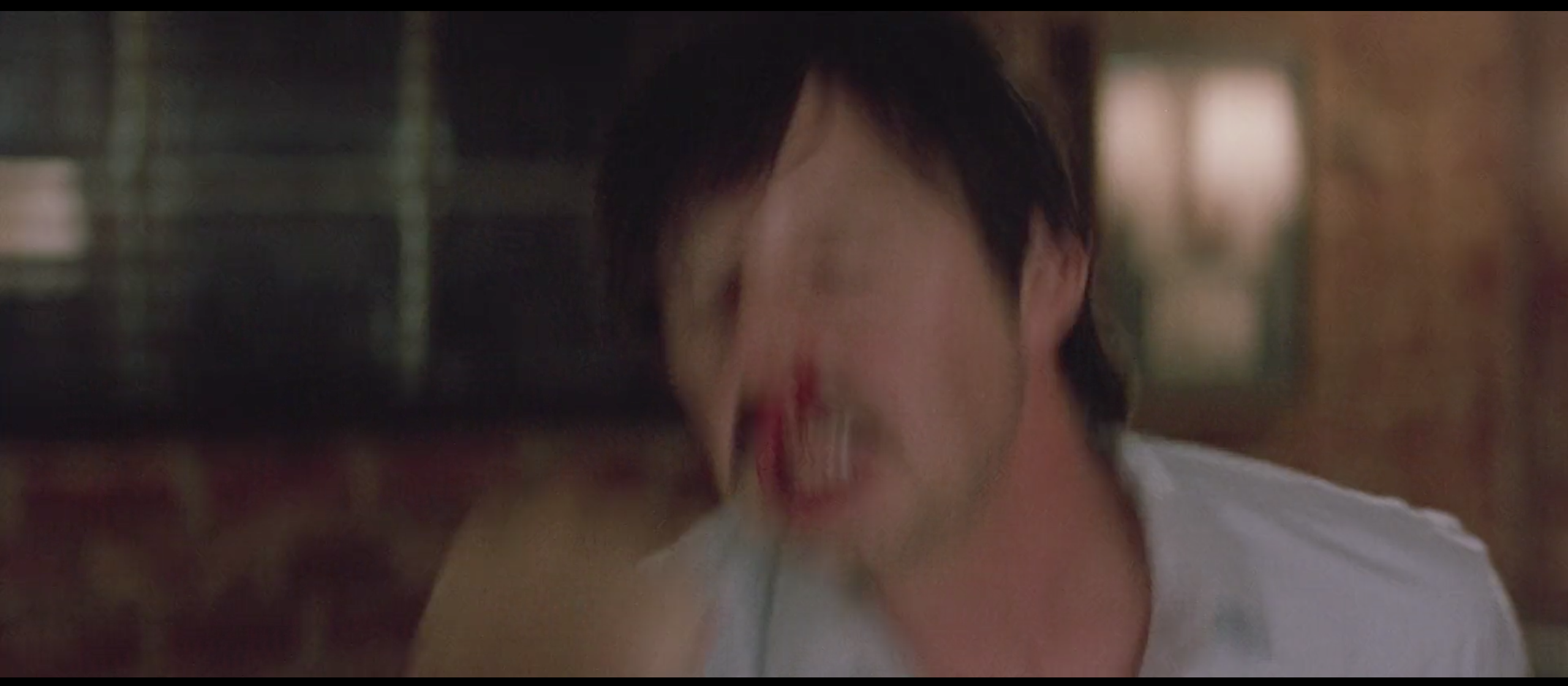
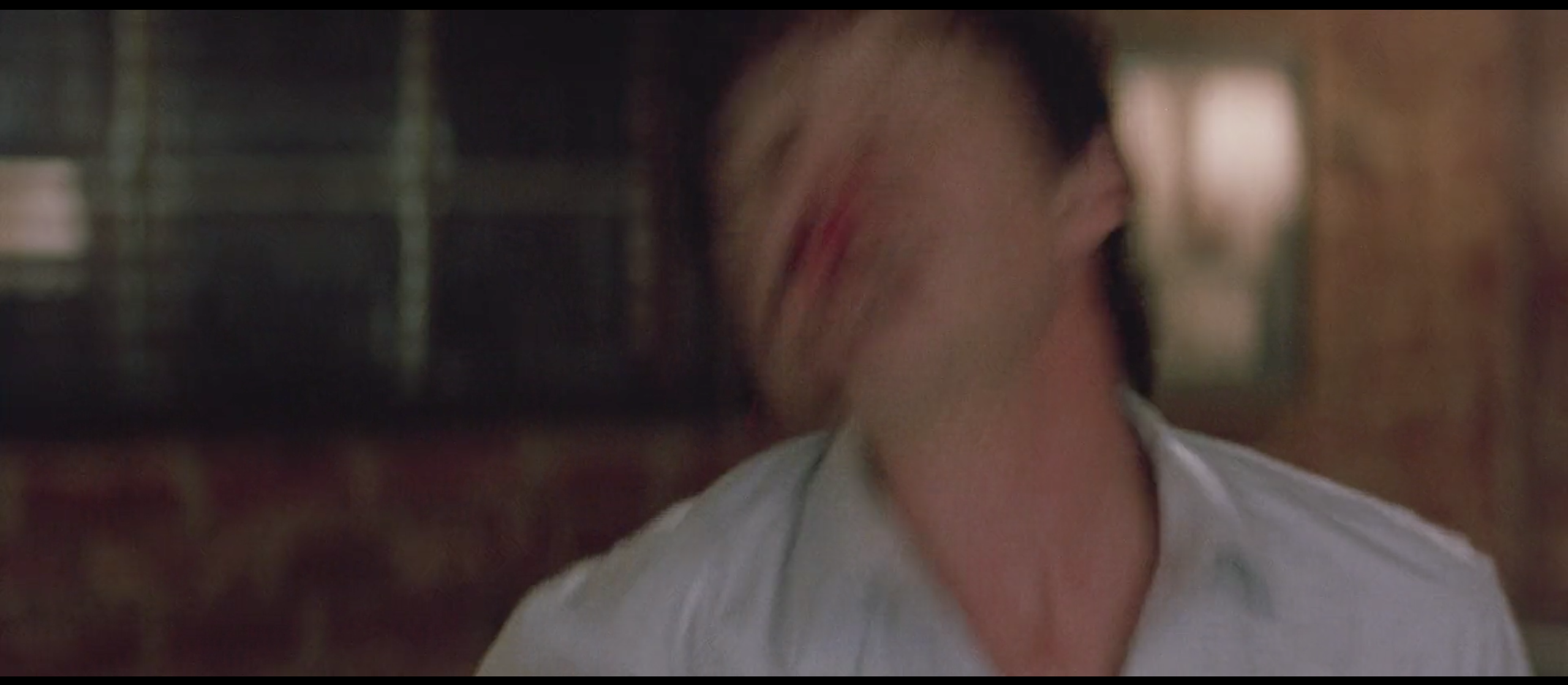
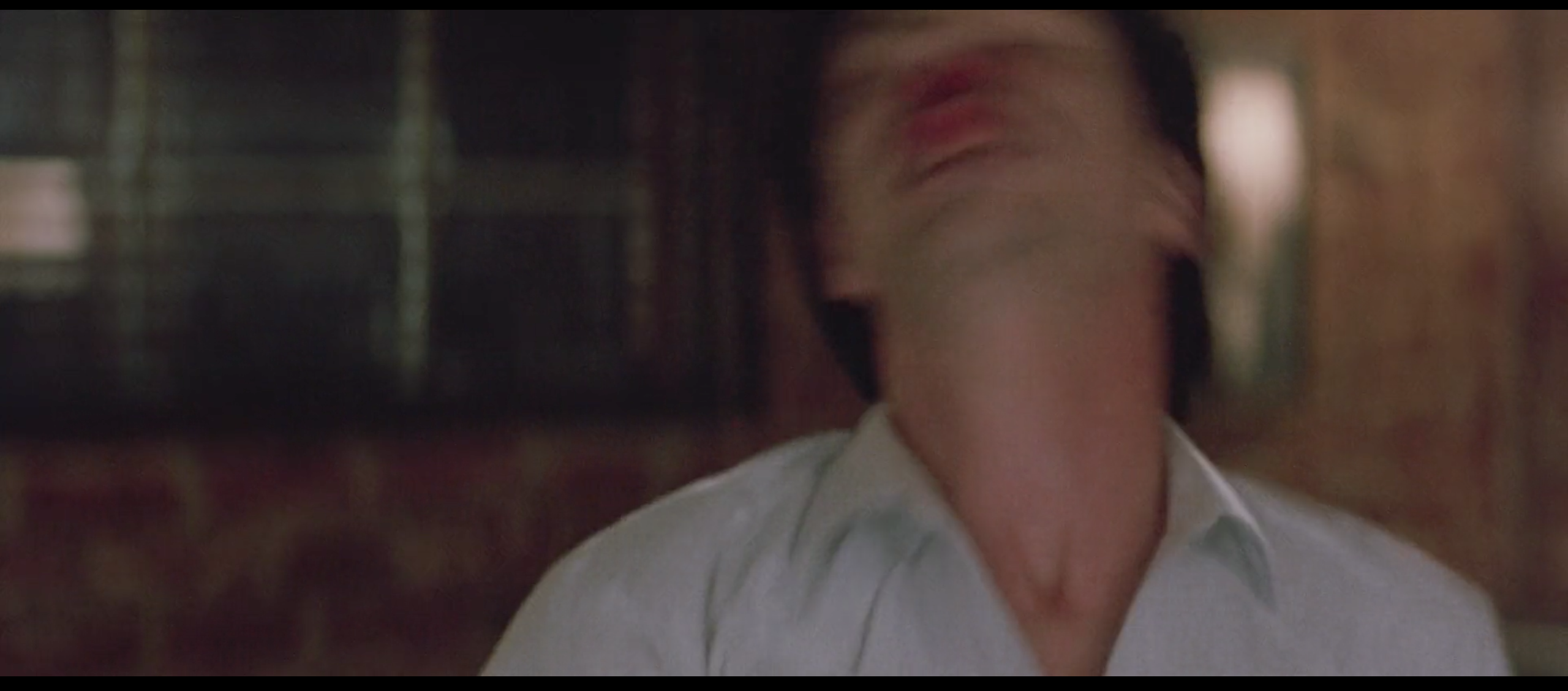
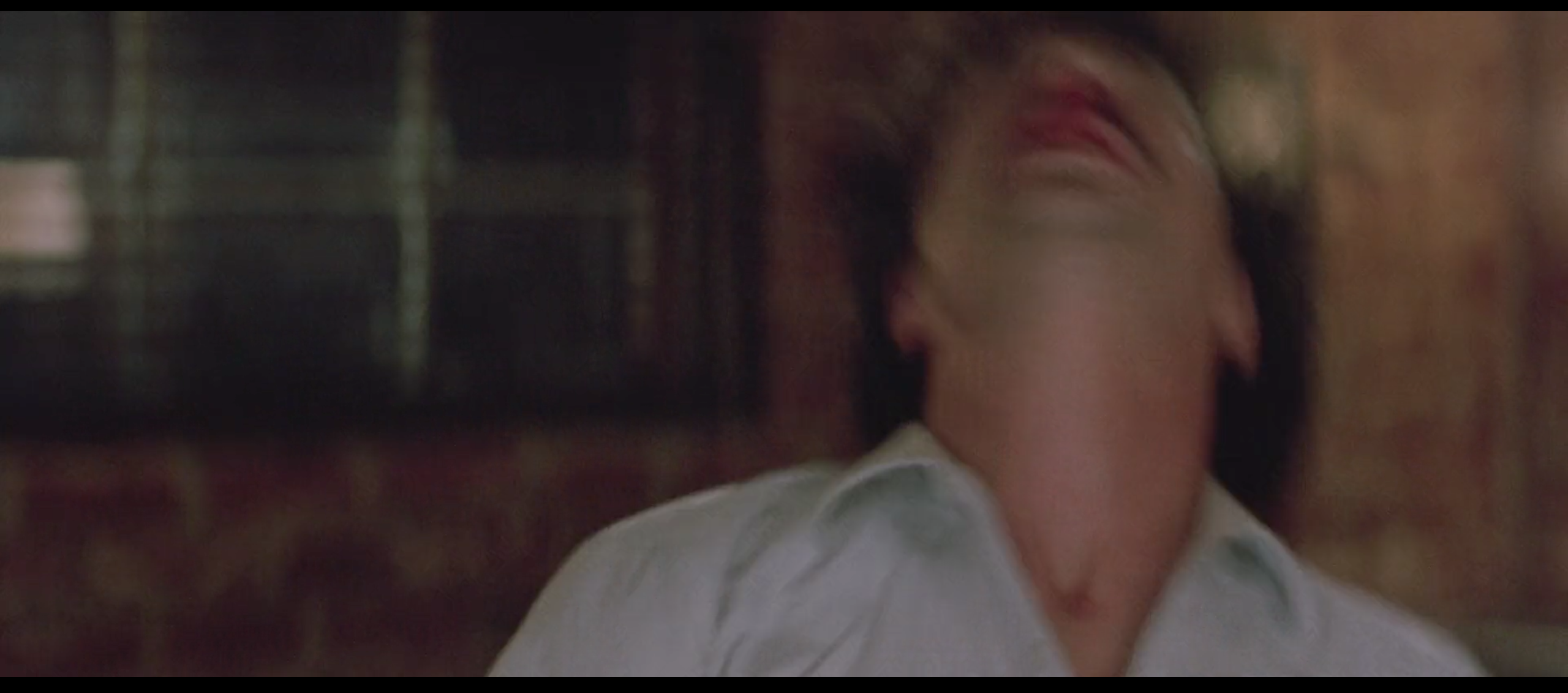
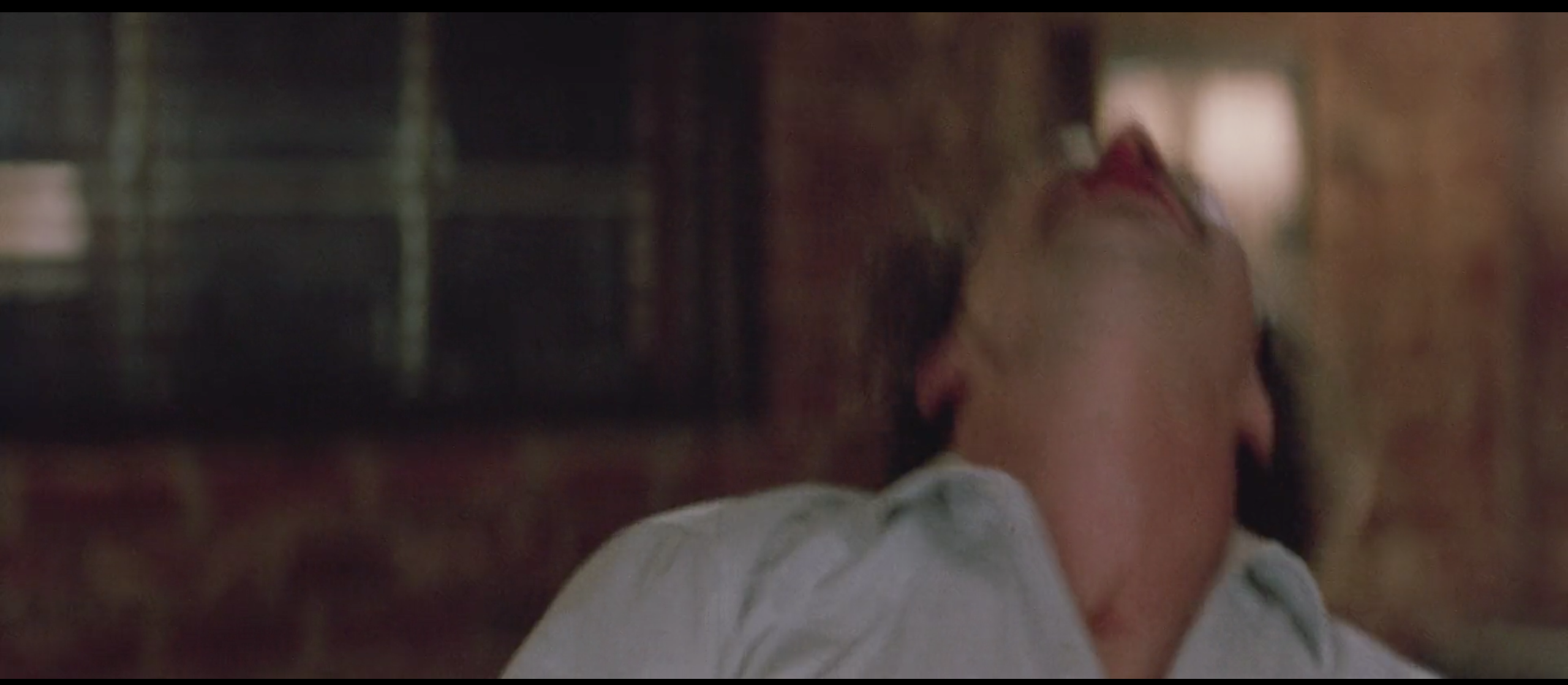
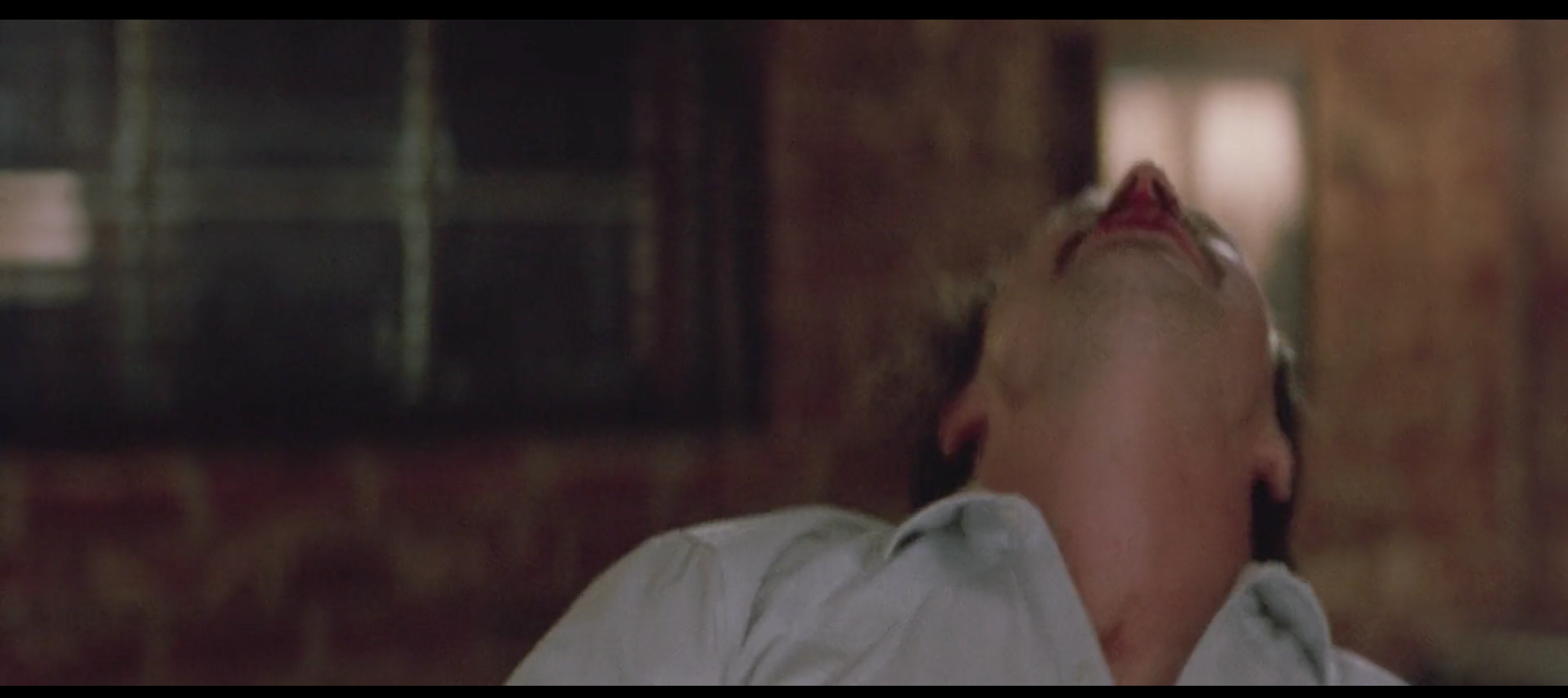
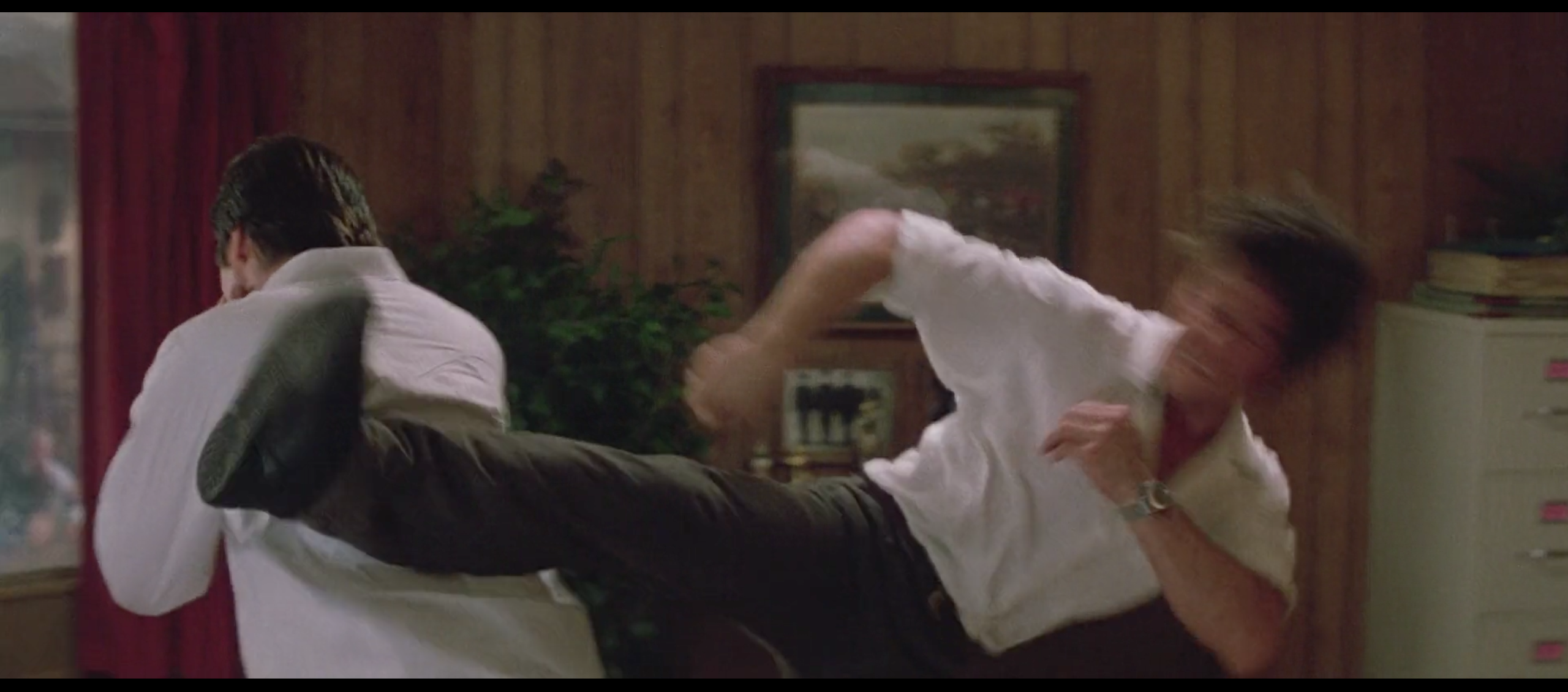
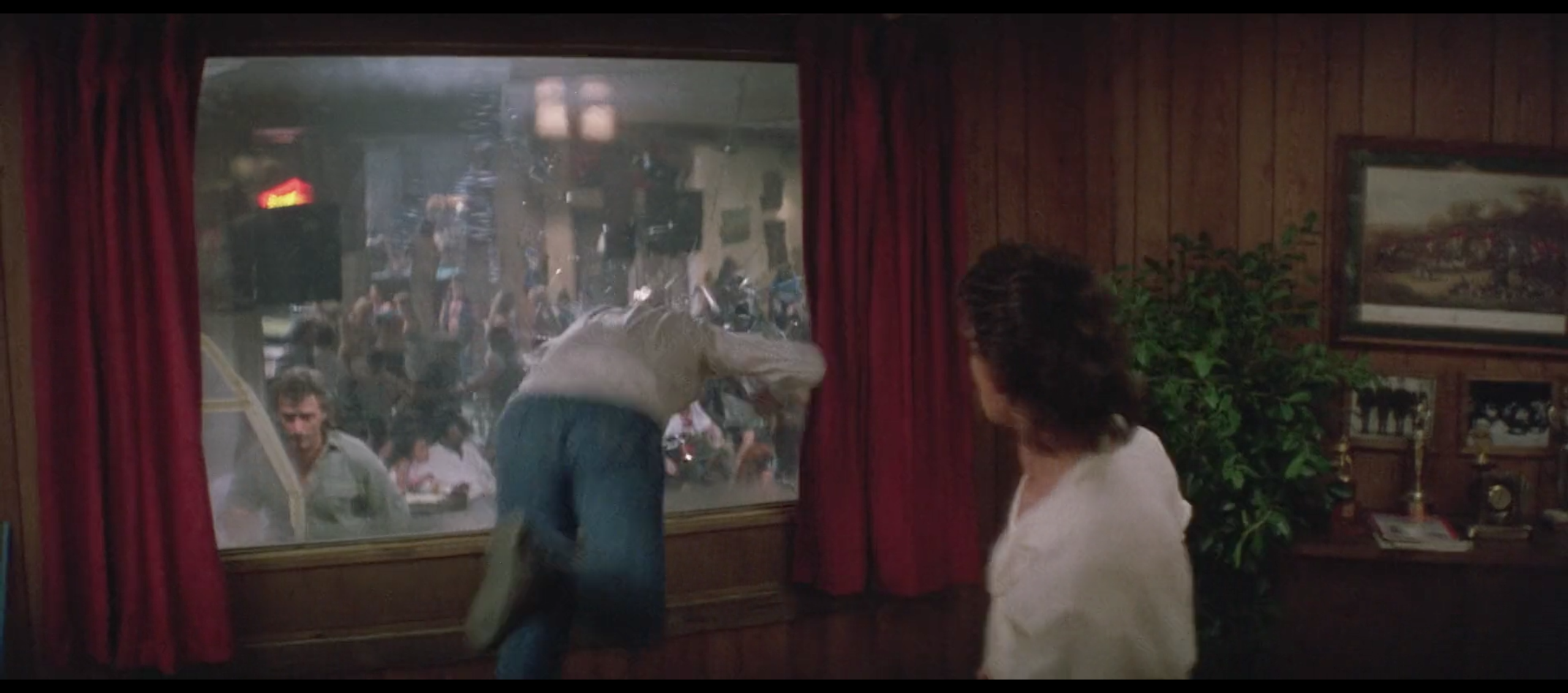
It’s simple, really. Sister-son Pat McGurn returns to his former place of employment with his uncle’s most useless enforcers O’Connor and Tinker in tow in order to force proprietor Frank Tilghman to reverse the decision of the bar’s new cooler Dalton and reinstate him to his position of bartender. Dalton takes very mild issue with the plan. Pat whine-gloats like a petulant child who thinks their parents are gonna punish their little brother and not them, then produces a knife the size of a machete and proceeds to simultaneously slash at and gay-panic taunt Dalton. Dalton punches his nose in. While he holds his hands to his broken face and howls in pain, Dalton spin-kicks him through a plate-glass window. He remains incapacitated for the duration of the fight that ensues, after which he is bodily carried out of the bar.
Concerned that Pat McGurn didn’t receive enough punishment? I’ve got you. First it’s important to note that by the end of the film Dalton will murder Pat McGurn, using the body of a dying goon to block Pat’s shotgun blast, then withdrawing the knife he’d inserted into the now dead goon’s gut and throwing it into Pat’s chest, causing him to misfire one last time and then plummet from a second-story landing to the ground below. Second you’ll notice from those screenshots that Pat’s nose was already bleeding before Dalton’s punch connected; you can call this slapdash continuity if you want, but I prefer to believe that either his body anticipated the damage that was about to be done to it and started hemorrhaging spontaneously, or that Dalton caused him to bleed without touching him by sheer force of chi. Or both! I’m not picky.
But here’s the bottom line, friends: Road House is a film in which Patrick Swayze beats the shit out of John Doe from X.
Pain Don’t Hurt: The Patreon
March 4, 2019The name…is Sean T. Collins. I’m a writer and critic who’s appeared in The New York Times, Rolling Stone, Pitchfork, Vulture, Decider, Grantland, the AV Club, and more. I’m also the co-founder (with Stefan Sasse) of The Boiled Leather Audio Hour, a podcast about Game of Thrones & A Song of Ice and Fire, and the co-editor (with Julia Gfrörer) of Mirror Mirror II, an anthology of horror/erotic/gothic comics and art published by 2dcloud. I’m The Original Bad Boy of TV Criticism. I gave this nickname to myself as a joke but it stuck so it counts.
Also, I love Road House, the 1989 Patrick Swayze action movie. Road House is the story of Dalton, a famous bouncer whose quest to free a small town from the iron fist of the guy who is on the verge of opening the area’s first JC Penney will lead directly to the deaths of over half a dozen men. I love Road House so much in fact that in late 2018 I decided I would write an essay about Road House every single day for an entire year, that year being 2019—on top of the TV recaps, album reviews, film and television recommendations, and broader essays and deep dives I write for a living.
In the words of Road House, I’d like to make a better life for myself.
By subscribing to my new Patreon you’ll make Pain Don’t Hurt a paying concern. If you’re a fan of my Road House stuff this sells itself. But the beauty of getting paid to write about any one thing is that it makes it possible to write even more about other things. If you’ve ever enjoyed anything I’ve written, subscribing here is the best way to see more of it—both through tiered rewards that give you access to bonus stuff and simply by helping my family and I stay afloat so I can do more of the writing I love. (I love to write even more than I love Road House, though it’s obviously close.)
Friends, it’s time to be nice. Join the Jasper Improvement Society today! Thank you for your support!