I rarely promote it on here, but the support I receive from my Patreon — where you can also keep up with everything I do — makes a huge difference for my family. Join here, pay whatever you like!
Posted in Uncategorized | Comments Off on Support the STC Patreon!
I’m happy to report that Julia Gfrörer and I once again have copies of our horror/erotic/gothic comics and art anthology Mirror Mirror IIavailable for sale at her Etsy shop. It’s an absolute murderer’s row of artists; if you like our sensibilities at all, you’ll like this book.
This is the big one. This is the moment to which the entire season has built. This is something you knew you wanted, wanted badly even, but it’s not until you actually get it that you realize how deeply you’d missed it, and how profoundly you needed it back.
It’s time to have the Maeve discussion. Are you as tired of this miserable person as I am? Always with the unfunny insults, overflowing with vulgarity that thuds to the floor rather than ringing in your ears. Loyal to no one, out to get everyone, and never honest for a moment, a characteristic that over time proves very boring indeed. A constant threat to everything from the lives of characters who are a whole lot more interesting than she is to simple peace and quiet around a goddamn dinner table.
I’m speculating like crazy, because “The Lowdown” is a show designed to get you worked up. Lee is constantly escaping jams by the skin of his teeth, only to return home to his growing pile of personal calamities. The high-anxiety presence of Ginger as his partner in crime-fighting only adds to show’s race-against-the-clock energy.
The result makes you feel like you’re watching your favorite team’s running back dodge an entire defensive line in a last-ditch attempt to score a game-winning, season-saving touchdown: Sure, it isn’t actually you out there on the field, but for the minutes you’re watching, it can sure feel like it. The same is true of watching Lee careen around Tulsa in his beat-up white van, causing commotions and dodging disasters like a human Looney Tunes character. That anvil could drop any minute, and you’re right there with him as he races to avoid it.
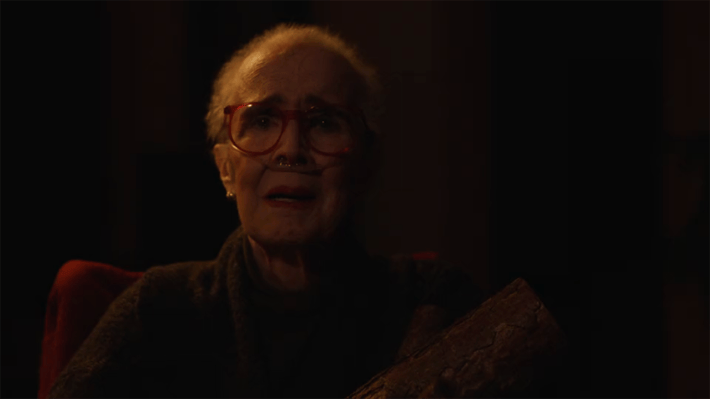
She was. Catherine E. Coulson, the actor who turned the Log Lady from a bit part into an icon of Twin Peaks, was dying of cancer when she delivered this final performance. It is impossible to divorce my feelings about this from my feelings about the Log Lady’s final scene. I cannot help but see it as a farewell from Coulson herself, courtesy of her old friends and collaborators Mark Frost and David Lynch. Hearing her last phone call to Hawk feels like hearing the last words of a loved one.
Hawk, I’m dying….You know about death, that it’s just a change, not an end. Hawk, it’s time. There’s some fear, some fear in letting go….Hawk, my log is turning gold. The wind is moaning. I’m dying. Goodnight, Hawk.
“Goodnight, Margaret,” Hawk says before the call ends. “Goodbye, Margaret,” he adds afterwards. He gathers Andy, Lucy, Bobby, and Frank in the conference room, and tells them that Margaret has died.
“The Log Lady’s dead?” Lucy asks. You can hear the disbelief in her voice. The Log Lady has always seemed like a woman out of time, eternal.
But when those tears fall, they’re not just the tears of Lucy Brennan. That’s Kimmy Robertson, crying for her old friend. You can see it, you can hear it. She’s mourning a woman she really has lost.
All of us are. Coulson’s Log Lady was the soul of the show, one of the white wizards, a gentle force for good. Even among her dying words she finds time to warn Hawk to watch out for “the one under the moon on Blue Pine Mountain,” which feels instantly important. Such was her power that she transcended the fourth wall, providing a series of extracanonical introductions to each episode of the first two seasons that were written by Lynch for reruns of the show on Bravo. (It was a different kind of network back then.) Perhaps this is why she alone has received “In Memory Of” tags both for the actor and, in this episode, the character herself. It somehow feels that the Log Lady existed in both worlds at once.
This is television of astonishing power, honoring both a real person who mattered to people and the art she made, which also mattered to people — in many cases, mattered more to those people than any other art.
And this occupies, what, a tenth of the runtime of this episode, if that? These 55 minutes include some of the most ecstatic emotional highs and most abject emotional lows we’ve ever seen on this show. If you told me it was your favorite Twin Peaks ever, I wouldn’t argue with you for a second.
As much as I enjoy the camp (no pun intended) value of the Dragnet hippies, the horny teens, and the Mayberry RFD yokels, it’s undoubtedly a good thing to have an episode’s tone determined by the acting of Linda Cardellini, William Catlett, and Hamish Linklater. As Briana, Devin Kessler also performs in this serious register. When comic relief characters like Dorfman, Rita, and Enos are used here, they’re used in a way that feels consistent both with their own humorous track records and with how normal people would behave. That neatly ties both halves of the show together.
But the real dramatic energy here is from the demented nuclear (again, no pun intended) Whittering/Voorhees family: patronizing, patriarchal, sociopathic Elias; ferocious, loyal, chemically imbalanced Pamela; and…Jason, or whatever’s left of him.
There’s nothing surprising about the secret origin of Pamela and Jason Voorhees. Should there be? It might be nice, I suppose, but then there was never anything all that surprising about Friday the 13th to begin with. You’re not here to watch Crystal Lake reinvent the wheel, you’re hear to see it stud that thing with spikes and run people over with it. In that sense, this episode delivers. You may have seen this kind of super-child origin story done before, but rarely with the gusto you get here by the end.
If you can’t solve a problem, make it bigger. This maxim was a favorite of United States Defense Secretary Donald Rumsfeld. It seems to be the approach favored by the increasingly unhinged Pamela Voorhees as well, and with similarly grisly results.
I am now fully on board with the cartoon hippies of Crystal Lake. I’m smoking their grass, I’m dropping their acid, I’m rockin’ their van till no one comes a-knockin’. They’re simply too funny to resist anymore.
Funny on purpose, I mean. To me, that’s obvious, because the show is funny on purpose all the time. Claudette droning on about how the power of prayer can spiritually replace her hymen because “Jesus has a hard-on” for her, Barry teaching the kids how to row with a paddle by saying “cup the tip, guide the shaft, in and out, in and out” over and over, the dark dark comedy reveal that Claudette’s pastor is a pervert — this episode alone has ample evidence of the show’s comedic chops. But you can also think back to the brilliant splatstick comedy of Pamela’s fight with the Bellflower thugs, or the bawdy read-along that introduced us to Rita and the rest of the townsfolk.
In other words, when this show wants to be sharp, it is. And not just in the comedy department, either: The gap between how seriously Pamela, Lee, and Grace are taken versus the rest of the cast remains pretty vast, which by now seems deliberate. The point is that if Crystal Lake is ever stupid, it’s stupid like a fox.
I mean, for crying out loud, they’re giving Harmony, the lead hippie, dialogue like this:
“The straight world’s no place for our kind.”
“Our souls are vibrating at the same frequency.”
“Everyone’s waiting for us. We’re building a new society.”
“I get the suffocating hypocrisy of our male-dominated society.” (“Right on, sister,” her friend chimes in.)
Everyone making this is aware they’re just doing the Dragnet hippie episode on the shores of Crystal Lake, and everyone’s having a whale of a time with it. So am I.
I’m BACK on the great Wrestling Brain podcast for their big AEW WrestleDream preview show! Who will win? Who will lose? How mean will I be to Chris Jericho? Watch/listen and find out!
Crystal Lake’s problems remain consistent: Pamela, Lee, and Grace’s material remains much stronger than everyone else’s, and man do I wish the nighttime cinematography made real use of darkness and light. But so do its strengths: Linda Cardellini and William Catlett are fantastic, the gore is gross and right in your face, and perhaps most importantly, it’s suggesting that Jason Voorhees and Captain America have similar origin stories. Now all we need is a little mass murder and we’ll really be cooking.
Is Harry Da Souza too good for the Harrigans? I don’t mean too good a person; we’ve seen him execute way too many people in blood way too cold to have any illusions about the kind of person Harry is. But is he too good at his job, too good at being a fixer and fixing things, for a family as thoroughly broken as the Harrigans?
Crystal Lake isn’t a perfect show. The yokels are drawn a little too broadly to be effective as characters, especially up against characters as serious Pamela and Lee and performances as strong as Linda Cardellini’s and William Catlett’s. The nighttime photography is flat and lifeless, an especial shame given the original films’ oceans of black illuminated by flashlights and porch lights.
But there’s just so much fun stuff here! In the opening flashback, young Jason blows off a nasty series of jagged cuts in his arm he got from a branch, feeling no pain at all; “I’m pretty tough,” he says, in the understatement of the year. The discovery of the cabin is another piece of the “how did Jason survive out there” puzzle. There’s a creepy shot that reveals Jason has been in Pam’s garage without her knowing it, going through his old box of toys. The opening credits are striking and unlike anything else on TV right now.
On a more serious note, Grace remains a refreshingly imperfect and complicated child character; watching her try to figure out how to parent these terrible adults is heartbreaking, as is the scene in which it’s revealed her cigarette burn was self-inflicted. Pam and Lee’s chemistry is as incendiary as her need to mother Grace is stifling. “I couldn’t save my son,” she growls at one point, “but I can save her.” From whom?
Bottom line: Pamela Voorhees knocks a woman’s face off with a bigass meat hammer. That’s entertainment, if you’re a sicko. If you’re not a sicko, what are you doing here?
The thing I love most about Crystal Lake so far — and I do love it, make no mistake, I’m a real sucker for what this show is doing — is its hidden depths, no pun intended. You don’t have to make a character like Rita both a classic ’70s floozy and a woman who suffered a stillbirth and thus sees Pamela’s strength and love for her child more clearly than anyone else on the show, but isn’t it better if you do? You don’t have to burrow into the original series’, how shall I put this, fraught relationship with teenage female sexuality so deep that you’ve got Grace mimicking older kids gossiping about “sluts” in the bathroom mirror, or staring intently at the sexual graffiti all over the stall door, or putting on lipstick and clogs to hang with the very kids she watched have sex while Jason drowned — but again, doesn’t it make this a more interesting show when you go there?
As a slasher series, Friday the 13th is like a chainsaw that took three tugs on the cord to fully fire up.
Like Scream famously points out, Jason Voorhees, the unstoppable killing machine that the franchise turned into a horror icon, isn’t even the killer in original 1980 film. It’s his mother, Pamela Voorhees. Even though Victor Miller’s unevenly written script doesn’t bother introducing this character before the big reveal, the gleefully deranged performance of actor Betsy Palmer ensures Pamela’s place in horror history.
After we watch a gaggle of camp counselors engage in fairly wholesome sexual activity (strip Monopoly! oh no!) and get slaughtered one by one by an unseen assailant, we learn that Pamela has gone insane and is out to avenge her son’s death from drowning at Camp Crystal Lake decades earlier. The culprits were a couple of neglectful, sexually active teenage camp counselors whom she killed a year after the incident; now, to Pamela, the only good camp counselor is a dead one. No lumbering behemoth in a hockey mask here, just a middle-aged lady with a haircut and sweater that scream “church bake sale,” slaughtering teenagers for “making love while that boy drowned!”
Only in Part 2 does Jason himself, who survived his apparent drowning and has lived in the woods as a feral scavenger ever since, begin his own killing spree. Taking the same zero-tolerance approach to camp counselors as his mother, whose death he’s now out to avenge, he is defeated by yet another sexually active camp counselor, who smartly uses his fixation on his mother to escape certain death.
By Part III, Jason’s a lumbering behemoth with super-strength, seemingly just killing anyone unlucky enough to be near Crystal Lake, where he, uh, didn’t drown. It’s here he gets his trademark hockey mask, grabs his trusty machete, and becomes the monster the series is famous for. It’s also here where the series gets incredibly dumb: toilet humor, central-casting hippies and “punks” as victims, and the worst 3D effects you’ve ever seen. By the time he literally rises from the dead in the fourth film, infamously subtitled The Final Chapter, he might as well be Godzilla, if Godzilla movies had gratuitous nudity and special gore effects by Tom Savini.
Sleazy, silly, and creatively disjointed as they are, though, there’s an arc formed by these initial Fridays — the story of a disabled and bullied boy, a mother driven mad by grief, and an improbable tale of survival that turned the boy into a monster like his mother before him. The heart of it all is an incredible scene at the end of Part 2, in which the film’s “final girl” (Amy Steel) finds Jason’s macabre shrine to his mother (complete with her severed head), puts on her trademark blue sweater, and pretends to be her, cooing at the crazed killer to “come to mommy.” The scene is such a psychosexual live wire, so brilliantly acted by Steel and Palmer, that it feels like it’s from a different, better series.
Wisely, it’s on this powerful, ultimately lethal relationship between mother and child that Peacock’s Crystal Lake focuses. This prequel/reboot hybrid from creator-writer Brad Caleb Kane, co-showrunner of the excellent, similar It: Welcome to Derry, launches with an entire episode about a mother losing her vulnerable, beloved son before her eyes. It actually takes the emotional stakes of the films’ premise seriously, even as it plants seeds for some of the franchise’s most outlandish elements — and, arguably, gets even more out-there than they did by the end.
But that’s Lee for you, making friends wherever he goes. He almost instantaneously strikes up a rapport with a recently fired corrections officer with the improbable name of Chili Franks (a delightfully unhinged Paul Schneider). His hair is a thistle of frosted tips, his uniform is still on regardless of his actual employment status, he has a reputation for being a depressive sort … and he makes the best cheeseburgers you’ve ever had. Or so he insists, anyway, when he invites Lee back to his place to keep their conversation going.
By now, Lee has learned that the officer who menaced him and Ginger is named McMann — he saw a shirtless photo of him in a charity calendar. (The guy’s a slab of beef.) Over a long, drunken, cringe-inducing evening, Chili tells Lee that McMann is the unofficial boss of the guards and fired him for reasons he doesn’t specify.
At one point, Chili grabs a shotgun and appears ready to kill himself over it. But when Lee reveals he’s a reporter out to take powerful people like McMann down, Chili suggests they go out for more beers and instead drives Lee to McMann’s house. The ex-guard sees this as his chance to get back in the boss’s good graces.
In the episode’s funniest sight gag, Lee flees into the trees surrounding McMann’s house, dodging shotgun blasts … only to discover that every tree he hides behind has a motion-activated floodlight rigged to it, revealing his location over and over and over. It’s like something out of “Coyote vs. Acme.”
But Harjo is also an entertainer. The mystery of Mekko and Ginger is instantly engaging, and the jokes fly from every direction. I can’t decide if my favorite is the conversation between Lee and his lawyer neighbor, Dan (Macon Blair), about Dan’s “throuple trouble,” or Ginger ending an angry telephone call with a client photographed with cocaine all over his face with an incongruous “I love you too.”
Actually, no, scrap that: I’m giving it to Ginger, because Gilpin is the best actor on television. She never makes a boring, predictable or unnatural choice, and she is good in everything she has ever been in, elevating shows by dint of her presence in them. After Jeanne Tripplehorn’s formidable and complex romantic foil for Lee in Season 1, Gilpin has a tough act to follow. But she and Jones, as Lee Senior, are the kind of performers who can power “The Lowdown” to new heights.
In this episode of Twin Peaks, Deputy Andy goes to the White Lodge, Gordon Cole receives a message in a dream from Monica Bellucci (appearing as herself), and Sarah Palmer takes her face off and kills a guy with her teeth. Prior to this episode of Twin Peaks, these are three events the possibility of which had not even occurred to me. I like to think I have a vivid imagination, but nevertheless, I was wholly unaware that Deputy Andy going to the White Lodge, Gordon Cole receiving a message in a dream from Monica Bellucci (appearing as herself), and Sarah Palmer taking her face off and killing a guy with her teeth were even on the table.
While the plot of the series’ long-delayed third season (Infamy came out in 2019), begins with Pepper, he’s merely the catalyst. Devil in Silver is as much an ensemble piece as was the stellar first season, staffed with a Widow’s Bay–style lineup of heavy-hitter TV actors including Judith Light, CCH Pounder, Stephen Root, Aasif Mandvi, and John Benjamin Hickey.
Expanding the story beyond Pepper is more than a matter of making use of the talent on hand, however. It’s true that he’s important to the entity that has haunted New Hyde since its founder, Dr. Walter (Hickey), practiced hundreds of involuntary lobotomies. This devil — or duppy, as it’s called by Guyanese immigrant and ward administrator Miss Chris (Pounder) — feeds on the suffering of New Hyde’s patients. I won’t tell you how, but Pepper is the key to its plans to continue eating.
But it’s precisely Pepper’s belief that he is important, his bone-deep conviction that he’s a great guy and fuck you if you disagree, that makes him so attractive to the devil. That anger gives him vitality, and that can be used. Taking the form of a rich white eugenicist with a history of violence against women and trying to enlist an angry blue-collar white guy with something to prove: Now that’s the work of the devil alright.
[…]
SEAN T. COLLINS: Pepper is the main character, but he’s not the Heroic Protagonist, so to speak.
CHRIS CANTWELL: This was one area where we wanted it to have some grounded nature in the way it reflected the horrors of our world today. The core team was really Victor, me, Karyn Kusama — who was EP through the entire thing and directed the first block of episodes — and David Zucker, who runs television for [executive producer Ridley Scott’s company] Scott Free. It was the four of us huddling up and making sure this thing felt real. Our joke was that the only thing worse than the devil would be the American healthcare system. So a moment where Pepper punches the devil to death and saves everybody and goes out in a blaze of glory…that didn’t feel of a piece with the verisimilitude we were trying to create inside that place.
The character became about the harder challenge of living for someone as opposed to dying for them. It was very important to Karyn not to drive everybody into nihilism; she wanted us to have some note of hope, but which also shows the burden of what that could mean, to be there for somebody you’ve hurt in the past — specifically for a white man who has gone through the gauntlet that normally he would have the privilege of not experiencing.
Below is one of this spooky season’s biggest shows, literally: Set on the coast of Newfoundland, it relies on sweeping vistas of the Atlantic shoreline, massive icebergs hundreds of miles from where they belong, and something very, very big lurking under the water’s surface.
It’s also very familiar. Stop me if you’ve heard this one before: A tiny fishing village in the Northeast is beset by strange phenomena that leave people missing, mad, or dead, and only one desperate man and his friends can stop the horror. That’s right, it’s also roughly the premise of Widow’s Bay, not to mention the dozens of Stephen King and H.P. Lovecraft stories and imitations that inspired it. And while Widow’s Bay operates in a comedic register that Below doesn’t possess (at least not intentionally), it’s hard to watch this new series without comparing it to its Emmy-festooned recent predecessor given their many narrative, character, and setting overlaps. So with all six episodes of Below now streaming on Netflix, we’re taking a survey of how creator Jesse McKeown’s and star Josh Hartnett’s Canadian maritime monster party stacks up against Katie Dippold’s New England horror comedy. In this cross-border, cross-streamer rivalry, which is the real village of the damned good television?
Tom Hardy echoes this binary nature in his performance. Harry’s most disarming quality is how casual he seems, how loose and laid-back even though he’s a battlefield commander. He peppers his speech with “yeah”s and “all right”s that deflate the gravitas of what he’s saying, no matter what that is. It’s a trait that can calm the most panicked people…or panic the most calm, because whether he’s saving someone’s life or ending it, it never changes.
What seems endearing in one circumstance becomes repulsive under another. When you’re forcing a cop you bought off but who is now compromised to hang himself from a tree in the woods in the rain, for instance, that shit is no longer adorable. It’s nightmarish. Harry reminds me of Tommy from GoodFellas or Nicky from Casino: They really are funny guys, until they pop your eye out of your head with a vise. Their charm is poisonous.