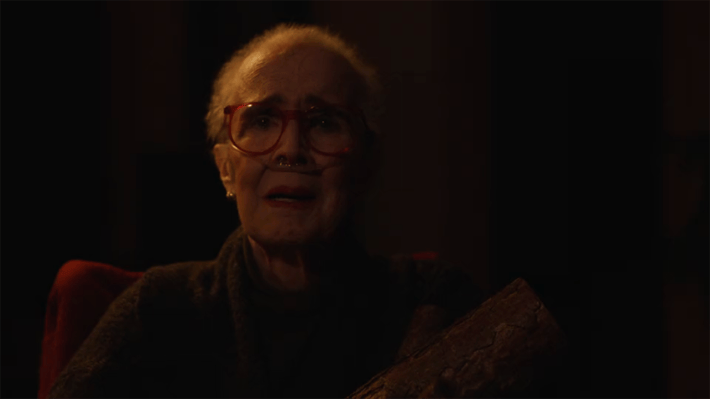
She was. Catherine E. Coulson, the actor who turned the Log Lady from a bit part into an icon of Twin Peaks, was dying of cancer when she delivered this final performance. It is impossible to divorce my feelings about this from my feelings about the Log Lady’s final scene. I cannot help but see it as a farewell from Coulson herself, courtesy of her old friends and collaborators Mark Frost and David Lynch. Hearing her last phone call to Hawk feels like hearing the last words of a loved one.
Hawk, I’m dying….You know about death, that it’s just a change, not an end. Hawk, it’s time. There’s some fear, some fear in letting go….Hawk, my log is turning gold. The wind is moaning. I’m dying. Goodnight, Hawk.
“Goodnight, Margaret,” Hawk says before the call ends. “Goodbye, Margaret,” he adds afterwards. He gathers Andy, Lucy, Bobby, and Frank in the conference room, and tells them that Margaret has died.
“The Log Lady’s dead?” Lucy asks. You can hear the disbelief in her voice. The Log Lady has always seemed like a woman out of time, eternal.
But when those tears fall, they’re not just the tears of Lucy Brennan. That’s Kimmy Robertson, crying for her old friend. You can see it, you can hear it. She’s mourning a woman she really has lost.
All of us are. Coulson’s Log Lady was the soul of the show, one of the white wizards, a gentle force for good. Even among her dying words she finds time to warn Hawk to watch out for “the one under the moon on Blue Pine Mountain,” which feels instantly important. Such was her power that she transcended the fourth wall, providing a series of extracanonical introductions to each episode of the first two seasons that were written by Lynch for reruns of the show on Bravo. (It was a different kind of network back then.) Perhaps this is why she alone has received “In Memory Of” tags both for the actor and, in this episode, the character herself. It somehow feels that the Log Lady existed in both worlds at once.
This is television of astonishing power, honoring both a real person who mattered to people and the art she made, which also mattered to people — in many cases, mattered more to those people than any other art.
And this occupies, what, a tenth of the runtime of this episode, if that? These 55 minutes include some of the most ecstatic emotional highs and most abject emotional lows we’ve ever seen on this show. If you told me it was your favorite Twin Peaks ever, I wouldn’t argue with you for a second.
In this episode of Twin Peaks, Deputy Andy goes to the White Lodge, Gordon Cole receives a message in a dream from Monica Bellucci (appearing as herself), and Sarah Palmer takes her face off and kills a guy with her teeth. Prior to this episode of Twin Peaks, these are three events the possibility of which had not even occurred to me. I like to think I have a vivid imagination, but nevertheless, I was wholly unaware that Deputy Andy going to the White Lodge, Gordon Cole receiving a message in a dream from Monica Bellucci (appearing as herself), and Sarah Palmer taking her face off and killing a guy with her teeth were even on the table.
There’s no need to wonder where Big Ed Hurley is. He’s at Big Ed’s Gas Farm tonight, like he is every night, like he has been for decades. He sits by himself, eats takeout soup from the Double R, watches the cars pass in the dark from his island of light, and suffers in silence.
Does Big Ed regret that the stars have never aligned for him and Norma? Does he regret that he didn’t do more to align them himself when he had the chance? Whatever the case, he’s trapped in a limbo every bit as paralyzing and soul-destroying as the one Dale Cooper spent the past 25 years in. No ring, no curtains, no zigzag floor — just a life spent watching the traffic go by on the road not taken.
Why put two such similar scenes, slinging around such unfamiliar names, back to back? In part I think it’s meant to reinforce what’s emerging as one of the season’s central conceits: Twin Peaks is everywhere and everyone, not just one little town and the weird people in it. There are weird people there we haven’t met and never will. There are weird people in Deer Meadow, in Buckhorn, in Las Vegas, in New York, in Rio de Janeiro. There were weird people in that rich people neighborhood where James Hurley had his film noir storyline back in Season 2!
To whatever extent the original run of Twin Peaks was intended to feel like a peaceful idyll in a town time forgot — obviously it was much more complicated and sinister than that, but that was there — that’s gone now. Everywhere you look, characters on this show are constantly scrambling to stay one step ahead of the collection agency, the oncologist, the friend or family member who gets loose with his fists when he drinks. Poverty, disease, mental illness, and the threat of intimate violence and gun violence are everywhere.
In working on this review, I mentioned that last bit to my wife. “Well, they are,” she said simply.
Now this is a nice simple Twin Peaks episode. Just your basic, meat-and-potatoes storytelling about interdimensional vortices, murderous spectral woodsmen, mystery diseases, ancient symbols, and prophetic dreams about cherry pie. Easy peasy lemon squeezey!
In all seriousness, this is in many ways the most straightforward episode of Twin Peaks Season 3 to date. Sequences are largely self-contained rather than cross-cut, non-narrative surrealism and dream logic are kept to a minimum, and the continued sense that we’re getting somewhere across multiple storylines provides a natural gravitational pull, sucking us into the story — just like an interdimensional vortex.
Twin Peaks Season 3 spreads the heartbreak of Laura’s loss all across the country, in one form or another. But at the end of the main action of the episode, the Log Lady calls Deputy Sheriff Hawk again. Hinting that the secrets of “the dream of time and space … that which is and is not” will soon come out, she speaks of a different force.
“The Truman brothers are true men,” she tells Hawk. “They are your brothers. And the others, the good ones who have been with you. Now the circle is almost complete.” She also insists “Laura is the one” in the same episode where Gordon Cole sees her materialize in front of him. That can’t be a coincidence. Heartbreak is everywhere, but there are still people out there trying to mend what was broken, hanging on to hope as the fabric of reality frays.
Disease remains a constant presence in this season of Twin Peaks. So do money troubles: The Detectives Fusco commiserate over how expensive it is to get a taillight fixed, even taking the time to check out the replacement before arresting Ike the Spike. Andy and Lucy’s sweet “Gift of the Magi” routine is about a chair that costs under $200 with shipping. But people can’t afford to be loose with their money. Just look at the Hornes: Sylvia is shouting for a home aide when Johnny has his accident. Home aides are not cheap, even for the Hornes. Years later, The Pitt would earn well-deserved praise for its depiction of the ugly, crash-strewn intersection of money, health, and happiness in America. Mark Frost and David Lynch knew it too.
Under any other circumstances heaping superlatives on an episode of television like I’m about to do would be overdoing it. With “Part 8,” I don’t know if I’ll even hit the floor of where those superlatives should be. This is a masterpiece, one of one, unparalleled on television before or since. David Lynch and Mark Frost constructed a cathedral for Hell.
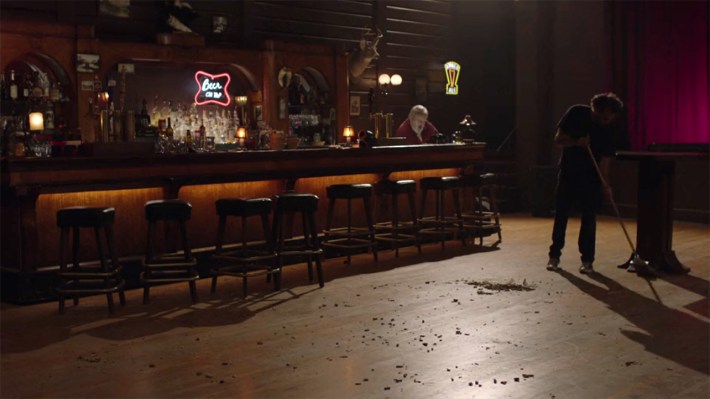
In addition to the ominous soundscapes of Dean Hurley and the familiar synth-score of Angelo Badalamenti, even David Lynch’s beloved mid-century pop music gets in on the act. Booker T. & the M.G.’s immortally cool rock instrumental “Green Onions” plays almost in its entirety over an unbroken shot of a worker sweeping up the floor at the Roadhouse; it’s slow cinema at its most entertainingly dull, until Jean-Michel Renault reveals that his family, which has been running the place for nearly 60 years, is still trafficking teenage girls there.
Santo & Johnny’s equally iconic instrumental “Sleep Walk” plays over a scene at the Double R, where Shelly and Heidi serve customers as Norma does the bills. Suddenly the door bursts open, and a man (Riley Lynch) yells “Has anybody seen Billy?” No one has. The frantic man leaves, and the song plays on. Ghostbusters did this as a gag at Tavern on the Green; Stephen King did it as a primary characteristic of the town of Derry and its people in It. As Laura put it, “They’ve never listened to my cries.” We sleepwalk past others’ unhappiness to preserve our own, for however much longer we can.
Other things happen in the sixth episode of Twin Peaks’s return — funny things, fascinating things, frightening things, things we’ve waited to see for 25 years. Most of them fade in the glare of white-hot agony generated by that one scene. It is one of the most viscerally upsetting moments in both David Lynch’s oeuvre and, frankly, the history of television drama.
Back in Twin Peaks, the more things change, the more they stay the same. Shelly and Norma (a re-debuting Peggy Lipton) watch concerned as Shelly’s daughter Becky (a radiant Amanda Seyfried) “borrows” money to compensate for the shiftlessness of her husband, Steven Burnett (Caleb Landry Jones). This guy is such a no-account that Mike freaking Nelson (Gary Hershberger, also making his return) boots him from a job interview because he couldn’t even fill out the application properly. Norma and Shelly, who have no shortage of experience with winding up with the wrong guy too young, can only watch and cling to each other.
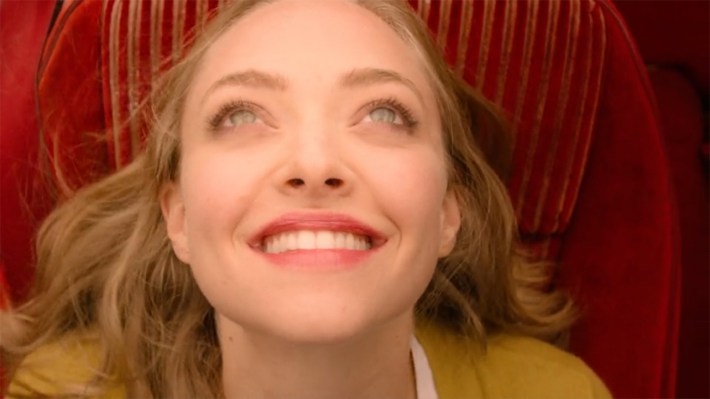
But even the dumbest young love is still young love. Becky is clearly enamored with Steven’s flattery of her and promises of a brighter future…and with his cocaine, which he hoovers up like a vacuum apparently. He still has enough left over for her to take an absolutely blissed-out, coked-up ride in his convertible, staring up into the sky with luminous eyes while the Paris Sisters’ oldie “I Love How You Love Me” plays on the car radio.
Honestly, someone probably should show the fun parts of dating a dirtbag and doing a lot of blow. These can be fun activities! They just come with some side effects, usually. But Lynch and Frost convert this moment into a kind of ecstatic tribute to the joy of being young, being beautiful, being in love, being alive, the sun, fast cars, fun drugs, good music, grinning from ear to ear just because you feel good. It’s incredible how many moments like this, in how many different moods and tones and genres, the TP braintrust has created already this season. They can shoot threes from the logo or shatter the backboard with a dunk seemingly at will.
Airing back to back with “Part 3,” this episode rounds out the Vegas storyline somewhat, showing us exactly who Dougie is and what the hell Cooper is going to do in his shoes. What it really does is establish that apparently nobody is going to much notice that the Dougie Jones they know has been replaced with a doddering simpleton who can only repeat snippets of things people say to him and has forgotten how to do all basic tasks, from getting out of a car to urinating.
Maybe that will change, and more people like Bill Shaker’s wife will come along. Maybe Lynch and Frost are making a point about how for certain guys, things kind of just always align in their favor. Maybe it’s just funnier that way.
Regardless, it’s one of the most audacious things this show has ever done — as big a departure from the original in its way as purple oceans and cannibalistic entities mutilating nude people. If you don’t want Twin Peaks at its Dougie Jones, you don’t deserve it at its Dale Cooper or its doppelganger. To paraphrase another great TV show, they’re building something here, and all the pieces matter.
This journey beyond the infinite deserves, frankly, a round of applause. Coop’s journey is not without precedent: Without straying far from mainstream nerd culture, it’s reminiscent of David Bowman’s travels past Jupiter in 2001, the concept of the Source Wall from Jack Kirby’s Fourth World comics, or the ritual of Chüd in Stephen King’s novel It. Even so, it looks and feels wholly unique. Mark Frost and David Lynch are combining horror, fantasy, science fiction, surrealism, and experimental filmmaking with gobsmacking results — the kind of episode that leaves you either knocked back on your couch or excitedly pacing around the room, recalling favorite moments and spinning elaborate theories. My notes read “THERE’S SIMPLY NEVER BEEN ANYTHING LIKE THIS ON TELEVISION.”
Rolin Jones’s Interview with the Vampire was always good, but during Season 2 something extraordinary happened. It just got better and better from episode to episode until the finale, which was the best episode the show had ever aired. And they say lightning doesn’t strike twice! Moving, disturbing, disgusting, hilarious, and harrowing, this final episode of The Vampire Lestat’s first season is the best episode in the whole show’s history.
This is true even though it succumbs to that otherwise woeful trend of shows building and building to an explosively violent climax that never arrives. Shōgun Season 1, House of the Dragon Season 2, and Fallout Season 2 were all good-to-great, yet they all dry-dicked us when it came to bloodshed, if you’ll pardon the Daniel Molloy–level vulgarity.
This episode overcomes that deficit through its sheer richness. “Silver threads,” Lestat says dreamily as he (apparently) looks directly into Heaven at one point. “Silver threads stretched out over other threads.” That’s how the writing on this show feels. Hannah Moscovitch’s script is a tapestry of different tones, styles, genres, emotions, sensations, all of it so wittily worded, so diamond sharp that Oscar Wilde could use it to file his nails. Director Alan Taylor, the major Sopranos and Game of Thrones director, returns to the chair for the first time since IWTV’s phenomenal series premiere, and lays out a real feast for the eyes as well as the ears.
I reviewed the season finale of The Vampire Lestat for Pop Heist. I just wanna be clear that as a horror person, a glam rock person, a musical theater person, a goth, and a TV critic, this show had a very high bar to clear with me, and it soared over that thing straight into the
I’ll say right here that Kyle MacLachlan is simply magnificent in this role, terrifying and wholly unique in his malevolence. The doppelganger looks as if all the light inside a normal human has been completely emptied out and replaced with tar. He sounds unbearable when he’s pretending to be happy and uncanny when he actually is. He’s pure darkness. I’m a big fan of Jamey Sheridan’s work in Mick Garris’s 1994 adaptation of The Stand, but if you said that MacLachlan’s Nega-Cooper is the best portrayal of Stephen King’s infernal archvillain Randall Flagg, I wouldn’t argue with you. He is the Dark Man, the Walkin Dude, the Hardcase, the Man with No Face.
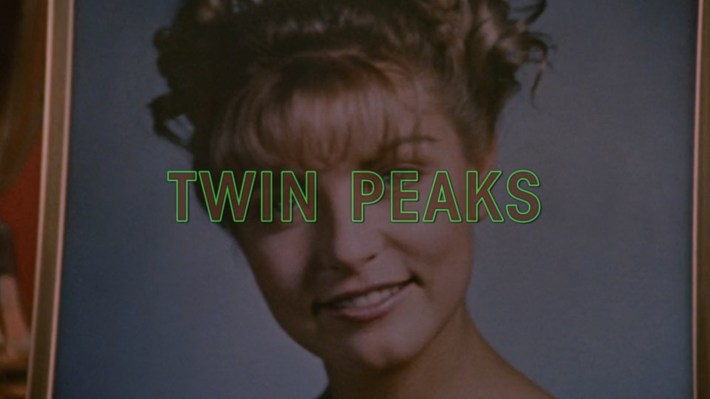
The differences are established right away. The opening title sequence, with its familiar sight of a chirping bird and whirring saws, is gone. After woozy shots of the black-and-white floor and the red curtains, there’s a cold-open flashback set in the Black Lodge, with Laura Palmer telling Dale Cooper she’d see him again in 25 years. We fade to mist over the pines, then to the walls of Twin Peak High School, where the screaming girl runs through the courtyard as she did in the pilot, in slow motion. The camera pushes in to the trophy case, zeroing in on Laura’s homecoming photo. When the title of the show appears and Angelo Badalamenti’s theme finally hits, it’s over Laura’s face.
This opening alone establishes three things. First, the Black Lodge is no longer a side dish, it’s the main attraction, with the Red Room’s zig-zag flooring and billowing crimson drapery the first things you see. Second, we will be diving deep into memory here, into what happened 25 years ago and what happened in between. Third, Laura Palmer is at the center of it all.
The Vampire Lestat is now at the point that Interview with the Vampire reached in its second season. It is escalating in quality at a rate that is frankly psychotic. Each episode is better than the last; in IWTV’s case, this culminated in the Season 2 finale, which was the best episode in the history of the show. There are two episodes left in this season. Pump them directly into my veins.
Here’s where we address the white horse in the room: the performance of top-billed stars Sheryl Lee and Ray Wise as Laura and Leland. They are, without qualification, the two best film performances I’ve ever seen in my life. Even in a series stuffed with gifted actors tasked with doing difficult work and succeeding, there’s nothing like these two. There’s nothing like them anywhere. They touch the sun.
This is challenging, layered material, written like profane poetry and glittering like Lestat’s eyeshadow. A show like that doesn’t come around often, not even during this very strong year for TV. There’s something special in this combination of glitter and gore.
Considering the strength of Jacob Anderson as a lead in what used to be Interview with the Vampire the TV show, shifting not only to Reid as an actor but to Lestat as a narrator — a nastier, more cynical, more comedic, less reliable narrator — is a massive risk that is paying off in spades. The Vampire Lestat visually and aurally bitchslaps you with entertainment like an unexpected shot of Eric Bogosian’s bare ass.