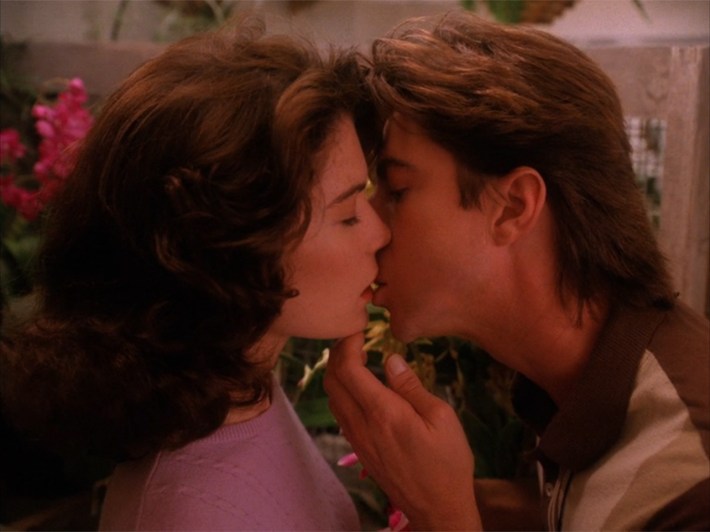
Before his departure from Twin Peaks, Dale’s supervisor, Regional Bureau Chief Gordon Cole, makes his move on Shelly, asking for a kiss before he leaves, perhaps for good. To him, she’s a goddess, not only due to her looks and personality but the fact that she’s magically cured his hearing loss, somehow for herself only. I mean, that is kind of hard to argue with.
But even as they’re locking lips, Bobby walks in, leading to a needle-scratch sound effect from the jukebox and a fantastic reaction shot from actors David Lynch (hooray!) and Mädchen Amick, who has never looked lovlier. (Let’s face it, the entire human race has never looked lovelier.)
“YOU ARE WITNESSING A FRONT THREE-QUARTER VIEW OF TWO ADULTS SHARING A TENDER MOMENT!” Cole informs him. “Acts like he’s never seen a kiss before,” he says to Shelly at a conversational volume, his face wearing the unmistakable look of a man who knows he’s successfully punching way above his weight class. “TAKE ANOTHER LOOK, SONNY!” he shouts back to Bobby. “IT’S GONNA HAPPEN AGAIN!” Then he leans in for his second kiss, fulfilling his, and one can only assume David Lynch’s, fondest wish. (Series mainstay Harley Peyton and co-creator Mark Frost wrote this episode, and Lynch’s fondness for his leading ladies, usually platonic but occasionally less so, is well-documented.)
The discovery of that hidden panel and that symbol is what prompts Coop to declare that they’re on a journey to “a place both wonderful and strange.” This is as apt a description for Twin Peaks, and Twin Peaks, as I’ve ever heard. With only four episodes left in the show’s second season, which for a quarter century meant only four episodes left in total, things are getting truly mystical. We have a white wizard in the form of Dale Cooper. Now we have Windom Earle as his opposite number, a dark sorcerer. A clash seems inevitable. What wonderful and strange place will it lead us to? Will it fill us with wonder, or leave us stranded where the stars are strange?
“She came to me,” Harry says, “and she made everything better.” He repeats himself, breaking down, in a way that’s hard to hear if you’ve ever worried about losing someone who’s done that for you. “Everything, so much better.” Dropping his gun, he collapses into Coop’s arms, and the two hold each other in the show’s most arresting portrait of their free and easy friendship yet. These guys love each other, man. How can you not love that? How can you not love them?
Like most of the episodes in this critically disfavored stretch of the series — be careful which Twin Peaks fans you say the words “pine weasel” around — this feels, well, extremely Twin Peaks to me. It makes room for everything from Andrew Packard gleefully proclaiming “I’m aliiiiiiive” to Josie like he’s his own Dr. Frankenstein, to huge moments in the romances between the Hurley boys and their beloveds, to goddamn Bob and the Man from Another Place reappearing. It all fits.
The show reminds me of a well-recorded rock song in this way, where if you sit and single out any given instrument, you hear something almost totally new. Want to focus on how Mädchen Amick is the best-looking human being ever to be filmed for the small screen as she sits at the bar in the Roadhouse in a brown leather jacket smoking a cigarette? Want to marvel at Thomas Eckhardt’s garish robe as he breathes his last, ending legendary bad-guy actor David Warner’s brief stint on the show? Want to contemplate the cosmic injustice of a woman forced into moral dissolution by powerful men, punished by demons, and trapped in a wooden limbo forever? Twin Peaks makes all of it possible, even the things you wish weren’t.
David Lynch is not the only notable name to direct an episode of Twin Peaks. Lesli Linka Glatter, famous for her later work on Mad Men and Homeland, directed four episodes. Duwayne Dunham, whose résumé as an editor includes Return of the Jedi and Blue Velvet, directed three, as did Caleb Deschanel, cinematographer of The Natural and The Right Stuff.
But it’s fair to say that Diane Keaton — yes, that Diane Keaton — is the biggest star to sit in the director’s chair this side of Lynch himself. While she’s most famous as an actor, Keaton brings more than just her Oscar and her star on the Walk of Fame to the proceedings. While clearly working with the stylistic palette established by Lynch himself, Keaton takes the opportunity to flex.
Finally, there’s Twin Peaks’ answer to The Omen, Little Nicky. Andy informs Lucy of his and Dick’s theory that their young mentee is a murderer who offed his own parents. “We think he was six at the time of the crime,” Andy says gravely. Royally peeved, Lucy recruits Doc Hayward to tell these two dopes the real story, and boy, is it a tearjerker.
The Doc himself delivered Nicky, whose mother, a poor immigrant chambermaid at the Great Northern who was the victim of sexual assault but carried Nicky to term anyway, died in childbirth. “We buried her in potter’s field and sent the infant to the orphanage,” Doc says, like he’s an Edwardian vicar. Nicky’s tragic life took a turn for the even worse when the loving parents who adopted him died in a car accident. By the time Doc says “Six-year-old Nicky managed to pull his parents from the blazing car,” Dick and Andy are sobbing and I was howling with laughter. Between this storyline and that Jacoby line, this episode features some of the show’s funniest dialogue ever. But right at the end of this deliberately over-the-top moment of sensitivity, Lucy swats a mosquito, and the thing is full of blood. It’s such an odd, unnecessary, uncomfortable, funny, weirdly shocking thing to do. In other words, it’s Twin Peaks.
It’s been a while since we’ve seen or heard from Twin Peaks’ show within the show. Invitation to Love, the cheesy soap opera many of the townsfolk followed during Season 1, has been completely absent from Season 2, and with it one of the filmmakers’ chief methods of having a little fun at their own expense. They’re fully aware that the only thing that really separates the melodramatic potboiling of the fake show from the real one is execution, so they hung a lampshade on it. It’s all in good fun.
In audio form, anyway, the show makes its triumphant return this episode. We hear it playing in Shelley Johnson’s still half-finished house as Bobby Briggs jilts her in favor of his big opportunity with Ben Horne. (And, presumably, his equally hot prospects with Ben’s daughter Audrey.) The soap has always been an escape for Shelley; now it plays as her prospects narrow and the walls close in.
Sure enough, the inevitable finally occurs, and the monstrous Leo Johnson emerges from his coma. He’s got a party hat on his head, cake smeared all over his face, and if his sinister smile is any indication – murder on his mind. Shelley can only scream like a girl in a horror movie, which is more or less what she is.
Shelley’s survival notwithstanding, Invitation to Love feels like an appropriate accompaniment to this episode, one of the horniest and most violent in the show’s brief history. Couple after couple, including some surprising ones, get it on, while heroes and villains alike employ brute force either to save the day or darken it.
It took a few episodes, but it’s safe to say it now: As of the twelfth episode of Twin Peaks Season 2, Twin Peaks Season 2 has officially begun.
Depending on how new to the show you are, you may or may not know that its second season has a historically poor reputation. By now the whole Twin Peaks saga — the original run, the prequel film Twin Peaks: Fire Walk With Me, and Season 3, aka Twin Peaks: The Return — is so beloved, as is its co-creator and primary director David Lynch, that you may hear Season 2 badmouthed less often than it used to be.
Speaking personally, I think people lump together the entire Laura Palmer saga in their heads as “Season 1,” then lump everything after that (plus the “Mr. Tojamura” thing, perhaps) together as “Season 2.” Even then, a lot of the things people love about Twin Peaks happen after Laura’s murder is resolved. You’re never going to hear anyone complain about post-Laura Season 2 because it introduced Denise Bryson or the concept of the Black Lodge, that’s for sure.
Other than that, though? When people use “Season 2” pejoratively, this episode is rooted almost entirely in the storylines they’re talking about. James’s film-noir road trip. Nadine’s high school wrestling career. Andy, Lucy, Dick Tremayne, and the devilish Little Nicky (Joshua Harris). The widow Milford and her siren-like power over every man who lives in a town already inhabited by, well, the female cast of Twin Peaks. Ben Horne becoming a Confederate sympathizer during a psychotic break.
Well, everyone knows these Twin Peaks Season 2 storylines suck. What this review presupposes is…maybe they don’t. Written and directed by one of the series’ A-teams — Harley Peyton, Robert Engels, and Caleb Deschanel — it makes a strong opening case for some of the show’s most maligned material.
Wherever you go, there you are. Buckaroo Banzai’s maxim feels broadly applicable to the people of Twin Peaks. Transplants bring their pasts with them, and expats remain trapped in a perpetual Twin Peaks of the mind.
Rumors of Twin Peaks’ demise have been greatly exaggerated.
We’re up to the tenth episode of the show’s second season, which tends to be described in monolithic terms as wholly unsatisfactory, a betrayal of Season 1’s potential. But everything from that cliffhanger season finale through Leland Palmer’s capture and death has been every bit as good as Season 1, and in several cases significantly better; the episode in which Leland is revealed as Laura’s killer is the most powerful episode of the show to date.
In a way, Season 2 hasn’t even really started until now. Given the truncated length of Season 1, it makes more sense from the perspective of today’s viewer to view everything from the pilot until Leland’s death at the hands of his demonic inhabitant Bob as the first chapter of the story. The remaining 13 episodes of Season 2, starting here, are effectively Chapter Two.
And what a start Chapter Two gets off to. The first episode of the show to be both written and directed by women, Tricia Brock and Tina Rathborne respectively, it’s a thoughtful farewell to the side of Leland that prevailed in the end, a heartwarming series of bon voyages between a departing Agent Cooper and the good people of Twin Peaks, and an introduction to several new storylines that, for now at least, feel both urgent and intriguing.
“In pursuit of Laura’s killer, I have employed Bureau guidelines, deductive technique, Tibetan method, instinct, and luck. But now I find myself in need of something new, which, for lack of a better word, we shall call magic.”
We know who that killer is now, and that makes Twin Peaks a fundamentally different show than it was an episode ago. With the show’s central mystery solved from the viewer’s perspective, you can already feel the force of storytelling gravity tugging the case towards its resolution. There’s only so long you can leave the killer on the loose without making Agent Cooper and company look incompetent, which cuts against the core appeal of the character.
I’ve given some thought to the sublime in cinema — moments when it feels what I’m watching has somehow transcended earthly limitations, visually expressing a feeling so huge that it’s impossible for words to articulate. I realize now that for me, this happens in horror more often than anywhere else. In fact, it may only happen in horror.
It happens when characters are made to confront some symbolic representation of…not death, though that’s part of it, and not evil, though that’s part of it too. They confront the darkness we fear exists at the world’s heart, the terrible void that acts as a megapredator for our tiny souls. They confront the true black.
I think of moments like Chief Brody on the beach, the camera dolly-zooming on him Vertigo style as he sees that the shark he hoped had been killed but knew in his heart had not claim another victim. Father Karras and Father Merrin, chanting “The power of Christ compels you!” at a hovering Regan MacNeil. Wendy Torrance turning a corner and watching an elevator unleash a river of blood. The cops gazing down the hall of Barton Fink’s hotel and seeing a demon in human form amidst a blazing inferno. The end of Mulholland Drive. The end of The Zone of Interest.
And this episode of Twin Peaks. Maddy and Leland and Bob and Sarah in the living room. Coop and Harry and the Log Lady and the Giant and the waiter and Bobby and Donna and James in the Roadhouse. Evil incarnate, drawing out grief from people who don’t even yet know why they’re grieving — only that there’s been some tear in the fabric in the world, one that they can sense but never repair.
When Mark Frost and David Lynch’s credit appeared against the red curtains, I couldn’t hold back anymore. The tears I’d withheld came pouring out. This is one of the most deeply awful and awesome things ever aired on television. I have not forgotten it since I first watched it nearly three decades ago. I will never forget it for as long as I live.
There’s room for silly business like this in Twin Peaks for sure. It’s part of the charm. But we’re now getting ever closer to the pulsating black heart of the story — the force of sheer malevolence that claimed Laura Palmer’s life. As such, even the simplest lines that touch on this mystery take on an awesome power. When Mike describes Bob as “the parasite,” attaching himself to human hosts and feeding on their fears and carnal pleasures, it’s like hearing Max Von Sydow talk about the thing inside Regan in The Exorcist.
“He is Bob, eager for fun,” Mike says. “He wears a smile. Everybody run.”
This dialogue moves me to the point of tears, not of sorrow or joy, but awe. A great and terrible thing is at hand.
The sequence that follows is fascinating for how directly it addresses female desire, a constant theme where Laura is concerned. To help flesh out Harold’s “living novel” and satiate his thirst for secrets — in exchange for which he’ll read to her from Laura’s diary — Donna tells the story of a time in junior high when she and Laura dressed up in their tightest clothes to pick up boys at the Roadhouse.
The college boys who pick them up wind up going skinny dipping with them, which is Donna’s idea, not Laura’s. Laura had begun dancing provocatively, and Donna is desperately trying to keep up. She imitates the dance, half in shadow, to make her point.
As Laura makes out with two of the three young men in the water, the third swims out to where Donna is and kisses her hand, then her lips, a feeling she remembers almost physically even now. “I never saw him again,” Donna tells Harold with tears in her eyes. “It was the first time I ever fell in love.”
Harold is blown away. He takes her back to show her his orchids, paying special attention to the “lower lip” of its petals, “called a labellum.” The words hang in the air, dripping with innuendo.
“So delicate,” Donna purrs. When Harold explains it’s a landing pad for pollinators, Donna replies, “Romantic, isn’t it?” The two kiss before Harold, suddenly anxious or self-conscious, breaks it off and scampers away.
There are any number of taboos being violated here, giving the scene the heat of the forbidden. There’s the obvious erotic power of that story over Donna even now, yet it’s not presented as some lascivious Lolita kind of thing. In how she tells the story, Donna is clearly expressing feelings she experiences now, as a young adult…and which Harold experiences as an older one. So there’s that age gap aspect, too.
But at the same time, Harold’s severe mental illness, and his ignorance of Donna’s true motives, put her in control of the much older man, not the other way around. The whole thing is a psychosexual bramble, and its thorns are hard to disentangle yourself from.
Leland Palmer has a confession to make. Once again sobbing like the devastated father we knew before his hair went white, Leland admits that he killed Jacques Renault, the man he believed to be Laura’s killer. His motivation, he explains to Sheriff Truman, Agent Cooper, and Doc Hayward, was “absolute loss…more than grief. It’s deep down inside. Every cell screams. You can hear nothing else.”
And indeed, we do hear the sound in Leland’s head as he sits in the interrogation room in the Twin Peaks Sheriff’s Department, staring into the holes in the paneled walls. It’s the voice of his daughter, Laura, calling “Daddy!” over and over.
The only glimpse I caught of Twin Peaks during its initial run occurred on October 13, 1990. I was 12 years old, it was after 10 p.m., and I must have been flipping through the channels absent-mindedly before bed after the Golden Girls/Empty Nest block on NBC had ended. I was aware of the show by then, even as a person who’d only freshly become aware of “pop culture” as a phenomenon; the cast and the parodies were absolutely everywhere for months. But this was my first look at the show itself.
I saw a one-armed man with a syringe have a seizure in a men’s room stall, then emerge in perfect calm, talking to an unseen figure like a man possessed.
I was a squeamish kid. That was plenty of Twin Peaks for me.
The motorcycle parked outside the Palmer house lets you know who’s inside. James Hurley and his girlfriend Donna Hayward have come to visit Maddy Ferguson, the out-of-town cousin of their beloved friend Laura Palmer. In fact, they’ve come to record a love song, using a tape recorder, an old-fashioned microphone, and James’s acoustic guitar. While Maddy and Donna sit side by side on the floor and coo their dreamy backing vocals, James takes lead. His tremulous voice sings a song called “Just You,” which sounds like something you might have slow-danced to at the 1961 Spring Fling.
Donna’s mistake is believing that the song is for her. It might have been when he wrote it. It might even have been when he started singing it. But as the song continues, the dynamic shifts. As Maddy’s eyes seek out James with increasingly obvious hunger, and he responds by looking back at her instead of Donna, Donna’s own eyes grown desperate, pleading, and finally tearful. Eventually it’s too much, and she gets up and runs off.
“I’m trembling, James,” she says when he comes to comfort her. “You made me.” It’s true, but not in the heated way she intends it to sound. The thought of losing James has rocked her.
Maddy just sits there looking uncomfortable for this bit.
Then something happens. As she looks absently into the depths of the Palmer family’s first floor, a man emerges into view. Slowly he approaches, crawling over the sofa, scrambling over the coffee table, staring straight into the camera until he’s right in our faces. Maddy screams uncontrollably, even as Donna and James rush to her side to comfort her. She’s seen Laura’s killer. She’s seen Bob.
These few short minutes of screentime begin with a song so sugary sweet it passes through camp and back around into to dead-serious sincerity. There’s just no denying the passion and pain in the glances exchanged between the three singers. Add in Donna’s attempt to kiss James back into loving her and you’ve got something desperately romantic, in line with the star-crossed relationships of Blue Velvet or Mulholland Drive. But then, after some brief comic relief courtesy of Maddy’s third-wheel awkwardness, comes what remains one of the scariest shots ever aired on television: Frank Silva’s Bob, coming for all of us.
If you called Twin Peaks Season 2, Episode 1 one of the greatest season premieres of all time, you’d be telling the truth. You’d also be lying by omission.
I love Desmond’s debut down the Hatch at the start of Lost Season 2 (a show whose creators never made any bones about the debt they owed Twin Peaks). I love the knife’s-edge suspense between Walt, Jesse, Mike, and Gus at the beginning Breaking Bad Season 4. Shit, I love Sam drinking and whoring his way through getting left at the altar by Diane to kick off Cheers Season 3. But to compare these excellent episodes of television to these revolutionary 90 minutes is to damn what Mark Frost and David Lynch did here with faint praise. Those episodes have surprises, shocks, bittersweet laughs. This episode has the waiter, the Giant, Leland’s musical numbers, Audrey Horne’s prayer, Gersten Hayward’s recital, Major Briggs’s vision, Laura Palmer’s murder. They are not the same.
When people toss the word “Lynchian” around, it’s usually either as a very specific subgenre of surrealism, or as a way too broad synonym for “weird.” But the opening scene of this episode is a whole different flavor of Lynch, one every bit as important to his overall project. FBI Special Agent Dale Cooper, you’ll recall, was shot three times at point-blank range by a still-unidentified assailant to end Season 1. (We learn from the insufferable but brilliant Agent Rosenfield, back on the scene to bully everyone within the Twin Peaks city limits, that his would-be assassin was of average height, hardly narrowing it down.) When we rejoin Coop this episode, we can see that only one of the bullets penetrated his body, right where he’d lifted up the bulletproof vest he’d been wearing beneath his shirt while undercover at One-Eyed Jack’s. He was hunting for a pesky wood tick, you see; the bullet found the little bugger, and his torso, instead.
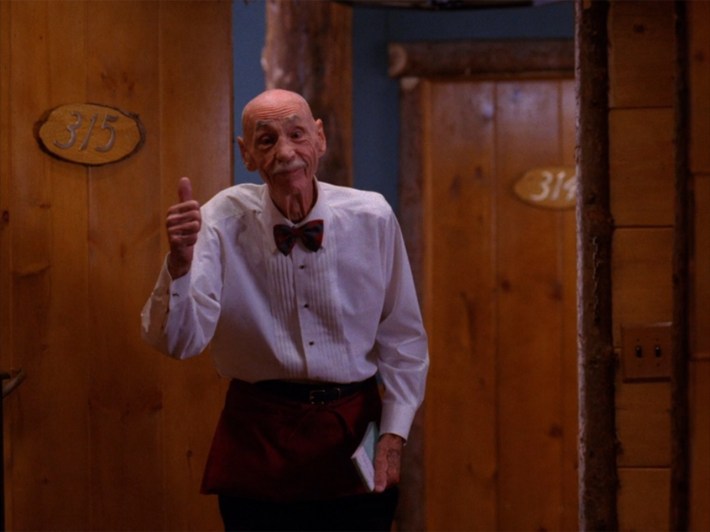
At great length, an elderly room service waiter (Hank Worden) slooooooooooooooooooooooooooooooooooooooooooooooooooowly delivers Cooper a glass of warm milk, hangs up the phone on a panicked Deputy Andy rather than call a doctor, and gives Coop — whose reputation apparently precedes him among the staff, if the waiter’s nearly giddy repetition of “I heard of you!” is any indication — several encouraging thumbs up and eye winks before shuffling away. The waiter also has him sign the room service bill. (Gratuities are included.)
Experiments in comedic tedium like this have been a Lynch hallmark since Eraserhead. I’d argue that on Twin Peaks in particular, as we’ll see later this episode with Leland Palmer, they’re a form of proto–cringe comedy, predating Steve Coogan and Armando Ianucci’s creation of Alan Partridge in 1991, Garry Shandling and Dennis Klein’s The Larry Sanders Show in 1992, and Mike Lazzo and Keith Croffod’s Space Ghost Coast-to-Coast (the most Peaksian of these early examples) in 1994. Scenes like these (fire) walk the fine line of boredom, discomfort, and silliness. It’s astonishing to think that in this case, they’ll lead to the absolute horror we see at episode’s end.
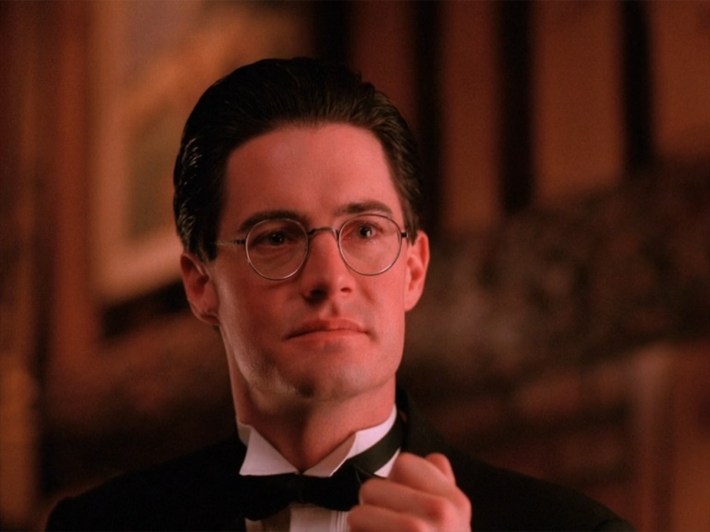
It’s Kyle MacLachlan’s finest moment to date as FBI Special Agent Dale Cooper, though you wouldn’t know he’s a Fed to look at him when it happens. He’s undercover as a high roller at One-Eyed Jack’s, the Canadian casino and brothel we (though not he) now know is owned by corrupt Twin Peaks business magnate Benjamin Horne. Wearing glasses and a tux, he’s fronting as the secret money man behind Leo Johnson’s cross-border cocaine smuggling operation.
Very quickly, he wins the trust of Leo’s partner in crime, bartender and blackjack dealer Jacques Renault. Convincing Jacques that Leo’s taking advantage of him, Cooper’s yuppie druglord offers Jacques ten thousand dollars cash to complete a job directly for him, “No Leo, no middleman.” Unsurprisingly given what we know of his work schedule, the French-Canadian dirtbag happily accepts the job.
There’s just one question Cooper has for Jacques before he sends him off on his errand, which of course is a trap designed to snare him within Sheriff Harry Truman’s jurisdiction in Twin Peaks itself. He’s already brandished the broken poker chip that matches the fragment found in Laura’s stomach. How did the chip get broken, that night with the girls, he wonders?
Cheerfully, with the relish of a schoolkid about to share his dad’s porn stash with a friend, Jacques explains that Laura liked to be tied up, which is what left her wide open when Waldo the bird was freed from his cage by Leo and landed on her shoulder. She and Waldo liked each other, and they were only “love pecks” according to Jacques, but with Leo “doing a number on her,” it was too much. She began to scream.
So Leo grabbed the chip, shoved it in her mouth, and said — Jacques delivers, chortling, in his thick accent — “Bite the bullet, baby. Bite the bullet!”
Throughout Jacques’s story, the view alternates between increasingly tight, subtly slow-motion closeups on Jacques’s grinning mouth as he talks, and Cooper’s rigid inexpressiveness as he listens. You can see, courtesy of MacLachlan’s best work on the show, that Cooper hates this man. He’s practically vibrating with it.
But he holds back all his loathing, all his disgust, and reacts as if he’s heard nothing out of the ordinary for men in their line of work. “Thanks for clearing that up,” he says in the end, with a snort of mirthless laughter. Coop’s pained non-reaction of a reaction reminds us this is not just a whodunit, but a tragedy. Jacques has given himself up as a suspect, but it won’t undo what was done.
My Prestige Prehistory series is taking a week off after this, but we’ll be back for Season 2 on January 12. That gum you like is going to come back in style!