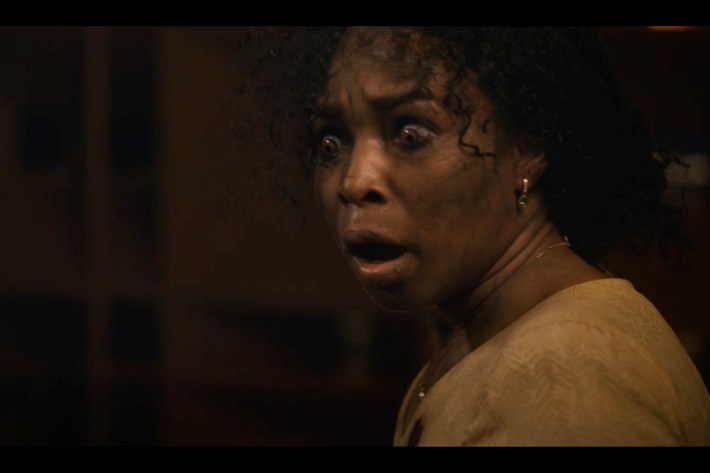
But more importantly, we learn exactly how Claudia feels about “Daddy Lou”: She hates his goddamn guts. Sometimes inhabiting Merrick, sometimes appearing directly before them, Claudia says she hates Louis more than anyone she’s ever known.
Photo: AMC
She mocks his self-pity, saying she only chose him over Lestat because he’s a natural-born “slave” who’d be easier to manipulate and then discard. Even worse, she reveals she’s had no rest in the afterlife, searching the void for her beloved Madeleine, who is nowhere to be found. “STOP SAYING MY NAME!” she screams, and departs. At last, Claudia has been given a voice of her own, and actor Delainey Hayles uses it for all it’s worth.
Or is it Claudia’s voice? Again, everything we’re hearing and seeing this season is being mediated through Lestat, just as Interview with the Vampire was through Louis. It’s possible that the needier, more damaged Louis, the creepier Armand, the more vindictive Daniel, and the Claudia who hates Louis more than her maker and kinda sorta murderer Lestat are closer to reality than the ones we saw through Louis’s eyes. It’s possible we got Spirit Claudia as-is, with no editorializing by Lestat. It’s just as possible that we didn’t.
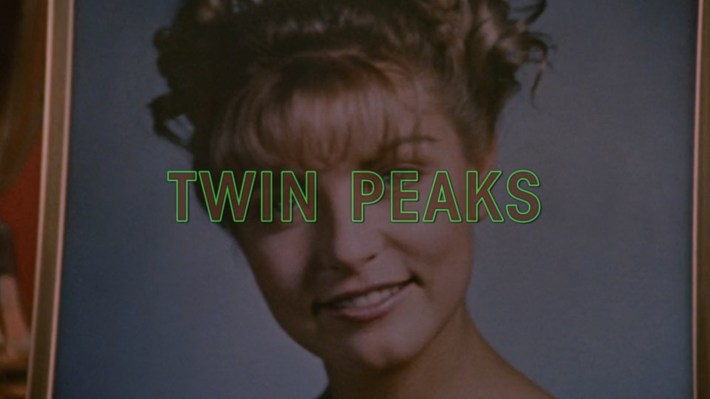
The differences are established right away. The opening title sequence, with its familiar sight of a chirping bird and whirring saws, is gone. After woozy shots of the black-and-white floor and the red curtains, there’s a cold-open flashback set in the Black Lodge, with Laura Palmer telling Dale Cooper she’d see him again in 25 years. We fade to mist over the pines, then to the walls of Twin Peak High School, where the screaming girl runs through the courtyard as she did in the pilot, in slow motion. The camera pushes in to the trophy case, zeroing in on Laura’s homecoming photo. When the title of the show appears and Angelo Badalamenti’s theme finally hits, it’s over Laura’s face.
This opening alone establishes three things. First, the Black Lodge is no longer a side dish, it’s the main attraction, with the Red Room’s zig-zag flooring and billowing crimson drapery the first things you see. Second, we will be diving deep into memory here, into what happened 25 years ago and what happened in between. Third, Laura Palmer is at the center of it all.
Daemon Targaryen is a hard man. He has left a trail of dead enemies across the Seven Kingdoms of Westeros and done it with a smirk on his face. His preferred tactic of negotiation is “take it or leave it.” It is exceedingly rare for him to display any negative emotion at all that doesn’t end in violence or its implied threat.
It’s with this Daemon in mind that we watch him encounter his daughter Rhaena in the wilds of the Vale. Daemon’s dragon, Caraxes, leads him right to the cave where Rhaena’s own dragon, Sheepstealer, has made its lair. Sheepstealer’s disastrous rampage through the Battle of the Gullet helped drive Queen Rhaenyra’s son Jace to his death, and she wants its rider brought to justice. Now Daemon knows the horrible truth: To avenge Rhaenyra’s child, he would have to sacrifice his own.
“No,” he gasps, doubling over. The reaction staggered me nearly as much as the revelation staggers the Rogue Prince. He has displayed a devil-may-care attitude all season long, but it turns out the devil does care after all.
A couple years ago I wrote an essay about a TV style or subgenre I called “the New Lurid”: Dead Ringers, The Fall of the House of Usher, The Idol, Copenhagen Cowboy, and other hyper-lush depictions of the incestuous degeneracy of the ultra-rich — Saltburn-core, basically. Since then, recent seasons of shows such as The White Lotus, Industry, Euphoria, and Interview with the Vampire as retitled The Vampire Lestat have carried the New Lurid torch. Cape Fear, a raw psychosexual thriller about a one-percenter family in which everyone is related, as they fight and fuck under trees whose branches appear ready to snap from the weight of their greenness, does so too.
“Like a televisual vanitas,” I wrote, these shows are “sensual but death-haunted, lush to the point of rottenness, like a once-magnificent family finally, terminally, gone to seed.” If that doesn’t describe Cape Fear, I don’t know what does.
It’s a very strong ending, a razor-sharp idea that keeps the spotlight on Farrell and Dalton where it belongs. I don’t know if it’s the influence of showrunner and Breaking Bad veteran Sam Catlin, the presence of Better Call Saul star Dalton or what, but it reminds me of something Walter White might have done to Jesse Pinkman if push came to shove for them. If the Sugar 2.0 can generate more moments like these, then we’d be talking. I’m just not sure it makes up for all the ways the writing had to fudge things to get us there.
Ironically, given the nature of the titular structure, Silo’s lore does not run that deep. I’m fond of pointing out that rather than take the usual mystery-box approach, keeping the core question in the dark as you add more and more questions to maintain momentum, Silo keeps it simple. There’s really only one mystery here: Why are they down there? Everything else flows directly from or to that central gap in the narrative.
But it’s not just the mystery plot, Juliette’s often interrupted quest to get to the truth, that reflects this welcome simplicity. As a result of that storytelling decision, all the backstory, the fake history, the world-building, the lore must also point in the direction of that one big question. In a lore-heavy episode like this one, we see the benefits of that approach. The information still opens up new vistas of understanding, but the camera, so to speak, is always focused on the exact same landscape. We just see it more clearly now.
The Vampire Lestat is now at the point that Interview with the Vampire reached in its second season. It is escalating in quality at a rate that is frankly psychotic. Each episode is better than the last; in IWTV’s case, this culminated in the Season 2 finale, which was the best episode in the history of the show. There are two episodes left in this season. Pump them directly into my veins.
It’s happening again. It’s happening again. It’s happening again. — Sarah Palmer, Twin Peaks: The Missing Pieces
The emergence of The Missing Pieces was our first real sign that it might, indeed, be happening again. It was the first new Twin Peaks material anyone had seen since 1992, when Fire Walk With Me came out. Though it comprises deleted and extended scenes, sometimes with alternate takes, from FWWM, The Missing Pieces is considered canonical. The things that are happening in those missing pieces are really happening.
That’s not to say you’d be able to understand a moment of it if you hadn’t watched Fire Walk With Me first. The Missing Pieces has been edited into a continuous feature-length film, but even in the opening titles themselves, which bill what you’re about to watch as an outtakes collection more or less, no one’s making any pretense that it’s intended to stand on its own.
That’s reflected in how its story is told. There are no character introductions, no settings established, and much of the plot has been excised, happening in between the scenes we’re watching. Moreover, the scenes are arranged in the order they might have appeared in the original movie, not chronologically — scenes of Leland Palmer’s relationship with Teresa Banks, for example, are shown around the point of the film where he himself thought about them, even though they take place prior to anything else. You’re just dumped into it, with FBI Special Agent Chester Desmond already investigating Teresa’s murder. It’s expected you’ve watched Fire Walk With Me if you want to know who either of those people are or why they matter.
The Missing Pieces is designed to expand on and enhance our understanding of Fire Walk With Me — clearing up certain elements that came out confusing in the finished movie, beefing up the roles of the eccentric FBI agents from its opening sections, reintroducing a number of characters and actors from the original series whose material was filmed but didn’t make the final cut.
Most importantly, it provides a much larger, clearer window into both the lives of the Palmer family and the workings of the Black Lodge, allowing us to know the people this happened to and the things that made it happen more accurately and intimately. As such, it contains some of the most frightening images and moving moments in the entire Twin Peaks oeuvre. They can’t stand alone, exactly, but they do stand apart.
The composer Ramin Djawadi has been working in Westeros since 2011. First on “Game of Thrones” and now on “House of the Dragon” — which now uses a souped-up version of its predecessor’s famously rousing opening theme — Djawadi has crafted hours of music tailored to the setting’s many disparate cultures, characters, environments and emotions. His work so far this season bears special attention: He has given each of the three episodes its own sonic signature.
In the season premiere, a low, threatening synth line conveyed the horror-movie horror of the Battle of the Gullet. In the second episode, insistent strings built in a swirling crescendo that never seemed to resolve, adding tension and dread to the fall of King’s Landing to Rhaenyra’s invading dragons.
Now Rhaenyra sits on the Iron Throne, Queen of the Seven Kingdoms … and her sonic signature is a repeated, percussive, distracting sound, an ominous bong halfway between a bell being struck and someone punching the strings of a piano. In this episode it can be heard again and again, when Rhaenyra is faced with an insurmountable challenge, an unexpected obstacle or a reminder of the fragility of her rule.
As if to reinforce that this “music” represents the tumult in her head, at several points we see that Rhaenyra is straight-up hearing things. Murmurs, whispers, the roar of a distant crowd or the low voices of a nearby one — these, too, provide an auditory window into the mind of the Black Queen. She even has a full-blown hallucination of her dead son Jacaerys, bong included.
I’ve written that Sugar is a fantasy of a frictionless, trafficless Los Angeles, in which our angelic alien glides from destination to destination, easily earning the trust of people from across the town’s tapestry of cultures. It enhances the show’s dreamy tone, sure. But does the fact that John Sugar is, for all intents and purposes, a rich white man in a suit influence his ability to do what he does so effortlessly? The other explanations — highly stylized writing, or as-yet undisclosed alien pheromones — are satisfying, but they don’t make for a particularly rich text.
What has always distinguished Sugar is the off-kilter excellence of its execution. In some senses that’s still there: the photography of Los Angeles, whether at night or in broad daylight, remains absolutely beautiful, and so does the photography of Colin Farrell.
But the wheels are really starting to creak everywhere else. The sequence in which Sugar walks through the EZ4’s base of operations is frankly an embarrassment, a series of glowering tattooed Mexicans with white socks pulled up high, mean-mugging the only white person on the screen. To paraphrase Community, I can excuse racism, but I draw the line at a boring walk through a yard controlled by drug dealers when The Wire did this for season after season without ever once being dull about it twenty damn years ago.
We live in a time of unsubtle metaphors. The White House lies in ruins so the billionaire president can build a combination ballroom and bunker for himself and his rich pedophile pals, the Reflecting Pool is full of pond scum and guarded by soldiers and cops who arrest people for touching a monument that belongs to them. So by all means, stick psychotic omnisexuals in the walls, have a misogynistic freak buy the house across the street, leave literal trails of blood everywhere you go. You could not possibly be less subtle with the subtext than reality itself.
The point being made by Neveah’s existence within the very walls of the Bowdens’ happy home is that nothing is sacred, nothing is safe, home and family provide neither security nor succor. This is borne out by the plot time and again. Not a single member of the Bowden family trusts any of the others.
The last we saw Juliette Nichols, she was on fire. Played by Rebecca Ferguson, Juliette is the working-class hero of the post-apocalyptic bunker called the Silo and the protagonist of the series. Expelled by former mayor Bernard Holland (Tim Robbins) for investigating the Silo’s secrets, she survived the poison atmosphere of the outside world long enough to make it into a different Silo entirely. Its few residents helped her make it back home, leading to a fiery confrontation with Bernard just outside the original Silo’s airlock before her storyline cut to black.
Three months later, it’s a whole new world down there. Juliette has been elected mayor. Hell, some people seem to view her as a kind of messiah. In addition to miraculously surviving both the poison air and the fiery reentry chamber, her return to alert the Silo residents that it was deadly to go outdoors ended the facility’s brief civil war.
What’s more, her actions exposed Bernard’s schemes to society. Though he himself died during the fire, his surveillance camera system is being dismantled, his abuse of the governing Pact has been curtailed, and the Pact itself is being rewritten by Sheriff Paul Billings (Chinaza Uche). Now there’s a whole governing council comprising representatives of every level and department in the Silo: Juliette, Paul, Judge Robert Sims (Common), and his wife Camille (Alexandria Riley), Juliette’s handler and chief of staff.
There’s just one problem: Juliette doesn’t have the first clue how any of this happened.
This is sort of the platonic ideal of a Vampire Lestat episode. The entire core cast — Sam Reid, Jacob Anderson, Delainey Hayles, Eric Bogosian, Jennifer Ehle — are given meaty material and make meals out of it. The vampire action, however you want to define action, is both bloody and sexy as hell. Lestat has never been more unhinged onstage than he is during his cheerleader-chant diss track against Armand. Gabriella has never been sexier than she is covered in the blood of a man still inside her, beckoning to her own son. (The show’s never been more perverted than that, either; hell yeah, brother.) Louis and Daniel’s hearts are tested, and one of them, at least, has already failed. Richer and more decadent than eating a shipful of sailors, The Vampire Lestat is better than I could have imagined.
“What have you done? Jace. Jace! What have you done? How could you? How could you do this to me? Answer me!”
Like the bereaved King David crying “O Absalom, my son!” repeatedly in his despair, Queen Rhaenyra is facing a grief so total that her brain short-circuits and runs on a loop. As she looks at the corpse of her son and heir, Jacaerys, all she can do is upbraid him over and over, like the disappointed parent she is. But disappointment doesn’t come near to what she’s feeling. Devastation is more like it.
Rhaenyra is bedridden with sorrow when her husband, Prince Daemon, returns from the Riverlands after hearing the news. To him, she spells out the grim absurdity of her situation: “The boys who clung to me, who hid their little faces in my skirts, dead, so that I may sit upon a throne of swords?” She has lost two sons, Luke and Jace, to her cause. To fight on seems pointless.
But the episode’s loveliest shot isn’t one of Sugar’s visions of the cosmos, gorgeous as those are. It’s when he visits the grandmother of a murdered friend of Ji’s, sees that her grief has rendered her unable to do basic tasks like the dishes, and voluntarily starts doing them for her. Unwilling to let a guest in her home do all the work himself, she gets up and helps dry. This goes on for a wordless minute or two — a moving moment of human connection. (Well, half-human, anyway.)
What Max is doing is playing the most long-term, high-stakes game of “not touching you! not touching you! not touching you!” of all time. Over the course of years he built his plans for revenge, turning various people (mostly women and girls) to his cause. (Tabitha, the vapid journalist, seems on the verge of becoming one of his disciples herself.)
There’s no law against bumping into people, or having a daughter, or buying a house. He’s not doing anything, not that they can successfully pin on him anyway. Since every word Max speaks to the Bowdens is friendly, at least on the surface, there’s little grounds for any kind of legal protection. They just have to sit there and take it as he tricks them into being their own undoing. Judging from the number of unforced errors they make this episode, that won’t be too hard. Cape Fear is a journey into brains as overheated and unhealthily vibrant as the colors of the show itself.
Was her death a difficult place for you to get to as an actor? That was one of the scenes I was most proud of. In the script, it’s really only two lines — it says something like “They fight and she’s killed” — and I got to decide how I wanted to play that. The obvious way to play it would have been that she fights to the bitter end and goes down with a sneer of hatred. I decided that in those final moments, she is afraid. I wanted the audience to sympathize with her and to see what this journey of revenge has cost her. The theme of this season is the cost of war, and I wanted to set us up for that.
Something that all the female reporters I’ve spoken to have picked up on is how that scene where she dies is a hard watch, because it’s a much larger man strangling a woman to death. I was never scared of being in physical danger during the battle, but there are moments that are emotionally difficult. I mean, being strangled underwater by a much bigger man is a scary thing. I have been attacked by men, as almost every woman has, and it is a scary thing to go through, even if it is just pretend. The emotions sink into your soul a little bit.
Even though we’ve seen her do all this stuff, there’s something about that which is hard to watch, and I deliberately chose to make that hard for you to watch. Fortunately, Abu is a very professional and kind guy. I remember when we watched it back, Abu said, “They’re gonna think I’m a monster. They’re gonna hate me.” I was like, “I know!”