In the standard opening sequence of The Prisoner, the voice of the new Number Two tells Number Six that he and the masters of the Village want “information … information … information.” Some Number Twos deliver the latter two iterations of the word as if they’re a phrase: “In formation…in formation.” They want him to line up and march, like a good soldier.
The final episode of The Prisoner in every possible running order, “Fall Out” is named after a phrase with several meanings depending on whether it’s one word or two. “Fallout” means the often unfortunate ramifications of an action or event; more specifically, it also means the radioactive debris that rains down on the area surrounding a nuclear explosion. People “fall out” when they have a relationship-ending argument or disagreement. Objects “fall out” when they drop from a place they’d been secured.
In a way, all of those meanings apply to this episode, but none more so than this: Just as soldiers “fall in” when they get in line, they “fall out” when they break formation.
Far out even by Prisoner standards — far out even by “Once Upon a Time” standards, which was itself far out even by Prisoner standards — “Fall Out” is one of the most confrontational series finales ever aired. It’s a “Did you people think I was fucking around? Do you know what kind of show you’re dealing with here?” moment on par with the trial of the Seinfeld Four, Tony Soprano playing Journey at the diner, and the Lynchian un-resolutions of the two (!) Twin Peaks series finales. (The first one was so unresolved that the 25-year gap until Season 3 somehow felt logical — like, of course it would take everyone that long to recover from what happened at the end of Season 2.) It’s a finale that feels designed to be divisive.
You make a show like The Prisoner to make an episode like this.
Written and directed by creator and star Patrick McGoohan, the auteurist masterpiece “Once Upon a Time” is a clear move toward the series’ endgame, advancing the overarching plot (!), ending on a cliffhanger (!!!), and promising us that in the next episode both Number Six and we in the audience will, at long last, meet Number One (!!!!!!). That’s thrilling enough, and a textbook case of The Prisoner breaking the rules it’s established for itself in basically every way conceivable at one point or another.
But as important as all that is, as much as we’ve been waiting 16 episodes for it to happen, it pales in comparison to the execution. “Once Upon a Time” is one of the most boldly experimental episodes of television ever filmed. You’d have to fast forward to the finale of Twin Peaks Season 2 or the phantasmagorical eighth episode of Twin Peaks Season 3, I think, before you found anything comparable.
There have been other mightily sophisticated, groundbreaking, stylistically innovative shows that weren’t made by Patrick McGoohan, Mark Frost, or David Lynch, of course. But to cite two representative examples, The Sopranos‘ dream episodes are the clear product of the everyday mind of the main character, and Nicholas Winding Refn and Ed Brubaker’s magisterially bleak Too Old to Die Young operates in the same basic soporific register the entire time. Only in The Prisoner and Twin Peaks did things already start out “both wonderful and strange,” then somehow find a way to become wonderful and strange even by their own immeasurably lofty standards.
Throughout The Prisoner, Patrick McGoohan and his collaborators have been restless to the point of mania. Any rule they can break in their story of a lone intelligence operative pitted against unknowable and implacable forces, they break, even if it was their own rule to begin with. Episodes with different opening credits. Episodes with no opening credits. Every episode is about escape, until they aren’t. Every episode features Rover and the Announcer, until they don’t. Every episode has a new Number Two, except the ones that reuse old ones. Episodes that begin with twenty minutes of silence. Episodes in which Number Six is a suave secret agent in Paris. Episodes set in the Old West.
Seen in that light, “The Girl Who Was Death” is perhaps The Prisoner‘s boldest experiments yet. It alone dares to ask the question: What if an episode of The Prisoner was really, really stupid?
Stupid like a fox, of course. Working from a script by Terence Feely, director David Tomblin, a pivotal player in The Prisoner‘s production, knows that this screwball Swinging ’60s British super-spy pastiche is silly as hell.
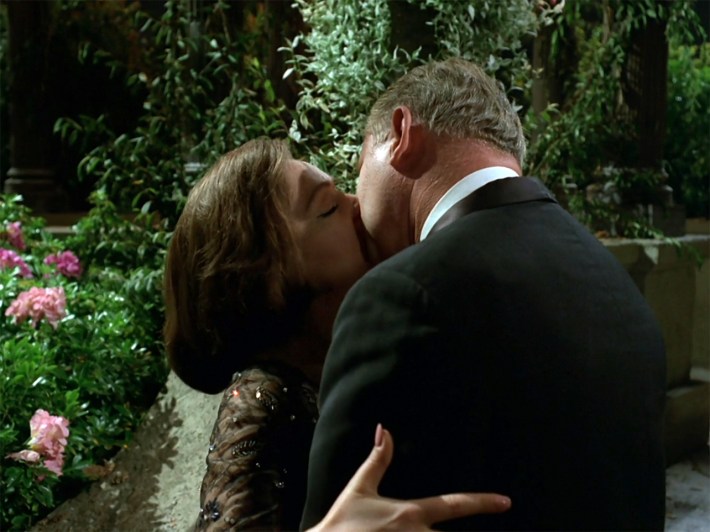
Even though he’s doomed to be in the wrong body, even though he’s doomed to inevitably return to the Village to complete the procedure, even though he initially demurs rather than scare her away with the crazy-sounding truth, he has to convince her he’s the man she loves, and not through anything as dry as handwriting analysis. So after tracking her down at a party, he tells her to grab the receipt he needs to pick up the slides and meet him outside, where he’ll deliver a message from “Number Six”.
The message is a kiss. Boy, is it ever. In a long take, over electric guitar music that is almost ambient in its plaintiveness, he shows her who he is. “Who else could have given you that message?” he says afterwards. Oooh-whee, that is romance.
Photo: Prime Video
It’s also not Patrick McGoohan. Six finally scores (sex afterwards is faintly but legibly implied), including a big on-screen kiss, but he’s not Six as we know him. Remember, the devoutly Catholic star of this secret-agent show had a no-kissing clause.
Still, we needed this, I think he realized. We needed to know that there was more to Number Six’s life before the Village than a stint on Her Majesty’s Secret Service, a stormy resignation, and a stubborn refusal to explain why. We needed to know that he cared about someone other than himself, had other ideals beyond independence and personal liberty. Personally I think it’s safe to assume he does, that he soured on the work he was doing in some way. We know from “A. B. and C.” that he didn’t resign to sell out or switch sides. In “The Chimes of Big Ben” he began to explain his resignation by saying “I resigned because for a very long time, I—” before the eponymous bells toll. Some kind of moral reason is implicit.
But love? Love indicates he’s more than a man of principle. He’s a man. There’s a woman he loves waiting for him back home. There’s a life that’s been taken from him. If he can have that life back however briefly, in however strange a way, he’ll take it. If he can pay back the people who cruelly taunted him with it only to yank it away by helping Seltzman escape and trapping his enemy in the wrong body, he’ll do that too.
Throughout The Prisoner‘s many strange visits to the Village, the title sequence has remained comfortingly familiar. With its sound of thunder and spy-thriller soundtrack, the wordless depiction of Number Six’s resignation and abduction is a blast to watch, culminating with him rising from his forced slumber, looking out his front window, and seeing the Village for the first time. (And the episode title, too, which must be helpful for him.) Just like that, anyone tuning in for the first time knows the backstory.
Then comes the call-and-response voiceover face-off between Number Six and each episode’s Number Two. This part of the opening sequence sets up the show’s big mysteries in a handful of koanlike questions and mantralike answers. The ominous sight of Rover, the reveal of the new Number Two, Six raging at the sky while yelling “I am not a number, I am a free man!”, Two’s mocking laughter … it puts today’s “abstract substances coalesce and morph into various familiar things from the show you’re watching” trend to shame; that’s for sure. All told, those three minutes are one of The Prisoner‘s greatest achievements.
Naturally, they went and binned it. This is The Prisoner we’re talking about — a show that breaks every mold it can get its hands on, including its own. Even the credits are fair game.
All of this is a long way to say that when this episode opens with a cowboy on horseback in the Wild West instead of a secret agent in a sports car in London, I cheered “Hot damn!” These magnificent bastards did it again!
Despite all his scheming and note-planting and trust-undermining, Six doesn’t really do anything to take Number Two down in this episode. He’s not actually a plant; he’s not actually working for a top-secret new commander; he’s not actually conspiring with any of the other Villagers on either side of the invisible cage bars. He’s just … there, solid and unyielding as ever. Through sheer implacability, he forces Number Two to bang and bang and bang away until there’s nothing left of him. In boxing, this is called rope-a-dope, and they’ve done it time and time again to Number Six. Turnabout is fair play.
Now, I’ve done a lot of research about this by now, and anywhere it’s discussed, a blacksmith will eventually chime in and point out that hammers damage anvils all the time. Anecdotal counterexamples aside, you get the idea, right? Compared to the solid mass of an anvil, a hammer’s as flimsy as a conductor’s baton. Bang that thing as hard as you can and you’re more likely to break the hammer, or even your own arm, than you are the anvil itself. And what is Number Two in the end if not a broken arm of the Village body? Control’s strength is finite, but defiance’s is not. Tyranny is brittle. Oppression is the mask of fear.
The Prisoner is, no pun intended, a number of things. It’s both colorful episodic sci-fi and a bleak, Kafkaesque parable of persecution. It’s a work of dreamlike surrealism and an extended riff on swinging ’60s super-spy shows. And it’s a dystopia in miniature, its setting an eerily idyllic open-air prison instead of a gigantic closed society. Of course, at least one Number Two has suggested that the endgame for all of this can be summed up as “Today the Village, tomorrow the world.”
Of all the episodes we’ve watched, “A Change of Mind” is the one in which actor-auteur Patrick McGoohan — who once again directs under his “Joseph Serf” pseudonym — seems engaged most directly with the mid-20th century’s dystopian landmarks. Orwell’s 1984 looms large, of course, as it long has: faces of authority looming down from sloganeering posters, captives reconditioned to love their tormenters, a reassuring face replacing an image of terror in compulsory film viewing, even the Winston/O’Brien relationship between Number Six and several of the Number Twos.
The use of drugs and aversion therapy to induce reflexive compliance and nonviolence, meanwhile, is straight out of Anthony Burgess’s A Clockwork Orange, published five years prior. The show predates Stanley Kubrick’s infamous and stylistically influential adaptation of the novel and anticipates the director’s aesthetic approach, from its costumed droogs to its combined movie theater/torture chamber.
But McGoohan’s also firing live ammo here. Under the new Number Two (John Sharp, whose roles in The Wicker Man and Barry Lyndon yield a significant Prisoner-fan Venn diagram overlap), the Village’s methods of bringing antisocial, inadequate, disharmonious, UNMUTUAL Villagers to heel recall any number of real-world oppressions: Soviet show trials, McCarthyite purges, Maoist self-criticism sessions, the vicious conformity of little England or small-town America. The term used in the episode for its science-fictional mind-wiping procedure, “social conversion,” carries bitter echoes of the persecution of queer kids in the decades to come.
It begins in silence, and in silence it stays. Other than some unintelligible radio chatter and a couple of lines barked in German, 19 minutes pass after Number Six proclaims “I am not a number, I am a free man!” at the end of the opening sequence before anyone utters a single word. The Village is deserted, so there’s no one there to speak. The boat which Six builds and sails to freedom, sails all the way back to England in fact, houses exactly one passenger, and he has nothing to say to himself. Six’s first line of dialogue — the episode’s first line in English — is a question, to a Roma traveler he encounters on a seaside cliff. It’s just three words and just three syllables: “Where is this?”
That is the question, Number Six. That is the question.
In response, the Nazis swept into the village of Lidice, which was wrongfully suspected to have hid co-conspirators, and wiped it out. They executed 340 people, including every male resident over the age of 14, as well as 82 children, who were gassed to death after being transported to a concentration camp.
On May 27, 1942, members of the Czech resistance killed a monster. Though the assassination itself was a comedy of errors involving jammed machine guns and “close only counts in horseshoes and hand grenades” grenade throws, Reich Protector Reynard Heidrich, the brutal overseer of Czechoslovakia and a prime mover of the Holocaust, died of his wounds several days later.
In this episode of The Prisoner, a clockmaker Villager played by actor Martin Miller, a Czech Jew, plots to assassinate the Village’s overseer, Number Two. In that context, I think Number Six can be forgiven for what he does, or doesn’t do, next.
Colin Gordon is a fascinating Number Two, with a more modish fashion sense and a general vibe of, let’s say, confirmed bachelorhood. Whereas previous Numbers Two who couldn’t get INFORMATION out of Number Six seemed content to mess with him a bit and call it a day afterwards, this one has been tasked with getting results in no uncertain terms, with consequences that are clearly grave should he fail. This gives the episode a previously entirely unused dramatic axis around which to spin. The look of terror he shoots the phone in the episode’s final shot is the finest moment to date for anyone in the role.
Meanwhile, McGoohan is an absolute hoot as the unflappable Six, confident he’s beating his warders at their own game. As 14, Sheila Allen plays a reluctant Dr. Frankenstein, driven past the point of safety by the demands of Number Two. (“Where’s your scientific enthusiasm?” he demands when she worries the procedure could hurt or kill the patient.) Along with Kath, Carell, and Bettine Le Beau in a momentary but memorable bit part as a French maid who catches Six’s eye, Allen is one of several smoldering guest stars, and there’s no crime in that: Even a spy thriller as serious-minded as The Americans understood the value of sex appeal in the spy game.
Visually, this is sumptuous stuff even by Prisoner standards. Director Pat Jackson’s inventive use of rear projection helps conjure up both the giant screen on which Six’s dreams are projected and the Champs-Élysées at twilight as C. drives Six to his secret rendezvous.
Dutch angles turn the third night at the party into a visual fight between Six’s consciousness and the weakened drug. The costuming, from C.’s dress to 14 and D.’s respective capes, remains colorful and creative.
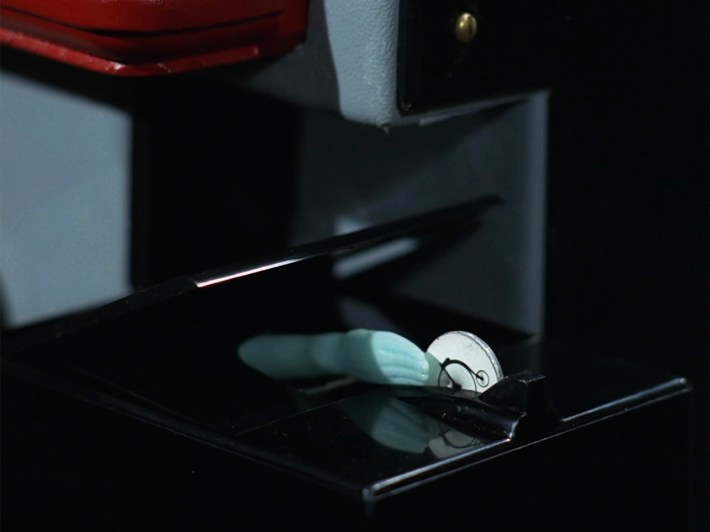
In order to reach the Village’s boardroom and broadcast center, you have to put a tiny disc in a little slot. Once you do this, a tiny blue plastic hand emerges from a little box and grabs the disc, snatching it away and disappearing back into the box. After this point, you — and I should mention here that you’re dressed in a top hat and black coat with black sunglasses indoors — can pass unimpeded through the forcefield-protected entrance.
Is there a reason that a tiny little blue plastic hand has to emerge from a little box to grab a disc before you can get in there? Considering that virtually every inch of the Village is monitored by video and patrolled by guards both human and spherical in nature, no, not really. You could just have some guy wave you in after you show an ID card. You could have Rover the floating orb (who does not appear in this episode) act as bouncer. You could do pretty much anything. But The Prisoner chooses to have a tiny little blue plastic hand emerge from a little box to grab the disc and let you in.
Photo: Prime Video
Why? Well, the Village is very impressed with its technological prowess and, simultaneously, possessed by the aesthetic sensibility of an outsider artist — the better, perhaps, to bewilder the straightlaced cop types who become intelligence officials. This is a facility that seemingly spares no expense in creating elaborate, even baroque machines and procedures that Occam’s razor, if applied, would slice to ribbons. In that sense, the little blue plastic hand is exactly the kind of shit these weirdos would set up.
However, I think a different explanation gets to the heart of it. The Prisoner is based on a simple concept: What if you made a TV show that was interesting instead of uninteresting whenever a choice between the two was available?
I mean, yes, absolutely, you could have a guard stand in front of that hallway, letting people in based on an approved list of Numbers allowed to attend the board meeting or work in the broadcast center. Indeed, there’s a whole new cadre of guards invented in this episode for just this sort of work — grey-jumpsuited, helmeted, shades-indoors goons with white batons who’ll gladly beat the shit out of you if ordered. They’re literally standing around waiting to do a job like letting people in to a top-secret area.
But the little blue plastic hand that picks a disc up out of a slot and yoinks it back into its tiny black box? That’s something better than plausible: It’s bitchin’. It’s mint. It’s just some of the weirdest, coolest shit you’re gonna see on your screen this week, I guarantee. Would Patrick McGoohan and his Prisoner collaborators put it in quite these terms? No, probably not. But we’re free to call a spade a spade, you and I, and this show is cool as hell. It feels like it’s trying, really going for it, at all times and in all ways, and that is vanishingly rare.
Considering the amount of screen time the two Sixes share, the late-Sixties special effects that enable them to appear together in the same shot is shockingly effective. Their hand-to-hand combat in particular is very visceral, in part because of McGoohan’s fists-only fighting style, here doubled, but also because both men appear determined to be the only Six left standing by the end of it.
But could the doubling suggest something deeper? Whatever else it is, The Prisoner was made in the shadow of McGoohan’s previous super-spy TV hit, Danger Man. (That’s what Danger Mouse was parodying, if you didn’t know.) It’s no secret that McGoohan had grown bored with the role by the show’s fourth season; The Prisoner, developed with help from Danger Man Season 4 script editor Doug Markstein, is essentially McGoohan doing a revisionist version of the character he’d just finished playing. The biting cynicism, the distinct lack of heroic catharsis, the overall absence of globe-trotting derring-do, with mind-bending psychological torture in its place: It’s kind of like if Chris “Captain America” Evans created and starred as Homelander in The Boys. Is there a better visual metaphor for this than Patrick McGoohan, secret agent at large, duking it out with Patrick McGoohan, secret agent in chains?
(Also, are you familiar with a little show called Twin Peaks? Because I’ve got a feeling many of the trials and tribulations of the oft-doubled FBI Special Agent Dale Cooper can be tracked back to this episode.)
Still, the thing that really got to me had nothing to do with Six at all, but with Twelve, the traditional movie/TV secret-agent type sent to imprison him. Whoever he is, he had a wife who loved him, and who he subsequently lost, and — wait, did we just figure out why this person would agree to become another man in the first place? The surgery, the training, all of it: Is it the equivalent of Jim Carrey getting his memories erased in Eternal Sunshine of the Spotless Mind, or Adam Scott taking on a very strange day job so he can forget about his late wife in Severance?
Even if you’re not buying this backstory (which I just made up as I wrote that paragraph), there’s no two ways about it: Number 12, Curtis, loved a woman named Susan, who loved him back, and now she’s gone. By the time we learn any of this we’ve already seen him be destroyed by Rover (now identified by this codename by both Six and Two, so there you go, official Orb name designated) in what looks to be excruciating fashion. It’s hard to empathize with the kind of person who’d work for the Village organization, or who’d try to break Six in this way. It’s hard for me, personally, to imagine that people with minds like that — fascists, I mean — can truly love the way real people can. But that’s the life he built for himself, and that’s the life that’s over now, and even Number Six is made to wrestle with that.
“I want him with whole heart, body, and soul,” Number Two says early on, while rejecting the usual offers to use more extreme methods to break Number Six. That is the way of fascism. It’s not enough to submit: You must embrace your own submission. That this itself is a destruction of heart and soul does not concern the regime. Your heart and soul are your masters’, and they will remake you in their grey and grinning image.
Number Six is his own worst enemy. But you don’t have to take my word for it: just ask the administrators of the Village. For two episodes in a row now, they’ve used his own determination to smash the security of his prison and break free to drag him down deeper into their morass of mind games.
I think this is why Patrick McGoohan works so well in the role. Sure, he created the show, stars in it, wrote and directed several episodes, uses his own professional headshot for Six’s dossier photograph, uses his birthdate for Six’s right down to the second, et cetera. (This is partly why co-creatorship claims by McGoohan’s collaborator, the writer and script editor George Markstein, strike me as exaggerated.)
But beyond that, he’s developed a very physical style of acting that meshes well with the man of action he portrays. I’ve joked before that Six has three settings: lurk, lurch, and loom. His movements are sudden, almost erratic. Quick-cut editing makes them seem even choppier and more unpredictable. Even his style of hand-to-hand combat, which he’s deployed in two episodes running now, is all stiff punches. This guy’s gonna hit you till you fall down, full stop. He’s gonna get where he’s going at top speed. He’s gonna get answers from the people he wants answers from even if he has to chase them down and pop out of the woodwork to grab them.
But the most unnerving thing about the episode is the way it depicts Number Six’s fellow Villagers as mysterious, fundamentally unknowable people. Some of them are brainwashed automatons. Some of them are active agents of the enemy. Some seem reluctant to fulfill their duties, others positively gleeful. They spend their days in endless parades and celebrations, blasting John Philip Sousa marches and screaming at the top of their lungs — except for the times when they’re eerily silent and still.
How can you possibly live in a society constructed of people this unreliable, this unstable, this incapable of conceiving of genuine common good and working towards it together? How can you live with people who’ve collectively abandoned reality?
To this last declaration of Number Six, the final line of the dialogue that from here on out is a standard fixture of the opening sequence of The Prisoner, the new Number Two only laughs. Everything else Number Six says to her, she dignifies with some sort of response. The idea of freedom garners only mocking dismissal without a word.
I reviewed the second episode of The Prisoner for Pop Heist. (Gift link!) Please note! If you’re following along you’ve already noticed we’re watching the show out of order vs. how it’s listed on streaming sites. That’s because it was not really intended to be watched in the order it was aired! Fun, right? We’re using Zack Handlen’s so-called AV Club order, which you can find here, in a nifty table you can rearrange according to the various suggested viewing orders floating around out there with a couple of clicks.
The Prisoner can largely be credited, or blamed, for the mystery-box genre via its outsized influence on Lost, which in many ways feels like a sexier, less severe version of this show — The Prisoner: Pacific Nights, if you will. Certainly the question of who runs the Village and why they’re so obsessed with Number Six is of grave concern both to the audience and Six himself.
But what I take away from this episode is not a puzzle to solve but a person to study. Here’s a guy who did Her Majesty’s dirty work, and apparently with enough aplomb and success to drive a preposterous sportscar. He was so good at his job of being a spy for a Western government that the Village, whoever or whatever is behind it, has dedicated its resources to cracking his brain open and seeing what’s inside.
And what is his attitude towards all this? Lol yeah right, best of luck, assholes. Is he confused, is he angry, is he frightened? Oh, for sure. But he has a single conviction, and it is this:
“I will not make any deals with you. I’ve resigned. I will not be pushed, filed, stamped, indexed, briefed, debriefed, or numbered. My life is my own.”
The most talked about and praised show of the year is Andor, Tony Gilroy’s exploration of violent insurrection in the face of fascism, set in the Star Wars universe. The reason it has resonated so much with people, I think, is because its eponymous character shares this sentiment.
For all its maddening — and intentional; it serves fascists well to confuse their opponents and victims — contradictions, fascism presents us with a straightforward proposition: We are human only to the extent that we fit the regime’s perpetually constricting definition of who is human. Resisting fascism is in large part a matter of personal integrity: My words will match my thoughts, my actions will match my words, I will be the person I am and not the servant they want me to become, I will not betray my soul. Number Six, who in this episode gives Patrick McGoohan’s birthdate as his own down to the minute, will not go along with any of this either. He’s not the machine-man with a mind of gray sludge that Number Two and his masters want him to be. He is a human. He is not a number. He is a free man.
But the problem with Secret Invasion’s AI credits isn’t just one of ethics, or of ugliness. It’s a waste of some of the most valuable creative real estate any television show has. Throughout television history, thoughtfully crafted opening title sequences have set the tone for the shows to follow, conveying valuable information about everything from the mood you can expect to the plot of the show itself. Some are woven so deep into the fabric of the series they kick off that the two become synonymous. The best function like short films, artistic statements on their own. Speaking plainly, AI just doesn’t have the juice.
When Cheers wanted to show you a place where everybody knows your name, they relied on a carefully curated and edited selection of illustrations and photographs depicting nostalgic good-old-days revelry created by James Castle, Bruce Bryant, and Carol Johnsen. Monty Python member Terry Gilliam established his troupe’s style of surrealistic inanity with animation that would become a staple of the show. David Lynch and Mark Frost used second-unit footage and the evocative music of close Lynch collaborator Angelo Badalamenti to transport you to Twin Peaks.
When mercurial writer-actor-director Patrick McGoohan parlayed his experience playing a secret agent on the British show Danger Man to create an espionage thriller of his own, he unexpectedly created the prestige drama 30 years ahead of its time. The Prisoner is a frightening, funny, philosophical, absolutely mesmerizing allegory in which McGoohan’s nameless title character, a retired spy dubbed Number Six by his mysterious captors, is imprisoned in a bizarre place called the Village. While crafting an escape plan, he’s subjected to psychological experiments designed to break him by a series of interchangeable superiors all named Number Two. It’s one of the mot visually striking and bracingly bleak shows ever; everything from Lost and Twin Peaks to The Americans owes it a debt.