
Posts Tagged ‘reviews’
“Halt and Catch Fire” thoughts, Season Two, Episode Three: “The Way In”
June 14, 2015You know that old saying about how you can’t judge a book by its cover? Halt and Catch Fire seems hellbent on puncturing the proverb; it’s a show that’s always taken pride in how it communicates about its characters through their appearances. Tonight’s episode — “The Way In” — is a case in point: Success story Gordon Clark suits up and shaves to show he’s enjoying his current victory-lap life. Former silicon-prairie gunslinger Joe MacMillan dresses casual in a plain white tee to signify his simple new outlook. And, more subtly and perhaps most importantly, punk coder extraordinaire Cameron Howe is letting her chopped-off, bleached-blonde hair grow long and dark. The founder of Mutiny is, literally and figuratively, putting down roots.
This latest rock-solid installment is striking for doubling down on the stability of its leading ladies. That may be an odd thing to say when Cameron threatens to fire her partner/resident voice of reason Donna after a company-wide meltdown — and then has a panic attack that only the abrasive Tom Rendon can rescue her from. But think about it: The dynamic duo of Clark and Howe are building an pre-Internet powerhouse from the ground up, and all their arguments stem from how seriously they’re taking it. It’s the men who find themselves locked out of where they want to go, forced to devise workarounds to get back in.
Halt and Catch Fire was terrific tonight, you guys! I reviewed it for Rolling Stone.
‘Game of Thrones’: Why Knowing Nothing (About the Show) Is Great for Book-Readers
June 14, 2015Now I get to feel all the nervous anticipation, stomach-churning dread, and jaw-on-the-floor shock everyone else does each Sunday at nine—or that I did, for that matter, every time I sat down to watch new episodes of Breaking Bad or Mad Men or The Sopranos or any other seminal New Golden Age drama you’d care to name. Much has been made of the excesses of spoiler culture, and complaints about the constant demand that not so much as a peep about the plot be uttered in advance of a viewer’s initial encounter with it are thick on the critical ground. But deciding what to reveal and when to reveal it is a core component of narrative fiction, every bit as deliberate and valid an aesthetic choice as the casting or cinematography or score — doubly so for a show that derives as much of its artistic heat from spectacle and shock as Game of Thrones does. Only now that the TV version has jettisoned its rocket-booster books and truly taken off, in other words, are book readers like myself genuinely seeing the show the way it was meant to be seen.
In practical terms, this is nerve-wracking as all hell. I greeted the ominous avalanche that signaled the arrival of the army of the dead with the same what-fresh-hell-is-this bewilderment as Lord Snow. I watched the White Wedding of Sansa and Ramsay with a mounting mix of queasy repulsion and vain hope that the coming catastrophe could be avoided. And by the time poor Princess Shireen took her long walk to a tall stake in the snow after an episode full of foreshadowing and fakeouts, I felt like I was being marched to the flames along with her. On the flipside, I got to witness the big When-Dany-Met-Tyrion moment with its full holy-shit power preserved. This is a show that’s all bass and treble — as Cersei put it, “you win or you die; there is no middle ground” — and I feel like I’m hearing it for the first time.
“Hannibal” thoughts, Season Three, Episode Two: “Primavera”
June 13, 2015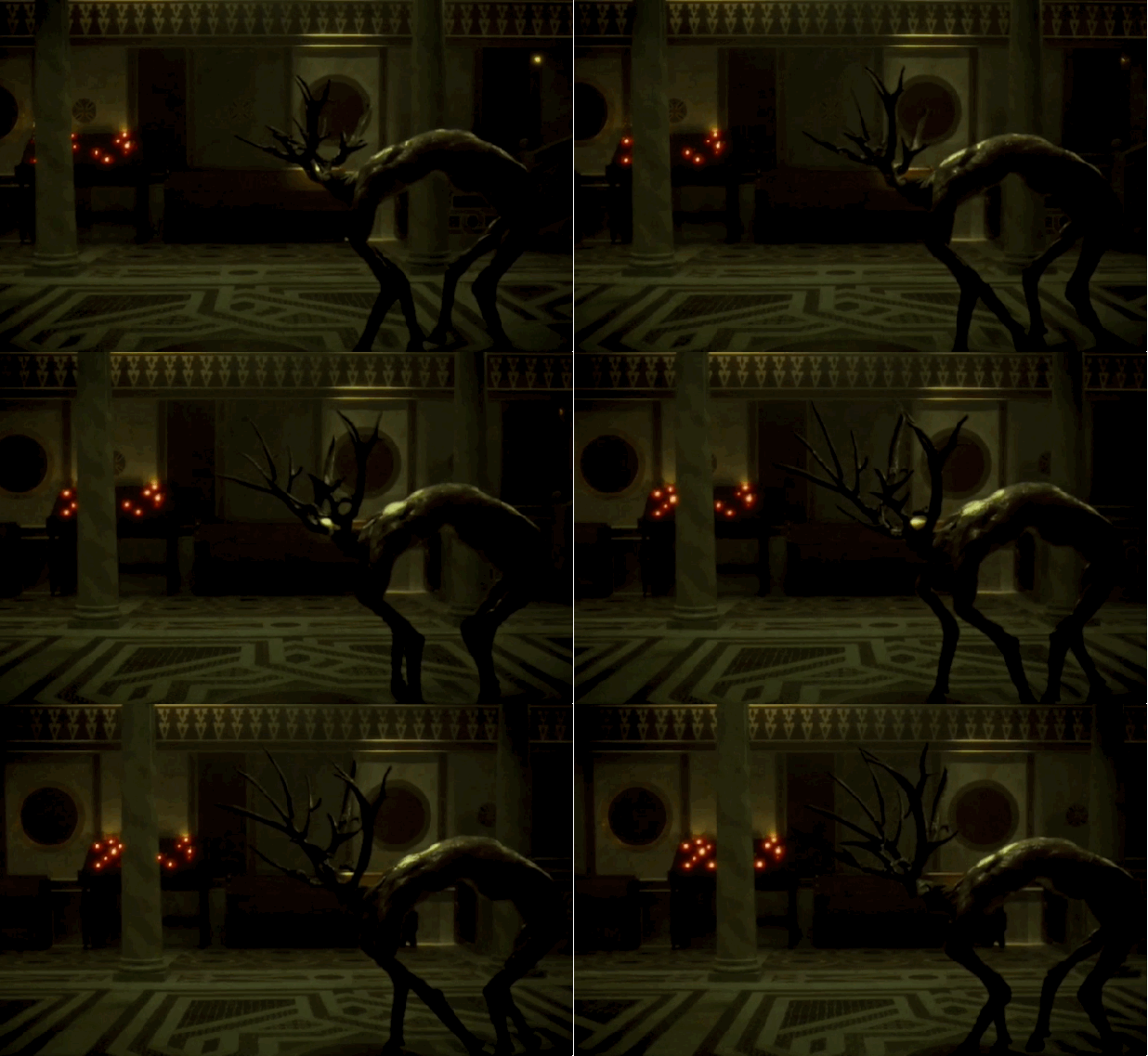
Il Mostro’s crimes were crazy, albeit not quite as crazy as NBC censors blurring out nudity in Botticelli’s paintings while letting people be graphically mutilated onscreen. But they also show that even this criminal supergenius had a period where, like any artist, he learned by copying from the best before moving on to make his own masterpieces. Case in point: the gigantic heart Hannibal fashioned out of the twisted limbless corpse of stupid sexy Antony Dimmond, the smarmy scholar who saw through Lecter’s false identity last week. Though impressive enough on its own, like all great art its full potential is only unlocked when it’s put in front of its intended audience, Will Graham. He envisions its transformation into a repulsive antlered avatar of Hannibal, in a sequence that’s part Hellraiser’s rebirth scene, part Beetlejuice’s sculpture garden, and part Salvador Dalí’s Soft Construction with Boiled Beans.
I reviewed this week’s typically marvelous episode of Hannibal for Decider.
The Boiled Leather Audio Hour Episode 39!
June 11, 2015BLAH 39 | (What’s So Funny ‘Bout) Peace Love and Bummer Stannis: Discussing “The Dance of Dragons” and Other Elements of Late Season Five “Game of Thrones”
We’re back, and we’ve got a burning desire to discuss Stannis, Shireen, and the controversial scene that dominated the conversation around “The Dance of Dragons,” Game of Thrones Season Five’s penultimate episode! This time out, Stefan and I tackle what the Mannis’s heel turn really means for the character, the adaptation, the fandom and more. We also take a quick tour of the disappointments of Dorne, gaze into the fires and give you our predictions for the season finale (including a theory from Sean that’s either bold or batshit), and address the very nature of criticism itself. All in a tight 32 minutes and 32 seconds!
Additional links:
Stefan’s review of the episode.
George R.R. Martin recommends Boiled Leather for your fighting about GoT needs.
Sean’s piece on the four worst types of TV critics.
“Halt and Catch Fire” Thoughts, Season Two, Episode Two: “New Coke”
June 8, 2015But the funniest thing about this episode: It was genuinely funny. Halt 2.0 appears to have included a serious humor upgrade, a welcome development given the clenched-jaw tension of Season One. There are great little visual gags, like Gordon using SEXYBEARD as his Mutiny username. There are lol-worthy throwaway one-liners, as when a Mutiny’s code monkey crams all the free pizza he can eat into his face while saying “I don’t even want this anymore!” Even the music gets in on the act: When Joe shows up for his first day at work, the one-time wunderkind’s stylish synthpop soundtrack cuts out the second he sets foot in his dingy new digs. It’s a perfect sonic spit-take, and a sign that the show’s sophomore evolution away from self-seriousness may be the best way to get people to take it seriously.
I reviewed tonight’s Halt and Catch Fire, which has become a fun show, for Rolling Stone.
“Game of Thrones” thoughts, Season Five, Episode Nine: “The Dance of Dragons”
June 8, 2015The difficulty of telling true from false, of choosing sides, is precisely why the show burned Shireen. Why risk kneecapping Daenerys’ triumphant reunion with her dragon and the primal thrill of her first ride with this horror? The answer lies in the look in Tyrion’s eyes as he watches Drogon torch insurgents and bystanders left and right. The Imp, it turns out, is a true idealist (the biggest cynics often are; constantly being let down will do that to you). He had high hopes that the Khaleesi truly would “break the wheel” on which humanity has suffered for so long. Now, faced with the wrath of a literal monster, he sees what that the flames of war consume ally, enemy, and innocent alike. “You can stop this,” he told her minutes earlier when Ser Jorah Mormont fought for her favor in the arena. “She can’t,” Hizdahr said. Indeed she couldn’t.
This is the antiwar point the show is making even amid the wonder of Dany’s wild ride, just as surely as it did during the horror of Hardhome last week, when a literal avalanche of corpses rained down upon the living. This is the point it makes every time it shows us some all but unwatchable atrocity, no matter how hard we wish they didn’t. The elemental force that is war has one purpose and serves one god: death. Ice freezes. Fire burns. And as a wise woman once said, “When this kind of fire starts, it is very hard to put out. The tender boughs of innocence burn first, and the wind rises, and then all goodness is in jeopardy.”
“Hannibal” thoughts, Season Three, Episode One: “Antipasto”
June 5, 2015Hannibal captures the strange, very adult phenomenon inherent in relationships between you and your coworkers or you and your therapist: Within these fixed confines you become truly important to one another, yet you only ever see each other’s forward-facing parts. Hannibal’s psychosis, Will’s unclassifiable disorder, Dr. DuMaurier’s years-long manipulation by Dr. Lecter — these factors make them unknowable, but stand in for the mysteries we all choose to leave unexplored in the people we work with, because separation is safer than immersion.
This is the one-two punch that makes Hannibal haunting. At the same time its story pokes and prods at our most intimate and complex connections with one another — often through the work of its protagonists, profilers and psychiatrists for whom this is literally their vocation — its grand guignol imagery loosens your moorings and sets you adrift in the realm of pure nightmare. The human element forces you to lower your guard; when the wall is down, the horror is poured into your brain like a black liquid, pooling in the creases of your cerebellum till it’s impossible to get clean again. Once you let this devil in, he’s there to stay.
I’m covering Hannibal for Decider this season! Here’s my review of the season premiere.
“Hannibal”: The Sick Genius of TV’s Darkest Show
June 4, 2015This is a show that leaves you thinking that maybe the world is a little bit worse for its presence — a mark of all great horror. And whether you’re a fan of the genre or a practitioner, you’ve got to be like Will Graham voluntarily connecting with the worst humanity has to offer. You must be willing to turn to the work and say “just fuck me up.” In this series, that thrillingly self-destructive impulse is invited — and then rewarded a hundredfold with some of the most gorgeous visuals of murder and cooking you’ve ever seen. When you binge on Hannibal, Hannibal binges back. Bon appétit.
“Game of Thrones” thoughts, Season Five, Episode Eight: “Hardhome”
June 1, 2015At its best, fantasy — like horror, science fiction, and the whole spectrum of genre storytelling — uses unreality as a key to unlock aspects of reality that the reason and logic of the workaday world keep hidden. Simply put, the White Walkers are the series’ vision of war itself: death breeding death breeding death until nothing living is left. Sansa and Theon, Daenerys and Tyrion, newly minted pit-fighter Jorah Mormont and fledgling hitwoman Arya Stark have each caught their own glimpses of this truth. Tonight we saw that vision with crystal blue clarity, in the metaphorical form of a literal avalanche of bodies, and the creature responsible. Jon Snow saw it too. Now he carries its message, and the game — the real game — begins.
I reviewed tonight’s fucking magnificent Game of Thrones for Rolling Stone. The ending gave me the chills and made me cry.
“Halt and Catch Fire” thoughts, Season Two, Episode One: “SETI”
June 1, 2015Across the board, Halt’s great leap forward makes for a breezier, better show. Though the painstaking process of chronicling the group’s personal-computer empire-building last season gave the show a sturdy core, it was also exhausting for the audience as well as the characters. Jumping ahead means skipping past the back-and-forths that bogged the series down just as surely as calling a ceasefire on the constant hostility does.
And it clears some space in the hard drive for much cooler stuff. There’s some just-this-side-of-showy stylistics, like the opening sequence in which a hand-held camera follows Donna around the chaotic Mutiny office for minutes on end. There’s a nifty metaphor for Cameron’s “where you see a wall, I see a door” thinking in her customer-service call, where she coaches a gamer trapped in a room full of holograms to escape by simply walking right through them. There’s a more playful sense of humor, from the goofy mid-Eighties commercial for the “Giant” to the sight of a coked-up Gordon reading William Gibson’s cyberpunk classic Neuromancer and muttering “What the hell??” with a bloody tissue up his nose. There may even be a new structure, since for all we know each season will focus on a brand-new aspect of the tech biz — like how The Wire handled Baltimore, but with joysticks.
“Outlander” thoughts, Season One, Episode 16: “To Ransom a Man’s Soul”
June 1, 2015This is the problem with Outlander, really: It always feels like just a TV show. Rooting Randall’s torture of Jamie in the undeniable facts of physical — their nude bodies streaked with blood and spit and tears and sweat and lube — may have alleviated this fact, or obscured it if you want to be less charitable about it, by creating a sense of terrible intimacy. But who are they, really? Randall’s a one-dimensional sadist and Jamie’s a heroic hunk with more scars than facial expressions. The take-no-prisoners treatment of rape in all its horror, the sociopolitical ramifications of its emphasis on masculinity or recovery — neither factor matters all that much if the characters are ciphers, their story stays so predictably linear, and music and voiceovers tell you exactly how to feel about all of it at all times. Grading it all on a curve because the sex scenes are strong, or this sexual assault sequence was strong in an entirely different way, does no one any favors.
I reviewed last night’s Outlander finale, an ambitious failure, for the New York Observer.
“Under the Skin” Is the Best Horror Movie You’ve Never Seen
May 27, 2015
Like comedy and pornography, horror is a practical art with a concrete aim; it exists to frighten. This utilitarian aspect makes horror a genre that constantly interrogates its own past, examining how other scary movies scared people in order to refine and surpass them. So like almost all of the great horror films,Under the Skin exists in conversation with its forerunners. The main character’s pattern of luring lonely, horny, pasty men to a decrepit house to be consumed by some nightmare secreted from the floor evokes the plot of Clive Barker’s similar meditation on agony in the UK, Hellraiser; a late-game makeup effect recalls its even more uncompromisingly brutal sequel, Hellbound: Hellraiser II. The circular, ocular forms that dominate the movie’s abstract opening sequence recall not only the baleful gaze of the killer computer HAL 9000 in Stanley Kubrick’s 2001 (a frequent point of comparison in reviews) but also the similar combination of curvilinear shapes and unnerving musical dissonance that kicks off Tobe Hooper’s The Texas Chain Saw Massacre (a film with which UtS shares an unarticulated but brutal meat-is-murder subtext, one that’s a lot clearer in the source novel).
Another Kubrick masterpiece, The Shining, earns a visual echo in the bird’s-eye-view shots of the characters driving the curvy roads carved through the rugged region. Its long silent passages, in which our sole window into the world of the film is the monster at its center, force us into her skin in a fashion reminiscent of Norman Bates’s clean-up and disposal in Psycho. Indeed, the ominous hums and screeching strings of Mica Levi’s score place it with Bernard Herrmann’s Psycho, John Williams’s Jaws, and the Ligeti/Penderecki/Wendy Carlos/Rachel Elkind–dominated soundtrack of The Shining at the top of the horror movie music pantheon.
The list could go on—seriously, I cut several entries for space—but it’s important to note this: None of these elements exist to be spotted, per se. They’re not overt references or homages, but rather a bedrock on which the film can be built into something new and unique. Under the Skin uses our shared vocabulary of horror tropes and techniques to create a new language, just like the disembodied syllables we hear the main character murmur over the stunning, dissociative opening sequence evolve into the words she uses to seduce and destroy.


Under the Skin is one of the best horror movies ever made, and one of the best movies I’ve ever seen, period. I make the case for it over at Decider.
“Game of Thrones” thoughts, Season Five, Episode Seven: “The Gift”
May 25, 2015As with solitaire or Angry Birds, we tend to think of the Game of Thrones as a single-player pursuit. We focus on the lords of ancient houses, like Daenerys Targaryen and Stannis Baratheon. We monitor the behind-the-scenes schemers, like Cersei Lannister and Littlefinger. We watch the dark horses moving along the margins, like Jon Snow and Tyrion the Imp. In each case, it seems like power is a weapon only one person can hold in the end. But tonight’s episode — “The Gift” — showed just how much this game is a team sport. Friends and family matter at every step, and if you lose them? Game over.
I reviewed tonight’s jam-packed Game of Thrones for Rolling Stone.
This weekend I saw an okay movie called “Mad Max: Fury Road”
May 20, 2015I liked it fine. It wasn’t bad, and it was never mindless which sets it a cut above 90% of action blockbusters, but it wasn’t great. It was okay.
And it was spectacular, but the spectacle added nothing but scale. This is particularly true of the many chase sequences, which despite the well-publicized commitment to practical stuntwork had little of the white-knuckle claustrophobic about-to-break intensity of The Road Warrior. It was The Road Warrior but MORE, which in the end meant less. To be fair, The Road Warrior is flawless, a wholly original and alien vision, poetry in motion, probably the greatest action movie ever made, one of the best movies of any kind. Fury Road feels like George Miller took his masterpiece and added a bunch of unconvincing prosthetics to it, which in a sense he literally did.
To me the enthusiasm for Fury Road’s fantastical grandiosity is an echo (perhaps via influential cartoonist Brendan McCarthy, who storyboarded the film back in the day) of recent years’ fixation within the alternative/indie-comics world on Moebius and similar genre-comics artists who combine great technical ability with vivid visual imaginations; this attempt to realign the canon away from the Ware / Clowes / Doucet / Brown / Hernandez / Spiegelman / Crumb axis has been baleful for the artform in most every particular. (Simon Pegg was right.)
Miller also gave it an unambiguously happy ending, a big step back from the marvelous, singularly simultaneous gutpunch and uplift of The Road Warrior’s conclusion. A happy ending of this sort is fun, don’t get me wrong, but you can’t live off it.
Moreover, the sociopolitical praise for it, as is usually the case when people go berserk for giant pop-culture artifacts, is further evidence of the soft bigotry of low expectations. (Anita Sarkeesian was right.) You’ll be happy to hear that Mad Max: Fury Road takes a bold stand against the enslavement of women as broodmares by insane albino warlords, and that tough women with hip haircuts shoot guns in it. It’s a strange sort of progressivism that lionizes violence so long as it’s sufficiently badass and nominally egalitarian in its participants. It leaves us wishing Game of Thrones into the cornfield while demanding a Black Widow action figure in every pot.
Everyone in it was good, though, I’ll give it that as well. Tom Hardy is a god, Nicholas Hoult seems a very lively talent, Charlize Theron was rock solid. Like I said, it was fine, I enjoyed it I guess. It’s just that the existence of The Road Warrior renders it superfluous.
Spoiler Alert: The Mad Men Series Finale
May 18, 2015I discussed the Mad Men finale with the New York Observer’s Drew Grant, the Guardian’s Brian Moylan, and the Huffington Post’s Ricky Camilleri on HuffPost Live’s Spoiler Alert today. It’s a contentious and productive discussion.
“Mad Men” thoughts, Season Seven, Episode 14: “Person to Person”
May 18, 2015I remain agnostic about whether Don made the ad, as I believe the show intends. At any rate, it’s largely immaterial. We’ve spent seven seasons watching Don grow, shrink, succeed, fail, move forward, stagger back, and generally struggle with his inability to fill the void inside him with things pulled in from outside, whether that’s money, sex, love, wanderlust, creativity, or industrial quantities of alcohol. There’s no reason, really, to assume the struggle would end when the show does — that Don’s grin marks, for certain, the beginning of a more grounded, more centered new life completely separate from the old one.
What’s more, an uncomfortable overlap between his current self and his ad-man past would in no way wipe out the losses and gains he experiences here. Don’s grief over Betty’s diagnosis and his subsequent realization that his absence from his children’s life is, to them, “normal life” is real. So is his litany of unforgivable sins, recited in the sardonic lilt that should be familiar to anyone who’s taken a similar vebal inventory of their failings and found the results to be a crippling psychological wound: “I broke all my vows. I scandalized my child. I took another man’s name and made nothing of it.” Don once told Peggy that despite seemingly having it all, he’s still gripped with a terrible worry: “That I’ve never did anything, and I don’t have anyone.” Crumpled by the payphone at the retreat, he’s realized his worry has come true. I envy anyone who doesn’t find this story, this show, completely devastating.
But it’s not just his collapse that remains real, but his catharsis as well. Sitting in the encounter group, he listens to a man named Leonard, a square in every respect, describe a life that’s very much like the ideal all-American one Don himself had at first tried to create before going on to constantly undermine and eventually destroy it. This, Leonard hasn’t done; it doesn’t matter. “I’ve never been interesting to anybody,” he says. “I work in an office—people walk right by me. I know they don’t see me. And I go home and I watch my wife and my kids—you know, they don’t look up when I sit down. It’s like no one cares that I’m gone. They should love me. Maybe they do, but I don’t even know what it is. You spend your whole life thinking you’re not getting it, people aren’t giving it to you, then you realize they’re trying and you don’t even know what it is.” He describes a dream that sounds like an ad, about living in a refrigerator, thrilling to the smiling faces he sees when people open its door and the light switches on until he realizes they’re not looking for him at all and the door swings shut. At this, Don stands, walks over, kneels down, and embraces the man, a total stranger, as they cry. In this moment he realizes there are many ways to Have It All, and that so long as you see this as your goal, they all leave you with nothing.
I reviewed the finale of Mad Men for Wired. This was a show, folks. This was a show.
“Game of Thrones” thoughts, Season Five, Episode Six: “Unbent, Unbowed, Unbroken”
May 18, 2015Few of these developments hold a candle to the episode’s most upsetting and controversial development: the wedding night of Sansa and Ramsay. In the books, Lady Stark’s place in this storyline is held instead by a childhood friend, groomed to impersonate Arya and dupe the Northern lords into believing House Bolton has wed itself into Winterfell’s ancient line. What befalls her is no less awful than what happens to Sansa, but because she’s a comparatively minor player in the saga rather than one of its most prominent and beloved figures, the events hit even harder here. The groom’s sadistic grin, the bride’s look of resigned and mounting agony (so reminiscent of Daenerys on her first night with Khal Drogo all those full moons ago), the tears of Theon Greyjoy as he’s forced to watch — these faces will be hard to forget.
So yes, Sansa’s rape by Ramsay is of the show’s own devising, and it feels every bit the violation it is. But by involving a multidimensional main character instead of one introduced primarily to suffer, the series has a chance to grant this story the gravity and seriousness it deserves. The novels present this material through Theon’s eyes, relegating Bolton’s bride to a supporting role in a man’s story. Sansa has a story of her own, of which this is now an admittedly excruciating chapter — but she, not Theon, is the real victim here, and it remains her story nonetheless. The next chapters will be hers alone to write.
“Outlander” thoughts, Season One, Episode 15: “Wentworth Prison”
May 18, 2015There’s a quote attributed to Star Wars impresario George Lucas via his ex-wife, Oscar-winning editor Marcia, that speaks directly to what you and I and everyone who watched Outlander this week subjected ourselves to. As Peter Biskind tells it in his classic history of American cinema in the ‘70s, Easy Riders, Raging Bulls, “Emotionally involving the audience is easy,” George is said to have remarked. “Anybody can do it blindfolded, get a little kitten and have some guy wring its neck.” No kittens, I’m happy to report, were harmed in the making of “Wentworth Prison,” this week’s installment. But what happened was just as lopsidedly sadistic and nakedly manipulative, the only difference being that the target wasn’t a housecat, but a character with all the three-dimensionality and disposition of one. Like an episode of Hercules: The Legendary Journeys directed by Hostel auteur Eli Roth, “Wentworth Prison,” tonight’s installment of Outlander, is an experiment designed to see how badly cheese can bleed.
[…]
There’s no sense in pulling punches here: It’s infuriating to be asked to suffer through the extended torture and humiliation of characters who, at every other juncture save perhaps their creatively choreographed sex scenes, are trotted around like action figures and posed like romance-novel covers. Outlander’s insistence that Jamie Fraser as a character, or Sam Heughan as the actor playing him, possesses the smoldering and unpredictable charisma required for him to make sense as the anchor of a crazy centuries-spanning love is as wholly unsupported by the on-screen evidence as the show’s claim that he has red hair. (It’s brown! We can all see it!) The man doing the humiliating and torturing has no shades of grey (ironically), no characteristics that make him feel human, or even just interesting as a complete black-hat villain. The less said about the legion of interchangeable dudes in beards and kilts, the better. Only Claire herself stands out, which makes watching her cry for this cipher a surefire way to undermine her power, and a genuinely maddening act of “emotionally involving the audience” by the Lucas definition. Dump her into a pile of corpses, make a mute goon sexually assault her, subject her to whatever indignity you can come up with in lieu of creating characters who equal her depth — it’s not going to suddenly make the show worth taking seriously. Quite the opposite! Calling Outlander soft porn has never been a fair critique. Now it’s torture porn, too, though. And it’ll leave you limp.
I reviewed this week’s Outlander for the New York Observer. Turns out torture and sexual violence aren’t a shortcut to seriousness.
End Game: TV’s Best and Worst Series Finales
May 13, 2015Best: ‘Battlestar Galactica’
Divine intervention, voluntary space-fleet destruction, the incredible disappearing Starbuck — the decisions made in the final episode of this politically charged sci-fi reboot baffled viewers at the time. Hindsight, however, has been extremely kind to Commander Adama and his crew. The show’s long-simmering supernatural elements paid off with the daring idea of a deity whose actions are just as unpredictable and unfathomable as humanity’s. And the joint human-Cylon decision to jettison their ships and live out their days planet-side — in what turns out to be our own Earth’s pre-history — bucked a core tenet of post-apocalyptic SF, arguing that individual lives are more important than the preservation of a culture at all costs. Risky? You bet. Rewarding? So say we all.
I wrote about Battlestar Galactica, Cheers, Dexter, Lost, Roseanne, and The Sopranos for Rolling Stone’s list of the best and worst series finales. But which are which? The answer may surprise you!
“Mad Men” thoughts, Season Seven, Episode 13: “The Milk and Honey Route”
May 11, 2015Pete Campbell not looking for a new job, but there’s one heading toward him at jet speed. Drunk, desperate Duck Philips has headhunted him into an ersatz interview with an executive at Learjet, the private aviation firm that heretofore had a reputation for providing playthings to Hollywood stars. But there are no stars in Pete’s eyes when—with the same clarity of vision that helped him predict the rise of the youth and African-American markets, and which helped him secure wayward clients Burger Chef and Avon for his new bosses at McCann—he proposes a different clientele. “Corporate executives should be your core business,” he tells the impressed exec, explaining that the company’s best bet is to market its service as “a tool, not a frivolous extravagance.” Giving people what they want is well and good. Giving people what they need? That’s something else entirely.
Providing high-priced jets to high-powered suits seems miles away from the emotional abattoir that is “The Milk and Honey Route,” Mad Men’s penultimate episode. It was an hour of television haunted by death and graced with unexpected rebirth, in which the characters barely set foot in their agency’s office—Don has officially quit, walking away from millions in the process, and Pete is about to follow suit. But while the Learjet material seems incidental, the course of action Campbell plots for his future employer also maps the path of the characters. Pete, Betty, and Don all reject glamorous illusion for journeys of necessity.