
Posts Tagged ‘reviews’
“True Detective” thoughts, Season Two, Episode Five: “Other Lives”
July 20, 2015Tonight’s episode was absolutely stuffed with plot points, pretzel-like twists and some seriously overripe, laugh-out-loud lines. More often than not, it felt like a parody of prestige drama rather than the real thing. No character got away clean: Not Ani, who suffers her way from the most one-dimensionally grotesque sex-harassment workshop ever before revving her fellow offenders’ engines with (presumably) sarcastic talk about big dicks. Not Paul and his ridiculous cliché of a mother, who scream and weep their lungs out when he finds out she stole his hidden loot from Afghanistan like they were in a bad telenovela. (Apparently someone in the writers’ room thinks “poisoned cooze” is an insult a human being would use in the year of our Lord 2015.) Not Ray, who records a monologue about suffering for his son — “Pain is inexhaustible. It’s only people that get exhausted” — like he’s auditioning for the role of Rust Cohle in the school play. (Runner up: his big cliffhanger-ending “You and me need to talk.” No shit!) Not Frank and his wife Jordan, who stammer their way through a fight about his return to the gangster lifestyle and her inability to have children centered on sentences like “Crime exists contingent on human desire.”
The pièce de résistance, of course, is Frank’s grand declaration of frustration to Ray. “The enemy won’t reveal itself, Raymond,” he says, like a summer-stock Pacino in Godfather III. “Stymies my retribution. It’s like, uh, blue balls in your heart.” Blue balls in your heart, people. Blue. Balls. In. Your. Heart. Look, a simile makes connections in order to uncover meaning, not overwhelm it; “blue balls in your heart” does nothing to explain the unique rage of delayed revenge except bury it under a mountain of “Wait…what the hell did he just say?” It’s enough to give you, uh, jock itch in your brain.
I don’t even know what to say, folks. I reviewed tonight’s True Detective for Rolling Stone.
“Halt and Catch Fire” thoughts, Season Two, Episode Eight: “Limbo”
July 20, 2015The discovery leaves Joe in the unenviable position of transitioning from chemically induced bliss to pure panic. Instead of fucking his bonnie bride amid his beloved mainframes while rolling on MDMA after a lengthy, lushly shot nightclub sequence, he’s not only forced to sober up; the man has to reenter the enemy territory. Dressed head-to-toe in white like Don Johnson after an all-night Miami Vice cast party, MacMillan staggers into Mutiny HQ and desperately attempt to convince everyone that he had nothing to do with destroying their life’s work. The result is the rare moment where no one’s buying what our resident mover-and-shaker is selling.
It’s hard to believe, given the swaggering alpha-male asshole we remember from Season One, but it’s a crushingly sad moment. Here’s a guy who really has become a better man…and it doesn’t matter. Jacob’s swindle is as convincing a copy of Joe’s old tactics as his bogus new network is of Mutiny’s proprietary code, so none of his former coworkers believe MacMillan is innocent for a second. That’s a tremendous demonstration of how hard it can be to break the mold you’ve made for yourself. It’s always there to shape how others see you.
“Masters of Sex” thoughts, Season Three, Episode One: “Parliament of Owls”
July 12, 2015Masters of Sex, at its best, is a lot like Arizona: extremely dry and extremely hot. When it works it’s fueled by the R-rated Rosalind Russell vibes of Lizzy Caplan’s Virginia Johnson, the strength of its premise — a historical battle the eventual victor of which is obvious everywhere you look today — and its tasteful yet provocative clinical eroticism, which is another way to say it’s super fucking sexy to watch people fuck for science. When it doesn’t work it’s weighed down by its protagonist’s lack of charisma, its supporting cast’s ‘90s-network-drama two-dimensionality, its repetitive relationship dynamics, and its use of throwaway characters who exist simply to spout the prejudices and since-rejected conventional wisdom of the day. Tonight’s Season Three premiere, “Parliament of Owls,” most definitely did not work. What does this tell us? Let’s make like Masters & Johnson and observe & report.
Masters of Sex’s main problem is its title character. Bill Masters is a singularly unappealing figure, bold and forward-thinking about precisely one thing, his sex research project, and a drip in every other way. Imagine if Don Draper were just as good at advertising as ever but weren’t also charming, frequently kind, and unbelievably handsome, and you’ve pretty much got the good doctor covered. This makes a show about a small army of people who rearrange not just the entirety of their own lives but also science and society in general around the guy a tough sell indeed.
I reviewed tonight’s season premiere of Masters of Sex, which I did not care for, for the New York Observer. It’s kind of a write-up of my feelings about the show in general.
“True Detective” thoughts, Season Two, Episode Four: “Down Will Come”
July 12, 2015Structurally, tonight’s big bang comes at the exact same end-of-Episode-Four point as the single-take shootout from Season One. But that was a deep-cover diversion, a consequence of Rust Cohle getting dragged along for a drug heist while posing as a white-supremacist biker. This week’s rampage, by contrast, took place as part of the search for the actual suspect in Ben Caspere’s killing, a figure in the Mexican mob whose prints were on the dead man’s pawned watch.
As such, it potentially corresponds not to the aforementioned seven-minute sequence, but to Marty and Rust’s raid on Reggie Ledoux’s compound in the following episode. That was when the original Detective duo murdered numerous shady men while the real killer went free for another decade. This time around, Ray knows for sure that the Vinci P.D. wants the case closed, and he suspects the state is in for the opportunity to shake down his crooked town for extra cash. With that in mind, it’s likely there will be pressure to act like they’ve gotten their man, however improbably that may be. Only ganglord Frank, who knows better than to believe that a guy hard up enough to pawn jewelry could be behind all his ruined plans, will want to keep up the hunt until the actual culprit is found. In other words, the criminal has been the true detective all along. Congrats if you had him in your office pool!
I reviewed tonight’s bullet-ridden True Detective for Rolling Stone.
“Halt and Catch Fire” thoughts, Season Two, Episode Seven: “Working for the Clampdown”
July 12, 2015The dramas of TV’s New Golden Age excel at presenting their characters with a choice of evils. Should Walter White attempt to take down a more powerful druglord, or turn his family’s life upside down by fleeing? Should Daenerys Targaryen let the slaves she freed take vengeance against their former masters, or punish their payback attempts with still more violence? Should Don Draper sell out, or give up? For many shows, the central conflict involves a question with seemingly no right answers.
But what if there are no wrong answers? What if the choice is hard to make because the benefits of either option are too difficult to turn down? In the right hands, that’s an even deeper dilemma — and “Working for the Clampdown,” tonight’s Halt and Catch Fire, proves this is a series with the tools and the talent to navigate this demanding kind of drama.
“Hannibal” thoughts, Season Three, Episode Six: “Dolce”
July 11, 2015Let’s state it for the record: If Hannibal really is over, it’s the most upsetting cancellation since Deadwood, hands down. Both series are, or were, ruthless and uncompromising in articulating the poetically violent visions of their creators through inimitable dialogue and sumptuous cinematography. They’re gifts we’ve been lucky to have, even if only for three seasons apiece. That said, only one involved human bodies prepared like Peking duck, attempted incestuous insemination, beautiful women having kaleidoscope sex, and bone saws slicing through living human skulls. C’mon, NBC, Netflix, and Amazon! Hannibal has it all! And “Dolce,” tonight’s episode, was a veritable garden of unearthly delights — funny, sexy, suspenseful, repulsive, and, as always, absolutely gorgeous.
Hannibal is goddamn great. I reviewed this week’s episode for Decider.
“Halt and Catch Fire” thoughts, Season Two, Episode 6: “10BROAD36”
July 5, 2015There’s no surer sign that a show is doing something very right than when even its most plot-heavy episodes leave you thinking not about what happened, but how it happened. Sure, you can recount where Mad Men‘s final episode left all its leading players — but the real magic lies in the way Don Draper’s climactic breakdown and breakthrough is presented. (You’re craving a Coke right…about…now.) Game of Thrones‘ Season Five finale similarly stranded nearly all its major characters in the direst of straits, but weeks later it’s the sound of the crowd surrounding Cersei Lannister’s walk of shame that sticks in your mind.
This is the enviable position in which Halt and Catch Fire finds itself with the latest installment in its season-long hot streak: “10BROAD36.” It’s an episode that bursting with big story beats: the Mutiny crew found out about Cameron and Tom’s romance; Donna hid both her pregnancy and abortion from her husband Gordon, who was busy cheating on her half a continent away; and Joe MacMillan used his “simple” plan to provide server space to Cam’s company as an entry point for taking it over entirely. (Bad Joe is back!) But it’s how these characters interacted, and how everything was shot and staged, that made for a fantastic hour of television.
“True Detective” thoughts, Season Two, Episode Three: “Maybe Tomorrow”
July 5, 2015…this isn’t the first time True Detective has lacked the courage of its convictions. Rust Cohle spent the first season spouting the bleakest arguments about life and death ever advanced by a primetime drama, only to see the light and put his pessimism aside in its final minutes. The show could have broken important ground, depicting a person who believes the worst about the world yet still does good in it, with neither feature canceling out the other. (Faith in humanity is not required to be a decent human being.) Instead, Rust played the hero and got a hero’s reward, psychologically anyway.
Reviving Ray leaves similarly challenging and exciting territory unexplored. The idea of a good-cop/bad-cop narrative forced to live on past the death of its bad cop is an intriguing one indeed. For starters, it would have shaken up the story’s seen-it-all-before structure. It could also have been an opportunity for Pizzolatto and company to examine the toxic masculinity the show alternately (and perhaps unwittingly) critiques and embodies. Dodging an entire seasons’ worth of comparisons between the Harrelson/McConaughey and Farrell/Vaughn stunt castings wouldn’t have hurt, either.
And while we’re playing the What If game: If Velcoro were gone, maybe there’d be room to signify the psychological hang-ups of the other characters outside of bedroom-related problems. Take the trio that rounds out the core cast: Ani Bezzerides’ sexual assertiveness, Frank Semyon’s failure to perform at the fertility clinic, and Paul Woodrugh’s physical rejection of a romantic overture are used to advertise their overall dysfunction like a neon sign. Pimps and prostitutes are everywhere, each one a more leering stereotype than the last. Hollywood types talk about risqué parties like middle-schoolers who just looked up the word “orgy” on wiktionary.com for the first time. The evil mayor has a house full of hustlers and harlots, including his son and wife. The murder victim himself is a garden-variety perv. Factor in Marty Hart’s philandering, his teen daughter’s promiscuity, and his wife’s weaponized seduction of Rust back in Season One, and it’s as if True Detective believes anything short of having seamless, zipless sexual experiences is a signal that your life is about to fall apart.
“The Brink” thoughts, Season One, Episode One: “Pilot”
July 3, 2015What if an actual crazy person got his hands on Pakistan’s nuclear arsenal, and only America’s horniest men could stop him? That’s the basic premise of The Brink, HBO’s alleged new comedy. In theory, it’s not a bad set-up for a satire. If anything, this country’s gang-who-couldn’t-drone-straight foreign policy in the Muslim world deserves an even more ruthless roasting than its comedians have given it, and anxieties about the so-called “Islamic bomb” and the impenetrable nexus of militant groups and secret agencies that surround it on all sides are ripe for Strangelovian spoofing. Homeland Season Four, but funny on purpose? Starring Jack Black, Tim Robbins, Aasif Mandvi from The Daily Show, and Pablo Schreiber from The Wire Season Two? Sure, this could work.
Alas! “Pilot” (the default title for a series-premiere actually fits the story) gets no closer to Kubrick than the trisected structure that creators Roberto and Kim Benabib cribbed from the good Dr. Looked at in the most generous light imaginable, Black’s low-ranking Islamabad-based diplomat Alex Talbot is a bawdier version of Peter Sellers’s Colonel Mandrake, Robbins’s even randier Secretary of State Walter Larson is a less macho take on George C. Scott’s General Buck Turgidson, and Schreiber’s Navy fighter pilot Zeke “Z-Pak” Tilson is a pill-popping, civilian-casualty-avoiding echo of Slim Pickens’s Major Kong; together, it seems, they’ll have to help Esai Morales’s President Julian Navarro—handsomer than Sellers’s Merkin Muffley but just as ineffectual—keep a powerful general with paranoid delusions about enemy plots against his nation’s reproductive capabilities (yep, it’s that direct a swipe) from igniting World War III. I don’t remember Strangelove having this many dick jokes, though. Okay, this many bad dick jokes.
“Hannibal” thoughts, Season Three, Episode Five: “Contorno”
July 3, 2015“Contorno,” last night’s action-packed, bowel-unpacked episode ofHannibal, took visceral (no pun intended) pleasure in kicking the living shit out of Hannibal Lecter. Physical opponents — that psychopathic mental-hospital orderly, Mason Verger and his goons, and of course Jack himself — have gotten the drop on the Doctor in the past, but in each case the action was elegant and elevating, whether Hannibal was being trussed up for the perfect death or engaging in an expertly choreographed hand-to-hand battle with a worthy opponent. None of that this time. This was just a decent guy who’s getting too old for this shit handing an asshole’s ass to him. And man, it felt good, even if he got away in the end. The split from the show’s usual operatic setpiece-violence in favor of this down-and-dirty fight was striking, and provided a surprising and welcome break from the claustrophobic, symbolism-laden slaughter.
And maybe it’s the latent class warrior in me — okay, not so latent, the expropriation of the wealthy really can’t begin fast enough — but it seems as if the show relied on a certain slobs-vs.-snobs schadenfreude to fuel the climactic town-vs.-gown beatdown. After all Hannibal’s posturing, his expensive clothes and fine wine and gourmet meals and high culture, he was for all intents and purposes beaten in a bar fight by a working stiff. Hannibal revels in the perversity of immersing us in this aristocratic killer’s mind and world, but a scene like this shows it’s still wisely attuned to popular desire to watch the effete elite taken down a peg. (The use of Rossini’s “The Thieving Magpie” as the soundtrack for this scene smartly recalls its accompaniment of Alex DeLarge’s anti-aristo rampages in A Clockwork Orange.)
He takes a beating and keeps on eating: I reviewed this week’s Hannibal for Decider.
“Halt and Catch Fire” thoughts, Season Two, Episode Five: “Infiltrator”
June 29, 2015Halt’s got many strengths besides its characters, of course; its period pop-culture reference game has rarely if ever been as on point as it was tonight. Cameron and Tom’s rental of The Terminator, for example, takes on any number of roles within the narrative. Arnold Schwarzenegger’s voice gives them funny accents to flirt in. Renting the video provides Tom with a convenient excuse for one of his many sudden “I gotta go”s, which seems to suggest a secret at home. The film’s totally-Eighties nightclub-massacre scene is beautifully recreated in Gordon’s own visit to the local hotspot, with a zonked-out computer engineer substituting for the gun-toting cyborg. The Mutiny crew watches the scene featuring the famous line “And it will not stop, ever, until you are dead,” which echoes Clark’s understanding of his disease. And the first-person shooter the company wants to develop will, in all likelihood, owe a lot to the visceral violence and implacable antagonists of James Cameron’s classic.
Ditto the just-imported Nintendo Entertainment System that Gordon’s kids can’t wait to play. Like the Macintosh that appeared at the end of last season like one of 2001‘s monoliths, the NES will create a massive cultural explosion that Cameron and company will have to deal with. The children’s prophetically passionate response shows how important the characters’ family lives can be to their professional ones, if only they pay attention. The bemused way Donna’s mother describes the game they’re playing (“A bunch of little men fighting turtles”) illustrates how easy it is to ignore a Super Mario Bros–sized forest for the trees. It also indicates the weird alchemy required to create a world that gamers will want to immerse themselves in again and again, which is Cameron’s current quest for her theoretical online multiplayer game. Maybe it’s a coincidence that so many shots in this episode showed characters as small figures against big backgrounds, Mario-style — but if so it’s a coincidence that counts.
“True Detective” thoughts, Season Two, Episode Two: “Night Finds You”
June 28, 2015Let’s get a little Rust Cohle-ish for a second: There’s a theory among physicists that any event with multiple possible outcomes is essentially a root from which parallel universes grow. If you’re reading this recap, for example, you probably decided to watch True Detective tonight — instead of, say, playing World of Warcraft, or writing to your congressional representative about the cancellation of Hannibal. But according to the “many-worlds interpretation” of quantum mechanics, the timelines in which you leveled up your orc mage or explained the twisted relationship between Dr. Lecter and Special Agent Will Graham to a member of the House Ways and Means Committee are just as real as this one.
Tonight, True Detective 2.0 itself reached a multiversal branch point. Either it killed off its top-billed main character in its second episode, thus crafting the quickest course correction in TV history, or it didn’t, creating one of the most obnoxious bait-and-switch cliffhangers ever. This makes Colin Farrell the TV-antihero version of Schrödinger’s cat — simultaneously alive and dead, at least until next week. Time may be a flat circle, but it’s sure-as-shit better to be on one side of the interdimensional disc than the other.
“Hannibal” thoughts, Season Three, Episode Four: “Apertivo”
June 26, 2015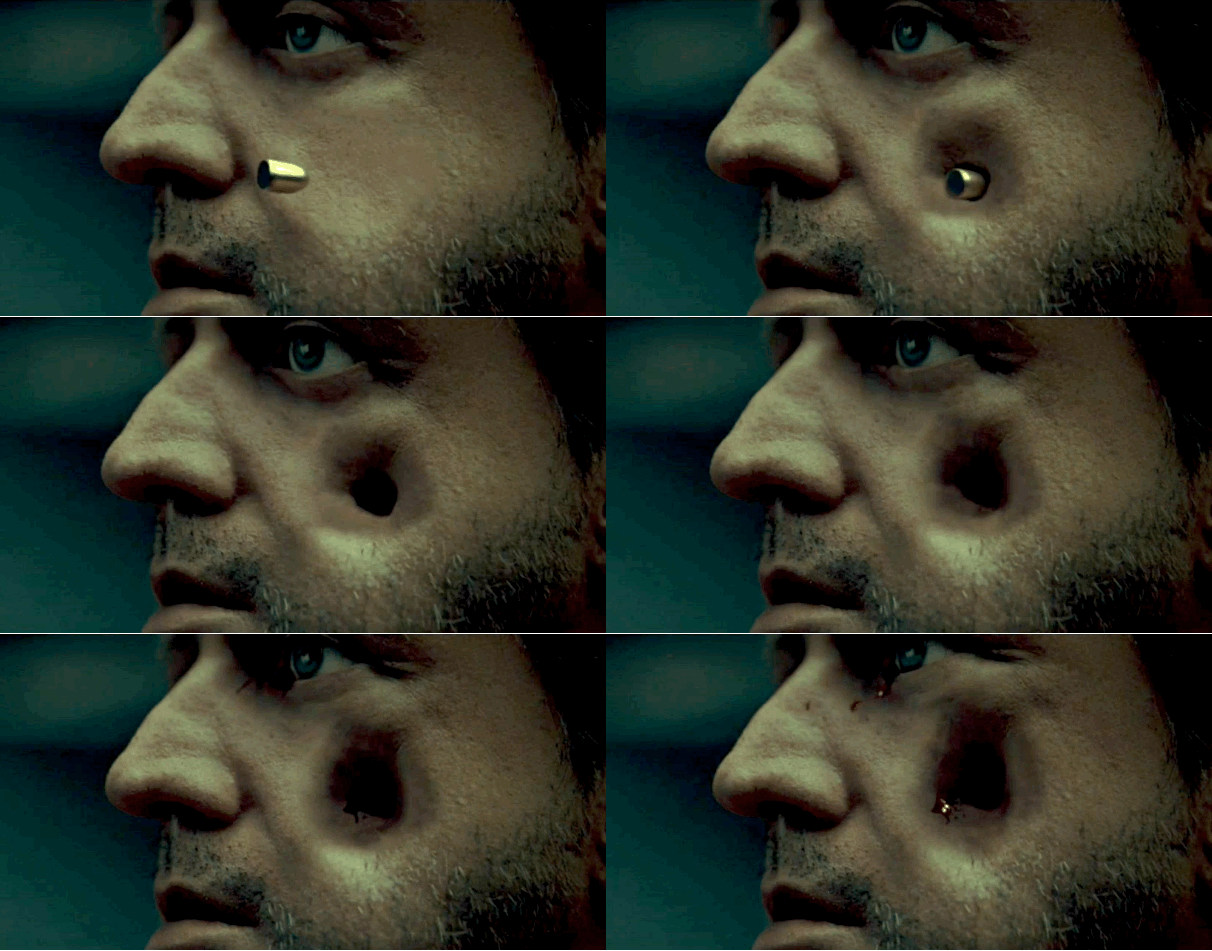
It will be left to scholars to determine whether opening “Apertivo,” this week’s ep, with a slow-motion closeup of a bullet entering a man’s face and exiting through the back of his head in a geyser of viscera influenced NBC’s decision to cancel the series days before it aired. But the fact remains: Hannibal is, without exaggeration, one of the most visually and narratively audacious shows in the entire history of television. It’s to the Peacock Network’s credit that they let it get away with murder for as long as they did.
“Halt and Catch Fire” thoughts, Season Two, Episode Four: “Play with Friends”
June 21, 2015Directed by Boys Don’t Cry’s Kimberly Peirce, this week’s Halt made extensive and ostentatious use of canted frames, handheld cameras, and most memorably a GoPro-filmed dart-gun battle. These immersive techniques made for a constructive contrast with the clean-machine opening titles. The credits and their accompanying theme music portray technology’s advance as orderly, antiseptic, and unstoppable; meanwhile, the camera work conveys just how haphazard, shaky, and human things really are beneath the surface.
Speaking of being human — hoo boy, do Cameron Howe and Tom Rendon have sexual chemistry to burn. Mark O’Brien has been dynamite in the role from the start, equally convincing as an arrogant hacker and an overworked, underpaid kid trying to make ends meet. He brings that same easy naturalism to his scenes with Mackenzie Davis, making their characters’ physical and romantic connection so convincing you feel like you’re watching a perfect-for-each-other couple make out at a party for the very first time.
The hour-long buildup to their first kiss is killer, too. First Cameron reprimands him for showing up late and half-asleep. Next, she goes out of her way not to make him feel embarrassed when she discovers him working a supermarket night shift to pay the bills. Then they share a platonic moment in a closet during the dart-gun war, and brainstorm the idea for multiplayer online gaming as a sort of sublimated seven-minutes-in-heaven. Finally, in the middle of cleaning up Mutiny’s beercan-strewn backyard, they stop for a giggly hookup that’s clumsy with passion and excitement. It’s super sexy stuff, and not an item of clothing is shed.
“True Detective” thoughts, Season Two, Episode One: “The Western Book of the Dead”
June 21, 2015Vince Vaughn hands in some of the episode’s best work; watch his eyes, which radiate genuine unspoken concern over Velcoro’s sorry state when the two of them meet up near the end of the episode. Yet he’s also asked to deliver gangster dialogue that sounds cribbed from a video game cut scene: It’d take a Brando to make clunkers like “This filth hurt your woman” or “This place is based on a codependency of interests” or “A good woman mitigates our baser tendencies” sound halfway passable.
As two of those three examples indicate, True Detective’s woman trouble has hardly improved. McAdams’ character is introduced in her underwear, storming out of the bedroom after freaking out her boyfriend by apparently requesting something a bit too wild. Both she and Kitsch’s character experience sexual dysfunction as a shorthand for their psychological issues, but in his case he can’t get it up without Viagra; it’s telling how the worst problem a man can have in the series’ world is failure to perform, while for a woman it’s performing too aggressively.
Certainly that’s reflected in the women Woodrugh encounters: a speeding starlet who gets him suspended with false accusations of soliciting sexual favors, and a girlfriend (also introduced in her underwear) who we’ve barely seen for 30 seconds before she says “It’s been a week, Mr. Policeman — get that dick over here.” Can’t she see he’s suffering?! Well, no, because he saves that for his long solo night rides on his bike, the wind against his face making for the hour’s most unintentionally hilarious visual.
Worse still is the emotional contract the show asks us to sign regarding Velcoro and Semyon. A flashback shows the pair first connecting when the latter provides the former with information about the suspect in his wife’s rape — hence the “this filth hurt your woman” bit. Given what we’ve seen of Velcoro’s subsequent behavior, it’s easy to imagine what he did with this knowledge. It’s much harder to know how the actual victim felt, given that we never see his wife, hear her, or even learn her name in the episode. The show asks us to believe that a rape is fundamentally the story of the abusive man who avenges her (when he’s not menacing children himself), a repeat of Season One’s unfortunate white-knight theme. Why must we accept stories about violence in which its perpetrators are its heroes? Unless and until it answers that question, True Detective risks simply being a one-season wonder.
I reviewed the True Detective season premiere for Rolling Stone. It was not good.
“Hannibal” thoughts, Season Three, Episode Three: “Secondo”
June 19, 2015What ultimately keeps “Secondo” from sinking under the weight of its contradictions is the strength of the statements its central characters make about who, and how, they are. Even in a series as quotable as this one, last night was a real power hour. Hannibal on what happened to him as a kid that made him the way he is: “Nothing happened to me. I happened.” Will on why he wants to find Hannibal, a mission that obviously means more to him than just an attempt to catch a killer: “I’ve never known myself as well as I know myself when I’m with him.” Bedelia on the bond between these two mad geniuses: “Forgiveness is too great and difficult for one person. It requires two, the betrayer and the betrayed….Betrayal and forgiveness are best seen as something akin to falling in love.”
Indeed, Will and Hannibal speak about each other with a seriousness and intensity that, while neither romantic nor even sexual, is undoubtedly erotic, even to those of us not given for making lovey-dovey Tumblr gif sets of every pair of fictional characters we enjoy. Which gives his concluding declaration about what it will take for him to forgive Will for deceiving him — the same way he “forgave” his sister for awakening his urges — the thrill of the perverse as well as the horrific: “I have to eat him.” Well, you know what they say: You are what you eat.
I reviewed last night’s Hannibal — shakier than usual, sensuous as ever — for Decider.
The Characters of Game of Thrones’ Saddest Season, Ranked by Happiness
June 16, 20155. Sansa Stark
Sansa’s got the potential to be happy. First of all, she’s matured a lot. She actually liked Joffrey at the beginning! And given how terrible it’s been for her, she’s not doing too bad. I think that for her, it’s possible to recover from trauma. They show her to be that type. I mean, she’s pretty tough. She never got to the point where she just gives up. She thought everybody in her family was dead, but when it looked like Theon would light that candle and she would be saved, she really thought she was going to be okay. It didn’t go well, but even now she’s got hope again, now that she’s found out her little brothers weren’t killed. And also, she chewed Theon out, but then when she found out her brothers weren’t killed, she backed off. She’s not so angry and vindictive that it’s destructive. She’s appropriately so.
4. Samwell Tarly
This guy has peace. With his background of being bullied, he’s unusual because he doesn’t seem overly insecure. He’s not trying to prove to people, “I’m not really such a wimp!” He does stuff when he has to, not just to prove things. It’s not the usual outcome of his whole set of features for him to be comfortable with himself, but he is. He loves his girlfriend, he loves the baby she named after him, he has purpose, and he’s very comfortable with that. It’s not the overly driven ones who are happy, it’s the ones who find peace within. It sounds so trite, but it’s true.
Does No Good Deed Go Unpunished on “Game of Thrones”?
June 16, 2015Certainly, roads to Hell paved with good intentions are as easy to find inGame of Thrones as reanimated corpses at Hardhome. Tyrion Lannister did his best to mitigate the cruelty of his psychopathic nephew King Joffrey and wound up framed and sentenced to death for his murder. Daenerys Targaryen put aside her quest for the Iron Throne to emancipate the people of Slaver’s Bay and ignited an insurgency that forced her to flee on the back of a dragon. Brienne of Tarth swore to serve relatively decent sorts, like Renly Baratheon and Catelyn Stark, but couldn’t stop their murders, and she vowed to protect Cat’s daughters Arya and Sansa, only to be rejected by both. Their brother Robb broke a pledge to his weasel-y ally Walder Frey in order to marry his true love, Talisa, resulting in the Red Wedding slaughter of himself, his mom, his pregnant wife, and his entire army. Sunday night, his half-brother Jon Snow saw his humanitarian campaign to save the hated Wildlings from the far greater threat of the White Walkers lead to his own assassination. The Ur-example of all this, of course, is Ned Stark: He risked his own life to warn Cersei that he’d uncovered her crimes so that she and her kids could escape before her wrathful husband Robert killed them, but it’s Ned’s own head that wound up rolling. Time and time again, the better angels of characters’ natures are precisely what caused them to give up the ghost. As Ser Jorah Mormont — who, by the way, contracted a fatal disease when he risked his life to save Tyrion’s — put it when discussing the defeat of Dany’s apparently benevolent big brother: “Rhaegar fought valiantly. Rhaegar fought nobly. And Rhaegar died.”
Does this make Game of Thrones a fundamentally nihilist series — a work where, when it comes to the evil that men do, resistance is futile? Seven hells, no.
For starters, that would only make sense if the Game players who cheated consistently came out on top, and that’s hardly been the case. Stannis Baratheon’s decision to burn his daughter to death led directly to the collapse of his army. Joffrey Baratheon’s career as the Mad King 2.0 came to an early end when he was poisoned to death at his own wedding by the family of the bride. Theon Greyjoy betrayed the Starks and conquered Winterfell, but wound up forsaken by both his biological and adoptive families and tortured into madness by the Bastard of Bolton. The Warlocks of Qarth and Good Masters of Astapor tried to fuel their dirty deeds with Dany’s dragons and got roasted for it. Nearly every name on Arya Stark’s hit list of murdering shitbags — from child-molesting Meryn Trant to Gregor “the Mountain” Clegane, arguably the biggest sociopath in the series (literally and metaphorically) and now a mindless zombie — has been crossed off, whether or not by her hand. Cersei Lannister brutalized and betrayed her way to the top of the Seven Kingdoms’ power structure, yet it was her own scheming that led to her downfall when she was arrested, imprisoned, and ritualistically humiliated by the very fanatics she’d empowered in the finale’s most excruciating scene. And what of Lord Eddard’s rival patriarch, Tywin Lannister? The archetypal avatar of ruthless realpolitik who orchestrated the Red Wedding and sentenced his own son to death wound up dead on the shitter, with his pants around his ankles and an arrow in his gut.
While it may look like any choice leads to a slit throat or squashed skull, this is in no way an argument that morality doesn’t matter. The constant cruelty of Game of Thrones’ world only increases the importance of doing good deeds while you still occupy it: If all men must die, as the saying goes, this makes the decision to do the right thing anyway all the more valuable. Jon Snow’s murder does not take away the lives he saved by rescuing as many Free Folk as he could from the army of the dead. Ned may have been foolish to trust Cersei to flee rather than fight, but if he’d guaranteed their deaths by narc’ing to Robert right away, he’d have been little better than she was. Tyrion’s brief reformist reign over King’s Landing likely saved hundreds of lives from the madness of King Joffrey before it ended, and now he has the chance to repeat the feat in Meereen. Dany’s drive to free the slaves of that city and its neighbors is perhaps the most complex political question the series poses — its white-savior overtones and occupier/liberator dynamic are uncomfortable to contemplate, and deliberately so — yet it’s hard to imagine that the world would be better off had she marched straight for Westeros on an ocean of fire and blood instead of literally ending the slave trade in one of its most entrenched enclaves.
Does No Good Deed Go Unpunished on GOT? I examined the show’s epic-fantasy ethics for Vulture.
“Game of Thrones” Season Five: What Did We Learn
June 15, 2015Take a look at the political game that gives the show its title. Things may be bad now, but the season began with the possibility of setting up something better, as a quartet of newly minted leaders took charge and tried to shape the system to suit their vision. The Night’s Watch elected good-hearted Jon Snow as their 998th Lord Commander. Daenerys Targaryen settled in as the monarch of Meereen, attempting to rule through diplomacy rather than dragons. Stannis Baratheon became the new King in the North, following up his daring rescue of the Wall from a wildling invasion with a plan to defeat the even more dangerous forces of House Bolton. And after a lifetime of playing second fiddle to the men in her life — her husband, her father, her son Joffrey, and her brothers Jaime and Tyrion — Cersei Lannister found herself in almost complete control of King’s Landing, ready to rule more or less openly on her own.
But as Lady Sarah of House Palin once put it, “How’s that hopey-changey thing workin’ out for ya?” Jon governed nobly, Cersei ruthlessly; Stannis and Dany somewhere in between. Yet all four fledgling regimes ended in roughly the same place — with their leaders dead, deposed, defeated, or stuck between a Dothraki and a hard place. In fact, each was undone by events they themselves had set in motion. Jon fell to the men who’d elected him after ignoring their concerns about the Free Folk in their midst. (Et tu, Olly?) Dany’s attempts to moderate and mollify her divided city by reopening its fighting pits led to a massacre that required a last-minute dragon-assisted exit. Stannis executed his own daughter to preserve his messianic image; he then lost his dignity, his army, his wife, his war, and quite likely his life in return. And Cersei empowered religious fundamentalists to eliminate her rivals, only to become their biggest victim.
I took a big-picture, big-theme look at ‘Game of Thrones’ Season Five for Rolling Stone.
“Game of Thrones” thoughts, Season Five, Episode Ten: “Mother’s Mercy”
June 15, 2015…Each death was written and shot to feel unique, and uniquely awful.
Cersei Lannister’s walk of shame, however, felt even worse.
The Lannister lioness was shaven and shorn (much like another literary lion of note, Aslan from C.S. Lewis’ fantasy-classic Chronicles of Narnia), then forced to march naked through the streets of King’s Landing for a full five minutes of agonizing screen time. For critics of the series who believe that its repeated depiction of misogynistic sexual violence is, if not endorsement, then at least exploitation, Game of Thrones will have done itself no favors by preserving this punishment, drawn straight from Martin’s books. (Certainly, its track record with regards to female nudity is decidedly mixed.)
But too much art that purports to address uncomfortable topics does so by making them comfortable to encounter, leaving audiences feeling good about their own moral choices without ever asking them to confront anything deeper. This is not that kind of art. Terrible though her crimes might be, Cersei deserved this no more than Theon Greyjoy, murderer and traitor though he is, deserved to be tortured and mutilated. But as a male victim of sexualized violence, “Reek” is an exception; females, from the little girls purchased and abused by the late, unlamented Meryn Trant to the Queen Mother herself, are the rule. The gendered epithets hurled at her along rotten vegetables and buckets of shit demonstrate that as a woman, her fate was guaranteed to be worse than if she were a man. You certainly didn’t see her cousin Lancel, with whom she committed the crime, subjected to the same fate. Game showed us the screeching, leering face of patriarchy in all its ugliness and wouldn’t let us look away.
In doing so, it took one of its most unsympathetic characters and, in the space of five minutes, made her a person most of us would have bodily thrown ourselves in front of to protect. By the time the Queen started crying for her loss of basic human dignity, it’s likely viewers were crying too. Great art will do that to you. Maybe it must do that to you.
I reviewed the Game of Thrones season finale for Rolling Stone.