
Posts Tagged ‘reviews’
Comics Time: Held Sinister
May 26, 2010
Held Sinister
Conor Stechschulte, writer/artist
Closed Caption Comics, June 2009(?)
32 pages
I don’t remember what I paid for it
I’m coming up empty, but maybe you can buy it from Closed Caption Comics
I’ll tell you what, I wish I could find a link at which you could buy this comic, because if you enjoy the rough-edged alt-art-horror comics I talk about on this blog all the time? Dude, run, don’t walk.
Stechschulte’s art is rough in the extreme, a scribbled mess of thick blacks that nonetheless coheres into something palpable and easy to parse. It reminds me a bit of when I was a kid and I’d scribble one continuous line on a page for a long time, and then go back and highlight the figures and shapes I’d unwittingly drawn in the process. It’s not that manic, but that’s the general idea. It’s a great way to convey claustrophobia and barely contained desperation, which is what our main character experiences as he anticipates and then experiences what is apparently a monthly encounter with a sinister, supernatural visitor–a doppelganger carved from shadow itself. It’s a cool little story, a dark fairy tale or a lost piece of Poe, distinguished by a strong fight sequence, complicating details like the place a body gets stuffed, and a convincing air of inevitability and despair. I wish someone would put together an anthology of horror comics like this. I’d read the shit out of it, and if you care about horror in comics, you would too.
Comics Time: Snow Time
May 24, 2010
Snow Time
Nora Krug, writer/artist
self-published, 2010
12 pages
I don’t remember what it cost, but I remember it wasn’t cheap
How I love little arty morality plays. Hot-shit illustrator Nora Krug follows up her ambitious Red Riding Hood Redux project–probably my big find for MoCCA 2009–with this short, achingly lovely to look at story of weather and murder. Like Red Riding Hood, Snow Time hides some rough stuff beneath its pretty surface, this time around telling the story of a man whose mother’s suicide has left him with dangerous abandonment issues. None of this is made clear until the middle of the story, after which the man’s apparent delight and attention to the snowman he’s built in his front yard in the middle of a weeks-long spate of snowstorms takes on a new (albeit only implied) punchline quality, and it’s a refreshingly chilling one. (Pun intended, but seriously, the image it implies through one quick panel of the snowman melting is sticking with me.) Snow Time is also an exercise in getting rich, sumptuous green-blues and manila-yellows to not just sit on a page, but radiate off of it, the way you can feel cold coming off of something metal. It ends with a tableau of grim discovery that reminds me of Taxi Driver of all things. It was worth the coin.
Lost thoughts roundup
May 23, 2010Below are links to all my Lost posts. Enjoy!
Episode 5.1: Because You Left/Episode 5.2: The Lie
Episode 5.3: Jughead
Episode 5.4: The Little Prince
Episode 5.5: This Place Is Death
Episode 5.6: 316
Episode 5.7: The Life and Death of Jeremy Bentham
Episode 5.8: LaFleur [part one]
LaFleur [part two]
Episode 5.9: Namaste
Lost thoughts extra: “…and the rest”
Episode 5.10: He’s Our You
Lost thoughts extra: Ben time
Episode 5.11: Whatever Happened, Happened
Episode 5.12: Dead Is Dead
Episode 5.13: Some Like It Hoth
Episode 5.14: The Variable
Episode 5.15: Follow the Leader [part one]
Follow the Leader [part two]
Episode 5.16: The Incident
Flashback: The First Five Episodes
Episode 6.1-2: LA X [part one]
LA X [part two]
LA X [part three]
Episode 6.3: What Kate Does
Episode 6.4: The Substitute [part one]
The Subsitute [part two]
Episode 6.5: Lighthouse [part one]
Lighthouse [part two]
Episode 6.6: Sundown
Episode 6.7: Dr. Linus
Episode 6.8: Recon
Episode 6.9: Ab Aeterno
Episode 6.10: The Package
Episode 6.11: Happily Ever After
Episode 6.12: Everybody Loves Hugo
Episode 6.13: The Last Recruit
Episode 6.14: The Candidate
Episode 6.15: Across the Sea
Episode 6.16: What They Died For
Episode 6.17: The End [part one]
The End, bonus thoughts
The End, part two
The End, part three
The End, revisited
Comics Time: The Mystic Hands of Doctor Strange #1
May 21, 2010
The Mystic Hands of Doctor Strange #1
Keiron Gillen, Peter Milligan, Ted McKeever, Mike Carey, writers
Frazer Irving, Frank Brunner, Ted McKeever, Marcos Martin, artists
Marvel, March 2010
48 pages
$3.99
I’ve read enough Hellblazer to understand the appeal of an anthology-style series of self-contained stories about a sorcerer jumping ugly with the dark supernatural and coming out on top, but at a price. John Constantine himself, though, is not for me. The spiked hair and stubble and cigarettes, the rumpled trenchcoat and English curses…obviously that’s cool with a capital C for many people, but it’s just not a set of character descriptors I can get terribly invested in. I think my favorite Hellblazer stuff I’ve ever read was a Jamie Delano thing back when he had longish wavy hair and spent the arc in jeans and a clean white t-shirt.
Doctor Strange, on the other hand? Oh yes indeed. People like NeilAlien and Tom Spurgeon have made much more convincing cases on behalf of the once and (hopefully) future Master of the Mystic Arts than I could ever do, but I’ll simply say that he’s a collection of images and ideas that I really like when they’re all smushed together. I like his big high-collared cloak, the Eye of Agamotto, his goatee/gray-temples combo, his Steve Ditko hands and Steve Ditko psychedelic vistas, his Greenwich Village lair that’s got more mysterious rooms than you’d find in its official floorplan, his pal Wong, his origin as the world’s biggest dickhead who suddenly realizes what a worthless tool he is when his hands get broken in a car wreck and he can no longer be a hot-shit surgeon, his vision quest in the Himalayas, his gorgeously designed enemies like Dormammu and the Mindless Ones, the idea that he’s constantly fighting against so many massive threats that neither the other heroes nor civilians could ever possibly appreciate the magnitude of his gig, all those great gibberish names and epithets Stan Lee cooked up for him to invoke, his highfalutin speech pattern derived from years of study of the most esoteric subjects imaginable, and on and on and on. I understand why the strictures of Marvel’s publishing model with respect to its superheroes probably prevents this, but a largely continuity-free solo Doctor Strange series in the vein of Hellblazer? I bet a small but loyal audience would be there for every issue, in large part because a large and loyal number of writers would love to sweep in for an issue or an arc and tell the one Doctor Strange story they’d always dreamed of telling, and an equal number of artists would wanna give their Ditko chops a major workout. I’d be there with ’em.
And lookee here! One of a series of pulpy ’70s-style black-and-white one-shot anthologies featuring stories about some of Marvel’s rough’n’readier characters (we’ve also seen War Machine and Ares), The Mystic Hands of Doctor Strange is (wait for it) just what the Doctor ordered. I was entertained as the dickens by all four tales contained herein, for all the reasons I enumerated above.
I think my favorite take on Strange here comes from Kieron Gillen in the story that kicks off the book. Sure, it doesn’t hurt that he’s working with the awe-inspiring Frazer Irving, who was born to draw Doctor Strange’s world. (He was also born to work in color, and you can feel him wanting to–for god’s sake it’s a Doctor Strange story set in the hippie era–but I’ll take what I can get.) But I was intrigued by Gillen’s conception of magic as a sort of cosmic whodunit, where when something’s going down, the Doc must figure out who had the means, motive, and opportunity to do it…in an arena where none of the rules of cause and effect, physics, or human behavior with which we are familiar are necessarily operative. In both the Gillen/Irving and Milligan/Brunner stories, there’s a final twist that emphasizes Strange’s self-martyrdom, his willingness, whether through necessity or weakness, to do some bad thing that will hurt him to get the job done. It’s really only he who gets hurt in the process, though, which is what separates him from your run-of-the-mill anti-heroes. When the Sorcerer Supreme crosses a line, he’s the only collateral damage. That’s what makes him the Sorcerer freakin’ Supreme, you know?
While the first two stories are period pieces set in the same timeframe as the publication of Marvel’s original black-and-white magazines, the second two are different. Ted McKeever’s one-man showcase of scratchy, angular blacks and weirdo creature designs–yep, that’s our Ted!–is a timeless tale, in which a devastated Doctor Strange roaming around on an alcoholic bender nevertheless encounters a demon and a benevolent spirit and learns an important lesson about his sorcery…which is exactly the kind of thing that should happen to a Sorcerer Supreme on an alcoholic bender. (I like to believe he’s discovering hidden knowledge when he’s on the shitter, even.) The final story is a short prose piece by Mike Carey in the style of an early 20th century weird adventure, featuring an impressively evocative Frazetta Death Dealer-style antagonist, a simplistic but effective take on mind over matter, a grin-inducing tease of Doc’s archenemy, and a pair of killer spot illos from Marcos Martin, including one that’s almost Paul Pope-ish in its riotous kinetic energy.
All told, it’s as an effective a disquisition on what makes Doctor Strange worth making comics about since Martin and Brian K. Vaughan’s memorable miniseries The Oath–perhaps even moreso, since while that series was clearly an attempt to say “See? Doctor Strange still works!”, this one-shot feels like it was constructed with that basic proposition never once in doubt. I got from it precisely the modest but indubitably pleasurable pleasure I wanted. More like this, please.
Comics Time: Weathercraft
May 19, 2010
Weathercraft
Jim Woodring, writer/artist
Fantagraphics, April 2010
104 pages, hardcover
$19.99

Wow. And you thought Wilson was mean-spirited!
Part theater of cruelty, part joyous liberating revolution, Jim Woodring’s freakishly beautiful Weathercraft is at once the most direct and most elliptical of his Frank comics that I can remember reading. In its pages, Manhog, the half-human half-pig character who’s the Frank-verse’s avatar for the physical side of the id in the same way that funny-animal Frank represents consequences-be-damned curiosity and leisure, is made to physically suffer like you’ve seen few comic-book characters suffer before. Yet due to circumstances just as beyond his control as the passion he’s put through, this trauma leads him to an enlightenment that defies the spacetime continuum as he channels his newfound understanding into righting wrongs small and large. Yes, the cosmic reset button is hit at the end–this is a Frank comic after all, and it needs must remain static just as the Krazy/Ignatz/Offisa Pup triangle does. But until then, you’ve got a comic that’s both so confrontationally visceral and brutal that I almost put it down a couple of times, and one that’s such a visual and narrative strange-geometry dodecahedron that I compulsively read all the jacket copy upon finishing the comic just to make sure I had the first clue what the hell had just happened.
I think perhaps the most underrated weapon in Woodring’s artistic arsenal–certainly the one that had the greatest and most unexpected impact on me in this book–is, of all things, his panel borders. As you picture a Woodring Frank comic in your head, you’re probably seeing those wavy, buzzy lines that comprise his backgrounds, looking like a mosquito in your ear sounds; or perhaps those overripe plant-animal-mushroom-deity hybrid visuals, which explode the narrative at regular intervals. Unless you were paying specific attention to them, my guess is that if you were asked to describe Woodring’s panels, you’d say they were wavy themselves, maybe even prone to the baroque. But lo and behold, they are rigorously ruled rectangles and squares; on any given page, their borders are the thickest line to be found. I know I’ve written in the past that the presence of panel borders makes it difficult for comic horror to infect your nightmares; I still think that’s true, but in the moment, they can have–as they do here–an almost subliminal effect on your reading experience. No matter how woozily psychedelic each image here is, those big thick blocks tell you that something heavy is happening, something scary and indelible. Even in a Frank story; even in a Frank story where the characters’ nemesis Whim–that evil grinning guy who looks like a cross between Old Scratch and the moon-faced guy from those old McDonald’s commercials–reveals his all-powerful true self like the Sentry in Siege #3 and melts the reality of his enemies; hell, even in a Frank story in which a pair of new characters who look like something out of Stephen King’s Dark Tower series play Dark Tower-style games with the very fabric of their fictional world’s reality–even in stories like those, those panel borders communicate “Not a hoax! Not a dream! Not an imaginary story!” It makes Manhog’s torment all the more awful, and his triumph, however fleeting, all the more awesome.
Comics Time: Trigger #1
May 17, 2010
Trigger #1
Mike Bertino, writer/artist
Revival House, April 2010
24 pages
$5
They don’t make ’em like this anymore. Time was, a fella could stand in the aisle of one of your better comic book shops and watch one-man staple-spined anthology series like what Mike Bertino’s Trigger #1 augurs roam the countryside in huge horizon-spanning herds, from the halcyon days of Eightball and Optic Nerve to outliers like Rubber Necker and Uptight. Now, Buenaventura Press’s quixotic damn-the-torpedoes efforts aside, the format is the provience of minicomics and micro-publishers. And bless ’em, because as seen here, it’s a useful format.
Bertino puts himself through the paces with three comics done in three different tonal and artistic styles. First up there’s a literary-fiction young-professional thing about a teacher’s first day with a new class. You’ve got your white-guy class’n’race issues, the ominpresence of alcohol, and a sexual politics sideswipe–the material suggests Tomine, while the straightforward, oval-eyed art reads to me like part-Jessica Abel, part-Hope Larson. Then there’s the funny middle section, which seems to use the fact that flannel is in again to tell a very ’90s altcomix-style story about a drunken debacle in a dive bar. Shit jokes, cusswords, crude and emasculating romantic mishaps, an anthropomorphized unicorn named Buttface abound, the story unfolds with a charming well-paced “one bad night” logic, and Bertino flips his style around to a rubbery Johnny Ryan/John Kerschbaum kinda thing. Finally, in a story of the sort that would likely find the most purchase in other alternative-comics anthologies today, a young man comes to terms with his abuse-scarred past via a series of might-be-visions, might-be-hallucinations. Here the art is at its most delicate and loveliest, like a thinner-lined Gabrielle Bell or a sturdier Anders Nilsen; the visions are done in a melty Mat Brinkmany freakout mode, with flame effects that reminded me of Jesse Moynihan. As a bonus, there’s the multicolored art-noise cover and equally messy/melty/monstrous/indecipherably fonted endpages, a sort of Providence-school cameo appearance.
Sandwiched together as they can only be in the solo anthology model, the disparate stories and styles provide a snapshot of Bertino’s range of interests and abilities; moreover, the whole product takes on an invigoratingly restless feel, as reader and artist alike appear not to know which way he’ll head with the next story. I suppose all the name-dropping above indicates that it comes across as a sort of greatest-hits package for the past decade and a half of alternative comics, and that it does, but I’m not complaining! After all, Bertino appears to know exactly which style to employ to achieve each of his desired effects, which is smart cartooning. Besides, the point of one of these one-man shows is to have room to explore, experiment, dabble, pastiche, parody, imitate, whatever, whether in service of a fully formed statement down the road or just for the love of the game.
Comics Time: Wiegle for Tarzan
May 14, 2010
Wiegle for Tarzan
Matt Wiegle, writer/artist
Partyka, April 2010
12 pages
$1
Buy it from Partyka, most likely
Today’s installment of Insurmountable Conflict of Interest Theater is brought to you by my friend and collaborator Matt Wiegle’s latest one-dollar humor minicomic. This one’s campaign literature, essentially, as Wiegle announces his intention to run for the neglected but pivotal office of New York’s official State Tarzan. The key image is Matt wearing nothing but a necktie and a leopard-skin loincloth, which is as far as you might expect this gag to go. But his strength as a humor cartoonist has been his off-angle take on his simple concepts–the foodie specificity of the beast-based dishes in Monsters and Condiments, for example. So here, instead of just the basic idea of Tarzan existing alongside Governor and Attorney General and County Executive as a political office, you have the position’s origins following the Hobson Shirt Company’s “Loose Lion Incident” of 1919; you have the career-politician behavior of the incumbent, who “has barely touched a vine in 20 years!”; you have “ill-equipped” first responders like mustachioed firefighters handling “Tarzan-related crises” like an attack by anthropomorphized ant-people; you have “social networking” listed as one of Wiegle’s proposed transformational goals for the office, as depicted by a man tweeting for help as he gets sucked into quicksand, and so on. I’m spoiling gag after gag, I know, but I’ve read this thing a few times now and I’m still chuckling out loud, so you ought to be alright. At any rate, they all click harder thanks to his art, honed at this point through countless panels drawn for adapting literary greats for Barnes & Noble’s SparkNotes to a really sturdy combination of realism and cartoony brio, perhaps best exemplified here by the dead-eyed stare of a necktie-clad giant-cobra lobbyist. Wiegle gets my vote, that’s all I’m saying.
Comics Time: The Numbers of the Beast
May 12, 2010
The Numbers of the Beast
Shawn Cheng, writer/artist
Partyka, April 2010
28pages
$I forget
The challenge of reviewing a shitty comic by a friend is obvious; the challenge of reviewing a good comic by a friend less so and thus perhaps more pernicious. Indeed many people find the whole enterprise suspect and distasteful, and I can hardly blame them. I think that rather than gushing about the gestalt of the project it behooves me to talk about what my pal Shawn Cheng’s The Numbers of the Beast does well as specifically as possible. Scales, for one thing: The reptilian hide of the Hydra, used to illustrate the number 9 in Cheng’s Greek-myth-based take on a child’s counting book, is a gorgeous multiplicity of little semicircular panels; I’m particularly taken with the tangent lines between two of the beast’s overlapping necks. The curly hair of the Chimera (#4), Geryon (#6), and Pan (#7) is handled with similar precision, as are the stippled dots that denote the gray stone of the Basilisk’s victims (#8) or the Colossus’s legs (#10). Cheng takes necessary detail and doubles it as ornamentation. His creature designs, meanwhile, are probably the most accessible in a career filled with critters, nearly all of them seem based on simple circles or ovals, dovetailing with Cheng’s never-smoother line and befitting a book dedicated to Cheng’s toddler daughter. The shiny ivory cover stock alone makes the comic worth a peek. Fans of Fantagraphics’ Beasts! books, here’s one for your SPX shopping list.
Comics Time: Henry & Glenn Forever
May 10, 2010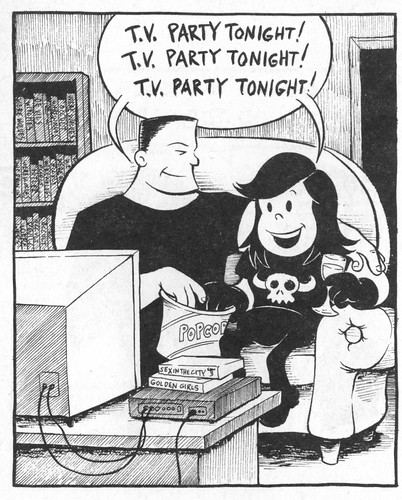
Henry & Glenn Forever
Tom Neely, Scott Nobles, Gin Stevens, [anonymous], writers/artists
Igloo Tornado/Cantankerous Titles, April 2010
64 pages
$5
Buy it from Microcosm Publishing
When I was a teenager, even though I didn’t much care for their music, I was at the very least entertained by Henry Rollins and Glenn Danzig purely on a “who’d win in a fight?” level. This was the early ’90s, and the concept of broadly defined alternative musicians with actual visible muscles was something of a mindblower, to say nothing of the superhero levels to which these two guys took it. Although spitballing which of the two would come out on top in hand-to-hand comeback has since been largely rendered moot, I’d imagine Henry & Glenn remain associated with one another in the minds of many lo these many years later by dint of their toyetic physiques (and their equally genre-art-badass mutual love of black clothing), quite aside from their shared role at the roots of hardcore. In that light it’s no surprise that in one of this book’s sixty or so one-page gags on the idea of Rollins and Danzig as a committed couple, they’re simply drawn as Colossus and Wolverine respectively, without further comment. If either man has spent any time in your ideaspace, no explanation is necessary.
Produced by The Blot‘s Tom Neely and his compatriots in the Igloo Tornado collective (the fourth member of which appears to wish to remain anonymous for the purposes of this project), Henry & Glenn Forever is an email your friends, hey-you-gotta-see-this meme in minicomic form for one simple reason: It takes hardcore’s two most self-consciously self-styled tough guys and casts them as lovers, not fighters. It helps if you’re familiar with some of their music, since there are a handful of gags (particularly Neely’s) based on Black Flag or Misfits lyrics–including the outrageously tumblriffic image I stuck at the top of this review, as well as another that’s both one of the comics’ few gross-out gags and almost completely indecipherable unless you know the line that comes after the line Glenn utters in the panel. But in general, all you need do is, y’know, look at how Glenn Danzig and Henry Rollins look, and then sit back and enjoy how funny it is to think of them as a sweet romantic couple who wish they could spend more time together, hate themselves for arguing, write about their Hot Topic shopping sprees in their diaries, fret about whether their fishnets will still fit them if they go see Rocky Horror at the Nuart, and so on.
Lest you worry it’s a one-note project, a goodly number of the jokes go in different directions. Some preserve Henry & Glenn’s machismo but take it to ridiculous levels: In one panel they’ve replaced their hands with guns and knives, in another they’ve sprouted the black horns of a “unicorn of death.” There’s a subplot involving their nextdoor neighbors Darryl Hall and John Oates, cast here as very polite Satanists. And there are plenty of jokes directly at the expense of werewolf-loving, Hitler-studying, occult-dabbling Danzig that would work whether or not he and Henry Rollins were in love. Rollins, who in my day became something of a poster child for alt-culture elitism, is roasted a couple of times on those grounds, but he’s generally the straight man here. So to speak. In a world where Oates’s mustache is the star of its own animated series, the jokes about those two yachtrockers fall a little flat, but I laughed a lot at pretty much everything. (And okay, seeing the two of them say “Oh, I can’t go for that!” “No can do!” as Henry and Glenn erect an anti-Prop 8 sign on their front yard made me laugh too.)
If you’re looking for a gorgeous art showcase, you’ll probably wanna look elsewhere: Of the four Igloo Tornado guys, Neely’s the only real cartoonist in the bunch. I love the visual shorthand he developed for the pair: Rollins is a towering, barefooted, squint-eyed, unibrowed, flattopped ogre, Danzig a tiny, doughy imp with Annie Warbucks’s eyes and Veronica Lodge’s hair. The rest of the gang cartoons just well enough to get their gags across, and honestly that’s part of the charm–Neely’s chops aside, this thing looks and reads like a book you and your friends could have put together after drunkenly stumbling across the idea, cracking up the whole while. Which, as I understand, is exactly what Neely & Company did. Sometimes, it pays to heed the words of a wise man: “Don’t think about–do it!”

Comics Time: Jumbly Junkery #8-9
May 7, 2010

Jumbly Junkery #8
L. Nichols, writer/artist
self-published, October 2009
44 pages
$5
Jumbly Junkery #9
L. Nichols, writer/artist
self-published, April 2010
36 pages
$5
Most of the minicomics I’ve read have one overriding, primary purpose: They’re an art object, they’re a formal exercise, they’re a concise storytelling or visual statement. L. Nichols’s Jumbly Junkery has a purpose, I think, but instead of a well-placed sniper’s bullet, it’s a shotgun blast. The goal of her one-woman anthology minicomics series appears to be nothing more or less than creating a vehicle for the unfiltered self-expression of a cartoonist with a massively prodigious work ethic. It’s a conveyor belt from the artist’s brain to the reader’s.
Most of the strips in these two issues, based on my unscientific survey, are little autobiographical sketches. They’re the sort of comic where
each new phrase
is separated out from the others
and captions each new panel
for an effect that is at once staccato
and ersatz-elegiac.
Which is not my favorite writing style in the world, admittedly. But in Nichols’ case it doesn’t come across like the comics-as-poetry nightmare you might be picturing, because it’s so clearly tied to her compulsion to create. It’s like she can’t help but draw a new panel for every phrase and clause. The two issues are peppered with strips where she either contemplates her constant drawing or perseverates on the worrying feeling that, you know, this is all there is, occasionally combining as she fears that what she’s doing is an insufficient means of transcending both her own inadequacies and those of humanity in general. In all three cases, there’s a sense of obsession that goes a long way toward undercutting any potential cutesiness in the art or execution. Throw in the repeated motif of mathematical formulae, derived from her own studies IRL and serving the same purpose as those spotted mandalas in Blankets, and you can understand what she’s going through even you’re not quite ready to go along with her.
Nichols works primarily in a pleasantly cartoony style best exemplified by her self-caricature as a stuffed doll with x’d-out button eyes and a mohawk. Again, there’s the danger of twee, but it’s undercut by genuinely deft gray shading, the doll’s unsettling featurelessness, and an overall attention to craft. Moreover, issue #9 displays a wide array of styles, from a wiry, scratchy, more recognizably “altcomix” philosophical comic to an abstract comic with Mondrian-style squares to a cleaner, slicker “comic strip” style complete with zipatone to an almost xkcd-ish bit on the white noise of technology to a funny-animal thing that feels like a Matt Furie comic drawn by someone who does kids comics for First Second. And since most of the stories in both issues are just one or two pages long, there’s a pleasant idea churn. Don’t like this strip? Don’t worry, there’s a new one on the next page. All told, Jumbly Junkery is a fine example of a minicomic as a means to an end, a record of and venue for a cartoonist’s progress rather than a discreet declaration.
Comics Time: Wilson
May 5, 2010
Wilson
Daniel Clowes, writer/artist
Drawn & Quarterly, April 2010
80 pages, hardcover
$21.95

All apologies to Ken Parille, but I don’t think the kaleidoscopic array of styles in which Daniel Clowes drew Wilson says much of anything. I think that’s the gag. And I mean this aside from the fact that these are all styles you saw Clowes employ (and no duh–as with Ware, it’s almost boring at this point to mention that the guy is an absolute titan of craft) with full shock-of-the-new force in Eightball #22/Ice Haven, where the Sunday-funnies format made their import a lot clearer. Here, it’s like Thirty Two Short Films About Some Dickhead, or that guy who pointed out that all New Yorker cartoons are funny if you caption them with “Christ, what an asshole.” Draw it how you will: Wilson’s always there, in medium close-up more often than not, a wide-eyed and open-mouthed expression of guileless wonder on his face more often than not, saying something fucking horrible almost constantly. No matter how you shake and dance, the last two drops go in your pants; no matter whether he’s detailed or abstracted or realistic or cartoony or full-color or two-tone or black-and-white or whatever the hell, Wilson is a massive, massive tool.
Wilson is sort of like the refined, sharpened, weaponized version of Mister Wonderful. Marshall is self-absorbed, Wilson is self-absorbed and cruel. Each single-page unit of Mister Wonderful is paced like a gag strip; the same is true of Wilson, only there are four times as many of them, and they’re at someone’s expense. There’s hope for Marshall; Wilson ends on a note akin to The Godfather Part II. Mister Wonderful is funny; Wilson is hilarious–I read this on the train and was embarrassingly vocal in my enjoyment of it. The second I got to a computer I made “PROPERTY OF SIR D.A.D.D.Y. BIG-DICK” my Google Chat status, I emailed my friends the entirety of Wilson’s disquisition on The Dark Knight, and even now I can’t think of “Hey, it talks!” without laughing out loud. Marshall is preoccupied with making a connection with someone outside himself, even if he’s constantly hamstringing his attempts to do so; the only times Wilson appears able to take that step is when death has rendered it too little, too late. This book is utterly mean and hilarious, and I loved every page.
Comics Time: Mister Wonderful
May 3, 2010
Mister Wonderful
Daniel Clowes, writer/artist
The New York Times, September 2007-February 2008
20 pages
Download it for free from The New York Times
The key sequence in the comic Dan Clowes serialized through The New York Times‘ Funny Pages section a couple years back (!!!) comes in its October 28th. 2007 installment. Up to that point, and afterwards in fact, you could fairly comfortably play the theme song to Curb Your Enthusiasm in the background while reading and get roughly the right effect. The titular character, a graying sad sack named Marshall, is so self-obsessed in a self-deprecating manner that it’s almost a mental illness. In a series of one-page sequences he waits for a blind date he’s increasingly sure will never arrive, mentally lashing out at himself and his fellow coffee-shop patrons in a torrent of caption boxes that superimpose themselves on action and dialogue alike. Clowes’s comedic pacing is drum-tight, his portraiture hilariously scathing, able to capture the pleading vulnerabilites of a human face and then exploit them ruthlessly. You’re left wondering if this will ultimately be as biting a portrait of a pathetic, bitter guy as was The Death-Ray (only, you know, with no ray guns).
Things don’t exactly improve when Marshall’s blind date, a lovely if seemingly scatterbrained woman just shy of 40 named Natalie, actually shows up. Marshall, who at this point is half-drunk, immediately begins constructing elaborate fantasies of their happy life together, basically calling her the most perfect person who ever existed–the better to preemptively excoriate himself for blowing it with every fumbled word or body-language cue. Most of what she says to him is obscured by his interior-monlogue captions: Immediately after thinking to himself, “O.K., Marshall — now’s the perfect time to show what a sympathetic and attentive listener you are — eye contact, Marshall! Concentrate!”, he interrupts a word balloon containing the story of her failed marriage with a giant block of narration beginning “So here’s the basic gist:”. It’s smart cartooning, as you’d expect from Daniel effing Clowes, and it’s nasty and funny, as you’d also expect.
Then something unexpected, and subsequently unremarked-upon, happens. Marshall relates to us the story of Natalie’s common-law marriage, a 15-year relationship that began in grad school and ended when she could no longer forgive her boyfriend’s laughing dismissal of her worry that their lack of an actual marriage or children meant he was ashamed of her. It’s just a four-panel sequence, but it’s done in these lovely glacial blues, and there’s this gut-wrenching effect Clowes uses to convey the idea that “every time she went into that room, the laugh was there”: A large, three dimensional, yellow block-letter “HA HA,” first sitting on the kitchen table, then towering over the whole room like a monument.
It’s not made explicit, but here’s the thing: This isn’t Natalie’s memory of the disintegration of her relationship. This is Marshall’s mental reconstruction of Natalie’s story, pitched to us with the same no-bull neurosis as everything else he’s told us so far. Only it’s beautiful, it’s thoughtful, it’s sad and crushing. For these four panels only, all traces of Marshall’s compulsive self-absorption and solipsism are gone. Whatever he thinks of himself in the moment, we know he really did empathize with Natalie, he really did listen attentively, he really does care about her not as an idealized ticket out of his miserable lonely life, but as a person with a story all her own. For all the Larry David humor and brutal caricature in here, that’s the beating heart of the story, hidden under all the black. I think it’s worth remembering the next time you hear someone dismiss Clowes as a misanthropic self-loathing crank. Mister Wonderful is a story about the need to cling to one another in the face of not just the world’s awfulness but also your own, because what else are you gonna do? It doesn’t skimp on the awfulness, but the clinging’s the point.
Comics Time: Tales Designed to Thrizzle #6
April 30, 2010
Tales Designed to Thrizzle #6
Michael Kupperman, writer/artist
Fantagraphics, April 2010
32 pages
$4.95
Aw, bummer, this one isn’t that good! I never thought I’d be saying this, but this issue of Michael Kupperman’s heretofore unfailingly, unflaggingly hilarious humor series is kind of flat. That manic twisting-and-turning of his, where each new panel or turn of the page can completely upend the premise of the previous one, is nowhere to be found. You don’t know how disappointing it is for a die-hard Kupperfan to discover that, say, the “Jungle Princess” story begins and ends with the same jungle-heroine premise. Yeah, it’s funny that she dresses the exact same way in her city-dweller “secret identity,” and there are some cute sight gags involving jungle creatures doing unusual things, but that’s as you’d expect it to be. Similarly, a Richie Rich parody in which the little rich kid eats jewels ends with him needing surgery to remove the jewels from his intestines; the story of a has-been Broadway actress in danger of getting upstaged by her new production’s elaborate drainage system ends with her getting upstaged by her new production’s elaborate drainage system; Einstein and Twain in space is basically just Einstein and Twain in space, and though it does end with the out-of-nowhere death of director Tony Scott, it’s your basic “spaceship lands on someone annoying” gag. (I preferred it when Mystery Science Theater 3000: The Movie wished that the crashing spaceship at the end of This Island Earth would land on, of all people, Kenny Loggins.) Kupperman’s unmistakable art is as meticulously constructed as ever–I’ve seen him draw and I still can’t figure out how he does it–and the appealing color work still lets his uncanny linework shine, but beyond that? It’s like half of the ideas fell out someplace, and you keep waiting and waiting for craziness that never comes. 🙁
Comics Time: Death Trap
April 28, 2010
Death Trap
Lane Milburn, writer/artist
self-published, April 2010
112 pages
$12
It feels good to see someone win a Xeric Grant whose work you’ve already been following, then to discover that the work they won that Xeric for is their best work to date. In that light, Lane Milburn’s Death Trap is the feel-good comic of the year. Everything he does well, he does as well as he’s ever done it here: Immersive environments, crosshatched and “lit” to look like they were constructed from solid smoke. Weird, ugly monster designs that connote some sort of infectious sickness of reality as much as they do simply somethin’ scary. A real mastery of building the human body out of its constituent parts into something that appears meaty and palpable on the page–from his trademark fireplug goons to a convincingly sexy teenage girl. A flair for the ridiculous that manifests itself both through far more controlled riffing on the over-the-top writing of comics of yore than what you saw in his recent Feeble Minded Funnies and through a series of action beats and sight gags that juxtapose his bizarre creatures with the ’70s redneck-stoner-horror demimonde he squeezes them into. Some truly killer beat-by-beat action sequences of the sort you wish somebody, anybody who isn’t working with Grant Morrison on Batman & Robin would attempt in a contemporary superhero comic. An intelligent combination of the teenagers-preyed-upon-by-maniacs horror of The Texas Chain Saw Massacre with even woolier comics villainy. Off-to-the-side visual flourishes, from the separate full-color science fiction story that opens the book to a Mario Bava/Barbara Steele-style pin-up that kicks off the main titular tale. And perhaps the most finely tuned sense of queasy, bottom-just-dropped-out horror and madness you’ll find in comics this side of Al Columbia. If any of this sounds at all appealing to you, drop the 12 bones, and put some cash aside for whatever he does next.
Comics Time: Keeping Two
April 26, 2010
Keeping Two
Jordan Crane, writer/artist
finite webcomic, 2001-?
That question mark up there is doing a lot of work. I remember following Keeping Two in serialized fashion…but I don’t remember where. Were any installments in NON? Were they on Jordan Crane’s old Red Ink website? Did he make minicomics of them? Was maybe some of it in Uptight? The comic’s presentation on Crane’s gorgeous webcomics-anthology site What Things Do bears the date “18 December 2001,” but I have no idea what that means. I think that’s when it started? I don’t know when it ended. Hell, I don’t know if it ended. But I’ll get to that.
Anyway. Comic!
Jordan Crane’s comics are Mary Poppins’ maxim at work. The spoonful of sugar, and actually it’s more like a dumptruck full, is Crane’s art. His characters have the slightly disproportionate and adorable heads of children. They see the world through little dot eyes. They’re drawn with a line so soft you wanna reach out and pet it. His omission of periods at the end of sentences gives even the dialogue a vulnerable, open feel.
Then the medicine comes along, and it’s like one of those giant needles doctors admit in advance will hurt like hell. In the case of Keeping Two, the medicine is death. It’s presented here with shocking directness. When a baby is stillborn, you see his corpse, see his weeping mother hold him and say “Oh my sweetie”. When a dog dies, you see his body lying on the ground, eyes open, his owner’s recounting of her discovery of her dead best friend staggered out over the course of countless word balloons as though every word is an agony. I hadn’t read this stuff in a long time, and seeing it again knocked the wind out of me. It’s brutal and unflinching.
The story itself is a multifaceted look at a young couple on a day when death touches their lives in several ways: Through the book the woman is reading, through the passing of an acquaintance and the death of the man’s mom’s dog, and finally in the head of the man as the woman takes too long to return from the video store. (Video stores: Sign #1 this comic was started up a long time ago.) In a way it reminds me of Richard McGuire’s “Here,” dazzlingly complex but centered on absence rather than presence and stretched out for an entire story. The couple’s story is sequenced out of order, there are flashbacks, there are multiple perspectives on the same conversation, there’s a story within the story, there are multiple daydream sequences, there are scenes imagining what the real scenes must have been like, there are lengthy “Scott McCloud explaining manga”-type sequences of washing dishes, there’s an ending so open I’m not 100% convinced it is an ending…but it all circles around the direct and devastating image of a dotted-line silhouette where a person, a dog, a baby used to be, just like your mind does. That it’s so lovely to look at doesn’t soften the blow so much as aim it.
Comics Time: Skim
April 23, 2010
Skim
Mariko Tamaki, writer
Jillian Tamaki, artist
Groundwood, 2008
140 pages, hardcover
$18.95

The story of a teenage outcast’s traumatic, illicit first love, Skim impressed me with what it chose to show and what it chose to hide. On the show side of the ledger, first of all, it’s a book about a teenage Wiccan lesbian and about suicide, and it really doesn’t skimp on any of that. There are rituals, there’s a love story, there’s cursing out the wazoo, and teenagers die. It’s an article in a local newspaper about What Our Children Are Reading waiting to happen. In that sense, even though it’s very much a Young Adult book, it felt to me less like something created to be maximally appealing and accessible to a YA readership and more like something created the way we like to imagine all good comics are created: A writer and/or an artist had an idea and committed it to paper, full stop. Ballsy.
Also in the “show” column, there are the stylistic filigrees and flourishes of Jillian Tamaki’s art. Her figurework is really singular and memorable, most prominently: There’s a shot early on of a hallway full of Catholic high school girls, the plaid of their skirts more a suggestion of motion than a pattern on fabric, that is simply swoonworthy if ever you’ve swooned over a hallway full of Catholic high school girls. Main character Kim “Skim” Cameron’s “otherness” is suggested with the clever visual shorthand of making her face look like someone that stepped out of a classical Japanese portrait. Ms. Archer is every bohemian art or English teacher you’ve ever crushed on, swirling around under yards of fabric and hair. Suicide-haunted Katie Matthews’s face is a pinched little scowl, not depressed so much as enraged. Even the cowlick epidemic that plagues the hair of what seems like a solid 50% of the characters comes across as an endearing tic rather than a goof. It’s all very cleverly done.
Then there’s the equally clever “hide” column. I fairly marveled at just how much was left unsaid or performed offstage. Why on earth would Ms. Archer do what she did? Though we get a lot on the damage she did, and can infer how she chooses to deal with that damage, the damage that caused her to do what she did is unexplored. Actually, so is…what she did itself. There are hints, there’s a fleeting glimpse, but we never learn how far things went, what was done, what was said. This is where the wise choice to make Skim such an unreliable narrator comes into play. She’s constantly crossing out and rewriting her narration, and we establish early on that she’s willing and able to skip over major, major events if she doesn’t feel comfortable discussing them. We’re never able to trust that she’s giving us the whole picture, and that lack of trust is the structuring absence around which the story and our understanding of it is built. This in turn is reflected in the rumors and half-truths and lies and gossip that keep buzzing in the background, and in the lack of candor between Skim and her supposed best friend Lisa…it’s really a book about hiding, now that I think of it. The villains of the piece, such as they are, are villains precisely because they make such a show of everything. Even the climactic happy ending is presented to us as obliquely as possible. The moral of the story is that private lives are private, and you offer access to them at both your great pleasure and your great peril.
Comics Time: Young Lions
April 21, 2010
Young Lions
Blaise Larmee, writer/artist
self-published, March 2010
96 pages
$10
Now here’s an interesting combination: A fairly straightforward “aimless young smart people” graphic novella in the vein of Adrian Tomine or Ghost World-era Dan Clowes, drawn in the wispy, dreamlike style of C.F. Larmee’s take on the CF “tradition”* foregrounds its frequent warm beauty rather than its fetishistic cold transgression. It pushes back the Henry Darger and pulls forward the Nell Brinkley, if you will.
This has a dual effect within the narrative (“story” isn’t quite right), which is about three young “conceputal artists” whose routine is shaken up by the unexpected intrusion of a beautiful young woman whose drunken disruption of one of their performances leads to their most successful gig yet, and a subsequent road trip to determine whether she’s worthy of official inclusion in the group. First, in the hands of Larmee’s delicate pencil line, these people are gorgeous–skinny, babyfaced androgynes constantly hitting effortlessly languid, painfully beautiful poses. If the characters in Young Lions were real, you might not want to talk to them, but you’d sure wanna stare at them, or, you know, dash your heart to pieces on the rocks of their indifference, tossing underappreciated mix CDs in their direction every now and then.
The second effect the beauty of the art, and by extension the characters, has on the narrative is making it immersive and appealing. A lot more so, in fact, than it might otherwise have a right to be. Cody and Alice seem completely oblivious to how easy they have it as (apparently) wealthy, (definitely) gorgeous, (avowedly) artsy young Americans; Wilson is less attractive but makes up for it by sheer force of obnoxious intellectual domineering and is the type you know will always be able to find a scene he can dominate; Holly is a bit harder to get a handle on, but she clearly enjoys the attention inherent in her exploitation by the trio and is thus difficult to sympathize with even as the others condescend to her naivete and poverty. A less charitable documentarian of this particular demimonde might simply stick “Bohemian Like You” by the Dandy Warhols on loop and be done with it. In the hands of a less visually charitable cartoonist–Clowes, say, or even Tomine!–this would read as a pretty merciless satire. Given Larmee’s deeply unfortunate internet persona (the fact that it’s a put-on doesn’t make it any less of a head–scratching headache inducer), you might even say merciless satire is what both characters and creator deserve.
But when I said Larmee is dragging the beauty of this art style forward, I meant that literally: As opposed to CF’s side-scrolling distance, we’re in constant close-up close quarters with this quartet. Their reclining bodies occupy entire panels, their upturned, closed-eye’d faces appear inches away from our own, the background details are all but nonexistent. It’s tough to stand in judgement of people you’re seeing primarily through the POV you’d get if you were about to make out with them, you know?
It’s that intimacy that makes Young Lions successful, that makes the whole greater than the sum of its parts. Yes, these are assholes. But who–especially among artists and arts-interested people of the sort who’d buy a Xeric-winning self-published graphic novel such as this one–hasn’t been an asshole? Who hasn’t been friends with assholes, worked with assholes, been impressed by the creative output of assholes, been disappointed with the creative output of assholes, fallen in and out of love with assholes? Larmee may doom them to an open, down ending, but as Kevin Smith once said, that’s exactly what life is. Beyond that it’s not our place to judge.
* the emergence of which is fascinating to me, by the way, a second generation of the Providence artcomics aesthetic following Fort Thunder and Paper Rad, which are themselves obviously quite distinct but still noise-dominated while I think CF is quiet-dominated, but anyway
Comics Time: The Arrival
April 19, 2010
The Arrival
Shaun Tan, writer/artist
Arthur A. Levine, 2006
128 pages, hardcover
$19.99

(Before I begin the review, can you believe this book came out four years ago? I swear I thought I was a year at most behind this particular curve. But comics barrels headlong through its Golden Age and you have to run to keep up sometimes.)
Don’t let the sepiatones fool you. This fine, captivating wordless graphic novel re-strange-ifies the immigrant experience, shaking it free of elementary-school field-trip/filmstrip nostalgia and making it something scary and wonderful again. Taking place in a fantastical, almost Expressionist city filled with incomprehensible writing, bizarre architecture, and creatures that look like they evolved in a world where Jim Woodring’s Frank stories are the central creation myth, it powerfully conveys that traveling far from home, all alone, to a place you’ve never been before, where you know no one and don’t speak the language and aren’t even guaranteed a place to work or sleep, is extremely risky…but also worth the risk. I don’t think it had occurred to me how weighed down by cliche such narratives have become until I read The Arrival, but with each of Tan’s dreamlike or nightmarish twists on the pitfalls and miniature triumphs of his suit-wearing immigrant protagonist, I marveled anew both at his inventiveness, and at how effectively he burrows down through a million PBS documentaries to get to the core of emotion in each vignette.
Me being me, I was hit hardest by Tan’s depictions of the things that caused each character to flee his or her native country: representing persecution as faceless giants in hazmat suits, sucking people up with enormous vacuum cleaners; representing ruinous war as happy men in conical gnome hats happily marching out of a city, their feet crossing ever more harsh landscapes, giving way to a tableau of skeletal remains, and culminating in just one of the me, badly wounded, returning to a city that’s totally destroyed. But there’s cute business too, like our protagonist’s short, ill-fated stint putting up posters; and there’s genuine joy in seeing him slowly form the makings of a new community of friends with his neighbors and co-workers. Tan’s neo(magic)realist art is particularly good at the latter: He puts us in the place of the protagonist as his new friends directly address him, drawing us in with their gaze and gestures, as intimate as his massive splash pages and spreads are intimidating.
Perhaps the nicest thing I can say about what Tan does in The Arrival is that despite its provenance as a children’s book, he keeps the action on the knife’s edge, the danger of failure (or worse) radiating from our worried, harried hero at every turn. I really wondered whether things would work out for him or not. The effect is enveloping. I imagine this will make the eyeballs of little kids and parents who pick it up from the library melt out of their skulls, it’s so lush and lovely and fully conceived an act of visual worldbuilding. Well worth a read, a flip-through, and a read again.
Comics Time: Spider-Man: Fever #1
April 9, 2010
Spider-Man: Fever #1
Brendan McCarthy, writer/artist
Marvel, April 2009
21 story pages
$2.99
(UPDATE: Now with fewer hideous mixed metaphors)
I went into Spider-Man: Fever with absolutely no brief with Brendan McCarthy, not even his Solo issue a few years back. All I knew is I liked the looks of the preview images floating around the Internet–I mean, I would–and wanted to see more. See more I did: McCarthy’s scribbled psychedelia, powerfully augmented by his and Steve Cook’s woozy glowy neon colors is a thing of gooey beauty. He’s even calling the style “glo-fi,” much to my delight!
Would that the surrounding comic were equally delightful, but it’s a pretty perfunctory rehash of Bronze Age rehashes of Silver Age storytelling. An avalanche of knowingly stiff dialogue, which turns out to be as numbing as the unknowing variety, crushes whatever action hasn’t already been flattened by the surprisingly inert physicality McCarthy cooks up for Steve Ditko mainstays Spider-Man and Doctor Strange. (Nice-looking Vulture, though.) There’s even some embarrassingly cringeworthy African-American dialect, for that true late-’70s feel. I’m as happy as anyone to have a Spider-Man comic featuring a mystical poetry-reciting dog-god named Pugly, but when it comes to reading the thing instead of just looking at it, turns out I oughtn’t have gone beyond those preview images for the glo-fi thrill I wanted.
(Interview link via Jog.)
Comics Time: S.H.I.E.L.D. #1
April 7, 2010
S.H.I.E.L.D. #1
Jonathan Hickman, writer/artist
Dustin Weaver, artist
Marvel, April 2010
36 story pages
$3.99
Supremely confident superhero comics-making from Jonathan Hickman here. In fact I’d say there hasn’t been a debut issue this sure of itself, this willing simply to throw its audience headlong into what the writer has cooked up, since the Nu-Marvel golden age of Morrison & Quitely’s New X-Men, Bendis & Maleev’s Daredevil, and Milligan & Allred’s X-Force. Who knows where it’ll all end up, who knows if it’ll hold up or make sense or not be really stupid or something. But within the context of these 34 pages of comics and two pages of Hickman designiness, I found it extraordinarily invigorating.
S.H.I.E.L.D. purports to tell the secret history of a Marvel Universe (I’m not comfortable using the definite article for reasons that will become apparent), in which a blend of fantistorical figures like the Pharaoh Imhotep and actual real-world Great Men like da Vinci and Galileo have banded together over the centuries in an ancient secret society called the Shield (I’m not comfortable using the acronym for reasons that are a little nebulous at this point). The Shield has quietly protect the world from assorted apocalyptic threats familiar to us from Marvel’s outer-space material, including Galactus, a Celestial, the Brood, and (I think) the Phoenix. You are perhaps at this point tuning out: Secret histories and secret societies and super-awesome science heroes who protect us both from threats and knowledge of those threats are obviously a pretty shopworn concept at this point, and the influence of Hickman’s mad-idea-mongering predecessors Grant Morrison and Warren Ellis is unmistakable.
But it’s not the size of the boat, it’s the motion of the ocean, and Hickman and artist Dustin Weaver keep things moving at breakneck speed. You get a grand total of one page to ease into the action, with main character Leonid slowly and silently walking toward the viewer, and then BOOM, he’s whisked off by a pair of suited agents in a sweet ’50s car, he’s revealing that his body is made of stars or something, he’s flown to Rome and shown a gigantic underground city–by page four. Most comics today might get that far by issue four. I’m not one to complain about decompression, or at least I didn’t used to be, but obviously the technique has gotten so common as to become predictable; most anyone who’s read enough superhero comics could write a new series’ first story arc in their sleep, knowing exactly where each beat would fall. With Kirkman and S.H.I.E.L.D., I’m kept dancing to a different beat, one where world-ending threats are introduced and thwarted in the space of two to three pages, only for a jump of centuries to bring us to the next one; where a character learns his great destiny and then a three year lacuna reveals him stuck in place, bored and staring at the ceiling; where villains are introduced for the very first time anywhere as if we have the same lengthy history with them that the characters do; where names of great import to Marvel fans are dropped in, precisely calibrated to do that whole “everything you thought you knew was wrong” thing; where Leonardo da Vinci flies into the sun, All-Star Superman-style. In my favorite panel, a council of elders just starts rattling off omgcrazy terminology like they’re reading the specials at the Cheesecake Factory: “The Greater Science.” “The Quiet Math.” “The Silent Truth.” “The Hidden Arts.” “The Secret Alchemy.” Rat-a-tat-tat!
I know he’s being singled out for a lot of praise, but I think Weaver’s the weak link here, to an extent. He’s doing great things with the designs of the Shield’s unique armor and architecture, in a fashion that reminds me of similarly impressive filigrees by the likes of Steve McNiven and Mike Choi. But his characters sit awkwardly among the splendor: Their scale is off at times, and but for a blink-and-you’ll-miss it caption and school bus it’s impossible to tell that this is a period piece and that Leonid’s in high school at the oldest. I’d love to see as much attention paid to the mundane aspects of establishing the story’s world as the mind-blowing ones. But this is sort of small beer. Call it supercompression, call it simply a return to the no-nonsense pacing of the Golden and Silver Age superhero origin stories, but S.H.I.E.L.D. comes across as a book that knows what it wants to do and can’t wait to show you. It’s a delightful feeling.