We know who that killer is now, and that makes Twin Peaks a fundamentally different show than it was an episode ago. With the show’s central mystery solved from the viewer’s perspective, you can already feel the force of storytelling gravity tugging the case towards its resolution. There’s only so long you can leave the killer on the loose without making Agent Cooper and company look incompetent, which cuts against the core appeal of the character.
I’ve given some thought to the sublime in cinema — moments when it feels what I’m watching has somehow transcended earthly limitations, visually expressing a feeling so huge that it’s impossible for words to articulate. I realize now that for me, this happens in horror more often than anywhere else. In fact, it may only happen in horror.
It happens when characters are made to confront some symbolic representation of…not death, though that’s part of it, and not evil, though that’s part of it too. They confront the darkness we fear exists at the world’s heart, the terrible void that acts as a megapredator for our tiny souls. They confront the true black.
I think of moments like Chief Brody on the beach, the camera dolly-zooming on him Vertigo style as he sees that the shark he hoped had been killed but knew in his heart had not claim another victim. Father Karras and Father Merrin, chanting “The power of Christ compels you!” at a hovering Regan MacNeil. Wendy Torrance turning a corner and watching an elevator unleash a river of blood. The cops gazing down the hall of Barton Fink’s hotel and seeing a demon in human form amidst a blazing inferno. The end of Mulholland Drive. The end of The Zone of Interest.
And this episode of Twin Peaks. Maddy and Leland and Bob and Sarah in the living room. Coop and Harry and the Log Lady and the Giant and the waiter and Bobby and Donna and James in the Roadhouse. Evil incarnate, drawing out grief from people who don’t even yet know why they’re grieving — only that there’s been some tear in the fabric in the world, one that they can sense but never repair.
When Mark Frost and David Lynch’s credit appeared against the red curtains, I couldn’t hold back anymore. The tears I’d withheld came pouring out. This is one of the most deeply awful and awesome things ever aired on television. I have not forgotten it since I first watched it nearly three decades ago. I will never forget it for as long as I live.
There’s room for silly business like this in Twin Peaks for sure. It’s part of the charm. But we’re now getting ever closer to the pulsating black heart of the story — the force of sheer malevolence that claimed Laura Palmer’s life. As such, even the simplest lines that touch on this mystery take on an awesome power. When Mike describes Bob as “the parasite,” attaching himself to human hosts and feeding on their fears and carnal pleasures, it’s like hearing Max Von Sydow talk about the thing inside Regan in The Exorcist.
“He is Bob, eager for fun,” Mike says. “He wears a smile. Everybody run.”
This dialogue moves me to the point of tears, not of sorrow or joy, but awe. A great and terrible thing is at hand.
The sequence that follows is fascinating for how directly it addresses female desire, a constant theme where Laura is concerned. To help flesh out Harold’s “living novel” and satiate his thirst for secrets — in exchange for which he’ll read to her from Laura’s diary — Donna tells the story of a time in junior high when she and Laura dressed up in their tightest clothes to pick up boys at the Roadhouse.
The college boys who pick them up wind up going skinny dipping with them, which is Donna’s idea, not Laura’s. Laura had begun dancing provocatively, and Donna is desperately trying to keep up. She imitates the dance, half in shadow, to make her point.
As Laura makes out with two of the three young men in the water, the third swims out to where Donna is and kisses her hand, then her lips, a feeling she remembers almost physically even now. “I never saw him again,” Donna tells Harold with tears in her eyes. “It was the first time I ever fell in love.”
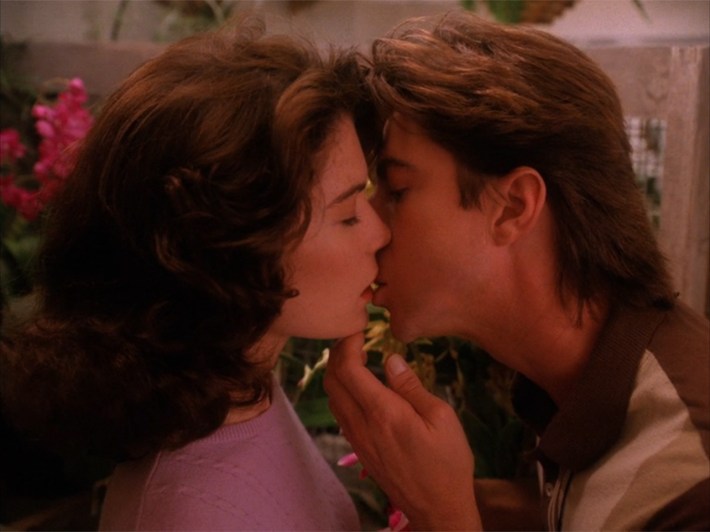
Harold is blown away. He takes her back to show her his orchids, paying special attention to the “lower lip” of its petals, “called a labellum.” The words hang in the air, dripping with innuendo.
“So delicate,” Donna purrs. When Harold explains it’s a landing pad for pollinators, Donna replies, “Romantic, isn’t it?” The two kiss before Harold, suddenly anxious or self-conscious, breaks it off and scampers away.
There are any number of taboos being violated here, giving the scene the heat of the forbidden. There’s the obvious erotic power of that story over Donna even now, yet it’s not presented as some lascivious Lolita kind of thing. In how she tells the story, Donna is clearly expressing feelings she experiences now, as a young adult…and which Harold experiences as an older one. So there’s that age gap aspect, too.
But at the same time, Harold’s severe mental illness, and his ignorance of Donna’s true motives, put her in control of the much older man, not the other way around. The whole thing is a psychosexual bramble, and its thorns are hard to disentangle yourself from.
Leland Palmer has a confession to make. Once again sobbing like the devastated father we knew before his hair went white, Leland admits that he killed Jacques Renault, the man he believed to be Laura’s killer. His motivation, he explains to Sheriff Truman, Agent Cooper, and Doc Hayward, was “absolute loss…more than grief. It’s deep down inside. Every cell screams. You can hear nothing else.”
And indeed, we do hear the sound in Leland’s head as he sits in the interrogation room in the Twin Peaks Sheriff’s Department, staring into the holes in the paneled walls. It’s the voice of his daughter, Laura, calling “Daddy!” over and over.
The only glimpse I caught of Twin Peaks during its initial run occurred on October 13, 1990. I was 12 years old, it was after 10 p.m., and I must have been flipping through the channels absent-mindedly before bed after the Golden Girls/Empty Nest block on NBC had ended. I was aware of the show by then, even as a person who’d only freshly become aware of “pop culture” as a phenomenon; the cast and the parodies were absolutely everywhere for months. But this was my first look at the show itself.
I saw a one-armed man with a syringe have a seizure in a men’s room stall, then emerge in perfect calm, talking to an unseen figure like a man possessed.
I was a squeamish kid. That was plenty of Twin Peaks for me.
The motorcycle parked outside the Palmer house lets you know who’s inside. James Hurley and his girlfriend Donna Hayward have come to visit Maddy Ferguson, the out-of-town cousin of their beloved friend Laura Palmer. In fact, they’ve come to record a love song, using a tape recorder, an old-fashioned microphone, and James’s acoustic guitar. While Maddy and Donna sit side by side on the floor and coo their dreamy backing vocals, James takes lead. His tremulous voice sings a song called “Just You,” which sounds like something you might have slow-danced to at the 1961 Spring Fling.
Donna’s mistake is believing that the song is for her. It might have been when he wrote it. It might even have been when he started singing it. But as the song continues, the dynamic shifts. As Maddy’s eyes seek out James with increasingly obvious hunger, and he responds by looking back at her instead of Donna, Donna’s own eyes grown desperate, pleading, and finally tearful. Eventually it’s too much, and she gets up and runs off.
“I’m trembling, James,” she says when he comes to comfort her. “You made me.” It’s true, but not in the heated way she intends it to sound. The thought of losing James has rocked her.
Maddy just sits there looking uncomfortable for this bit.
Then something happens. As she looks absently into the depths of the Palmer family’s first floor, a man emerges into view. Slowly he approaches, crawling over the sofa, scrambling over the coffee table, staring straight into the camera until he’s right in our faces. Maddy screams uncontrollably, even as Donna and James rush to her side to comfort her. She’s seen Laura’s killer. She’s seen Bob.
These few short minutes of screentime begin with a song so sugary sweet it passes through camp and back around into to dead-serious sincerity. There’s just no denying the passion and pain in the glances exchanged between the three singers. Add in Donna’s attempt to kiss James back into loving her and you’ve got something desperately romantic, in line with the star-crossed relationships of Blue Velvet or Mulholland Drive. But then, after some brief comic relief courtesy of Maddy’s third-wheel awkwardness, comes what remains one of the scariest shots ever aired on television: Frank Silva’s Bob, coming for all of us.
If you called Twin Peaks Season 2, Episode 1 one of the greatest season premieres of all time, you’d be telling the truth. You’d also be lying by omission.
I love Desmond’s debut down the Hatch at the start of Lost Season 2 (a show whose creators never made any bones about the debt they owed Twin Peaks). I love the knife’s-edge suspense between Walt, Jesse, Mike, and Gus at the beginning Breaking Bad Season 4. Shit, I love Sam drinking and whoring his way through getting left at the altar by Diane to kick off Cheers Season 3. But to compare these excellent episodes of television to these revolutionary 90 minutes is to damn what Mark Frost and David Lynch did here with faint praise. Those episodes have surprises, shocks, bittersweet laughs. This episode has the waiter, the Giant, Leland’s musical numbers, Audrey Horne’s prayer, Gersten Hayward’s recital, Major Briggs’s vision, Laura Palmer’s murder. They are not the same.
When people toss the word “Lynchian” around, it’s usually either as a very specific subgenre of surrealism, or as a way too broad synonym for “weird.” But the opening scene of this episode is a whole different flavor of Lynch, one every bit as important to his overall project. FBI Special Agent Dale Cooper, you’ll recall, was shot three times at point-blank range by a still-unidentified assailant to end Season 1. (We learn from the insufferable but brilliant Agent Rosenfield, back on the scene to bully everyone within the Twin Peaks city limits, that his would-be assassin was of average height, hardly narrowing it down.) When we rejoin Coop this episode, we can see that only one of the bullets penetrated his body, right where he’d lifted up the bulletproof vest he’d been wearing beneath his shirt while undercover at One-Eyed Jack’s. He was hunting for a pesky wood tick, you see; the bullet found the little bugger, and his torso, instead.
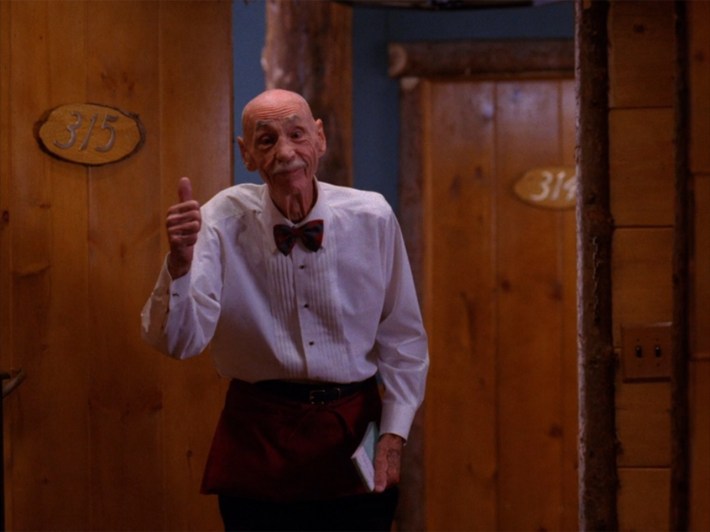
At great length, an elderly room service waiter (Hank Worden) slooooooooooooooooooooooooooooooooooooooooooooooooooowly delivers Cooper a glass of warm milk, hangs up the phone on a panicked Deputy Andy rather than call a doctor, and gives Coop — whose reputation apparently precedes him among the staff, if the waiter’s nearly giddy repetition of “I heard of you!” is any indication — several encouraging thumbs up and eye winks before shuffling away. The waiter also has him sign the room service bill. (Gratuities are included.)
Experiments in comedic tedium like this have been a Lynch hallmark since Eraserhead. I’d argue that on Twin Peaks in particular, as we’ll see later this episode with Leland Palmer, they’re a form of proto–cringe comedy, predating Steve Coogan and Armando Ianucci’s creation of Alan Partridge in 1991, Garry Shandling and Dennis Klein’s The Larry Sanders Show in 1992, and Mike Lazzo and Keith Croffod’s Space Ghost Coast-to-Coast (the most Peaksian of these early examples) in 1994. Scenes like these (fire) walk the fine line of boredom, discomfort, and silliness. It’s astonishing to think that in this case, they’ll lead to the absolute horror we see at episode’s end.
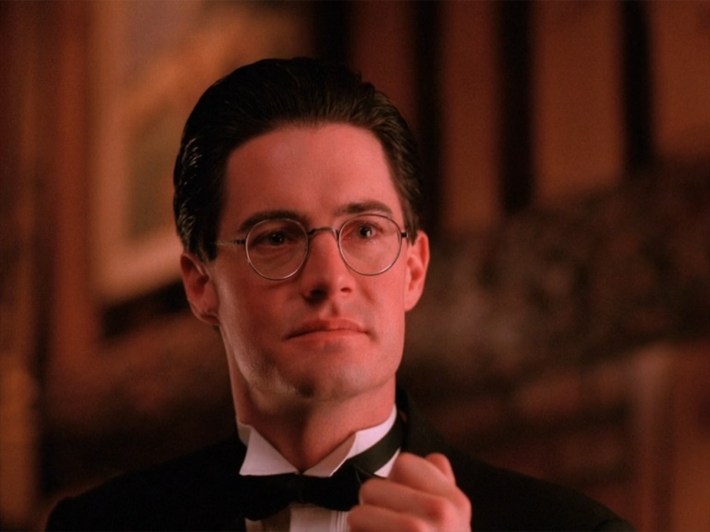
It’s Kyle MacLachlan’s finest moment to date as FBI Special Agent Dale Cooper, though you wouldn’t know he’s a Fed to look at him when it happens. He’s undercover as a high roller at One-Eyed Jack’s, the Canadian casino and brothel we (though not he) now know is owned by corrupt Twin Peaks business magnate Benjamin Horne. Wearing glasses and a tux, he’s fronting as the secret money man behind Leo Johnson’s cross-border cocaine smuggling operation.
Very quickly, he wins the trust of Leo’s partner in crime, bartender and blackjack dealer Jacques Renault. Convincing Jacques that Leo’s taking advantage of him, Cooper’s yuppie druglord offers Jacques ten thousand dollars cash to complete a job directly for him, “No Leo, no middleman.” Unsurprisingly given what we know of his work schedule, the French-Canadian dirtbag happily accepts the job.
There’s just one question Cooper has for Jacques before he sends him off on his errand, which of course is a trap designed to snare him within Sheriff Harry Truman’s jurisdiction in Twin Peaks itself. He’s already brandished the broken poker chip that matches the fragment found in Laura’s stomach. How did the chip get broken, that night with the girls, he wonders?
Cheerfully, with the relish of a schoolkid about to share his dad’s porn stash with a friend, Jacques explains that Laura liked to be tied up, which is what left her wide open when Waldo the bird was freed from his cage by Leo and landed on her shoulder. She and Waldo liked each other, and they were only “love pecks” according to Jacques, but with Leo “doing a number on her,” it was too much. She began to scream.
So Leo grabbed the chip, shoved it in her mouth, and said — Jacques delivers, chortling, in his thick accent — “Bite the bullet, baby. Bite the bullet!”
Throughout Jacques’s story, the view alternates between increasingly tight, subtly slow-motion closeups on Jacques’s grinning mouth as he talks, and Cooper’s rigid inexpressiveness as he listens. You can see, courtesy of MacLachlan’s best work on the show, that Cooper hates this man. He’s practically vibrating with it.
But he holds back all his loathing, all his disgust, and reacts as if he’s heard nothing out of the ordinary for men in their line of work. “Thanks for clearing that up,” he says in the end, with a snort of mirthless laughter. Coop’s pained non-reaction of a reaction reminds us this is not just a whodunit, but a tragedy. Jacques has given himself up as a suspect, but it won’t undo what was done.
My Prestige Prehistory series is taking a week off after this, but we’ll be back for Season 2 on January 12. That gum you like is going to come back in style!
“Harry, I’m gonna let you in on a little secret. Every day, once a day, give yourself a present. Don’t plan it, don’t wait for it, just let it happen. It could be a new shirt at the men’s store, a catnap in your office chair — or two cups of good, hot, black coffee, like this.”
It’s exceedingly rare to receive actionable advice on better living from a TV cop, but Dale Cooper is a rare cop indeed. I think this little speech, from the penultimate episode of Twin Peaks’ short first season, does more to endear Coop to us than half a dozen high-speed chases, collared perps, or climactic shootouts would have done.
Twin Peaks doesn’t have storylines, it has story clusters. That’s the simplest way to picture it, I think, and the easiest way to make sense of it. There are a handful of core concepts — the murder of Laura Palmer, the Ghostwood Estates/Packard Sawmill real estate swindle, the cross-border drug trade, the saga of Norma and Big Ed, the cops, the teens, the dreams — around which different sets of characters swirl. A few characters, like Dale Cooper, Audrey Horne, Leo Johnson, Bobby Briggs, and Laura Palmer herself, are able to cross between clusters. By connecting them, they help create the sense that it’s all one big story after all.
And then there’s Bobby and Shelly. Boy oh boy, is there ever Bobby and Shelly. Director Tim Hunter films the two of them making out in her unfinished house, Shelly straddling Bobby’s lap in her waitress uniform as they kiss and clutch at each other. When Bobby gets the idea to use Leo’s shirt to get rid of him, Shelly rewards him by opening her uniform to reveal a black lace teddy, against which she clutches a gun suggestively. And just like that, Bobby decides he has a few minutes to spare before he leaves after all.
I don’t blame him. Mädchen Amick is the most beautiful woman in a cast that includes Lara Flynn Boyle, Joan Chen, Sherilyn Fenn, Sheryl Lee, and Peggy Lipton, which to paraphrase The Big Lebowski puts her in the running for the most beautiful woman worldwide. Dana Ashbrook is a megababe too, whose mercurial nature — beneath the tough-guy act he’s clearly an emotional and easily hurt kid — makes his obvious hunger for Shelly feel wild and insatiable.
But that’s just it: He’s complicated, and so is their whole situation. Bobby is a red-hot lover, but he really did care about Laura, and Shelly says she wished she could have comforted him at her funeral. Shelly, meanwhile, is perfectly capable of playing the seductive desperate housewife, all bullets and black lace, but she also spends her shift commiserating with Norma about their similarly shit taste in husbands.
So yes, they’re gorgeous, but it’s the stickiness of their situation, the sharp angles and rough edges, that makes Bobby and Shelly’s romance work so well. Passion is the means by which they process their pain. Isn’t that the purpose of soaps — like Invitation to Love, the show within the show that the characters keep on watching even as their real lives exceed it — in the first place?
Consider Leland Palmer. He, too, has an uncomfortable outburst at Laura’s funeral. Perhaps triggered by the fight between Bobby and James, he quite simply melts down, throwing himself atop his daughter’s coffin. The hydraulic apparatus designed to lower it into the ground then malfunctions, yanking the sobbing man up and down. “Don’t ruin this too!” shrieks his wife, Sarah, who’s been decompensating in her own way as well.
Some mourners, like Shelly Johnson, find the whole thing comedic enough to reenact for the amusement of the diner patrons at the Double R. (She’s also hiding a gun in her home to protect her from her psychotic husband Leo, the prime suspect in Laura’s killing at the moment, so cut her some slack.) And it’s true, there’s something funny about it, and not just the slapstick-comedy nature of the incident.
Leland’s grief is so over the top that it provokes nervous laughter, the kind you let out when what you’re watching is too intense to take seriously, for a moment at least. It’s hard to watch him weep and wail on the coffin, or again on the dance floor at the Great Northern, as he begs for someone, anyone, to dance with him in Laura’s place. I bet Sarah could do with some attention, too, but what happened to their daughter is pulling them apart, not bringing them together. That’s a second tragedy.
What’s worrisome is that Leland has another family member to worry about while this is going on. Laura’s cousin Madeleine — a brunette with big glasses but a lookalike in every other way, played by Laura actor Sheryl Lee — arrives in town for the funeral, and is there to witness the catastrophe at the cemetery. We’ve already seen Sarah superimpose her daughter’s face on the girl’s best friend, Donna Hayward. It isn’t difficult to imagine Madeleine being cast in that same role, whether she wants to play it or not.
The show’s third episode is, in effect, the final chapter of a big three-part premiere. This is literally true, to an extent: Coop’s dream recycles footage originally created for an extended cut of the pilot for European markets. More to the point, it introduces multiple load-bearing elements of Twin Peaks’ cultural iconography, things you’ve probably seen or heard of whether or not you have any idea whodunit or where all this is headed (no spoilers, in other words): Audrey’s dreamy dance, Leland’s hysterical grief, Coop’s unconventional police work, One-Eyed Jack’s, the Red Room, the Man from Another Place (Michael J. Anderson), the backwards speech, Laura Palmer whispering in Agent Cooper’s ear, the “Fire Walk With Me” poem, one-armed Mike, Killer Bob.
Episode three is where it becomes clear that something not just strange but supernatural is occurring in this quiet logging town. It’s where the show goes from weird to Weird. And in all its non sequitur, nonlinear surrealist menace, it’s where David Lynch as we’d know him for the rest of his career — the David Lynch of Fire Walk With Me, Lost Highway, Mulholland Drive, Inland Empire, and this show’s own unlikely comeback season — is born.
Director Duwayne Dunham, who collaborated with Lynch as an editor both before and after working on Twin Peaks’ original run, clearly knows Lynch’s stuff well. His shot compositions for the one-on-one heart-to-hearts echo the quietude of Lynch’s own approach, against which surreal flourishes, like the blue glow on Hawk in the hospital, or scary ones, like the sudden appearance of that man behind the bed, pop more brightly.
He also respects that this is a show about people experiencing pain over Laura Palmer’s murder, not just trying to solve it: The sympathetic way he shoots characters like Sarah and Donna as they each grieve in their own way are among the show’s most memorable so far. Granted, “so far” means two episodes. But what episodes! From the mesmerizing opening credits on down, Twin Peaks asks you to quietly sit with whatever it’s doing — gags and bits, soapy melodrama, serial-killer horror, coping with loss, ranting about cotton-ball-powered drape runners — and listen to the screams, or the sighs, or the silence.
“Who killed Laura Palmer?” is a question that drips with a pain that Lynch and Frost admirably refuse to clean up and wipe away. Whatever their original intent regarding the resolution of her murder, Laura Palmer is no MacGuffin, no glowing briefcase or unobtainium or Maltese Falcon. She is, or rather was, a real person. She was complicated, obviously, and led multiple secret lives, lives even Donna and James, her best friend, knew nothing about. She was likely an addict. She may have been trafficked. She was a child — Leland and Sarah Palmer’s child. She was Laura Palmer.
Now she’s gone. Through all the surreality and silliness, as suspect after suspect is introduced and dismissed, Lynch and Frost never lose sight of Laura. They never silence the cries of those who loved her, to the point where I found it impossible not to cry along with them all. They never take their eyes off that empty desk. They never let you forget what it means.
Please note that while this is a gift link, Pop Heist is a worker-owned site that makes algorithm-free pop-culture coverage with no big-money backer. No other place would let me do this (or I, Claudius, or The Prisoner). It’s $7/month or $70/a year to subscribe, and it’s worth it.
As for Jack Pulman and Herbert Wise’s 1976 TV series? To call it a masterpiece is to understate the case. With a cast that turns over completely mid-series, it keeps churning out compelling new characters, brought to life with performances that feel rivetingly true to life yet grandiose enough to burn Rome down around them. Brian Blessed, Siân Phillips, George Baker, Patrick Stewart, Patricia Quinn, John Hurt, Sheila White, and Derek Jacobi alone sear themselves in your memory with their terrible energy; they are the glistening tip of a spear made of ace supporting players seemingly without end.
With a budget and design aesthetic more attuned to live theater than broadcast television, it uses deft camerawork and industry-best blocking of its actors to draw the audience into a conspiracy of make-believe. Long takes that allow you to sink into the acting and thus inhabit a world you know is not real; you may not be there, but you are there. Since so much of the work is done in-camera, when the series does resort to visual effects or striking editing choices, they hit like a freight train. Try shaking the feeling of all those characters talking directly to you in this episode, I dare you.
What emerges paramount from it all, from those spectral faces looming in the lens on down, is the feeling of ancient history speaking to the present. It is madness, madness, to trade away hard-learned, hard-fought moral and political principles for the expediency of autocracy. The lives of first Augustus and then Claudius himself prove there is no such thing as a benevolent dictatorship; surrender your rights and you have no right to complain when you are forced to surrender far more.
It should be noted here that Sheila White, the beautiful actor playing Messalina, is frequently shown nude throughout this episode, as are her male lovers. Her fuckathon battle with Scylla is described with shocking frankness, and when you see the aftermath – Scylla, her hair mussed, her chest slicked with sweat or saliva or, well, you know – there’s no question what has taken place. I kept reacting like Tim Robinson in that one I Think You Should Leave sketch: “I don’t know if you’re allowed to do that.”
In retrospect, there was one clear warning sign. Yes, Messalina, the sweet, beautiful, precociously competent and intelligent teenage girl to whom Claudius was forcibly wed by his demented uncle Caligula, makes the newly crowned emperor happy. Yes, she helps him immeasurably in his work. Yes, she’s the mother of first one, then two children by him. Yes, it seems like butter wouldn’t melt in her mouth.
Until she says this: “My darling, I want to be Livia to your Augustus!”
It is, of course, the last hurrah of the spectacular John Hurt as Caligula, which means it’s the last time we’re going to hear one of the most distinctive, melodic, terrifyingly powerful voices in the history of cinema. The way Hurt lets his raspy delivery sink into a purr, flitter into flights of laughter, or rise in volume and intensity until it sounds like he really is an angry god, is all-timer work on a show full of all-timer work.
Will I miss him? Oh, absolutely. But I also missed Augustus, Julia, Livia, Livilla, Sejanus, and Tiberius, and we’re getting along fine without all of them, aren’t we? I’ve never seen a show that goes through its core cast at this rapid a clip — Claudius is the only character in this episode who appeared in any of the first five — and never suffer a drop in quality, or the sense that the writing is flailing around looking for the next thing to do. I don’t see any reason why Caligula’s death should deal more of a blow to the show than any of the others, Livia’s in particular.