Special guest serial killers. Harrowing sexual violence depicted on camera. Lurid savagery against innocents out of European art films like The Devils or Saló. A woman’s declaration of independence turning into a monstrous display of emotional abuse. And, of course, an axe murder. Monster: The Lizzie Borden Story has grabbed ahold of the hatchet, and it’s taking the biggest swings it can.
This, then, is the world as Lizzie knows it. The women are unfeeling harridans who take out their own feelings of inadequacy and powerless on women further down the ladder. The men are uncaring brutes who bond over weapons but won’t dip into their generational wealth to help each other out. All Lizzie wants to do is expand the feeling of freedom and beauty she feels in the cherry blossoms and the dovecote to the world beyond, however many whacks it takes.
Let’s talk about vomit. Lots of vomit. Gushes of it, gouts of it, firehose torrents of blood, bile, and bad oysters, firing from every available orifice in Rebecca Hall’s and Charlie Hunnam’s bodies. Hurling, heaving, gurgling, spraying, splattering, oozing all over the tablecloth and the floor, forcing poor Lizzie Borden to nimbly dodge the puddles as she belatedly leaves this chamber of bodily-fluid horrors to seek help.
But scatology can serve a satirical purpose. Just moments before they began exploding out of both ends, Edward and Abby Borden were chuckling gleefully about Mrs. Borden’s slaughter of Lizzie’s beloved doves earlier that day. Her mother had the temerity to blame Lizzie for forcing her hand; her father screamed at her to shut the fuck up about her stupid birds and leave him the fuck alone.
Under their wealth and their obsession with surface-level propriety, their behavior is repulsive. Should their physical presence be any different?
The truly spectacular sight of the Bordens geysering forth like a Monty Python sketch depicts the Bordens as simultaneously disgusting and pitiable, almost infantile. Whereas Lizzie’s severe menstrual bleeding represents her imprisonment by her gender, Abby and Edward’s vomit and diarrhea is just…them. It’s what they are. It’s who they are. If you are what you eat, it stands to reason you are also what you excrete.
“When the legend becomes fact, print the legend.” This newspaperman’s maxim from The Man Who Shot Liberty Valance might well be the mission statement for Netflix‘s Monster, Ian Brennan and Ryan Murphy’s anthology show about America’s most infamous murderers. Its stories of Jeffrey Dahmer, Lyle and Erik Menendez, Ed Gein, and now Lizzie Borden use the facts of these cases as a skeleton, sure. But as the umbrella title indicates, the show is more concerned with the creation of monsters — both how these figures came to see themselves as monstrous and commit monstrous acts, and how they filled the role of monster in popular culture, reflecting the interests and prejudices of the culture that gave birth to them.
The facts are important. The legend is the story. Why else open the show with an old-fashioned iris out on a stage curtain, which parts to reveal a toy piano playing the “Lizzie Borden took an axe” schoolyard rhyme all on its own? The story of Lizzie Borden you are about to see is just that: a story about both a person and the idea of that person, one that calls attention to the artifice of its own construction. It’s like Velvet Goldmine for murderesses.
Twin Peaks Season 3 spreads the heartbreak of Laura’s loss all across the country, in one form or another. But at the end of the main action of the episode, the Log Lady calls Deputy Sheriff Hawk again. Hinting that the secrets of “the dream of time and space … that which is and is not” will soon come out, she speaks of a different force.
“The Truman brothers are true men,” she tells Hawk. “They are your brothers. And the others, the good ones who have been with you. Now the circle is almost complete.” She also insists “Laura is the one” in the same episode where Gordon Cole sees her materialize in front of him. That can’t be a coincidence. Heartbreak is everywhere, but there are still people out there trying to mend what was broken, hanging on to hope as the fabric of reality frays.
That’s right! For the first time in years, I’ll be attending the Small Press Expo in Bethesda, Maryland! I’ll be at table H11, where I’ll be helping Julia Gfrörer sell copies of her new one The Gleaners: Chapter Two, as well as a bunch of our collaborations in one form or another. I’ll also be selling copies of my new/old collaboration with Josiah Leighton, A Real Gentle Knife, brought back to life by Josiah for the show — he’s at table G14B. Stop by and say hello!
What’s the funniest line from the season finale — and it’s clearly a season finale, not a series finale, at least not if Ryan Murphy and Bret Easton Ellis get what they want — of FX’s The Shards?
Is it Liz Schaffer wailing “There’s a serial killer targeting the glamorous!”
Is it Robert Mallory patronizingly telling Bret, “You’re struggling with your sexuality, and from what I’ve read — Death in Venice, among other things — that’s some really heavy shit.”
Is it Terry Schaffer dismissing his ambitious assistant Steven Reinhardt by saying, “You look like a prostitute businesswoman on a spaceship.”
Or is it Thom Wright, on his knees in the middle of Hamburger Hamlet following a disastrous attempt to propose to his (ex-)girlfriend Susan, watching her get dragged away by her friend Debbie, plaintively calling after them: “Think about it?”
Of course, if your sense of humor leans in another direction, you can pick just about any bit of Bret Easton Ellis, Boy Detective’s molasses-thick hard-boiled narration: “One of the most intimate ways to kill someone is to push them from a great height.” “That fateful night, before the most terrifying event of her life occurred, Susan went to bed feeling what she hadn’t felt for months: peace.”
Or my personal favorite, the troll to end all trolls: Capping off the entire season with a shot of the entire cast in a police station interrogation room, with the cops announcing someone in that room is a killer, accompanied by Bret saying “And that’s when things really got crazy.” These crazy sons of bitches really went and did the This is just the beginning thing at the end of the season. You have to admire the chutzpah!
Disease remains a constant presence in this season of Twin Peaks. So do money troubles: The Detectives Fusco commiserate over how expensive it is to get a taillight fixed, even taking the time to check out the replacement before arresting Ike the Spike. Andy and Lucy’s sweet “Gift of the Magi” routine is about a chair that costs under $200 with shipping. But people can’t afford to be loose with their money. Just look at the Hornes: Sylvia is shouting for a home aide when Johnny has his accident. Home aides are not cheap, even for the Hornes. Years later, The Pitt would earn well-deserved praise for its depiction of the ugly, crash-strewn intersection of money, health, and happiness in America. Mark Frost and David Lynch knew it too.
Well, that was a slapper of an episode, wasn’t it? With only one episode remaining now, FX’sThe Shards has established some pretty serious candidates for the secret identity of the serial killer called the Trawler, while also digging deep into the way the characters’ extravagant wealth and privilege is a sort of rot that eats away at family, friendship, business, and romance with equal voraciousness. And it remains fun as hell to watch.
Under any other circumstances heaping superlatives on an episode of television like I’m about to do would be overdoing it. With “Part 8,” I don’t know if I’ll even hit the floor of where those superlatives should be. This is a masterpiece, one of one, unparalleled on television before or since. David Lynch and Mark Frost constructed a cathedral for Hell.
Despite the episode’s cruelty — some of it comedic, like the sight of the homecoming queen in cuffs; some of it horrific, like Matt’s awful fate — there are some surprising displays of tenderness. Susan really seems to treasure the opportunity to turn the now drab and dour Rhonda into someone who commands attention once again. (“You’re gonna be able to have sex with anyone you want!” Debbie enthuses when she sees the results of the makeover. “Anyone in the band, at least!”)
Bret, meanwhile, rigs the election so that Debbie has a decent showing, knowing how much the appreciation of others means to her now that her reputation as “a frivolous and spiteful clown” has seemingly been cemented. He doesn’t fix it so she wins, just so she won’t be upset. It’s a decent thing to do, and it shows that despite all his delusions of grandeur, Bret’s heart is in the right place. I just hope his brain catches up.
“Though she returned to school, Rhonda did not come back,” Bret Easton Ellis gravely intones near the start of this episode of FX’s The Shards. “What she felt, she felt alone. The world was lost to her, and her to it.
“I deeply related to this feeling,” he concludes.
I’m sorry, but this show is a goddamn scream. You can feel however you want about Bret Easton Ellis the real person, but Bret Easton Ellis the co-creator of this show has helped craft “Bret Easton Ellis,” a hilariously pretentious and self-serious know-it-all whose good intentions regarding the murder and kidnapping victims now dotting Los Angeles’s tonier districts don’t keep him from planting his head firmly up his own ass.
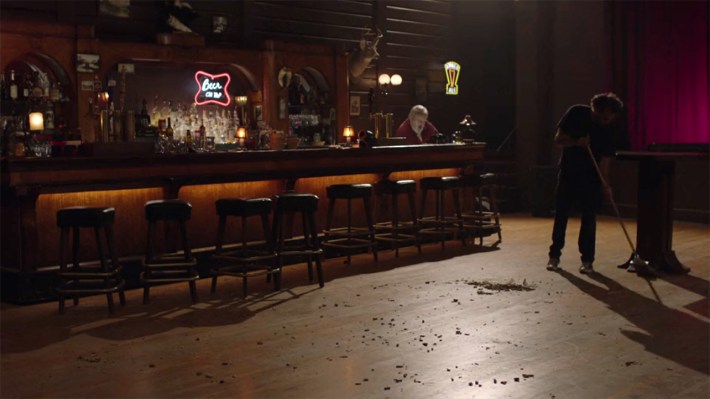
In addition to the ominous soundscapes of Dean Hurley and the familiar synth-score of Angelo Badalamenti, even David Lynch’s beloved mid-century pop music gets in on the act. Booker T. & the M.G.’s immortally cool rock instrumental “Green Onions” plays almost in its entirety over an unbroken shot of a worker sweeping up the floor at the Roadhouse; it’s slow cinema at its most entertainingly dull, until Jean-Michel Renault reveals that his family, which has been running the place for nearly 60 years, is still trafficking teenage girls there.
Santo & Johnny’s equally iconic instrumental “Sleep Walk” plays over a scene at the Double R, where Shelly and Heidi serve customers as Norma does the bills. Suddenly the door bursts open, and a man (Riley Lynch) yells “Has anybody seen Billy?” No one has. The frantic man leaves, and the song plays on. Ghostbusters did this as a gag at Tavern on the Green; Stephen King did it as a primary characteristic of the town of Derry and its people in It. As Laura put it, “They’ve never listened to my cries.” We sleepwalk past others’ unhappiness to preserve our own, for however much longer we can.
I love a good dance scene. I mean I love a good dance scene. I adore watching interesting characters played by beautiful people move their bodies in time with good music playing within their fictional world. I find interpreting their body language, feeling what the music and the movements are meant to communicate, absolutely thrilling. Dance scenes are a rhythmic audiovisual spectacle of sex and glamour. That’s the stuff movies and TV were made for. So of course I’m gonna go gaga for an entire dance episode.
Other things happen in the sixth episode of Twin Peaks’s return — funny things, fascinating things, frightening things, things we’ve waited to see for 25 years. Most of them fade in the glare of white-hot agony generated by that one scene. It is one of the most viscerally upsetting moments in both David Lynch’s oeuvre and, frankly, the history of television drama.
The episode ends with Debbie refusing to look up at the beautiful sky. “I’ve seen it already,” she sighs. This cynicism is the embodiment of the world of adulthood and death into which Bret now feels he’s been thrust permanently. His days as a kid are permanently over. This, of course, is what the whole party was a rehearsal for, but now it seems ugly and empty. As a wise woman once said, when they get what they want, they never want it again.
FX‘s The Shards loves lingering on beautiful things that won’t last. Director Michael Uppdendahl’s lens luxuriates in the sight of a beaming, utterly fearless girl roller-disco dancing on her own in slow motion…on a circle of young, beautiful friends eating lunch, the camera whirling around and around them…on an incredible dancer commanding the camera…on a fast drive down a twisting, secret road…on a fallen model practicing her grand Oscar kiss-off…on a boy smelling his lost boyfriend’s jacket and crying. When this episode finds something nice to look at, it lets you know it, and does not let go, until it has to.
Back in Twin Peaks, the more things change, the more they stay the same. Shelly and Norma (a re-debuting Peggy Lipton) watch concerned as Shelly’s daughter Becky (a radiant Amanda Seyfried) “borrows” money to compensate for the shiftlessness of her husband, Steven Burnett (Caleb Landry Jones). This guy is such a no-account that Mike freaking Nelson (Gary Hershberger, also making his return) boots him from a job interview because he couldn’t even fill out the application properly. Norma and Shelly, who have no shortage of experience with winding up with the wrong guy too young, can only watch and cling to each other.
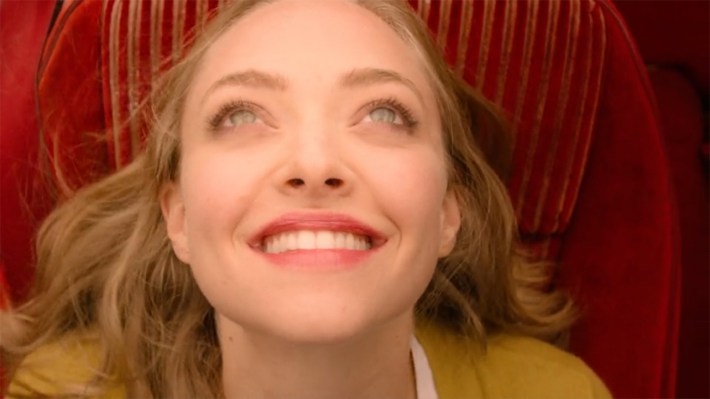
But even the dumbest young love is still young love. Becky is clearly enamored with Steven’s flattery of her and promises of a brighter future…and with his cocaine, which he hoovers up like a vacuum apparently. He still has enough left over for her to take an absolutely blissed-out, coked-up ride in his convertible, staring up into the sky with luminous eyes while the Paris Sisters’ oldie “I Love How You Love Me” plays on the car radio.
Honestly, someone probably should show the fun parts of dating a dirtbag and doing a lot of blow. These can be fun activities! They just come with some side effects, usually. But Lynch and Frost convert this moment into a kind of ecstatic tribute to the joy of being young, being beautiful, being in love, being alive, the sun, fast cars, fun drugs, good music, grinning from ear to ear just because you feel good. It’s incredible how many moments like this, in how many different moods and tones and genres, the TP braintrust has created already this season. They can shoot threes from the logo or shatter the backboard with a dunk seemingly at will.
Directed by frequent Ryan Murphy collaborator Michael Uppendahl, this episode lacks its predecessor’s copious film references and dreamy vibe. But it’s excellent at capturing the outrageous lives of hedonism, luxury, and unsupervised independence enjoyed by Bret and “the gang.” Drinking red wine in the hot tubs of houses blissfully unoccupied by parents might be a memorable evening for normal kids; for them, it was Tuesday.
The show’s deadpan cheesiness, meanwhile, is a hoot. The central-casting Satanic cult and its evil leader named (dun dun dunnnnnn!) Bruce (Gus Halper). Bret keeping a knife on his manuscript for self-defense. Susan narrating every detail of the Kellner family’s lives (Matt’s dad is played by an uncredited James Wolk) like she’s somehow the prosecuting attorney in his murder trial. Bret’s pretentious pronouncements about the perils of life in the Serial Killer Age…It’s funny! On purpose!
It’s also sexy and sleazy and now and then creepy and occasionally, as in a striking composition that puts Bret’s face in the extreme foreground as Debbie does her makeup behind him, lovely. As is typically the case with Murphy ensembles, everyone in the cast appears to be having a ball with the material. I know I am.