The motorcycle parked outside the Palmer house lets you know who’s inside. James Hurley and his girlfriend Donna Hayward have come to visit Maddy Ferguson, the out-of-town cousin of their beloved friend Laura Palmer. In fact, they’ve come to record a love song, using a tape recorder, an old-fashioned microphone, and James’s acoustic guitar. While Maddy and Donna sit side by side on the floor and coo their dreamy backing vocals, James takes lead. His tremulous voice sings a song called “Just You,” which sounds like something you might have slow-danced to at the 1961 Spring Fling.
Donna’s mistake is believing that the song is for her. It might have been when he wrote it. It might even have been when he started singing it. But as the song continues, the dynamic shifts. As Maddy’s eyes seek out James with increasingly obvious hunger, and he responds by looking back at her instead of Donna, Donna’s own eyes grown desperate, pleading, and finally tearful. Eventually it’s too much, and she gets up and runs off.
“I’m trembling, James,” she says when he comes to comfort her. “You made me.” It’s true, but not in the heated way she intends it to sound. The thought of losing James has rocked her.
Maddy just sits there looking uncomfortable for this bit.
Then something happens. As she looks absently into the depths of the Palmer family’s first floor, a man emerges into view. Slowly he approaches, crawling over the sofa, scrambling over the coffee table, staring straight into the camera until he’s right in our faces. Maddy screams uncontrollably, even as Donna and James rush to her side to comfort her. She’s seen Laura’s killer. She’s seen Bob.
These few short minutes of screentime begin with a song so sugary sweet it passes through camp and back around into to dead-serious sincerity. There’s just no denying the passion and pain in the glances exchanged between the three singers. Add in Donna’s attempt to kiss James back into loving her and you’ve got something desperately romantic, in line with the star-crossed relationships of Blue Velvet or Mulholland Drive. But then, after some brief comic relief courtesy of Maddy’s third-wheel awkwardness, comes what remains one of the scariest shots ever aired on television: Frank Silva’s Bob, coming for all of us.
If you called Twin Peaks Season 2, Episode 1 one of the greatest season premieres of all time, you’d be telling the truth. You’d also be lying by omission.
I love Desmond’s debut down the Hatch at the start of Lost Season 2 (a show whose creators never made any bones about the debt they owed Twin Peaks). I love the knife’s-edge suspense between Walt, Jesse, Mike, and Gus at the beginning Breaking Bad Season 4. Shit, I love Sam drinking and whoring his way through getting left at the altar by Diane to kick off Cheers Season 3. But to compare these excellent episodes of television to these revolutionary 90 minutes is to damn what Mark Frost and David Lynch did here with faint praise. Those episodes have surprises, shocks, bittersweet laughs. This episode has the waiter, the Giant, Leland’s musical numbers, Audrey Horne’s prayer, Gersten Hayward’s recital, Major Briggs’s vision, Laura Palmer’s murder. They are not the same.
When people toss the word “Lynchian” around, it’s usually either as a very specific subgenre of surrealism, or as a way too broad synonym for “weird.” But the opening scene of this episode is a whole different flavor of Lynch, one every bit as important to his overall project. FBI Special Agent Dale Cooper, you’ll recall, was shot three times at point-blank range by a still-unidentified assailant to end Season 1. (We learn from the insufferable but brilliant Agent Rosenfield, back on the scene to bully everyone within the Twin Peaks city limits, that his would-be assassin was of average height, hardly narrowing it down.) When we rejoin Coop this episode, we can see that only one of the bullets penetrated his body, right where he’d lifted up the bulletproof vest he’d been wearing beneath his shirt while undercover at One-Eyed Jack’s. He was hunting for a pesky wood tick, you see; the bullet found the little bugger, and his torso, instead.
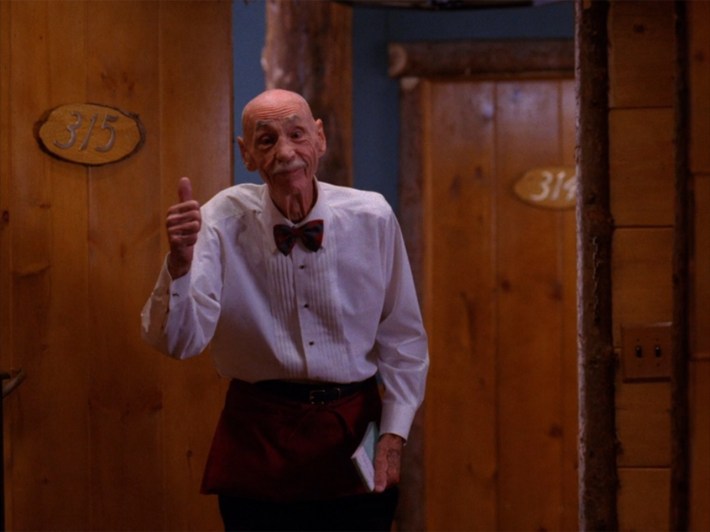
At great length, an elderly room service waiter (Hank Worden) slooooooooooooooooooooooooooooooooooooooooooooooooooowly delivers Cooper a glass of warm milk, hangs up the phone on a panicked Deputy Andy rather than call a doctor, and gives Coop — whose reputation apparently precedes him among the staff, if the waiter’s nearly giddy repetition of “I heard of you!” is any indication — several encouraging thumbs up and eye winks before shuffling away. The waiter also has him sign the room service bill. (Gratuities are included.)
Experiments in comedic tedium like this have been a Lynch hallmark since Eraserhead. I’d argue that on Twin Peaks in particular, as we’ll see later this episode with Leland Palmer, they’re a form of proto–cringe comedy, predating Steve Coogan and Armando Ianucci’s creation of Alan Partridge in 1991, Garry Shandling and Dennis Klein’s The Larry Sanders Show in 1992, and Mike Lazzo and Keith Croffod’s Space Ghost Coast-to-Coast (the most Peaksian of these early examples) in 1994. Scenes like these (fire) walk the fine line of boredom, discomfort, and silliness. It’s astonishing to think that in this case, they’ll lead to the absolute horror we see at episode’s end.
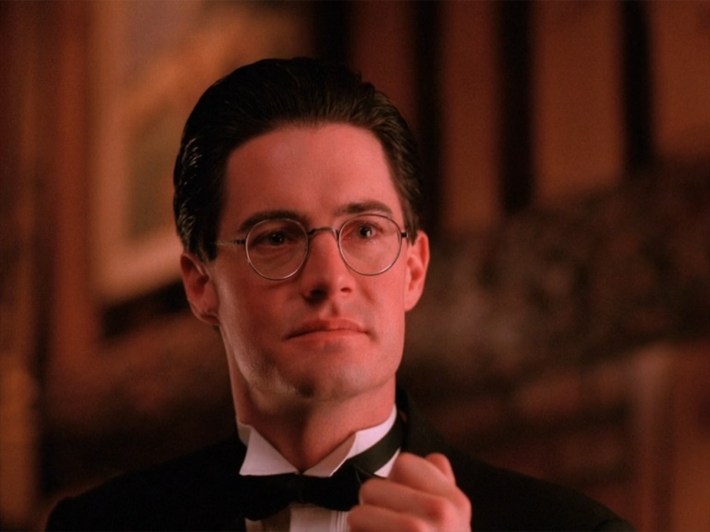
It’s Kyle MacLachlan’s finest moment to date as FBI Special Agent Dale Cooper, though you wouldn’t know he’s a Fed to look at him when it happens. He’s undercover as a high roller at One-Eyed Jack’s, the Canadian casino and brothel we (though not he) now know is owned by corrupt Twin Peaks business magnate Benjamin Horne. Wearing glasses and a tux, he’s fronting as the secret money man behind Leo Johnson’s cross-border cocaine smuggling operation.
Very quickly, he wins the trust of Leo’s partner in crime, bartender and blackjack dealer Jacques Renault. Convincing Jacques that Leo’s taking advantage of him, Cooper’s yuppie druglord offers Jacques ten thousand dollars cash to complete a job directly for him, “No Leo, no middleman.” Unsurprisingly given what we know of his work schedule, the French-Canadian dirtbag happily accepts the job.
There’s just one question Cooper has for Jacques before he sends him off on his errand, which of course is a trap designed to snare him within Sheriff Harry Truman’s jurisdiction in Twin Peaks itself. He’s already brandished the broken poker chip that matches the fragment found in Laura’s stomach. How did the chip get broken, that night with the girls, he wonders?
Cheerfully, with the relish of a schoolkid about to share his dad’s porn stash with a friend, Jacques explains that Laura liked to be tied up, which is what left her wide open when Waldo the bird was freed from his cage by Leo and landed on her shoulder. She and Waldo liked each other, and they were only “love pecks” according to Jacques, but with Leo “doing a number on her,” it was too much. She began to scream.
So Leo grabbed the chip, shoved it in her mouth, and said — Jacques delivers, chortling, in his thick accent — “Bite the bullet, baby. Bite the bullet!”
Throughout Jacques’s story, the view alternates between increasingly tight, subtly slow-motion closeups on Jacques’s grinning mouth as he talks, and Cooper’s rigid inexpressiveness as he listens. You can see, courtesy of MacLachlan’s best work on the show, that Cooper hates this man. He’s practically vibrating with it.
But he holds back all his loathing, all his disgust, and reacts as if he’s heard nothing out of the ordinary for men in their line of work. “Thanks for clearing that up,” he says in the end, with a snort of mirthless laughter. Coop’s pained non-reaction of a reaction reminds us this is not just a whodunit, but a tragedy. Jacques has given himself up as a suspect, but it won’t undo what was done.
My Prestige Prehistory series is taking a week off after this, but we’ll be back for Season 2 on January 12. That gum you like is going to come back in style!
They’re both right, and that’s true across the board on this show, nowhere more so than with the dueling outlooks of Lucy and the Ghoul. The gunslinger is kind of like a one-man Walking Dead, where he’s both the zombies and the human beings who’ve turned into ruthless, merciless killers to survive. On that show, there was only ever one correct answer when faced with the question of whether to help outsiders: Don’t, because they’re always dangerous, and the most important task for anyone is to protect yourself.
Lucy’s presence upsets all that. While the Ghoul is usually right not to trust outsiders, that doesn’t make Lucy’s belief in people’s fundamental goodness seem like a weakness. When he says “Empathy’s like mud, you lose your boots in that stuff,” we’re not supposed to believe that he — or Elon Musk, or any other real-world anti-empathy crusaders — have the right of it. Lucy’s optimism is presented as a strength even when it gets her into trouble; in Fallout’s view, it’s the world, not Lucy, that is wrong and must be made to change.
A-bombs aside, this episode, like its predecessor, made me appreciate the emotional and ethical complexity of Carol’s situation. Should it have been self-evident that Zosia was capable of lying to her by omission, and that the plurbs will never rest until they convert her? Yes. Could that have overcome all her human desire for love and companionship? Should it have done so? I’m not so sure.
Yet Manousos is capable of rejecting the embrace of the Joined. His personality and rigid adherence to the rules make him seem like a difficult person to love, on either the giving or receiving end. (Remember him calling his mom a bitch?) But presumably he desires human fellowship no less than does the similarly misanthropic Carol. He managed to stay true to the cause of the human individual against the encroaching hivemind. What’s her excuse?
It’s love, of course. In getting to know the collective through Zosia, she’s fallen in love with this…individual? Instance? She was selected to be optimally physically attractive to Carol, and she can cater to her with the knowledge and enthusiasm of every human being on the planet. She’s a walking lovebomb. Director Gordon Smith’s Jonathan Demme–esque straight-on closeup as Carol processes her feeling of betrayal upon learning that Zosia is still just one of them — as she realizes certain truths which should perhaps have been self-evident — is powerful because you can feel Zosia’s pull all the same.
“Harry, I’m gonna let you in on a little secret. Every day, once a day, give yourself a present. Don’t plan it, don’t wait for it, just let it happen. It could be a new shirt at the men’s store, a catnap in your office chair — or two cups of good, hot, black coffee, like this.”
It’s exceedingly rare to receive actionable advice on better living from a TV cop, but Dale Cooper is a rare cop indeed. I think this little speech, from the penultimate episode of Twin Peaks’ short first season, does more to endear Coop to us than half a dozen high-speed chases, collared perps, or climactic shootouts would have done.
Carol’s moaning was sweet, it was hot, it was tender and moving and erotic, and it got me to thinking. Carol reacts to kissing Zosia the way that she does because she’d kept every victim/beneficiary of “the Joining” at arm’s length, and they she, this whole time. But of course it’s insane to completely remove yourself from humanity, even the strange form of it represented by members of the hivemind like Zosia. You need that contact, however peculiar it has now become. Or Carol needs it, anyway: When she was totally cut off, she really did begin losing her mind.
Yet at the same time, I couldn’t stop thinking that it was also insane to talk with Zosia, to befriend Zosia, to make love to Zosia, like Zosia is a real person, when in fact she’s…well, all real people, all at once. She is the original Zosia. She is Carol’s dead wife. She is Carold’s dead wife’s relatives. She is Carol’s own relatives! She is every woman Carol ever fucked, and every woman they ever fucked, and so on, and so on, and so on.
Is the intimacy required for even the most exhibitionistic and non-monogamistic sex possible when your partner is every living human being, minus one dozen? What about the intimacy required to confide, to conspire, to share hopes and dreams and frustrations and inside jokes? To stargaze amid incredible romantic red lights, to play croquet on the 50 yard line, to get massages, to visit an old haunt like the Mulholland Drive–esque diner the plurbs rebuild for Carol’s enjoyment? To do all the things friends and lovers do?
Keep in mind also that Zosia is also all of the world’s greatest lovers. She is every woman who’s ever given head and every woman who’s ever been given head. She’s every man in that same equation, if for some reason that knowledge should come in handy. By the time she and Carol have sex, the episode has already established that Zosia is literally unbeatable in games of skill or knowledge, having instantaneous access to the thoughts — but not the physical or emotional feelings — of every human being on earth. Tough to imagine this idea was introduced in the same episode where she and Carol fuck out of pure coincidence, right?
So is it mind-blowing? Is it the best sex she’s ever had? Is it tailor-made to match the performance and preferences of a familiar lover, like her wife? Is it deliberately dialed down by a collective consciousness that knows every sexual trick in the book, including how not to overwhelm your more inexperienced inamorata? Is there a reason it’s happening now?
Twin Peaks doesn’t have storylines, it has story clusters. That’s the simplest way to picture it, I think, and the easiest way to make sense of it. There are a handful of core concepts — the murder of Laura Palmer, the Ghostwood Estates/Packard Sawmill real estate swindle, the cross-border drug trade, the saga of Norma and Big Ed, the cops, the teens, the dreams — around which different sets of characters swirl. A few characters, like Dale Cooper, Audrey Horne, Leo Johnson, Bobby Briggs, and Laura Palmer herself, are able to cross between clusters. By connecting them, they help create the sense that it’s all one big story after all.
This fluid approach to the movies’ continuity is part of what makes this show such a surprise. “It: Welcome to Derry” feels like a mulligan for Muschietti, who directed them. The first film’s haunted-hayride vibe, the second’s nonsensical plot and warmed-over, quip-heavy dialogue: All of that has been jettisoned. In their place stands a season-long testament to the power of cruelty in art.
From start to finish, “Welcome to Derry” has relentlessly probed fears that plague our childhood and our adulthood. Children are tormented with their worst nightmares. Adults are taunted for their most painful failures and confronted with their most terrible memories.
At the center of it all lurks an orange lunatic who feeds on fear and suffering, empowered by a government apparatus working to spread that fear and suffering from sea to shining sea. As such, Pennywise is a monster for our degraded age.
Rooting you in the physical experiences of another person, one who isn’t even real, is one of the great magic tricks cinema is able to pull off. It’s especially hard when those experiences are unpleasant, enormously so when those unpleasant experiences drag on and on for an episode or a movie. Yet the Ordeal draws us in, because there’s catharsis to be found in physically connecting with someone who is suffering — the profound catharsis of empathy, which requires us to get out of our own heads just as the Ordeal itself requires its harried heroes to leave the comforts of the familiar world behind for parts unknown. As for Manousos, he’s still got a long way to go if he survives the spines. (The arrival of a hivemind helicopter is a good sign, right?) With any luck — ours, not his — his grueling, stunning Ordeal will continue.
In honor of this week’s Pluribus I wrote about the Ordeal, one of my favorite cinematic subgenres.Deliverance, Sorcerer, The Revenant, Stalker, Gravity, The Descent, Aguirre – The Wrath of God, Annihilation, Children of Men, Fitzcarraldo, Valhalla Rising, The Terror, American Primeval — if a movie or TV show is about someone killing themselves to get from Point A to Point B, I’m going to make a Point of C-ing it.
There’s so much that Pluribus is doing that no other show on TV is doing right now. Those crystal blue skies! The majority of entire episodes passing in dialogue-free silence! The full commitment to the bit of playing the entire “Hello, Carol” voicemail recording every single time she dials! Pluribus makes life feel like the never-ending struggle it is, and it’s damn good at it. I don’t need the jokes and gags and bits. Just point the cameraat two people slowly being driven insane by the fact that, for all intents and purposes, they are the only two people.
And then there’s Bobby and Shelly. Boy oh boy, is there ever Bobby and Shelly. Director Tim Hunter films the two of them making out in her unfinished house, Shelly straddling Bobby’s lap in her waitress uniform as they kiss and clutch at each other. When Bobby gets the idea to use Leo’s shirt to get rid of him, Shelly rewards him by opening her uniform to reveal a black lace teddy, against which she clutches a gun suggestively. And just like that, Bobby decides he has a few minutes to spare before he leaves after all.
I don’t blame him. Mädchen Amick is the most beautiful woman in a cast that includes Lara Flynn Boyle, Joan Chen, Sherilyn Fenn, Sheryl Lee, and Peggy Lipton, which to paraphrase The Big Lebowski puts her in the running for the most beautiful woman worldwide. Dana Ashbrook is a megababe too, whose mercurial nature — beneath the tough-guy act he’s clearly an emotional and easily hurt kid — makes his obvious hunger for Shelly feel wild and insatiable.
But that’s just it: He’s complicated, and so is their whole situation. Bobby is a red-hot lover, but he really did care about Laura, and Shelly says she wished she could have comforted him at her funeral. Shelly, meanwhile, is perfectly capable of playing the seductive desperate housewife, all bullets and black lace, but she also spends her shift commiserating with Norma about their similarly shit taste in husbands.
So yes, they’re gorgeous, but it’s the stickiness of their situation, the sharp angles and rough edges, that makes Bobby and Shelly’s romance work so well. Passion is the means by which they process their pain. Isn’t that the purpose of soaps — like Invitation to Love, the show within the show that the characters keep on watching even as their real lives exceed it — in the first place?
Ingrid does not appear evil at first. Was it challenging to keep that aspect of the character under wraps?
Andy [Muschietti] actually loved her very much! He feels that she was good in her heart. That wasn’t a difficult thing to portray. There’s a sense that Ingrid is stunted. She’s caught in the age when this terrible tragedy happened. She’s been in a state of suspension all these years, waiting for the impossible, waiting for her father to be reclaimed. She sees something in this girl Lilly, and her compassion for her is very real — but then it stops, because there’s something else that’s really driving her. Part of that involves Pennywise’s trickery over her, the illusion that he’s created.
But when I see what’s going on right now, there are grand illusions happening before our very eyes. And nobody believes that they’re a bad human being. You can see that in the Epstein emails, for instance. It’s fascinating to me, watching Epstein have conversations with Larry Summers: They’re saying certain things about Donald Trump, but nobody’s looking to themselves. They view themselves as the good guys. In Ingrid’s mind, she thinks she can extract her father from It and bring him back to himself, and all the rest will end. It’s an “end justifies the means” situation.
“This town is the monster.” After the events of this episode, I think Charlotte Hanlon can be forgiven for stating the thesis of “It: Welcome to Derry” so baldly. The creature known as Pennywise runs riot in this episode, to be sure, in all of his head-chopping, child-terrorizing glory. But he is helped in his gruesome work by the good people of Derry, who commit a mass murder that is swept under the rug by the time people are having their coffee the next morning.
Load up HBO Max these days and you can’t miss the promos for its big comedy of the season. Created by and starring a cult-favorite comedy actor, it’s a skin-crawling look at a secret, sweaty side of the American experience. Desperate to find not just money but career fulfillment, our hapless protagonist must negotiate a world of scams, in which people with no morals purposely sell junk with no value to customers with no standards, enriching themselves at the expense of society while lying through their teeth. The show depicts the inner workings of its unique death-spiral-capitalist hellscape — one in which many of the characters do not even appear to realize they live — with an understanding of how this awful, soul-crushing shit works that borders on frightening in its clarity. But hey, if I Love LA doesn’t work for you, there’s also The Chair Company.
For the first however many minutes of this week’s Pluribus, the louche Mr. Diabaté reenacts a generic James Bond scene with a gaggle of plurbs (for lack of a better term) dressed up as cool party people and/or evil villains. At no time is anyone in any danger, even of losing money, let alone their lives. Mr. Diabaté is not at risk. His enemy is not at risk. No one at the party is even really partying! They’re all just playing along to please him, and the moment he leaves the room they switch off the revelry and start cleaning the place up, as if someone had thrown a switch. (God only knows how creepy this effect is when the women with whom he’s constantly having orgies get up and leave the hot tub room.)
In essence, this episode asks us to spend its opening minutes watching something that isn’t happening, that doesn’t matter, and that isn’t even necessary, given that we already learned the kind of person Mr. Diabaté is during our first meeting, and that the mere existence of his Las Vegas digs conveys this too. Why waste valuable screen time on an inert Austin Powers riff?
It’s equally bold to hire a massive star to do a little cameo just for funsies. But while that may be bold, the identity of the massive star matters. Had Pluribus gotten, I dunno, Daniel Day-Lewis, now that’d be something. Instead, it got John Cena, the most happy-to-be-here man in Hollywood.
A spinoff TV series for his D-list superhero from the DC Universe? A cohost for a show in which people get whacked by large foam-rubber balls into water 15 feet below them? A WWE event in the haven of creative freedom known as Kingdom of Saudi Arabia? An apology to the nation of China for acknowledging the existence of Taiwan? John Cena’s your man. If there’s an audience for “funny” John Cena cameos in 2025, I am not a part of it.
Consider Leland Palmer. He, too, has an uncomfortable outburst at Laura’s funeral. Perhaps triggered by the fight between Bobby and James, he quite simply melts down, throwing himself atop his daughter’s coffin. The hydraulic apparatus designed to lower it into the ground then malfunctions, yanking the sobbing man up and down. “Don’t ruin this too!” shrieks his wife, Sarah, who’s been decompensating in her own way as well.
Some mourners, like Shelly Johnson, find the whole thing comedic enough to reenact for the amusement of the diner patrons at the Double R. (She’s also hiding a gun in her home to protect her from her psychotic husband Leo, the prime suspect in Laura’s killing at the moment, so cut her some slack.) And it’s true, there’s something funny about it, and not just the slapstick-comedy nature of the incident.
Leland’s grief is so over the top that it provokes nervous laughter, the kind you let out when what you’re watching is too intense to take seriously, for a moment at least. It’s hard to watch him weep and wail on the coffin, or again on the dance floor at the Great Northern, as he begs for someone, anyone, to dance with him in Laura’s place. I bet Sarah could do with some attention, too, but what happened to their daughter is pulling them apart, not bringing them together. That’s a second tragedy.
What’s worrisome is that Leland has another family member to worry about while this is going on. Laura’s cousin Madeleine — a brunette with big glasses but a lookalike in every other way, played by Laura actor Sheryl Lee — arrives in town for the funeral, and is there to witness the catastrophe at the cemetery. We’ve already seen Sarah superimpose her daughter’s face on the girl’s best friend, Donna Hayward. It isn’t difficult to imagine Madeleine being cast in that same role, whether she wants to play it or not.
Although our attention has been largely occupied by the kids and the clown, let’s not take for granted how good this show’s three grown-up leads are. Chris Chalk, Jovan Adepo and Taylour Paige make the adult material as magnetic as that of the young losers.
They don’t feel as if they’re playing characters in a spooky popcorn flick; they feel as if they’re playing human beings who are worried about their families, their ethics and their sanity. That scream from Chalk is one of the most harrowing things I’ve heard on television all year, and it’s been a harrowing year.
I love how much of Pluribus takes place in silence. I love how much strength it derives from simply putting a complicated person on the screen, wordlessly, and allowing us to observe them. I love how much the show moves to the rhythms of labor, the painstaking, time-consuming, and necessary efforts we put into living that most shows ignore. There’s even a time-lapse shot of Carol Sturka sleeping as the light coming through the window shifts with the lengthening of the day. In short, Pluribus takes great pains to convey what it is like to simply exist in the world it has constructed — to be a human, a thinking person in a human body, surrounded by a world grown hostile and strange.
The show’s third episode is, in effect, the final chapter of a big three-part premiere. This is literally true, to an extent: Coop’s dream recycles footage originally created for an extended cut of the pilot for European markets. More to the point, it introduces multiple load-bearing elements of Twin Peaks’ cultural iconography, things you’ve probably seen or heard of whether or not you have any idea whodunit or where all this is headed (no spoilers, in other words): Audrey’s dreamy dance, Leland’s hysterical grief, Coop’s unconventional police work, One-Eyed Jack’s, the Red Room, the Man from Another Place (Michael J. Anderson), the backwards speech, Laura Palmer whispering in Agent Cooper’s ear, the “Fire Walk With Me” poem, one-armed Mike, Killer Bob.
Episode three is where it becomes clear that something not just strange but supernatural is occurring in this quiet logging town. It’s where the show goes from weird to Weird. And in all its non sequitur, nonlinear surrealist menace, it’s where David Lynch as we’d know him for the rest of his career — the David Lynch of Fire Walk With Me, Lost Highway, Mulholland Drive, Inland Empire, and this show’s own unlikely comeback season — is born.