
Posts Tagged ‘decider’
“The Assassination of Gianni Versace: American Crime Story” thoughts, Episode Five: “Don’t Ask, Don’t Tell”
February 15, 2018Watching Jeff’s final confrontation with Andrew prior to the murder is painful, then, both because of what he gets right and what he gets wrong. “I don’t know what you stand for,” he shouts at Cunanan. “I don’t know who you are. You’re a liar. You have no honor.” Correct on all counts — possibly lethally, so if you figure this contrast in their outlook is a big part of what drove Andrew to kill. But when Andrew rightfully points out that he believed in and supported Jeff while his beloved Navy treated him like shit — “I saved you!” — Jeff bitterly retorts “You destroyed me. I wish I’d never walked into that bar. I wish I’d never met you.” He says he wants his life back, as if Andrew took it from him, instead of Bill Clinton and Uncle Sam. Andrew doestake his life away, eventually, mere hours from that moment in fact. But in a sense, he was just an accessory after the fact. Jeff signed his own death warrant the moment he decided, in the face of society’s hatred, that some principles are worth fighting for anyway.
I reviewed last night’s episode of ACS Versace for Decider. This is a great show.
“The Assassination of Gianni Versace: American Crime Story” thoughts, Episode Four: “House by the Lake”
February 15, 2018“You can’t do it, can you?” “I can’t what?” “Stop.”
The Assassination of Gianni Versace: American Crime Story is what Matt Zoller Seitz once described, by way of a subtitle to his blog, as “a long, strange journey toward a retrospectively inevitable destination” — the titular murder, seen in the cold open of the very first episode. We’ve already seen where we’re going; what’s left to the show is to depict how we got there. Even those swept along and killed by Andrew Cunanan during the journey seem to sense it. Hence the exchange above. Promising young architect David Madson is the love of Andrew’s life, to hear Andrew tell it. He’s a man to whom the murderer is so fanatically committed that he not only slaughters his rival for David’s affections, his own former love interest Jeff Trail, with a hammer, thus beginning his murder spree, but then manages to convince the shellshocked David that he has some how become an accomplice to the crime and must flee by his side. As time wears on and the shock wears off, David grows less pliable to Andrew’s nonsensical advice and admonishments, but also more honest with himself about where his journey as the Bonnie to Andrew’s would-be Clyde will end. He has no more hope of survival than Andrew has a chance of shutting the fuck up and telling the truth. He can’t do it, can he.
I reviewed last week’s episode of ACS Versace, another tremendous piece of work, for Decider.
“The Assassination of Gianni Versace: American Crime Story” thoughts, Episode Three: “A Random Killing”
February 15, 2018I’m glad, in that beautiful terrible way tragedy can make you glad, that Marilyn Miglin gets the last word of the episode, even as Andrew continues shopping and driving and killing on the way to his appointment in Miami. She returns to her gig hawking her signature line of fragrances on the home shopping channel almost immediately — a gutsy move with which the show challenges us to continue to feel empathy for her as she slips into the uncanny valley between sincerity and showmanship, just as the mere presence of any older woman with a glamorous background triggers our societally induced suspicion and revulsion at female failure to remain young. “He believed in me,” she tells her audience, completely honestly. “How many husbands believe in their wive’s dreams? How many treat us as partners? As equals? We were a team for thirty-eight years.” That’s what they were, even if it’s all they were. That’s an achievement. That’s what Andrew destroyed.
Marilyn ends the episode by recounting the advice she got when she first began selling stuff on TV, a technique for connecting with the camera and the people on the other side. “Just hink of the little red light as the man you love.” She stares at the light, at the camera, at us, and as the impenetrable black mascara of her wet eyes closes and the scene cuts to black, her thoughts are ours to imagine.
I reviewed episode three of The Assassination of Gianni Versace: American Crime Story, a truly magnificent hour of television, for Decider. Thank you for your patience with this flu-delayed piece.
A quick note on “ACS: Versace”
February 13, 2018Yes, I wrote a review of episode 3 (which has not been posted by Decider yet) as well as episode 4 (which has)! But I was badly delayed in handing it in due to the flu. Given how long ago it aired it’s understandably not a huge priority for my editors to get it edited, formatted, and posted, but I’ve been assured that they will eventually. My hope is that it will be up prior to my review of tomorrow night’s installment, episode 5. Once it goes up I’ll link to everything in order the way I usually do, but I’m waiting until then just to keep things straight. Thank you for your patience!
“The Assassination of Gianni Versace: American Crime Story” thoughts, Episode Two: “Manhunt”
January 25, 2018Just two episodes into the series, Darren Criss is cementing the status of his portrayal of Cunanan as one of the all-time great on-screen serial killers, not just calling to mind Anthony Perkins as Norman Bates, Tom Noonan as Francis Dolarhyde, Ted Levine as Jame Gumb, or Christian Bale as Patrick Bateman, but actually earning the comparisons.
He’s certainly helped in this respect by Smith’s script and the direction of People v. O.J. cinematographer Nelson Cragg. The reference set they assemble for Andrew to inhabit includes a genderbent shower scene by the beach with Andrew’s ersatz friend and escort manager Ronnie (a warm, wounded, marvelously understated Max Greenfield), combining Psycho’s defining visual with the pre-shower/murder rapport between Norman and Marion Crane, not to mention its star Perkins’s closeted sexuality. (A motel also figures prominently, again with roles reversed: Andrew’s the guest on the run from the law, not the person at the front desk, and he must ingratiate himself to her instead of the other way around.)
Elsewhere, a scene of excruciating sadism, in which an underwear-clad Andrew dances to the Big ‘80s strains of Phil Collins and Philip Bailey’s pounding “Easy Lover” while an escort client slowly suffocates beneath the duct-tape mask Cuanan wrapped around his head (“You’re helpless…accept it…accept it…ACCEPT IT…”) drags the male-on-male-gaze subtext of Bret Easton Ellis and Mary Harron’s respective American Psychos squirming into the harsh Florida light. Simultaneously hitting Pulp Fiction‘s gimp sequence, Boogie Nights‘s “Sister Christian”/”Jesse’s Girl”/”99 Luftballoons” coke deal gone bad, and Silence of the Lambs‘ Buffalo Bill/”Goodbye Horses” buttons as well, this is a scene people will remember. (A closing scene in which Cunanan prefaces his usual torrent of bullshit about his life by straight-up saying “I’m a serial killer” to a prospective suitor also tears a page from the AP playbook.)
And in the most chilling allusion of all, Ronnie — a sweet guy who moved to Miami because he’d heard “people like living by the ocean who don’t have much living left,” then got unexpectedly healthy, and now dreams of opening up a small florist shop with the money he and Andrew have amassed from his escort gigs — knocks on the bathroom door and finds Andrew in full Manhunter Great Red Dragon mode on the other side, the top half of his face rendered obscure and inhuman by the duct tape he’d applied to himself. Because the context of each of these scenes is so specific to who Andrew and Ronnie are, none of it feels derivative or plagiaristic, the way the generic King/Carpenter/Spielberg rehash of Stranger Things does, for example. Indeed, it’s no different from the way it alludes to Christ telling Peter he’d deny him three times when Andrew tells Ronnie, who’s desperate for connection even as Cunanan flees, “When someone asks you if we were friends, you’ll say no.” As I’ve argued before, the horror genre exists in conversation with itself, and Versace is simply using the language established by its forebears to tell a story all its own.
I reviewed the extraordinary second episode of ACS Versace for Decider.
“The Assassination of Gianni Verace: American Crime Story” thoughts, Episode One: “The Man Who Would Be Vogue”
January 17, 2018However you feel about Ryan Murphy’s other projects, ACS‘s debut season, The People v. O.J. Simpson, is unquestionably his apotheosis. In conjunction with writer-creators Scott Alexander and Larry Karaszewski, Murphy revisited a media-circus murder case nearly everyone thought had been exhausted of any creative or sociopolitical potential, and the result was a kaleidoscopic, knockout-powerful examination of racism, sexism, celebrity culture, journalism, the judicial system, the rise of reality TV, domestic violence, police misconduct, and the whole goddamn human condition. It was one of the best television shows of all time, full stop. Can Murphy, now working with writer Tom Rob Smith and adapting journalist Maureen Orth’s book on the case Vulgar Favors, draw water from that same dark well a second time?
Yes.
I reviewed the premiere of The Assassination of Gianni Versace, the brilliant new season of American Crime Story, for Decider, where I’ll be covering the show till the end.
Netflix Turned a Creative Corner In 2017 With Originals Like ‘Dark,’ ‘Suburra’ and ‘The Punisher’
January 2, 2018Call it the Lilyhammer of the Gods.
In February 2012, Netflix established its creative model right out of the gate. Its first original show, Lilyhammer, starred “Little” Steven Van Zant, fresh from playing a mobster on The Sopranos…as a mobster, albeit one who’s relocated to Norway for witness-protection purposes.
The road from Lilyhammer‘s quirky Sopranos rehash to Stranger Things‘ unabashed theft from ’80s pop-culture staples is not a particularly long one. All that changed was the company’s self-identification as a creator of original content rather than an online video store, and its subsequent accumulation of user data and development of a predictive algorithm to deliver the goods.
Many of the network’s original series —”original” being a relative term— speak to this desire to please the crowd with things that have already pleased them. Why have only one off-beat comedy about the mildly crazy lives of young people set in New York (Master of None), for example, when you can also have one in Chicago (Easy) and Los Angeles (Love) as well? It’s too bad Donald Glover titled his show Atlanta and took it to FX, or else I’m sure Netflix would have something on the docket for that youth-culture mecca as well. In a more traditional move, reboots are common, from the campy (Fuller House) to the acclaimed (One Day at a Time). And that little row of Netflix Original rectangles contains enough grim-visaged cops, crooks, and killers to look like a photo array you’d use to identify suspects in the world’s most focus-grouped crime.
Which is what makes shows like Dark, The Punisher, and Suburra: Blood on Rome stand out. From the outside, these 2017 debuts seem like status-quo programming. But each veered of the course they could have cruised down effortlessly, taking creative risks that yielded entertaining and provocative results.
Once is happenstance, twice is coincidence, the third time it’s enemy action: Over at Decider I wrote about the possibility that Dark, The Punisher, and Suburra represent a creative turning point for Netflix, in which the sheer volume of material the network puts out is now enabling some shows to complicate and interrogate their genre elements rather than serving them up straight.
“Mr. Robot” thoughts, Season Three, Episode Ten: “eps3.9_shutdown-r”
December 15, 2017SPOILER ALERT
The best part was the axe murder.
When Dark Army fixer Irving drives the blade into corrupt FBI Agent Santiago’s chest, and eventually many other parts of his body, a lot of things happen at once. Bobby Cannavale is finally given a chance to cut loose after a season of playing Irving as a model of chatty, casual restraint; now he can go full Gyp Rosetti, and it’s a thing of beauty. Moreover, Mr. Robot has had horror in its DNA, from Tod Campbell’s often eerie cinematography to the roots of fsociety’s iconography in a slasher film; an axe murder seen in that light seems almost overdue. Finally, an explosion of intimate, savage, gory violence after a season full of tension and sadness, in which even a gigantic series of terrorist bombings is witnessed only at a remove, takes all of the show’s unspoken resentments and hatreds and buries them in a warm, wet body, over and over again. “These are for me,” says Irving as he sends his traumatized and cowed new slave at the FBI, Dom DiPierro, away. They’re for everyone on the show, really.
I wish the rest of Mr. Robot’s Season 3 finale (“eps3.9_shutdown-r”) cut half so deep. Instead, it’s a claimant for the most disappointing episode in the history of the show — a profound narrative miscalculation that sees the show retrench rather than create new possibilities, yet also denies the basic sense of completion and catharsis you’d think such a retrenchment would require. Axe murders aside, it just sort of sits there, waiting for something else to happen.
[…]
All told, it doesn’t surprise me that the finale, and the season itself, is being held up by other critics as a return to form. It was — to a fault. Audacious episodes like the Tyrell Wellick spotlight and the long-take high-rise thriller, the highlights of the season for me, now feel like respites in a long act of creative backpedaling, to get the show back to where it was when it was a zeitgeisty phenomenon during Season 1. “Like 5/9 never happened”? More like if Season 2, a phenomenally bold season of sweepingly despairing and vicious television that risked alienating the audience the show had built, never happened. We’re headed back to the start, and that’s not a ride I’m sure I want to take.
“Dark” thoughts, Season One, Episode Ten: “Alpha and Omega”
December 15, 2017The true innovation and genius of Dark — the thing that separates it from even the most entertaining time-travel stories, from Back to the Future to The Terminator to The Time Machine itself — is that it’s not just an exciting riddle about creating and escaping time warps for you to try and solve, nor a chilling look at a dark future we wish to avoid (until that final scene, anyway). As I put it in an earlier review, “Dark’s true interest isn’t in the characters’ inability to escape the spacetime loop, but in using that premise to explore their inability to escape their own nature.”
The adult Jonas makes this point explicitly to his younger self. In the middle of a speech about how he has to leave the teenage Jonas locked up in Noah’s chamber, because his experiences inside will be necessary to make him the man he becomes, he drops what almost feels like a non sequitur: “Why did you kiss Martha?” Then he elaborates: “We’re not free in what we do, because we’re not free in what we want. We can’t overcome what’s deep within us.” At this, the younger Jonas begins sobbing, begging his older self to stop talking over and over again. “I want everything to go back to normal,” he says.
But there is no normal. Just as the wormhole locks the people of Winden in an inescapable loop of misery, so too do their own unchangeable natures and desires. It’s the boldest wedding of time travel to a provocative psychological theme I’ve ever encountered. For that reason alone I’ll follow Dark into the future.
I reviewed the season finale of Dark for Decider. It ends with my least favorite scene in the series so far, and it’s a bit deflating to see it reach the end zone only to trip over its own untied shoelaces, but whatever. Still a show to be reckoned with.
“Dark” thoughts, Season One, Episode Nine: “Everything Is Now”
December 15, 2017It occurs to me now that among its many other antecedents, Dark feels like a version of Lost folded in on itself, in which the action on the magical, spacetime-traveling Island and the secret-revealing, surprise-laden, character-driven backstory flashbacks all occur simultaneously. “Everything Is Now” indeed.
I wrote about the baroque complexity of Dark’s penultimate episode for Decider.
“Dark” thoughts, Season One, Episode Eight: “As You Sow, So Shall You Reap”
December 15, 2017Like so much great genre art, Dark uses its fantastical elements not just because they’re compelling in their own right, but because their spectacular nature is closer to the inarticulable gravity of the emotions we experience every day. Helge, Ulrich, Mikkel, Hannah, Jana, Jonas, the mysterious stranger, and (in a striking reveal) Claudia Tiedemann all seem to have driven to mental illness by the wormhole’s impact on their lives, but as another great work of genre fiction about family and murder once put it, we all go a little mad sometimes. And what else do the worst disasters and failures of your life feel like if not a tear in the fabric of space and time themselves?
I reviewed episode 8 of Dark, which really fucking went there, for Decider.
“Dark” thoughts, Season One, Episode Seven: “Crossroads”
December 8, 2017As convoluted as Dark‘s plot can be, forcing you to keep track of a sprawling cast of interrelated characters across multiple timelines, it’s done an impressive job of making that task easier as the show goes along. This is where the show’s emphasis on the emotional struggles of Winden’s townsfolk pays practical dividends as well as dramatic ones. Like Game of Thrones or Twin Peaks, two shows that also boast large casts and complex storylines involving secret identities and family connections, Dark digs painfully deep into the darkest recesses and most burning desires of its characters, which in turn makes figuring out who’s who and what’s what much more intuitive.
I reviewed the seventh episode of Dark for Decider; new reviews will resume Monday. Use that time to catch up over the weekend, please, since this show is one of the best Netflix has ever done. (More on that anon!)
“Mr. Robot” thoughts, Season Three, Episode Nine: “eps3.8_stage3.torrent”
December 7, 2017The reason I singled out the kisses at the start of this review, though, is because they represent something larger. At an impromptu meeting between E Corp CEO Phillip Price, his once and future underling Tyrell Wellick, and Tyrell’s ersatz hacker ally Mr. Robot (who’s just Elliot, as far as Price knows), Price tells Elliot “World catastrophes like this? They aren’t caused by lone wolves like you. They occur because men like me allow them.” Certainly the past year of real life has borne this out. Much as we’d like to pin the rise and fall of campaigns, parties, and countries on rogue actors, who therefore can be isolated and eliminated if we’re smart and good enough, the real fault is systemic, and that system is run by men who make themselves increasingly untouchable with each Supreme Court decision and tax cut.
And yet! Here’s why Phillip Price, Master of the Universe, decided to hire Allsafe, the firm that Elliot and Angela worked for, to handle E Corp’s cyber-security, thus setting all of this in motion:
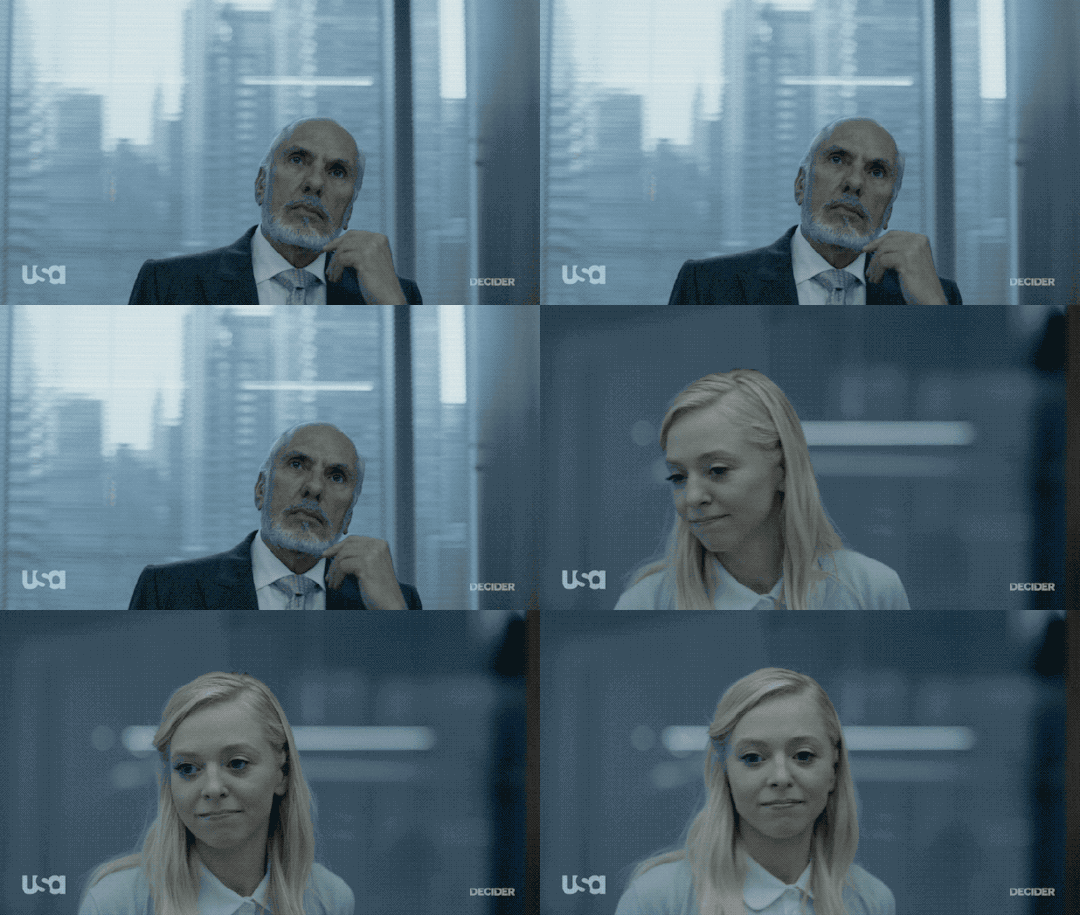
Stages 1, 2, and 3 happened because Phillip Price fell for Angela Moss at first sight. They happened because Angela and Elliot and Darlene were heartbroken over the deaths of their parents. They happened because Whiterose, as the cracks in her voice betray, is tired of men like Price, who “only understand force, and a lot of it. That is the only currency with these men!” They continue to happen because Grant loves his boss, and because Dom is a lonely person who turned to Darlene for comfort, and on and on and on. Systemic causes trump individual ones, yes. But the personal and the political are inextricable, because external power and internal passion are inescapable. If you want to survive, you must endure them both.
I reviewed the penultimate episode of Mr. Robot Season Three for Decider.
“Dark” thoughts, Season One, Episode Six: “Sic Mundus Creatus Est”
December 7, 2017“You don’t really know your parents, do you? What they were like as kids, or teenagers. You’re a family, but you don’t really know anything about each other.” Martha Nielsen says this to her brother Magnus as they lay in bed together, contemplating the disaster area their lives have become following the disappearance of their brother Mikkel. The most moving sequence in “Sic Mundus Creatus Est,” Dark‘s excellent sixth episode, demonstrates the truth in her words to devastating effect.
“Dark” thoughts, Season One, Episode Five: “Truths”
December 7, 2017This latest installment of the time-traveling trials of the men, women, and children of Winden is bookended by lengthy splitscreen montages. It’s the most effective, and stylistically bold, use of the technique I’ve seen since Fargo Season Two. And rather than showing us multiple points of view as characters move toward confrontation or through a suspense sequence, the splitscreens are used to compare, contrast, and highlight the emotional reactions of the characters to the romantic and familial trauma they’re experience. It’s like calling in Brian De Palma to cut an Ingmar Bergman film.
I reviewed the fifth episode of Dark for Decider, and this passage about its formal aspects is really just the tip of the iceberg. This is a very challenging and very rewarding show, and I’m proud of the writing I’m doing on it.
“Dark” thoughts, Season One, Episode Four: “Double Lives”
December 5, 2017There’s power of a different sort in nearly everything the Dopplers’ daughter Franziska does in this episode. Like a teutonic Laura Palmer, she leads a double life — star student and ribbon-wielding rhythmic gymnast by day, big-money drug dealer by night. The latter truth is uncovered by Mikkel’s goonish older brother Magnus, who’s simultaneously angered, repulsed, and attracted to the mismatch between Franziska’s emotional exterior and interior. Of course, he finds her just as magnetic in her gymnastics uniform, while his anger at her sparks a sudden torrent of truth-telling about the state of her family. The next thing you know, the two frienemies are fucking while fully dressed in the school locker room. Again, this is powerful stuff for a supernatural Netflix show to play with: probing the point at which intense feelings of any kind grow so white-hot that they exceed the capacity of the designated area of the brain to process and wind up fueling sexual energy instead, and depicting sex as a way damaged people can address the things that are damaging them without doing so directly.
I wrote about Dark’s very strong fourth episode for Decider. The complex dynamics in the Doppler family — including their extremely awesome and funny deaf daughter Elisabeth — demonstrate how the show puts in the work where other supernatural shows just coast.
“Dark” thoughts, Season One, Episode Three: “Past and Present”
December 5, 2017“Past and Present,” the aptly named third episode of Dark, continues its predecessors’ pattern of being hella reminiscent of a past genre work. In this case it’s Richard Kelly’s melancholic cult-classic science fiction film Donnie Darko, which the episode echoes in ways that feel more like homage than out-and-out swipes.
Yes, Mikkel has indeed been transported back in time through some kind of “crossing” (to borrow the term from Jonas’s late father’s map) in the caverns outside of town. After his unpleasant run-in with his parents and grandmother — the former are assholes, the latter is too distraught by her missing son Mads to do anything but grab the kid and beg him for information — he wanders to his school, only decades in the past. As he wanders around in a skeleton costume that looks like the one Donnie wore in the film except a few sizes smaller, the totally-’80s style of the town’s teens are paraded in front of the camera while a Tears for Fears song plays on the soundtrack (“Shout” here, “Head Over Heels” in the movie).
Would it be nice if shows stopped doing this kind of thing? Even good shows? Yes. The Punisher, for example, was strong enough on its own for its in-your-face (ahem) borrowing from the climax of 28 Days Later… in its penultimate episode to feel completely unnecessary, though perhaps not ethically or creatively ruinous. And Dark has enough going on to render this hat tip superfluous. Admittedly, though, the line between homage and theft is a blurry one, particularly in horror, a genre more in conversation with itself than any other. I could rattle off scene-by-scene comparisons in, say, Get Out or The Descent with the movies their filmmakers clearly know and love. But those two films are animated by a spirit that is unmistakably their own. Dark isn’t at that level, but it’s operating with enough sophistication to provide context for nods to its antecedents, instead of simply constructing itself out of nothing but such nods.

“Dark” thoughts, Season One, Episode Two: “Lies”
December 5, 2017Two episodes in and Dark is reminding me of a different touchstone in recent zeitgeisty supernaturally-tinged murder mysteries: True Detective Season One. Co-creator/director Baran bo Odar’s style is not far removed at all from TD‘s original helmer Cary Joji Fukunaga: wide, stately shots of the imposing yet beautiful natural landscape, deep greens, lots of tree imagery, the occasional crazy conspiracy wall. Throw in references to time as circular — “yesterday, today, and tomorrow are not consecutive; they are connected in a neverending circle,” as the pilot’s cold open put it — and you half expect local cop Ulrich Nielsen to call Rust Cohle in for a consult. None of this is blow-you-away amazing, or all that original (duh), but Dark creates a vibe for itself and deploys it effectively, and doesn’t require you to think back fondly on stuff you loved as a kid to do so, unlike certain other shows we could mention.
“Dark” thoughts, Season One, Episode One: “Secrets”
December 1, 2017The opening credits for Dark, Netflix’s first German-language original series, are simple but striking. Eschewing the “here is a significant object and/or an image of one of the cast members’ faces, slowly moving through a black field, with some cool coloring” technique beloved by so many shows for the past few years, the title sequence reflects moments seemingly plucked from throughout the series back on one another, symmetrically — the mirror effect from “When Doves Cry,” basically. Like a kaleidoscopic rorschach test, it renders the familiar suddenly weird and angular as if it’s being sucked into or ejected from an invisible portal in the middle of the frame, simply by repeating what you see and smushing it back in on itself.
If that ain’t the Netflix model, I don’t know what is.
Created by Jantje Friese and Baran bo Odar and directed in its entirety by bo Odar, Dark sure feels familiar. “Secrets,” its series premiere, is set in a small town surrounded by a forest that borders a nuclear power plant, where teenagers and their adult parents are forced to come to grips with the unexplained disappearance of a young boy. And based on a brief glimpse we’re given of the plight of a previously vanished teenager, it seems he might be subjected to strange psychological and physical experiments designed by a mysterious lone captor. In other words, if you watched Stranger Things and The OA, this is Recommended for You: The Series.
Yet Dark does not feel nearly as derivative as it could, or perhaps even should. For starters, it’s dealing with much more emotionally fraught material than Stranger Things, the show to which it will no doubt most frequently be compared. (Including by me, apparently.)
I’m covering Dark for Decider, starting with my review of the series premiere. Could be a pip, could be a pip.
“Mr. Robot” thoughts, Season Three, Episode Eight: “eps3.7_dont-delete-me.ko”
December 1, 2017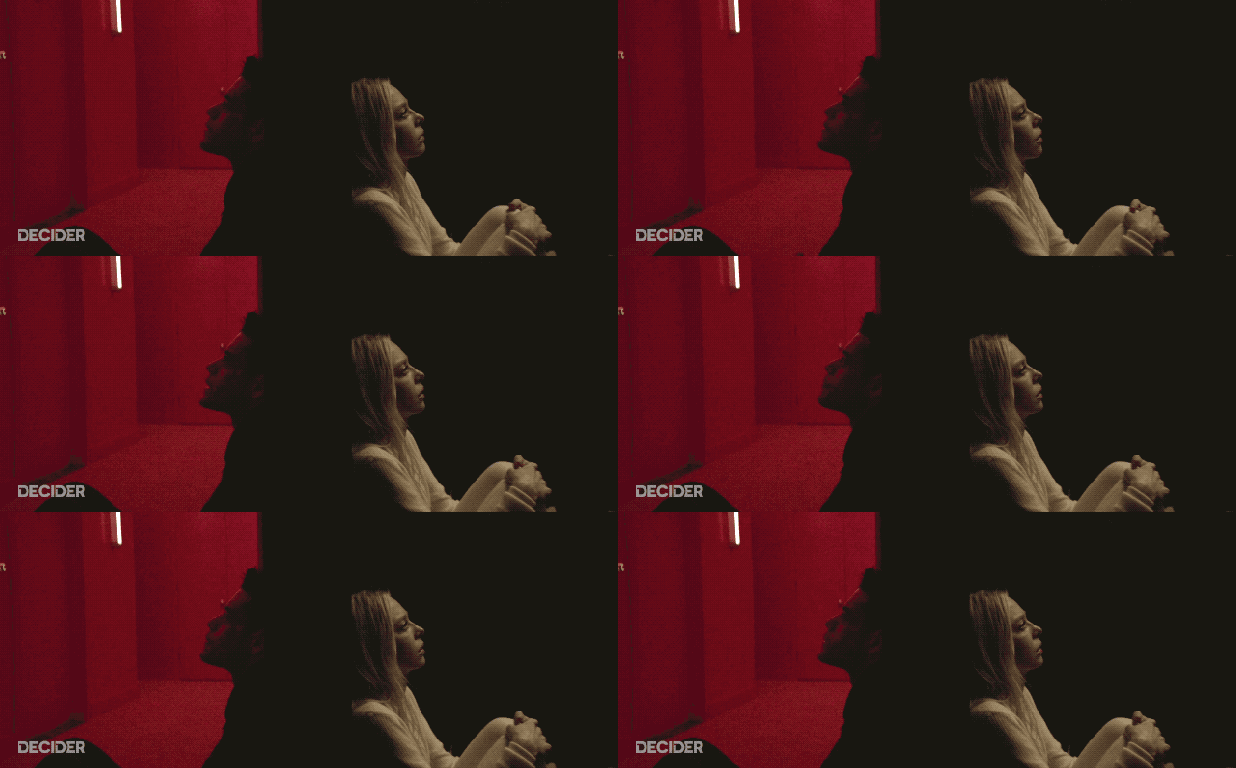
Mr. Robot may have bobbled the immediate aftermath of Stage 2, the mass murder at the center of its Season 3 storyline. But in its own melancholy way, the follow-up feels like the show has found itself again.
Entitled “eps3.7_dont-delete-me.ko,” this week’s episode avoids the pitfalls of the previous installment. Last week, most of the characters were too blasé about the terrorist attacks they’d either unwittingly helped unleash or failed to prevent, with the exception of Angela, whose regression into childlike magical thinking felt cartoonishly severe. This time around, characters do what people really do, a couple of weeks into the new normal following a catastrophe. They drift apart, or drift together; they settle on self-destruction, or rebound to self-improvement; they watch movies they love, from The Careful Massacre of the Bourgeoisie to Back to the Future. They act like we’ve all been acting for a year now.
I reviewed this week’s episode of Mr. Robot for Decider. Man, look at that fuckin’ shot.