
Posts Tagged ‘decider’
“The Rain” thoughts, Season One, Episode One: “Stay Inside”
May 14, 2018Written by series co-creator Jannik Tai Mosholt and directed by Kenneth Kainz, The Rain’s series premiere is the most breakneck work of sci-fi worldbuilding I’ve seen since the pilot episode of Lost. It’s a smart play. The high-speed opening distinguishes the show not only from the usual Netflix-bloat pacing problems, but also from the traditional way in which post-apocalyptic narratives dole out information about the stakes and the threat a little bit at a time. The show seems to assume that yeah, we’re familiar with how these kinds of stories operate, and we can dispense with the formalities and get right into the good stuff.
I reviewed the first episode of The Rain, Netflix’s surprisingly good new Danish post-apocalyptic drama, for Decider. Much more on this show to come.
“The Americans” thoughts, Season Six, Episode Six: “Rififi”
May 14, 2018Let’s talk about silence. I mean, the Jennings family certainly does this week, and how can we go wrong following their example? Elizabeth discusses it in the context of Rififi, the classic French crime movie by blacklisted American director Jules Dassin. She watches the film in an attempt to ingratiate herself with one Jackson Barber, a handsome young film buff who works for Senator Sam Nunn, a key player in the arms-reduction negotiations she’s spent the season trying to undermine. The movie features a heist sequence that clocks in at something close to half an hour without a single word spoken. You can see how this would appeal to Elizabeth, who knows how these kinds of things work—and to The Americans, which has worked out so well in large part by following in its footsteps.
Elizabeth talks about silence again with her son Henry, in a painful phone conversation the pleasantries of which reveal long-standing estrangement between her and the child she didn’t bother recruiting. Henry complains about having to read Walden, Henry David Thoreau’s treatise on the virtues of quiet contemplation. “It’s important literature, apparently,” he verbally eye-rolls; critics of this show’s slow-burn approach no doubt know how he feels.
Yet Henry picks up on something hidden inside Elizabeth’s strategic silences: pain that she’s struggling, in vain, to cloak in small talk. “She was asking about school and the weather,” he tells his father Philip about the call. “It was weird, because she doesn’t really call me? We barely ever talk, but all of a sudden she’s calling from a business trip and asking me about English class.” He concludes with a casual observation that hits her husband like a Mack truck: “I don’t understand why she’s so unhappy.” She never said a word to that effect, bur her silence spoke volumes.
I reviewed the sixth episode of The Americans (from a couple weeks back) for Decider.
“The Americans” thoughts, Season Six, Episode Five: “The Great Patriotic War”
April 30, 2018Can people change? The question drives many of the New Golden Age of Television’s greatest shows. Arguably it drives the New Golden Age of Television. To the extent that the medium’s rebirth coincides with the seismic upheavals in American life in the time period that stretches from 9/11 through the election of Barack Obama to the ascension of Donald Trump, the question may resonate because it’s so similar to the one we’ve been asking ourselves as a country for over half a generation.
Can people change? Different shows have come up with different answers. The Sopranos says no. Deadwood says yes, but at a cost. The Wire says the system prevents change, so “n/a.” Mad Men says yes, eventually. Breaking Bad (and its doom-laden prequel Better Call Saul) says yes, for the worse. The Walking Dead says yes, for the worse, and that’s good, which is why the show is bad. Game of Thrones says we’d better fucking hope so.
Can people change? After watching “The Great Patriotic War” — an appropriate title for one of the most upsetting episodes of this series yet — I think The Americans is saying yes and no, simultaneously. Perhaps this, more than the simple fact of having co-ed co-protagonists, is its real innovation in the antihero genre. It’s telling two stories at once, chronicling two competing theories of the world. It’s its own cold war.
I reviewed last week’s episode of The Americans for Decider. I’m proud of what I was able to do with this review (and, in a different way, that headline).
“The Americans” thoughts, Season Six, Episode Four: “Mr. and Mrs. Teacup”
April 19, 2018I’ll close with one of my favorite-ever scenes of allegorically resonant sickness in a series that’s been full of them: Elizabeth in her home-care disguise, taking her patient to a World Series party so she can spy on the woman’s husband and a potential double agent with in the Russian negotiating team, then getting vomited on as the dying artist panics and gushes up food and fluid from her disease-ridden guts. It’s Elizabeth who pushed the woman into attending the party in the first place so she’d have a chance to spy first-hand; it’s Elizabeth who talked her and her husband out of euthanasia to keep the information channel open; it’s the hated Russian negotiator who rushes over to help clean the vomit by Elizabeth’s side.
As best we can tell, Elizabeth’s primary reaction to the incident is dismay that it interrupted the taped conversation between her husband and the Russian. But earlier in the episode, the artist told Elizabeth she wishes she’d spent less time painting and more time with her spouse “The work is the best of me,” she thought, “something to leave behind. But really, who cares? Who cares. All those hours, just…honestly, I wish I’d spent them with Glenn. Just being with him, doing I don’t know what. Just…doesn’t matter.” Something’s eating Elizabeth up from the inside, too: her work. “There’s something rotten about it,” Oleg says to Philip; perhaps that’s why the artist vomits three times, once for each of Elizabeth’s victims earlier in the episode. Will Elizabeth listen to the woman whose suffering she’s aiding and abetting and get out before any more lives are wasted, with bullets or otherwise?
I reviewed last night’s episode of The Americans for Decider. This is such a rewarding show to write about. It’s got so much to give.
“The Looming Tower” thoughts, Episode Ten: “9/11”
April 19, 2018Based on the talent involved, The Looming Tower could and should have been better. But with the task it faced and the approach it took, I’ll be damned if I can figure out how. Some things just weren’t meant to be dramas. So despite a slate of fine actors doing their best — and despite a scorching critique of the CIA, the Clinton and Bush administrations, and the Saudi royal family — The Looming Tower never built up into something more than a well-cast book report. It gets harder and harder to never forget.
I reviewed the final episode of The Looming Tower for Decider. The show never really worked, though it did give us a magnificent Michael Stuhlbarg performance (is there any other kind?) as, of all people, Richard Clarke.
“The Americans” thoughts, Season Six, Episode Three: “Urban Transport Planning”
April 13, 2018“I am alone without them, here. Alone.” This line — delivered by Soviet hockey player turned double agent turned defector turned likely divorcé Gennadi to the FBI agent he considers his only friend, Stan Beeman — hit me harder than anything else in this week’s episode of The Americans. As a reminder, this week’s episode of The Americans opened with Elizabeth Jennings washing a man’s brains and blood off her face, then yelling at her traumatized daughter Paige for making the unforgivable mistake of running toward the scene to make sure her own mom was still alive. It includes Elizabeth straight-up lying to Paige about the nature of the man’s death, which she calls a suicide without mentioning that “assisted suicide” is closer to the mark but still woefully inadequate. It includes Elizabeth rolling some poor sap who may have been her easiest mark ever, effortlessly getting him to tell her everything he knows about the weak spots at the secure warehouse where he works before grabbing him from behind and choking him to death on his way out the door. It includes Stan apologizing to his old ally Oleg Burov for his inadvertent role in the CIA threatening him and his family should he refuse to turn double agent, and Oleg rejecting the apology. It includes Philip Jennings growing so alarmed about Elizabeth’s contempt for the United States and oblique hints about her participation in some kind of power struggle against Mikhail Gorbachev that he accepts Oleg’s proposal to spy on, and potentially act to stop, his own wife. If you’re in the market to get hit hard, this is an embarrassment of riches.
So why did this line from a minor character in the grand scheme of things affect me so much? “I am alone without them, here. Alone.” When he says this, Gennadi has been unceremoniously yanked from his double life in the middle of the airport, where in the middle of one of his courier missions Stan approaches him saying he understands he’s requested political asylum — an agreed-upon signal that he’s at risk and must end his life in the Soviet Union forever. Stan’s old partner Dennis Aderholt does the same with Gennadi’s wife Sofia, the TASS news agency worker who helped the flip Gennadi in the first place, but who’s now so unhappy in their marriage that she’s leaking secrets to her new beau, some unseen guy named Bogdan. Other agents pick up her son Ilya from elementary school. The protection they’ll need as defectors ensures that they’ll be moved far away; if the divorce goes through, they’ll be moved to separate locations where they’ll be unreachable to one another. So Sofia moves ahead with her plan to divorce him, Gennadi will never see her or Ilya again. What all of this means for Gennadi is that he’s lost his homeland, his home life, both of his jobs, and his family in the space of an afternoon. He is a man without a country.
Is there a better way to describe each individual member of the Jennings family?
I reviewed this week’s episode of The Americans for Decider. As an aside, it’s nice that the soundtrack calmed down a bit.
“The Americans” thoughts, Season Six, Episode Two: “Tchaikovsky”
April 13, 2018If I had to sum up this hour-long portrait of how Elizabeth’s studied, professionally mandated distance from the emotional needs of other people — except insofar as they can be instrumentalized and weaponized — is slowly destroying her, I’d do it with an exchange she has with Claudia. Elizabeth can’t help but see how Paige has responded to the woman’s grandmotherly presence in her life. “The way Paige has taken to you,” Elizabeth says to Claudia, “if something were to happen to me at any point…” Your mind fills in the blank before Elizabeth can do so herself — surely she wants Claudia to care for her daughter in the event of her own death — until Elizabeth finishes the thought: “I think you could finish with her.” Just as when she uses her children as a ploy to get the general to let down his guard when he pulls out the gun she’ll eventually use to kill him, the mission is the priority, not the well-being of another person, not even that of her own daughter. It’s clear where that leads them both.
“The Looming Tower” thoughts, Episode Eight: “A Very Special Relationship”
April 13, 2018Serious question: When the makers of The Looming Tower called this episode “A Very Special Relationship,” did they have Jeff Daniels’s graphic sex scenes in mind?
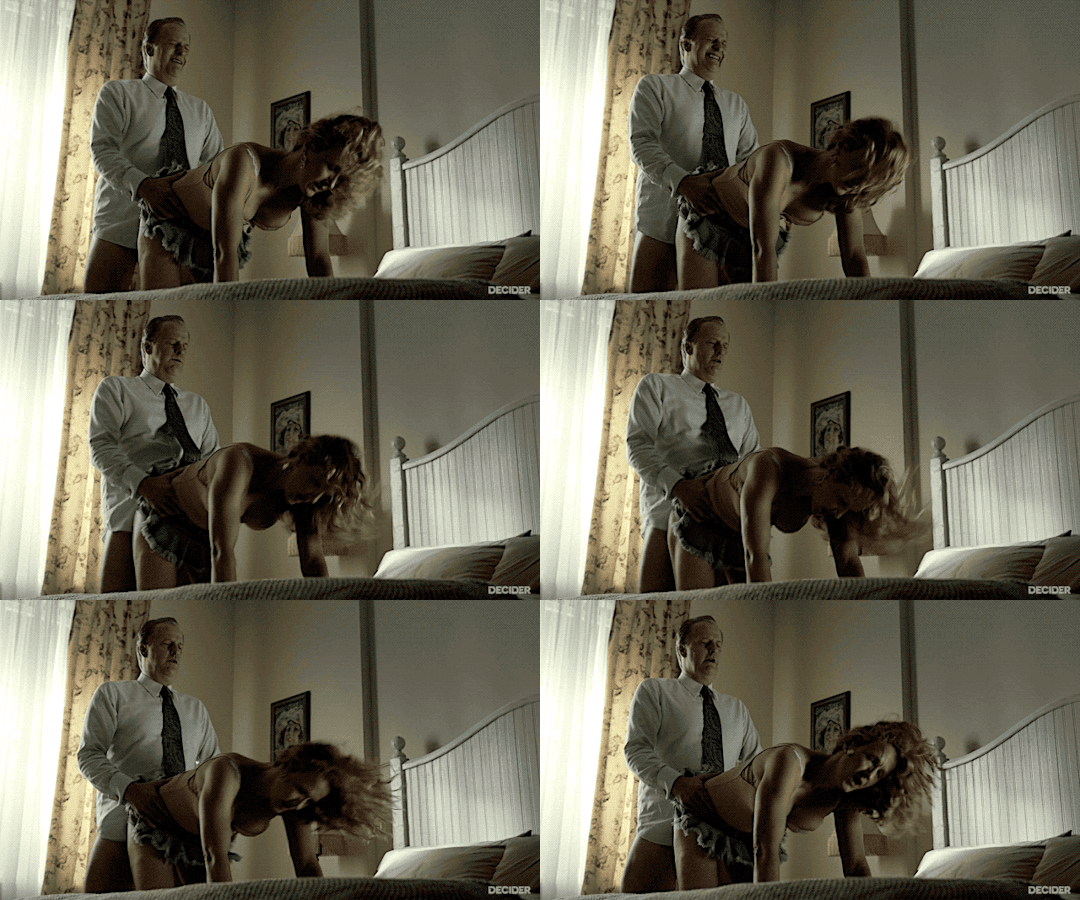
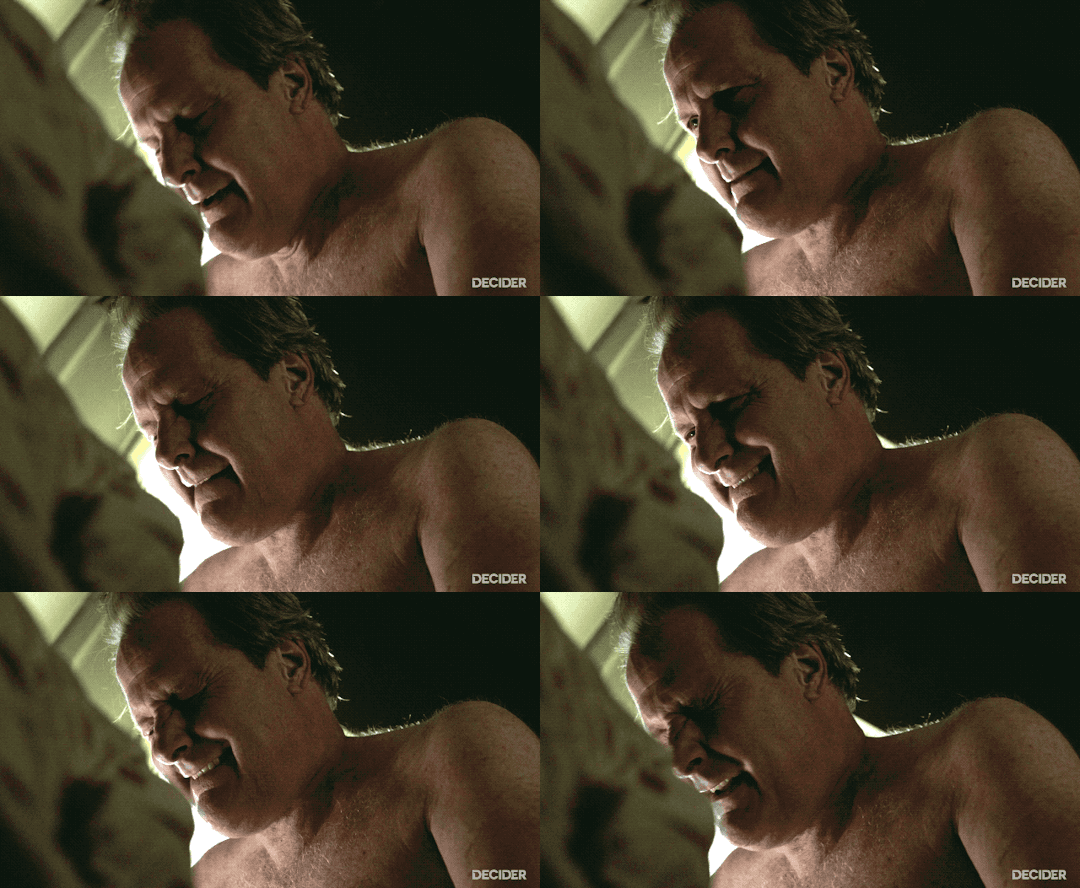
I wrote a whole bunch more about how the failure of The Looming Tower to make a cohesive character out of FBI anti-terrorism chief John O’Neill undermines a lot of the dramatic parallels the show is trying to make in my review of its eighth episode for Decider, but I also just want you to see these gifs.
“The Americans” thoughts, Season Six, Episode One: “Dead Hand”
March 31, 2018Elizabeth Jennings sits in a cafe in Mexico City and learns that the leader of the Soviet Union will be murdered if he agrees to deactivate his country’s top-secret plan for retaliatory nuclear annihilation. She learns this not in a warning, but in a demand for her assistance. Making an end-run around her superiors back home, a man from the Soviet army has come to recruit her to spy on Gorbachev’s team at a disarmament summit. Her job is to make sure that the Strangelovian project — codenamed “Dead Hand,” because why fuck around — is not on the bargaining table. If it is, she is to report back, and history will change forever.
As she learns this information, which will culminate in her receipt of a necklace with a poison pill hidden inside in order to protect the sanctity of Dead Hand should she ever be captured, Peter Gabriel’s “We Do What We’re Told” rises in volume on the soundtrack, higher and higher, until the only reason we can make out her contact’s words is because we can read their subtitled translations. It’s a clever callback to The Americans‘ first episode and its use of “In the Air Tonight” by Phil Collins — another eerie solo standout from a Genesis alum that was famously used in the soundtrack for Miami Vice some thirty years ago. But it’s also away to focus our attention not on the mission, but the shock of receiving it. The Americans deploys quiet and wordlessness as effectively as any show on TV; so many of its standout performers (Noah Emmerich, Brandon J. Dirden, Costa Ronin) are strikingly soft-spoken, and many of its best moments consist of characters just standing and staring at something they can only just bear to see. This isn’t an option in the middle of receiving your marching orders, so the show does the next best thing: It drowns them out. Elizabeth herself is quiet, but there’s a tumult in her head.
[…]
Watching The Americans in 2018 is a much different experience than watching The Americans in 2013 — not just because it’s much better show than it was during that first season (a reasonably enjoyable thriller and not much more), nor because during the 2012 election liberal pundits treated Mitt Romney describing Russia as our enemy as a gaffe while now many of those same pundits are out to start a new Cold War against the country and its ex-KGB leader. You get a little closer when you start talking about why — Russian meddling in 2016 election and influence peddling with its Electoral College–appointed winner Donald Trump and his minions — but only if you treat that as the starting point rather than the finish.
Should even the worst of the allegations against the Putin and Trump governments turn out to be true, they’re basically just tit for tat if you go back to what happened after Gorbachev, when America helped establish an oligarchy by kicking off a capitalist fire sale in the country, and intervened directly and more or less openly to ensure Putin predecessor Boris Yeltsin presided over it. A slightly, but only slightly, less dramatic looting of the commons by corporations, their wealthy viziers, and their paid representatives in the United States government took place here at home. And there’d be no Trump on whose behalf to meddle if our own grotesque racism, sexism, xenophobia, gutting of the social safety net, and worship of money hadn’t made him possible.
In short, it’s much, much harder than it used to be for all but the most blinkered patriots, liberal or conservative, to look at America and Russia’s recent history and see good guys and bad guys. History is a palimpsest, rewritten as we go. And as with Elizabeth in that cafe, things that used to be sound perfectly clear are getting harder and harder to hear.
“The Looming Tower” thoughts, Episode Seven: “The General”
March 31, 2018“And it’s one, two, three, what are we fighting for?” —Country Joe and the Fish, “I-Feel-Like-I’m-Fixin’-to-Die-Rag”
If there’s one thing that struck me about “The General,” the seventh episode of The Looming Tower, it’s that the answer to Country Joe MacDonald’s musical question is, as it always was, “not much.” Not much of value, anyway. Ostensibly depicting the investigation into the bombing of the USS Cole off the Yemeni coast, the episode is in fact about how interagency and international strife made a halfway decent investigation impossible. Most of the fighting that gets done here is between people who are supposed to be on the same side. Why are they doing it? As Country Joe put it, “Don’t ask me, I don’t give a damn.”
I reviewed this week’s episode of The Looming Tower, the first one where I started to think maybe they’re gonna run out of fuel for this story long before they run out of story to fuel, for Decider. The Looming Tower does not have the spark. It does not have the magic.
“The Assassination of Gianni Versace: American Crime Story” thoughts, Episode Nine: “Alone”
March 22, 2018Andrew Cunanan walks through Miami Beach toward death as “Vienna” by Ultravox plays on the soundtrack. That New Wave masterpiece is both a celebration and rejection of glamour. Sequentially so, in that vocalist Midge Ure sings of “a man in the dark in a picture frame, so mystic and soulful” and “haunting notes, pizzicato strings, the rhythm is calling,” only to follow up by proclaiming “the image is gone…the feeling is gone…this means nothing to me.” Simultaneously so, in that when he sings “this means nothing to me” the song soars as if nothing has ever meant more to him. Inextricably so, in that it wedges “only you and I” between each declaration of faded emotion and emphatic meaninglessness; in that the title comes from the chorus’s climactic phrase “Ah, Vienna,” a cry of joy and a sigh of loss all at once. The first time that chorus hits in the ninth and final episode of The Assassination of Gianni Versace: American Crime Story, Andrew Cunanan assassinates Gianni Versace. The second time, he’s standing in a stranger’s kitchen, rummaging through a fridge in a house he’s burglarized, pulling out a bottle of champagne and fiddling with the foil around the cork. His lonesome toast to himself is not timed to the music. The feeling is gone, only you and I, it means nothing to me, this means nothing to me.
[…]
Andrew Cunanan is dead and gone when The Assassination of Gianni Versace, one of the best dramas of the decade, concludes. Its final scenes focus on the family of the title character, not his killer; even this choice is a deliberate disconnection from what’s come before. Estranged though they are, both his sister Donatella and his partner Antonio struggle to connect what they had with what they have now. Donatella, who has coolly presided over Antonio’s excision from his late partner’s estate, sobs, because her brother annoyed her on the day of his murder to the point where she refused to pick up the phone when he called. Antonio has been rejected not only by Donatella but by the priest at Gianni’s funeral mass — where rich and famous friends from Princess Diana to Elton John to Naomi Campbell to Sting were present, but where Antonio himself did not merit a mention as a part of the family, nor a kiss from the cleric, whose institution spent the decade denying the humanity of homosexuals while systematically destroying the humanity of so many children in its charge. Like Andrew, he attempts suicide; unlike Andrew, he is unsuccessful.
Gianni Versace ends the series as a photo in a shrine where his sister goes to grieve and lament what could have been had she picked up the phone. Donatella is a distorted reflection in glass embellished with the House of Versace’s Medusa head emblem, monstrous in her mourning. Antonio lies cradled in the hands of the help, who save him from his effort to die with the love of his life. Andrew is just a name on a wall in a mausoleum, one of countless others, nothing special. It’s all so unglamorous, so unceremonious, so blunt and short and ugly. The beauty Versace worked all his life to create, that Andrew tried all his life to recreate, has no place here at the end. The image is gone, only you and I, it means nothing to me, this means nothing to me.
I reviewed the season finale of ACS Versace for Decider. This show is an all-timer.
“The Assassination of Gianni Versace: American Crime Story” thoughts, Episode Eight: “Creator/Destroyer”
March 22, 2018Andrew Cunanan was cool.
Like, really cool.
Sincerely, legitimately awesome.
That’s the tragedy of “Creator/Destroyer,” the penultimate episode of this extraordinary season of television. By the time we see Andrew in his full glory as one of the wildest guys at his high school, we’ve also seen his father Modesto, who debuts in this episode, get his hooks deep into the kid. Andrew has seen his father harangue and assault his mother. He’s borne the weight of all his dad’s dreams, knowing this comes at the expense of his siblings, sensing on some level it’s not right to have this kind of pressure placed on him but, because the pressure is couched as praise, not knowing how to fight back. He’s been…well, the show is cagey on this, but saying he’s been molested by his father would not be out of bounds.
And even now, as an ebullient and confident teenager, he’s begun certain behavior patterns that will get him in trouble in the end: he has a sugar daddy, and he becomes fast friends with Lizzie, his future bestie, because she shows up at a high-school house party pretending to be a kid rather than the married adult she really is. (“I’m an impostor.” “All the best people are.”) He’s picking up little tidbits on how to deceive (including his go-to pseudonym, DeSilva, the name of the people who own the house where the party takes place) and why (because “when you feel special, success will follow” as his father teaches him).
But for a brief time, he’s just a cool, slightly weird, slightly obnoxious, slightly closeted teenager, and if you weren’t at least two of those things during your high school career I don’t wanna know you. He stands up to homophobes in a familiar way, by camping it up even further, going so far as to pose for his class photo with his shirt all the way unbuttoned to show off his (impressive!) torso. He’s prophetically chosen to be “Most Likely to Be Remembered,” and equally prophetically selects “Après moi, le déluge” as his yearbook quote. He rolls into the parking lot like a refugee from Less Than Zero (complete with that movie’s soundtrack staple, the Bangles’ cover of “Hazy Shade of Winter”; the film was his IRL fave) and shows up at the house party in an Eddie Murphy red-leather jumpsuit. (Finally it’s clear why so many of his music cues over the course of the ‘90s portion of the series were anachronistically ’80s: The ’80s were his time.) This Andrew could be loved. This Andrew could be saved.


I reviewed last week’s episode of ACS Versace for Decider. What a show.
“The Assassination of Gianni Versace: American Crime Story” thoughts, Episode Seven: “Ascent”
March 22, 2018“We must be talked about, or we are nothing.” —Donatella Versace, to the Versace staff
“For me, being told ‘no’ is like being told I don’t exist. It’s like I disappeared or something.” —Andrew Cunanan, to Jeff Trail
“Is this normal? Is this normal enough?” —Gianni Versace to his sister Donatella, on creating a less unique ready-to-wear version of the haute couture dress they designed together for her
“It’s just a name they made up to sound special.” —Andrew Cunanan to his mother Mary Anne, on Häagen-Dazs ice cream
“It needs confidence.” “It gives confidence.” —Donatella and Gianni, on the dress
“So you can hold your own at a dinner table conversation.” “I am the dinner table conversation.” —an escort agency owner and Andrew Cunanan, on Andrew Cunanan
“I want the world to see you in a way that you have never been seen before.” —Gianni to Donatella
“Oh, if they could see me now.” “Who?” “Everyone.” —Andrew Cunanan to Norman Blachford
“This dress is not my legacy. You are.” —Gianni to Donatella
“He’s a good boy. He’s always been a good boy.” —Mary Anne on Andrew Cunanan
“Ascent,” the seventh episode of ACS Versace, is the one where my admiration for what writer Tom Rob Smith has accomplished with his scripts and structure for the series shifted into something approaching awe. Returning to the Versaces’ world of high fashion for the first time since Episode 2 (their appearance in Episode 5 centered on Gianni’s coming out, not their work as designers), it creates a series of parallels between the the artist and the man who would murder him that are all the more striking for how different they are in intention and affect.
I reviewed episode seven of ACS Versace for Decider a couple weeks back. (I apologize for all the catch-up linkblogging tonight.) I remember going through my notes on this one and thinking “Christ, this is a well-written show.”
“The Looming Tower” thoughts, Episode Six: “Boys at War”
March 22, 2018Fittingly, director Michael Slovis and writer/showrunner Dan Futterman crafted a cinematically memorable version of the Cole bombing. After a long, slow, even placid build-up, the actual attack maintains the same feel and rhythm; if you didn’t know any better, you’d think this really was just a couple of guys and their nephew or something, out for a pleasant cruise, waving to the smiling sailors nearby. This isn’t some Euron Greyjoy–style pirate assault — it’s a sneak attack that no one saw coming even when they literally saw it coming. The cinematography is so fitting that it almost feels complicit.
The show’s done the character work to make the sequence stick in that respect, too. All those scenes of the bombers being friendly and joking around with one another are obviously reminiscent of what the FBI agents we’re also following around do, too. They’ve even got a kid sidekick whom they can playfully surprise and delight with their video camera, a bit of technology he’s never had the chance to experience before; the way they all repeat the word “zoom” and laugh when they use that feature to get a closer look at the Cole is genuinely funny and endearing if you put the context aside. But the show’s not really asking you to do that, since it provides its own context for what they’re doing: the murder of the kid’s family and friends by the United States, in an attack so senseless and unstoppable that the only way he can make sense of it is by magically attributing it to Shaytan himself. (The only hiccup is the Shaytan monologue, which overstays its welcome and drifts too far into otherizing “strange foreigner invokes demons and deities” territory.) Put it all together and you get that these are basically normal people, traumatized by injustice, and driven to kill for their countries and ideals in ways we too could understand.
When you’ve done all that, what does putting the kid on the boat add? We don’t need it for cinematic impact, for pathos, or to illustrate the human cost, since we’ve gotten all that already. It just feels indulgent, and oddly disrespectful of the facts to boot. Dramatic license is fine if you wanna create believable composite characters like Schmidt and Marsh in the CIA or Chesney and Stuart in the FBI, or even the kid himself. If you’re inserting a character in such a way that his presence would materially change the world’s understanding of the event that’s occurring, as the use of a literal child to suicide-bomb the U.S Navy surely would have done, that’s a whole different story. That it was all unnecessary only makes it worse. Have faith in the tragic truth.
I enjoyed writing about this week’s episode of The Looming Tower for Decider, one of those episodes that really helps you understand why what works works and what doesn’t doesn’t. This particular sequence was good to explore in light of the creative success of The Assassination of Gianni Versace, another true-crime series that takes necessary liberties and inferences, yet always feels on-point.
“The Looming Tower” thoughts, Episode Five: “Y2K”
March 22, 2018The Looming Tower is a cop show set in a world very much like our own: a world full of scumbags, banding together in little clandestine groups with a self-awarded licensed to kill on behalf of their scummy ideologies. Unlike the real world, however, the world of The Looming Tower has a magic-realist tinge to it. In Towerworld, there exist Cassandra-like oracles capable of seeing the future and its ocean of blood but utterly incapable of doing anything about it. In fact, to the characters, these unheeded, impotent prophets of doom are completely invisible. After all, they’re not characters themselves. They’re the audience.
I reviewed last week’s episode of The Looming Tower for Decider. It was the first one where the lethal folly of this War of the Shitheads really started getting to me.
“The Looming Tower” thoughts, Episode Four: “Mercury”
March 9, 2018Despite earning the respect of his bosses for his correct call against making the attacks, and lining up much-needed help cracking the CIA’s vault of secrecy from the Justice Department, John O’Neill’s a fuckin’ mess, man. Belying his on-top-of-the-world swagger, his lavish lifestyle of fine dining and $400 shoes (in 1998 money!) combined with the need to travel between three different romantic partners has buried him in debt. His credit cards get declined. He’s out of town for so long all the time that his wife and children barely tolerate him when he returns. Catholic cardinals fail to give him a reprieve to divorce his religiously devout missus and marry his equally devout (and deceived) girlfriend Liz, no matter how many Cohibas he smokes with them. Just to top it all off, his other other woman is planning a move to New York to be near him. He’s, uh, not thrilled.
And even when he’s right in this installment, he’s right about stuff that makes him seem prurient, rather than prophetic. In place of his many killer one-liners about how bin Laden wants us to go to war, maaaan, he’s pontificating about the “72 virgins” issue with his star agent Ali Soufan, who tells him it’s all bullshit. “Blow yourself up and win the pussy sweepstakes—it’s like consumer fraud,” O’Neill concludes. “And ironically, so fuckin’ American.” He’d know!
This is how Jeff Daniels can work: as a guy who seems to have all the advantages a wealthy white straight cis Christian man who’s got a high-ranking job in a law-enforcement agency in America’s cultural and political capitals can get, yet seems incapable of not pissing those privileges away. People keep trying to cast him as Wyatt Earp or Walter Cronkite, while his potential to portray a reasonably popular governor forced to leave office after getting caught using the state education fund to pay his mistress’s son’s orthodontist bill was right there all along.
Hey gang—I figured out Jeff Daniels’s strengths as a dramatic actor and wrote about them in my review of this week’s episode of The Looming Tower for Decider! What do you think of that, Jeff?

“The Looming Tower” thoughts, Episode Three: “Mistakes Were Made”
March 8, 2018The third episode of The Looming Tower was struck by two coordinated explosions. No, not the al-Qaeda-orchestrated embassy bombings in Kenya and Tanzania, nor the CIA-orchestrated tough-guy retaliatory strikes on an AQ training camp in Afghanistan and its, ahem, “chemical weapons facility” in Sudan. As if invoking the “two-for-two” principle that led American intelligence and defense officials to launch the latter attacks, writer Bash Doran and director John Dahl teamed with their actors to set off a double detonation of their own: the interrogation-room outburst of FBI investigator Robert Chesney, played by Bill Camp; and the furious freakout over being kept out of the loop on the airstrikes, potentially lethally, by his boss John O’Neill, played by Jeff Daniels. The first of these hit its target. The second was a dud. The difference between them says a lot about what these two actors, each likeable in his own way, have to offer.
[…]
I don’t blame Daniels for failing to deliver the dynamite that Camp cooks up in his similar scene, not entirely anyway. But it’s certainly true that Daniels is a far broader performer than Camp, even when the latter is screaming at the top of his lungs. His recent career has seen him repeatedly cast as ostensibly convincing figures of authority, be they good (his blustery Real News anchorman from Aaron Sorkin’s The Newsroom, whose name I can’t remember but whom I now always think of as “Jeff Newsroom” thanks to a vocal anti-Sorkin contingent on Twitter) or evil (his extravagantly bearded one-armed mass murderer in Netflix‘s Western series Godless, which feels like the part of a Broadway show’s run where a new actor takes over for the lead who originated the role, in this case most likely Jeff Bridges).
Yet these authority figures never actually convince. Again, the writing is often to blame, but either way it’s impossible to imagine a ham like his Newsroom character saving the moral heart of the journalism industry, or his pretentious, bible-quoting gunman becoming the most feared figure in the West in a show where Michelle Dockery and Merritt Wever both displayed more, ahem, true grit. His O’Neill commands respect insofar as we know he was right and his enemies were wrong, but Daniels is just the guy whose job it is to inhabit that suit of rectitude. He doesn’t wear it particularly well. (His secondary characteristic — an irresistible ladies’ man whose ruddy middle-aged machismo is irresistible to half a dozen different women half his age — is an even worse fit.)
I did a satisfyingly close read of the performances of Jeff Daniels and Bill Camp in my review of The Looming Tower’s third episode for Decider. Camp is the most underrated actor on television.
“The Looming Tower” thoughts, Episode Two: “Losing My Religion”
March 8, 2018“We’re at war.”
“Only if we want to be.”Welp, there you have it. That’s the game right there. That’s the whole megillah. “Losing My Religion”, Episode 2 of The Looming Tower, may have a too-cute-by-half title. (It’s a reference to our lapsed Catholic and observant Muslim FBI heroes dealing with his own sins in the former case and those of his correligionists in the other — relatively minor issues in the scheme of things). But that nine-word exchange between the CIA’s Strangelovean, bearded boffin Martin Schmidt and the FBI’s hard-drinkin’, hard-lovin’, law’n’order straight-shooter John O’Neill encapsulates the great debate that would shape the next 20 years of American history because of who winds up winning.
[…]
I’m a bit perplexed by complaints that the show is a sentimental look back at 9/11 with little to tell us about what happened afterwards. In the pilot, all the sniping and name-calling and backstabbing between agencies made me think it possible, even likely, that by showing us FBI, CIA, and DoD morons staging a pissing contest while people die, The Looming Tower would be more useful to us today than a deep dive into Islamist extremism would be. Now I see that while that element continues, so too does a blunt, bare-essentials critique of the War on Terror. Put it all together, and you’ve got a portrayal of an intelligence community that’s overworked, underinformed, and lacking in basic human empathy, helping to usher in America’s dying-empire phase. Again, look at today’s headlines and tell me this isn’t a valuable perspective.
I reviewed episode two of The Looming Tower for Decider. It’s a very straightforward show, but it certainly isn’t hidebound.
“The Assassination of Gianni Versace: American Crime Story” thoughts, Episode Six: “Descent”
March 2, 2018“He’s a house. He’s a home. He’s a yard and a family and picking kids up from school…he’s a future.”
“They say this man…this man has nothing left to give. And a man with nothing to give is a nothing man….This world has wasted me.”
Ominously directed by Gwyneth Horder-Payton and featuring absolutely stunning dialogue from series writer Tom Rob Smith, “Descent,” the sixth episode of The Assassination of Gianni Versace: American Crime Story, is the first and only episode so far to steer entirely clear of murder and its aftermath. Yet somewhere between those two statements above — the first is a description of his beloved David Madsen to his friend Lizzie, the second a description of himself to a meth-induced nightmare vision of Gianni Versace — Andrew Cunanan dies. The old Andrew, anyway, the Andrew capable of warmth and charm and moments of honesty amid the lies. It’s not hard to identify the specific spark of vitality that gets snuffed out to make his dark rebirth into the new, lethal Andrew happen, either. When his hope dies, the old Andrew dies with it.
And what rough beast, its hour come round at last, slouches toward Minneapolis to be born? I reviewed this week’s stunning episode of ACS Versace for Decider.
“The Looming Tower” thoughts, Episode One: “Now It Begins…”
March 1, 2018The Towers really do loom over The Looming Tower. They stand in the distance as John O’Neill, the FBI’s chief counterterrorism agent, complains to a colleague that the Bureau’s director slept through a nationally broadcast interview with Osama bin Laden, a sure sign that “we’re running out of time.” They show up again as he rides the train into Manhattan the night al Qaeda simultaneously blew up the U.S. embassies in Tanzania and Kenya, as he calls his best Arabic-speaking agent Ali Soufan to tell him “now it begins.” The presence of the Twin Towers is a commonplace in pre-9/11 period pieces, and of course they appear in countless films made before the attacks with little or no fanfare, a simple marker that the characters have woken up in the city that never sleeps — hell, I watched The Money Pit the other night and there they were in the opening credits, a recognizable Manhattan landmark meant to establish contrast with the bucolic, disintegrating suburban mansion Tom Hanks and Shelley Long were about to fall down in a lot. But their presence takes on extra heft in The Looming Tower. Only here do they loom over a man who dedicated his career to thwarting terrorist attacks, quit when bureaucratic infighting made his job impossible, then died mere weeks into his private-sector career as a security consultant when the World Trade Center collapsed on top of him. He was right, and it killed him.
I’m covering The Looming Tower for Decider, beginning with my review of the series premiere. It’s a pretty straightforward show as far as this one hour of it is concerned, but that’s probably the best way to play this. While I’ve read reviews saying the moment for this treatment of this material has passed, since it focuses on the American intelligence community exclusively rather than treating al Qaeda’s leaders and forerunners as co-protagonists the way the book did, I’m curious to see if it can transform itself into something that does speak to the present moment after all. A show about FBI, CIA, and DoD morons having a pissing contest while people die is probably more useful to us at this point than one about Islamist extremism anyway.