Death by a thousand cuts. Max Cady (Javier Bardem) has already compared his (allegedly) undeserved prison sentence to this form of piecemeal torture. He may have actually committed it, if indeed he’s responsible for severing a certain teenager’s toe. But after this episode of Cape Fear, it’s apparent that Anna (Amy Adams) and Tom Bowden’s (Patrick Wilson) happy family is under lethal threat, and death by a thousand cuts is how they’re in danger of being taken out.
The funny thing is that this isn’t a super-funny episode of Widow’s Bay, or a super scary one, or one that riffs on one or two very specific stories or subgenres. Sure, there are shades of Nope and The Lighthouse here and there, and a twister straight out of The Wizard of Oz, but there’s no one central horror here — no sea hag, no sunset cocktails death ritual, no machete-wielding Boogeyman. Other than Chris Fleming’s untimely demise and the genuinely chilling cold open, this episode feels mostly like set-up for the finale. It’s funny in places and creepy in others, but in both the horror and comedy categories, I’m hoping it’s just the calm before the storm.
Just to reiterate: We’re watching the queer glam rock incest vampire show. This one’s for the sickos, and brother, that’s me.
Lestat is for anyone who’s ever wanted to watch a show about gay draculas who sing “The Jean Genie” knockoffs into a camera dripping with human blood, then go bitch about it to Eric Bogosian. It’s for anyone who loves The Lost Boys and Velvet Goldmine and Cabaret and Bram Stoker’s Dracula and has ever thought “Hey, wouldn’t it be nice if all those were the same thing at once?” It’s for people who know that even if that dark spot on Lestat’s pants at the end of one his performances isn’t his vampire blood-semen from ejaculating on stage, the fact that it’s even a question is a very good sign indeed.
We have it all now: the who, what, when, where, how, and why.
Who: Windom Earle — former FBI Special Agent, liaison to the Air Force’s paranormal investigation Project Blue Book, Dale Cooper’s former partner and mentor, the husband and murderer of the love of Cooper’s life, master of disguise, serial killer, seeker of secrets, would-be sorcerer.
What: The entrance to the Black Lodge — diametrically opposed to the benevolent White Lodge, home of the murderous entity called Bob, an immeasurably powerful place of evil for evil’s sake.
When: During the astrological conjunction of Jupiter and Saturn from January to June, whose opposing expansive and contractive forces augur times of great change, for good or evil.
Where: Somewhere in the woods outside of Twin Peaks, at a location indicated by the petroglyph from Owl Cave, which both Windom Earle and Deputy Andy Brennan have figured out is actually a map.
How: The doors to the Lodges require a key, and the Black Lodge is opened by fear (“my favorite emotional state!” whoops Windom), a feeling to which creatures like Bob are drawn as “their bread and butter.”
Why: Power. Is not the will to dominate the root of all evil?
When we open, Max Cady’s life has been turned upside down. Seven years ago, in a flashback sequence depicted in gritty black and white, Max is attacked in the prison weight room by a trio of Nazis. He gets the better of them, definitively killing two of them before passing out from his own head injuries, which we know continue to plague him even now.
But this bare-bones description does not do this cold open justice. Cape Fear has just given us the most brutal television fight scene since the Mountain dueled the Red Viper on Game of Thrones, possibly even since Dan Dority met Captain Turner in the thoroughfare on Deadwood. Simply put, it’s fucking unbelievable.
Horror is a genre in conversation with itself. Tasked with frightening their audiences, horror filmmakers naturally turn to what has frightened them. Even the very best works in the genre borrow ideas and images from their predecessors, often quite openly. Provided the end result is something unique unto itself, this process can yield results as vital as cover versions or well-chosen samples do in music.
Nick Antosca, creator and writer of Cape Fear, has a distinguished track record in the genre himself, creating or co-creating the shows Channel Zero, The Act, Brand New Cherry Flavor, Candy, and A Friend of the Family — a mix of gory, surreal horror and true crime served at a bone-chilling temperature. Here he’s working directly from a trio of sources: John D. MacDonald’s 1957 novel The Executioners, J. Lee Thompson’s 1962 film Cape Fear, and Martin Scorsese’s 1991 remake of it. All three are credited as source material on screen.

But the show’s very first scene isn’t a reference to any of those works that I can see. With its inverted, photo-negative images soaked in lurid color, with its images of a happy family enjoying the good life on the Fourth of July, it feels like a nod to a very different movie: of all things, Jonathan Glazer’s The Zone of Interest.
“There’s something wrong. This isn’t right. There’s something wrong here.”
These are the last words of this episode, spoken by Dwayne Milford, mayor of the town of Twin Peaks. He hasn’t suddenly developed concerns beyond his usual ones: badly presiding over local events, talking slowly, flirting with his much younger girlfriend Lana. He is in fact simply struggling with the microphone at a Miss Twin Peaks event. There’s a sight gag where he adjusts the mic only for it to sink away from him when he lets go that’s one of the funniest moments of the episode, even.
But we’re privy to information and observations to which Mayor Milford is not. We’ve spent a full episode listening to some of composer Angelo Badalamenti’s most unsettling work, much of it a series of ambient, ominous whooshing and humming. We hear it over the roar of the falls, in the wooden interiors of the Great Northern, in the formica paradise of the Double R diner. There’s something wrong here.
The camera of Stephen Gyllenhaal (Jake and Maggie’s dad) follows suit, its slow movements drawn out to at times genuinely striking lengths. There’s a seemingly endless shot of Coop and Annie mooning at each other over the counter, talking Augustine and Heisenberg as if this is how everyone flirts, where our viewpoint drifts further and further from them, as Badalamenti’s horror-movie synth slowly overwhelms the jaunty country-western music on the diner jukebox.
There’s no immediate explanation for any of this, no source of the visual or sonic disturbance that we can identify, no real reason for the shot, which ends with a breathless match cut on Annie and Coop leaning in for a kiss, at all. And there’s no reason for the slow-motion shot of syrup dripping from shattered dishware on a noisily dropped tray, oozing like blood, that follows the kiss. There’s something wrong here.
Euphoria’s third season has amounted to a full reboot, starring most of the same people in the same roles but with little else in common. It truly can’t be exaggerated what a difference the shift between Labrinth and Hans Zimmer as composers alone makes to the overall vibe, much less having Rue make border runs and Cassie make actual porn and Jules wear multi-thousand-dollar garments instead of stuff from the Salvation Army. These aren’t the kids we knew, fucked-up kids though they may have been, and this isn’t a show about those kids anymore. It’s a show about sawed-off shotguns. You have to make your peace with that.
Which I have. Euphoria Season 3 doesn’t feel like a memorial service, it feels like a viking funeral. It’s not about first kisses and popularity and suburban secrets, it’s a VistaVision fantasia about a hell on earth governed by a devil named fentanyl, and the lost souls fighting against the demon lords responsible. It’s not how I saw this story ending when it started, but it’s one of the wildest and most beautifully filmed neo-Westerns in the history of TV, big and bold and bloody against blue skies, like Pluribus for perverts. I’m only sorry you can’t light the same ship on fire twice.
In the meantime, it’s still a marvelously made show. The vocal effects for Warren feel like something out of Robert Eggers’s Nosferatu, and the age makeup holds up extremely well under direct closeups. But even less showy aspects of the episode are striking, like the sharp blue-tinted white light used to illuminate the boat and its cabin, cutting against the digital gloom that often plagues nighttime scenes set at sea on streaming shows. It’s a minor thing, but minor things add up, whether you’re making a show about a haunted island, or actually living on one.
Betty Gilpin is television’s most valuable player. She has that Catherine O’Hara/Philip Seymour Hoffman factor: She’s good in absolutely everything, no matter how good that thing is. To name two recent examples relevant to her work in the first of this week’s two Widow’s Bay episodes, she played a ferocious survivor in Mark L. Smith and Peter Berg’s brutal ordeal, American Primeval, and a momentary First Lady in Mike Makowsky and Matt Ross’s creepily relevant assassination drama Death by Lightning. The former felt like a project written with her in mind, the latter one like one where her character was an afterthought. Regardless, she’s excellent in both. Unsurprisingly, she’s excellent here.
So is Hamish Linklater. (Jeez. Is this the most “actors beloved by TV critics” cast ever assembled or what?) His most relevant recent work is Midnight Mass, Mike Flanagan’s story of a small island fishing town beset by evil forces, in which Linklater plays a God-fearing religious protector of the village with a sinister secret of his own. Sound familiar?
Did Nate deserve any of this? What difference does that make, one way or the other? This is what happened to him. As Clint Eastwood put it in Unforgiven, “Deserve’s got nothin’ to do with it.”
Before his departure from Twin Peaks, Dale’s supervisor, Regional Bureau Chief Gordon Cole, makes his move on Shelly, asking for a kiss before he leaves, perhaps for good. To him, she’s a goddess, not only due to her looks and personality but the fact that she’s magically cured his hearing loss, somehow for herself only. I mean, that is kind of hard to argue with.
But even as they’re locking lips, Bobby walks in, leading to a needle-scratch sound effect from the jukebox and a fantastic reaction shot from actors David Lynch (hooray!) and Mädchen Amick, who has never looked lovlier. (Let’s face it, the entire human race has never looked lovelier.)
“YOU ARE WITNESSING A FRONT THREE-QUARTER VIEW OF TWO ADULTS SHARING A TENDER MOMENT!” Cole informs him. “Acts like he’s never seen a kiss before,” he says to Shelly at a conversational volume, his face wearing the unmistakable look of a man who knows he’s successfully punching way above his weight class. “TAKE ANOTHER LOOK, SONNY!” he shouts back to Bobby. “IT’S GONNA HAPPEN AGAIN!” Then he leans in for his second kiss, fulfilling his, and one can only assume David Lynch’s, fondest wish. (Series mainstay Harley Peyton and co-creator Mark Frost wrote this episode, and Lynch’s fondness for his leading ladies, usually platonic but occasionally less so, is well-documented.)
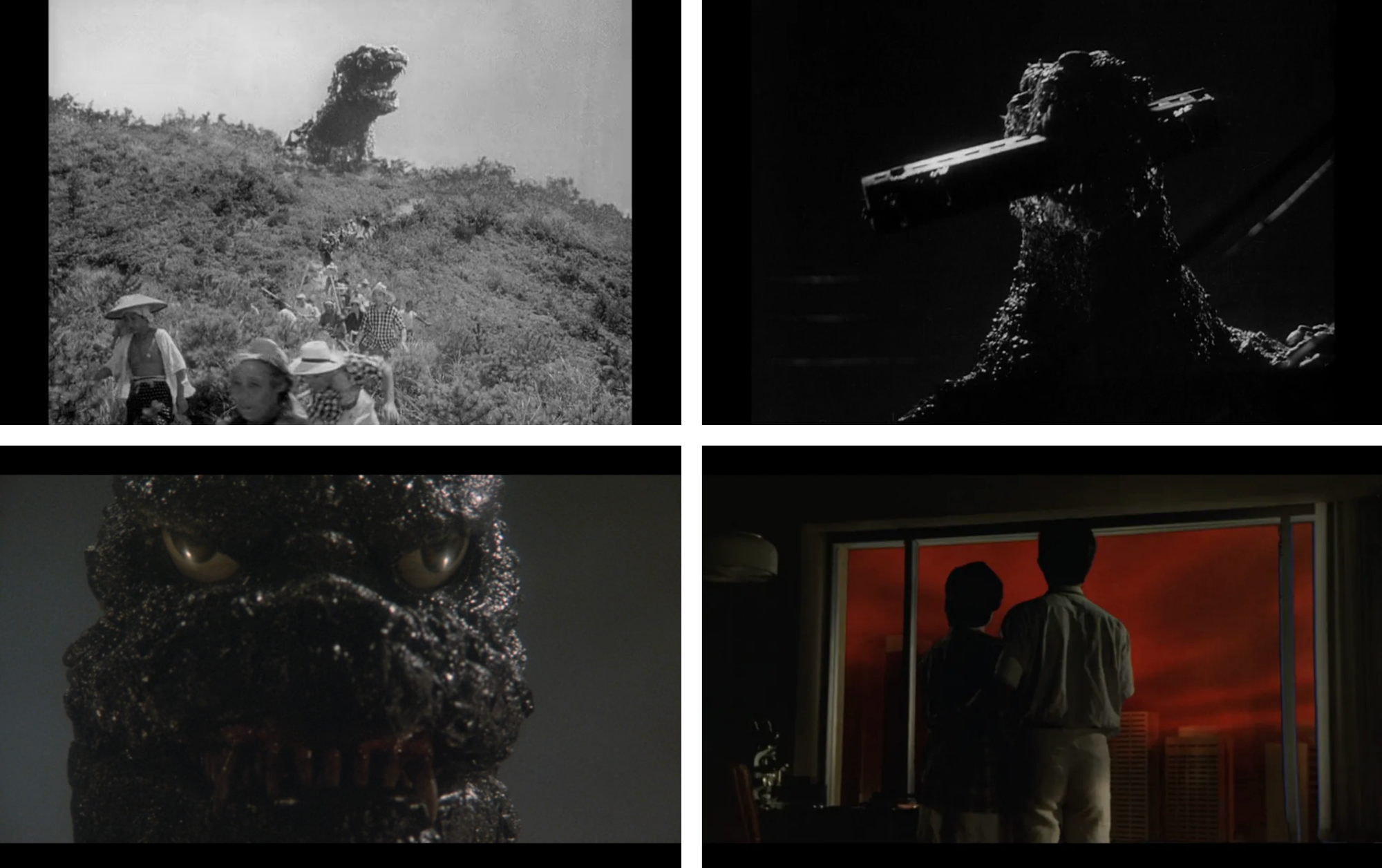
The mindlessly destructive, implacably angry Godzillas of 1954 and 1984 feel like a custom-made representation of America, the country responsible for its creation, in 2026. Godzilla loves sinking ships full of sailors. It loves recklessly attacking nuclear facilities. It loves carelessly ripping up famous architecture in the capital city. It loves spreading a trail of uninhabitable environmental ruin wherever it goes and leaving rubble in its wake. And it loves stepping on people too slow or sick or just too unlucky to get out of the way. As Return puts it, “It does as it pleases, and continually destroys.”
None of the show’s writing problems lessen the charm and vitality of the core cast. Elle Fanning, Michelle Pfeiffer, Nick Offerman, and Greg Kinnear are all excellent — adorable, infuriating, and empathetic at different times. Nicole Kidman has much less to do as their wrestler-turned-lawyer, but hey, it’s Nicole Kidman, and somehow wrestlers turned lawyers feel good in a place like this.
Thaddea Graham, however, is asked to do nothing as Susie but radiate sidekick energy, while Michale Angaro and Marcia Gay Harden are wasted on their characters’ exasperating villainy. This brings us back around to the writing. The Gables feel out of place because they’re the only characters who get to be assholes to Margo without either a) getting booted out of the story, or b) reconciling with her by the end of the next episode, or even the current one. That’s just how this show works.
Once you notice that mechanism…well, it’s a lot like that opening credit sequence. Margo gets bounced around from problem to problem that are inserted in her way expressly for her to collide with. She’s a pinball, not a person. That’s her real trouble.
The reviews are in, and Grogu is dead. His movie, anyway. The toyetic little critter popularly known as “Baby Yoda” co-stars with Pedro Pascal in The Mandalorian and Grogu. A theatrical spinoff of a Star Wars television show, one that way fewer people watched than any given Star Wars movie, was always going to be a heavy lift. By most accounts, director Jon Favreau and his co-writer, Disney Star Wars honcho Dave Filoni, have dropped it like Luke Skywalker trying to levitate his X-Wing.
I, however, am far less interested in this movie’s box-office death than I am in imagining a series of gruesome endings, perhaps thousands of them, for the little beast Grogu himself. I am not alone.
What is motivating this murderous impulse against a character who, to look at him, is no more offensive than Hello Kitty? I spoke to some of his killers to find out.
But for the most part, Tom’s trip is depicted through what we don’t see or hear. Smash cuts to black punctuate the action, which repeatedly resumes with Tom suddenly finding himself in some other place with some other character and no recollection of how they got together and then got where they currently are. From Todd’s house, to his office, to the historical society, to a meeting full of townsfolk furious with his curfew, to a meeting suddenly empty of townsfolk furious with his curfew (Tom’s only clues to their absence are dry erase marker in his hand, a message on a whiteboard, and a trashcan full of his vomit), back to the historical society, to Rosemary’s car, to a gas station, and finally to his house — he’s getting booted through time and space by the drug like he’s Billy Pilgrim in Slaughterhouse-five.
The discovery of that hidden panel and that symbol is what prompts Coop to declare that they’re on a journey to “a place both wonderful and strange.” This is as apt a description for Twin Peaks, and Twin Peaks, as I’ve ever heard. With only four episodes left in the show’s second season, which for a quarter century meant only four episodes left in total, things are getting truly mystical. We have a white wizard in the form of Dale Cooper. Now we have Windom Earle as his opposite number, a dark sorcerer. A clash seems inevitable. What wonderful and strange place will it lead us to? Will it fill us with wonder, or leave us stranded where the stars are strange?
Euphoria is, above all, an impressionistic show, in which sound and vision often shift to show us the world as not as it is, but as it feels to those living in it. In that sense, the burning tree is no different than Cassie the Topless Kaiju. An image like this, however, inspires awe of a totally different sort. In surviving the near-crash, Rue once again feels God looking out for her, and the burning tree symbolizes His presence as the burning bush once did to Moses.
Which is why the burning tree should worry Rue, not reassure her. God spoke to Moses, yes, and watched over him and his people for years. But Moses died before reaching the promised land. Everything was alright, for a while anyway, but not for the person God appeared to in flames.
During its original run, Scrubs built every single episode to a serious emotional moment. Sometimes it involved the lives of the doctors and nurses (and Janitor) who worked at the show’s Sacred Heart hospital. Sometimes it involved the lives — and deaths — of their patients. Sometimes it was both.
Either way it’s the sort of thing that would normally be death for the show itself. This is a sitcom we’re talking about, a situation comedy. If every situation were Sam Malone falling off the wagon, or Dorothy Zbornak failing to find a diagnosis for her chronic fatigue syndrome, or the Diff’rent Strokes episode with the “funny” bike shop owner, they wouldn’t be comedies anymore, would they?
This never eluded Bill Lawrence, Scrubs’ creator. I can’t speak to the man’s oeuvre since, but back then he knew that for every spoonful of sadness or schmaltz, he needed to include some of the silliest, goofiest, stupidest jokes imaginable. There’s a lot of great character-based work on Scrubs, don’t get me wrong, but if you watched the show I bet you remember The Todd’s banana hammocks or Turk’s dance routine to Bel Biv Devoe’s “Poison” as much as you remember J.D.’s long-running rivalry with his older brother or whatever.
The point is that Scrubs worked hard for its laughs. Jokes, gags, pratfalls, wordplay, cutaway surrealism, workplace humor, slapstick, guys in banana hammocks, you name it — that show tried everything to get you to laugh. And it worked! It isn’t for everyone of course, but it’s one of this century’s few dramedies, as you might broadly define the subgenre, to understand that its drama portion requires comedy ballast.
To put it another way, O.G. Scrubs understood something virtually no dramedy or comedy that gets serious or whatever has understood since: If you’re going to bastardize the sitcom format to tug at the heartstrings enough to make every episode a Very Special Episode, you’d better make me fucking laugh by any means necessary first.
Margo’s Got Money Troubles has never understood this. Sure, it’s an affable show, full of likeable characters doing vaguely amusing things, like professional wrestling, or OnlyFans modeling, or getting married in an Elvis chapel. It’s stacked to the ceiling with actors I like a lot: Elle Fanning, Michelle Pfeiffer, Nick Offerman, Greg Kinnear, Nicole Kidman. (I’ve never been super high on Marcia Gay Harden and her work here is not turning me around, but your mileage may vary favorably.) It’s about important and interesting topics: sex work, single motherhood, the death of the middle class, professional wrestling. (Sorry, I really like professional wrestling.)
But is it funny enough to sustain an episode like this one, in which Margo is put through the stations of the cross by her awful babydaddy, his ghastly mother, her hugely irresponsible and selfish parents, and the iron fist of Child Protective Services. Not on your life, buster.