
Why not celebrate by checking out my New Year’s horror resolution over at this week’s Horror Roundtable?
Sean T. Collins’s Best Things of 2007
Caveats
1. All these lists are in order of preference.
2. The comics lists are by no means intended to be a comprehensive overview. There are just so many books that came out this year that I didn’t have a chance to read yet.
3. Every year, it seems like I end up listing my favorite comics in a different way. Sometimes it’s in alphabetical order. Sometimes it’s in order of preference with no regard to genre. Sometimes it’s a no-nonsense list. Sometimes it’s with explanations. This year it’s in order of preference, separated into two different categories, Artsy and Genre-Ish. That just felt right to me. And I limited myself to 15 each.
4. The movie list isn’t comprehensive either, because I never got to see There Will Be Blood or Control, to name a couple movies I think I might have liked a lot. No limit this time–I just listed the six movies I really liked.
5. The album and song lists aren’t comprehensive either, but I say that mostly because I haven’t gotten the new Wu-Tang Clan and Ghostface Killah records and haven’t gotten a chance to really listen to the new Beirut and Jens Lekman albums. A lot of the kinds of albums you tend to see on these lists don’t really interest me. I basically listed all the albums I really connected with; for songs, I stopped at 15.
6. There’s kind of miles and miles between the first three items on my TV list, which are three of my all-time seven favorite shows, and the rest. I stopped at 10. And I’ve never watched The Wire, so that explains that. (I know, I know.)
7. A lot of the things I first experienced and really got a lot out of this year, from Children of Men to Amusement Parks on Fire’s Out of the Angeles to Matt Furie’s Boy’s Club, actually came out earlier than 2007, so I didn’t list them. It’s all about ’07 baby! Woo!
Sean T. Collins’s Favorite [Blanks] of 2007
Comics (artsy)
1. The End, by Anders Nilsen
2. Asthma, by John Hankiewicz
3. Love & Rockets digests, by Gilbert and Jaime Hernandez
4. Cold Heat, by BJ and Frank Santoro
5. Notes for a War Story, by Gipi
6. The Blot, by Tom Neely
7. Skyscrapers of the Midwest, by Josh Cotter
8. Garage Band, by Gipi
9. The Salon, by Nick Bertozzi
10. Mome, by various
11. Pulphope: The Art of Paul Pope, by Paul Pope
12. House, by Josh Simmons/Batman, by Josh Simmons
13. Johnny Ryan’s XXX Scumbag Party, by Johnny Ryan/Blecky Yuckerella Vol. 2: Back in Bleck, by Johnny Ryan
14. The Monkey and the Crab, by Shawn Cheng and Sarah Edward-Corbett
15. Uptight, by Jordan Crane
Comics (genre-ish)
1. The Immortal Iron Fist, by Ed Brubaker, Matt Fraction, David Aja, and various artists
2. BPRD, by Mike Mignola, John Arcudi, and Guy Davis
3. Captain America, by Ed Brubaker, Steve Epting, and Mike Perkins
4. All Star Superman, by Grant Morrison and Frank Quitely
5. 52, by Geoff Johns, Grant Morrison, Greg Rucka, Mark Waid, Keith Giffen, J.G. Jones, and various artists
6. Jack Kirby’s Fourth World Omnibus, by Jack Kirby
7. Jack Kirby’s Silver Star, by Jack Kirby
8. Dragon Head, by Mochizuki Minetaro
9. I Shall Destroy All the Civilized Planets: The Comics of Fletcher Hanks, by Fletcher Hanks, edited by Paul Karasik
10. Green Lantern, by Geoff Johns, Ivan Reis, Ethan Van Sciver, and various artists
11. Daybreak, by Brian Ralph
12. Runaways, by Brian K. Vaughan and Adrian Alphona
13. Criminal, by Ed Brubaker and Sean Philips
14. Daredevil, by Ed Brubaker and Michael Lark
15. The Perry Bible Fellowship, by Nicolas Gurewitch
Movies
1. No Country for Old Men
2. 28 Weeks Later
3. 300
4. Darkon
5. Eastern Promises
6. Beowulf
Television Programs
1. The Sopranos
2. Lost
3. Battlestar Galactica
4. The Soup
5. Dr. Phil
6. 120 Minutes
7. America’s Next Top Model
8. Judge Judy
9. Scrubs
10. Law & Order: Special Victims Unit
Albums
1. Underworld: Oblivion with Bells
2. LCD Soundsystem: Sound of Silver
3. Radiohead: In Rainbows
4. Robyn: Robyn [UK]
5. Muscles: Guns Babes Lemonade
6. Beirut: Lon Gisland
7. Nine Inch Nails: Year Zero
8. Klaxons: Myths of the Near Future
9. Editors: An End Has a Start
10. Digitalism: Idealism
11. Kylie Minogue: X [UK]
Songs
1. Underworld: Beautiful Burnout
2. Radiohead: All I Need
3. Gus Gus: Moss
4. LCD Soundsystem: Sound of Silver
5. Beirut: Scenic World
6. Maria Taylor: A Clean Getaway
7. Robyn: Should Have Known
8. Muscles: One Inch Badge Pin
9. Editors: An End Has a Start
10. Klaxons: Atlantis to Interzone
11. The Horrors: Count in Fives
12. Tori Amos: Bouncing Off Clouds
13. Rihanna: Umbrella
14. The White Stripes: Icky Thump
15. Kings of Leon: Arizona
Columbia/Argento
Via Fantagraphics’ Eric Reynolds we find Al Columbia’s take on Dario Argento’s Suspiria.

See the whole thing–created at the behest of an open call for B-movie-based art submissions to “a film fest that combines fantasy, sci-fi, horror, action, live burlesque and a special art exhibit sponsored by Fantagraphics Books” calledSupertrash Fest; there’s still two weeks left to submit, artists!–at Columbia’s website.
Dropping the ball
I thought that in light of tonight’s big Times Square soirée, this article by the New York Times’ Sewell Chan on filmmakers’ penchant for destroying New York City with aliens, monsters, natural disasters, nuclear war, terrorist attacks, rampant crime, marshmallow men, viral vampires, the passage of time and so on is all too appropriate. What’s more, it references The Blair Witch Project when discussing Cloverfield, thus providing fodder for my Blair Witch trend post’s lively comment thread.
One quote from the article perplexed me, however:
In contrast to “I Am Legend”–which like “The Omega Man” (1971) is based on a Richard Matheson novel–the “Cloverfield” images verge on being tasteless, [Celluloid Skyline author James] Sanders said. “They are playing on feelings not just about New York as civic symbol but on the shock of Sept. 11,” he said. “To some degree, that’s not fair ball.”
Okay, first of all, I Am Legend did the exact same thing, believe me. I don’t even think you needed to be in an opening-night screening in Union Square, listening to the uncomfortable laughter of your fellow New Yorkers as neighborhood after neighborhood and landmark after landmark is shown abandoned and destroyed, to figure that out. (Though it helped.) And Legend isn’t even the first such post-9/11 horror film to go there–Spielberg’s War of the Worlds, anybody? But the thing that really sticks out is Sanders’s assertion that playing upon 9/11 anxiety is unfair for a genre filmmaker to do. That’s really like saying it was unfair of, I dunno, Godzilla to play upon the Japanese people’s experience with nuclear war. Maybe he means that Cloverfield is crassly exploiting 9/11, but that’s not what he (or Chan, to be fair) actually said. It’s simply an unsupportable position as articulated.
(Via Matt Zoller Seitz.)
Trendspotting
For a movie with such a seismic impact in terms of marketing and production, The Blair Witch Project didn’t really inspire any other films as far as I can tell–particularly compared to the other big horror hit of Summer ’99, The Sixth Sense. So my question is this: Between Cloverfield (Blair Witch meets Godzilla), Diary of the Dead (Blair Witch meets Night of the Living Dead), and The Poughkeepsie Tapes (Blair Witch meets Hostel meets Henry), are we finally seeing the wide-scale birth of the Blair Subgenre?
And hey, did it take the rise of YouTube to ultimately make first-person docuhorror feasible?
Sadness in the Pacific Northwest
Last night me and the Missus watched the pilot and first episode of Twin Peaks (in her case for the first time!). In the opening minutes of the pilot, Laura Palmer’s body is discovered, her mother realizes she’s missing and frantically makes phone calls trying to find her, and then her father is notified of her death while speaking to her mother on the phone. As Mrs. Palmer’s screams of grief faded to black for the first commercial break I was surprised to find myself in tears. I turned to the Missus, who was similarly shaken up, and said “Wow, that was tough to watch.” She replied “I was just going to say it’s refreshing to see a murder mystery that treats the murder this way.” Indeed, I think that if the show hadn’t started this way–treating Laura’s death and its profound effect on her loved ones very very seriously–the whole thing wouldn’t have worked. Beneath all the weirdness, humor, and glamour beats an emotional heart of genuine sadness.
Thank you, TiVo programming guide info
“91 – FLIX – Evil Dead 2 – Sat 12/29 10:00pm-11:25pm – Rated R AL, GV – Horror (1987) [three stars] Bruce Campbell, Sarah Berry, Dan Hicks. Cabin visitors fight protean spirits of the dead with a chainsaw, a shotgun and Egyptian incantations. (CC, Stereo, SAP, Letterbox)”
Quote of the day
Giant flying reptiles, believe it or not, have routinely been sighted in the Olympic National Park’s rainforest in Washington State. I’ve been hearing about reports from there for decades.
–Loren Coleman, “Pterodactyl Causes Car Crash,” Cryptomundo. More here.
Thumb wrestling
The other day I noted the absence of the lauded-to-the-heavens No Country for Old Men from many a year-end best-of list, a backlash seemingly in full effect. On a related note, There Will Be Blood tops a lot of them and is on many more. Now, over the past couple of months it was tough to find a critic capable of mentioning one of those movies without mentioning the other in the same breath, if only to say “Paul Thomas Anderson will have his work cut out for him to top the Coens” or what have you. So I wonder: Does Blood‘s Christmas release date keep it in the sweet spot for the year-ender lists–smack in the first major flush of adoration, before the emperor-has-no-clothes contingent has a chance to coalesce?
Again, why?
Apparently Ted Rall decided to reprise his “King Maus” shtick with regards to the comics that have been running in the New York Times, repeating his absurd hyperbolic accusations of censorship because someplace is running the kinds of comics he doesn’t like as opposed to the comics made by him and his friends, and indulging in the sort of “altcomix are all navel-gazing stories about depressed white people for the New Yorker set” hogwash you’d expect from a Newsarama comment thread troll. Why are we acting like this argument is worth engaging? Why am I even posting about it? About the only worthwhile thing Rall’s rant has to offer is that it might make other critics think twice the next time they’re tempted to talk about how great “bombthrowing” or “just starting the conversation” is.
Video killed the Mario star, plus bonus thoughts and links
This charmingly lo-fi hack of the original Super Mario Bros. is the most hilariously mean-spirited video game I’ve ever seen. It’s really a rather brilliant Bizarro take on the basic philosophy of gaming: Instead of rewarding exploration, this game punishes it.The sadistic booby traps make that Super Mario Bros. 2: The Lost Levels thing look like a game on your nephew’s Leapfrog. When the floor dropped out from under the poor sap–that’s when I lost it. And when he eventually starts maneuvering through the level with evident fear, well, you’ll believe an avatar can cry.
Many more video clips can be found at Wiifanboy. Via the illustrious Justin Aclin.
Speaking of video games, I showed this astonishing unedited four-minute Tony Jaa steadicam slobberknocker to the Missus, who rather astutely pointed out that it’s like a video game: the guy navigates a multi-tiered environment, battling the bad guys who pop out at set intervals and benefiting from clever use of the environment they fight in.
And speaking of my ToyFare compadre Justin, Poe Ghostal has posted the final pair of interviews in his series of chats with TF staffers, photographer Dylan Brucie and Price Guide Editor/Twisted ToyFare Theater co-writer Jon Gutierrez.
The state of the beast
The father of a teen who was killed by a tiger at the San Francisco Zoo questioned the facility’s safety on Thursday, as police reportedly considered whether one of the victims taunted the deadly jungle cat.
Sources close to the investigation told the San Francisco Chronicle that police are probing whether one of the Siberian tiger’s three victims climbed over a fence Christmas Day and then dangled a leg or other body part over the moat.
Police said Carlos Sousa, 17, of San Jose was killed just outside the tiger’s enclosure. The two others, who were injured, were about 300 yards away by a cafe.
A shoe and blood were found between the fence and the moat, the Chronicle reported, and a footprint has been found on a metal fence at the zoo. The investigation is looking into the possibility that the tiger escaped by latching on to a leg or other body part, the paper reported.
“Somebody created a situation that really agitated [the tiger] and and gave her some method to break her out,” zoo director Manuel Mollinedo told the Chronicle. “A couple of feet dangling over the edge could possibly have done it.”
—“Victims may have dangled leg over tiger’s moat, says report,” CNN.com
Why?
Comicdom’s continuing enabling of Dave Sim astounds me, not necessarily because his beliefs are crazy and evil but because those crazy and evil beliefs so directly inform all his work. Actually, it’s more than that: His work is about his crazy and evil beliefs. I’m not sure why otherwise bright people would “look forward” to a comic about women by a man who espouses any number of noxious, vile, misogynist, almost paranoid-schizophrenic beliefs about women. I wouldn’t look forward to listening to an opera about the Jews by Wagner, either.
And that’s without getting into the fact that his idea of fashion-based illustration apparently begins and ends with Patrick Nagel and the design of the book’s promo piece looks like something from an RPG fanzine circa 1991.
What’s the Storey, Morning Glory?
Until Tom Spurgeon’s beleaguered site is back online, you can find his excellent interview with the excellent Cold Heat and Storeyville cartoonist Frank Santoro over at the Comics Comics blog.
Biting the hand that feeds with two sets of mandibles
I was struck by this post on Bloody Disgusting declaring new release and major Bloody Disgusting advertiser Aliens vs. Predator: Requiem “horrible crap,” because not only does it tell readers “please, please, please save your money,” it also explicitly takes a shot at the presence of AVPR advertising on the site itself. I’m just not used to that kind of candor or courage in the context of fannish entertainment news media, I guess.
Carnival of souls
* This was a neat idea: horror site Bloody Disgusting is presenting a year-end pictorial tribute to 2007’s best horror movie posters…

…and 2007’s worst horror movie posters.
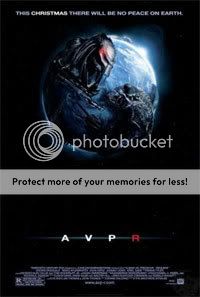
I largely agree with the selections on both ends. Down with the giant-face one-sheet!
* I Am Legend star Will Smith is angry that a recent comment of his about Adolf Hitler was misinterpreted. I know that’s the sort of response you usually associate with someone whose comment was in fact interpreted quite correctly, but Smith is really in the right here.
* It’s an Ana-Lucia Christmas: former Lost star Michelle Rodriguez has started her six-month prison sentence for violating her probation after a DUI conviction.
* Chris Mautner concludes his interview with comics critic Joe “Jog” McCulloch. Surely it’s only a matter of time before a contrarian anti-Jogger emerges?
Lost in the woods
(Warning: Mild SPOILERS follow for Twin Peaks and Lost, but really only in the form of lists of names and discussion of time frames that won’t really mean anything to you unless you’ve watched the shows and probably won’t ruin them for you if you haven’t. I certainly don’t say who killed Laura Palmer or anything like that.)
On the flight out to Colorado to visit my in-laws today I watched some of the special features on the Twin Peaks: The Definitive Gold Box Edition DVD set, an early Christmas gift. Ironically, the feature-length making-of documentary “Secrets from Another Place” makes the best case I’ve ever heard for “Season 2 sucks,” and right from the mouths of the cast and crew! I’d of course known that when the network forced David Lynch and Mark Frost to reveal the identity of Laura Palmer’s killer early in Season 2, their hearts and the hearts of many viewers were no longer into it, and I knew that the network started shuffling the show around in the schedule, causing it to bleed audience like crazy. And while I noticed both a slight dropoff of quality and the presence of new, superfluous storylines that didn’t tie into either Laura Palmer/Bob or the various schemes surrounding the Hornes and Packards–James Hurley’s road trip, the egregious Andy/Lucy/Dick Tremayne love triangle and Little Nicky business–I was so compelled by the later episodes and the deepening supernatural elements that I’ve always been a pretty staunch Season 2 defender. But “Secrets” lays out a point by point indictment of the post-“Who killed Laura Palmer?” Peaks, including a lot of stuff I either didn’t know or had never thought about in quite those terms.
* Both Lynch and Frost essentially abandoned the show to shoot movies after the first few episodes of Season 2 (Frost did Storyville and Lynch did my least favorite Lynch movie, Wild at Heart, and knowing this now makes me like it even less), leaving the creative reins in other hands. They both came back guns blazing for the final hours, but by then the show’s decline and fall with the network and audience was a fait accompli.
* The outbreak of the first Gulf War preempted the show something like six times. I always thought the time frame for the show’s collapse was portrayed as too rapid to make sense–a half a season was all it took to go from pop-culture phenomenon to the chopping block?–so the extra bumps in the schedule make that click for me a bit more now.
* The show unwisely expanded beyond its core cast to bring aboard guest star after guest star. Some of these were really just cameos, like the David Warner and David Duchovny characters, but others–Windom Earle, Annie, Evelyn Marsh, the aforementioned Dick Tremayne–ate up tons of screen time and added new elements to a show that pretty much had everything it needed in place already with its existing cast.
* It got jokey. The show was always very funny, but it wasn’t silly until you started having things like Nadine joining the wrestling team, the crusade to save the pine weasel or whatever that was, (say it with me) Dick Tremayne, and so on.
* It also started attracting performers (and presumably crew) who thought of it as a chance to “be weird,” which led to material that felt less like Twin Peaks and more like a parodic mischaracterization of it. Lynch, of course, never chooses to be weird–he simply can’t help it.
* The creative team waited too long after the revelation of Laura Palmer’s killer to introduce the second major antagonist, Earle, losing a lot of momentum. And when he did show up he was in the jokey/self-consciously scenery-chewing weird mold of late Peak, until perhaps his final episodes, where his old, erudite wild-man demeanor was finally harnessed as a frightening counterpoint to Cooper’s young, intuitive straight-shooter.
Anyway, I was thinking about all of this in the context of another Christmas gift, Lost: The Complete Third Season. It seems like at a few key points, Lost zigged where Peaks zagged. First and foremost there’s the brilliantly portrayed late-innings antagonist, Ben. I’ve said for a long time (and online, too, though I can’t find the post) that it’s hard to imagine how hard a hit the show would have taken had that character been written or played too broadly. In Kenneth Welsh’s Windom Earle we have just such a counterfactual example.
Also, after they were forced to reveal Laura Palmer’s killer, the creators of Twin Peaks basically gave up. As someone in the making-of doc put it, that was the spine of the show, and they had nothing to immediately replace it with; it was several crucial weeks before the magnitude of the Black Lodge issue became apparent, and by then it was too late. By contrast, Lost always has a whole new vista open up every time they pull the camera back to reveal the mystery at hand. You might find the new mysteries less interesting, but they’re at least there, and usually there’s a lot of them, and they tend to blow things wide open. Just think of how little we really knew about anything when the credits rolled at the end of Season One, and the explosion of information we received over the course of early Season Two. Hell, I think we’ve only just seen the show’s Bob figure for the first time. This is not to say Lost never falters with its reveals–relegating the origin of the Numbers to that stupid ARG is almost unforgivable–but it learned from the fate of Peaks (by the creators’ admission) to always have something else in store anytime a question is even close to answered. And to go to the mattresses with the network if need be, which was perhaps the most valuable lesson Twin Peaks ever taught anyone.
Thumbs down, part 2
If you click around the Top 10 film lists linked to by Matt Zoller Seitz and Green Cine Daily, one title that comes up a lot less often than you might expect it to–strikingly less often in fact–is No Country for Old Men. It’s backlash time, apparently.
Thumbs down
This week’s Horror Roundtable is about our least-favorite horror experience of 2007. There’s an obvious pun on that experience’s title I could make here but won’t.