Carnival of souls

* Today’s Strange Tales Spotlight: Jonathan Jay Lee. You might not have heard of him before–I hadn’t–but his work sure looks lovely.

* Beware the savage lure of Matt Wiegle’s 1984.

* Get this: Two Kentucky librarians refused to allow an 11-year-old to check out The League of Extraordinary Gentlemen because they thought it was “pornography”…and they got fired for it! Regardless of the wisdom of letting your 11-year-old read Alan Moore’s Mina Murray/Allan Quartermain May-December fanfic, you have to admit it’s delightful to see the kinds of nitwits who’d label this book “pornographic” get shitcanned for it.

* I’m not reading this until I see the movie, and god only knows when that will be (The Hurt Locker, A Serious Man, Zombieland, etc.), but for what it’s worth, the estimable Rich Juzwiak has titled his review of Paranormal Activity “Believe the hype”.

* I read Devin Friedman’s GQ profile of Von Dutch/Ed Hardy mastermind Christian Audigier in the pharmacy yesterday and realized that if you combine it with The New Yorker‘s James Cameron profile and Bronson Pinchot’s (ongoing!) tell-all interview(s), you get a sort of group portrait of contemporary Hollywood awfulness. (Pinchot link via Whitney Matheson.)

Carnival of souls

* Over at Robot 6, I pointed out the Frank Miller/Victor Davis Hanson connection (via Rodrigo Baeza), linked to the Kramers Ergot 7 minicomic (via Blaise Larmee), and continued riding the Con War train into Pulitzer Junction.

* Today, my Marvel.com Strange Tales Spotlight shines on Jay Stephens.

* And eff it, I’m linking to my interview with Brian Chippendale for Providence’s website one more time. If n’ Oof is going to be 700 pages long, did you know that?

* TJ Dietsch’s list of The 12 Weirdest Horror Movie Theme Songs at Topless Robot is solid gold. I figured nothing would top Burt Bacharach’s “Beware of the Blob,” but then I didn’t count on “The Ballad of Harry Warden.”

* Kristin Thompson presents Hollywood blockbusters: weapon against the trade deficit!

* Real-World Horror: A group of prominent pop and rock musicians have joined together to demand that their music stopped being used to torment prisoners at Guantanamo Bay. No one saw the irony of using “March of the Pigs” to torture people?

* Wow, that really is a great Nova sketch.

* Finally:

Its a wild world. You can travel to the US city of your choice with your cowboy hat and your stirrups and have a gun fight in a back alley. You can sign up with Blackwater Inc and go murder woman and children in Iraq and get good health benefits as well. Grab a job at the Pentagon or a private firm piloting robotic drone bombers in Afghanistan, 10 points for a grandma! 20 for a pregnant lady! You might even hit a Terrorist! Air conditioned office, ergonomic chairs, free coffee! Hell, sign up to print those huge signs that folks with lots of extra time and solid legs hold outside of family planning clinics, photos of bloody, melted, gnarled, oozing aborted fetuses. Drive home after a long hard day of life-saving life-affirming work to eat a good rare steak, dripping red juice. Beat your kid. Feed the dog. Swing by the church to check out the choir boys. You can sleep under a bridge with homeless families near a halted condo development, or you can peep under a different bridge to see a sanctioned village of sex offenders, each with a scarlett letter stamped on their forehead. You can pray in a circle of your friends around your sick daughter as she dies of treatable diabetes, a display of failed Magic/Kung Fu. You can listen to radio hate-seller Rush Limbaugh spew violence that we can only hope will turn inward on his vacant icy soul, causing a massive, prolonged, agonizing heart attack. His already bloated body writhing in an unseen torture, as his inner demons “blow off some steam”. He can broadcast the grunts, the groans. I will turn on my receiver, I will amplify his final address, the hospital gets caught up in paperwork but he will live on in some fashion.

And that, ladies and gentlemen, is how Brian Chippendale begins his review of The Hands of Shang-Chi, Master of Kung Fu #34.

Gossip Girl thoughts

* Blair’s All About Eve dream sequence marked the Gossip Girl debut of Vanessa’s cleavage. Let’s hope it’s a recurring role!

* Not to be outdone, Chuck makes his first appearance in a purple paisley bathrobe. For those keeping score at home, Prince is now the second-coolest man to (presumably) have worn this garment. And Chuck is two-for-two for sleepwear this season.

* I was pretty impressed with the poker storyline. Clearly they’re going to keep the “schemes” portion of the show as larger-than-life as Chuck and Blair’s earlier anti-Carter machinations would indicate. Betting for a man’s life is about as big as it gets.

* Blair listed Mao as one of the philosophers she wanted referenced in her speech? Alert Glenn Beck!

* Despite getting off to an auspicious start, Vanessa was really loathsome in this episode. That was some bush-league psych-out stuff from her regarding Olivia, Dan, and the speech. With each scene she dug herself deeper, fucked over her supposed best friend for no reason even worse, and made me hate her more. And it wasn’t just her that was annoying, it was the whole mix-up storyline, which is the sort of thing I almost physically can’t stand. Cleavage pass revoked, Vanessa.

* And here’s the funny thing: The kind of behavior that makes you hate Vanessa makes you love Blair. “You really think you’re that much better than me?” “Oh, I think we both know the answer to that?” We sure do, Blair!

* She was so horrible that I kind of enjoyed that her mom was even more insufferable than she was, to the extent that it made her life worse. Mom walking in to hear Vanessa declare how much she hates her was just icing on the schadenfreude cake.

*Related: By all means, Gossip Girl writers, lay shit like “He’s installing the solar panels on the chicken coop at the co-op” as thick as you please. In the Gossip Girl world, that is of course the only lens through which progressivism could possibly be seen.

* That said, Vanessa’s instantaneous reaction to her mom blowing her off at the coffee place was beautifully acted by Jessica Szohr, and actually moving. The Missus and I just turned and looked at each other and made sad faces, which is saying something given that we’d spent the whole episode hoping they’d kill her off.

* Okay, okay. I know what you’re really here for. And yes, the Chuck-on-dude kiss was a cop-out. (I wanted tongue, goddammit.) But here’s the thing: The lead-in and follow-up were sooooooooooooo magnificent that I couldn’t stay mad if I tried. Chuck’s affirmative smile and nod when Blair revealed the target was a guy and asked him if he was still up for it…”Can I help you?” “Oh, definitely.”…”You think I’ve never kissed a guy before?” Hoyay to the UNNNNNNNNF power. Chate shippers, there’s still hope!

Carnival of souls

* At Robot 6, I continue to be the Ben Urich of the Con War.

* Is the $3.99 price point on certain Marvel and DC comics hurting post-launch sales? I’d add two other questions: Does Marvel’s method of raising the price on its “important” books cannibalize mid-list sales? And does DC’s method of adding back-ups starring B-list characters to justify its price increases move the needle one way or the other?

* This week’s “best of the horror blogs” round-up at The League of Tana Tea Drinkers focuses on bloggers’ favorite horror novels. I’ve got a couple links in there for the curious.

* Every interview should be like The Onion AV Club’s Bronson Pinchot interview.

Comics Time: Slow Storm

Slow Storm

Danica Novgorodoff, writer/artist

First Second, 2008

176 pages

$17.95

Buy it from Amazon.com

This is like half of a good book. The visual half, for the most part. Danica Novgorodoff’s story of a Kentucky firefighter and the undocumented Mexican worker she kinda sorta befriends after a fire claims the stable he tended is a stunning-looking thing. She has a wiry line that often suggests handwriting, with all its idiosyncracies, so that the occasional wonky scale or perspective seems like (or can be passed off as) a deliberate choice. Individual moments beam out a little Taiyo Matsumoto, a little Ralph Steadman, a little Gerald Scarfe, only with the dial turned from savage to lilting. And her watercolor coloring takes a limited palette of greens, browns, grays, and oranges and fleshes out the artwork so lushly I barely even realized just how few colors she limited herself to in the first place. It’s in the moments where she really draws with the colors–a creek, a tornado, the omnipresent cloud and fire motifs–that the book comes alive.

But its in moments where the dialogue takes the lead where it sputters. Frequently too portentous–every conversation creaks under the weight of capital-M Meaning–it fails to convince us of firefighter Ursa’s shattered psyche, so that when she perform’s the book’s central act it feels like a horrifying, selfish overreaction. Which, granted, it’s supposed to feel like, but you’re also supposed to think “okay, I could see where that came from,” whereas I just thought “Christ, what a fucking maniac.” Ditto her behavior during the event’s fallout, which adds “asshole” to the equation. Meanwhile, Rafi, the Mexican immigrant, is laden with poetic visions of saints and white horses–it’s just laid on too thick. The key for Novgorodoff (an Isotope winner and Eisner nominee who clearly doesn’t need any advice from me but what the hey) will be to scale back her swing as a writer and tell a story as understated as her art is sweeping.

Carnival of souls

* Perhaps the best way to describe Dana Goodyear’s instant-classic New Yorker profile of James Cameron–and describing it doesn’t do it justice at all; you simply must read it–is to say that after reading it, you’d find suggestions that the rig in which Cameron sits in the picture below is either a movie prop, his directing rig, his personal mode of transportation, or a throne upon which he insists on sitting during meetings with studio executives all equally plausible.

* Not as long, and more intro-level, but almost as interesting, is Brian Rafferty’s Wired profile of Tim Heidecker and Eric Wareheim of Tim & Eric Awesome Show, Great Job! I’ve talked about maybe writing something lengthy about Tim & Eric around here in the past, but I’m frankly daunted. I don’t think they’re done having whatever effect it is they’re having on how I look at art yet; I get the hunch it could be eventually be measured on the same scale as my discovery of Velvet Goldmine and David Bowie in late 2000. The Missus and I compare them to Monty Python and mean it.

* Tom Spurgeon’s right: It is fun to yell “Con War.” I like to do it in the voice of Jack White doing his “Conquest” cover. Anyway, Spurge interviews NYCC’s Lance Fensterman, as does Kiel Phegley, about the now open hostilities between Reed Exhibitions and Gareb Shamus Entertainment. Fensterman points out something I’d missed, which is that Shamus’s Toronto show isn’t just a rival to Fan Expo, but to the Reed co-sponsored Penny Arcade Expo East, directly against which Shamus scheduled the Tornoto show; he says they saw this particular move coming in that light. And to Spurge’s credit, he explicitly asks Fensterman about alleged Shamus/Wizard misconduct, reports/rumors of which have been circulating off the record for several months now. Fensterman doesn’t take things much further than that, though he asserts that Wizard inflates its attendance numbers in his interivew with Kiel. I wonder who will be the first to talk on the record about some of the other allegations making the rounds.

* Meanwhile, Heidi MacDonald’s photo parade proves that sometimes a picture really is worth a thousand words:

* Over at Robot 6 I put in my two cents on Sandy Bilus’s 100 Best Comics of 2008 meta-list, an excellent mathematically derived list that rose phoenix-like from the ashes of the late great Dick Hyacinth. Sandy chimes in in the comment thread with some interesting info about the list’s Number One, so do check it out.

* Dude. Dude. Dan Nadel writes about Happy Hooligan. Look at it, dude. They face the audience. They face the audience! What a motherfucking eureka moment this is for me, I really can’t even begin to tell you. They face the goddamn audience!!!

* At first it seems like David Allison’s piece on Inglourious Basterds and Hitler riffing is out to hoist me by my own petard, but that’s mostly a headfake to illustrate how what Quentin Tarantino is up to in his movie is quite different from revisionist trivializing.

* Is this the perfect Monster Brains post? MB’s Aeron Alfrey digs up a Fangoria reader-participation “design the alien for John Carpenter’s upcoming remake of The Thing art contest from 1981. Pure delight.

How does this keep happening?

Draw a line in the sand, comics. Draw a line in the sand. (Via Heidi Mac.)

Sometimes I despair

Sometimes Victor Davis Hanson despairs, too, mostly over the surfeit of homos and hip-hop and liberals and such sullying the beautiful pop-culture of our grandparents. But fortunately, sometimes Frank Miller shows up in his comment thread to cheer him up. Does that “he is the hero” Chandler quote get invoked? You bet your ass it does.

Utterly amazing. (via)

Comics Time: Driven by Lemons

Driven by Lemons

Joshua W. Cotter, writer/artist

AdHouse, September 2009

104 pages, hardcover

$19.95

Buy it from AdHouse, eventually

Buy it from Amazon.com

So yeah, this is pretty much the ideal Josh Cotter comic for me. Didja like the bizarre, symbol-laden wordless reveries of Skyscrapers of the Midwest? Here’s a whole book full of them! This shit makes the locust/migraine sequence from Skyscrapers #2 look like Dilbert! What’s it about? In large part, who cares? Like (in my experience) most great comics, it’s about how, and what, it makes you feel. It makes me feel like one of those ’80s special-effects sequence where some being’s exterior shell is chipping away and beneath each chunk that falls off a blindingly bright white light shines out like a beam–like that’s basically what Cotter did to his own brain to produce this thing, and like that’s what you run the risk of if you stare too long.

That’s essentially what Cotter does, visually, over and over again throughout the book: Something will cause one of Cotter’s nominal protagonists (anthropomorphized Life in Hell bunnies, pretty much) to spew forth from his person an amount of visual information that totally overwhelms them and the page itself, scribbled and scribed like a Charles Crumb notebook, and at one memorable point caked/painted with watercolors squeezed straight from the tube. In that light, and considering the first section’s apparent Chicago setting and slow evolution into comics from a straightforward-ish stream-of-consciousness prose-plus-doodles diary format, it’s tempting to read the book as some sort of autobiography: a story of the onset of, treatment of, and recovery from mental illness. For what it’s worth, I interviewed Cotter about his life and work at length for The Comics Journal and such an incident never came up, though I could have just whiffed on it. If I’m wrong, so much the better for Cotter, because having dealt with the mental-health institutionalization of two people very very close to me, this is about as accurate a representation of what I always pictured going on in their heads as you’re gonna find. Noise, blotting out signals and forming its own.

Glorious noise, too. For all of the books insular inscrutability, several passages here stand out with an effect as awe-inspiring as a great visual effects sequence in a blockbuster by some genuine Hollywood visionary. The paint explosion. The great cloud of scribble, with sensuously tangled lines looking like they’ve somehow been carved through other lines. The marvelously reproduced, bright reds and blues representing warring states of mind, popping off the off-white pages like 3-D. (The whole book, a facsimile of Cotter’s sketchbook, is really an astonishing work of design by Cotter and Chris Pitzer.) The forward momentum of the chase sequence, with two bunnies battling for supremacy in frame after Haring/Muybridge mash-up frame. An eruption of a column of red that rockets into the sky so powerfully you can practically hear the noise. And a creepy cameo by the mad god Dionysus, quoting the soundtrack from the animated Transformers movie, rings out as a reminder of madness after all is said and done like that dissonant shot of the cab’s rear view mirror at the end of Taxi Driver.

Outstanding work. Where the hell does he go from here?

Carnival of souls: Special “Carnival of Sean” edition

* I’m pretty happy with this interview I did with Brian Chippendale for Providence’s arts/tourism website. What a fascinating guy.

* My Strange Tales Spotlight interview with Stan Sakai was a lot of fun, too. Samurai Hulk!

* I’ve been keeping pretty busy at Robot 6 now that the post-Anaheim/C2E2 “phony war” phase of the Reed/Shamus conflict is over and the Blitz has begun. Here’s my latest Con War report, featuring reactions to the now-completed Big Apple Comic Con over the weekend. Earlier reports are here and here.

* Elsewhere at Robot 6, I wrote an obituary for the late George Tuska, gave shoutouts to Vice’s Where the Wild Things are comics gallery and Marc Silvestri & Whilce Portacio’s Filipino flood relief charity auction, and revealed what I’ve been reading.

* And I can’t find it on Marvel.com yet, but the latest episode of What The–?! is up. What do you mean, “to play us out”?

* Jeet Heer calls for the creation of a “proto-graphic novel” master list. Seriously, it really would be nice to gather all such titles all in one place. I’d love to see “graphic novel” be fairly generously defined in such a list, too, because the purpose should be comprehensiveness rather than orthodoxy. In other words, Milt Gross and “The Monster Society of Evil”–come one, come all!

* I love the idea that I am in some way responsible for making Kiel Phegley appreciate He-Man and the Masters of the Universe. I also love Poe Ghostal’s list of five incredibly obscure MotU characters he’d like to see made into toys for the first time, which I found courtesy of Kiel.

* Check out Rickey Purdin’s Big Apple haul. I really can’t get over getting Acme #19 for four measly American dollars.

* CRwM’s epic game-theory march through the Saw franchise continues. Brilliant.

* Ceri B. walks us through the lair of the silithids, a sentient insectoid race wreaking Lovecraftian havoc in World of Warcraft. The still-twitching limbs of a long-dead beast so big it could pass for a geographical feature are a marvelously disgusting touch.

* What have we here, Kevin Huizenga?

*Renee French. Jiminy Christmas.

Before everyone gets all Rich Johnston breathless about this

I know the last time this happened this was a bizarrely controversial point to make, but can we please agree this time around that if your convention gets closed down by the fire marshal, it’s not a sign of success, it’s a sign that you should have planned your convention better?

Comics Time: Abstract Comics

Abstract Comics

Andrei Molotiu, editor

R. Crumb, Victor Moscoso, Spyros Horemis, Jeff Zenick, Bill Shutt, Patrick McDonnell, Mark Badger, Benoit Joly, Bill Boichel, Gary Panter, Damien Jay, Ibn al Rabin, Lewis Trondheim, Andy Bleck, Mark Staff Brandl, Andrei Molotiu, Anders Pearson, Derik Badman, Grant Thomas, Casey Camp, Henrik Rehr, James Kochalka, John Hankiewciz, Mike Gestiv, J.R. Williams, Blaise Larmee, Warren Craghead III, Janusz Jaworski, Richard Hahn, Geoff Grogan, Panayiotis Terzis, Mark Gonyea, Greg Shaw, Alexey Sokolin, Jason Overby, Bruno Schaub, Draw, Jason T. Miles, Elijah Brubaker, Noah Berlatsky, Tim Gaze, Troylloyd, Billy Mavreas, writers/artists

Fantagraphics, 2009

232 pages, hardcover

$39.99

Buy it from Fantagraphics

Buy it from Amazon.com

Visit the Abstract Comics blog

One of the pleasures inherent in anthologies is the way proximity draws out the contrast between successful and unsuccessful work. One of the unique pleasures of this anthology is how that success or lack thereof can be determined not just by the subjective standards of the reader but also by the ostensibly objective standards of the anthology itself. In his introduction, editor Andrei Molotiu defines abstract comics thusly:

What does not fit under this definition are comics that tell straightforward stories in captions and speech balloons while abstracting their imagery either into vaguely human shapes, or even into triangles and squares. In such cases, the images are not different in kind, but only in degree, from the cartoony simplification of, say, Carl Barks’ ducks….While in painting the term [“abstract”] applies to the lack of represented objects in favor of an emphasis on form, we can say that in comics it additionally applies to the lack of a narrative excuse to string panels together, in favor of an increased emphasis on the formal elements of comics that, even in the absence of a (verbal) story, can create a feeling of sequential drive, the sheer rhythm of narrative, or the rise and fall of a story arc.

True, none of the comics featured here use (legible) captions or speech balloons. But as Molotiu’s subsequent emphasis on “images” implies, the lack of text is incidental to the more fundamental lack of narrative or story. It’s by that petard that several of the strips Molotiu selects are hoisted. The contributions from Ibn Al Rabin, Lewis Trondheim, Andy Bleck, and to an extent Mike Gestiv and Bill Shut all rely precisely the sort of “difference in degree” Molotiu warns about–in their comics, abstracted shapes perform actions based on recognizable, and in some cases quite clearly depicted, physical motivations and even emotions, just like the “triangles and squares” we’re told may as well be Uncle Scrooge. These strips are cute, but not exactly challenging, and far from abstract.

But the successful strips in Abstract Comics prove that comics need not depict emotions to pack an emotional wallop. Indeed, part of my long-held enthusiasm for this project stemmed from my suspicion, based on steps (small and giant alike) in the direction of abstraction during this decade by such alternative comics artists as Kevin Huizenga, John Hankiewicz, Anders Nilsen, Josh Cotter, and Frank Santoro, that abstract comics stripped completely away from their narrative moorings–abstract comics “in the wild,” as it were–had the potential to generate emotional content of enormous power. What I didn’t expect was just how…I don’t know, idiosyncratic my reaction to such comics would be.

For example, I’ve already described how the more openly narrative works contained here elicited a chuckle but not much else. What’s interesting to me is how the sorts of shapes used by those artists–outlined blobs, for the most part–left me cold even in purely abstracted form. The squiggles of Elijah Brubaker, the whorls of James Kochalka, suggest a warmth and an airiness I’m just not tuned into at all. I’m not a curve man, it turns out. Meanwhile, I’m equally unaffected by strips that eschew drawing sharp contrasts from image to image and panel to panel, either by muting the differences between juxtaposed visuals (Warren Craghead, Richard Hahn, Janusa Jaworski) or by weakening or eliminating the parametric framing and structure provided by panels (Noah Berlatsky, Billy Mavreas, Troylloyd, Tim Gaze, Bruno Schaub).

What I am interested in, it appears, are angles. boxes, cold geometry. Jason Overby’s “Apophenia” is perhaps my favorite comic in the whole book: Beginning with a grid of penciled-in panel borders containing nothing at all, it proceeds to flash various sharply carved shapes into panels at random intervals like sudden words emerging from a haze of silent static, or subliminal messages erupting from a blank screen. Mark Goneya’s “Squares in Squares” is just that, panel after panel of brightly colored squares surrounding one another like an infinite regression, their position within the panel shifting slightly to slow our eye’s descent into the abyss. Mutts creator Patrick McDonnell’s untitled, college-vintage contribution uses a repeated bisected-circle motif in black, white, and watercolor-blood red to suggest cold sunrises and magisterial eclipses. And Spyros Horemis black-and-white concentric circles and swirls practically glow off the page with the force of an optical illusion.

I’m also interested in a sense of awe and scale. Molotiu’s own excerpts from The Cave overwhelm with bright colors and massive slopes that dwarf panel borders and seem to escape his control, like a microscopic process blown up to IMAX size or a projected filmstrip set on fire. Henrik Rehr’s “The Storm” is as aptly named as was “Squares in Squares”: Great waves or windgusts toss us to and fro across black backgrounds, sending tiny offset panels scattering like leaves. Alexey Sokolin’s “Life, Interwoven” sees its panels slowly overwhelmed by furious black scribbling, like a diary of a madman, until it not only totally blots out the grid but appears to topple it over.

And sometimes I’m like John Cleese’s pope: I may not know art, but I know what I like. I like the loneliness of Blaise Larmee’s tiny, shaky, frail, incomplete rectangles against their off-white background in his Nilsenesque “I Would Like to Live There.” I like the humor of Geoff Grogan repeating a bullseye motif until the laugh-out-loud punchline photo of a woman’s nipple in “Bullseye.” I like Jason T. Miles creating shapes out of chunky, semi-monstrous black and white lattices–Brinkman Blocks, if you will–then signing it with a great big clumsy JASON T. MILES in “Mainstream Blackout.” I like the implied sequentiality of Mark Badger following up a pencil-sketched “Kung Fu” strip from 1980 with a boldly colored remake of the same strip from 2008. And I like the pure psychedelia–in the information-overload sense–in R. Crumb’s “Abstract Expressionist Ultra Super Modernistic Comics,” drawn, laid out, and even titled as though attempting to get it down on paper winded him.

So. By my count I liked, mmm, about half the book, give or take a couple strips. And there are potentially fruitful paths that remain largely untrodden. For example, I know Molotiu has been doing yeoman’s work on carving out a space for nonnarrative comics for years because I remember jostling with him a bit about on the Comics Journal messageboard following the release of Kramers Ergot 4 in 2003; however, the work of Fort Thunder and its fellow travelers, showcased so memorably in Sammy Harkham’s anthology, isn’t represented here (unless you count their spiritual godfather Gary Panter). Meanwhile, Crumb and Larry Zenick excepted, the use of representative figures in an abstract way is elided here; I wish Molotiu had selected one of John Hankiewicz’s enormously effective strips in this style rather than the comparatively staid and painterly contribution we see here. And for my money, the sequencing peters out toward the end–I’m not sure what I was supposed to take away from the final strips, rather formless black and white affairs. An editorial focus not so much tighter as tweaked, I suppose, is what I’m looking for.

But what I liked! What I liked, I liked for more than just the strips themselves–I liked them for the proof they offer that comics really is still a Wild West medium in which one’s bliss can be followed even beyond the boundaries of what many or even most readers would care to define as “comics.” That an entire deluxe hardcover collection of such comics now exists is, I think, one of the great triumphs for the medium in a decade full to bursting with them. And even if the book’s existence is ultimately more impressive than the sum total of its contents, it strikes me as churlish to complain.

Links of the day

Begun, the Con War has.

Carnival of souls: Special belated edition

* This was supposed to go up yesterday and didn’t for some reason. Beats me!

* SLG’s Dan Vado and (even more to the point) Street Angel‘s Jim Rugg both disagree with my insinuation the other day that SLG didn’t do right by Street Angel. Thanks for the clarifications, guys!

* I know I’ve disagreed with some of the Are You a Serious Comic Book Reader? gang’s positions on alternative comics, but while there’s some stuff I think they get wrong, I’m really enjoying what they get right: an attitude of wide-eyed discovery and awe when it comes to reading cool comics with little attention (digs on traditional altcomix aside) paid to tribal allegiances. Dig, if you will, Brandon’s post on Joe Casey and Nathan Fox’s sleeper sensation Dark Reign: Zodiac (man, Casey’s work really takes off when he’s paired with a good artist–seems like a truism I know, but for serious), or Sammy’s Baltimore Comic-Con haul report (Tatsumi belies the anti-literary comics stance somewhat, no?). I do think, from time to time, that my reliance on book-formatted comics–really my weapon of choice no matter what genre you’re talking about–causes me to miss out on some weird and wild finds out there. Maybe I do need to go longbox-diving at a show at some point–I hope I get half as much out of it as the Serious Comic Book Readers seem to.

* Continuing his recent hot streak, And Now the Screaming Starts’ CRwM applies game theory to the deathtraps in the Saw series. I haven’t seen a single Saw movie (which, as we know, makes me a terrible horrorblogger) and I still think this post is epically awesome.

* Bookmarked for later use: Eve Tushnet reviews Paranormal Activity.

* The best thing about my chum Ben Morse’s post on the titles he’d have revived for DC’s Blackest Night skip-month stunt is that several of them are actually more plausible candidates than the ones that are actually getting revived. JLI is practically a no-brainer.

* Robot 6 roundup: Michael Jackson wrote a graphic novel and Jon Favreau’s not directing The Avengers.

Carnival of souls

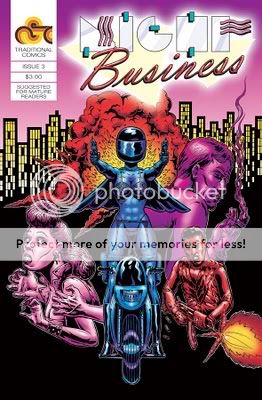
* Absolute must-read of the day: Curt Purcell interviews the living shit out of Night Business and Gangsta Rap Posse creator Benjamin Marra. Marra throws bombs left and right, and names are named. Where most “indie comics are wishy-washy autobio crap” provocateurs take jabs at Clumsy or “My Sex History,” Marra comes gunning for Maus and Jimmy Corrigan. Shit gets REAL, son. (For the record I strongly disagree with his assertions in that regard, though the stance feels performative, of a piece with his comics themselves.)

* The Expendables trailer! Stallone, Statham, Li, Lundgren, Rourke, Austin, Couture, Roberts…magnificent and utterly ’80s. It’s like if you added a bunch of ampersands to Tango & Cash. Get it while it’s hot–Lionsgate has been yanking ’em down. (Via Topless Robot.)

* Afrodisiac trailer! In the words of Clay Davis, sheeeeeeeeeeeeeeeeeit. I’ve seen the book and it’s as good as it looks. It’s awesome to see Jim Rugg and Brian Maruca at a publisher that knows what to do with them. (Via AdHouse.)

* In this quick piece Tom Spurgeon hints at one of my big concerns engendered by the cancellation of Vito Delsante and Rachel Friere’s high-school dramedy FCHS: What the heck kind of business are we in where a project like that can’t find an audience? This isn’t John Hankiewicz’s Asthma we’re talking about, it’s a book described by the creators as “90210 meets Archie.” Something’s very wrong here.

* Nick Bertozzi talks to CBR’s Alex Dueben about a lot of things. Apparently he took his Stuffed! gig as a response to editorial feedback that his own comics are too complex, which is fascinating to me. There’s also an update in there about his long-gestating Lenny Bruce bio with Harvey Pekar. And he feels like choosing to do comics at age 27 makes him a late bloomer, which strikes me as a deeply unfortunate consequence of the premium placed on youth in this medium. We could use more late bloomers like Nick Bertozzi!

* Geoff Johns As readers’ Qs at CBR. Black Manta!

* I’m really happy that Brian Bendis and Mike Oeming’s Powers is coming back–like Ultimate Spider-Man, it’s been really good for a really long time even as some of Bendis’s more high-profile projects have left me flat, but its erratic schedule has pushed it even further off most people’s radar than USM. Here’s a report on the books’ 10th anniversary panel at the Baltimore Comic Con. Wow, ten years of Powers, and ten years of Planetary too, right? Those two books anticipated pretty much this entire decade. (Well, maybe more The Authority than Planetary.) The modern age of superhero comics is getting old.

* Comics Journal assistant editor and smart person Kristi Valenti talks about comics and comics criticism. (Via Tom Spurgeon.) This paragraph is killer:

You can use academic and critical tools to critique comics, such as close readings, theory, and thorough research. I think, though, that there’s a lot of what I dub “bad academia” going on: people who don’t bother to learn the material and technological history behind how comics were produced (fortunately, there are now excellent sources such as Men of Tomorrow and The Ten Cent Plague for that), so they don’t put comics in the proper context–theory for theory’s sake, divorced from the actual comic; bad comparisons based on lack of breadth of knowledge (Johnny Ryan is like Chris Ware, because they’re both alternative); people who feel guilty or ashamed for liking comics, and so use their academic credentials and training to justify it, or people who have a pet area of study and use comics to justify it (Blackest Night is like Paradise Lost); etc.

* Rickey Purdin’s doing a month of horror sketches again. Yay!

* If you ever want to know why the world is in such shitty shape, just remember that people in positions of authority, like government officials and newspaper reporters, don’t have the first fucking clue what they’re talking about.

Comics Time: Sulk Vol. 3: The Kind of Strength That Comes from Madness

Sulk Vol. 3: The Kind of Strength That Comes from Madness

Jeffrey Brown, writer/artist

Top Shelf, September 2009

64 pages

$6

Buy it from Top Shelf

Buy it from Amazon.com

I still don’t get where this whole “Jeffrey Brown can’t draw” thing comes from. I mean sure, if your standard for artistic excellence is Neal Adams or something, you’re gonna be like WTF, but as always I’m ignoring those people and talking about altcomix fans who should know better. I’ve said this before, but compare the work of Brown (full disclosure: I like him a lot personally) to that of any of the ultra-lo-fi slice-of-life humor/pathos diarists who’ve emerged in his wake and he’s just doing so much more–with how he arranges space in his panels; with how he adds line upon line for shading, depth, and detail; with the expressiveness of his characters; with how even his action pastiches are genuinely dynamic and fun to follow; with how he bounces from genre to genre with the same “here’s something I thought was funny about this topic” good humor. Especially in the outright humor stuff, he’s like your funny friend bullshitting.

That’s not necessarily to say that everything he does is for everyone. As in previous genre-parody works like Incredible Change-Bots, the sci-fi/action/fantasy hodgepodge of Sulk #3 presupposes simultaneous knowledge of, affection for, and skepticism of the kinds of stuff he’s swiping from/at, plus (obviously) an appreciation of Brown’s visual approach to the material. It’s an acquired taste: The ribbing might be too gentle for people who wanna see an indie stalwart get some yuks at the expense of elves and unicorns, while the irony might be tough to stomach for po-faced “new action” fans. Indeed I think the reason why Brown’s Bighead books (including Sulk #1) are the strongest of his work in this area is because this kind of parody is more familiar with superheroes than with any other subgenre; you can “get it” easier than you can when you’re dealing with pirates or D&D or Godzilla or boy geniuses as you are here. Meanwhile the MMA-based Sulk #2’s 80-page fight scene was easy to grok as an exercise in ways drawing combat and writing the combatants’ interior monologues. The anchor point in The Kind of Strength That Comes from Madness is much harder to locate.

I suppose it just comes down to what you think you might want to see in a comic. Do you want to see an adorable, realistically depicted stag smack his antlers against a tree and then stare at the reader, demanding to know “DO YOU STILL WANT TO TANGLE WITH ME?” in giant capital letters? Do you want a ground-eye-view parallel to Brown’s memorably poetic giant-monster rampage comic from Mome in which a couple of moron brothers take the opportunity to make a “looting list” out of their weekly grocery list and then smack the dying reptile around with a baseball bat? Do you want to read lines like “A vampyre! It’s exactly like a vampire, but far more dangerous,” or hear small-city residents thank goodness that the giant monster is attacking their town instead of big important places like New York or L.A.? Do you want the occasional visual digression about boobs or beards or babies? I know my answers at least.

Carnival of souls

* Kevin Melrose notes that Alaskan legislators are making moves in the direction of labeling cartoons and computer-generated images that depict minors in sexual situations as child pornography. Gross, loathsome art is still just art, not a criminal act.

* Lots of news-of-note for superhero comics fans came out during last night’s Diamond Retailer Summit–Kiel Phegley has a full report. The Invincible developments sound particularly intriguing, and I’m as curious as anyone to see how Marvel wraps up its years-long meta-plot with their upcoming Siege miniseries.

* Hey, my occasional collaborator Matt Rota has a blog! This cat can draw, man. (Via Tom Spurgeon.)

* Fantagraphics says Johnny Ryan has drawn 30 pages of Prison Pit Vol. 2 for a projected Summer 2010 release. Hot damn. Meanwhile Chris Mautner reviews Prison Pit Vol. 1, along with Hans Rickheit’s The Squirrel Machine.

* And while I’m linking to Fanta’s twitter, looks like they’re working on a collection of Megan Kelso’s Artichoke Tales. Man, talk about years in the making!

* Here’s a loooooong interview with Mike Mignola about the state of the Hellboy and B.P.R.D. universe. You don’t often see Mignola sounding off about his franchise the way, say, Brian Bendis gets interviewed about Marvel or Geoff Johns gets interviewed about Blackest Night. (Via Kevin Melrose.)

* Go check out PictureBox’s new stuff, including Cold Heat Special #6.

* A new ToyFare comes out Wednesday, and with it a new installment of Twisted ToyFare Theater, which I co-write. Be there.

Gossip Girl thoughts

* Blair is childish! I don’t know why I didn’t see it before her bad behavior around Bree. I’d been looking at her attempts to recreate her high-school dominance just in terms of fear of failure in a new environment, but (provided the writers connect the dots) what’s playing into it at least as much is that she’s just not a grown-up.

* Crazy pathetic cartoonish Georgina is a let-down. Plus, I wanted Georgina and Vanessa to solve their impasse the only way they know how: with lovemaking.

* Holy shit, Chuck giving Blair a massage in black silk pajamas. Me and Charlie, eyeball to eyeball. The man in the black pajamas. Worthy fuckin’ adversary, dude. Worthy fuckin’ adversary.

* Vanessa dropped the Scott bomb on Dan pretty unceremoniously. It was done as part of a funny mix-up scene rather than built up to as a life-changing detonation. Interesting choice.

* I loved Serena’s post-Carter revelation, post-Brooklyn Botanic Garden wedding-failure moping. The Thinker with cleavage.

* The Human Turtleneck stood up for himself pretty nice there as he was hunting for Scott with Lily, I thought.

* “By the power vested in me by having recorded Daydream Nation…”

* MOST of the cast is now officially related. Rufus, Lily, Dan, Jenny, Serena, Eric, Scott, and Chuck. It’s like the Brady Bunch!

* Anyone else catch Carter’s Long Good Friday impression there at the end?

* Shuffling Scott, Carter, Bree, and Georgina offstage in one fell episode. Wow. As my friend Ben Morse put it, every fourth episode of this show is like a season finale. Will they rotate new cast members back in?

* Chuck kissing a dude in the next-week teaser!!!!!!!!!

Carnival of souls

* Altcomix con conga! MoCCA is moving to April while Desert Island and PictureBox are launching the Brooklyn Comics and Graphics Fest this December. I’m looking forward to both. For what it’s worth, I remain pretty stunned by the subcurrent of resentment toward MoCCA following this past summer’s sweat-soaked show. It seems like that peeled the lid off a lot of preexisting displeasure with the con and the umbrella organization.

* My other Robot 6 post today gave thumbs up to Monster Brains’ awesome video game and pinball art galleries.

* Good news: Jack Staff is being relaunched and rebranded as The Weird World of Jack Staff, an even more explicitly anthology-style series featuring Paul Grist’s veddy British superhero universe. Grist promises to get things under control schedule-wise, but I’ll see it when I believe it, if you will.

* Bad news: AdHouse has cancelled the publication of Vito Delsante and Rachel Friere’s FCHS due to low preorders. I like Vito and AdHouse’s Chris Pitzer both a lot personally and thing Friere’s art is gawjuss, and I hope this works out to everyone’s relative satisfaction.

* My pal Jason Adams caught a lot of interesting stuff in his daily linkblogging post today. To wit:

* This is apparently old, but it’s new to me: 13 writing tips from Chuck Palahniuk.

* The Let the Right One In remake Let Me In is being produced by the revivified Hammer Studios. Jason noted this because this PR seems to indicate the movie’s being filmed on a soundstage, but I just assume it means parts of the movie are being filmed there, not all of it.

* Finally, I’m bookmarking this piece on the difference between the original and theatrical cuts of Paranormal Activity for when I finally see the goddamn movie. (Which joins a list of as-yet-unseen-by-me films that includes The Hurt Locker, Gamer, A Serious Man, Zombieland…dammit, I’m seeing New Moon before I see any of those, aren’t I?)

* Speaking of Zombieland, this pretty awesome post by CRwM at And Now the Screaming Starts calls the movie a feature-length version of the “Merry Looter” scenes from flicks like Dawn of the Dead and 28 Days Later, which is a wonderful term to add to the lexicon; it then goes on to compare Zombieland‘s eschatology with Thundarr the Barbarian and Adam Rapp & George O’Connor’s First Second graphic novel Ball Peen Hammer. Lateral thinking at its finest!

* And speaking of Paranormal Activity, the triumphalist tone of this Bloody Disgusting article on the flick’s $7 million limited-release haul this past weekend really has me scratching my head. Mr. Disgusting’s argument is that We the Horror Hardcore are the people who made this possible. But isn’t it abundantly clear at this point that the film’s ever-widening release and ever-mounting receipts have nothing to do with the horror grassroots (beyond, of course, the benefit any movie can derive from rave reviews online) and everything to do with an extremely well-planned and well-executed release plan by the studio? If you honestly think that Paramount fully intended to bury this movie until the demands of rabid Bloody Disgusting readers “forced” them to make it their big Halloween horror movie of the year, I’ve got a bridge to sell you.

* The Secret Origin of Gary Groth. Jesus, can you imagine being Gary Groth and going to “Robert E. Lee High”?

* Tom Spurgeon lists five truths about comics he holds to be self-evident, possibly in error. His points about loving serialized comics and disliking comics as a social scene definitely both inform his analysis of comics overall, in my experience, so it’s definitely worth reading his reasons why he finds this to be so.

* Rickey Purdin shows off the latest additions to his Watchmen and ninja sketchbooks. Not simultaneously, alas.

Comics Time: Cold Heat #7/8

Cold Heat #7/8

BJ & Frank Santoro, writers

Frank Santoro, artist

PictureBox, September 2009

48 pages

$20 (hey, it’s a limited edition of 100)

Buy it from PictureBox

Buy it from Copacetic Comics

Radiohead threw me not when they made their shift into electronic music with Kid A–I’d been listening to Aphex Twin since I was a sophomore in high school, yeah that’s right, I’m an IDM OG, or at least as close as we got to one on L.I.–but with the two albums after that, Amnesiac and Hail to the Thief. I now listen the heck out of those records (okay, more Hail than Amnesiac), but the band’s sudden lack of interest in providing the big, sweeping, soaring moments of catharsis they were still doing as late as “How to Disappear Completely” and “Morning Bell” struck me then and now as a willful avoidance of their own strengths. Now they’re doing that sort of stuff again on In Rainbows and all is well with the world, but I do wish that more people would acknowledge that guitar rock or no guitar rock, that was the big, not-entirely-successful risk they took this decade.

Something similar is going on in Cold Heat #7/8. For about 4/5ths of this limited-edition double-issue installment of Santoro & Jones’s punk-rock sci-fi saga, the psychedelic vistas and geometric reveries that were the series’ aesthetic calling card are largely abandoned. In their place is a comparatively straightforward, albeit tongue-in-cheek, international espionage quasi-parody involving cynical jetsetting journalists, deadpan quip-dropping CIA agents, sinister pharmaceutical conglomerates, crooked conspiring politicians, and Castle, the small-town American fuck-up who’s unwittingly unravelling the plot. Silence is rare, with more voluminous dialogue and lots of those little labels Santoro likes to drop in. It’s the sort of thing some combination of Stephen Soderbergh, George Clooney, and Matt Damon might release in a limited September theatrical run, or what you might see in one of the Coen Brothers’ seriocomic conspiracy-caper flicks if they were given an effects budget and asked to throw something spacey in there now and then. There’s even some broad comedy about the U.K. rock press and a celestial poker game involving not-exactly-dead rock star Joel Cannon being invited to play a hand with Jimi, Janis, Jim, and John. (Jerry opted to kick it in the hot tub.)

This ain’t your father’s Cold Heat, long story short. Honestly it’s so different in tone it feels more like a particularly off-model Cold Heat Special than a Cold Heat proper. And it may not be the droids you’re looking for–at least until the very end, where Castle searches for her kidnapped journalist lover, running through the streets of Rio in a wet bathing suit, fleeing the psychic and physical attacks of the evil Senator Wastmor’s puppetmasters. That’s the sort of dreamlike/nightmarish imagery you’ve come to expect from Cold Heat, and it’ll be interesting to see if there’s more of that in the offing, perhaps wedded to the new potboiler-parody structure we’re seeing here. Here’s hopin’.