Thought of the day

I want someone to pay Al Columbia six figures to adapt Stephen King’s It.

Lost in Zombieland

Look: I get it. It’s a horror comedy. True, the non-horror comedy parts were a bit shopworn. Of course the neurotic guy’s phobias include clowns, and when a zombie clown finally appears, of course he says “Look at this fucking clown.” Of course the redneck carries a banjo he uses as a weapon, and when he uses it to lure out zombies, of course he plays “Dueling Banjos” on it. And of course the junk food he’s obsessed with is fucking Twinkies.

But the horror-comedy aspects were pretty top drawer. I’m sort of astonished by the credit sequence, for example. A series of shockingly gory kills, played for laughs, shot in super slow-mo so they look like a cross between one of those stagey horror photos by Whatsisname and that Spike Jonze video with the burning guy chasing the bus (referenced outright, by the way), and soundtracked by the ever-awesome “For Whom the Bell Tolls”? Add in the slightly overripe, saturated color palette that medium-budget studio efforts all seem to use these days, and the whole opening plays like an Opposite Sketches version of Zack Snyder’s Dawn of the Dead. Hey, well played!

The four main characters, they’re okay. Jesse Eisenberg must feel about Michael Cera the way Gollum feels about the Ring–he hates and loves him, as he hates and loves himself–but he’s pretty game in this the second film in which he’s a one-man Cera cover band who has some adventures in an amusement park. Woody Harrelson’s genial shitkicker is woefully underbaked, a collection of pro forma cliches that coasts entirely on Harrelson’s CV full of genial shitkickers, but that meant I could pretend this was an unofficial sequel to Natural Born Killers, which was a ton of fun. It’s entirely plausible that Harrelson played this role while all the while thinking of himself as an older, slightly mellower, but no less lethal Mickey Knox. Abigail Breslin is spunky and seems to be aging into teen roles pretty gracefully, while the other girl they gave the raccoon-eye make-up to was fine in a cute tough girl with a soft streak kinda way. Mostly I like dark-haired girls in jeans and t-shirts with rock and roll make-up, so, you know, mission accomplished there.

And the movie had its moments. I liked the fourth-wall-busting use of Columbus’s “rules,” popping up and getting knocked around by the action. Riffs a little bit on Tarantino, presages what I’m assuming will happen in Edgar Wright’s Scott Pilgrim movie, which you can’t help but think about when you’re watching a post-Shaun of the Dead zombie comedy starring a guy who’d play the other Michael Cera character if they did a new version of The Twelfth Night. Great bit with the girl from the next apartment. Some nice music on the soundtrack, “Oh Sweet Nothing,” “Kingdom of Rust,” ” Everybody Wants Some.” And though it was thoroughly spoiled for me by now, great cameo.

But then! They fucking kill the guy, act like it’s no more big a deal than if they broke his television, crack jokes during his death, dump his body off his balcony, and carry on having target practice and goofing around and doing the romantic-comedy bit as though nothing had happened. FUCK that. I seriously almost walked out. Not because I was so ouuuuuutraaaaaaged or anything, but because how the fuck could I care about anything else that happened? Like I said, I get it: It’s a horror comedy. But it’s a horror comedy predicated on the notion that these four people grow to care about each other and act accordingly–I mean, you could see that ending coming a mile away. (Though its wonky timeline was a surprise.) And yet they run into another living person, a person that for reasons I won’t spoil they already feel enormously attached to, a person who’s being really, really nice to them–and, might I add, a person who was in a far better and more tonally consistent horror comedy!!! And then they fucking kill him and act like they don’t care? Blam, there goes the whole movie. I was thrown so far out of it it was like someone hit the eject button. I didn’t care about Tallahassee’s tragic backstory anymore, I sure as shit didn’t care about the romance, I didn’t care about the pointless “big climactic battle” at the amusement park. Totally, utterly movie-ruining misstep. To paraphrase the movie itself, “[NAME REDACTED] was a photo in someone’s wallet, too.”

Carnival of souls

* The theme for today at Robot 6 was people interpreting other people’s work. Besides this impressive sneak peek at an upcoming theatrical adaptation of Phoebe Gloeckner’s The Diary of a Teenage Girl

…there’s also Tony Millionaire doing Achewood, Ryan Dunlavey & ToyFare’s excellent comic-strip mash-ups, and Dustin Harbin’s Dune book club–featuring art by Paul Pope, Dustin, and lots of other folks.

* Speaking of Paul, I love his dirty drawings.

* Tom Spurgeon reviews The Best American Comics 2009. Heck, Tom Spurgeon reviews a comic!

* Curt Purcell gives Blackest Night its midterm progress report. He’s not that impressed. That’s fine. What’s irking me (and Curt’s not guilty of this so much as the reviewers he links to, who fall all over themselves to find inventive new put-downs) is the fashionable new response to Johns’s work among many comics critics, which is that he likes Hal Jordan too much and therefore he stinks. I’m sorry but the idea that he likes Hal Jordan more than, say, Grant Morrison likes Bruce Wayne or Kal-El is ludicrous.

* Keep posting Cold Heat stuff on your blog and I’ll keep linking, Frank Santoro.

* Jeet Heer discusses what he thinks The Comics Journal has done well lately, and by implication what it’s done not-so-well. I think they’re simply at the mercy of whoever wants to do reviews and criticism for that publication anymore. I love that they’ll pay me to talk to Josh Cotter for an hour, but I’d rather read something and post a review of it that same day than read something that’s a few months old and watch the review come out a few months after that. I’ll be curious to see if the new site gets involved in the day-to-day discussion again.

* My wife is pretty. And pale.

Comics Time: Pim & Francie

Pim & Francie: The Golden Bear Days

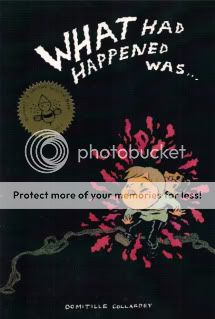
Al Columbia, writer/artist

Fantagraphics, 2009

240 pages, hardcover

$28.99

Buy it from Fantagraphics

Buy it from Amazon.com

At SPX this year, a friend of mine approached Al Columbia for a sketch in his themed sketchbook. Columbia started drawing, didn’t like it, tore out the page, crumpled it up. Started drawing again, didn’t like that one either, tore out the page, crumpled it up. Told my friend he couldn’t do it with all the noise and distractions in the room. Stopped drawing sketches for anyone for the rest of the day, except for a tiny circle-dot-dot-curve smiley face next to his signature for anyone who purchased a copy of this book. After I heard this story I told it to a couple of friends. One remarked that if he’d been forced to concoct a story about what trying to get a sketch from Al Columbia would be like, this would have been it. Another said he’d agree with that assessment, but only if Columbia had been paid for the work first.

Al Columbia may be the closest alternative comics has come to producing a Syd Barrett, an Axl Rose, a Sly Stone, a Kevin Shields, a sandbox-era Brian Wilson, or heck, a Steve Ditko–a prodigious, world-beating talent chased off stage by his own…ugh, I don’t want to say demons, but even if you ascribe Columbia’s Big Numbers flameout and lack of published work post-Biologic Show to perfectionism, surely perfectionism that total and unforgiving is a demon of a kind.

The genius of Pim & Francie is harnessing the power of that demon–whatever it is or was that led Columbia to abandon his impossibly immaculate conceptions of monstrousness and murder half-drawn on the page time and time again–and deploying it as a conscious aesthetic decision. Reproducing unfinished roughs, penciled-in and scribbled-out dialogue, half-inked panels, torn-up and taped-together pages, even cropping what look like finished comics so that you can’t see the whole thing, Columbia and his partners in the production of this book, Paul Baresh and Adam Grano, have produced a fractured masterpiece, a glimpse of the forbidden, an objet d’art noir. As I wrote on Robot 6 the other day:

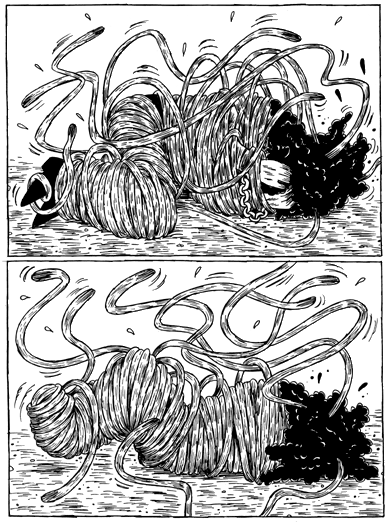
my favorite thing about Columbia’s comics–many of which can now be found in his new Fantagraphics hardcover Pim and Francie–is how they look like the product of some doomed and demented animation studio. It’s as though a team of expert craftsmen became trapped in their office sometime during the Depression and were forgotten about for decades, reduced to inbreeding, feeding on their own dead, and making human sacrifices to the mimeograph machine, and when the authorities finally stumbled across their charnel-house lair, this stuff is what they were working on in the darkness.

The horror of Columbia’s sickly-cute Pim & Francie vignettes–a zombie story, a serial-killer story, a witch-in-the-woods story, a haunted-forest story, a trio of chase sequences–is extraordinarily effective. And the stand-alone images both inside and outside those stories–the Beast of the Apocalypse as story-book fawn, a field of horrid man-things staring right at you, a broken-down theme park and the phrase “there’s something wrong with grandpa,” a forest of crying trees, some dreadful being of black flame running full-tilt down the basement stairs, zombie Grandma stopping her dishwashing and glancing up toward where the children sleep–are as close as comics have come (hate to keep using that formulation, but there you have it) to the girls at the end of the hall in The Shining, the chalk-white face of the demon flashing at us in Father Karras’s dream in The Exorcist, the inscrutable motionlessness of characters in The Blair Witch Project and Paranormal Activity. The craft involved in their creation is simply remarkable, with Columbia’s assuredness of line, faux-vintage aesthetic, and near-peerless use of blacks all actually gaining from his panels’ frequent extreme-close-up enlargement throughout the collection.

But moreover, these scary stories and disturbing images are all so gorgeously awful that they appear to have corrupted the book itself. They look like they’ve emerged from the ether, seared or stained themselves partly onto the pages, then burned out, or been extinguished when the nominal author shut his sketchbook and hurled it across the room or tore up the pages in terror. It’s comic book as Samara’s video from The Ring, Lemarchand’s box from Hellraiser, Abdul Alhazred’s Necronomicon from Lovecraft, the titular toy from Stephen King’s “The Monkey”–an inherently horrific object. Bravo.

The stand

In the long list of things that Nigel Tufnel was right about, “there’s a fine line between stupid and clever” is right up near the top. Which side of that line Paranormal Activity falls on has been bedeviling me since I (finally) saw it Halloween afternoon. Just by way of a for instance, while we chatted about the film in the lobby, I complained to the folks I saw it with about the demonologist who never barked. If the filmmakers were never going to actually put him in the movie, why introduce the concept in the first place? It left me with this weird sensation that either a chunk of the movie had gone missing, or the filmmakers just didn’t have that much of a grasp on what they were doing. But then my wife theorized that maybe that truncated feeling was the point–the movie gets you believing that this demonologist will show up “in a few days,” so when the end comes and he’s still nowhere in sight, it’s all the more shocking. Which got me to thinking about how I’d spent most of the movie believing the climax would come on the night of October 31st, only for the proceedings to stop short several weeks before then. Then there was my brother’s paranormal-buff fiancee, who “explained” that this kind of haunting had to be “a demonic” rather than the work of a (formerly) human entity, so they needed to address this (the psychic telling them to hire a demonologist) without actually allowing it to fix the problem (Micah puts off calling him, and when Katie finally does, he’s out of town). You could probably go back and forth about all the other loose ends–the house fire, Katie’s sister, the haunting of Diane back in the ’60s–in a similar fashion.

Ditto the believability of the two main characters. I found Micah’s desire to get to the bottom of the haunting rather than wave the white flag, even when this ran counter to Katie’s express wishes, a totally credible trait; amusingly, my wife found his behavior so dickish as to shatter her suspension of disbelief. On the flip side, I thought the seams really showed on Katie’s performance during scenes where she was obviously required to express a certain sentiment or say a certain line; The Missus found her compelling and her story sad. That part we agree on, at least, which is why this post analogizing the story arc of Paranormal Activity to domestic violence has lodged itself in my head the way it has. Overall, again, it’s difficult to say whether the shortcomings of the characters are simply the fault of them as characters or the result of poor choices by the filmmakers.

And the scares? As I alluded to the other day, the film shares with The Hurt Locker a structural advantage: The second you’re placed in a certain environment (a mission/bedtime), you in the audience are prepped to have the shit scared out of you (by an explosion/by the haunting). Both films smartly let you do most of the work for them, letting you sit there, hearing the pounding of the blood in your ears, straining toward the screen to see what happens yet pushing back in your chair dreading it as well. Paranormal has the added advantage of doing for bedrooms what Psycho did for showers and Jaws did for beaches, transforming a familiar environment into a locus of horror–how much of the “scariest movie ever” buzz simply stems from people not being able to avoid their own bedrooms and therefore recalling the movie whether they want to or not? Ditto how deftly it works with the uncomfortable idea of being watched while you sleep–by a camera, by some malevolent entity, and (we’ll get to this again later) even by someone you love.

The difference between the two set-ups, of course, is that Kathryn Bigelow pretty much delivers something memorable every time, from world-class action sequences to gorgeous scenery to those haunting extreme close-ups of falling shells or shockwaves. Director Oren Peli, on the other hand, can really only show you a static shot of a bedroom or a shakicam shot of a living room, in night vision; at times, the “action” disappears into the darkness where you’re vaguely aware there’s something going on–the tug of war between Micah and the demon after it drags Katie out of bed is the best example–but can’t make it out. Once again, is this a deft use of parametric filmmaking or amateur hour?

With all these unsettled questions, there’d be no way I’d feel comfortable proclaiming this “the scariest movie ever made” even if I were inclined in that direction to begin with. Which (the moment you’ve been waiting for!) I’m not. With a couple of exceptions, there was nothing here you couldn’t get out of a particularly well done episode of A Haunting; in fact I can think of a moment from that series that scared me and The Missus worse than anything here. Because of the film’s abrupt ending, the sense of relentless pacing and crescendoing terror that characterizes (here it comes) The Blair Witch Project is absent. With it goes the gut-wrenching grinding down of the protagonists–Katie can collapse and cry on the floor all she wants, there’s still nothing here that approaches that desperate conversation between Heather and Mike as they droolingly rattle off their favorite foods, knowing they’ll probably never taste them again. There’s no sense that Micah and Katie have been driven to that desperate a strait, even after the thing yanks her out of bed and bites her.

A big part of the problem is that just like Micah (and Katie, prior to her final under-the-influence decision to stay), we in the audience can’t help but associate the haunting with the house. That’s what a million haunted-house movies and stories have taught us to do since time immemorial. Even ones that aren’t predicated on the location still tend to make tremendous use of it–cf. The Exorcist and how inseparable your memories of it are from that freezing cold, harshly illuminated bedroom. Paranormal Activity is similar: It does such a good job of violating domestic tranquility and transforming the bedroom, a place of comfort and refuge, into a horrorshow, that you can’t help but want to scream at them “Check into a hotel and hang out in the lobby overnight! Go to a Walgreen’s!” As hard as the movie works to establish that there’s no escape, it also never shows them trying and failing to do so (budget limitations, perhaps?), so we’re left wondering what-if and letting the air out of the scare. Heather, Josh, and Mike are lost in the woods; Micah and Katie could go grocery shopping or visit his mom or catch a flight to Hawaii if they wanted.

But all of this just keeps the movie from being an awesome stone-cold classic. I think it’s still a fine film, and largely for the same reasons it’s not a great one. All that ambiguity about the characters, the loose plot threads, whether or not they could have escaped–that’s still very interesting, even if you can’t nail it all down as a point in the film’s favor for certain. I find myself thinking “What if he’d done this? What if she’d tried that?” It’s giving me something to chew on.

And while nothing here genuinely freaked me out once I was in the comfort of my own home–something Blair Witch, The Exorcist, The Shining, and The Ring all managed to pull off, just to name a few–nor really traumatized me during the viewing–all those movies, The Texas Chain Saw Massacre, The Birds, Psycho, Hostel, The Descent, Hellraiser, Hellbound, etc etc–I can say that there were a few world-class horror images in here. Not the grunts and footprings, not the mysterious photograph, not the ouija board, not the shattered photograph, at least not for me. What got me were two things. For some reason, the lights being flipped on and off really got me. They weren’t flickering–something was walking around turning lights on and off. Not only was something else present in the house, it was basically using the house the way we would–only it was nothing like us in nature or intent. I dunno, that creeped me out pretty bad.

But best/worst of all were the two scenes where somnambulist Katie got out of bed, turned to face it, and just…stood there, for hours and hours. That’s pure automaton Freudian uncanny, of course, and a monumental horror-image par excellence. And it’s reminiscent of the original-edit ending of Blair Witch to boot–to this day the scariest thing I’ve ever seen in a movie–because there’s just no reason for it to be happening. It hits all my buttons, hard, as does the resolution of that first scene, where she walks away and Micah finally wakes up, following her down and out into the backyard, where she’s just swinging in a swing. These are actions that really have no inherent emotional or psychological content whatsoever. They’re purely neutral. But when you have no idea why someone’s doing them, even totally neutral actions can become sinister, almost intolerable. That much I’m sure about.

More to come, but for now

Paranormal Activity and The Hurt Locker have a lot in common.

Not Comics Time: Portable Grindhouse: The Lost Art of the VHS Box

Portable Grindhouse: The Lost Art of the VHS Box

Jacques Boyreau, editor

Fantagraphics, 2009

200 pages, slipcover

$19.99

Buy it from Fantagraphics, eventually

Buy it from Amazon.com eventually too

My entire circle of friends has been clamoring for this long-delayed collection of video box art for over a year–and could this be any more in my wheelhouse right now? If you made a Venn diagram out of the New Action, the Manly Movie Mamajama, and everything I talk about it that Dark Knight Strikes Again review, you’d find this right in the sweet spot. Even if this book didn’t exist, it would be necessary for me to invent it.

So let’s start by talking about what I didn’t like about it. Well, “didn’t like” is probably too strong–it’s fine, just not what I was looking for–but I couldn’t help but be let down by editor and compiler Jacques Boyreau’s introduction. You get a brief sketch of his personal history with home video, a lengthy technical history of the format, and a diatribe about the evils of digital. Actual discussion of “the lost art of the VHS box” is reserved for an interesting but meager two-paragraph rumination on the way their display in video stores made them the iconic equivalent of the films they contained, but this quickly gives way to one last swipe at DVDs, downloads, and digital projection. Nothing about any of the artists or designers involved, nothing about the evolving aesthetics of box art as home video went became a megabusiness, nothing about any of the covers on the pages that follow. If you’re looking for information about the business and creative decisions that led to the creation of this childhood-memory art form, you’ll come away disappointed.

But if you’re simply looking for a gallery of those memories and beyond, Boyreau did you right. He and designer Jacob Covery wisely chose to present the front cover of every box in the context of a product shot, rather than simply scanning the art and running it full-bleed–he’s absolutely right to argue that these images are inseparable from their status as objects. The box shots of the front cover (and spine) occupy the right-hand side of every spread, while the left-hand side reproduces the back cover. And here they do scan it and run it full-bleed, which actually just makes it funnier. Why? Well, it was clear from the start that what you needed to do with the front of your VHS box was make the image as lurid and eye-catching as possible, so there are surprisingly few variations in that regard beyond obvious budget and talent limitations in some cases. But what to do with the back cover? For a long time, no one seemed to know. The familiar tagline/teaser blurb/stills/credits framework was far from universal, and in its place were long lists of other movies released on home video by the studio (on the back of Vanishing Point, Magnetic Video Corporation listed fully fifty-eight), terse flat-affect plot summaries (The Chamber of Fear‘s blurb begins “The crevice of the volcano is very deep. Scientists are searching for a form of underground life that according to theory still exists.”), poorly written catalogues of the depraved behavior contained inside (Blood Spattered Bride notes “Although not rated this film contains nudity and scenes of graphic violence”), and in one memorable case (The Best of Burlesque–somehow I doubt it!) just a flipped and blown-up segment of the front cover’s airbrushed T&A illustration. Seeing all this proto-professional weirdness on the page normally reserved for placing the image next to it in some sort of factual context is hilarious.

But let’s face it, you’re here for the front covers, and they don’t disappoint. You’ve got titles like Drive-In Massacre, Don’t Go In the House, and Slave Girls from Beyond Infinity. You’ve got taglines like Video Violence‘s “…When renting is not enough!!”, Slashdance‘s “SAVE THE LAST DANCE…FOR HELL!” and The Lift‘s “TAKE THE STAIRS, TAKE THE STAIRS. FOR GOD’S SAKE TAKE THE STAIRS!!!” You’ve got images you likely remember from the scary sections of your local mom-and-pop video shop–the girl-gun of Master Blaster, the knife-through-the mask of Friday the 13th: The Final Chapter (the back-cover blurb appends a question mark to that increasingly inaccurate adjective, by the way), and the genuinely striking redneck cheesecake of ‘Gator Bait. You’ve got bloody knives, Giger knock-offs, urban warriors, and underboob.

As is probably clear by now (if it wasn’t already from the book’s title), the bulk of these boxes are for B-movie genre pictures. The exceptions are therefore often all the more interesting. Go Hog Wild is a glorious example of a truly lost art, the cartooned/painted high-school sex comedy poster. Barbie and the Rockers: Out of this World, with a 1987 copyright date, demonstrates the by-then astonishing moneymaking potential of the medium–a full rental fee for one 25-minute cartoon! The box-art design for Sidney Lumet’s Network, though crude by today’s standards, provides a representative look at the far classier approach to A-list studio affairs.

Most anomalous of all are the non-fiction efforts. A Johnny Bench documentary stands out for its blandness, while the Unknown Comic’s bag-clad noggin and overall awfulness could, with a little tweaking, fit right in with the various monsters and slashers. There’s a Gulf War I cash-in from ABC News, simply repackaging a military briefing from Norman Schwarzkopf. Grossest of all is an obliviously bloodthirsty hunting documentary called Bowhunting Whitetails: Just for Fun!: A grinning hunter holds a dead deer’s head by the antlers on the front, the back-cover copy revels in the hunter’s triumph over the poor stupid unarmed animal he slaughters, and there’s a tagline advertising “5 Vivid Arrow Impacts!” Even more than hilariously inept stuff like the Lon Chaney/John Carradine vehicle Alien Massacre and its crosseyed cover babe, it’s these documentaries and hobbyist videos that show just how widely the doors were thrown open to media producers and consumers of all stripes by the home video revolution.

And believe it or not, a couple of the covers even succeed as art! Boyreau smartly puts the two that do best right next to each other–the jagged ’80s splash-of-paint surrealism for the euro-slasher Eyeball (featuring an extremely rare artist credit, for illustrator Dick Bouchard) and the striking still of a loincloth-clad Cornel Wilde running from his life from spear-chucking African natives that bedecked the colonialist adventure The Naked Pray. Elsewhere, the bold two-color art for Walter Hill’s rock’n’roll fantasia Streets of Fire is ripe for reinterpretation today, I’d say; it’s easy to picture a Scott Pilgrim promotional piece riffing on its look and pose. And did I mention ‘Gator Bait? Step it up, Terry Richardson!

Now here’s the thing: A little Google Fu and you could probably come up with jpgs of nearly all the titles I’ve mentioned, and more besides. Boyreau laments how digital phased out analog when it comes to our movie viewing; has the Internet done the same with his book commemorating the losing side of that battle? I say no. It’s not just because of the tremendous job Boyreau and Covey did with the cover reproductions, or the lovely, solid paper stock, or the cutesy slipcase. It’s because Boyreau is right: the aura of the object is irreplaceable. A book collection of VHS box art contains preserves what was special about them in a way a Flickr gallery just can’t. Next time you have a trashy movie marathon, pass this around between movies–unlike your laptop, you won’t even need to worry that much about spilling beer on it.

Carnival of souls

* STC Elsewhere: I shined the Strange Tales Spotlight on the great Becky Cloonan and noted the demise of Wizard’s price guide and message board.

* Fantastic interview with Gary Groth and Kristi Valenti about the revamped print and web iterations of The Comics Journal by Kiel Phegley over at CBR. Five words, folks: Gary Groth’s Happy Hour podcast. Also, among other things, we learn that TCJ will be hosting blogs by Shaenon Garrity, Rob Clough, and R. Fiore, as well as importing Noah Berlatsky and Ng Suat Tong’s Hooded Utilitarian group blog.

* Jog analyzes the sizzle-to-steak ratio in Greg Rucka and J.H. Williams III’s Detective Comics. If there’s enough sizzle, can it become a steak substitute?

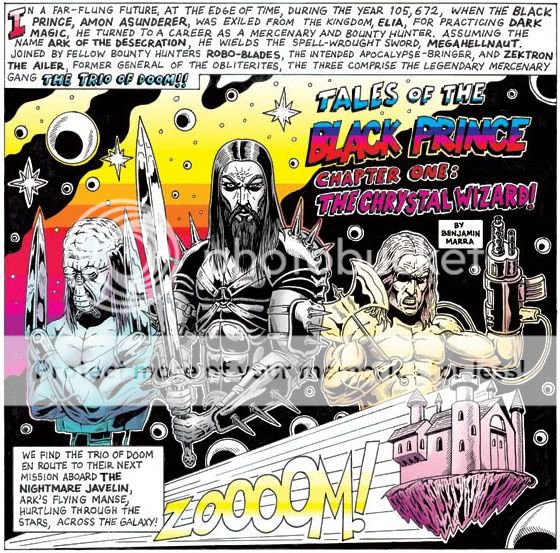
* Wanna see Benjamin Marra draw Marilyn Chambers?

* Wanna see Johnny Ryan draw the poster for The Exorcist on a post-it note? And do a kids’ comic with Dave Cooper?

* Wanna see Frank Santoro draw a Cold Heat tribute to the poster for Mario Bava’s Black Sunday?

* Wanna see every page of Chris Ware’s Jimmy Corrigan laid out on a wall?

* Wanna see a new comic written and drawn by Alan Moore? Also, he’s working with Gorillaz, he tells a cute story about Brian Eno, and the League of Extraordinary Gentlemen book he’s finishing now takes place in the present day!

* Oh yeah: While Moore’s thoroughgoing ignorance about many aspects of contemporary culture is lamentable (no matter how good a writer he is), it’s also increasingly clear that his expression of it in interviews is in no small part due to lousy questions from his interviewers.

* Well, this is odd: This interview with Sleigh Bells and this interview with Gary Numan (via) reveal that both owe their entire careers to a coincidence: Sleigh Bells’ Derek Miller and Alexis Krauss met when he waited on her at a restaurant and happened to ask if she sang, while Numan discovered his signature instrument, the Moog keyboard, because someone left one at the studio where his ersatz punk band was recording. I can relate: the only reason I bumped into the old high school and college classmate who got me my first job as a writer and remains my editor at Maxim is because I was wandering around Manhattan looking for a party that turned out to be in Brooklyn.

* Quoted on Pitchfork! Made it, Ma! Top o’ the world!

Carnival of souls

* I’m pretty happy with how my piece on six great alt-horror cartoonists for “Robot 666” came out.

* And I’m really happy with how my review of Frank Miller & Lynn Varley’s The Dark Knight Strikes Again (and glo-fi and Paper Rad and Tim & Eric and so on) came out. In both cases, hyperlinks are truly the blogger’s best friend!

* Now that I’ve watched Matt Zoller Seitz’s “Zombie 101” video essay, I’m linking to it all over again. You know, for a subgenre that’s so dominated discourse about horror this decade, the canon, as demonstrated by Seitz’s choices, is really pretty small–the vast majority of the major clips come from the Romero and the 28…Later movies, with Shaun of the Dead for laughs and pick your black and white voodoo-zombie movie for roots.

* Seeing these lists of “Best of the Decade” lists for music makes me realize–have you seen any such lists for comics yet? I haven’t. And I sure haven’t made one, because frankly the prospect is too daunting. Not only does this decade contain virtually my entire comics-reading life, it’s also just such a seismic time period. It includes everything from Jimmy Corrigan to Kramers Ergot 7, you know? I think you could do a 100 Greatest Comics of All Time list that could conservatively be 25% books from the last ten years.

* Ridley Scott says the Alien prequel he’s working on will take place about 30 years prior to Alien. Just getting that out there.

* I like Rich Juzwiak’s review of the Michael Jackson concert-rehearsal film This Is It.

* Purple Reign: Meet the Flamingo, terror of the Gotham City underworld and apparent Prince fan. (I don’t know what it says that it feels like this is the first time we’re seeing him even though he’s already appeared in this series at least twice, but hey.) Gotta love that this got out there on the same day I spent all this time comparing a Batman comic to colorful ’80s-conscious pop art.

* And here’s another song I coulda linked to in that DK2 post had the review gone up at the right time. Woo doggie, more like this please.

Comics Time: The Dark Knight Strikes Again

The Dark Knight Strikes Again

Frank Miller, writer

Frank Miller & Lynn Varley, artists

DC, 2003

256 pages

$19.99

Buy it from Amazon.com

For today’s Comics Time review, please visit The Savage Critic(s).

Gossip Girl thoughts

* No way am I burying the lede this time around: Best Serena cleavage ever.

* Of course Rufus is lame enough to make KISS jack o’ lanterns.

* Make Blair kiss a girl, Chuck! Make Blair kiss a girl!

* That publicist character is the fucking worst. Every minute she’s on screen is insufferable. This, of course, is an accurate portrayal of publicists.

* These people just routinely lie to each other. Trick or treating, career stuff, helping your boyfriend, dating your costar, whatever, it’s always time to lie.

* I liked that goofy shot of Serena taking all that time to walk out of the Humphrey loft as Dan and Olivia argue over her pretending to still be dating her ex-costar. It was like something out of Wet Hot American Summer, only featuring awesome stems.

* The gangster outfits were a little much even for this show.

* Here’s why the end of the episode was a mess: If getting busted by the cops is so self-evidently good for the hotel, why would Serena think it would be bad for the celebrities? Even if you want to grant her the initial freakout, eventually it’s no longer theoretical–it turns out to be great for the celebrities. And yet she’s still pissed at Blair. Meanwhile, Blair never says “hey, it’ll be great for them too,” she makes some kind of lame “I’m putting Chuck first” argument instead of pointing out that it’s an obvious win-win. Bad writing.

Carnival of souls

* Appearing in the Strange Tales Spotlight today: Corey Lewis. That stuff looks lovely.

* Ooooh man, I cannot wait to sit down and watch Matt Zoller Seitz’s “Zombie 101” video essay.

* Tom Spurgeon talks to Gary Groth about the coming rejiggering of The Comics Journal‘s print and online iterations.

* Curt Purcell reviews the Superman and Batman Blackest Night tie-in minis. I think Curt is right to defend them against accusations that they’re “red skies” tie-ins, i.e. that they perfunctorily acknowledge the existence of some wider crossover framework but then go about their regular business. Clearly, they’re about nothing but the Blackest Night goings-on. But for me, that’s sort of the problem. What they are is really nothing more or less than three-issue depictions of what’s going on with Superman and the new Batman (and their sidekicks) during the invasion of the Black Lanterns. They don’t really have their own beginnings, and they certainly don’t have much in the way of endings–they’re basically like the “here’s what’s going on with so-and-so” sequences we’ve seen in the main miniseries, only extracted and expanded. It’s just kinda weird, is all. And compared to the two-issue Final Crisis tie-ins for these two characters, which also removed them from the main flow of the event but showed them dealing with unique problems, they feel a little unnecessary. I dunno, man, writing tie-ins that make those who buy them feel like they matter and those who don’t buy them feel like they’re not missing anything crucial to the enjoyment of what they are buying is perhaps the toughest row to hoe in this the event-comics era.

* My love-hate relationship with the Are You a Serious Comic Book Reader gang continues with Brandon’s post on ’70s & ’80s Eurocomic weirdness. I’m all for reclaiming forgotten, fecund areas of comics history, but your argument for this needn’t be laden with egregious strawmen or attacks on publishers simply for not sharing your own tastes. You may not like, say, the comics of Fletcher Hanks, but isn’t that pretty much exactly the kind of “hey, look off the beaten path and shake off your insularity and publish something overlooked” project you’re calling for? And I’m sorry, but you shouldn’t get to say things like this…

It does not really benefit the smaller companies, especially the tastemakers like Fantagraphics or Top Shelf to try to republish this stuff because their bread and butter is still very much the overtly sophisticted, gets-write-ups-in-the-New York Times type comics, be it personal, arty stuff made now or lost pieces of early comics history.

…without getting called out about the Hernandez Brothers and Josh Simmons and Johnny Ryan and Charles Burns and Gipi and Robert Williams and Jacques Tardi and Portable Grindhouse and The League of Extraordinary Gentlemen and The Surrogates Super Spy and Renee French and everything else those publishers publish that gives obvious lie to those claims. If you think people should publish more weird ’70s and ’80s genre comics that aren’t superheroes, that’s what you should say. If you’ve got confidence in your case, make it on the aesthetic (and financial) merits.

* Tom Neely’s horror-comic cover versions are always a delight.

* So are the Cold Heat pages Frank Santoro posts on his blog.

* Behold the origin of the Psychic TV logo.

* And Now the Screaming Starts notes David Bowie’s mid-’70s occult meltdown. Surprising no one, I have actually written a comic about this. Would anyone out there like to draw it for me? Email’s to your left.

* This Halloween mix by DJ Daymage really is outstanding. Download it twice.

Let me explain to you why I don’t care for Basement Jaxx

Honestly I don’t feel very strongly about Basement Jaxx in either direction. But lately I’ve been listening to “Where’s Your Head At” a bunch. It’s a very good song, mostly thanks to the firepower of its fully armed and operational Gary Numan sample. But it’s as though they were unsatisfied with merely centering their song around one of the most monstrous synth lines ever constructed and felt compelled to add a bunch of unnecessary junk to it, like some kind of obsessive-compulsive disorder. The single edit in the video above is better than the full-length version in this regard, but it still gets a little too goofy with the funny voices. And the full-length version has about 45 unnecessary seconds in the middle and another 45 unnecessary seconds at the end. It’s not like I’ve listened to a ton of Basement Jaxx, but pretty much everything I’ve heard is like this in some way–just too busy. I understand that this is considered “maximalism,” but for me it’s clutter, or mania, or trying too hard, or something else unappealing, and when you’ve divorced it from a colossal Numanism it’s not something I’m interested in hearing at all.

Comics Time: Dark Reign: The List #7–Wolverine

Dark Reign: The List #7–Wolverine

Jason Aaron, writer

Esad Ribic, artist

Marvel, October 2009

48 pages

$3.99

Well well well, looks like Marvel decided maybe they should have strained that Grant Morrison bathwater for babies before they threw it all out. Yeah, Joss Whedon (and, in those nobly intentioned but ill-conceived Phoenix minis, Greg Pak) got to nod in New X-Men‘s direction now and then–Cassandra Nova, a one-line reference to Magneto’s trashing of Manhattan, even the Bug Room. But other than wiping out Genosha, killing Jean Grey, and establishing Emma Frost as the X-Men’s new HBIC, Marvel basically ran, not walked, away from Morrison’s ideas and tone alike. (Exhibit A: that Xorn arc from New Avengers.) So writer Jason Aaron’s full-fledged Morrison Marvel Team-Up in this very very central event title, pitting Wolverine, Marvel Boy (!), and Fantomex (!!!) against Norman Osborn for the fate of The World (i.e. the Morrison-created birthplace of the Weapon Plus program that spawned everyone from Captain America to the ol’ Canucklehead), is something of a turning point. Certainly I didn’t expect to see a French-accented international man of mystery playing a role in Dark Reign, except perhaps as someone for Ares to chop in half in a throwaway sequence in Dark Avengers.

What’s impressive about this is that rather than try to ape high Morrisonian “mad ideas” (except for a played-for-laughs viral-religion thing), Aaron riffs on an entirely different Morrison tone: cheeky high-concept comedy. Instead of writing Marvel Boy as some sort of brooding military brat, Aaron returns him to the quasi-Clockwork Orange blend of arrogance, ultraviolence, and killer good looks that made his original Morrison miniseries such a hoot. He’s like Chuck Bass with insect DNA. (Okay, more insect DNA.) Similarly, Fantomex is treated as a charming rogue with a cool white uniform rather than Aaron simply waving his hands in the face of his weird power set and Frenchness and giving up or phoning in some black-ops boilerplate. Wolverine actually plays a supporting role more than anything else, but when he’s unleashed, it’s in a splatstick fashion consistent with the joli-laid physicality Morrison’s collaborator Frank Quitely imbued him with. Ribic’s art goes a long way in this regard–I’d previously known him only for his admittedly dynamic Alex Ross-indebted painted work, but his pencils have a cartoony zest that would be right at home on some three-issue Vertigo miniseries.

What does it all mean in the context of Dark Reign and The List and so on? As best I can tell, not much. But reintegrating Morrison’s many toys into the mainstream Marvel Universe, as opposed to the province of editorially hands-off limited series, is pretty momentous in and of itself. Fingers crossed we’ll see the Phoenix Corps again when all is said and done.

Carnival of souls

* Today’s Strange Tales Spotlight subject is Chris Chua, a relative unknown who more than anyone else in the series so far is gonna make you marvel that this is being published by Marvel.

* Whoa, The Comics Journal is shifting to a semiannual with a beefed-up online component.

* Battlestar Galactica: The Plan comes out on DVD today, and thus ends the series. It turns out I don’t enjoy this sort of release pattern at all–instead of making this appointment television, it’s become “eh, I’ll buy it eventually.”

* Oh yeah, buncha Monty Python docs of the sort I usually really enjoy come out today too.

* Given my usual preoccupations in terms of this show it’s probably no surprise that my favorite parts of Whitney Matheson’s reader Q&A with Lost honcho Damon Lindelof center on how outside concerns like actor availability and budget overruns affected Lost‘s story.

* The Hellraiser remake is going to be 3-D, I guess.

* New Chris Ware! (Via JK Parkin.)

* Honestly, my main takeaway from these interview snippets with Marvel VP of Sales David Gabriel is that Marvel will be switching to a more DC-style release pattern with its trade paperbacks–i.e. they’ll take forever to come out–which really bums me out as someone who really only ever wants or buys trade paperbacks for this material. I imagine the reasoning behind not wanting to stagger the release of books featuring the same character will raise some eyebrows.

* Jason Adams is on the Scott Pilgrim movie beat, catching some interesting tweets from Juno director Jason Reitman following a screening of 30 minutes of footage from Edgar Wright’s adaptation:

It is a game changer for Edgar and the genre. It moves the speed of light and carries more unadulterated joy than Ive seen in recent cinema.

SP does what everyone our age has been dreaming about: achieves the first all encompassing film of the joystick generation.

I’m in awe of the sheer control in the filmmaking. It feels like a “Matrix” for love and how willing we are to fight for it.

Honestly I wasn’t as crazy about the first volume of Scott Pilgrim as a lot of other people were, but I still remember the way it worked video-game combat and iconography into its relatively normal story hitting me like a ton of bricks. If the movie can really do the same thing, hoo baby.

* Green Zone, a Paul Greengrass-directed Matt Damon-starring politicized action film that isn’t a Bourne movie? [Pause for thought] Sure, I’ll eat it.

* My friend Ben Morse hired Todd Nauck to draw portraits of the groomsmen at his wedding as their gifts. That’s a pretty rad idea.

* Renee French is freaking me out.

* He-Man is awesome. (Via Kiel Phegley.)

Some kind of monster

Kathryn Bigelow’s The Hurt Locker starts off by playing upon what I believe is the oldest and most primal human fear, developmentally speaking. You sit down in the theater with its stereo surround sound blazing, you watch a team of explosive experts use an all-too-clumsy robot to gingerly manipulate a roadside bomb in Iraq, and before you know it your heart is pounding because an explosion could occur at any moment and some part of your brain really, really does not want to be startled by a loud noise.

The whole rest of the film is essentially a demonstration of how life as a soldier (or civilian) in Iraq works in much the same fashion. Though far from the comfy confines of a movie theater on 13th Street, these people are similarly subjected to an environment where something brain-rattlingly terrifying could happen to them at any moment. Most of the film’s set pieces–and it basically moves from set piece to set piece, like Saving Private Ryan (with one key difference I’ll get to in a moment)–create tension and suspense simply by demonstrating, through a few shots of a byzantine network of alleys or featureless expanse of desert or cramped and hole-riddled warren of rooms, that there is literally no possible way that our trio of American soldiers could prepare themselves for every way in which that brain-rattlingly terrifying thing could happen. Keep your eyes in one direction and get shot from another. Defuse a bomb and get blown up by the one five feet away from it. Pop your head up to shoot someone and get shot in return. And unlike in Spielberg’s paradigm-shifting shakicam action epic, there’s no sense of forward momentum, no inexorable drive to the fulfillment of a quest. There’s just a countdown till the last day in Bravo Company’s rotation, a slow grind of hundreds of daily life-and-death situations, an increasingly indistinct and almost pointless parade of triumphs and tragedies. A tedium of terror. To the extent that the film has an ideological or political component, you can suss it out from there.

But it’s a very big world with a lot of people in it, and surely there are people out there who don’t just survive such a situation but thrive in it. That’s Sgt. James, our hero, played by Jeremy Renner just as marvelously as anyone who’s seen Dahmer or 28 Weeks Later would expect. Like Sanborn and Eldridge, the two other men in his three-man bomb squad, I spent much of the movie trying to figure out what makes this guy tick. Is he an arrogant, cigarette-smoking John Wayne wannabe, living every day as if this is the one during which he can walk away from an explosion in slow motion? Is he Robert Duvall in Apocalypse Now, a bloody-handed sociopath glibly waltzing through the killing fields, knowing that some day this war’s gonna end but never quite allowing himself to finish the thought? Is he enacting some sort of slow-motion suicide by haji, running headlong away from responsibility for others and for himself alike until someone or something finally puts him out of his misery? Or is he just the best damn explosives expert anyone’s ever seen–as Eldridge puts it, “not very good with people, but a hell of a warrior”? In one brilliant scene, a murderous commanding officer follows up a near-disaster outside the UN compound with a creepily complimentary inquisition of James that seems to entertain all these possibilities at once.

Two key conversations convey one last possibility: that there’s no real method to James’s madness. We can rule out sociopathy, at least, because he clearly cares deeply about some of the violence’s victims–though his pathos in this regard turns out to be both dubiously inspired and stupidly, self-aggrandizingly addressed. But beyond that, how can he do it? I don’t know, I don’t know, I don’t know, he says; later, he casts life as a process by which the things you love are slowly revealed to be basically garbage, except for one or two real, true things. It’s love as a fix, and his love, his fix, is his pas de deux with death. He seemingly can’t help being the way he is any more than Bodie from Bigelow’s Point Break (or Johnny from Mike Leigh’s Naked, whom I thought of quite a bit by the end). In this light what looked like recklesness, like not caring, is revealed to be what he cares about the most. His body needs a blast radius.

Carnival of souls

* Today on the Con War front: I’m pretty happy with how my Robot 6 piece on the friendly date-switch deal made by Heroes Con and Supercon came out. There are the usual Wizard/Reed tidbits mixed in there as well.

* I also enjoyed the lengthy round-up by Heidi MacDonald and Tom Spurgeon’s “what does it all mean, and not mean?” piece. Tom makes one really interesting distinction, between “aesthetically gross” stuff done by the various cons and “ethically gross” stuff, which is a different and more pressing issue but which remains difficult to separate from the former category simply because so few people are willing to go on the record about the many, many shady things being whispered about behind the scenes.

* Robot 6 is rebranding itself Robot 666 for this pre-Halloween week. Boo!

* Paranormal Activity beat the tar out of Saw VI at the box office during the latter’s opening weekend. To me this isn’t a story of David and Goliath so much as Goliath in David’s clothing vs. Goliath’s great-great-great-great-grandson, but hey, worth noting.

* It’s a great privilege to be able to claim Jim Hanley’s Universe as my Local Comic Shop. It’s with that in mind that I read and appreciated Jim Hanley’s eulogy for his late buisness partner Rich Hafstead. (Via Dirk Deppey.)

* New Hans Rickheit!

* New Kevin Huizenga!

* New R. Crumb!

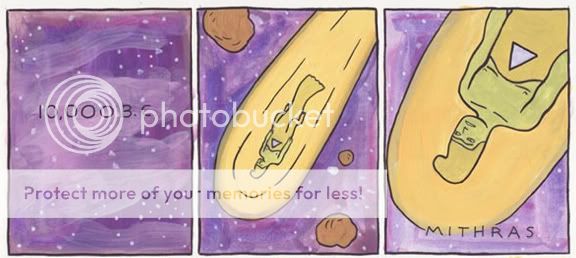
* Old Al Columbia! And new Al Columbia I had no idea existed!

* I dig Frank Santoro’s minimalist APE recap. The Troublemakers is out!

* Real-Life Horror: 15 minutes of sensory deprivation can make you hallucinate. Via Andrew Sullivan, who points out that the United States government has subjected its own citizens to way, way, way more than 15 minutes of sensory deprivation.

* I loved The A-Team as a kid, and while I think the movie version will have a really really tiny needle to thread in terms of finding a tone that’ll make it enjoyable, I am indeed delighted by this picture of the cast. That’s Liam Neeson, believe it or not.

Comics Time: nothin’

Today’s Comics Time review has been canceled because I accidentally read and reviewed a book that’s embargoed until Wednesday. I am a doofus. Comics Time will resume on Wednesday, and I may throw in an extra review at some point this week just to make up for this. You never know.

Comics Time: Invincible Iron Man #19

Invincible Iron Man #19

Matt Fraction, writer

Salvador Larroca, artist

Marvel, October 2009

40 pages

$3.99

It’s been a long time since I read superhero comic that wasn’t by Grant Morrison more than once out of enthusiasm rather than confusion. But golly, I enjoyed this one, and I enjoyed it just as much the second time around.

Subtitled (somewhat pretentiously) “Into the White (Einstein on the Beach),” this is the conclusion of the year-long “World’s Most Wanted” arc of Fraction and Larroca’s movie-toned Iron Man book, in which the disgraced and deposed Tony Stark runs around the world trying to destroy both his tech and his own mind lest both fall into the hands of new King Shit of Turd Mountain Norman Osborn. In the past I’ve found this set-up very hard to swallow because of how dependent it is on other, lesser comics like Civil War and Secret Invasion. For example, I don’t care what universe you live in, if Bernard Kerik can go from Homeland Security chief nominee to getting his mugshot taken, it strains credulity that a guy who used to dress up as a goblin and throw pumpkin bombs at people is gonna get put in charge of jack shit.

But Fraction compensates for this inherited conceptual sloppiness simply by making the plot mechanics for this story as tight as he possibly can. He cuts relentlessly back and forth between the protagonists and antagonists: the Charlie’s Angels trio of Black Widow, Maria Hill, and Pepper Potts attempting to escape from Osborn’s lair; Osborn’s second-in-command Victoria Hand trying to prevent this and quaking in terror of what will happen if she doesn’t; Osborn himself cockily closing in on his quarry; the intelligence-officer grunt who’s secretly feeding Osborn bad information and the colleague who smells something fishy about him; and Iron Man himself, experiencing an Algernon-like loss of his faculties as he hurls himself in his dilapidated old armor toward his final destination. If you’ve ever tried to write an action sequence, let alone cross-cut between several of them, you know how hard it is to get what needs to happen to happen for any reason other than your need for it to happen, right? Well, never once do the A-B-C sequencings of Fraction’s various plots feel like they’ve skipped a letter just to get to point Z quicker. From the captured spies moving up and down and in an out of an elevator, to the precise interpersonal dynamics between all the personnel involved in Norman’s pursuit of Tony Stark, each moment proceeds directly from the last, whether physically or emotionally.

How many fight scenes have you read lately where a character will get smacked several dozen yards by some giant powerhouse only to be up and about a few pages later? How many times have creators had to go online to clarify the physical fate of a character whose beating they wrote into incomprehensibility? How many times has a climactic battle been undercut completely by glib banter, almost completely disconnected from the circumstances of that place, that moment, those characters? You’re not gonna get any of that shit here. Each scene and sequence feels like it’s taking place in a physical space you and the characters could navigate, with physical maneuvers having readily understandable physical consequences. Each move toward and away from the characters’ goals comes with a sense of the stakes involved–the grand illusion of serialized shared-universe superhero storytelling, that there really can be winners and losers, has rarely been so astutely conveyed.

This is all the result of what feels like a real partnership. This issue’s success is equally due to Fraction’s just-right dialogue and direction and Larroca’s deft work with body language and fight choreography. (His days as a Greg Land-style spot-the-photoref novelty act are loooooong behind him.) Both shine brightest in the climax, making Osborn’s slide from glee to rage to frustration to confusion to defeat snatched from the jaws of victory as clear as day and almost frightening. It’s capped off with a one-liner in which the totality of Tony’s pwnage of Norma is made hilariously clear (provided you’re a Marvel nerd), and a one-page coda that manages to set up the coming mega-crossover without losing a sense of beatific victory and loss.

Did I mention that they managed to rehabilitate Iron Man’s badly damaged character in my head, despite the fact that even now none of his actions during Civil War have turned out to make any kind of practical or moral sense within the world of the story in any way? And that they managed to establish Spider-Man villain the Green Goblin as a for-the-ages Iron Man enemy as surely as Frank Miller made Kingpin the archnemesis for Daredevil? I dunno, man, this is some mightily effective work in this genre. I feel like it should be taken apart and studied at story summits for a long, long time: If this is what you want to do, this is how you want to do it. Aw, hell, I’m gonna read it again.