‘The Better Sister’ thoughts, Episode 2: ‘Lotta Sky’

 Biel is a compelling actor, one of those performers blessed with looks so striking they have to figure out something interesting to do with it lest it swamp their talents. (Think of half the cast of Mad Men, for example.) In Biel’s case, she uses her severe, patrician beauty and gym-toned silhouette to suggest being tightly wound, even brittle. She projects the air of a person whose house of cards is about to come tumbling down just by how she inhabits her wardrobe, her hairstyle, the screen itself. 

This all works particularly well when contrasted with the flashbacks that show her as a looser, less particular version of herself when her relationship with Adam began. And talk about a psychological cocktail there: Chloe and Adam trying to make up for Nicky’s failure by effectively recreating the relationship with a different sister swapped in. But despite this potentially fertile material, there’s simply a limit to what any actor can do with a character who’s less a person and more a contradiction in terms.

I reviewed the second episode of The Better Sister for Decider.

‘The Better Sister’ thoughts, Episode 1: ‘She’s My Sister’

We love watching the ultra-rich suffer. This has always been true to one extent or another, but less than 15 years ago we mostly loved watching the ultra-rich either dress up in science-fiction armor and blast supervillains, or buy Dakota Johnson lingerie for spanking purposes. But the days of Iron Man and 50 Shades of Grey gave way to the time of Succession and The White Lotus some time ago, and the advent of an American government run for the sole purpose of taking money out of your pocket and putting into Elon Musk’s and Donald Trump Jr.’s has only sharpened the viewing public’s metaphorical guillotines. 

Into this heady atmosphere emerges The Better Sister. Adapted by Olivia Milch from the novel by Alafair Burke, it’s the story of an extremely put-together go-getter who’s tied to her good-for-nothing sister by the man they both loved and the child they both share through him, brought back together when that man gets murdered. There’s a lot of potential in the idea. There’s a lot less potential in the execution. 

I’m covering the new Amazon show The Better Sister for Decider, starting with my review of the series premiere.

‘Murderbot’ thoughts, Season 1, Episode 4: ‘Escape Velocity Protocol’

Once again, Murderbot delivers on its modest promise: fun sci-fi shenanigans, 20 minutes at a time. 

I reviewed this week’s Murderbot for Decider.

An interview with Julia Gfrörer: ‘I don’t think that I could make like a nice book if I wanted to’

Are there any self-imposed taboos in your work, like rules that you won’t break?

Yes, there definitely are. Probably a lot of them are not things that I’m immediately conscious of. I won’t put a beautiful girl on the cover of my book, just because I find it boring and kind of pandering, and also obviously kind of misogynist. I guess I don’t really like to put people on the covers of my books at all.

I’m very careful about the way that I depict violence, domestic violence, sexual violence, things like that. I think it’s important to show, and I won’t hide them. There can be a tendency to think it’s fine to show these things as long as you do it properly in a way that it telegraphs your true intentions, so you have to have a disclaimer on every page that says, well, this character is stomping on a duckling, but I would never stomp on a duckling. 

I try to show things like that with as little judgment as possible, because when you encounter those things in real life, they don’t usually come with a disclaimer. And usually when violence suddenly appears in your otherwise violence-free day-to-day life, it is difficult to know how you are supposed to feel about it. So I don’t want to give the reader any help in that regard. 

I also won’t show things that I can’t stomach. So if there’s a certain type of violence that I show, like, for example, I don’t know if I’ve ever shown somebody being burned alive. I think probably not. But if I were to show that, I would do my best to read firsthand accounts of that type of death, people who have come close to it, people have witnessed it, or maybe even watch videos of it if they exist. I mean, to my way of thinking, it’s the least that I can do. 

Like, to honor those who have been burned alive.

I guess it sounds kind of silly when you put it that way. I just don’t think that I have any right to use that as part of my story if I can’t face it. Does that make sense?

Well, you’re taking a lot of time to draw it, so that’s a sustained amount of time where you have to think about it.

Yeah, and that’s part of how I choose the things that I write about. I will purposely choose things that are difficult for me to think about. I really hate drawing close-ups of people screaming. I hate to look at them, but I do sometimes think they’re necessary. So I and make myself do it and I lean into the discomfort for my own sake to feel like I’ve earned it, maybe. It makes my entire process sound very masochistic. It’s like the comic is just a byproduct of my own need to just kind of swim around in the cesspit of human experience. That can’t be healthy.

And yet.

And yet. I mean, it’s more healthy than a lot of other ways that I could be chasing that feeling.

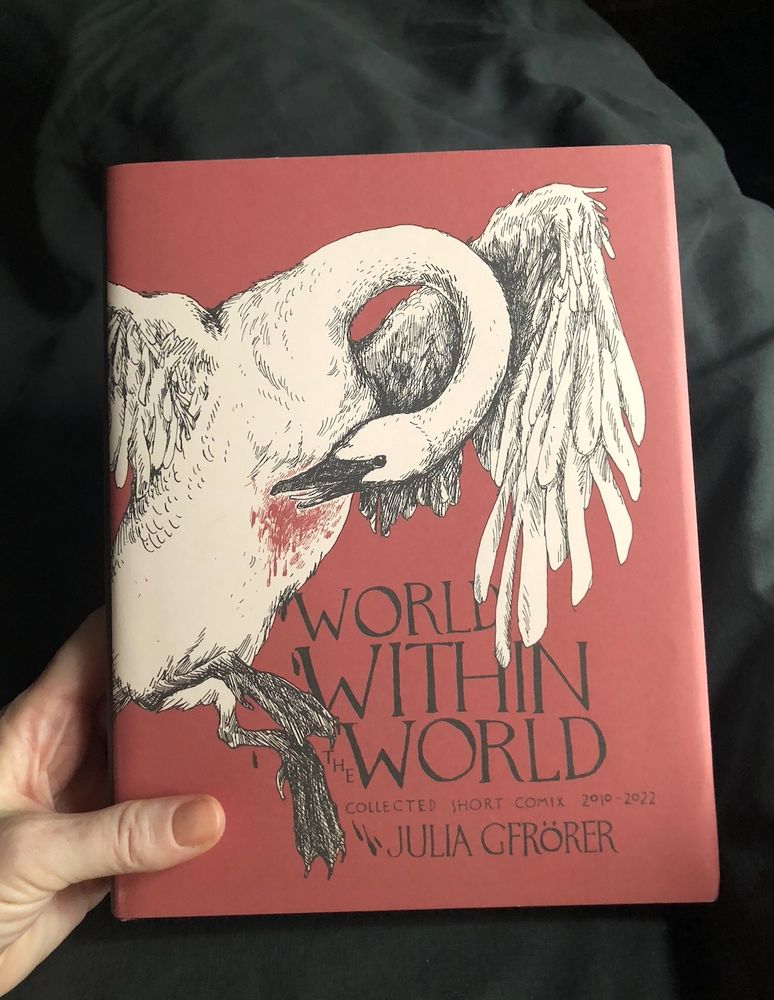
My brilliant friend Matthew Perpetua interviewed my brilliant wife Julia Gfrörer about her brilliant book World Within the World for the Comics Journal! If you’ve ever been curious about her stuff, this is the interview to read.

‘MobLand’ thoughts, Season 1, Episode 9: ‘Beggars Banquet’

If you’ll permit one last bit of TV-critic musing, I’ll say this: I’ve seen shows go from “yeah, it’s pretty good” — or even “yeesh, it’s not that good” — to “whoa, something’s going on here” before. Usually the real quantum leap in quality occurs around the Season 2 premiere, but there tend to be glimpses of a better show beneath the surface of the existing one in the final quarter or so of the debut season. That’s what we’re experiencing with MobLand right now, and that’s a great sign, for the season finale and beyond.

I reviewed this past weekend’s MobLand for Decider.

‘The Last of Us’ thoughts, Season 2, Episode 7: ‘Convergence’

It insists upon itself. That’s it. That’s the issue with The Last of Us. That bit of not-quite-intelligible criticism that Seth MacFarlane swiped from a film professor and put in the mouth of his Godfather-disliking creation Peter Griffin is, despite coming from The Family Guy, a one hundred percent accurate assessment of this show. Every case is made a bit too strenuously, every loss is rendered a bit too tragically, every act of villainy is heinously unjustifiable, every act of antheroism is justified in its heinousness, every dive for profundity leaves the show with a cracked skull in the shallow end. It aims for the heavens, but it can only play to the cheap seats. It insists upon itself, Lois.

I reviewed the season finale of The Last of Us for Decider.

‘Murderbot’ thoughts, Season 1, Episode 3: ‘Risk Assessment’

Clocking in at just around 20 minutes total — shorter than a Friends episode, minus commercials and the Rembrandts — this installment of Murderbot shows what a fun approach to this material these bite-sized episodes offer. There’s something really old-school about it, and I mean old school, like 1960s Batman old-school. Here’s a colorful genre piece about a strange pereson in a costume fighting to keep people safe against nefarious forces that nearly triumph once every half hour.

Why belabor the issue by extending the episodes to an hour, or deviating from the bubbly pop-surival-horror tone? Why not play the Aliens Colonial Marines’ arrival on LV-426 with Burke from the Company in tow for laughs? Why not do it as the thesis statement for an entire show? 

I reviewed this week’s Murderbot for Decider.

NEW PLAYLIST: STRAIGHT ’98

🔷 new playlist 🔷

STRAIGHT ’98

cool blue sounds from an era after hours

Apple Music | Spotify | YouTube

‘The Last of Us’ thoughts, Season 2, Episode 6: ‘The Price’

Ellie doesn’t know the backstory, of course, but she takes Joel’s words on board. “I don’t think I can forgive you for this,” she says. Yeah, no fuckin’ shit, I wrote in my notes. He perpetrated a mass shooting and doomed humanity to a second dark age like a one-man Trump administration, on behalf of a person who would rather have died for the cause. (One of TLoU’s many false binaries is the idea that the only way the Fireflies could find a cure is by killing Ellie; another is that the only way they could bring about her death is through deception, rather than by respecting her autonomy and asking her for this sacrifice.)

But then she adds “…but I would like to try.”

To quote I Think You Should Leave, you sure about that? 

I think it’s perfectly okay not to forgive Joel for what he did, actually. (No matter what Druckmann says in interviews.) I think it is in fact reasonable to demand that members of society, even one being actively atomized by environmental catastrophes and authoritarian governments, consider not only their rights but their responsibilities, not only the good of them and theirs but of everyone and everyone’s. I think a common good exists, and I think it’s meet and right to shun and despise people who do their utmost to destroy it. 

Like most episodes of TLoU, this one makes the most of its gorgeous natural backdrop. Druckman has a real knack for theatrical tableaux — Joel watching Ellie climb a vine-encrusted dinosaur statue, Joel and Ellie walking around a model of the solar system, Ellie and Joel and Gail and Tommy gathered around Eugene’s body. These moments, where the action slows down so both the characters and ourselves can gaze in something in awe or horror or wonderment, are one of the show’s trademarks, and maybe its strongest aesthetic weapon. And again, Mazin is a frequently clever and capable writer; that moth business is going to stick with me.

But The Last of Us has chosen to prioritize a heartwarming father-daughter reunion over, quite literally, the salvation of humankind. The world is awash with men harboring this exact paranoid fantasy, that their proprietary interest in their wives and children absolve them of their bonds to broader humanity and absolve them of any wrongdoing committed in their in-group’s name. They run our country now, as they do others, and they’ve perpetrated real horrors against real people. I’m not interested in trying to forgive them. I think it’s worth considering what this show is asking us to forgive.

I reviewed this week’s episode of The Last of Us for Decider.

‘MobLand’ thoughts, Season 1, Episode 8: ‘Helter Skelter’

In short? These people are interesting. Their relationships are interesting. Their jobs are interesting. Their world is interesting. And most importantly, the way creator Ronan Bennett, co-writer Jez Butterworth, and director Lawrence Gough are depicting all this is, itself, interesting. The deeper we get into the crime shenanigans, the more complex and engaging the characters become. 

It’s worth keeping in mind that many shows, even many great shows, start simple and broad before their focus sharpens and their strength increases. Just to cite one extremely mighty example, The Sopranos was always terrific, but it wasn’t until midway through Season 3, during an incident involving Ralph Cifaretto, a stripper named Tracee, and a parking lot, that it truly became THE SOPRANOS. Mad Men was making corny jokes about how “there’s no magic machine that makes copies” in its pilot episode, but by the end of its first season it had created a rivalry storyline between main character Don Draper and his young nemesis Pete Campbell that simply never went where I expected it to go. 

Is MobLand either of those shows? I’d say “no, of course not,” but I’m never gonna sell this particular cast short. If someone gave this crew Sopranos-level scripts, I have no doubt they’d nail it. My point is simply that a rising tide lifts all boats, and this episode is a rising tide. The twisty plot, the twisted secrets, the idiosyncratic and engaging lead performance of Tom Hardy, the reliably keen work of everyone else in the cast — there’s something here, I think, something potentially fascinating. And if worse comes to worst, all we get is a fun British gangster show with a crackerjack crew of actors. Every show should be so lucky as to have that for their worst case scenario.

I reviewed this week’s MobLand for Decider.

‘Murderbot’ thoughts, Season 1, Episode 2: ‘Eye Contact’

Apple TV+ has done more experimentation with 30-minute dramas, particularly genre pieces, than any other streamer I can think of. To cite two examples, last year’s Sugar, starring Colin Farrell as an unusual private detective, worked, because the mystery format lends itself to being broken up into discreet chunks whenver there’s a twist or breakthrough in the case. Before, a supernatural thriller starring Billy Crystal and Judith Light, did not work, because effective horror depends on building tension and dread, which you can’t do if you’ve got to end on a big cliffhanger every 26 minutes or so. 

Murderbot can go in the “works” category. It’s not asking a ton of you as a viewer, at least not yet; its main question seems to be “Do you like watching Alexander Skarsgård play a neurodivergent Terminator?”, and that’s a question you can easily answer, in the affirmative, in 30-minute chunks. I want to see what trouble this big goofy killing machine gets up to. I want to find out what trouble it’s gotten up to in the past. And I want to see how it gets its reluctant human friends out of their own trouble — or, who knows, maybe abandons them to it in a shocking way and becomes a real antihero, instead of a wisecracking sidekick who suddenly got a story of its own. Either way, I’ll be watching. 

I reviewed the second episode of Murderbot for Decider.

‘Murderbot’ thoughts, Season 1, Episode 1: ‘FreeCommerce’

There’s a world out there, a world not so very different from our own, a world in which Apple TV+ rebrands as sci-fi specialty streaming service — a la Shudder for horror or Crunchyroll for anime — and makes a very strong go of it. SeveranceSiloFoundationFor All MankindInvasion, at least one other show I could name but won’t because it would spoil a pretty big surprise: Apple’s genre efforts are stylistically and thematically diverse, they provide a platform for a phalanx of terrific actors, and they look expensive as hell. It’s clear that this science fiction is treated with care and concern by the streamer. Apple TV+ wouldn’t have canceled Raised by Wolves, that’s for damn sure. (I’m still salty about that. Damn you, Zaslav!)

Judging from its premiere (both episodes one and two drop today), Murderbot fits neatly into this existing pattern of platforming bold and often beautiful science fiction visions. This one comes from author Martha Wells — her novel All Systems Red, the first in her Murderbot Diaries series, provides the basis for the show — and co-creators Chris and Paul Weitz, who also co-write the first two episodes and split the honors directing. Running at sitcom length, it has a mostly breezy and comedic vibe, between moments of sudden inhuman violence and cutaways to a psychedelic sci-fi show-within-the-show. The mix works.

I reviewed the series premiere of Murderbot for Decider.

‘Andor’ thoughts, Season 2, Episode 12: ‘Jedha, Kyber, Erso’

There’s a great and powerful beauty in giving voice to true things that are forbidden to say. This is why authoritarian governments work so hard to keep you from saying them. They will arrest you, they will disappear you, they will strongarm you, they will blackmail you, they will bribe you, they will kill you to keep you from saying them. Nemik’s manifesto points this out when it talks about how frantic tyranny’s efforts have to be to control all the spontaneous outbursts of freedom that threaten it. People want to hear true things, say true things, share true things. True things shield us from the fascists. Eventually, with effort, with sacrifice, when enough people try, true things can be shaped into a sword to kill them with. 

Andor has spent two season avoiding “May the Force be with you.” It’s nearly ignored the Force entirely, except for these last handful of episode, in which its presence is minimal still. This was in large part the point of the show. Stripped of good and bad samurai wizards whose powers effectively demonstrate who’s good and who’s evil, the Star Wars galaxy was remade by showrunner Tony Gilroy and his collaborators into something, hopefully, more recognizable to us. A galaxy of slave labor in prisons. A galaxy of dehumanizing propaganda campaigns against scapegoated groups. A galaxy of arbitrary arrest, imprisonment, and execution. A galaxy of rapists and torturers and murderers in uniform, swaggering around like they own the place. A galaxy of dead friend after dead friend after dead friend, the bodies piling up all around. Andor ground its title character’s face into this dirt over and over again.

Then this man, a kind man, a good man, Obi-Wan Kenobi’s friend, Princess Leia’s dad, walks up to him and says “May the Force be with you.”

These, too, are the words of a dead man to a dead man. Bail will be killed when the Death Star destroys his home planet of Alderaan. Cassian will be dead before then, perishing in the fight to transfer the battle station’s plans to Bail’s daughter Leia. But that doesn’t matter. Forget what Cassian’s done, what he’s seen, what he’s lost, what he stands to lose. There’s good in this world. He’s a part of it. It’s a part of him. He is one with the Force, and the Force is with him.

As if to honor all this, John Williams’s magnificent Star Wars theme actually plays over the end of the closing credits, if I’m not mistaken the first time in the history of the Disney+ Star Wars TV shows that this has happened. Someone up there knows we’ve watched something special.

There are no Jedi in the world we live in, no Sith. No one will deflect a blaster bolt with a lightsaber or choke you out with a gesture. We’re not so lucky to have definitive proof of good and evil. But we can recognize it when we see it; only years, decades of conditioning can convince us otherwise. That conditioning is unnatural. Freedom is not. That’s the force we can be a part of, not a long time ago in a galaxy far, far away, but here, now.

After forty years of fandom, forty years of it being a catchphrase, “May the Force be with you” meant something to me again. It moved me. Sitting there with the television paused, I was unable to continue until I processed this feeling — the pure, simple hope for good things to happen to other people rather than bad. Rebellions, of course, are built on hope.

Hearing those words spoken aloud in this moment feels like a miracle. Four decades after it was first said on screen, “May the Force be with you” made me burst into tears. That is the power — the force, if you will — of Andor, one of the best television shows of all time.

I reviewed the series finale of Andor for Decider. This show is a masterpiece.

‘Andor’ thoughts, Season 2, Episode 11: ‘Who Else Knows?’

The miracle of this penultimate episode of Andor is that despite knowing how everything turns out for just about everyone left on the show — their futures are spelled out in the prequel film Rogue One, their legacies cemented in the original Star Wars film, A New Hope — it’s one of the most suspenseful 30-odd minutes of television I’ve ever seen.

I reviewed episode 11 of Andor Season 2 for Decider.

‘Andor’ thoughts, Season 2, Episode 10: ‘Make It Stop’

The zeal of the convert is a fearsome thing. The classic Biblical example is Saul, persecutor of Christians, taking the road to Damascus and becoming Paul, Christianity’s greatest and most strident proselytizer. Paul famously saw the light. A man named Sgt. Lear saw the darkness. 

In this episode of Andor, chronicling the final hours in the life of Luthen Rael, we learn that he was once an Imperial soldier during what seems like its birth and initial establishment of dominance. But the wholesale slaughter of civilian populations wrought by his brothers in arms leaves the sergeant cowering in his ship, chanting “Make it stop! Make it stop!”, sometimes in his native language, “Rosh ne luts” — the first and only time we ever hear him speak it. 

I reviewed episode ten of Andor Season 2 for Decider.

Strike, Dear Mistress: Sexy Goth 1967-1994

🖤 NEW PLAYLIST 🖤

STRIKE, DEAR MISTRESS: SEXY GOTH 1967-1994

Sensual, sexual, romantic sounds to warm the cold dark

Apple Music | Spotify | YouTube

Stardust: The Absolute Best of David Bowie

STARDUST: THE ABSOLUTE BEST OF DAVID BOWIE

Over 110 carefully selected songs spanning his entire career, including every phase and album (plus singles and collaborations), some more than others. Fully updated and patched since it was first posted — now with Spotify and YouTube versions too.

Apple Music | Spotify | YouTube

‘MobLand’ thoughts, Season 1, Episode 7: ‘The Crossroads’

MobLand is not thinking deep thoughts. That’s a compliment. Unlike, say, The Last of Us, this show about violent people doesn’t spend its runtime weeping and sweating and getting stress hives as it LarryDavidCantDecide.gif’s the morality of torture and murder. Turns out it’s not that deep. The characters on MobLand revenge-kill each other in painfully theatrically ways because they’re not good people. Simple as. Creator Ronan Bennett and his cowriter Jez Butterworth have no interest in trying to persuade you otherwise. After the carnage of this particular outing, they couldn’t if they tried.

[…]

I’ll tell you what is good, though: Tom Hardy, action antihero. I never wanna see this actor do this kind of bang-bang shoot’em-up style stuff wearing a uniform or a badge, unless he’s explicitly playing a bad cop. As all his best roles prove, Hardy is an agent of chaos, a fly in the ointment, a monkey in the wrench, a pain in the ass. He shoots people to prove he means business, he uses unarmed men as human shields to open doors he knows are heavily guarded, he interrogates a man he disemboweled. The closest this man should ever get to playing a cop is if they ever need to reboot the Punisher. 

And for what, by the way? For what reason is he killing a couple dozen people, creating scores of grieving wives and husbands and mothers and fathers and daughters and sons and friends and coworkers? Why is he giving dozens of families just as much cause to launch a vendetta as the Stevensons and the Harrigans themselves have? Because he’s a Harrigan soldier, and Harrigan lives are more important, and he’s gonna kill and torture whoever he has to in order to save those Harrigans. Again, simple as. We’re not asked to understand, we’re not asked to excuse, we’re not asked to forgive. This guy’s a scumbag. It’s just that because he’s the star of the show, he’s our scumbag.

I reviewed this week’s MobLand for Decider.

‘The Last of Us’ thoughts, Season 2, Episode 5: ‘Feel Her Love’

To sum up: This episode is a dull recreation of a kind of gameplay that’s a lot more exciting when you’re actually playing a game, culminating in the hero of the piece torturing a helpless woman. I can only envy you if you find this diverting.

I reviewed this week’s The Last of Us for Decider.

Bonus Playlist: Horny Punk

UNCONTROLLABLE URGES: HORNY PUNK 1969-1983

Sweaty, desperate, down bad tracks that need it all through the night, from in and around the punk explosion

Apple Music | Spotify | YouTube