Robby and Langdon’s helicopter-soundtracked conversation is the centerpiece scene for this week’s episode of “The Pitt.” It’s a major step forward for one of this season’s most important story lines, featuring two of the show’s most prominent characters, set against a “swimmer vs. propeller” boating injury severe enough to require a helicopter for transportation. It’s an attention grabber no matter how you slice it.
The sequence also shows how the Pitt’s close quarters and insane work rate force people together, even when one or both would prefer to stay away. It’s doing astute character work in the process: The din of the chopper blades helps to mask the vulnerability of both men in that moment. Could Langdon have chosen the helipad to bare his soul, even unconsciously, for that very reason?
In terms of filmmaking, the emotional heat of the moment is matched by the heightened sensory intensity of the helicopter landing — the noise, the wind, the yelling, the dramatic rooftop setting. All together, this is “The Pitt” at its best.
There’s room for silly business like this in Twin Peaks for sure. It’s part of the charm. But we’re now getting ever closer to the pulsating black heart of the story — the force of sheer malevolence that claimed Laura Palmer’s life. As such, even the simplest lines that touch on this mystery take on an awesome power. When Mike describes Bob as “the parasite,” attaching himself to human hosts and feeding on their fears and carnal pleasures, it’s like hearing Max Von Sydow talk about the thing inside Regan in The Exorcist.
“He is Bob, eager for fun,” Mike says. “He wears a smile. Everybody run.”
This dialogue moves me to the point of tears, not of sorrow or joy, but awe. A great and terrible thing is at hand.
At this point in its run, Industry is the kind of show that makes me sound like a drunk at a party, cornering you with booze-scented opinionation. So be it. You gotta understand: I watch a lot of television. Industry is as good. as. it. gets. As good as it gets! Set to a pulsating horror-movie synth score by Nathan Micay and even more massive needledrops (“Silence” by Delirium and Sarah MacLachlan, freaking “Both Sides, Now”), it continues to rival the greatest television shows ever made: for insight, for intensity, for that freefall sense of never knowing what will happen next, but still being sure it’ll hurt.
The genius of “A Knight of the Seven Kingdoms” is that it in this bitter victory, it gives Ser Duncan everything he wanted from the start. Consider what has happened: Dunk took the field at the great tourney at Ashford. He did battle with some of the most famous knights and lords in the realm. He emerged victorious, proving both his mettle and his character in the process. Even the squire he reluctantly took under his wing served him well.
But triumph of Ser Duncan the Tall in his trial of seven is not the stuff of song. There’s no glamour to be found rolling around in the mud, getting stabbed full of holes while pounding another man’s face in. There’s no glory in a victory that comes at a cost steeper than Dunk wanted anyone to pay.
You don’t expect casualties among the core cast of “The Pitt.” Yes, they deal with life-or-death stakes, and sometimes with infectious diseases or belligerent patients. But characters in a medical procedural are not in the kind of danger you expect in a show about gangsters, knights or rebel spies. When I sit down to watch this series, I expect to be affected by heartbreaking deaths, but not involving anyone I’ve come to care about over the show’s 21 episodes to date. Dr. Robby and the gang feel off-limits, somehow.
While the episode looks and feels bifurcated, it’s really best considered as a whole. Byron Forst is a cautionary tale about the obsession with beauty — how in the hands of a vapid sociopath it’s just another weapon, a set of fangs that lets him sink his teeth even deeper into a world he’s already despoiled. He’s human Mar-a-Lago Face, if Mar-a-Lago Face didn’t make you look like a monster on the outside as well as the inside, that is. He’s an obsession with beauty as dominance, beauty as the currency of the world’s masters.
Mike and especially Clara, by contrast, illustrate that it’s not always vain or frivolous or shallow or incel to care about how you look. Mike’s not really that much of a schlub, he’s just kind of leading a low-effort life when he’s not at work. Clara’s spent decades living as a man, getting married, having kids, the whole nine; now she’s finally out and transitioning, but she can feel the wasted time hanging over her already, and the process itself is immiserating to her.
These people don’t want to bang stewardesses and then order their murder with their genitals still wet. They don’t want to deplete children’s college savings funds to overcharge for a miracle drug. They want to have the confidence that looking amazing, the way they want to look, will give them. Are they reckless, maybe selfishly so, given how little they know about the drug? Yes. But they care about each other before, during, and after their transformations. They’re friends. Their motives are not alien to us, as Byron’s are. Clara and Mike are fascinating books to read, but they get judged by their covers. It’s hard to begrudge them their redesign, even though we know that disaster follows.
In the present, the newly Beauty-fied Jordan convinces Cooper she is who she says she is by repeating her nickname for his dick: Provigil, an anti-narcolepsy drug, that “brings me back to life.” (I mean this sincerely: Stay classless, The Beauty.) At dinner, she explains how after fleeing the hotel in a panic after transforming, she initially enjoyed the attention her youthful new body and face received, until increasingly unpleasant interactions with men made her feel objectified and stupid. Cooper assures her she was beautiful long before the drug got in her system.
I’d like to see that explored a bit more, to be honest. Rebecca Hall, the actor who plays original-version Jordan, is in fact stunning, and the character is not even 40 yet. Ashton Kutcher, the transformed version of Byron, is 47 years old. He can absolutely play younger, but so can Hall, so what gives?
At the risk of shooting the show bail, I think the double standard is deliberate. Men made this drug, mostly for a male userbase, entirely for a patriarchal world. For these guys, and for a lot of people in fact, it’s okay to be a handsome 47-year-old man in a way it’s not okay to be a beautiful 40-year-old woman. Men online will speak of “the wall,” some completely mythical barrier women hit as they age after which their looks evaporate, as if it’s an incontrovertible fact of life. Would a scientist willing to take these bastards’ money be any different?
The sequence that follows is fascinating for how directly it addresses female desire, a constant theme where Laura is concerned. To help flesh out Harold’s “living novel” and satiate his thirst for secrets — in exchange for which he’ll read to her from Laura’s diary — Donna tells the story of a time in junior high when she and Laura dressed up in their tightest clothes to pick up boys at the Roadhouse.
The college boys who pick them up wind up going skinny dipping with them, which is Donna’s idea, not Laura’s. Laura had begun dancing provocatively, and Donna is desperately trying to keep up. She imitates the dance, half in shadow, to make her point.
As Laura makes out with two of the three young men in the water, the third swims out to where Donna is and kisses her hand, then her lips, a feeling she remembers almost physically even now. “I never saw him again,” Donna tells Harold with tears in her eyes. “It was the first time I ever fell in love.”
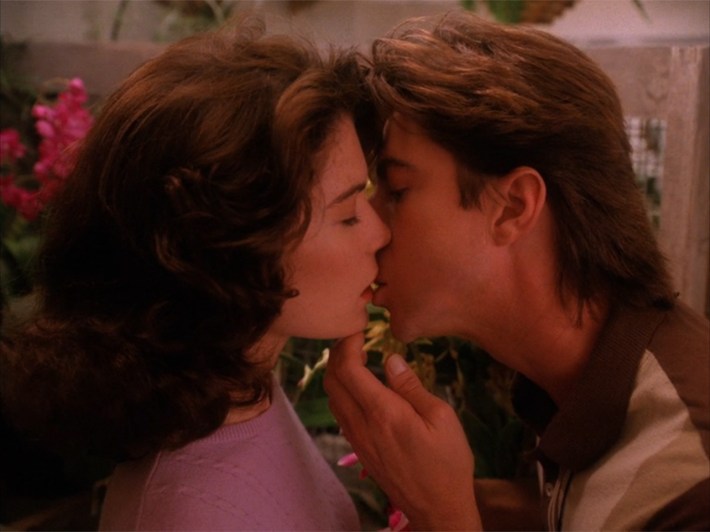
Harold is blown away. He takes her back to show her his orchids, paying special attention to the “lower lip” of its petals, “called a labellum.” The words hang in the air, dripping with innuendo.
“So delicate,” Donna purrs. When Harold explains it’s a landing pad for pollinators, Donna replies, “Romantic, isn’t it?” The two kiss before Harold, suddenly anxious or self-conscious, breaks it off and scampers away.
There are any number of taboos being violated here, giving the scene the heat of the forbidden. There’s the obvious erotic power of that story over Donna even now, yet it’s not presented as some lascivious Lolita kind of thing. In how she tells the story, Donna is clearly expressing feelings she experiences now, as a young adult…and which Harold experiences as an older one. So there’s that age gap aspect, too.
But at the same time, Harold’s severe mental illness, and his ignorance of Donna’s true motives, put her in control of the much older man, not the other way around. The whole thing is a psychosexual bramble, and its thorns are hard to disentangle yourself from.
There’s always the risk of overpraising a current show you’re very excited by. Critics especially are given to hyperbole in order to convey that excitement to their readers, and I know I’m no exception. Nevertheless, the one season of television I keep thinking of while watching Industry Season 4 is Mad Men Season 5, a string of back-to-back-to-back-to-back-to-back masterpieces representing the show, and the entire medium of television, at its absolute best. Industry feels very much as if it’s on the same kind of run right now. I eagerly anticipate, and deeply dread, everything to come.
Two half-hour episodes remain in the show’s short first season. (It was renewed before it even debuted.) With the combatants already on the field, it feels as if we’re headed for a penultimate episode in the grand “Game of Thrones” tradition, a wall-to-wall battle, followed by an final episode of wrap-up with an eye toward the future. It’s an exciting feeling: I have never quite forgiven “Shogun” or “House of the Dragon” Season 2 for teasing battles that never arrived. (Or won’t until the next season, anyway.) That won’t be an issue here.
But it’s more than the prospect of combat that moves me. “A Knight of the Seven Kingdoms” is a decency fantasy, a term coined by the comics critic Tom Spurgeon to refer heroic narratives that privilege kindness, cooperation, competence and the fundamental humanity of their heroes over individualistic derring-do or edgy anti-heroism.
Ser Duncan may or may not survive his trial of seven (though the show’s renewal feels like a tip-off). But in the same way that he most likely saved Tanselle’s life by putting himself between her and her attacker, his allies Prince Baelor, the newly minted Ser Raymun, the jocular glory hound Ser Lyonel and the others are all volunteering to try to do the same for him. It’s as if justice were contagious, spread whenever even an ordinary person like Dunk proves willing to defend the defenseless.
Dr. Robby’s beef with Dr. Langdon, or a case of necrotizing fasciitis: Which condition will prove harder for the medical professionals of “The Pitt” to handle?
Falloutis a victim of its own success. It’s just aired a season of television that was meaner, sharper, grosser, funnier, and better looking than its already strong initial outing. Expectations for the finale, therefore, were always going to be high. Even so, I had every confidence that Fallout would meet the moment.
But there’s an air of anticlimax to Fallout’s Season 2 finale. There were just a few too many payoffs deferred, a few too many secrets held back, a few too many storylines stretched thin. Don’t get me wrong, everything here was good, but there’s the nagging sense that the show decided to stop just short of being great.
You can say this for the finale, directed by Frederick E.O. Toye from a script by Karey Dornetto: It never lets you get bored. The action ricochets between half a dozen characters, locations, and even time periods at frequent intervals. By the end of the episode you’re going from one to the next every few seconds. All of them are compelling action/thriller sequences, featuring characters whose fates we care about.
Leland Palmer has a confession to make. Once again sobbing like the devastated father we knew before his hair went white, Leland admits that he killed Jacques Renault, the man he believed to be Laura’s killer. His motivation, he explains to Sheriff Truman, Agent Cooper, and Doc Hayward, was “absolute loss…more than grief. It’s deep down inside. Every cell screams. You can hear nothing else.”
And indeed, we do hear the sound in Leland’s head as he sits in the interrogation room in the Twin Peaks Sheriff’s Department, staring into the holes in the paneled walls. It’s the voice of his daughter, Laura, calling “Daddy!” over and over.
There’s a lot of good TV on right now. Even more specifically there’s a lot of good TV on HBO Max right now. In addition to Industry, there’s The Pitt and A Knight of the Seven Kingdoms and Heated Rivalry. They’re all big buzzy dramas. (For the record, Knight isn’t a comedy or a dramedy, it’s a drama that’s funny, a subtle but crucial distinction.)
But even relative to its strong contemporaries, Industry is in a class by itself. It’s in the conversation with The Sopranos, Mad Men, and The Young Pope/The New Pope. I don’t know what that conversation is, necessarily — something to do with artful, ruthless television about how the cycle of venal but irresistible desire unmoors us from the morality that makes us human beings — but that’s where Industry is. Every time I sit down to write a review of this magnificent smorgasbord of sociopathy, my first thought is “Where do I begin?”
At any rate, with none of his squire’s privileges and protections of rank and title, Dunk straight-up decks a man he knows to be a Targaryen. Having seen his own father hanged as a boy, he is under no illusions about the nature of Westerosi justice. He knows standing up for Tanselle will cost him his life. Then he does it anyway.
Ser Duncan sees armed and armored agents of the state assaulting a woman of color — racism against the darker-skinned Dornish is pervasive at court during this time period in George R.R. Martin’s stories — and places her life above his own. He does this instinctively, without thinking, without letting the almost certainly fatal consequences deter him. He has seen the powerful doing evil, and he has chosen to fight it. For him, there’s really no choice to make at all.
When Aerion petulantly asks Dunk why he has chosen to throw his life away, it’s a rhetorical question. But it sheds more light on the prince than he realizes. Men like him really can’t understand that kind of selflessness, that sense of kinship with one’s fellow human beings. That inability is the tyrant’s biggest weakness. And it’s what gives free people hope for a fighting chance — a hope which belongs to all who invoke it.
The only glimpse I caught of Twin Peaks during its initial run occurred on October 13, 1990. I was 12 years old, it was after 10 p.m., and I must have been flipping through the channels absent-mindedly before bed after the Golden Girls/Empty Nest block on NBC had ended. I was aware of the show by then, even as a person who’d only freshly become aware of “pop culture” as a phenomenon; the cast and the parodies were absolutely everywhere for months. But this was my first look at the show itself.
I saw a one-armed man with a syringe have a seizure in a men’s room stall, then emerge in perfect calm, talking to an unseen figure like a man possessed.
I was a squeamish kid. That was plenty of Twin Peaks for me.
Keep that in mind as you watch Coop’s subsequent actions throughout the episode. When he’s interviewing the GQ guy, he learns that the man was in love with the woman who blew up, though he knew she didn’t feel the same. When he starts to sob with grief, Cooper actually takes the risk of reaching out and holding the man’s hand. “Thank you for being kind,” the man says with shocking directness. “They’ve kind of been treating us like animals.” Light shines on them from above, transformed from the harsh glare of an interview room to a kind of visual benediction.
The same thing happens with Platt’s character. When Cooper enters the plastic-lined chamber where doctors are working on him, he’s struggling against his restraints, begging them to “talk to me like a real person” over and over. That’s exactly what Cooper does, calming Manny down by discussing their dogs and, again, holding the man’s hand. “You have a kind face,” Manny plaintively tells Cooper at one point, not incorrectly. Things go south after that, but that’s the virus’s fault, not Cooper’s.
If you’re not a heterosexual cis man and you’re reading this, I need to impress upon you just how not done it is to reach out and hold the hand of basically any man, let alone a stranger. You have to willingly leap a pretty big gap of societal convention, patriarchal conformity, homophobia, and emotional stuntedness to do it — and you have to count on the recipient to be willing and able to do the same. I found these moments strangely beautiful as a result. Even amid all the camp body-horror shenanigans, the show makes time for men to treat each other decently.
What’s more, Ashley and Manny aren’t simple stereotypes. Ashley, who’s kind of a gym bro, feels looked down upon by the elite fashionistas at Vogue. He knew Manny was cruisy in the men’s room — but he didn’t mind, because letting the guy check out his dick gave him a little confidence boost. “I’d give him a little show. Made me feel superior. Picked me up on down days or something.” Only after rambling like that does he catch himself: “Sorry. I don’t know why I’m telling you this.”
It’s a humanizing comment, a funny and unexpected detail, and an illustration of how even straight gym bros who are madly in love with beautiful women and absolutely love to kiss and tell about it also engage in a little homosociality now and then for various reasons, all in one. It’s excellent writing from co-creators Ryan Murphy and Matt Hodgson, and the entire hospital segment is engagingly acted by Peters, Platt, and Halper.
“The Pitt” loves its teachable moments. If a patient doesn’t have insurance, characters will discuss the way many families fall in a coverage no man’s land: too poor to afford health insurance, not poor enough to receive Medicaid. If a nurse ignores a deaf woman in favor of her A.S.L. translator, he — and the hearing members of the audience — will be gently reminded to address deaf people directly when speaking to them. If a secretly bulimic patient’s pneumonia is caused by her eating disorder, the safe money says that the friendly emergency room doctors will persuade her to accept help almost immediately. They will also note, correctly, that Black women with eating disorders are underdiagnosed.
Every episode of “The Pitt” features moments reminiscent of “very special episodes,” in which 1980s sitcoms briefly silenced their laugh tracks to address serious societal issues. Moments like those in “The Pitt” work as much like educational programming or civics lessons as they do drama.
But the skill of the actors and filmmakers goes a long way toward lessening the sense that you’re being lectured. It would indeed be nice to live in a world where the differing needs of people from different backgrounds and with different conditions were met with care, respect and understanding. No matter what cases come their way — and the cliffhanger ending, about an antibiotic resistant infection, suggests they’ve got a doozy on their hands — it is a safe bet that the staff of the Pitt, for all their imperfections, will teach by example.