
Author Archive
Carnival of souls
September 23, 2009* Standing in the Strange Tales Spotlight today: Jacob Chabot.
* While we’re on the self-plugging tip, it’s only one comment long as of this writing and already the comment thread at my latest Savage Critic(s) post is awesome beyond words.
* Finally, I think there have been like four Marvel.com What The–?! videos released since I last linked to them: You can find the full YouTube playlist here. If you’ve ever wanted to hear the Blob say “Keep fucking that chicken,” now’s your chance!
* Big sale at the Drawn & Quarterly store. 40-50% off everything! (Via Tom Spurgeon.) I went looking for Crickets #2 but it’s out of stock. Does anyone have a copy they’d be willing to part with?
* Wow, Watchmen‘s DVD release pattern seems actively designed to alienate the movie’s relatively few fans. After releasing a “director’s cut” that was not, in fact, the everything-and-the-kitchen-sink cut that director Zach Snyder had been promising for as long as the movie’s been in production, Warner Bros. is now finally putting out that “Ultimate Cut”–but it doesn’t include DVDs of the theatrical or “director’s” cuts, charges you for a digital copy and the motion comic each on its own disc, tosses in some extras that apparently were already available on the other editions, and tops it all off with the goofiest cover imaginable. Aggressively irritating.
* This manga may supposedly stink, but the cover sure doesn’t. Wolf whistle. Stomach fat wrinkles are so sexy.

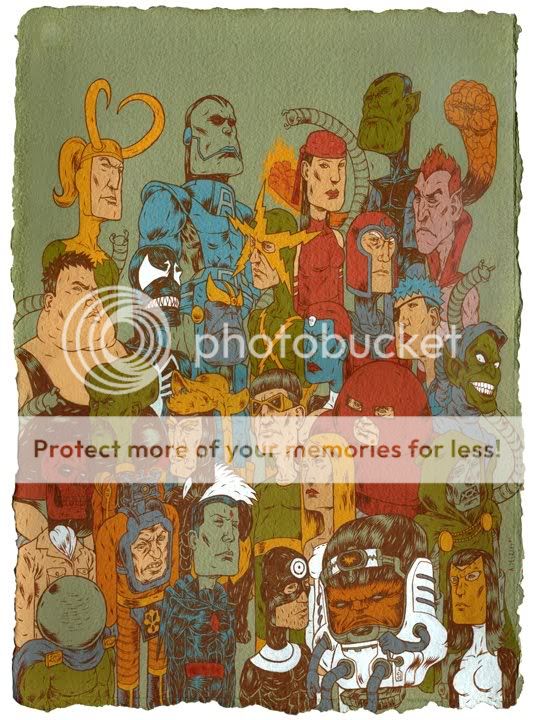
* Dang, Andrew DeGraff! (Via JK Parkin.)
* My friend Zach Oat’s list of his favorite Bruce Willis robots had me laughing out loud. I like the Squinty 5000 myself.
* Please oh please let a Gary Numan/Trent Reznor collaboration get off the ground. Still, I don’t get the impression that Trent likes when his potential collaborators let the cat out of the bag too early.
* For a long time since the advent of near-universal cellphone usage I’ve thought about old movies that depended on people not being able to get in touch and how some entire plots wouldn’t work if the characters could just reach into their pockets and pull out a cellphone. Turns out a lot of horror and thriller screenwriters have thought about this problem to, and their solution is just to drop coverage. Leave it to Rich Juzwiak, pop culture’s leading obsessive compulsive, to compile all the “shit–no signal!” scenes he could find into one 4 minute 56 second montage.
Comics Time: “Superhero comics worth your time today”
September 23, 2009

Gossip Girl thoughts
September 22, 2009* Back by popular demand! Not even kidding.
* After watching the season premiere last week I was pretty sure I wasn’t gonna do this again. I’ve got a lot on my plate and that thing was kinda lackluster. I appreciate Serena riding a horse like Gandalf or Goldfrapp, but it was mostly lame shit like the done-in-one non-story with Chuck and Blair’s roleplaying and Vanessa getting angry at Dan for, essentially, being a character on Gossip Girl. Whatever coolness Vanessa’s vagina absorbed from Chuck’s penis last season got burned through pretty quickly. I was glad they seemed to be introducing new main-ish characters for what seemed like the long haul–Chuck and Serena’s secret brother, Georgina, Carter, that redhaired girl from the CW show that got cancelled last year–but other than that, meh.
* This, on the other hand, was more like it. Backstabbing, secret plots, hookups, comedies of manners, Chuck referring to his apartment as “the Basscave,” someone asking Blair her opinion on Battlestar Galactica…swell!
* I fully support Deorgina, or Georgdana, or whatever you call it. But the funny thing was that when Blair asked Dan to take her to the party, I was ready to fully support Dair or Blan or whatever you’d call it. I realized that I’m basically just very, very excited by any new pairing. If Cherena or Serenuck or whatever you’d call it happens, I’m going to be fucking thrilled about that too. Not as thrilled as I would be by Chate/Nuck, but thrilled.
* I thought having all of Blair’s usual crazy snobby stuff turn her into a pariah in the college world of pizza and big red plastic cups was really funny and clever.
* College girls of the world, please don’t follow Dan’s advice about not dressing like Blair dresses. Dress like Blair dresses.
* Oh Nate, keeping the boarding pass in your pocket? You are too beautiful for this world.
* Serena is getting really, really annoying. Poor, misunderstood Serena, doing all kinds of stupid impulsive annoying shit and then later standing there looking and sounding half asleep issuing explanations and pseudoapologies while barely making eye contact with the aggrieved parties. If she keeps screwing shit up for Chuck I hope he has her assassinated.
* I liked how when the Bible-thumpers showed up they ruined everything. Because they do!
* Can anyone figure out why Secret Brother gave Vanessa a bum steer on that professor and then flipped out about it? How does that advance his plot? The Missus and I were totally baffled.
* Man, Phoenix can’t whore “1901” out hard enough, can they?
Carnival of souls
September 22, 2009* The Kirby heirs are indeed seeking a piece of Spider-Man in their copyright claim. Wouldn’t you? Tom Spurgeon offers some thoughts on the still-developing story, which I will be substituting for my own as is custom.
* Frazer Irving says he is indeed the artist on Grant Morrison’s Batman & Robin #10-12. Something tells me DC didn’t intend for the news to come out this way. Still, Frazer Irving!
* Drawn & Quarterly and PictureBox unveil who and what they’ll be bringing with them to SPX this weekend. Their collective bounty includes John Porcellino’s Map of My Heart, the Sammy Harkham-edited Bart Simpson’s Treehouse of Horror, and the ultimate con debut, Lauren Weinstein and Tim Hodler’s brand new baby. Congratulations! Dig John P.’s convention badges, too:

* Wow, I’m digging this Monster Brains gallery of monster art by Skinner. More here.
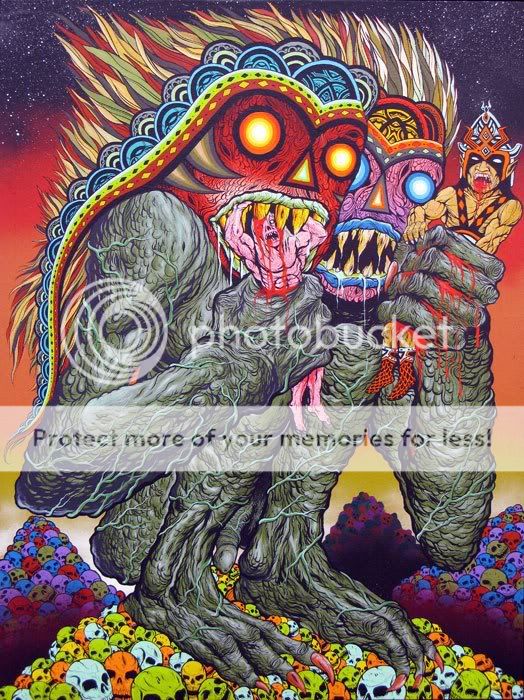
* Longtime ADDTF fave Robert Burden returns with another time-lapse video of one of his colossal action-figure paintings, this time around a 6 foot by 8 foot portrait of Battle Cat. Someday I’m taking the mirrors off my bedroom ceiling and replacing them with one of these things.
Comics Time: Clive Barker’s Seduth
September 21, 2009
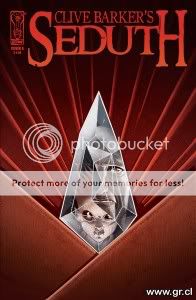 Clive Barker’s Seduth
Clive Barker, Chris Monfette, writers
Gabriel Rodriguez, artist
Ray Zone, “3-D conversion”
IDW, October 2009
32 pages
$5.99
“Surprise”: I love Clive Barker. Actual surprise: I was not looking forward to reading this Clive Barker comic. Despite its being touted as Barker’s first straight-to-comics work in two decades, the presence of a co-writer dampened my enthusiasm. So too did the 3-D aspect–we’ve all been burned by gimmickry. As for IDW’s involvement, I’d been mightily impressed by Kris Oprisko and Gabriel Hernandez’s lovely, lyrical Thief of Always adaptation, but Seduth artist Gabriel Rodriguez’s cartoony art on the company’s Great and Secret Show–admirable though it may have been for committing a full 12 issues to the effort–struck me as project-deflatingly wrong for the work. In my head, I see Barker as his own adapter, whether as filmmaker or painter or drawer; after that, I cut to the Gothy Hellraiser/Tapping the Vein aesthetic of the Epic Comics days, or to an altcomix style like C.F.’s that has never actually been applied to his stuff. Dude’s transgressive; let’s keep him that way.
Rarely have I been as happy to be wrong as I was about Seduth. Story first: Holy smokes, is this dark. It’s as savagely nihilistic as anything Barker’s done since the Books of Blood, or the story of Hellbound: Hellraiser II, which in its potentially apocalyptic nature and certain specific geometrical and extradimensional imagery is perhaps its closest point of comparsion. Heck, Seduth‘s done-in-one short-story nature makes it feel like an adaptation of a lost BoB outtake. But whereas most adaptations belabor the point, ladling unnecessary prose atop redundant illustrations for an oomph-sapping length of time, then suddenly eliding entire sections, this thing just leaps out of the gate and proceeds at an inexorable pace to its hopeless conclusion. If anything, it’s almost too rapid-fire, rather than the usual tedious legato-staccato juxtaposition you’ll find in comics versions of prose writers’ works. And whatever the division of labor between Barker and Monfette, the transitions are seamless, even to this seasoned observer of Barker’s work. After well over a decade of fantasy from the man, not even of the “dark” variety in many cases, I’d all but forgotten he had this kind of thing in him.
Meanwhile, whatever his deviation from my platonic Barker-adpatation ideal, Rodriguez steps up big-time. Yes, his work is cartoony rather than romantic or abstracted, the directions I’d go in, but its cartooniness is rock solid and reminiscent of some of the form’s most skillful current practitioners–some Tony Moore here, some Philip Bond here. Most of all it relies on a thick, confident line, which turns out to be perfectly suited to 3-D. From what I’ve been told, 3-D effects specialist Zone was involved in the project nearly from its conception, consulting with Barker, Monfette, Rodriguez, and project major domo Robb Humphreys on what kind of effects he’d like to employ in a perfect world. Barker appears to have given him carte blanche, because there’s nary a jump-scare “look out, a hand’s reaching out at you and a knife’s flying at your face!” cliche in sight. Instead, it’s all about layering, playing off the congruences and tangents of Rodriguez’s line to draw the eye in and around the page; the effect is dazzlingly unpleasant in all the right ways. Perhaps it’s just all the Chippendale and Rickheit I’ve been reading talking, but it struck me as an extremely effective and, yes, alternative way of exploring space on the page, to the point where I’m now curious to see what a Fort Thunder alum might do with this particular toolkit. But it can be used for spectacle as well, and it is, particularly in one back-to-back splash-page sequence in which Rodriguez, Zone, and colorist Jay Fotos produce an effect reminiscent of Dr. Manhattan’s line about the light taking him to pieces in Watchmen. Barker, who’s been vocally mainlining the work of Grant Morrison, was surely inspired by Morrison’s Final Crisis tie-in Superman Beyond both in the use of 3-D in the first place and its narrative role as a sign of extradimensionality, but I think the special effect is more nuanced, more effective, here.
So three cheers for Seduth; it made a believer out of this skeptic. Barker has long been thwarted by obstacles in terms of getting his ideas out to the public, from a studio sitting on his movie to a publisher rejecting his photography collection as too explicit to his own overflow of ideas getting the better of him to the point where he advances many projects but completes few. Comics famously has one of the lowest idea-to-finished-product thresholds in the arts; here’s hoping he continues to make such good, focused, no-nonsense use of it as he does in this short, sharp shock.
Carnival of souls
September 21, 2009* Happy birthday to two of my favorites: Craig Thompson and Stephen King. Over at his blog, the former explains how the latter’s insights helped him rescue his long-gestating graphic novel Habibi from a creative impasse.
* League of Extraordinary Gentlemen, Lost Girls, and Tom Strong author Alan Moore complains about today’s comic-book writers turning to decades-old stories for inspiration.
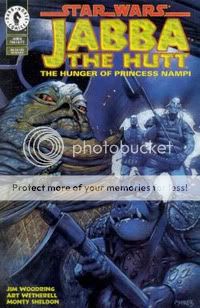
* Whoa whoa whoa whoa whoa: Jim Woodring wrote a Star Wars comic? About a potential mate for Jabba the Hutt threatening to eat him after sex? Oh, indeed.
* Jason Adams has great things to say about Total Film’s list of the 20 Greatest Horror Films You’ve Never Seen, but I have neither the time nor the inclination to inflate their hitcount by paging my way through their one-movie-per-page slideshow this afternoon. Maybe later.
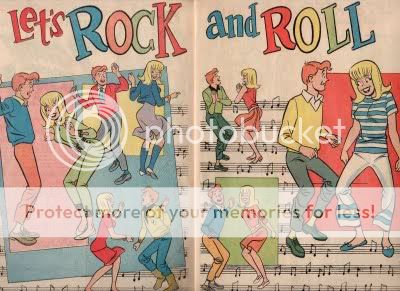
* Two posts in a row might be too few to refer to as “a roll,” but Tim Hensley sure is on something–jiminy christmas look at these Samm Schwartz spreads from Tippy Teen. Wow, Hensley is to the Archie aesthetic what CF, Frank Santoro, Ben Jones, Kaz Strzepek et al are to ’80s action-adventure comics, isn’t he?
* Ta-Nehisi Coates explains the sexual side of Michael Jackson’s “Thriller.” I feel pretty strongly about the power of the song myself.
* Ten years ago today, Nine Inch Nails released their (his) sprawling double album The Fragile. If it weren’t for various world-historical releases like Nevermind and OK Computer, I’d say it was the best album of the ’90s. Listen to the whole thing for free at Last.fm. (Via @nineinchnails.)
* Meanwhile, Trent (?) reports that a deluxe edition of some kind is coming in 2010. I have an iTunes playlist consisting of every original track and NIN-created remix coming from that entire period, up through and including the mostly-acoustic Still EP, placed in logical order based on the extended vinyl version of The Fragile as well as general euphoniousness, that I call “The Complete Fragile.” Hopefully it’s something like that.
Carnival of souls
September 20, 2009* Never a dull moment: Jack Kirby’s heirs are pursuing legal action to reclaim copyrights on his co-creations. You’ve got to wonder how much of the $4 billion Disney’s spending on Marvel would be in play without him. (Via Robot 6.)
* Manga and Muhammad, Iron Man and the Internet: Tom Spurgeon on five fundamental ways the comics industry has changed over the past five years.
* Brian Hibbs presents the case for Paul Levitz.
* Anders Nilsen previews Big Questions #13–coming soon! And as always, Nilsen says two issues remain after this one.
* Speaking of great stuff on the way from Drawn & Quarterly, Tom Devlin says John Porcellin’s Map of My Heart (a) will be out at SPX, and (b) contains Porcellino’s real star-making material from King-Cat. Heck yeah.
* Happy belated birthday to the best comics (co)publisher, Gary Groth!
* Tim Hensley reveals that the secret inspiration for Wally Gropius is…Phil Donahue? For real, what a fascinating idea for the post: the unlikely reference source for the Gropius strips’ near-Ditkoesque proficiency with interestingly posed hands.
* Frank Santoro sure can draw!
* Remember when superhero events flowed from series to series rather than relying on a central tentpole with tangential tie-ins? Curt Purcell does, and in his latest Blackest Night post he discusses the pros and cons.
* My Strange Tales Spotlight interview series at Marvel.com is about to kick into high gear again in anticipation of issue #2. First up: Jonathan Hickman.
* The secret origin of Miss Martian: She’s my friend Ben Morse’s fiancee! Seriously.
* WHOSE RESPONSIBLE THIS? made the Guardian, in an article that also discusses the Downfall/Hitler Reacts and Kanye Interruption memes. It refers to WRT? as “crowdsourced bullying” of poor Brickhousebunny21, the incestuous pedophilic bestiality enthusiast who coined the ungrammatical cri de coeur in the first place. I can promise that as the person who first pointed out the comedy/meme goldmine that that phrase is, it had nothing to do with trying to pick on BHB21 and everything to do with celebrating ridiculousness. Meanwhile, Rob Bricken collects another Best of the Best post for Topless Robot. For his part, Brickhousebunny21 showed up in my comments again to call me “a homo.” Gotta lvoe it!
The Manly Movie Mamajama Rides Again
September 18, 2009In light of recent events–namely the passing of Patrick Swayze and the release of Crank 2: High Voltage on Blu-Ray–my friends and I are convening for the first time since last October for a three-movie marathon of mirth, mayhem, and manliness: The 14th Manly Movie Mamajama. The booze, the junk food, the heckling, the gratuitous violence and nudity, the homoeroticism…it’s all so close I can taste it. What better time to take a stroll down MMM memory lane?
THE MANLY MOVIE MAMAJAMA
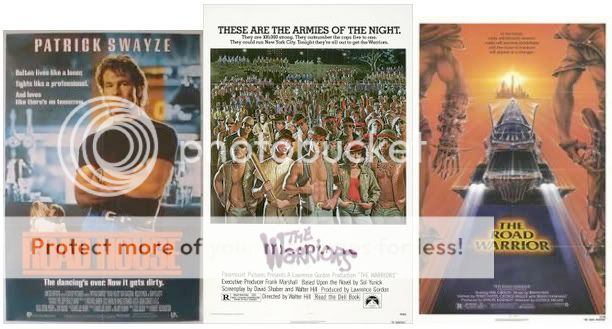
MMM1: ROADS AND/OR WARRIORS
1. Road House
2. The Warriors
3. The Road Warrior
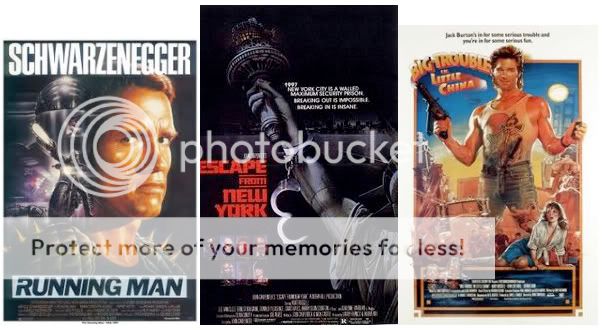
MMM2: DYSTOPIAN FUTURES AND/OR KURT RUSSELL
4. The Running Man
5. Escape from New York
6. Big Trouble in Little China

MMM3: VERHOEVEN IN VER-GOSHEN
7. RoboCop
8. Total Recall
9. Starship Troopers
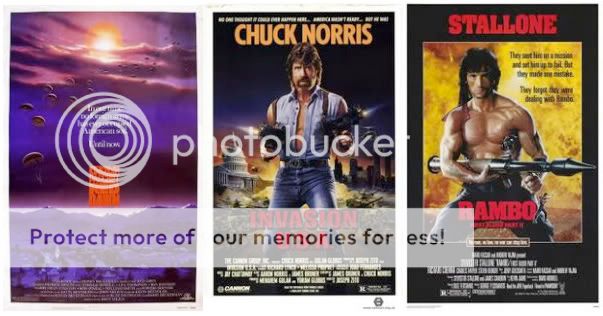
MMM4: GET WELL, FIDEL
10. Red Dawn
11. Invasion U.S.A.
12. Rambo: First Blood Part II

MMM5: SCHLOCKTOBERFEST
13. The Monster Squad
14. Hellraiser
15. The Thing

MMM6: FEMININE FILM FEST
16. Terminator 2: Judgment Day
17. Aliens
18. The Descent
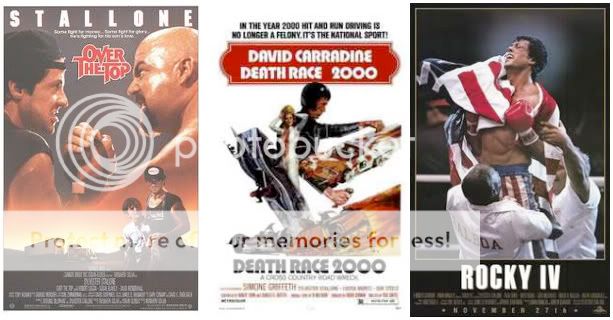
MMM7: STALLONE IN THE DARK
19. Over the Top
20. Death Race 2000
21. Rocky IV
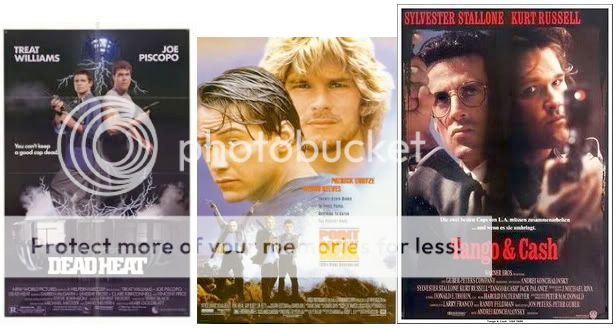
MMM8: MMMY BUDDY
22. Dead Heat
23. Point Break
24. Tango & Cash
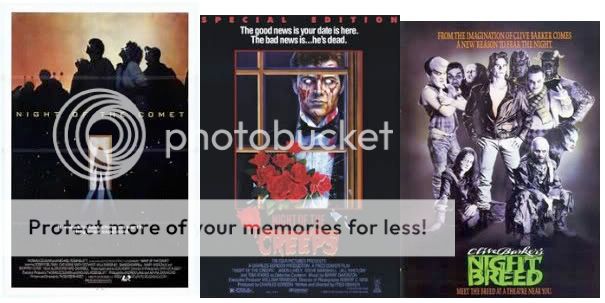
MMM9: NIGHT OF THE LIVING NIGHTS
25. Night of the Comet
26. Night of the Creeps
27. Nightbreed
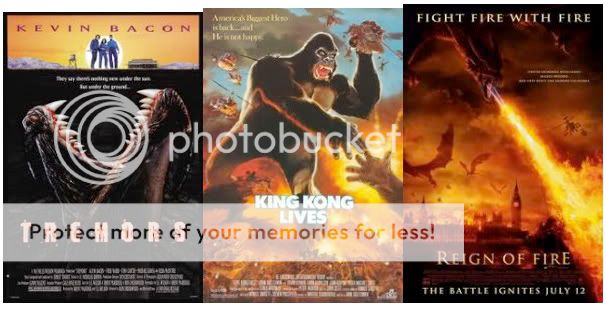
MMM10: MONSTER MOVIE MAMAJAMA
28. Tremors
29. King Kong Lives
30. Reign of Fire
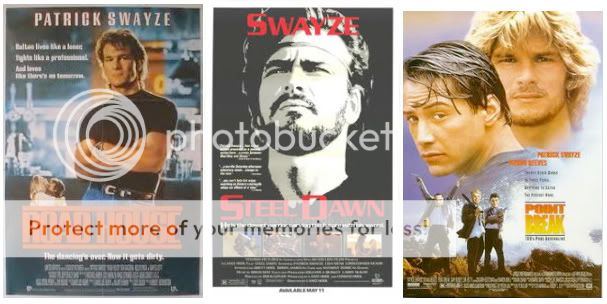
MMM11: SWAYZE FROM THE HEAT, OR “THEY SAVED PATRICK SWAYZE’S PANCREAS: A VERY SPECIAL MMM”
31. Road House
32. Steel Dawn
33. Point Break
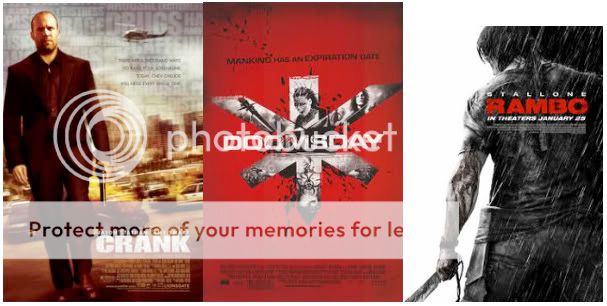
MMM12: THE MODERN MANLY MOVIE
34. Crank
35. Doomsday
36. Rambo

MMM THE 13TH: SUFFERING IN SUFFERN
37. The Lost Boys
38. Slumber Party Massacre II
39. Dead Alive
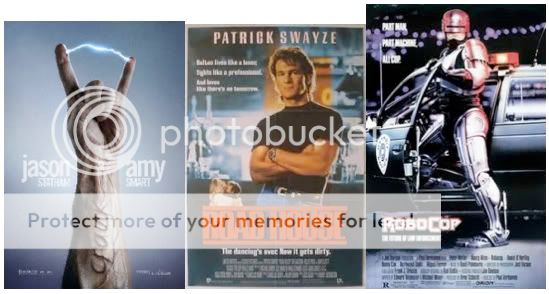
MMM14: MEN. MOVIES. MAYHEM.
40. Crank 2: High Voltage
41. Road House
42. RoboCop
Alert readers will note that both Road House and RoboCop are re-runs. In Road House‘s case–our first threepeat–the reasons are obvious. In both cases we figured there’s no possible way a new film could follow the nigh impossible to fathom insanity of Crank 2. We went with the familiar and awesome instead.
For a full explanation of the MMM phenomenon, click here. But to fully understand, you have to be there.
Comics Time: Gangsta Rap Posse #1
September 18, 2009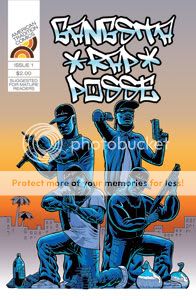
Gangsta Rap Posse #1
Benjamin Marra, writer/artist
American Tradition, 2009
14 pages
$2
Or: “What If N.W.A. Weren’t Making All That Shit Up?” The idea of a Bush I-era hardcore hip-hop outfit who actually are gun-toting, ho-pimping, mass-murdering drug kingpins as outlined in their platinum-selling rap career is so fucking brilliant a high concept I’m stunned I’ve never seen it in action before. It’s difficult to remember now, in an age when Jay-Z has more number-one album debuts than anyone but the Beatles and the President jokingly banters about Kanye West’s antics, but when my generation of white kids was growing up, “rapper” was a career that took on the same sort of quasi-mystical air as “cowboy” or “ninja.” Obviously there really were people who did those things for a living–okay, maybe not ninjas so much anymore–but the word, the concept, had a totemistic quality above and beyond “performer who composes and recites rhymes over beats.” Now, I was never a huge gangsta fan, but the less criminally minded but equally angry Public Enemy were one of my favorite groups of any kind during middle school, and from Flav’s accessories to Chuck D’s barn-burning baritone to the marching, uniformed S1Ws to that crosshairs logo, P.E. came across like a black G.I. Joe squad. The kinds of hip-hop that politicians and parents groups rent their garments over back then were tailor-made for action-hero status, and that’s what Marra delivers here. Watching his N.W.A. manques roll up on a rival MC’s compound and strafe his bodyguards with machine-gun fire fulfills a long deferred desire to see the larger-than-life lyrics of such groups made real, or at least as real as an action comic would make them.
It’s so effective in that regard that it’s tempting to overlook the obviously problematic racial territory we’re in. What we have here is a white guy taking Easy, Cube, Ren, and Dre’s lurid cop-killing, bitch-fucking, crack-pipe-illuminated fantasy world and drawing it, and that’s a bit of a sticky wicket, innit? It’s an ugly portrait, even if you’re just painting by the numbers left by the subjects. Fortunately, aside from the all-too-real hairstyles of that era, the visual stereotyping is kept to a minimum; Robert Crumb’s “When the Niggers Take Over America” this isn’t. But the irony is that while, to me, Crumb’s comic is an obvious parody of white racism, Gangsta Rap Posse‘s lack of Crumb’s corrosive irony and sarcasm might make it tougher for some to take despite its simultaneous lack of Crumb’s most outre visuals. Similarly, the dialogue’s ebonics are a far cry from Crumb’s pidgin dialect, but it’s also never half as clever, say, the lyrics from Straight Outta Compton, which were so wickedly funny that they came across like the group letting you in on the joke. Here, it’s a little tougher to tell if the joke’s on them.
But it seems to me that what Marra’s doing is simply taking vintage gangsta and treating it like any other kind of genre fiction. Perhaps the big clue is the sequence where the GRP’s manager complains that the record label’s been waiting for their new album for two years–how could they possibly have time to maintain their recording career when they’ve got an organized crime empire to run? The Gangsta Rap Posse doesn’t exist in continuity with Malcolm X or the Last Poets, they’re in the tradition of Robert E. Howard or the film library of Golan and Globus, and Marra’s using “Fuck tha Police” here the same way he used exploitation cinema in Night Business, or maybe even the same way Bryan Lee O’Malley uses Mega Man in Scott Pilgrim. He’s working much, much edgier territory here than either of those works–it has a lot more in common with Johnny Ryan than O’Malley–but you get that same thrill of cross-pollination and unexpected magpie influences. So I’m down. And I’m really hoping the GRP come up against a fictionalized black-nationalist paramilitary organization version of Public Enemy in the next issue.
Carnival of souls
September 17, 2009* A very happy 5th blogiversary to the best comics blogger, Tom Spurgeon!
* Because I’m a nincompoop, when I linked to SPX’s programming slate the other day I didn’t actually mention anyone who was on it. How about John Porcellino, Jeffrey Brown, Matt Furie, Lisa Hanawalt, Kate Beaton, Eleanor Davis, Hellen Jo, Matthew Thurber, and a metric ton more? Fantagraphics in particular is apparently out to just murder people: Its guests include Kevin Huizenga, Gahan Wilson, Hans Rickheit, and Al Columbia, while they’re debuting Ganges #3, Portable Grindhouse, The Squirrel Machine, Steve Ditko’s Strange Suspense, Al Columbia’s Pim & Francie, Mome Vol. 16, Jacques Tardi’s You Are Here…ye gods.
* Look, a new Marc Bell book! Supposedly there’s even comics in it!
* Here’s a tiny preview of the upcoming Clive Barker-cowritten 3-D comic Seduth. By the time you read this, I may have already interviewed Clive about it for an outlet to remain nameless. Elsewhere on the Clive tip, I missed his most recent interview with the keepers of his official website, in which he talks about a short story/novella collection and an erotic photography book I had no idea were even in the works.
* Jason Adams presents links to relevant news and views on a trio of films of potential interest to readers of this blog: the Aliens/28 Weeks Later-model-following sequel [REC]2, the David Lynch-produced, Werner Herzog-directed My Son, My Son, What Have Ye Done, and (get this) the remake of the Coen Brothers’ Blood Simple by Hero and House of Flying Daggers director Zhang Yimou, Three Guns.
* Will I continue to link to all of Curt Purcell’s Blackest Night posts, like today’s review of issue #3? Signs point to yes!
* In both a post and the comment thread that follows, Joe “Jog” McCulloch says some provocative things about Frank Quitely’s work on Batman & Robin. I don’t agree with his conclusions–I’m not even sure I agree with his assertions; I don’t think I ever once read one of those issues and thought “man, Quitely’s action scenes are too slow and too tough to parse”–but I do take a perverse pleasure in iconoclasm. Of course, after Batman & Robin #4, Jog’s plea for people to quit acting like Quitely’s an impossible act to follow can only cause a single tear to slowly fall from one eye, like Frodo.
Here’s the thing: Morrison’s worked with worse artists on this run. Although I wouldn’t say Tony Daniel is one of them; and as with Daniel, Tan at least has been imposed on Morrison for a story arc about extreme ’90s-style anti-heroism, so his Image-derived style makes some sense. But Daniel, Andy Kubert, and the guy who drew the two Final Crisis tie-in issues didn’t make their debut on the book directly following one of the two or three best superhero artists working today. JRJR would have punked them out just as badly, and (this is the point) through no fault of their own.
Hitler’s Responsible This
September 17, 2009Breathtaking.
Comics Time: Night Business #1-2
September 16, 2009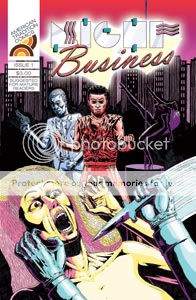
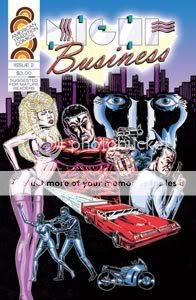
Night Business #1 & 2
Benjamin Marra, writer/artist
American Tradition, 2008-2009
24 pages each
$3 each
Buy them from BenjaminMarra.com
I had a whole long tedious review of these comics written out and five seconds ago I deleted it. Didn’t even copy it to the clipboard first! I think it’s stupid to write a boring review of an exciting comic. (Not that it’s stopped me in the past…) And Night Business is definitely an exciting comic, the kind of thing you want to sneak into the hands of all your teenaged cousins or spill beer and pizza grease on during the Crank 2: High Voltage/Road House/Predator movie marathon you’re having this Friday night.
The point I was trying to make in the scrapped review was that Night Business isn’t a pastiche of ’80s trash-culture thrillers as found in straight-to-video late-night-cable exploitation movies or “adult” independent comics from fly-by-night “publishers” so much as it’s a re-creation of them. Dolly Parton (whom, coincidentally, Marra has drawn) famously said “it costs a lot of money to look this cheap”; while I doubt that Night Business cost anyone a lot of money, its cheapness is clearly hard-earned. Benjamin Marra’s art is studiously amateurish and ugly in a totally consistent fashion–precisely the way that the art of someone whose natural talent is totally outgunned by his boundless enthusiasm and obsession bordering on dedication would be. These blocky, blockheaded, stiff figures–everyone, male and female, looks like their bodies are 85% gristle–seem like the thought-through product of a worldview, like they’re the output of someone who’s drawn page after page after meaty, pulpy page of these people without ever thinking twice about what anyone will think of it (beyond, perhaps, “they’ll fuckin’ love it!”). The layouts are simple, all business, as if to say “enough of all the frou-frou, let’s just see what happens next.” Every outfit is peeled from some hair-metal or porno fantasy world where men are either leather and denim street toughs or sharp-dressed sharks in suits, and where women routinely walk around in lingerie and heels. The City (capitalized like a motherfucker) consists almost solely of strip clubs, alleys, morgues, and the preposterous offices of an exotic-dancer management empire; everything is lit by streetlights or neon. In order to offset some of the icky taste that might be left in your mouth by doing a story about the serial murder of strippers while spending page after page depicting the naked bodies of those strippers (necessarily, I think; look how toothless Robert Rodriguez’s strangely prudish grindhouse homage Planet Terror ended up being without it), the series takes a page from every bard of the urban nightpeople since Steve Perry’s small-town girl took the midnight train going anywhere and builds up the hopes, desires, and dreams of each dancer as she takes it off to the leering crowds. Sure, they’re all pure-dee hokum, but in a world where the men’s emotions can all be expressed by grimacing and never rise above the complexity level of a Blackest Night tie-in issue’s Lantern Corps appearances, they’re the most psychologically fleshed-out characters in the book. The effect isn’t just reminiscent of some bargain-bin Scarface, it’s identical. If it weren’t for the ironic author photo and bio giving the game away at the back of each issue you’d never know that Marra is, on some level at least, kidding. And by that point, who cares? Smoke ’em if you got ’em and bring on issue #3.
Carnival of souls
September 15, 2009* Patrick Swayze died yesterday. He was the star of the movie Road House, the foundational text of the Manly Movie Mamajama and a favorite way for The Missus and I to while away a couple of leisurely hours on the weekends. As such it’s difficult to exaggerate the enjoyment he’s given me over the past four years or so. I’m really sorry he died.
* My fellow MMM attendees are also as upset as you’d imagine. Rickey Purdin is posting a Swayze sketch a day every day for the rest of the month, while if you read only one emotional tribute to the man and his movies, make it Chris Ward’s.
* Now that I’m done plugging my own appearances (I’m presenting an Ignatz Award too! Okay, now I’m done) I want to point out that SPX’s programming slate for this year boasts and more.
* Tom Spurgeon ponders the Disney/Marvel and WB/DC stories. A couple elements of his analysis stood out to me:
1) The idea that somewhere between Marvel’s current domination of the rump Direct Market and holding it to the sales standard of Stephenie Meyer or James Patterson there’s a middle ground in which it, and the DM overall, simply does a better job of getting comics to the kinds of people who are interested in buying comics. There probably are plenty of runners left on the bases, particularly in terms of Marvel’s book program. And this is really just a subset of larger point regarding the potential for major structural changes resulting from these moves, not just trying to push a little harder or stretch things out a little further in existing directions.
2) The speculation that Jim Lee may be named Publisher of DC. Why not!
* I can’t believe there are only six issues of Brian K. Vaughan and Tony Harris’s Ex Machina left! This was always my favorite of BKV’s creator-owned titles, though now I’m hopelessly far behind and am going to have to catch up in trade. In the back of my mind I always reminded myself that the series revealed it was going to have a down ending right on the first page of the first issue, and I’m excited to see what that down ending is.
* Paranormal Activity has a trailer and a sneak preview release date–September 25th at midnight, which means I won’t be going because I’m schlepping down to SPX the next morning. Rats.
* It only just occurred to me after reading his review of New Avengers #49 that Ninja author Brian Chippendale named his new blog Marvelous Coma because it’s going to be about Marvel comics. Holy smokes. Meanwhile, you can’t tell me that issue wouldn’t have been better if it had Chippendales suggested extra page in it.
* Johnny Ryan is working some rough, rough chuckles. Are these even jokes anymore?
* Dread Central has a couple clips from John Harrison’s film adaptation of Clive Barker’s Book of Blood. It hits DVD September 22nd, and let’s face it, it’s gonna be months before I see the fucking thing because I’m so far behind on my movie-watching so this is kind of pathetic that I’m even acting like I’m all on top of this shit.
* For a long time I’ve thought about the kinds of superhero comics readers who follow characters rather than creators in terms I borrowed from Jerry Seinfeld’s routine about sports fans: Like people who love a player when he’s on “their” team but hate him after he leaves even though the only difference is the uniform, fans who’ll buy any goddamn Batman comic regardless of who’s writing or drawing him are, in essence, rooting for laundry. But I’d never thought of using this analogy in defense, or at least in explanation, of that weird completist behavior the way Tim O’Neil does in his latest X-Men essay. Tim likens fans who’ll buy the X-Men no matter what to fans of the Cubs or other perennial also-rans, where not only are you expected to stick with the team through thick and thin, the thin periods actually increase rather than decrease your devotion. Of course, I don’t like sports either. Anyway, Tim also advances an argument as to why the X-Men franchise cratered in the ’00s: He blames Grant Morrison, though not in the way you’re thinking. (My theory is that Marvel doesn’t really grok the outsider concept anymore, hence the mangling of the mutant-minority metaphor in House of M, but Tim’s got a point.)
* I stumbled across Chris Mautner’s review of Jeff Lemire’s Sweet Tooth #1 in my RSS reader today, and his throwaway line about the deus ex machina at the end of the issue got me thinking: The serialized comic book can be a real turkey of a format for long-form stories, can’t it? I thought the ending was by far the weakest and most pat thing about the issue, and it’s not hard to see how it was nothing more or less than an in-story solution to the logistical problem of having to stop the issue there instead of going on in the laconic fashion Lemire’s independent projects afford him. I actually think this hurts more in “serious” books like this than in superhero comics–with superheroes, you’ve sort of been raised to expect that cliffhanger. Here, it’s kind of like watching an hour-long drama that has to end with every commercial break and start up again four minutes later.
* If you can’t combine Tolkien with Lovecraft willy-nilly in your massively multiplayer online role-playing game, why even bother?
Comics Time: The Squirrel Machine
September 14, 2009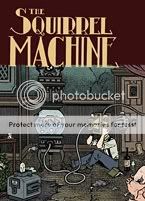
The Squirrel Machine
Hans Rickheit, writer/artist
Fantagraphics, 2009
192 pages, hardcover
$18.99

Given what I’ve been reading lately I can’t help but compare Hans Rickheit to Fort Thunder. Like Brian Chippendale, Mat Brinkman, Brian Ralph et al, Rickheit spent the late ’90s and very early ’00s living and working in a combination art gallery/performance space/flophouse in a New England college town–theirs, Fort Thunder, in Providence; his, the Zeitgeist Gallery, in Cambridge. Like them, he saw his one-time shangri-la end before its time–theirs by municipal diktat, his by fire. Like them–and, like them, perhaps unsurprisingly given his years-long conflation of room and board with bristol board–he creates comics centered on the exploration of space, rooms, houses, environments. And like them, he fills that space with marks, so that reading one is almost a tactile, exploratory experience itself.
But the similarities are not complete. Unlike Ralph’s cavemen or Brinkman’s monsters or Chippendale’s warriors, Rickheit’s Edwardians are observers at least as much as explorers. Though they move about in his strange, gristly world, they are not of that world. More often than not they’re limned by a fine white void; it serves the purpose of making them pop against his often overwhelming backgrounds, yes, but it also reinforces their separateness, their otherness. They wander through strange environments constructed by unknown architects, gazing through lenses and orifices at any number of bizarre transmixtures of human, animal, and machine. They are constantly seeing things, to borrow the title of a book by Rickheit’s visual and thematic kindred spirit Jim Woodring. When we see what they see, the effect is reminiscent of catching a glimpse of an older family member as he or she masturbates, or strips to reveal what Rickehit’s friend E. Stephen Frederick refers to in his memorably Kenneth Smithian introduction to The Squirrel Machine as “secondary hair.”
In the comics of the Fort, exploration is, at worst, value-neutral. In Ralph’s comics they lead mostly to mischief and lessons learned (though that changed somewhat in the bleak zombie comic Daybreak), in Chippendale’s they usually lead to freedom or adventure, and in Brinkman’s, for every bleak wordless parable of creatures lost in an endless maze, there’s another LOL-inducing story of a beast barging into a castle to take a dump on the king’s throne. In Rickheit’s comics, though, the explorations and the visions waiting at their conclusions are unmistakably disturbing. They reveal creatures and creations of arcane origin and dubious value, frequently hidden inside a smoothly artificial or warmly organic surface like a grotesque parody of birth, or a Cracker Jack prize. When you end up at the end of one of Rickheit’s wonderings, there’s a sense that, to quote Trent Reznor, “Now I am somewhere I am not supposed to be, and I can see things I know I really shouldn’t see.” That’s no less true for our desire to see them. In this, he has more in common with Josh Simmons than with the Fort, though unlike the House author, up until this point the damage incurred in Rickheit’s characters’ travels is more psychological than physical.
This changes in The Squirrel Machine, Rickheit’s Fantagraphics debut and for all intents and purposes a simultaneous coming-out party and summation of all that has gone before. In the past–his Xeric-winning erotic coming-of-age nightmare Chloe, his dewily sexualized surrealist gag strip Cochlea & Eustacea–Rickheit imbued his character’s journeys into what he refers to as the Underbrain with a sliver of redemptive power. Chloe finds something that replaces what she lost; Cochlea and Eustacea’s antics are as funny and horny as they are freaky. But here, the downbeat direction hinted at by C&E’s fate in the last issue of Rickheit’s self-published anthology Chrome Fetus emerges in full flower, and the result is awesome to behold.
In Rickheit’s story of the brilliant brothers Torpor, William and Edmund, art does not provide the antidote to the encroaching cruelty of the civilized world, as it does in Chippendale’s Ninja. On the contrary, the art of William and Edmund is wholly dependent on the taking of life. Their childhood games aren’t free-spirited enactments of the struggle of good against evil, and they’re not really games, either. They’re attempts to follow their brains as far as they can take them. Other beings–the animals who are their chosen medium, their hapless mother, the angry townsfolk and mocking bullies–factor in only as means rather than ends. Even exploration itself is represented as a frightening loss of control by its most prominent exponent here, Edmund’s sleepwalking. There seems to be no escape from the power structure of oppressor and oppressed.
The one exception to that rule is for those with whom they can form a sexual connection–but even that will only be allowed to take them so far. Visually, Rickheit tips his hand after the book’s first big sex scene. It’s weird, hot stuff as always from Rickheit, rooted in memorable details that serve to knock you off balance and make you vulnerable like the characters themselves. But in the middle of the act we cut to a stunning two-page spread, silent, no people present–simply incredibly byzantine images of the Torpor family home, utterly cluttered with the detritus of their inventions. Pipes and chains and ropes and stairs and beams and wires crisscross the panels, creating along with the gutters a dense thicket of tangents and congruences. The eye is led everywhere and nowhere all at once. The message is clear: Sex offers no escape. And like art, it can, and likely will, destroy and degrade and subjugate. When life and love, of a sort, finally do reassert themselves at the book’s end, it’s horrifying and drawn in a fashion that makes it look less like a natural thing and more like a terrible apparition, or a special effect.
It’s strange, but of all the dizzying details Rickheit deploys in The Squirrel Machine, the one that stood out the most to me came early on in the book: A distant water tower topped not with the usual tank, but with what looks like a giant version of the old-fashioned, grated helmets divers once wore. It sits atop a tower and beside a train trestle that are both as realistic as you please, but there it is, a mute monument to illogic. In Grant Morrison and Dave McKean’s Arkham Asylum, Amadeus Arkham recalls his fateful initiation into his mad mother’s “other world”:
A world of fathomless signs and portents. Of magic and terror. And mysterious symbols.
This has long been the world Rickheit has chronicled. The allure in both cases is that these portents can be scryed, these symbols can be decoded, this world can be mapped. But it’s only in reading this book–a painstaking chronicle of the lack of solace provided by art to the powerless–and thinking back on the diver’s-helmet tower that I realized that in our darkest moments, it’s easy to see that world as our world too–only the symbols can’t be read. When exploration is punished, when everything we see feels like something we oughtn’t, when theoretically life-affirming forces are either nipped in the bud or exposed as brutal frauds, doesn’t it all seem as maddeningly inscrutable as a giant diver’s helmet on top of a water tower? That there’s some reason for it all, something lurking beneath the surface, something we will never, ever get to?
STC @ SPX
September 14, 2009The SPX programming slate is up! Astute readers will notice the following items of potential interest:
Critics’ Roundtable
A murderers’ row of comics critics will address general issues facing comics criticism today and will candidly discuss several new and recent works in a lively, no-holds-barred, roundtable conversation. Rob Clough, Sean Collins, Gary Groth, Chris Mautner, Joe McCulloch, Tucker Stone and Douglas Wolk will share their acute critical insights with moderator Bill Kartalopoulos.
The New Action
For decades, independent cartoonists have labored to distinguish their work from the corporately-controlled material popularly associated with the form. In the process, artist-driven comics have frequently avoided genres such as adventure, fantasy, and science fiction. Recent years, however, have seen a wave of cartoonists who embrace genre and have explored new ways to activate comics’ ability to depict movement, action, and spectacle. Sean Collins will discuss these topics and more with Shawn Cheng, Benjamin Marra, Brian Ralph, Frank Santoro and Kazimir Strzepek.
SPX is Saturday, September 26th and Sunday, September 27th. Please come and say hello!
Carnival of souls
September 14, 2009* Josh Simmons’s excellent, unauthorized Batman minicomic is now on sale for a limited time at Secret Headquarters’ web store. You know what to do.
* Speaking of sales, Top Shelf and PictureBox are both having great ones right about now. The Top Shelf sale boasts some real steals, while the PictureBox sale ends tomorrow. Shop early, shop often!
* Cameron Stewart will be drawing the third arc of Grant Morrison’s Batman and Robin! Announcement here; more art here; interview here; attempt to read the tea leaves as to what this means for Frank Quitely’s previously announced second arc and Frazer Irving’s never officially announced but talked about by Morrison and Stewart arc here.
* Here’s a real treat: The great film scholar David Bordwell takes a look at Inglourious Basterds (and Public Enemies, but I skipped that part because I never got to see the movie). One insight out of many:
Talk in Tarantino comes in two main varieties: banter and intimidation.
* My pal Kevin Mahadeo speaks to Agents of Atlas author Jeff Parker about the team’s upcoming crossover with the X-Men. That’s a come-up for the Agents and Parker alike.
* Nice get for Robot 6’s weekly What Are You Reading? column: Art Spiegelman and Francoise Mouly.
* One of the reasons I’ve been enjoying (and repeatedly linking to) Curt Purcell’s Blackest Night posts is because as a lapsed reader of superhero comics who’s been away from them for quite some time, he’s coming at the project with a set of assumptions we devotees don’t have, and without another set of assumptions that we devotees do have. In his latest post on BN, he voices disappointment that despite ten or so issues of Blackest Night comics if you count all the tie-ins, the only thing that’s really happened is some old superheroes and supervillains have come back as Black Lanterns and attacked other superheroes. Having spent the past eight years or so reading superhero comics on the regular, it was weird to me just to see Curt use the phrase “ten issues later” to describe where we’re at with Blackest Night–by my reckoning, i.e. by the numbering of the main BN series, we’re only two issues deep. It would never occur to me that anything important would happen in any of the tie-ins, except perhaps the Johns-authored Green Lantern and Tales of the Corps issues. There are a couple of routes recent event comics have taken to make their tie-ins matter: You can use them to fill in all the important story details that your main-series slugfest elides, as did Secret Invasion scribe Brian Bendis in his vastly superior New Avengers and Mighty Avengers issues; or you can make the tie-ins have little, if anything, to do with the main series, as Grant Morrison, Geoff Johns, and Greg Rucka did with their Final Crisis minis. The problems here are obvious, though: The former can leave fans feeling like we could have lost a few boring battle splash pages in favor of actual information, while the latter can leave fans scratching their heads and ruing their purchases.
* The quote of the day comes from Squirrel Machine author Hans Rickheit:
I have now graduated from being someone who draws comics that no-one reads to a person that draws comics that no-one comprehends!
* Finally, Brickhousebunny21 would like us all to know that All Of Our Responsible This.
Our Responsible This?
September 14, 2009


Fire Walk With Meme
September 12, 2009
In related news, Brickhousebunny21, who coined this phrase, has decided to pay this blog a visit in the comment thread downblog. Make him feel at home!
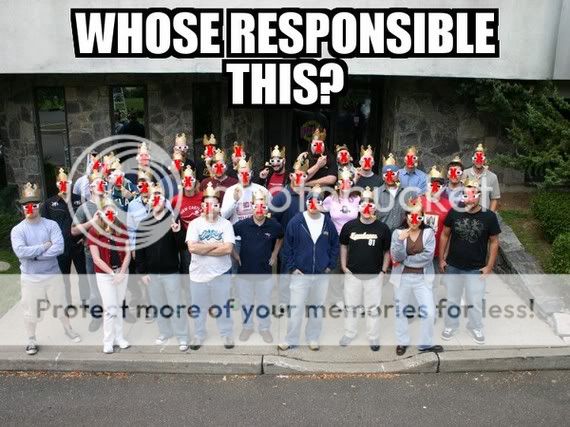
WHOSE RESPONSIBLE THIS?
September 11, 2009My friend Rob Bricken, aka Topless Robot, has a recurring feature at his site called Fan Fiction Friday, the goal of which is to plumb the abyss of horror that is the collective imagination of the nerd Internet. This week’s installment is about a woman having sex with a baby Pokemon teddy-bear thing. But where it really takes off is when the author (search the page for Brickhousebunny21) shows up to complain and threaten. He leads with WHOSE RESPONSIBLE THIS?, as meme-worthy a phrase I’ve seen on the Internet since “I am aware of all Internet traditions.” It’s an ALL YOUR BASE ARE BELONG TO US waiting to happen. I’m working it into my repertoire immediately. The next time I’m outraged by something on the Internet, I’m damn well gonna try to find out whose responsible this.
The Beatles and drugs
September 11, 2009Is it just me, or are the Beatles the best argument in favor of recreational drug use ever? It’s universally acknowledged–indeed it’s all but written into the band’s official unofficial hagiography–that the full flowering of the band’s genius stemmed directly from their discovery of marijuana and LSD. Before drugs they were awesome-to-behold hitmakers, yeah, but after drugs they recorded Rubber Soul, Revolver, Sgt. Pepper’s Lonely Hearts Club Band, Magical Mystery Tour, the White Album, and Abbey Road, and transformed human society, more or less. Certainly that’s the contour of the storybook version of their career as will become canon for a generation courtesy of Rock Band–the missing ingredient is elided, but all of a sudden they go from a rockin’ live act to godlike beings performing psychedelic masterpieces in “dreamscapes.” Best of all, drugs didn’t contribute to their break-up, and none of them O.D.’d! Drugs were terrific for the Beatles. And yet even as we trumpet the treasures that pot and acid helped John, Paul, and George mine from their brains, the government will be spending millions upon millions of dollars telling kids that recreational drug use is always horrible. Lying to them, in other words. (Drink up, though!)