What happened out there? How does a crew with the competence level of the people we’ve seen aboard the Maginot round up not only the universe’s deadliest alien, but several comparably awful creatures? How do you even set foot on a planet where these monsters run wild without getting your head bitten off or your lungs sucked out the moment you take five steps from your landing craft? Is there some kind of big cosmic zoo out there, constructed by more sophisticated aliens, that our Weyland-Yutani pals simply burglarized?
What manner of man becomes a Morrow? I don’t mean a cyborg, though this flashback episode of “Alien: Earth” gives us that answer: The chief security officer of the doomed spaceship Maginot was once a “feral street kid with a palsied arm.” He was “taken in” by a long-ago Ms. Yutani, the grandmother of the woman who is currently in charge of her family’s mega-corporation. She, or the company she ran, gave him his mechanically enhanced, transforming arm.
In exchange, he gave Yutani a lifetime. More than a lifetime, in fact.
It’s never been clear what tempts people to take jobs on Weyland-Yutani’s long-haul space flights. By the time the gig is over, you’ll have spent years, perhaps decades in cryo-sleep, frozen in stasis while the world moves on without you. Morrow already mentioned that he had a little girl back home who died long ago; now we know the circumstances.
Morrow clearly joined the mission in order to permanently provide for his little girl, whose painfully cute pet name for him is “Dadabear.” But eight years into the journey, Morrow received word from the Company that his daughter died in a house fire. A printed-out memo indicates 53 years would have to pass between Morrow hearing the news and Morrow returning to Earth to collect his daughter’s belongings. By then he might be the only person alive who remembers she existed.
So for the bulk of his time in the cold recesses of space, surrounded by people he doesn’t like, collecting disgusting and deadly creatures capable of wiping out everyone aboard, Morrow has known he has nothing to return to. All this time, all this loss, is for nothing. I think that might break me too.
But nothing can be turned into something if you try hard enough, or if you need it to badly enough. With nothing else to cling to, Morrow now has only two priorities. He must fulfill his mission to bring back the specimens safely to Earth, or it really will have all been for nothing, and that cannot be borne. And he must do so to honor the trust and care shown to him by the chief executive’s grandmother long ago.
Gritty, realistic, down-to-earth: If you read much about Task, the new crime drama from Mare of Easttown creator Brad Ingelsby, those are the kinds of adjectives you can expect to see. You won’t see them used about the show’s music, though, that’s for sure. Composed by Baltimore electronic musician Dan Deacon, Task’s score soars, it sizzles, it screeches, it screams. It’s an insanely overheated sonic signature for the show, making anything from fixing a morning coffee to brushing dead leaves off a porch sound like Oppenheimer waiting for the bomb to go off.
I love that for Task, personally. And I love how much director Jeremiah Zagar echoes that energy in his shot compositions — men framed in colorful doorways, masked monsters pass in slow silence across every axis of the frame. There’s a charge to how this thing looks and sounds that I couldn’t find in Mare outside of Kate Winslet’s lead performance. It feels like a big leap forward.
Obscenity is a form of violation. That’s the idea behind it, anyway. When you say a movie or a painting or a book is obscene — okay, not you, dear reader, but the kind of people who do say movies and paintings and books are obscene — you mean they violate the dignity of the reader or viewer. If performers are involved, you might say it violates their dignity too, or that of their whole gender. You could say the same about the use of the word to refer to, say, income — “So-and-so makes an obscene amount of money,” violating the social compact that no one person should command that kind of wealth when others do not — but of course it’s the purportedly degrading sexual and scatalogical stuff that gets people really riled up. The human body is sacred, and this is how you treat it? Shame on you, and may the full force of capital and the state be wielded against you.
There’s a line about obscenity I return to over and over, from the film Apocalypse Now. Ranting and raving as per usual, Marlon Brando’s mad Colonel Kurtz speaks of the hypocrisy of the United States military, from which he has defected to create a society more honest about its brutality:
“We train young men to drop fire on people, but their commanders won’t allow them to write FUCK on their airplanes, because it’s obscene!”
Kurtz knew that the most vile imaginings of the most uptight general or admiral in the armed forces could not imagine a more unspeakable violation of the human body associated with the word FUCK than the actual, physical, cataclysmically violent violation of the human body associated with napalm. There’s no question what’s more obscene, no question where our ire should be aimed, no question what we should be trying to stop at all costs. Instead, we’re banning cusswords while we rain death upon all of Indochina. Translated into modern terms, it’s expelling student protestors of genocide in Gaza rather than lifting a finger to do anything to stop that genocide.
Brother Dusk commits genocide in this episode of Foundation, three times over. Appearing as a Wizard of Oz–sized hologram before the galactic council as they prepare to hand the Mule not only Trantor but him, too, the last Cleon standing decides to make a counteroffer. With sadistic mirth in his voice and that unmistakable Dusk twinkle in his eyes, he uses the Novacula, his black-hole bomb, to wipe out the homeworld of the Council, the sacred planet of the Luminists, and the entire cluster of worlds called Cloud Dominion. He does it in seconds, with the push of a button. A blast, a brief detonation, and then poof — billions of lives reduced to floating ash as instantly as a dandelion blown apart by a child. And it’s all done with about that level of consideration.
Foundation is no stranger to planet-destroying weaponry. But it’s the anticlimactic nature of these planetary blasts that turns your stomach. There’s no suitably huge explosion of flame, like the mushroom cloud after a nuclear detonation, or planets and Death Stars bursting apart in Star Wars. It’s like I said: a blast, a rumble, a conflagration that lasts about two seconds, and then nothing. If the body is sacred, then the sacred was just profaned in the most grievous way imaginable, billions upon billions of times over. They weren’t even afforded the dubious dignity of going out in a way that suited the immensity of the loss. Their funeral pyre was denied them.
“Don’t fuck with Empire,” Dusk says before signing off.
It’s one of the most shocking, disgusting, horrifying acts in the history of this show, and that’s saying something.
The Texas Chain Saw Massacre is more than just the title of a movie. It is, depending upon your perspective, either a threat or, to paraphrase Roger Ebert, a promise. From the moment you decide to watch the movie till the moment, fairly deep in, when the titular atrocity begins, you know you’re living on borrowed time. You have decided to watch a movie which you know, for a fact, includes a chain saw massacre. One of the smartest things I ever read in film school was that half the work of Tobe Hooper’s grisly, greasy torture-porn masterpiece was done by the title alone.
This episode of Chief of War is titled “The Day of Spilled Brains.”
Overall, Wednesday is finally the creepy kooky mysterious spooky and altogether ooky fun I’d been promised during Season 1, only to wind up disappointed. By leaning even harder on the gifts of its two irrepressible leads, then adding a third cut from the same living-cartoon-character cloth in the form of Agnes (she refers to them as “the Three Musketeers”; Wednesday and Enid disagree), the show located and leaned on its greatest strengths — not the plot, but the performances. Wednesday is a showcase more than it’s a show, and accepting that its superpower.
Enid locks herself within the confines of the lupine cages to prevent her from wolfing out, since a full moon is coming up, and if a young alpha transforms at that stage of the lunar cycle, they’re stuck that way permanently. Inside her cell, Enid tells Wednesday something Professor Capri said to her about her pack being her strength. “You’re my pack, Wednesday,” she insists.
And even though both characters are essentially living cartoon characters — very literally, in Wednesday’s case — that bond between them feels legit. It’s not so much that opposites attract, it’s that each of these people has gotten so used to looking at their opposite number and thinking “I know exactly what she needs” that they now consider each other in this way as a matter of habit. You can’t not make Wednesday care about Enid, not for long, nor vice versa. They’re too determined to stay in each other’s business. That’s a very believable basis for a comedy friendship, and this is one of the best comedy friendships on TV.
Foundation is a marvelously rich experience, in which a Crayola 64-pack of SFF character types, visuals, and storylines coexist not only easily but symbiotically. The heady stuff enhances the earthy stuff. The kaleidoscopic spectacles provide contrast for the ghastly gore. Scenery chewing baddies like the Mule and Shakesperean tragedies like Lady Demerzel inhabit the same story.
The Kingdom of Hawai’i, Ka’ū District. The windswept, ocean-darkened beach sands. Keōua, newly crowned King of a divided Hawai’i, kneels before a fire. His mother (Kekuhi Keali’ikanaka’oleohaililani), a formidable singer and one of his chief advisors, brings him his father’s mahiole, the trademark Hawai’ian helm. It was a symbol of his wise father’s rule, but he has no use for it anymore. “I no longer fight to preserve his kingdom,” Keōua says, tossing his father’s legacy on the flames. “I will live to build my own.”
My notes at this point read simply “THAT’S INCREDIBLY BADASS. THIS IS JUST A BADASS SHOW.”
Did I say the last episode was the best Wednesday episode ever? I lied. Boy, did I ever. A body-swap comedy that sees the mind of Wednesday Addams inhabit the body of Enid Sinclair and vice versa, “Woe Thyself” (Season 2, Episode 6) proves that Wednesday, well, knows itself. From the start, leading actors Jenna Ortega and Emma Myers have played their mismatched roommate characters as if they were John Goodman and Jeff Bridges in The Big Lebowski, no matter how far short the material they were given fell of the talent they were giving it back. What this episode, co-written by co-creators Miles Millar and Alfred Gough, does is simple. It takes the best things about the show and gives them even more to do: act like each other.
It wasn’t a fluke. Wednesday Season 2’s mid-season finale was the show’s best episode ever — funny, frightening, and genuinely striking to look, all in ways the show had so often struggled to achieve. That struggle seems to be over. The fifth episode of the series’ bifurcated second season is even neater and nastier.
To accurately describe the world is to sound insane. That’s the dilemma facing observers of America’s collapsing empire today. The corruption is so naked, the incompetence so comical, the sheer evil so gleeful and unrepentant, that describing the situation to others makes you come across as badly undermedicated. There’s an old saw that goes around lefty political spaces saying that when you explain Republican policies in black and white for people, they simply won’t believe you. Surely, no one could be that psychopathically cruel for so long and just get away with it.
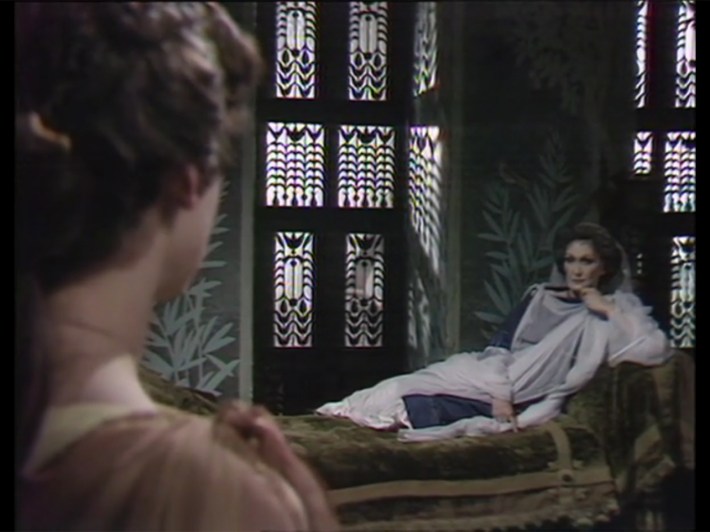
Postumus Agrippa (John Castle) lives in a world that’s similarly askew. The dark secret at its center is right there in his own name: He’s the son who was born to the legendary war hero Marcus Agrippa posthumously. Why did Marcus Agrippa die, and his rival Marcellus before him? What of Postumus’ late brothers, Gaius and Lucius? Did the solitary exile of his mother Julia have a reason behind it beyond her infidelities? And what of Drusus, ally to the Republic, son of Empress Livia, and father of Postumus’ best friend, the twitching, limping, stuttering Claudius?
The answer has been obvious to us in the audience all along: Livia Drusilla is behind it all. She’s behind the deaths of Marcus, Marcellus, Gaius, Lucius, and Drusus, plus the exile of Livia, and as of now the exile of Postumus for attempting to rape Claudius’ married sister, the gorgeous Livilla (Patricia Quinn, aka Magenta from The Rocky Horror Picture Show). In this very episode we see Livia confront Livilla about the affair, then half-cajole, half-blackmail the younger woman into keeping it up long enough to frame Postumus. She’ll do anything, stop at nothing, to ensure her son Tiberius is next on the throne.
Photo: Acorn
But try telling this to Augustus, the greatest man in the history of the known world. He’s not such a bad guy, as far as it goes, but he’s not a person accustomed to being told he’s wrong. (By anyone but Livia, that is.) Now he’s been told that his beloved wife is responsible for the death or disappearance of half a dozen people he adored, including no fewer than five planned successors to the throne, plus the mother of three of them.
“For years, everyone around you has either died or disappeared. Do you think it was all an accident?” Well, you’d want to, wouldn’t you? Would you choose to accept the horrible truth? Or would you go on clinging to the world as you knew it, believing in your heart that it could never really change? We know how our own elites have reacted; Augustus reacts little differently.
It’s a brilliant narrative maneuver by screenwriter Jack Pulman, working off the novels by Robert Graves. Here we have the moment we’ve all been waiting for: Finally, someone exposes Livia as the serial killer she is to the only man who can do anything about it. But even as it’s happening, we know nothing will come of it, because unless you’ve been watching through the BBC’s cameras, there’s no way you’d accept Postumus’ word for it, not when he’s trying to save his own skin in the process.
This episode offers us a brief history lesson of the “Alien” world, courtesy of Joe, the still-human brother of the show’s lead “hybrid,” Wendy. (Joe insists sentimentally on using her human name, Marcy.) Joe explains to the childlike hybrids that once upon a time there existed things called governments, in which people voted for how they wanted their world to be run. “It didn’t work,” Joe says simply. So the corporations stepped in, and “apparently, they solved all the problems.” That “apparently” sure feels pointed.
It’s a chilling scene for several reasons. First, every single thing we’ve seen about Boy Kavalier would indicate that this man should be nowhere near the levers of power. The default assumption that the ability to succeed in business or technology makes one a natural leader is one of the fundamentally delusional capitalist beliefs that the “Alien” franchise exists to skewer, ever since the Weyland-Yutani Corporation sent a bunch of long-haul truckers to recover a lethal species of giant parasitical space piranhas in the 1979 film that started it all.
But beyond that, the scene shows how corporate control of education and media eliminates the ability of Joe and the hybrids to understand and articulate the problems facing the world they live in. Democracy “didn’t work”? OK … says who? The five corporations who replaced it? They hardly seem an unbiased source of information. “Apparently, they solved all the problems?” What problems did they solve? And why are there still so many problems now?
Since the sets and set-ups are so limited on this show, it falls to blocking and camera placement and movement to create a sense of space, pacing, and momentum. Good Lord, does it ever do so in this episode. From the long take that sees Augustus stalk up and down a line of Julia’s accused lovers like a wolf selecting his prey, to the way the camera wheels around from a triumphant Livia to an enraged Augustus when the power shifts between them following Julia’s exile, these shots and staging decisions use physical space to convey the political and psychological hierarchy of the royal family — who’s on top and who’s beneath them, who’s the public face and who’s the force in the background. As a visual text, I, Claudius one of the most watchable shows I’ve ever seen, no frills required.
We live in a time when the most powerful, most wealthy, most seemingly unstoppable people in the world are telling you and me and our children on a daily basis that no one else matters, no one else is real, the only thing that counts is getting what you want, preferably at the expense of others. There are certainly characters on Chief of War who’d fit right in in that world; give King Kahekili a tactical vest and a neck gaiter and he could be out there threatening Democratic politicians at gunpoint even now. What a boon to see a story in which the willingness to be open, to listen, to understand, to be honest, to be friends and family and lovers, to be a community, a people, is seen as the ultimate virtue. Other people aren’t our enemies, they’re our brothers, our sisters, our siblings. When we betray them, we betray ourselves.
It’s almost boring to say at this point, but Foundation’s astonishing hot streak continues. For the second season in a row, the show balances a seemingly impossible-to-reconcile number of characters, storylines, tones, and visual palettes in episode after episode. The Demerzel hallucination is an all-timer image for this show, which is saying something, and both the flashbacks and the Foundation’s horrifying massacre by the Mule’s mind-controlled forces recall the most unpleasant moments of Andor’s masterful second season. Writers Jane Espenson and Greg Goetz and director Christopher J. Byrne also prove adept chroniclers of the Mule’s sadism, with Indbur’s bloodless but brutal demise ranking way up there on this series’ history of violence. Again, this is really saying something.
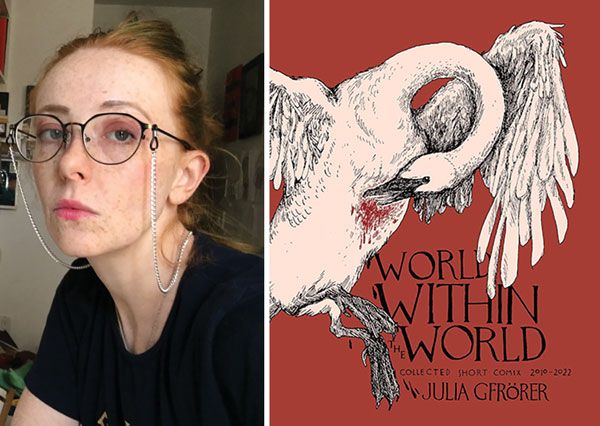
My beautiful and talented wife Julia Gfrörer has been nominated for an Ignatz Award for World Within the World, her magnificent career-spanning collection of short stories. (I wrote four of them, which means I’m like 1/60th an Ignatz Award nominee myself!) Please submit an awards ballot request and vote for her here, as she is very dear to me and the book is brilliant. Thank you!
The “Alien” franchise explores two overlapping nightmares. The first is the Alien, a cold and implacable force against which humanity is defenseless. The second is humanity itself, which through technological hubris and old-fashioned greed might well invite its own destruction. Against the first we are helpless; with the second, we are all too eager to help.
Drusus himself now occupies the command of the German legions Tiberius once oversaw. He’s a fine and honorable soldier as best we can tell, and a friend to Augustus as well. But while he serves the Empire, he’s no fan of it, nor of the all-powerful position it’s built around. In a letter to his brother after he returns to the front, Drusus writes of his worries:
A period of enforced rest due to a slight head wound has given me much time to ponder and reflect on the state of our beloved Rome. Such was the extent of the corruption and petty place-seeking that I found in Rome, that I have come to the conclusion that it is the inevitable consequence of the continued exercise of supreme power by Augustus.
The problem with building an enormous, largely unaccountable apparatus of power around one person, however good a guy he is, that power will eventually be inherited by someone who’s not such a good guy. Okay, so today we’re legalizing same sex marriage and talking about how the moral arc of the universe bends towards justice. That’s nice. We’ll get Shep Fairey to make a poster.
But what happens tomorrow? Perhaps the council of black-robed wizards who decide whether laws are legal or not will one day be dominated by right-wing lunatics. Perhaps the person placed at the apex of the richest and mightiest nation in human history will one day be a senile Nazi with an axe to grind against anyone who’s ever wronged him. Every opportunity we had to undermine the power of these institutions and didn’t take it was a waste of good fortune and a crime against the future.
Drusus already senses these problems arising, even with Augustus still on the throne. In argument with his mother, who resents both Drusus and her first husband for harboring hopes for the return of the Republic, Drusus asks her if she wants Rome to be reduced to the open corruption of “the Eastern potentates,” upon which their civilization had always looked down. He sees how quickly these things fall apart, even with someone decent at the top.
This is a plot-focused episode compared to its predecessors, relatively light on the sci-fi spectacle that’s Foundation’s hallmark. That’s fine — it’s good to bring things back down to earth a bit in order to advance the story.
But this is not to say it’s devoid of fascinating space-opera visuals. Demerzel pulling the Prime Radiant out of herself from between her robotic cleavage is an image that probably shouldn’t be as disconcertingly strange and sexy as it is. The coldwave psychedelia of their journey into the black hole is a bravura effect, reminiscent of Hari’s strange fractal freakouts while trapped within the Prime Radiant last season. And I love the design of Mycogen, which blends the familiar Blade Runner vibe of a decrepit futuristic city with the art nouveau beauty of a Peter Jackson Elf kingdom for its wealthier districts. I’m perpetually amazed by just how smart the design of this show is.
I keep coming back to poor oblivious Brother Day, though. His is the shock of any rich and powerful person when confronted with how normal people really think about them. Don’t you love me? I love me! I know it’s fake with all the others, but it’s real with me, right? Right? The belief of the mighty in their own irresistibility is a gap in their armor as clear and as vulnerable as the missing scale on the belly of Smaug the Golden. Great and terrible things can be done when it’s exploited.