
Posts Tagged ‘TV’
“Billions” thoughts, Season Five, Episode Five: “Contract”
May 31, 2020As a music cue, [Neil] Young’s plaintive ballad [“Old Man”] makes emotional sense, even if crosscutting between the two old men in question drives the point home a bit too hard. Young’s old-before-its-time voice erases any edge of condescension his youth might have brought to the material at the time he recorded it — he was 24, amazingly. It’s the sound of a young man trying to find common ground with one of his elders, and the song never reveals whether the effort is successful. Chuck and Bobby, two complicated men with difficult fathers, could surely relate.
“White Lines” thoughts, Season One, Episode Ten
May 25, 2020White Lines‘ first season tried to do a lot of things, and that kind of ambition is worth praising. Zoe’s midlife crisis, her romance with Boxer, the Calafat family drama, Marcus’s third-time loser routine, David and his spirituality and drugs, Anna and her sexuality and drugs, raising teenage children, the sideplot about Zoe and Axel’s dad, Ibiza, house music—it’s all in there, and all of it is handled more or less well. But the whole isn’t so much less than the sum of its parts as it is a jumble of them thrown together, all of them prominent but none of them truly emerging as what this show is about. Its hedonistic pleasures are undeniable. But like many of its questing characters, I want more.
“Billions” thoughts, Season Five, Episode Four: “Opportunity Zone”
May 24, 2020Wendy Rhoades stares at the man opposite her. And stares. And stares. And stares some more.
I reviewed tonight’s episode of Billions for the New York Times.
“White Lines” thoughts, Season One, Episode Nine
May 24, 2020With one episode in the season remaining, it’s worth taking stock of how far we’ve come. The jumpy timeframe and the rapidity with which these characters form and break bonds makes it easy to forget that Boxer brutally murdered two guys a few days ago, and that Zoe and Marcus are both involved in the cover up. Instead, the show focuses on their personal growth journeys, their sex lives, the question of whether they’re in love and if so who with. I can’t quite square that with the same people who hauled dead bodies out of the water and buried them in a shallow grave, you know? It seems like that would take precedence in their psychological landscape.
I reviewed the penultimate episode of White Lines Season One for Decider.
“White Lines” thoughts, Season One, Episode Eight
May 23, 2020To paraphrase Lenin, there are episodes of White Lines where whole seasons happen. This is one of those. Boy, is it ever!
“White Lines” thoughts, Season One, Episode Seven
May 22, 2020There’s a part of me who’s down with White Lines just for the fun of it. That’s probably something the characters could relate to, no? The beautiful setting, the beautiful people, the rampant hedonism, the sex scenes, monster acid house tracks like A Guy Called Gerald’s “Voodoo Ray” on the soundtrack—it’s kind of hard to resist! Almost enough to forget, you know, the murders!
“White Lines” thoughts, Season One, Episode Six
May 21, 2020You know, after a long day of looking at photos of my murdered brother picking street fights and pulling his own tooth out of his mouth with a pair of pliers, going scuba diving to retrieve my friend’s lost cocaine, accidentally uncovering a pair of dead bodies, holding them beneath the surface in order to prevent the police from finding them, loading them into a boat and accidentally driving into the middle of a religious procession, watching the metal rods in my friend’s broken legs accidentally tear free, driving the boat into the middle of nowhere until my car stalls out, dragging the boat halfway across a field by hand, calling the murderer with whom I had a one-night stand for help, and burying the bodies and the drugs in a rainstorm, there’s nothing quite like having sex on top of a wet and shallow grave to take the edge off.
“White Lines” thoughts, Season One, Episode Five
May 21, 2020Things are getting sexy on White Lines.
“White Lines” thoughts, Season One, Episode Four
May 19, 2020This is a plot-dense episode, and some of the show’s storytelling decisions are a bit baffling to me, I must admit. Take the big fight Boxer and Zoe have when he chews her out for being ungrateful for his help. (At this point she’s unaware that his “help” included a double homicide.) We see Boxer blow up at her and kick her out, we see her bump into Kika and Kika’s fuckbuddy Sissy on the way out, we see her dance, we see her bring up the fight—and then we get a flashback to the fight that adds a few sentences and a few household items thrown in anger but is otherwise much the same. In other words, there wasn’t some secret about the fight that was withheld, there’s no big revelation in the flashback to events that happened just minutes prior; the flashback just kind of happens, and that’s that. If you squint at it hard enough you can maybe see the show making a point about selective recollection of events—the whole series does revolve around a murder the details surrounding which no one present can remember—but since the initial view and the revisit show basically the same thing, I’m not sure that explanation washes.
I wrote about episode four of White Lines for Decider. Things are starting to get hinky.
“White Lines” thoughts, Season One, Episode Three
May 18, 2020Well, we learned a lot about what kind of show White Lines is in Episode 3. Is it the kind of show that will drop music cues by the Happy Mondays or that screaming cowboy song for atmosphere? Yes, but we knew that. Is it the kind of show that derives a lot of mileage from the extremely photogenic people playing the late DJ Axel Collins and his apparent mother-daughter love interests Conchita and Kika Calafat? Also yes, and we knew that too.
But the incestuous overtones, not just to Axel having sex with two women from the same family but also Conchita’s casual toplessness in front of and intimate embrace of her son Oriol? That’s new. The high-speed chase that begins the episode, in which Boxer and Zoe deal with the problem of having seven kilos of coke in their car by racing away from the cops and dumping it out the windows as they go? Also new.
And you know what else is new? The brutal violence.
“Billions” thoughts, Season Five, Episode Three: “Beg, Bribe, Bully”
May 17, 2020“Billions” is a show that seems to appreciate pro wrestling, as seen in the fandom of its dudebro character Mafee and the recent cameo by Becky Lynch. So I hope it’s not too indulgent to quote one of the great heel wrestlers, Ted DiBiase, better known as the Million Dollar Man, as a kind of epigraph for this episode: “Everybody’s got a price.”
I know, I know: That’s kind of the point of the whole show, right? It’s a drama about the corrupting influence of money and power. But it felt more poignant in this week’s episode than it has in quite some time, perhaps because the institutions being assailed by the show’s money-talks characters — family, art, education, the environment — feel sacrosanct.
I reviewed tonight’s episode of Billions for the New York Times.
“White Lines” thoughts, Season One, Episode Two
May 16, 2020I very nearly titled this review of White Lines Episode 2 “Seven Kilos and a Funeral.” The seven kilos are obvious enough: They’re the purloined payload of drugs that Zoe Collins steals from her late brother Axel’s DJ friend Marcus in hopes that this will force him to come clean with what he knows about her brother’s disappearance and murder—the absence of which lands Marcus in leg-breaking hot water with his suppliers. The funeral would be the memorial service for Axel thrown by his friend-turned-guru Dave, who serves magic mushroom tea to the mourners-slash-revelers.
But then I remembered: There was a second funeral in this episode. For a dog.
“White Lines” thoughts, Season One, Episode One
May 16, 2020If there’s one thing I love about the English, it’s their dance music. If there’s two things I love about the English, it’s their dance music and their stylish crime thrillers. If there’s three things I love about the English, it’s their dance music and their stylish crime thrillers and their conviction that the golden age is always receding into memory, to be revisited and yearned for but never quite recaptured.
Is this my way of saying White Lines might be extremely my shit? Yes it is.
I reviewed episode one of Álex Pina’s new Netflix show White Lines for Decider.
“Billions” thoughts, Season Five, Episode Two: “The Chris Rock Test”
May 10, 2020Mike Prince gets there first. Just as the conference is wrapping up with one last dinner, he presents his guest of honor: Bram Longriver. “You stole my shaman,” Bobby tells Prince hilariously. (It reminded me of one of the best lines in the rock documentary “Dig!”, in which the Brian Jonestown Massacre’s lead singer, Anton Newcombe, angrily declares “You [expletive] broke my sitar, [expletive]!”)
I reviewed tonight’s episode of Billions for the New York Times. The only recap of Billions to reference the Brian Jonestown Massacre, guaranteed!
10 Off-the-Beaten-Path Shows To Keep You Busy During This Neverending Quarantine
May 7, 2020Grappling with the big questions?
Try The Young Pope and The New Pope (HBOGo/HBO NOW)
Here’s the deal: Italian director Paolo Sorrentino’s outrageously bold pair of series take on the iconography and ideology of the Catholic Church with a sly sense of humor and a knack for surreal visuals. The Young Pope stars Jude Law as Lenny Belardo, an “incredibly handsome” American elected Pope by his brother cardinals, whom he comes to rule with an iron fist. The New Pope, which is simply The Young Pope Season 2 by a new name, introduces John Malkovich as Belardo’s successor, the dandyish Englishman Sir John Brannox. Fully loaded with eye candy, both shows grapple head-on with the power of faith and the mystery of love—or is that the other way around? Your jaw will drop even as your mind expands.
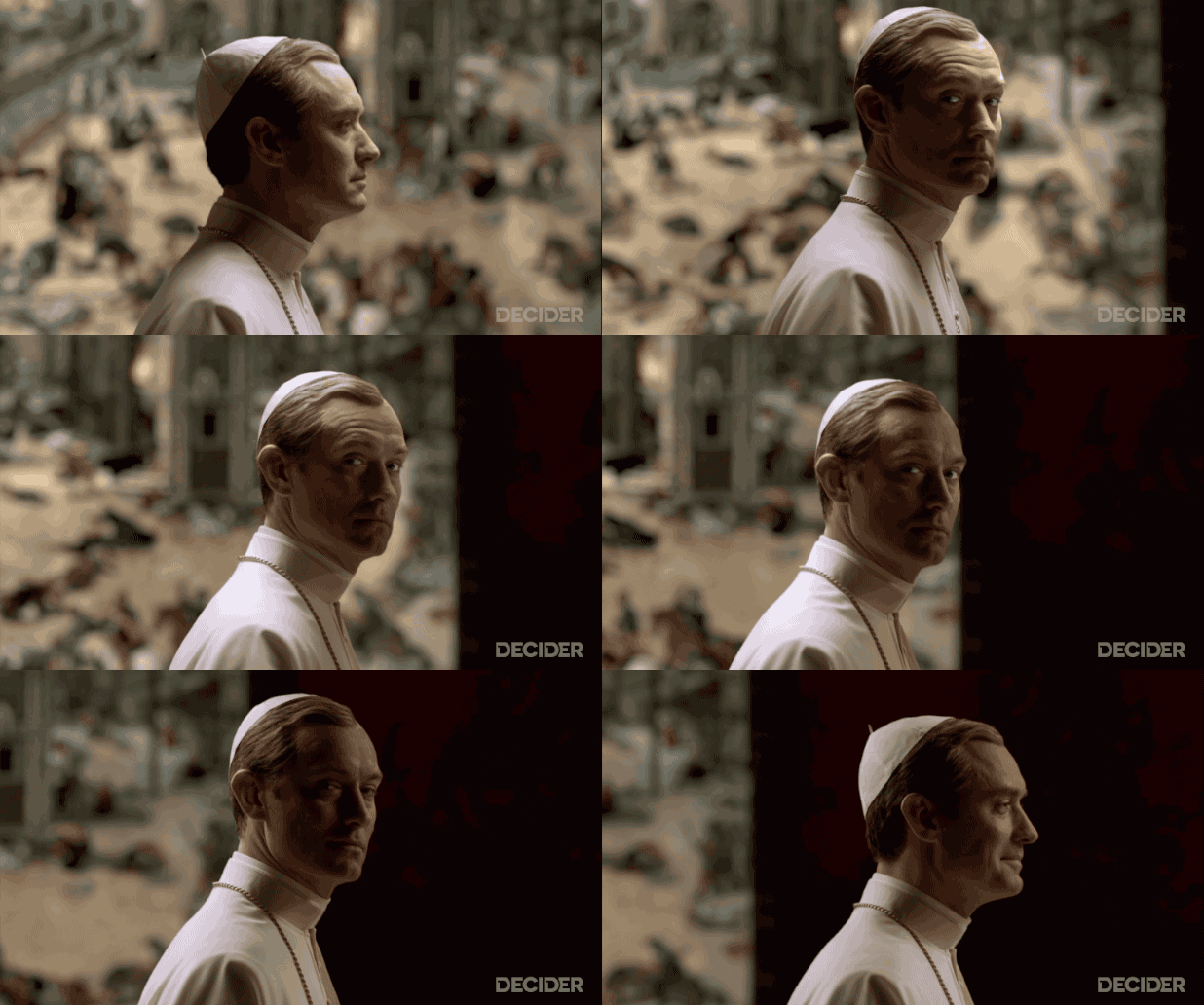
I wrote a guide to 10 off-the-beaten-path shows to binge-watch during quarantine for Decider. This one was a long time in the making—I hope you dig it!
“Westworld” thoughts, Season Three, Episode Eight: “Crisis Theory”
May 4, 2020“I dunno,” Caleb says. “The world looks a little like a nightmare, Dolores.”
“Change is messy,” Dolores replies. “Difficult.”
Take a look around, people. They’re both right!
Set in a chaotic, desperate world that’s a bit too close for comfort right now, Westworld‘s season finale (“Crisis Theory”) is based on the hope that Dolores can have her apocalyptic cake and eat a new-world utopia, too. Concerned with her and Caleb’s quest to upload the Solomon supercomputer’s plans for revolution into its successor Rehoboam — and with Cerac and Maeve’s attempts to stop them — it’s an ugly action thriller that asks us if humanity has enough beauty in it to be worth saving.
I reviewed the season finale of Westworld for Rolling Stone. I have mixed feelings about it, and about the whole season, but it certainly was a rewarding stretch of TV to write about, the way good-but-not-good TV often can be.
“Billions” thoughts, Season Five, Episode One: “The New Decas”
May 3, 2020Move over, Bobby Axelrod: You’re not the only pugnacious redhead in Axe Cap’s hallowed halls anymore.
For a brief time during the wildly entertaining Season 5 premiere of “Billions,” the truculent employees of both Bobby’s company and its quasi-independent subsidiary Taylor Mason Capital unite to admire a surprise guest, the flame-haired Irish professional wrestler Becky Lynch, playing herself. (Well, technically it’s Rebecca Quin, playing the same character she plays as a professional wrestler. Wrestling is complicated like that.)
At the end of last season, Taylor Mason’s breakaway firm was brought back into the fold as part of an elaborate scheme — as if there were any other kind of scheme on this show — and tensions have been running high. After a staged fight with Wendy Rhoades (Maggie Siff, who one hopes will get more opportunities to beat people up on this show), Lynch tells the assembled traders about the importance of “doing the job,” of allowing oneself to be humbled in the interest of the greater good. In professional wrestling, someone needs to lose in order to maintain the illusion that what’s going is unscripted — without a loser, no one could ever win.
“There’s nothing more noble than taking a beating and making someone else look good for the good of the whole damn operation,” Lynch says.
“Hollywood” thoughts, Season One, Episode Seven: “A Hollywood Ending”
May 1, 2020But in the end, isn’t that Hollywood‘s big idea? Imagine a world in which, thanks to a string of lucky breaks, women and queers and black people and Asian people and people who’ve been arrested by vice squads suddenly had it within their power to change the kinds of movies Hollywood makes. Imagine a world in which, thanks to innovative business and PR maneuvers, the first of these movies winds up being a big hit. The resulting story isn’t a matter of “Well, if Rock Hudson had simply come out of the closet we wouldn’t have had all those problems”—it’s speculative fiction, a sort of social-justice steampunk (imagine Dick’s early invention of the wide release as the equivalent of an armored blimp or whatever) in which values of diversity and acceptance battered down the doors years before they did IRL. I get it. I enjoyed it. I had a good time at the movies, so to speak. Action!
I reviewed the season/series/not sure finale of Hollywood for Decider. It was a fun show!
“Hollywood” thoughts, Season One, Episode Six: “Meg”
May 1, 2020Directed once again by Janet Mock, it’s maybe the most Hollywood episode of Hollywood yet. Take the opening sequence, for example. Avis vows to provide security for the cast and crew, who’ve come under threat by the Ku Klux Klan. Ernie, the old pimp benefactor of Jack and Archie, refuses their and Rock and Raymond’s offer to go back to work to make up Meg‘s budget shortfall, instead calling in all his old employees for a week-long binge of sex work in order to raise the money for them (and earns a major role for himself in the process). You gotta love a series that takes that old Mickey Rooney/Judy Garland “hey kids, let’s put on a show” vibe and funds it with prostitution!
I reviewed the penultimate episode of Hollywood for Decider.
“Hollywood” thoughts, Season One, Episode Five: “Jump”
May 1, 2020The speed with which Hollywood can shuffle between all these storylines and all these modes—the personal, the artistic, the political—isn’t trivializing any of them, I don’t think. If anything, it’s arguing that these factors are all fundamentally inseparable. The big test of the show, I think, will be whether it argues that success in one sphere equates to success in the others. Does making a politically worthy film make the film good, or make the filmmakers good people? Can great art affect political change, or do we settle for it in lieu of political change? I don’t know how Hollywood will answer these questions, especially with just two episodes to go. But my butt will be in the seat until I find out.