
Posts Tagged ‘TV’
“Masters of Sex” thoughts, Season Three, Episode Seven: “Monkey Business”
August 28, 2015We might as well start by addressing the ep’s 800-pound you-know-what. It’s…difficult, to understate the case considerably, to imagine that anyone in the Masters audience was clamoring for the series to include a storyline in which the pioneering authors of Human Sexual Response struggled to give a gorilla an erection. Yet what they came up with was pretty interesting, in the end. First, a lively cameo by Alex Borstein—aka the voice of The Family Guys’s Lois Griffin—as Loretta, the gorilla’s emotionally overinvested former trainer, created an atmosphere that was way more complicated than the goofy premise made it sound. She described her relationship with the ape the way you might talk about an opposite-sex best friend from college with whom you’ve, like, stayed up late discussing your masturbation habits yet never gone any farther with—a combination of sincere affection and appreciation with a slightly too-intimate undertone. Or in this case, maybe more than slightly, since, you know, she’s a human and he’s a gorilla. Borstein plays this fundamentally absurd exchange completely straight, a smart and necessary tactic.
Then Virginia and Bill—who by this point is pushing for the gorilla research, against which he’d previously knee-jerked in typical tedious Masters of Sex office-argument fashion, simply to keep Johnson away from perfume doofus Dan Logan—pay another visit to the beast’s enclosure, where they quickly realize he wants more than Gini’s encouragement: He wants her to put ‘em on the glass. Okay, so there’s the whole bestiality thing to contend with here, but try to put that aside. Honestly, try! One of the most erotic things about the show’s handling of Masters and Johnson’s research is its presentation of instrumentalized sexuality, of people making their bodies go through the stages of arousal and orgasm, like machines, for purposes external to the traditional demands of romantic or sexual desire. This forces a direct focus on the biological processes involved rather than their emotional underpinnings, and that direct focus can’t help but remind you how good those processes feel. Watching Gini expose her breasts to someone in order to help him have sex with someone else fits the pattern, even if those someones are a different species. And as an added storytelling bonus, it clearly dovetails with Gini’s concerns that she exists to facilitate the drives of the powerful, occasionally beastly male with whom she shares an office and a byline.
“Hannibal” thoughts, Season Three, Episode 12: “The Number of the Beast Is 666”
August 24, 2015Whatever its pleasures as a hobby and legitimate value as a means for its mostly young, mostly female practitioners to explore sexual taboos, fanfic has a worrying tendency to collapse the incredible range of potential adult relationships in fiction into a romantic singularity, distorting the totality of human experience just as surely as a black hole warps light. This act of emotional reduction—and reduction’s the right word for it, as both the fannish truncation of “relationships” into the neologism “shipping” and the pruning of the pair names into the portmanteau “Hannigram” semiotically symbolize—hits the possibility of non-romantic male friendship, cooperation, or even enmity especially hard. Is there truly no other way to process the bizarre mind meld between Hannibal Lecter and Will Graham than as their bloody valentine?
The answer, of course, is that maybe there is and maybe there isn’t, but either way the question is irrelevant. This is the way Bryan Fuller, Hannibal’s creator and visionary, is processing that relationship. It may not be the story I expected—not any more than I expected Will Graham to slip into murderous darkness throughout the show’s run rather than remain squarely on the side of the angels—but it’s the story Fuller has chosen to tell, and it’s that story, and no other, that must be engaged by the audience. At its worst, the partisanship of shipping represents a willful refusal of art’s transcendent potential, in which rather than step outside oneself and inhabit the mind of the artist, its adherents force her ideas into a template of their own mentally provincial devising. What better way to atone for its excesses than to go along for Hannibal’s ride, no matter how many left turns it takes?
“Fear the Walking Dead” thoughts, Season One, Episode One: “Pilot”
August 24, 2015Given that it’s the most popular show on television, The Walking Dead can pass quite easily for one of the New Golden Age of TV’s crown jewels. The reality, however, is a lot closer to costume jewelry. Despite a grim tone typical of many iconic shows and proximity to masterpieces of the medium like Mad Men and Breaking Bad via their shared network, AMC, the blockbuster adaptation of the surprise-hit comic-book series by writer Robert Kirkman and artists Tony Moore and Charlie Adlard is striking for has so little else in common it has with its antihero-and-auteur-driven era that it gives us a whole lot to chew on.
For starters, there’s no auteur to speak of. Developer and Shawshank Redemption director Frank Darabont departed unceremoniously after disputes with the network, and his successor Glen Mazzara lasted only two seasons until parting ways with the show in another impasse before current showrunner Scott M. Gimple took over. And while creator Kirkman remains actively involved, the show departed so radically from his source material almost immediately—another marked contrast from contemporaries like Game of Thrones—that the closest thing it has to a consistent creative vision is that of zombie-makeup guru Greg Nicotero. Though this lack of a singular voice is not necessarily an inherent evil—Darabont’s mawkish sub-Spielbergian sentimentality, to say nothing of his penchant for Wang Chung music cues, is certainly no great loss. But the difference from Davids Lynch, Chase, Milch, and Simon, and their heirs, from Louis C.K. to Shonda Rhimes, is tangible.
More importantly, and alarmingly, TWD’s approach to its own bloody bleakness too often takes the “anti” out of “antihero.” Even the most uninspired post-Sopranos series about the inner turmoil of men who murder people for a living generally pay lip service to the idea that their cathartic explosions of violence do more harm than good, and that our vicarious thrills must be priced against the moral cost of killing. For Rick Grimes and company, however, gore, to paraphrase Gordon Gekko, is good. Yes, the show frequently toys with the idea that the former sheriff and his roving band of zombie-apocalypse survivors have Gone Too Far This Time; in fact, the frequency with which this question is raised indicates the inconsistency of the writing. But far more often, the story serves as an ersatz endorsement of brutality in the name of survival, justice, and revenge, concepts frequently treated as indistinguishable. For The Walking Dead, killing is bad, unless you really really have to or unless they really really deserve it, in which case it’s extremely good. Seriously: When The Wire veteran Chad Coleman’s pacifistic Tyrese finally offed someone, the crew congratulated him like he’d just been bar mitzvah’d.
Normally I’m first in line to blast critics for equating the depiction of atrocity with either the exploitation or outright endorsement thereof. But in TWD’s case, the frequent recourse to redemptive violence in a world where virtually none of its massive audience will experience such situations reads as decadent at best and downright immoral at worst, a nasty and unnecessary exponent of the reactionary potential that’s been buried beneath the zombie-horde metaphor from the start. To treat “What would you do to protect those you care about?” as the central ethical question of our time is to invite the creation of imaginary enemies to justify our mental murderousness against them; the consequences of this paranoid mentality for America are as thick in the air as teargas in the streets of St. Louis.
I reviewed the series premiere of Fear the Walking Dead, and the Walking Dead phenomenon generally, for Decider. I’ll be covering the show there all season, which should be interesting.
“Hannibal” thoughts, Season Three, Episode Ten: “And the Woman Clothed in Sun”
August 20, 2015TMI time: As a TV critic, you see enough sex scenes to get desensitized. Whether it’s the pneumatically thrusting buttocks of a pay-cable drama or the “let’s show them getting all breathy and frantic as they start tearing at each other’s shirts because that’s basically all we can show” approach of your average commercial-network affair, the stuff just hits a point of diminishing returns after a while. For me, at least, it takes something special to elicit that telltale sign of effective televised sexmanship: a long, low murmur of “fuuuuuuuuuuuuuuuuudge,” but, you know, not actually the word “fudge.”
So, yeah, the bit where Rutina Wesley’s Reba McClane reenacts holding her face to the power and heat of the sleeping tiger on the lap Richard Armitage’s Francis Dolarhyde instead? Fuuuuuuuuuuuuuuuuuuuuuuuudge.
“Hannibal” thoughts, Season Three, Episode 11: “…And the Beast From the Sea”
August 20, 2015If a lifetime of gorehoundsmanship has taught me anything, it’s that horror is a genre in perpetual conversation with itself. By that standard, “…And the Beast From the Sea,” this week’s Hannibal, is a chattier episode than most. And why shouldn’t it be? If you’re going to bring one of the most iconic monsters in horror history to the small screen, why not cannibalize some of that history in the process?
So take a look at Francis Dolarhyde’s raid on Will, Molly, and Walter Graham’s family homestead. His mesh mask echoes the pantyhose disguise of an earlier incarnation of the Red Dragon, Tom Noonan’s in Michael Mann’s Manhunter. Molly & Wally’s daring through-the-window in-a-bathrobe escape echoes Wendy & Danny Torrance’s flight from Jack Nicholson and the Overlook Hotel in The Shining. The way they burst from the trees into the road to be saved by an African-American motorist passing by feels a whole lot like the end of The Texas Chain Saw Massacre, while that motorist’s death so that they might live is reminiscent of one of the shootouts in No Country for Old Men. You don’t needto know any of these reference points; hell, they don’t even need to be things the show is deliberately referring to. They’re just part of the narrative and visual vocabulary of terror available to any astute horror filmmaker. And that’s long before we get to the Tooth Fairy’s Tyler Durden impression.
“Masters of Sex” thoughts, Season Three, Episode Six: “Two Scents”
August 20, 2015Virginia Johnson wants to be courted, as in a good old-fashioned courtship. Dating, dining, dancing, you name it. What Liz Phair referred to as “all that stupid old shit, like letters and sodas” in “Fuck and Run.” Granted, this desire was awakened by an oily perfume magnate who invested in her sex-research clinic so he could employ her to measure the vaginal lubrication of women exposed to the smell of pit sweat, making his motives transparent and her reaction incoherent, but for the sake of argument let’s ignore that, since the show sure did. Let’s focus instead on how she pitches this to Bill Masters, her partner. “We hooked ourselves up to wires while we talked each other through the stages of arousal,” she reminds him, and us. But don’t let your memories of when Masters of Sex was actually, you know,sexy cause your vaginal-lubrication sensors to redline just yet—Gini’s got a different idea in mind. “Do you ever wonder what it would have been like if we had met differently?” I believe I speak for the group when I say no!
No, no, no, no, no, I don’t wonder what it would have been like had Bill and Virginia been merely star-crossed colleagues pursuing a forbidden romance instead of exhibitionistic/voyeuristic weirdo geniuses verbally informing one another of the onset of orgasm as they fucked with a bank of electronic equipment rigged to their junk. I don’t wonder about how the co-author of Human Sexual Response would have fared as peewee-league football coach. I don’t wonder about how the woman who upended the entire medical establishment’s approach to sexuality got along with her mother and daughter. I don’t wonder what Masters of Sex would have been like if it were a dime-a-dozen workplace/relationship/family drama. But in “Two Scents,” this week’s episode, that’s once again what we’re getting.
I reviewed this week’s typically frustrating Masters of Sex for the New York Observer.
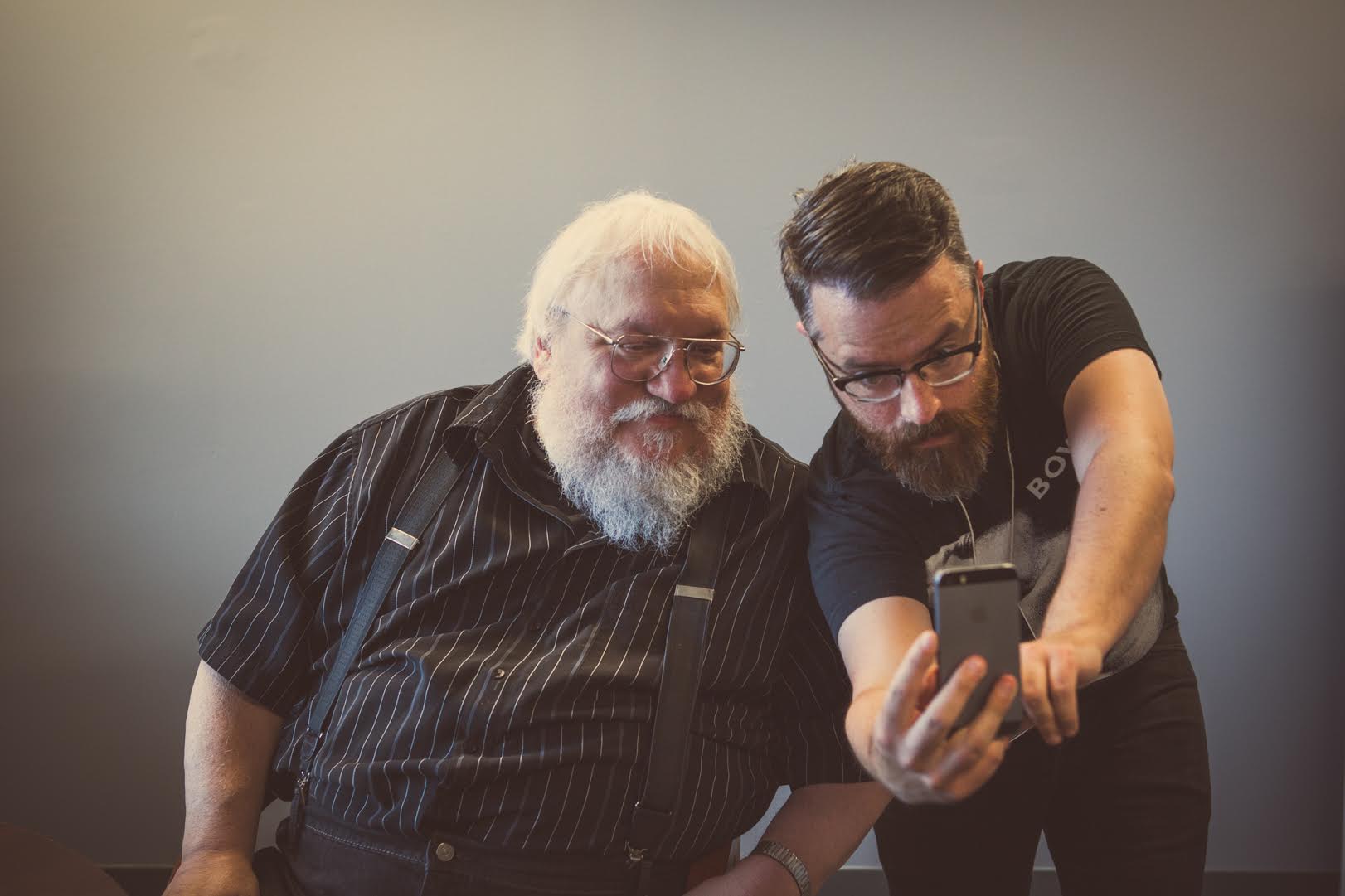

I interviewed George R.R. Martin
August 11, 2015The number one question people ask me about the series is whether I think everyone will lose—whether it will end in some horrible apocalypse. I know you can’t speak to that specifically, but as a revisionist of epic fantasy—
I haven’t written the ending yet, so I don’t know, but no. That’s certainly not my intent. I’ve said before that the tone of the ending that I’m going for is bittersweet. I mean, it’s no secret that Tolkien has been a huge influence on me, and I love the way he ended Lord of the Rings. It ends with victory, but it’s a bittersweet victory. Frodo is never whole again, and he goes away to the Undying Lands, and the other people live their lives. And the scouring of the Shire—brilliant piece of work, which I didn’t understand when I was 13 years old: “Why is this here? The story’s over?” But every time I read it I understand the brilliance of that segment more and more. All I can say is that’s the kind of tone I will be aiming for. Whether I achieve it or not, that will be up to people like you and my readers to judge.
I interviewed George R.R. Martin, and you can read what he said in the New York Observer.
What Went Wrong with True Detective Season 2?
August 11, 2015For all that, the season still exerted a strange sort of magnetism. The endless overhead shots gliding over L.A.’s knotted freeways, the many quiet closeups of its main characters as they did nothing but sit and smolder, the sinister thrum of the electronic score overseen by T Bone Burnett – put it together and you get a rhythm and vibe unlike much else on TV right now. Even at its most frustrating, TD often felt like a show smoking a slow-burning cigarette under a streetlight at 3 a.m., a momentary oasis of chemical calm with nothing but trouble and turmoil on either side. Many series that are much better in every other respect would kill for that kind of palpable atmosphere.
But atmosphere alone isn’t enough to save a show; it can just as easily smother it like smog. Many of the season’s visual and sonic strong points gave off an air of impending doom, but when doomsday arrived the payoff couldn’t justify all that time spent sitting around waiting for it. So you’re left with flyover glimpses of roads that didn’t lead anywhere, or portraits of people so visibly exhausted and immiserated by their lives that the feeling becomes contagious. When you’re dealing with a mystery as murky as this one was, that’s just not enough fuel to power you through.
“Masters of Sex” thoughts, Season Three, Episode Five: “III-A”
August 10, 2015At this point, I believe the experiment Masters of Sex is dedicated to chronicling is not the scientific measurement of human sexual response, but rather how to make sixty minutes of television feel like a six-month community-service sentence. I genuinely do not know how else to explain the bulk of the show’s third season so far, up to and including “III-A,” tonight’s episode. By any reasonable standard, a show which spends an entire scene showing Allison Janney putting in just the tip of the D should be entertaining, if nothing else. Instead it was an endurance test, where looking at the timestamp and seeing, say, 47 minutes to go felt like a personal attack. All I want is to watch people watch people fuck while covered in EKG sensors. Is that too much to ask?
George R.R. Martin Goes Out to the Ballgame
August 10, 2015The score was 10-1 in favor of the Staten Island Direwolves by the time he grabbed the mic and took the field, but George R.R. Martin was there to warn the boys of summer that winter could still be coming. “If they can only hold on for another couple innings,” the man behind the Game of Thronesphenomenon said, “I won’t have to kill another Stark.” The crowd roared. And when the live arctic wolf accompanying him took a dump near the third base line a few seconds later, they roared again.
From top to bottom, Saturday’s “Meet George R.R. Martin Night” at the Staten Island Yankees’ scenic Richmond County Bank Ballpark was a weird, wild event. With the Lower Manhattan skyline shining in the distance, a record crowd of 7,529 turned out to watch the minor league team, renamed the Direwolves for one night only, take on the Hudson Valley Renegades while wearing custom House Stark and House Lannister uniforms. Direwolf swag and autographs from the A Song of Ice and Fire author himself were available on a first-come, first-served basis. It was a star turn for the author, who’s been catapulted to celebrity status by the success of the HBO series based on his novels.
But for Martin himself, it was a time for wolves. His appearance was a fundraiser for New Mexico’s Wild Spirit Wolf Sanctuary, a non-profit rescue facility for the animals at the heart of his epic-fantasy saga – hence the beast who befouled the infield. The team cut the charity a surprise $10,000 check and launched a benefit auction of the custom jerseys. In the process, they enabled fever-dream sentences like “George R.R. Martin attends a Yankees farm team’s Game of Thrones-themed ballgame on Staten Island to raise money for wolves” to actually make sense…more or less.
Strange shit, but Martin’s seen stranger. “It’s pretty weird,” he told Rolling Stone, “but it’s only like a seven on the weirdness scale. That company that came out with leggings with my face on them? That’s up to a ten.”
I went to a minor-league baseball game with George R.R. Martin and wrote about it for Rolling Stone.
“True Detective” thoughts, Season Two, Episode Eight: “Omega Station”
August 10, 2015The moment the phrase “90-minute season finale” flashed on screen last week, it was all over for True Detective but the shooting. A shoddy second season had by then partially redeemed itself with a pair of tight, tense episodes that made up in muscle what they lacked in depth. But just when it seemed like the series was putting together the pieces and cranking up the pace after weeks of floundering, boom — a movie-length meditation on failure. “Omega Station,” the eighth and final installment of TD 2.0, could not have more effectively shut down the show’s progress if it dressed up like a cholo, drove it out to the desert, stabbed it, and left if for dead.
I reviewed the disappointing True Detective season finale for Rolling Stone.
I Serve the Base
August 9, 2015
‘The Walter White of Comedy’: James Urbaniak on ‘Review’ and Rise of Funny Antiheroes
August 5, 2015At first glance, Review appears to be comedy in which someone makes a major production of doing basic things in a very stiff, social-anthropology, insider-playing-at-outsider way — Sasha Baron Cohen in khakis. This is indeed the basic approach. But the show’s genius is that instead of treating each review as a separate, self-contained event, mined for jokes then never referred to again, there’s continuity between all of them. The magical comedy reset button you’d expect them to hit after Forrest, say, gets addicted to cocaine, overdoses, and goes to rehab, never gets hit. The experiences build one on top of another.
That’s the angle that stands out to actor James Urbaniak, who plays Forrest’s amoral producer/enabler Grant. “There’s an element of it being a satire of reality TV,” he says. “In reality TV, you make decisions that have an emotional effect on people but are restricted by the parameters of the game or the competition. Review “is breaking down those parameters, so he’s making very big decisions, like getting divorced, that affect his whole life.”
“Affect” is an understatement. Even though the only time he acknowledges it before the first season finale is in one brief fit of self-pity while eating an enormous stack of pancakes (don’t ask), Review shows Forrest slowly but surely destroying his life and the lives of everyone around him. His marriage ends. Multiple people get killed. All under the rubric of this preposterous high-concept mockumentary show.
In other words, Review is a satire not just of reality shows, but of New Golden Age of Television antihero dramas, hiding in plain sight. It takes the basic “man ruins all he cares about in the name of something that makes him nominally freer and more powerful” structure of the genre and plays it for deliberate laughs. Instead of a meth empire or a mafia family or a double life, he commits his bad acts in the name of the television show that chronicles them. He’s Walter White, but without the sense that there’s anything tragic about him — he’s just an oblivious faux-smart buffoon. It’s a satire of the middle-class middle-aged white-male entitlement and privilege that all the big dramas treat as the stuff of life.
“He is like Walter White,” Urbaniak says. “I never really thought about it that way, but I like it, and I’m buying it. He’s a guy who’s made, at a certain age, decisions that simultaneously give him some power but also upend his reality and the reality of those around him. Andy, in his comedy before the show, has always explored the disturbing depths within unassuming guys. He’s from New Jersey, but he has a quintessentially midwestern quality. He just seems like a quintessential nice, pleasant-looking, affable American guy; then it’s all about the depths that this guy’s capable of getting himself into, very much on his own. That sort of is like Don Draper and Walter White and those other guys. I dunno—maybe there’s some zeitgeisty thing going on about middle-aged white guys.”
Halt and Catch Fire’s Kerry Bishé on Donna’s Huge Season and Why the Show Isn’t a Hit
August 3, 2015That camaraderie came through on the screen. You can understand why these characters are drawn to working together, even when they’re not getting along. They seem to respect each other.
That’s really great. One of the big differences between season one and season two is that the working relationships in season one were incredibly contentious. The characters would manipulate and lie, and they were really out for themselves. In season two, the working relationship really changed. While it remained contentious, there was a sense that these two women [Donna and Cameron] in particular very deeply respect and value each other, and they’re really trying hard to make it work.And in many of their disputes, both of the positions on where to take the company are equally reasonable. It’s much more exciting to watch a drama when you genuinely can’t decide what “should” happen.
I love that. That’s what good writing does, to me. All the characters have good reasons to do what they do, so you can understand CameronandDonna, even though they’re making opposite decisions or have opposite priorities. You still feel like they’re both completely justified in the choices they’re making. I concur, I think that’s a really great part of this show.That carries over to the characters’ personal lives too. The show didn’t pump-fake in the direction of Donna’s abortion — she actually went through with it, and her reasons were presented as sound and strong and nothing to be ashamed of.
That was a fascinating story line, and it was interesting how it all played out. The writers were really intent on making it a confident decision that Donna made. They didn’t want her to be wishy-washy, they didn’t want it to be a thing that [dramatic voice] destroyed her, you know? They did a great job of giving her that backbone. But at the same time, in a bigger-picture way, I didn’t want it to feel like, you know, working women who have a career have to sacrifice, or that given the opportunity women will choose their career over their family. It felt like threading a needle to me. It ended up being a pretty good balance between what the writers needed it to be and what I needed it to do to feel okay about what we were putting out in the world.
“Halt and Catch Fire” thoughts, Season Two, Episode Ten: “Heaven Is a Place”
August 3, 2015They made up their mind to make a new start, they’re going to California with an achin’ in their hearts. Halt and Catch Fire ended tonight’s season finale by packing up and heading west, abandoning the Lone Star state for the Golden one. But from Joe and Sara MacMillan’s scuttled plans for relocation to Gordon Clark’s disastrous dalliance with a west-coast lady, the characters have walked through the shadow of the Valley of Silicon all season long. The results were not promising, which signals that the hard reboot Donna Clark, Cameron Howe and company are hoping for most likely won’t work.
The irony is that this parable about the illusory nature of second chances was told by a show that proved it was the exception to that rule. Written by series creators Christopher Cantwell and Christopher C. Rogers and directed by Sopranos, Mad Men, and Daredevil veteran Phil Abraham, “Heaven Is a Place” caps one of the most remarkable rebirths for a series in recent memory. Its freshman-year jitters are now as obsolete as the Cardiff Giant — Halt came out of its sophomore season as smart, savvy top-shelf TV, full stop.
“True Detective” thoughts, Season Two, Episode Seven: “Black Maps and Motel Rooms”
August 3, 2015So why wasn’t it this tightly wound all along? Most murder mysteries operate along a linear progression of false starts, red herrings, leads, revelations, and the final whodunit. The approach that True Detective took was a revisionist one in a way, and perfectly valid in theory. Instead of piecing together clues one after another, Ray, Ani, Paul, and Frank just kinda kept pouring more and more info into a big swirling morass that remained incomprehensible until the moment it all became clear, like a cloudy pool of water finally settling down enough for you to see your reflection in the surface. That daring Metal Gear Solid action sequence aside, it’s probably a little bit closer to how solving major crimes works in real life.
The problem is that the show offered so little firm ground to walk on as it traveled through the murk. Compelling dialogue? Not so much; the pitch-black noir aphorisms that sounded magical in the mouth of Matthew McConaughey last season gave us a bad case of blueballs of the ear this go-round. Engaging characters? Not until they hit their respective rock bottoms over the past two episodes did the Drab Four feel like people you could empathize with, much less enjoy as reasons to tune in week to week. Intimidating antagonists? With the possible exception of creepy-ass Dr. Rick Springfield, no one in the semi-anonymous gaggle of corrupt police, politicians, land barons, and ethnically diverse gangsters giving our heroes trouble will be joining Reggie LeDoux or the Yellow King in the annals of memorable villainy anytime soon. Before this week, it’s unlikely much of the audience even knew their names. If you’re gonna make the mystery a mess until just before the end, fine, but there has to be something to make getting there at least half the fun.
I reviewed last night’s True Detective for Rolling Stone. I thought it was solid, which helped me understand why until last week, the rest of the season was not.
“Masters of Sex” thought, Season Three, Episode Four: “Undue Influence”
August 3, 2015At the top of the list is the return of Allison Janney’s Margaret Scully, now divorced from her secretly gay husband Barton (who’s come to work at Masters & Johnson’s clinic) for three years and semi-happily ensconced in a three-way relationship, as we discover at the episode’s end. The “semi” caveat stems from the fact that Graham, her bawdy but seemingly good-hearted boyfriend and the male corner of this very ‘60s triangle, now cums too quickly for them to have the kind of sex she finds so fulfilling after a lifetime of going without.
Aside from the obvious “whoa” factor of the storyline, it draws a lot of strength from its key performer. Janney has been perfectly cast from the start; her big eyes can alternate between baleful and intense at will, giving her sexual reawakening real heat. It’s entirely believable that she’d leap from decades of disengagement to a longterm ménage à trois in which the pursuit of simultaneous orgasms has not just physical but emotional and even “spiritual” importance, and equally convincing that she’s forward-thinking enough to take the sight of her boyfriend and his other girlfriend in bed more or less in stride, yet still be traditional enough to be concerned that her ex-husband isn’t getting enough to eat. Her plight takes on added pathos when she reveals just why the physical aspect of her relationship is so central to her sense of well-being: She begs Barton for permission to tell his secret to her boyfriend, so that he can understand the history that led her to a place where, in her words, “sex is the only way I know that he loves me.” And she desperately wants him to tell the woman he’s been seeing under false pretenses as well, so that he doesn’t do to her (and to himself) what he did to Margaret and their marriage all those years. She has just about as much going on as a human heart can handle, and the balance of emotions is perfectly weighted by the writing.
It’s not a storyline without its problems, though. One is the underutilization of Beau Bridges, a veteran actor of deceptive depth who is too often asked by Masters to do little more than force an avuncular smile and lie to someone’s face about how fine he’s feeling. Another is the series’ habit of repeatedly trotting out new sexual issues and kinks, from oedipal complexes to impotence to incest, but using the same characters to demonstrate them: a hypersexed cad one week only likes older women the next, say, or a character introduced as someone’s mistress is later revealed to be unable to have sex at all. If Masters wants to explore polyamory and premature ejaculation, hey, by all means. But why do it at the same time, and using the same character they’d previously utilized to examine anorgasmia and sexless marriage to a closeted gay man? It’s like if the ‘60s Batman TV show still did the villain-of-the-week thing but had Cesar Romero play not just the Joker but the Penguin, the Riddler, and Catwoman too.
I reviewed last night’s Masters of Sex for the New York Observer.
“Hannibal” thoughts, Season Three, Episode Nine: “…And the Woman Clothed with the Sun”
August 3, 2015‘Hannibal’ Recap: With a Little Help from My Friends
The decision to reintroduce Abigail Hobbs, the dead daughter of the killer who was killed during Hannibal and Will’s very first case, via flashback, in the middle of a story arc as self-contained and separate from the past as Red Dragon, is a baffling one. Don’t get me wrong — the character brings out a level of paternal perversity from the show that’s awesome to behold. I mean, get a load of the scene in which Hannibal recruits her to help him fake her own death. Her acquiescence is hard to swallow (no pun intended, Will) at first, given her terror of Lecter and her warm feelings toward Graham. But it’s not difficult to imagine the severe Stockholm Syndrome that would kick in when the daughter of a serial killer who forced her to help him find victims is told by another serial killer she’s about to die, but then spared at the last second as part of some grand plan.
This leads to what can only be described as the most erotic faked murder ever filmed. (Move over, Gone Girl, I guess?) Her glee about participating is Oedipally delicious: “Can I push the button?” she asks, referring to the device Hannibal will use to shoot her blood across the room in mimicry of arterial spray, with a tone of voice that would make Humbert Humbert blush. After a langourous bloodletting, during which Hannibal tenderly brushes Abigail’s brown hair back from the ear he will soon slice off and force-feed to his friend, the girl slips off the kitchen counter and into the arms of her murder-daddy. He manipulates her body like a cellist playing his instrument until the moment of release: a slow-motion shot of her blood being expelled from a tube like a vampire ejaculating.

I reviewed this week’s Hannibal for Decider, which is another way to say I was paid to write the phrase “like a vampire ejaculating.”
“Hannibal” thoughts, Season Three, Episode Eight: “The Great Red Dragon”
July 27, 2015More impressive still is Richard Armitage’s instant-classic work as Francis Dolarhyde — aka the Tooth Fairy, aka the Great Red Dragon — whom he doesn’t so much play as inhabit. In a recent interview, Armitage said he patterned his (so far entirely wordless) performance on Mica Levi’s avant-garde score for Jonathan Glazer’s art-house horror masterpiece Under the Skin. That a main character on a network television show would be based not a performance but the music from one of the most difficult and surreal horror films ever made is remarkable in and of itself. But beyond that, the connection makes perfect sense. Like Under the Skin, Red Dragon concerns an individual in the process of becoming: making, and perhaps unmaking, themselves into a creature driven to commit monstrous crimes. Armitage’s Dolarhyde stares at his own hands as if only now realizing not just their potential but their existence, and mouths formless syllables as if trying to construct not just speech but the meaning behind it. It’s both easy and instructive to see the parallels with Scarlett Johannson’s nameless predator, another beast slouching toward mayhem to be born.
But there are few parallels, if any, between Dolarhyde’s brutality and that of the series’ title character. After a half-season immersion in Hannibal’s world of refined and decadent Old Europe evil, the blunt force of this new killer could not be more striking. Frederic Chilton, who as played by Raul Esparza could quite convincingly pass himself off as Armitage/Dolarhyde’s twin brother, makes a joke out of the contrast (to say nothing of Hannibal’s ratings woes). “He has a much wider demographic than you do,” he tells Lecter. “You, with your fancy allusions and fussy aesthetics, will always have niche appeal. But this fellow…there is something so universal about what he does. Kills whole families, and in their homes. Strikes at the very core of the American dream. You might say he’s a four-quadrant killer.”
Indeed, Dolarhyde kills with an urgent simplicity that’s more viscerally frightening than the elaborate installation-art, performance-piece slayings that have been the stock in trade of both Hannibal and his several serial-killing rivals throughout the series’ run. The Tooth Fairy uses a gun to commit most of his murders; he needs to end lives as quickly as possible. While he does stage his victims’ bodies in gruesome tableaux, posing them together as one big happy family with the shards of broken mirrors over their eyes and mouths (and in the mothers’ genitals), he actually puts the corpses back afterwards. He has no interest in advertising himself to the world, proclaiming his sick genius; what he does, he does for himself alone. If Lecter is a vampire, Dolarhyde is a werewolf. He is an exclamation point to Hannibal’s ellipsis. All of this is communicated by the show through killing; this is its design. And if it is the punctuation that must end the series, so be it.

I reviewed this week’s episode of Hannibal for Decider. This show is astonishing.