
Posts Tagged ‘TV’
“Twin Peaks” thoughts, Season Three, Episode Nine
July 13, 2017Last time we visited, Twin Peaks unleashed the fires of the atom and the demons of the Black Lodge. For the follow-up, the show wants to talk about … love. Why not? If director David Lynch and co-writer/co-creator Mark Frost have proven anything in this inventive, powerful relaunch of their supernatural soap opera, it’s that they can do pretty much anything they damn well please. A show that spends minutes on end inside a nuclear explosion one week can depict lovable goofballs Deputy Andy and Lucy Brennan ordering living-room furniture the next.
‘Game of Thrones’: Everything You Need to Know for Season 7
July 7, 2017When you play the game of thrones, you learn to expect the unexpected. But even so, the previous season of Game of Thrones did something totally unprecedented in the history of HBO’s blockbuster show: It got less complicated from start to finish, not more.
Yes, we are nearing the endgame, which means a whole lot of major players got knocked off the board last year. Now the unholy trinity of King in the North Jon Snow, Queen of the Seven Kingdoms Cersei Lannister and Mother of Dragons Daenerys Targaryen are in undisputed charge of their respective realms. Meanwhile, north of the Wall, the menace of the White Walkers and their eternal winter draws ever closer. This is the real war that all these minor squabbles between rival human factions have done nothing but enable.
And if the true enemy is about to reveal itself, you won’t wanna go into battle without good intel, right? That’s where we come in. Below you’ll find a region-by-region rundown of where everyone and everything stands prior to the start of the new season on Sunday, July 16th. The royals and their retinues, the human and the superhuman, the living and the dead – you’ll find all the info you need, and then some, before winter falls for good.
Thought Leader
June 30, 2017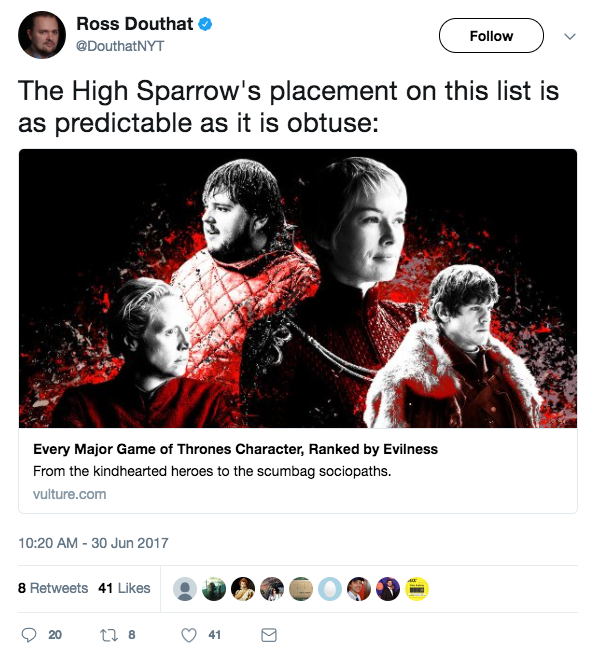
I really couldn’t ask for a more delightful criticism of my Game of Thrones Evil Rankings than Ross Douthat defending the High Sparrow
Every Major Game of Thrones Character, Ranked From Good to Evil
June 29, 2017Jon Snow
A reformer with results. Ned Stark’s (alleged) bastard rose from the ranks to become Lord Commander of the Night’s Watch, then rose from the dead after his underlings murdered him for being too humane to their lifelong enemies, the wildlings. He then helped liberate the North from the bloody grasp of House Bolton. He’s also a generous lover (“You know nothing, Jon Sn — oh!”), a secret Targaryen prince, and most likely the messiah.Sansa Stark
There’s a line in George R.R. Martin’s books about how alone among the Baratheon brothers, Robert was “the true steel,” strong and sharp and flexible and durable. Out of the Stark siblings, Sansa is the true steel. She’s shaken off a short lifetime of sexist princess stories, survived the lethal court intrigues of King’s Landing, weathered the untoward attentions of Littlefinger and the Hound, outlived her rapist Ramsay Bolton, and saved her brother Jon’s life. It’s possible that Petyr Baelish may win her over to the dark side, but until that happens, she’s on the side of the angels.Eddard Stark
Ned is dead, but he didn’t deserve to be. He made moral compromises over the course of his life, from lying to his wife Catelyn and everyone else about Jon’s parentage (including Jon himself) to playing the game of thrones alongside his dissolute old friend King Robert. But in the end, he sacrificed his honor to save his daughters’ lives. It’s not his fault that Cersei, Joffrey, and Littlefinger repaid his kindness with a knife in the back and a sword through the neck.
93 Shades of Gray: Because I am insane, I ranked every major Game of Thrones character in ascending order of evilness for Vulture. This trio of faves is on the good end of the spectrum.
“Twin Peaks” thoughts, Season Three, Episode Eight
June 26, 2017What is clear is the birth of Bob’s bracing message. This disturbing, disorienting episode explicitly ties the demon’s creation to the atom bomb’s detonation, an act of man that rivals, or betters, the dark deeds of any religion’s devil. The connection is no accident. Nor is it without precedent: Ever since the original Twin Peaks introduced supernatural horror into its director’s body of work, the link between otherworldly evil and real-world brutality has been a constant. Lynch treats human cruelty like a rupture in the fabric of reality through which demons of every shape and size can enter — think Lost Highway‘s white-faced Mystery Man, Mulholland Drive‘s monstrous dumpster-dweller and gibbering old folks, Inland Empire‘s balloon-faced Phantom and, of course, the dwellers of the Black Lodge. They all feed on and perpetuate the cycle of violence that enabled their emergence.
Some experiences and emotions are so cataclysmic that our everyday imagery and vocabulary cannot possibly do them justice; monsters give shape to those feelings, the same way an aria in an opera or a song in a musical gives human passion a voice. In crafting creatures like that denim-clad monster and his dark brethren, Lynch is doing what all great horror does. He’s taking the agony and fear we already feel and, like Dr. Frankenstein in his lightning-streaked laboratory, bringing it to unholy life. The real question this episode asks, then, is no more or less than the one pilot Robert A. Lewis asked when he dropped the atomic bomb on Hiroshima: “My God, what have we done?”
“Fargo” thoughts, Season Three, Episode Ten: “Somebody to Love”
June 24, 2017The question facing us is simple. Does Varga walk away, or is he locked up? Will he exalt himself like the eagle and make his next among the stars, or will the Lord bring him down? Is Schrödinger’s metaphorical cat dead or alive? Is the ethical universe half-full or half-empty? The lady, or the tiger?
I want to focus on writer Frank R. Stockton’s extremely famous short story of that name here, because I think the ending of this episode will be similarly misconstrued. The gist of “The Lady, or the Tiger?” is simple enough: In ancient times, a barbaric king offers a condemned man a choice inside a gladiator-style arena where two doors stand before him. Behind one is a ravenous tiger that will devour him on the spot; behind the other is a beautiful woman who will marry him on the spot. The process is completely random, and the prisoner has a fifty-fifty chance of life or death. (“Call it.”)
At least that’s the version of the story you may recall from the dim recesses of memory of English classes gone by. In reality the situation’s a lot more complicated. For one thing, if you get lucky and wind up with the lady, the capricious king will insist you marry her no matter your previous familial commitments or romantic entanglements. Happily married already? Tough luck.
For another, the specific case at the center of the story is a unique one. The condemned man in question, described by the story’s narrator in a sardonic and self-aware voice not far removed from that of Fargo’s occasional voice-over commentators as “a young man of that fineness of blood and lowness of station common to the conventional heroes of romance who love royal maidens,” has been sentenced to this ordeal for the crime of falling in love with the king’s daughter. Like her father, the princess is herself a barbarian by nature, and through sheer force of will has discovered the secret of what lies behind each door. But that same barbarian blood makes her intensely jealous of the other lady in the equation, to whom her suitor will be betrothed should he dodge that tiger-shaped bullet. It’s up to her to signal to the dude which door he should take, and up to us to guess whether she’s sent him to his death or to a life without her, a fate less bloody but possibly no less cruel, in the princess’ eyes anyway.
Apply these lessons to our current story, and the simple choice between good and evil we’re asked to make when we speculate about the outcome of Varga and Gloria’s meeting becomes way less simple.
I reviewed the finale of Fargo Season Three, and quite possibly Fargo itself, for Decider. I think it’s a far more complex episode than surface readings of its ending give it credit for, and I think overall it may be the season that haunts me most.
“Better Call Saul” thoughts, Season Three, Episode Ten: “Lantern”
June 20, 2017In the gorgeously shot sequence that helps open the episode (following the portentous cold-open flashback in which young Chuck assures young Jimmy that everything will be alright in the story they’re reading by lantern-light together), Howard faces the older man down across the lighted arches of HHM’s conference table, before dismissing the other partners so they can speak alone. Actor Patrick Fabian is…well, after seeing him in this role, where he has to take his natural USA Network blue-sky legal-eagle-drama good looks and imbue them with complexity and depth, you wanna see him sink his teeth into something even juicier. For now, though, he’s completely convincing as a straight-and-narrow, buttoned-up guy who worked for years to protect a man he considered a friend, only for that friend to attack him when he dared suggest a different course of action. “Your first instinct is to sue me?” he asks, the incredulity written all over his face. He winds up buying Chuck out of the firm using funds drawn from his own pocket. The ensuing faux-farewell scene, in which the entire office floods the foyer to wish Chuck goodbye, is like something out of The Young Pope—figures lining balconies, overhead shots of curvilenear staircases, a system working in concert to expel a person who does not belong.
This leaves us with Chuck himself. Between his humiliation at HHM and his severing of ties with Jimmy, he suffers a psychological blow that not even his hard-fought recovery from psychosomatic illness can surmount. At first I was kind of bummed out by what ensued: prestige TV’s umpteenth homage to The Conversation, as Chuck’s mental dissolution is metaphorically depicted by his dismantling and destruction of his house in search of a stray electrical current he can’t seem to shut off at the source. But between Michael McKean’s go-for-broke performance and Dave Porter’s evocative, trumpet-based score, something happens that transcends the sequence’s origin. Before too long it’s clear that something deeper than metaphor is at work. Chuck is losing his mind, permanently. As in, it’s lost. He’ll never find it again.
The episode ends with an image that’s all but nauseating in its unfiltered depiction of this loss. With his house a debris-strewn ruin, Chuck sits at his desk, eyes vacant, his legs repeatedly—almost automatically—kicking. The only satisfaction remaining to him is that of destruction, a feeling his brother Jimmy knows only too well. He just kicks and kicks and kicks at his desk until, finally, his lantern falls off, and explodes, and starts a fire we witness silently from across the street. Chuck has no friends, no family, no sanity. But death is always there for you, waiting. Like the brother you wish you had.
I reviewed the beautiful season finale of Better Call Saul for the New York Observer.
How ‘Better Call Saul’ Secretly Became One of TV’s Best Dramas
June 20, 2017Better Call Saul has also secretly morphed into one of the most visually accomplished shows on the air. Bad‘s riotous visuals echoed its chaotic plot, but this prequel has taken a more austere, slow-and-steady approach to its storytelling – and its cinematography follows suit. Directors of photography Arthur Albert (for Seasons One and Two) and Marshall Adams (his successor for Season Three) favor shot compositions that emphasize the geometry of the spaces that Jimmy & co. find themselves in: rectangular windows, square glass bricks, the diagonal slash of a staircase, the glowing arches of a conference table’s lights. The result is an elegant claustrophobia, in which the characters look pinned to a grid or a game board, unable to control their own movements.
And during the show’s third season, Adams adapted Albert’s already impressive use of different lighting styles into a cleverly coded system, to the point where you could almost tell which character’s story we’d be following before they appeared on screen. Jimmy’s segments are brightly lit by the New Mexico sun or by the glare office-light fluorescents, casting a spotlight on his sins. Chuck exists in a shadowy world of his own making, silhouetted in the darkness of his house against a clean white haze of daylight from his windows or the glow of his indoor lantern. Mike’s nocturnal prowlings are given an amber yellow cast – the color of caution, warning and ear, all subliminally signaling us to slow down and watch out.
Saul Mighty: With some help from editor David Fear, I wrote about how Better Call Saul transcended its prequel roots to become one of the best shows on television for Rolling Stone.
“Twin Peaks” thoughts, Season Three, Episode Seven
June 19, 2017The third pseudo-ominous scene, and we’re gonna guess it’s the one that gets people talking, takes place in the Bang Bang Bar, a.k.a. the Road House, a.k.a. the place where we just sit around and watch a guy sweep up debris from the floor for nearly the entire duration of “Green Onions” by Booker T. and the MGs. Why? The answer that springs to mind is “why the hell not,” and hey, that’s perfectly valid. But the phone conversation that ends the scene, in which Jean-Michel Renault (no, not the long-dead sleazebag Jacques, but one of his equally gross relatives) rants and raves about the 15-year-old girls he pimped out to an unhappy client, provides a different answer. What you’ve got here is the banality of evil: A dude who can sit around twiddling his thumbs to an old R&B classic, then pick up the phone and crack jokes about statutory rape. As Jacques would say in a thick French-Canadian accent, “Bite ze bullet, baby.”
I reviewed last night’s tense and clever Twin Peaks for Rolling Stone.
“American Gods” thoughts, Season One, Episode Eight: “Come to Jesus”
June 19, 2017Mr. Wednesday’s war has come, but we’ve gotten his target wrong all along. Sure, he wants to unite the surviving old gods of the world’s various fallen faiths and pantheons against the New Gods of American hegemony—technology, the media, guns, commercialization, and the military-industrial-corporate-intelligence-government complex represented by the mysterious Mr. World. But attacking we the people is his way to win. In “Come to Jesus,” the eight and final episode of American Gods’ spectacular misfire of a first season, the war begins — a biological war in which Wednesday recruits Ostara, goddess of spring, to destroy all the vegetation in the nation until people begin worshipping the old gods again. “Never once have they had to work for it,” he reasons, “give thanks for it.” His plan is to starve us pampered Americans into prayer.
Wednesday’s thesis, and by extension the show’s, is an even more fundamental misreading of American life than the series’ underlying assertion that in our country’s centuries-long existence it hasn’t had room for legends, myths, and magic. Certainly vast swathes of America have been insulated from hunger, poverty, violence, and toil — though that swathe is getting smaller by the year. But the very idea that “never once have they had to work for it, give thanks for it” is the height of blinkered liberalism, a world view that recognizes the existence of injustice but always manages to locate it elsewhere. As of 2015, the year American Gods was greenlit, thirteen percent of American households are food insecure; in some states that percentage rises higher than one in five households. This pat assessment of America as a land of coddled weaklings who’ve never struggled may be true from where Neil Gaiman, Bryan Fuller, and Michael Green are sitting, but any Viking war god worth his salt ought to fucking know better.
The Boiled Leather Audio Moment #7
June 16, 2017Moment 07: Bran and the Time Travel Effect
On this month’s subscriber-only Boiled Leather Audio Moment, we’re going back…to the future! Okay, not really—that’s sort of the point of the discussion. In our first-ever BLAM available at our new $2 reward level, Sean & Stefan answer a question from listener Max B. about whether recent events on the Game of Thrones adaptation indicate that Bran Stark, everyone’s favorite paraplegic telepath, will have an increasingly dramatic effect on past events in the world of the story. Paradoxes abound, and to borrow Ser Barristan’s unfortunate phrasing we slice through them like a knife through cheese. Hit that $2 subscription button, then press play!
“Fargo” thoughts, Season Three, Episode Nine: “Aporia”
June 16, 2017I’ve enjoyed season three of Fargo so much for so many reasons that I’ve barely had the time or inclination to comment on the few things that haven’t quite clicked. Now’s as good a time as any, since the clicking has finally occurred. Basically, Ewan McGregor’s performance(s) have been one of the season’s few weak links. He’s never been bad as either Emmit or Ray Stussy; I don’t think he has it in him to deliver a bad performance straight-up. But I’ve gotten the sense from time to time of an actor clinging to his wigs as a sort of life raft, the only way he can navigate the choppy waters of playing two superficially similar but very different characters, who look alike, in an accent completely alien from his own. (He’s not as bad as, say, Peter Dinklage trying to be posh, but the Scottish texture of McGregor’s voice is hard for him to disguise completely when he plays American, as viewers—or in my case, triple-digit re-viewers—of his work in Velvet Goldmine could tell you.)
There were already signs that this was ending in the last couple of episodes. Think of the way he ranted and raved about the travails of the One Percent during his lunch meeting with Mrs. Goldfarb after he accidentally killed his brother, a convincingly inappropriate and desperate coping mechanism. Or the cast of his face as he waved down to Sy Feltz for what he may well have known was their last moment of genuine human connection. Or his guilt-stricken panic when Nikki and Wrench began taunting him with the detritus of he and his brother’s history. The accent is the accent, but underneath a person was emerging.
In this week’s episode, “Aporia,” that person emerged in full. It happened during his beautifully framed confession of murder to Gloria Burgle—less “just the facts” than a rambling, time-jumping journey through his entire sorry relationship with his kid brother Ray. It’s one of those moments where you can see an actor seizing the best stuff he’s been given all season, like a swimmer surfacing for that first big fresh gulp of air.
I reviewed this week’s fantastic episode of Fargo for Decider.
“bear witness, that is all”
June 14, 2017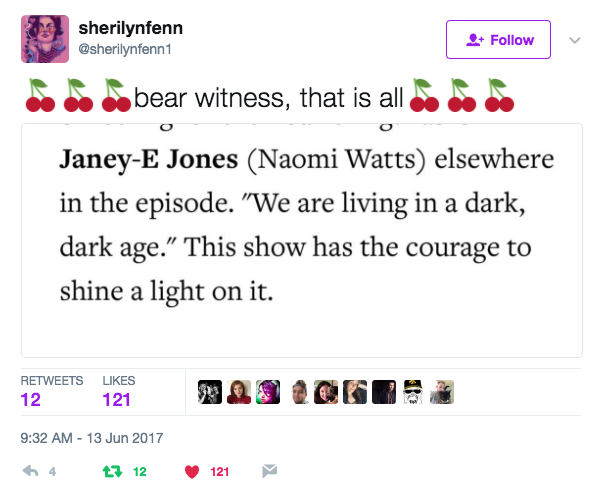
Sherilyn Fenn, aka Audrey Horne, quoted my review of the latest Twin Peaks and added a bunch of cherry emojis. So I’m dead now,
“Better Call Saul” thoughts, Season Three, Episode Nine: “Fall”
June 14, 2017Kim Wexler has lost control. Considering the company her partner and boyfriend Jimmy McGill will soon be keeping, if the worst thing that happens to her because of Jimmy is accidentally driving her car into a ditch, she’s gotten off easy. But while it’s easy to miss amid the fireworks between Jimmy and Chuck or the historical first meeting of Mike and Gus, not to mention Rhea Seehorn’s never-let-them-see-you-sweat performance, but this season has slowly ratcheted up the pressure on Kim to what turns out to be a physically unbearable degree. The episode is entitled “Fall,” and that’s basically what she does.
I reviewed this week’s very good Better Call Saul for the New York Observer. I talk about this elsewhere in the episode, but like Costa Ronin as Oleg Burov in The Americans, Michael Mando as Nacho Varga speaks barely a raised word and barely ever one in English and is delivering one of the best performances on television.
“Twin Peaks” Thoughts, Season Three, Episode Six
June 14, 2017Harry Dean Stanton is 90 years old, though he’s looked so world weary for so long that he seems somehow ageless and immortal. In light of the key Twin Peaks players who’ve died before the series’ return to the air – Jack Nance, Frank Silva, Frances Bay, Don S. Davis, Warren Frost, David Bowie, and most hauntingly Miguel Ferrer and Catherine Coulson, who reprised their roles as Albert Rosenfield and the Log Lady before they passed away – we’re fortunate to have him. When his character, Carl Rodd, tells his younger companion “I’ve been smokin’ for 75 years, every fuckin’ day,” he literally laughs in the face of his own mortality. But way back when we first met him in Fire Walk With Me, set nearly 30 years ago, he intimated to a pair of FBI agents investigating a Black Lodge–related murder that he’d seen too much. “I’ve already gone places,” he said. “I just want to stay where I am.”
Making Stanton’s Carl the Virgil on our journey to this episode’s particular Hell – the hit-and-run killing of a little boy by local monster Richard Horne (Eamon Farren) – lends even more weight to the moment. It provides a contrast between the old man’s long life – achieved against the medical odds, by his own admission – and the life of the little boy, cut so horrifically short. It offers an unparalleled range of emotion, beginning with him simply sitting on a bench and enjoying the wind and light through the trees and ending with him seeing one of the worst things a person can see. And whether he’s watching the boy’s soul ascend or simply providing his mother with human connection and validation by touching her and looking into her eyes, his role is just that: to see, to bear witness. It’s not that witnesses are in short supply – plenty of bystanders observe the accident and its aftermath. But when Carl takes the next step and comforts the grieving mother, he’s the only one to bear witness – bear as in a cross.
[…]
Two crucial links to the murdered child who set the entire chain of events in motion are uncovered in an episode that forces us to confront the killing of children face-on. Laura’s face appears in the opening credits every week, but this is a way to make her presence, and her absence, hit home. Doing any less would be a cop out, a dodge, a refusal to bear witness. “What kind of world are we living in where people can behave like this—treat other people this way, without any compassion or feeling for their suffering?” asks Janey-E Jones (Naomi Watts) elsewhere in the episode. “We are living in a dark, dark age.” This show has the courage to shine a light on it.
I reviewed this week’s extremely difficult Twin Peaks for Rolling Stone. I have to say, the response I’ve gotten to my writing on the season so far, and this episode in particular, is extremely gratifying. What it’s doing means a lot to me.
“American Gods” thoughts, Season One, Episode Seven: “A Prayer for Mad Sweeney”
June 14, 2017The best way to describe American Gods is that it features Nick Sobotka as a leprechaun and somehow I still don’t like it. “A Prayer for Mad Sweeney,” the seventh and, shockingly, penultimate episode of AG’s first season (seriously, doesn’t it seem like they have a lot of ground left to cover) features Nick Sobotka as a leprechaun more than ever; while I’m still not crazy about it, it’s a better episode than most.
Cut to Black: The best (and worst) post-‘Sopranos’ series finales
June 9, 2017It’s been a decade since “Don’t Stop Believin'” cut off in Holsten’s, and The Sopranos cut off with it. June 10 marks the tenth anniversary of the original airing of “Made in America,” the final episode of creator David Chase’s modern mafia masterpiece. Credited (correctly!) with kicking off a new Golden Age of Television, the show ended on an equally influential note: silence. We’ll never know whether mob boss Tony Soprano was killed as he sat down for dinner with his family (as in nuclear, not crime), or if his life simply went on, with the next FBI raid, hitman or plate of ziti always just around the corner. Nor are we meant to figure it out, no matter what you’ve read on the internet. For Chase, the ambiguity and uncertainty speak not only to Tony’s uniquely precarious existence, but all of ours’ as well.
Demanding, divisive and pretty much perfect for the show it concluded, “Made in America” remains the gold standard for finales to this day. In one form or another, nearly all its successors are a reflection of it, whether attempting to right its perceived wrongs or live up to its masterpiece status. Moreover, as one of the first major shows of its kind that was allowed to end in its own time and on its own terms, The Sopranosaccidentally popularized the unfortunate idea that a show is only as good as its final episode, and that if you don’t “stick the landing,” nothing that came before is worthwhile. That’s an extreme overreaction, of course — a bad finale is not a magic eraser that wipes out the hours you spent enjoying the show up until that point — but it’s a concept creators and audiences alike now wrestle with.
With Tony trapped in that diner limbo for ten years (Schrödinger’s Soprano?), we’re taking a look at six of the standout series finales that have aired since: Mad Men, The Wire, Breaking Bad, Boardwalk Empire, Lost and Battlestar Galactica. What did they get right, or wrong, about the shows they’re concluding? What did viewers take away — and what should they have focused on instead? Should we be asking if they stuck the landing, or if they leapt into the unknown? Fire up the Journey and find out.
“Fargo” thoughts, Season Three, Episode Eight: “Who Rules the Land of Denial?”
June 9, 2017This is the one you’ve been waiting for. Whether you’ve been one of Fargo Season Three’s inexplicably large number of skeptics or singing its praises from the jump, this is the episode that either puts paid to your criticism or pays off your faith. It’s called “Who Rules the Land of Denial?”, and it features the season’s best action/thriller sequences, its goriest crimes, its biggest surprises, its most striking cinematography, and its most direct trafficking in the uncanny.
I adored this week’s episode of Fargo, which I reviewed for Decider.
“Better Call Saul” thoughts, Season Three, Episode Seven: “Slip”
June 9, 2017“To our four-corner strategy!” So goes the toast proposed by Mesa Verde head honcho Kevin to his right-hand woman Paige and attorney Kim as they dine out to celebrate their success and plan its next stages. On “Slip,” this week’s episode of Better Call Saul, the show does the good banker one better. It rotates between fully five functionally separate storylines, starring Jimmy McGill, Mike Ehrmantraut, Chuck McGill, Kim Wexler, and Nacho Varga respectively. Such is the strength of the series, the least flashy top-tier drama on television right now, and of the performances given by Bob Odenkirk, Jonathan Banks, Michael McKean, Rhea Seehorn, and Michale Mando, that I’d happily watch a spinoff starring any one of those five characters exclusively.
I reviewed this week’s beautifully balanced Better Call Saul for the New York Observer.
Goodbye, ‘The Leftovers’: How HBO’s Show Went From Good to Canon-Worthy Great
June 5, 2017Then something wonderful happened. As the first season went on, the show got weirder, wilder, and – no coincidence here – better. And given the way they operate primarily through symbolism, the Guilty Remnant are a great place to begin looking for answers as to how.
For starters, the GR and their leader Patti Levin (the great Ann Dowd) made for antagonists of a sort we’d never seen before. Like an army of proto-Pepes, their modus operandi was trolling: specifically, a deliberate mockery of everything the survivors clung to, right on down to the memories of their missing loved ones themselves. The group’s climactic assault on the town of Mapleton wasn’t a murder spree; it was simply using realistic life-sized dolls to recreate the Departed and spook the squares. The cult pulled a similar trick the following year down in Miracle, Texas, when they threatened to bomb the bridge that led to the miraculously Departure-free town and wound up merely throwing open the gates to the hippie hordes camped outside. They violated the norms of every day life in ways that were simultaneously horrifying and darkly hilarious.
Looking over The Leftovers‘ three seasons, it’s hard not to see shades of the Guilty Remnant’s chain-smoking, white-wearing mischief in the show’s writing staff itself. Simply put, there was no convention of storytelling, external or internal, these folks wouldn’t break if it made for more intense viewing. Most famously, Season Two tossed the balance and setting the show had worked so hard to establish aside – relocating from New York to Texas, reloading the cast with a whole new family, pushing many of the original characters aside for episodes at a time. It also replaced the gloomy original opening credits with jaunty country music and brightly lit family photos that showed disappearing people basically merge with the stars, a sign the show was capable of recognizing its excesses and playfully tweaking itself for them.
I wrote about how The Leftovers got great by going crazy for Rolling Stone. Really going to miss this show. I can only hope that others will pick up the torch and carry on its blend of emotional rigor and balls-out risk-taking. (Too many shows emphasize the latter at the expense of the former.)