Telling you that any given episode of Foundation kicks ass in five or six different ways seems to be the Prime Radiant’s prediction of my destiny, and far be it from me to deny the math: This episode of Foundation kicks ass in five or six different ways. Caitlin Parrish and Leigh Dana Jackson’s script is merciless, sullying a babyface character perhaps beyond salvation. It’s also dependent on not one but two characters, Gaal and the Mule, remaining several steps ahead of the audience, which in my case at least they certainly did. I always enjoy it when shows are smarter than I am.
As outer space spectacle, this remains a magnificent show. From Toran’s wounded ship skipping across space and down to the surface of their planet half destroyed, to the imposing enclosure of Kalgan by Empire’s ships, to the “cobalt spike” that burns the planet, even down to the red and green lighting of Dusk aboard his “black hole gun” weapon as he hears the news from Dawn, to the gravity-defying ways of the tubular planet where the Council meets, there’s virtually always something to feast on.
This show is full of surprises. With a one-year time jump, the relocation of a major character into a whole other world, and the introduction of perhaps the most major character of all, Chief of War has once again shaken itself up from one episode to the next. What impresses me most isn’t that it keeps introducing new wrinkles to what is at heart the simple story of a noble exile and an evil king, but how artfully it’s done.
In terms of sheer imagemaking, this is Tim Burton’s best work on the show. In terms of overall quality across the board, this is the show’s best episode. It’s scary, it’s actually funny, it’s relatable (knock before you enter the room when your roommate’s in there, god!), it’s got that awesome orc-troll-Gollum-Large Marge monster design for Tyler, it’s got goth Patsy from AbFab, and it ends with the possibility of Wednesday Addams journeying to the realm of the dead for real. It makes me want to tune in next time, even if that’s a month away. That’s exactly what you want a midseason finale to do.
So yeah, random animated sequences? Jenna Ortega and Catherine Zeta-Jones doing their best Uma Thurman/Lucy Liu impression? Horror comedy centered on a Luis Guzmán shower scene? Christina Ricci getting dragged before Thandiwe Newton in chains? It would be churlish to deny the show’s pleasures. But it would be foolish to deny the many ways it hobbled itself right out of the gate.
It took me a minute, but I figured out what the second episode of Wednesday’s second installment reminds me of: Conan O’Brien’s old “Late Night’s Parade of Characters” bit. Hey, everyone, look! It’s Thandiwe Newton as a director of psychiatry for a hospital for the criminally insane! It’s Heather Matarazzo as the hospital’s chipper, ugly sweater–wearing personnel director! It’s Hunter Doohan returning as his evil Tyler/Hyde character, who’s now basically the Red Hulk! It’s Fred Armisen making an Uncle Fester Cameo for ten seconds! It’s Christopher Lloyd as a severed head in a robotic jar! It’s Catherine Zeta-Jones and Luis Guzmán as Morticia and Gomez, who are now series regulars because we realized the Addams Family is more interesting as a concept when it’s an actual family! And don’t forget Principal Evil Steve Buscemi! But wait — Morticia’s estranged Mama Hester is still on her way!
So why did the series hit so big? The cast, plain and simple. Headlined by overnight sensation Jenna Ortega in the title role, supported by a breakout turn as Wednesday’s chipper werewolf sidekick Enid by Emma Myers, and augmented by a cast that included — let’s face it — certified dimepieces Catherine Zeta-Jones, Christina Ricci, Gwendoline Christie, Joy Sunday, Riki Lindhome, Hunter Doohan, and Percy Hynes White, the show felt more vivacious and charming than it actually was at any given time, just by virtue of how pleasant it was to watch these people act out their haunted-house hijinks. The flatness of any scene involving the badly miscast Luis Guzmán as family patriarch Gomez Addams shows how important the casting was to the overall project; it’s the exception that proves the rule.
In the standard opening sequence of The Prisoner, the voice of the new Number Two tells Number Six that he and the masters of the Village want “information … information … information.” Some Number Twos deliver the latter two iterations of the word as if they’re a phrase: “In formation…in formation.” They want him to line up and march, like a good soldier.
The final episode of The Prisoner in every possible running order, “Fall Out” is named after a phrase with several meanings depending on whether it’s one word or two. “Fallout” means the often unfortunate ramifications of an action or event; more specifically, it also means the radioactive debris that rains down on the area surrounding a nuclear explosion. People “fall out” when they have a relationship-ending argument or disagreement. Objects “fall out” when they drop from a place they’d been secured.
In a way, all of those meanings apply to this episode, but none more so than this: Just as soldiers “fall in” when they get in line, they “fall out” when they break formation.
Far out even by Prisoner standards — far out even by “Once Upon a Time” standards, which was itself far out even by Prisoner standards — “Fall Out” is one of the most confrontational series finales ever aired. It’s a “Did you people think I was fucking around? Do you know what kind of show you’re dealing with here?” moment on par with the trial of the Seinfeld Four, Tony Soprano playing Journey at the diner, and the Lynchian un-resolutions of the two (!) Twin Peaks series finales. (The first one was so unresolved that the 25-year gap until Season 3 somehow felt logical — like, of course it would take everyone that long to recover from what happened at the end of Season 2.) It’s a finale that feels designed to be divisive.
Shows that launch with two or three episodes at once instead of a simple one-and-done series premiere always intrigue me. Is this just some random fluke of streaming services’ inexplicably bizarre release schedules, or is there some narrative or thematic logic to it? Are those first two or three episodes telling one big chapter of the larger story, or are they just, y’know, the first two or three episodes?
Chief of War’s second hour falls firmly in the latter category. In retrospect, the Chief of War we saw in the actual first episode was only half a show. We got to know the lay of the land, the sociopolitical circumstances, our hero, and his family. But we had yet to meet his co-protagonist, or encounter the world of white people, the boundaries of which are expanding all the time.
I reviewed the second episode of Chief of War for Decider.
Blood, butts, boats, and beauty: There are worse foundations upon which to build your historical epic. Judging by the sheer quantity of each in the series premiere of Chief of War, Apple TV+’s brutal and beautiful new saga of war-torn late 18th century Hawaii, this show’s on solid ground. Filmed entirely in Hawaiian and fueled by the simmering star power of Jason Momoa, who co-created the show and co-wrote the episode with Thomas Pa‘a Sibbett, it’s proof that the “Game of Thrones but in the real world” success of Shōgun was no fluke. Executed with care and charisma, it’s a formula that works.
You make a show like The Prisoner to make an episode like this.
Written and directed by creator and star Patrick McGoohan, the auteurist masterpiece “Once Upon a Time” is a clear move toward the series’ endgame, advancing the overarching plot (!), ending on a cliffhanger (!!!), and promising us that in the next episode both Number Six and we in the audience will, at long last, meet Number One (!!!!!!). That’s thrilling enough, and a textbook case of The Prisoner breaking the rules it’s established for itself in basically every way conceivable at one point or another.
But as important as all that is, as much as we’ve been waiting 16 episodes for it to happen, it pales in comparison to the execution. “Once Upon a Time” is one of the most boldly experimental episodes of television ever filmed. You’d have to fast forward to the finale of Twin Peaks Season 2 or the phantasmagorical eighth episode of Twin Peaks Season 3, I think, before you found anything comparable.
There have been other mightily sophisticated, groundbreaking, stylistically innovative shows that weren’t made by Patrick McGoohan, Mark Frost, or David Lynch, of course. But to cite two representative examples, The Sopranos‘ dream episodes are the clear product of the everyday mind of the main character, and Nicholas Winding Refn and Ed Brubaker’s magisterially bleak Too Old to Die Young operates in the same basic soporific register the entire time. Only in The Prisoner and Twin Peaks did things already start out “both wonderful and strange,” then somehow find a way to become wonderful and strange even by their own immeasurably lofty standards.
Throughout The Prisoner, Patrick McGoohan and his collaborators have been restless to the point of mania. Any rule they can break in their story of a lone intelligence operative pitted against unknowable and implacable forces, they break, even if it was their own rule to begin with. Episodes with different opening credits. Episodes with no opening credits. Every episode is about escape, until they aren’t. Every episode features Rover and the Announcer, until they don’t. Every episode has a new Number Two, except the ones that reuse old ones. Episodes that begin with twenty minutes of silence. Episodes in which Number Six is a suave secret agent in Paris. Episodes set in the Old West.
Seen in that light, “The Girl Who Was Death” is perhaps The Prisoner‘s boldest experiments yet. It alone dares to ask the question: What if an episode of The Prisoner was really, really stupid?
Stupid like a fox, of course. Working from a script by Terence Feely, director David Tomblin, a pivotal player in The Prisoner‘s production, knows that this screwball Swinging ’60s British super-spy pastiche is silly as hell.
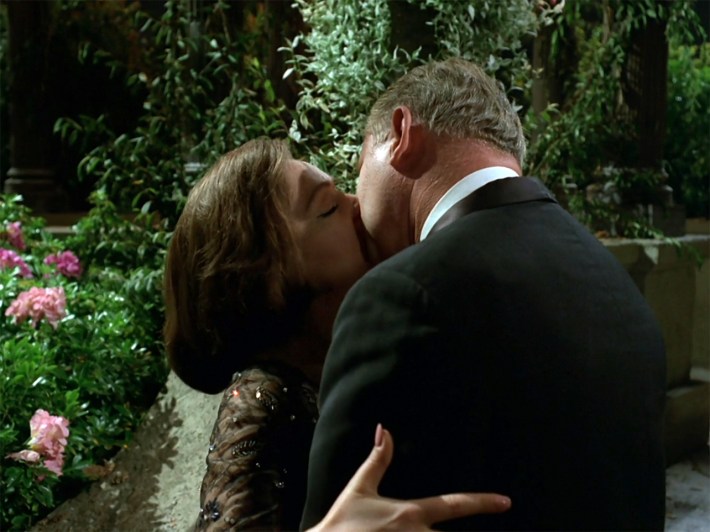
Even though he’s doomed to be in the wrong body, even though he’s doomed to inevitably return to the Village to complete the procedure, even though he initially demurs rather than scare her away with the crazy-sounding truth, he has to convince her he’s the man she loves, and not through anything as dry as handwriting analysis. So after tracking her down at a party, he tells her to grab the receipt he needs to pick up the slides and meet him outside, where he’ll deliver a message from “Number Six”.
The message is a kiss. Boy, is it ever. In a long take, over electric guitar music that is almost ambient in its plaintiveness, he shows her who he is. “Who else could have given you that message?” he says afterwards. Oooh-whee, that is romance.
Photo: Prime Video
It’s also not Patrick McGoohan. Six finally scores (sex afterwards is faintly but legibly implied), including a big on-screen kiss, but he’s not Six as we know him. Remember, the devoutly Catholic star of this secret-agent show had a no-kissing clause.
Still, we needed this, I think he realized. We needed to know that there was more to Number Six’s life before the Village than a stint on Her Majesty’s Secret Service, a stormy resignation, and a stubborn refusal to explain why. We needed to know that he cared about someone other than himself, had other ideals beyond independence and personal liberty. Personally I think it’s safe to assume he does, that he soured on the work he was doing in some way. We know from “A. B. and C.” that he didn’t resign to sell out or switch sides. In “The Chimes of Big Ben” he began to explain his resignation by saying “I resigned because for a very long time, I—” before the eponymous bells toll. Some kind of moral reason is implicit.
But love? Love indicates he’s more than a man of principle. He’s a man. There’s a woman he loves waiting for him back home. There’s a life that’s been taken from him. If he can have that life back however briefly, in however strange a way, he’ll take it. If he can pay back the people who cruelly taunted him with it only to yank it away by helping Seltzman escape and trapping his enemy in the wrong body, he’ll do that too.
Throughout The Prisoner‘s many strange visits to the Village, the title sequence has remained comfortingly familiar. With its sound of thunder and spy-thriller soundtrack, the wordless depiction of Number Six’s resignation and abduction is a blast to watch, culminating with him rising from his forced slumber, looking out his front window, and seeing the Village for the first time. (And the episode title, too, which must be helpful for him.) Just like that, anyone tuning in for the first time knows the backstory.
Then comes the call-and-response voiceover face-off between Number Six and each episode’s Number Two. This part of the opening sequence sets up the show’s big mysteries in a handful of koanlike questions and mantralike answers. The ominous sight of Rover, the reveal of the new Number Two, Six raging at the sky while yelling “I am not a number, I am a free man!”, Two’s mocking laughter … it puts today’s “abstract substances coalesce and morph into various familiar things from the show you’re watching” trend to shame; that’s for sure. All told, those three minutes are one of The Prisoner‘s greatest achievements.
Naturally, they went and binned it. This is The Prisoner we’re talking about — a show that breaks every mold it can get its hands on, including its own. Even the credits are fair game.
All of this is a long way to say that when this episode opens with a cowboy on horseback in the Wild West instead of a secret agent in a sports car in London, I cheered “Hot damn!” These magnificent bastards did it again!
“Do you feel it? The air gone stale? The common people holding their breath, watching their neighbors’ door get kicked in?” When Captain Han Pritchard asks this of the wealthy nepo baby Toran Mallow (Cody Fern) and his “wife” — marriage is the latest trend; everything old is new again — Bayta (Synnøve Karlsen), he knows what their answer will be. They’re too rich, too callow, too comfortable to hear the sound of the jackboots. When the Black Tongue, the flagship vessel of the telepathic pirate warlord known as the Mule, hovers over their honeymoon spot, their only concern is that its shadow will prevent them from getting a tan. They don’t want something so insignificant as a coup interfering with their comforts.
Not to sound like a broken record in these reviews, but boy, does that feel familiar!
Despite all his scheming and note-planting and trust-undermining, Six doesn’t really do anything to take Number Two down in this episode. He’s not actually a plant; he’s not actually working for a top-secret new commander; he’s not actually conspiring with any of the other Villagers on either side of the invisible cage bars. He’s just … there, solid and unyielding as ever. Through sheer implacability, he forces Number Two to bang and bang and bang away until there’s nothing left of him. In boxing, this is called rope-a-dope, and they’ve done it time and time again to Number Six. Turnabout is fair play.
Now, I’ve done a lot of research about this by now, and anywhere it’s discussed, a blacksmith will eventually chime in and point out that hammers damage anvils all the time. Anecdotal counterexamples aside, you get the idea, right? Compared to the solid mass of an anvil, a hammer’s as flimsy as a conductor’s baton. Bang that thing as hard as you can and you’re more likely to break the hammer, or even your own arm, than you are the anvil itself. And what is Number Two in the end if not a broken arm of the Village body? Control’s strength is finite, but defiance’s is not. Tyranny is brittle. Oppression is the mask of fear.
What can I say? The rom worked, the com worked, the Shakespeare/Austen happy wedding ending worked. I’d watch a second season about their married life in a heartbeat. It’s not Girls at all, but at no point did I expect it to be. It delivers on the promise of its opening moments: It gives Jessica her grand English love story, and it gives that to us too.
Will she head back to him, or is Lena Dunham going to give us a rom-com with an unhappy ending?
Beats me, man. People often forget that though Dunham’s own character on Girls, Hannah, got a bit of a grace note, the show’s verdict on its protagonists was bitingly cynical. I wouldn’t put it past her to craft a five-hour America-dreams-of-England rom-com with a down ending, even if it is based on the real-life happy ending she found with her own husband, the show’s co-creator Luis Felber. But I doubt it. I think we’re headed for a kind of anti-Girls, in which the creator of a show all about how grand young romances are dysfunctional and doomed throws her lot in with love, actually.
So the two angrily part ways in the night, a beautiful floodlit blackness as captured by Bravo’s camera. Assuming we’re headed for a happy ending, this isn’t the end of the road, but it’s something that’s just as important in its way: the first Big Fight, the first Close Call, after that first exchange of I Love Yous. You’ve put your heart on the line, you’ve staked a decent part of your life on it, and now you’re furious at each other. Do you work through it, or do you decide it’s a dealbreaker?