
Posts Tagged ‘TV reviews’
“The Terror” thoughts, Episode Five: “First Shot a Winner, Lads”
April 17, 2018Inviting officers from both ships, including the hated Sir James Fitzjames, to sit in, the drunken sailor asks them a favor. “I’m going to be unwell, gentlemen,” he tells them. “Quite unwell, I expect. And I don’t know for how long.” It soon dawns on his officers that he means to quit drinking cold turkey; the favor he’s asking is their help in covering for him in command, covering up the true nature of his illness, and above all refusing to let him talk them out of it. “We mustn’t stop until it is finished,” he says, drawing from an unexpected reserve of dignity and resolve, “and you musn’t let me.” His tone softens with rueful anticipation of agony to come as he adds, “I may beg you.” He slurs, shakes, grins, and cries his way through the scene, as if the ice of his addiction is slowly crushing the hull of his spirit, and he’s frantically trying everything he can to hold the ship together. Even Sir James seems deeply moved by the display, and considering the raw power of Jared Harris’s performance here, he damn well better be. If you’ve ever known an alcoholic who got sober, you know this moment. I do, and the recognition made me cry. There are all kinds of terror, after all.
I reviewed last night’s episode of The Terror for the A.V. Club. Jared Harris, man. Jared Harris.
“Billions” thoughts, Season Three, Episode Four: “Hell of a Ride”
April 16, 2018Chuck Rhoades Jr. and Charles Rhoades Sr. are at war. They have been since the last season of “Billions,” when son betrayed father as part of a plot by Chuck to ruin his nemesis, Bobby Axelrod. But the most powerful weapon wielded in the conflict so far hasn’t been a legal threat or a stock swindle. It’s the kiss that Charles plants square on Chuck’s mouth, hands locked on his son’s head to prevent him from pulling away.
That kiss is the climax of “Hell of a Ride,” this week’s aptly titled episode from the writer Randall Green and the director John Dahl. In a series that has made a study of the physicality of the rich and powerful, the scene is a graduate-level course.
On one level, and like so many of these characters’ other words and actions, it is very likely a reference to a work of macho pop culture: the kiss of betrayal that Michael Corleone plants on his disloyal brother Fredo in “The Godfather Part II.” (Bobby quoted the first “Godfather” film earlier in the episode when he instructed his philanthropy guru, Sean Ayles (Jack Gilpin), to “use all your powers and all your skills” in support of his latest stealthy venture.) But like the best such moments on “Billions,” the context transforms the reference into something new and unique, and in this case uniquely disturbing.
I reviewed the latest terrific episode of Billions for the New York Times.
“The Americans” thoughts, Season Six, Episode Three: “Urban Transport Planning”
April 13, 2018“I am alone without them, here. Alone.” This line — delivered by Soviet hockey player turned double agent turned defector turned likely divorcé Gennadi to the FBI agent he considers his only friend, Stan Beeman — hit me harder than anything else in this week’s episode of The Americans. As a reminder, this week’s episode of The Americans opened with Elizabeth Jennings washing a man’s brains and blood off her face, then yelling at her traumatized daughter Paige for making the unforgivable mistake of running toward the scene to make sure her own mom was still alive. It includes Elizabeth straight-up lying to Paige about the nature of the man’s death, which she calls a suicide without mentioning that “assisted suicide” is closer to the mark but still woefully inadequate. It includes Elizabeth rolling some poor sap who may have been her easiest mark ever, effortlessly getting him to tell her everything he knows about the weak spots at the secure warehouse where he works before grabbing him from behind and choking him to death on his way out the door. It includes Stan apologizing to his old ally Oleg Burov for his inadvertent role in the CIA threatening him and his family should he refuse to turn double agent, and Oleg rejecting the apology. It includes Philip Jennings growing so alarmed about Elizabeth’s contempt for the United States and oblique hints about her participation in some kind of power struggle against Mikhail Gorbachev that he accepts Oleg’s proposal to spy on, and potentially act to stop, his own wife. If you’re in the market to get hit hard, this is an embarrassment of riches.
So why did this line from a minor character in the grand scheme of things affect me so much? “I am alone without them, here. Alone.” When he says this, Gennadi has been unceremoniously yanked from his double life in the middle of the airport, where in the middle of one of his courier missions Stan approaches him saying he understands he’s requested political asylum — an agreed-upon signal that he’s at risk and must end his life in the Soviet Union forever. Stan’s old partner Dennis Aderholt does the same with Gennadi’s wife Sofia, the TASS news agency worker who helped the flip Gennadi in the first place, but who’s now so unhappy in their marriage that she’s leaking secrets to her new beau, some unseen guy named Bogdan. Other agents pick up her son Ilya from elementary school. The protection they’ll need as defectors ensures that they’ll be moved far away; if the divorce goes through, they’ll be moved to separate locations where they’ll be unreachable to one another. So Sofia moves ahead with her plan to divorce him, Gennadi will never see her or Ilya again. What all of this means for Gennadi is that he’s lost his homeland, his home life, both of his jobs, and his family in the space of an afternoon. He is a man without a country.
Is there a better way to describe each individual member of the Jennings family?
I reviewed this week’s episode of The Americans for Decider. As an aside, it’s nice that the soundtrack calmed down a bit.
‘Westworld’: 9 Questions We Have for Season 2
April 13, 20189. Will there be so many mysteries this time around?
This is the biggest question of all. Season One came with all the clues, twists, and meta-mindgames you’d expect from a show co-created by J.J. Abrams and Jonathan Nolan, whose puzzle-box projects include Lost, the Cloverfield franchise, Memento and The Prestige between them. (The third member of the trinity, Lisa Joy, has a track record of more straightforward storytelling.) All that code-cracking, flash-backing, and maze-running kept YouTubers and Redditors busy for months. But sometimes the trickery got in the way of what otherwise would have been a cracking yarn about machines struggling to become sentient, the sadistic humans who made them that way and the weird war between them.Maybe it’s foolish to expect an old host to learn new tricks. But if the Season Two trailers – full of half-built robotic bulls, menacing fleshless android skeletons and Evan Rachel Wood on horseback straight-up murking dudes – are any indication, Westworld has pulpy power to spare. With the secrets of the Maze, the Man in Black and Ford’s new narrative finally solved, could the show embrace the joys of sci-fi/fantasy/action genre storytelling that have worked so well for shows from Game of Thrones to Breaking Bad, without ever dumbing them down?
I’ll be covering Westworld for Rolling Stone again this year, starting with this piece on the big questions left over from Season One; the question above is really the only one that matters.
“The Terror” thoughts, Episode Four: “Punished, as a Boy”
April 13, 2018I’m spelling all this stuff out in detail because the details are there, and the material is designed to withstand this kind of scrutiny. The Terror could be coasting on survival-horror staples and period-prestige clichés. Instead, it’s using these extraordinary circumstances as a crucible for revealing character, not melting it away for cheap thrills and meaningless misery. It’s a miracle on the ice.
My review of this week’s episode of The Terror for the A.V. Club focuses on a worried-wife scene and a torture scene that the show elevates from rote to vital.
“Billions” thoughts, Season Three, Episode Three: “A Generation Too Late”
April 13, 2018Written by Wes Taylor and directed by Colin Bucksey with all the wit and verve that is now par for the “Billions” course, this week’s episode continues to treat unchecked ambition as a metastasizing cancer that consumes everything it touches.
[…]
“You want it darker, we kill the flame,” Leonard Cohen croons on the soundtrack; funny and fast-paced though it is, “Billions” likes it quite dark indeed.
If you put together these two lines from my review of last week’s Billions for the New York Times, you’ve got a clear picture of the show’s never-stronger appeal right now.
“The Americans” thoughts, Season Six, Episode Two: “Tchaikovsky”
April 13, 2018If I had to sum up this hour-long portrait of how Elizabeth’s studied, professionally mandated distance from the emotional needs of other people — except insofar as they can be instrumentalized and weaponized — is slowly destroying her, I’d do it with an exchange she has with Claudia. Elizabeth can’t help but see how Paige has responded to the woman’s grandmotherly presence in her life. “The way Paige has taken to you,” Elizabeth says to Claudia, “if something were to happen to me at any point…” Your mind fills in the blank before Elizabeth can do so herself — surely she wants Claudia to care for her daughter in the event of her own death — until Elizabeth finishes the thought: “I think you could finish with her.” Just as when she uses her children as a ploy to get the general to let down his guard when he pulls out the gun she’ll eventually use to kill him, the mission is the priority, not the well-being of another person, not even that of her own daughter. It’s clear where that leads them both.
“The Looming Tower” thoughts, Episode Eight: “A Very Special Relationship”
April 13, 2018Serious question: When the makers of The Looming Tower called this episode “A Very Special Relationship,” did they have Jeff Daniels’s graphic sex scenes in mind?
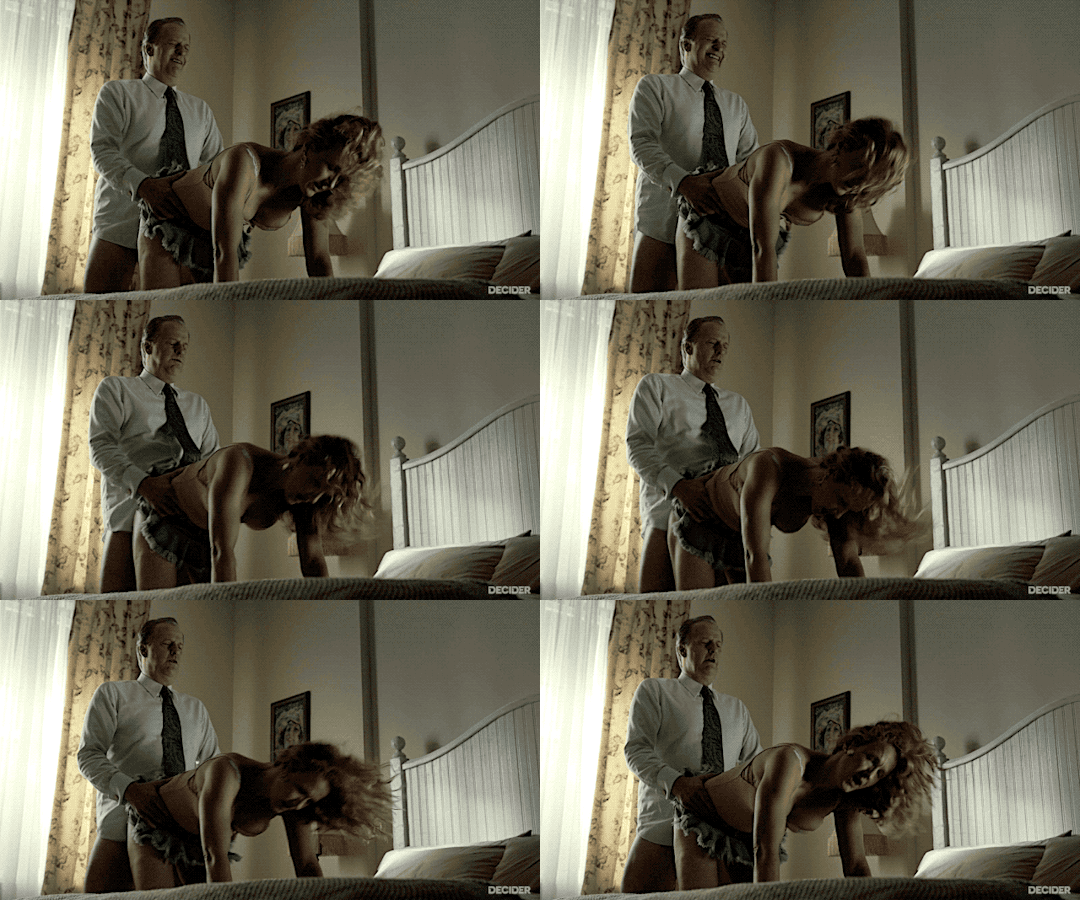
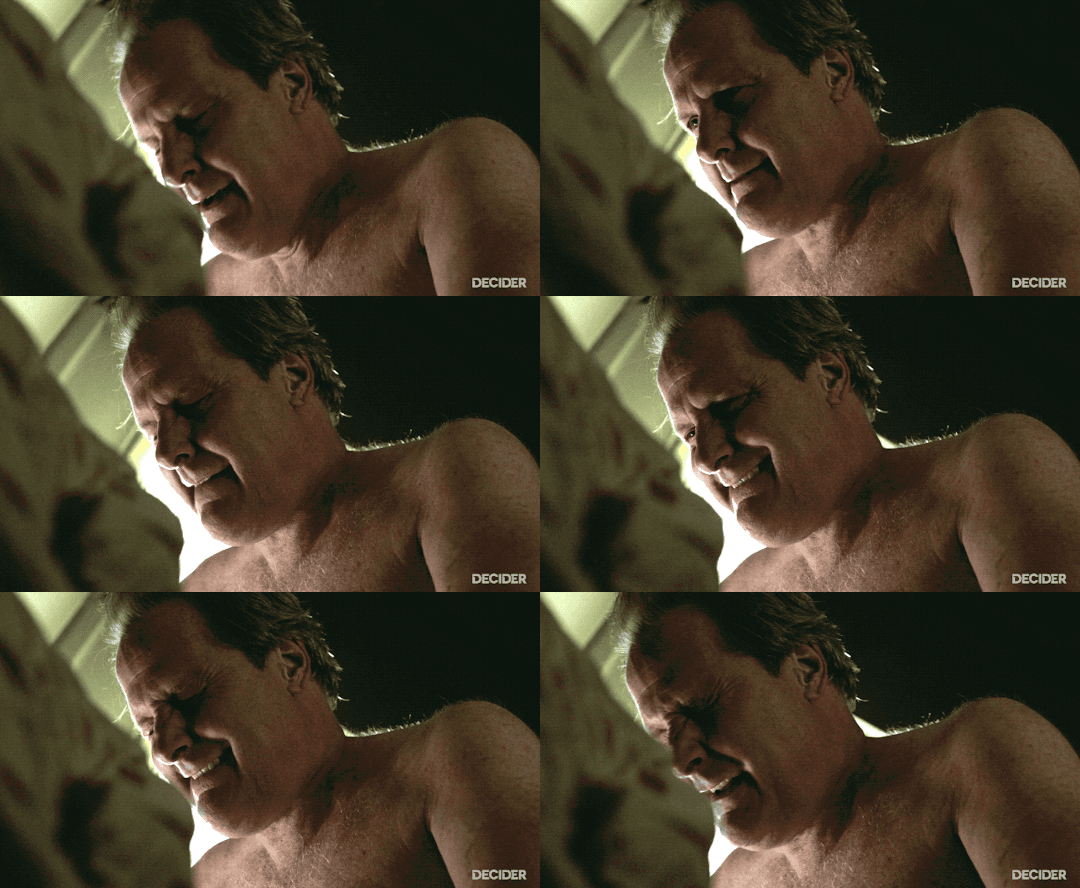
I wrote a whole bunch more about how the failure of The Looming Tower to make a cohesive character out of FBI anti-terrorism chief John O’Neill undermines a lot of the dramatic parallels the show is trying to make in my review of its eighth episode for Decider, but I also just want you to see these gifs.
“The Terror” thoughts, Episode Three: “The Ladder”
April 13, 2018SPOILER WARNING
Many, and perhaps most, prestige television shows traffic in death. Name your top five dramas right now and chances are good the majority are about people who kill other people for a living, or at the very least on a pro-am basis. Yet for all their fixation on mortality, violent or otherwise, few shows bother attempting to answer the unanswerable question of what death feels like. The one that (maybe) gave it a serious try wound up doing something so strange by the standards of its peers that we’re still talking about it eleven years later.
Which makes “The Ladder,” The Terror’s horrific third episode, one of the year’s most impressive hours of television. Climaxing with the surprise death of a major character—a shock tactic you’ve almost come to expect from high-profile dramas—it takes the opportunity to root the viewer in the experience of dying, and dying horribly. Using dizzying camerawork, surreal editing, brutal gore, and a simple but staggering performance by Ciarán Hinds, the episode makes the killing of Sir John Franklin a real voyage into the unknown: the mind of a man who suddenly finds himself in the grips of panic and pain from which there will be no return.
“The Terror” thoughts, Episode Two: “Gore”
April 13, 2018You don’t need to get clocked on the head by a hailstone the size of a grapefruit to think that there was something playful about The Terror this week. For one thing you wouldn’t have much of a head left, but it’s more than that. Titled “Gore,” the episode creates a sense of anticipation that something terrible, or at least disgusting, is going to happen from the start. This isn’t wrong, but it also isn’t the whole picture. In shades of the series title’s double meaning, Gore is the surname of the lieutenant to whom the horrible thing happens. What’s more, his death and disappearance at the claws of a huge, elusive bear takes place after eight months of nothing happening, apparently: Between the final shot of the premiere and the first shot of this installment, eight months have elapsed. A series with the confidence to take such a huge narrative leap this early in its run, and to make gallows-humor puns about the inexorable doom approaching all its characters, is a series worth watching.
I reviewed episode two of The Terror for the A.V. Club. It’s an impressive show.
Brendan Fraser’s ‘Trust’ Comeback Began With a Role on ‘The Affair’ You Have to See to Believe
April 13, 2018“I utterly believed him.” So said director Danny Boyle of Brendan Fraser‘s role as an abusive prison guard on Showtime’s dark kaleidoscope of a drama The Affair. It’s an odd compliment to receive when you’ve just played an utter bastard, but Boyle — the Academy Award winner behind Trainspotting, 28 Days Later, and Slumdog Millionaire — knows his way around bastards, and in the curious case of Brendan Fraser, it was entirely well deserved.
Boyle told GQ earlier this year that after watching Fraser’s work on the show hired the actor to play the oddball ex-CIA officer turned private investigator James Fletcher Chace on his new anthology series Trust, chronicling the outrageous fortunes of the Getty oil dynasty. More than just a henchman, Fraser’s Chace is a fourth-wall breaking narrator — the liaison between the audience and the stranger-than-fiction world he himself inhabits. It’s a smart choice, one that centers an actor already known and loved by millions from his roles in blockbusters like The Mummy and Journey to the Center of the Earth, as well as goofy comedies like George of the Jungle and Encino Man, and even Oscar fare like Gods & Monsters and Crash. We all like Brendan Fraser. And it’s because he played a hateful character on The Affair that we all get the chance to like him again.
A while back I read that Brendan Fraser got his current gig starring in Danny Boyle’s Trust because of his work on The Affair, one of my favorite shows. So I dove deep into his performance, the memes that resulted from an interview he gave about it, and the comeback that began because of it for Decider.
“Billions” thoughts, Season Three, Episode Two: “The Wrong Maria Gonzalez”
April 13, 2018Live like a king. It’s a phrase that connotes wealth, luxury, excess, a life of unlimited possibility and security. How easy it is to let the sparkle of the crown jewels blind us to the dead enemies and discarded undesirables through which they were purchased. This week’s episode of “Billions” reminds us, as bluntly as the show ever has, that the games played by Bobby Axelrod and his billionaire boys club in order to remain comfortable on their thrones can have as steep a cost to bystanders as to any player in the game.
I reviewed the second episode of Billions’ third season for the New York Times. This one leaned into the cruelty of both the billionaire class and the Trump regime real hard.
“The Americans” thoughts, Season Six, Episode One: “Dead Hand”
March 31, 2018Elizabeth Jennings sits in a cafe in Mexico City and learns that the leader of the Soviet Union will be murdered if he agrees to deactivate his country’s top-secret plan for retaliatory nuclear annihilation. She learns this not in a warning, but in a demand for her assistance. Making an end-run around her superiors back home, a man from the Soviet army has come to recruit her to spy on Gorbachev’s team at a disarmament summit. Her job is to make sure that the Strangelovian project — codenamed “Dead Hand,” because why fuck around — is not on the bargaining table. If it is, she is to report back, and history will change forever.
As she learns this information, which will culminate in her receipt of a necklace with a poison pill hidden inside in order to protect the sanctity of Dead Hand should she ever be captured, Peter Gabriel’s “We Do What We’re Told” rises in volume on the soundtrack, higher and higher, until the only reason we can make out her contact’s words is because we can read their subtitled translations. It’s a clever callback to The Americans‘ first episode and its use of “In the Air Tonight” by Phil Collins — another eerie solo standout from a Genesis alum that was famously used in the soundtrack for Miami Vice some thirty years ago. But it’s also away to focus our attention not on the mission, but the shock of receiving it. The Americans deploys quiet and wordlessness as effectively as any show on TV; so many of its standout performers (Noah Emmerich, Brandon J. Dirden, Costa Ronin) are strikingly soft-spoken, and many of its best moments consist of characters just standing and staring at something they can only just bear to see. This isn’t an option in the middle of receiving your marching orders, so the show does the next best thing: It drowns them out. Elizabeth herself is quiet, but there’s a tumult in her head.
[…]
Watching The Americans in 2018 is a much different experience than watching The Americans in 2013 — not just because it’s much better show than it was during that first season (a reasonably enjoyable thriller and not much more), nor because during the 2012 election liberal pundits treated Mitt Romney describing Russia as our enemy as a gaffe while now many of those same pundits are out to start a new Cold War against the country and its ex-KGB leader. You get a little closer when you start talking about why — Russian meddling in 2016 election and influence peddling with its Electoral College–appointed winner Donald Trump and his minions — but only if you treat that as the starting point rather than the finish.
Should even the worst of the allegations against the Putin and Trump governments turn out to be true, they’re basically just tit for tat if you go back to what happened after Gorbachev, when America helped establish an oligarchy by kicking off a capitalist fire sale in the country, and intervened directly and more or less openly to ensure Putin predecessor Boris Yeltsin presided over it. A slightly, but only slightly, less dramatic looting of the commons by corporations, their wealthy viziers, and their paid representatives in the United States government took place here at home. And there’d be no Trump on whose behalf to meddle if our own grotesque racism, sexism, xenophobia, gutting of the social safety net, and worship of money hadn’t made him possible.
In short, it’s much, much harder than it used to be for all but the most blinkered patriots, liberal or conservative, to look at America and Russia’s recent history and see good guys and bad guys. History is a palimpsest, rewritten as we go. And as with Elizabeth in that cafe, things that used to be sound perfectly clear are getting harder and harder to hear.
“The Looming Tower” thoughts, Episode Seven: “The General”
March 31, 2018“And it’s one, two, three, what are we fighting for?” —Country Joe and the Fish, “I-Feel-Like-I’m-Fixin’-to-Die-Rag”
If there’s one thing that struck me about “The General,” the seventh episode of The Looming Tower, it’s that the answer to Country Joe MacDonald’s musical question is, as it always was, “not much.” Not much of value, anyway. Ostensibly depicting the investigation into the bombing of the USS Cole off the Yemeni coast, the episode is in fact about how interagency and international strife made a halfway decent investigation impossible. Most of the fighting that gets done here is between people who are supposed to be on the same side. Why are they doing it? As Country Joe put it, “Don’t ask me, I don’t give a damn.”
I reviewed this week’s episode of The Looming Tower, the first one where I started to think maybe they’re gonna run out of fuel for this story long before they run out of story to fuel, for Decider. The Looming Tower does not have the spark. It does not have the magic.
“The Terror” thoughts, Episode One: “Go for Broke”
March 31, 2018“Past hope. Past kindness or consideration. Past justice. Past warmth or cold or comfort. Past love. But past surprise? What an endlessly unfolding tedium life would then become!” —Francis Wolcott, Deadwood
The men of the Royal Navy about whose lives and deaths The Terror concerns itself have set out on an expedition into the unknown, but the show itself is not. Carefully researched, meticulously art-directed dramas about the evil that heavily accented, infrequently bathed men did back in the olden days are as common across the TV landscape as ice in the Arctic. (At least, as common as ice in the Arctic used to be.) In too many of these cases, hitting that one note of grim, grimy gloom seems to have been viewed as sufficient by the filmmakers involved.
What The Terror gets right, and so many other works of period miserabalism—including executive producer Ridley Scott’s own Taboo, starring a soot-encrusted Tom Hardy—get wrong, is that you have to feel bad that the characters are so miserable in the first place. If you start them all at the same glowering, fundamentally mean-spirited place and just make things worse from there, that empathy can’t be generated; you’re left with the “endlessly unfolding tedium” that the granddaddy of the genre once described. Deadwood never fell into that trap, and neither, based on this opening hour, does The Terror.
I reviewed the crackerjack premiere of The Terror for The A.V. Club, where I’ll be covering the show all season. Most people I know who read Dan Simmons’s source novel enjoyed a lot of it a whole lot but have major problems that kept them from declaring it a truly great book, and I’m in that camp myself. When I heard they were making a show of it, I got excited not because the book is perfect, but because it isn’t, and a good show might be able to excise those imperfections. I’m happy to report that The Terror is, indeed, a good show. Remember that spark I said The Alienist doesn’t have? The Terror does. It’s got the magic.
“The Alienist” thoughts, Episode Ten: “Castle in the Sky”
March 31, 2018It’s in those final steps of the hunt for the killer that the problems really begin. Kreizler bamboozles Roosevelt and his men so that Kreizler and Moore, already under close watch by Byrnes, could sneak away to the child-killer’s new lair unnoticed. How do they know that this lair is in the Croton Reservoir? How does Sara, whom Kreizler also dupes (reasons unclear), figure out that same thing in turn, arriving at the reservoir just in time to save their lives? There’s some hand-waving about interpreting the killer’s map of the water and sewer systems, a change in his modus operandi, and his apparent obsession with John the Baptist. But that’s all wild guess work, and New York was a really big city — on an island, no less — even during the Gilded Age. Water, water everywhere, yet they know exactly where to go.
The episode ratchets up the tension by including Byrnes and Connor as factors in the final showdown, from a poorly explained scene in which Byrnes monitors our men at the opera house to Connor’s almost comically dogged pursuit of the alienist’s team. But while their acute interest in the case made sense while one of their high-society patrons was under suspicion, it made considerably less sense once that patron was killed by Connor. His involvement in the murder of Laszlo’s beloved Mary seems to be an open secret as well, although this, too, is poorly explained. Now Connor goes to all this trouble just because the police object to the doctor’s newfangled methodology? It simply doesn’t hold up as a motive.
Put it all together, and it feels rushed and forced, as if the filmmakers looked at the clock, realized they were running out of time and did a speed run through the final hour of what until now had been a very meticulous, patient detective story.
I reviewed the finale of The Alienist, a show I never really liked but also kind of enjoyed (??), for the New York Times. Charming performances by Luke Evans and Dakota Fanning, and a slightly harder-to-swallow but still endearing turn from Daniel Brühl, buoyed the proceedings considerably. Still, it never had that spark, you know? That magic. Some shows do and some shows don’t.
“Billions” thoughts, Season Three, Episode One: “Tie Goes to the Runner”
March 31, 2018“There’s a new sheriff in town,” drawls Attorney General Waylon Jeffcoat to an assemblage of United States attorneys now under his employ, “and you are my deputies. Gonna be one hell of a turkey shoot!”
Well, yes and no. After watching the Season 3 premiere of “Billions,” Showtime’s amusement-park ride of a financial drama, it is clear that the show’s creators and characters are indeed coming out guns blazing. But the new sheriff, known as Jock, hasn’t changed the series’s old winning ways. A boots-on-the-desk Texan played by the dulcet-toned character actor Clancy Brown, Jock Jeffcoat announces he’s pulling the Justice Department away from Wall Street’s white-collar crimes. Elsewhere, the revelation that the unctuous hedge-fund creep Todd Krakow (Danny Strong), previously the show’s comic-relief antagonist, has been named Treasury Secretary is perhaps the best gag of the episode, in that funny-because-it’s-true sort of way.
The premiere is the most direct reference to the advent of the Trump era we’ve seen so far, if not explicitly so. And yet “Billions” is still the story of the hedge-fund billionaire Bobby Axelrod (Damian Lewis) and Chuck Rhoades (Paul Giamatti), the crafty, crusading prosecutor out to take him down. The two remain uncomfortably connected by Wendy Rhoades (Maggie Siff), Axe’s on-staff therapist and performance coach who’s also Chuck’s wife and dominatrix. Each man is the other’s Ahab, with Wendy playing Ishmael to them all, complemented by one of the strongest supporting casts on television. Trump may have changed the playing field, but the players and the game remain the rollicking, entertaining same.
I’m very excited to be covering Billions for the New York Times this season, starting with my review of the season premiere. It’s a terrifically fun show in which the writing just gets tighter and the performances cannier with each passing episode, it seems, so it’s a delight to write about anyplace of course. But writing about it for the Times, where a) the readership could not possibly be more Billions’ target demographic, and b) my reviews will almost certainly be among the most left-wing things the paper publishes, is a little something extra.
“The Assassination of Gianni Versace”: Tom Rob Smith on Making Meaning From Pain
March 22, 2018You don’t want to reduce an actual human being to an avatar of impersonal forces at work in the world, but Andrew is in one sense the weaponization of all the obstacles that have been placed in all those people’s way by homophobia. Even at Versace’s funeral, the priest performing the ceremony refuses to take his partner’s hand in comfort.
Yeah. All of that is real. We’ve got the footage of the priest pulling his hand away from Antonio. That’s not an inference — we can see it. That priest knew he was on camera, knew he was in front of thousands of people, knew he was at the funeral for this man, and still couldn’t control his hatred. He still felt no need to control it. Versace was so successful he managed to overcome that, which was what was so extraordinary about him. But the whole point of Andrew’s personality was that he wanted to impress people, and he’s born into one of the most marginalized groups in society. That paradox — How can you impress someone when they find you disgusting intrinsically before you even open your mouth? — that’s the conundrum of Andrew.
I think it’s tricky. The most homophobic person in this story is Andrew, by far. When he becomes this killer, he becomes a horrific homophobic bully. It’s like he’s soaked up everything and unleashes it on Lee and Versace. He’s like, “I’m going to shame you. You’ve achieved success and I’m going to rip it down, both through physical destruction, but also through the act of scrutiny and having the world look down upon you.”
Even when he was younger and acting as a welcoming figure in the gay community, he was pushing his racial identity as an Asian American to the side. That’s a stark contrast.
You know, he kind of did both. He wanted to change his name from Cunanan to DeSilva so he could say he’s Portuguese rather than from the Philippines. Then he was saying he was Israeli. So yeah, he would push the racial thing to one side. But the sexual thing is interesting, if you look at the way his life tracks. He can’t deal with anyone who might be critical. If he met someone who was homophobic and he wanted to be friends, he would say that he was straight, or that he had a wife and a daughter. He would play the audience. Eventually he went into an audience of these older men that he didn’t have to play to, because he was instantly impressive. He was younger and witty and clever and appreciated. Once he lost that audience, he hit rock bottom.
There’s this moment we never managed to get into the show which I’ve always thought captured something about Andrew. He was at a party when his descent was really accelerating, and no one was paying attention to him; in fact, someone had already reprimanded him for being really annoying. He just went over to this table and set fire to a napkin. He needed people to run over and notice him.
I interviewed Tom Rob Smith, the writer of The Assassination of Gianni Versace: American Crime Story, for the New York Times. Again, ACS Versace is a great show.
“The Assassination of Gianni Versace: American Crime Story” thoughts, Episode Nine: “Alone”
March 22, 2018Andrew Cunanan walks through Miami Beach toward death as “Vienna” by Ultravox plays on the soundtrack. That New Wave masterpiece is both a celebration and rejection of glamour. Sequentially so, in that vocalist Midge Ure sings of “a man in the dark in a picture frame, so mystic and soulful” and “haunting notes, pizzicato strings, the rhythm is calling,” only to follow up by proclaiming “the image is gone…the feeling is gone…this means nothing to me.” Simultaneously so, in that when he sings “this means nothing to me” the song soars as if nothing has ever meant more to him. Inextricably so, in that it wedges “only you and I” between each declaration of faded emotion and emphatic meaninglessness; in that the title comes from the chorus’s climactic phrase “Ah, Vienna,” a cry of joy and a sigh of loss all at once. The first time that chorus hits in the ninth and final episode of The Assassination of Gianni Versace: American Crime Story, Andrew Cunanan assassinates Gianni Versace. The second time, he’s standing in a stranger’s kitchen, rummaging through a fridge in a house he’s burglarized, pulling out a bottle of champagne and fiddling with the foil around the cork. His lonesome toast to himself is not timed to the music. The feeling is gone, only you and I, it means nothing to me, this means nothing to me.
[…]
Andrew Cunanan is dead and gone when The Assassination of Gianni Versace, one of the best dramas of the decade, concludes. Its final scenes focus on the family of the title character, not his killer; even this choice is a deliberate disconnection from what’s come before. Estranged though they are, both his sister Donatella and his partner Antonio struggle to connect what they had with what they have now. Donatella, who has coolly presided over Antonio’s excision from his late partner’s estate, sobs, because her brother annoyed her on the day of his murder to the point where she refused to pick up the phone when he called. Antonio has been rejected not only by Donatella but by the priest at Gianni’s funeral mass — where rich and famous friends from Princess Diana to Elton John to Naomi Campbell to Sting were present, but where Antonio himself did not merit a mention as a part of the family, nor a kiss from the cleric, whose institution spent the decade denying the humanity of homosexuals while systematically destroying the humanity of so many children in its charge. Like Andrew, he attempts suicide; unlike Andrew, he is unsuccessful.
Gianni Versace ends the series as a photo in a shrine where his sister goes to grieve and lament what could have been had she picked up the phone. Donatella is a distorted reflection in glass embellished with the House of Versace’s Medusa head emblem, monstrous in her mourning. Antonio lies cradled in the hands of the help, who save him from his effort to die with the love of his life. Andrew is just a name on a wall in a mausoleum, one of countless others, nothing special. It’s all so unglamorous, so unceremonious, so blunt and short and ugly. The beauty Versace worked all his life to create, that Andrew tried all his life to recreate, has no place here at the end. The image is gone, only you and I, it means nothing to me, this means nothing to me.
I reviewed the season finale of ACS Versace for Decider. This show is an all-timer.
“The Assassination of Gianni Versace: American Crime Story” thoughts, Episode Eight: “Creator/Destroyer”
March 22, 2018Andrew Cunanan was cool.
Like, really cool.
Sincerely, legitimately awesome.
That’s the tragedy of “Creator/Destroyer,” the penultimate episode of this extraordinary season of television. By the time we see Andrew in his full glory as one of the wildest guys at his high school, we’ve also seen his father Modesto, who debuts in this episode, get his hooks deep into the kid. Andrew has seen his father harangue and assault his mother. He’s borne the weight of all his dad’s dreams, knowing this comes at the expense of his siblings, sensing on some level it’s not right to have this kind of pressure placed on him but, because the pressure is couched as praise, not knowing how to fight back. He’s been…well, the show is cagey on this, but saying he’s been molested by his father would not be out of bounds.
And even now, as an ebullient and confident teenager, he’s begun certain behavior patterns that will get him in trouble in the end: he has a sugar daddy, and he becomes fast friends with Lizzie, his future bestie, because she shows up at a high-school house party pretending to be a kid rather than the married adult she really is. (“I’m an impostor.” “All the best people are.”) He’s picking up little tidbits on how to deceive (including his go-to pseudonym, DeSilva, the name of the people who own the house where the party takes place) and why (because “when you feel special, success will follow” as his father teaches him).
But for a brief time, he’s just a cool, slightly weird, slightly obnoxious, slightly closeted teenager, and if you weren’t at least two of those things during your high school career I don’t wanna know you. He stands up to homophobes in a familiar way, by camping it up even further, going so far as to pose for his class photo with his shirt all the way unbuttoned to show off his (impressive!) torso. He’s prophetically chosen to be “Most Likely to Be Remembered,” and equally prophetically selects “Après moi, le déluge” as his yearbook quote. He rolls into the parking lot like a refugee from Less Than Zero (complete with that movie’s soundtrack staple, the Bangles’ cover of “Hazy Shade of Winter”; the film was his IRL fave) and shows up at the house party in an Eddie Murphy red-leather jumpsuit. (Finally it’s clear why so many of his music cues over the course of the ‘90s portion of the series were anachronistically ’80s: The ’80s were his time.) This Andrew could be loved. This Andrew could be saved.


I reviewed last week’s episode of ACS Versace for Decider. What a show.