
Posts Tagged ‘TV reviews’
“Better Call Saul” thoughts, Season Three, Episode Seven: “Expenses”
May 26, 2017If there’s a defining image for “Expenses,” this week’s episode of Better Call Saul, it’s of a mentally, emotionally, physically, and financially exhausted Jimmy McGill, disheartened by the failure of his latest scheme, just sitting there alone on the sidewalk, collecting himself. Everyone needs a breather now and then, including this show.
The slow pace obscures it somewhat, but season three of BCS has seen a whole lot of excitement go down from the return of Gus Fring and other figures from Breaking Bad’s drug wars to the courtroom showdown between Jimmy and his brother Chuck. The seeds of both were planted in the finale of Season Two, with Mike’s Gus-aborted assassination attempt on Hector Salamanca and Jimmy’s felony confession at Chuck’s house. The resulting sense of momentum was powerful, no matter how long it took Mike Ehrmantraut to reassemble the bug in his gas cap.
But Mike’s dealings with his future boss Gus reached a head in episode four, the courtroom drama occupied episode five, and its aftermath ate up the half of episode six not occupied by the reintroduction of the soft-spoken gangster Nacho Varga as a major player. The task of episode seven, then, seems to be to relax, regroup, and reboot. It’s the first installment of the season that doesn’t feel like a drift downward into an inexorable hell.
I reviewed Monday’s Better Call Saul for the New York Observer.
“American Gods” thoughts, Season One, Episode Four: “Git Gone”
May 26, 2017I’m never sure whether to be pleased or annoyed when a mediocre show finally airs an episode that warrants the praise it’s been getting from the start. On one hand, as a critic — and no one believes me when I say this, but it’s true — I’m in the liking-things business, and getting to experience art I enjoy is the delight that drives my whole career. On the other, climbing aboard an already-in-full-swing bandwagon for a show that I sincerely believed to be bad makes me feel dirty, at least until its future trajectory can be determined.
And one episode is definitely not enough to make that determination. Take Noah Hawley’s Legion, about as apples-to-apples a comparison with Bryan Fuller’s American Gods as you can get. Like American Gods, Legion was a new project from a television visionary fresh from a stunningly successful and unique adaptation of outside source material, with Fargo standing in for Hannibal. Like American Gods, Legion was itself an adaptation, of work by influential comic-book creators, with Neil Gaiman standing in for Chris Claremont and Bill Sienkiewicz (themselves working off concepts created by Jack Kirby and Stan Lee). Like American Gods, Legion saw the artifice and spectacle present in the showrunners’ previous work cranked up to astronomical new heights. And like American Gods, Legion waited until its fourth episode to do something worth the extravagant praise that had been heaped upon it already.
I reviewed this past weekend’s episode of American Gods, which was quite good, for Decider. That was a heck of a Sunday night for TV, all things considered.
“The Leftovers” thoughts, Season Three, Episode Six: “Certified”
May 22, 2017SPOILER ALERT
Then we get to the final scene. Laurie has had heart-to-hearts with her husband John, her ex-husband Kevin, and her frenemy Nora, and seems unburdened by it all, though she’s decided not to stick around to see if Kevin is the messiah. (“Is Nora gone?” he asks her as she leaves. “We’re all gone,” she replies, not unkindly.) The whole wide world is open to her, and sure enough she seems to be taking advantage of it. We pick up with Laurie as she rides a boat out into the ocean, wearing scuba gear, and … oh God, scuba gear. That’s my third and final “oh, no” moment: the realization Laurie intends to kill herself, just as Nora described. Then she gets a phone call, from her daughter Jill, with her son Tommy laughing along in the background. They’re calling to clear up an argument about a kids’ show Jill used to watch on a tape salvaged from a garage sale — the old Nickelodeon show Today’s Special about a mannequin who comes to life, that’s got a real earworm of a theme song. Grinning from ear to ear, Laurie clears up the question for her kids, tells them she loves them, and hangs up.
“It’s now or never, miss,” the captain tells her. A storm’s been coming since the day before, as Kevin Sr. pointed out earlier with evident satisfaction, so if she’s going to dive she’d better go before it hits. She puts on her mask and mouthpiece, breathes, breathes, breathes, breathes, breathes, and falls backwards into the sea. The camera just sits there, filming the emptiness she’s left behind. The sound of the storm approaches. The scene cuts to black. Laurie’s love for her children, for her husbands, for Nora, for everyone — it’s all real, and it’s still not enough to stop her. Everyone involved, from Brenneman to episode writers Patrick Somerville and Carly Wray to director Carl Franklin, seems determined to drive both points home. Love is real, and love is not enough. The episode ends as it begins: with a woman giving up.
What an extraordinary show.
Oh yeah, The Leftovers aired last night too, and it was excellent. I reviewed it for Vulture.
“Twin Peaks” thoughts, Season Three, Episodes One and Two
May 22, 2017It’s the first time we’ve see the Twin Peaks logo and heard the opening notes of Angelo Badalamenti’s unforgettable theme song in 25 years. When it happens, we’re looking right at the face of Laura Palmer. Director David Lynch and his co-creator and co-writer Mark Frost could have chosen pretty much any image to pair with the kick-off of the show’s almost manically anticipated return. But after a cold-open flashback that recycled footage from the original series – the sequence from the series finale in which she informs Agent Dale Cooper that she’ll see him again “in 25 years” – it’s the high-school girl whose horrific murder set the whole story in motion to whom they give the honor.
Whether in its two seasons on TV in the early 1990s or in the 1992 prequel film Fire Walk With Me, Twin Peaks has always placed Laura front and center, treating her not as a fetish object or an excuse for male characters to sleuth and mourn, but as a person deserving of our empathy and respect. All these years later, that has not changed.
Much else about the show, however, has changed. The rest of the opening credit sequence traces the progress of roaring water as it cascades down the falls, and then shows the black-and-white zig-zag floor and billowing red curtains of the Black Lodge, the nightmarish source of the story’s supernatural evil. That’s the other half of the equation for Showtime’s new Twin Peaks season, which bears the subtitle “The Return”: a plunge into magic and madness.
Words I never thought I’d type: I reviewed the season premiere of Twin Peaks for Rolling Stone.
“Fargo” thoughts, Season Three, Episode Five: “The House of Special Purpose”
May 19, 2017If “The House of Special Purpose” demonstrates anything it’s how bad things are getting, and how fast they’re getting there. God bless the silence, restraint, and deliberately painstaking pacing of crime shows like Better Call Saul and The Americans, but there’s something cathartic about watching everything collapse as quickly as possible. In this episode alone, Emmit loses his wife over a fake sex tape Ray and Nikki record in a failed blackmail attempt; he blows up at Sy and risks their friendship; Ray realizes the cops are on to his involvement in Ennis Stussy’s murder; Emmit learns the IRS is investigating him due to Ray’s “withdrawal” from Emmit’s personal account while in disguise; Varga goes apeshit on Sy in his oily way; and Varga’s hired muscle beat Nikki to a pulp. The best thing that happens to anybody is that Sy’s meeting with the Widow Goldfarb, a potential buyer and thus lifeline from Varga’s depredations, isn’t a total fiasco. “You’re supposed to be a fixer!” Emmit barks at Sy in the middle of all this. “Nothing’s fixed. Everything’s broken.” That’s about the size of it.
I reviewed this week’s episode of Fargo for Decider. In the review spend a bunch of time writing about Nikki Swango, a curveball of a character.
‘Twin Peaks’: Your A to Z Guide
May 17, 2017MAJOR SPOILER ALERT
A: Angelo Badalamenti
“Where we’re from, the birds sing a pretty song and there’s always music in the air.” That music – as indispensable to to the series as Dale Cooper or donuts and coffee – is the work of Lynch’s longtime musical collaborator Angelo Badalamenti, whose suite of lush leitmotifs made the show sound like a world all its own. Twin Peaks without the composer’s sumptuous synths is like Psycho without Bernard Herrman’s screeching strings, or Jaws without John Williams’s menacing “dun-DUN-dun-DUNs.” This clip of the composer explaining how he and Lynch came up with “Laura Palmer’s Theme” shows how much heart and soul he poured into every note.B: Bob
Lynch was filming a scene for the pilot in which the late Laura Palmer’s mother sits bolt upright and screams. Then he noticed a face in the mirror behind her – the same face he himself saw when its owner, an actor turned set dresser named Frank Silva, crouched behind Laura’s bed to dodge the camera for a different shot. From this sinister coincidence was born Bob, the demonic rapist and murder from the otherworldly Black Lodge who began the series by killing Laura Palmer and ended it by possessing Agent Dale Cooper. Thanks to his malevolent presence, no show has ever been scarier.
The 20 TV Shows Most Influenced by ‘Twin Peaks’
May 17, 2017Picket Fences
For the past quarter century, TV has in large part been a tale of Davids, from Lynch to the triumvirate of Chase (The Sopranos), Simon (The Wire), and Milch (Deadwood). But there was once a time when David E. Kelley – the man behind Ally McBeal, Boston Legal, et al – was the biggest David of them all. His show Picket Fences was a reliably engaging crossbreed of police, legal and medical dramas, set in a strange small town in Wisconsin with more than its share of TP‘s goofiest charms. A stellar all-star cast – Tom Skerritt, Lauren Holly, Fyvush Finkel, Kathy Baker, Don Cheadle, Ray Walston, Marlee Matlin and more – helped insulate it from charges of quirk for quirk’s sake. STC
Alongside the usual murderers’ row of contributors, I wrote about some of the shows that bear the distinctive stamp of David Lynch & Mark Frost’s masterpiece for Rolling Stone. Remember Wild Palms?
“The Americans” thoughts, Season Five, Episode Eleven: “Dyatkovo”
May 17, 2017I marvel at Irina Dubova, the actor who plays the ill-fated “Natalie Granholm,” whose sad fate occupies the final reel of the episode and whose hometown, “Dyatkovo” gives it its name. The weight placed on this guest player’s shoulders, to bear the brunt of the hatred and horror and violence that has been brewing for episode after episode all season long. The need to lie convincingly, and then lie unconvincingly, and then tell the truth unconvincingly, and then tell the truth so convincingly it tears your goddamn guts out. “Natalie” was once someone else entirely—a teenage girl whose family was murdered by the Einsatzgruppen, the roving killing squads responsible for conducting the Nazi Holocaust on the move throughout Eastern Europe and the Soviet Union. She was gang-pressed into working for them afterwards, you see. And worse than accepting her punishment from Elizabeth and Philip, tasked by the Centre with executing her for the crime, is the idea of this happening in front of her American husband. “Please don’t hurt him,” she says. “Please, he doesn’t know,” she says. “He thinks…I’m wonderful,” she says. Christ.
“There was no reason,” she says of her survival among the Nazis, when her husband has returned home and finds himself at the mercy of the Jennings alongside her “Nothing made any sense. They give me food. I was obedient, helpless.” Quite suddenly and quite unexpectedly, I found myself crying over this woman, along with this woman, a minor character we’ve never seen before tonight and, as was becoming increasingly apparent, would never see again. “The first time,” she continued, “they gave me so much to drink I could barely stand up.” Thinking that I knew where this was headed, I started crying harder. “The first time…?” one of the Jennings asks—at this point my notes begin breaking down too—and Natalie-not-Natalie replies “…that they shot them,” and my understanding of the horror reverses course yes, but it deepens as well, as does my sobbing. That the Nazis assaulted her, violated her person, seems drearily likely. But they forced her into complicity with their violation of others, too—countless others, vast unmarked graves full of others. This is what she decides to tell her husband and her killers about in her last minutes on earth—what she did, or was forced to do, to others, not what others did to her.
I reviewed this week’s devastating episode of The Americans for the New York Observer.
“Better Call Saul” thoughts, Season Three, Episode Six: “Off Brand”
May 17, 2017From The Blair Witch Project to The Ring to Adult Swim, filmmakers have long been aware of the horrific potential of the VHS tape. Few have used it as subtly but disturbingly as director Keith Gordon did on Better Call Saul this week. Fresh from helping to transform Perfect Strangers star Mark Linn-Baker into a figure of menace on The Leftovers a few weeks back and working from a smart script by Ann Cherkis, Gordon closes out the episode with a look at the frenetic ad for an ad hoc advertising agency, created by an incognito Jimmy McGill to recoup the cost of the commercials he’s now legally forbidden to run. Screening the commercial for Kim, Jimmy presses pause on the VCR right at the end. At the top of the screen is the pseudonym he’s chosen for the project: SAUL GOODMAN. At the bottom, there’s the wavy distortion and static of a freeze-framed videocassette. “That guy has a lot of energy,” Kim deadpans. “It’s just a name,” Jimmy replies. But the screen says it all. That name will alter Jimmy out of recognition, and warp the whole world around him.
I reviewed this week’s episode of Better Call Saul for the New York Observer. I spend a lot of time talking about how good Michael Mando is as Nacho.
“American Gods” thoughts, Season One, Episode Three: “Head Full of Snow”
May 17, 2017In both sequences, the faults of the modern-fantasy writing style pioneered by original American Gods author Neil Gaiman, both in his prose work and in his mega-popular Sandman comics, remain visible cracks in the edifice. The opening sequence begins with the soon to be dead woman talking to herself out loud about her good-for-nothing son, her wild grandkids, and the meal she’s cooking; It’s so needlessly direct and explicit that you can all but see the comic-book word balloons or caption boxes floating around every line of dialogue. Her acceptance of her supernatural visitor feels convincing enough, though, perhaps because she just died and that seems like the kind of experience that would leave one feeling particularly open-minded about how the world works.
The jinn sequence has no such excuse. It’s just hard to swallow the idea that a novelty salesman in a powder-blue suit who just dutifully sat in an office for seven hours waiting for a meeting with a guy who never even bothered to show up would simply roll with the punches when he discovers his cab driver’s eyeballs are on fire. I mean, does he strike you as the adventurous type? But the blithe treatment of the extraordinary as commonplace is a hallmark of Gaiman’s work and that of all the writers who followed in his footsteps, both in the Vertigo comics line built around his characters and in the world of fantastic fiction at large. This dude has to be okay with meeting (and eventually fucking) a supernatural entity within seconds of discovering his existence, because otherwise there’s no story, is there? Granted, this is in part just a genre convention: Normies react differently to supernatural beings in urban fantasy stories than they do in, say, superhero or horror. But it’s always sat wrong with me, and no amount of red-hot (literally and figuratively) sex is gonna set it right. (The less said about the decision to superimpose the subtitles for their conversation against gigantic flowing Arabic script, the better.)
I reviewed this week’s episode of American Gods, which was better but still not good, for Decider.
“The Leftovers” thoughts, Season Three, Episode Five: “It’s a Matt, Matt, Matt, Matt World”
May 17, 2017SPOILER ALERT
Okay, here goes. On this week’s episode of The Leftovers, a French naval officer strips naked, blasts old music at full volume to attract the attention of his captain, murders the man, steals his nuclear launch key, seals himself in the missile launch control room of a submarine, and fires a nuke at an uninhabited island in the South Pacific. With commercial flights grounded following the explosion, a quartet of our heroes led by Reverend Matthew Jamison board a relief plane and land in Tasmania, where they board a boat to travel to Melbourne and rescue Kevin Garvey so he can resume his duties as the messiah. This boat happens to be the venue for a massive lion-themed orgy. One of the guests is a former Olympic bronze-medal decathlete who rose from the dead after breaking his neck three years ago and now believes he’s God. If he looks familiar, that’s because he appeared in the hallucinatory afterlife purgatory where Kevin went when he died and came back from the dead. “God” murders a guy by tossing him overboard in the middle of the party; Matt’s the only witness and no one really believes him. Matt is also, apparently, dying. Matt confronts God twice, first getting punched in the gut, then knocking him out with an axe handle and holding him prisoner until, half-convinced he’s got the real deal on his hands (or just too delirious to care), he frees the deity in exchange for being saved from his illness. The cure doesn’t seem to take. When the boat finally docks, police arrive to arrest God because a fishing boat found a floating corpse, which confirms Matt’s story. In the confusion, a splinter faction of the lion orgy frees the actual live lion brought onboard as the guest of honor. The lion promptly kills and eats God as he attempts to flee. Matt turns from the scene toward the camera, looks at his friends, and says, “That’s the guy I was telling you about.” The end.
When you lay it all end-to-end like that, the sheer narrative and tonal audaciousness of The Leftovers is clearer than ever. From the crazy lion orgy boat to the storm-tossed cargo plane to the nuclear submarine commandeered by a madman in his birthday suit, this is a strange trip. But the show’s confidence that it will get to its appointed destination carries you along for the ride — just like Matt’s sheer bloody-minded belief in God, in Kevin, and in himself was enough to drag former skeptic John Murphy, his devoutly Christian son, Michael, and his strictly rationalist wife, Laurie, all the way across the globe. Right down to a willfully goofy title — “It’s a Matt, Matt, Matt, Matt World” — that practically dares you not to take it seriously. This episode is The Leftovers at its boldest and best.
“Fargo” thoughts, Season Three, Episode Four: “The Narrow Escape Problem”
May 13, 2017Varga’s theory of human behavior is expressed via a memorable metaphor: bulimia. Twice in this episode, we see him in his deliberately shabby suit, gorging on rich food, then heading for the bathroom and bringing it all back up. (The handkerchief he neatly unfolds to protect the knees of his pants from the men’s room floor is a lovely little shoutout to the similar ritual performed by the Faulkneresque alcoholic writer W.P. Mayhew in Barton Fink.) Consume all you want — just don’t dare to leave a trace of it where people can see.
How “Billions” Became One of TV’s Best Shows
May 10, 2017I was ready to write Billions off as a loss. Debuting last year, Showtime’s high-profile financial thriller boasted an impressive cast, helmed by Paul Giamatti and Damian Lewis in the dueling roles of U.S. Attorney Chuck Rhoades and billionaire hedge-fund genius Bobby Axelrod. The writing, led by co-creators Brian Koppelman and David Levien, combined obvious affection for the setting with a gimlet eye for its excesses and crimes (not to mention its denizens’ penchant for comparing themselves to movie gangsters at any given opportunity). But for all that, the combination never quite clicked. The power plays that gave the show its most exciting moments were so fast and furious that character got lost in the shuffle, and Chuck and Bobby’s rivalry, while carefully balanced in terms of audience sympathy, never quite attained the Ahab vs. Moby Dick “from hell’s heart I stab at thee” vibe it demanded.
Then along came Season 2 and, to be blunt, holy shit. Starting with a season premiere that saw it leap straight off the blocks, Billions became one of the most consistently, raucously entertaining shows on television. The war between Bobby and Chuck enlisted a growing cast of characters in its most exciting battles yet, under the eyes of an all-star lineup of directors including Reed Morano (The Handmaid’s Tale), John Singleton (Boyz n the Hood), Karyn Kusama (Girlfight), Noah Emmerich (The Americans), Alex Gibney (Going Clear), Ed Bianchi (Deadwood), and Anna Boden & Ryan Fleck (the upcoming Captain Marvel). The dialogue was drum-tight and laugh-out-loud funny, the suspense sequences white-knuckle stuff, and the moments of pathos all the more compelling for the show’s general disinterest in pulling at your heartstrings when it could make your heart pound instead. All in all it’s a textbook case of a second-season turnaround, right up there with critics’ darlings The Leftovers and Halt and Catch Fire.
What the hell happened?
“The Americans” thoughts, Season Five, Episode Ten: “Darkroom”
May 10, 2017“The badly knitted flank might not have caused an accident in and of itself, but further weakened by the frailty of the competitors it set a scene for death on an unprecedented scale.”
—Clive Barker, “In the Hills, the Cities”
“Better Call Saul” thoughts, Season Three, Episode Five: “Chicanery”
May 10, 2017Yeah, I know that there are viewers who are vocally disinterested in the Chuck vs. Jimmy storyline, because I see them saying so on social media. (To be fair, you can see people say just about anything on social media—get a load of this crank who hates Mad Max: Fury Road, for instance. The nerve of some people!) This is a disinterest I don’t share, and understand only insofar as I understand that there will always be an audience segment who dislikes the most prominent non-criminal on any show involving criminals. But by god, Better Call Saul is at least in part about what two damaged, middle-aged brothers do to one another, despite the love they constantly and sincerely profess. When was the last time you saw anything like that on television?
I’m consistently amazed by how well the show, and actors Michael McKean and Bob Odenkirk, handle this particular strain of love-hate relationship—the resentment that comes from being tied to one another like a rat king, unable to permanently break free of one another because they care, driven to new heights of anger and vengeance because of it. Both characters are smooth talkers in their own way—Chuck is a high-class attorney, Jimmy’s a confidence man—so the choice of the creators and performers to depict their moments of greatest conflict by making their voices break and crack with rage is a brilliant one. Think of Jimmy screaming like a madman when he breaks in to Chuck’s house. Think of Chuck lashing out at Jimmy over his law degree, comparing him to a chimp with a machine gun. Think of the climactic scene of this episode, with Chuck uncontrollably venting a literal lifetime of spite and disgust against his baby brother, near tears as he recalls Jimmy’s juvenile betrayal of their hard-working father decades ago. That shit is so real to me, so raw. In each man’s voice you can hear the cognitive dissonance: They really do love and care about the person they hate most in the world. How can you live with that? How can you live like that? We’re finding out, and it isn’t a story with a happy ending.
I reviewed this week’s Better Call Saul for the New York Observer. It occurs to me that as much as I enjoy the Mike material on this show, more than the Jimmy material on balance I’d say, the Chuck/Jimmy scenes, or perhaps more accurately the Michael McKean/Bob Odenkirk scenes, are the things that stick with me the longest. I’ve never seen this before.
“American Gods” thoughts, Season One, Episode Two: “The Secret of Spoons”
May 8, 2017They’re gettin’ the pantheon back together, man! “The Secret of Spoons,” American Gods’ second episode, is where the show truly begins living up to its title, as Mr. Wednesday and Shadow Moon meet a series of deities from around the world, up to and including an idol of the silver screen itself. But the residual thrill you get from watching the show do its version of a movie trope as familiar and beloved “the team comes together” is where this episode’s pleasures begin and end. Alternately corny and cringeworthy, it otherwise leads you to suspect that American Gods is material tailor made to bring out the worst in Bryan Fuller. It reduces his visual spectacle to mere excess and flattens his writing from operatic to dime-store paperback.
I reviewed this week’s episode of American Gods for Decider.
“The Leftovers” thoughts, Season Three, Episode Four: “G’Day Melbourne”
May 8, 2017SPOILER ALERT
This is the way the relationship between Kevin Garvey and Nora Durst ends: not with a whimper, but a bang. A big one, apparently. Sirens-in-the-street big. No-cabs-available big. “All flights have been grounded” big.
I wouldn’t be surprised if we look back on “G’Day Melbourne,” tonight’s episode of The Leftovers, and conclude that not showing us the explosion that brought society to a standstill was the smartest thing it did. In the luxurious confines of their personal hell hotel, neither Kevin nor Nora (nor we in the audience) had any idea it even happened. They were too busy undergoing an emotional apocalypse of their own.
I reviewed this week’s episode of The Leftovers for Vulture. Carrie Coon + Justin Theroux forever.
“Billions” thoughts, Season Two, Episode Twelve: “Ball in Hand”
May 8, 2017Last week’s time-jumping cat-and-mouse game was Billions’ equivalent of Game of Thrones episodes like “Blackwater” or “The Rains of Castamere”: a climax that comes in the penultimate episode so that the finale’s mopping-up operation has room to breathe. But “Ball in Hand,” the finale for the financial thriller’s killer sophomore season, does more than pick up the pieces. It plays with them, juggles them, and rearranges them before moving them into their final positions. It’s a marvel to behold. This show has gotten so good at playing to its characters’ strengths that seeing the show uncover new ones in the season finale is surprising to the point of “okay, now you’re just showing off.”
I reviewed the excellent season finale of Billions’ excellent second season for the New York Observer. What a pleasure this show has been to watch.
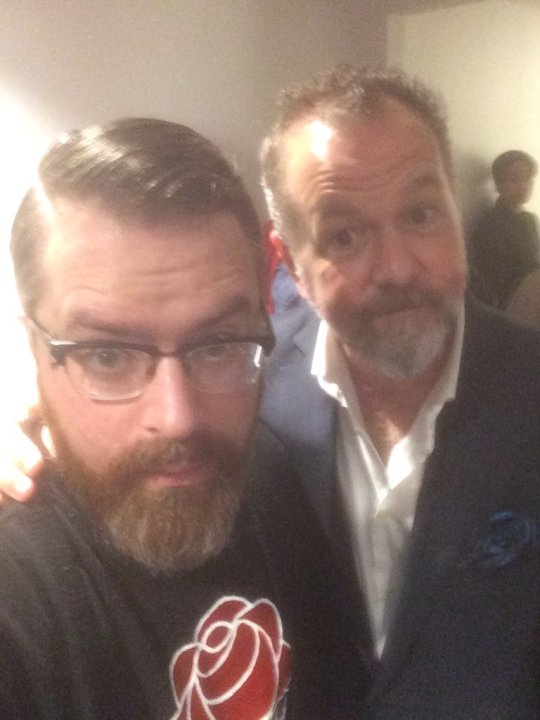
I also met the cast and creators and took a selfie with David Costabile last week. 🙂
“Fargo” thoughts, Season Three, Episode Three: “The Law of Non-Contradiction”
May 8, 2017Hawley tapped John Cameron, a longtime collaborator of both the Coens and their old friend Sam Raimi, to helm one of the series most Coen-esque installments ever, which is really saying something. (Un)comfortably ensconced in Los Angeles rather than the upper midwest, Fargo could really bring its Barton Fink/Big Lewbowski A-game, with some of its most explicit shout-outs and hat-tips yet. For example, the “ring for service” bell that never seems to stop ringing, the shot of Gloria reclining on the beach looking out into the sea, the mysterious shoes and the equally mysterious box, the screening room lit by the hazy light of the projector, Tad’s role as a screenwriter whose success in another medium leads him to get in over his head in Hollywood: That’s that Barton Fink feeling, baby, brought to you by filmmakers who understand the feelings of alienation and insecurity they’re supposed to engender in you, not just by people who are trying to coast on the residual goodwill of previous work with throwaway references.
In some places the allusions seem to fold endlessly into one another — Gloria’s motel simultaneously evokes Barton Fink’s hotel, the motel that figures prominently in No Country for Old Men, and the site of the Sioux Falls Massacre from the show’s previous season — to say nothing of cinema’s ur-motel, run by one Norman Bates and his mother. The emotional resonance here is dense, is what I’m saying; unlike some shows I could mention — fuck it, I mean Stranger Things — it’s designed to last beyond the mere fact of recognition. In other words, to paraphrase Barton Fink, it will show you the life of the mind.
Despite not caring fro two prominent aspects of last week’s Fargo, I liked the overall thing quite a bit, and explained why at Decider. (That cameo from you-know-who!)
“American Gods” thoughts, Season One, Episode One: “The Bone Orchard”
May 4, 2017Will you believe in American Gods? There are two ways to uncover the answer, and fortunately neither involves accepting any deity as your personal lord and savior. The first hinges on how you felt about Hannibal, AG co-creator Bryan Fuller’s spectacularly disgusting, confrontationally beautiful (or is that the other way around?) adaptation of Thomas Harris’s Hannibal Lecter novels. The slow-motion gouts of computer-enhanced arterial spray, the gardens of the dead, the highly symbolic horned-animal imagery — it’s all here, as spectacular as ever under frequent Fuller collaborator David Slade’s sure directorial hand. (Even if Hannibal composer Brian Reitzell’s score works way too hard to sell it to you.)
The second hinges on whether you can stomach characters called Shadow Moon and Mad Sweeney fighting for the pleasure of Mr. Wednesday in a show called American Gods. For fans of Neil Gaiman, the comics writer and novelist from whose book Fuller and co-creator Michael Green adapted the show, this is the sort of modern-fairy-tale whimsy that makes him such a beloved and influential figure. (His work has inspired some comics writers’ entire careers. Hell, it’s inspired some comics publishers’ entire careers.) But if you’re allergic to Gaiman’s “it’s the Magic of Storytelling” schtick, or to the urban-fantasy vibe that this show shares with series like Preacher and True Blood (themselves based on books that are hard to imagine existing without Gaiman), you may be out of luck.