
Posts Tagged ‘reviews’
Comics Time: Multiple Warheads #1
January 9, 2008
Multiple Warheads #1
Oni Press, July 2007
Brandon Graham, writer/artist
48 pages
$5.99
(I hope you’ll pardon me for getting meta for a moment. Normally I think talking about trends when discussing a comic like this is just a substitute for actually discussing the comic, but in this case the meta takes us in a direction my mind’s been wandering in a lot lately anyway.)
I don’t know if it’s fair to credit Scott Pilgrim as throwing wide the doors for projects like these, or if it’s simply the highest-profile such project to pass through said doors regardless of who might have opened them. But at any rate, Multiple Warheads is one of those books like SP that makes you say “hey, this is an exciting time to read comics.” Like a growing number of projects–many from Oni–it’s the product of a North American artist who’s interested in action-based genre storytelling yet has no particular debt to superhero comics, a creature that until recently didn’t exist. In this case the artist is Brandon Graham, and he’s bringing to bear obvious interests in manga, European sci-fi comics, barbarian stories, and porn to create a fast, loose story of a waaaaay post-apocalyptic future where a va-va-voom young lady named Sexica smuggles super-powered organs around a walled-off city inhabited by aliens and werewolves and normal people too. It’s a pretty slight thing. Maybe that’s because the most obvious points of comparison–Scott Pilgrim, East Coast Rising, The Pirates of Coney Island–are all telling book-length stories while Graham’s going done-in-one (and at kind of a hefty price point). Or maybe it’s because the thin line, skewed proportions (everything seems both a bit narrow and a bit bowed), and acres of blank space in the word balloons give the art a tossed-off barely-there feel. Or maybe it’s because the story isn’t really a story per se, it’s more of a “day in the life” kind of thing that simply begins when it begins and ends where it ends, arc schmarc. But the end result of all that slightness is not unpleasant in the, well, slightest. It’s a breezy vibe for a breezy character. Indeed, breeziness is very serious for Sexica, almost a raison d’etre. She wants to go someplace nice, untouched by war, and she’s tried to get there, it seems, through means both intimate (sewing a smuggled wolf dick onto her boyfriend for some extra spark in the sack) and direct (taking advantage of a spaceship crash to get the hell out of Dodge). It’s a laid-back book, almost a stoned book, which makes sense given that Vaughn Bode is evident in Sexica’s every lovingly delineated curve. I enjoyed it, and I’m hoping that future issues will provide some muscular mind-expansion–something along the lines of the beautiful panel that communicates Sexica’s post-coital bliss at being surrounded by the comforts of home with a bed’s-eye-view of the bulbous light fixture on the ceiling above her–to deepen and enrich the pleasures of this installment’s lovely but fleeting buzz.
Comics Time: Batman by Josh Simmons
January 7, 2008
Batman
self-published
Josh Simmons, writer/artist
16 pages
Read it for free at joshuahallsimmons.com
This haunting, completely unauthorized take on Batman begins with what may be the best first panel of a comic I’ve seen in the past year: A crazed jumble of a cityscape whose non-Euclidean geometry resembles something out of The Cabinet of Dr. Caligari threatens to overwhelm the panel borders and spill out all over the reader, while a caption box identifies it, simply and confrontationally, as “Gotham City.” That sets the tone for what follows–a disturbing, uncomfortable response to the Batman concept. What really knocks me out is just how many different levels it works on. It could be a horror comic in about a human monster in the Henry/Buffalo Bill/Leatherface vein. It could be a blackly humorous, satirical pisstake on the Caped Crusader. It could be a vicious assault against the reactionary politics of the superhero. It could be an angry riposte to the ever-grittier direction superhero comics are headed in. It could be an exercise in drawing action and environments. Most amazingly, it could be a great Batman comic, period–Batman’s rooftop and skyscraper milieu is depicted with genuine awe, the physical particulars of his methods are choreographed impeccably (as good as any comic this side of Paul Pope’s Batman Year 100), and the story is totally convincing as an examination of what might happen if Batman, worn down by the weight of years of horror and toil–“I’ve been Batman for a long time,” he repeats–finally snapped. As in his horror graphic novel House, Simmons’ art excels in conveying the way the sheer size of environments both natural and manmade can be frightening, and as his inks shift back and forth from woodcut chunkiness to manic clarity, the effect is practically palpable. The pacing is ruminative but never plodding, lingering just a bit too long, making you feel like something is off but never tipping its hand till the story demands it. Clever bits of business involving Catwoman’s acrobatics and the passing of a nearby plane add pizzaz to an extremely dark affair. Even Simmons’ figures, never his strong suit, have the mitigating factor of masks and costumes working in their favor. And on a meta level, it’s just exciting to watch an artist steal a major corporate icon because he’s got something to say and needs him to say it. This is a hard comic to shake, so thank goodness I have no intentions of trying to do so.
Comics Time: Powr Mastrs Vol. 1
January 4, 2008
Powr Mastrs Vol. 1
PictureBox Inc., November 2007
C.F., writer/artist
120 pages
$18

It might be the jellyfish-on-human double-penetration tentacle-sex scene that makes you realize that this is an adult fantasy comic, but that label, “adult,” is really present throughout this first in a projected series of chronicles of the land of New China. For all that characters like Subra Ptareo may be on a quest and Mosfet Warlock may be a mad scientist, their interlocking stories (so far) don’t read like the genre narratives of my youth beyond their fantastic trappings at all. Instead, they’re stories about buying things and selling things, about twentysomethings (or at least twentysomething analogues) meeting new people and flirting with them, about getting stoned, about fucking and deceiving the people you fuck, about being moved to tears by the realization that you’re actually good at what you’ve chosen to do with your life. Where the fantasy really comes in, for me at least, is in the art. C.F.’s simple, childlike line is reminiscent in affect and effect of Frank Santoro’s in their mutual publisher’s Cold Heat, but while the latter relies on open spaces and canny color choices to evoke the both the supernatural and the mental states akin to it, the former gets it done with detail. The result is always shocking, whether a sudden splash page overripe with flowers and foliage or a doggystyle-eye-view close-up of a tentacle-filled vulva. The word I’m really looking for here is psychedelic, not the cheesily amorphous lowest-common-denominator version but the intense wall-of-sound riot of art-information present in a Moscoso font or the crescendo in the Beatles’ “A Day in the Life.” The combination results in as fecund a playground for the imagination as a far more traditional fantasy story, but arrived at from a totally different direction. It’s inspiring.
Comics Time: Kid Eternity
January 2, 2008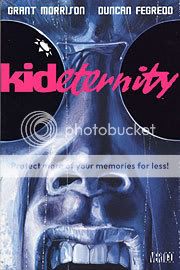
Kid Eternity
DC/Vertigo, February 2006
Grant Morrison, writer
Duncan Fegredo, artist
144 pages
$14.99
So this must be one of those “minor works” I always hear so much about. Collecting the three-issue 1991 Vertigo “reimagining” of some old DC character, Kid Eternity reads like many a current comic really intended as a movie pitch rather than a reading experience: A hapless everyman is inducted by a glib, ubercompetent, superpowered cool dude into the secret truth behind the world as we know it. The pleasures to be had here are in the idiosyncratic details Morrison weaves into this shopworn plot: casting said everyman as an observational stand-up comic (his name, Jerry Sullivan, evokes a Seinfeld with an Irish-Catholic’s hang-ups instead of a Long Island Jew’s); making said secret truth a weird (if familiar) splatterpunk take on Dante’s Inferno; harnessing artist Duncan Fegredo, who currently mimics Mike Mignola in the pages of Hellboy, to the yoke of the world’s lengthiest Dave McKean impression. But the curveballs failed to keep me as too many of the surrounding pitches were predictable and almost half-hearted. Serial killer? Check! Deranged Christian missionary? Check! Crazy lettering? Check! Tarot cards? Big check! Fegredo’s visuals feel similarly lackluster: For every memorably wild vista (his infernal architecture is particularly ambitious) there’s a murky, difficult-to-follow action sequence (I’m still not quite sure what happened in that initial bloodbath), hard-to-distinguish supporting character (I didn’t notice that there were two separate murderous antagonists for Jerry and the Kid until they started attacking one another), or just generally uninspired choice (a would-be mindblower tour of hell is metonymized by a few static stand-alone panels and one image seemingly picked at random to anchor the spread in the background). Morrison’s at his best when his comics either really read like comics (Arkham Asylum, All Star Superman) or look like comics (We3, I dunno, Seven Soldiers), and this comes across as a creature of its era that thinks it’s too cool for school to do either, which it isn’t.
140 things I loved about ‘The Sopranos’
June 10, 2007SPOILERS, obvs.
1. Paulie saying “You’re a general, T!” to Tony when Tony discovers that Paulie had rescued a painted portrait of Tony with his late horse Pie-Oh-My and had Tony repainted into Napoleon.
2. The scene where a suburban family on a trip into the city gets carjacked by a couple of black guys when pulling out of the parking garage, and their dog runs away chasing the car, and the dad yells “Niggers!” and completely shocks his children, and then we cut to Tony smilingly eying a polaroid of the stolen SUV because it ended up in his crime family’s hands.
3. AJ’s suicide attempt, and Tony rescuing him and telling him “It’s alright, baby. It’s alright.”
4. The ducks leaving the pool.
5. Tony asking Dr. Melfi if anything’s wrong after her rape, and her saying “no.”
6. Adriana begging “please” as she struggles to get away from Silvio when he pulls over in the woods to kill her, and Silvio saying “c’mere, you cunt.”
7. Uncle Junior thinking Larry David and his manager on Curb Your Enthusiasm are he and Bobby Baccala.
8. The glow of the wildfire in the window as Moby’s “When It’s Cold I’d Like to Die” plays in the background as “Anthony Soprano” sits on his hotel bed during his coma hallucination sequence.
9. Artie Bucco.
10. Tony and Christopher repeating their reminiscence about the van full of wine they hijacked from the bikers, to diminishing returns.
11. The psychiatrist, never seen before or since, who tells Carmela to take the children and run, not walk, away from Tony immediately.
12. “University.”
13. Bobby Baccala telling Uncle Junior, who’s just decided not to support Richie Aprile’s bid for power against Tony, “I’m in awe of you.”
14. Meadow Soprano’s dance in her underwear for Finn to Bill Laswell and William S. Burroughs’s “Seven Souls.”
15. Carmela’s reaction when Tony’s Russian mistress Irina calls and says “I’m the woman who used to fuck your husband.”
16. The Father Phil storyline.
17. The Vito Spatafore storyline.
18. The use of the music of Andrea Boccelli during the Furio/Carmela storyline.
19. Johnny Sack discovering his wife Ginny binge eating, and his genuine devastation as he says “You lied to me!”
20. The quick cut from the old man who reacts to the Tony-ordered shoot-up of an old brownstone by saying “I told you that crack is some bad shit!”
21. The quick cut from Patsy Parisi reacting to Tony’s big rousing speech about the need for solidarity in the face of Phil Leotardo and Johnny Sack’s vendetta against Tony B. by saying “Thank you, very much.”
22. The proto-mashup of “The Peter Gunn Theme” and “Every Breath You Take” as the FBI tries to bug Tony’s basement.
23. The Kinks’ “Living on a Thin Line.”
24. Afrika Bambaataa and John Lydon’s “World Destruction.”
25. Van Morrison’s “Glad Tidings.”
26. The Rolling Stones’ “Moonlight Mile.”
27. The word-by-word shots of the passages in the study Dr. Melfi’s reading that explain how sociopaths con their therapists, particularly through their sympathy for babies and animals.
28. Vito Spatafore’s interior monologue countdown to his lunch break as he tries to do an honest day’s work on the farm.
29. The look on Tony B.’s dead face.
30. Adriana throwing up all over the table at the FBI office.
31. Burt Gervasi’s terrier barking as Silvio kills him.
32. The hapless landscaper forced into indentured servitude along with his college-kid son thanks to the war between Paulie Walnuts and Feech LaManna.
33. Idiotic Little Carmine actually making the right decision pretty much every time he makes a decision.
34. The fact that Bobby Baccala and Johnny Sack evolved from bit parts into main characters.
35. Gloria Trillo gasping “Kill me! Kill me!”
36. “You shot me in the foot!” “It happens.”
37. The loser in the band that Chris and Adriana are producing shitting all over the Beatles for being so predictable and boring.
38. Hesh dating African-American women exclusively.
39. Uncle Junior crying when Tony asks him if he ever loved him.
40. Finn falling asleep during the marathon argument with Meadow that ends with him proposing to her.
41. The ghostly silhouette of Livia at the Inn at the Oaks during Tony’s coma-hallucination.
42. The name Kevin Finnerty.
43. Phil Leotardo coming out of the closet in Vito’s hotel room.
44. The look on Feech’s face on the bus back to prison.
45. The waiter who Chris and Paulie murder in the parking lot after stiffing him on the tip.
46. The motorcyclist who gets run over during the hit on Silvio and Patsy.
47. The kids crying during the hit on Bobby.
48. “Daddy, they shot me!”
49. Detective Markasian honking and yelling at the traffic on his way to commit suicide.
50. Detective Markasian putting his badge on just before he commits suicide.
51. Eugene Pontecorvo hanging himself.
52. Vito’s son taking a shit in the shower.
53. Ralph Cifaretto yelling “I did nnnnnot! But so what?”
54. Agent Harris.
55. Bobby Baccala.
56. The homeless woman with the Daily News stuffed up her ass.
57. Tony curbing Coco.
58. Bobby telling the jury foreman that if he were to convict a man like Junior Soprano, he’d want to put a bullet in his head here, here, and here.
59. Matthew Bevilaqua/Drinkwater.
60. Phil Leotardo saying “No more, Butchie. No more.”
61. JT Dolan telling Christopher “You’re in the Mafia.”
62. Johnny and Ginny Sack’s obviously anorexic daughter exasperatedly demanding “Can this family talk about anything but food?”
63. Johnny crying as they drag him back to prison at his daughter’s wedding.
64. Big Pussy asking Tony if it’s alright to sit down before they kill him.
65. Uncle Junior’s mistress sobbing and screaming “Corrado! Corrado!” after he hits her in the face with the pie and walks out on her.
66. Uncle Junior crying after he hits her in the face with the pie and walks out on her.
67. “The Test Dream.”
68. “It’s all a big nothing.”
69. “Everything turns to shit.”
70. Caitlin, Meadow’s depressed freshman-year roommate.
71. Finn looking over and seeing Vito pop up from blowing the security guard.
72. Furio’s rampage in the massage parlor.
73. Kennedy and Heidi.
74. Sil, Bobby, and Tony shadowboxing when the music from Raging Bull starts playing in the restaurant where they’re discussing going to war against Phil.
75. Bobby’s death scene.
76. Paulie killing his mother’s friend.
77. Adriana talking about how nice it is that Matush is sending money back to fund schools for boys in Pakistan.
78. Big Pussy bragging about going down on his Dominican mistress, and Tony asking “Hey Puss–did she really even exist?”
79. Tracee brining Tony baked goods while topless, with a smile full of braces.
80. All the malapropisms, from “my knight in white satin armor” to “irregardless” to “at the precipice of a crossroad” to “prostate with grief” to “mayham.”
81. Janice’s Rolling Stones tattoo.
82. The dream version of Detective Makasian sining “Three Times a Lady” to Annette Benning.
83. Tony beating the shit out of his driver just to show he’s still got it.
84. The Scautino bust-out.
85. Big Pussy running over the cyclist as he attempts to tail another gangster on behalf of his FBI contacts.
86. The dream-fish Big Pussy telling Tony that his fellow fish are asleep.
87. Carmela’s speech to comatose Tony in the hospital.
88. Tony punching through the wall during the big fight with Carmela.
89. “It’s just that ‘remember when’ is the lowest form of conversation.”
90. Dumping the asbestos in the middle of nowhere.
91. Livia smiling as they wheel her away from Tony.
92. The murder of naked Lorraine.
93. Tony having sex with Charmaine Bucco as Artie cheers them on in a dream.
94. The pervasive racism.
95. Tony B. zooming in on Carmela’s ass as he videotapes their pool party.
96. “Cunnilingus and psychiatry brought us to this.”
97. The whole series from “University” onwards.
98. “In the end, you die in your own arms.”
99. The opening credits.
100. The fact that we knew Tony’s captain Ray Curto was wearing a wire for like two seasons, but because he wasn’t a main character no one paid any attention to it and focused on Adriana instead, and then when they finally brought it up again he had a heart attack and died in the FBI agent’s car.
101. Carmela’s philistinism.
102. AJ giving the bike to the hoodlums outside Blanca’s apartment.
103. AJ’s therapist asking him why he’s depressed, and him responding “How could anyone not be?”
104. “I get it! I get it!”
105. The look in Tony’s eyes as he kills Christopher.
106. “Fucking D-girl!” “Hey! I am a vice-president!”
107. Johnny Boy Soprano’s mistress singing “Happy Birthday, Mr. President” to Tony.
108. Ralphie’s “collegiate” look.
109. “You let him hold a gun to your head during sex?” “It’s not like it’s loaded.”
110. Dr. Elliot Kupferberg.
111. “Fuck Ben Kingsley! Danny Baldwin just took him to acting school!”
112. Cosette.
113. Paulie asking Big Pussy in his dream “When my time comes, will I stand up?”
114. The handheld camera during “Chasing It.”
115. The rocking of the boat during Tony and Paulie’s fishing trip.
116. The Tindersticks’ “Tiny Tears.”
117. The episode that used a song from Aphex Twin’s Selected Ambient Works Vol. II over the closing credits.
118. Ralphie running across the yard after his son gets shot in the head with the arrow.
119. Chris explaining his tardiness to a meeting: “Sorry, T–the highway was jammed with broken heroes on a last-chance power drive.”
120. The fact that Frank Vincent was on the show.
121. Melfi reverse-Godfathering Tony by closing the door on him.
122. Bobby refusing to defrost his late wife’s last meal.
123. Tony goading Janice to break her anger-management routine just because.
124. Ralphie’s Gladiator obsession.
125. The art direction for the promo materials from Season Two onwards.
126. Calling the last episode “Made in America.”
127. Playing that commercial with Abe Lincoln and the talking beaver in the mental ward where AJ is institutionalized.
128. Hesh’s description of Livia: “Between her brain and her mouth, there was no interlocutor.”
129. Tony Soprano.
130. “Poor you.”
131. Butchie accidentally wandering from Little Italy into Chinatown as he wraps up his phonecall to end the war.
132. Agent Harris: “We’re gonna win this thing!”
133. Phil gootchie-gootchie-gooing his twin grandbabies at the gas station.
134. The guy who pukes when the SUV rolls over Phil’s head.
135. Meadow telling Tony how the government and FBI discriminate against Italian Americans, and Tony replying, “Well…”
136. Meadow parallel parking.
137. The man in the Members Only jacket.
138. “Don’t Stop Believin’.”
139. “Don’t stop—”
140. Cut to black.
Slightly Less Behind the Curve but Still Not Quite Caught Up Theater, with your host Sean Collins, part the third
July 1, 2005Today’s installment: Batman Begins, directed by Christopher Nolan. Shhhh, don’t tell anybody we talked.
I unloaded about this movie on a message board right after I saw it. (I barely saw the whole thing–I came as close to walking out on it as I have on any movie since The Thin Red Line. I’ve since mellowed about it somewhat–the acting was terrific, and I appreciate the characterization of Batman as someone to be scared of–but they made such a hash out of virtually everything else that I’ve sort of de-mellowed and come to really resent the movie again.) Here’s my litany:
—–
Rutger Hauer to Morgan Freeman: “Go get all those papers and disks and data and put them on my desk right now. Also, you’re fired.” Because THAT makes sense.
I also LOVED how Alfred’s FIRST GUESS about what Master Bruce was talking about in terms of becoming a “terrifying symbol” against crime was that he was going to adopt a second persona. Because that would have totally been my first instinct too. I mean, doesn’t everybody assume that people who go missing for seven years and end up being broken out of a Himalayan prison by a death cult then come back and start talking about how they’re going to strike terror into the hearts of their enemies want to dress up in a costume and fight crime?
Haphazard, murkily edited fight scenes with drearily boring fight choreography. This is the era of Kill Bill, House of Flying Daggers, The Matrix–if you’re going to make a big deal out of your protagonist’s martial-arts training, at least make it look impressive.
Can we please have ONE comic book movie that doesn’t hinge on some big, dopey, nebulously powered sci-fi device that’s going to destroy the city? X-Men, Spider-Man 2, now this–enough.
Scarecrow, one of the film’s two major villains, was dispatched by a supporting character simply by shooting him in the face with a taser. He then gets carried off screen on a spooked horse. Wow, what a climax.
Speaking of boring and pointless Scarecrow scenes, his first confrontation with Batman lasted approximately 5 seconds before Batman got his ass handed to him. By a psychiatrist who looks like he weighs about 98 pounds.
Also, Batman’s costume is bulletproof and can withstand direct electrical currents, but it burns like polyester.
Batman’s cowl and mask are really dopey looking. The ears are too small and curve inward—they’re not intimidating. The mask curves down too low on his face and makes his chin look fat.
God knows I love Christian Bale but except for the scene where he’s interrogating the crooked cop, his Batman voice was awful, like the world’s worst Clint Eastwood impersonator.
Scenes just collide one on top of the other with no through line, no sense of transition, seemingly no logic. Characters are introduced with no build-up and no sense of pacing or timing. Bam! It’s Morgan Freeman! Bam! It’s Dr. Jonathan Crane! Bam! It’s Liam Neeson!
Katie Holmes supposedly ingests a fatal dose of fear toxin, yet she’s still coherent enough to listen to Batman’s calming instructions as he drives her around town.
That was the most boring car chase scene ever, btw. Nothing at stake—for all the jive about how Katie Holmes was gonna die, she seemed fine, no more freaked out than any normal person would be if a man in a Bat costume was driving them through the downtown of a major city at 200mph with a squad of cops chasing them)—no interesting or genuinely evil antagonists, just a bunch of thoroughly outclassed cops.
For someone who (in this version at least) is completely pathological about all crime, Batman sure doesn’t mind causing millions of dollars in property damage, does he?
“Not saving someone” and “killing someone,” in the circumstances shown in the film, are the exact same thing. That’s a truly retarded bit of fanboy morality.
“I’m not an executioner. Therefore I’m going to burn down your monastery, killing you, dozens of your henchmen, and most likely the very criminal I’m currently refusing to execute.”
“Hello, I’m a random employee of the water system, introduced during the climax of the movie simply to explain what’s going on, because I guess it’s impossible to have Morgan Freeman serve this function for some reason. Anyway, if that pressure-raising device that’s currently following the monorail above the water main gets back to this central processing plant in which I am speaking, the whole system will blow! Everybody in the audience get that? No? Okay, I’ll repeated it two minutes later!”
Not only did Batman not stop the Scarecrow, leaving it to a supporting player, he didn’t stop the subway either—he left that to another supporting player, Jim Gordon. I don’t know why it’s so hard for filmmakers to realize that the big climax of your movie should feature YOUR HEROES TAKING AN ACTIVE ROLE IN BRINGING THINGS TO THAT CLIMAX AND SOLVING THE CLIMACTIC PROBLEM. Ahem, Wachowski Brothers in The Matrix Revolutions, ahem ahem.
I’m just wondering if anyone else picked up on the fact that the theme of the film was fear? Because I don’t think they made it clear enough when EVEN BEFORE THEY INTRODUCED THE FREAKING SCARECROW they used the word fear or afraid or scared or terror or some variation thereof about six dozen times. Yes, that’s part of what Batman’s about, but it’s not ALL he’s about. Give it a goddamn rest already with the fear.
ANYONE who complained about stiff dialogue in the Star Wars prequels but didn’t complain about it here should have their Complaining License revoked. At least in the SWprequels it made some sort of sense—it was all in this sort of faux-Shakesperean milieu. Here, on the other hand, the filmmakers brag and brag about how real-world this version of Batman is, and they’re all speaking in the most unbelievably wooden shitty hackwork Batman-comic-from-1993 self-serious fashion imaginable. “How long are you planning on staying in Gotham, Master Bruce?” “As long as it takes. I want my enemies to feel my dread.” Good Lord. Rachel’s constant little speeches–“The good people do nothing, blah blah blah”–are almost unlistenably bad. And don’t even get me started on Thomas Wayne’s Basil Exposition imitation on the monorail into the city.
There’s no theme music. WTF? How can you have a Batman movie with no theme music?
This is difficult to articulate, but every character seems to display a totally unearned level of familiarity with every other character. Not thirty seconds after Bruce is introduced to the concept that Falcone runs the city, he’s sitting across from Falcone facing him down, and Falcone knows exactly who he is and is lecturing him on his psychological shortcomings. Alfred has seen Bruce for all of a few hours in seven years and he’s instantly simpatico with Bruce’s desire to become a costumed vigilante. About a minute after he meets Ducard he’s ready to climb the Himalayas to meet a total stranger. This is such unbelievably lazy writing.
Apparently two minutes is enough time for every last socialite to clear out of Wayne Manor, for their limo drivers to pull into the driveway and pick them up, and for them to get completely clear of the grounds before Ra’s al-Ghul’s thugs burn it down.
Holy moses did the jokes seem out of place and out of character! “Excuse me,” he says to the criminally insane inmates as he blasts a hole out of their cell and into the streets? Argh. Lines like that worked in the first movie, but not here.
Not to mention the fact that Batman essentially does what Ra’s and the Scarecrow do later on, which is let inmates out of Arkham Asylum.
Alfred’s near tears when he discovers that Bruce wants to tear down Wayne Manor, but then later when it actually gets destroyed he’s all “ah, no big whoop.”
“Your nice personality is just a mask. The man I loved never came back, Bruce, and I will only love you if that changes. So now let’s hold hands while I tell you how proud I am of you. Because that makes sense.”
The only character with any emotional depth is the guy who killed the Waynes, who at his parole hearing seems genuinely contrite, and therefore calls into question the notion, drilled home again and again, that compassion for criminals is a weakness. Though given the rest of the film that was probably a mistake on the filmmakers’ part rather than a conscious choice.
Speaking of which, our hero received all his training and indoctrination from what turns out to be an al Qaeda style terrorist network led by a madman. Just saying “I’m not like you guys” but then acting like them in every way save the use of lethal force (most of the time) does not exactly inspire confidence in our hero’s motive or methods.
Before he gets his Bat costume he breaks into Gordon’s office (which is stupid—once he’s decided he’s going to use a costume, he should use the Bat costume and the Bat costume only; only if he seized on the Bat as inspiration AFTER beginning his vigilante career would it make sense for him to ever go out without it) and has this whole coversation about what it would take to bring down Falcone—put pressure on the crooked judge, rely on Rachel the uncorrupt DA, etc. So what happens? He beats up Falcone at a drug buy that THE BOSS OF ORGANIZED CRIME IN GOTHAM CITY IS INEXPLICABLY ATTENDING PERSONALLY and ties him to a spotlight. I guess that’ll work too, but why bother with the meticulous explanation of what it’ll take to stop him if you’re not going to do a damn thing with it?
If you’re going to steal from Frank Miller—falling down the hole and discovering the bats, calling all the bats to help escape from a swat team, etc.–why not steal his greatest contribution to the Batman origin story and have a wounded, don’t know what to do with himself Bruce Wayne be inspired to become Batman by a giant bat that comes crashing through the picture window of Wayne Manor? Instead he’s just happily putting together his tech and is like “Oh yeah, I think bats are scary, why don’t I dress up like that.”
Also, if you’re going to have him talk in overly formal pronunciations all the time, why not actually go the whole hog and have him give the “Criminals are a superstitious, cowardly lot…I shall become a bat” speech?
The “What are you?” “I’m Batman” exchange made sense in the first movie because the guy asking “What are you?” had just seen a giant bat creature materialize out of nowhere, kick his partner’s ass, take bullets square in the chest and keep coming. It does NOT make sense here because Falcone hadn’t seen Batman AT ALL yet.
Those were sure some boring, non-scary “scary” hallucinations at the end there, huh?
That’s all for now, man. I’m spent.
—–
In retrospect I could get around a LOT of that if it weren’t for the fact that they made this HUGE deal out of the “I’m not an executioner” thing but then had him wipe out half the League of Shadows AND presumably the handcuffed prisoner too, and behave INCREDIBLY recklessly during that pointless thrillless car chase in which he was running policemen off the road, running over their cars, etc. All the smarts of developing Batman as this terrifying yet fundamentally just force went right out the goddamn window the second he ran over his first cop car and later on bragged about it to Alfred.
I’ll admit that Batman is the one character in superhero comics I’m a fanboy about (not in the icky, “Don’t call him Bats–that’s disrespectful” kinda way; I just really like the character), so I probably saw the film with a set of expectations that could only be completely fulfilled if I myself made the movie; but there you have it. It’s driving me nuts that people think this film did a good job, because the franchise is going to be continued by people who are saying to themselves “See, we really NAILED it there!” Me and my memories of how great Tim Burton’s first Batman movie was will be over here in the corner, brooding.
Dan, just admit it… (or: a spoiler-filled analysis of Eightball #23)
June 29, 2004Foreword: Petty patronizing hyperbole aside, my pal Milo’s recent posts on the preponderance of superhero-centric writing in the comics blogosphere has had at least one positive effect: convincing me to get off my duff and blog more often about alternative/art comics. But the altcomic that I’d like to talk about today also happens to be a superhero comic. Dramatic irony, or poetic justice–you make the call! Also, SPOILER ALERT.

Eightball #23
Daniel Clowes
44 pages, full color, $7.00
Fantagraphics
Okay. When I said Daniel Clowes’s new comic, Eightball #23: The Death-Ray was a superhero comic, I was exaggerating a bit. Oh, sure, it’s an explicit response to the genre–a critique, even–but it properly belongs to another maligned type of genre fiction: the serial killer narrative. The superhero trappings throughout this pitch-black work provide an easy in for discussion, not to mention one of Clowes’s trademark meta-references to the history and ephemera of the medium in which he is so alarmingly proficient, but in the end The Death-Ray is about superheroes in the same way that The Silence of the Lambs is about psychiatrists. The professional inspiration of the killer is interesting, but it’s the fact, the existence, of unflinching, unreflective evil that’s the point.
The Death-Ray‘s protagonist is Andy, to whom we are introduced when he’s a twice-divorced middle-aged dog owner, but whom we mostly follow during his years in high school. (In fact, we’re not even sure we’re following the same guy, at least initially; I had to go back and reread the opening high-school sequence (“The Origin of Andy”) before I realized that the brown-haired, skinny kid in it was, in fact, not a girl.) Andy is a quiet, nondescript kid of no discernible social strata in his school, whose only friend is bespectacled, somewhat arrogant crypto-Nietzschean student named Louie. Raised by his aging and ailing grandfather following the deaths of his father, mother, and grandmother, Andy discovers upon smoking a cigarette (one he initially thought must have been laced with PCP) that he gains superhuman strength with the introduction of nicotine into his bloodstream. A letter addressed to him from his late scientist father explains that this incredible power is a result of an experimental hormone he treated Andy with during his childhood. It also reveals the existence of another experimental weapon: A yellow gun resembling a science-fiction blowdryer, that fires something referred to by Andy’s dad as a death-ray. We soon learn that when Andy (and only Andy) pulls the death-ray’s trigger, whatever he aims it at is erased from the face of the Earth. With the advice and encouragement of Louie (who, following a trip to New York City, has become enraptured with the exhibitionistically angry punk movement), Andy sets about finding a way to use his newfound powers for good, in pursuit of the “something big” for which he feels his tragedy-laden life has destined him.
And oh, geez, where to go from there. Eightball #23, like its predecessor #22 (Ice Haven), is a staggeringly rich and dense work. Like #22, #23 is divided into numerous subsections of varying artistic styles, each with its own old-fashioned sub-title. Unlike #22, though, #23’s subsections would be difficult to understand if read on their own; the individual titles are less a mechanism of the paradigmatic writing method involved in the previous issue (in which individual vignettes about various characters cohered to tell an overall story, a la Altman) and more a convenient method of simultaneously transitioning from one scene to another, setting up and/or commenting on the scene at hand, and tying the entire work back to the superhero and melodrama genres with which Clowes is constructing his new work.
Primarily drawn in a slightly looser, sketchier style than is customary for Clowes, the art of The Death-Ray conveys a sense of terrible urgency, as though this was a story Clowes felt he had to tell as soon as possible. (This despite the two-year gap between issues—it sure doesn’t feel like it’s been that long.) Switches between one style and another are not done with the rigorous regularity of #22; there’s less of a sense of “I’m aiming for something different with this section” and more of “this is just the most efficient way for me to keep the story going at this clip.”
The primacy of the need to get this story out is reinforced within the narrative itself by the way Clowes has Andy, the book’s narrator and in almost every scene its focal character, tell us the story. Rather than using traditional thought balloons or thought caption boxes, Andy’s thoughts and narration are contained in actual word balloons. There is a slight difference between the balloons that contain narration/interior monologue and the balloons that contain actual—the former are slightly rectangular, the latter have the usual rounded shape—but the overall effect is that wherever Andy goes, whatever Andy does, his personal view of the world is not just inescapable but dominant. It’s a brilliantly evocative technique, familiar to any reader who’s ever gone through the motions of interaction with others yet spent the whole time in his or her own head. (As Andy puts it, not of his way of thinking but of his use of his superpowers, “somebody has to impose some kind of structure on the world, I guess. Otherwise everything would just fall apart, wouldn’t it?”)
Andy, then, is very much the star of his own movie. That is also one of the themes of the book: The degree to which pop culture molds individuals’ expectations of themselves. Andy’s adoption (largely at Louie’s behest) of a superhero’s costume and vigilante techniques make next to no sense given Andy’s actual life experience, even given the incredible introduction of superpowers into it; after all, Andy surmises that his father simply intended for his son to become as strong as the athletic kids in his grade and “turn myself into the most popular kid in school.” It’s the boys’ exposure to funnybooks and, one assumes, the Batman TV show, that convinces them to use Andy’s super-strength and death-ray to fight crime, such as it is. The multiple sub-titles that Clowes assigns various sections of the book—”ON PATROL,” “THE FURTHER ADVENTURES OF THE DEATH-RAY,” “THE LAST STRAW”—further drive home the artificially constructed nature of Andy’s self-perception. Moreover, the occasional sequence depicts Andy and Louie swinging along city rooftops and battling crooks in the traditional superhero manner, even as they themselves continue discussing the far more quotidian battles in which they’re engaged. (The occasional “Right again, old chum!” is thrown in, but only to demonstrate the depths of the budding psychosis; we know that this was not spoken aloud, but it’s no less an accurate depiction of Andy’s mindset for that.) And it’s not just mass, mainstream culture that’s to blame, by the way. Louie’s cookie-cutter punk outlook is as much a catalyst in the terrible events that follow as is the boys’ familiarity with superhero tropes, since it gives Louie’s preexisting contempt for nearly everybody a cultural framework in which to thrive. Punk does little more for Louie than providing him an avenue to get laid, making him a bigger asshole than he already was, and giving him an excuse to pick fights—which he then cites as proof that other people are assholes who deserve what they get.
Indeed, the real problem besetting Andy and his supposed sidekick is the arbitrariness of their actions in combating crime and bad people. Simply put, the disconnect between the crimes committed and the punishment Andy and Louie dish out is so great that the act of punishment itself becomes meaningless. Andy and Louie use a discarded wallet as bait, then bully the impoverished man who picks it up, committing a “crime” that couldn’t even have occurred without the boys’ intervention. Andy roughs up a couple of burglars who he spies running off with an old man’s TV set, but even before he catches up with and knocks the snot out of them, they’ve dropped the TV, destroying it; it’s clear from the old man’s expression that he can’t afford to buy another. A girl Louie has the hots for gets smacked around by her father; Louie and Andy beat the man, but do so as he’s walking the girl’s beloved dog, who runs away, thus making her even more upset. Louie constantly tries to persuade Andy to have at a high-school meathead named Stoob with whom Louie has a long-standing and incredibly stupid grudge; it gets to the point where Louie lies on the sidewalk motionless in front of Stoob in hopes that the kid will kick him, in order to “prove” that Stoob deserves to die. In a sequence that quietly hits home for the grown-up Andy, a bartender is rude to a man who’s drinking because his grandmother died that day; Andy subsequently beats the oblivious barkeep to a bloody pulp. The beginning of the end for Andy and Louie occurs when Louie’s resentment toward his sister Teresa’s drug-dealing boyfriend leads the boys to indulge Teresa’s ex’s semi-veiled request to take the man out permanently. As Louie, abuzz with newfound moral qualms, puts it to Andy after the event, “You know, C.J. was an asshole, but he didn’t deserve to die. You didn’t even know the guy.” This from the kid who came up with the whole idea in the first place, as Andy immediately points out to himself. Louie may have had enough, but by now Andy is too far gone, too attached to the notion that he finally has the ability to “impose structure on the world,” to stop.
So at last we come to the heart of Eightball #23’s darkness: We’re witnessing the birth of a serial killer. Murder has never been far from the surface of Clowes’s work—with the exception of Ghost World, all his major works have contained violence or the threat of violence—but this is his most thorough (and not coincidentally his bleakest) examination of the subject to date.
The day before I bought this comic, I used my employee discount to pick up Michael Newton’s The Encyclopedia of Serial Killers. In it, Newton quotes a jailhouse monologue from prolific serial murderer Henry Lee Lucas:
It’s a damn shame about people, it really is. We are surely the ugliest creatures in all of nature. Look at you: What have you ever done? What gives you the confidence to sit there with a smirk on your face like you’re better than me? You think anybody cares about you? Guess what—they don’t. You can lie to yourself all you want, but the rest of us are wise to your scam. You should have been an abortion or sold into slavery. Who gave you the right to take up space in my world? I’ve never done anything to anyone they didn’t deserve. My justice is nothing if not merciful. Does that mean I’m soft? Hell no. You think I’m afraid to erase you from the landscape? Look, I know what you’re thinking. Hell, maybe you’re right. It’s a lot of responsibility, but I’m not one to complain. I’ve got a job to do like everyone else. Who am I? Your worst nightmare.
Chilling, horrifying…and fictional. That wasn’t Lucas at all, but our hero Andy, toward the end of the book, in one of the strongest sequences Clowes has yet created. Throughout this grotesque monologue the present-day, middle-aged Andy’s “mask of sanity” remains intact: He returns from the grocery store, puts away his food, strolls over to his closet, reaches inside, walks up to his apartment building’s roof, surveys the green below him, eats his TV dinner. It’s only just now, after several readings of the book, that I’m realizing that the thing he reaches into his closet to grab is the death-ray, that his talk about “eras[ing] you from the landscape” is no idle chatter, that the bell-shaped silhouette in the eighth panel of this sequence is not the doorknob to Andy’s apartment but the muzzle of the death-ray as outlined against the evening sky, and that the man sitting on a park bench below Andy (the appearance of whom made me nervous, in a Charles Whitman-referencing sort of way, but little more) has just become his next victim. The insipid banality of the Rambo quote that ends the passage merely heightens the horror: Andy has no real insight into why he does what he does beyond the cheesy vigilante morality of Hollywood.
And this momentous act is not the only one that happens in a caesura. At the end of the book we see a partial line-up of Andy’s victims, answering the section’s sub-title’s question, “Why did Andy destroy you?” We learn that the two divorces Andy has spoken of having were caused by men with whom Andy’s wives cheated, men who Andy then murdered. We learn that a brief conversation between the teenaged Andy and his housekeeper, in which the housekeeper implied that her daughter had been taking drugs, led to the execution of a man whose crime was nothing more than selling the daughter some weed. In the same way that the disturbing crime at the heart of Eightball #22, as well as its resolution, took place between the panels, so too do many of the killings in #23. It’s as though, to our central character, they’re hardly worth mentioning—the events he does choose to depict are assumed to be explanation enough. Given the circumstances, Andy seems to suggest, any one of you would have done the same.
As with nearly all serial killers, sex is a key component of the killings, although not as obviously as with some. Most serial murderers hunt within the gender to which they are sexually attracted (as an aside, this gives lie to the notion that The Silence of the Lambs is homophobic: Buffalo Bill is not gay at all, but a woman-hater whose transsexualism is intended as a mockery of both homosexuals and women; we even see Polaroids of the guy with strippers at one point). This is not the case with Andy, as near as we can tell’he maintains an idealized long-distance relationship with his “girlfriend,” Dusty (“I hadn’t stopped loving her—and still haven’t to this day, come to think of it,” he says 24 years later, though once again this is likely just an attempt to assign meaning to a life where none has truly existed). But he displays true, romantic feelings (which it nonetheless appears he is trying to hide from the reader; he never describes them to us, and the one time he does address them directly in the context of a dream about having sex with her, he talks to her (“you”) directly) toward his African-American housekeeper. Clowes clearly wants us to see this attachment as an integral part of what makes Andy into what he becomes. The key sequence in which Andy discovers the truth about his superhuman inheritance from his father, “THE ORIGIN OF THE DEATH-RAY,” begins with two panels of disembodied sexual dialogue (“Fuck me, Andy!” “Yeah, baby—that’s it!”), and eventually includes yet another (“Oh Andy, you fuck me so good!”). It’s not until two-panel daydream sequence pages later that we learn the idenity of speaker: Dinah, the housekeeper who keeps the place from falling apart as Andy’s Pappy becomes more infirm. Andy eventually makes his feelings for Dinah clear to her by attempting a kiss; by the very next panel, she’s gone, and the placement of this sequence just before the most traumatic one in the book implies a causal relationship between Andy’s actions in the former and his actions in the latter.
Similar goals influence Louie’s behavior. Right after a scene in which he and Andy discuss their lack of superheroic motivation (“Look at the Hulk—his wife died, or something”), Louie spots the girl on the basis of his crush on whom he and Andy would later assault her father. It’s Louie’s later discovery of a pretty punkette that leads to the moral conversion that catastrophically unravels his relationship with Andy. (Yes, the “one friend in the world” the grown-up Andy refers to is not Louie, to our surprise.) Moreover, nearly all of the victims of Andy we know of have some sexual connection to him, whether they’re the men who ‘fucked his wives” or the dealer who sold grass to his beloved housekeeper’s daughter. And finally, of course, there’s the unspoken sexual dimension of Andy and Louie’s relationship itself. Paired killers are not at all uncommon, from the Hillside Stranglers to Henry Lee Lucas and Ottis Toole, and often the killings serve to consummate the sexual tension that the killers themselves aren’t (or, sometimes, are) willing to consummate themselves. It’s no coincidence that, just before Andy and Louie’s traumatic “break-up,” Louie seems to have found an actual girlfriend and Andy has finally acted on his love for Dinah. The two don’t need each other anymore. (It’s also no coincidence that the one scene we see without the interceding viewpoint of Andy is of a weepy Sonny, Louie’s sister’s lovelorn ex-boyfriend and the man whose desire to win her back sets the ultimate breakdown between Andy and Louie in motion. In the world of serial murder, love and death are inseparable.)
Of course, Clowes’s usual pitch-black insights into the human condition are omnipresent. Whether it’s Pappy’s cri de coeur (“Oh God, why can’t I remember things?”) and his inability to recall that his wife Sarah has died (“Dear S” reads his unfinished letter to her); Andy’s “girlfriend” Dusty’s tragicomic pose with a garden hose, using it as a microphone, lipsyncing to the radio with braces on her teeth; carrot-topped Stoob’s sensitive acoustic-guitar wooing of a pretty girl; Louie’s pre-NYC assessment of punk music (“You like this?” “I dunno…I think so. It makes me want to kill somebody.”); the fact that the mechanism Andy’s dad chose to activate his latent superpowers will likely give him lung cancer….You’ve got to laugh to keep from crying. It all culminates Andy’s closing address to the reader, delivered on what we assume is the Fourth of July after a run-in with a grown-up Stoob (you can insert the de rigeur “It’s about Iraq!!!” reading here, if you absolutely must):
He couldn’t fool me. Underneath it all, he was still the same guy. Nobody ever changes.
That’s not to say that everybody’s an asshole. I know better than that. Hell, you’re probably a decent person yourself. There are plenty of you out there.
For you, Mr. and Mrs. Decent Citizen, I’ll do anything. Just say the word.
You’ve got a friend in old Andy.
Of course, we don’t. But in the same way that Andy’s thoughts superimpose themselves against the events of his life, it’s Andy’s view of The Way Things Are, not ours that has the final say. Andy’s among us, and we’re his one friend in the world. Maybe he is our worst nightmare, after all.