
Posts Tagged ‘reviews’
Comics Time: “2001”
February 18, 2011
“2001”
Blaise Larmee, writer/artist
self-published on the web, January 2011-
Read it at BlaiseLarmee.com
What a thrilling comic. It’s worth noting, I suppose, that the white-on-black presentation of Blaise Larmee’s gorgeous webcomic “2001” largely removes Larmee’s work from the pencil-smudged, fragile-lines-on-white, Darger/CF context in which it’s previously been located. But far more interesting to me than how the comic operates versus Larmee’s other stuff is how it operates in and of itself. The vastness of the full-bleed images, the fact that they occupy the entire page, the way the starfield/snowfall background is a big black nothing that appears to isolate the characters in infinity, is immediately impactful, even awe-inspiring, maybe the most striking use of the webcomic medium I’ve ever seen. Now that enough pages have accrued, however, we discover that Larmee isn’t just tracking bodies in space, but bodies in a particular space. The big geometric planes of white and black that interrupt the snow/stars, we can now tell, are a building or structure of some sort — the white its roof, the black its walls — around which our two heroines twirl and leap and walk and peek. Storywise, there’s not much more to it at the moment, beyond some almost Bendisesque cute dialogue about how “very May ’68” the place is and how they’ve got tea but want coffee instead. But there needn’t be more to it than what there is: An innovative, arresting, and beautiful way to arrange movement on a comics page, and to arrange a comics page, period.
Comics Time: “Flash Roughs/In a Hole: Jul-Aug 2010”
February 16, 2011
“Flash Roughs/In a Hole: Jul-Aug 2010”
Matt Seneca, writer/artist
self-published on the web, February 2011
52 pages
Read it at Death to the Universe
Talkin’ ’bout his g-g-g-g-generation. When he’s not making comics, Matt Seneca is best known as a promising new critic of the things, one of the very few who have emerged on the internet over the past few years who engage with alternative and art comics with any regularity. He does this in post-post-post fashion. For starters, he’s part of the first wave of post-Comics Comics critics. Dan Nadel, Tim Hodler, and Frank Santoro could take the work done by Gary Groth and The Comics Journal in carving out a critical space for comics of genuine literary ambition and execution as read, enabling them to eschew the Journal‘s then-necessary ruthless aesthetic elitism and reclaim genre comics as a valid and fecund field for criticism. (At its best, the young comics blogosphere — and its print funnel, Dirk Deppey’s Comics Journal — did some of this work too, especially the inestimable Joe McCulloch, but I think the Nadel braintrust, through its multiple venues (CC, PictureBox, The Ganzfeld, Art Out of Time), really put it over the top.) In turn, Seneca exists in a world where the Journal‘s distinctions are a pretty distant memory, a world where in the wake of the CC crew’s rehabilitation project, genre work of whatever sort can be unhesitatingly and unashamedly examined with all the close-reading intensity and epiphanic emotion anyone ever brought to “The Death of Speedy Ortiz.” Seneca is also probably several years deep into the post-Internet cohort, a group that never saw print as the primary outlet for criticism or goal of its writers, a group that didn’t exist even five years ago. As such, personal critical interests, obsessions, and conundrums can be pursued with a length and an idiosyncratic focus unthinkable to any primarily-print writer (Kent Worcester excepted). Finally, he’s post-Tucker Stone/Mindless Ones/Noah Berlatsky, the performance-art superstars of Internet comics criticism. Though each of these writers (or group of writers in the Mindless Ones’ case) is very different, each embraces a style of writing and an approach to criticism that (for better or worse — which one really isn’t important here, however) makes them the star of the criticism as much as the work in question; I know this is old news in, say, rock crit, but in my experience growing up, comics critics, even the most outspoken ones, basically wanted to get out of the way of what they had to say about the comics they were talking about. The Mindless Ones’ Morrison-under-a-microscope rhapsodies, Stone’s insult-comic/battle-rap smackdowns, and Berlatsky’s indefatigable, Google Alert-enabled contrarianism all require readers to engage not just their analysis of and opinions on the work, but the way that analysis and those opinions are performed.
Not that anyone ever asked, but I’ve got some problems with all of this. I find that the focus on artsy genre stuff, or genre stuff that can be reinterpreted as artsy (Carmine Infantino?), can get monotonous (must every comic deliver thrills and sexy cool explosions?) and myopic (won’t somebody think of John Porcellino?) and lead to the lionization of some pretty middling work (like Brendan McCarthy’s dopey, weirdly racist Spider-Man: Fever). And I think the tendency to wax loquacious, coupled with the use of a given comic to put on a little show about lots of other things besides, can lead to some errors in interpretation and judgment because the error feels more right than what might result from a more rigorous interrogation of the work. Not every comic, and certainly not every cartoonist’s entire career, can be sussed out from a single panel in “as below, so above” fashion, and all the passion in the world can’t make The ACME Novelty Library #20 a work of life-affirming optimism or people’s discomfort with Ebony White in The Spirit comparable to idiots’ discomfort with the use of “nigger” in Huckleberry Finn.
So there’s that. Or maybe I just like shorter, more direct criticism. Maybe I just like reading about contemporary works that don’t feature extraordinary individuals solving problems through violence. Or maybe I would like to have been half the writer Seneca is at his age (my shit was pretty embarrassing) and had (or have! who knows?) half the audience he does, or would like to be able to convincingly make comics myself instead of just writing them and/or writing about them.
Point is, I brought a lot of baggage to “Flash Roughs/In a Hole: Jul-Aug 2010,” Seneca’s breakout work as a comics creator. In comics form, it synthesizes many of the features and factors Seneca brings to the table as a critic into art of its own. In fact, the comic itself is both comic and comics criticism: Interwoven with intensely confessional writing about Seneca’s break-up with his fiancée is astute, self-reflexive, process-based discussion of Seneca’s attempt to create a (bootleg, highly personal) comic starring the Flash, as well as passages about the sensual qualities of the work of Carmine Infantino and Guido Crepax delivered in more-or-less straight (albeit handwritten) prose. It feels like the logical place for Seneca’s criticism to go. Both style and emotional impact are such a big part of his critical writing; what better way to enhance both than making that critical writing into actual art that pleases the eye with its bright reds and yellows and bold hand lettering, that aims straight for the heart and gut with ripped-from-real-life doomed romance? Seneca knows his limits as a draftsman — that’s part of what the comic is about, his earlier self coming to terms with how his Flash comic was likely to look when he “finished” it and realizing that the “rough,” pencil-only version might make for more powerful comics — and compensates for it with eye-grabbing color and a welcome willingness to let words work as pictures. Much of this is done literally atop notes in Seneca’s sketch/notebooks — notes for the Flash comic, notes from the art class he was taking at a time; these bleed through and are pasted over in Brian Chippendale Ninja style. You’ll never feel bored reading this comic, never feel like your eyes or mind are being underfed, and this is one of the great strengths that artcomics, which need not meet any of the obligations of the representational, can bring to the table. Seneca, a voracious reader of comics, knows what he can do with the things.
And the same self-awareness he brings to craft concerns forms the lynchpin of the narrative: Knowing full well that we probably got there pages and pages ago, Seneca self-effacingly walks us through the achingly long time it took him to realize that the super-sexy, super-smart new character he’d introduced for his Flash comic wasn’t just a tribute to Crepax’s Valentina, but quite obviously and painfully to his increasingly estranged girlfriend as well. Once they break up, the comic is lost to him forever. Anyone who’s tried their hand at making art will recognize that feeling, that you’re often the last person to figure out what the art you’re making is about.
Even still, I’ve got my reservations about the comic — not so much what it’s about, but how it goes about it. Any work this profoundly personal and traumatic for the author makes those who find themselves unable to get fully on board feel like churlish heels, but c’est la vie: I think I’m past the point where I can appreciate doomed glamour. I don’t see anything glamourous about doom anymore. So when Seneca scrawls “WHEN LOVE LEFT MY LIFE” in giant block letters that take up nearly an entire page, or writes “SHE LEFT.” in white against a black block background, or fairly casually drops in some drug references, or ends on a lightly scrawled note of uplift centered against a blank spread, these things feel calculated for maximum Tumblarity to me, like a fashion photo of a pretty girl in a Joy Division t-shirt. (I am not immune to such things’ charms, to be sure! But that’s on me.) And the writing gets mighty purple in the big climactic (heh) pre-breakup “tonight’s the night, it’s gonna be alright” sex scene. Again, I’m not about to deny that this is how this felt to him in that moment, but sometimes in art as well as in criticism, you need to remove yourself from the equation. Of course, you could just as easily say that maybe I need to take my own advice.
Comics Time: The Dark Knight Strikes Again
February 14, 2011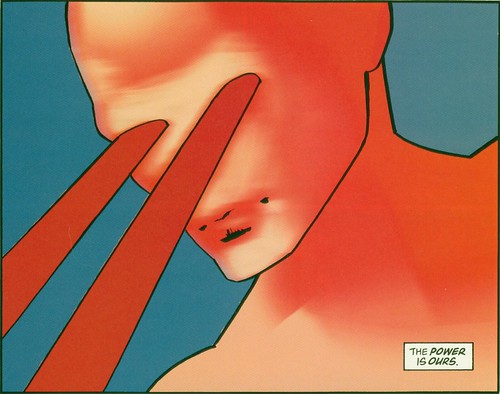
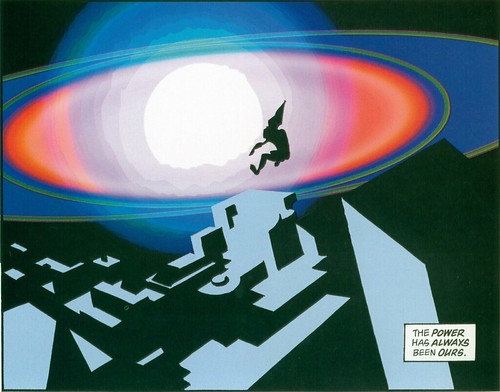
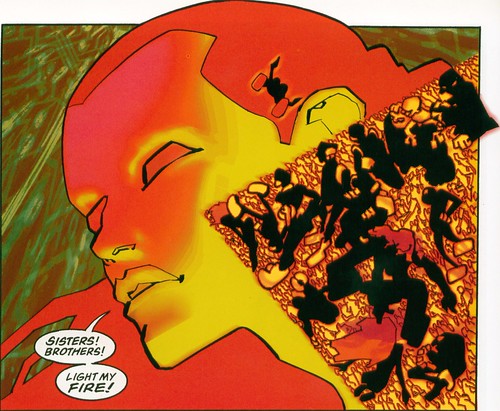
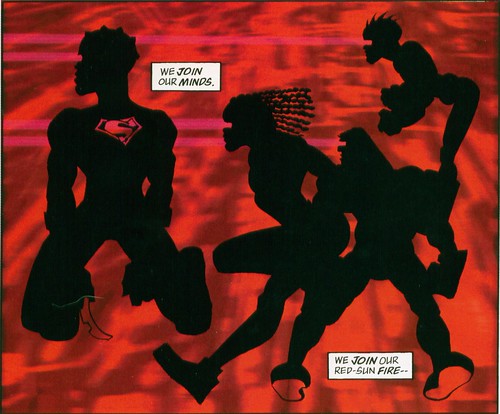
The Dark Knight Strikes Again
Frank Miller, writer/artist
Lynn Varley, colorist
DC, 2003
256 pages
$19.99
Buy it from Amazon.com

Originally posted on October 28, 2009 at The Savage Critic(s).
Years ago I came across an eye-opening quote from Jaron Lanier in the liner notes of the reissued Gary Numan album The Pleasure Principle. Google reveals that it was pulled from this Wired essay. Here’s what it said:
“Style used to be, in part, a record of the technological limitations of the media of each period. The sound of The Beatles was the sound of what you could do if you pushed a ’60s-era recording studio absolutely as far as it could go. Artists long for limitations; excessive freedom casts us into a vacuum. We are vulnerable to becoming jittery and aimless, like children with nothing to do. That is why narrow simulations of ‘vintage’ music synthesizers are hotter right now than more flexible and powerful machines. Digital artists also face constraints in their tools, of course, but often these constraints are so distant, scattered, and rapidly changing that they can’t be pushed against in a sustained way.”
Lanier wrote that in 1997. I’m actually not sure which vintage-synth resurgence he was talking about, unless you count the Rentals or something (although everyone and their grandfather was namechecking Gary Numan back then, which was sort of the point of including the quote in the liner notes. Maybe he meant Boards of Canada?).
But golly, it sure seems prescient now, huh? Here we are, in the post-electroclash, post-Neptunes, post-DFA era. The hot indie-rock microgenre is glo-fi, which sounds like playing a cassette of your favorite shiny happy pop song when you were three years old after it’s sat in the sun-cooked tape deck of your mom’s Buick for about 20 years. And my single favorite musical moment of last year, as harrowing as those songs are soothing, was the part of the universally acclaimed Portishead comeback album that sounded exactly like something from a John Carpenter film score. (It’s at the 3:51 mark. It’s awesome, isn’t it?)
And that’s just on the music end. Visually? Take a look at Heavy Light, a show at the Deitch Gallery this summer featuring a murderers’ row of video artist specializing in primary-color overload and technique that doesn’t just accentuate but revels in its own limitations. Foremost among them, at least for us comics folks, is Ben Jones, member of the hugely influential underground collective Paper Rad and recent reinterpreter of the massively mainstream The Simpsons and Where the Wild Things Are. But the ones with the widest cultural import at the moment are Tim Heidecker and Eric Wareheim of the astonishingly funny and bizarre Adult Swim series Tim & Eric Awesome Show, Great Job!. Their color palette is garish, their digital manipulations are knowingly crude, and their analog experiments are even more so. When they combine the three, god help us all. And let’s not forget Wareheim’s unforgettable, magisterially NSFW collaboration with fellow Heavy Light contributor and Gary Panter collaborator Devin Flynn.
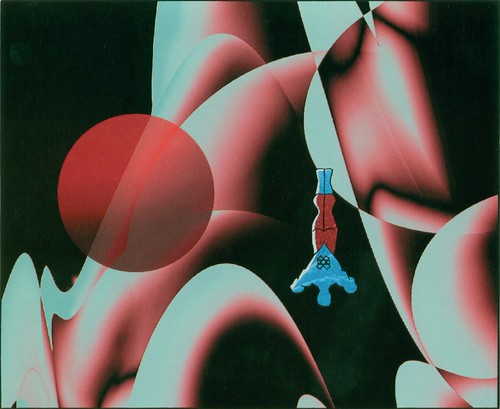
Yeah, most of these guys are playing it either for laughs or for sheer mind-melting overload, but I think there’s frequently beauty in there to rival what some of the musicians are doing. (Click again on that first Ben Jones link.) And (thank you Internet God) this amazing video by Peppermelon shows that you can do action, awe, even sensuality with this aesthetic. The rawness, the brightness, the willingness to let the seams show–it all gives you something to push against again.
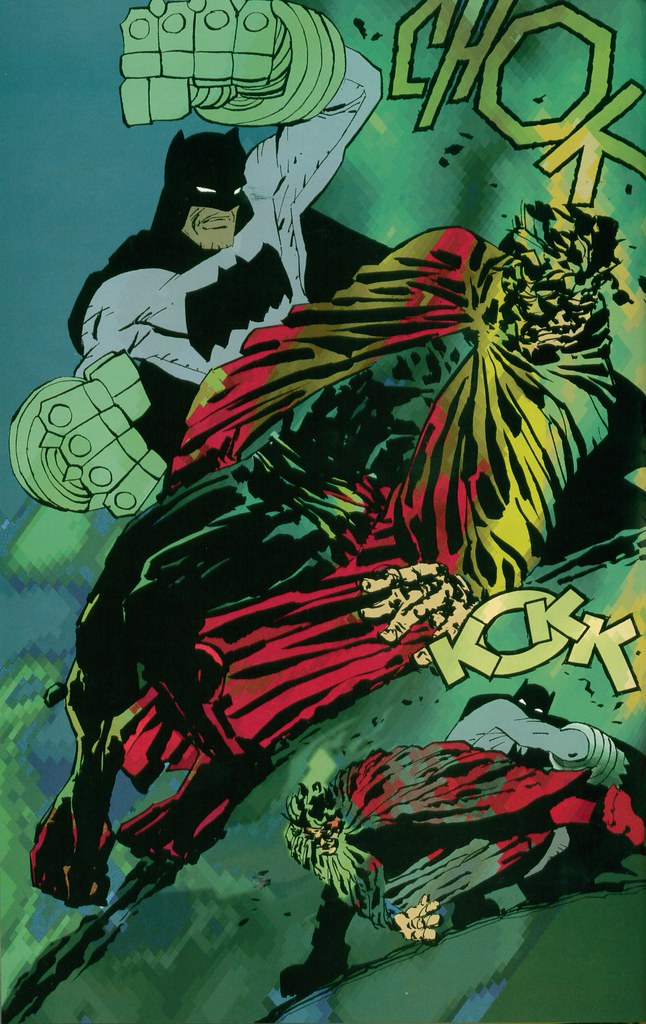
When I’ve written about The Dark Knight Strikes Again I’ve been fond of saying it was years ahead of its time. Sometime in the past week and a half or so, there was a day when I listened to Washed Out, then stumbled across that Deitch show link in an old bookmark, then watched an episode of Tim & Eric, then came across that Ben Jones WTWTA strip–and suddenly I realized I was right! Not that it matters–at all–whether or not Miller and Varley have any real continuity with any of this material. They certainly didn’t get there before Paper Rad, unless I’m wildly mistaken. But then half the fun of DKSA is spotting all the stuff Miller does, from naked newscasters to superheroes ruling the earth rather than just guarding it, seemingly without realizing someone’s done it first. What difference would that make? Meanwhile, in all the off-the-beaten-path references Frank Santoro has cited during the production of his Ben Jones collaboration Cold Heat–essentially a glo-fi comic book–I haven’t heard word one about this book. But I’m not saying Miller & Varley paved the way for anything. I’m saying that when Miller abandoned his chops (and, for the most part, backgrounds!) for the down and dirty styles he (thought he) saw at SPX, and when Varley decided to use photoshop to call attention to itself rather than to create a simulacrum of something else, they were using the same tools, tapping the same vein, seeking the same sense of excitement, discovery, and trailblazing as these newer movements.
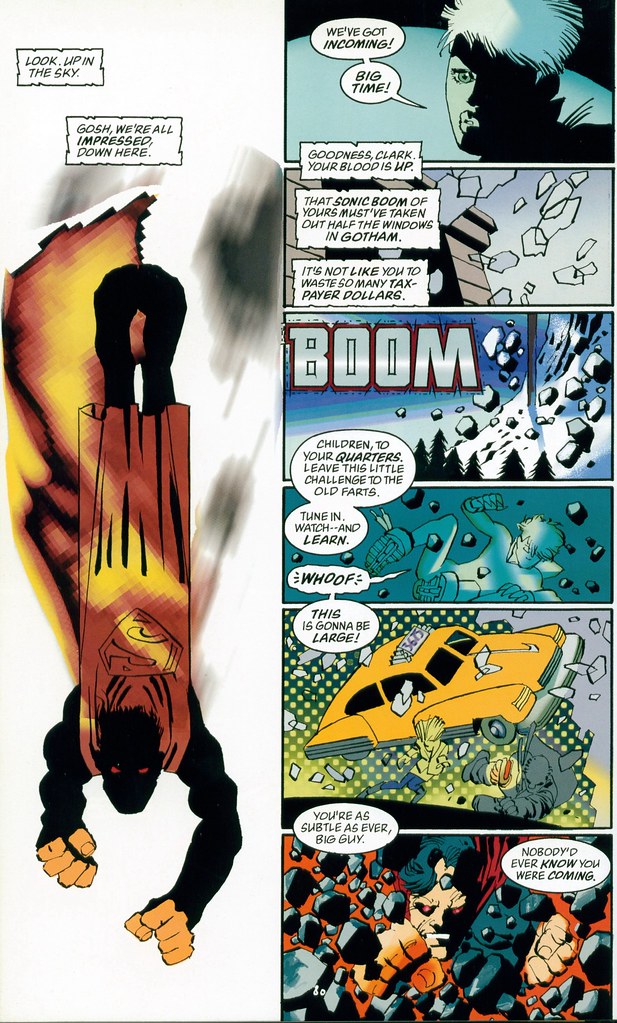
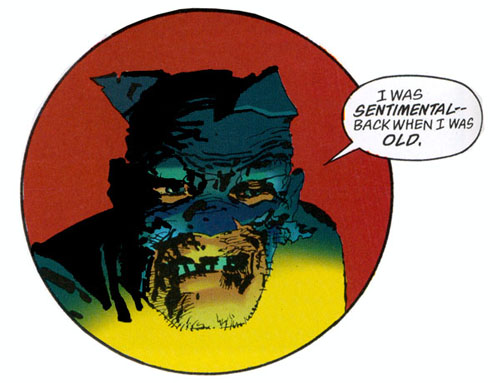
I’ve also been fond of likening DKSA to proto-punk, taking a cue from Tony Millionaire’s jacket-wrap blurb: “Miller has done for comics what the Ramones et al have done for music. This book looks like it was done by a guy with a pen and his girlfriend on an iMac.” The idea is that it’s raw, it’s loud, it’s brash, it doesn’t have time for the usual niceties–it’s getting comics back to their primal pulp roots. I spoke to Miller several times during and following the release of the book, one time for print, and he said as much. (I certainly never would have bought the cockamamie idea that this thing was some sort of corporate cash-grab even if he’d never said word one.) He even mentioned to me his belief that the brightly colored costumes of the early superheroes served mainly the dual purpose of a) telling them apart from one another, and b) proving they weren’t naked, so even his thinking in historical terms had him ready to peel back from realism as a form of reclamation. And of course it’s not exactly like the story was at all subtle in this regard: Batman and his army came back to overthrow the dictators that kept us fat and happy and turned the superheroes into boring wimps. But ultimately the punk comparisons were just a little off. Born less of despair than of delight, filled less with anger than with joy, The Dark Knight Strikes Again anticipated a way of doing things that is not intended to look or sound effortless, that draws attention to its own construction, but which–with every pixelization and artifact, with every crayolafied visual and left-in glitch, with every burbly synth and sky-bright color–pushes against that construction and springs out into something wild and wonderful.
Comics Time: All-Star Superman
February 11, 2011
All-Star Superman Vols. 1 & 2
Grant Morrison, writer
Frank Quitely, artist
DC, 2008-2010, believe it or not
160 pages each
$12.99 each
Buy them from Amazon.com

Originally posted on March 11, 2010 at The Savage Critic(s).
The cheeky thing to say about the brand-new out-of-continuity world Grant Morrison constructed to house his idea of the ideal Superman story is that it’s very much like the DC Universe we already know, but without backgrounds. Like John Cassaday, another all-time great superhero artist currently working, Frank Quitely isn’t one for filling in what’s going on behind the action. One wonders what he’d do with a manga-style studio set-up, with a team of young, hungry Glaswegians diligently constructing a photo-ref Metropolis for his brawny, beady-eyed men and leggy, lippy women to inhabit.
But, y’know, whatever. So walls and skyscrapers tend to be flat, featureless rectangles. Why not give colorist/digital inker Jamie Grant big, wide-open canvases for his sullen sunset-reds and bubblegum neon-purples and beatific sky-blues? We’re not quite in Lynn Varley Dark Knight Strikes Again territory here, but the luminous, futuristic rainbow sheen Grant gives so much of the space of each page–not to mention the outfits of Superman, Leo Quintum, Lex Luthor, Samson & Atlas, Krull, the Kryptonians and Kandorians, Super-Lois, and so on–ends up being a huge part of the book’s visual appeal. And thematically resonant to boot! Morrison’s Superman all but radiates positivity and peace, from the covers’ Buddha smiles on down; a glance at the colors on any given page indicates that whatever else is in store, it’s gonna be bright.
Moreover, why not focus on bringing to life the physical business that carries so much of the weight of Morrison’s writing? The relative strengths and deficiencies of his various collaborators in this regard (or, if you prefer, of Morrison, in terms of accommodating said collaborators) has been much discussed, so we can probably take it as read. But when I think of this series, I think of those little physical beats first and foremost. Samson’s little hop-step as he tosses a killer dino-person into space while saying “Yo-ho, Superman!”…Jimmy Olsen’s girlfriend Lucy’s bent leg as she sits on the floor watching TV just before propositioning him…clumsy, oafish Clark Kent bumping into an angry dude just to get him out of the way of falling debris…the Black-K-corrupted Superman quietly crunching the corner of his desk with his bare hands…Doomsday-Jimmy literally lifting himself up off the ground to better pound Evil Superman’s head into the concrete…the way super-powered Lex Luthor shoulders up against a crunching truck as it crashes into him…the sidelong look on Leo Quintum’s face as he warns Superman he could be “the Devil himself”…that wonderful sequence where Superman takes a break to rescue a suicidal goth…Lois Lane’s hair at pretty much every instant…You could go whole runs, good runs, of other superhero comics and be sustained only by only one or two such magical moments. (In Superman terms, I’m a big fan of that climactic “I hate you” in the Johns/Busiek/Woods/Guedes Up, Up & Away!) This series has several per issue.
And the story is a fine one. Again, it’s common knowledge that rather than retelling Superman’s origin (a task it relegates to a single page) or frog-marching us through a souped-up celebration of the Man of Steel’s underrated rogues gallery (the weapon of choice for Geoff Johns’s equally underrated Action Comics run), All-Star Superman pits its title character, directly or indirectly, against an array of Superman manques. The key is that Superman alternately trounces the bad ones and betters the good ones not through his superior but morally neutral brains or brawn, though he has both in spades, but through his noblest qualities: Creativity, cooperation, kindness, selflessness, optimism, love for his family and friends. I suppose it’s no secret that for Morrison, the ultimate superpower of his superheroes is “awesomeness,” but Superman’s awesomeness here is much different than that of, say, Morrison’s Batman. Batman’s the guy you wanna be; Superman’s the guy you know you ought to be, if only you could. The decency fantasy writ large.
Meanwhile, bubbling along in the background are the usual Morrisonian mysteries. Pick this thing apart (mostly by focusing on, again, Quitely’s work with character design and body language) and you can maybe tease out the secret identity of Leo Quintum, the future of both Superman and Lex Luthor, assorted connections to Morrison’s other DC work, and so on. But the nice thing is that you don’t have to do any of that. Morrison’s work tends to reward repeat readings because it doesn’t beat you about the head and neck with everything it has to offer the first time around. You can tune in for the upbeat, exciting adventure comic–a clever, contemporary update on the old puzzle/game/make-believe ’60s mode of Superman storytelling in lieu of today’s ultraviolence, but with enough punching to keep it entertaining (sorry, Bryan Singer). But you can come back to peer at the meticulous construction of the thing, or Morrison’s deft pointillist scripting, or the clues, or any other single element, like the way that when I listen to “Once in a Lifetime” I’ll focus on just the rhythm guitar, or just the drums. Pretty much no matter what you choose to concentrate on, it’s just a wonderfully pleasurable comic to read.

Comics Time: Various pieces by Uno Moralez
February 9, 2011
Various comics and illustrations by Uno Moralez
Uno Moralez, writer/artist
self-published, 2011-
Read them for free at UnoMoralez.com
I’ve been struggling mightily to put my finger on what the art and comics of Uno Moralez remind me of. I got that he draws the faces and figures of his characters to evoke that weird frisson you get when you see commercial illustration from other cultures, where what’s perfectly normal in (say) Eastern Europe or the Indian subcontinent or Southeast Asia or Central America looks just slightly off-kilter and disconcerting to us. And I got that he paces his horror comics with the attention to narrative economy and rhythm of a dark Nick Gurewitch. (That comic about the kid and his telescope gave me panicky giggles with each subsequent reveal.) And I got that there’s a massive, in-your-face dose of kink and smut, tying it to similar traditions in Japanese illustrations and comics and also reinforcing that “I shouldn’t be seeing this” feeling. But that weird, glitchy computer drawing style — what is that all about? Then it hit me: It looks like a black-and-white version of the still images they used as cut scenes in old 8-bit Nintendo games. It feels wrong to apply that aesthetic to these horrific images and stories; and because the style is so mechanical, it’s a wrongness that feels as though it has settled into and infected the very digital medium conveying it — the computer equivalent of Pim and Francie‘s Golden Age animation studio gone horribly wrong. Put it all together and you’ve got one of the most impressive and fully formed horror aesthetics I’ve seen…well, since Michael DeForge, I suppose, coupled with that same “whoa” factor I got from the format and pacing of Emily Carroll’s brilliantly assembled “His Face All Red.” Jeepers creepers, does this person hit my buttons.
(Via Zack Soto via Jillian Tamaki via Ryan Sands)
Comics Time: Squadron Supreme
February 7, 2011
Squadron Supreme
Mark Gruenwald, writer
Bob Hall, Paul Ryan, John Buscema, Paul Neary, artists
Marvel, 1985-1986 (my collected edition is dated 2003)
352 pages
$29.99
Buy it used from Amazon.com

Originally posted on August 10, 2009 at The Savage Critic(s).
I don’t know what it is about Squadron Supreme, but I seem to read it only during times of great personal trauma. I first read the book in 2003, during my wife’s hospitalization at a residential treatment facility for eating disorders. I have vivid memories of sitting at a nearby Panera Bread between visiting hours, slowly turning the pages. And as I reread the book over the past couple of weeks, an 11-month period during which my wife suffered two miscarriages was capped off by the news that one of my cats has a chronic immune-system disease, complications from which prevented him from eating; our other cat had a cancer scare; both of our cats required major surgery; and one of my wife’s best friends lost her sister-in-law, her niece, and all three of her very young children in a catastrophic car accident that left three other people dead as well.
So it’s entirely possible that as effective and affecting as I find Mark Gruenwald’s magnum opus, my real life is doing a lot of the heavy lifting. Certainly there are a couple of very different ways to read this, arguably the first revisionist superhero comic available to the North American mainstream. For some people, no matter how interesting Gruenwald’s ideas are in terms of laying out the effects of a Justice League of America-type group’s decision to really make the world a better place by transforming society into a superhero-administered utopia, the execution–art, dialogue, and melodramatic plotting all firmly in the mainstream-superhero house style–cuts it off at the knees. For others, it’s precisely that contrast between the traditional stylistics of the superhero and a methodical chronicling of superheroes’ disastrous moral and physical shortcomings that makes the book work.
Count me in the latter category. Squadron Supreme may have more in common with later pseudo-revisionist works like Kingdom Come than it does with Watchmen in that it obviously stems from a place of great affection for the genre rather than dissatisfaction with it. Heck, even The Dark Knight Returns, which is really a celebration of the superheroic ideal, earns its revisionist rep for a thorough dismantling of the superheroes-as-usual style, something Squadron Supreme couldn’t care less about. No, by all accounts (certainly by the testimonials from Mark Waid, Alex Ross, Kurt Busiek, Mike Carlin, Tom DeFalco, Ralph Macchio, and Catherine Gruenwald printed as supplemental materials here) Mark Gruenwald seems to be working in Squadron as a person who loves superheroes so much that he can’t help but try to find out just how far he can take them. That what he comes up with is so bleak and ugly–nearly half of his main characters end up dead, for pete’s sake–is fascinating and sad. It’s like watching Jack Webb do another season of Dragnet consisting of plotlines from The Wire Season Four: Against America’s broken inner-city school system and grinding cycle of poverty, violence, corruption, and abuse, even Sgt. Joe Friday would be powerless.
Of course, in Squadron Supreme the heroes generally do prove able to conquer humankind’s intractable problems. A combination of the kind of supergenius technology that under normal circumstances only gets used to create battle armor or gateways to Dimension X and the tremendous sheer physical power of the big-gun characters proves enough to end war, crime, and poverty, and even put a hold on death. (The book’s vision of giant “Hibernaculums” in which thousands of frozen corpses are interred until such time as medical science discovers a cure for their condition is one of the book’s great, haunting moments of disconnect between cheerful presentation and radical society-transforming idea.) Gruenwald and his collaborators seem to have no doubt that should Superman, Wonder Woman, Green Lantern, the Flash, and the rest of the JLA (through their obvious Squadron analogues) be given the reins of the world, they really could solve all our problems for us.
It’s the methods they’d use to get us there that Gruenwald has doubts about. A Clockwork Orange-style brainwashing for criminals; a Second Amendment-busting program of total disarmament for military, law enforcement, and civlians alike; a takeover of many of the key functions of America’s democratically elected government–despite placing his beloved heroes at the center of these plots, it’s no secret where Gruenwald’s sympathy lies. (To return to the Hibernaculums again, a brief sequence involving “right to die” protestors features some of the book’s most provocative ideas just painted on their placards, eg. “WITHOUT DEATH, LIFE IS MEANINGLESS!!!” Yes, there were three exclamation points on the sign.) Still, Gruenwald backpedals from condemning his heroes for their excesses outright: During the book’s climactic confrontation, as bobo Batman Nighthawk wages a war of words with Superman stand-in Hyperion, the rebel leader reveals his biggest problem with the Squadron’s “Utopia Program” to be his fears over what will happen to it when the golden-hearted Squadron members are gone and someone less worthy takes over their apparatus of complete control. (It’s worth noting that the Squadron gets the idea for the Utopia Project as a solution for the damage they themselves did to the planet while under mind control by an alien tyrant.)
But parallel to the big political-philosophical “What If?” ramifications runs another, more affecting revisionist track. This one focuses on the individual problems and perils of the Squadron members. Some of these flow from the underlying Utopia Project scenario, and about those more in a minute, but other times–a Hyperion clone succesfully impersonating him and seducing the Wonder Woman character, Power Princess, in his place; little-person supergenius Tom Thumb (just barely an Atom analog) dying of cancer he’s not smart enough to cure–Gruenwald simply takes a familiar superhero trope or power set and plays the line out as far as it’ll go. In some cases, such as setting up a fundamental Batman/Superman conflict, making Superman and Wonder Woman an item, explicitly depicting the Aquaman character Amphibian as an odd man out, and dancing up to the edge of Larry Niven’s “Man of Steel, Woman of Kleenex” essay on the dangers of superhero sex, I would guess Gruenwald was for the first time giving in-continuity voice to the stuff of fanboy bull sessions that had taken place in dorm rooms and convention bars for years.
While that’s a lot of fun, it’s the unique touches brought to the material by Gruenwald, shaped into disconcerting images by his rotating cast of collaborators (mostly Bob Hall and Paul Ryan), that get under your skin. Nuke discharging so much power inside Doctor Spectrum’s force bubble that he suffocates himself. The vocally-powered Lady Lark breaking up with her boyfriend the Golden Archer under a suppressive cloud of giant, verbiage-filled word balloons. A comatose character’s extradimentional goop leaking out of him because his brain isn’t active enough to stop it, threatening to consume the entire world until Hyperion literally pulls the plug on his life support system. Power Princess tending to her septuagenarian husband, who she met when she first made the scene in World War II. Hyperion detonating an atomic-vision explosion in his semi-evil doppelganger’s face, then beating him to death. Tom Thumb’s death announced in a panel consisting of nothing but block text, unlike anything else in the series. Amid the blocky, Buscema-indebted pantomime figurework and declamatory dialogue, these moments stand out, strangely rancid and difficult to shake.
Perhaps no other aspect of the book gives Gruenwald more to work with than the behavior modification machine. There are all the ethical debates you’d expect–free will, the forfeiture of rights, the greater good. There’s the slippery slope of mindwiping you saw superheroes slide down decades later, and far less interestingly, in Identity Crisis. But again, the personal trumps the political. The standout among the series’ early, episodic issues is the one in which Green Arrow knockoff the Golden Archer (who has the second-funniest name in the series, after Flash figure the Whizzer) uses the b-mod machine on Black Canary stand-in Lady Lark to make her love him after she rebuffs his marriage proposal. She ends up unable to bear being away from him, her fawning driving him mad with guilt, and even after he comes clean about his deception and is expelled from the team, the modification prevents her from not loving him. Later, the device’s use on some of the Squadron’s supervillain enemies turns them into obsequious allies-cum-servants whose inability to question the Squadron, and moreover to feel anything but thrilled about this, does more to turn your sympathies against the SS than all the gun-confiscation scenes in the world.
Late in the book, another pair of behavior modification-related incidents ups the pathos to genuinely disturbing levels. When b-modded ex-villain Ape X spies a new Squadron recruit secretly betraying the team, her technologically mandated inability to betray the Squadron member by telling on her or betray the rest of the team by not telling on her overwhelms Ape X’s modified brain and turns her into a vegetable. And when Nighthawk’s rebel forces kidnap the mentally retarded ex-villain the Shape in order to undo his programming, his childlike pleas for mercy are absolutely heartbreaking, as is the cruel way in which the rebels repeatedly deceive him in order to advance their aims. The look of panic on his face as he shouts “Don’t hurt Shape please!” is tough to stomach.
What it reminds me of more than anything is taking an adorable stuffed animal that you love and throwing it in the garbage. Do you know that feeling? This is not a sentient creature, it does not and cannot interact with you in any real way–and yet you love it. It never did anything to hurt you. Why would you want to throw the poor guy away? No, don’t! By the time you get to the end of Squadron Supreme, a love-letter to the Justice League of America that ends with an issue-long fight that leaves half the participants brutally slaughtered, that’s the feeling I get from the whole book. These superheroes never did anything but bring Mark Gruenwald great joy, he wanted to repay that by doing something unprecedented with them, but as it turns out the unprecedented thing to do was to throw them away.
Book reports
February 4, 2011One of my favorite things to do (and what this says about me I couldn’t begin to guess) is backlog enough comics reviews that I can take a few weeks off from the funnybook grind and plow my way through a suitably ambitious prose-reading project. This winter that project is apparently reading fantastic-fiction series written for young adults. First up was Susan Cooper’s The Dark Is Rising Sequence, which I’ve talked about a bit before. Christmas almost always puts me in the mood for these books, just like seeing bugs congregate around my houselights when I take the garbage out at night makes me want to re-read Stephen King’s “The Mist” every summer. The Dark Is Rising, which gave the series its name, contains some marvelously Christmasy stand-offs between good and evil in the English countryside, involving carols like “Good King Wenceslas,” constant references to Midwinter’s Day, the magical properties of holly, and so forth — the ancient Britannipagan roots of the Christmas traditions we know today. But it’s also the second book in the series; the first, Over Sea, Under Stone, was written some years before the rest and is much more a children’s mystery and much less an overt fantasy. So you kind of have to buckle down and commit to reading the whole megillah before you get to the candles and wassails and mince pies and so forth (whereas with “The Mist,” you get a sweltering summer instantly and giant insects crawling across supermarket windows within half an hour’s reading), which is an investment. But this year I felt up to the challenge, and thus over the holiday break I took a crack at the whole series for the first time in eight or nine years. I ended up quite impressed by how much mileage Cooper could get out of merely describing how her conflict between the Lords of Light and Dark — and I mean sheer description, an endless succession of infodumps. Any time our young chosen-one hero Will confronts the enemy, the rules governing their conflict are simply asserted, either by the more experienced characters or, after he reads a book that literally teaches him everything ever, by Will himself, rather than uncovered through action. It’s not a choice I’d have made, certainly…and yet it never feels lazy, somehow. Why? Because Cooper’s overriding theme is that pure Light and pure Dark are both hard masters. Having all the usual fantasy story beats arrived at not through struggle or coincidence but by through “it is the way it is, the way it must be” rules and prophecies and plans and destinies makes perfect sense in a world where even the heroes are resigned to the occasional destruction of the souls of normal humans with the misfortune to be caught up in the conflict. Don’t get me wrong, this series isn’t at all about the necessity for Hard Men In A Dangerous World; indeed I’m not sure there’s any appropriate ideological/allegorical reading to be applied to it. It’s more a combination of Cooper pursuing the brand of fantasy that most intrigued her — lofty and explicitly Arthurian — and then occasionally, and particularly in the masterful Newbery Medal-winning fourth volume The Grey King, chronicling the emotional effect such cold purity has on we hot, impure humans. It’s a fantasy series with a lot of images that shine brightly — the Black Rider, the White Rider, the Six Signs, the Afanc, the Mari Lwyd — but also sting.
Far closer to ground level is Lloyd Alexander’s Prydain Chronicles. Like Cooper, Alexander drew heavily on Welsh legends, but that’s pretty much where the similarities end. On the surface it’s the most (and prior to A Song of Ice and Fire, the only) thoroughly Tolkien-indebted fantasy series I’ve ever read, albeit one written on the reading level of The Hobbit throughout its five proper installments and subsequent collection of prequel short stories. There’s a dark lord (Arawn, Lord of Death) who rules a stronghold at the edge of the known world (Annuvin) and sends his undead thralls (the Cauldron-Born) against a motley crew of various beings (the Companions) masterminded by a wizened wizard (Dallben) and spearheaded by an unlikely-hero hick (Taran, the Assistant Pig-Keeper) and his scion-of-royalty guide (Prince Gwydion of the Sons of Don) whose home is eventually besieged (Caer Dathyl). Where Alexander distinguishes himself from the good Professor is in the welcome regularity with which he drives home the central theme of the book: “Please put in the hard work necessary to learn how to not be a jerk.” He depicts Taran’s intellectual, emotional, and ethical growth process in such detail that it’s almost an instructional volume. Taran is never swept along by the mystical conflict with which he becomes entangled on his way to becoming a hero — he trudges and marches and stumbles and picks himself back up and continues to trudge through it. In each book Taran repeatedly is faced with decisions only he can make; he makes them first impetuously, and after learning how that usually works out, with as much care and consideration as he can muster; they either work out or don’t; then — crucially — he accepts responsibility for the results of the decision, accepts the results themselves as the terrain on which he must operate, and endeavors to move forward from there. It’s a constant process of experimentation, failure, contrition, and moving forward with his friends’ support. People try to do right by each other in this book, at all costs. One sacrifice, toward the very end of the book, made me tear up, something I thought I was long past in books like these — it wasn’t even a fatal sacrifice, just one you knew tore the sacrificer’s heart out but didn’t stop him from making it to help the people he cared about. He’d learned not to be a jerk.
I tweeted about all this a few days ago, and two separate people tweeted back in virtually identical terms that the books sound like the anti-Ayn Rand. That’s precisely it. The message is that acting responsibly toward others is really the only way we can gauge responsibility to ourselves — an enormously salutary message, more so now even than when the books were first written over four decades ago. Indeed Arawn Death-Lord’s greatest evil is said to be not his warring and general sorcerous nastiness, but his theft of the skills and secrets that made everyone in Prydain’s lives better once upon a time — better ways to farm and build and sew and create. Arawn took them all and hid them in his own private Galt’s Gulch; Taran’s quest was in part to liberate them, but much more than that it was to work to find his own gifts, and his own limitations, and contribute to the lives of others as best he could.
(In that light it’s hard to find fault with Alexander for his one weakness here, which is that he’s far more willing to harm the characters his main characters care about than he is to harm those main characters, i.e. the ones he and we care about. (This made me appreciate just how much of a taboo George R.R. Martin really shattered, by the way.) Plus, Arawn, the Cauldron-Born, the Huntsmen, and the Horned King are all world-class villains, so on a fantasy-mechanics level there’s still plenty to crow about.)
Finally I’ve just now started Suzanne Collins’s The Hunger Games. I don’t know what I was expecting, prose-wise, but it certainly has that slightly-weak-YA-fiction tendency to eliminate subtext and spell everything out. If the heroine has a tragic backstory, she is going to tell you what it is in the opening chapters. If she feels one thing but is forced to say another, she’s going to describe the situation to you in pretty much exactly those terms. In other words, big surprise, the writing is not as strong as George Orwell or William Golding. Don’t go comparing dystopian apples to oranges as I did.
What it has going for it instead is two things, as best I can tell. I only got up to the actual Hunger Games — the Battle Royale-style bread-and-circuses spectacle in which tweens/teenagers from the subjugated populations are forced to fight each other to the death for the sport of the ruling class as a way to show everyone who’s boss every year — today, but obviously as with any such dystopian-future bloodsport set-up, the kill-or-be-killed nature of the Games is pure narrative napalm. You’ve got a built-in structure that keeps people turning the pages, you’ve got a ready-made cast of varying antagonists you can endow with noteworthy quirks, of course you’ve got life or death stakes, and you have the audience’s expectations that at some point your hero (or heroine, in the case of lead character Katniss) will rip the lid off the system and show the world that the game is rigged and the only way to win is not to play. Juicy, pulpy stuff, regardless of how many school summer reading lists it’s on.
The other thing (and again, I’m barely halfway through volume one, so who knows where if anywhere this all leads) is that it makes bracingly literal contemporary culture’s penchant for watching young people display themselves and/or die for our entertainment pleasure. There’s an out-of-nowhere injection of kink before the games begin — Katniss is stripped, shaved, inspected, and tarted up by a team of stylists to help her win over the crowds; she has every expectation that she may be made to perform in front of a live audience of thousands and television audience of millions stark naked, which has apparently happened to the teen contestants in the past — that fairly blew my mind at age 32; if I’d read this when I was part of the target audience I’m not sure if I’d ever think of anything else. That willingness to go there in the face of what I imagine were objections from the folks in charge of placing this thing in libraries was refreshing.
Moreover, the youth of the bloodsport contestants, as mandated by the government, reminds me not just of the simultaneously voyeuristic and condemnatory coverage of teen misbehavior upon which huge swathes of the media depend, but also of the cold hard fact that when wars are called for, what’s really being called for is for young people to travel someplace to kill people and get killed. Again, I’d imagine that if I were a teenager, this would connect with me very hard on some level, even if I weren’t able to quite articulate how.
On a sillier note, I can’t remember the last time I read a book that my mind cast with actors as quickly and irrevocably as it did here. Katniss is Kristen Stewart, skin tone be damned; Gale is Talyor Lautner; Peeta is Armie Hammer minus a few years; Effie is birther queen Orly Taitz with the voice of that “great, great, really great!” woman from Elaine’s office in Seinfeld; Haymitch is Lieutenant Eckhardt from Tim Burton’s Batman; Cinna’s the guy who runs the New York City bridal salon on Say Yes to the Dress. I wonder who will be brutally murdered next.
Comics Time: Spotting Deer and SM
February 4, 2011

Spotting Deer
Michael DeForge, writer/artist
Koyama Press, December 2010
12 pages
$5
Buy it from Michael DeForge
SM
Michael DeForge, writer/artist
self-published, December 2010
12 pages
I forget what it cost
“Although physically similar to a common white-tailed deer (Ocoileus virginianus), the spotting deer (Capreolus vulgaris) is actually a kind of terrestrial slug.” So begins the first of two short, creepy comics debuted by Canadian wunderkind Michael DeForge at this past December’s Brooklyn Comics and Graphics Festival, and so does one get a sense of the type of skin-crawly, dis-ease driven horror DeForge is creating here. In the guise of a nature guide, the cartoonist not only piles discomfiting detail (“Its ‘antlers’ are actually colonies of parasitic polyps that are first attached to the deer during adolescence”) upon discomfiting detail (“biologists nickname this phenomenon the ‘sexual acqueduct'”), but trots out a unique and fully formed full-color palette to do so; he then whisks the comic into unexpected territory by making it just as much about the obsessive in-story writer of the guide, whose face we never see even as evidence quietly accrues that his interest in these strange creatures has more or less ruined his life. The self-published SM is similarly based in the horror of the squicky and gross (a snowman stands mutely smiling as two teenagers take a knife to it, unpleasantly revealing that it’s somehow made out of real flesh) and similarly takes off into unpredictable territory (the flesh is hallucinogenic; the snowman’s nearest neighbor is a Texas Chain Saw Massacre-style old man who doesn’t take kindly to trespassers). As if compensating for the comparative lack of color, DeForge makes the book’s centerpiece as sensual as possible: It’s a full-on psychedelic freak-out laid atop a topless makeout session by an ersatz Maggie and Hopey. It’s enough eye candy to send you into the visual equivalent of diabetic shock, which somehow leaves you even better prepared to picture the unpleasantness that goes on between panels on the subsequent page and is about to go on after that elegant final panel. The best part of all, of course, is that while DeForge’s alt-horror idiom is familiar enough (especially to me, especially lately), his personal drawing style isn’t; DeForge’s comics really do look only like themselves. Give me more.
Comics Time: Studygroup12 #4
February 2, 2011
Studygroup 12 #4
Zack Soto, Steve Weissman, Eleanor Davis, Michael DeForge, Trevor Alixopulos, T. Edward Bak, Chris Cilla, Max Clotfelter, Farel Dalrymple, Vanessa Davis, Theo Ellsworth, Jason Fischer, Nick Gazin, Richard Han, Jevon Jihanian, Aidan Koch, Amy Kuttab, Blaise Larmee, Corey Lewis, Kiyoshi Nakazawa, Tom Neely, Jennifer Parks, Karn Piana, Jim Rugg, Tim Root, Ian Sundahl, Angie Wang, Dan Zettwoch, writers/artists
Zack Soto, editor
Milo George, editorial/technical advisor
Published by Jason Leivian and Zack Soto, December 2010
80 pages
$20
Buy it from Zack Soto
This is going to come out sounding waaaay more like a diss than it’s intended to, but in flipping through the comeback installment of this Zack Soto-edited alt/artcomix anthology a few weeks after my initial read-through, I realized I didn’t remember anything in it prior to cracking the covers once again. Which is fine, I think! Looking at it now, Studygroup12 #4 seems to me to be much more an art book than a comics anthology. For one thing it’s exquisitely made: Beautiful screenprinted neon-pink-and-aqua covers inside covers (trust me, it’s much glowier than the scan above suggests); a gallery of impactful pink/blue/purple splash pages to kick things off and close things out, including some of the most striking images Jon Vermilyea and Dan Zettwoch have ever constructed out of their customary melty-monster and diagram styles respectively; pages printed in the vivid, inky blue-purple of a carbon copy. It’s a lovely package even compared to the similar approaches of Mould Map and Monster. My point is simply that all these things point to a book that works better from moment to moment as a catalog of images and illustrations rather than one whose strength arises from the cumulative impact of individual sequential narratives. Flipping through, I’m struck by the weird mystical sensuality of Aidan Koch’s portraiture and triangular caption boxes; the Renee-French-on-a-photocopier haze of Jennifer Parks’s creepy little strip; the pleasure of seeing Tom Neely images reproduced at a much larger size than his customary minicomics; the strength of the way Vanessa Davis designs leering faces, something that’s much clearer to me here than its ever been in the comics I’ve seen from her elsewhere, which frankly have never bowled me over the way they have so many readers; some funny punk/thrash/metal/trash pastiches from Vice Magazine’s mustache-at-large Nick Gazin (I wish a HAUNTED HOLOCAUST: “THE TEENAGE TITS TOUR” t-shirt actually existed). But much of what really reads as comics does so rather weakly — an uncharacteristic experimental misfire from Michael DeForge; the return of USApe, my least favorite Jim Rugg character; diminishing returns from Vermilyea’s anthropomorphized breakfast gang, which here get a little too Milk and Cheese-y; a Farel Dalrymple strip that’s drowned out by its over-shading; etc. Ultimately it’s really only Blaise Larmee’s riotously confrontational anxiety-of-influence comic, in which one of his trademark prepubescent/elfin protagonists navigates her way through some sort of abstract geometric maze only to stand in front of a menacing reproduced photograph of Charles Schulz (!!!), that hits me hard as comics; perhaps not coincidentally it’s the first time I’ve seen anything from his whole Comets Comets crew that makes good on their kill-yr-idols gotta-make-way-for-the-homo-superior internet trolling. As a look at the Portland-helmed turn-of-the-decade artcomix look, it’s swell; as a look at their comics, and where they might take everyone else’s, it’s only a start.
Comics Time: Snake Oil #6: The Ground Is Soft
January 31, 2011
Snake Oil #6: The Ground Is Soft
Chuck Forsman, writer/artist
self-published, December 2010
56 pages
$7
Buy it from the Oily Boutique
Last time we checked in with Chuck Forsman, he was chronicling a young man trapped in an unrewarding life by the demands of family and culture and his own inability to muster the gumption to really try to escape them. Here, he…chronicles a young man trapped in an unrewarding life by the demands of family and culture and his own inability to muster the gumption to really try to escape them. But you’d be surprised, stunned even, to see how far away from Snake Oil #5’s straightforward slice-of-lifer Forsman can get even within that basic tonal template. In The Ground Is Soft, Forsman employs a sort of late-model Dan Clowes kaleidoscopic-narrative effect to tell a vaguely alt-fantasy story about an abusive warrior-father, his hapless would-be-priest son, his two wives (one loving, the other a little too loving), and the customs that govern their society and their lives, which are largely inscrutable until the kaleidoscope is shifted in just the right way toward the end of the book, revealing something deeply unpleasant about the culture and (potentially) redeeming about the father, depending on how you look at it. It’s very smart work, with a sense of humor that’s more somber than traditionally black, and a degree of control over how the one- or two-page vignettes assembled out of chronological order to tell the tale play off one another and hold back the big reveal until the very last minute. As was the case with his contribution to Monster I’m really not sure why he chose to cap things off with the equivalent of the sort of corny joke accompanied by a wah-wah trombone sound — go ahead, be bleak, nobody minds, man! I certainly don’t. This guy’s good.
Comics Time: Uptight #4
January 28, 2011
Uptight #4
Jordan Crane, writer/artist
Fantagraphics, December 2010
36 pages
$3.95
Buy it from Fantagraphics
It’s the details that distinguish what Jordan Crane does. He’s not breaking any conceptual or thematic or formal ground in the two stories comprising this fourth issue of his old-school solo-anthology alternative-comic-book series, both of which are continuations of previous stories: “Trash Night” picks up the misadventures of a working-class couple whose female half is conducting a secret affair, while “Dark Day” is another chapter in the saga of Simon and Jack, the school-hating kid and his giant cat who starred in Crane’s all-ages graphic novel The Clouds Above. The latter story is part of your basic “kid explores a magical world beyond the watchful eyes of adults” set-up, while the former presents love and sex through a sordid, hate-fucky lens, an approach I’ll always associate with the 1990s filmography of Jeremy Irons. But none of that accounts for the sticky, unexpected images he pours into these familiar templates. For “Trash Night,” that means the perversely sensual lifelessness of the wife’s eyes, mouth, and breasts as the husband cradles her dead body in a mordant daydream (a recurring theme for Crane at this point); the memorable specificity of the argument that sends her back into the arms of her lover (vegetable oil!); the out-of-nowhere suddenness and savagery with which he attempts to strip her naked when she returns home; the shadowy, samurai-esque way he holds aloft a rake before bringing it down on the body of a raccoon who bit him; the unexpected and believably unglamorous way their bout of make-up sex begins (with him sitting on the toilet as she puts neosporin on his wound); and even the multiple meanings of the title itself, which could refer not just to the husband’s chores but to his likely self-identification as white trash and to the quality of his experiences during the time period. “Dark Day” is equally cleverly named in that it quietly ties this much frothier all-ages affair to the grim day-in-the-life we just read about, and uses irony to draw our attention to how much lighter this strictly black-and-white strip feels compared to the dingy, depressive graytones of the earlier comic. Here, Crane uses his wispy line as a way to cram visual cacophony into each panel, conveying how seeing an adult-created and administered world in disarray can be frightening to a child — the principal’s office, all books and papers and plaques and diplomas precariously overhanging the principal’s ogre-like frame, is at least as menacing as the shadows and icicles and smoke that Simon and Jack and Rosalyn must navigate and escape. At this stage in his career it’s quite clear how impeccable Crane’s technique is, both as an artist and as a designer; I think it’s equally important to note that what he does with that technique is just as considered and just as well-executed.
Comics Time: AX: Alternative Manga Vol. 1
January 26, 2011 AX: Alternative Manga Vol. 1
Osamu Kanno, Yoshihiro Tatsumi, Imiri Sakabashira, Takao Kawasaki, Ayuko Akiyama, Shigehiro Okada, Katsuo Kawai, Nishioka Brosis, Takato Yamamoto, Toranosuke Shimada, Yuka Goto, Mimiyo Tomozawa, Takashi Nemoto, Yusaku Hankuma, Namie Fujieda, Mitsuhiko Yoshida, Kotobuki Shirigari, Shinbo Minami, Shinya Komatsu, Einosuke, Yuichi Kiriyama, Saito Yunosuke, Akino Kondo, Tomohiro Koizumi, Shin’ichi Abe, Seiko Erisawa, Shigeyuki Fukumitsu, Kataoka Toyo, Hideyasu Moto, Keizo Miyanishi, Hiroji Tani, Otoya Mitsuhashi, Kazuichi Hanawa, writers/artists
Sean Michael Wilson, editor
Mitsuhiro Asakawa, compiler
Top Shelf, 2010
400 pages
$29.95
Buy it from Top Shelf
Buy it from Amazon.com

This is a tough one. I mean, as a Whitman’s Sampler of approaches to Japanese comics outside of the Japanese mainstream, this inaugural English-language compilation of comics from the fat, regularly released alternative-manga anthology series AX strikes me as wide-ranging and comprehensive, almost to a fault. In terms of known quantities for American altcomix readers, you’ll find both the straightforwardly drawn irony of gekiga pioneer and a A Drifting Life author Yoshihiro Tatsumi and the over-the-top visual and thematic crudeness of Monster Men Bureiko Lullaby‘s Takashi Nemoto represented here. You’ll see comics that look very much like the lavishly illustrated horror or porn manga you might have come across (Takato Yamamoto, Keizi Miyanishi, Kazuichi Hanawa) and comics that are so far removed from the manga tradition and so similar in bold graphic spirit to the first wave of North American alternative comics that they’d fit in RAW (Nishioka Brosis, Otoya Mitsuhashi). In perhaps the most marked deviation from work from the equivalent time period (turn of the millennium) here in North America, there’s a metric ton of crass taboo-shattering of the sort cartoonists here haven’t been all that interested in as an end in itself since the underground days (Tatsumi, Nemoto, Mitsuhashi, Osamu Kanno, Shigehiro Okada, Kotobuki Shiriagari, Saito Yunasuke, Hiroji Tani), but there are also twee little slice-of-lifers, modern urban fables, and O. Henry/New Yorker litfic that you could easily see populating a Petit Livre from Drawn & Quarterly or an issue of Mome (Takao Kawasaki, Katsuo Kawai, Shinbo Minami, Akino Kando, Shin’ichi Abe, Shigeyuki Fukumitsu).
So your preferred color of the alt/art/lit/indie/indy/underground spectrum is almost surely represented somewhere in these pages, and chances are you’ll find something you’ll consider a minor revelation. In my case, I was really impressed by the murky, inky body-horror dream comic “Conch in the Sky” by Imiri Sakabashira, the title of which gives a pretty solid impression of what you can expect. Brosis’s “A Broken Soul” combined off-kilter 2-D character designs, a wiry thin line, gray textures that looked like an artifact of photcopying, and a sort of whimsical ennui, to remind me favorably of Mark Beyer. And Shinya Komatsu’s “Mushroom Garden” is a real stunner, its bulbous, plush mushrooms evoking an array of psychedelic comics practitioners from Vaughn Bode to Moebius to Brandon Graham. In other words I don’t regret the time spent with the volume at all, and it’s given me several promising roads for further exploration, god and translators willing.
That said, AX Vol. 1 is consistently undercut not just by the heavy hand of many of its contributors, too many of whom rely on shock value or Tatsumiesque hamfisted irony, but by various production shortfalls. First and foremost among those is the translation work by Spencer Fanctutt and Atsuko Saisho, which is the epitome of the translated-manga tendency to emphasize fidelity at the expense of clarity. Here’s a representative passage from Shigehiro Okada’s sex farce “Me”: “However strangely I might dress, if I could really slip my existence, I could become a part of the cityscape like those ruins of decades ago. My instinct would explode if it took form. The light holds death. The darkness holds life. That’s what I’m waiting for. I…I would die for its expression.” If it’s not a sentence you can imagine a native English speaker coming up with, you’ve got to go back to the drawing board!
Meanwhile, while the design and font selection for the jacket, table of contents, and ancillary material (including Paul Gravett’s informative, if slightly overwritten, introduction) are all quite strong, the lettering for the comics themselves is frequently distracting, with inexpressive computer fonts and, often, vast empty spaces in balloons and caption boxes where kanji clearly used to reside. Finally, the decision to list creators first-name-first in the TOC and on each page but last-name-first in the who’s-who at the back of the book is a baffling one.
None of these things are dealbreakers in and of themselves. Heck, I don’t think they’re dealbreakers even when all added up. Like I said, there are a lot of intriguing comics in here, and a few excellent ones, and the cumulative effect is an eye-opening and educational one if you’re a reader with an interest in Japan’s equivalents to the American alternative comics you enjoy but few inroads into them. But in a field that’s increasingly crowded with impeccably conceived, assembled, edited, and packaged anthologies, AX isn’t just competing with scanlators and sporadic English-language apperances in long out-of-print publications, it’s competing with what the Eric Reynoldes and Zack Sotos and Sammy Harkhams and Ivan Brunettis and Ryan Sandses and so-ons of the world are putting together. It’s in that sense that AX could stand to be sharpened. (Sorry, couldn’t resist.)
Comics Time: Johnny 23
January 24, 2011
Johnny 23
Charles Burns, writer/artist
Le Dernier Cri, December 2010
64 pages
$24.95 price
Buy it from Le Dernier Cri
Buy it from PictureBox
X’d Out: This Is The Remix. For reasons unknown and with results most welcome, Charles Burns decided to cut up, shrink down, re-order, and re-release his recent surrealist art-sex satire/Tintin tribute, substituting English for an invented alien alphabet and language (has anyone translated it yet?) and reconfiguring the story into something recognizable but still very different. The trick here is that Burns realizes that the recurring images that populate X’d Out — photographs, holes, voyeurs, fetuses, eggs, wounds, cats, vents, nudes — can be used not only as dreamlike leitmotifs but as Legos, basically — connective nubs that allow him to disassemble the original narrative and put it back together in a new way, with the material between those recurring images treated like interchangeable bricks. Couple this with the inscrutable lettering and dialogue and the effect is even more dreamlike, and even more overpowering. The book’s protagonist Johnny 23/Nitnit is tossed seemingly willy nilly from one reality to another; he’ll walk through a hole in the wall in one world as one version of himself and exit into another as the other; he’ll look through a window and see himself; he’ll pick up a photo, we’ll look at the photo, and then we’ll see that his alter ego is now holding it. The book’s new landscape format furthers the sense of relentless forward momentum now that the pages are longer than they are tall, and the luscious purple ink in which the now colorless line art is printed emphasizes the sensuality of the images even more powerfully. It’s some weird erotic nightmare constructed from raw formal mastery of comics. What a performance.
Comics Time: Monster
January 21, 2011 Monster
Paul Lyons, Jim Drain, Michael DeForge, Michaela Zacchilli, Brian Ralph, Chuck Forsman, James Kochalka, Jim Rugg, Peter Edwards, Andy Estep, Oscar Estep, CF, Brian Chippendale, Blade, Keith McCulloch, Mike Taylor, Roby Newton, Edie Fake, Leif Goldberg, Keith Jones, Dennis Franklin, Jo Dery, Erik Talley, Beatrice McGeoch, Tony Astone, Mat Brinkman, Nick Thorburn, Melissa Mendes, Aaron DeMuth, writers/artists
Paul Lyons, editor
self-published (I think), October 2010
88 pages
$20
Buy it from PictureBox
They’re gettin’ the band back together, man! From out of the rubble of Fort Thunder rises the surprise 2010 revival of the gigantically influential Providence underground-art institution’s house anthology, featuring mostly-about-monsters work from all six of the Fort’s core cartoonists — Brinkman, Chippendale, Ralph, Drain, Lyons, Goldberg. Plus Andy Estep, Peter Edwards, Roby Newton, and a lot of other people you’ll see listed as having lived/worked/played in the Fort. Plus fellow-travelers like Providence’s CF and Jo Derry and Highwater’s James Kochalka. Plus Jim Rugg and Michael DeForge and Chuck Forsman and other leading lights of post-Fort alternative comics. And a reunion tour is exactly what it feels like.
Don’t get me wrong, there’s fine comics in this beautifully printed navy-blue-and-white package, many of which take advantage of its unusually large trim size. (We’re not talking Kramers Ergot 7 territory, but the thing is big. Think the Wednesday Comics hardcover.) Brian Ralph uses his comparatively clean cartoony style for a hilariously violent giant-robot comic, “Voltron from Hell,” basically, with huge panels and splash pages taking perversely pretty delight in mass destruction and death. The final panel of CF’s weird tale about an ambulance driver-cum-cat burglar who sneaks into the house of a woman with a mysterious disease actually made me jump — just a beautifully done little scare. Brian Chippendale’s story ties in with his Puke Force webcomic and gives him a chance to draw some villains at full splash-page size. I thought Chuck Forsman cut himself off at the knees a bit with his punchline ending, but until then his contribution was a creepy little thing that reminded me favorably of the urban legend my Delawarean wife recounted to me about the zoobies, the inbred mutant children of the DuPont family who would roam around the woods waylaying passers-by. There are insanely METAL full-page illustrations from Brinkman (who’s by now made a wonderful career of such things), Tony Astone, and Dennis Franklin — I mean, I laughed out loud at how fuckin’ devil-horns they were. And Lyons’s wraparound cover portraits of various barfing beasts is breathtaking, one of the most impressive single comics images of the year.
But in a way, the Fort Thunder aesthetic is a victim of its own success. I lost track of the number of good-to-great comics that came out this year bearing its influence, and those apples-to-apples comparisons make it hard for the work here, which I think all parties involved would admit was done more for fun than for tear-down-the-walls boundary-pushing, to stand out. In terms of anthologies alone, you could stand this one right between Studygroup 12, Closed Caption Comics, Smoke Signals, Diamond Comics, and Mould Map. Fort Thunder and the Providence scene’s DNA is now deeply embedded in an array publishers, including not just the late and lamented Highwater, Bodega, and Buenaventura, but also PictureBox, Secret Acres, Koyama, Nobrow, Pigeon, Gaze, and even the mighty Drawn & Quarterly. Moreover, whether you call it fusion or New Action or simply slap an alt- prefix in front of horror or SF or fantasy, Fort Thunder’s pioneering jailbreak of genre from the mainstream American comics prison has subsequently allowed it to become almost inescapable in smart-comics circles. Finally, Chippendale, Brinkman, Forsman, DeForge, CF, Fake, and Rugg are all in direct competition with work they put out elsewhere last year, most of which was more ambitious. And understandably so! Seriously, I’m not complaining — Monster is what I think it set out to be. It’s seeing Floyd get together for an awesome Live 8 gig, rather than seeing Waters and Gilmour working together again, and as such it’s more a treat for the fans than documentary evidence of why we became fans in the first place.
Comics Time: FUC* **U, *SS**LE
January 19, 2011 FUC* **U, *SS**LE
Johnny Ryan, writer/artist
Fantagraphics, 2010
pages
$11.99
Buy it from Fantagraphics
Buy it from Amazon.com

Take a good look at that cover, if you will, and you’ll see what it is that makes Johnny Ryan’s grossout humor comics so special. Blecky Yuckerella isn’t just emitting bog-standard gag-strip flopsweat and stinkflies as she hangs, she’s also squirting out tiny little drops of urine. That’s the kind of attention to detail and willingness to go the extra mile that took Ryan to the top!
In Ryan’s last Blecky collection (co-Bleck-tion?), the fun came in seeing the pacing economy of the four-panel gag strip used as a vehicle for a completely unconstrained sense of the absurd, a willingness to turn the corner into even weirder and more ridiculous or offensive territory with each new panel. By contrast, the fun of FUC* **U, *SS**LE (aside from the title itself, Ryan’s best since Johnny Ryan’s XXX Scumbag Party) is mostly how straightforward it is: Ryan’s got a punchline in mind, and by god he’ll set it up in those first three panels no matter how idiotic it is. Wine made from stomping pig carcasses (“I call it S’wine!”), Curly Moe and Larry as the Messiah (“It’s Stoogeus Christ!”), diarrhea caused by eating Bigfoot (“the Sasquirtz”), a porno called 69-11 (“It’s like 9-11, only more erotic!” Blecky points out as Flight 11 and the North Tower perform oral sex on one another) — I’d say “you can’t make this shit up,” but you can, or Ryan can at least, and watching him frogmarch his characters through the outlandish scenarios needed to give birth to these you-gotta-be-fucking-kidding-me ideas is Guffaw City. And as I always point out, he’s a fine, fine cartoonist; this idea has more traction in a post-Prison Pit world, I know, but you don’t get to see his buoyant brushwork in those books, while here it’s what sells the childlike glee of everything that’s going on. His thick blacks really vary up the dynamics of each page, too. Unfortunately, this Blecky’s final hurrah, as Ryan has retired the strip. You can certainly see how Prison Pit and Angry Youth Comix afford him a lot more formal leeway, but I’m going to miss the consistently high batting average on display in the Blecky books. I guess it’s like Blecky herself tells Aunt Jiggles: “You can either have a lotta annoying noise and a clean robot pussy, or peace and quiet and nasty robot pussy stench. But you can’t have it both ways!”
Playing a Game of Thrones: Why you should read George R.R. Martin’s A Song of Ice and Fire series
January 18, 2011Regular readers of this blog are no doubt aware (to say the least!) that I am a big fan of George R.R. Martin’s series of fantasy novels called A Song of Ice and Fire, and that I’m eagerly anticipating the HBO series adapting them, called Game of Thrones. But a few days ago I realized that you might not know why. Credit for this goes to my blogging chum Curt Purcell, who used the occasion of my umpty-millionth post on the topic to ask:
Without giving too much away, can you maybe hit a few bullet-points about what sets SONG OF ICE AND FIRE apart from other similar fantasy series? It sounds so run-of-the-mill, even when people gush about it. What am I missing that would make me want to read it?
As I said in the comment I left to answer his questions, I’m such an enthusiast for this material that I don’t know if I’ll be any good at expressing or explaining why. (I’m also emotionally and physically exhausted due to all sorts of off-blog goings-on this past week and am not at my most cogent.) But I’ll take a shot at running down some of the series’ distinguishing characteristics. Sit back, relax, and enjoy the hard sell.
First off, what exactly are we talking about here? Well, as I said, A Song of Ice and Fire is a series of epic fantasy novels by writer George R.R. Martin, whom some comic fans and nerds may know from his involvement with the Wild Cards series of revisionist-superhero prose novels, or for his time on the writing staff for the Ron Perlman/Linda Hamilton Beauty and the Beast TV show. So far, four volumes of a (sort-of^) planned seven have been released: A Game of Thrones, A Clash of Kings, A Storm of Swords, and A Feast for Crows. The HBO series, spearheaded by David Benioff and Dan Weiss, takes its title (sans indefinite article) from the first volume and will debut on April 17; the plan is to adapt one book per season, although the books get so long that some may need to be spread over the course of two seasons.
What’s the setting? Without spoiling anything important, here goes: The books take place mostly in a land called Westeros, your basic roughly medieval-European epic fantasy setting, albeit one with far, far fewer overt trappings of fantasy than, say The Lord of the Rings — humans are the only game in town in terms of races, and we’re several generations removed from the last time magic/sorcery or mythical creatures like dragons were a going concern. The main fantastical feature when the story begins is how the flow of seasons work: Summer and winter can each last for years, decades even, before shifting unpredictably.
Westeros, which ranges from an arctic climate up north to a Mediterranean one down south and has similar cultural lines of demarcation, was once divided up into Seven Kingdoms, each ruled by great families, or Houses. But for centuries now, the whole continent has been united under one ruling King. However, about 15 years or so before the story begins, a group of powerful Houses banded together to overthrow the current king, who had gone insane, thus ending the kingdom’s first and up until that point only dynasty.
What’s the story about? Again, without spoiling anything important: It’s 15 years after Mad King Aerys of House Targaryen was overthrown by an alliance of nobles who were either burned by his cruelty or hungry for power of their own, or some combination thereof. The leader of the alliance, Robert Baratheon, has been king ever since, supported by his wife’s hugely influential, hugely assholish family, House Lannister. But when his mentor and right-hand man dies (or is murdered — no one’s really sure), Robert, who seems well-intentioned but by now is kind of a drunk and glutton and horndog and not a very good king, heads north to seek the help of his best friend, Eddard Stark, who has command of the kingdom’s distinctly unglamorous northernmost area. A Game of Thrones primarily chronicles the conflicts between House Stark and House Lannister as Ned, as he’s known to his friends, tries to help out King Robert and get to the bottom of the mystery of their mutual mentor’s death, and some other shady goings-on as well.
But meanwhile, two threats are brewing beyond the kingdom’s borders and outside the struggle for power and influence surrounding the rival Houses. The first lies in the uncivilized wastelands to the North, beyond a massive Great Wall of China-type structure called The Wall, a 700-foot-tall barrier made totally of ice that stretches from sea to sea. Thousands of years ago some kind of supernatural menace came out of the North to threaten the Seven Kingdoms, and the Wall was constructed after mankind’s victory to keep the threat from coming back. By now it’s been so long that the organization tasked with maintaining the wall is a neglected, ragtag band, ill-prepared for…whatever it is that seems to be going on out there, somewhere.
The other lies overseas, where the only two survivors of the overthrow of House Targaryen, a boy named Viserys and a girl named Danaerys, have hit their teenage years and are trying to mount a comeback. Even though Aerys was a major creep, and Viserys is no great shakes either, if the two of them get the right backers and the right soldiers, they could present a major threat to the new rulers of their old kingdom, who know they’re out there but have no idea how to find them.
Why should I care about any of this? This is really the heart of Curt’s question, and probably yours, if you have a question about the series yourself. Chances are you either are perfectly conversant and comfortable with the standard tropes of fantasy and thus this series’ specific iterations thereof aren’t enough to hook you, or you’re the sort of person who automatically tunes out anytime someone in a tunic whips out a sword and says “I am Aragorn son of Arathorn, heir to the throne of Gondor” or somesuch and thus you’re skeptical that the books would be for you even if they’re the best gosh-darn stories about a made-up kingdom of knights and dragons and shit ever invented. With all of you in mind, I put together a list of what sets the books apart, both for me and, from what I’ve gathered based on talking to and reading about other fans, for a lot of people. This is the stuff that matters.
1) I mentioned this already, but it bears repeating: The fantasy elements are surprisingly minimal, particularly at first. Simply put, if you’re the kind of person who can’t stand elves and orcs and dwarves and wise old wizards, they won’t be around to turn you off out of hand. Now, this wasn’t really a selling point for me, since I’m a person who has the White Tree of Gondor tattooed on my left arm and obviously has no preexisting, in-principle problem with elves and orcs and dwarves and things of that nature. But I think you’d be surprised at how little high/epic fantasy I’ve actually read outside of The Lord of the Rings. The vast majority of my fantasy reading was done when I was a YA reader, and was centered either on satires (Piers Anthony’s Xanth books, Robert Asprin’s Myth series) or sort of off-model, less Tolkienian series (this is the stuff I remember more fondly — Susan Cooper’s The Dark Is Rising Sequence, Ursula K. LeGuin’s Earthsea trilogy, and Lloyd Alexander’s Prydain Chronicles, the most Tolkienian of the group but still pretty far removed from the Elves/Dwarves/Orcs model that dominates much of the genre)). In my mind, I’d come to associate stuff that more directly bore the fingerprints of Professor T or his Gygaxian reinterpreters with either unoriginality, tedium, or cheese. So a series that focused more on character and worldbuilding in the cultural and historical senses of that word than on invented races or bestiaries or magical systems was perfect for me when deciding to give fantasy another try at age thirtysomething.
2) A closely related point: In the absence of magical stuff, the story’s driven by realistic human conflicts. Martin has said that the series’ central struggle for power — the titular game of thrones played by various important people we meet — was inspired by England’s real-world War of the Roses, with its complex web of family loyalties and regional rivalries and so on. In terms of narrative fiction, I think the the closest comparison is The Godfather and The Godfather Part II. A Game of Thrones combines the first film’s story of rival families violently jockeying for supremacy amid all sorts of complex conspiracies and alliances with the second film’s story of the very serious, very smart leader of one of those families trying to uncover the origin of a plot against him and his. The point is that we’re very far from rote Joseph Campbell hero’s-journey fantasy storytelling, with some dude learning it’s his destiny to defeat the Dark Lord. If you’re sick of that sort of thing, you’ll find a lot more to hook you here. This goes double if you’re the sort of person who’s ever enjoyed fictional or non-fictional war epics or gangster stories. “The Sopranos with swords” really is a pretty dead-on way to describe what’s going on here.
3) Another reason “The Sopranos with swords” works, and probably one of the big reasons HBO bit: There’s graphic language, violence, and sex. Again, I’m not particularly well-read in the genre, but this is something I’ve really never seen before, not outside weirdo projects like CF’s Powr Mastrs — and this isn’t some cult-favorite alternative comic series, it’s the most popular and influential contemporary fantasy series other than Robert Jordan’s Wheel of Time. If you’re the sort of person who’s complained that Tolkien’s world is too sexless and bloodless to really care about, believe me, you won’t be voicing similar complaints here. I’ll elaborate on this a bit below, but I also would argue strongly against the notion that any of this is shock for shock’s sake, or rote revisionism. It’s simply Martin writing fantasy the way other writers would write about any other world full of human beings who kill each other and have sex and get pissed off. It’s refreshing. “Deadwood with swords” works here.
4) One last related point: The story isn’t just set in a (relatively) realistic world, driven by realistic human conflicts, and featuring realistic human behavior — it’s powered by relatable human relationships, emotions, drives, desires, and even mistakes. I’ve written about this at length before in somewhat spoilery fashion, but to recap it here, so much of what happens in these books hinges on the personal relationships between the characters, and the way old grudges or old friendships cloud judgment and lead to poor decisions. Perfectly well-intentioned, innately noble characters can’t stand other perfectly well-intentioned, innately noble characters for various reasons that are all too familiar — long-ago affairs, half-forgotten insults, petty jealousies. Characters will know full well that their family is a collection of really awful people, but they’ll still do their level best to help out because hey, it’s family, and it’s psychologically and emotionally tough as hell to leave your family behind. In other words, like all of the best HBO shows did with their respective genres — The Sopranos with the mafia, Deadwood with Westerns, The Wire with cop shows — A Song of Ice and Fire isn’t just surface revisionism, it’s bringing the full weight of richness of literary fiction to genre entertainment.
5) Moving on, here’s a point about the basic logistics of reading these books: The structure of the narrative is highly addictive. Each chapter focuses on a particular character, whose name serves as that chapter’s title, and the characters rotate throughout the book(s). This has the effect of embroiling you in a particular character’s situation or storyline, then immediately popping you over into another’s, so that you find yourself racing through the chapters to get to the next one starring the person you’re interested in — and then getting interested in the ones you’re reading in the interim, and repeating the process over and over. It’s rather brilliant.
6) The raw plot is enormously engrossing. There’s a dynastic struggle that encompasses a murder mystery, a conspiracy, shifting and secret alliances, political machinations — and then brewing underneath it all, two major external threats. You find yourself wanting almost desperately to get to the bottom of it all, and Martin is a strong enough writer to keep adding elements without drowning out the ones that hooked you in the first place. A good comparison here might be Lost, where each time you hit the ground level of the until-then central strain of antagonism, the creators yanked the rug out and revealed another beneath it. The shape and scope of the story is perpetually enriching and expanding.
7) I think Martin’s a pretty strong prose craftsman. There are a few groaners in there, especially in the first book (I think there are two warm fires in the hearth that couldn’t chase away the coldness in Character X and Y’s hearts, for example), but let’s just say that my dayjob sees a lot of SF/F pass across my desk and some of it is embarrassingly badly written. Martin knows his way around the typewriter.
8.) Big surprises, as shocking and powerful as any I’ve read or seen in any work of narrative fiction ever. Stuff that’s on the level of all-time gut-punches like “I did it thirty-five minutes ago” or “You are the dead” (or for you altcomix readers, the big moments in ACME Novelty Library #20 or Love & Rockets: New Stories #3). You want to stay as spoiler-free as possible about these books, that’s all I’ll say. Like, if you start reading them, don’t even read the back-cover or inside-flap blurbs. (Seriously, DON’T.) This is not to say that if you know the surprises, you won’t enjoy the books — I knew one of ’em and still loved it, just like I knew all of the major deaths in The Sopranos through Season Four and still loved it — but man oh man. There’s one part that had me so stunned and upset I literally lost sleep over it, and sat there rereading the chapter, sure I must have missed something or somehow gotten what I’d read wrong. I didn’t. It was awesome.
9) This is hard to articulate without spoiling the grand arcs of the narrative, but suffice it to say that having read all four currently existing volumes, Martin is playing an impressively long game. I don’t want to say too much more, but when you’ve read enough to start getting a sense of where it may head in the final three volumes, it’s kind of stunning in scope. Seeds planted in the first volume are carefully cultivated and tended to for multiple books and multiple years and multiple thousands of pages and still haven’t blossomed yet. Best of all, I think this all ties to one of the central themes of the series, but again, I don’t want to spoil anything.
10) This one’s important: There’s basically nothing glorious or badass whatsoever about violence as portrayed in these books. Most great fantasies don’t skimp on the emotional consequences of being enmeshed in these great struggles — the scouring of the Shire and Frodo’s departure are obviously the beating heart of The Lord of the Rings just for starters — but I don’t think I’ve ever read a heroic fiction that so relentlessly drives home how war and violence immiserate and degrade everyone who participates in them. There’s a haunting flashback in the first volume that in other hands would have been a depiction of some great and glorious last stand, but Martin imbues it so thoroughly with a sense of great sadness and loss and waste and terror. It’s beautiful and really humanistic. Now, I know Tom Spurgeon, who’s no dummy, disagrees with me on how the violence in the book comes across — he thinks it’s Mark Millar’s Ultimate Lord of the Rings, not because he feels Martin is glib or crass or glorifying the violence, mind you, but simply because he feels the use of violence is primarily calculated to get the material over with maximum genre-tweaking impact — but as he’ll also tell you, he’s in a very small minority on this. Martin, as it turns out, was a conscientious objector during the Vietnam War; I know that doesn’t necessarily reveal a fundamental truth about him beyond “he really didn’t want to go to Vietnam,” but in reading these books, I think his draft board made the right call.
11) That said, when there is action and violence, it’s really strong and really heart-pounding. And when there is fantasy, it’s exciting and strange and awesome, in the original sense of the word. The reason why is the same in both cases: We know that in this world, both swordplay and the supernatural have irrevocable, terrible, life-changing, world-altering consequences.
In short (haha, yeah right), I’m about to say something that I pretty much never say, even about works I deeply love and even to readers whose tastes I feel I understand deeply: I recommend these books without hesitation or qualification. And I’ve done so to readers ranging from my Destructor compadre Matt Wiegle to the fiftysomething mother of two grown children who works in the cubicle next to me, all of whom are basically over the moon for them. If you look into ASoIaF fandom at all, you’ll find this story repeated over and over: Fantasy skeptic gets enthusiastic recommendation from trusted friend, says “What the hell, I’ll give it fifty pages,” and within hours is passing on enthusiastic recommendations of their own. Consider this mine.
^ Why the “sort of”? The series was originally envisioned as a trilogy, but it grew to four volumes and then to six as Martin wrote the initial volumes. When he hit the writing process for the fourth book, he realized the amount of material he wanted to cover would require the book to be split in half even just as a logistical matter, so the series is now slated seven books long. This decision, plus his decision to scrap a planned “five-year jump” for the story between volumes three and four and his subsequent need to re-write and re-conceive a lot of existing work, led to a lengthy delay between A Storm of Swords and A Feast for Crows and a positively infamous delay between Crows and the planned fifth volume, A Dance with Dragons. Martin seemed to have planned to announce a publication date for Dragons during the TCA press tour last week, but an illness around Christmastime sideswiped him; still, I expect an announcement on the book before or when the HBO series debuts in April. (back)
Comics Time: A Drunken Dream and Other Stories
January 17, 2011 A Drunken Dream and Other Stories
Moto Hagio, writer/artist
Fantagraphics, 2010
288 pages
$24.99
Buy it from Fantagraphics
Buy it from Amazon.com

I frequently gasped, out loud, at the beauty of this goddamn thing. Pioneering Japanese girls’-comics artist Moto Hagio is not a world a way from the shoujo artists you might have seen elsewhere; theirs is a shared vocabulary of thin, beautiful women and men who look like their emotions could lift them off the ground. But Hagio’s line is just a little bit fuller, her character designs a little more lived-in, the endings of her stories a less likely either to pull punches or hit you full-force with maudlin tragedy. Most of them remind me of Jaime Hernandez, of all people, in that the force of the narrative is toward the protagonists coming to terms — with the damage done by a cruel mother, with the inspiration that arose unexpectedly from a childhood tragedy, with the sudden loss of a friendship through a shared mistake in judgment, with the death of a hated rival, with a necessary but traumatic decision, with the death of a parent. Or not! Some characters die, some characters are never afforded the rapprochement they seek, and one little girl gets zapped into nothingness by the conformist overlords of her suddenly science-fictional home. Either way it’s the visual journey that counts just as much as the destination, a journey in love with lush gray textures and stippled explosions of light, and in one memorable strip an array of red-based colors from horror-movie-blood red to rusty russet to hot pink, and portrayed through luxurious swooping lines that make the characters they depict look like Precious Moments dolls gone sexy. (A good thing, I promise you!) Each story’s big narrative and emotional moments seem to swell within and explode out of these textures and lines, like they’ve actualized the potential energy there all along. I dunno, I’m probably sounding a little ridiculous — my point is simply that this is the kind of book whose impact comes as much from simply soaking in the images as reading them, like great comics ranging from Kirby to Fort Thunder. Editor Matt Thorn, who also provides a lengthy essay on and interview with Hagio, is also the book’s translator, and he does a magnificent job; I can’t tell you what a relief it is to read manga with none of the clumsy, overly literal sentence constructions that frequently plague even the best and most well-intentioned such projects, ironically thwarting the author’s intended effect in the name of fealty. Really, really fantastic lettering, even — how often can you say that about translated manga? Reads like a dream, looks like a dream.
Comics Time: Map of My Heart
January 14, 2011
Map of My Heart
John Porcellino, writer/artist
Drawn & Quarterly, October 2009
304 pages
$24.95
Buy it from Drawn & Quarterly
Buy it from Amazon.com

I’ll be honest: I skipped most of the prose stuff. I’ve never felt much kinship with zine culture, and among all the other things that John Porcellino’s legendary, long-running, self-published minicomic series King-Cat Comics and Stories is — most notably a pioneering combination of pointilist autobiography and minimalist cartooning without which the careers of Kevin Huizenga, Jeffrey Brown, James Kochalka, James McShane, and virtually every webcomic diarist would be unthinkable — it is also a zine. Over the years it’s functioned, essentially, as one end of a pen-pal conversation between Porcellino and his readers, and thus his lengthy handwritten digressions about fishing trips or local wildlife or his Top 40 lists of stuff he’s recently enjoyed serve a necessary and fruitful role during that particular round of correspondence. But that’s never how it’s functioned for me: My experience reading Porcellino and King-Cat has come either from buying a bunch of issues all at once and reading them in one go or from seeing his work in collections like this one. I’m here for the cartooning, not for the conversation.
Fortunately the cartooning is fantastic. The stretch of “comics and stories” collected here run from 1996-2002, a pivotal time period for Porcellino not simply in personal terms — he became critically ill, recovered, moved back home to Illinois after years spent in Denver, married, divorced, and remarried — but in artistic ones as well: I’m reasonably sure his long-form memoir Perfect Example was constructed during this time, and within King-Cat his art made its second quantum leap. After what looks to my admittedly inexpert eyes like an experiment with a brush in issue #57 (which followed and revealed his divorce), his line becomes a true thing of beauty in issue #58’s story “Forgiveness.” It’s smoother and thinner, its curves more graceful, the sense of space between them less cluttered and more balanced. With no captions to guide us, we’re left alone with young John in this reminiscence of an unintentional act of cruelty that clearly still haunts him; the image of his younger self twice curled into a fetal position, repeating “I’m sorry” over and over again, is devastating. Similar flashes of remonstrance and self-loathing creep up occasionally and unexpectedly in some of his Zen-influenced comic poems, a powerful juxtaposition with their serene images and contemplative words. Can it get a little twee? Sure, but I think there’s a sharpness and a coldness to that line, and the occasional glimpses of despair it affords us, that make writing Porcellino’s stuff off as cutesy hippie stuff a big mistake. To flip through the comics material in Map of My Heart is to get a picture of a man fighting to find beauty in the world even as what he’s seen of it buffets him around like one of the leaves on the breeze that he draws. No wonder people loved to hear from him.
Comics Time: Bodyworld
January 12, 2011
Bodyworld
Dash Shaw, writer/artist
Pantheon, April 2010
384 pages, hardcover
$27.95
Read it for free at DashShaw.com
Buy it from Amazon.com

Did everyone know this was a comedy but me? I actually put off reading Dash Shaw’s, what is it now, second magnum opus and first full-length science-fiction graphic novel because I find the formal experimentation of his SF stuff intimidatingly difficult to parse even in short-story format — surely a 400-page webcomic turned fat hardcover would fuck my shit up, right? But while Shaw’s shorts frequently swap complexity for clarity, at least for me, Bodyworld is a breeze to read. Part of that’s physical — the fun of its vertical layout, kicking back and flipping the pages upward on your lap or desk. But mostly it’s that the thing reads like a quirky indie-movie genre-comedy — think a mid-00s Charlie Kaufman joint, or Duncan Jones’s Moon with more laffs ‘n’ sex. We follow one helluva protagonist, Professor Paulie Panther, a cigarette-smoking, plain white tee-clad schmuck who wouldn’t look out of place hanging out with Ray D. and Doyle in a Jaime Hernandez comic and who has harnessed his prodigious appetite for doing drugs and not doing work into a career as a field-tester for hallucinogenic plants. Basically, he travels around the world smoking anything that looks unusual. For the purposes of Bodyworld that has taken him to Boney Borough, a Thoreau-like enclave whose planners mixed unfettered nature right into the zoning laws as a response to a horrific decades-long Second Civil War that began ravaging the United States, it seems, following the installation of George W. Bush. There he discovers a smokable plant that gives its users a telepathic bond with anyone in their proximity, leading to disastrous romantic entanglements and disentanglements with the local high school’s hot teacher, its prom king, and his girlfriend. But there’s more to the plant that meets the eye, and a Repo Man-style series of surreal/slapstick/science-fictional escalations leads to a funny but still black and potentially apocalyptic ending, like the Broadway version of Little Shop of Horrors.
Bodyworld‘s webcomic incarnation was famous for its vertical scroll, and for my money it’s recreated enjoyably by the vertical flip in the book format. What surprised me about Shaw’s other formal innovations here is how relatively restrained they are. You don’t really need to keep track of his complex, color-coded grid maps of Boney Borough or the school to understand what’s going on where, and the to the extent that he plays with overlaps and repetition and color and so on it’s mostly done to convey the hallucinogenic mind-melding engendered by the drug, quite effectively, at that. Moreover, I’ve often found his character designs hard to parse and hard to like — something about the way they’re constructed from purposely ugly swirls and swoops just gives me prosopagnosia — but his quartet of leads and dozen or so prominent supporting characters are by far his strongest ever in this area; you really can get who they are and what they’re about just by looking at them, which prospect is not at all unpleasant, either. And while some of the yuks fall flat (particularly with the town sheriff late in the game), it’s for the most part a dryly witty, occasionally laugh-out-loud funny comedy, with finely observed humor about high schoolers, teachers, druggies, hoary sci-fi tropes, and the sort of shiftless ne’er-do-wells you enjoy spending an evening with when your buddy brings them along. In short, it’s a prodigiously ambitious cartoonist plying the various tricks of his trade just to tell a good story you can catch some weekend afternoon and then chat about with friends at the diner afterwards.
Comics Time: Mould Map #1
January 10, 2011
Mould Map #1
Jason Traeger, Daniel Brereton, Aidan Koch, Massimiliano Bomba, Stéphane Prigent, Kitty Clark, Matthew Lock, Lando, CF, Jonathan Chandler, Matthew Thurber, Brenna Murphy, Drew Beckmeyer, Colin Henderson, Leon Salder, writers/artists
Hugh Frost, Leon Sadler, editors
Landfill Editions, December 2010
16 large pages
$12
Buy it from Landfill
Buy it from PictureBox
Learn more at MouldMap.com
Ingenious idea, meet ingenious execution. In this gorgeously printed, oversized anthology, a posse of prominent and obscure artcomickers create evocative one-page science-fiction strips/images/whatever — not so much to tell a complete story as to convey a mood, an environment, a series of story possibilities that emerge into the past and future of the events depicted on the page. Aidan Koch’s bold all-caps lettering meshes perfectly with her story of a nude, distraught wanderer of the highways who knows that something terrible is growing inside of him. Lando’s similarly perambulatory protagonist is confronted in the final panel by a reptilian counterpart, the ominous of the sudden meeting conveyed by superimposing a massive image of the creature’s head over the panel itself. CF’s contribution features a warrior in freefall and ends with the phrase “ENTERING ENEMY AIRSPACE” — it stops where the story starts, basically. Jonathan Chandler’s soldiers marvel after one of their fellows — “He really did it. He went out alone after the lights.” — whose journey to a cryptic series of what look like cardboard cutouts of robots or aliens remains unexplained. Many more pages are simply wordless images or wordless series of images featuring vaguely science-fictional figures doing vaguely science-fictional things. The tight space constraints offer the participants a welcome opportunity to step away from the typical worldbuilding concerns of alt/artcomix-genre hybrids and instead focus on world-evoking, a sense of what it would be like to be there, even when you don’t know what or how or why “there” is. The comic is printed in a flourescent orange and blue palette, like Cold Heat‘s pink and blue gone radioactive — a post-apocalypse run by a New York Mets memorabilia cargo cult. It’s a fine package and a delightful combination of form and function.