
Posts Tagged ‘horror’
“Preacher” thoughts, Season One, Episode Three: “The Possibilities”
June 14, 2016In other words, here’s the problem with Preacher: Its tracking shots, title cards, and go-for-broke mirth and mayhem make the show a lot more entertaining than a show by Seth Rogen and Evan Goldberg based on a retrospectively cheesy ’90s “comics aren’t just for kids anymore” series has any right to be. But being entertaining is a lot different from being interesting. Preacher talks in a language all its own, but that doesn’t mean it has anything to say.
“Preacher” thoughts, Season One, Episode Two: “See”
June 7, 2016While we’re on the subject of explosives, let’s talk about Joe Gilgun as Cassidy, lovable Irish vampire. This dude is a fucking supernova in this role, for real. He has the rangy physicality of a guy who’s had just enough to drink to give his every movement a tiny bit more momentum than required to get the job done — he always seems to be leaning, slouching, lunging, weaving, careening, even when sitting still. This serves him well in his comedic exchanges with Jesse and his major domo Emily, and even better in his fight scenes, which are fast becoming among the best choreographed and bloodiest on the small screen. His gory churchhouse slobberknocker with the two mysterious Brits who’ve been tracking the entity that has possessed Jesse is some Evil Dead-level splatstick, right down to the chainsaw, with severed arm still attached at the handle, crawling itself down the aisle toward the preacher’s passed-out body. Cassidy’s such a welcome presence every time he shows up that you half-forget he’s a vampire and thus oddly superfluous to the central storyline, like if Game of Thrones had a character who was an alien.
“Preacher” thoughts, Season One, Episode One: “Pilot”
May 26, 2016Is it the Word of God that has come unto Jesse Custer, or is he merely possessed by the spirit of the ‘90s? Preacher, AMC’s new readymade blockbuster series — it’s got the nerd pedigree, the nonsensically titled Chris Hardwick postgame show Talking Preacher, a superstar co-creator in the form of Seth Rogen, the whole nine — is based on the comic book series of the same name by writer Garth Ennis and artist Steve Dillon (and, though he’s not credited, tone-setting cover artist Glenn Fabry), which ran for 75 issues or so during the pre-millennium tension of the last five years of the 20th century. This was perhaps the last era during which taboo-busting for taboo-busting’s sake could get a comic over with an audience; a quick visit to the Preacher wikipedia page reveals more inbreeding, cannibalism, anal rape, and Kurt Cobain references than you can shake a crucifix at.
And judging from the pilot episode, the TV show is just as indebted to the signature filmmaker of the era, Quentin Tarantino, as were the “cutting edge” mature-readers-only comic books of the day. There’s a redneck-laden setting, a madcap vampire, a soundtrack full of hipster-revered square singers, a series of self-aware title cards (OUTER SPACE / AFRICA / TEXAS / ETC.), and mutilation galore. If you mashed up Natural Born Killers, the “bring out the gimp” sequence from Pulp Fiction, and the “Stuck in the Middle With You” scene from Reservoir Dogs, then sprinkled in some post-9/11 elements like the Budd segment of Kill Bill Vol. 2, the Death Proof half of Grindhouse, and the cartoonish graphic design of Scott Pilgrim (itself a comic-book adaptation) and Zombieland (starring Natural Born Killers leading man Woody Harrelson in what I insist to this day is a reprisal of his role from that Tarantino-story-credited film), you’ve got pretty much the whole show nailed down. To paraphrase a conversation I had about the show with critic Eric Thurm, you’re a Bill Hicks monologue away from reliving the second half of the Clinton administration.
So is the bloody thing any goddamn good?
I’m reviewing Preacher for the New York Observer, how about that? I started with last weekend’s pilot, which was audacious and entertaining but at times worryingly glib.
“Fear the Walking Dead” thoughts, Season Two, Episode Seven: “Shiva”
May 23, 2016“Look at me!” Chris Manawa yells at his father Travis, minutes after holding a child hostage at gunpoint and moments after trying to stab his old man to escape. “I’m no good! I’m no good!” He may not be wrong—he’s directly threatened the lives of his stepmother and stepsister multiple times—but nor is he alone. “Shiva,” the “midseason finale” (ugh) of Fear the Walking Dead, offers the clearest demonstration yet that there’s something rotten in the extended Clark-Manawa-Salazar-Strand clan. Too bad the only people capable of seeing it are batshit insane.
I reviewed last night’s Fear the Walking Dead for Decider. Lots of fire, but not so hot.
“Fear the Walking Dead” thoughts, Season Two, Episode Six: “Sicut Cervus”
May 16, 2016Fear the Walking Dead just served up one of 2016’s great doomed romances. Show of hands: Who the hell saw that coming? Before today, this largely superfluous spin-off’s idea of tenderness was…well, who knows, since it never showed us. Travis and Maddie have all the chemistry of a wet firecracker, Daniel’s love of his late wife seemed primarily a matter of wanting to save her life and/or determine the time and place of her death, whichever was necessary, and Alicia’s two love interests either died in the initial outbreak or were part of a crew of pirates who nearly got them all killed. Enter Victor Strand and Thomas Abigail, two he-men with hearts of gold, separated by the apocalypse itself, tragically reunited just in time to say goodbye. Their love for each other made “Sicut Cervus,” this week’s episode, the best Fear the Walking Dead yet.
You’re not gonna believe this: I really liked last night’s Fear the Walking Dead, which I reviewed for Decider. It shows how easy it would be to defuse the franchise’s fascistic overtones simply by introducing alternatives to “kill or be killed.”
“Fear the Walking Dead” thoughts, Season Two, Episode Five: “Captive”
May 9, 2016Break out your Dungeons & Dragon alignment chart, folks: “Captive,” this week’s episode of Fear the Walking Dead, spelled out this show’s versions of good, neutral, and evil in no uncertain terms. “Good” came from Travis, held prisoner by chef-turned-pirate Connor and his not-so-merry men: “I’m sorry,” he tells Alex, the woman Strand cut adrift a couple episodes back. “I’m so sorry for all of this. We can…we can be more than what we’ve become, can’t we?” Though neither he nor Alex necessarily believe the answer is yes, he’s at least striving for than the vicious cycle of violence he and his companions have embraced during the course of the series. “Neutral” arrives via Ofelia, while she’s mopping up the blood of the imprisoned pirate Reed whom Chris had just shot to death. “This is what we do now,” she says: “Spill blood, clean it up, and spill it again.” She sees the horror in this but neither embraces nor rejects it — it just is. And before he dies, Reed gives voice to “Evil”: “Blood’s all that matters now,” he tells Chris, articulating the blood-and-soil pseudofascism that underlies Fear’s central survival tenet: To protect you and yours, you must do whatever it takes against all potential threats. If you can’t guess which ethos wins out, you haven’t been paying attention.
I reviewed last night’s Fear the Walking Dead for Decider. This was the calmest I’ve been while writing about the show in a while, and it wound up being an interesting episode to pick apart, even though I still feel the same about the series.
“Fear the Walking Dead” thoughts, Season Two, Episode Four: “Blood in the Streets”
May 9, 2016Every time I think Fear the Walking Dead has hit bottom, out comes some big steampunk subterranean drillmobile to dig even deeper. On “Blood in the Streets,” this week’s episode, it comes in the form of Reed, the leader of the trio of pirates who’ve been following our heroes since they hit the high seas. He and his mates, Alicia’s ersatz shortwave-radio boyfriend Jack and a very pregnant woman named Vida, bluff their way aboard the Abigail by faking a bloody pregnancy complication. Chris, standing guard duty on deck with Ofelia, is paralyzed with indecision about whether or not to shoot them, shouting to anyone who’ll hear for advice, but it’s too late — though not too late to spare us the obscene spectacle of a teenager pointing a gun at a pregnant stranger and wondering aloud whether he should shoot her to death.
But this is Fear the Walking Dead, so of course the answer was yes: Once on board, the newcomers drop the ruse, quickly overpower everyone aboard, shoot Strand’s raft and leave him for dead as he tries to escape, help their pirate leader Connor kidnap Alicia and Travis, and nearly kill everyone else before an unexpected rescuer (more on him later) kills them instead. Before he dies, Reed drives the point home by taunting Chris for his hesitation to, and I stress this, shoot and kill a pregnant woman in distress and the two panicked men trying to help her. “‘Should I shoot ’em?’ Piece of advice: If you have to ask the question, someone should already be dead.”
Folks, if I sat around and tried, I could not possibly have come up with a better illustration of what makes this show such an appalling, fascistic spectacle. Like I keep saying over and over and over, because the show keeps doing it over and over and over, the correct choice in any given situation is always cruelty and violence, without exception. Anything less — helping children, aiding a wounded person, not shooting a pregnant woman to death — is foolhardy to the point of suicide. For the preservation of your people, you must act without mercy. I dunno about you, but I liked it better in the original German.
I reviewed last week’s Fear the Walking Dead for Decider, and you’re damn right I linked to a speech Himmler delivered to the SS.
“Fear the Walking Dead” thoughts, Season Two, Episode Three: “Ouroboros”
April 29, 2016The first rule of Fear the Walking Dead Club is kill or be killed. The second rule of Fear the Walking Dead club is there is no other rule. Three episodes deep into its second season, the Walking Dead spinoff demonstrates no clear raison d’etre other than demonstrating how vitally important it is to stamp out any people who stand in the way of your tribe’s survival without mercy. Every other rule of survival? Who the fuck cares? Certainly not the creators, who pepper the story that surrounds the punishment of empathy with death and the vicious treatment of outsiders with decisions a shitty slasher movie couldn’t get away with. In this regard, “Ouroboros,” this week’s installment, is as lazy as it gets.
“Fear the Walking Dead” thoughts, Season Two, Episode Two: “We All Fall Down”
April 18, 2016“Ring Around the Rosie” is not about the bubonic plague. It’s not a song invented by medieval children about carrying posies to ward off infection, or about how the disease’s rash takes the form of a rosy red ring, or in which “ashes to ashes” is a corruption of the “ah-choo” sound of sneezing, or in “we all fall down” refers to death. The idea that it is is pure fabrication, an urban legend spread around by people who get a thrill out of inserting fake-deep, phony-dark meaning into entertainment for children. So naturally, it’s the perfect chunk of horseshit for Fear the Walking Dead.
Fear presents the fake factoid with a straight face in this week’s episode — actually named “We All Fall Down,” for god’s sake — as a way a doomed little girl to get schooled by sadder, wiser teenager Alicia, despite the fact that the Snopes page debunking the claim is “Ring Around the Rosie”’s second fucking google hit. I never thought I’d tell a show as tryhard as FtWD to try harder, but seriously, Fear writers, Let Me Google That For You.
I reviewed last night’s Fear the Walking Dead for Decider. What a contemptible show.
“Fear the Walking Dead” thoughts, Season Two, Episode One: “Monster”
April 13, 2016They called it Fear the Walking Dead because The Walking Dead was taken and Sad-Faced People Walking Into and Out of Rooms on a Boat for an Hour was too long for twitter. But make no mistake: Sad-faced people walking into and out of rooms on a boat for an hour was precisely what “Monster,” the premiere of FtWD Season Two, delivered. Sure, there were zombies on the beach at the beginning and zombies in the ocean at the end, but for the most part, there were unhappy, underwritten characters, played by actors who treat their presence on the show like a trip to the county courthouse to dispute a parking ticket, entering the places where other such characters are, having a desultory conversation about mercy or family or safety or bravery or some shit, then leaving again. This is the way the world ends: not with a bang, but a snoozer.
“This House Has People In It”: Inside Adult Swim’s Latest Horror Masterpiece
March 18, 2016Home is where the horror is. That’s the underlying logic of This House Has People In It, which debuted with little fanfare at 4am Tuesday morning as part of Adult Swim’s elusive “Infomercials” initiative. The network, a ratings powerhouse which nonetheless airs some of the most ferociously experimental stuff on TV, used this horror-comedy-parody umbrella project to launch a genuine viral hit with last year’s smash sitcom satire Too Many Cooks. But its successor, Unedited Footage of a Bear, was the best and most brutal of the bunch—a send-up of medication commercials that rapidly devolved into one of the most frightening works of doppelgänger horror this side of Mulholland Drive, as well as an emotionally upsetting vision of how severe mental illness can hold entire families at its mercy.
Now AB Video Solutions and Wham City Comedy, the overlapping Baltimore art, music, and performance collectives who unleashed Unedited Footage, have returned with This House—an even more ambitious stab at the horror genre. Constructed as an assembled collection of surveillance-camera recordings of a seemingly ordinary blended family, the 11-minute movie takes place on the day of their son’s birthday, when his older sister’s…condition, let’s say, threatens to shatter the suburban tranquility forever. But the story spills beyond the confines of the video, into a website for “AB Surveillance Solutions” that’s packed with hidden links, videos, text files, images, and audio recordings that further flesh out the family’s plight. We don’t want to spoil the sick surprises, but they involve a mysterious ailment called Lynks Disease, a kids’ cartoon character named Boomy the Cat, an amateur sculptor with a hankering for clay and a dark secret, a whole lot of screaming, and a very special houseguest who’ll keep you from feeling comfortable in basements, bedrooms, and backyards for a long, long time. Sure enough, Reddit sleuths have been working round the clock to unearth every hidden horror.
We spoke with This House co-writers and executive producers Robby Rackleff, Alan Resnick, and Dina Kelberman—all of whom played multiple roles in its creation alongside fellow ABV members Ben O’Brien and Cricket Arrison, with Resnick making a cameo and serving as director, cinematographer, co-editor, and effects supervisor, Rackleff co-editing and co-starring as the family’s father, and Kelberman providing web design—about the video(s), the site(s), the superfans, and the reason suburban families provide such fertile territory for terror.
Mirror Mirror 2
March 11, 2016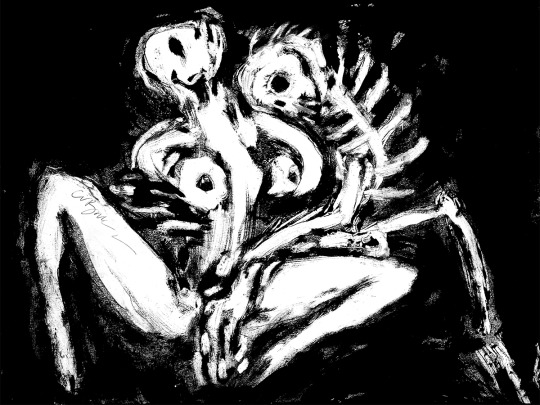
Mirror Mirror 2
an anthology
featuring new comics and drawings by
Lala Albert / Clive Barker / Heather Benjamin / Sean Christensen / Nicole Claveloux / Sean T. Collins / Al Columbia / Dame Darcy / Noel Freibert / Renee French / Meaghan Garvey / Julia Gfrörer / Simon Hanselmann / Hellen Jo / Hadrianus Junius / Aidan Koch / Laura Lannes / Céline Loup / Uno Moralez / Mou / Chloe Piene / Josh Simmons / Carol Swain
horror / pornography / the Gothic / the abject
edited by Sean T. Collins & Julia Gfrörer
published by 2dcloud
Q1 2017 | advance copies Fall 2016
“For darkness restores what light cannot repair”
teaser image by Clive Barker
Mirror Mirror 1 | available now for preorder
“Mad Dogs” thoughts, Season One, Episode Ten: “Needles”
February 8, 2016That there is a Season 2 is a tough thing to complain about. Mad Dogs was entertaining as the dickens from start to finish, its pacing often as good as this kind of “oh shit!” suspense gets, its performances uniformly strong right down to the bit parts, its musings on sacrifice and regret and morality never glib or hamfisted and often quite thoughtful. Plus, with any luck, Allison Tolman and Ted Levine will be along for the ride on a semi-permanent basis next time.
But it’s still tough not to wonder if the show wouldn’t have been better off as a miniseries or anthology. No matter how hard the writers work to justify it, bringing the four friends back together in Belize, or anywhere else for that matter, can’t help but feel like horny teenagers returning to Camp Crystal Lake, or John McClane running into yet another band of terrorist bank robbers only he can stop. As it stands, the series was forced to soft-pedal the confrontation with “Jésus,” introduce Levine’s Conrad Tull but leave him hanging there like an unfinished sentence, and leave many vital questions about Joel and his current situation unanswered (but not in a cliffhanger way—in a “hey, what the hell is up with that?” way). A finite, 10-episode story would almost certainly have yielded a bigger emotional payoff and a more explosive genre-based ending. I’ll be happily watching next year regardless, but perhaps this trip really should have been once in a lifetime.
I liked Mad Dogs a lot, but I got to thinking that even as showrunners have been granted authority to tell and end their stories as they see fit, for the most part (aside from anthology series) they’re still expected to tell those stories over multiple seasons. I wrote about that in my review of the final episode.
“Mad Dogs” thoughts, Season One, Episode Nine: “Seahorse”
February 8, 2016SPOILER ALERT
…Jazmin just doesn’t measure up. She comes across like a bad guy in a bad action movie, all unpredictable mood changes, inappropriate laughter, and the overall demeanor of an ADHD kid who’s gone off her meds. One second she’s playing Luke Skywalker with a machete, the next she’s asking Joel if he’d like to fuck, and the next she’s telling him how sad his kids will be to hear that he died. This manic pixie drug kingpin schtick flattens the character into a collection of tics, and makes it hard to take Joel’s plight seriously. He’s basically being threatened by a Looney Tunes character, whether the CIA wants to recruit her services or not.
“Mad Dogs” thoughts, Season One, Episode Eight: “Broodstock”
February 3, 2016At some point during the eighth episode of Mad Dogs—I believe it was between when the bomb exploded and when the chihuahua got its throat cut—I got to thinking: This shit is hard. I don’t mean survival for Cobi, Joel, Gus, and Lex, mind you—I mean writing it. Like Breaking Bad and Fargo before it, Mad Dogs depends on a plot structure of interlocking catastrophes so intricate you’d practically need those robot arms they use to handle plutonium to pull it off. The go-to comparison is dominoes, with one thing falling on top of the next as everything speeds out of control, but that implies a linearity that doesn’t exist here. TV shows like this are like dominoes if and only if occasionally new dominoes spring up from the ground, or drop out of the sky, or materialize from space, or are fired from a drone piloted by the CIA. They’ve got to simultaneously maintain the tension of knowing something bad’s going to happen and wanting to avoid it, the suspense of not knowing something bad is going to happen but suspecting that it will, the shock of having something bad happen completely out of the blue, the plausibility that all these events could conceivably occur (within a TV show or movie, anyway) without knocking you out of the story with their ridiculousness, the raw mechanical skill to make the action plain entertaining, and the emotional stakes of protagonists and antagonists you enjoy watching, if not care about as people. Even to a writer who can see the wires, so to speak, pulling off this feat feels close to magic.
I reviewed episode 8 of Mad Dogs and wrote quite a bit about both the Breaking Bad model of constant-bad-shit-happening TV and the importance of a great villain to genre storytelling.
“Mad Dogs” thoughts, Season One, Episode Seven: “Ice Cream”
February 1, 2016Remember those episodes of Breaking Bad where the show was less a story than a series of unfortunate events? The ones where no matter what Walt and Jesse tried to do, they were met with a neverending cascade of calamities, each one more unexpected than the last? Okay, yeah, that’s pretty much all the episodes of Breaking Bad. But it fits “Ice Cream,” the seventh ep of Mad Dogs, to a tee as well.
“Mad Dogs” thoughts, Season One, Episode Six: “Leslie”
February 1, 2016Without the great Allison Tolman as a stabilizing and unifying presence, “Leslie,”Mad Dogs’ sixth installment, resumes its previously very, very heavily serialized model. As I’ve said before, the show’s episodes increasingly feel less like cohesive (if to-be-continued) units and more like fifty-plus minutes torn off at random from a ten-hour reel. Think of how different the first half of this ep, with its Outbreak/Contagion quarantine claustrophobia and paranoia, feels from the second, with Joel and Cobi cutting and running and communing with beatific locals and tourists they encounter along the way. You could have rolled the closing credits right in the middle and begun an entirely new episode for all their stylistic and thematic continuity.
“Mad Dogs” thoughts, Season One, Episode Five: “Hat”
January 29, 2016Allison Tolman is a tremendous screen presence and her casting here is a real coup, like plopping a fifth main character right into the action halfway through the season. Even if she doesn’t last—and that’s how it’s looking, though on this show anything’s possible—she transformed the dynamic simply by being there. For one thing, her presence opened up space for kindness between the characters and the people they meet, a note that had been almost entirely absent for hours now. A story with Rochelle in it, however briefly, is a story where our foursome can stop to help scavenging street kids, where Joel can admiringly commune with a local living the good life with his wife and goats up in the mountains, where Gus and Cobi can hold children on their laps and sing songs to them to make them laugh, where Lex can have a kind and quiet conversation about music and life on the road with a person who won’t at some point condescend to his addictions and failures. It’s a story where the black-comedy nightmare can clear up for a few minutes, giving everyone much-needed emotional breathing room.
I reviewed the Allison Tolman episode of Mad Dogs for Decider.
“Mad Dogs” thoughts, Season One, Episode Four: “Flares”
January 28, 2016I’ve never really bought the idea that Amazon and Netflix are doing something materially distinct from HBO and AMC or any other terrestrial TV network. Television has been doing heavy serialization since The Wire, and before that Twin Peaks, and before, during, and after that in every single daytime soap. Netflix and Amazon execs can make all the noise they want about seeing the season rather than the episode as the fundamental storytelling unit, but this too is basically true of every good prestige drama, to one extent or another—just ask David Simon. In my experience, if a streaming series suffers when seen one episode at a time as opposed to in multi-hour chunks, that’s not because streaming TV is a different medium, it’s because the show isn’t that great. Jessica Jones would not have been less a slog had I watched five episodes a day instead of one, you know?
“Mad Dogs” thoughts, Season One, Episode Three: “Well”
January 26, 2016As critiques of Toxic Masculinity™ go, it’s pretty cutting. Who doesn’t love their crime thrillers with a terrifying, gun-toting dwarf in an animal mask mixed in? It’s precisely the kind of surreal badassery such films have trafficked in since the world first heard the phrase “bring out the gimp.” You could read Cobi, Lex, Gus, and Joel trimming the Cat’s claws as Mad Dogs indulging that kind of cinematic cool just long enough to reject it.