
Posts Tagged ‘decider’
“Suburra: Blood on Rome” thoughts, Season One, Episode Seven: “Last Customer”
October 17, 2017Episode seven in fact marks a significant slowdown in the heretofore breakneck speed of the story. A calm before the storm? Perhaps. Whatever the case, it’s more about consolidating the status quo than shaking things up….That’s not to say that it’s boring. Come on, this is Suburra—it doesn’t do boring.
Not a ton to say about episode seven of Suburra: Blood on Rome, which I reviewed for Decider. But the review contains some gifs that’ll show you what I mean about how the show’s visual component makes it feel alive even in a breather of an episode like this one.
“Halt and Catch Fire” thoughts, Season Four, Episodes Nine and Ten: “Search” and “Ten of Swords”
October 16, 2017Halt and Catch Fire is one of the best shows ever made. Judging from the reaction to its two-part series finale this weekend, that’s uncontroversial now, which is an amazing thing to contemplate. From its rough start in Season One to its skin-of-the-teeth renewals for each subsequent year to its status as a critics’ darling that far too few people other than critics were talking about (and even critics let down the side a bit at the beginning of this season), it felt like the Little Engine That Almost Could. But there’s never been a show like it: generous of spirit toward its characters, yet always ruthless about their shortcomings and never sappy in its optimism that they might overcome them. Rooted in genuine moral dilemmas—not black and white choices, not even the shades of gray “I know it’s not the right thing but kinda I want to” stuff of the best antihero shows, but legitimately difficult choices between two strong options, neither of which is a sure thing. The sense that for all its focus on transformative technological advances and for all its temporal and geographical sweep (its four short seasons began in Texas 1981 and ended in California 1994), it all could have taken place in a single room between five characters. Co-creators Christopher Cantwell & Christopher C. Rogers and actors Kerry Bishé, Mackenzie Davis, Toby Huss, Scoot McNairy, and Lee Pace did what their characters could never quite do but never stopped dreaming of doing: They built something that will last.
[…]
I had another TV dream. They don’t happen frequently, but when they do they’re usually about a show that’s got me on the edge of my seat with anticipation for its next episode—a season finale, say, or the next installment in a particularly momentous stretch of the story. When they happen, my brain will conjure up an entire imaginary episode from the ether and play it for me, start to finish, as I “watch.” This has happened to me with shows I loved: The Sopranos, Mad Men, Battlestar Galactica, Lost. It’s happened with shows I didn’t love, too: True DetectiveSeason One was never one of my favorites, but I dreamed not one but two separate terrifying season finales in a single night, so it must have done something right.
But this one was unlike the others. It happened after I’d watched “Search” and “Ten of Swords,” the two-part series finale of Halt and Catch Fire. I went to bed late that night—early that morning, really—and dreamed I was at a cafeteria in midtown Manhattan. I was getting lunch with old friends, beloved coworkers from a job I had ten years ago, who were in town for a convention. Our awful old boss was there too, I guess because we couldn’t think of a way to get rid of him.
Suddenly I feel a tap on the shoulder and hear a cheerful greeting, I turn to my left and see Scoot McNairy and Lee Pace from Halt and Catch Fire sitting down to join me. It’s after the finale aired, and they’re all smiles. They just wanted to thank me for my writing about the show over the years. I turn to hug Scoot and congratulate him on the work they’d all done, then reach across him to shake Lee’s hand; the handshake gets weirdly botched and we joke about it as we try again. Turning to my coworkers (and studiously avoiding my old awful boss) I gesture to the two actors. “These are my friends,” I say.
Then I woke up.
I reviewed the series finale of Halt and Catch Fire, one of the best shows I’ve ever seen, for Decider. Writing about this show for the past four years has been one of the great pleasures of my career. I’m so grateful to everyone who made it possible.
“Suburra: Blood on Rome,” Season One, Episode Six: “Garlic, Oil, and Chili Pepper”
October 16, 2017You’re not watching Suburra to find out who comes out on top of this particular dirty deal; let’s face it, the show only gives you rooting interest in the young guns….Rather, you’re watching Suburra just to watch it — to see three incredibly handsome dudes try to pull one over on the world in a series of striking shot compositions across the length and breadth of the Eternal City.
“Mr. Robot” thoughts, Season Three, Episode One: “eps3.0_power-saver-mode”
October 14, 2017That’s why I insist to this day Mr. Robot Season Two was a tremendous creative success. With the possible exception of Game of Thrones and its allegorical brutality, no show on television last year had the courage to be so honestly discouraged by human nature. That pessimism proved prophetic just a few months later, when Donald Trump’s installation as president ushered in a wave of corporate rapaciousness and white-nationalist belligerence by which we all continue to be battered day after day. Trump and the forces he represents didn’t come out of nowhere, though. While the rest of TV culture was consumed by a dozen different adorkable sitcoms and the Reaganite nostalgia of Stranger Things, Mr. Robot blazed a bleaker, truer path.
In this relatively low-key premiere, that’s the path it continues to tread.
I reviewed this week’s season premiere of Mr. Robot for Decider. I know I said it’s low-key, but there’s one major exception. Let’s put it this way: Here’s how I started the review…
Did…did Mr. Robot just do what I think it did?
“Suburra: Blood on Rome” thoughts, Season One, Episode Five: “She Wolf”
October 14, 2017At the risk of constructing an inelegant metaphor, what do you do when you it a pothole in your plot? Here’s one strategy: Put the pedal to the metal and just drive right the hell on. That’s the approach adopted by Suburra: Blood on Rome.
“Suburra: Blood on Rome” thoughts, Season One, Episode Four: “Enjoy Your Meal”
October 14, 2017So maybe it’s just me. Maybe I want these three crazy mixed-up kids to all get along. I certainly get my wish with Aureliano and Spadino. It’s hard to isolate the sweetest moment in their relationship this episode. Is it Lele telling Aureliano it wasn’t a miracle that saved his life, but Spadino? Is it Spadino asking if Aureliano is alright when Lele comes to the Anacleti compound to set up the meeting, and their shared smile of relief when the answer is yes? Is it the way Spadino and Aurelinao joke around at their meeting, and actually just come right out and say “I probably like you. Can’t I like you?” “Yeah. I like you too”? Is it Spadino’s look of obvious romantic affection for his enemy turned ally when the latter’s not looking? Is it the fact that both of them have ridiculous teenage-boy bedrooms, like college kids who moved back in with their parents and never left? Can I just go with “all of the above”?
I reviewed the fourth episode of Suburra: Blood on Rome for Decider. This one has a plot twist that concerns me.
“Suburra: Blood on Rome” thoughts, Season One, Episode Three: “Rabid Dogs”
October 14, 2017I believe it Chekhov who said that if you introduce a dog in the first episode, you have to shoot it by the third.
I reviewed episode three of Suburra, which is a lot of fun, for Decider.
“Halt and Catch Fire” thoughts, Season Four, Episode Eight: “Goodwill”
October 9, 2017SPOILER ALERT
Halt and Catch Fire is, or was, a drama about the tech industry. Not this week, though. “Goodwill,” one of the most important and best episodes of the entire series, goes by with no tech talk whatsoever. The various enterprises that meant so much to the characters, that consumed so much of their lives, are mentioned, in passing, a grand total of three times. The Symphonic, the Giant, Comet — they each get a line or two, all of them vague allusions to something that once happened in the past or might happen in the future. In the end they were just a platform on which something much more important was built: life, and the connections the series’ main characters made during its course. For Gordon Clark, that life has run its course. That’s all his family, his friends, and the show that brought them to us care about anymore.
In that light, this epochal episode is a stunt on the order of one of Game of Thrones’ big battle setpieces or Breaking Bad’s action and suspense thrillers. Written by Zack Whedon and directed by series co-creator Christopher Cantwell, it’s a confident, courageous demonstration of the show’s strengths, which from around the end of Season One onward have been on display like a product at a computer-industry convention. The tech stuff served as the series’ hook, its anchor, and, in the sense that the characters had to navigate the same Scylla-and-Charybdis passage between creativity and commerce as its creators, its allegory. Now, at Halt’s deepest and darkest moment, it takes a back seat to the thing at which the show has always proven most adept: depicting the relationships between people who have no more of a straightforward story arc, and no greater supply of easy answers, than any of us watching it do.
“Suburra: Blood on Rome” thoughts, Season One, Episode Two: “Plebes and Patricians”
October 9, 2017When I reviewed the series premiere of Suburra: Blood on Rome the other day I made a big deal about how its complicated organized-crime narrative’s many moving parts would probably crowd out the show’s potential with the need to burn through as much plot per episode as possible. There’s a professional reason for that. When you review TV shows for a living you’re not just reviewing the show in question, no matter how hard you try to make that happen — you’re reviewing it against other shows of its kind, and other shows not of its kind, and your overall understanding of how shows work generally. The Netflix release model, which basically opens up a spigot and blasts “Because you watched…” algorithms directly into your piehole, makes dealing with this all the more difficult. If the network is shoving shows down your gullet based on what it thinks you think about other shows, how can you not think about them yourself?
Folks, I goofed. But hey, it happens! I’ll try not to beat myself up about it.
As far as I can tell from its second installment, “Plebes and Patricians,” Suburra rules. When Netflix crime shows from Ozark Season One to Narcos Season Two dutifully but unimaginatively hit genre notes in their first few episodes, keeping you wishing and hoping for a payoff down the line, this fuckin’ thing delivers straight out the gate.
And yeah, I see the contradiction here. After admitting that comparing Suburra to other shows clouded my judgment after the pilot, I’m changing my tune based on…comparing Suburra to other shows. Oh well! As a critic, I’m in the liking-things business — that’s honestly how I see it, which is what makes middling work such a bummer for me. (Though it can be fun to write about.) If I’m going to err, I’d rather err on the side of enthusiasm. Not the kind of enthusiasm that inflates everything into a masterpiece or a life-lesson dispenser — that’s a problem of its own — but the “wheeeeeee, this is fun!” kind. Suburra serves that up by the bucketload.
The thing about roller-coaster rides is that if everything feels weightless, there’s no ride worth taking. You need to feel the weight of the car as you take the plunge, and the sturdiness of the track as it shakes beneath you. I think that’s where Suburra is distinguishing itself most.
Enjoying the hell out of Suburra at the moment. Here’s my review of the second episode for Decider.
“Suburra: Blood on Rome” thoughts, Season One, Episode One: “21 Days”
October 6, 2017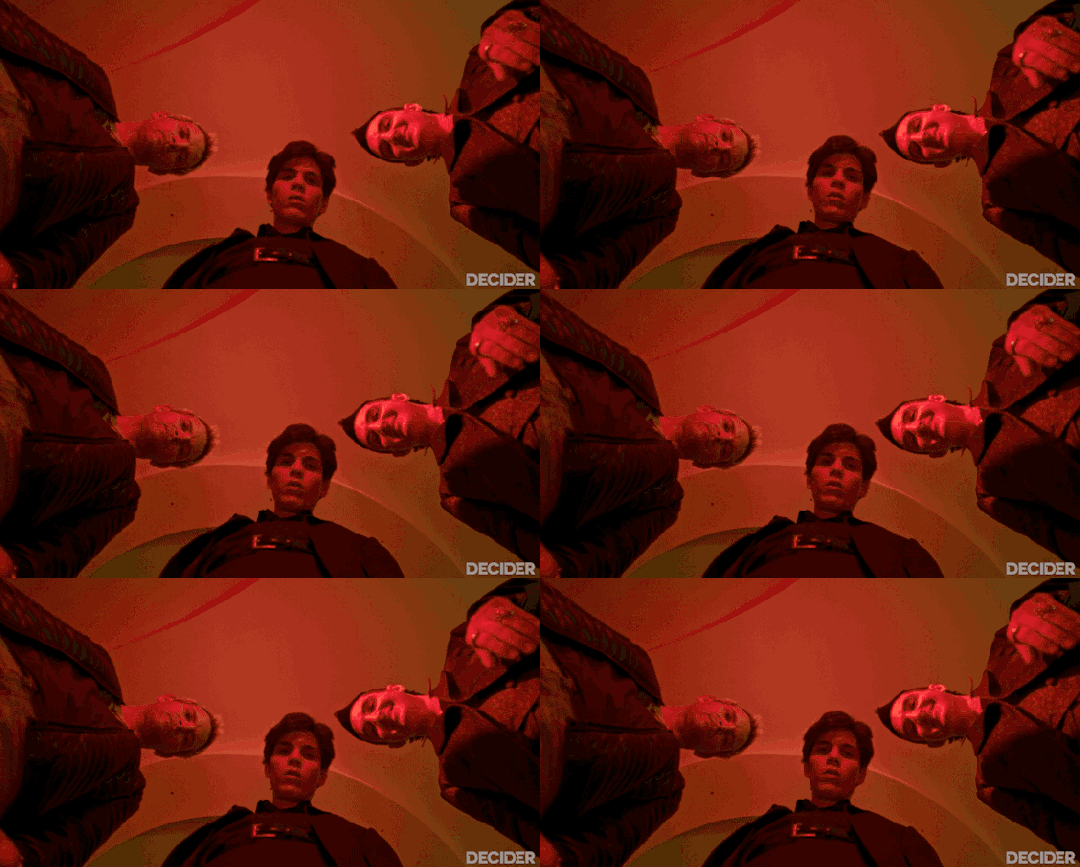
The first thing you notice about Suburra: Blood on Rome, Netflix’s new Italian crime drama, is…well, let’s be frank here. It’s the gigantic coke-fueled priest orgy.
The second thing you notice is that the men on the show are incredibly handsome.
I’m covering Suburra for Decider, starting with this review of the series premiere. The cast is stunning and the score, by Loscil, is lush like little else on TV right now. Worth a look!
“Halt and Catch Fire” thoughts, Season Four, Episode Seven: “Who Needs a Guy”
October 2, 2017SPOILER ALERT
Extraordinary even by the series’ own elevated standards, “Who Needs a Guy” provided the crushing payoff for four years of Halt and Catch Fire. It’s not the first time the show has tugged on its many strings until they all either knotted or came apart in a single scene; the conference-room battle between Cameron and Donna last year comes to mind just for starters. Nor is it the first time the show has handled a character’s death with sensitivity but without sentimentality; again, it did so last season with the suicide of Joe’s apprentice Ryan. But it is the first time these two strengths have been combined, and the effect is stunning, like getting hit with a feather and, somehow, being knocked clear across the room. Written by Lisa Albert and directed by Tricia Brock — both of whom effectively abdicate the episode’s awful final minutes to the show’s surviving core cast, about the smartest thing a writer and director could do — it’s one of the hours we’ll turn to when we want to make the case that Halt and Catch Fire is one of the finest dramas of the prestige-TV era. It left me a wreck for hours. I’m still gutted. I loved it.
I reviewed this weekend’s absolutely stunning episode of Halt and Catch Fire for Decider.
“Halt and Catch Fire” thoughts, Season Four, Episode Six: “A Connection Is Made”
September 27, 2017This weekend I was tweeting excitedly about how good Halt and Catch Fire is. A friend, no stranger to the world of TV drama, replied, “It’s back???” This speaks poorly of how the critical community is covering Halt and Catch Fire. As of this week’s episode, “A Connection Is Made,” it’s one of the richest, loveliest, most unsparing, most humane dramas of the year. And think about the year of dramas we’ve had! We should never, ever shut up about this thing.
I wrote about this weekend’s sumptuous Halt and Catch Fire for Decider.
“Halt and Catch Fire” thoughts, Season Four, Episode Five: “Nowhere Man”
September 24, 2017In the closing montage, Donna loads up Cameron’s infamously difficult video game, while Gordon digs up the painstakingly maintained journals he’d been keeping of his deteriorative brain condition’s progress. Donna cracks the code that had thwarted so many players: Instead of trying to choose a path forward, you move upward instead, beginning a beautiful journey that leads you back home. As she does this, Gordon takes his journals and throws them into the fireplace, seemingly determined to live in the now and stop worrying about the future altogether. The accompaniment for the sequence is PJ Harvey’s “Rid of Me,” a song in which Harvey simultaneously brags about how she’s so irresistible her ex will never want to be free of her, but will wish he never met her all the while. Sound familiar?
I reviewed last week’s episode of Halt and Catch Fire for Decider. This week’s review coming soon.
“Narcos” thoughts, Season Three, Episode Ten: “Going Back to Cali”
September 18, 2017The finale of Narcos Season 2 was the best episode of the series. The finale of Narcos Season Three…isn’t.
…yeah. I reviewed the disappointing finale of Narcos’ aimless third season for Decider.
“Narcos” thoughts, Season Three, Episode Nine: “Todos Los Hombres del Presidente”
September 18, 2017If you need to sum up the problem with Narcos Season 3, you could do a lot worse than to show what victory for Agent Peña and his allies looks like: the Rodriguez Brothers, cozying up behind bars. This is what all of Peña, Feistl, Van Ness, and Salcedo’s efforts have amounted to: the Cali Godfathers, hanging out together in a jail in which they have full rein, their momentary internecine enmities forgotten. What was it all for? You’d have to ask Narcos‘ writers for the answer.
“Narcos” thoughts, Season Three, Episode Eight: “Convivir”
September 18, 2017The star of “Convivir,” Narcos Season 3 Episode 8, is the camera. Once again, standout director Fernando Coimbra lets imagery convey emotion and comment on the plot, in what is otherwise a very straightforwardly shot series. And in this tense, cruel hour of TV, that willingness to show rather than tell matters more than ever.
I liked episode eight of Narcos Season Three quite a bit too. I reviewed it for Decider.
“Narcos” thoughts, Season Three, Episode Seven: “Sin Salida”
September 18, 2017All told, it’s super-engaging genre television. But thanks to director Fernando Coimbra, it’s well made genre television as well. Coimbra lends a certain glow to the nighttime lighting of the city and the base where Peña and Serrano plan the raid. He cleverly mirrors church-door entrances by Pacho and Peña. And he echoes it again when he shows Miguel breaking down from exhaustion and fear in a doorway in his largely destroyed safehouse, emphasizing the fact that unlike the other two men, he’s not moving forward. (It’s actor Francisco Denis’s strongest moment in the role, too.)
Bottom line? This is more like it.
I reviewed episode 7 of Narcos Season 3 — the first one I really liked — for Decider.
“Halt and Catch Fire” thoughts, Season Four, Episode Four: “Tonya and Nancy”
September 11, 2017Can’t any of these people ever do anything that isn’t in some way designed or defined by each other?
Well, no, of course not. That’s the point. That’s the resonance and relevance of Tonya and Nancy — two athletes forever linked by the former’s attack on the latter, and the latter’s response. You can’t tell the story of one without telling the story of the other.
I reviewed yet another lovely episode of Halt and Catch Fire for Decider.
“Narcos” thoughts, Season Three, Episode Six: “Best Laid Plans”
September 11, 2017There are problems on the (nominally) good-guy side of the story, too. Feistl and Van Ness are fun enough to watch, with their Mutt-and-Jeff height difference and the contrast between Van Ness’s uptight demeanor and his awesome collection of ‘90s band t-shirts. (Wu-Tang is for the DEA as well as for the children, apparently!) But poor Javi Peña spends so much time running around by himself — literally running around, in this episode, thanks to his foot chase with Franklin Jurado in the streets of Curaçao — that he might as well be starring in a completely separate show. Without a foil like his former partner Chris Murphy or regular in-person contact with any of the other current main characters (Feistl, Van Ness, Jorge, the Rodriguezes, whoever), his adventures feel disconnected and weightless. His dull narration (the episode’s big concluding speech begins with “Things don’t always go according to plan” — no shit!) does him no favors either.
“Narcos” thoughts, Season Three, Episode Five: “MRO”
September 11, 2017“It was a mistake, not stopping it sooner,” says Christina Jurado of her life near the beating financial heart of the world’s largest drug cartel. “Have you ever done anything like that?” “I have,” responds Javi Peña, presumably thinking of his role in starting the Los Pepes death squads, but perhaps also rueing ruined romantic entanglements, or just his general penchant for being a pain in everyone’s ass.
This exchange (between Donna from Halt and Catch Fire and the Red Viper from Game of Thrones, as if my dreams were doing the casting) sums up “MRO,” the fifth episode of Narcos Season 3. A whole lot of people are reaching the point where they’re in over their heads, and should have stopped swimming away from the shore a long time ago. Some, like Christina — whom Javi is pressuring to persuade her cartel financier husband to turn on his bosses — realize it. Others don’t.