
Posts Tagged ‘comics’
Carnival of souls: Lots and lots of webcomics and illustrations, Morrison & Mignola interviews, Lady Gaga’s “Born This Way” reviewed, more
February 14, 2011* Recently on Robot 6:
* I’ve barely talked about the Egyptian Revolution in public at all; I try to explain why in this piece on Domatille Collardey and Sarah Glidden’s webcomic “Egypt from 5,000 Miles Away”;

* Valentine’s Day comics #1: In the tradition of Henry & Glenn Forever comes Johnny Ryan’s Mark Mothersbaugh/Gary Numan slashfic strip “Mark + Gary Forever”;

* Valentine’s Day comics #2: a great made-up myth by webcomic wunderkind Emily Carroll;

* and hey, did you know a bunch of Ben Katchor’s Metropolis magazine strips are online?

* There’s a pair of new, off-the-beaten-path interviews with the two prime movers behind the very best serialized superhero comics of the past half-decade. First up, Alex Carr of Amazon.com’s Omnivoracious blog interviews Grant Morrison. One thing I like about this interview, and it’s a minor thing but still kind of neat to my mind, is that since it’s for Amazon, it refers to Morrison’s comics exclusively in terms of their collected editions. Anyway, this is part one of a longer interview, and focuses mainly on Dick Grayson and Damian Wayne, The Return of Bruce Wayne, Joe the Barbarian, 18 Days, and Morrison’s desire to one day tackle the Flash and Wonder Woman. There’s a bit that explains an object that shows up in the Stone Age with time-displaced Bruce Wayne that I for one found extremely helpful. (Via Kevin Melrose.)
* Next up, BLDGBLOG interviews B.P.R.D. and Hellboy impresario Mike Mignola, with an unusual and fascinating focus on Mignola’s use of architecture and environment. It’s quite neat to hear that Mignola prefers Lovecraft’s settings to his bestiary. And this passage was wonderful:
Well, once upon a time, when I started all this stuff, the one thing I didn’t want to draw at all was buildings. Because, growing up in California, buildings to me were an exercise in using a ruler and perspective, and shit like that. I just had no interest in drawing that kind of stuff.
It was only after having lived in New York for a while, around really old buildings—where you see that, actually, this building’s kind of sagging and that building’s kind of leaning against the other building next door and this chimney looks like, if those three wires weren’t there, it would all fall over, and that fire escape is at some odd angle—that’s when I really started to love architecture.
(Via Tom Spurgeon.)
* I’m not sold on Austin English’s comics, but I greatly enjoyed his Inkstuds guest post on the artists and cartoonists who influenced him, since it reminded me of the existence of the D’Aulaires, whom I’d completely and shamefully forgotten.

* The cartoonist L. Nichols writes on Joe Sacco’s word balloon and caption box placement, with copious marked-up examples. I’ve talked about all the heavy lifting they do, too. Very much worth your time — and it’s maybe worth reading it and then revisiting that Emily Carroll strip above, too, to see how such techniques work on the web as well as the printed page.

* What does this lovely Justin Green illustration for The New Yorker have to do with Colin Ferguson, the man who shot 25 people on the Long Island Rail Road before it pulled into a station located about five minutes from where I grew up? Let Green explain it to you.

* Jesus Christ, Michael DeForge.

* My friend Matt Rota sure can draw.

* I’m pretty tired of designy Internet-supported minimalist movie posters, but Sam Smith’s take on David Lynch’s Mullholland Dr. maps so neatly onto my personal iconography for the film and Lynch’s work and supernatural horror in general that how could I resist? (Via Shaggy.)

* Allow me to be the 3,892nd person to excitedly inform you that Radiohead are releasing their new album The King of Limbs on Saturday. I really, really enjoyed In Rainbows, thinking it was their best thing since Kid A and digging it hard enough to go back and reevaluate Hail to the Thief (the quicker stuff is really strong, the slow songs aren’t except for “The Gloaming”; still not a big Amnesiac person), so I’m looking forward to this.
* This Rich Juzwiak review of Lady Gaga’s new song “Born This Way” is what finally sold me on it. (Finally being a matter of, like, two days, but whatever.) At first listen I wasn’t crazy about it, because it seems really simple and obvious. I mean, i understand everything she’s doing here — she’s making a gay club anthem for the ages; she’s trying to have the final word on the current UNF UNF UNF UNF four-on-the-floor pop-house revival; she’s trumping earlier, vaguer, far less actually gay “yay empowerment, yay gays” songs by Ke$ha and Katy Perry and Pink; she’s being way more uplifiting and positive, and less sleazy and focused on sex and fame, than all her other hits. So it’s definitely smart on all those counts, and successful on all those counts. It’s just way less interesting to me than the songs from The Fame Monster, especially “Bad Romance,” which was a knockout I’d never heard anything like before, like Britney covering Marilyn Manson. “Born This Way,” by contrast, is just kind of a peppy dance song. And as far as the ubiquitous comparisons to Madonna’s “Express Yourself” goes, “Born This Way” doesn’t really sound like it in any way that matters — except that the melody for “Born This Way”‘s chorus is totally cribbed from the “so if you want it right now, better make him show you how” part from “Express Yourself”. So you get to the big anthemic chorus part for the big anthemic song, and it’s a snatch of someone else’s melody, and therefore it just didn’t click for me the way it was supposed to. And I say this as someone who’s totally fine with the ABBA/Ace of Base riff she did with “Alejandro,” or the “All the Young Dudes” thing she did with “Speechless,” and so on and so forth. The weird thing is that those two songs actually sound more like their inspirations overall than this one sounds like Madonna, but there’s no specific passage in either of them that sounds as much like a specific passage in their inspirations as the chorus for “Born This Way” sounds like that one bit of “Express Yourself.” But where Juzwiak saves the day is by likening the song not primarily to “Express Yourself,” but to Patrick Hernandez’s unbelievably wonderful disco anthem “Born to Be Alive.” “Born to Be Alive” is one of my all-time favorite songs by anyone ever, a massive onslaught of delightful sounds (“Yes we were BAWRN! BAWRN! BAWRN!”), kind of ridiculous lyrics (a lot of it doesn’t really rhyme or even make sense grammatically), and cockeyed optimism. And that’s pretty much what “Born This Way” is. Hearing it with those ears gives me a workaround for the “Hey this sounds like ‘Express Yourself'” bug when it comes up.
* And in case you just saw the big Destructor image and clicked right through it in my early post, here’s part one of my big interview about Destructor with The Cool Kids Table’s Ben Morse and Kiel Phegley.
Comics Time: The Dark Knight Strikes Again
February 14, 2011
The Dark Knight Strikes Again
Frank Miller, writer/artist
Lynn Varley, colorist
DC, 2003
256 pages
$19.99
Buy it from Amazon.com

Originally posted on October 28, 2009 at The Savage Critic(s).
Years ago I came across an eye-opening quote from Jaron Lanier in the liner notes of the reissued Gary Numan album The Pleasure Principle. Google reveals that it was pulled from this Wired essay. Here’s what it said:
“Style used to be, in part, a record of the technological limitations of the media of each period. The sound of The Beatles was the sound of what you could do if you pushed a ’60s-era recording studio absolutely as far as it could go. Artists long for limitations; excessive freedom casts us into a vacuum. We are vulnerable to becoming jittery and aimless, like children with nothing to do. That is why narrow simulations of ‘vintage’ music synthesizers are hotter right now than more flexible and powerful machines. Digital artists also face constraints in their tools, of course, but often these constraints are so distant, scattered, and rapidly changing that they can’t be pushed against in a sustained way.”
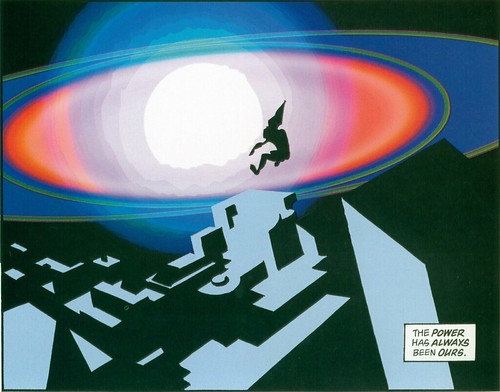
Lanier wrote that in 1997. I’m actually not sure which vintage-synth resurgence he was talking about, unless you count the Rentals or something (although everyone and their grandfather was namechecking Gary Numan back then, which was sort of the point of including the quote in the liner notes. Maybe he meant Boards of Canada?).
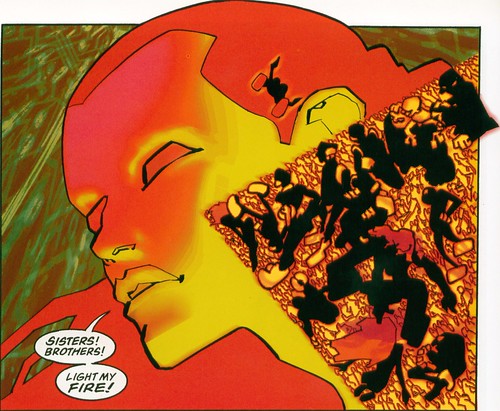
But golly, it sure seems prescient now, huh? Here we are, in the post-electroclash, post-Neptunes, post-DFA era. The hot indie-rock microgenre is glo-fi, which sounds like playing a cassette of your favorite shiny happy pop song when you were three years old after it’s sat in the sun-cooked tape deck of your mom’s Buick for about 20 years. And my single favorite musical moment of last year, as harrowing as those songs are soothing, was the part of the universally acclaimed Portishead comeback album that sounded exactly like something from a John Carpenter film score. (It’s at the 3:51 mark. It’s awesome, isn’t it?)
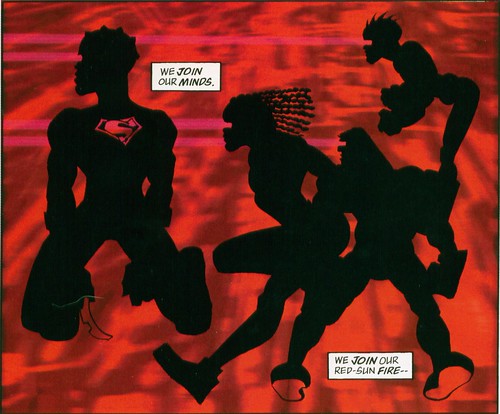
And that’s just on the music end. Visually? Take a look at Heavy Light, a show at the Deitch Gallery this summer featuring a murderers’ row of video artist specializing in primary-color overload and technique that doesn’t just accentuate but revels in its own limitations. Foremost among them, at least for us comics folks, is Ben Jones, member of the hugely influential underground collective Paper Rad and recent reinterpreter of the massively mainstream The Simpsons and Where the Wild Things Are. But the ones with the widest cultural import at the moment are Tim Heidecker and Eric Wareheim of the astonishingly funny and bizarre Adult Swim series Tim & Eric Awesome Show, Great Job!. Their color palette is garish, their digital manipulations are knowingly crude, and their analog experiments are even more so. When they combine the three, god help us all. And let’s not forget Wareheim’s unforgettable, magisterially NSFW collaboration with fellow Heavy Light contributor and Gary Panter collaborator Devin Flynn.

Yeah, most of these guys are playing it either for laughs or for sheer mind-melting overload, but I think there’s frequently beauty in there to rival what some of the musicians are doing. (Click again on that first Ben Jones link.) And (thank you Internet God) this amazing video by Peppermelon shows that you can do action, awe, even sensuality with this aesthetic. The rawness, the brightness, the willingness to let the seams show–it all gives you something to push against again.
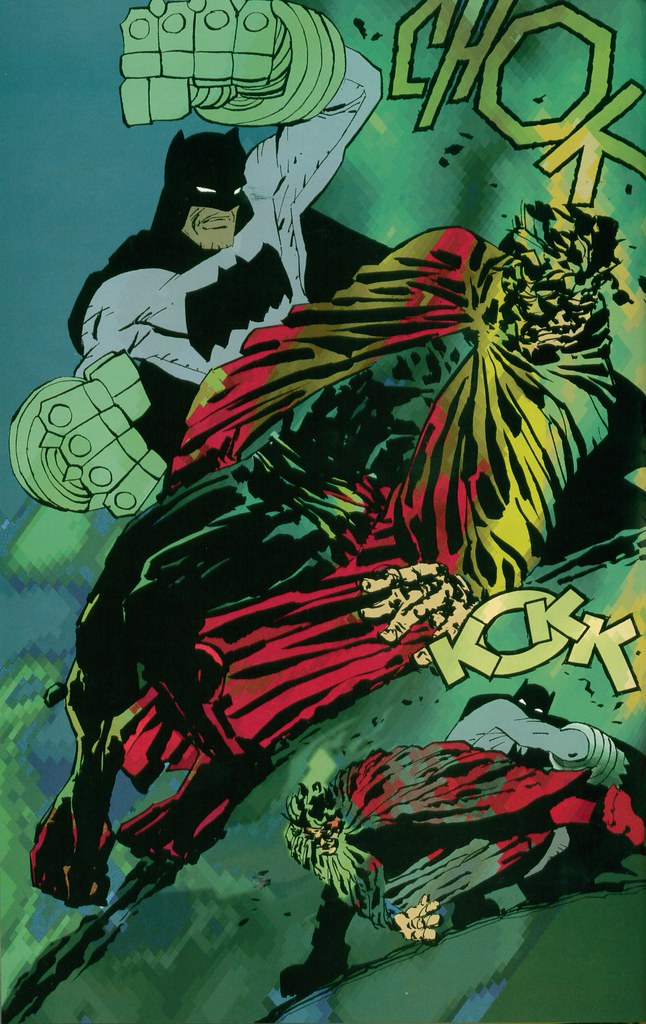
When I’ve written about The Dark Knight Strikes Again I’ve been fond of saying it was years ahead of its time. Sometime in the past week and a half or so, there was a day when I listened to Washed Out, then stumbled across that Deitch show link in an old bookmark, then watched an episode of Tim & Eric, then came across that Ben Jones WTWTA strip–and suddenly I realized I was right! Not that it matters–at all–whether or not Miller and Varley have any real continuity with any of this material. They certainly didn’t get there before Paper Rad, unless I’m wildly mistaken. But then half the fun of DKSA is spotting all the stuff Miller does, from naked newscasters to superheroes ruling the earth rather than just guarding it, seemingly without realizing someone’s done it first. What difference would that make? Meanwhile, in all the off-the-beaten-path references Frank Santoro has cited during the production of his Ben Jones collaboration Cold Heat–essentially a glo-fi comic book–I haven’t heard word one about this book. But I’m not saying Miller & Varley paved the way for anything. I’m saying that when Miller abandoned his chops (and, for the most part, backgrounds!) for the down and dirty styles he (thought he) saw at SPX, and when Varley decided to use photoshop to call attention to itself rather than to create a simulacrum of something else, they were using the same tools, tapping the same vein, seeking the same sense of excitement, discovery, and trailblazing as these newer movements.
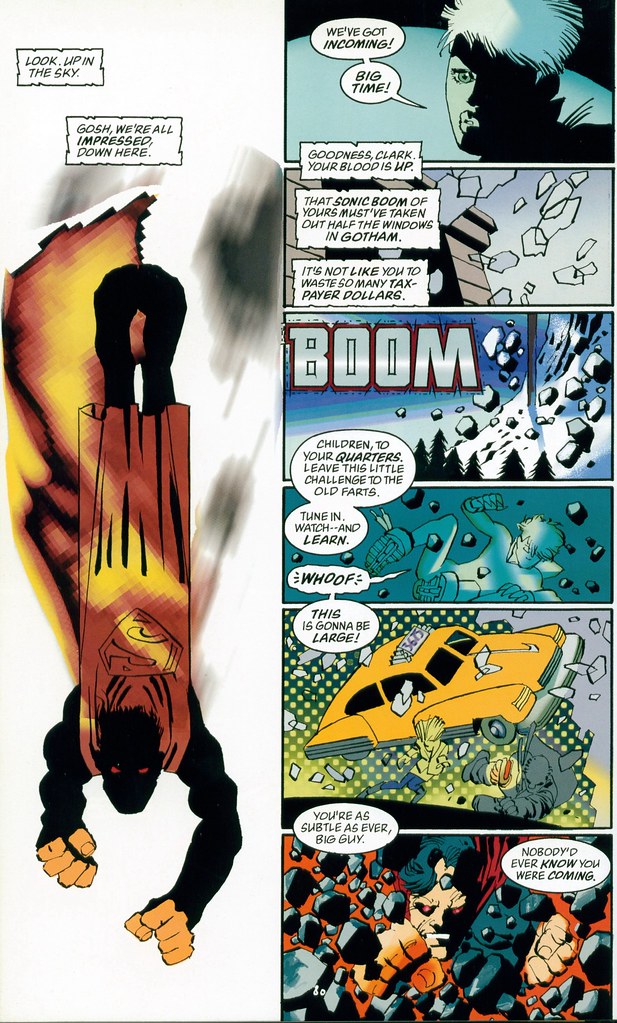
I’ve also been fond of likening DKSA to proto-punk, taking a cue from Tony Millionaire’s jacket-wrap blurb: “Miller has done for comics what the Ramones et al have done for music. This book looks like it was done by a guy with a pen and his girlfriend on an iMac.” The idea is that it’s raw, it’s loud, it’s brash, it doesn’t have time for the usual niceties–it’s getting comics back to their primal pulp roots. I spoke to Miller several times during and following the release of the book, one time for print, and he said as much. (I certainly never would have bought the cockamamie idea that this thing was some sort of corporate cash-grab even if he’d never said word one.) He even mentioned to me his belief that the brightly colored costumes of the early superheroes served mainly the dual purpose of a) telling them apart from one another, and b) proving they weren’t naked, so even his thinking in historical terms had him ready to peel back from realism as a form of reclamation. And of course it’s not exactly like the story was at all subtle in this regard: Batman and his army came back to overthrow the dictators that kept us fat and happy and turned the superheroes into boring wimps. But ultimately the punk comparisons were just a little off. Born less of despair than of delight, filled less with anger than with joy, The Dark Knight Strikes Again anticipated a way of doing things that is not intended to look or sound effortless, that draws attention to its own construction, but which–with every pixelization and artifact, with every crayolafied visual and left-in glitch, with every burbly synth and sky-bright color–pushes against that construction and springs out into something wild and wonderful.
Carnival of souls: Strange Tales II cover, Game of Thrones pronunciation guide, more
February 11, 2011* Hot cha, look at the cover for the Strange Tales II hardcover! Art by Kate Beaton, design by Paul Hornschemeier, very silly jacket copy by yours truly.

* Very useful: HBO’s official pronunciation guide for Game of Thrones. The “CAT-lin” thing blows my mind, but I’ve heard George R.R. Martin pronounce it that way, so it’s canon. Westeros notes that one difference between GRRM’s preferred pronunciations and the show’s is that they’ll be pronouncing the honorific “Ser” as “SAIR” rather than “SIR.” This makes sense to me, actually: In the books, the changed spelling was sufficient exotification, but viewers can’t hear a spelling change.
* Oh man, JEEZ, this Kate Beaton panel. JEEZ.

* Another fine, candid CBR interview with Marvel’s Tom Brevoort. This time he reveals that Nick Spencer is taking over Secret Avengers because Ed Brubaker wasn’t having a good time writing it, just for example. And whoa, those are some nice colors on that Thor #620 preview! Is that Pasqual Ferry doing his own colors? I forget. Anyway, you may disagree with some of what Brevoort says, but wouldn’t it be marvelous if all the major figures in the North American comics industry were this vocally opinionated and forthright?

* Real Life Horror, Actual Class Warfare Edition: Republican Governor Scott Walker of Wisconsin is threatening to deploy the National Guard to help him take away the collective bargaining rights of state employees. (Via Atrios.)

Comics Time: All-Star Superman
February 11, 2011
All-Star Superman Vols. 1 & 2
Grant Morrison, writer
Frank Quitely, artist
DC, 2008-2010, believe it or not
160 pages each
$12.99 each
Buy them from Amazon.com

Originally posted on March 11, 2010 at The Savage Critic(s).
The cheeky thing to say about the brand-new out-of-continuity world Grant Morrison constructed to house his idea of the ideal Superman story is that it’s very much like the DC Universe we already know, but without backgrounds. Like John Cassaday, another all-time great superhero artist currently working, Frank Quitely isn’t one for filling in what’s going on behind the action. One wonders what he’d do with a manga-style studio set-up, with a team of young, hungry Glaswegians diligently constructing a photo-ref Metropolis for his brawny, beady-eyed men and leggy, lippy women to inhabit.
But, y’know, whatever. So walls and skyscrapers tend to be flat, featureless rectangles. Why not give colorist/digital inker Jamie Grant big, wide-open canvases for his sullen sunset-reds and bubblegum neon-purples and beatific sky-blues? We’re not quite in Lynn Varley Dark Knight Strikes Again territory here, but the luminous, futuristic rainbow sheen Grant gives so much of the space of each page–not to mention the outfits of Superman, Leo Quintum, Lex Luthor, Samson & Atlas, Krull, the Kryptonians and Kandorians, Super-Lois, and so on–ends up being a huge part of the book’s visual appeal. And thematically resonant to boot! Morrison’s Superman all but radiates positivity and peace, from the covers’ Buddha smiles on down; a glance at the colors on any given page indicates that whatever else is in store, it’s gonna be bright.
Moreover, why not focus on bringing to life the physical business that carries so much of the weight of Morrison’s writing? The relative strengths and deficiencies of his various collaborators in this regard (or, if you prefer, of Morrison, in terms of accommodating said collaborators) has been much discussed, so we can probably take it as read. But when I think of this series, I think of those little physical beats first and foremost. Samson’s little hop-step as he tosses a killer dino-person into space while saying “Yo-ho, Superman!”…Jimmy Olsen’s girlfriend Lucy’s bent leg as she sits on the floor watching TV just before propositioning him…clumsy, oafish Clark Kent bumping into an angry dude just to get him out of the way of falling debris…the Black-K-corrupted Superman quietly crunching the corner of his desk with his bare hands…Doomsday-Jimmy literally lifting himself up off the ground to better pound Evil Superman’s head into the concrete…the way super-powered Lex Luthor shoulders up against a crunching truck as it crashes into him…the sidelong look on Leo Quintum’s face as he warns Superman he could be “the Devil himself”…that wonderful sequence where Superman takes a break to rescue a suicidal goth…Lois Lane’s hair at pretty much every instant…You could go whole runs, good runs, of other superhero comics and be sustained only by only one or two such magical moments. (In Superman terms, I’m a big fan of that climactic “I hate you” in the Johns/Busiek/Woods/Guedes Up, Up & Away!) This series has several per issue.
And the story is a fine one. Again, it’s common knowledge that rather than retelling Superman’s origin (a task it relegates to a single page) or frog-marching us through a souped-up celebration of the Man of Steel’s underrated rogues gallery (the weapon of choice for Geoff Johns’s equally underrated Action Comics run), All-Star Superman pits its title character, directly or indirectly, against an array of Superman manques. The key is that Superman alternately trounces the bad ones and betters the good ones not through his superior but morally neutral brains or brawn, though he has both in spades, but through his noblest qualities: Creativity, cooperation, kindness, selflessness, optimism, love for his family and friends. I suppose it’s no secret that for Morrison, the ultimate superpower of his superheroes is “awesomeness,” but Superman’s awesomeness here is much different than that of, say, Morrison’s Batman. Batman’s the guy you wanna be; Superman’s the guy you know you ought to be, if only you could. The decency fantasy writ large.
Meanwhile, bubbling along in the background are the usual Morrisonian mysteries. Pick this thing apart (mostly by focusing on, again, Quitely’s work with character design and body language) and you can maybe tease out the secret identity of Leo Quintum, the future of both Superman and Lex Luthor, assorted connections to Morrison’s other DC work, and so on. But the nice thing is that you don’t have to do any of that. Morrison’s work tends to reward repeat readings because it doesn’t beat you about the head and neck with everything it has to offer the first time around. You can tune in for the upbeat, exciting adventure comic–a clever, contemporary update on the old puzzle/game/make-believe ’60s mode of Superman storytelling in lieu of today’s ultraviolence, but with enough punching to keep it entertaining (sorry, Bryan Singer). But you can come back to peer at the meticulous construction of the thing, or Morrison’s deft pointillist scripting, or the clues, or any other single element, like the way that when I listen to “Once in a Lifetime” I’ll focus on just the rhythm guitar, or just the drums. Pretty much no matter what you choose to concentrate on, it’s just a wonderfully pleasurable comic to read.

Carnival of souls: The fate of Big Numbers #4, BookScan, pood, more
February 10, 2011* Al Columbia tells Inkstuds he destroyed the art for his and Alan Moore’s Big Numbers #4 to make an album cover for his roommates in the band Sebadoh. I really don’t know what else to say about that, except that the actual story has ended up being even better than the rumors suggested.
* Again, please do listen to Al Columbia’s entire interview with Inkstuds’ Robin McConnell; an absolutely fascinating way for comics lovers and Columbiaologists to spend two hours. He comes across as an enormously affable guy, admirably cognizant of and secure in his talents and his limitations, and prone to dropping the occasional deeply troubling revelation into the conversation at a moment’s notice.
* pood #3 hits stores April 20th; you can order it through Previews now.
* Retailer and commentator Brian Hibbs has posted his annual look at the BookScan graphic novel/comics sales figures for the bookstore market. It makes for fascinating, if occasionally grim, reading. I think you’ll be surprised by just how well-represented the major corporate prose publishers are on the lists; it can be hard to tell, because their comics releases tend to be spread between various imprints. Unfortunately for fight fans, Brian didn’t include his customary comparisons of the bookstore market to the Direct Market of comic specialty shops, and thus failed to provoke the customary Brian Hibbs/Tom Spurgeon reenactment of the Roddy Piper/Keith David fight from They Live over the conclusions drawn in those comparisons.
* I don’t usually comment on the weekly serial comics releases, but I want to state for the record someplace less ephemeral than twitter that this week’s The Walking Dead #81 from Robert Kirkman and Charlie Adlard has to be one of the best issues of the series. There’s a line in it that made me say “Oof” and sort of shake my head, and that’s quite aside from whatever zombie-related developments may or may not take place.
* This reminds me that I should have said something similar about The Invincible Iron Man #500 — I mean, I said on Twitter that it was the best issue of the Matt Fraction/Salvador Larroca run, but I want to say it here too. I enjoyed the flashforwards, I thought the recursive structure was well thought-out and well-executed and also fun to read and unravel rather than just being showoffy or self-satisfied, the action was slam-bang, and Fraction wrote a Spider-Man cameo that actually made me laugh out loud at one point. Plus it boasted fine art from a variety of contributors, including Larroca, Nathan Fox, Kano, and Carmine di Giandomenico. Thumbs up.
Thought of the day
February 9, 2011I wonder if Nick Gazin and Vice stopped tagging their comics-related posts with “comics” so that the comics-only Vice RSS feed I made wouldn’t work anymore.
Carnival of souls: Joyce Farmer, CF, Comix Cube, more
February 9, 2011* CBR has a pretty extraordinary Joyce Farmer in-store appearance report. Man, it sounds like she tore her guts out to make that book.
* Matt Seneca interviews CF for the Hooded Utilitarian. One of the highlights is CF’s impassioned denial that he’s encoding occult symbolism of any sort into Powr Mastrs. And he really comes out swinging in favor of story-based comics:
I’m aware that there are young people right now trying to make moves in comics and deny the story, but comics are a storytelling medium, more or less. They can be poetic in the hands of one who “knows” (John Porcellino), but comics are designed to tell stories of some kind. So in a way you’re asking “why comics?”.
Stories are actually our history, our knowledge, our wisdom. We can’t live without them! Stories are unique in their ability to speak on many levels at once in a very intimate way. I’m drawn to that infinity of possibility. I want to talk about “everything” with my work, but in an elegant and economical way. Comics are perfect for this. So we have funny jokes, economics, significant and insignificant events, cruelty, violence, eroticism, death, and tranquility within one work. It’s a visual world, with exclusive abilities, living in time…. and still so simple. That to me is very beautiful. This is what comics are for… if I want to do other things, I make a painting, a sculpture, or music. There’s no excuse for abusing comics. Of course we can play with the idea of “story”, and I think that’s a great, worthy thing to do, but I want the characters and ideas to always remain legible within that experiment.
* Today’s look at the work of Uno Moralez seemed to go over pretty well; here’s his Tumblr. (Via Same Hat!)
* This looks promising: The writers and cartoonists L. Nichols, Darryl Ayo Brathwaite, and Kevin Czapiewski have started a group blog called Comix Cube, where they’re mostly talking about influence and process and such, and in refreshingly personal terms. Highlights so far? Czap’s review of Blaise Larmee’s 2001, and his post touching on (among other things) one of the greatest comics of all time, Kevin Huizenga’s “A Sunset.” To me that’s the “Here” of the ’00s. Like Czap, I too was floored by that strip — it absolutely recalibrated my understanding of what comics were capable of. I think it’s maybe the underdiscussed comic of the past ten years.
* I’m tabling this till I can actually read the book, and god knows when that will be, but at first scan, Charles Hatfield’s review of James Stokoe’s Orc Stain, comparing it at length to other acts of fantasy-narrative worldbuilding and to D&D, looks like it’s working some very fertile ground.
* Dan Nadel explains Fort Thunder. Readers looking for a canonical list of Fort residents will come away confused, though, so make sure to consult The Official Handbook of the Fort Thunder Universe if you have any questions.
* Graeme McMillan loved Nick Bertozzi’s Lewis & Clark. Can’t wait to check this one out; Bertozzi’s historical comics have historically been beasts.
* Spider-Man’s joining the Fantastic Four (again). Sure, I’ll eat it. Spidey’s got a history with those characters, he’ll give the book some comic relief, the Hickman/Epting FF run has been really entertaining so far, and I like costume color changes on principle. Why not?
* Here’s an amusingly complete recap of the past fifty or so episodes of Jesse Moynihan’s cosmic-realist webcomic Forming. It’s a bit like reading a Wikipedia entry on The Young & the Restless, only instead of Victor Newman, there’s Ghob King of the Gnomes.
* This is just fine, fine writing on “Welcome to the Jungle” and Guns n’ Roses by Mike Barthel.
* I’m less nuts about Grayson Currin’s rave review of James Blake’s self-titled full-length album for Pitchfork, because given that the record’s big departure from Blake’s previous, shorter releases is the introduction of singing, it seems like the lyrics should have been discussed more, which is to say at all. This goes double because the lyrics are so minimalist, and therefore so direct. But I could just be saying that because the singing and the lyrics are what sold me on Blake at last, after a bunch of instrumental EPs that I thought were kind of undistinguished versions of things I’d heard before as far back as Burial and as recently as the last Four Tet record. By contrast, James Blake feels like the emergence of a bonafide pop songwriting tradition with mid-to-late-’90s Aphex Twin at its roots, which couldn’t be more up my alley. (That said, when I hear the phrase “Joni Mitchell cover,” I reach for my gun.)
Comics Time: Various pieces by Uno Moralez
February 9, 2011
Various comics and illustrations by Uno Moralez
Uno Moralez, writer/artist
self-published, 2011-
Read them for free at UnoMoralez.com
I’ve been struggling mightily to put my finger on what the art and comics of Uno Moralez remind me of. I got that he draws the faces and figures of his characters to evoke that weird frisson you get when you see commercial illustration from other cultures, where what’s perfectly normal in (say) Eastern Europe or the Indian subcontinent or Southeast Asia or Central America looks just slightly off-kilter and disconcerting to us. And I got that he paces his horror comics with the attention to narrative economy and rhythm of a dark Nick Gurewitch. (That comic about the kid and his telescope gave me panicky giggles with each subsequent reveal.) And I got that there’s a massive, in-your-face dose of kink and smut, tying it to similar traditions in Japanese illustrations and comics and also reinforcing that “I shouldn’t be seeing this” feeling. But that weird, glitchy computer drawing style — what is that all about? Then it hit me: It looks like a black-and-white version of the still images they used as cut scenes in old 8-bit Nintendo games. It feels wrong to apply that aesthetic to these horrific images and stories; and because the style is so mechanical, it’s a wrongness that feels as though it has settled into and infected the very digital medium conveying it — the computer equivalent of Pim and Francie‘s Golden Age animation studio gone horribly wrong. Put it all together and you’ve got one of the most impressive and fully formed horror aesthetics I’ve seen…well, since Michael DeForge, I suppose, coupled with that same “whoa” factor I got from the format and pacing of Emily Carroll’s brilliantly assembled “His Face All Red.” Jeepers creepers, does this person hit my buttons.
(Via Zack Soto via Jillian Tamaki via Ryan Sands)
Brief carnival of souls: The Wicker Tree, Spider-Man: Turn Off the Dark, “Here”
February 8, 2011* The first trailer for Robin Hardy’s The Wicker Tree is out. It’s cut for maximum red-band-osity, but aside from that it does indeed look intriguingly weird, as befits the spiritual (if not literal) sequel/remake/reboot of Hardy’s own The Wicker Man, one of the most intriguingly weird films of all time. At this point I should probably abandon even the pretense of going to see interesting-looking horror movies in the theater — I still haven’t seen fucking Midnight Meat Train, let alone Monsters — but this could be entertaining.
The Wicker Tree – Trailer
Uploaded by dreadcentral.
* My Robot 6 colleague Kevin Melrose has the best round-up of the critical beatdown Spider-Man: Turn Off the Dark took in today’s papers, and the best headline for it as well. One silver lining I think we can all hope for for this thing is that it could maybe serve as the “Uncle Ben getting murdered”-type catalyst for a late-period U2 creative self-reevaluation and renaissance, which is badly needed right about now. (Fun fact: In the show, Uncle Ben dies not from a burglar that Peter Parker failed to stop, but from an unrelated car accident.)
* Hey, Richard McGuire’s “Here” is online in its entirety. One of the all-time great comics.

Carnival of souls: Comic-Con, Al Columbia, Brandon Graham, more
February 7, 2011* The San Diego Comic-Con 2011 completely sold out in one day. Zoinks. Tom Spurgeon has further thoughts, centering on the fact that the show still puts up a world-class slate of comics programming and exhibitors and that the programming end, at least, is better attended now than ever — but that none of that may matter if the way that tickets to the show are sold redound to the movie-trailer crowd’s near exclusive benefit. It’s not clear that that’s the case, however. One thing that seems abundantly clear is that the days of SDCC being something a casual or curious person could plop themselves into the day of, or even the month of, are loooooooong gone, never to return; everyone’s expectations should be recalibrated from there.
* Saving this for when I have the chance to really listen: Inkstuds interviews Al Columbia for two hours. Worth it for the below header image alone:

* Tokyopop is looking into publishing a collection of Brandon Graham’s King City at the extra-large trim size of its Image Comics serial-comic incarnation. I look forward to reading it! Via Frank Santoro, who has more.
* Now this is freaking heartwarming, doubly so if you’ve read the books: The girl who plays Sansa Stark in Game of Thrones has adopted the dog who plays Sansa’s direwolf Lady. That’s the happy pair with the young actors who play Bran and Arya. <3 <3 <3

* Speaking of A Song of Ice and Fire, I agree with the assessment of regular commenter Hob, who emailed me a link to this astonishing map of Westeros by Other-in-Law with the message “Possibly the best fan art I’ve ever seen.” Click the image to see the whole thing, and more maps from ASoIaF besides.

* The Hobbit starts shooting on Monday, March 21, 2011.
* The Australian magazine The Lifted Brow looks interesting — the current issue boasts contributions from comickers Eddie Campbell, Lisa Hanawalt, Noel Freibert, Ron Regé Jr., and Lane Milburn. (Via Mr. Freibert.)

* Interesting list of the Seven Deadly Sins that crappy horror movies commit from Tawnya Bhattacharya. I don’t agree with them all — what inner demon of Sally’s did Leatherface represent in the original Texas Chain Saw Massacre? Her childhood fascination with the zebras on the wallpaper in her grandparents’ house? — but so many horror movies are colossal wastes of time that it behooves us to try to understand why. (Via Jason Adams.)
* Rob Humanick reminds us that Shutter Island > Inception.
* Headline of the Day: One in 50 Troops in Afghanistan Is a Robot
* He’s certainly an expert on leadership vacuums, I’ll say that much.
* Is it just me or does R. Fiore’s review of Acme Novelty Library #20 get just about everything wrong, from matters of basic reading comprehension (the veracity of Lint’s son’s memoir) and aesthetic judgment (the quality of the memoir’s art) to the overall assessment (Ware needs to buckle down and tell a by-god STORY already!).
* Finally, do not tl;dr Lawrence Wright’s enormously long, enormously compelling New Yorker article on the Church of Scientology, as seen through the eyes of its most socially prominent defector, Crash/Casino Royale/Million Dollar Baby writer and director Paul Haggis. I tend not to go for South Park-style Scientology skewering, because it seems clear that the only thing keeping the tenets and traditions of all the world’s religions from sounding just as ridiculous as Scientology (or Mormonism) when laid out in just-the-facts terms is centuries of faith and familiarity. Start a faith thousands of years ago in the Middle East or the Indian subcontinent rather than decades ago in the United States of America and they magically become a lot harder to mock as bad science fiction, Moroni and Xenu be damned. However, the CoS’s alleged financial shakedown and apparent physical intimidation of its members, as well as the extraordinary lengths to which it goes to ensure they don’t leave, rise above and beyond the illogic all religions definitionally share and enter the realm of Roman Catholic Chuch-style criminal conspiracy. Moreover, no one who’s spent as much time in the occult/conspiracy underbelly as I have can fail to find the story of L. Ron Hubbard’s shake-and-bake religion, Jack Parson’s black-magick orgy house and all, deeply and darkly hilarious; and the article is coldly ruthless in the way it exposes Hubbard’s self-aggrandizing legend as hokum. Equally damning is its quiet but emphatic and repeated contrast of the Church’s official line about this or that claim by its detractors, however mild or innocuous, with the claim itself: Not only are the particulars of any given apostate or non-member’s recollection of an event denied, but the event in question is said to have never taken place, and indeed the participants are alleged to have never even met. Finally, the way it just tosses out the occasional wholly chilling detail makes for bracing reading. Fun fact: Church leader David Miscavige has apparently had his own wife disappeared for insubordination; no one outside the Church has known where she is for years, and the Church isn’t talking. (Via Anne Laurie.)
Comics Time: Squadron Supreme
February 7, 2011
Squadron Supreme
Mark Gruenwald, writer
Bob Hall, Paul Ryan, John Buscema, Paul Neary, artists
Marvel, 1985-1986 (my collected edition is dated 2003)
352 pages
$29.99
Buy it used from Amazon.com


Originally posted on August 10, 2009 at The Savage Critic(s).
I don’t know what it is about Squadron Supreme, but I seem to read it only during times of great personal trauma. I first read the book in 2003, during my wife’s hospitalization at a residential treatment facility for eating disorders. I have vivid memories of sitting at a nearby Panera Bread between visiting hours, slowly turning the pages. And as I reread the book over the past couple of weeks, an 11-month period during which my wife suffered two miscarriages was capped off by the news that one of my cats has a chronic immune-system disease, complications from which prevented him from eating; our other cat had a cancer scare; both of our cats required major surgery; and one of my wife’s best friends lost her sister-in-law, her niece, and all three of her very young children in a catastrophic car accident that left three other people dead as well.
So it’s entirely possible that as effective and affecting as I find Mark Gruenwald’s magnum opus, my real life is doing a lot of the heavy lifting. Certainly there are a couple of very different ways to read this, arguably the first revisionist superhero comic available to the North American mainstream. For some people, no matter how interesting Gruenwald’s ideas are in terms of laying out the effects of a Justice League of America-type group’s decision to really make the world a better place by transforming society into a superhero-administered utopia, the execution–art, dialogue, and melodramatic plotting all firmly in the mainstream-superhero house style–cuts it off at the knees. For others, it’s precisely that contrast between the traditional stylistics of the superhero and a methodical chronicling of superheroes’ disastrous moral and physical shortcomings that makes the book work.
Count me in the latter category. Squadron Supreme may have more in common with later pseudo-revisionist works like Kingdom Come than it does with Watchmen in that it obviously stems from a place of great affection for the genre rather than dissatisfaction with it. Heck, even The Dark Knight Returns, which is really a celebration of the superheroic ideal, earns its revisionist rep for a thorough dismantling of the superheroes-as-usual style, something Squadron Supreme couldn’t care less about. No, by all accounts (certainly by the testimonials from Mark Waid, Alex Ross, Kurt Busiek, Mike Carlin, Tom DeFalco, Ralph Macchio, and Catherine Gruenwald printed as supplemental materials here) Mark Gruenwald seems to be working in Squadron as a person who loves superheroes so much that he can’t help but try to find out just how far he can take them. That what he comes up with is so bleak and ugly–nearly half of his main characters end up dead, for pete’s sake–is fascinating and sad. It’s like watching Jack Webb do another season of Dragnet consisting of plotlines from The Wire Season Four: Against America’s broken inner-city school system and grinding cycle of poverty, violence, corruption, and abuse, even Sgt. Joe Friday would be powerless.
Of course, in Squadron Supreme the heroes generally do prove able to conquer humankind’s intractable problems. A combination of the kind of supergenius technology that under normal circumstances only gets used to create battle armor or gateways to Dimension X and the tremendous sheer physical power of the big-gun characters proves enough to end war, crime, and poverty, and even put a hold on death. (The book’s vision of giant “Hibernaculums” in which thousands of frozen corpses are interred until such time as medical science discovers a cure for their condition is one of the book’s great, haunting moments of disconnect between cheerful presentation and radical society-transforming idea.) Gruenwald and his collaborators seem to have no doubt that should Superman, Wonder Woman, Green Lantern, the Flash, and the rest of the JLA (through their obvious Squadron analogues) be given the reins of the world, they really could solve all our problems for us.
It’s the methods they’d use to get us there that Gruenwald has doubts about. A Clockwork Orange-style brainwashing for criminals; a Second Amendment-busting program of total disarmament for military, law enforcement, and civlians alike; a takeover of many of the key functions of America’s democratically elected government–despite placing his beloved heroes at the center of these plots, it’s no secret where Gruenwald’s sympathy lies. (To return to the Hibernaculums again, a brief sequence involving “right to die” protestors features some of the book’s most provocative ideas just painted on their placards, eg. “WITHOUT DEATH, LIFE IS MEANINGLESS!!!” Yes, there were three exclamation points on the sign.) Still, Gruenwald backpedals from condemning his heroes for their excesses outright: During the book’s climactic confrontation, as bobo Batman Nighthawk wages a war of words with Superman stand-in Hyperion, the rebel leader reveals his biggest problem with the Squadron’s “Utopia Program” to be his fears over what will happen to it when the golden-hearted Squadron members are gone and someone less worthy takes over their apparatus of complete control. (It’s worth noting that the Squadron gets the idea for the Utopia Project as a solution for the damage they themselves did to the planet while under mind control by an alien tyrant.)
But parallel to the big political-philosophical “What If?” ramifications runs another, more affecting revisionist track. This one focuses on the individual problems and perils of the Squadron members. Some of these flow from the underlying Utopia Project scenario, and about those more in a minute, but other times–a Hyperion clone succesfully impersonating him and seducing the Wonder Woman character, Power Princess, in his place; little-person supergenius Tom Thumb (just barely an Atom analog) dying of cancer he’s not smart enough to cure–Gruenwald simply takes a familiar superhero trope or power set and plays the line out as far as it’ll go. In some cases, such as setting up a fundamental Batman/Superman conflict, making Superman and Wonder Woman an item, explicitly depicting the Aquaman character Amphibian as an odd man out, and dancing up to the edge of Larry Niven’s “Man of Steel, Woman of Kleenex” essay on the dangers of superhero sex, I would guess Gruenwald was for the first time giving in-continuity voice to the stuff of fanboy bull sessions that had taken place in dorm rooms and convention bars for years.
While that’s a lot of fun, it’s the unique touches brought to the material by Gruenwald, shaped into disconcerting images by his rotating cast of collaborators (mostly Bob Hall and Paul Ryan), that get under your skin. Nuke discharging so much power inside Doctor Spectrum’s force bubble that he suffocates himself. The vocally-powered Lady Lark breaking up with her boyfriend the Golden Archer under a suppressive cloud of giant, verbiage-filled word balloons. A comatose character’s extradimentional goop leaking out of him because his brain isn’t active enough to stop it, threatening to consume the entire world until Hyperion literally pulls the plug on his life support system. Power Princess tending to her septuagenarian husband, who she met when she first made the scene in World War II. Hyperion detonating an atomic-vision explosion in his semi-evil doppelganger’s face, then beating him to death. Tom Thumb’s death announced in a panel consisting of nothing but block text, unlike anything else in the series. Amid the blocky, Buscema-indebted pantomime figurework and declamatory dialogue, these moments stand out, strangely rancid and difficult to shake.
Perhaps no other aspect of the book gives Gruenwald more to work with than the behavior modification machine. There are all the ethical debates you’d expect–free will, the forfeiture of rights, the greater good. There’s the slippery slope of mindwiping you saw superheroes slide down decades later, and far less interestingly, in Identity Crisis. But again, the personal trumps the political. The standout among the series’ early, episodic issues is the one in which Green Arrow knockoff the Golden Archer (who has the second-funniest name in the series, after Flash figure the Whizzer) uses the b-mod machine on Black Canary stand-in Lady Lark to make her love him after she rebuffs his marriage proposal. She ends up unable to bear being away from him, her fawning driving him mad with guilt, and even after he comes clean about his deception and is expelled from the team, the modification prevents her from not loving him. Later, the device’s use on some of the Squadron’s supervillain enemies turns them into obsequious allies-cum-servants whose inability to question the Squadron, and moreover to feel anything but thrilled about this, does more to turn your sympathies against the SS than all the gun-confiscation scenes in the world.
Late in the book, another pair of behavior modification-related incidents ups the pathos to genuinely disturbing levels. When b-modded ex-villain Ape X spies a new Squadron recruit secretly betraying the team, her technologically mandated inability to betray the Squadron member by telling on her or betray the rest of the team by not telling on her overwhelms Ape X’s modified brain and turns her into a vegetable. And when Nighthawk’s rebel forces kidnap the mentally retarded ex-villain the Shape in order to undo his programming, his childlike pleas for mercy are absolutely heartbreaking, as is the cruel way in which the rebels repeatedly deceive him in order to advance their aims. The look of panic on his face as he shouts “Don’t hurt Shape please!” is tough to stomach.
What it reminds me of more than anything is taking an adorable stuffed animal that you love and throwing it in the garbage. Do you know that feeling? This is not a sentient creature, it does not and cannot interact with you in any real way–and yet you love it. It never did anything to hurt you. Why would you want to throw the poor guy away? No, don’t! By the time you get to the end of Squadron Supreme, a love-letter to the Justice League of America that ends with an issue-long fight that leaves half the participants brutally slaughtered, that’s the feeling I get from the whole book. These superheroes never did anything but bring Mark Gruenwald great joy, he wanted to repay that by doing something unprecedented with them, but as it turns out the unprecedented thing to do was to throw them away.
Carnival of souls: Blaise Larmee, Max Brooks, Stephen King on The Stand, more
February 4, 2011* Really can’t say enough about Blaise Larmee’s new webcomic 2001. Beautiful.

* Well this is outstanding: Max Brooks has posted a vampire story set in the World War Z universe for free on the Daily Beast. Nerdout commencing! Can’t wait to read this thing; World War Z holds up miraculously well. (Via CRwM.)
* Stephen King apparently heard about the new adaptation of The Stand at the same time the rest of us did. In this day and age that seems like a failure of due diligence on the producers’ part, doesn’t it? So much nerd media rises and falls on its makers’ ability to convince the nerd audience that the property’s original creators (or current caretakers, on the part of superhero movies) are involved every step of the way. You’d think they could have given Uncle Steve a phonecall.
* Beavis and Butt-head are coming back. “Dammit, Pantera! Get your ass into the kitchen and grab me a beer.”
* Congratulations to pood‘s Kevin Mutch for his Xeric win.
* Fantagraphics hires Janice Headley for its already formidable marketing department.
* I sure like listening to Tom Brevoort talk about comics.
* Yep, that’s Adrian Tomine’s workspace, alright.
* It’s Brian Chippendale’s world; Dan Nadel just visited there.
* Very, very close, I daresay!
* A couple of Real Life Horror links via Matthew Yglesias: Timothy Snyder tackles the world-historical horrorshow of life in the lands contested between Hitler and Stalin, while Daniel Davies springboards off the Egyptian revolution to muse on the strategic value of arseholes:
And so that brings me to a useful piece of advice for any readers who are aspiring dictators, one that the Communists knew, Suharto knew, but that some modern day tyrants seem to have forgotten. There is always a level of civil unrest that outstrips the capability of even the most loyal and largest regular armed forces to deal with. In all likelihood, as a medium sized emerging market, you will have a capital city with a population of about five or six million, meaing potentially as many as three million adults on the streets in the worst case. Your total active-duty armed forces are unlikely to be a tenth of that. When it becomes a numbers game, there is only one thing that can save you.
And that is, a reactionary citizens’ militia, to combat the revolutionary citizens’ militia. Former socialist republics always used to be fond of buses full of coal miners from way out the back of beyond, but the Iranian basijs are the same sort of thing. Basically, what you need is a large population who are a few rungs up from the bottom of society, who aren’t interested in freedom and who hate young people. In other words, arseholes. Arseholes, considered as a strategic entity, have the one useful characteristic that is the only useful characteristic in the context of an Egyptian-style popular uprising – there are fucking millions of them.
(Sidenote: Matthew Yglesias has the worst comment section on the Internet, and I say that as someone who reads comic book websites.)
* I co-wrote the latest, Super Bowl ahem BIG GAME-themed episode of Marvel Super Heroes: What The — ?! I had nothing to do with the funniest bits, though. Fun fact: Alex Kropinak animates these things all by himself.
Comics Time: Spotting Deer and SM
February 4, 2011

Spotting Deer
Michael DeForge, writer/artist
Koyama Press, December 2010
12 pages
$5
Buy it from Michael DeForge
SM
Michael DeForge, writer/artist
self-published, December 2010
12 pages
I forget what it cost
“Although physically similar to a common white-tailed deer (Ocoileus virginianus), the spotting deer (Capreolus vulgaris) is actually a kind of terrestrial slug.” So begins the first of two short, creepy comics debuted by Canadian wunderkind Michael DeForge at this past December’s Brooklyn Comics and Graphics Festival, and so does one get a sense of the type of skin-crawly, dis-ease driven horror DeForge is creating here. In the guise of a nature guide, the cartoonist not only piles discomfiting detail (“Its ‘antlers’ are actually colonies of parasitic polyps that are first attached to the deer during adolescence”) upon discomfiting detail (“biologists nickname this phenomenon the ‘sexual acqueduct'”), but trots out a unique and fully formed full-color palette to do so; he then whisks the comic into unexpected territory by making it just as much about the obsessive in-story writer of the guide, whose face we never see even as evidence quietly accrues that his interest in these strange creatures has more or less ruined his life. The self-published SM is similarly based in the horror of the squicky and gross (a snowman stands mutely smiling as two teenagers take a knife to it, unpleasantly revealing that it’s somehow made out of real flesh) and similarly takes off into unpredictable territory (the flesh is hallucinogenic; the snowman’s nearest neighbor is a Texas Chain Saw Massacre-style old man who doesn’t take kindly to trespassers). As if compensating for the comparative lack of color, DeForge makes the book’s centerpiece as sensual as possible: It’s a full-on psychedelic freak-out laid atop a topless makeout session by an ersatz Maggie and Hopey. It’s enough eye candy to send you into the visual equivalent of diabetic shock, which somehow leaves you even better prepared to picture the unpleasantness that goes on between panels on the subsequent page and is about to go on after that elegant final panel. The best part of all, of course, is that while DeForge’s alt-horror idiom is familiar enough (especially to me, especially lately), his personal drawing style isn’t; DeForge’s comics really do look only like themselves. Give me more.
Carnival of souls: Yokoyama, Kartalopoulos, Heer on Spiegelman, more
February 2, 2011* PictureBox reveals the details about their next release from Yuichi Yokoyama, Garden. Really looking forward to this one.
* Bill Kartalopoulos’s “Cartoon Polymaths” show sounds pretty cool. I mean, Winsor McCay and Paper Rad in one art exhibit, y’know? It opens tomorrow at Parsons in NYC.
* They’re making A Song of Ice and Fire comics. Shrug. It looks like they’ll be done in the typical front-of-Previews mode, which I don’t think will do the material any favors.
* Jeet Heer defends Art Spiegelman. I think it’s a testament to how deeply influential were not just Maus but also the original version of Breakdowns (not to mention his co-editorship of RAW) that what were once hugely groundbreaking works are now deeply ingrained as almost habits of thought in all of art/alt/lit comicdom and are thus undervalued. Heer also points out Spiegelman’s value as a comics’ foremost public intellectual.
* Michael DeForge reminds us (or at least me) that The Believer has had an Alvin Buenaventura-edited comics section for many issues now. Anyone read the mag? How is it? I mean, the February 2011 issue has Jonathan Bennett, Charles Burns, Lilli Carré, Michael DeForge, Matt Furie, Tom Gauld, Leif Goldberg, Lisa Hanawalt, Eric Haven and more, so it seems like it should be pretty great, yet I feel it’s sort of disappearing into the void, at least among comics-critic-dom.
* Speaking of things I’m not reading because I’m a miserly ignoramus, Frank Santoro takes the opportunity of what I think is the conclusion of the Shaky Kane series The Bulletproof Coffin to wax tangential on different modes of serialization in contemporary comics. One of those tangents involves the fate of collections of work that was getting some attention in serialized form, like Coffin and King City. My reading of serialized comics basically hinges on what I can access for free, and my request for review copies for Bulletproof Coffin, King City, Orc Stain, and Morning Glories was turned down en masse by Image, so I can tell you, Frank, I’ll probably be very likely to check out collections of those if I can get my hands on ’em.
* Here’s a nice primer on Mokele-Mbembe, the relict sauropod dinosaur that supposedly roams the Congo basin and is one of my favorite cryptozoological creatures in the world.
* Emily Carroll’s fondness for drawing sessy ladies gets my full support.

* My pal Isaac Moylan is pretty talented.
* Is the latest episode of Axe Cop intentional commentary on the role of women in superhero comics, or is that just a pleasant coincidence?
* I really want to redirect you to Matthias Wivel’s interview with Chris Ware, now that I’ve finished reading it at last. Must-read material. Question now that I’ve read it: Where would Ware be without Richard McGuire’s “Here”?
Comics Time: Studygroup12 #4
February 2, 2011
Studygroup 12 #4
Zack Soto, Steve Weissman, Eleanor Davis, Michael DeForge, Trevor Alixopulos, T. Edward Bak, Chris Cilla, Max Clotfelter, Farel Dalrymple, Vanessa Davis, Theo Ellsworth, Jason Fischer, Nick Gazin, Richard Han, Jevon Jihanian, Aidan Koch, Amy Kuttab, Blaise Larmee, Corey Lewis, Kiyoshi Nakazawa, Tom Neely, Jennifer Parks, Karn Piana, Jim Rugg, Tim Root, Ian Sundahl, Angie Wang, Dan Zettwoch, writers/artists
Zack Soto, editor
Milo George, editorial/technical advisor
Published by Jason Leivian and Zack Soto, December 2010
80 pages
$20
Buy it from Zack Soto
This is going to come out sounding waaaay more like a diss than it’s intended to, but in flipping through the comeback installment of this Zack Soto-edited alt/artcomix anthology a few weeks after my initial read-through, I realized I didn’t remember anything in it prior to cracking the covers once again. Which is fine, I think! Looking at it now, Studygroup12 #4 seems to me to be much more an art book than a comics anthology. For one thing it’s exquisitely made: Beautiful screenprinted neon-pink-and-aqua covers inside covers (trust me, it’s much glowier than the scan above suggests); a gallery of impactful pink/blue/purple splash pages to kick things off and close things out, including some of the most striking images Jon Vermilyea and Dan Zettwoch have ever constructed out of their customary melty-monster and diagram styles respectively; pages printed in the vivid, inky blue-purple of a carbon copy. It’s a lovely package even compared to the similar approaches of Mould Map and Monster. My point is simply that all these things point to a book that works better from moment to moment as a catalog of images and illustrations rather than one whose strength arises from the cumulative impact of individual sequential narratives. Flipping through, I’m struck by the weird mystical sensuality of Aidan Koch’s portraiture and triangular caption boxes; the Renee-French-on-a-photocopier haze of Jennifer Parks’s creepy little strip; the pleasure of seeing Tom Neely images reproduced at a much larger size than his customary minicomics; the strength of the way Vanessa Davis designs leering faces, something that’s much clearer to me here than its ever been in the comics I’ve seen from her elsewhere, which frankly have never bowled me over the way they have so many readers; some funny punk/thrash/metal/trash pastiches from Vice Magazine’s mustache-at-large Nick Gazin (I wish a HAUNTED HOLOCAUST: “THE TEENAGE TITS TOUR” t-shirt actually existed). But much of what really reads as comics does so rather weakly — an uncharacteristic experimental misfire from Michael DeForge; the return of USApe, my least favorite Jim Rugg character; diminishing returns from Vermilyea’s anthropomorphized breakfast gang, which here get a little too Milk and Cheese-y; a Farel Dalrymple strip that’s drowned out by its over-shading; etc. Ultimately it’s really only Blaise Larmee’s riotously confrontational anxiety-of-influence comic, in which one of his trademark prepubescent/elfin protagonists navigates her way through some sort of abstract geometric maze only to stand in front of a menacing reproduced photograph of Charles Schulz (!!!), that hits me hard as comics; perhaps not coincidentally it’s the first time I’ve seen anything from his whole Comets Comets crew that makes good on their kill-yr-idols gotta-make-way-for-the-homo-superior internet trolling. As a look at the Portland-helmed turn-of-the-decade artcomix look, it’s swell; as a look at their comics, and where they might take everyone else’s, it’s only a start.
Carnival of souls: The Stand, Hans Rickheit, Chris Ware, more
February 1, 2011* They’re making a movie of Stephen King’s The Stand, one of my favorite novels and already the basis for a pretty-darn-good-for-what-it-was TV miniseries. I think there are several potential pitfalls here. For one thing, you truly do need more than the length of a conventional theatrical movie to adapt this thing, but at the same time I’m not sure a rated-R post-apocalyptic survival-horror saga is the sort of thing that can sustain Lord of the Rings/Hobbit/Harry Potter/Twilight-style multi-movie adaptations in box-office terms. Obviously Ron Howard and company are out to prove me wrong with The Dark Tower, but that series is also a fantasy and a Western and science fiction; The Stand is about everyone in the world dying from a biological weapon. I’m also not convinced that the two projects won’t cannibalize one another’s critical and audience and PR oxygen — I mean, without giving too much away, they have a lot in common. I’m also realizing I’m at an all-time low ebb in terms of my tolerance for big-budget Hollywood studio genre blockbuster filmmaking. But I’d be quite happy to see a good Stand movie or movies, certainly.
* It’s Hans Rickheit’s next book, Folly. I know a lot of people who’ve wanted to check out Rickheit’s minicomic series Chrome Fetus, and this is going to collect a lot of that material, so I expect it will go over well.

* The One Ring warns us that the talk about Hobbit creature designs in The New Yorker‘s recent profile of Guillermo del Toro should be taken with a grain of salt, since the interview predated del Toro’s exit from the production. I can’t think of a single cinematic phenomenon more overrated than del Toro’s supposed proficiency with creature design — the alleged complexity of Christopher Nolan movies, perhaps — so this is good news to me.
* To me, the meat of Clive Barker’s recent series of tweets is the forthcoming live-action teaser for his third Abarat book, not a supposed “return to directing” from Barker himself, which is what all the horror sites are talking about but which seems to me to stem from a possible misinterpretation of Barker referring to “my next movie.” After all, the guy has produced the last few adaptations of his work — he has a production shingle and everything — and I’m sure he considers those “his movies” too.
* Curt Purcell on the role of religion in Battlestar Galactica. I don’t want to spoil anything about the show, but speaking from a perspective of thoroughgoing irreligiosity, I’ve always felt that it took an almost willfully small-minded approach to the topic to find anything objectionable about how BSG treated faith and God as valid concerns. The howl of butthurt from the kinds of atheists who voluntarily turn off their brain at anything less obviously condemnatory of religion than Monty Python’s “Every Sperm Is Sacred” joined in chorus with the Science Fiction Is Serious Business with Rules to Follow crowd to create an enormously dispiriting reaction to a show that deserved much better even from its critics. If you watch BSG and think that the series has shoved the Skyfather down your throat, I feel bad for you.
* Ken Parille’s Daniel Clowes Bibliography is really impressive. How great would it be if every major cartoonist had a similar resource?
* Gabrielle Bell wraps up her bedbug comic.

* The great Geoff Grogan has started a “Covered”-style blogathon of his very own. First up: Mike Ploog’s The Monster of Frankenstein #2.

* Still can’t quite get over that Frank Santoro and the Great Cartoonists of Los Angeles photo.
* Finally, I’ve only read half of it — parts one and three, even! — because I missed how it was paginated before I loaded the constituent parts onto my laptop for the train ride home from work, but Matthias Wivel’s interview with Chris Ware, conducted at the Komiks.dk festival in May 2010 and now published on The Comics Journal’s website, is an absolute pleasure. Page one, page two, page three, page four. Here’s a great bit:
MW: …something people often talk about in terms of your drawing style is that it’s kind of dispassionate, distanced, and I think that’s a very purposeful approach …
CW: I prefer the word ‘constipated.’
MW: Right. [Laughter from audience.] I wasn’t going to say it.
CW: Are you asking me why?
MW: Yeah, the choice of this very clean style.
CW: Well, again, it’s to try to get at sort of an ideographic style of drawing, a cartooning style of drawing. I think the closest analogy in the history of art would be Japanese prints, which are really not in any way representational — they’re all about how things are remembered. Their idea of perspective is not about how something is seen, it’s about how something is felt and remembered, and I try to get that in my work too. If I can use the word ‘work’; it makes me sound like I think I’m an artist. So, I don’t try to draw how things are seen, I try to draw how they’re remembered, I guess that is the best way to put it. And I don’t want them to be interesting lines or interesting drawings, because then my hand comes into it too much.
MW: Why is that a problem?
CW: Because I just think it’s harder to read, in the same way that I wouldn’t want to read Ernest Hemingway’s rough draft of one of his novels, I would want to read the typeset, clean version, because I don’t want to be aware of his handwriting or anything. Not that you couldn’t be, necessarily. It’s certainly interesting to see an author’s corrected proof — you can see his scratch-outs and things that are added in — but fundamentally the intention is to have it read smoothly. It’s the words that matter; it’s the story that matters, and fundamentally, I’m interested in the story…
Much much more where that came from.
Carnival of souls: Destructor interview, the Wizard diaspora speaks, more
January 31, 2011* I was extremely flattered to be interviewed about Destructor by my Robot 6 colleague Tim O’Shea. This is the most depth I’ve ever gone into about the history of the strip, from how Matt Wiegle and I hooked up to the influences on the comic and characters from across the decades. If you’re interested in the comic, you’ll probably be interested in this interview.
* Over at Robot 6 I rounded up every post about the deaths of Wizard and ToyFare written by ex-Wiz/TF staffers I could find, and tried to draw what conclusions I could.
* Frank Santoro’s L.A. diary. That’s Johnny Ryan, Jaime Hernandez, Ron Regé Jr., Jordan Crane, Sammy Harkham, and Frank. Jeez.

* Michael DeForge’s Lose #3 is debuting at TCAF. The first two issues are completely sold out; you snooze, you lose Lose!
* In light of DC’s recently announced sixteen Flashpoint limited series, with tie-ins from ongoing series no doubt pending, which recent(ish) mega-event miniseries had the most tie-in issues? Douglas Wolk crunches the numbers.
* This Tim O’Neil post on the deaths of Supergirl and the Flash in Crisis on Infinite Earths is pretty good, but my favorite part is about a different comic entirely: the recent “New Krypton” storyline in the Superman titles, which I enjoyed quite a bit until I hit the ending. Put simply, when it becomes apparent that the only way your story can end is with every character who wears the Superman ‘S’ on their chest collectively failing to prevent a genocide — and hopefully that becomes apparent very early on in the brainstorming process — it’s time to rethink that story.
* Perhaps the best hyperfocused comics Tumblr yet: Four Color Taint, a blog dedicated to comics artists’ predilection for showing superheroes’ grundles.

* Renee French remains very talented.

* It’s VHS Box Art Week at Monster Brains!

* Sumptuous writing: David Bordwell on nothing but the facial expressions made by the actors in The Social Network.
Comics Time: Snake Oil #6: The Ground Is Soft
January 31, 2011
Snake Oil #6: The Ground Is Soft
Chuck Forsman, writer/artist
self-published, December 2010
56 pages
$7
Buy it from the Oily Boutique
Last time we checked in with Chuck Forsman, he was chronicling a young man trapped in an unrewarding life by the demands of family and culture and his own inability to muster the gumption to really try to escape them. Here, he…chronicles a young man trapped in an unrewarding life by the demands of family and culture and his own inability to muster the gumption to really try to escape them. But you’d be surprised, stunned even, to see how far away from Snake Oil #5’s straightforward slice-of-lifer Forsman can get even within that basic tonal template. In The Ground Is Soft, Forsman employs a sort of late-model Dan Clowes kaleidoscopic-narrative effect to tell a vaguely alt-fantasy story about an abusive warrior-father, his hapless would-be-priest son, his two wives (one loving, the other a little too loving), and the customs that govern their society and their lives, which are largely inscrutable until the kaleidoscope is shifted in just the right way toward the end of the book, revealing something deeply unpleasant about the culture and (potentially) redeeming about the father, depending on how you look at it. It’s very smart work, with a sense of humor that’s more somber than traditionally black, and a degree of control over how the one- or two-page vignettes assembled out of chronological order to tell the tale play off one another and hold back the big reveal until the very last minute. As was the case with his contribution to Monster I’m really not sure why he chose to cap things off with the equivalent of the sort of corny joke accompanied by a wah-wah trombone sound — go ahead, be bleak, nobody minds, man! I certainly don’t. This guy’s good.
Carnival of souls: Brevoort, Flashpoint, fun Friday art, more
January 28, 2011* Whoa: DC is launching fully sixteen miniseries for its Flashpoint event. And when you look at last year’s sales charts, can you blame them? “Whither the midlist” is always the big question, but these things are going to eat up like half of the upper charts all on their own.
* This Axe Cop fan film looks beautiful and has an incredible theme song.
* Ooh, a lovely A Song of Ice and Fire art gallery by Gianluca Maconi.

* My collaborator Matt Wiegle is posting illustrations for Lord of the Flies at the Partyka site.


* Via Matt Seneca, this comic Superwest by Massimo Mattioli sure looks interesting.

* I’m happy/sad to hear that Jeffrey Brown has an Incredible Change-Bots strip in the final issue of Wizard. Click the link for further Change-Bots goodies.
* Speaking of Wizard, my friend and former coworker Mel Caylo of Archaia talks to Sam Humphries and the gang at Meltdown Comics’ Meltcast podcast about the demise of Wizard and ToyFare. If there’s one thing we Wizard alums can do well, it’s talk about life at Wizard; Mel should give you some insight into what it was really like there.
Comics Time: Uptight #4
January 28, 2011
Uptight #4
Jordan Crane, writer/artist
Fantagraphics, December 2010
36 pages
$3.95
Buy it from Fantagraphics
It’s the details that distinguish what Jordan Crane does. He’s not breaking any conceptual or thematic or formal ground in the two stories comprising this fourth issue of his old-school solo-anthology alternative-comic-book series, both of which are continuations of previous stories: “Trash Night” picks up the misadventures of a working-class couple whose female half is conducting a secret affair, while “Dark Day” is another chapter in the saga of Simon and Jack, the school-hating kid and his giant cat who starred in Crane’s all-ages graphic novel The Clouds Above. The latter story is part of your basic “kid explores a magical world beyond the watchful eyes of adults” set-up, while the former presents love and sex through a sordid, hate-fucky lens, an approach I’ll always associate with the 1990s filmography of Jeremy Irons. But none of that accounts for the sticky, unexpected images he pours into these familiar templates. For “Trash Night,” that means the perversely sensual lifelessness of the wife’s eyes, mouth, and breasts as the husband cradles her dead body in a mordant daydream (a recurring theme for Crane at this point); the memorable specificity of the argument that sends her back into the arms of her lover (vegetable oil!); the out-of-nowhere suddenness and savagery with which he attempts to strip her naked when she returns home; the shadowy, samurai-esque way he holds aloft a rake before bringing it down on the body of a raccoon who bit him; the unexpected and believably unglamorous way their bout of make-up sex begins (with him sitting on the toilet as she puts neosporin on his wound); and even the multiple meanings of the title itself, which could refer not just to the husband’s chores but to his likely self-identification as white trash and to the quality of his experiences during the time period. “Dark Day” is equally cleverly named in that it quietly ties this much frothier all-ages affair to the grim day-in-the-life we just read about, and uses irony to draw our attention to how much lighter this strictly black-and-white strip feels compared to the dingy, depressive graytones of the earlier comic. Here, Crane uses his wispy line as a way to cram visual cacophony into each panel, conveying how seeing an adult-created and administered world in disarray can be frightening to a child — the principal’s office, all books and papers and plaques and diplomas precariously overhanging the principal’s ogre-like frame, is at least as menacing as the shadows and icicles and smoke that Simon and Jack and Rosalyn must navigate and escape. At this stage in his career it’s quite clear how impeccable Crane’s technique is, both as an artist and as a designer; I think it’s equally important to note that what he does with that technique is just as considered and just as well-executed.